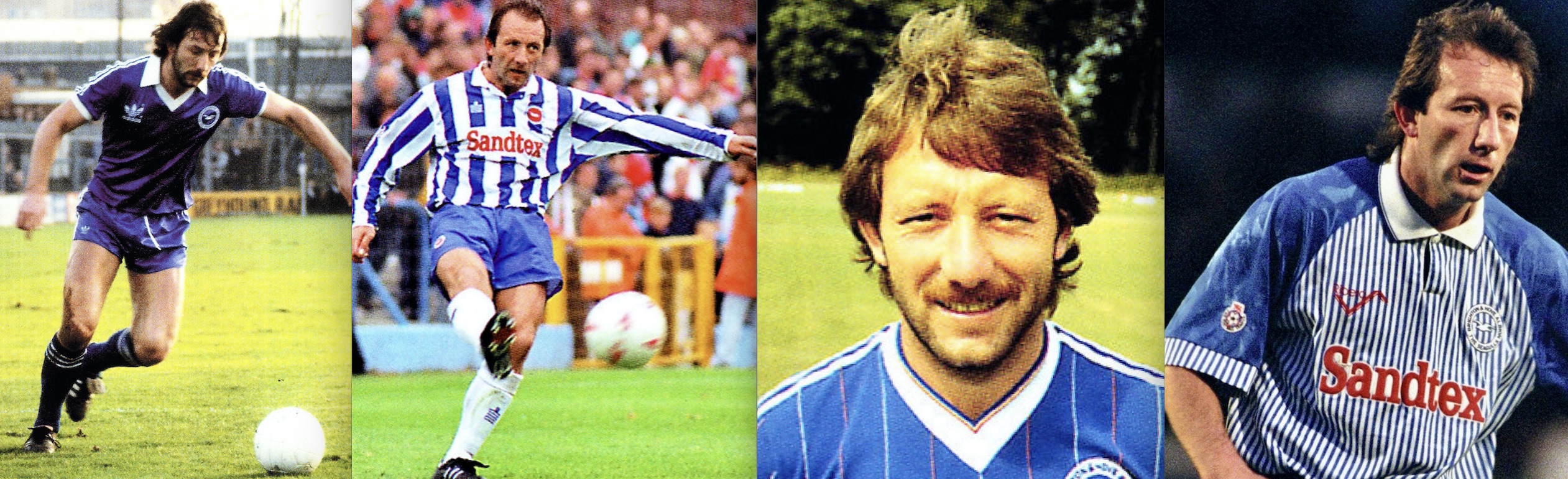
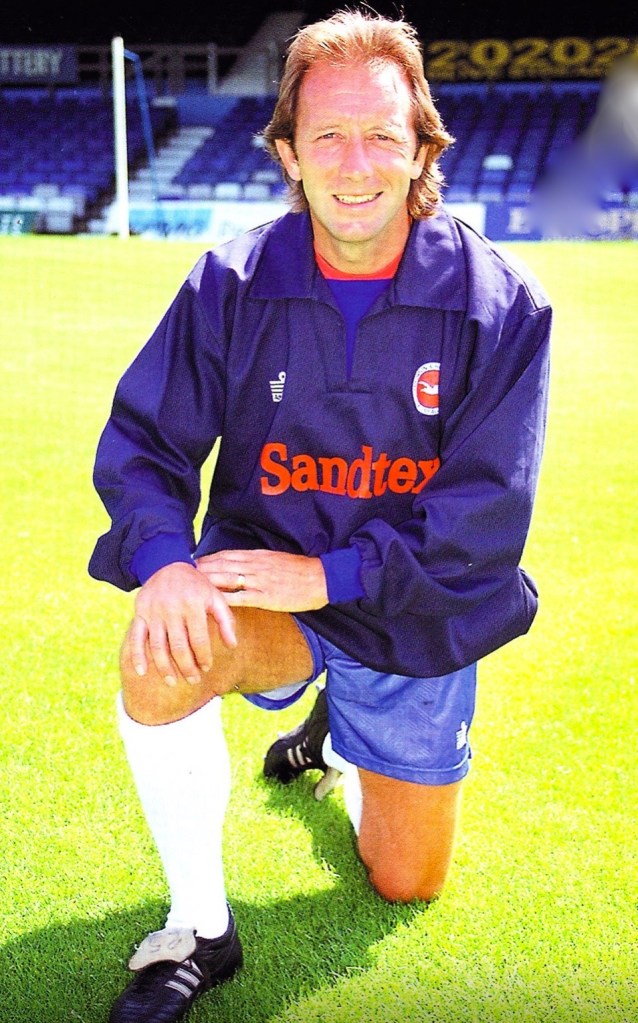
Wearside hero Gary Rowell blighted by injury after leaving Sunderland

gary rowell tony normanBRIGHTON fans never got to witness the best of prolific goalscorer Gary Rowell who, to this day, Sunderland fans eulogise in the same way Albion fans still sing about Peter Ward.

He died aged 68 on 13 December 2025, exactly 50 years to the day of his first appearance for the Black Cats following a long battle with leukaemia.

Rowell has a place in Sunderland’s best all time XI selection, in 2005 he topped a Football Focus poll as Sunderland’s all-time cult hero and, in 2020, was inducted into the SAFC Hall of Fame, which he described as ‘the best night of my life’.

There is a website that details every one of the 103 goals the Seaham-born footballer scored for the Wearsiders in 297 games after making his debut as a 71st minute substitute for Mel Holden in a 1-0 Sunderland win over Oxford United at Roker Park.

Unfortunately, the free-scoring striker-turned-midfielder was struck by a knee injury which hampered the latter part of his career, including his spells with Norwich City and the Seagulls.

Having left Sunderland on a free transfer after 12 years at the club, Rowell tore ligaments in his right knee on a pre-season tour of Scandinavia with Norwich before he even managed to kick a ball in anger.

In a year at Carrow Road, he made only six appearances – four as a substitute – and scored just the once, coming off the bench to net against Aston Villa. Typical of this spell between August 1984 and July 1985, he was substituted after only 16 minutes of his reserve team debut.

The following season, a £35,000 fee took him back to the North East to play for Middlesbrough, but, at the time, they were in the middle of a financial crisis and lost their second-tier status. Rowell top-scored with 10 goals in 27 appearances – two of them against the Albion at the Goldstone in January 1986 – but Boro were relegated in second-to-last spot (Brighton finished in 11th place that season).

Brighton were not exactly flush with cash themselves in the summer of 1986 when Alan Mullery, the manager who’d previously led them from third tier to the elite, returned to the club to replace Chris Cattlin.

Mullery found a very different set-up to the one he’d left acrimoniously in the summer of 1981. With little money available to be spent on new arrivals, hard-up Albion, not for the first time, had turned to the supporters in an effort to raise transfer funds.

Money from a scheme called the Lifeline fund went towards buying goalkeeper John Keeley for £1,500 from non-league Chelmsford, Darren Hughes for £30,000 from Shrewsbury Town, and Rowell from Middlesbrough on a free transfer (the Lifeline funds being used to help with his relocation to the South Coast).

Mullery explained the Rowell signing thus in his programme notes: “I see his role with us as coming forward from midfield and adding to our power in the box.

“We know he can get goals and he is a versatile player. When we further improve the squad, we may use him a little differently.”

Rowell , who discovered Mullery had tried to sign him back in 1979 (but Sunderland hadn’t informed him), joined just after the start of the season, in time to be given a place on the bench for the away 1-1 draw with his former club Sunderland. He went on for Kieran O’Regan with 18 minutes left.

He kept the bench warm for two more matches before getting his first start in place of Northern Irish centre-forward Gerry Armstrong in a 2-2 draw away to Plymouth Argyle on 13 September.

Unfortunately, it wasn’t long before Mullery was reporting his absence from the side because of an ankle injury sustained in training.

Nevertheless, interviewed by Tony Norman in the matchday programme, Rowell, who was 29 and married with two small children, said: “I’m delighted with the move. I’ve found it to be a very friendly club and people have gone out of their way to make us feel at home. Now I want to repay the club by playing well for the team.”

The longest run of games he got in an Albion shirt came in November and December 1986 when he took over from winger Steve Penney for six matches (two wins, two draws, two defeats).

rowell BW HS

A broken toe and a troublesome hamstring made him feel injury-jinxed but, during his run back in the side, he had what Mullery described as “his best game since joining us” in a 3-0 win over Shrewsbury Town on 21 December. Six days later, the toe went again, and he didn’t play for the rest of the season.

Mullery was then controversially dismissed the following month and Rowell had to wait until the start of the following season for successor Barry Lloyd to select him.

He featured in three pre-season friendlies, all of which ended in defeats and wore the no.4 shirt in the opening two fixtures of the 1987-88 season, but those were his only first-team starts that campaign. His midfield berth was taken over by the experienced Alan Curbishley.

By October, the matchday programme reported Rowell and fellow midfielder Dale Jasper had been placed on the transfer list following long discussions with Lloyd. Curiously, it added: “However, both players are keen to stay with the club, regardless of any offers made, and will be battling hard for first team places.”

Rowell subsequently appeared seven times as a substitute for the first team, but he was largely confined to the Reserves for whom he made 20 appearances and scored once. In February 1988, he moved to Dundee on trial, but, when not taken on, moved the following month to Carlisle United.

After just seven games for the Cumbrians, he finished his professional career at Burnley, where he scored once in 19 appearances.

Born in Sunderland on 6 June 1957, Rowell grew up in the mining village of Seaham, became an apprentice at Sunderland in 1972 and two years later turned professional.

In 1976, when Sunderland were struggling in the First Division, manager Jimmy Adamson gambled on the introduction of the 19-year-old Rowell: it paid off in spades as he scored 44 goals in two and a half seasons.

During that prolific spell, Rowell was in the squad for two end of season England Under 21 Championship preliminary matches; he went on for Laurie Cunningham in a 1-0 win over Finland in Helsinki on 26 May 1977 but wasn’t involved in a 2-1 win over Norway in Bergen six days later. This was an England side including future full internationals Peter Barnes and Peter Reid.

He was also a non-playing member of Dave Sexton’s squad that assembled at the Goldstone Ground three months later, but he had to watch as an over-age Peter Ward (22), playing on home turf, of course, scored a hat-trick in a 6-0 win over Norway. The aforementioned Curbishley was also a non-playing onlooker in that squad.

footballinprint.comUndoubtedly, the stand-out moment of Rowell’s Sunderland career came when he scored a hat-trick in a 4-1 win over arch rivals Newcastle United at St James’ Park, which he referred to in a profile article (see above).

In a vote for Sunderland’s best players of the 1970s, Rowell was described as “a lovely footballer. Though not blessed with blistering pace, he would ghost into goal-scoring positions and his finishing was deadly.” Rowell was an expert penalty taker, scoring 25 of 26 he took for Sunderland.

Some observers reckon but for injury he would surely have gone on to gain full England international honours. However, his career was severely disrupted by a serious knee injury sustained in a March 1979 game against Leyton Orient.

After a lengthy recovery, he resumed scoring goals regularly but there were doubts over his being able to maintain fitness for the duration of a whole season.

As part of a big team rebuilding exercise carried out by manager Len Ashurst in 1984, Rowell was allowed to move to Norwich.

After his playing days ended, Rowell became a financial consultant in Burnley and those loyal Sunderland supporters still got to hear their hero because, for a number of years, he was a commentator on Sunderland games for Metro Radio.

  • Pictures mainly from matchday programmes. Sunderland profile article: footballinprint.com.

Gerry Ryan – ‘a special player and one of football’s nice people’

THERE WAS no shortage of tributes paid to Gerry Ryan when the former Albion winger died at the age of 68 on 15 October 2023.

Fellow Irish international Liam Brady, who appointed Ryan as his assistant when he took charge of the Seagulls in 1996, said: “Gerry was a wonderful team-mate. He was a very quick winger, very brave, and he took people on.

“We had some great games together and then we ended up on opposite sides, for Brighton and Arsenal, in the old First Division.”

Although Ryan and Brady’s time in charge happened during a turbulent time off the pitch, Brady pointed out: “We did a pretty good job in what were, of course, difficult circumstances, and I could see then just what Brighton meant to him – he was in love with the club so much.

“Off the pitch, Gerry was just a really nice guy. He was affable, unassuming and got on with everyone he came in contact with.”

That sentiment was echoed by teammate Gordon Smith who told the Albion website: “Gerry was always fired up to play.

“He was not always first choice, but he was still a very good player. He had this ability to be able to turn games around because he was quick and he could score goals.

“He was so reliable – he could fit into any position with his levels of fitness, ability and positional play.

“We were a very close group; we socialised a lot, we played golf, went to the races and Gerry was a key part of that – he was a really good laugh.”

Turlough O’Connor, another former team-mate, from his early days playing for Bohemians in Dublin, told the Irish Independent: “He was the most easygoing guy you’d ever meet, very laidback and always in a happy mood, and a very good footballer as well.

“He was comfortable both left and right, very good on the ball, and very quick, which helped. A very good crosser, he went by people, and was always a threat. He helped so many times laying on goals for me.”

Ryan was one of the most likeable Albion players for a huge number of fans, and I was one of them.

A versatile trier who was good enough to represent the Republic of Ireland on 18 occasions, the wholehearted Ryan might not make it into the all-time best Brighton XI but, if it was judged on affability, his name would be first on the team sheet.

A cruel twist of fate saw his career ended in a tackle made by his Irish teammate (and former Albion boss) Chris Hughton’s brother, Henry. Typically, Ryan bore no grudges, as stressed by former Argus Albion reporter John Vinicombe in an article published in May 1986 when the genial Irishman finally accepted that his career was over.

Describing “the immense dignity and true manliness that Ryan displayed in refusing to condemn or indeed utter any harsh word against the player responsible,” he added: “Where others have sued and raged, slandered, cursed and threatened, Ryan said nothing.”

GR leg break

It was 2 April 1985 when his career was ended by that Hughton tackle in a 1-1 draw with Crystal Palace at Selhurst Park.

“Never in his life has he shirked a tackle and the one that ended his career so unfortunately at Crystal Palace was typical of many he faced in his career,” said Alan Mullery, the manager who signed him for the Seagulls.

“As a person, he is a lovely and typical Irish personality,” Mullery said in the programme for the player’s testimonial game against Spurs at the Goldstone on 8 August 1986. “I can honestly say that I have never met a player who dislikes him or has a bad word to say about him. I will remember Gerry Ryan as being a special player and one of football’s nice people.”

Mullery also referred to a Sunday lunch he and his family had with Ryan and his wife at the time he signed. “When Gerry ordered roast beef and chips I must have known then that I had a very special sort of player. At the time, I was a little dubious but afterwards I had no regrets.”

Mullery had been over in Dublin watching Albion’s Mark Lawrenson playing for the Republic of Ireland and Derby’s Ryan was playing in the same side. He had been having talks about moving to Stoke City but Mullers persuaded him to join Brighton instead, and, in a strange quirk of fate, he made his debut in a 2-2 draw away to Stoke.

After they’d become teammates, Lawrenson was among those players appreciative of Ryan’s “mercurial” qualities. He said in a matchday programme: “He wasn’t the most confident of players but he had loads of ability. For a wide player, he would come in and get goals for you.”

GR capsA week after joining the Seagulls, Ryan became an instant hit with Albion fans when he scored on his home debut in a 5-1 win over Preston. He notched a total of nine goals in 34 appearances in that first season and went on to score 39 in a total of 199 games.

Born in Dublin on 4 October 1955, Ryan was one of eight children. His early education was at the local convent in Walkinstown, a suburb to the south of Dublin where the family lived. At the age of eight he moved on to Drimnagh Castle School (it covered primary and secondary age groups).

At that stage, he was playing Gaelic football and hurling, at which he was capped at under-15 level by Dublin Schools. He didn’t play competitive football until he was 16 when he was introduced to a Dublin football club called Rangers AFC. He played alongside Kevin Moran, who later played for Manchester United, and Pat Byrne, who later played for Leicester City. Byrne and Ryan also played together for Bohemians, the oldest football club in Dublin.

Ryan joined the Dublin Corporation as a clerical officer on leaving school and played for Bohs as an amateur initially before becoming a part-timer on professional terms. By 18, Ryan was a first-team regular and, after collecting a League of Ireland Championship medal, was watched by Manchester United boss Tommy Docherty.

Docherty didn’t pounce then but, after Ryan had stayed four years with Bohemians, the ebullient Scot eventually returned to take him to England as his first signing for Derby County for a fee of £55,000.

The newly-appointed Docherty was determined to shake-up the club and while long-serving goalkeeper Colin Boulton was discarded along with striker Kevin Hector, Ryan, Scottish internationals Bruce Rioch and Don Masson, and Terry Curran and Steve Buckley were all introduced.

Ram Ryan

Ryan spoke about the way Docherty’s attitude towards him changed in an interview with Brian Owen of The Argus in 2016.

“One minute you were the blue-eyed boy, the next he wouldn’t even talk to you,” he said. Ryan made a hamstring injury worse by playing when Docherty insisted he was fit enough, and ended up sidelined for three months. “He didn’t like me then! That’s the way he was, he would turn on you, and he turned on me.”

Within a year, Docherty accepted Brighton’s £80,000 offer for Ryan and, as he was weighing up whether to choose the Seagulls or Stoke City, Ryan consulted the legendary Republic of Ireland and ex-Leeds midfielder Johnny Giles to ask his opinion.

“Gilesy said ‘Stoke have been in and out of the First Division forever but there is something going on down at Brighton. They get great crowds and it’s a beautiful place.’ I went to Brighton that weekend and absolutely loved it,” Ryan told Owen.

It was on 25 September 1978 winger Ryan arrived, prompting the departure of popular local lad Tony Towner after eight years at the Albion.

Five months before Ryan arrived at the Goldstone, he made his international debut, featuring for the first time in April 1978 in a 4-2 win over Turkey at Lansdowne Road. He only scored once for the Republic, but it was a cracking overhead kick in a 3-1 defeat against West Germany.

Ryan Eire

He was one of four regular Eire internationals playing for Albion at the time: Lawrenson, Tony Grealish and Michael Robinson the others.

His final appearance for his country came in a 0-0 draw against Mexico at Dalymount Park in 1984.

Ryan was part of some all-time history-making moments during his time with the Albion – scoring at St James’s Park in the 3-1 win over Newcastle on 5 May 1979 to clinch promotion to the top division for the first time, and burying the only goal of the game as unfancied Albion beat Brian Clough’s European champions Nottingham Forest, who’d previously not lost at home for two and a half years.

Ryan scoresMy personal favourite came on 29 December 1979 at the Goldstone when he ran virtually the entire length of a boggy, bobbly pitch to score past Joe Corrigan in the goal at the South Stand end to top off a 4-1 win over Manchester City. Ryan himself reckoned it was “the best goal I ever scored” as he recounted in a May 2020 BBC Sussex Sport interview with Johnny Cantor.

It was one of the most superb individual goals I saw scored and, when he was trying to recuperate from the horrific leg break which ultimately ended his career, I wrote to him in hospital to say what a special memory it held for me.

I was delighted to receive a grateful reply from him, and he has held a special place in my Albion memory bank ever since.

There were other stand-out occasions, two of which came against Liverpool:

in February 1983 at Anfield when he opened the scoring in Albion’s memorable 2-1 FA Cup triumph en route to the final, and, in the following season, at the Goldstone when he and Terry Connor were on target in Second Division Albion’s 2-0 win over the Reds in the same competition, the first-ever live FA Cup match (other than finals) to be shown (previously any television coverage of FA Cup ties was only ever recorded highlights).

If the modern-day reader can’t quite put the feat in perspective, it is worth pointing out that Liverpool, managed by Joe Fagan, went on to win the League Cup, the League title and the European Cup that season.

Danny Wilson hadn’t long since joined the Albion and, in an interview with the Seagull matchday programme in 2003, he recalled: “That has to be my favourite memory from all my time at the Goldstone. Back then, Liverpool were just awesome, and to beat them like we did was virtually unheard of.”

Ryan’s involvement in the 1983 Cup run was hampered by a hamstring injury which meant he missed out on the semi-final. But, in the days of only one substitute, he was on the bench for the final and, when the injured Chris Ramsey couldn’t continue, Ryan went on at Wembley and did a typically thorough job at right-back.

GR prog snow

Following Albion’s relegation, as the big-name players departed the Goldstone, Ryan’s versatility and play-anywhere attitude came to the fore and, in his last two seasons with the club he was often selected as a centre-forward, although he was not a prolific goalscorer from that position.

After he was forced to quit playing, Ryan took what was then quite a familiar route for ex-players and became a pub licensee, running the Witch Inn at Lindfield, near Haywards Heath. Ryan and goalkeeper Graham Moseley, who he’d known from his days at Derby, were neighbours in Haywards Heath.

GR pots

However, when another of his former Republic of Ireland teammates, Liam Brady, was appointed Albion manager in 1994, it was an inspired choice for him to appoint Ryan as his assistant.

When that all-too-brief managerial spell came to a messy close, Ryan returned to his pub, and then moved back to the family home in Walkinstown. Ryan’s son Darragh played 11 games for the Albion in the late 1990s.

Sadly, in August 2007, Ryan suffered a stroke, and three years later he was diagnosed with kidney cancer. On his death, his family paid tribute to the care he was given by the staff of Our Lady’s Hospice, Harold’s Cross and to the staff of Lisheen Nursing Home, Dr Brenda Griffin, the Beacon Renal Unit, Tallaght, and Tallaght Hospital Renal Unit “for the excellent care given to Gerry over the past number of years”.

Pictures from a variety of sources but mainly from my scrapbook, the matchday programme and The Argus.

Mis-firing Mick Ferguson couldn’t repeat goalscoring prowess for Everton or Brighton

MICK FERGUSON was a prolific goalscorer for Coventry City but the goals dried up in spells with Everton and Brighton & Hove Albion.

Ferguson’s arrival at the Goldstone in the early autumn of 1984 was certainly not amid a great fanfare. The Albion, under new chairman Bryan Bedson, were wrestling with debt and, to bring in some much-needed funds, sold striker Alan Young to Notts County for £50,000 and full-back Mark Jones to Birmingham for £30,000.

Needing a cut-price replacement for Young, and with Ferguson unwanted at Birmingham having been responsible for getting them relegated (see below), he came to the Goldstone as part of the deal that took Jones to St Andrews.

In modern-day football, loan players don’t generally play against their parent clubs but, amazingly, at the end of the previous season, Ferguson was allowed to play against Birmingham while on loan at his old club Coventry, and ended up scoring a goal that kept the Sky Blues in the top division but sent Birmingham down.

It was such an unusual saga that as recently as May 2017, the Guardian revisited the tale, catching up with Ferguson to explain the circumstances.

As the article explains, shortly before the player’s 30th birthday, manager Ron Saunders offloaded him to Brighton, where the manager was Ferguson’s former Coventry teammate, Chris Cattlin. Just to prolong Saunders’ agony, Ferguson made his Seagulls debut in a 2-0 home win… over Birmingham! This time he didn’t score. And, for Brighton, that state of affairs existed for several months.

I remember his second game quite vividly. It was a midweek league cup tie away to Fourth Division Aldershot and I went to the game with my pal Colin Snowball, who at that time was living in nearby Bagshot. There wasn’t anything subtle about Albion’s tactics that night. Goalkeeper Graham Moseley would kick the ball long for Ferguson to get on the end of it.

But, as the striker tried to lay it off, all he succeeded in doing was heading it into touch – repeatedly. The new signing did not impress! Despite their superior status in the league, Albion succumbed 3-0 in what was a pretty humiliating exit. Ferguson was remarkably selected for the following Saturday’s game, an away defeat to Oxford, after which he was omitted for four games. Cattlin gave him another chance with a four-game spell but still the dismal form continued and he didn’t get another look-in for four months.

Freelance journalist Spencer Vignes did a retrospective article about Ferguson for the Albion matchday programme and discovered the striker didn’t have a high opinion of his former playing colleague. “Several of the players just didn’t get along with him, and I was one of them,” he said. “His man-management skills  left a lot to be desired. As a manager you need to have the players on-side. Chris certainly didn’t have us on-side.”

Ferguson admitted to being frustrated by Cattlin chopping and changing the side and said there were times he turned out when only 80 per cent fit, which didn’t do justice to himself, the team or the supporters. “My ankles weren’t great and towards the end I did struggle with my back, but I felt when I was fit I could certainly do a good job.”

The striker felt with the ability in the squad at the time they should have achieved more but pointed the finger at Cattlin for it not happening. “Some people aren’t cut out for management and I don’t think Chris was. It doesn’t surprise me that he never worked as a manager again.”

The history books (many thanks to Tim Carder and Roger Harris) recall him as the goalscorer in a 1-1 draw away to Portsmouth on 6 April 1986 but, having been to that game too, I seem to recall it was a rather desperate claim for what looked more like an own goal by Noel Blake.

The start of the following season saw the arrival of former £1m striker Justin Fashanu from Notts County and Dean Saunders, a free transfer from Swansea City, so Ferguson’s prospects of a starting place looked bleak.

However, the 1985-86 season was not very old before Cattlin had a striker crisis on his hands. Gerry Ryan was out long-term with the horrific leg break from which he never recovered, Terry Connor and summer signing Fashanu were also sidelined with injury and a big man was needed to play alongside Alan Biley.

Cattlin had little choice but to bring back the previously mis-firing Ferguson, and to everyone’s surprise and delight his goal touch returned, albeit briefly.

“I was virtually forced into the team through injury,” Ferguson admitted in a matchday programme interview. “But, fortunately, things turned out quite well. It was nice to get a goal against Blackburn in my first match back. That seemed to pave the way.”

The programme article had tried to give some perspective to the dismal form when he had first arrived. It said: “Mick’s confidence was affected by his loss of form, but he never lost an inner belief that he would pull himself out of the bad patch. And what a difference the goals make. He has shown great character this season and did a marvellous job for the team while Justin Fashanu was out with injury.”

Ferguson himself said: “It took us quite a while to settle down. We were in a flat at first and I was having a lot of problems, one way and the other, so it wasn’t an easy time.”

Eventually Ferguson, his wife and two daughters settled into a house in Hove, and the striker admitted: “When you’re having a bad time there is a tendency to bring your problems home. It’s unfair on your family. I didn’t notice at the time, but, looking back, I think I probably was a little snappy with my wife and children.

“I think you can reach the stage where you really start to wonder, but I always knew I could score goals for Brighton. I’ve scored goals everywhere else I’ve played. It was just a question of time and waiting for the right break.”

Indeed, Ferguson scored in three successive matches in September 1985, prompting Cattlin to give him a special mention in his programme notes for the league cup game at home to Bradford City. “The form of Mick Ferguson is bound to improve even more with the confidence he is gaining through his three goals in three games,” wrote the manager. “His header against Wimbledon was a true indication of his ability; it was of the highest class.”

The renewed confidence saw him add another consecutive pair the following month – before on-loan Martin Keown took over the no.9 shirt and demonstrated he could score goals as well as defend!

Sadly, the revival in Ferguson’s fortunes were not to last. When Fashanu was fit again, Ferguson was dropped and only stepped in a couple more times. His goal in a 4-3 home win over Huddersfield on 16 November was the last he scored for the club.

Apart from a lone outing in January, in a 3-0 defeat at Sheffield United, Ferguson was on the outside looking in until, to everyone’s astonishment, after a five-week absence from first team action, he was selected by Cattlin to lead the line in a FA Cup Sixth Round tie against First Division Southampton on 8 March 1986.

Ferg action Shilts Bond CaseFerguson, sandwiched between Kevin Bond and Jimmy Case, is foiled by Southampton goalkeeper Peter Shilton in what turned out to be the striker’s final Brighton game.

A crowd of 25,069 packed into the Goldstone – when the average attendance at the time often dipped below 10,000 – but it ended in a disappointing 2-0 defeat and the manager admitted he had made a mistake with his selection. It turned out to be Ferguson’s last game for the club.

Just over three weeks later, he moved to fourth-tier Colchester United – whose manager Cyril Lea was promptly sacked!

United’s reserve team manager, Mike Walker (who would later manage Everton) took over the first team as caretaker and, as the team went on an unbeaten run of eight games, Ferguson scored seven times, the first of which came in a 4-0 win over Leyton Orient on 8 April.

The following season he played 19 games and scored four times before leaving on 7 November 1986 to join non-league Wealdstone.

It was quite a fall from the heady days of the early Seventies.

Born in Newcastle on 3 October 1954, Ferguson was picked up by Coventry City’s youth scheme in 1970 and, although he made his debut in 1975, shortly after the sale of Scotland international Colin Stein, it wasn’t until the start of the 1976-77 season that he became a Highfield Road regular.

In tandem with Ian Wallace (who was later a strike partner of Peter Ward’s at Nottingham Forest), he really started to attract attention, as the Coventry Telegraph recounted when describing him as a “truly great goalscorer”.

The article reckoned he was strongly tipped for international honours at one point but injury and loss of form affected him over the next two seasons. Forest, Villa and Ipswich were all supposedly keen to sign him, with Brian Clough agreeing a £500,000 deal, then pulling out.

However, in the summer of 1981, he finally left City having scored 57 goals in 141 games (plus eight sub appearances) all in the top flight when Everton paid £280,000 for him. Ferguson scored six times in his first eight games – but the goals dried up after that and he was gone within less than a year having made only made 10 appearances (plus two as a sub).

In 2007, David Prentice, in the Liverpool Echo, sought out Ferguson for an explanation of his less than happy time on Merseyside.

Manager Howard Kendall initially loaned him to Birmingham City, before making the deal permanent, but injury disrupted his chances at St Andrews, hence the loan move back to Coventry.

After retiring from playing in 1987, Ferguson stayed in the game working in community development roles for Sunderland – for 10 years, until he fell out with manager Peter Reid – Newcastle United and Leeds United, where he was head of Football in the Community.

Pictures from Albion matchday programes and, via YouTube, from Coventry City’s Sky Blues TV.

Desk job at Leeds in later life

Liverpool legend Jimmy Case became a Seagulls favourite too

Case 4 imagesJIMMY Case remains one of my all-time favourite Albion players.
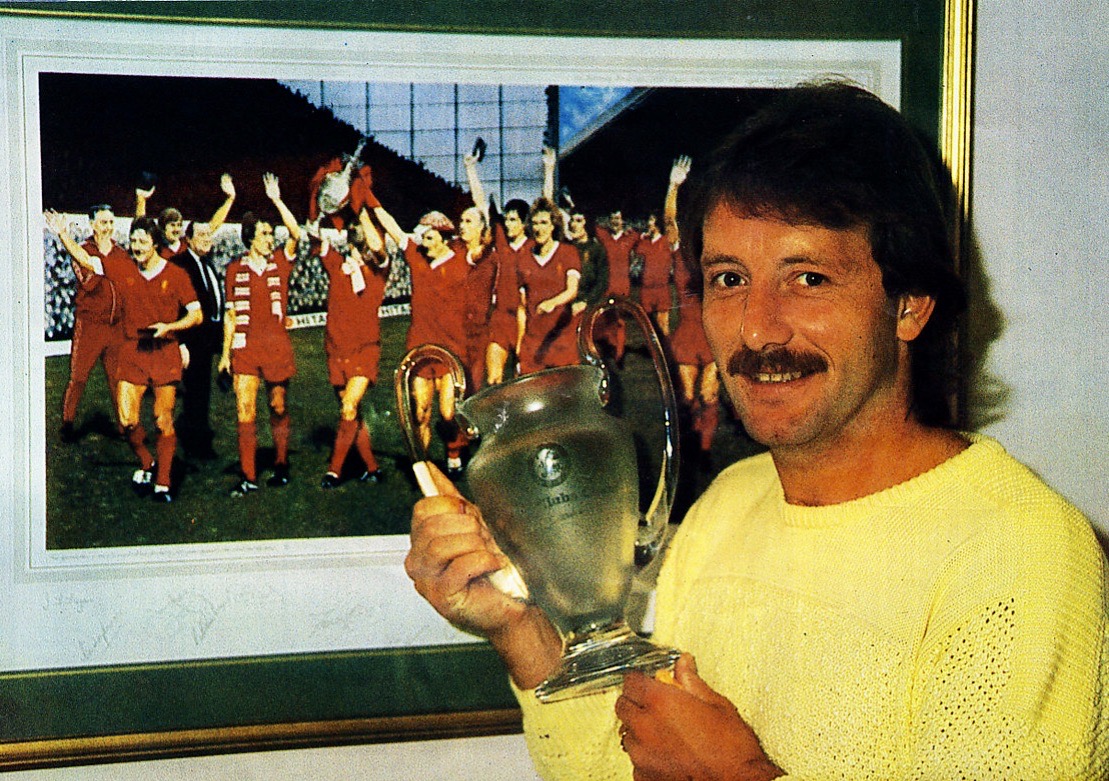
Several of the best moments I can recall as an Albion supporter involve Case: the 1983 FA Cup semi-final belter against Sheffield Wednesday at sunny Highbury perhaps the most memorable.

The biggest disappointment was that Albion let him go so easily.

Younger readers may only remember his unhappy stint as manager when the misdirected club was in turmoil, and he ended up holding the reins when Liam Brady just couldn’t take any more.

But rather than remember him as the man who took Brighton down to Division 3 in 1996, I remember the class act who arrived at the Goldstone in 1981 with a trophy cabinet the envy of many a footballer.

Although Brighton lost the sublime Mark Lawrenson to Liverpool as part of the deal that saw Case move to Brighton, they gained a player who had already got three European Cup winners’ medals, four Division 1 (Premiership equivalent) winners’ medals plus one each for winning the UEFA Cup, European Super Cup and the League Cup.

Case, born in Liverpool on 18 May 1954, was one of four children David and Dorothy Case raised in a council house in the city’s Allerton district.

He learned how to handle himself on a football field playing in a tough dockers’ team but Liverpool picked him up from the local non-league club, South Liverpool. By then, Case had left school and was training to be an electrician.

He carried on those studies but after two years on Liverpool’s staff he made his first team debut in April 1975 in a 3-1 win over QPR.

He scored his first goal in a 3-2 home win over Spurs at the beginning of the following season and, in what must have seemed a dream start, completed his first full season as part of a championship winning team, as well as scoring in the two-legged UEFA Cup Final win over FC Bruges.

Case EuropeThe triumphs and trophies kept coming with Case enjoying the ride but by 1980-81 he was beginning to be edged out by Sammy Lee, and manager Bob Paisley didn’t look kindly on some of the off-field escapades Case was involved in with fellow midfielder Ray Kennedy.

Paisley said: “He had lost his appetite for the game in his last year at Anfield. It’s a hard stint working the right flank in our team and Jimmy had stopped getting forward and was looking to play early passes from deep positions. I think his legs had become tired.”

The move to Brighton might never have happened if Alan Mullery had got his way because he had already done a deal with Ron Atkinson to sell Lawrenson to Manchester United in exchange for two of their players.

But when chairman Mike Bamber pulled rank and forced through the Liverpool deal he had negotiated, Mullery quit and Case arrived on a five-year contract to find a new manager in charge in Mike Bailey.

It felt to me that Brighton were stepping up to a whole new level bringing in someone of Case’s stature, and so it proved.

In his first season at the Goldstone, Albion recorded their highest-ever finish among the elite – 13th.

I recollect heading to Upton Park for the opening game of the season to see Case make his debut against West Ham and Albion earned a 1-1 draw despite having Gerry Ryan sent off.

Case found himself in trouble with referees on way too many occasions that season. Although he came to the club with a hard man image, amazingly he had never previously been suspended for accumulating bookings.

But by December he had to sit out a two game ban, and when his bookings total reached eight by March, he missed another three games.

Case told John Vinicombe of the Evening Argus: “I am a face, and there is nothing I can do about that. I am known, and that might explain some of the things that have happened to me on the pitch.

“The last thing I wanted on coming to Brighton was to get suspended. Brighton didn’t give me a contract to miss games.”

For anyone who has not yet read it, Case’s autobiography, Hard Case (John Blake Publishing) is well worth a read, detailing through writer Andrew Smart a fascinating career.

Disappointingly, it has a few factual errors that doubtless the distance of time brought about. Nevertheless, Case says: “I enjoyed every minute of my time with Brighton.”

Particularly pleasing for him was to score with a thumping header past Bruce Grobelaar in a 3-3 draw with Liverpool at the Goldstone, and to be on the right end of Albion’s 1-0 win at Anfield that season.

Case enjoyed life off the field as well and admits in his book: “The inhabitants of Brighton and Hove were just a little more sophisticated than the Allerton of the 1970s and I was introduced to the many and varied attractions of decent food and fine wine. It was an education I really appreciated.”

His second season was to end in relegation, but, more famously, with Brighton’s one and only appearance in an FA Cup final. Case scored goals in the fourth, fifth and sixth rounds, as well as the semi-final.

The newspapers had a field day when Case’s winner for Brighton in the fifth round of the Cup at Anfield denied his old boss Bob Paisley the chance to wipe the board with trophies that season.

It seemed every national and local newspaper headline revolved around the likeable Scouser: ‘It’s Case for Champagne’, ‘Jimmy sets out his case’, ‘Old boy Case kills off Liverpool hopes’, ‘Amazing Case’, ‘Killer Case’, ‘Case packs a super Cup punch’, ‘Case for Cup win’.

The Daily Mirror made him their footballer of the month for February on the back of that goal with reporter Harry Miller declaring: “No single act did more to capture the imagination of the public than midfielder Case’s dramatic 71st minute winner on Sunday, February 20.”

Case himself had mixed emotions about it all, saying: “I had ten fantastic years at a remarkable club. That’s something that goes deep down.”

He also revealed how a good friend of his had been out of the country at the time of the game and sent him a postcard with only two words as its message: ‘You bastard’.

When he scored the only goal of the game in the quarter final win over Norwich, the headlines continued: ‘Case of bubbly’, ‘The odd Case of hero and villain’, ‘Seagulls have landed with champagne Jim’.

That belting free kick in the Highbury sunshine set Albion on their way to the 2-1 win over Sheffield Wednesday, earning a first ever  – and only – place in the FA Cup final.

He was no stranger to Wembley, of course, having previously scored Liverpool’s goal in the 1978 2-1 defeat to Manchester United, but unfortunately he didn’t repeat his earlier goalscoring feats in the 1983 final.

He played a key part in Albion’s brave effort to earn a draw against Man U and then had the agony of returning home that Saturday evening to discover his mother, who had been a visitor, had died in her sleep at the age of just 63.

It was to Case’s immense credit that he took his place in the side for the replay just five days later.

While relegation brought the inevitable break-up of the team, with Gary Stevens and Michael Robinson departing before the new season began, Case publicly declared his intention to stay and try to get the team back up to the elite.

However, once fellow Scouser Jimmy Melia had been replaced by Chris Cattlin, there was probably only going to be one outcome and eventually Case was sold to Southampton for £30,000 in March 1985.

For him, it was a great move because he was returning to the top division again. It turned out that he was Lawrie McMenemy’s last signing for Saints, but, on this occasion, the change of manager was to cement his place in the side. Chris Nicholl made him the club captain the following season.

In 1985-86, Saints reached the semi-final of the FA Cup (beating Brighton 2-0 in the quarter-final!) losing 2-0 to Liverpool after extra time. If Saints had won, Case would have been the first player to appear in three FA Cup finals with different clubs.

Over his six years at The Dell, Case played alongside Glenn Cockerill and Barry Horne and helped to bring on the careers of youngsters such as Matt Le Tissier, Alan Shearer and Jason Dodd.

But when Ian Branfoot took over as manager in June 1991, he dispensed with Case’s services within a matter of days and transferred him to Bournemouth, who were managed by Harry Redknapp.

After 40 league games for Bournemouth in 1991-92, he moved to Halifax Town managed by former Saint and, one-time Albion loanee, John McGrath, who was being assisted by another ex-Albion man, Frank Worthington.

But Case only played there for six months, moving on to Wrexham, where he helped them gain promotion from the 3rd Division at the end of the 1992-93 season.

He then turned out for non-league side Sittingbourne until, at the ripe old age of 39, Liam Brady brought him back to Brighton in December 1993, as a player/coach. It was during that spell that he played in his 600th league game, the club chief executive David Bellotti presenting him with a silver salver on reaching that milestone

As a mark of the esteem in which Case was held, a testimonial game for him at the Goldstone Ground on 17 October 1994 had to be delayed 10 minutes because so many people wanted to get in to pay tribute. The capacity of the grand old ground was much reduced by then but still 15,645 packed in to see Case’s old club Liverpool do him the honour of providing the opposition.

Albion featured Matt Le Tissier in their line-up and even Ryan and Brady made substitute appearances as Liverpool emerged 2-1. The result, of course, was immaterial, and an emotional Case said afterwards: “I can’t thank the supporters enough. This was the only game I’ve ever been nervous about. I’ve never really asked for anything from the game, I just wanted everyone to enjoy it.

“It’s all been quite embarrassing really. I like to go to parties, I just don’t like them being my own.”

After his unhappy time as Albion manager, Case later managed non-league Bashley but is more often seen and heard these days on the after dinner speaking circuit or on regional football programmes. He also contributes to Southampton’s in-house radio station “The Saint”.

In July 2007, he once again donned a Brighton shirt, playing a cameo role alongside other past heroes in a brief curtain-raiser to Kerry Mayo’s testimonial game against Reading.

Cross the colossus majestic in promotion-winning season

1-cross-clincherGRAHAM Cross won promotion from the third tier in successive seasons – one with Brighton & Hove Albion, the next with Preston North End.

They came after a record-breaking 15-year spell with his hometown club Leicester City.

Cross was a tower of strength and ever-present in Alan Mullery’s 1976-77 promotion-winning team. He was so consistent that his fellow professionals named him and fellow Seagulls Brian Horton and Peter Ward in the division’s PFA team of the year.

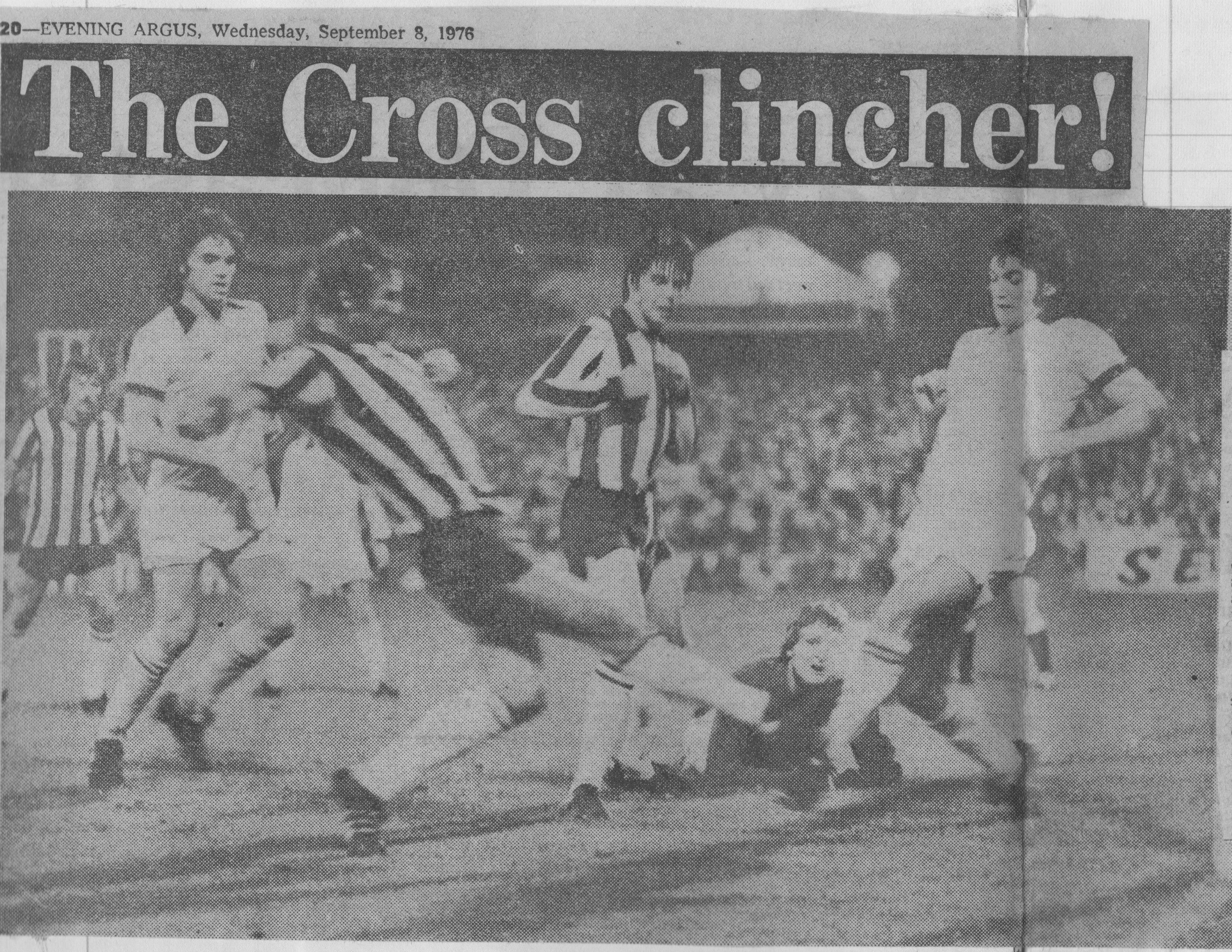
One standout performance I recall was in a cracking League Cup replay at the Goldstone against Division 1 side Ipswich Town on 7 September 1976 (see picture above).

Despite the Albion being down to 10 men, having had Phil Beal carried off injured after sub Ian Mellor had already come on, Cross scored the winning goal two minutes from time to give Albion their first competitive victory against a first division team for 43 years!

“Graham had an absolutely tremendous 1976-77 season for us and I can’t speak too highly of him,” Mullery told Shoot! “When I first started planning for the new term I reckoned on having him in the side for our step up into the Second Division.”

G Cross BW HSHowever, when he realised he could land the highly promising 20-year-old Mark Lawrenson from Preston for £112,000, those plans changed.

Lawrenson had played brilliantly against the Albion during the promotion season and was eager to take the step up so he headed south together with full back Gary Williams and Cross and left back Harry Wilson went in the opposite direction.

“I wish him well at Preston and can assure their supporters they are getting one of the most honest lads in the game in Graham,” said Mullery.

Cross certainly played his part as Preston earned promotion from the third tier – one of his teammates was centre forward Michael Robinson, who joined Albion in 1980 – but in the following season the magic touch eluded him when he played 19 times for Lincoln City but didn’t manage to stop them being relegated to the Fourth Division.

3-gc-leicesterCross had been part of the furniture at Leicester and the meashamfox blog recalls how he scored on his debut on 29 April 1961 against Birmingham City in a 3-2 win at Filbert Street.

He was a real ‘Mr Versatility’ who played in eight different positions, although mostly  in midfield – the history books describe him as an inside forward or wing half – and at centre back.

During all the hullabaloo surrounding Leicester’s remarkable Premiership title win in 2016, there were flashbacks to the last time a Leicester side went that close to clinching the league title – in 1962-63 – with Cross a member of that side.

In an interview with the Leicester Mercury, his former Scottish international teammate Frank McLintock spoke about a so-called signature move called ‘the switch’ Leicester employed whereby Cross dropped back and McLintock bombed past him.

“It was a load of rubbish, really,” McLintock told the paper. “It was just that I was really fit and Graham, who was a great player, would be a bit puffed out when he got back. We just swapped positions for a bit.

“The opposition would get confused with who was picking up who. Even Bill Shankly copied it later on at Liverpool.”

Unlike the 2016 vintage, the 1963 side blew their title chances by losing their last four league games. However, they did reach the FA Cup Final that year. Cross was in the side that lost 3-1 to Manchester United. He was also in the Leicester side that lost the 1969 final 1-0 to Manchester City.

His performances in 1963 were good enough to earn him a call up to the England under 23 team, making his debut in a 0-0 draw with Yugoslavia at Old Trafford. In the return fixture two months later, he scored a penalty to supplement an Alan Hinton hat-trick as England won 4-2.

He was a permanent fixture in the side for 10 matches (including a 4-1 win over West Germany, when future Albion colleague Peter Grummitt was in goal). But in November 1964, Leeds’ Norman Hunter took over the no.6 shirt.

Cross was recalled for one more game, in April 1966, when the under 23s beat Turkey 2-0 at Ewood Park. Two of the side that day – Martin Peters and Roger Hunt – would go on to be part of the England World Cup winning team three months later, but Cross never progressed to the senior England team.

Nevertheless he did pick up a  League Cup winner’s medal when Leicester beat Stoke City in 1964 but was a loser the following year when they were beaten narrowly by a Chelsea side containing Barry Bridges and Bert Murray.

Three years before joining Brighton, Cross received a long service clock to mark 500 first class appearances.

Throughout this period, he was also one of that rare breed who played county cricket too.

A right-arm medium-fast bowler, he played 83 first class matches for Leicestershire between 1962 and 1976 and took 92 wickets at an average of 29.95. His top batting performance was a knock of 78.

I am indebted once more to the meashamfox blog to learn that it was Cross’ dual sporting prowess that eventually brought his Leicester career to an end.

In the summer of 1975, he was part of the Leicestershire side captained by Ray Illingworth that won the county championship and the Benson and Hedges Cup, making him the only man to have played in cup finals at Wembley and Lord’s.

But the Leicester board took a dim view of him carrying on playing cricket instead of reporting back for pre-season training and he was suspended.

He was sent out on loan to Chesterfield and played 12 times for them in the 1975-76 season, before being released.

He arrived at the Goldstone on May 25 1976 at the same time as full back (and future manager) Chris Cattlin.

Manager Peter Taylor had impeccable contacts in the Midlands and in Cattlin, from Coventry, and Cross, from Leicester, he acquired two experienced campaigners who had played at the top level in the game for many years.

Taylor’s intention was that Cross would have the sort of impact at Brighton that the ageing Dave Mackay had on Derby when Taylor and Brian Clough signed him from Spurs.G Cross LEic

Taylor had tried to sign Cross before, in the pair’s early days at Derby. Leicester even accepted an £80,000 bid but Cross prevaricated over the move and they turned their attentions elsewhere. He admitted his regret at missing out on the £4,000 cut of the deal but told Goal magazine: “I’m happy in Leicester and I’m pleased that I decided to stay.”

That decision would ultimately lead him to become the all-time appearance record holder for Leicester, having played 599 games; a feat still not surpassed.

Clough and Taylor were renowned for building their sides on solid defences and, having already captured Grummitt, Graham Winstanley, Andy Rollings and Wilson, Taylor added Ken Tiler, Dennis Burnett, Cattlin and Cross.

Taylor, of course, didn’t hang around to see how Cattlin and Cross would contribute. With only four weeks to go to the start of the season, he decided to quit and renew his partnership with Clough, this time at Nottingham Forest.

One of the first images fans saw of his replacement, Alan Mullery, showed him embracing Cross and Cattlin at the pre-season press photocall.

Cross mostly played alongside Rollings, with Burnett and Winstanley filling in when Rollings was sidelined.

Interestingly, Cross never actually moved to Brighton during his spell with the Seagulls: the deal he agreed allowed him to continue to train with Leicester because he and his wife had business interests in the Leicester area.

The meashamfox blog declared “Graham Cross was Leicester City’s finest ever player” although the author was also sad to report how in February 1993 “he had been jailed for using post office funds to pay off his gambling debts”.

The blog concluded: “Despite this blip in his life, for me ‘The Tank’ Graham Cross is a true Leicester legend.”

Pictures from my scrapbook show:

  • A cracking Argus picture and headline record the winner Graham Cross scored against Ipswich in the League Cup.
  • A full page colour photo in Goal magazine when at Leicester.
  • Celebrating his inclusion in the PFA division 3 team of the year with Brian Horton and Peter Ward at the annual awards dinner.
  • Another Goal article, from 1973, marking a clock presentation to Cross in recognition of 500 senior appearances for Leicester.
  • Cross in the Preston team line-up alongside Michael Robinson, who would eventually join the Seagulls via Manchester City.
Cross aged 77 was interviewed and photographed by The Times ahead of Leicester’s 2021 FA Cup Final win over Chelsea