World Cup legend Armstrong too often warmed Albion bench

IMG_3807

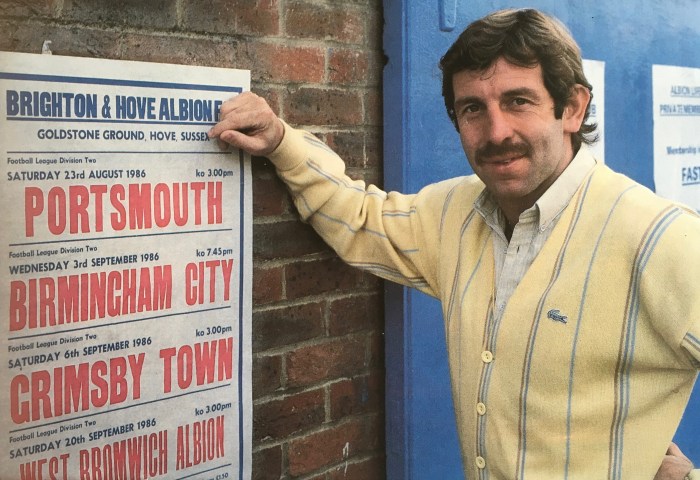
IN THE SPACE of 10 weeks, Gerry Armstrong went from 71st minute substitute for Northern Ireland against Brazil at the 1986 World Cup in front of 51,000 in the Estadio Jalisco, Guadalajara, Mexico, to centre forward for Brighton & Hove Albion in front of 13,723 at the Goldstone Ground in a season-opening 0-0 draw against Portsmouth.

That 3-0 defeat to the mighty Brazilians signalled the end of an international career in which Armstrong had written his name in Northern Irish football history at the 1982 World Cup in Spain four years earlier. He had scored 12 goals in 63 appearances for his country but none as important as the one which beat hosts Spain to send the Irish through to the quarter-finals, which I shall come on to.

Screenshot

Four years later, while away with Ireland in Mexico, former Spurs striker Armstrong took a call at the team’s hotel from someone else who had made his name with the North London club – Alan Mullery – who had recently been restored to the managerial chair at Brighton.

“Alan knew I was a free agent and I promised to talk things over with him when I got back from Mexico,” Armstrong said in a matchday programme article. “I was impressed by the manager’s ideas for the future and Brighton appealed to me because I have always liked the club,” he said.

“I always got the impression that there is a good, family atmosphere here and I liked that.

“In many ways, Brighton reminds me of Watford. I had three very happy years there and I’m looking forward to enjoying myself just as much here at Brighton.”

Born in Belfast on 23 May 1954, Armstrong grew up in the Falls Road area and initially played Gaelic football and could have made that his chosen sport. But while he was banned from playing, he took up soccer with junior Irish clubs St Paul’s Swifts and Cromac Albion before beginning a three-year spell playing semi-professionally with Bangor between 1972 and 1975.

Spurs manager Terry Neill had family in Bangor and Tottenham paid a £25,000 fee for Armstrong’s services in November 1975. He made his Spurs debut in a 3-1 defeat at Ipswich Town on 21 August 1976. The season ended in relegation for the North Londoners but the young Armstrong was trying to make his way.GA Spurs

He said: “I was basically big, strong and courageous but that wasn’t enough alone so Spurs made me skilful as well.

“I set myself the task of gradually playing more first team games each season and managed to achieve it.”

After scoring 16 goals in 98 league and cup games for Spurs, Armstrong was sold to Watford for £250,000 in November 1980.

When the Hornets made it to the top division for the first time in their history, Armstrong scored their first goal at that level, against Everton, and they finished the season as runners up.

“Graham Taylor influenced me more than anybody,” he said. “My time at Spurs was going stale because they were using me in all sorts of different positions but, at Vicarage Road, Graham taught me about forward play and then gave me the chance to repay him.”

Nevertheless, it was breaking through at Spurs that helped Armstrong onto the international stage. He made his debut for Northern Ireland playing up front with George Best in a 5-0 defeat to West Germany in Cologne in April 1977. And in November the same year he scored his first goals for his country, netting twice in a 3-0 win against Iceland in Belfast.

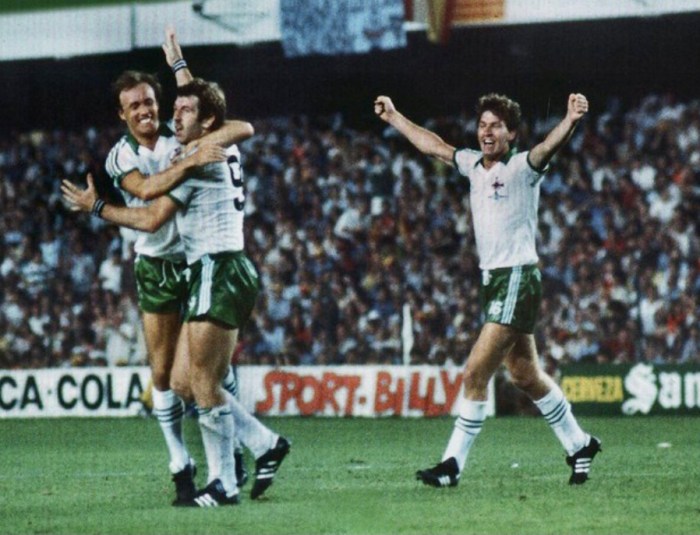
His stand-out moment in football which fans still talk about came when Northern Ireland were minnows at the 1982 World Cup in Spain. In front of a crowd of 49,562 – mostly Spanish – packed into Valencia’s Estadio Luis Casanova, on 25 June 1982, Ireland beat the hosts 1-0 and Armstrong fired home the only goal of the game in the 47th minute.

“I cracked it in between a couple of defenders, but couldn’t really believe it because there was this deathly hush. Fifty-five thousand people (a bit of Irish overstatement) all there to see Spain, and we ruined the party!”

He added: “It was a very satisfying one to get for the team, because it was a great win for us. “The odds were against us because there was a huge crowd in the stadium and virtually all of them were backing Spain. Nobody really gave us a chance, but it was a great team performance.

Armstrong Spain

“All the players worked hard for each other and that game summed up the excellent team spirit I have enjoyed with the national side over the years.”

Armstrong also scored Ireland’s only goal in their 4-1 quarter-final defeat to France.

The Spanish climate obviously agreed with Armstrong because in the summer of 1983, having scored 12 goals in 76 league games for Watford, Real Mallorca signed him for £200,000. Although he got stick from certain sections of Spanish supporters who remembered the goal he scored against them, he spent two years with Real Mallorca scoring 13 times in 55 league games.

On his return to the UK in August 1985, he initially signed for West Brom on a free transfer but struggled with travelling to and from London to train and play, didn’t see eye to eye with manager Ron Saunders, and picked up some injuries. He spent the second half of the season at Chesterfield, where former Spurs teammate John Duncan was boss, so he could get some game time to put him in contention to be selected by Northern Ireland for the upcoming World Cup.

irish news gerry arm

A free agent on his return, he joined Mullery’s Brighton having heard good things about the former Spurs captain from his Irish international colleague Pat Jennings, who’d played in the same Tottenham team as Mullery. However, it was 17 games before Armstrong managed to get on the scoresheet – in a 3-1 defeat at Leeds – although he did score again in the very next game, as Shrewsbury were beaten 3-0 at the Goldstone.

When Mullery’s second spell as manager ended rather abruptly, in January 1987, Armstrong was loaned to Millwall. New manager Barry Lloyd did restore him to the Albion line-up for the final eight games of the season, but the side finished in bottom place.

Back in Division 3, Armstrong was transfer listed along with Steve Gatting and Chris Hutchings as Lloyd was forced to shuffle the pack. He stayed with the club, but only got one full game, in a league cup tie, all season: he came off the bench 11 times and was a non-playing sub on 14 other occasions.

He was suitably philosophical about his involvement from the bench, however, and said in another matchday programme interview: “Over the years I’ve gained a bit of a reputation for grabbing goals when it matters most, and I figure that if I only get on for the last 20 minutes then there’s even more reason to take the game by the throat and get stuck in.”

In the 1988-89 season, Armstrong managed four starts but was once more on the bench more often than not and eventually was appointed reserve team player-coach.

But his time with the club ended ignominiously. In a Sussex Senior Cup tie at Southwick in January 1989, following the first ever red card of his career, as he walked off, he took exception to a comment from a supporter, jumped into the crowd and headbutted the person concerned.

The incident is referred to amongst the annals of assaults by players on fans. Armstrong left the club a fortnight after the altercation but the matter ended up in court and the footballer received a conditional discharge.

His final games as a player were at Glenavon back in Ireland after he had spent some time as a player-coach at Crawley Town, who were in the Beazer Homes League at the time.

In November 1991, he became manager of Worthing and led them to a promotion before being appointed assistant manager of Northern Ireland by his former teammate Bryan Hamilton.

He continued to live in Hove, though, and worked as a cable advisor for Nynex Communications. He even carried on playing football for Sussex Sunday League side James Lytle.

Although he left the national assistant role in 1996, he reprised it under Lawrie Sanchez between 2004 and 2006. Then, in 2011, the Irish FA recruited him as an elite player mentor – in essence to try to persuade young Catholic Northern Irishmen considering playing for the Republic of Ireland (a choice made by Shane Duffy, for example) to stick with the country of their birth.

Throughout all of this time, Armstrong has also forged a successful media career and is probably best known for his work with Sky Sports coverage of La Liga.

In 2015, the Belfast Telegraph did an interview with Armstrong and his wife Debbie in which they spoke about running a restaurant in Majorca, and his involvement as part-owner of a football club in Portugal.

The player’s autobiography, Gerry Armstrong: My Story, My Journey, written in conjunction with Dave Bowler, was published in November 2021 by Curtis Sport.Armstrong autobiog

Pictures from the Albion matchday programme and in the international shirt from the Irish News.

Winger Neil Smillie was a Wembley winner eventually

NS v MU Wemb

AN UNSUNG hero of Brighton’s 1983 FA Cup Final side, winger Neil Smillie, had the distinction of being the first ever apprentice the legendary Malcolm Allison signed for Crystal Palace.

Big Mal had enjoyed league and FA Cup success at Manchester City as Joe Mercer’s sidekick but he swept into Palace in the early 70s as a boss in his own right, courting publicity with his flamboyant fedora hat and giant cigar.

Smillie admitted: “I was going to West Ham but Allison persuaded me to take a look at Palace.

“The place was so alive and vibrant under him that I went there instead.”

Born in Barnsley on 19 July 1958, Neil followed in the footsteps of his dad, Ron, a former professional who played for Barnsley and Lincoln.

After joining Palace in 1974, Smillie turned professional a year later and was on Palace’s books for seven years, although he had three loan spells away from Selhurst.

In 1977, he went briefly to Brentford, who he ultimately would have a long association with later in his career.

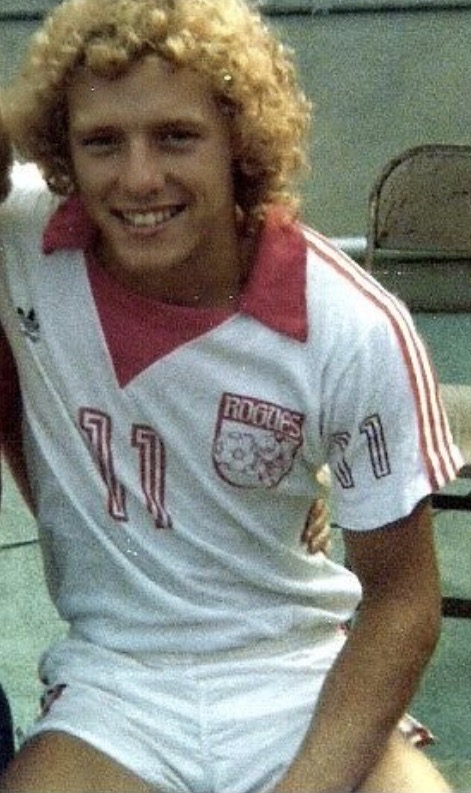
Smillie MemphisThe following two years, he went to play in America for Memphis Rogues (pictured left) where his teammates were players from the English game winding down their careers: the likes of former Albion players Tony Burns and Phil Beal, ex-Chelsea, Leicester and Palace striker Alan Birchenall and former Chelsea winger Charlie Cooke; the side being managed by former Chelsea defender Eddie McCreadie.

At the end of the 1981-82 season, Smillie was denied a pay rise by Palace so he decided to quit and wrote letters to clubs in the top two divisions in England asking for a job!

Brighton had managed to offload the troublesome Mickey Thomas to Stoke City so had a need for a left winger. They were the first to come up with an offer, and with full back Gary Williams surplus to requirements since the arrival of experienced defender Sammy Nelson, Brighton offered him in exchange for Smillie.

The bubble-haired winger gratefully accepted the switch to the Seagulls. While he made the starting line-up for the opening game of the new season, a heavy (5-0) defeat away at West Brom in the next game then saw him dropped and sidelined for months.

It was only once ultra-cautious manager Mike Bailey had left that Smillie got back in contention, and only then – in January 1983 – through someone else’s misfortune.

He said: “I was out in the cold and only got my break when Giles Stille was injured during the Cup game against Newcastle United.”

Smillie seized his opportunity and remained in the side for the rest of the season, culminating in the two Wembley FA Cup Final matches against Manchester United.

Back in the second tier following Brighton’s relegation, Smillie played 28 games plus once as a sub but following new manager Chris Cattlin’s signing of Northern Irish winger Steve Penney, there was competition in the wide areas.

Throughout the 1984-85 campaign, Smillie was more often than not a substitute rather than a starter. He did manage a seven-game run of appearances in the late autumn and began the final three games of the season, but the last game, a 1-0 home win over Sheffield United, proved to be his farewell.

Smillie revealed in a 2003 interview with Spencer Vignes that he’d discovered Manchester City had been keen to take him on loan but Cattlin hadn’t sanctioned it, even though he wasn’t selecting him.

“Chris had turned them down, saying I was a good player and he needed me. Yet he wasn’t even playing me! I just couldn’t believe he’d done it,” he said. Although he and his family were settled in Sussex, he realised he had to move.

Several eyebrows were raised when Cattlin managed to secure a £100,000 fee from Watford for Smillie’s services in the summer of 1985. The winger joined Graham Taylor’s beaten FA Cup finalists but he failed to establish himself in the side and made just 16 first team appearances in a season with the Hornets.

In the summer of 1986, he moved on to Reading for two years and, in 1988, after his disappointment with Brighton, Smillie was finally a winner at Wembley, scoring and setting up two goals as Reading beat Luton 4-1 in the Simod Cup Final.

The Hatters were led by former Albion captain Steve Foster and another of Smillie’s former teammates, Danny Wilson, was in their midfield. Mick Harford scored the opening goal for Luton, but Smillie’s pass allowed Michael Gilkes to bundle home an equaliser.

Smillie then won a spot kick converted by Stuart Beavon, and, in the second half, Mick Tait swept home another Smillie assist. Smillie then rounded off a great afternoon by scoring himself. It was hailed as one of the best days in Reading’s history, witnessed by over 45,000 loyal Royals fans.

Nevertheless, Smillie didn’t hang around and instead joined Brentford, where his former Palace teammate Phil Holder was assisting the manager at the time, Steve Perryman.NS Bees

Nick Bruzon interviewed Smillie in depth for a Where are they now? feature on the Brentford FC website in July 2010.

“Representing Brentford over three different decades, initially on loan in 1977 and then for five years from 1988 to 1993, Neil Smillie combined raw pace with ceaseless energy to make him one of the most popular players to patrol the New Road touchline,” said Bruzon. “Whilst with Brentford he experienced promotion, relegation and play off heartbreak, scoring 18 goals in 185 games.”

Smillie said: “I’ve got to say, the five years I spent at Brentford (and I was 30 when I signed) I thoroughly enjoyed.

“I’d reached a point in my career where I felt comfortable in terms of what I could give on the pitch. I’d always been a hard worker and I got the feeling that the supporters appreciated someone who worked hard.”

In the 1992-93 season, he played alongside Chris Hughton, who, like Smillie, was winding down his playing career.

“I loved taking people on and I loved getting crosses in for people to score so that just seemed to fit in nicely at the time with the team that we had,” he said. “I played my part as well as others who played theirs in getting the ball to me. We all did our bit and for me it was a great part of my career.”

On leaving Brentford, Smillie became a player-coach at Gillingham when his old Palace teammate Mike Flanagan was the manager. When Flanagan was sacked, Smillie took over the managerial reigns on a caretaker basis while the club tried to stabilise during financial troubles.

Smillie told Bruzon: “We were in a fairly precarious position and ended up in a decent position. So there was some enjoyment to it but the situation at a club without any money and struggling was difficult.”

Some names familiar to Brighton fans were at Gillingham at the time. Smillie played up front with Nicky Forster. Paul Watson was in defence and Richard Carpenter in midfield.

His three-month reign came to an end when Gillingham appointed Tony Pulis as the new manager and former Palace manager Alan Smith took Smillie to Wycombe Wanderers to look after their youth team.

When Smith left, Smillie was caretaker manager until former Albion full back John Gregory got the managerial post. Smillie then became Gregory’s successor in the hot seat for a year.

When the inevitable sack came, Smillie stepped outside of day to day running of football to become sports marketing manager for Nike in the UK. His role was to identify emerging talent for Nike to associate themselves with, and, as a result he stayed in touch with the game.

Among the players he signed to Nike were Theo Walcott, Darren Bent, Gabby Agbonlahor, James Milner, Tom Huddlestone, Danny Welbeck and Johnny Evans.

Pictures show (top) Smillie in action on the cover of the Albion programme; walking his dog; in Match magazine, on the cover of Shoot! being tackled by Liverpool’s Sammy Lee; a Simod Cup winner with Reading.

Willie Bell rang last orders on his playing career at Brighton

High-flying Willie Bell in night game action versus Rotherham at the Goldstone Ground

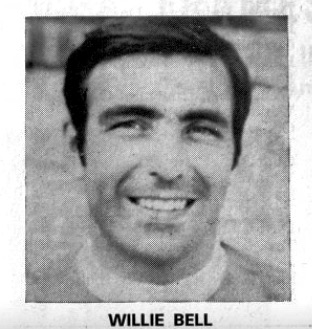
LEFT-BACK Willie Bell was a key part of the first successful Leeds United side built by Don Revie. A Scottish international, his illustrious playing career ended with the then Division Three Brighton.

Bell missed only two games during Albion’s 1969-70 season having been signed as a player-coach by his former Leeds United teammate, Freddie Goodwin, from the 1969 FA Cup Finalists Leicester City.

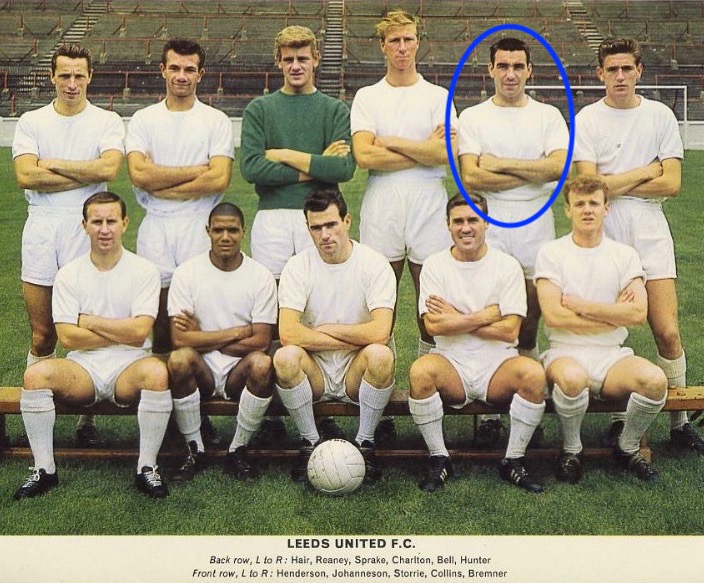
Screen Shot 2019-03-03 at 08.51.01Goodwin (pictured below alongside Bell in a Leeds line-up) obviously knew the pedigree of the player and mightyleeds.co.uk covers in depth how Bell was an unsung hero of that famous Don Revie side as it rose to prominence between 1962 and 1967.
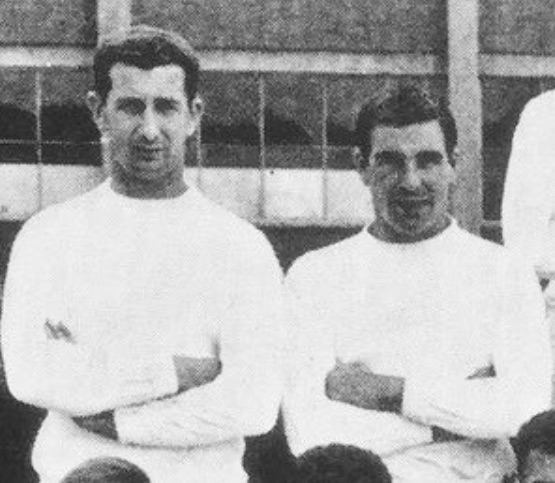
Legendary Leeds hardman Norman Hunter is quoted as saying: “Willie Bell was one of the bravest men I have seen in my life. He never blinked, he never flinched, he just went for it.”

And Scottish international winger Eddie Gray remembered something similar. “Willie was a natural defender; a big, strong player who epitomised the old school of British full-backs in his discipline in sticking rigidly to the basic defensive requirements of his job.”

Good+Willie

However, he stands accused of contributing to what Welsh Evertonian Roy Vernon labelled one of the most “savage confrontations” on a football pitch: an Everton v Leeds match in November 1964.

Everton full-back Sandy Brown had been sent off in only the fourth minute when he decked Johnny Giles for a tackle that left stud marks in the defender’s chest.

“Things came to a head in the 35th minute when full-back Willie Bell launched a two-footed tackle at Derek Temple near the touchline,” it was said in Blue Dragon: The Roy Vernon Story. “It was around neck high and one of the worst seen outside a wrestling ring.” The Everton winger had to be stretchered off by St John Ambulance attendants.

Born in Johnstone, Renfrewshire, on 3 September 1937, Bell began his career as a wing-half and in 1957 transferred from Neilston Juniors to Scottish amateur side Queens Park. While he was there, he won two Scottish amateur caps which attracted the attention of Leeds manager Jack Taylor.

Bell, aged 22, joined Leeds in the summer of 1960 after they had been relegated to the old Second Division. The Scot struggled to adapt to the English game initially and only featured sporadically in the Leeds first team. It was Taylor’s successor Revie who switched him to left-back to replace the long estanlished Grenville Hair and he only became a regular in the 1963-64 season.

He developed a great understanding with left winger Albert Johanesson as Leeds won the Second Division title and, by the end of the following season, he was part of the Leeds side that reached the  1965 FA Cup Final, only to lose to Liverpool after extra time.

England international Terry Cooper eventually replaced him at Leeds, but his performances for the Elland Road outfit earned him two full caps for Scotland in 1966, against Portugal and Brazil.

Leeds transferred Bell to Leicester in 1967 for £40,000 and he was their captain for a while but the emerging, future England international David Nish became their first choice left back and, in the summer of 1969, Bell linked up with Goodwin at Brighton.

It was halfway through the season when Bell was put in charge of Albion’s reserve side and they couldn’t have made a better start for him because they hammered Southend United 6-1 with goals from Andy Marchant, Brian Tawse, Paul Flood, Ken Blackburn, Barrie Wright and Dave Armstrong.

Bell headshotThe matchday programme noted: “Willie is continuing his career as a player, but devotes a good deal of his time to the reserve side. He’s thoroughly enjoying this new phase to a fine career in the game.”
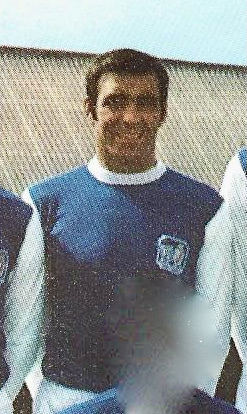
When Goodwin left Brighton for Birmingham, he took Bell and youth coach George Dalton with him, but Goodwin was so eager to hire his old pal that he made an illegal approach to him while he was still under contract at Brighton and Birmingham were later fined £5,000 for the offence.

Goodwin and Bell launched the career of Trevor Francis, the first £1m footballer, as a teenage starlet at Birmingham. In 1972, Francis, Bob Latchford and Bob Hatton spearheaded promotion for the Blues and a place in the FA Cup semi finals.

When Goodwin was sacked at the end of the 1974-75 season, Bell became caretaker manager and, after a successful spell in temporary charge, got the position on a permanent basis.

Screenshot
Birmingham City manager

Bell brought in Syd Owen, the former Leeds United trainer, as a coach, but the team struggled, finishing one place above the relegation zone at the end of their 1975-76 centenary season.

He led them to an improved 13th in the following season but after losing the opening five matches of the 1977-78 season, Bell’s managerial career at St Andrews came to an end. His successor was none other than former England boss Sir Alf Ramsey, who was by then a Birmingham director.

Bell meanwhile went on to manage Third Division Lincoln City, following the unsuccessful George Kerr in trying to emulate the heights enjoyed by the Imps under Graham Taylor, who had gone on to manage Watford. It wasn’t to be, though, and on leaving Lincoln in October 1978, Bell emigrated to the USA and coached at Liberty University in Virginia.

After suffering a heart attack in 1993, he turned to religion and became active in the church. In 2001 he and his wife Mary retired to Yorkshire and in 2014 published an autobiography called The Light At The End of the Tunnel.

Bell died aged 85 on 21 March 2023 after suffering a stroke.