The Christmas presence at the heart of Albion’s ‘90s defence

INJURIES beset Derek Allan’s promising career but he played 100 games at the heart of Brighton’s defence during turbulent times and remembers warmly “a wonderful club”.

In an exclusive interview with In Parallel Lines, Allan reveals the niggles that affected him and recalls the people who helped to shape his playing career.

The Scot remains involved in the game as an academy coach at Greenock Morton and his only lament is that the sports nutrition and science today’s footballers are able to call on to prevent and cure injury wasn’t available when he was playing.

Born in Irvine, on the West Coast of Scotland, on Christmas Eve 1974, Allan’s first steps towards a professional career came with selection for Scottish schools’ representative sides, being picked at all levels from 12 through to 16.

Ayr United, the club based a 20-minute drive from his home town, took him on as a YTS trainee and he moved quickly through the ranks before signing as a professional at the age of 17.

George Burley, the former Ipswich and Scotland international full-back, was beginning his managerial career with The Honest Men at that time but it was his assistant, Dale Roberts, who’d also played for The Tractor Boys, who helped Allan the most.

“Dale was a huge figure in my early days: a fantastic guy,” said Allan. “He had me out every day striking footballs; he was an incredible guy.” Roberts sadly died from cancer aged 46 in 2003.

After only five appearances for United in the 1992-93 season, Allan was sold to Southampton for £75,000. He explained how the move came about. “I was spotted playing for Ayr at Hamilton Accies on a cold Tuesday night in 1993. Ian Branfoot (Southampton manager at the time) came to watch someone else and took me instead.”

It must have been quite an upheaval to leave home and family to start a career on the south coast, but Allan said it was the making of him.

“It was a huge learning curve for me and I wasn’t really prepared to leave family and friends at that time.

“But that few months after leaving set me up for life. It made me the person I am today.”

Scottish under-18 and under-21 honours were added to his schoolboy recognition but his progress during three years at Southampton was hampered by injury.

“It was the story of my career, really,” he said. “Looking back, I lost 18 months of a three-year contract to injury and it was a crucial time in my development.

“In hindsight, I could have done more myself to look after myself better, although there were no sports scientists back then to help with nutrition, recovery etc.”

That backdrop of injury meant he was restricted to just one first team appearance for the Saints, when he was a late substitute for Matthew Bound in a 1-0 defeat at Manchester City on 1 May 1993.

Ken Monkou was at the heart of the Saints defence at the time and a certain Micky Adams was left-back with Jason Dodd also prominent.

It was in March 1996 when former Saint Jimmy Case, by now rather reluctantly in the hotseat at the Albion, went back to his old club to take the young centre-back on loan in the same week that future captain Gary Hobson was signed permanently from Hull City, and forward Zeke Rowe from Chelsea.
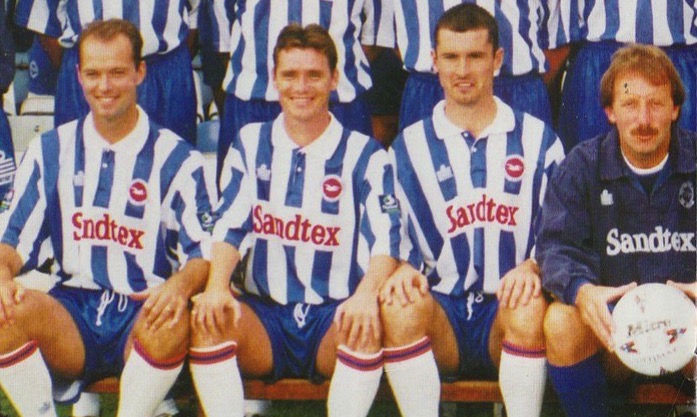
Seagulls’ ex-Saints quartet: Maskell, McDonald, Allan and Case

“I felt at that time Jimmy, with his connection to Saints, and his understanding of the game would be ideal for me,” Allan recalled. “Unfortunately, we all know what happened.”

Nevertheless, he was certainly among familiar faces because Case had not long previously persuaded his old club to part with Paul McDonald and Craig Maskell.

Allan took over the no.5 shirt from Ross Johnson for his debut but was on the losing side as Albion went down 3-2 at Swindon Town.
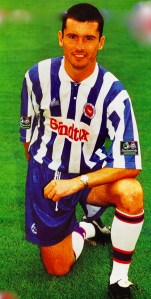
After an initial eight games, Allan’s move became permanent and he often appeared alongside Hobson in the heart of the defence, although, with a combination of poor results, injuries and frequent managerial changes, he wasn’t always an automatic starter.

The likes of Johnson, the experienced Mark Morris and, for a while, young Kevin McGarrigle provided competition as Albion bumped around the basement.

However, in his first full season with the Seagulls, 1996-97, Allan played 32 matches as the club scrabbled to avoid dropping out of the league, surviving only courtesy of the last-game 1-1 draw at Hereford. By then, of course, Steve Gritt had taken over from Case and Allan rated him highest of the different bosses he played under.

“Steve Gritt was definitely the best for me personally, it’s just a shame the injuries I got stopped me from showing what I could do consistently,” he said.

The off-the-field shenanigans, with rogue directors trying to sell the ground for redevelopment without having a new ground to move to, must also have been a difficult backdrop for any of the side at that time.

Allan said: “It’s easy to see the problems they had at that time and it’s a very different club now. The fans were unbelievable back then and they supported us every week even though we played under some huge pressure.

“I didn’t do myself justice really, playing with injuries and stuff like that, but it’s a wonderful club and fanbase. The fans never really got to see the best of me, which was a shame.”

Towards the end of his time with the Seagulls, he went on the transfer list and didn’t see eye to eye with Brian Horton, who’d returned to the club as manager. Allan declared it was “just the usual disagreements that happen between player and manager” which is now all water under the bridge.

“I actually saw Brian years later and we had a laugh about it,” he said. “He was an angry man, the same as me!”

At the end of his Albion stint, Allan stepped into the Conference with Kingstonian — a “great club with a great manager in Geoff Chapple” — and he made 75 appearances in two years.

Allan was on the bench when Kingstonian beat Kettering Town 3-2 to win the FA Trophy in front of 20,034 fans at Wembley in May 2000. Geoff Pitcher, who later played briefly for the Seagulls in the 2001-02 season, was in Kingstonian’s midfield that day.

“I finished my last season there as Player of the Year and Players’ Player of the Year,” said Allan. “I think that was the beginning of my thoughts of shifting to getting a new career long term. It was the best decision I ever made.”

Problems off the field meant in 2001 he moved back to Scotland, where he joined Queen of the South on a semi-professional basis for three years. During his time there, they won the Bell’s Cup and the Scottish Football League Division 2 Championship.

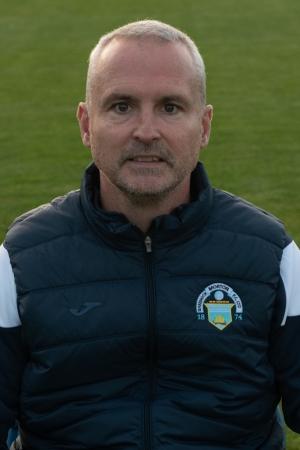
After 60 appearances for The Doonhamers, Allan’s last port of call as a semi-pro player was at Scottish Division Two Dumbarton for the 2004-05 season, making five appearances plus one as a sub.

Asked to sum up his career, he issues an upbeat thought, saying: “Great promise, bad luck, brilliant life memories and no regrets. Not many people can say they played for these wonderful clubs. I have memories that will last a lifetime.”

Before those playing days had ended, in 2002, Allan began a new career as a technical recruitment consultant, spending 11 years with NES Global Talent. Since 2013, he has been head of recruitment and talent acquisition for engineering services provider Booth Welsh, part of the global Clough Group.

He obtained the UEFA Advanced Youth A coaching licence in 2014 and is currently the under-18 academy coach at Greenock Morton.

“We have brought through some great young guys who have careers in the game,” he said. “I still love the competitive side and it’s great still to be involved.”

Today, Allan occasionally exchanges messages with former Albion teammates Hobson and Kerry Mayo but he is in more regular contact with McDonald, who only stood down in July 2021 after 18 years as an academy coach at Kilmarnock.

• Pictures from Albion matchday programmes and various online sources.

Ups and downs of medal-laden Mark McGhee’s career

MARK McGHEE saw highs and lows as Brighton & Hove Albion manager after a medal-laden playing career that took him from his native Scotland to England and also to Germany.

McGhee was in charge when the Seagulls memorably won the 2004 play-off final to gain promotion from the third tier, beating Bristol City at the Millennium Stadium, Cardiff.

Play off final boss

Keeping the Seagulls up the following season was arguably an even greater achievement considering at the time playing home games at the crowd-restricted Withdean Stadium meant the club was at a huge disadvantage compared to most clubs in the division.

With the Amex still a distant dream, relegation came at the end of the 2005-06 season, and it wasn’t long into the following season that Dick Knight wielded the axe on the Glaswegian’s time in charge.

“It was hard to sack Mark, but we had to have a change,” Knight wrote in his autobiography, Mad Man: From the Gutter to the Stars. “Everyone recognised what he had done in taking up and keeping up a team that was not that great, to be honest. Hats off to him, he had done a terrific job. And he is a very intelligent, personable guy.”

Knight took decisive action when part of the crowd became vociferous in wanting McGhee out, and the chairman also felt some of the young players drafted into the team weren’t responding to him.

He was finally toppled over lunch at Topolino’s, and Knight admitted: “It was a difficult decision. There was strong vocal opposition to McGhee, but also a large, less noisy element who were behind him.”

McGhee liked Brighton so much he made it his home despite subsequently taking on a series of other roles the length and breadth of the country.

It’s probably fair to say the Scot has never been afraid to speak his mind, which his former Newcastle boss Bill McGarry mentioned to him. McGhee recounted in an interview with theleaguepaper.com: “I was managing Wolves at the time. He said ‘Mark, you talk too much. Tone it down a bit’. I tried to take his advice, give nothing away in media briefings. Then, somebody would say something interesting and I wasn’t able to stop myself.”

It’s probably what helped him gain a place on the Sky Sports Soccer Saturday panel when he was in between management jobs.

McGhee would most likely look back on some jobs he’d perhaps have been wiser to stay away from, for example taking temporary charge of Eastbourne Borough in 2018, although his enthusiasm was undimmed as he revealed in an interview with thenonleaguefootballpaper.com.

Born in Glasgow on 20 May 1957, his father was an electrical engineer and his mother a fertility consultant at Glasgow Royal Infirmary. McGhee was on the books of Bristol City at the start of his long career but he returned to Scotland and became a part-timer with Greenock Morton while also training to be an architect.

Aforementioned manager McGarry signed him for Newcastle for a £150,000 fee on 30 December 1977 and he made his debut on 2 January 1978.

His face didn’t fit after Arthur Cox took over as boss, but Alex Ferguson took a punt on him in March 1979 and signed him for Aberdeen, and it proved to be one of many shrewd decisions the esteemed Scot would make in his career.

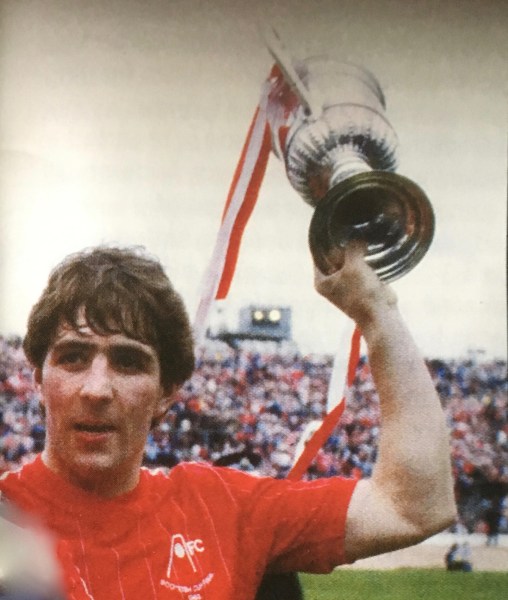
McGhee was named Scottish PFA Players’ Player of the Year in 1982, and the following year was part of the Aberdeen side who beat Real Madrid 2–1 to lift the 1983 European Cup Winners’ Cup in Gothenburg.

mcg cup

He also scored the second goal as Aberdeen defeated Hamburg 2-0 to win the UEFA Super Cup in the same year.

Asked about the best goal he scored, he said: “Probably the winning goal in my last game for Aberdeen.”

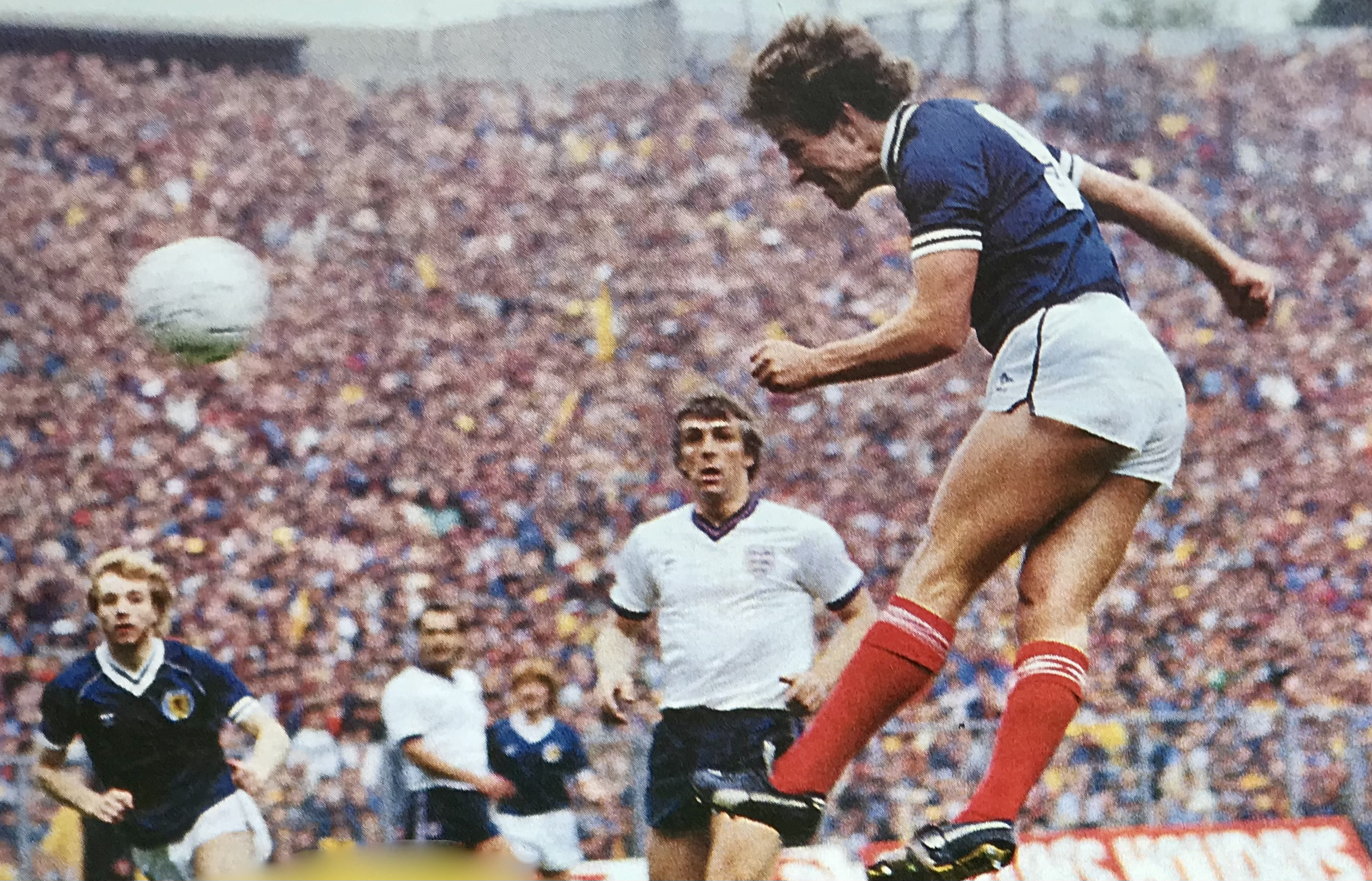
McGhee reckoned his best moment in football came on 26 May 1984 when he scored against England at Hampden Park. He headed in a cross (as pictured) from his great pal Gordon Strachan past Peter Shilton.

McG v Eng

“It put us 1-0 up but Tony Woodcock equalised to make the final score 1-1.”

It was one of four caps he won for his country. Nearly two decades later, in January 2013, Strachan appointed him as his no.2 with the Scottish national side.

M McGhee Old Football PhotosBut back to those playing days, and with two Scottish league titles and three Cup wins behind him, McGhee tried his hand at European football and spent 16 months at Hamburg. The spell was probably more of an education than a success, with injuries limiting his game time.

A £170,000 fee took him back to Scotland, to Celtic, where he had mixed fortunes during four years with the Glasgow giants. He was, though, part of the squad that won a League and Cup double in their centenary season.

After winning another Scottish Cup winners’ medal in 1989, he was on the move again, back to Newcastle.

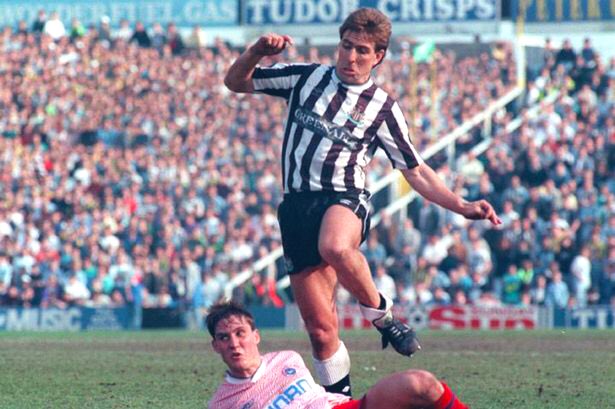
Now with Jim Smith in charge, Newcastle paid £200,000 to take McGhee back to St James’ Park, where he formed an impressive strike partnership with the legendary Micky Quinn as Toon finished third in the old Division Two.

“We were good friends, but we didn’t blend on the pitch like Toshack and Keegan, Quinn told theleaguepaper.com. “Mark was a free spirit. He’d get the ball and drift left or right and drop deep.

“He’d turn defenders and drag them out of position. He would hold the ball up well for me to get into the box and score goals. He went where he wanted, but it worked.”

football back then McGhee

This Football Back Then picture shows McGhee in action for Newcastle against Albion’s Nicky Bissett.

His farewell performance came on 6 April 1991, not long after Ossie Ardiles had taken over as manager, and McGhee departed having scored a total of 36 goals in 115 appearances for the Magpies.

Next stop was Sweden, where he played briefly for IK Brage, but he seized the opportunity to try his hand at management by taking up the role of player-manager at Reading in the summer of 1991.

He’d been recommended for the role by his old boss Ferguson, and, after quitting playing through injury in 1993, he led the Royals to promotion from the third tier the following year.

A struggling Leicester City gave him a chance to manage in the Premier League but he was unable to keep them up and, less than a year after joining, decided to switch to Wolverhampton Wanderers, to succeed Graham Taylor.

Wolves just failed to gain promotion in 1996-97 (they lost in the play-off semi-finals) and were ninth the following campaign. Four months into the 1998-99 season, following a string of poor results, McGhee was fired.

It would be 20 months before he gained his next opportunity, this time at Millwall where he enjoyed initial success, leading them to promotion from the third tier, and then narrowly missing out on another promotion when they lost in the play-off semi-finals to Birmingham City.

McGhee apptWhen he parted company from Millwall in October 2003, he wasn’t out of work long because Brighton needed a replacement for Steve Coppell, who’d been wooed to take over at Reading (pictured above, with chairman Dick Knight, at his unveiling as Albion manager).

Those Albion fans who stuck by the team in the humble surroundings of the Withdean Stadium enjoyed some good moments during McGhee’s time as manager, in particular promotion via the play-off final in 2004.

He certainly found a formula to get the best out of certain players, as Adam Virgo, converted from defender to goalscorer, observed in that theleaguepaper.com article. “Mark is a very good communicator and very experienced,” he said. “He can make you feel ten feet tall. He’s very good at being honest, at analysing your game and telling you what you’re good at.”

After his departure from the Albion, McGhee was out of the game for nine months but got back in at Motherwell, turning them from near relegation candidates to qualifiers for European competition.

The lure of his old club, Aberdeen, proved too strong in the summer of 2009, but his tenure proved to be disastrous – and brief.

He spent the majority of 2012 as manager of Bristol Rovers, where one of the squad he inherited was former Brighton defender-turned-striker, Virgo. The following year, his old pal, Strachan, appointed him as assistant coach to the Scottish national side.

He later combined the role part-time when he returned to Motherwell but there were mixed fortunes second time round, and he left them again in early 2017. Towards the end of that year, he popped up at League Two Barnet, but the arrangement lasted only two months before he was moved to a ‘head of technical’ role, and then dismissed in March 2018.

McGhee was ‘slaughtered’ on Twitter when he took over as interim manager of National South side Eastbourne Borough in the spring of 2019, after being beaten 3-0 by Wealdstone in his first match in charge, his new side reduced to nine men after two players were sent off. Borough won just once in 11 matches.

When Albion under 23s coach Simon Rusk was appointed manager of Vanarama National League side Stockport County in January 2021, McGhee was appointed as one of his assistants.

His final managerial post was at Dundee in February 2022 when he took temporary charge of the Scottish Premiership side until the end of the season (with Rusk as his assistant), but they couldn’t avoid them being relegated, overseeing just one win in 13 matches.

McGhee finally announced his retirement from the game in September 2022 at the age of 65, telling the Sunday Post: “I won’t be pursuing any other managerial vacancies, and nor would I want to be a director of football or a head of recruitment. That’s not what I am – I’m a manager.

“I feel that players now deserve a young manager who can give them the energy I was able to when I started out. They don’t need a 65-year-old with a dodgy ankle.”

Why the ‘hook’ at Edgar Street was a great relief to ex-Saint Paul McDonald

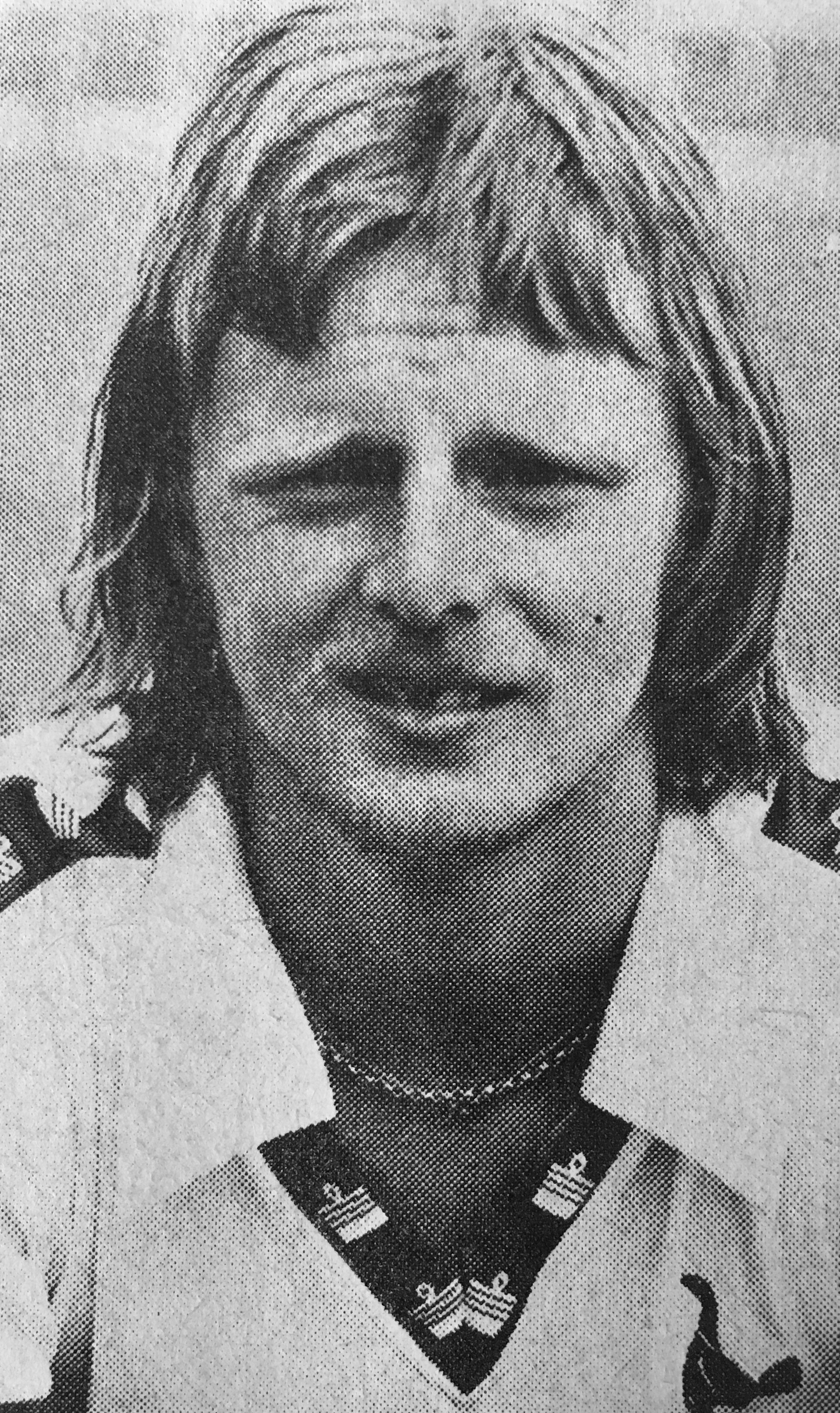
Paul McD on ballIF PAUL MCDONALD hadn’t been subbed off in that infamous game away to Hereford United in 1997, Brighton might have gone out of existence.

That’s some statement to make, but it’s a thought that has crossed the diminutive wideman’s mind over the years.

It was McDonald who gave way for substitute Robbie Reinelt to enter the fray and, as the history books thankfully record, it was he who buried the equalising goal to restore Albion’s status as a Football League club and condemn Hereford to relegation instead.

Even as recently as August 2017, in a preview to the Albion’s opening Premier League game against Manchester City, the current day Kilmarnock academy director shared his thoughts with the Daily Record (pictured below).

paul mcdonald Daily Record

“The prospect of top-flight football would have been the furthest thing from anyone’s mind at full time at Hereford but I’m over the moon to see them in the position they are in now,” said McDonald.

“I’m often reminded of that game and I’m actually claiming the assist because Robbie Reinelt replaced me. I’m just glad the chance didn’t fall to me or they might well have ended up as a non-league club!

“Seriously, it was a huge day for Brighton. I’ve never been involved in a game with so much at stake.

“It is a massive club and to be in the position they were in was bad.

“If we had lost to Hereford then in an extreme circumstance they could have folded but businessman Dick Knight had come in as chairman and he may not have let that happen.”

Born in Motherwell on 20 April 1968, McDonald was spotted playing local boys club football in his home town by Hamilton Academical and he was taken on in June 1986.

Over the course of seven years, he made a total of 215 appearances for the Accies before trying his luck south of the border.

Premier League Southampton paid £75,000 for his services but he failed to make a breakthrough and managed just three substitute appearances for Saints.

During the 1995-96 season, he was loaned out to Jimmy Mullen’s third tier Burnley where he made 11 appearances in two months, his only goal coming in a 2-0 Auto Windscreens Shield win away to Peterborough.

However, one of his matches included a 3-0 win over Brighton (in which one of the Clarets’ scorers was Kurt Nogan) and, according to the excellent clarets-mad.co.uk, McDonald so impressed watching Brighton manager Jimmy Case that day that it prompted him to sign the winger the following February.

Case persuaded hard-up Albion to part with £25,000 (or £40,000 according to the matchday programme)  to take McDonald along the coast, where at last he managed to get plenty of game-time.

In two years with the Seagulls, he played more than 60 games and scored five times. The first came in a 2-1 defeat away to Exeter City; he was also on the scoresheet in a 3-0 home win over Hull City, then scored from the spot in a 3-2 home win over Fulham in the Auto Windscreens Shield three days later.

He was twice more successful from the penalty spot, one coming five minutes from the end of the game to secure an unforgettable 4-4 draw with Orient at the Goldstone, the other in a 2-0 home win over Cardiff.

At the start of the following season, with the Albion in exile at Gillingham, McDonald was on the scoresheet in a 1-1 draw with Macclesfield, the toxic atmosphere around the proceedings captured by The Independent.

As financial constraints forced Albion to let go of five senior players in December 1997, McDonald returned to Scotland with Dunfermline. He then moved onto Partick Thistle and Greenock Morton before finishing his playing career back where it started at Hamilton Academical.

McDonald stayed in the game, initially working at Hamilton as youth development manager, before becoming the SFA community coach at Kilmarnock in 2003.

In 2013, he became academy director and in October 2017, McDonald was appointed caretaker manager of Kilmarnock after Lee McCulloch stepped down as boss with the club bottom of the table.

Neil McNab: Brighton fans ‘worst crowd I’ve played for’

FIERY SCOT Neil McNab left Brighton for a sizeable loss on their initial outlay and went on to be voted Manchester City’s Player of the Year twice.

No stranger to brushes with the football authorities, McNab joined Brighton in the second half of their first-ever season in the top flight.

In his autobiography, manager Alan Mullery said: “Neil McNab was a Scottish whippet, a fierce competitor in midfield who never stopped running or competing.

“I bought him halfway through the season from Bolton Wanderers and he gave us the extra edge we needed.”

The player to give way at the time was Republic of Ireland international Gerry Ryan, and it would be fair to say the football writers were impressed by the tenacious Scot’s early impact.

After watching a 5-1 drubbing against Southampton from the subs bench, McNab made his debut at home to West Brom in a game that finished goalless. “McNab showed some touches of class in his home debut but scarcely as much as the home crowd expected from their £230,000 capture,” said Harold Palmer in the Sunday Express.

The News of the World’s Peter Jarman was slightly more effusive and described it as “impressive” and John Vinicombe in the Evening Argus said: “McNab, on his home debut, impressed with his industry and general involvement.”

Of his second game, a 1-1 draw away to Leeds, the Sunday People’s Keith Ray observed: “McNab looked light years from the off-key young man that Bolton sold. His prompting coupled nicely with Lawrenson’s hard work, and Ward had two chances to hit the target before he made the vital strike.”

A demonstration of his appetite came in the next game, another 1-1 draw, at home to Coventry, when he ran 25 yards to stop Peter O’Sullivan from taking a corner that he fancied for himself. He whipped the ball in and Ray Clarke thumped a header past Jim Blyth in the Coventry goal.

Gordon Smith, another Albion player who moved to Manchester City, remembered McNab’s quick wit in his autobiography, And Smith Did Score.

When it looked like Brighton were heading for relegation, Mullery, in fear of losing his job, famously threatened the players that he’d run them down in his car if that happened.

Smith recounted how the players were huddled round trying not to laugh at the astonishing outburst. “I almost fell off my chair when Neil leant over and whispered, ‘If he loses his job, he’ll no’ have a f****** car!’”

It was no laughing matter for player or club, though, when the tenacious McNab was suspended for four matches for pushing a referee. In the following season, he was up before the FA again after a skirmish with World Cup winner Alan Ball at the end of a 5-a-side tournament at the Brighton Centre.

Charged with bringing the game into disrepute, Ball was fined £100 but McNab was given a £250 fine and a two-game ban.

Manager Mike Bailey was clearly relieved and told the Daily Mail’s Brian Scovell: “Neil was expecting more but the last instance was entirely different. It was on the field of play when he touched the referee.

“We got a fair hearing. We’re not complaining. Both were guilty but the crimes were different as Neil’s part was unfortunately physical while Ball’s was verbal.”

McNab had the third highest number of appearances (44 plus two as sub) in the 1981-82 season, which saw Brighton’s highest ever finish of 13th, and all four of the goals he scored were from the penalty spot.

However, the safety-first style of play adopted by Bailey created a disconnect between players and fans. In the final home game of the season (a 1-0 defeat to Ipswich), McNab was substituted in the 62nd minute and the crowd booed him off.

The often-obtuse Vinicombe reported in the Argus: “When McNab was withdrawn, 30 minutes from time, his gestures to the crowd were capable of only one interpretation.” In the Daily Mail, McNab told Brian Scovell: “They are the worst crowd I’ve played for. When you do something good on the ball they don’t clap and if you make a mistake they give you stick.”

Worse was to follow after the row at the beginning of the 1982-83 season when Steve Foster and Michael Robinson slapped in transfer requests in protest at chairman Bamber refusing to sanction the acquisition of Charlie George, the former Arsenal, Derby and Southampton maverick, who had been on trial pre-season.

In what was supposed to have been a clear-the-air meeting, McNab let his feelings be known in no uncertain terms.

McNab still had five of six years left on his contract. They tried to offload him on loan to Newcastle, but the midfielder refused to budge. Instead, he made a bitter personal attack on the chairman, accusing him of picking the team, and slapped in his own transfer request.

McNab blasted: “The club is petty and small-minded, and players are treated disgracefully.” McNab made it clear he didn’t see his future at the club and after a few months eventually went to Leeds for a six-game spell and also to Portsmouth.

That came after Bailey had been sacked and his replacements, Jimmy Melia and George Aitken, gave the team a big shake-up, dropping McNab and adopting a more adventurous approach (which ultimately led to relegation).

Although completely out of the first team picture from early December 1982 onwards, McNab was to play one last game nearly five months later.

With Melia struggling to field a team because of injuries and suspensions, McNab got the nod for an away game at Notts County on 30 April 1983.

But he was unable to join in the FA Cup run to Wembley because he had been cup tied during his spell at Leeds. The 1-0 defeat to County was the Scot’s last ever Seagulls appearance.

Relegation led to the release of some of the high earners, and while Robinson and Gary Stevens were sold for sizeable fees, McNab was sold to Manchester City – who had been relegated with Albion – for just £35,000.

Born on 4 June 1957 in Greenock, McNab went to the town’s Highlanders Academy and he was in his primary school team at the age of eight. By the time he was 10, he was playing for the Greenock and District Under 12 representative side.

He moved on to Mount Secondary School, playing for the school team at all age groups, and at 14 was selected for the Scotland Schools side.

He played against England at Ibrox Park, against Ireland at Stranraer, and even travelled to Frankfurt to play against West Germany. All the attention alerted various scouts but he had already signed schoolboy forms for his local club, Greenock Morton.

He actually left school before he was 15 to join Morton as a professional and when he made his first team debut aged 15 in September 1972 he was the youngest outfield player ever to play in the Scottish League. McNab ended that season having played 11 matches and appeared a a sub on three occasions.

McNab SpursHe made 14 appearances for them before being snapped up for £40,000 by Tottenham Hotspur in 1974 and made his first team debut for Spurs while still only 16. A former teammate at that time, Andy Keeley said in a recent interview: “I’ll never forget how he played in a friendly match; first team v reserves. He controlled the game from start to finish. He was outstanding. He had a very good career but I never understood how he didn’t become a superstar.”
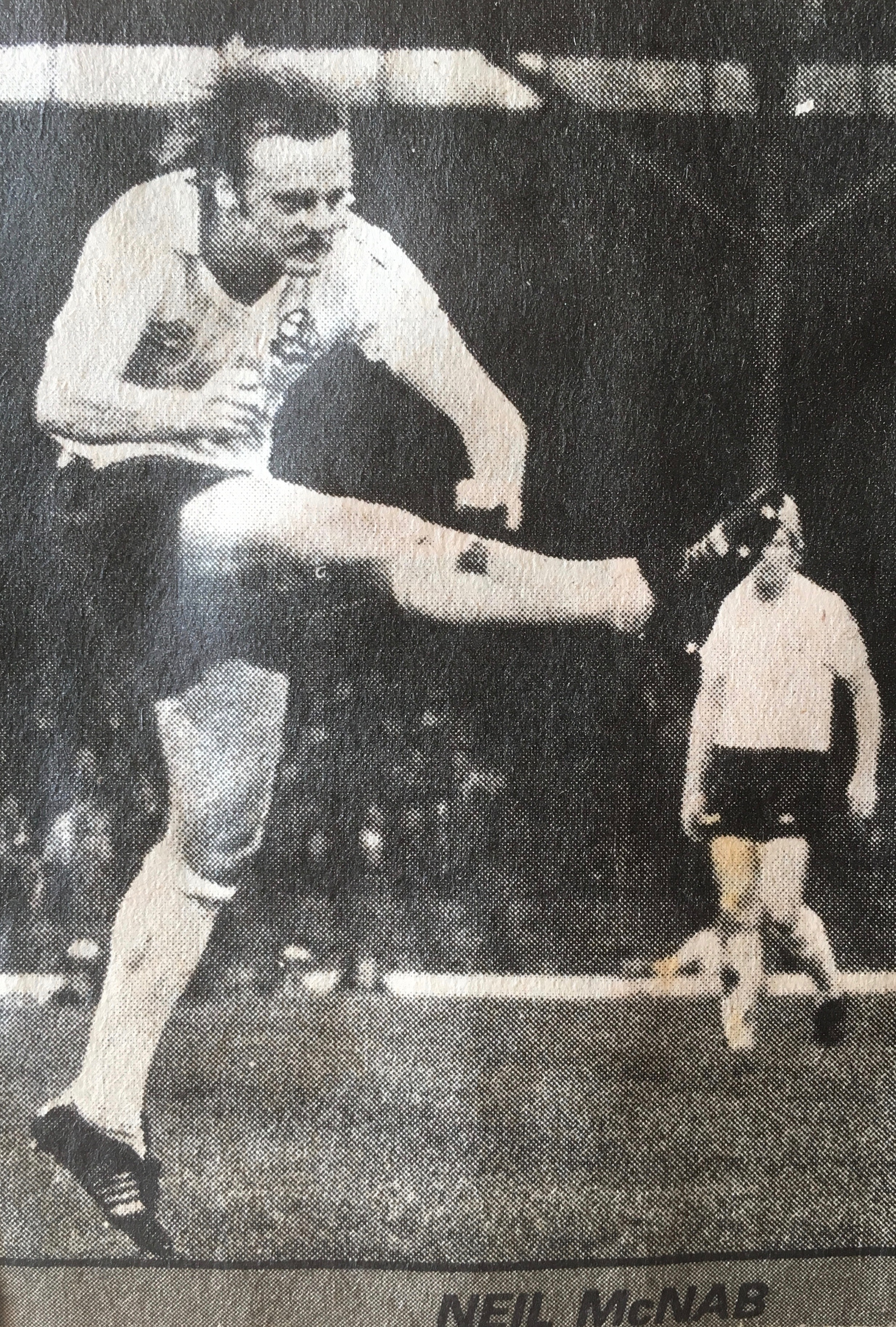
In four years at White Hart Lane, McNab played 72 matches and was selected by Scotland at under 15, under-18 and under-21 level, but never made it to the full Scotland team.

McNab - BoltonIn November 1978, Bolton Wanderers paid £250,000 for him but after only 35 appearances for the Trotters, in February 1980, Mullery signed him for Brighton.

When the former Scotland and Celtic captain Billy McNeill captured McNab’s signature in the summer of 1983, he began what would be a long association with Manchester City and he turned out to be a bargain buy considering in 1986-87 and 1988-89 he was voted City’s Player of the Year.

“Combative and always willing to stick a boot in, McNab was a key figure in City’s drive to promotion on more than one occasion,” was how manchestercity-mad.co.uk described him, while mancity.com, looking back at past players of the year, said: “Like a fine wine, got better as time went on.”

McNab w HartfordAcknowledging his initial signing failed to excite the City faithful, it added: “McNab developed into a skilful, combative midfielder who became a huge crowd favourite. Not unlike Asa Hartford (pictured above with McNab), McNab was a schemer who could pick a pass and kept the team’s tempo ticking over.”

McNab scored 19 goals in 261 league and cup games (plus five as sub) for City  but when Mel Machin’s successors at Maine Road (caretaker Tony Book and Howard Kendall) discarded him, he continued his playing career at Tranmere Rovers who paid £125,000 to take the 33-year-old to Prenton Park.

The combative midfielder added nous, steel and no little skill to the Rovers midfield, ending his first season in Birkenhead with two appearances at Wembley including the Leyland Daf Cup victory over Bristol Rovers,” said the Liverpool Echo.

He played 105 games for Tranmere, scoring six goals, and was part of the squad that secured promotion to English’s football’s second tier. He also earned the dubious distinction of being the first and thus far only Tranmere player to be sent off in a European game – a 2-1 win over Cosenza in the Anglo-Italian Cup.McNab HS

Determined to carry on playing, McNab had an 11-game loan spell at Huddersfield Town, returned to his native Scotland to turn out for Ayr United, appeared briefly for Darlington, played 13 games in Northern Ireland for Derry City, went non-league with Witton Albion (12 games) before finally calling it a day with Long Island Rough Riders in the States.

In 1994, he returned to Maine Road as youth team coach, when his old Albion teammate, Brian Horton, was City manager, and kept the position even when the aforementioned Alan Ball replaced Horton. But eventually he lost his job during another managerial upheaval in 1997 and took up a similar position at Portsmouth, once again working with Ball.

In October 2002, he finally landed a managerial position when he took the helm of League Two Exeter City. The reign was shortlived, though, and with only six wins in 26 matches (eight draws, 12 defeats) he was relieved of his duties.

McNab’s twin sons, Neil junior and Joe, who were born in Brighton, followed in their dad’s footsteps and were part of the young age group sides at Man City and Portsmouth. But after struggling to make the breakthrough, they moved to Wilmington, North Carolina, and have played for various sides in America.

Neil senior followed them to the States and in 2008 became director of coaching at Chiefs Futbol Club in Atlanta, Georgia, with Neil junior the club’s executive director.

In August 2017, it was reported Neil senior had suffered a severe stroke which left him fighting for his life.

On 2 March 2018, a message was sent via freelance writer Spencer Vignes to say that McNab had finally managed to return home after five months in hospital and in rehabilitation. “He has made tremendous progress, but still has a long way to go,” his son said.