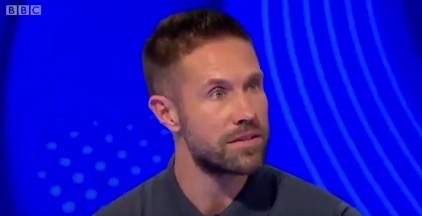
Matthew Upson was a class act in Albion’s defence

ARTICULATE pundit Matthew Upson was deservedly player of the season after starring in Brighton & Hove Albion’s back line during the 2013-14 season.

Earlier, in a career spanning eleven clubs, he played more times (144 plus once as sub) for West Ham United than any of his other clubs. He also won 21 England caps.

Upson initially joined the Seagulls during the second half of the 2012-13 season, signing on loan from Premier League Stoke City, where, in two years, he’d only managed 21 games (plus four as sub) following four years with the Hammers.

On signing him for Brighton at the age of 33, manager Gus Poyet told seagulls.co.uk, “When we had the chance to bring a player with the quality of Matt until the end of the season we went for him.

“He’s experienced, he’s been a regular Premier League player and there were no doubts about it. He has presence, he’s a leader as well and it’s a good opportunity for us to use him the right way and for him to play football.”

Upson joined a side already blessed with the on-loan presence of another former England international in the shape of left-back Wayne Bridge, but unfortunately the side couldn’t get past arch rivals Crystal Palace in the play-offs to gain promotion from the Championship.

Although Poyet departed, Upson decided to make his move to Brighton permanent and played 41 games, mainly alongside skipper Gordon Greer. Unfortunately, Oscar Garcia’s squad also stumbled in the play-offs.

Hampered by an ankle injury towards the end of the season, although Upson played in the first leg 2-1 home defeat to Derby County – when he conceded a penalty with a clumsy foul – he was one of several players to miss out through injury in the away leg, when the Rams prevailed 4-1.

At the season’s end, Upson declined a new contract offer with the Albion and decided to seize the opportunity to return to Premier League football with newly-promoted Leicester City.

As it turned out, injury delayed his debut by seven months and he made just six appearances for the Foxes before ending his playing days with MK Dons, where he was limited to four full appearances plus three as a sub.

Upson is now a regular pundit on our TV screens, displaying verbally the sort of calm assuredness he demonstrated out on the pitch.

So where did it all begin? Born on 18 April 1979 in Eye, a small Suffolk market town, Upson went to Diss High School, over the border in Norfolk, and his football ability first shone at Diss Town FC. He went on to the Ipswich Town Centre of Excellence but it was Luton Town who took him on as a trainee after his Ipswich coach, Terry Westley, had switched to the Hatters.

It was to be a lucrative decision by Luton because, after signing him as a professional in April 1996, a year later they sold him to Arsenal for £2million. He only ever made one first team appearance for Luton and that was as an 88th minute substitute against Rotherham United in August 1996.

Unfortunately, his time with the Gunners was dogged by injury and lack of opportunity because of the solid form of the likes of Tony Adams, Steve Bould and Martin Keown.

Just as he was beginning to make a breakthrough in the 2001-02 season, taking the ageing Keown’s place, he broke his leg and missed out on the Gunners’ end-of-season League and FA Cup double, although he earned a league winners’ medal. At the season’s end, he’d made 16 appearances plus six as a sub.

While waiting for his chance at Arsenal, he had gone out on loan, to Nottingham Forest and Crystal Palace, then Reading after his return from the leg break. But after a total of 39 appearances, plus eight as a sub, for Arsenal spanning five and a half years, he made a £1m move to Birmingham City in January 2003.

City were halfway through their first season in the Premier League, under Steve Bruce, and Upson made 14 appearances as the side finished in 13th place.

Upson told the dailystar.co.uk: “I had a good four and a half years under him at Birmingham. We had quite a successful period there.”

It was during his time with the Blues, during which he made 127 appearances plus one as sub, that his form was recognised with a call up to the England squad.

He had played at youth level and 12 times for the under 21 side but his first call-up for the senior squad came in February 2003, when he was an unused sub for England’s 3-1 win over Australia.

Three months later, coach Sven-Göran Eriksson gave him his debut when he came on for the second half In England’s 2-1 win over South Africa in Durban on 22 May 2003.

His final international appearance also came in South Africa – when he scored in England’s 4-1 defeat to Germany which brought about their exit from the 2010 World Cup. His involvement in the tournament was keenly followed by relatives and the whole community back in Diss.

He was involved in the squad for two subsequent games in September that year, but didn’t get to play. In total, he won seven caps while with Birmingham and 14 under Fabio Capello, after he had moved to West Ham. Of his 21 England appearances, 16 were as a starter, five as a sub.

Birmingham boss Bruce was reluctant to lose him but, on the final day of the transfer window in January 2007, the recently appointed Hammers boss, Alan Curbishley, paid £6million to take him to Upton Park, where enjoyed the longest spell of his playing career.

As he’d experienced at previous clubs, injury hampered him early on but eventually he got a regular spot in the side and subsequently took on the captaincy after the departure of Lucas Neill in August 2009.

It was after relegation from the Premiership during Sam Allardyce’s tenure as manager that Upson finally left the Hammers at the end of the 2010-11 season.

studio upson

Oatway took off with Bluebirds and soared with Seagulls

CHARLIE Oatway had not long earned his break in professional football with Cardiff City before he found himself behind bars in Pentonville Prison.

Up on a charge of GBH for his part in a fight, when an Afro-Caribbean friend was racially abused, Oatway didn’t expect to get incarcerated but ended up serving two months of a four-month sentence.

Before he headed off to court in London on a Monday morning, he had told Cardiff’s general manager, the former Leeds and Wales international Terry Yorath (broadcaster Gabby Logan’s dad), to expect him for training on the Tuesday morning!

The story is explained in detail in Tackling Life, the book Oatway published about how he turned his life round to become captain of Brighton and part of three promotion-winning sides.

The tale reveals how imprisonment was just one of the hurdles Oatway had to overcome in a life that’s taken many colourful twists and turns.

It was sadly ironic that his career as a player with Brighton was cut short in a Boxing Day clash against Queens Park Rangers, the team he followed home and away from an early age.

The family lived a stone’s throw from Loftus Road and Charlie – a nickname given to him by an aunt – was named by his Rs-daft dad after the whole of the promotion-winning 1973 QPR team: Anthony, Phillip, David, Terry, Frank, Donald, Stanley, Gerry, Gordon, Steven, James.

He was even starstruck at an Albion Legends event when he saw John Byrne who had been a hero of his during his days playing up front for the Rs alongside Gary Bannister.

Albion reaching the Division 2 play-off final in Cardiff in 2004 was the highlight of Oatway’s career – but a feature in the match programme was angled on the disappointment he had suffered the year before, when he had gone as a spectator with all his family to see QPR lose to Cardiff.

“Everything about the day was perfect apart from the result,” Oatway told reporter Alex Crook. “Being a QPR fan at heart, I felt the pain of the defeat just as much as the other 35,000 fans. But this time I am going up there as a player and not as a fan and I am determined our supporters will not go through what I did last season.”

The youngest of five kids, Oatway grew up in Shepherd’s Bush and even though he started to struggle in school from an early age, he displayed quite a talent for football.

“I knew by the time I was eight that I was as good as any of the eleven-year-olds I was playing with,” he recalls in Tackling Life. He had trials for the West London District schools team and played for Harrow Boys Club and Bedfont Eagles.

Oatway reveals how it was Wally Downes, the former Wimbledon player and later loyal assistant manager to Steve Coppell, who helped to get him noticed, along with his cousin, Terry Oatway.

The young Oatway joined up with Wimbledon in the year they won the FA Cup – 1988 – and played for the youth team, but he was let go at the end of the 1989-90 season because they thought he was too small. He went to Sheffield United on trial but was homesick so he returned to London and joined non-league Yeading on semi-professional terms. Off the field, life was by no means straightforward. “By the age of 19, I had two children with two different mothers,” he said.

After helping to get Yeading promoted in 1993-94, Oatway found a pathway back into the professional game when a community worker (Ritchie Jacobs) on the estate where he lived organised a trial at Cardiff City for him and two pals.

He was the only one of the three invited back and he said: “When Cardiff asked me back for another month, I knew it was the chance I’d been waiting for, and I was going to grab it with both hands.”

Not surprisingly, the two months he spent in Pentonville didn’t greatly help his cause but remarkably he was welcomed back to the club and accepted by the fans. However, in his absence there was a change in team management and ownership and, before long, new team manager Kenny Hibbitt was instructed to send Oatway out on loan to Coleraine in Northern Ireland.

On his return to Cardiff the following season, they had by then been relegated to the Fourth Division. Still he was unable to get back in the first team and he happened to play a reserve team game against Torquay United, who were managed by his old Cardiff boss, Eddie May. May asked if he fancied a move for first team football and, although he only joined just before Christmas in 1995, by the end of the season he had been voted Player of the Year.

When May moved on to become manager of Brentford, he put in a bid for the combative midfielder and took him back to west London to play in the Bees’ third tier side.

In 1998, Oatway had a brief loan spell with Lincoln City but on his return to Griffin Park he came under the managership of Micky Adams for the first time.

Adams had taken over the manager’s chair at Griffin Park but he was sacked when owner Ron Noades thought he could make a better job of running the team. Oatway was sent on a month’s loan to Lincoln, somewhat against his wishes, but on his return to the Bees he forced his way into the side and worked well with coach Ray Lewington.

Adams then took the reins at Brighton and, as the Albion began life back in Brighton & Hove after the two-year exile in Gillingham, Oatway and Bees teammate Paul Watson joined the Seagulls for a combined fee of £30,000.

Adams wanted the pair to join a nucleus of players who’d all played under him previously at Brentford and Fulham.

In an Albion matchday programme profile of Oatway to coincide with the visit of his former club, Torquay, on 2 September 2000, it noted: “Despite getting sent off rather stupidly in one of his earliest games for the Seagulls – he bit a Darlington player’s face – he soon became a great favourite with the Brighton crowd, who hadn’t seen a midfield scrapper like him since Jimmy Case retired.”

oatway prog cover

He went on to be a vital midfield cog in the back-to-back league title winning sides of 2001 and 2002. Although he was in the team that was relegated from the second tier in 2003, he was full of praise for the effort made to avoid the drop. “Steve Coppell was one of the best managers I’ve ever played under because of his attention to detail,” he said. “Steve’s team talks on the day before a game were brilliant.”

When the departed Coppell was replaced by Mark McGhee, Oatway remained a cornerstone of the Albion line-up and described that 2004 play-off final at the Millennium Stadium as “the best day of my career”.

But at one point it was touch and go whether he was going to be able to carry on. In October 2003, he underwent major back surgery to repair a slipped disc and trapped nerve.

He was out for nearly three months and he admitted in an Argus interview: “There was a good chance I wouldn’t play again.”

When the Albion cashed in on captain Danny Cullip in December 2004, selling him to Sheffield United, Oatway took over the skipper’s armband full-time, a role he had previously embraced as a stand-in.

The following season’s Boxing Day clash with QPR at Withdean was only two minutes old when Marcus Bean tackled Oatway from behind and escaped without even a booking.

Oatway was stretchered off and McGhee later told the mirror.co.uk: “Charlie has been a tremendous leader and captain and this is a huge blow. I’m very upset about it.”

Oatway had four different operations to try to fix the ankle injury, but he never recovered sufficiently to return to the required level to play league football.

“I tried to get back to playing again but by the pre-season of 2007 I had to call it a day,” he said.

However, even when he was out injured, Oatway was always a strong influence on the dressing room.

Stand-in skipper Dean Hammond said in an Argus interview in November 2006: “Charlie has been out injured but he has been fantastic for everyone. He comes in, he gets everyone up for it, he’s always laughing and joking. He’s got the enthusiasm and he is still determined, even though he is not playing.

“His personality is fantastic for everyone and I think he deserves a massive pat on the back.”

He also used the time productively, studying how the coaches worked with the youth team players and starting to take his coaching badges. When it was clear he wouldn’t be able to return to play full-time professional football again, he got involved with the Albion in the Community scheme as a community liaison manager.

Rather than give up the game completely, Oatway took the opportunity to become player-coach at Havant and Waterlooville and, in January 2008, he found himself in the national media spotlight when the Blue Square South minnows played away to Liverpool in the fifth round of the FA Cup.

Oatway wasn’t fit to start the game but he got on as a substitute in the 74th minute and later recounted how his former teammate Bobby Zamora fixed it for him to swap shirts with Liverpool’s Yossi Benayoun, who scored a hat-trick in the Reds’ 5-2 win that day.

Then, in 2009-10, Oatway began helping Brighton manager Russell Slade to coach the first team and, after Slade’s departure, continued in the role under Gus Poyet.

When Poyet left the Seagulls to join Sunderland, Oatway went with him and he was also in the dug-out alongside Poyet and his assistant Mauricio Taricco at Chinese Super League team Shanghai Greenland Shenhua, AEK Athens and Seville-based Real Betis.

Pictures: matchday programme; The Argus; Tackling Life (Quick Reads, 2011).

Saint Dean a sinner in some Albion fans’ eyes

HASTINGS-born Dean Hammond enjoyed two spells with the Albion having joined the club aged 11 and progressed from the school of excellence though the youth team and reserves to become a first team regular and captain of the side.

He also went on to captain Southampton as they rose from League One to the Premiership.

However, it’s a pretty surefire bet to say fans would be divided if asked to judge his contribution.

An over-the-top celebration in front of the Albion faithful after scoring for Southampton at Withdean made him public enemy number one in many people’s eyes.

The way he left the club under a cloud, suggesting they lacked ambition, was another catalyst for rancour.

Personally, I struggled with his penchant for missing some unbelievable, gilt-edged chances to score. There was one away at Leicester (one of his future employers) – a proverbial ‘easier to score than miss’ – that was particularly galling in a game that finished 0-0.

Putting all these things to one side, there is no denying that he ultimately enjoyed a decent career and, while his most successful years were spent in the second tier of English football, he also got to play at the highest level.

Albion have struggled for a good many years to bring through promising local talent from schoolboy level but Hammond was one of the few who made it.

Born a couple of months before Brighton’s 1983 FA Cup Final appearance, he made his Albion bow in December 2000 when former Saints full-back Micky Adams put him on as a substitute in a 2-0 Football League Trophy win over Cardiff, but it was only when former youth coach Martin Hinshelwood briefly held the first team manager’s role that he got his next chance.

That came as an 85th minute substitute for Nathan Jones in a 4-2 defeat at Gillingham in September 2002 and 10 days later he made his first start and scored his first Albion goal (celebrating below right) after only eight minutes in a 3-1 League Cup defeat to Ipswich.

When Hinshelwood was sacked, new boss Steve Coppell opted for experience over youth and Hammond’s next competitive action came during two spells out on loan in 2003 – at Aldershot (seven games) and Orient (eight games).

In an Argus interview in November 2006, Hammond said: “It’s been up and down for me at Brighton. I loved it when I came through the youth team and then broke into the first team at quite a young age.”

Hammond watched from the sidelines at the Millennium Stadium in May 2004 as the Albion won promotion to the Championship via play-off victory over Bristol City. A couple of months later, the Argus was reporting how he had been given three months to prove he had a future with the club.

He did enough in a handful of games to be offered a contract until the end of the season and, although he was mainly used from the bench between October and March, by the season’s end he was playing a pivotal role in helping to steer Albion clear of the drop zone, scoring the equaliser in a 1-1 draw away to Burnley and getting both goals in a vital 2-2 draw at home to West Ham.

Before the 2006-07 season got under way, manager Mark McGhee obviously felt players like Hammond needed toughening up and sent him and a few others to some boxing sessions with former world heavyweight title contender Scott Welch, from Shoreham, at his Hove gym.

Hammond told Andy Naylor of the Argus: “When the gaffer mentioned it, I think the boys were thinking ‘Boxing? How is that going to help us’. But he worked on the mental side, as well as the power and strength stuff.

“If we felt tired or felt we couldn’t go on, he was pushing us and he said it would help us in a game. I think he’s right. When we went back for pre-season training you tended to push yourself that bit more, so I think it will help in the long run.”

Unfortunately, it didn’t help enough because the season saw Albion relegated back to the third tier. It wasn’t long before former youth coach Dean Wilkins was installed as manager and youngsters were given a chance to flourish in the first team, with Hammond appointed captain.

“I would say it is the best time of my career and I am really enjoying it,” he told Naylor. “It’s brilliant at the moment.”

In the same interview, however, there were perhaps the first rumblings of his discontent with the progress of the club.

“I’ve been here since the age of 11. I’m like every other player. I’m ambitious and I want to do the best I can in my career and play as high as I can. Hopefully that will be with Brighton.”

A career-ending injury to Charlie Oatway and Richard Carpenter’s departure from the club in January 2007 led to Hammond taking over the captain’s armband and 2006-07 was undoubtedly his best Albion season. He finished with 11 goals from 39 appearances and the award of Player of the Season.

D Ham v W HamIt was in the 2007-08 season that it turned sour between player and club, even though before a ball had been kicked he told the Argus he thought Brighton had it in them to make the play-offs.

“We can beat anyone in the division. It’s just about being consistent. Realistically we can push for the play-offs,” he told Brian Owen.

Considering he had been at the club from such an early age, what happened next clearly rankled with chairman Dick Knight, who talked about it in his autobiography, Mad Man: From the Gutter to the Stars, the Ad Man who saved Brighton.

Knight accused Hammond’s agent, Tim Webb, of touting his client around Championship clubs while there was an offer on the table from the Albion that would have made him the highest paid player at the club.

“Hammond kept telling the local media that he wanted to stay and sign a contract, but I think he was being told to hold out for more money,” said Knight.

Because Hammond could have walked away from the club for nothing at the end of the season, the pressure was on to resolve the situation one way or another by the close of the January transfer window.

All the off-field stuff was clearly affecting Hammond’s head and I can remember a game at Oldham in the second week of January when he lunged into a reckless challenge after only nine minutes which certainly appeared to be a deliberate attempt to get himself sent off. That early dismissal was his last action for the Seagulls until his return to the club in 2012.

“I didn’t want to sell Dean but I was forced to,” said Knight, who persuaded Colchester United to buy him for £250,000, with a clause added in that Brighton would earn 20 per cent of any subsequent transfer involving the player. “In normal circumstances, I might have got more, but time was running out,” Knight added.

The move to Colchester wasn’t an unbridled success because his arrival couldn’t prevent them being relegated from the Championship, but, with Paul Lambert as manager, Hammond took over the captaincy in December 2008 and by the season’s end was voted Player of the Season.

Throughout the season there had been speculation that Southampton wanted to sign him and a deal duly went through in August 2009. At the time, Alan Pardew was the Saints manager and Hammond’s former Albion youth team coach and first team manager, Dean Wilkins, was Southampton first team coach, and played a part in him deciding to make the move. “His knowledge of the game and his passion for football is second to none and he was really good for Southampton – he had a good partnership there with Alan,” said Hammond.
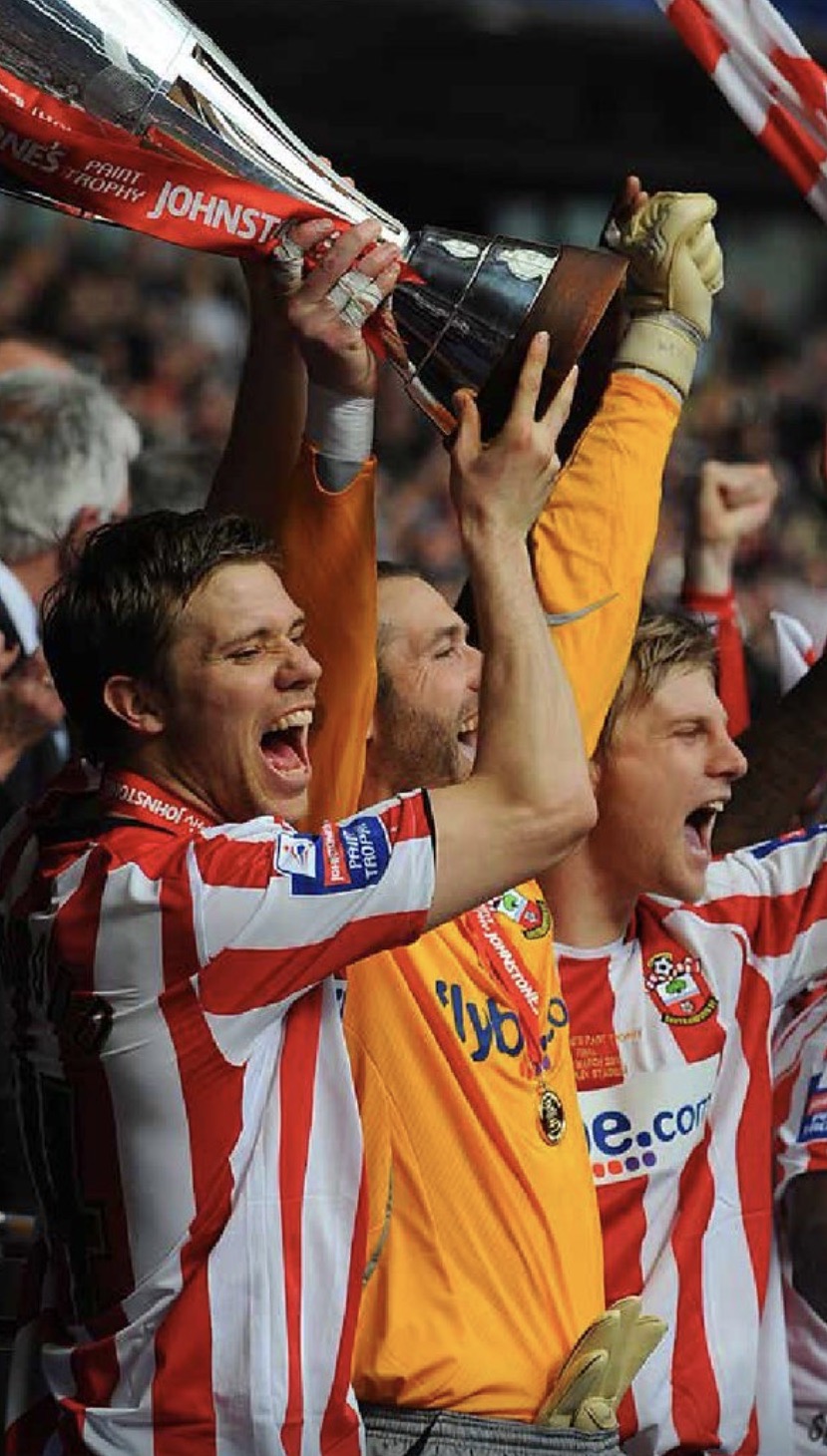
D hammo trophyAs had happened at his previous two clubs, it wasn’t long before Hammond was taking on the captaincy and he got to lift the Johnstone’s Paint Trophy at Wembley on 28 March 2010 (above) when Pardew’s team beat Carlisle United 4-1 – the first piece of silverware Saints had won since the 1976 FA Cup.

“I was really enjoying my football and it was like a new beginning for everyone connected with the club,” he said in an Albion matchday programme article. “Nicola Cortese came in off the field and a raft of new signings had been made, the likes of Rickie Lambert, Jason Puncheon, Lee Barnard, Radhi Jaidi, Dan Harding, Michail Antonio and Jose Fonte. When you add the likes of Morgan Schneiderlin and Adam Lallana, we had the makings of a really good team. It took us a little time to gel, but once we clicked we had a really good season.”

When Albion travelled to St Mary’s on 23 November 2010, the matchday programme inevitably featured their captain and former Seagull. It said: “Hammond was barely out of nappies when he first started supporting the Seagulls. He can even recall the days they played in front of 20,000 crowds at the old Goldstone Ground.

“The new Brighton stadium will hold just over 22,000 and the Saints midfielder said: ‘There’s no doubt they’ll fill it, certainly for their early games. That’s just about the size of their fan base and, if anyone deserved a bigger ground, it’s them’.”

Reflecting that he had certainly made the right career move, Hammond said: “I’ve developed as a player. I have a slightly deeper midfield role which means I pass the ball more and get involved in the game more.”

After two seasons in the third tier, Southampton famously finished runners up to Brighton in 2010-11 to regain their place in the Championship. Hammond was a regular throughout the 2011-12 season, although at times contributing from the bench, as Saints won promotion back to the Premier League, runners up behind Reading.

However, manager Nigel Adkins obviously didn’t see Hammond as top tier material and on transfer deadline day (31 August 2012) the midfielder agreed a season-long loan deal back at Brighton.
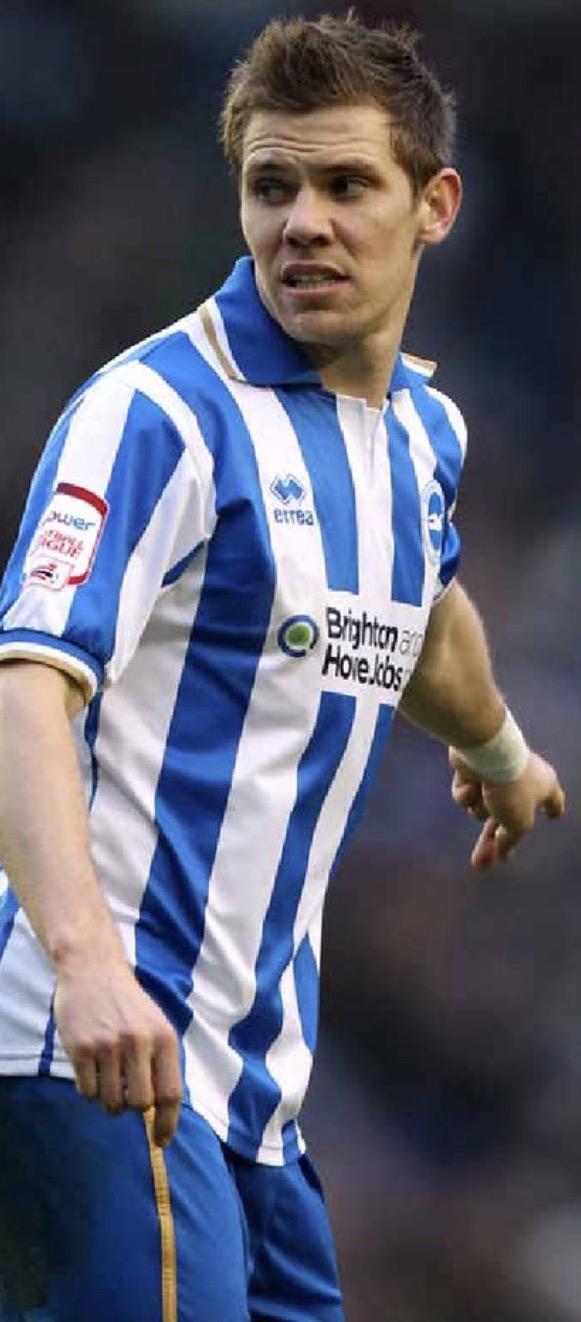
D Hammo 2By then 29, Hammond told the Argus: “It’s a different club now. The stadium is amazing and I can’t wait to get going.

“I saw the plans when I was 15 and it’s amazing to see it come to life. It will be a dream to play at this stadium as a Brighton player and I have been dreaming of that since a boy.”

Hammond made 33 appearances plus five as a sub during that season, alongside fellow loanees Wayne Bridge and Matt Upson, and said: “I loved my year back at the club. It was brilliant.

“I’d been sold the dream of the new stadium since I was 15 coming through the ranks, so to walk out of that tunnel for the first time as an Albion player was a fantastic feeling and one I’ll always cherish.”

Hammond reflected that the side did well to reach the play-offs but drew too many games. “We were only four points off automatic promotion and just didn’t do ourselves justice in that play-off game against Crystal Palace.

“Having drawn 0-0 at Selhurst Park, we really fancied finishing off the job at the Amex, but it just didn’t happen for us on the night. That has to rate as one of the biggest disappointments of my career.”

When manager Gus Poyet departed the Albion in the wake of the play-offs loss, Hammond returned to parent club Southampton, but, three months later he signed a two-year contract with Championship side Leicester City. Manager Nigel Pearson told the club’s website: “We’re really pleased to be able to add a player of Dean’s quality and experience to the squad.

“As well as having played a considerable number of games in his career, he also arrives with promotion credentials and will be a very positive influence on the squad both on and off the pitch.”

DHLCFC

Hammond added: “Once I knew of Leicester’s interest I wanted to come. My mind was made up. There was some interest from other clubs, but once Leicester was mentioned, and I spoke to the manager, I wanted to come here.

“It’s a massive football club. They came close last year in the play-offs and they’ve got a good history. It’s a club that’s going places and wants to push to the Premier League. It’s very exciting to be here.”

While facing midfield competition from Danny Drinkwater and Matty James, Hammond nevertheless played 29 games as Leicester were promoted and he finally got to play in the Premiership, albeit competition and injury restricted his number of appearances to 12.

Not all Saints fans felt it right that he had been abandoned as soon as the club reached the Premiership and, on the eve of his return to St Mary’s as a Leicester player, Saints’ fansnetwork.co.uk considered supporters might like to “thank him for his contribution to our resurgence in the game …. without Dean Hammond perhaps none of what they are enjoying in the Premier League would have been possible”.

Although Hammond earned a one-year extension to his contract in July 2015, he was not involved in the side that surprised the nation by winning the Premier League.

He had gone on loan to Sheffield United, then managed by his old Saints boss Adkins, and made 34 appearances for the Blades by the season’s end. However, he didn’t figure in new boss Chris Wilder’s plans and left the club in the summer of 2016.

Russell Slade gave him a trial at Coventry City in January 2017 but he didn’t get taken on and eventually he returned to Leicester to work with their under 23s. He later became loans manager for the Leicester City Academy.

Hammond opened up about his career, and some of the difficulties he’s faced since stopping playing, in an interview with James Rowe for The Secret Footballer.

  • Most photos from Argus cuttings; plus Southampton programme, Albion programme and Leicester City website.

Barça boy Orlandi twice denied promotion with the Seagulls

andrea-orlandi-brightonARTICULATE Andrea Orlandi would probably rank as one of my favourite Albion players of recent times. It was just a shame he seemed bedevilled by injuries which curtailed his contribution.
On his day, his technical ability definitely improved Brighton’s creativity going forward and I guess he’ll always be remembered for the goal he scored against Premier League Newcastle in the third round of the FA Cup on 5 January 2013 which he somehow guided in from what seemed an impossible angle.

On bbc.co.uk, the match report recorded: “A rejuvenated Wayne Bridge surged down the left flank, gathered Gordon Greer’s raking 50-yard pass and crossed for Orlandi, who flicked the ball up with his left foot and delightfully fired home with the outside of the same boot.”

Orlandi Newc goal

Orlandi was 28 when Gus Poyet signed him on a two-year contract on transfer deadline day in August 2012. “Andrea provides us with versatility and creativity across the midfield,” Poyet told the club’s official website.

“He can play as a typical winger, or more central in a number 10 role. He has played a lot of games in the Championship for Swansea, helping them win promotion, and he has played at the top level.”

It was crowd favourite Craig Noone’s departure to Cardiff that created the opening for Orlandi’s arrival, although they were very different players.

At Brighton, Orlandi had the chance to renew his great friendship with Seagulls legend Inigo Calderon, a former Alavés B side teammate, and there was quite a contingent of Spanish players at the club during that 2012-13 season.

As the Seagulls finished fourth and the Poyet era came to a close after the Palace play-off farce, Orlandi had played 30 games plus five as sub and added six league goals to that one in the FA Cup.

Under Poyet’s successor, Oscar Garcia, Orlandi picked up a knee injury in the opening game of the season, against Leeds, which required surgery.

“The doctor I went to see is regarded as one of the best in Europe so although it was disappointing that I had to undergo surgery, I was in the best hands,” he told the club website. “Although I was hoping rest would cure the problem, I was told I would risk further damage if I didn’t have surgery.”

As it turned out, he managed just 12 starts plus six as sub as the season culminated in yet more play-off heartache, this time at the hands of Derby County.

Orlandi played in both legs against the Rams and, although Garcia decided to quit, he recommended Orlandi be given a contract extension. As soon as Garcia had gone, though, head of football David Burke called him in to the club and told him he was being released.

Orlandi told the club website: “I’m sad. My youngest daughter was born here and I was hoping to stay here a lot longer but that is football.

“I really felt loved by everyone, especially the fans who were incredible to me whether I was on the pitch or off of it and that is something that nothing will ever take away from me.

“The city and all the people in it are wonderful and I wish everyone nothing but the best going forward and I hope the club can fulfil the dream of playing in the Premier League soon. I’m just sorry I couldn’t help to make that happen.

“It is a real shame that in my two years we got so close but we just couldn’t get over the finish line, but I will take away some magnificent memories with me.

“Once again I just want to pay tribute to the tremendous support I have felt during my time here.”

In a subsequent matchday programme article, Orlandi said: “Just running out at the Amex in front of a full house was an amazing experience – I loved every minute of my time at the club and loved playing for the fans.

“I will always hold Brighton close to my heart.”

Born in Barcelona on 3 August 1984 to Italian parents (a Juventus-supporting dad and an AC Milan-supporting mum), he played as a youth at Espanyol but at 17 moved to Alavés where he made 58 appearances for their B team between 2003 and 2005.

When loaned to Barcelona, he continued to be a B team player but he did play two first team games for the Catalan giants: as left back under Frank Rijkaard in a 3-1 defeat to Athletic Bilbao and a Copa Cataluyna win over Espanyol.

When Alavés released him in 2007, fellow Spaniard Roberto Martinez picked him up as a free agent and took him to Swansea City, where he stayed for five years.

Orlandi yellowManagerial changes at the Swans meant he wasn’t always first choice although on signing a contract extension in July 2011, chairman Huw Jenkins said: “He has grown into the squad over the past few years and his technical ability is well suited to the Premier League.”

He was part of Brendan Rogers’ squad promoted to the Premier League via a 4-2 play-off final win over Reading, appearing 24 times over the season, although he didn’t feature in the final at Wembley.

AO SwansIn one of his last Swansea games, on 28 April 2012, Orlandi scored after just 25 seconds of a Premier League game against already-relegated Wolves, but the game finished 4-4.

After his release from Brighton, he joined chaotic Championship side Blackpool, the day before the 2014-15 season started – with only a week to go, they had only eight registered professionals.

Under initially Jose Riga and then Lee Clark, Orlandi played 25 games plus five as sub, but the Tangerines finished rock bottom of the league, and the club was in disarray.

Orlandi revealed some of the strange goings-on in a weekly blog he wrote for Spanish website am14, including the time the goalkeeper Joe Lewis had to wear an autographed shirt intended for a presentation to a sponsor because there was no other top available.

In April 2015, Orlandi wrote: “When you first arrive in England in mid-April you imagine yourself spending your Sundays in the garden or having a drink on the terrace… you don’t imagine yourself stuck at home, listening to the wind and spending hours hiding from a hurricane.

“I have been living in England for almost eight years and the sun has always shone. This year is nothing like that, not in any sense. I will be patient and hopefully the nice weather will arrive before the end of the month. In terms of the football, the sun did not appear for Blackpool either.”

Orlandi also used the blog to talk about a defeat at Ipswich. “We started well, I scored a good goal thanks to a great assist from Cameron, and we lost. In part, this was thanks to my mistake which helped lead to their second goal.

“It was an error without explanation. ‘The pitch condition, the bounce of the ball, it came from a rebound’… excuses do not sit well with me. Unfortunately, sometimes we make inexplicable errors and that happened to me. I have to take responsibility, accept it and move on. The worst is that we equalised again and finally conceded 3-2 due to another silly play. It is the story of this season.

“When the league is finished, I will look at all the results and I shudder to think of the points that we have lost in, to put it mildly, a stupid fashion. Maybe we would not have avoided relegation but we would be in a different position, that is for sure.”

As the scorer of four goals, he was Blackpool’s second highest goalscorer for the season and, despite relegation, they hoped to keep him, but he invoked a release clause in his contract and became a free agent.

In August 2015, Orlandi signed for Cypriot First Division side Anorthosis Famagusta on a one-year deal but it didn’t sound like it was the greatest of experiences when Argus reporter Brian Owen caught up with him in February 2016, with Orlandi disappointed he hadn’t been able to find another English club in the Championship.

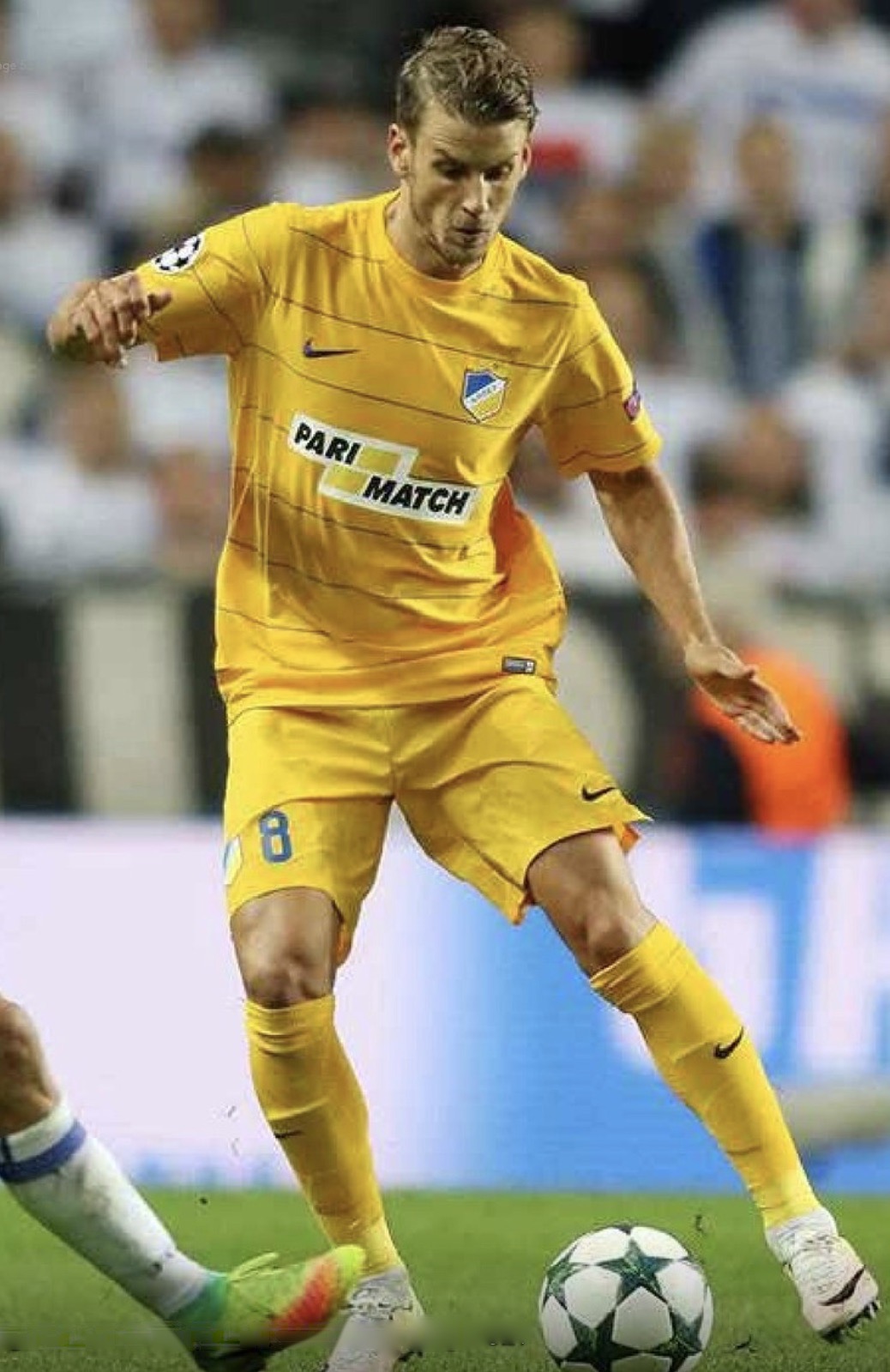
Orlandi switched clubs in Cyprus and joined APOEL but his one-year deal was terminated in January 2017 after he’d made 19 appearances.

He switched to Italy where he played 31 matches for Novara Calcio in Serie B and then joined his old pal Calde to spend half a season in the Indian Super League at Chennaiyin (under head coach John Gregory). On returning to Italy and signing for Serie C side Virtus Entella, during the medical a cardiologist discovered he’d got scarring in the left ventricle of his heart, and he was forced to retire without playing a game.

The popular Spaniard revealed in Richard Newman’s Football the Albion and Me podcast how he has gone on to become a scout for an agency as well as working as a TV pundit on La Liga and writing a column on that competition for the Evening Standard.Orlandi pundit

Pictures from various online sources and the Albion matchday programme