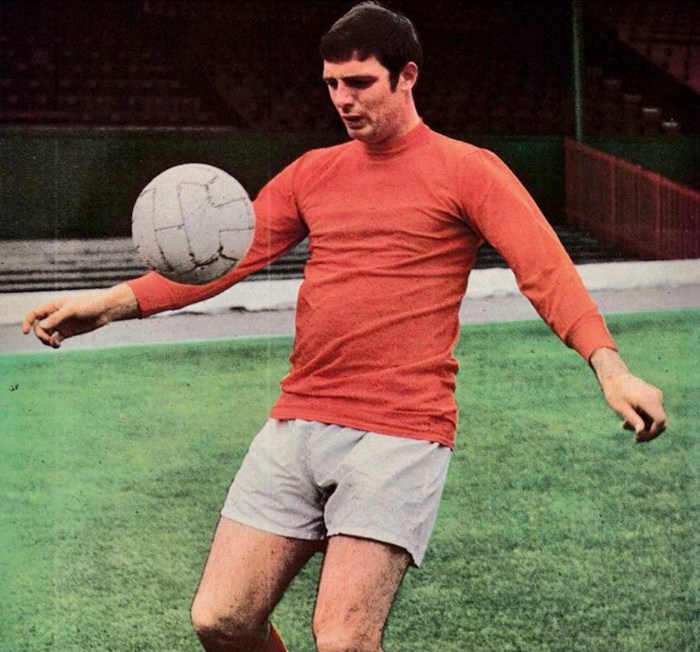
Brighton trial was curtain call for Fred Pickering’s career

PROLIFIC goalscoring centre-forward Fred Pickering, who at his peak scored hat-tricks on his Everton and England debuts, ended his career after an unsuccessful two-month trial with Brighton.

Pickering was a transfer record signing for Everton (the previous season’s league champions) when he joined them from Blackburn Rovers for £85,000 in March 1964.

On his debut for Harry Catterick’s side, he scored three past Nottingham Forest’s Peter Grummitt in a 6-1 thrashing.

Eight years later, a player who’d played for his country and, but for injury, might have been involved in the 1966 World Cup, scored once for Brighton’s reserve side: in a 3-0 home win over Colchester United on 8 March 1972.

Brighton won promotion from the old Third Division two months later thanks in no small part to 19 goals scored by Kit Napier and 17 from Willie Irvine (Pickering’s former Birmingham City teammate Bert Murray netted 13 and Peter O’Sullivan hit 12).

Throughout the season, manager Pat Saward had been hankering for something a bit extra in the forward line. While he appreciated the skill of Napier and Irvine, he said “none had the devil in him. We wanted more thrust.”

Pickering was the second seasoned striker Saward had run the rule over, wondering whether their experience of goal plundering at the highest level several years before might be revived in third tier Albion’s quest for promotion.

Earlier in the season, he tried recruiting an ageing Ray Crawford but contract issues with the player’s last club, Durban City, meant the former Portsmouth, Ipswich, Wolves and Colchester centre-forward ended up joining the staff as a scout and coach instead.

In February 1972, 31-year-old Pickering, by then not even getting a game in Blackburn’s Third Division side, was given a chance by Saward to show he still had the goalscoring ability he had demonstrated so effectively earlier in his career.

Photographs of a rather heavy-looking Pickering training appeared in the Evening Argus and the former England striker was interviewed on Radio Brighton (as it was then) about his illustrious career. Although he played for the reserves, he wasn’t deemed fit enough to make it into the first team.

Saward eventually got the thrusting forward he sought on March transfer deadline day when he signed Tranmere Rovers’ Ken Beamish, who, at 24, was younger and fitter, and quickly endeared himself to Albion fans by scoring a handful of late goals which helped clinch promotion.

But what of Pickering? Born in Blackburn on 19 January 1941, he played junior football in his hometown before joining Rovers as an amateur aged 15.

As a schoolboy, he’d been an inside forward (a no.8 or no.10 in today’s parlance) but he was a full-back when he signed as a professional for Rovers on his 17th birthday.

Indeed, he was at left-back in the Rovers side that won the FA Youth Cup in 1959, beating West Ham United 2-1 on aggregate over two legs.

Alongside him for Rovers were future Spurs and Wales centre-half Mike England and Keith Newton, who also later moved to Everton and played for England at the 1970 World Cup. West Ham included Bobby Moore and Geoff Hurst in their line-up.

With the likes of Dave Whelan and Bill Eckersley ahead of Pickering in the Blackburn pecking order, his chances of a first team breakthrough were limited.

But after a successful outing for the reserves up front, and with wantaway Irish striker Derek Dougan dropped, Pickering was given a chance as a centre forward – and he never looked back.

He scored twice in a 4-1 win over Manchester City and went on to strike up successful partnerships with Ian Lawther, initially, and then Andy McEvoy.

“It was a big turning point for me to be playing centre forward,” Pickering told the Lancashire Telegraph. “Especially when you consider in 1961, Dally Duncan (Blackburn manager, and later Brighton guesthouse owner) told me that Plymouth wanted me and that I was free to leave. I didn’t want to go because Blackburn was my club.

“I only left in the end because the club wouldn’t give me a rise of a couple of quid. It was absurd.”

By then Pickering had scored 74 goalsin158 appearances – some strike rate – which meant he always held a special place in the hearts of the Ewood Park faithful, as reporter Andy Cryer described in a 2011 article for the Lancashire Telegraph.

“Had fate been kinder to him he could easily have been a national darling too,” wrote Cryer.

“When hat-trick hero Geoff Hurst was firing England to World Cup final glory in 1966, an injured Pickering was left reflecting on what might have been after an incredible journey took him from Rovers reserves to international stardom.”

Pickering, nicknamed Boomer for his powerful right foot, had scored five goals in three England appearances and looked set for inclusion in England’s 1966 World Cup squad having been named in Sir Alf Ramsey’s provisional selection.

But he suffered a knee injury in an FA Cup quarter final replay against Manchester City which not only caused him to miss Everton’s FA Cup final win that Spring, but also meant he had to withdraw from the England squad. Cryer reckons it also led to the subsequent demise of his career.

Pickering told the reporter: “I played three games for England and I scored in every game I played, I scored five goals and I was playing well. I was named in the World Cup squads. I was going and from that day it was the following weekend when the knee started to go.

“I watched all the Brazil games at Goodison. England struggled in their first game against Uruguay and that is when Jimmy Greaves got injured.

“Obviously that is how Hurst got in, he wasn’t even really in the set up before. There was every chance if I had been fit it that might have been me who had got in. I wouldn’t say I would have done what Geoff Hurst did but you never know what might have happened.”

Pickering had made his England debut two months after moving to Everton, in a 10-0 demolition of the USA on 27 May 1964. It was the same match that saw future Albion manager Mike Bailey play his first full international for his country. Roger Hunt went one better than Pickering by scoring four, Terry Paine got two and Bobby Charlton the other. Eight of that England side made it to the 1966 World Cup squad two years later – alas Pickering didn’t.

The same scoring rate he had enjoyed at Blackburn continued at Everton and in his first full season he scored 37 goals in all competitions – the most by an Everton player since Tommy Lawton scored 38 in 1938-39.

In three years with the club, he scored 70 times in 115 matches but his exclusion from the 1966 FA Cup final squad soured his relationship with manager Catterick, as covered in detail by the efcstatto.com website. Injuries disrupted his involvement at the start of the following season, and a cartilage operation put him out of action for nearly six months.

Although he made his comeback in March 1967, his Everton days were numbered and, in August 1967, moneybags Birmingham City bought him for £50,000 to form a hugely effective forward line with Barry Bridges and Geoff Vowden.

Pickering and Bridges played in all 50 of Birmingham’s matches in the 1967-68 season; the aforementioned Bert Murray 47. Bridges was top scorer with 28 goals and Pickering netted 15.

The Second Division Blues made an eye-catching run to the semi-finals of the FA Cup, but they lost 2-0 to West Brom (who went on to beat Everton 1-0 in the final).

The following season, Pickering scored 17 times in 40 appearances (Phil Summerill also scored 17, and Jimmy Greenhoff 15) but City finished a disappointing seventh.
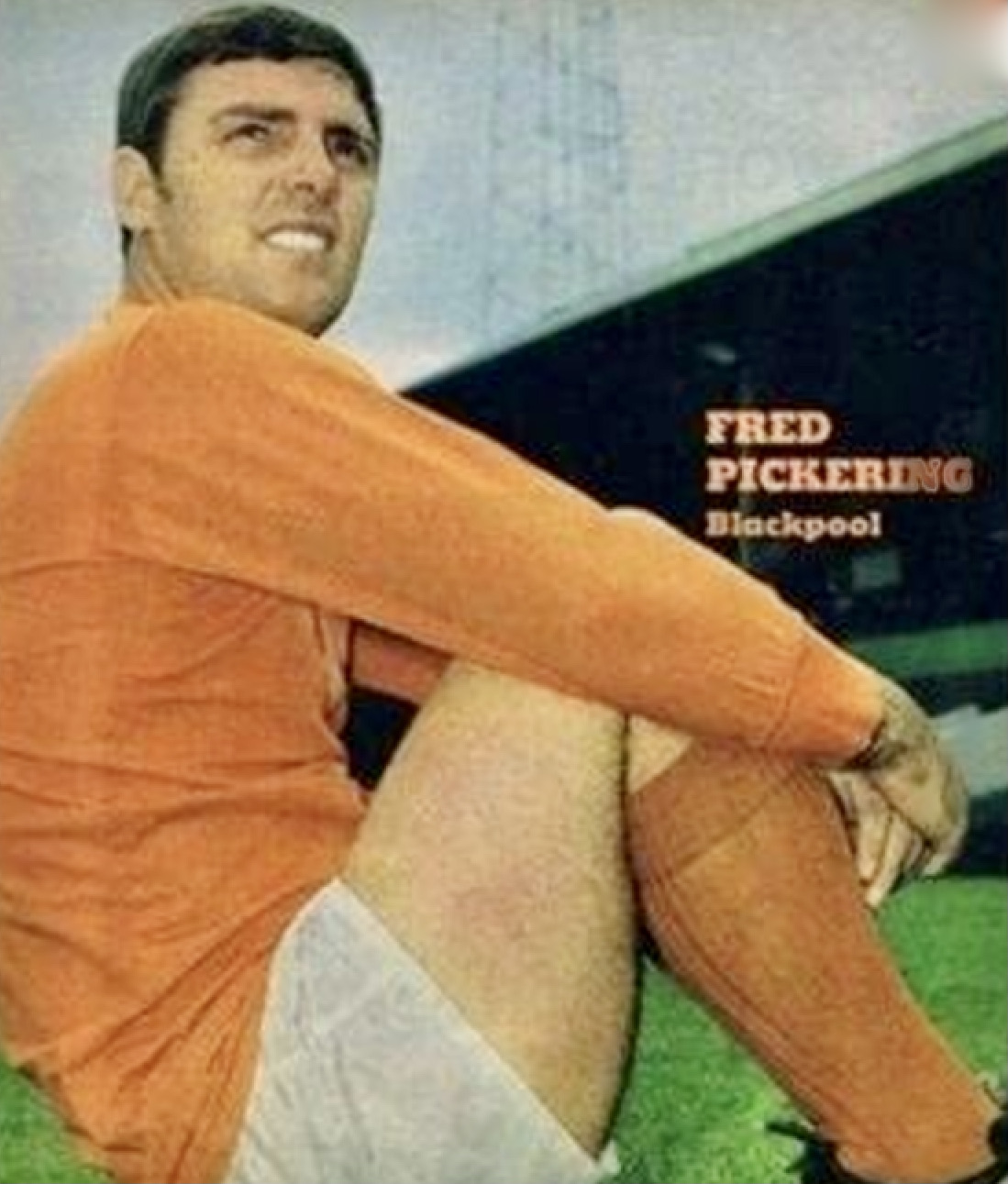
That signalled the end of the striker’s time in the Midlands and he returned to his native north west with Blackpool, who paid £45,000 for his services.

It was money well spent as Pickering top-scored with 18 goals as the Tangerines won promotion back to the elite, finishing runners up to Huddersfield Town. His most memorable performance was on 13 April 1970 when he scored a hat-trick away to local rivals Preston North End in front of a Deepdale crowd of 34,000. It earned Blackpool promotion while simultaneously relegating North End to the third tier.

But the 1970-71 season didn’t go well for Blackpool or Pickering. The club got through three managers and only won four matches all season, which eventually saw them finish bottom of the pile and relegated along with fellow Lancastrians Burnley. Pickering found himself fined and excluded for breaches of club discipline (mainly involving missing training) and before the season was over he was sold back to his first club, Blackburn.

That was a blow to Preston, who had just loaned Willie Irvine to Brighton and were keen to install Pickering as his replacement. But it was to Rovers, for £9,000, that he went, but he couldn’t prevent the Ewood Park outfit being relegated to the third tier.

He scored just twice in 11 League games in his second spell at Blackburn before that two-month trial at Brighton.

After he retired from football, he became a forklift truck driver. Warm tributes were paid when Pickering died aged 78 on 9 February 2019. Well-known football obituarist Ivan Ponting said of him: “At his rampaging best, Fred was an irresistible performer.

“Though neither outstanding in the air, nor overly-physical for a man of his power, not even particularly fast, he could disrupt the tightest of defences with his determined running and a savage right-foot shot that earned him the nickname of ‘Boomer’.

“Boasting nimble footwork for one so burly – he could nutmeg an opponent as comprehensively as many a winger – he was especially dangerous when cutting in from the flank, a manoeuvre that yielded some of his most spectacular goals.”

In March 2022, a road in the Mill Hill district of Blackburn, where he lived all his life, was named after him and his family spoke of their pride as they unveiled the street sign in his honour.

Big Chiv’s Brighton cameo at the end of an illustrious career

FORMER England international Martin Chivers rose majestically to head home a goal in a 3-3 draw between Leyton Orient and Brighton & Hove Albion.

It was textbook Chivers – a replica of so many similar goals he’d scored for Spurs and England during his glory days – and it put Albion 2-1 up. It turned out to be his one and only goal for the Albion.

It came in one of just five games he played for the Seagulls as his illustrious playing career drew to a close. In Teddy Maybank’s absence through suspension just as Brighton inched closer to promotion to the elite for the first time ever, Chivers – once one of this country’s top centre forwards – was an ideal stand-in.

The game at Brisbane Road on 7 April 1979 saw former Spurs League Cup winning teammates Chivers and Ralph Coates on opposing sides and, a 3-3 thriller was a cracking match for ITV’s The Big Match to have chosen for showing the following Sunday afternoon.

A month later Albion would travel to St James’s Park, Newcastle and clinch that dream promotion.

John Vinicombe, faithful chronicler of Albion’s fortunes for the Evening Argus, declared: “Make no mistake, Albion are First Division bound after that tremendous match at Orient.”

Mike Calvin in the Sunday Mirror, said: “Chivers’ bullet like header became an instant candidate for ITV’s goal of the season.”

While Ian Jarrett in The Sun said: “Martin Chivers’ 32nd minute goal came straight out of the former England striker’s scrapbook. ‘It was a dream goal. I’d like to have it on tape so that I could watch it being played back again and again,’ Chivers told him.

In the days when strikers invariably hunted in pairs, Chivers had previously starred for Tottenham Hotspur alongside the late Scot, Alan Gilzean, as Spurs put silverware in the White Hart Lane trophy cabinet in three successive seasons.

The team captain during that successful period was Alan Mullery and after the midfielder had hung up his boots and taken charge of the Seagulls, he turned to his old teammate in his hour of need.

With regular striker Maybank facing a two-match suspension, Mullery bought the 34-year-old Chivers for £15,000 from Norwich City just before transfer deadline day in March 1979 and he made his debut in a home 0-0 draw against Notts County on 31 March.

Chiv v CharltonEven a crocked Chivers (by his own admission, a troublesome Achilles tendon restricted his fitness) could do a job for the Albion in an emergency, the young manager believed.

“I took a bit of a chance on him, but he was terrific for us,” Mullery recalled in a retrospective matchday programme article. “He was a proven goalscorer and helped us both on and off the pitch.”

Chivers explained exactly how it came about in his autobiography, Big Chiv – My Goals in Life, which he discussed in an interview with the Argus in 2009.

Maybank returned to the side for the successful promotion run-in and, during the summer, Chivers had an operation on his Achilles. The new season, amongst the elite for the first time, was 13 games old before Chivers saw action for the Seagulls.

He appeared as a substitute in a 2-1 defeat away to Coventry City on 20 October, and the national media singled him out for mention.

“When Chivers came on for Ward 11 minutes after the break, the game at last came to life. From then on, Brighton were more decisive in attack and played with more confidence,” said the Daily Telegraph.

Sunday Express reporter William Pierce added: “Martin Chivers went on as a substitute for the out-of-touch Peter Ward and the ex-England striker twice might have scored.”

That contribution earned Chivers a starting place at Maybank’s expense in the next game, a 4-2 home defeat to his old club Norwich, and he stayed up top, this time partnering Maybank, in a 0-0 home draw with Arsenal in the fourth round of the League Cup.

But that was the last time he appeared in the first team. Mullery turned instead to another former Spur, Ray Clarke, and he and Ward were the preferred front pairing for the rest of the season.

Chivers remained with the club, appearing regularly in the Reserves through to the end of the season, and doing some scouting work, but his top-flight career was finally over.

But let’s take a look back at what had gone before. It was an impressive rise to fame.

Born in Southampton on 27 April 1945, Chivers was a pupil at the city’s Taunton’s Grammar School and wrote to his local club asking for a trial. His prowess as a goalscorer grew rapidly.

chiv SaintAfter playing regularly for Southampton’s youth side, his breakthrough came in September 1962 when just 17. He made his first-team debut against Charlton Athletic and signed as a full-time professional in the same week. He became a first-team regular the following season.

In February 1964, Chivers and future teammate Mullery were called up (along with future Albion goalkeeper Peter Grummitt) by Alf Ramsey as Reserves for the England under 23 side for a 3-2 win over Scotland, played in front of 34,932 fans at St James’s Park, Newcastle.

Two months later, at Stade Robert Diochon in Rouen, shortly before his 19th birthday, Chivers made a goalscoring debut for the Under 23s when coming on as a substitute for Geoff Hurst as England drew 2-2 with France.

It was the start of a record-breaking Under 23 career; in four years he appeared 17 times.

Southampton skipper Terry Paine, who was part of England’s 1966 World Cup winning squad, played alongside Chivers as he developed. “The potential was always there, especially when he made the Southampton first team. But the one thing he may have lacked was determination,” he told Goal magazine.

On Saints’ promotion to the top division in 1966, Bates supplemented his attacking options with the addition of established international Ron Davies from Norwich.

Davies and Chivers proved a twin threat to opponents but Chivers was somewhat overshadowed by the Welshman, and Paine said: “They just weren’t compatible. It didn’t work having two big blokes up there together. Chivers was playing second fiddle. He was no match for Ron in the air, there was never any doubt about that.”

It eventually led to Chivers putting in a transfer request in December 1967 and, a month later, having scored 106 goals in 190 appearances for Southampton, he was transferred to Tottenham for £80,000 with winger Frank Saul, an FA Cup winner with Spurs in 1967, a £45,000 makeweight going in the opposite direction.

Saints fans had a new hero in the emerging Mike Channon and inevitably comparisons were drawn between the two. “Martin had more finesse on the ball when he was Mike’s age, without punching his weight,” said Southampton boss Ted Bates. “Mike, however, has more drive and desire, a ruthless approach which Martin never had.”

Indeed, even in the early days at Spurs, fans failed to see why Spurs had shelled out what at the time was the biggest ever transfer fee in the country for the striker, with the legendary Jimmy Greaves and Scot Alan Gilzean the preferred front pairing.

It didn’t help matters when he was sidelined for months by a serious knee injury, although Bates felt the spell out actually proved to be a turning point in his career.

“During that long spell out of action I think he must have taken a good, long look at the game and examined himself thoroughly,” said Bates. “The result is that he now uses the full range of his talents.”

Bates believed he lacked belief in his own power and seemed reluctant to use his size to his advantage. “We were always trying to get Martin to use his physique properly,” said Bates. “He knew he had to be more aggressive, but in those days a big, strong centre-half could swallow him.”

It looked as though Chivers was going to be an expensive flop and, in an interview with Ray Bradley for Goal magazine, he admitted he’d been through a crisis at Spurs and his career had been at a crossroads.

“It was a hell of a frustrating time for me,” he said. “No matter how hard I tried I just couldn’t strike form. I suppose I was really battling to regain confidence again after injury.

“The fans, disgruntled with the form we had been showing, were gunning for me and finally they got their way when I was dropped.

“Things looked black for me but I was determined to fight my way back into the side. The turning point for me, I think, came in a reserve game against Northampton at the end of the season.”

Reserve team manager, Eddie Baily, took him aside and had a private chat, telling him the only way he’d get back his confidence was to fight for it on the pitch.

“He instilled in me that I must be more aggressive, that I must put myself about more if I was to win back my first team place,” said Chivers. “That little pep talk seemed to do the trick. It was a wet pitch and I really gave it all I had and ended up by scoring five goals.

“His words of encouragement after the match made me realise that it was up to myself if I wanted to succeed.”

With Greaves having departed the club for West Ham, once Chivers was back in the first team he did well up against Jack Charlton and Norman Hunter of Leeds, and he began to recapture his form. A good start to the 1970-71 season saw everything start to slot into place.

“I’ve always liked scoring goals,” he said. “Ever since I was a boy I liked to see the ball hit the back of the net.”

After scoring twice to help Spurs beat Aston Villa in the 1971 League Cup Final, Chivers said: “I feel fabulous. That’s the only way to describe how I feel after scoring two goals in my first-ever appearance at Wembley.

“Spurs are back on the glory trail and those two goals have really sealed my comeback this season.”

In a series of Goal articles about Chivers in November 1971, writer Warwick Jordan declared: “There have been few more exciting centre forwards to grace the game and there is little reason to dispute the claim that the Tottenham striker could become one of the best ever,”

A whole raft of top division players and managers were happy to put on record their admiration for the centre-forward. Everton boss Harry Catterick described him as “the new John Charles” and claimed: “Chivers has emerged this year as the most talented centre-forward in Britain.”

Leeds manager Don Revie was a big admirer, saying: “Chivers is a better player than Geoff Hurst. The comparison is appropriate as both men possess a high degree of skill not normally found in strikers of their heavy build.

“It’s hard to choose between them, but I consider Chivers has the slight edge as he does not rely so much on the men around him. He has the ability to take the ball through on his own and create chances out of nothing.”

Manchester City team boss Malcolm Allison said: “This boy is the best all-round centre-forward in Britain. He’s big, strong, skilful and exciting. A tremendous player who will always get goals.”

Stoke midfielder Mike Bernard told the magazine: “Chivers has got guts, skill, aggression, ball control and tremendous determination. You can’t fault the guy.”

Teak-tough centre back John McGrath, who once had a brief spell on loan to the Albion from Southampton, added: “That bad injury has helped to make him a much more determined player. When your career is in the balance it gives you a greater determination to succeed. Chivers has come back to the game a different player.

“He’s a much more physical player now. A more confident player than he was before. He’s developed more character.

“People don’t realise how fast he is. He’s got a sort of loping run, a bit ungainly. But it’s deceptive because he is gathering speed all the time.”

Despite gaining that record number of England under 23 caps, it wasn’t until early 1971 that he got his chance on the full international stage. His reinvigorated Spurs form led to him making his full England debut away to Malta on 3 February 1971, when England gained a 1-0 win under the captaincy of his Spurs teammate Mullery.

He scored his first goal for England two months later in a 3-0 win against Greece at Wembley.

It was said Chivers really arrived as an international star after a powerful two-goal performance in a 3-1 win over Scotland at Wembley on 22 May 1971.

“This has been the greatest day of my life,” said Chivers, after that win. “I didn’t know I was playing until lunchtime on the same day. I was determined to show I was worth my place.

“I know a lot depended on my display in that game. I know I could have jeopardised my international future if I had not grabbed the opportunity.”

Afterwards, though, he declared: “Now I feel I have established myself as an England player.”

Fellow England striker Francis Lee told Goal’s Jordan: “He’s a football manager’s dream. At his present rate of progress, he could become the greatest centre-forward this country has seen.

“His tremendous potential blossomed during that game in Switzerland (scored in a 3-2 win in Basle, 13 October 1971) where his performance made the difference between victory and possible defeat.

“But his finest game for England so far was the one against Scotland. Today he is the hottest soccer property in the game. He’s going to be a big winner for England.”

In total, he scored 13 times in 22 starts plus two appearances from the subs bench, but, in less than three years, Chivers’ England career was over.

He never played for his country again after being subbed off in the crucial game that meant England wouldn’t qualify for the 1974 World Cup – a 1-1 draw with Poland at Wembley in 1973.

In eight years at Spurs, Chivers scored 174 goals in 367 games, his greatest success coming between 1970 and 1973, when he scored more than 20 goals in successive seasons, and was a key part of the side that won the 1971 and 1973 League Cups, finished third in the league in 1971, and picked up the 1972 UEFA Cup.

He had two seasons in Switzerland, playing for Servette, before returning to the English game with Norwich in 1979-80, before the move to Brighton.

On leaving Brighton, he went initially to Southern League Dorchester Town as player-manager, then Norwegian side Vard and finished playing 10 games for Barnet in 1982-83.

It was a phenomenal scoring record to notch 255 goals in 546 appearances.

After he’d finished playing, Chivers became a hotelier in Hertfordshire (during which time I got to speak to him in a professional capacity, helping to promote my client’s involvement in his business) and for several years he was a matchday host at White Hart Lane.

Chivers died at the age of 80 on 7 January 2025.

Pictures from a variety of sources, especially Goal and Shoot magazines and matchday programmes.


Gary Williams knew where the goal was – even from left back

A CARTILAGE operation when he was just 17 changed Gary Williams’ career, but, after success at Brighton, it eventually brought his playing days to a premature end at Crystal Palace.

Originally a winger, the operation, when he was an emerging player at Preston North End, took the edge of his pace and led to him converting into an overlapping left back.

Thankfully, as Brighton fans would witness, his ability to score important goals never left him.

Born in Litherland, Liverpool, on 8 March 1954, Gary Peter Williams had unsuccesful trials with Liverpool and Coventry City before starting his career with non-league Marine. He caught the eye of a scout who’d gone to watch a different player and ended up signing for Preston in April 1972.

Williams made his Preston debut in the final game of the 1971-72 season as Preston drew 2-2 at home to Swindon.

He then played in the opening match of the following season, against Aston Villa, but had to wait until the end of March at Brighton for his next appearance.

After his cartilage op, and just when he thought he was set to be released aged 18, Preston’s reserve team left-back got injured, Williams filled in, did a good job, and it was the platform he needed to launch his career.

“Because I used to be a winger, I knew which way to shepherd them to make it difficult to cut inside,” he told the journalist and author Spencer Vignes in his 2005 book, A Few Good Men.

It was the legendary Bobby Charlton, briefly trying out management at North End, who gave Williams his big break into first team football, selecting him at left back for the final eight games of the 1974-75 season.

Young Gary Williams with former England World Cup winner, Nobby Stiles, at Preston, and scoring the winner at Sunderland.

Former Everton boss Harry Catterick took over from Charlton and made Williams the first choice left back in 1975-76. The following season his outstanding performances earned him the Player of the Season award and on 22 March 1977, he made his 100th league appearance in a 1-0 defeat at Selhurst Park.

By then, Williams was catching the eye of clubs higher up the league and his final game for Preston was the season-ending fixture at Shrewsbury on 14 May, which North End won 2-1.

In July 1977, Preston accepted a £45,000 fee from Brighton to sign Williams shortly after his teammate Mark Lawrenson joined for £100,000. Albion’s Graham Cross and Harry Wilson moved in the opposite direction to fill the positions they’d vacated.

Williams told Vignes how he’d always enjoyed playing against Brighton because of the size of the crowds they got.

“To run out in Division 3 at the Goldstone in front of a full house was amazing. You knew you were in for a hard time but the atmosphere was just infectious,” he said.

Manager Alan Mullery had called him and asked him to get himself down to Brighton and the club booked a room in the Metropole Hotel, the sea view helping to make up his mind about the move.

“I wanted to better myself and get into the First Division but football is such an up and down game that it’s not too wise to look too far ahead,” Williams told Football Weekly News magazine in 1980.

The start to his Albion career was somewhat inauspicious. Although he came on as a substitute in the opening game, a league cup tie away to Cambridge United which finished 0-0, injury then prevented him making his league debut for two months.

It finally came in a 2-0 win away to Sunderland on 1 October 1977 and he then missed only one game through to the end of the season, appearing a total of 34 times as the Seagulls finished fourth, missing promotion on goal difference to Tottenham.

The following season saw Williams play every game, scoring twice, as Brighton were runners-up to Palace gaining promotion to Division One for the first time.

In Albion’s first season amongst the elite, Williams was again ever present – indeed, he remarkably played 146 consecutive games during his time at the club.

The Everton-supporting full-back got the chance to play against his boyhood side in December 1979 and three months later he scored the first of two cracking, memorable Brighton goals in the top division as the Seagulls finished in 16th position.

On 29 March 1980, at the Goldstone, he lashed a shot from 30 yards that flew past England goalkeeper Peter Shilton to earn Albion the double over European Cup holders Nottingham Forest.

Williams beats Nottingham Forest full back Viv Anderson at the Goldstone and, together with Gary Stevens, tries to thwart Liverpool’s Kenny Dalglish.

Williams admits he was about to pass it until skipper Brian Horton urged him to ‘hit the ****ing thing!’

“When you hit the ball that sweetly, you don’t even really feel a thing,” he recounted to Vignes, in that 2005 interview. “By the time I looked up, it was heading for the top corner.”

Although Forest boss Brian Clough declared it a fluke in a post-match interview, because the game took place in front of the TV cameras, it was selected as one of the goals of the season.

Thirteen months after that goal, Williams struck another beauty, this time to silence the Sunderland faithful at Roker Park.

It clinched Albion a 2-1 win and was part of a late flurry of good results which saw the Seagulls escape the clutches of relegation.

Describing it to Vignes, he said: “It was our last attack of the game. Gordon Smith knocks a good ball into the penalty area and I’ve just taken a gamble and gone up from the halfway line. I say so myself but it was a really good volley.

“It fell to me around 10 yards out and you hear the net ripple because the crowd went silent.”

While it contributed to Albion staying up, that summer saw the departure of Mullery, Lawrenson and Horton and the arrival of Mike Bailey into the manager’s chair. It was to signal the end of Williams’ Brighton career.

Bailey favoured a far more defensive approach to his predecessor and brought in the experienced Northern Ireland international Sammy Nelson, who had been displaced at Arsenal by the arrival of Kenny Sansom.

Williams only learned about the signing through The Argus and, when he confronted the manager about it, was told Nelson was only going to be a squad player.

“I’m thinking ‘bollocks’ but he didn’t play him straightaway,” Williams recounted. “He couldn’t drop me because I wasn’t doing anything wrong.”

Ironically, however, he lost his place after bombing forward and scoring in a 4-1 win over Manchester City. Astonishingly, Bailey was annoyed that he had been too adventurous!

With Nelson keen to carry on playing and earn a place in Northern Ireland’s 1982 World Cup squad, it meant Williams was left to languish in the reserves.

By the end of the season, though, Mullery, by now manager of Crystal Palace, came to Willams’ rescue and gave him a chance to resume first team football.

In a swap deal that saw winger Neil Smillie arrive at the Goldstone, Williams moved to Selhurst.

But after only 10 games he was forced to have an operation on his troublesome knee. Expert advice steered him towards a painful decision but he took it and retired from the game aged just 29.

Williams told the Argus: “The trouble with my knee is really wear and tear. I had a cartilage out at 17, and I was told after the operation last October a lot of harm might be caused if I went on playing.”

In A Few Good Men, Vignes gained a great insight into a northern lad who fell in love with the Albion and remains a fan to this day.

“I was very lucky in that I played right at the beginning of the era of overlapping full-backs,” Williams told him. “It was beginning to creep in when I first came onto the scene, and I had an advantage as I’d started my career as a left-winger. I knew all about coming forward.”

gwms quit cutting