A GOALSCORING scourge of Newcastle United once pulled on the famous black and white stripes – and was booked in three of the five games he played for them!
Baird, who notoriously got himself sent off in the crucial last ever game Brighton played at the Goldstone Ground, led the line in an infamously fiery New Year’s Day derby between Newcastle and Sunderland when the Toon won 3-1 courtesy of a hat-trick by Peter Beardsley.
Jeff Clarke, who’d previously spent seven years at Sunderland and had five games on loan at Brighton at the start of that season, was at the back for Newcastle and future Albion veteran Clive Walker was in attack for the visitors.
A crowd of 36,529 watched the First Division fixture on 1 January 1985 when Sunderland were reduced to nine men through the sendings off of Howard Gayle and Gary Bennett. Baird was one of five bookings made by ref David Scott.
It was Baird’s fourth match for Newcastle after England World Cup winner Jack Charlton signed him on loan from Southampton. He made his debut three days before Christmas 1984 in a 4-0 defeat away to Aston Villa when his former England Schoolboys strike partner Paul Rideout scored a hat-trick. Baird’s only goal for United came in a Boxing Day 2-1 defeat at West Brom.
Three days later, as United lost 3-1 at home to Arsenal, Baird’s involvement was from the bench as a sub for David McCreery. His last game, on 12 January, was another tonking, 4-0 away to champions-in-waiting Everton.
Five years after his Toon cameo, Baird twice stymied Newcastle’s hopes of promotion from the second tier, scoring against them for Leeds in a 1-0 win in December 1989 (it turned out to be his last goal for them) and, after he’d fallen out with manager Howard Wilkinson and been transferred to Middlesbrough in January 1990, netted twice for Boro as they beat Newcastle 4-1 in the last game of the season.
Baird nets for Boro against the Toon
Leeds finished that campaign as second tier champions (Newcastle, who by then had Mark McGhee up front, were five points behind in third place) and Baird’s goals in Boro’s win put paid to the Magpies’ hopes of automatic promotion. To add salt to the wound, Newcastle lost to Sunderland in the semi-final of the play-offs.
Six years later Baird was Brighton’s captain in the penultimate must-win game of the season, when Doncaster Rovers were the visitors.
Albion needed all three points to give themselves a chance of avoiding relegation out of the league when they travelled to Hereford the following week for the final fixture of that tumultuous season.
What they really didn’t need was for the captain to get himself sent off after just 18 minutes of the match!
Talking to The Athletic about it in a 2022 interview, Baird recalled: “I was fired up for it. Darren (Moore) had come right through me, literally in the first minute. The referee didn’t give anything.
“Then he came through me again, and the referee gave a foul. The third time, I lost it. I just turned around and tried to wallop him. There was a big melee. Everyone knew what was at stake.”
Both players were dismissed (it was one of 11 sendings off in Baird’s career) and thankfully Stuart Storer’s memorably-scrambled goal in the 67th minute settled the game in Albion’s favour, although Baird admitted: “It was nerve-racking. I felt guilty that I’d let my team-mates down, let everybody down by getting sent off. It was a massive relief when we won.”
Thankfully, disciplinary rules were different back then (bans were only applied 14 days after the offence) and Baird was able to play his part in the match at Hereford when a 1-1 draw ensured Albion stayed up and The Bulls went down.
Baird’s exploits for the Albion highlighted in the matchday programme
Brighton were the tenth and last league club Baird had played for and he had only ended up with the Seagulls because of a pre-season falling out with Plymouth Argyle manager Neil Warnock.
Living near Southampton, only a 15-minute drive from Brighton manager Jimmy Case, a move east along the coast made good geographical sense, and a £35,000 fee took him to the Goldstone at the start of the 1996-97 season.
“Whenever I’d played against Brighton, I seemed to score,” Baird told The Athletic. “I loved the Goldstone Ground and there was the lure of playing for Jimmy.”
Although born in Rotherham on 1 April 1964, Baird had moved to Southampton with his family, via Glasgow, when he was a young lad, his father having sailed from the port when he worked on the Queen Mary.
After surviving meningitis as a six-year-old, Baird’s footballing ability saw him turn out for Bitterne Saints, St. Mary’s College, Southampton, Southampton and Hampshire Schools. He joined Southampton on schoolboy terms after he’d been spotted in the same boys’ team, Sarisbury Sparks, as Lawrie McMenemy’s son, Sean.
Baird won two England schoolboy caps: he was in England’s Victory Shield team that beat Wales 2-1 at Wrexham’s Racecourse Ground on 27 April 1979, playing alongside Rideout and winger Mark Walters, who went on to star for Aston Villa, Rangers and Liverpool.
In the same competition, he also played at St James’ Park – two days after Brighton had won 3-1 on the same pitch to win promotion to the top division for the first time in the club’s history.
On 7 May 1979, young England drew 1-1 with Scotland and 14-year-old Rideout’s goal was enough to enable England to retain the Victory Shield. The following month, Baird was an unused sub when England drew 2-2 with West Germany at Wembley.
A Saint with hair!
Baird was offered pro terms by Swindon, but he chose instead to sign for his adopted home town club. However, with McMenemy preferring the more experienced Frank Worthington and Joe Jordan, Baird was restricted to 21 starts and three sub appearances for Saints, and, after that loan spell at Newcastle, he moved to Leeds.
His two spells at Leeds (sandwiched either side of an unhappy time at Portsmouth) produced 50 goals in more than 160 appearances and he was in the Leeds side alongside Mervyn Day and Micky Adams that lost the 1986-87 Division Two play-off final to a Charlton Athletic team that included his future Brighton boss Steve Gritt and teammate John Humphrey.
Baird scored 19 goals that season for Billy Bremner’s side, four of them in the FA Cup as United reached the semi-final where they were beaten 3-2 by eventual cup winners Coventry City.
He had taken Saints’ teammate Jordan’s advice to move to Leeds and his next move was to Scotland where Jordan was in charge of Hearts. He later played under the Scottish international striker at Bristol City too.
The Pilgrim who fell out with Neil Warnock
Baird scored six in 29 appearances for Plymouth before that move to Brighton. Discipline might have been a problem but Baird scored eight goals in 10 games from January 1997 as nine wins and a draw at the Goldstone went a huge way to enabling Albion to escape the drop.
As Albion began the 1997-98 season in exile at Gillingham, Baird began the campaign with a three-match ban for that red card against Doncaster — and it wasn’t long before he was seeing red again!
It came in the 13th game of the season and it was certainly unlucky for Baird, well, unlucky in that a linesman spotted his off-the-ball headbutt on a Chester defender. Gritt publicly condemned Baird’s “out of order” behaviour and stripped him of the captaincy.
The following month, with another knee operation required, a surgeon advised him to pack in the game and he left Brighton in December that year having scored 14 goals in 41 appearances in 16 months.
“At least we kept Brighton up,” he told The Athletic. “There were a multitude of problems, it was a weird period, but it was a big thing.”
Post-Brighton, Baird ended up coaching in Hong Kong and was put in charge of the national side for three Asian Cup qualifiers, playing in Jakarta in front of 75,000 people, and then in Cambodia in front of 1,200 people. “It was certainly an experience, that is for sure,” he said.
Baird eventually returned to Hampshire, developed business interests in the vehicle sales and leasing and sports gear industries, while keeping his football links going in non-league circles: at Eastleigh, Sutton United and Havant & Waterlooville.
DEVONIAN FRED BINNEY was a prolific goalscorer for Brighton but the emergence of one of the club’s all-time great players brought a premature end to his stay in Sussex.
Binney was not afraid to put a head or boot in where it hurt and black and white action photographs in matchday programmes from the 1974-75 and 1975-76 seasons and in the Evening Argus invariably featured goalmouth action involving the moustachioed or bearded Binney.
I particularly remember a shot of him continuing to play wearing a bloodied head bandage after he’d cut himself but played on in a home game against Hereford United, a club he later played for and coached.
The ‘old school’ centre forward was signed by Brian Clough and Peter Taylor from Exeter City at the end of the 1973-74 season in exchange for Lammie Robertson and John Templeman plus £25,000.
Taylor had sought the opinion of David Pleat, later a manager of Luton, Tottenham and Leicester, who had played alongside Binney for the Grecians.
Mike Bamber and Peter Taylor capture Fred Binney’s signature with John Templeman and Lammie Robertson going to Exeter in exchange
Pleat recalls in the Summer 2025 edition of Backpass magazine: “I told him that he was a clinical finisher, very sharp, had an eye for goal but tended to be caught offside too often.”
Incidentally, Templeman, a Sussex lad who had been an Albion player for eight years, didn’t want to leave but, as he told Spencer Vignes in his book Bloody Southerners (Biteback Publishing 2018), Taylor told him he’d never play league football again if he didn’t agree to the move.
Binney’s arrival came as the former league title-winning duo set about clearing out most of the squad they inherited from Pat Saward as they sought to rebuild. Around the same time, a triple signing from Norwich City saw Ian Mellor, Andy Rollings and Steve Govier arrive.
Clough clearly didn’t fancy the forwards Saward had signed and, as well as using Robertson as a makeweight also let go two previous record signings in Ken Beamish and Barry Bridges.
Binney hadn’t managed to kick a ball in anger for Clough before the outspoken boss left to manage Leeds, but sidekick Taylor felt he owed it to chairman Mike Bamber to stay, and took on the job alone (bringing in ex-Long Eaton manager Brian Daykin as his no.2).
Binney making a splash at the Goldstone
Taylor also recruited Ricky Marlowe, a youngster who’d been a reserve at their old club, Derby County, to play up front with Binney, along with several other new arrivals with past Rams connections, such as Jim Walker and Tommy Mason.
It was not really surprising they thought Binney could do a job for Brighton because in 1972-73 he had scored 28 league goals for Exeter, making him the season’s joint-top goal scorer in the entire Football League (along with West Ham’s Bryan Robson). And in 1973-74, he was voted the PFA Division Four Player of the Year and Exeter City Player of the Year after he’d scored another 30 league and cup goals.
It was said the Grecians had already turned down an offer from Swindon Town before he made the move to Sussex.
With so many new arrivals at the Goldstone, perhaps, not surprisingly, consistency was hard to find in the 1974-75 campaign and Binney didn’t come close to repeating that scoring form with only 13 goals to his name as Albion finished a disappointing 19th in the table.
That all changed in 1975-76 – Albion’s 75th anniversary season – and Binney was on fire, netting 23 goals as Albion narrowly missed out on promotion. Taylor still couldn’t resist chopping and changing Binney’s strike partners. He started out with new arrival Neil Martin, an experienced Scottish international, then had Nottingham Forest loanee Barry Butlin.
When craggy Northern Irish international Sammy Morgan arrived from Aston Villa, it looked like Taylor had finally found his ideal pair, although it took Morgan six matches before he struck a rich vein of form.
Meanwhile a young reserve who’d been blooded in a friendly against First Division Ipswich Town on Friday 13th February 1976 began to find himself included in the first team picture.
He’d been a non-playing substitute three times before a big top-of-the-table clash away to leaders Hereford on 27 March, which BBC’s Match of the Day had chosen to cover.
In the pre-match team meeting, manager Taylor announced that Binney wouldn’t be playing and that Peter Ward would take his place.
“Fred Binney was nice, a great fella; there was no friction between us and I didn’t really have time to think about how he was feeling,” Ward said in Matthew Horner’s 2009 book about him (He Shot, He Scored, Sea View Media).
Just 50 seconds into the game, Ward scored, the game finished 1-1 – but Ward didn’t look back and went on to become one of the club’s greatest ever players.
Binney wasn’t quite finished but it was the beginning of the end. Ward scored again in his second match as Binney’s replacement (another 1-1 draw, at Rotherham) but after a 2-1 defeat at Chesterfield, Binney was restored to the starting line-up in place of Morgan and opened the scoring in a 3-0 home win over Port Vale (Ward and Mellor also scored).
Sadly, it was Albion’s last win of the season. They lost 3-1 away to promotion rivals Millwall and drew the last three games resulting in them finishing fourth, three points off the promotion spots.
Binney gets a shot away at The Den – and later had to make his own way home!
Binney scored a consolation goal in that game at The Den but ended up having to make his own way home when fuming Taylor ordered the team coach driver to leave without him!
Ward recounted the story in Horner’s book: “Pete Taylor had just had a real go at us in the changing rooms and we were all sitting in silence on the coach, wanting to get home as soon as we could.
“Fred was the only one still not on the bus because he was standing around talking to someone. Pete wouldn’t wait and said to the bus driver, ‘F••• him. Leave him. Let’s go’. It wasn’t the sort of place at which you’d want to be left but, luckily for Fred, he got a lift from some fans and managed to get back to Brighton before the coach.”
In his review of the season for the Argus, John Vinicombe wrote: “Few forwards in the division could match Fred Binney for converting half chances into goals,” although he observed that only eight of his goals were scored away from the Goldstone. “Away from home, Binney did not fit into the tactical plan. He looked lost,” wrote Vinicombe.
While the team missed out on promotion because of those draws, young Ward enhanced his credentials by scoring the equaliser in each of them, taking his tally to six goals in eight games.
Taylor decided to team up with Clough once again, at Nottingham Forest, and disappointed chairman Mike Bamber turned to former Spurs captain Alan Mullery who had thought he was going to take charge of Fulham after retiring from playing but was spurned in favour of Bobby Campbell.
As he assessed the strengths and weaknesses of his squad in pre-season training, Mullery quickly took a liking to Ward and gave Binney short shrift when he tried to persuade him that picking the youngster instead of him would get him the sack.
Even so Binney started the first ten games of the 1976-77 season, and scored four goals, but he was subbed off in favour of Gerry Fell on 50 minutes of the September home game v York City when the score was 2-2 and suddenly the floodgates opened with Albion scoring five without reply in front of the Match of the Day cameras. Binney didn’t play another game for the first team.
In the days of only one substitute, invariably it was his old strike partner Morgan who got the seat on the bench. In his autobiography, Mullery wrongly recollects that he sold Binney to Exeter within two months. While there were plenty of rumours of Binney moving on, with Torquay, Reading, Crystal Palace and Gillingham all keen to sign him, he spent the rest of the season turning out for Albion reserves.
“One of the best goalscorers in the lower divisions and popular with the Albion supporters, Binney was perhaps the biggest victim of Ward’s stunning introduction to league football,” Horner observed, noting that in 15 games in which they played together, that Vale game was the only match when they both scored.
Binney left Brighton having scored an impressive 35 goals in 70 matches and, as was often the case at that time, a chance to play in America would prove to be a blessing for him.
Binney up against Welsh international Mike England, left for Albion v Cardiff, right for St Louis Stars
He joined Missouri-based St. Louis Stars in the North American Soccer League, who had John Jackson in goal and former Spurs player Ray Evans in defence along with ex-Albion defender Dennis Burnett and ex-Palace and Liverpool full-back Peter Wall.
In a side managed by ex-Palace and Orient player John Sewell, Binney kept up his impressive scoring record by bagging nine goals in 18 appearances. Fellow striker Barry Salvage, who’d played for the likes of Fulham, QPR, Brentford and Millwall, only scored once in 25 games.
Born in Plymouth on 12 August 1946, it was to his hometown club that he moved on his return to the UK from America.
Binney had been raised in the Barbican area of Plymouth and I am grateful to Ian De-Lar of Vital Argyle for filling in details of his early playing career.
He was a prolific goalscorer in junior football whilst playing for CM Department juniors and was signed by South Western League side Launceston.
While starting work as an apprentice at Devonport Dockyard, he also played for John Conway in the Devon Wednesday League, where he was spotted by Torquay United scout Don Mills.
Torquay took him on as an amateur before he signed a professional contract in October 1966. Although he made his first team debut in September 1967, he was mainly a reserve team player and went on loan to Exeter City in February 1969 before joining them on a permanent basis in March 1970 for £4,000.
He’d scored 11 goals in 24 starts for the Gulls but in view of his future success Torbay Weekly reporter Dave Thomas declared: “If there was a ‘One That Got Away’ story from that era, it was surely Fred Binney.
“The bustling, irrepressible Plymothian was snapped up by United as a teenager, but despite hitting the net at will in the reserves, he could never convince (manager Frank) O’Farrell that he was the real deal.”
It was during the brief managerial reign of former goalkeeper Mike Kelly that Binney joined Argyle in October 1977 and although he scored nine in 18 matches, he wasn’t able to hold down a regular starting spot.
But when the wily former Crystal Palace and Manchester City manager Malcolm Allison returned to Home Park as manager, Binney’s fortunes turned round and, in the 1978-79 season, he scored a total of 28 goals, was the team’s leading goalscorer and ‘Player of the Year’.
In Allison’s first away match, on 21 March 1978, he was rewarded for giving Binney his first senior game for 10 weeks when the predatory striker scored twice in a 5-1 win at Fratton Park. Also on the scoresheet was 18-year-old substitute Mike Trusson, who replaced the injured Steve Perrin. Pompey’s consolation was scored by Binney’s former Albion teammate Steve Piper, on as a sub for the home side.
Binney’s goal-every-other-game ratio at Argyle saw him net a total of 42 goals in 81 games – 40 while Allison was his manager. That Argyle squad had Tony Burns as back-up goalkeeper to Martin Hodge.
Great Pilgrim
Those goals helped to earn Binney 20th place in a list of the top 25 ‘Greatest Pilgrims’ voted for in July 2019. But Allison’s successor, the former Argyle player Bobby Saxton, had different ideas and sold Binney to Hereford United for £37,000 in October 1979.
He scored six times in 27 appearances for the Bulls before moving into coaching, at first becoming assistant manager to Hereford boss Frank Lord. When Lord left in 1982 to manage the Malaysia national team, Binney went too.
He returned to England in 1985 to become assistant manager to Colin Appleton at his old club Exeter. When Appleton was sacked in December 1987, Binney went with him, taking up a role as recreation officer at Plymouth University. He subsequently became president and coach of its football club, and retired in 2013.
Albion fan Tony Hall posted this picture on Facebook of a chance pub encounter with Binney in 2025
That year, Binney’s son Adam was in touch with the excellent The Goldstone Wrap blog, saying of his dad: “He is not really interested in being lauded and doesn’t look for any kind of adoration. He doesn’t really like the attention, but he does love Brighton & Hove Albion and remembers his time there fondly.”
• In the Backpass article (left), Pleat recalls how, during his time as Leicester manager, Binney was his West Country talent scout. He also tells how Binney and his wife Lesley ran a cream tea shop in Modbury, Devon, for many years and how the former striker enjoyed travelling the length and breadth of the country’s canals on his own longboat, Escargot.
BRIGHTON were in a sorry state floundering at the bottom of the old Second Division when manager Pat Saward turned to a former Aston Villa teammate to borrow his back-up goalkeeper.
Albion had gone on a horrendous run of 14 consecutive defeats between November and February in the 1972-73 season and Saward decided to take regular custodian Brian Powney out of the firing line.
Inexperienced reserve goalkeeper Alan Dovey had twice conceded four goals (in defeats at Preston and Sunderland) during that awful run and between him and Powney they’d conceded 37 goals.
After seeing Albion succumb 3-1 at home to Villa and 5-1 at Fulham, Saward had a word with Vic Crowe, a former Villa teammate who by then was in the manager’s chair at Villa Park, and got him to agree a loan move for Tommy Hughes.
Hughes, who had spent years in Peter Bonetti’s shadow at Chelsea, arrived on the south coast to try to stem the tide and help Brighton get back on the winning trail.
His first run-out for the Albion came in a home friendly against then First Division Stoke City – both sides had been knocked out of the previous round of the FA Cup. Saward also gave a debut to 17-year-old Tony Towner although, unfortunately, Albion were once again on the losing side, 2-0. Nevertheless, the Albion matchday programme said Hughes “had a storming game”.
The losing streak finally came to an end the following Saturday when Hughes made his league debut at home to Luton Town. As well as the change in goal, Saward stuck with Towner on the wing and put another teenager, Pat Hilton, up front alongside Ken Beamish who scored both Albion goals in a 2-0 win.
Unsurprisingly, Hughes kept the shirt for two more league matches, a 3-1 defeat at Bristol City and a 2-0 reverse at Hull City.
Sandwiched between those games, he appeared in a Friday night friendly against visiting Moscow Spartak on 23 February which Albion won 1-0; captain Ian Goodwin scoring the only goal of the game.
Saward wanted to sign Hughes permanently but the powers-that-be couldn’t come up with the required fee and Powney resumed his place. Although Albion put up a bit of a fight, only losing two of the remaining 11 games, winning five and drawing four, the damage had already been done over the winter and they were relegated along with Huddersfield Town.
Hughes at Hereford
Hughes, meanwhile, returned to Villa Park but was soon on the move to a permanent home, where he stayed for many years.
Transferred to Hereford United in August 1973 for £15,000, he became something of a club legend and stayed in the area apart from one brief return to Scotland.
As the official club website noted: “He was an immediate success at Hereford and won the Player of the Year award in his first season and repeated the feat five seasons later.”
Manager Colin Addison brought him in when David Icke, the conspiracy theorist and former BBC sports broadcaster, was forced to retire through injury and regular no.1 Fred Potter was also sidelined.
Hughes made 240 appearances over nine seasons with The Bulls, and was in their Third Division championship-winning side of 1975-76. He later became Hereford’s caretaker manager during the 1982-83 season.
In 2006, he demonstrated his prowess at golf when he became the Herefordshire County Senior Champion. Posting a gross score of 72 at the Sapey course, the local newspaper said he had “produced a championship winning round in tricky conditions”. It added: “The course was beautifully manicured but many competitiors struggled to cope with the extra run and bounce off fairways baked hard after weeks of relentless sunshine.”
Born in Dalmuir, West Dunbartonshire, on 11 July 1947, Hughes started out with Scottish Second Division side Clydebank before Tommy Docherty signed him for Chelsea in 1966.
Only ever an understudy to Bonetti, he played two league games in each of 1966-67 and 1967-68, once in 1968-69 and six times in 1969-70.
His competitive debut came on 19 November 1966, when he was only 19, in a 1-1 Stamford Bridge draw against Sheffield United.
The following month he shipped six as Chelsea were thumped 6-1 at Sheffield Wednesday on New Year’s Eve.
In 1968, he was in the Chelsea side that won 5-3 at Southampton and 2-1 at Sheffield United.
In the six games he played between January and April 1970, he conceded 15 goals which included five goals in front of 57,221 at home to Leeds and five to Everton (who went on to win the First Division title) when 57,828 packed in to Goodison Park. Everton were 2-0 up (through Howard Kendall and Alan Ball) within five minutes of the start!
During his time at Chelsea, he was twice selected to play for the Scotland under 23 side. He made his debut on 3 December 1969 in a 4-0 win over France.
The following March he was between the sticks when the England under 23s beat the Scots 3-1 at Roker Park (his Chelsea teammate Peter Osgood scored twice, Brian Kidd the other) but the game was abandoned on 62 minutes when a snowstorm made it impossible to play the full 90 minutes.
His last game for Chelsea came the following month, on 15 April 1970, when Burnley beat the London side 3–1 at Turf Moor.
After Hughes broke his leg in a pre-season friendly in Holland, manager Dave Sexton brought in John Phillips from Villa to understudy Bonetti and, the following May, the displaced Hughes moved in the opposite direction, for £12,500. Phillips would later spend the 1980-81 season as Albion’s back-up goalkeeper under Alan Mullery.
Hughes might have thought he had finally claimed a no.1 spot of his own in a Villa side that had just been relegated to the third tier. He made his Third Division debut at home to Plymouth Argyle on 14 August.
But he only played 16 games under Vic Crowe before losing his place to Jim Cumbes, who had signed from West Brom. Cumbes was one of those rare breeds of sportsmen who also played county cricket for Lancashire, Surrey, Worcestershire and Warwickshire.
Hughes’ 23rd and last game for Villa saw him make a horrible blunder in a first round FA Cup match at Fourth Division Southend United in November 1971. He dropped a free kick at the feet of Bill Garner (who later moved to Chelsea) who set up Billy Best to score the only goal of the game for the Shrimpers.
The ‘keeper’s long run as Hereford’s first choice came to an end in the 1977-78 season, when new signing Peter Mellor, once of Burnley and Fulham, took over the gloves.
Hughes decided to return to Scotland and signed a one-month contract with Dundee United. He contemplated moving his family back up north permanently, but they wanted to return to Hereford, which they did.
“The club and the fans welcomed him back with open arms and Tommy remained at Edgar Street until he finally hung up his boots in 1982,” said the club website. “Tommy never lost his love for Hereford and jumped at the chance of having spells as commercial manager and even as caretaker manager when the financial situation at Edgar Street was fraught.”
As it turned out, he was to make one final appearance at Edgar Street in the 1983-84 Radio Wyvern Cup Final. He had attended as a spectator but turned out for Worcester City after their ‘keeper Paul Hayward dislocated a finger in the pre-match warm up.
Hughes had a spell as manager of Trowbridge Town but his home remained in Hereford where he ran his own successful carpet-cleaning business for many years.
FOR 40 YEARS, Mike Bailey was the manager who had led Brighton & Hove Albion to their highest-ever finish in football.
A promotion winner and League Cup-winning captain of Wolverhampton Wanderers, he took the Seagulls to even greater heights than his predecessor, Alan Mullery.
But the fickle nature of football following has remembered Bailey a lot less romantically than the former Spurs, Fulham and England midfielder.
The pragmatic way Brighton played under Bailey turned fans off in their thousands and, because gates dipped significantly, he paid the price.
Finishing 13th in the top tier in 1982 playing a safety-first style of football counted for nothing, even though it represented a marked improvement on relegation near-misses in the previous two seasons under Mullery, delivering along the way away wins against Tottenham Hotspur, Liverpool and then-high-flying Southampton as well as a first-ever victory over Arsenal.
Bailey’s achievement with the Albion was only overtaken in 2022 with a ninth place finish under Graham Potter; since surpassed again with a heady sixth and European qualification under Roberto De Zerbi.
Fascinatingly, though, Bailey had his eyes on Europe as far back as the autumn of 1981 and laid his cards on the table in a forthright article in Shoot! magazine.
Bailey’s ambition laid bare
“I am an ambitious man,” he said. “I am not content with ensuring that Brighton survive another season at this level. I want people to be surprised when we lose and to omit us from their predictions of which clubs will have a bad season.
“I am an enthusiast about this game. I loved playing, loved the atmosphere of a dressing room, the team spirit, the sense of achievement.
“As a manager I have come to realise there are so many other factors involved. Once they’re on that pitch the players are out of my reach; I am left to gain satisfaction from seeing the things we have worked on together during the week become a reality during a match.
“I like everything to be neat – passing, ball-control, appearance, style. Only when we have become consistent in these areas will Brighton lose, once and for all, the tag of the gutsy little Third Division outfit from the South Coast that did so well to reach the First Division.”
Clearly revelling in finding a manager happy to speak his mind, the magazine declared: “As a player with Charlton, Wolves and England, Bailey gave his all, never hid when things went wrong, accepted responsibility and somehow managed to squeeze that little bit extra from the players around him when his own game was out of tune.
“As a manager he is adopting the same principles of honesty, hard work and high standards of professionalism.
“So, when Bailey sets his jaw and says he wants people to expect Brighton to win trophies, he means that everyone connected with Albion must forget all about feeling delighted with simply being in the First Division.”
Warming to his theme, Bailey told Shoot!: “This club has come a long way in a short time. But now is the time to make another big step…or risk sliding backwards. Too many clubs have done just that – wasted time basking in recent achievements and crashed back to harsh reality.
“I do not intend for us to spend this season simply consolidating. That has been done in the last few seasons.”
Mike Bailey had high hopes for the Albion
If that sounds a bit like Roberto De Zerbi, unfortunately many long-time watchers of the Albion like me would more likely compare the style under Bailey to the pragmatism of the Chris Hughton era: almost a complete opposite to De Zerbi’s free-flowing attacking play.
It was ultimately his downfall because the court of public opinion – namely paying spectators who had rejoiced in a goals galore diet during Albion’s rise from Third to First under Mullery – found the new man’s approach too boring to watch and stopped filing through the turnstiles.
Back in 2013, the superb The Goldstone Wrap blog noted: “Only Liverpool attracted over 20,000 to the Goldstone before Christmas. The return fixture against the Reds in March 1982 was the high noon of Bailey’s spell as Brighton manager.
“A backs-to-the-wall display led to a famous 1-0 win at Anfield against the European Cup holders, with Andy Ritchie getting the decisive goal and Ian Rush’s goalbound shot getting stuck in the mud!”
At that stage, Albion were eighth but a fans forum at the Brighton Centre – and quite possibly a directive from the boardroom – seemed to get to him.
Supporters wanted the team to play a more open, attacking game. The result? Albion recorded ten defeats in the last 14 matches.
At odds with what he had heard, he very pointedly said in his programme notes: “It is my job to select the team and to try to win matches.
“People are quite entitled to their opinion, but I am paid to get results for Brighton and that is my first priority.
“Building a successful team is a long-term business and I have recently spoken to many top people in the professional game who admire what we are doing here at Brighton and just how far we have come in a short space of time.
“We know we still have a long way to go, but we are all working towards a successful future.”
Dropping down to finish 13th of 22 clubs, Albion never regained a spot in the top half of the division and The Goldstone Wrap observed: “If Bailey had stuck to his guns, and not listened to the fans, would the club have enjoyed a UEFA Cup place at the end of 1981-82?”
Bailey certainly wasn’t afraid to share his opinions and, as well as in the Shoot! article, he often vented his feelings quite overtly in his matchday programme notes; hitting out at referees, the football authorities and the media, as well as trying to explain his decisions to supporters, urging them to get behind the team rather than criticise.
It certainly didn’t help that the mercurial Mark Lawrenson was sold at the start of his regime as well as former captain Brian Horton and right-back-cum-midfielder John Gregory, but Bailey addressed the doubters head on.
“I believe it was necessary because while I agree that a player of Lawrenson’s ability, for example, is an exceptional talent, it is not enough to have a handful of assets.
“We must have a strong First Division squad, one where very good players can come in when injuries deplete the side.
Forthright views were a feature of Bailey’s programme notes
“We brought in Tony Grealish from Luton, Don Shanks from QPR, Jimmy Case from Liverpool and Steve Gatting and Sammy Nelson from Arsenal. Now the squad is better balanced. It allows for a permutation of positions and gives adequate cover in most areas.”
One signing Bailey had tried to make that he had to wait a few months to make was one he would come to regret big time. Long-serving Peter O’Sullivan had left the club at the same time as Lawrenson, Horton and Gregory so there was a vacancy to fill on the left side of midfield.
Bailey had his eyes on Manchester United’s Mickey Thomas but the Welsh wideman joined Everton instead. When, after only three months, the player fell out with Goodison boss Howard Kendall, Bailey was finally able to land his man for £350,000 on a four-year contract.
Talented though Thomas undoubtedly was, what the manager didn’t bargain for was the player’s unhappy 20-year-old wife, Debbie.
She was unable to settle in Sussex – the word was that she gave it only five days, living in a property at Telscombe Cliffs – and went back to Colwyn Bay with their baby son.
Thomas meanwhile stayed at the Courtlands Hotel in Hove and the club bent over backwards to give him extra time off so he could travel to and from north Wales. But he began to return late or go missing from training.
After the third occasion he went missing, Bailey was incandescent with rage and declared: ”Thomas has s*** on us….the sooner the boy leaves, the better.”
At one point in March, it was hoped a swap deal could be worked out that would have brought England winger Peter Barnes to the Goldstone from Leeds, but they weren’t interested and so the saga dragged out to the end of the season.
After yet another absence and fine of a fortnight’s wages, Bailey once again went on the front foot and told Argus Albion reporter John Vinicombe: “He came in and trained which allowed him to play for Wales.
“He is just using us, and yet I might have played him against Wolves (third to last game of the season). Thomas is his own worst enemy and I stand by what I’ve said before – the sooner he goes the better.”
Thomas was ‘shop windowed’ in the final two games and during the close season was sold to Stoke City for £200,000.
In his own assessment of his first season, Bailey said: “Many good things have come out of our season. Our early results were encouraging and we quickly became an organised and efficient side. The lads got into their rhythm quickly and it was a nice ‘plus’ to get into a high league position so early on.”
He had special words of praise for Gary Stevens and said: “Although the youngest member of our first team squad, Gary is a perfect example to his fellow professionals. Whatever we ask of him he will always do his best, he is completely dedicated and sets a fine example to his fellow players.”
The biggest bugbear for the people running the club was that the average home gate for 1981-82 was 18,241, fully 6,500 fewer than had supported the side during their first season at the top level.
“The Goldstone regulars grew restless at a series of frustrating home draws, and finally turned on their own players,” wrote Vinicombe in his end of season summary for the Argus.
He also said: “It is Bailey’s chief regret that he changed his playing policy in response to public, and possibly private, pressure with the result that Albion finished the latter part of the season in most disappointing fashion.
“Accusations that Albion were the principal bores of the First Division at home were heaped on Bailey’s head, and, while he is a man not given to altering his mind for no good reason, certain instructions were issued to placate the rising tide of criticisms.”
If Bailey wasn’t exactly Mr Popular with the fans, at the beginning of the following season, off-field matters brought disruption to the playing side.
Steve Foster thought he deserved more money having been to the World Cup with England and he, Michael Robinson and Neil McNab questioned the club’s ambition after chairman Bamber refused to sanction the acquisition of Charlie George, the former Arsenal, Derby and Southampton maverick, who had been on trial pre-season.
Robinson went so far as to accuse the club of “settling for mediocrity” and couldn’t believe Bailey was working without a contract.
Bamber voiced his disgust at Robinson, claiming it was really all about money, and tried to sell him to Sunderland, with Stan Cummins coming in the opposite direction, but it fell through. Efforts were also made to send McNab out on loan which didn’t happen immediately although it did eventually.
All three were left out of the side temporarily although Albion managed to beat Arsenal and Sunderland at home without them. In what was an erratic start to the season, Albion couldn’t buy a win away from home and suffered two 5-0 defeats (against Luton and West Brom) and a 4-0 spanking at Nottingham Forest – all in September.
Other than 20,000 gates for a West Ham league game and a Spurs Milk Cup match, the crowd numbers had slumped to around 10,000. Former favourite Peter Ward was brought back to the club on loan from Nottingham Forest and scored the only goal of the game as Manchester United were beaten at the Goldstone.
But four straight defeats followed and led to the axe for Bailey, with Bamber declaring: “He’s a smashing bloke, I’m sorry to see him go, but it had to be done.”
Perhaps the writing was on the wall when, in his final programme contribution, he blamed the run of poor results simply on bad luck and admitted: “I feel we are somehow in a rut.”
It didn’t help the narrative of his reign that his successor, Jimmy Melia, surfed on a wave of euphoria when taking Albion to their one and only FA Cup Final – even though he also oversaw the side’s fall from the elite.
“It seems that my team has been relegated from the First Division while Melia’s team has reached the Cup Final,” an irked Bailey said in an interview he gave to the News of the World’s Reg Drury in the run-up to the final.
Hurt by some of the media coverage he’d seen since his departure, Bailey resented accusations that his style had been dull and boring football, pointing out: “Nobody said that midway through last season when we were sixth and there was talk of Europe.
“We were organised and disciplined and getting results. John Collins, a great coach, was on the same wavelength as me. We wanted to lay the foundations of lasting success, just like Bill Shankly and Bob Paisley did at Liverpool.
“The only problem was that winning 1-0 and 2-0 didn’t satisfy everybody. I tried to change things too soon – that was a mistake.
“When I left (in December 1982), we were 18th with more than a point a game. I’ve never known a team go down when fifth from bottom.”
Bailey later expanded on the circumstances, lifting the lid on his less than cordial relationship with Bamber, when speaking on a Wolves’ fans forum in 2010. “We had a good side at Brighton and did really well,” he said. “The difficulty I had was with the chairman. He was not satisfied with anything.
“I made Brighton a difficult team to beat. I knew the standard of the players we had and knew how to win matches. We used to work on clean sheets.
“With the previous manager, they hadn’t won away from home very often but we went to Anfield and won. But the chairman kept saying: ‘Why can’t we score a few more goals?’ He didn’t understand it.”
Foster, the player Bailey made Albion captain, was also critical of the ‘boring’ jibe and in Spencer Vignes’ A Few Good Men said: “We sacked Mike Bailey because we weren’t playing attractive football, allegedly. Things were changing. Brighton had never been so high.
“We were doing well, but we weren’t seen as a flamboyant side. I was never happy with the press because they were creating this boring talk. Some of the stuff they used to write really annoyed me.”
Striker Andy Ritchie was also supportive of the management. He told journalist Nick Szczepanik: “Mike got everyone playing together. Everybody liked Mike and John Collins, who was brilliant. When a group of players like the management, it takes you a long way. When you are having things explained to you and training is good and it’s a bit of fun, you get a lot more out of it.”
Born on 27 February 1942 in Wisbech, Cambridgeshire, he went to the same school in Gorleston, Norfolk, as the former Arsenal centre back Peter Simpson. His career began with non-league Gorleston before Charlton Athletic snapped him up in 1958 and he spent eight years at The Valley.
During his time there, he was capped twice by England as manager Alf Ramsey explored options for his 1966 World Cup squad. Just a week after making his fifth appearance for England under 23s, Bailey, aged 22, was called up to make his full debut in a friendly against the USA on 27 May 1964.
He had broken into the under 23s only three months earlier, making his debut in a 3-2 win over Scotland at St James’ Park, Newcastle, on 5 February 1964.He retained his place against France, Hungary, Israel and Turkey, games in which his teammates included Graham Cross, Mullery and Martin Chivers.
England ran out 10-0 winners in New York with Roger Hunt scoring four, Fred Pickering three, Terry Paine two, and Bobby Charlton the other.
Eight of that England side made it to the 1966 World Cup squad two years later but a broken leg put paid to Bailey’s chances of joining them.
“I was worried that may have been it,” Bailey recalled in his autobiography, The Valley Wanderer: The Mike Bailey Story (published in November 2015). “In the end, I was out for six months. My leg got stronger and I never had problems with it again, so it was a blessing in disguise in that respect.
“Charlton had these (steep) terraces. I’d go up to them every day, I was getting fitter and fitter.”
In fact, Ramsey did give him one more chance to impress. Six months after the win in New York, he was in the England team who beat Wales 2-1 at Wembley in the Home Championship. Frank Wignall, who would later spend a season with Bailey at Wolves, scored both England’s goals.
“But it was too late to get in the 1966 World Cup side,” said Bailey. “Alf Ramsey had got his team in place.”
During his time with the England under 23s, Bailey had become friends with Wolves’ Ernie Hunt (the striker who later played for Coventry City) and Hunt persuaded him to move to the Black Country club for a £40,000 fee.
Thus began an association which saw him play a total of 436 games for Wolves over 11 seasons.
In his first season, 1966-67, he captained the side to promotion from the second tier and he was also named as Midlands Footballer of the Year.
Wolves finished fourth in the top division in 1970-71 and European adventures followed, including winning the Texaco Cup of 1971 – the club’s first silverware in 11 years – and reaching the UEFA Cup final against Tottenham a year later, although injury meant Bailey was only involved from the 55th minute of the second leg and Spurs won 3-2 on aggregate.
Two years later, Bailey, by then 32, lifted the League Cup after Bill McGarry’s side beat Ron Saunders’ Manchester City 2-1 at Wembley with goals by Kenny Hibbitt and John Richards. It was Bailey’s pass to Alan Sunderland that began the winning move, Richards sweeping in Sunderland’s deflected cross.
Bailey lifts the League Cup after Wolves beat Manchester City at Wembley
This was a side with solid defenders like John McAlle, Frank Munro and Derek Parkin, combined with exciting players such as Irish maverick centre forward Derek Dougan and winger Dave Wagstaffe.
Richards had become Dougan’s regular partner up front after Peter Knowles quit football to turn to religion. Discussing Bailey with wolvesheroes.com, Richards said: “He really was a leader you responded to and wanted to play for. If you let your standards slip, he wasn’t slow to let you know. I have very fond memories of playing alongside him.”
“He gave me – just as he did with all the young players coming into the team – so much help and guidance in training and matches on and off the pitch,” said Richards.
“There were so many little tips and pieces of advice and I remember how he first taught me how to come off defenders. He would say ‘when I get the ball John, just push the defender away, come towards me, lay the ball off and then go again’.
“There was so much advice that he would give to us all, and it had a massive influence.”
Midfielder Hibbitt, another Wolves legend who made 544 appearances for the club, said: “He was the greatest captain I ever played with.”
Steve Daley added: “Mike is my idol, he was an absolute inspiration to me when I was playing.”
Winger Terry Wharton added: “He was a great player…a bit of a Jekyll and Hyde character as well. On the pitch he was a great captain, a winner, he was tenacious and he was loud.
“He got people moving and he got people going and you just knew he was a captain. And then off the pitch? He could have been a vicar.”
When coach Sammy Chung stepped up to take over as manager, Bailey found himself on the outside looking in and chose to end his playing days in America, with the Minnesota Kicks, who were managed by the former Brighton boss Freddie Goodwin.
He returned to England and spent the 1978-79 season as player-manager of Fourth Division Hereford United and in March 1980 replaced Andy Nelson as boss at Charlton Athletic. He had just got the Addicks promoted from the Third Division when he replaced Mullery at Brighton.
In a curious symmetry, Bailey’s management career in England (courtesy of managerstats.co.uk) saw him manage each of those three clubs for just 65 games. At Hereford, his record was W 32, D 11, L 22; at Charlton W 21, D 17, L 27; at Brighton, W 20 D 17, L 28.
In 1984, he moved to Greece to manage OFI Crete, he briefly took charge of non-league Leatherhead and he later worked as reserve team coach at Portsmouth. Later still, he did some scouting work for Wolves (during the Dave Jones era) and he was inducted into the Wolves Hall of Fame in 2010.
In November 2020, Bailey’s family made public the news that he had been diagnosed with dementia hoping that it would help to highlight the ongoing issues around the number of ex-footballers suffering from it.
Perhaps the last words should go to Bailey himself, harking back to that 1981 article when his words were so prescient bearing in mind what would follow his time in charge.
“We don’t have a training ground. We train in a local park. The club have tried to remedy this and I’m sure they will. But such things hold you back in terms of generating the feeling of the big time,” he said.
“I must compliment the people who are responsible for getting the club where it is. They built a team, won promotion twice and the fans flocked in. Now is the time to concentrate on developing the Goldstone Ground. When we build our ground, we will have the supporters eager to fill it.”
Pictures from various sources: Goal and Shoot! magazines; the Evening Argus, the News of the World, and the Albion matchday programme.
RUSSELL SLADE had an eye for picking up footballing gems for nothing and he worked an unlikely miracle to spare relegation-bound Albion from the drop.
The one-time PE teacher who never played professional football himself was only Brighton manager for eight months but keeping them in League One in an end-of-season nailbiter was a much-lauded achievement.
He did it with some astute forays into the loan market and snapping up free agent Lloyd Owusu who made a crucial contribution to Albion’s injury-hit misfiring forward line.
Some years earlier, when youth team manager at Sheffield United, Slade famously picked up three young players – Phil Jagielka, Nick Montgomery and Michael Tonge – discarded by other clubs who went on to become Blades stalwarts.
At Brighton, his summer re-shaping of the squad he inherited put down the foundations on which his successor Gus Poyet was able to build a successful side capable of promotion.
In particular, Slade took great pride in bringing Andrew Crofts to the Albion on a free transfer from Gillingham, the club later selling him on to Norwich City for what was believed to be £300,000.
Slade signing Elliott Bennett, bought from Wolverhampton Wanderers for £200,000, was later sold to the Canaries for a fee believed to be £1.5million.
“The majority of my player signings went on to play crucial roles in this promotion season,” Slade asserts on his LinkedIn profile. “During my closed season I began what proved to be an extremely successful transitional period.”
If Slade had failed to keep Albion up at the end of that 2008-09 season, it is doubtful Poyet would have been drawn to the task of lifting the side through the leagues and possibly there would have been a longer wait to see Championship football at the Amex.
Slade’s tenure at the Albion may well have been longer if Tony Bloom hadn’t taken over control of the club from Dick Knight, who was chairman at the time Slade was brought in to replace Micky Adams.
Adams reckoned he was a victim of the power struggle between the two and it seems clear that Bloom wanted to install his own man once he was fully in the driving seat of the club.
Although Slade’s achievement in keeping Albion up was rewarded with a permanent two-year deal in the summer of 2009, the new season got off to a terrible start with no wins in the first six games, one of which saw Albion on the wrong end of a 7-1 thumping at Huddersfield.
Time was up for Slade after rocky start to the season
With only three wins and three draws in the next 10 games, after a 3-3 home draw against Hartlepool at the end of October, Slade was sacked with the side only out of the relegation zone on goal difference.
Bloom said: “It is not a decision we have taken lightly and one taken with a heavy heart. Russell is a good man – which made it an even harder decision to take – but it is one which has been made in the club’s best interests.
“Like all Albion fans, I am extremely grateful for Russell’s achievements at the end of last season, as he kept us in League One against the odds.”
When he reflected on his tenure in the Albion book Match of My Life, Slade explained: “Despite the club’s perilous position, I felt it was a great opportunity. I signed on a short-term deal, with the incentive to keep the club in the division.
“I inherited a huge squad but it was decimated by injuries and many of the players were loan signings or youngsters, but, in spite of that, I still thought there was enough within the squad to keep Brighton up.”
With 14 games to save the club from the drop, the first two ended in defeats but when Slade’s previous employer Yeovil Town were thumped 5-0 at the Withdean, there was cause for optimism.
A 3-2 Withdean win for Swindon, for whom Gordon Greer and Billy Paynter scored, threatened Brighton’s survival but it turned out to be the only defeat in the last seven games.
Albion memorably lifted themselves out of the relegation zone three games from the end of the season when they won 2-1 at Bristol Rovers, long-serving Gary Hart teeing up goals for Owusu and Palace loanee Calvin Andrew. Both players were also on target to earn a point in a 2-2 draw at Huddersfield.
After safety was secured in the last game of the season courtesy of barely-fit substitute Nicky Forster’s goal against Stockport, fans invaded the pitch and Slade was carried shoulder high by the Albion faithful.
“My hat got nicked and my head scratched, but it didn’t really matter,” he said. “When I finally got back to the office, I sat there with Bob Booker and Dean White and was absolutely exhausted – both emotionally and physically.”
Born in Wokingham on 10 October 1960, Slade’s route into professional football didn’t follow the traditional path.
“At 18 I had a chance to go to Notts County but I got into university so I went away to get a degree in sport instead,” he said. After completing his degree over four years at Edge Hill University in Ormskirk, Lancashire, he became a PE teacher at Frank Wheldon Comprehensive School in Nottingham (it later became Carlton Academy).
“My experiences helped me be more prepared and organised,” he explained. “I took numerous coaching courses and it allows you to be really open minded and dealing with different situations.
“I had qualifications to be a coach in swimming, athletics, badminton, basketball, cricket and tennis. It not only broadens your horizons but allows you to look at things in different ways.”
While he was qualifying as a teacher, he joined Notts County as a non-contract amateur player, appearing in their reserves and manager Neil Warnock appointed him an assistant youth coach under youth team head coach Mick Walker.
When Warnock was sacked in January 1993, County were bottom of football’s second tier (having been relegated from the top flight in the final season before the Premier League started), and Walker and Slade took charge of the first team, keeping them up with three points to spare.
The pair almost took County to the play-offs the following season, only missing out by three points, and also reached the final of the Anglo-Italian Cup, where they lost 1-0 to Brescia at Wembley.
After only one win at the start of the 1994-95 season, Walker was sacked in September and Slade took over as caretaker manager.
After managing only six wins and five draws in 23 matches, Slade reverted to assistant when ex-Everton boss Howard Kendall was appointed manager.
Kendall only lasted three months at Meadow Lane and Slade left the club at the same time but he later acknowledged how much he had learned from Kendall, Warnock and Jimmy Sirrel (an ex-Albion player who was a Notts County legend as manager and general manager).
“I’ve had a good upbringing,” he said. “The one for player management and for talking to players was Howard Kendall, without a doubt.
“He was terrific – had something about him. He had that X factor and you would listen to Howard – and when he coached you took it on board as well.”
Slade told walesonline.co.uk: “Working with Howard was massive because of his man management and his ability to give a football club direction.
“Neil was the big motivator out of all the coaches and managers I have worked with over the years.
“He took County into the top flight and his best work came at 10 minutes to three. He was exceptional, able to get every last drop of effort and energy from his team.”
Slade dropped into non-league football as manager of Southern League Midland Division Armitage but when they finished bottom of the division and then went into liquidation, Slade followed the chairman Sid Osborn to his new club, Leicester United.
That side finished 16th in the Southern League Midland Division, but they too went out of business in August 1996.
Kendall, in charge of Sheffield United, recruited Slade as youth team coach at Bramall Lane and even tried to take him with him when he returned to Everton in June 1997, but Blades demanded a compensation payment the Toffees weren’t prepared to pay.
Kendall said some while later: “I wanted Russell, who I knew from Notts County, to come and coach my kids. He was at Sheffield United at the time, and they didn’t want to lose him. He’s a talented coach who would have been a popular figure at Goodison.”
Slade remained in Sheffield and, in an interview with The Guardian in October 2013, recalled: “My best three spots were when I was at Sheffield United [in 1998].
“At the time I was doing a lot of work on released players because we needed to strengthen our youth squad and in one evening I took Phil Jagielka, Nick Montgomery and Michael Tonge – all for nothing.”
Montgomery made just short of 400 appearances for United and Tonge and Jagielka both played more than 300 games for the club. Jagielka became one of the best defenders in the top flight (at Everton) and won 40 England international caps.
“That was my best night’s work ever,” said Slade. “You don’t half get a buzz when you see those. When we played Everton in the [Capital One] Cup last season Phil gave me a signed shirt with ‘Thanks very much, Russ’ written on it.”
It was in March 1998 that Slade found himself in caretaker charge of the United first team after the departure of Nigel Spackman, overseeing a draw and a defeat, and he also stepped in for two games in November 1999 when Adrian Heath left the club, again overseeing a draw and a defeat before Warnock arrived at Bramall Lane.
It was at Scarborough where Slade landed his first full-time job as a league manager in his own right. During a three-year spell, he helped rescue the club from relegation, resigned when they went into administration but withdrew it when a fans petition urged him to stay.
A highlight was guiding the side on an excellent FA Cup run, when they memorably played Premier League Chelsea in a televised home tie. The Seadogs were only defeated 1-0 by a Chelsea side that included a young Alexis Nicolas in their line-up.
Next up for Slade was the first of two spells as manager of Grimsby Town. Supporters were calling for his head when they only managed a mid-table finish in the 2004-05 season, but an upturn the following season saw them flirt with automatic promotion and have a good run in the League Cup, beating Derby County and Tottenham.
Slade’s Mariners beat a Spurs side that included Jermaine Jenas, Michael Carrick, Robbie Keane and Jermaine Defoe 1-0. In the next round they went down 1-0 at home to a Newcastle United side managed by Graeme Souness, a goal from Alan Shearer sealing it for the visitors.
Grimsby slipped into the play-offs on the last day of the season and beat local rivals Lincoln City in the semi-finals to reach the play-off final at the Millennium Stadium.
But they missed out on promotion when Cheltenham Town edged the tie 1-0, and Slade was on his way.
He might not have reached League One with Grimsby but he was taken on by Yeovil Town on a three-year contract, declaring when appointed: “It is a fantastic opportunity for me as I think Yeovil are a very progressive club. They are going through a period of transition and I am really looking forward to the challenges that are ahead.”
Slade once again found himself a play-off final loser when the Glovers, captained by Nathan Jones, lost 2-0 to Blackpool in the 2007 League One end-of-season decider at Wembley.
It was a heartbreaking finish especially after Yeovil pulled off one of the most remarkable comebacks in the history of play-off football by coming from 2-0 down to beat Nottingham Forest 5-4 on aggregate in the semi-finals.
“Russell Slade’s side gained many plaudits for an impressive campaign in which they almost went up despite being one of the pre-season favourites for relegation,” said somersetlive.co.uk.
Small consolation for Slade was to receive the League One Manager of the Year award, but disappointment followed in 2007-08 when they won only four games in the second half of the season to leave them only four points clear of relegation.
When things didn’t improve in 2008-09, a frustrated Slade reportedly fell out with Yeovil chairman John Fry over a lack of transfer funds and he left Huish Park by mutual consent in February 2009.
The vacancy at the Albion was almost tailor-made for Slade, and chairman Dick Knight admitted he had spoken with the aforementioned former Seagull, Nathan Jones, about the managerial candidate.
“I had a long chat with Nathan and he told me some good stuff,” Knight told the Argus. “It was a very honest appraisal and I took that into account.
“When I met with Russell initially he impressed me greatly. His CV speaks for itself and his confidence and tactical shrewdness were obvious when I interviewed him.
“He has delivered at this level. He has an extremely competent track record at clubs who have punched above their weight, like Grimsby and Yeovil.
“His players like him. He will convey confidence to our squad and give them a lift.”
Stockport chief Jim Gannon had turned down the job and former England international Paul Ince didn’t even want to hold talks.
“The quality of applications was tremendous, even up to the last minute, from the top of the top league in Romania to one from Portugal which was very interesting but not appropriate at this time,” said Knight.
“By handing the mantle to Russell at this stage, the club is in good hands to address the task right now of staying in League One. We have got a very good and capable man.”
The rest, as they say, is history and, to borrow another familiar phrase, it was a case of not keeping a good man down after his departure from the Seagulls.
It wasn’t long before Barry Hearn, the sports promoter owner of Leyton Orient, was hiring Slade to try to improve the fortunes of the East London minnows.
It turned out to be a great move because Orient was where Slade had his longest ever spell as a manager, presiding over 241 matches with a 42 per cent win ratio.
Amongst the players he recruited were two who had played under him at Brighton: Andrew Whing and Dean Cox. Ex-Seagull from another era, Alex Revell, also joined and a certain Harry Kane took his first steps into competitive football on loan from Spurs on Slade’s watch.
The manager’s trademark baseball cap that he could be seen wearing at each of the clubs he served even had its own sponsor at Orient. City of London tax advisory firm Westleton Drake put their logo on the headwear.
Slade repeated the magic touch he’d shown at Brighton to keep Orient in League One and in his first full season in charge took them to seventh place, only missing out on the play-offs by one place.
Along the way was a memorable fifth round FA Cup tie with Arsenal, forcing a 1-1 draw at home before succumbing 5-0 at the Emirates.
There was certainly no questioning Slade’s commitment to the Os’ cause, as Simon Johnson, writing for the Evening Standard on 23 September 2010, observed: “His wife Lisa and four children are living more than 200 miles away in Scarborough, meaning he is all alone most evenings to worry about the side’s plight.”
Slade lived in one of the flats next to the stadium and told Johnson: “Most people get the chance to get away from the office if they have a bad day, but I wouldn’t want it any other way.
“I come back from training and work in the office for a few hours and then go to my flat. I love my job and enjoy the fact my finger is on the pulse and I’m right on top of things.”
When Sheffield United sacked manager David Weir (later to become Albion’s director of football) in October 2013, there was speculation Slade might be in the running for the job, but the out of work Nigel Clough was appointed.
The following Spring, Slade once again found himself in charge of a team in the final of the League One play-offs. Although Orient drew 2-2 with Rotherham United, they missed their last two penalties in the shoot-out to decide the winner and once again he left Wembley disappointed. His only consolation was once again being named League One Manager of the Year.
Even though the club narrowly missed out on the step up to the Championship, Slade himself made it shortly into the new season. After a change of ownership at Orient, Slade resigned and was appointed manager at Cardiff City in October 2014, succeeding Ole Gunnar Solskjaer.
History records Slade’s reign being heavily hampered by a lack of finance and being forced to cut the wage bill significantly and cancelling the contracts of several highly paid players. There was even an embargo on new signings during his second season.
The Bluebirds finished mid-table in his first season and then missed out on the play-offs the following season, losing 3-0 at Sheffield Wednesday in the penultimate game of the season to dash hopes of a top six finish.
Slade was removed from his post to be replaced by his head coach Paul Trollope (later Albion assistant manager to Chris Hughton) but was retained as Head of Football.
Slade decided it wasn’t for him and switched to a more familiar dugout job at Charlton Athletic.
Given a three-year contract by unpopular owner Roland Duchatelet, Slade lasted just 16 matches before he was sacked, although a club statement said: “The club would like to thank Russell for his tireless work during his time at The Valley, particularly the processes and disciplines he has instilled at the training ground.”
He wasn’t out of work for long, though, because Coventry City, sitting 21st in League One and enduring their worst run of results for 43 years, appointed him.
On the wrong end of a 4-1 defeat at Bristol Rovers in his opening match, on Boxing Day, he oversaw just three wins in 16 games and was sacked on 5 March.
In circumstances similar to the atmosphere at The Valley, Sky Blues fans were in dispute with the club’s owners, and the Ricoh Stadium was empty week after week.
Surprisingly, he guided the club to a Checkatrade Trophy final – Coventry later won the competition in front of more than 40,000 of their supporters at Wembley – but by then Slade had been sacked, having equalled the record for the most games (nine) without a win for a City manager before winning at the tenth attempt.
Andy Turner, writing for the Coventry Evening Telegraph, pulled no punches when he said: “Russell Slade will go down in Coventry City history as arguably the worst manager to have taken charge of the club.”
Slade’s take on it was: “It was not a good decision for me to go there, I didn’t do my homework enough before going there.”
Once again, though, Slade was back in work just over a month later when he returned to one of his former clubs, Grimsby Town.
Succeeding Marcus Bignot, Slade took charge with Grimsby 14th in League Two and they won two and drew another of their remaining five matches to stay in that position by the season’s end.
After making an encouraging enough start to the 2017-18 season, the side’s form dipped badly over the festive period, and with no wins on the board the club sank like a stone towards a relegation battle. Slade was sacked after a run of 12 games without a win, including eight defeats.
There was no swift return to management after his Grimsby departure, though, and it was another 18 months before he next took charge of a side, National League North side Hereford United, with former Albion full-back Andrew Whing as his assistant.
Not long afterwards, though, Slade started up his own business, Global Sports Data and Technology, and his tenure with the Bulls lasted only five months, club chairman Andrew Graham saying: “Unfortunately the existing business commitments of Russell Slade do not meet with the current demands of this football club.” Hereford had recorded only one win in 18 games at the time.
The ever-resilient Slade was back in the game the following month when his former player, Alex Revell, appointed manager at Stevenage, invited him to join his staff as a managerial consultant.
Revell, who played under Slade at Orient and Cardiff, said: “I have always respected Russ and it will be a great boost to be able to use his experience around the training ground and on matchdays.”
Plenty of disgruntled fans from clubs where Slade had been less than successful took to social media to mock the appointment.
Nevertheless, Revell was certainly right about experience because Slade could reflect on a managerial career that saw him serve 11 different clubs, taking charge of 865 matches, winning 314, drawing 240 and losing 311.
In his new venture, Slade champions the cause of the way performance data information is handled, as described in a BBC news item in October 2021.
It focuses on companies who take data and process it without consent. “It’s making football – and all sports – aware of the implications and what needs to change,” he said.
WHEN I watched Nathan Elder go on as substitute at Boundary Park, Oldham, on 12 January 2008 and score an injury-time equaliser, I remember wondering whether his Brighton career might finally be getting off the ground.
Previous cameo appearances off the bench had indicated Albion might have unearthed a useful rough diamond after picking him up from non-league Billericay, and he’d scored his first goal in the final game of the 2006-07 season: a 1-1 draw at Cheltenham.
But manager Dean Wilkins was somewhat spoilt for choice, especially when experienced Nicky Forster arrived that summer. Alex Revell and Bas Savage tended to be ahead of Elder in the pecking order too.
By the end of January, Albion splashed £300,000 on Glenn Murray and, Elder, still only 20, was deemed surplus to requirements. After only 13 months at Brighton, he was sold to Brentford for £35,000 (Revell left as well, when Southend parted with £150,000).
The Elder deal represented good business for the Seagulls – a £25,000 profit on a player who only made three first team starts during his time with the club. Disappointed with his brief spell at Brighton, Elder reflected some while later that he should have done more to persuade Wilkins to give him more playing time.
“It was my fault,” he told brentfordfc.com. “I trained really well and in the reserve games I was scoring every time, but I never knocked on the manager’s door and asked him why I wasn’t starting. I always thought to myself that I was lucky to be in this position and coming from where I’d come from, I didn’t want to ruffle any feathers.
“As time has gone on, I’ve realised that if you don’t show some hunger and give the manager a reason to start you, he won’t.”
That instinct was almost certainly right, bearing in mind comments Wilkins made in an Argus interview after that Oldham game.
“I know it has not been easy for Nathan,” he said. “He hasn’t had many opportunities but he has gone on and done exactly what we hoped he would do.
“He will probably be banging on my door now for a starting place and of course he has given me a dilemma.”
Elder, though, sat back and waited patiently. “I was sitting there too comfortably and thinking that if I got the call, I’d come in and do my best,” he said. “We went on a losing streak at Brighton of about four or five games where neither of the strikers scored.
“At that point, Dean Wilkins was watching me in training, but I never actually said to him, ‘Gaffer, put me in, give me a chance’.”
As he departed, Elder told the Argus: “I don’t really feel as though I was given enough of a chance to show what I can do, it was more in fits and spurts coming off the bench.
“I just don’t think he (Wilkins) was confident enough in me to start me on a regular basis.
“Even when some other players weren’t performing I don’t think he had that confidence to throw me in. That’s football, it’s not a walk in the park.”
Of the striker’s departure, Wilkins said: “Nathan has found his opportunities limited, he wants to start games but we couldn’t guarantee that and felt it was right to let him move.”
It was an unfortunate ending to his brief time with the Albion, especially after it had begun so well. He scored just 11 minutes into his debut for the reserves, director of football Martin Hinshelwood observing: “Nathan scored with a good finish.”
The striker told the matchday programme: “Going from the level I was at to this level, without playing any games, is a huge jump, but training has been wicked for me. It has really helped me improve: my movement, my touch, my movement without the ball.
“I felt I showed that in the game and that’s how I got my goal, with my movement. I could have had another two or three as well, but I know that I’ll become sharper as I get fitter.”
Born in Hornchurch, Essex, on 5 April 1985, Elder’s first involvement in football was at the town’s Langtons Infant School. He later played for a local Sunday league team, Barns Sports, before stepping up to play for Hornchurch in the lower reaches of the Isthmian League.
He progressed up that league via moves to Barking & East Ham United, Aveley and then Billericay Town. He came to Brighton’s attention when he was playing for Billericay against Worthing.
If nothing else, Elder’s disappointment at Brighton prepared him to seize the chance to shine with the Bees. It was thought he had scored an own goal on his debut for Brentford against Mansfield Town after just 15 minutes (it was later credited to Stags forward Michael Boulding), but he made amends by scoring the winner five minutes from time as Brentford eventually won 3–2, and he went on to be part of their 2009-10 promotion squad under Andy Scott.
Nathan Elder scores on his Brentford debut
Sadly, a shocking facial injury which threatened the sight in one eye put paid to his involvement in the promotion run-in.
It came when he was involved in an aerial collision with Rotherham’s Pablo Mills; the United player’s elbow inflicting a double cheekbone fracture, a fractured eye socket, severe trauma to the eyeball and extensive bleeding in and around the eye.
He described the incident in detail in an interview with Dan Long in 2019. “When the physio came over, I couldn’t see out of my eye, I thought my eyebrow and cheekbone had swollen up. I knew it was serious. The physio held up two fingers with a hand over one eye and asked how many fingers he was holding up. He switched eyes and I couldn’t tell him because it was just black. He could see that my eye was open and he didn’t panic, but his reaction showed that I needed to go to hospital immediately.
“I questioned it but stood up and went into the dressing room. As we got there, I looked in the mirror. Everyone was telling me to sit down but I told them to get off me for five minutes so that I could find out what was going on.
“I could see that both of my eyes were open, but I could only see out of one of them. That was scary and that’s when I started to panic because I immediately thought I’d lost sight in that eye and it was done for.”
Up to that point, Elder had enjoyed a successful partnership with Charlie MacDonald, who he said he learned a lot from. “He was just such a potent goalscorer,” he said. “As a young lad it was brilliant to watch what he was doing and try and emulate it.”
Sadly MacDonald also missed the triumphant end of the season after dislocating a shoulder and the pair didn’t get to feature for the Bees again.
Meanwhile, the incapacitated Elder said: “When they brought in Jordan Rhodes, it was really good to see the success he was bringing, but when you are sitting indoors and you can do literally nothing, that was pretty horrible.”
After Elder’s recovery from the injury, life was never the same at Griffin Park and on 3 August 2009 he signed a three-year contract for League Two Shrewsbury Town.
But only three months later he was transfer listed by manager Paul Simpson who was unhappy with a performance in a 1-0 FA Cup loss at home to non-league Staines Town.
Two months on, he joined Blue Square Premier club AFC Wimbledon on loan until the end of the 2009-10 season. Elder scored on his debut in a 2-0 home win over Mansfield Town and picked up the man of the match award.
He went on to make 18 appearances, and scored three goals, before injury struck again. He suffered a tear of his anterior cruciate ligament in a game against Tamworth. Eventually, on 24 June 2011, he was released by the Shrews.
Next stop was Conference Premier side Hayes and Yeading but he was only there a month before joining League Two Hereford United, initially on loan and then permanently. But he left at the end of the season and joined National League outfit Ebbsfleet United where he scored 16 times in 44 matches.
He spent the 2013-14 season at Conference South Dover Athletic and on 10 May 2014 scored the only goal of the game to win the play-off final against Ebbsfleet securing Dover’s return to the Conference Premier League.
His most prolific scoring came at Isthmian League Premier Division side Tonbridge Angels, who he initially played for on loan before spending three years (2015-18) on a permanent basis. He netted 58 goals in 148 matches for Tonbridge.
Elder moved on to Sittingbourne for the 2018-19 season where he balanced a player-coach role at the Isthmian South East Division side with a career in recruitment in London’s Leadenhall Market. He later became assistant manager at Hythe Town for two years.
NOT TO BE confused with the founder and first manager of Brighton & Hove Albion, that man’s namesake, John Jackson, was a coach at the Goldstone in the ‘80s and the ‘90s.
Less well known was that he could have been in goal for Albion for the 1983 FA Cup Final. Rather like Steve Foster, back-up ‘keeper Perry Digweed was serving a suspension when the game against Manchester United came round.
Digweed had been sent off in a reserve match in early May 1983 and was banned for the final and the replay. So, if anything had happened to first choice Graham Moseley – and let’s face it, he had been known to have off-field mishaps at other times during his Albion career – the man between the sticks at Wembley could well have been Jackson.
Jackson had signed on emergency Combination forms in February 1983 and played for the Reserves in a 1-1 draw at home to Luton when Moseley and youth team ‘keeper Martin Hyde were both injured. He stayed on and helped coach the youth team alongside John Shepherd and with Moseley fully fit was not needed for first team duty (in those days, there were no substitute goalkeepers on the bench).
Jackson, who died aged 80 four days after Christmas 2022, had spent the earlier part of the 1982-83 season at Hereford United, who had just finished bottom of the Fourth Division. He had appeared in six matches at the end of a 19-year career. bullsnews.blogspot.com reveals that Jackson was the oldest league player to turn out for United. He was six days past his 40th birthday when he played against Darlington on 11 September 1982.
It was all a far cry from the days when he was Crystal Palace’s first choice goalkeeper for eight seasons. He subsequently followed his former Palace coach George Petchey to Orient (where he played in the same side as Albion’s 1983 FA Cup Final captain Tony Grealish) and Millwall.
It seemed wherever Petchey went, Jackson was sure to go too. When Petchey was Chris Cattlin’s assistant manager at Brighton, he brought in Jackson to coach the Albion goalkeepers once a week. It was certainly a job close to home for Jackson, who lived in Hangleton with his wife and three daughters.
In an interview with Football Weekly News in 1979, Jackson said: “Petchey was coach at Palace, and manager of Orient, when I was with them, therefore I felt it was right to join the devil you know than the one you don’t know! I find George a straightforward and honest man to work with.”
When Petchey returned to the Albion in January 1994, as part of Liam Brady’s backroom team, it wasn’t long before Jackson was added to the staff to help his mentor develop young players.
And after Brady’s departure and Petchey’s elevation to become Jimmy Case’s assistant, Jackson took over running the youth team.
Jackson remained in post throughout the managerial upheavals of Case’s departure, the Steve Gritt reign, and the arrival of Brian Horton. But he left at the end of the 1997-98 season when Horton brought in Martin Hinshelwood as director of youth and former captain Dean Wilkins as youth team coach.
Born in Hammersmith on 5 September 1942, Jackson went to St Clement Danes School and spent time with Brentford as a junior. But it was Palace who swooped to sign him up, as Jackson explained in a 2019 cpfc.co.uk interview.
“Arthur Rowe spotted me playing for a London grammar school against an FA youth XI made up of players from other London teams and he got in touch with my teacher, and from that conversation I ended up having a couple of games with the Palace reserve side aged 18. Then, when I joined full-time, I eventually took the opportunity with both hands, literally!”
Jackson was often described as the best goalkeeper England never had. While he was unfortunate not to earn a full international cap, he played seven times for England Youth between February and May 1961, his teammates including the likes of Bert Murray, Ron Harris, Francis Lee and David Pleat.
He signed as a trainee at Palace in March 1962, and in the 1964-65 season initially shared the ‘keeper’s jersey with Welsh international Tony Millington (whose younger brother Grenville was briefly back-up ‘keeper to Brian Powney at Brighton).
Once Jackson established himself as first choice, he kept the shirt for the next eight seasons. At one stage, he played 222 consecutive games for Palace.
On the where-are-they-now.co.uk website, contributor Martin Wiseman said: “He was definitely one of the best goalkeepers I ever saw as Palace were pretty terrible most of the time and often he was the only thing that kept us in the game. When we played one of the bigger teams, the game was often just a succession of John Jackson saves. Brilliant player.”
Indeed, he was nicknamed ‘Stonewall’ Jackson (after the famous American Civil War Confederate general). Of his mentor Petchey, he said: “He used to work me hard but the harder you worked at your game the more you learned and the better you would become. He made me a more confident player.”
Unluckily for Jackson, it was an era when England were blessed with a string of fine goalkeepers. Apart from Gordon Banks, there was Gordon West (Blackpool and Everton), Jim Montgomery (Sunderland), Peter Bonetti (Chelsea) and, at under 23 level, Peter Grummitt was preferred.
The closest Jackson came to senior international recognition came on 17 March 1971 when he kept goal for a Football League XI that beat a Scottish League XI 1-0 at Hampden Park. Ralph Coates scored the only goal of the game and the English line up included World Cup winners Bobby Moore and Geoff Hurst. Playing in defence alongside Moore were Paul Reaney (Leeds), Roy McFarland (Derby) and Derek Parkin (Wolves).
Jackson’s reign between the sticks for Palace came to an end when flamboyant Malcolm Allison took over as manager. Palace fans were not happy. In the book We All Follow The Palace edited by Tony Matthews (Eagle Eye 1993), Keith Brody wrote: “When Jacko left us, it marked the end of an era, culturally as well as football-wise.
“It is oddly fitting that he was swept away with the same disrespect that has come to symbolise the generation that replaced his ilk. Even though we have plenty to thank Big Mal for, his treatment of our hero means it should always be done through clenched teeth.
“It would have been offensive if a loyal, but crap, goalkeeper had been replaced by Paul Hammond and Tony Burns, but to do it to Jacko was unthinkable.
“Watching the ineffective Hammond for three long years after the joys of Jackson was almost unbearable. Every game was spent pondering on the value of what we’d given away.”
It was on 16 October 1973 that Jackson followed his former coach Petchey to Orient for £25,000 (Gerry Queen, Phil Hoadley, Bill Roffey and David Payne were other ex-Palace players who made that switch) and at Bloomfield Road he went on to attract a whole new band of admirers. Indeed, in Tony McDonald’s book Orient in the 70s, Jackson is described as “Orient’s greatest ever goalkeeper”.
Palace did give Jackson a testimonial match, however, and on 11 December 1973, a Selhurst Park crowd of 11,628 turned out for a match opponents Chelsea won 3-1.
Orient were a second tier side throughout Jackson’s time at the club, during which they had some unsuccessful tilts at promotion but enjoyed some exciting FA Cup runs, including making it to the semi-final in 1978 before losing 3-0 to Arsenal.
Their run to the semis included a memorable fifth round replay win over Chelsea, with Jackson pulling off a superb save to deny Clive Walker an equaliser as Orient clung on to a 2-1 lead courtesy of two Peter Kitchen goals.
Jackson had taken over from Ray Goddard as Orient’s no.1 and it must have been a very happy Christmas for him when promotion contenders Orient beat Palace 3-0 at home on Boxing Day 1973 in front of a bumper crowd of 20,611.
Come the end of the season, they missed out on promotion by a single point to Carlisle United after failing to beat Aston Villa (it was 1-1) in front of another huge crowd of 29,766, and the LWT cameras for The Big Match. Days earlier Villa had lost 2-0 at Carlisle for whom Graham ‘Tot’ Winstanley proved an able deputy for suspended captain Bill Green.
Another memorable gamefilmed for The Big Match saw Jackson concede three on 7 April 1979 when Albion were on their way to promotion from the Second Division. Orient took the lead at Brisbane Road but Brighton equalised thus: “Paul Clark cracked in a seemingly unstoppable shot, miraculously John Jackson parried the effort but only to Peter Sayer, and (pictured above) the little Welshman slammed the ball joyfully into the home goal,” the matchday programme recorded. The game eventually finished 3-3, Albion’s other goals coming from Martin Chivers (his only one for Brighton) and Clark.
Three years earlier, Orient were finalists in the rather curious Anglo-Scottish Cup tournament of that time: 16 English teams and eight Scottish sides played a mix of group stage games and two-legged knockout matches.
Orient topped their group above Norwich, Chelsea and Fulham; they beat Aberdeen 2-0 on aggregate in the quarter finals and Partick Thistle 4-2 in the semis. They eventually lost out 5-1 on aggregate to Nottingham Forest, but it was Brian Clough’s first piece of silverware as Forest manager, and he said in his biography: “Those who said it was a nothing trophy were absolutely crackers. We’d won something, and it made all the difference.”
In common with many other English players at the time, Jackson tried his luck in the United States and in 1977 played for St Louis Stars, returning in 1978 when they became Californian Surf. His head coach was John Sewell, who’d been a playing colleague at Crystal Palace and Orient. Ironically, his predecessor at St Louis was Bill Glazier, the former Coventry City ‘keeper, who’d also been his predecessor at Palace.
It was the arrival of former West Ham ‘keeper Mervyn Day at Brisbane Road that signalled the end of Jackson’s time in Leyton and, in August 1979, Petchey, who’d taken over from Gordon Jago as boss at Millwall, signed him for £7,500.
“I have been in the game too long to end it in the reserves and decided that if I was to finish playing, it would be in the first team,” Jackson told Football Weekly News.
The then Third Division Lions went on to win the league. Jackson played a total of 53 matches for them that season and he was chosen by his fellow professionals in the 1979-80 PFA team of the year. (Former Brighton winger Tony Towner played 50 games for Millwall that campaign and scored 13 goals)
After two years with Millwall, by a curious turn of events, Bobby Robson signed him for the previous season’s First Division runners up Ipswich Town as a back-up to Paul Cooper.
His one league appearance for Ipswich was in a top-of-the-table clash against Manchester United, with Ipswich needing to win to stay in with a chance of winning the League Championship. And they did, 2-1, with John Wark scoring both and John Gidman replying for United.
The game was played in front of a 25,763 crowd at Portman Road and Jackson was given a standing ovation at the end after he’d pulled off three important saves. Robson was quoted in the Guardian as saying: “We have paid him a year’s salary to make those saves, but it was worth it!”
However, while Ipswich finished the season five points ahead of United, they were once again runners up, finishing four points behind champions Liverpool.
Even a second placed finish was enough to convince the English FA to give Robson the job of replacing Ron Greenwood as England manager after the country’s unbeaten exit from the World Cup in Spain.
While Jackson might have thought his playing days were over, they weren’t quite. Frank Lord signed him for Fourth Division Hereford United. Lord wasn’t long in the job, though, and he was succeeded by the Bulls’ long-serving former ‘keeper Tommy Hughes, who had played on loan for Brighton in 1973.
Jackson’s move into goalkeeper coaching at Brighton under Cattlin was to prove a career-defining moment for another top goalkeeper of that era: former Manchester City custodian Joe Corrigan.
“I got talking to him and it inspired me to look into doing something similar,” Corrigan told the Manchester City matchday programme on 29 September 2018. “So, it was down to Brighton indirectly that I moved into the next phase of my career.”
Corrigan had been signed by Jimmy Melia and was coming to the end of his illustrious playing career. He fell out with Melia’s successor, Cattlin, and went on loan to Stoke City, but eventually was forced to quit after being injured in an Albion reserve match.
He went on to become goalkeeper coach at Liverpool for 10 years, and also worked at Stockport, West Brom and Hull.
Jackson took a variety of different jobs outside of football – fitting blinds, working for a golf magazine, selling golf equipment and as a courier for Lewes Council. During his second spell back at the Albion, amongst the youngsters he took through was goalkeeper Will Packham.
Jackson signed him on as a YTS trainee after he left Blatchington Mill School in Hove, and he spent nine years on the club’s books.
STUART Storer cemented his place in Brighton’s history when he scrambled home a last-gasp winner in the final ever home game at the Goldstone Ground.
When a seemingly goal-bound header from Mark Morris bounced off the south stand end’s crossbar, fortunately it fell into the path of the onrushing Storer who managed to scramble it over the line among a sea of flailing Doncaster Rovers legs.
That moment on 26 April 1997 is often brought up with Storer via media interviews or simply when bumping into Brighton fans while on his travels. The goal is featured in the pre-match video montage shown on the TV screens at the Amex, so it has been seen by various generations of fans.
“I’m proud that people hold me in so much esteem and I’m very fortunate to be part of the club’s history,” Storer told Brighton & Hove Independent in an April 2017 interview. “Younger people that I teach watch the video and take the Mickey but they’ll never kill my pride. I’m very proud of that moment.”
Storer provided the photographers with plenty of action shots
The goal ensured a vital three points were secured in the fight to avoid relegation from the lowest tier in the Football League. In the one remaining game the following week, Albion managed to get the point needed to stay up while simultaneously relegating Hereford United.
Those crucial matches were just two of more than 150 games Storer played for the Albion under six different managers during an extraordinarily turbulent time for the club.
It was, though, a rather curious playing career all round that saw some of the game’s biggest names – Liam Brady, Alan Ball, Howard Kendall and Ron Saunders – sign him for their clubs. And he carried on playing until he was 42.
In 2006 and 2007, he was part of Everton’s Masters’ six-a-side team in the televised tournament featuring veteran players. Storer’s teammates included the likes of Neville Southall, Adrian Heath and Alan Harper.
Storer had been at Goodison Park the last time the Toffees were the English league champions. However, he didn’t make a first team appearance, invariably being the 13th man in the days when there was only one substitute.
He’d arrived on Merseyside as a transfer makeweight in a £300,000 deal Kendall struck with Birmingham City to sign Wolverhampton-born striker Wayne Clarke – the youngest of five brothers who played league football.
Clarke’s former club, Wolves, were convinced Storer had been included in the deal simply to lower the sell-on amount they were due as part of a previous agreement.
Clarke scored five goals in 10 games – including a hat-trick in a 3-0 win over Newcastle United on Easter Monday – to help Everton win the League Championship. Storer had made only 12 appearances for City in three years so his chances of making an impact with the title-chasers were slim.
Although Storer was on Everton’s books for nine months, he never crossed the white line for the first team and went on loan to Wigan Athletic, making his debut on the opening day of the 1987-88 season in a 4-4 draw away to Notts County (Garry Birtles scored two of County’s goals).
Storer was no stranger to a 4-4 draw. He played in two for Albion in 1997 – on 8 March at home to Orient and on Boxing Day later the same year when they drew at Priestfield against Colchester United (Paul Emblen got a hat-trick for the Seagulls).
Storer started nine games for the Latics and came on as a sub three times under Ray Matthias but they didn’t have the funds for a permanent transfer. Instead, the loan was cut short and, on Christmas Eve 1987, Everton sold him to then Fourth Division Bolton Wanderers for £25,000. He scored his first goal for the Trotters four days later in a 2-1 home win over Stockport County.
He enjoyed seven seasons at Burnden Park as they progressed from the basement division to the third tier under former Liverpool and England full-back Phil Neal.
His time with the Trotters included two trips to Wembley. He was a late substitute in the Wanderers side captained by Phil Brown who beat Torquay United 4-1 in to win the Sherpa van Trophy in 1989. And he was a starter in the Wanderers side who lost the 1991 Third Division play-off final to Tranmere Rovers.
Having broken an ankle and seen Neal switch to become Steve Coppell’s assistant manager at Manchester City, Storer was sold to Exeter City in March 1993 by Neal’s successor Bruce Rioch. Storer made 177 appearances for Bolton, but Rioch’s signing of David Lee had signalled the beginning of the end of his time there.
It was former World Cup winner Ball, then boss of Exeter City, who paid £25,000 for Storer’s services. He made 75 appearances (plus two as a sub) for the Grecians, initially under Ball and then his successor, former Leeds and England left-back Terry Cooper in the 1994-95 season.
Financial problems at the Devon club led to his departure. Early negotiations with a view to a transfer to Brighton initially broke down but Brady finally managed to secure his services for £15,000 in March 1995.
Ironically, he then suffered an injury during his first day’s training with the Seagulls, delaying his first appearance until 29 April. But it was memorable as he scored in a 3-3 draw away to his former club, Birmingham.
He recalled in a March 2019 interview with Michael Walker for the Daily Mail: “I was in an untenable situation at Exeter because they were going into administration. I had to get out. It was from the frying pan into the fire.”
However, Storer said, at the time he signed, he was unaware of the tensions going on around the Albion, although he knew he was the first player signed after a transfer embargo had been lifted. Not for the first time in the club’s history, fans dipped into their pockets to help buy the player.
“I think the fans just wanted to buy a player, any player, and they chipped in,” said Storer.
Born in the village of Harborough Magna, just north of Rugby, on 16 January 1967, he was raised in the village of Dunchurch, just south of Rugby, attending its local junior school before moving on to Bilton High School, where his footballing ability was recognised with selection in the Rugby Boys and Warwickshire Boys representative sides.
Wolverhampton Wanderers scout John Jarman spotted him and he went along to Molineux during the Ian Greaves managerial reign. When a takeover at Wolves saw Jarman and Greaves depart for Mansfield Town, they took the young Storer on as a trainee at Field Mill.
He began playing for their youth side but he was given his Mansfield first team debut aged only 16 in a 4-0 win over Hartlepool.
Storer and Julian Dicks at Birmingham City
Released after only a year with the Stags, he was offered another chance to build a league career by Birmingham who he joined in July 1984, initially signing as a trainee and then becoming a professional. But after limited first team opportunities at St Andrews, Saunders’ successor, John Bond, sold him to Everton as part of the Clarke transfer.
After Storer’s crucial part in keeping Albion in the League, he remained at the club until 1999, playing a total of 152 games and being part of the side who had to spend two years playing home games at Gillingham.
He moved back to Warwickshire on the day the Seagulls played their first friendly at Withdean on 24 July 1999,signing for Southern League Premier Division side Atherstone United, but he was only there for two months before moving to Kettering Town, who were playing in the Football Conference, the tier just below the Football League.
In May 2000, Storer signed for Isthmian League Premier Division side Chesham United and spent a season with them, before moving nearer to his Midlands base and signing for Hinckley United in March 2001.
Storer was made club captain, and as he approached his late 30s, he got more involved with coaching. At the age of 40, Storer was a member of the Hinckley team that achieved their highest ever league position of fourth in the Conference North, losing in the play-off final to deny them promotion.
After eight seasons, he had made more than 300 appearances for the part-timers of Hinckley while working as a PE teacher at various colleges in Coventry.
Storer continued to play until he was 42 and since 2013 has managed Bedworth United, where he is still in charge and also runs academies for boys and girls and A Level courses. He said: “I played until I was 42 at Hinckley in the Conference and then my legs gave way and I had to do something else in football.”
There’s a Michael Portillo style to Storer’s attire here and he admitted in a matchday programme article to having a penchant for “having a bizarre choice in clothing” as well as being an avid collector of hats.
LEFT-SIDED centre back Jake Wright had limited chances to show his mettle for Brighton but Chris Wilder liked what he saw – and was his manager at three different clubs.
Wright played for Wilder at Halifax Town, Oxford United and Sheffield United so was in a good position to assess the terrific job the Blades boss had done at Bramall Lane for a BBC Sport article on 10 January 2020.
“He’s not changed at all,” said Wright. “I don’t think his training sessions or his intensity have changed. As he’s progressed, he’s got better players in, so the quality’s changed. But how he goes about the day-to-day running of a football club hasn’t really changed.
“He’s always been hands-on. He’s always taken a lot of sessions himself. He knows what it takes to win and he knows how to motivate his players to be ready for a game.
“He’s ruthless. He’s got no qualms about dropping a player – no matter how long you’ve known him or how well you’ve done for him – he makes decisions to benefit the club.”
The article featured a number of players who played for Wilder over the years, and Wright added: “His CV’s incredible – one of the best in the country for how well he’s done at certain teams.
“I can’t compliment him enough as a manager. I’ve probably played more games for him than any other player and he hasn’t changed the way he is. He’s kept his philosophy.”
Born on 11 March 1986 in Keighley, Wright began his footballing journey eight miles away at Bradford City. Former England and Derby defender Colin Todd was manager at the time, and he awarded Wright his first professional contract, but it was away from Valley Parade that he gained first team experience.
Wilder was cutting his managerial teeth at Halifax and took Wright and fellow Bantam Danny Forrest to The Shay, initially on loan. The pair eventually joined on a permanent basis and Wright made 88 appearances for them but opted to move on when financial issues saw them demoted two divisions.
He moved to Crawley Town, then in the Conference Premier, and some solid performances at that level drew attention from various league clubs, including nearby Albion, who had recently narrowly escaped relegation to the fourth tier.
Manager Russell Slade took him on a trial basis for a pre-season friendly against Torquay United in July 2009, and, although Albion lost the game 1-0, Wright did enough to earn himself a two-year deal.
Slade said: “He has done very well, both in training and in the game at Torquay. He is a left-sided defender who can play at full-back or centre-half. He is also an excellent athlete, a good talker and I am expecting that he will prove himself as a quality player.”
Wright started the season in the no.5 shirt in the centre of the back four alongside Tommy Elphick but there was plenty of competition for places and Adam El-Abd and James Tunnicliffe were drafted in as Slade tried to address a four-game winless start.
He had a couple more starts in October but, with Brighton struggling towards the foot of the table, Slade was axed as boss that autumn, and Wright didn’t feature in new manager Gus Poyet’s plans.
On 31 December 2009, he was allowed to join Oxford United on loan until the end of the season. He’d only made eight appearances for the Seagulls.
“I wasn’t playing at Brighton and I want to be playing games,” Wright told the BBC. “I am coming to a club that is basically a league club and is going in the right direction. I want to be playing football.”
Wilder said: “I had Jake at Halifax and took him out of Bradford City reserves and he was superb for me.”
By the end of that season, Oxford had won promotion back into the league and Wright’s move was made permanent, courtesy of a free transfer.
The following summer he was appointed Oxford’s captain, and his stay at the Kassam Stadium extended to six seasons over which he made a total of 278 appearances.
After leading the U’s to promotion from League 2 as runners-up in the 2015-16 season, Wright left the club that summer having been told he wouldn’t be guaranteed his place in the higher division.
“Michael Appleton said I wasn’t in his plans and he’d give me the opportunity to move on,” Wright told the Oxford Mail. “It was a shock to be told, especially after we got promoted with the best defensive record in the league.”
Wright wasn’t without a club for long, moving back to Yorkshire to link up with Wilder once more, this time at Sheffield United.
“Jake brings a calmness to the team,” Wilder told the Sheffield Telegraph. “He’s one of those players I enjoy watching because he wants to win. In training and in games.
“He’s never played at this level and, with respect, he views this as an opportunity to do something at the back end of his career. I love players like that. People who get the maximum out of their careers. It’s not been a glittering career with medals littered all over the place. But every manager he’s had will tell you what Jake is like.”
He featured in 30 matches as they gained promotion from League One and played a further 22 games in their 2017-18 season in the Championship. Not involved in United’s Premier League side, in 2019-20 Wright switched on loan to League One Bolton Wanderers, where he played 12 matches.
Wright signed for Hereford at the start of the current season, with manager Josh Gowling saying: “Jake is a very big signing for us, he’s a very commanding centre half.
“He’s got a great attitude; he’s got hunger and desire and he still wants to push on and win things.”
BARRY LLOYD made a number of astute signings during some turbulent years in charge of the Seagulls; Mark Farrington wasn’t one of them!
Although Lloyd struck gold when he picked up Mike Small after seven years playing in Europe, his luck evaporated when he brought former Everton youth player Farrington back to the UK after a five-clubs-in-five-years spell in Holland, Belgium and Germany.
Lloyd agreed a £100,000 fee to sign him from respected Dutch outfit Feyenoord in 1991 – as a replacement for Small, who’d been sold to West Ham for £400,000. But in three years on the Albion’s books, Farrington mustered just four goals in 28 appearances. Subsequently, apart from a single league appearance for Hereford, he ended up at non-league Runcorn.
It’s no secret he’s gone down in Albion folklore as one of the club’s biggest flops, as evidenced by comments on the popular fans forum, North Stand Chat.
In 2004, in one of those discussions about all-time-worst player, ‘Metal Micky’ gave his vote to Farrington, adding: “The only one who came close to his utter shiteness was Ashley Neal.”
On another occasion, noting that Farrington managed to get on the scoresheet in a 3-1 win away to Burnley, ‘Pinkie Brown’ declared: “Mark Farrington scoring a goal rates alongside stepping in rocking horse crap, spotting Lord Lucan and going for a ride on Shergar. The last three are more realistic.”
On the same forum, ‘Withdean and I’ described him as: “The most expensive player ever to make so little impact at the Albion.”
It seems only right and fair, though, to try to balance the picture and I’m grateful to a November 2018 look-back article in the Sussex Express which recalled an occasion on 26 February 1994 when Farrington scored a goal in a 3-1 win at Huddersfield, and earned a plaudit from Lloyd’s replacement as manager, Liam Brady.
The newspaper reported: “For Farrington in particular, it had been a difficult season. He had made only sporadic appearances under Lloyd, but Brady was committed to give everyone a chance. ‘I brought Mark Farrington back into the side,’ said Brady. ‘As far as I am concerned, the slate is clean with everyone at the club and I am prepared to look at each and every player and Mark has done particularly well (in the reserves) and shown a good attitude’.”
It was good of Brady to give him the opportunity but at the start of the following season he brought in Junior McDougald to play alongside Kurt Nogan, and, in October 1994 Farrington left the club.
Born in the Allerton district of Liverpool on 15 June 1965, Farrington’s dad was a long distance lorry driver and his mum a shoe shop manageress. He attended Springwood Primary School and moved on to Hillfoot High School, where his footballing ability began to be recognised.
He also played for the local Allerton side and an Everton scout, Ray Marshall, spotted him. He was taken on as an associate schoolboy and then progressed to an apprenticeship. Unfortunately, his hopes of making it at Everton were dashed within weeks of him ending up on the losing side in the 1983 FA Youth Cup Final.
Farrington scoring features on the front cover of the Everton programme
Ironically, Farrington scored four times against Norwich City (see picture of one of them on front of programme) over two legs but City won a play-off and collected the trophy 6-5 on aggregate.
Everton decided not to offer Farrington a professional contract, but the opposition’s manager, Ken Brown, liked what he saw and took him on at Carrow Road.
A year later, he was blooded in an end-of-season top tier game away to Coventry City which the Canaries lost 2-1.
City history site Flown From The Nest notes he made a total of 18 appearances and scored twice before he was loaned to Cambridge United, where he scored once in 10 matches, and was then transferred to Cardiff City in July 1985.
City were newly relegated from the second tier. Farrington scored in the first game of the new season, a 4-1 win at Notts County, but Cardiff had a disastrous season and finished up relegated to the bottom tier. According to mauveandyellowarmy.net, Farrington scored only three more times in a total of 36 appearances for the Bluebirds before being sacked for a breach of club discipline by manager Alan Durban, who was sacked himself following relegation.
After an unsuccessful trial with Portsmouth, Farrington tried his luck on the continent.
At Dutch side Willem II Tillburg, he got into his goalscoring stride and bagged 26 in 61 appearances – by far his best scoring ratio for any club.
At RC Genk he scored five in 17 matches, and 10 in 30 games for Fortuna Sittard, including a hat-trick against PSV Eindhoven and four against Volendam. Next up on his European travels was Hertha Berlin for eight months, but he struggled to settle in Berlin and didn’t register a goal in nine games.
Dutch giants Feyenoord came to his rescue and, after he’d scored twice in a friendly, they bought out the rest of his Hertha Berlin contract. He scored once in five matches but when Gunther Bensson, the coach who’d bought him left, he failed to see eye to eye with his successor and began to seek a move. Lloyd took him on trial at Brighton and he scored in a reserves match against Ipswich.
“In May 1991 I had the chance to go to Spain to play for Seville but that fell flat and in August Barry called me again and I came to the Goldstone,” he told the matchday programme. “I had missed the pre-season training and all the other players had a head start and I suffered. I injured an ankle early on and one thing led to another. It soon became a nightmare, one injury followed another,” he said.
Farrington saw various specialists to try to get to the bottom of several niggles that were keeping him sidelined and months went by before he finally got the all-clear.


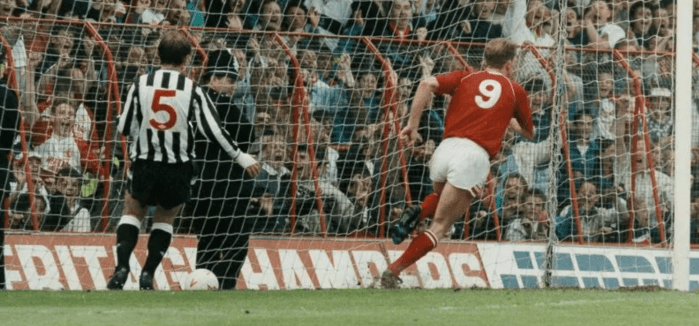
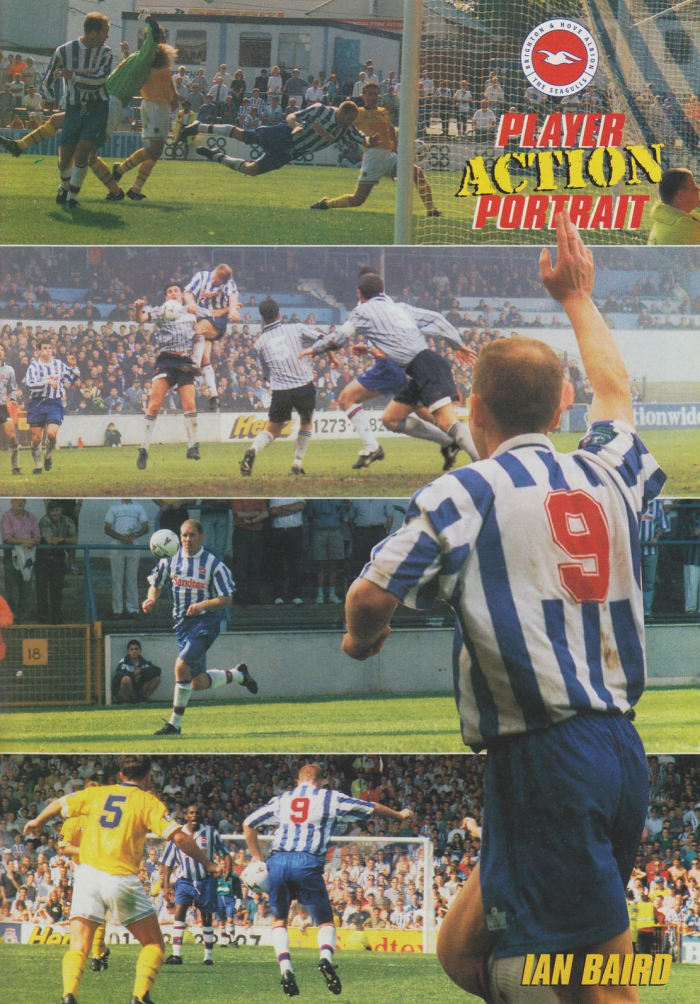

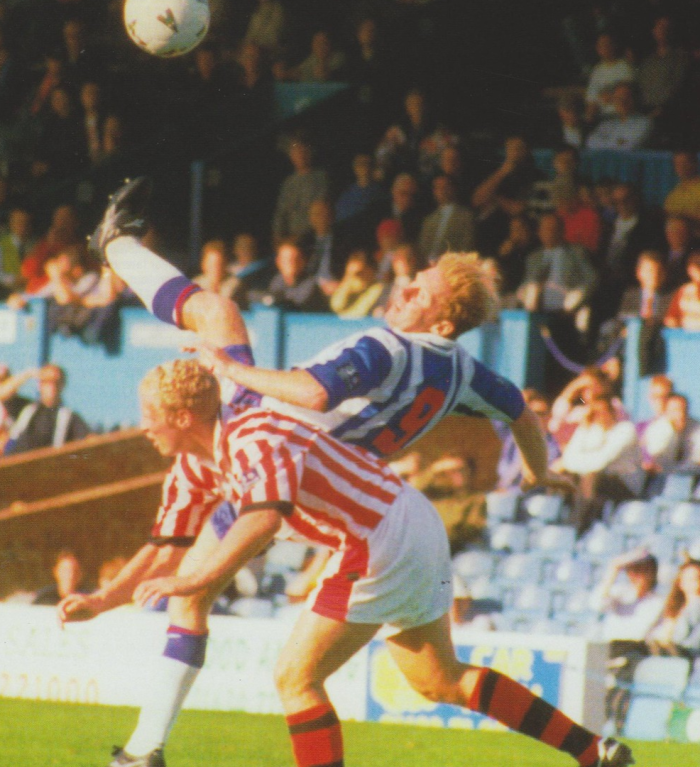


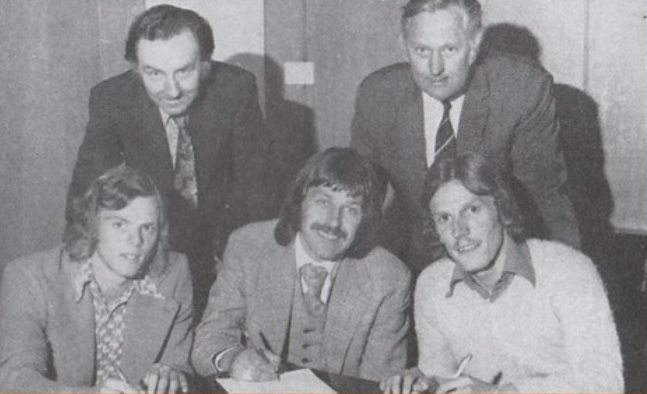


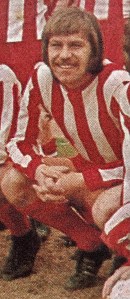


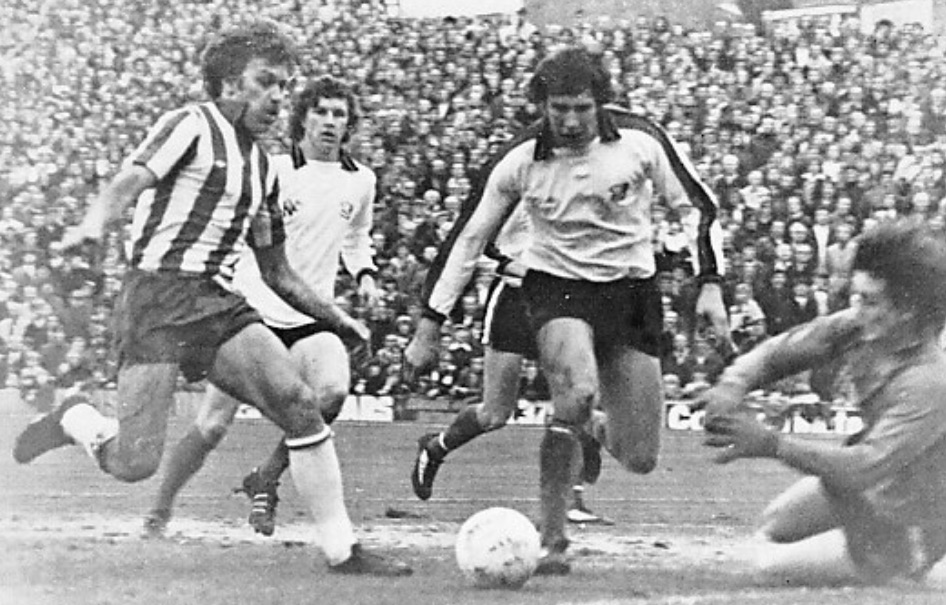


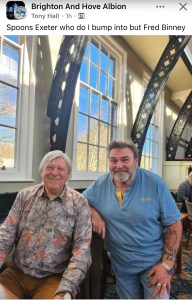
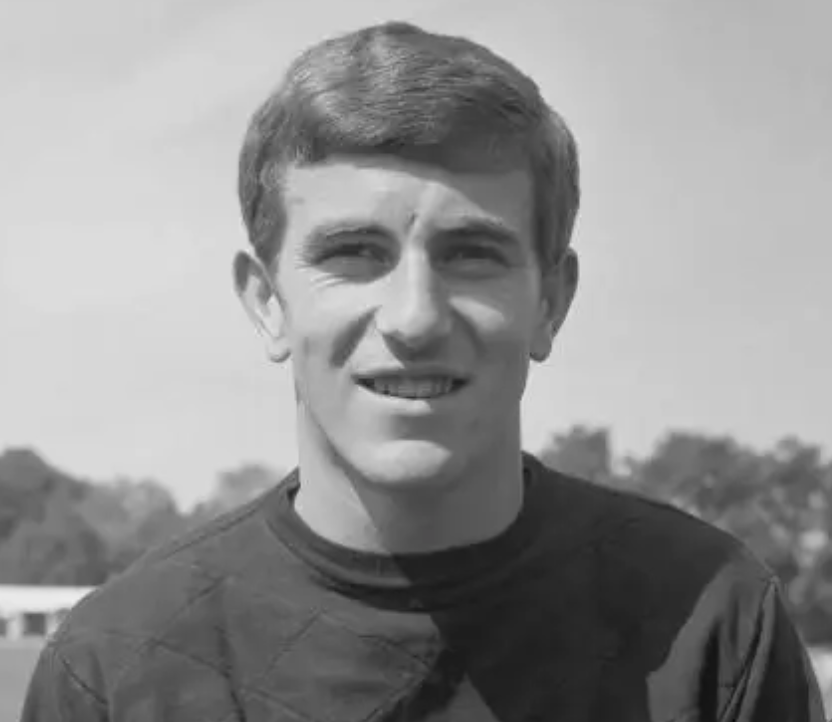
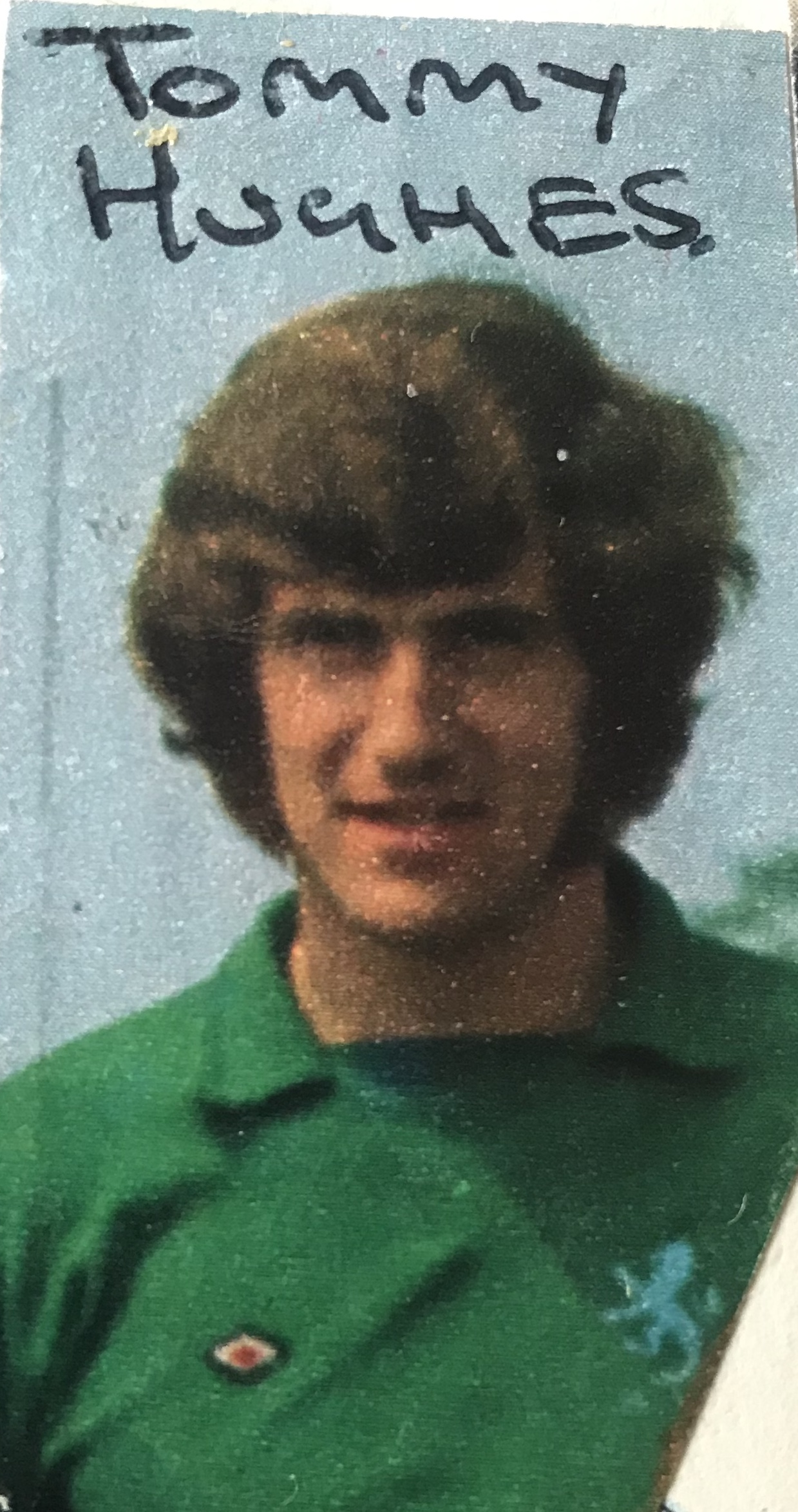


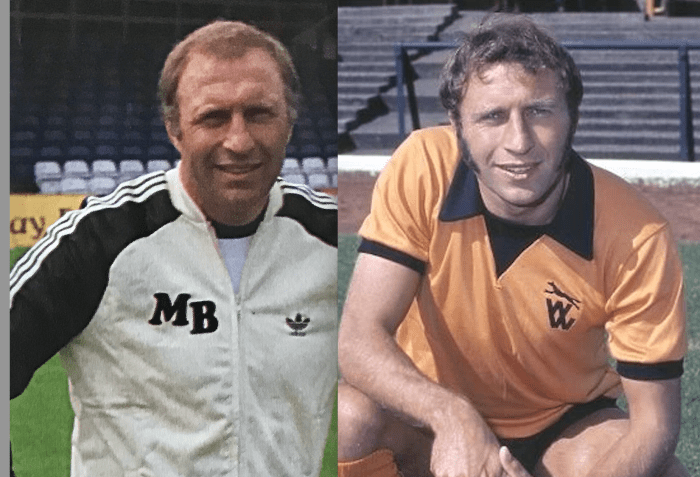


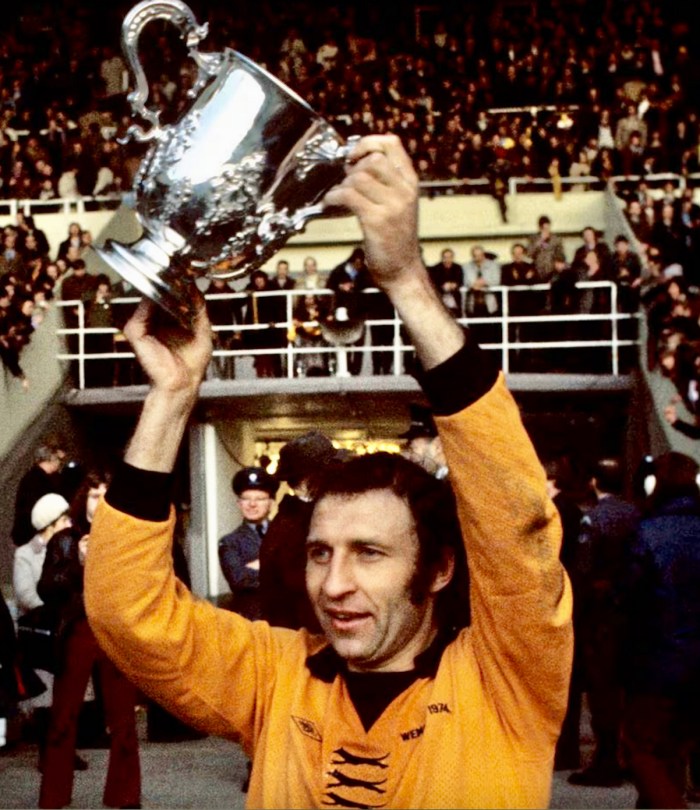


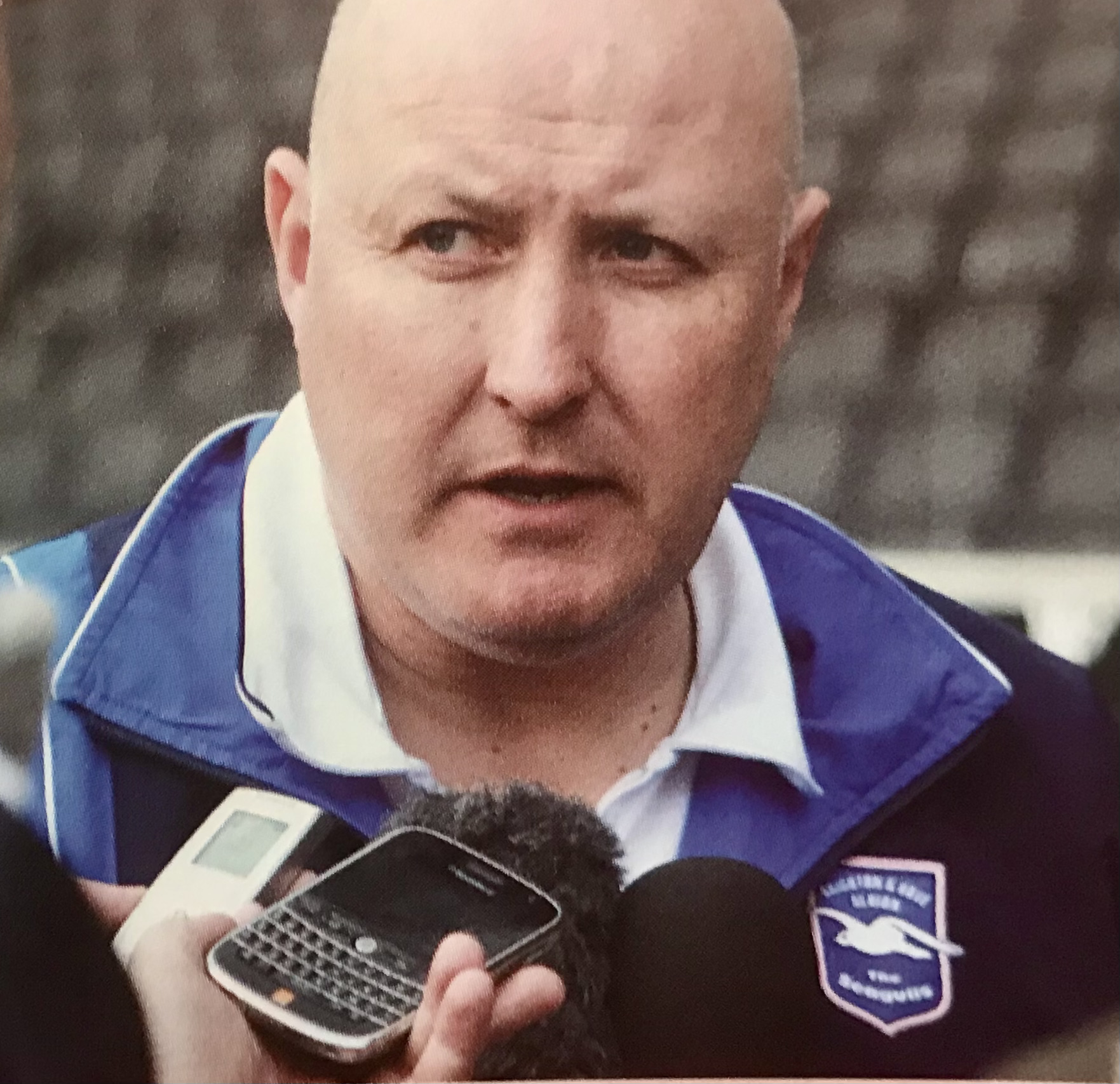




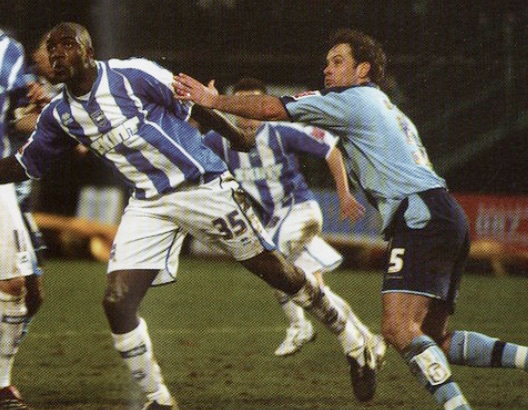


 He stayed on and helped coach the youth team alongside John Shepherd and with Moseley fully fit was not needed for first team duty (in those days, there were no substitute goalkeepers on the bench).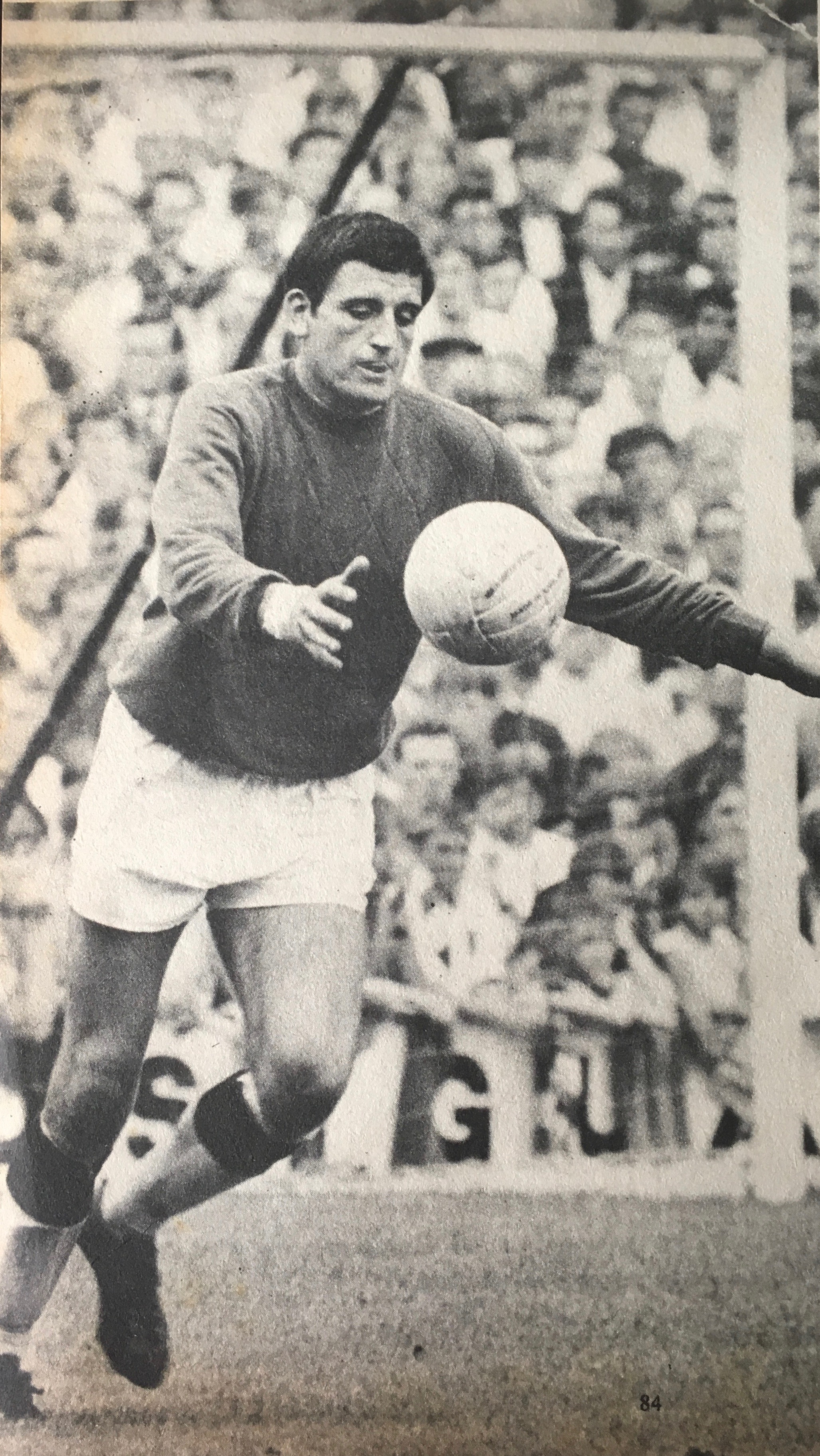

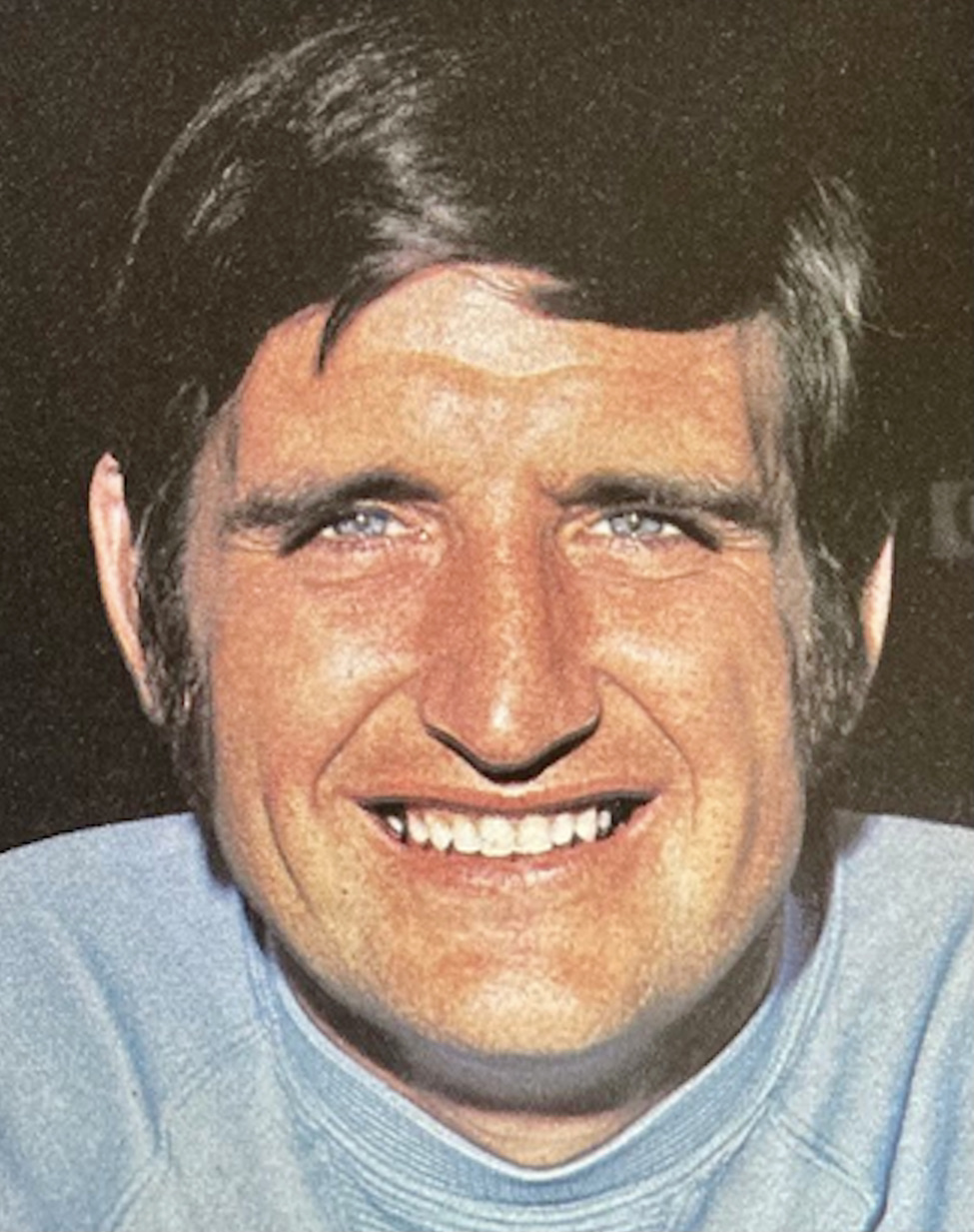
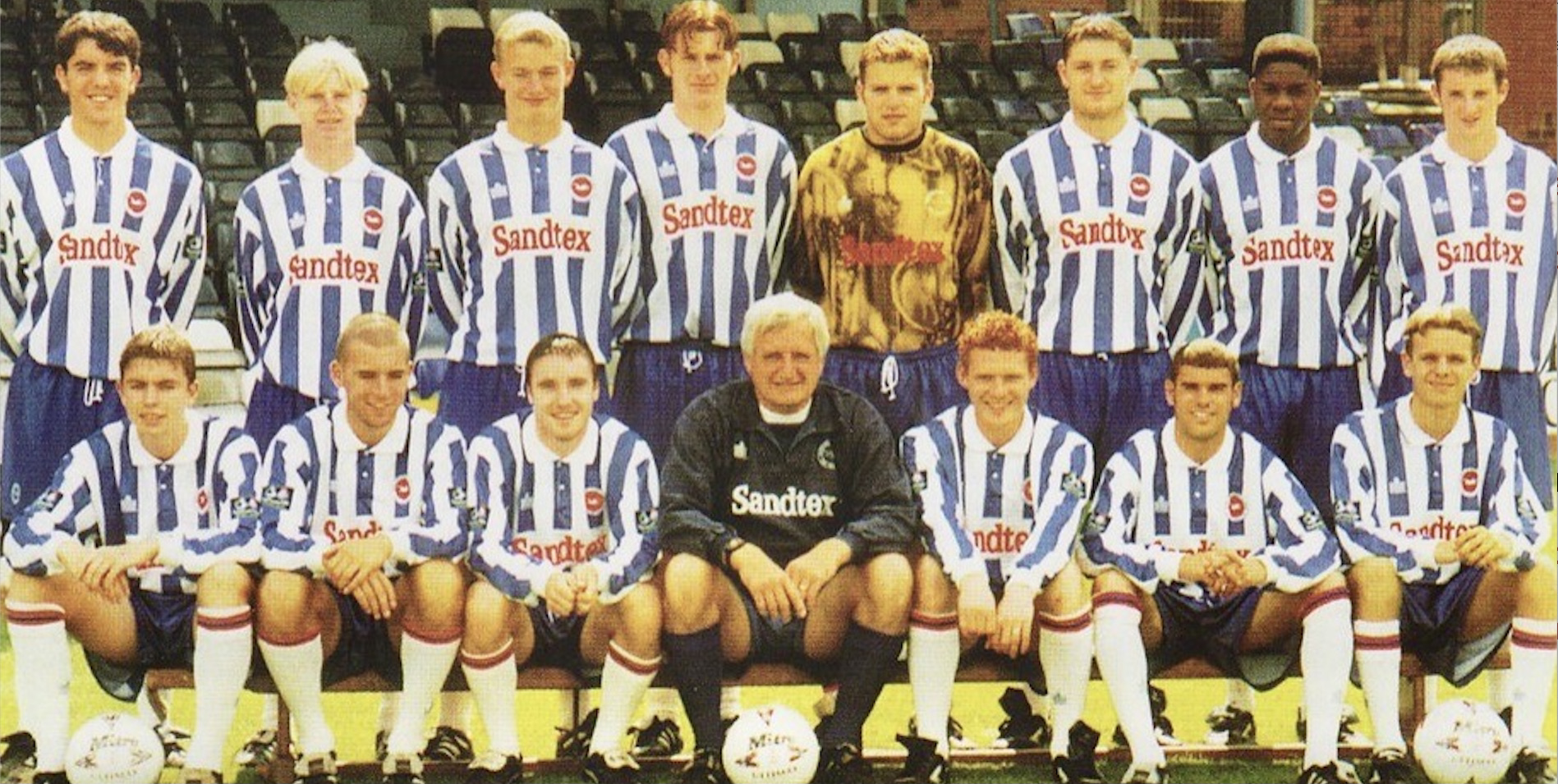

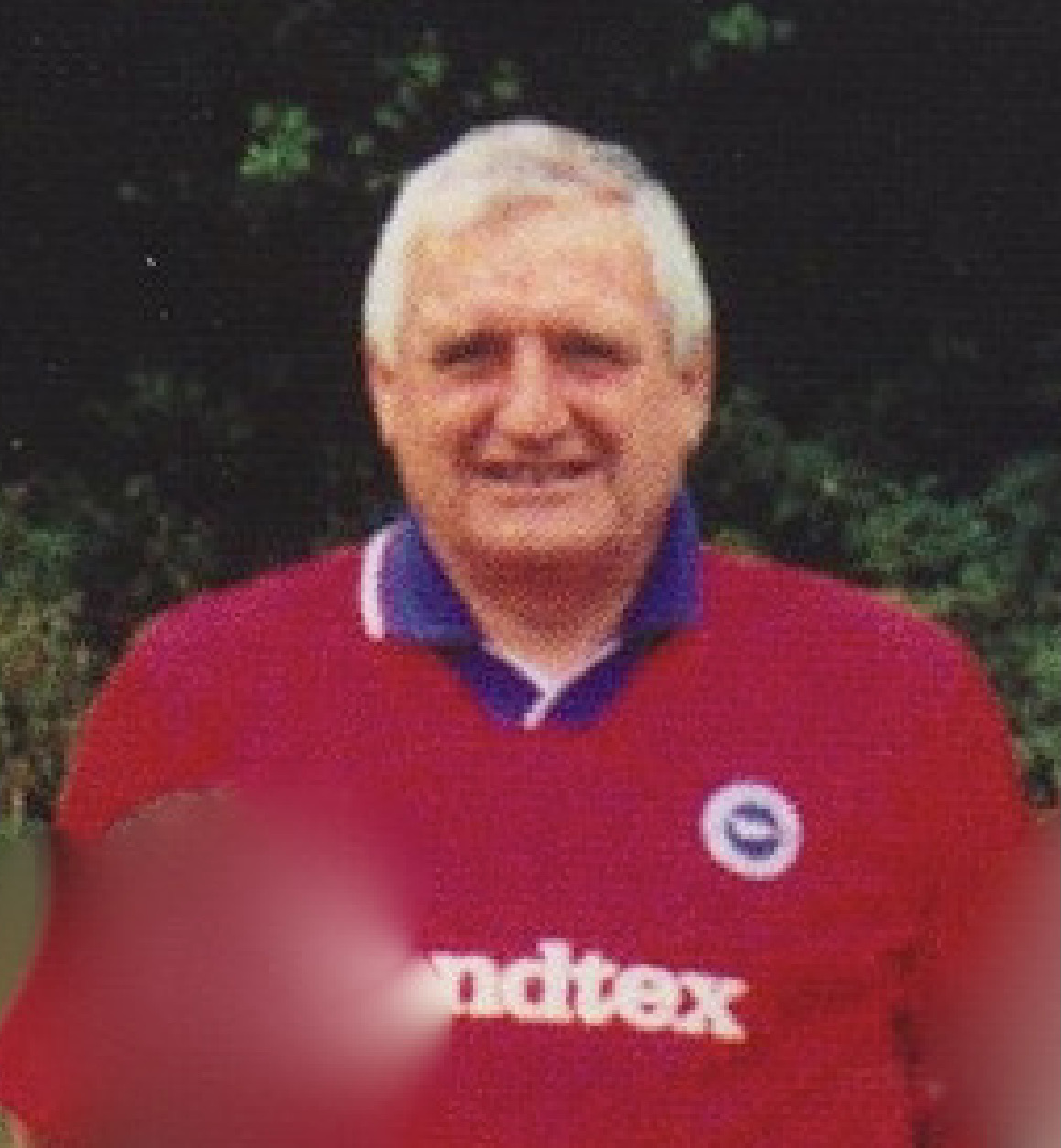


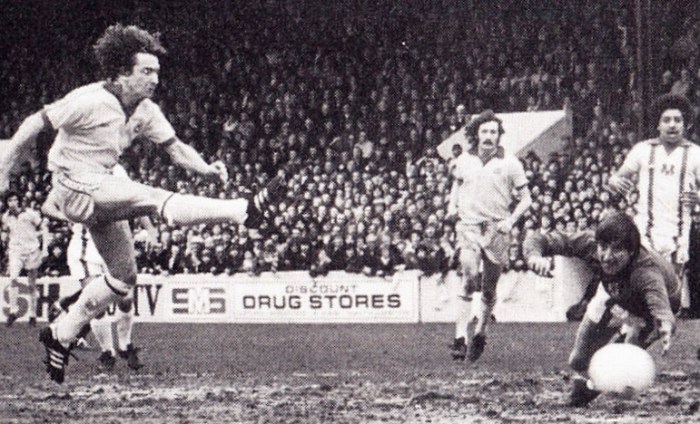
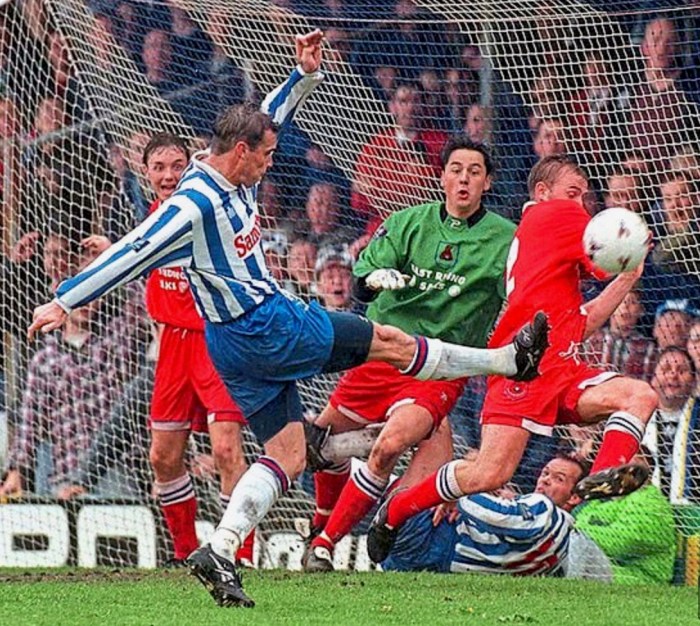
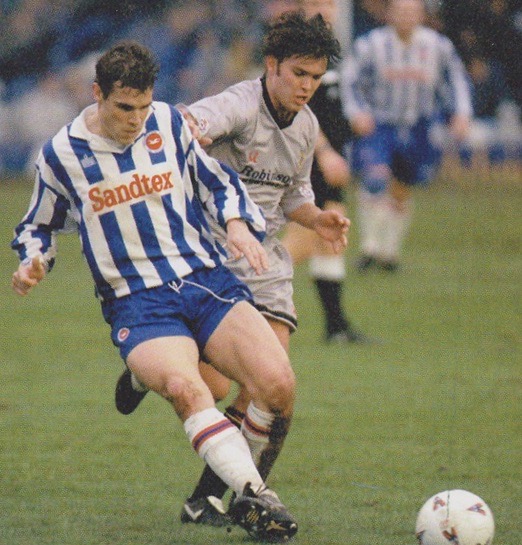

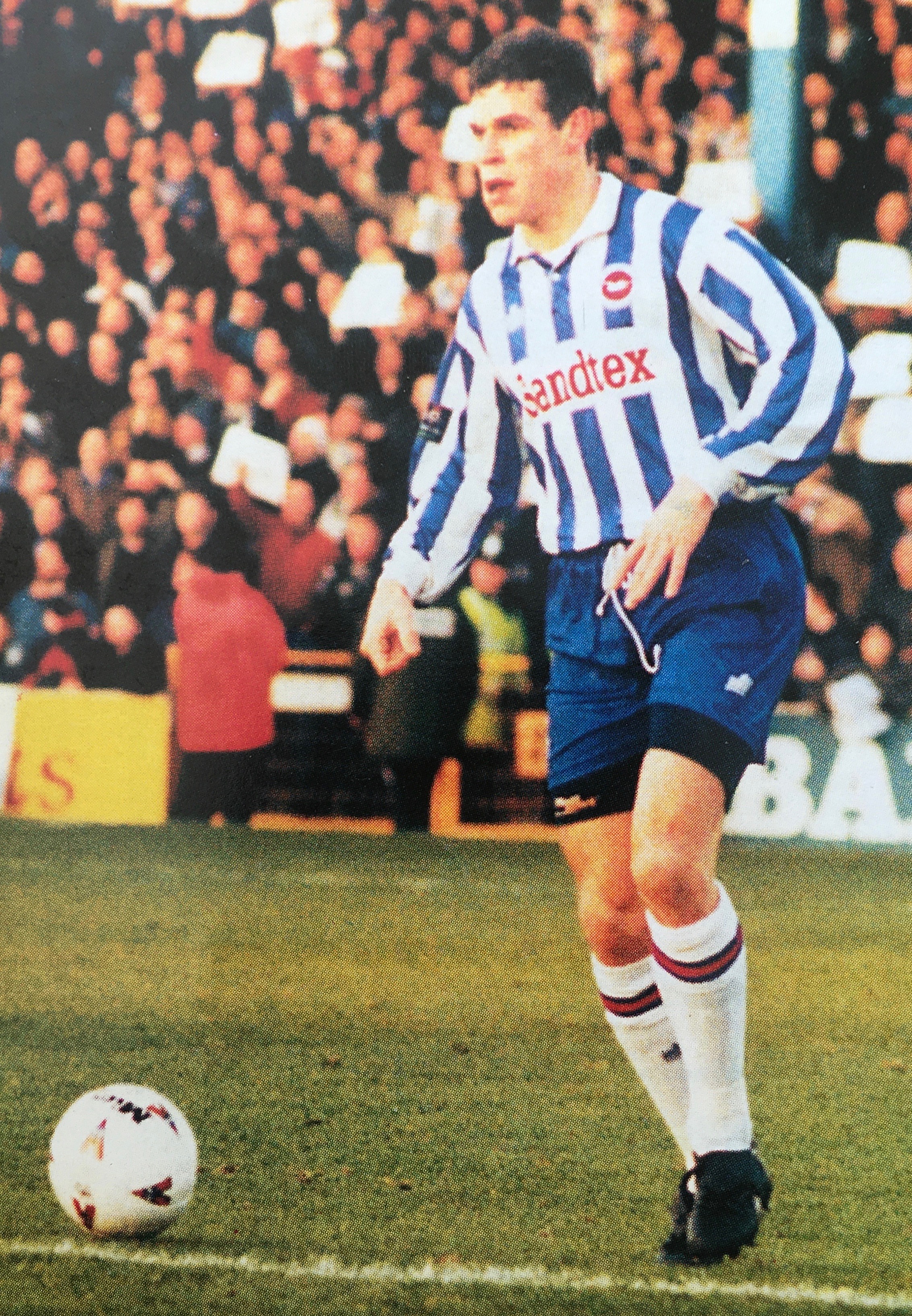

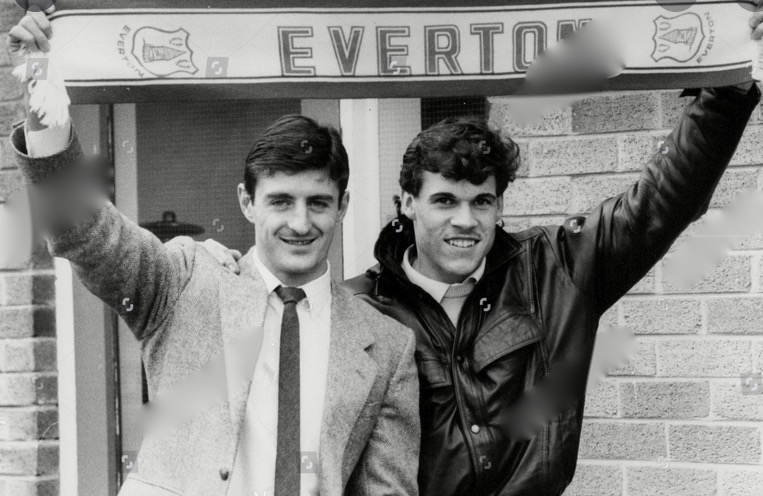
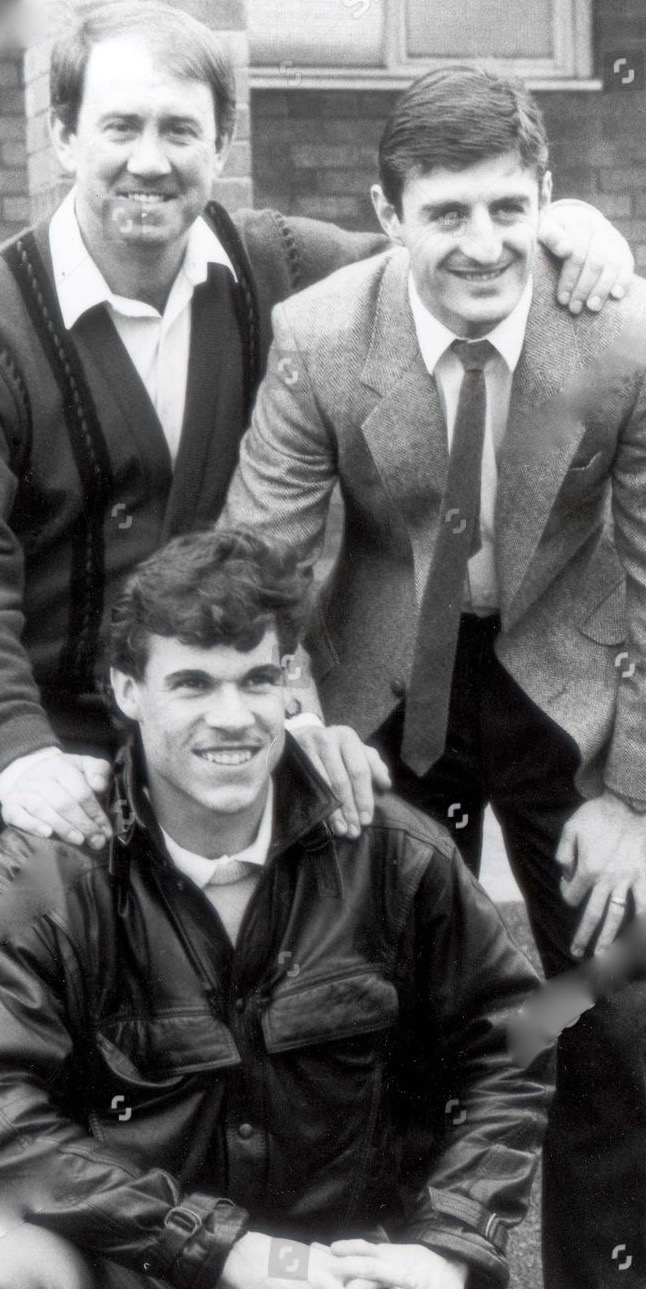


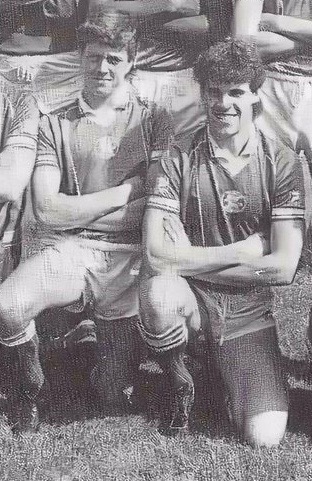

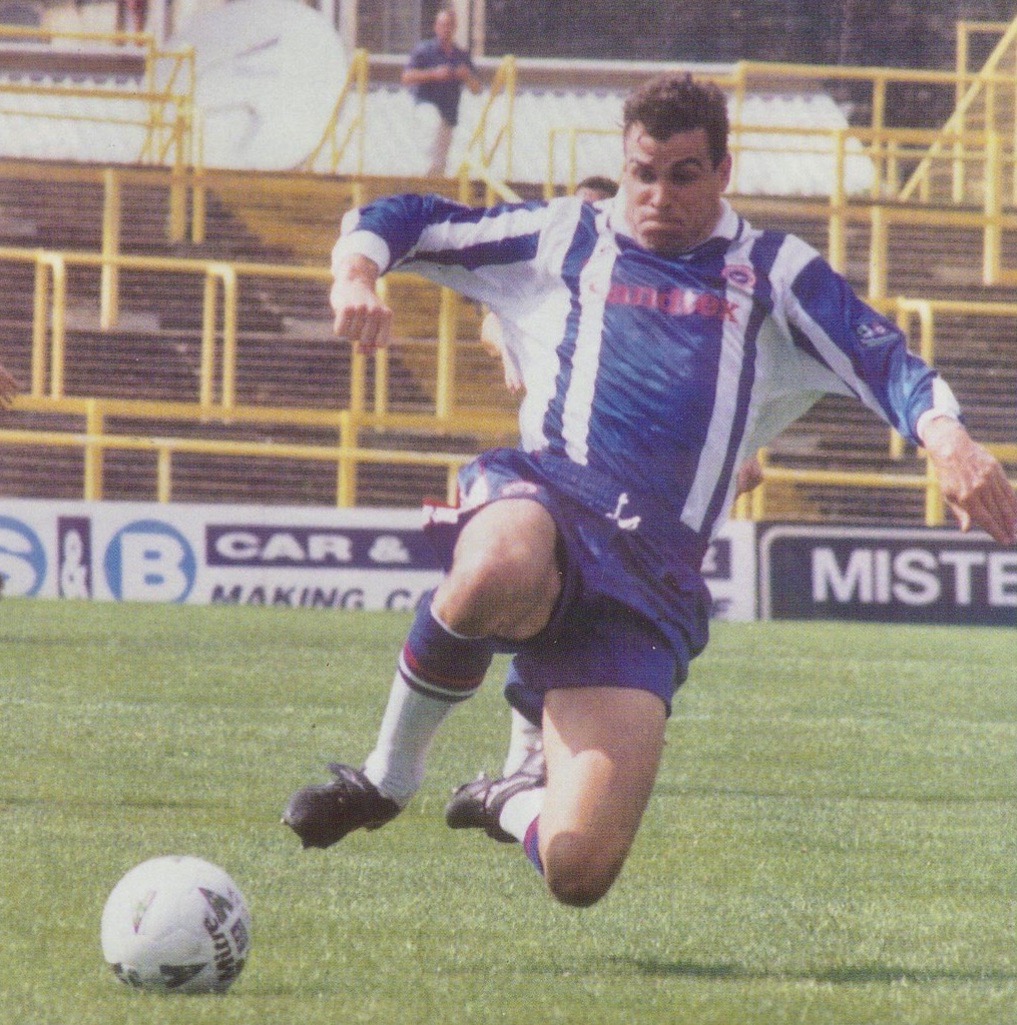
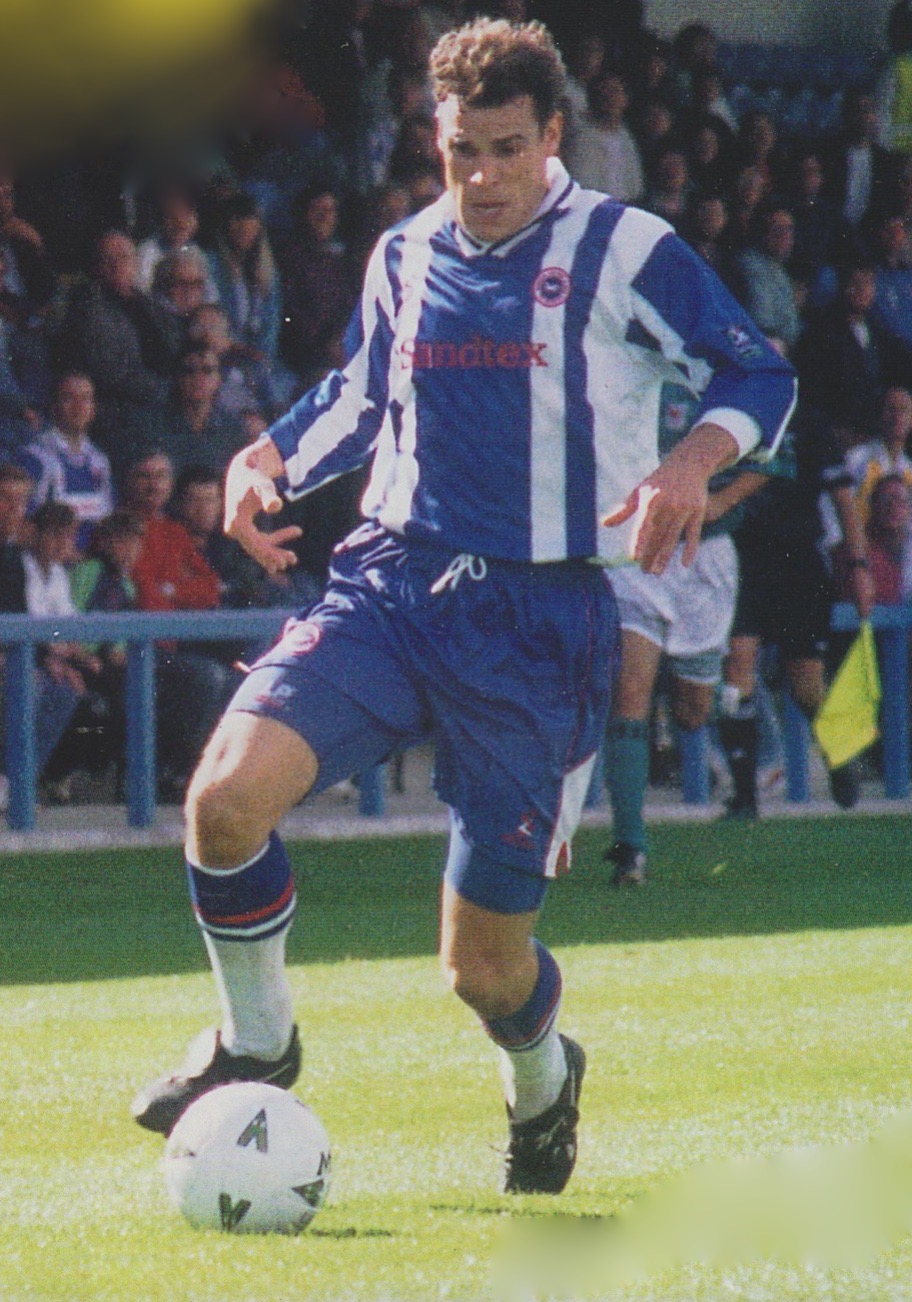
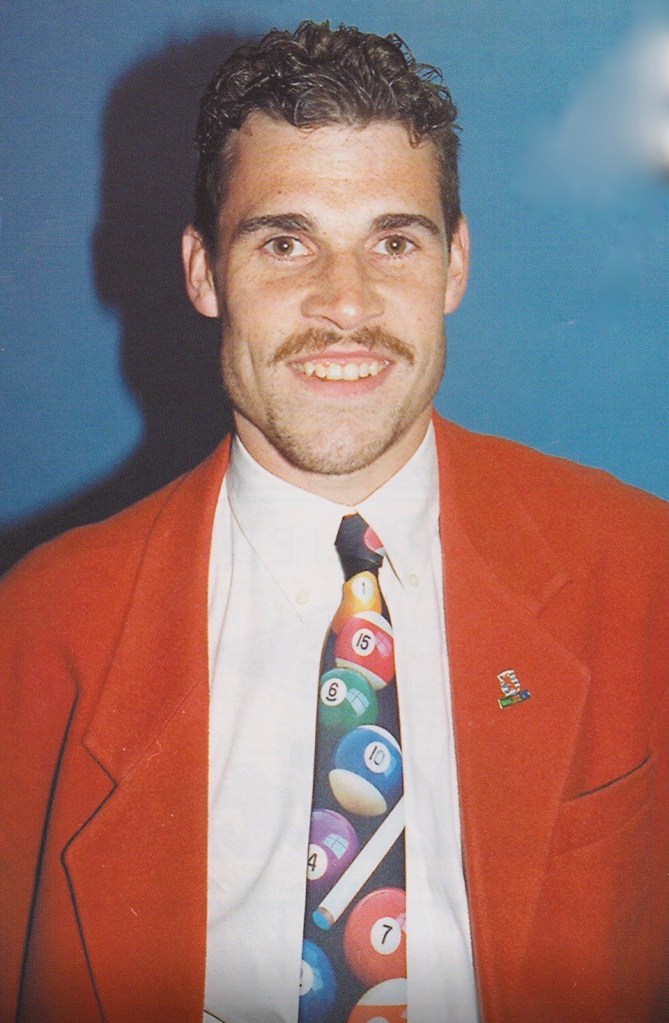
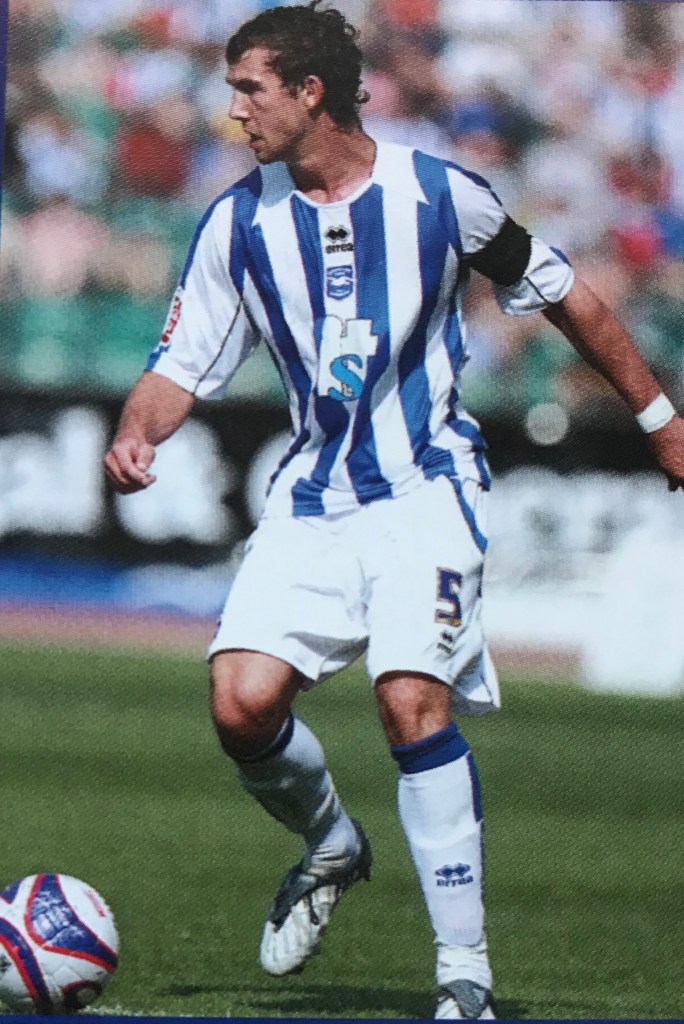
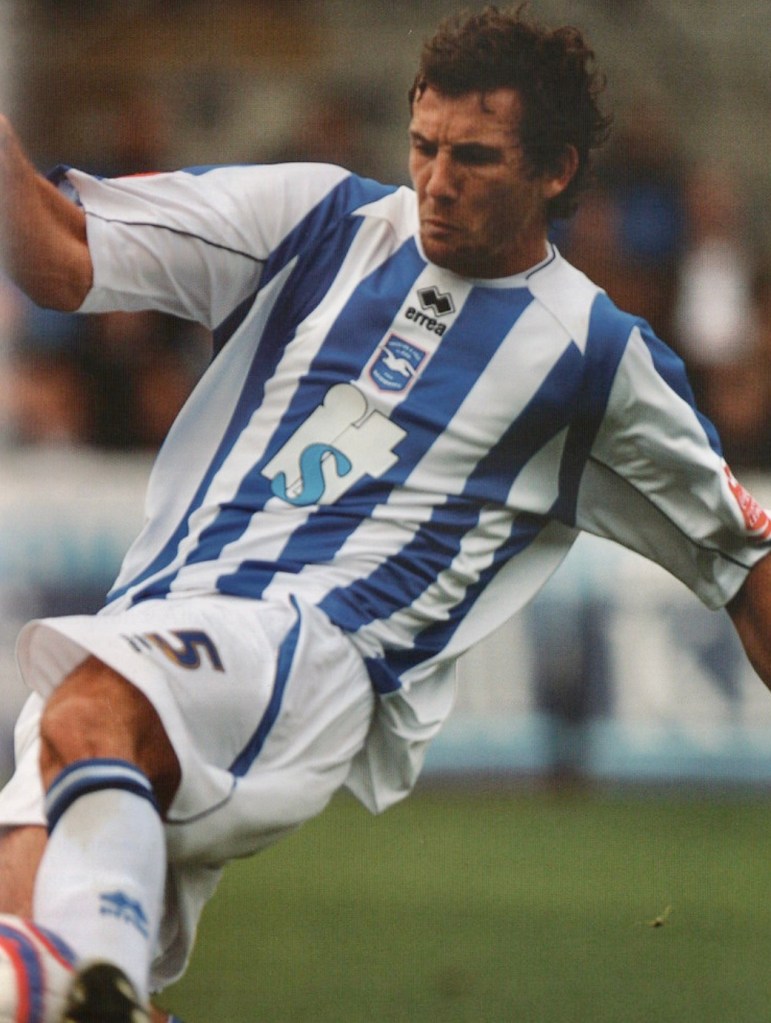
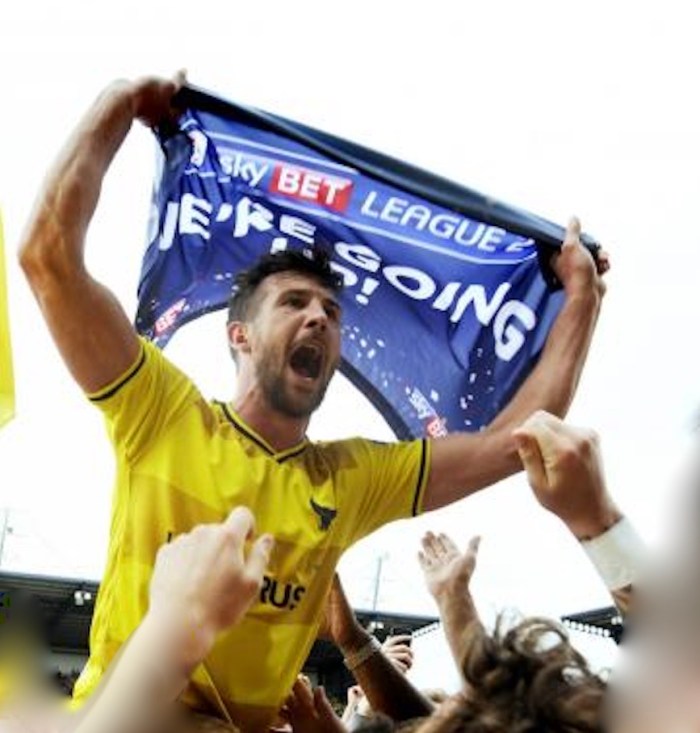

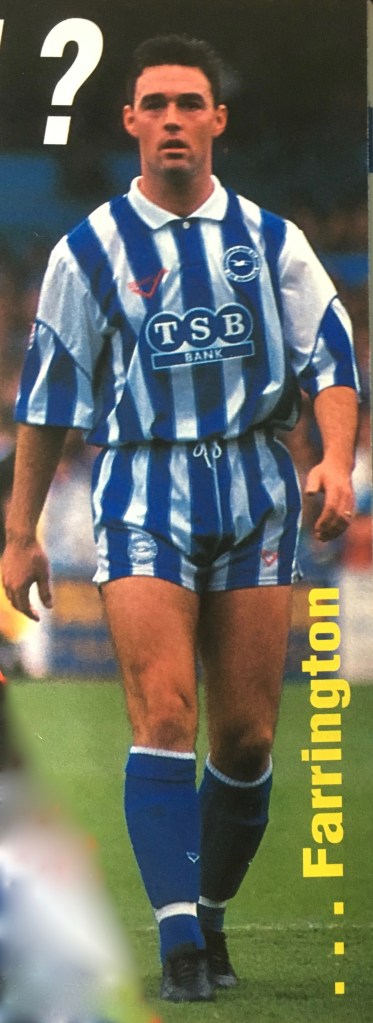


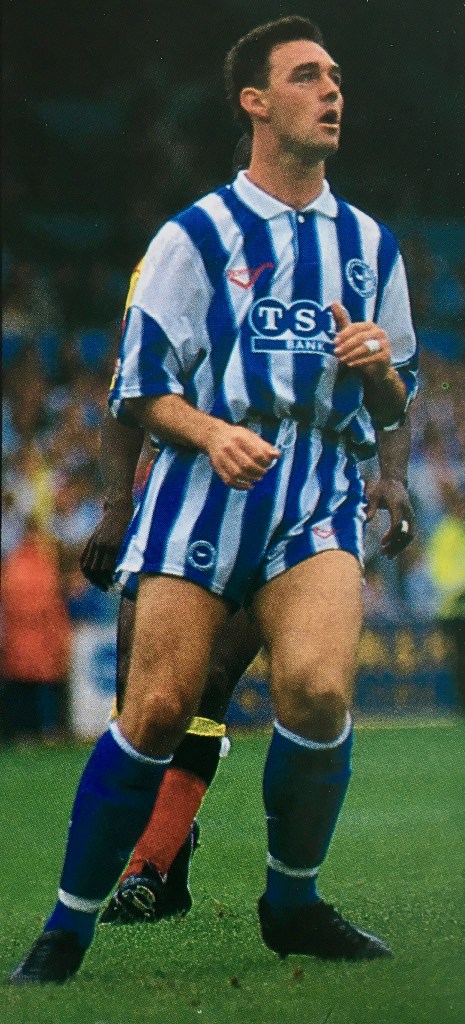

 In parallel lines