How Shots stopper Mark Beeney’s move saved the Albion

MARK BEENEY has coached young goalkeepers at Chelsea for nearly 20 years, but Brighton fans who saw him play remember his most important ever save.

The proceeds from his sale to Leeds United for £350,000 on 20 April 1993 quite literally saved the Albion from being wound up by the Inland Revenue.

Beeney had played 55 league and cup games in the Albion goal that season (missing only one because of a suspension) and he didn’t have much say in what happened next, as he remembered in an interview with the Argus in 2001.

“Albion were at Plymouth and the night before the game manager Barry Lloyd told me that he had given Leeds permission to talk to me and that he wanted me to negotiate a deal otherwise the club were history,” he said.

“I didn’t really have much choice because if I’d have turned down the chance I’d have been unemployed anyway with the financial situation at Albion.”

Howard Wilkinson, the former Albion winger who had led Leeds to the old Division One title the previous season, had been looking for a ‘keeper to compete with the ageing John Lukic, and Beeney fitted the bill….as well as footing the bill for Brighton where the taxman was concerned.

The move was certainly an upheaval in terms of geographical location but it presented Beeney with the chance to leap from third tier football into the Premier League.

It didn’t quite pan out as he might have hoped – most of his action was for Leeds’ reserve side! – but over the course of six years he played 49 games in the Premiership and 68 first team games in total for the Elland Road outfit.

Born in Pembury, near Tunbridge Wells, on 30 December 1967, Beeney went to St Francis Primary School in Maidstone then to St Simon Stock, a Catholic secondary school.

He first came to the attention of talent spotters when playing for Ringlestone Colts, a successful Maidstone junior side, and he was invited to join Gillingham, Kent’s only professional side at the time, as an associate schoolboy.

He made sufficient progress to be taken on as an apprentice by the Gills and turned professional in August 1985. He only played two first team games, though, and was given a free transfer by manager Keith Peacock.

Beeney, circled, when with the Maidstone United squad who won promotion to the league

He joined Maidstone United in January 1987 and, although they were in the GM Vauxhall Conference at the time, he helped them to gain promotion to the Football League in 1989.

His form for Maidstone led to international recognition when he played as a second half substitute for the England C (semi-professional) side in a 1-1 draw away to Italy on 29 January 1989. The game at Stadio Alberto Picco in La Spezia saw Fabrizio Ravanelli, a Champions League winner with Juventus seven years later, score the Italians’ goal.

Back at Maidstone, it wasn’t the best news for Beeney when Peacock arrived as manager. He ended up going on loan to Aldershot, where he played seven games. On his return, Maidstone’s goalkeeping coach Joe Sullivan recommended him to Brighton boss Barry Lloyd and the Seagulls paid a £25,000 fee to take him to the Goldstone in March 1991 as back-up to Perry Digweed.

Wheeler-dealer Lloyd had sold John Keeley to Oldham Athletic for £238,000 a year before – not a bad return for a player who cost £1,500 – and with the inexperienced Brian McKenna not really a meaningful challenger for Digweed’s place, Beeney was ideally suited to the Seagulls.

However, he had a rather ignominious start when, on 20 April 1991, Albion lost 3-0 at home to Oxford United but he kept a clean sheet second time around when he was between the sticks for a 1-0 win at Hull City before Digweed returned to star in the end-of-season excitement that culminated in a trip to Wembley for the play-off final.

Beeney’s third senior Albion appearance couldn’t have come in stranger circumstances, and I was at close quarters to witness it. I was a guest in the directors’ box at The Den, Millwall, on the evening of 4 September and tracksuited Beeney was sat a couple of rows behind me, having travelled but not been included in what in those days was a 13-man squad.
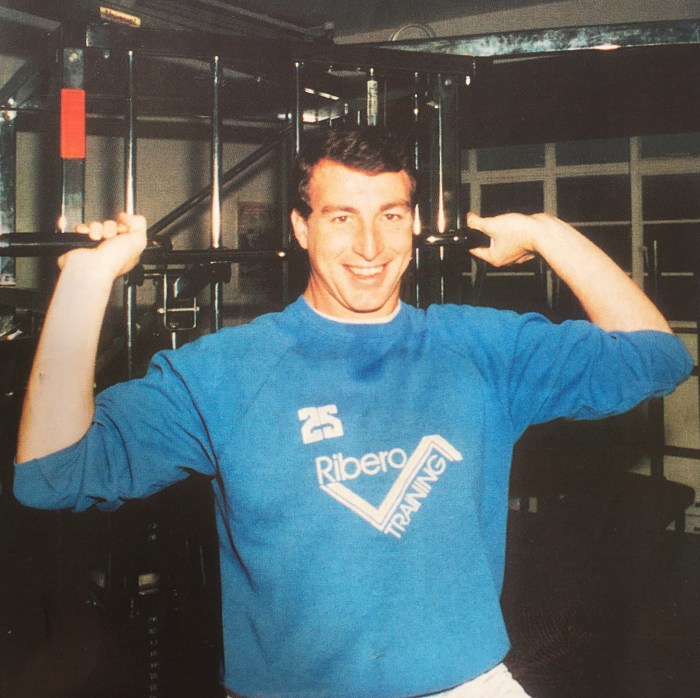
During the warm-up, Digweed suddenly pulled up with an injury and, after physio Malcolm Stuart attended to him, it was evident he wouldn’t be able to take part in the game. But the referee was poised to start the match, so the ‘keeper’s jersey was handed to Gary Chivers to go between the posts to avoid delaying the kick-off.

A discussion between the managers and the officials gave the green light to allow Albion to replace Digweed with a recognised ‘keeper and, although he hadn’t been due to be involved, Beeney was summoned from the stand to enter the fray as an emergency substitute.

Eight minutes of play had elapsed by the time he’d managed to leg it down to the changing room and get himself ready for action. John Crumplin, who had started the game in Chivers’ right-back slot instead of being on the bench, was forced to come off without having broken into a sweat, and a relieved Chivers resumed his more traditional defensive position.

Into the bargain, the eventful evening saw the Seagulls come away with a 2-1 win – their second successive victory at The Den, having won 2-1 there in the second leg of the play-off semi-finals four months earlier.

Digweed’s injury meant Beeney then had his first extended run in the side, playing in 30 of the following 31 league and cup games (loan American goalkeeper Juergen Sommer deputising in a 0-0 away draw at Cambridge United) before Digweed was finally restored to the no.1 spot in early February. Only five of the remaining 16 games were won and Albion were relegated back to the third tier.

When the new season got under way, Beeney had stepped up to become first choice ‘keeper, and, when interviewed in a matchday programme article, said: “I came as second string ‘keeper as I knew Perry was the number one but I have always wanted to establish myself and this season I have had my chance.”

As referred to earlier, his final Albion appearance came away to Plymouth on 17 April, and Beeney left the club having featured in 87 games plus that one as sub. He told the Argus he retained great affection for the Seagulls. “I remember it as a friendly club even though they didn’t have much to be cheerful about with the taxman trying to shut them down and the players were wondering whether they would get paid.

“There was a good spirit in the dressing room with experienced types like Fozzie (Steve Foster) and Johnny Byrne around the place who had seen it all before.

“I spent the least time there but it is the one former club that makes me most welcome. I appreciate that.”
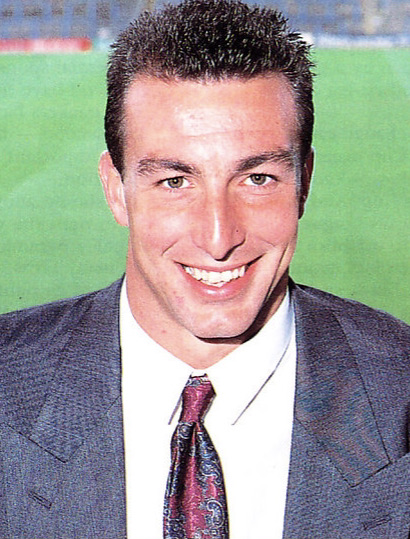
With Beeney transferred, Digweed returned for the final three games of the season, but the 3-2 home win over Chester turned out to be his last game for the club, and Albion began the following season with 18-year-old Nicky Rust as their first-team ‘keeper.

Because Beeney’s transfer had gone through outside of the window, Leeds gained special dispensation from the FA and their opponents, Coventry City, to allow him to make his debut in the final game of the 1992-93 season, there being nothing of consequence at stake with both sides comfortably sitting in mid-table.

Beeney conceded three in the game at Highfield Road but the game finished 3-3, diminutive Rod Wallace a hat-trick hero, rescuing a point for Leeds with goals in the 87th and 90th minutes to add to his first half strike.

In his first full season at Elland Road, Beeney shared the no.1 spot with Lukic, but the former Arsenal stopper had the upper hand in the following two seasons.

And just when Beeney thought he would make the breakthrough, Leeds signed Nigel Martyn from Crystal Palace to take over from Lukic.

Beeney told the Argus: “I thought I was going to be no. 1 and Paul Evans no. 2 in 1996 and both Paul and I were told a deal with Nigel was not going through. A couple of days later he had joined. I was disappointed. But I decided to buckle down as we were happy at the club and in the North with my family. I ended up playing more than 400 reserves games, I was hardly ever injured, and it was frustrating.”

Beeney handles ouotside the box at Old Trafford and is sent off

One time when he did get a start, against Manchester United at Old Trafford, on 14 April 1996, he was sent off after 16 minutes! Wilkinson never picked a sub keeper, so defender Lucas Radebe had to go in goal.

The excellent Leeds archive website ozwhitelufc.net.au remembers Beeney as:A big keeper, his meticulous planning left him well prepared as he keenly watched videos of potential penalty-takers. He proved a capable deputy for John Lukic, taking over from him when his form dipped. His contract was extended in June 1996 for a further two years, but he had to retire due to injuries sustained in a reserve game at Stoke City when he ruptured an Achilles tendon in March 1999.”

In fact, he ruptured it twice in the space of eight months, he told the Argus, and he quit playing professionally after taking the advice of Leeds’ boss at the time, David O’Leary, whose own career had ended with a similar injury.

“The medical people said the Achilles would not hold up to what was needed at the level I was at,” he said. “I sought a second opinion afterwards and was told the Achilles was strong but it’s so short it doesn’t give me the spring I need to play at the top.”

Beeney set up an executive chauffeur business – Victoria Beckham was among his clients – but a former playing colleague at Aldershot, Steve Wignall, had taken over as manager at Doncaster Rovers, and offered him a return to playing.

“I just wanted somewhere to train,” Beeney told the Argus. “He (Steve) said they needed cover as a goalkeeper so I might as well sign on. I played four reserve games and was substitute for the first team.”

Eventually, after eight years living in Yorkshire, Beeney moved the family back to Kent so sons Mitchell and Jordan could be nearer their grandparents. He linked up with Dover Athletic as a back-up ‘keeper and played in a couple of pre-season friendlies but was mainly standby to first choice Paul Hyde.

In October 2001, he switched to Sittingbourne as manager, and also began working two days a week with the young goalkeepers at Chelsea (under 21s, under 17s and under 16s).

He left Sittingbourne in 2004 when the role at Chelsea was made a permanent position, and he’s been coaching the Premier League club’s reserve and academy ‘keepers ever since, although he did work with the first team ‘keepers temporarily when Jose Mourinho was in charge in 2007.

Beeney the goalkeeping coach pictured in 2010

Both his sons went through the Chelsea academy as goalkeepers. Mitchell was at Chelsea from 2007 until 2018. He came close to first-team action as a non-playing substitute for a home 1-1 draw with Liverpool in May 2015, which he spoke about in an interview with the42.ie and he did get to play league football out on loan at Newport County and Crawley Town. When he finally left Chelsea, he moved to Ireland to play for Sligo Rovers and returned to the UK in 2019 to join Hartlepool United.

Younger son Jordan left Chelsea in 2014 after seven years and joined Charlton Athletic where he spent four years before being given a free transfer.

Pictures from Albion matchday programmes and online sources.

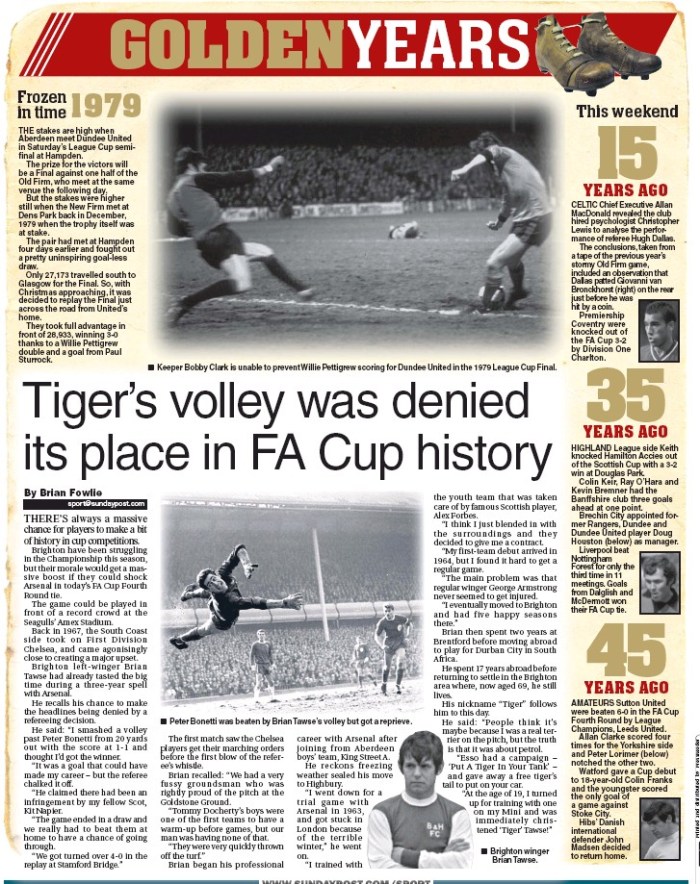
The Tiger who came to Brighton and fitted to a T

DIMINUTIVE winger Brian Tawse is remembered by veteran Brighton fans for his boyish good looks…. and a stunning disallowed goal.

It perhaps does a disservice to the fact he played 109 games (plus five as a sub) in the second half of the swinging Sixties after joining the club from Arsenal.

Tawse spent two years with the Gunners and made a handful of first-team appearances but with George Armstrong ahead of him it wasn’t until he joined the Albion that he began to play regular league football.

It was a cracking strike by Tawse in the closing minutes of a FA Cup fourth round tie against Chelsea in January 1967 that stuck in people’s memories.

In front of a packed Goldstone Ground crowd of 35,000, a big upset looked on the cards when Tawse’s terrific volley flew past Peter Bonetti five minutes from the end of the game for what would have been a 2-1 win.

Unfortunately, the referee had spotted an infringement by Kit Napier and the ‘goal’ was disallowed. In the replay at Stamford Bridge, Chelsea ran out clear 4-0 winners.

“I smashed a volley past Peter Bonetti from 20 yards out with the score at 1-1 and thought I’d got the winner,” Tawse told Brian Fowlie of the Sunday Post in 2015, ahead of Brighton’s fourth round FA Cup tie with Arsenal. “It was a goal that could have made my career – but the referee chalked it off.”

Tawse had been with the Albion for just over a year when that cup tie came around. He was one of three ex-Arsenal players in the side: the Northern Ireland international full-back Jimmy Magill joined Albion in October 1965, Tawse followed him two months later, and goalkeeper Tony Burns joined in the summer of 1966.

Albion’s boss at the time was fellow Scot Archie Macaulay, a former Arsenal player himself, who during his time at the Gunners had persuaded them to sign Alex Forbes, who later became the coach Tawse played under in Arsenal’s youth team. But more of that later.

Tawse got his first Brighton goal in only his second game, a 4-3 home win over Bristol Rovers on New Year’s Day 1966, and he went on to score six in 22 matches as the Albion finished 15th in Division 3.  

Although he started the next season in the no.11 shirt, close season arrival Howard Wilkinson became an automatic choice on one wing and Tawse found himself competing with Wally Gould for a place on the other.

Aside from the excitement of that Chelsea cup game, Tawse did find the net eight times (three times from the penalty spot) as he played in 28 games (+ one as sub) that season.

The winger couldn’t always be relied on from 12 yards, however, as contributor ‘Questions’ recalled on North Stand Chat in 2008. “Ah Tiger Tawse, he of the boyish good looks and ability to blaze a penalty over the north stand roof against Watford, I think. Good little player though….”

The majority of Tawse’s Albion games (41 + 1 sub) came in the 1967-68 season although he only scored twice as Albion finished 10th.

The signing of Paul Flood from Bohemians added forward options to the manager’s selection, but it was the £5,000 signing of speedy Dave Armstrong from Millwall in September 1968 that began to edge Tawse out.

Tawse (arrowed) in an official Albion team photo ahead of the 1969-70 season

In the 1968-69 season, which saw the arrival of Freddie Goodwin as manager in place of Macaulay, Tawse made only 16 appearances (+ three as sub), and he featured only twice between the start of December and the end of the season.

My own Albion watching journey began in February 1969 and the only game I saw Tawse play was in the Easter Saturday 4-1 win over Barnsley when he replaced Kit Napier; the only change to the side who had played 24 hours earlier, again at home, when Orient were beaten 2-0.

Goodwin mostly went for Armstrong on the left and Wilkinson on the right.

By the time the 1969-70 season arrived, opportunities were even more limited for Tawse. He was only on the bench once and started just two, his last first-team appearance coming in a 2-0 defeat away to Tranmere Rovers on 25 October 1969.

Former Albion teammate Wilf Tranter writing on North Stand Chat, said: “Brian finally lost the no. 11 shirt to Kit Napier in the 1969-70 season. He had been a very good servant to the club and was regarded with great affection by many supporters.”

Tawse with rival Kit Napier who became a good friend

Born on 30 July 1945 in Ellon, just north of Aberdeen, his footballing talent was first spotted while playing for Aberdeen boys’ team, King Street A. He told the Sunday Post’s Fowlie how the big freeze in 1963 worked in his favour.

“I went down for a trial game with Arsenal in 1963 and got stuck in London because of the terrible winter,” he said. “I trained with the youth team that was taken care of by famous Scottish player Alex Forbes.”

Forbes had joined Arsenal just after the war on the recommendation of fellow Scot Macaulay, whose place in the side he subsequently took over.

When Forbes later became youth coach at Arsenal, he took a party of Arsenal youngsters on a summer tour to South Africa, got offered a coaching job in Johannesburg and decided to make it his home for the rest of his life.

Tawse (centre) between George Armstrong and Jon Sammels in an Arsenal line-up, with Magill (far left) and Billy Wright

Billy Wright, the former England captain who’d won 105 caps for his country, was manager of Arsenal in the mid-’60s and it was he who took Tawse on as a professional.

Wright may have been a legend as a player but one of Tawse’s fellow Highbury hopefuls, John Ryan, who later starred for Fulham, Luton Town and Norwich City, was not at all enamoured.

Looking back in an interview with a Norwich archive site, he said: “Billy Wright was the only manager of the 12 I ended up playing for who I neither liked nor respected.

“He seemed to take an instant dislike to me and would single me out for some vicious treatment in front of the other young players.”

Ryan shared digs with Tawse and David Jenkins and he recalled how he found out Arsenal were letting him go. “At the end of that season (1964-65), I was sitting in the digs when two large brown envelopes and one small registered white one dropped through the front door. As I opened the small white one that was addressed to me, I wondered where the other two lads had disappeared to.

“It turned out that they’d read the situation as my letter was from the club notifying me I was being given a free transfer whilst the two brown envelopes that were for them both contained contract offers.”

Tawse made his Arsenal debut away to West Brom on 21 November 1964, a game which finished 0-0. Although his first team game time was limited, in the space of three days in February 1965 he played in successive 2-0 wins at home to Fulham and Spurs and at the end of the following month against West Ham away, another 0-0 draw.

Away to Nottingham Forest on 13 March 1965, Tawse took George Armstrong’s place on the wing – and the aforementioned Magill earned a rare outing in place of Don Howe at right back – but they lost 3-0.

Brian Tawse alongside George Armstrong, the winger he couldn’t dislodge to gain a regular Arsenal place

Although the official record books only show those league appearances, thearsenalhistory.com details how Tawse also played twice in an end of season five-game tour in Italy. He played in a 2-2 draw against Torino and was one of the scorers in a 3-0 win over Latina.

The following season he was selected in a 5-2 friendly win over non-league Corinthian Casuals on 21 September and a month later –  on 23 October 1965 –  he was on the substitute’s bench in a 2-2 home draw against Blackburn Rovers, but that was the last of his involvement, and he moved to Albion five weeks later.

“The main problem was that regular winger George Armstrong never seemed to get injured,” Tawse told the Sunday Post.

He also dispelled a myth about how he came to get his nickname Tiger, telling the reporter: “People think it’s maybe because I was a real terrier on the pitch, but the truth is that it was about petrol.

“Esso had a campaign – Put a Tiger in Your Tank – and gave away a free tiger’s tail to put on your car.

“At the age of 19, I turned up for training with one on my Mini and was immediately christened ‘Tiger’ Tawse!”

After leaving Brighton in March 1970, Tawse moved to Brentford where he played in 13 games as new manager Frank Blunstone took the Bees to within three points of promotion from Division Four, finishing fifth just behind Port Vale.

But in the 1970-71 season he made just eight appearance (plus two as sub) and ended up on loan to Southern League Folkestone.

Still only in his mid 20s, he decided to head to South Africa and played for Durban City at a time when dozens of British players, managers and coaches were recruited by that country’s 16 clubs.

He was later joined there by former Albion teammate and fellow Scot Kit Napier and after they hung up their boots, they worked together in the motor trade.

When Napier died in March 2019, Tawse told The Argus: “We remained friends afterwards and we were both golfers. He was a very good golfer, which people probably don’t realise. He played in a lot of pro-ams.

“He was a good lad and, of course, a bit of a legend for what he did with Brighton.”

Tawse spent 17 years in South Africa but returned to the UK and settled in Westdene, Brighton…and watches the Albion from the West Stand at the Amex.

Ex-Clarets boss Steve Cotterill not always ‘Mr Popular’

FORMER Burnley manager Steve Cotterill hasn’t always been popular during a nomadic football career that’s taken him the length and breadth of the country.

But he made a lasting connection with Brighton fans after impressing during an all-too-brief playing spell in 1992.

“I thoroughly enjoyed my time at Brighton and, whenever we’ve gone there, I’ve always had a great reception from their supporters. They’ve been terrific,” he wrote in his programme notes prior to a Cheltenham v Brighton fixture.

Injury curtailed Cotterill’s playing career – he endured 18 knee operations – but he made up for it by taking charge of nine different clubs over a period spanning more than 20 years.

His three years and seven months keeping Burnley in the second tier while seeing key players sold or injured was largely recognised as a decent achievement in the circumstances. Many of his other appointments were a lot shorter, and at times acrimonious.

Starting out as a player on the non-league circuit, it was Cotterill’s prolific scoring for Burton Albion (44 goals in 74 games) that prompted Wimbledon to snap him up in 1989.

Unfortunately, he sustained a serious cruciate ligament knee injury that halted his progress with the Dons and Albion boss Barry Lloyd gave him a lifeline to try to resurrect his career with the Seagulls.

Against a backdrop of financial instability, Lloyd had struggled to find adequate replacements for the prolific Mike Small and John Byrne in the 1991-92 season. Mark Gall, signed from Maidstone, offered a glimmer of hope, but Raphael Meade and Mark Farrington were disappointing to say the least, and Albion had been relegated back to the third tier a year after being one game from winning their place back amongst the elite in a play-off final against Notts County.

As the 1992-93 season got under way, Gall was unavailable due to a knee injury that eventually forced him to retire, Meade had departed and questions continued over Farrington, so Lloyd turned to loan signings Cotterill and Paul Moulden from Oldham Athletic.

It looked like he’d cracked it as the pair combined well and started scoring goals. Indeed, Cotterill scored four in 11 games, which was a promising start. Unfortunately, parent club Wimbledon wanted the sort of fee for him that cash-strapped Albion couldn’t afford, so he returned to south west London and eventually moved on to Bournemouth the following summer for £80,000.

In an interview with the Argus in October 2016, Moulden told Brian Owen: “One of the reasons I loved playing for Brighton was Mr Banter himself, Steve Cotterill. We met up like we had never been apart. I’d start the banter and he’d finish it or vice versa.

“We destroyed many a centre-half partnership during that three months. I was gutted to leave. I mean that very sincerely – absolutely gutted. I couldn’t believe nobody would have bought me and Steve as a pairing.

“We were both out of favour with our clubs and we hit it off so well. But it wasn’t to be – at Brighton or at any club.”

Born in Cheltenham on 20 July 1964, Cotterill’s injury-ravaged playing career came to a close at Dean Court. He’d won the player of the year title three times and scored 18 goals in 55 starts for the Cherries, but another knee injury finally put paid to his playing career, and he turned his attention to managing.

His first assignment was in Ireland where he succeeded his former Wimbledon teammate Lawrie Sanchez at League of Ireland’s Sligo Rovers. But his hometown club Cheltenham Town offered him a management opening back in England in 1997, and he steered them from Southern League football into the Conference and then into the bottom tier of the Football League. He twice won the Manager of the Year title and earned another promotion, to the third tier, via a play-off final victory over Rushden & Diamonds.

After leaving Cheltenham, Cotterill had a controversial five-month, 13 game stay as Stoke City boss at the start of the 2002-03 season before quitting to join Sunderland as Howard Wilkinson’s no.2. In May 2020, Cotterill endeavoured to explain to the Stoke Sentinel the circumstances surrounding his tenure, and the board interference regarding players.

The stay on Wearside was also short lived, with the pair being dismissed after only 27 games in March 2003.

The collapse of ITV Digital coincided with Cotterill taking over from Stan Ternent as Burnley manager in the summer of 2004. When he joined, they had only eight players on the books and, despite reassurances to the contrary, within six months Robbie Blake and Richard Chaplow, who he’d hoped to build a team around, had been sold.

When Blake’s replacement Ade Akinbiyi started scoring on a regular basis, he too was sold, and when he returned to the club later, he wasn’t the same player in front of goal.

Even after Cotterill had left, Burnley directors acknowledged the platform he’d provided for their eventual elevation to the Premier League under Owen Coyle.

The excellent uptheclarets.com, summed up his time at Turf Moor, thus: “He kept us in the second tier of English football for three years and that, looking back, was some achievement in, at times, difficult financial circumstances.”

It probably said something about the Championship that when Cotterill finally departed Turf Moor in the autumn of 2007, he’d been its longest serving manager at three years and seven months.

The following year, Cotterill was offered the opportunity to try his hand in America with Minnesota Thunder but work permit issues meant it never materialised. He didn’t resurface in the English game until 2010, when he enjoyed a short but successful reign – five months in charge of Notts County. He took charge on 23 February 2010 and they were crowned League Two champions on 27 April. A month later Cotterill was on his way, appointed in June 2010 as the manager of Portsmouth.

He helped to stabilise the then Championship club against a background of financial troubles and other clubs began to cast eyes on his achievements. The persistence of Nottingham Forest finally paid off and he moved there in October 2011, but a change of ownership of the club spelled the end of his time by the Trent.

In July 2012, he was only nine months into a three-and-a-half-year contract at Nottingham Forest when the owning Al-Hasawi family decided to relieve him of his duties and go in a different direction.

He was out of the game for six months but in January 2013 accepted Harry Redknapp’s offer to join the coaching team at Queens Park Rangers until the end of the season.

He turned down the chance to stay in post the following season and in December 2013 took charge of League One Bristol City, signing another three-and-a-half-year contract.

In his second season at Ashton Gate, he steered City to promotion from League One as champions and they won the Football League Trophy. It earned Cotterill the League One Manager of the Year award.

As with other times in his career, Cotterill found his club’s better players were sold, ultimately weakening the squads he was in charge of. For example, when Sam Baldock moved from Bristol City to Brighton. Cotterill told bcfc.com: “He was a very good captain and very good goalscorer; we were sorry to see him go…that happens in football.”

Ultimately, as City struggled to attain the same level of success in the Championship as they’d experienced in the division below, Cotterill was sacked in January 2016.

Perhaps to prove the point about Cotterill not always being everybody’s cup of tea, former Albion defender Adam El-Abd vented his feelings in September 2020, explaining why he fell out of love with football following a bust-up with the manager only a short time after he moved to Bristol City.

With only three matches of the 2016-17 season left to play, Cotterill once again was grateful to Redknapp, by now manager at Birmingham City, and he joined him there as first team coach.

He subsequently left in the close season in the hope of landing a manager’s role in his own right. Ironically, that opportunity arose back at St Andrews when Redknapp was sacked in October 2017.

Cotterill told The Sun’s Graham Hill how he felt he had mellowed after 20 years in the hotseat at various clubs, although, at the time, he probably didn’t expect to be out of work again five months later.

After leaving Birmingham in March 2018, Cotterill ruptured a disc in his neck while trying to keep fit but in an interview with gloucestershirelive.co.uk declared himself fit and ready for the next challenge.

That challenge emerged in November 2020 when Cotterill took charge of League One Shrewsbury Town but he faced a bigger fight – to his health – after contracting Covid-19 and he was twice admitted to Bristol Royal Infirmary, spending some time in intensive care, suffering badly from the virus and pneumonia. He was released from hospital in March 2021 to recover at home.

He left the Shrews job in June 2023 and was out of work until January 2024, when he took charge of Forest Green Rovers.

He was unable to stave off relegation from the Football League, but he rebuilt the side during the summer of 2024 to push for promotion back to League Two. When Southend United visited The New Lawn on 15 March 2025, the 2-2 draw was Cotterill’s 1,000th game as a manager. At the time, Rovers were joint-second in the National League.

Great strike rate at Brighton but journeyman Benjamin had 29 clubs!

T Benj BTNSELDOM in his remarkable 29-club career did Trevor Benjamin enjoy such a successful spell as the 10 games he spent on loan at Brighton.

The bustling striker who had thrived under Micky Adams at Leicester City the season before scored five times for Mark McGhee’s promotion-chasing side in 2004.

McGhee was keen to keep him through to the end of the season but because of the timing of the three-month deal he wouldn’t have been eligible to play in the play-offs.

As a result, he went back to Leicester and McGhee brought in Chris Iwelumo instead, and, with a goalscoring debut in an away win at Chesterfield, there was no looking back.

Born on 8 February 1979 in Kettering, Benjamin was brought up in Wellingborough, Northants, and, having done well for Wellingborough Colts, was picked up by Kettering Town, playing for their youth team and reserves.

Cambridge United took him on as a trainee and he made his first team debut aged only 16 against Gillingham and went on to score 46 goals in 146 appearances.

Such a scoring record caught the eye of Leicester boss Peter Taylor and, on 12 July 2000, Benjamin joined the Foxes for a fee of £1.3 million.

However, he managed only a single goal in the 2000-01 season and the following season was sent out on loan to Crystal Palace, Norwich City and West Bromwich Albion.

He returned to Leicester for the whole of the 2002-03 season, including playing against the Albion at Withdean.

He said in a matchday programme article for that season’s return match against Brighton on 19 April 2003: “Brighton are a very similar team to ourselves. They have got a good work ethic and never give up.

“I came on as a substitute for the last 10 minutes when we played against them at the Withdean Stadium just before Christmas and that was a tough night.

TBenj Lei action“The conditions were terrible and both sides had to work hard to beat the elements. But I think our quality shone through on the night.” (Leicester won 1-0).

The following season, Benjamin was back on his travels, initially to Gillingham, then Rushden & Diamonds and, in January 2004, to Brighton.

Benjamin’s first Brighton goal came after just 12 minutes of Albion’s home game against Plymouth Argyle, who were then top of the league table. Leon Knight added a second goal before a jubilant celebration in front of the Sky cameras and Albion prevailed 2-1.

He followed that up by netting Albion’s goal in a 1-1 draw away to Wycombe Wanderers, and was again on the scoresheet in the 2-1 away defeat to Grimsby Town.

A 3-0 home win over AFC Bournemouth saw Benjamin score the second of Albion’s three goals at Withdean. When Tranmere Rovers were dispatched by the same score, he once again scored the second goal.

Back at Leicester, when Craig Levein was installed as boss, he cancelled Benjamin’s contract in January 2005. Benjamin initially dropped down a couple of divisions to play for Northampton but, three months later, his old Leicester boss, Adams, took him to Championship side Coventry City. He helped to set up both goals on his debut for the Sky Blues as they beat Reading 2-1.

In Coventry’s matchday programme for their home game against Brighton on 2 April 2005, he talked about how he had been settling in and the efforts he’d been making to try to improve his game.

“I’ve been training quite hard with Alan Cork on my finishing since I got here and he’s great to work with. He’s trying to get me to focus on what I am best at and hopefully when the games start again the practice will pay off.”

Benjamin’s arrival at Coventry may have seen him make a leap of two divisions but he was by no means unfamiliar with football at that level having played with Leicester for five years in both the Premiership and the Championship.

David Antill wrote: ‘During his time with the Foxes he was loaned out to no fewer than seven clubs before eventually signing permanently with Northampton Town but he is delighted to be back in a league he enjoys playing, for a manager he believes can get the best out of him.

“I’ve always believed in my own ability and thought I could play at this level and it was great to be given the chance to return to this league with Coventry,” said Benjamin. “My confidence never really slipped – I never had a doubt about coming here and being able to deliver the goods.

“I know what Micky Adams is all about and he knows what I’m all about so I enjoy working with him. What he’s brought here is exactly what he brought to Leicester and that’s what brought him success there. He’s a hard-working manager and he wants exactly the same thing from all of his players and I think he’s getting that.”

After scoring only once for the Sky Blues, in the summer of 2005 the burly forward linked up with Peterborough United, where he signed a three-year deal. However, he was loaned out several times, appearing for Watford, Swindon Town, Boston United and Walsall.

There was some stability and a return to goalscoring when he moved to Hereford United. He scored 10 in 34 games for the Bulls but was released in May 2008 and ended up drifting across the non-league scene for the next four years, popping up at no fewer than 13 different clubs.

It was all a far cry from the heady days of 2001 and 2002 when he briefly reached the international arena.

He went on as a substitute for Howard Wilkinson’s England under 21s as they beat Mexico 3-0 in a friendly at Filbert Street on 24 May 2001. Because he hadn’t played in a competitive fixture, he was then able to swap allegiances and played two matches for the full Jamaica international side in 2002.

Gary Lineker cleaned defender Larry May’s boots

larry may wednesINJURY cut short Larry May’s playing career at Brighton but, during a purple patch of his four-year spell at Barnsley, he impressed his peers to the extent he was in the 1986-87 PFA team of the year.
Alongside him in that selection were Lee Dixon, the ITV football pundit who in those days played for Stoke City prior to his move to Arsenal, and former Albion full back John Gregory, who was playing in midfield for Derby County at the time.

Centre back Larry began his career with Leicester City and played over 200 games for them between 1977 and 1983. When given a run in the first team by former Rangers manager Jock Wallace, Larry’s boots were looked after by none other than Gary Lineker: the Match of the Day host being a Filbert Street apprentice at the time.

Leicester’s club historian John Hutchinson – who said of May: “He was very strong in the air, a powerful tackler and had pace” – drove down to Brighton in 2015 to interview Larry about his time with the Foxes and published the story on foxestalk.co.uk.

Leicester had spotted him playing for a local youth team in Birmingham and invited him for a trial. Aged 17, he made his debut in the top division against Bristol City when one of his teammates was Frank Worthington, another who later played for the Albion.

In the following season, Jimmy Bloomfield, the manager who gave him his debut, departed and was replaced by Frank McLintock, who didn’t give May much of a look-in.

Screenshot
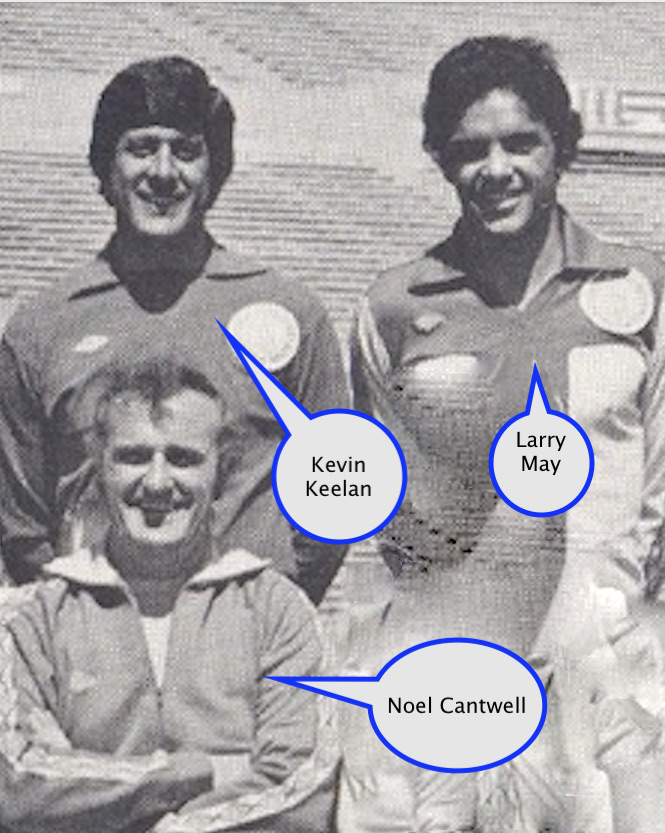
May played in front of ex-Norwich goalkeeper Kevin Keelan for the Tea Men

He went to play for New England Tea Men (a franchise owned by the Lipton tea company) in America under ex-Coventry manager Noel Cantwell to get some games but ruptured a cruciate ligament which some thought might end his career before it had even got off the ground.

Back at Leicester, McLintock was succeeded by Wallace and he paired May at the back with John O’Neill – a partnership that endured for the best part of five years.

In those early times, though, May admitted he had to play through pain and regularly ice his knee.

Not only was May ever-present in the 1979-80 side that won promotion from Division 2, he headed the only goal of the game at Leyton Orient on the last day of the season to clinch the title. Striker Alan Young, who played for Albion in the 1983-84 season, was another ever-present.

Leicester only survived a season in the top flight and following relegation Gordon Milne replaced Wallace as manager, guiding them to promotion in his first season. May, though, didn’t see eye to eye with the former Liverpool midfielder and ended up handing in a transfer request.

In an Albion matchday programme, May said: “”We fell out over something and nothing really but at 24 you think you know it all and there was no future for me once I’d asked for a transfer. “Thinking back, I realise that I should have got on with it.”

As it was, in August 1983 he dropped a division and joined Barnsley for a fee of £110,000, signed by the legendary former Leeds hard man, Norman Hunter.

larry may bw“For a man with a reputation of being one of the fiercest characters in football it was unbelievable – I’d say he was definitely the nicest fellow I’ve ever played for,” said May.
While on the books at Oakwell, with a nod towards a longer future in the game, May took his full FA coaching badge.

He told foxestalk.co.uk: “I was happy at Barnsley but, in retrospect, I should have bided my time and stayed at Leicester really. But I was a bit young and naïve. I loved it at Leicester. Leicester were the best club I ever played at. It was my best time in football and I loved it there.”

After three years with Barnsley, former Albion winger Howard Wilkinson took May to Sheffield Wednesday. He had just turned 28 and the move represented a step back up in standard.

“It was an important move at that stage in my career but looking back it was never brilliant for me at Hillsborough,” he said.

Amongst the competitors for his place was Nigel Pearson, later to be better known for some eccentricities in management with various clubs.

At the start of the 1988-89 season, a move south to Brighton was mooted but Wilkinson held onto him because of some early season injury problems. However, Barry Lloyd got his man towards the end of September 1988 and May joined Brighton for £200,000.

His debut in a 2-1 Goldstone win over Leeds brought to an end a run of eight defeats at the beginning of the season but it was back to losing ways – both 1-0 – in the following two games which, ironically, were against his former clubs, Barnsley, at home, and Leicester, away.

monoMay

The return fixture with Leicester was a happier outcome for May, though, because he was the sponsors’ man of the match in a 1-1 draw.

In his programme notes for the Barnsley game, manager Lloyd said: “I know he’ll have a big impact on the way we play….at 29, we know he has a lot of football left in him.”

Captain Steve Gatting had a programme column that season and he also welcomed the central defender, adding: “His experience in the top two divisions is bound to rub off onto some of younger players. When we’ve played against Larry in the past he’s tended to be the man of the match and I’m sure everyone at the Goldstone wishes him and his family every success.”

Understandable sentiments, of course, and such a shame that before the season’s end, after only 25 games, the cruciate ligament in his right knee was shattered in an accidental collision with teammate Paul Wood during a magnificent 2-1 home win over Man City.

“I knew straight away, having had knee trouble before, how serious it was,” he said. “It wasn’t Paul’s fault. It was just one of those things.” He was carried off on a stretcher and it was his last game for the club.

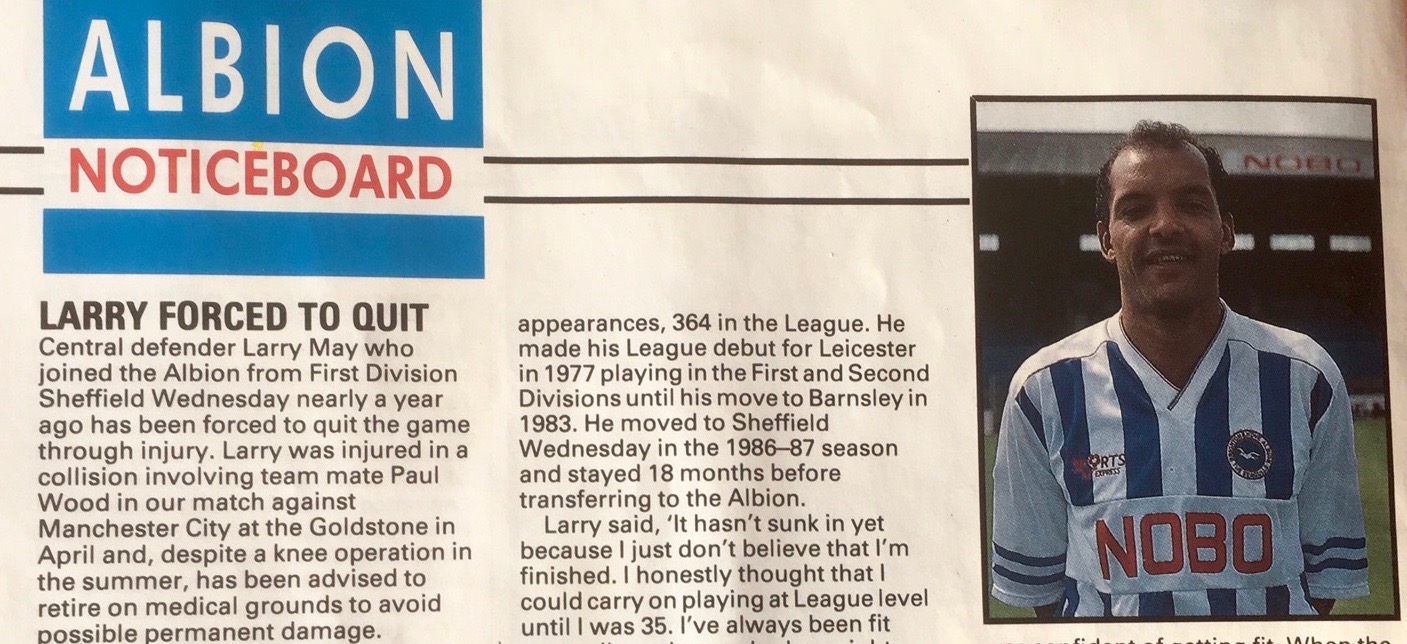
It was in the matchday programme for Albion’s game v Ipswich Town on 27 September 1989 that news of his forced retirement was announced.

“The sudden decision has stunned 30-year-old Larry and his family who were beginning to settle in the Brighton area after moving from Wakefield last year,” the announcement read. “In a 12-year career in the game, Larry has made more than 400 senior appearances, 364 in the league.”

A dejected May told the programme: “It hasn’t sunk in yet because I just don’t believe that I’m finished. I honestly thought that I could carry on playing at league level until I was 35. I’ve always been fit generally and never had a weight problem and this has really hit me.

“When the specialist told me that I shouldn’t play again my first reaction was that it had to be wrong. Now I’ve got to rethink and I’m not really sure about my future.”

Manager Lloyd added: “The announcement that Larry May had been forced to retire from playing was a particularly sad one. He performed very well for us last season and put heart and soul into everything around the club.”

Thankfully Larry was able to put that coaching badge to good use when Lloyd made him reserve team coach and, after a time working for the Surrey FA, he later returned to the club as Head of Sports Participation for Albion in the Community.

His links to the club also extended to his sons: Chris was a young goalkeeper who once had to replace the injured Michel Kuipers during a game and Steve was a centre-back who was in the youth set-up.

1-larrymaystripes2-argusmayintheface3-may-quits4-coach-may

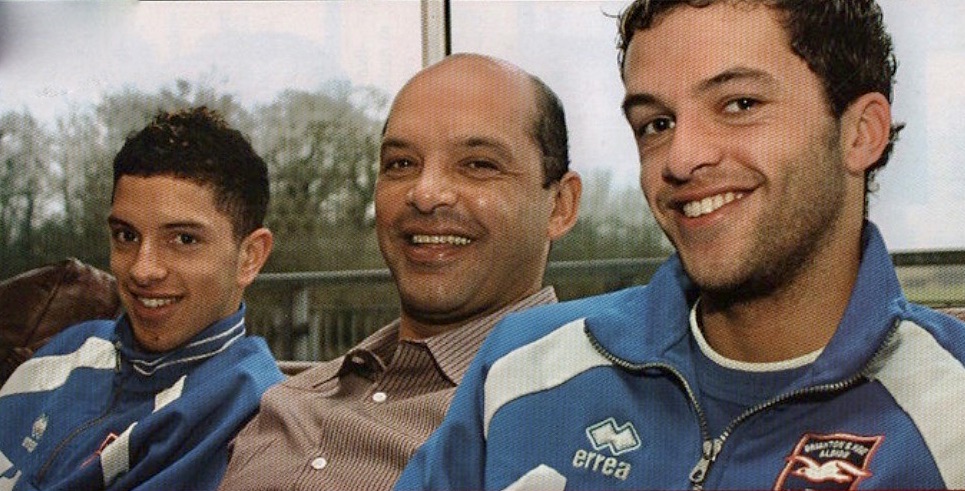
Larry and his sons Steve (left) and Chris

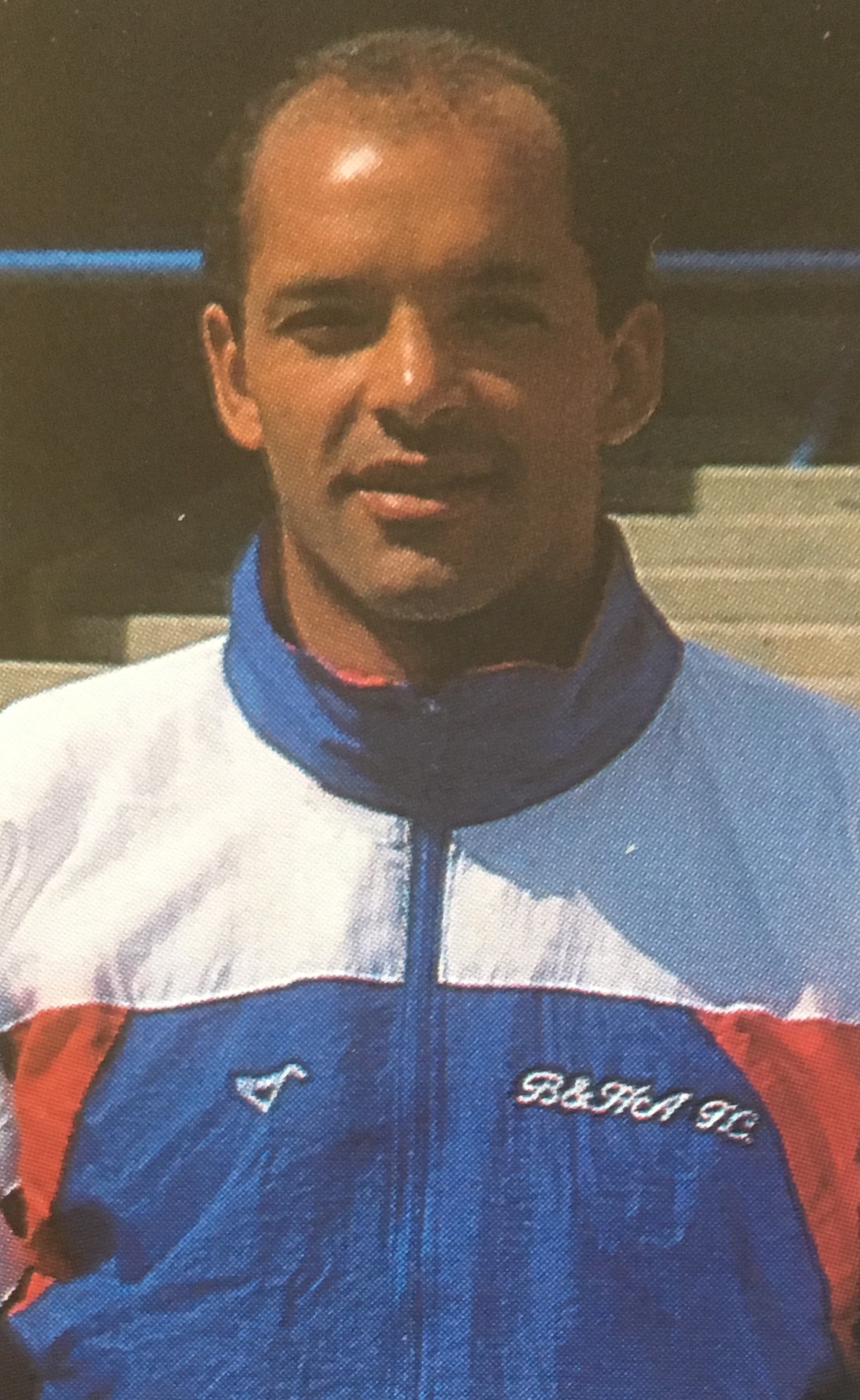
Pictures include Larry May in matchday programmes; captured by an Evening Argus cameraman getting a hand in the face; the programme announcement of his retirement; in an Albion team line-up as a coach, and with his sons.

Barry Lloyd’s turbulent time as Brighton boss

Screen Shot 2021-05-05 at 09.51.14

HISTORY may have judged Barry Lloyd’s reign as Brighton manager unfairly: while bleak times cloud the memory, the former Fulham captain did chalk up some successes.

For instance, it’s worth remembering he put together two of the most entertaining strike partnerships in Albion’s history.

However, when managers start getting involved in the boardroom, it’s probably not going to end well and that certainly proved to be the case after Lloyd was handed the role of managing director.

Frankly, there is probably not enough space in one blog post to cover the various off-the-field shenanigans that were an ugly backdrop to the Lloyd era.

From an outsider’s perspective, it appeared he was the unfortunate public figure put up to deal with a huge amount of flak generated by others wielding power in the background.

Inheriting the hotseat at a time of financial turmoil, from a distance it could be said he did well to win promotion as well as coming mighty close to restoring the elite status lost in 1983.

But fans who had seen huge success under high profile bosses were not best pleased to see their club’s fortunes put in the hands of someone who had previously only managed outside of the league.

Let’s look first at Lloyd’s playing career because, from early on, he was obviously a shrewd observer who made contacts he would be able to call on in later years.

Born in Hillingdon on 19 February 1949, Barry’s early footballing ability was rewarded with selection for the Middlesex and South of England schoolboy sides. He was signed up by Chelsea and was in their 1964-65 youth team alongside former Albion right-back Stewart Henderson in defence and future England international and Chelsea legend Peter Osgood up front.

In an extended interview with Fulham’s club historian, Dennis Turner, Lloyd recalled: “I chose Chelsea because under Tommy Docherty’s management they were an exciting team, with the likes of Osgood, Charlie Cooke and Bobby Tambling.”

Former Albion player Dave Sexton was the reserve-team manager – “a really nice man and terrific coach” – and Lloyd says in his four years at Stamford Bridge he learned a lot.

He made his debut in the top flight in April 1967 aged just 18, but competition for places was tough and, after only 10 first team appearances, in January 1969 he moved to neighbours Fulham with their centre half John Dempsey moving in the opposite direction.

lloyd-fulham-goal

Fulham were struggling for survival in the old Second Division having been relegated from the top flight and the man who signed him, Bill Dodgin, was their fourth manager in a year.

They dropped down into the old Third Division but as part of his rebuilding, Dodgin made Lloyd captain in succession to the legendary Johnny Haynes, who was coming to the end of his career.

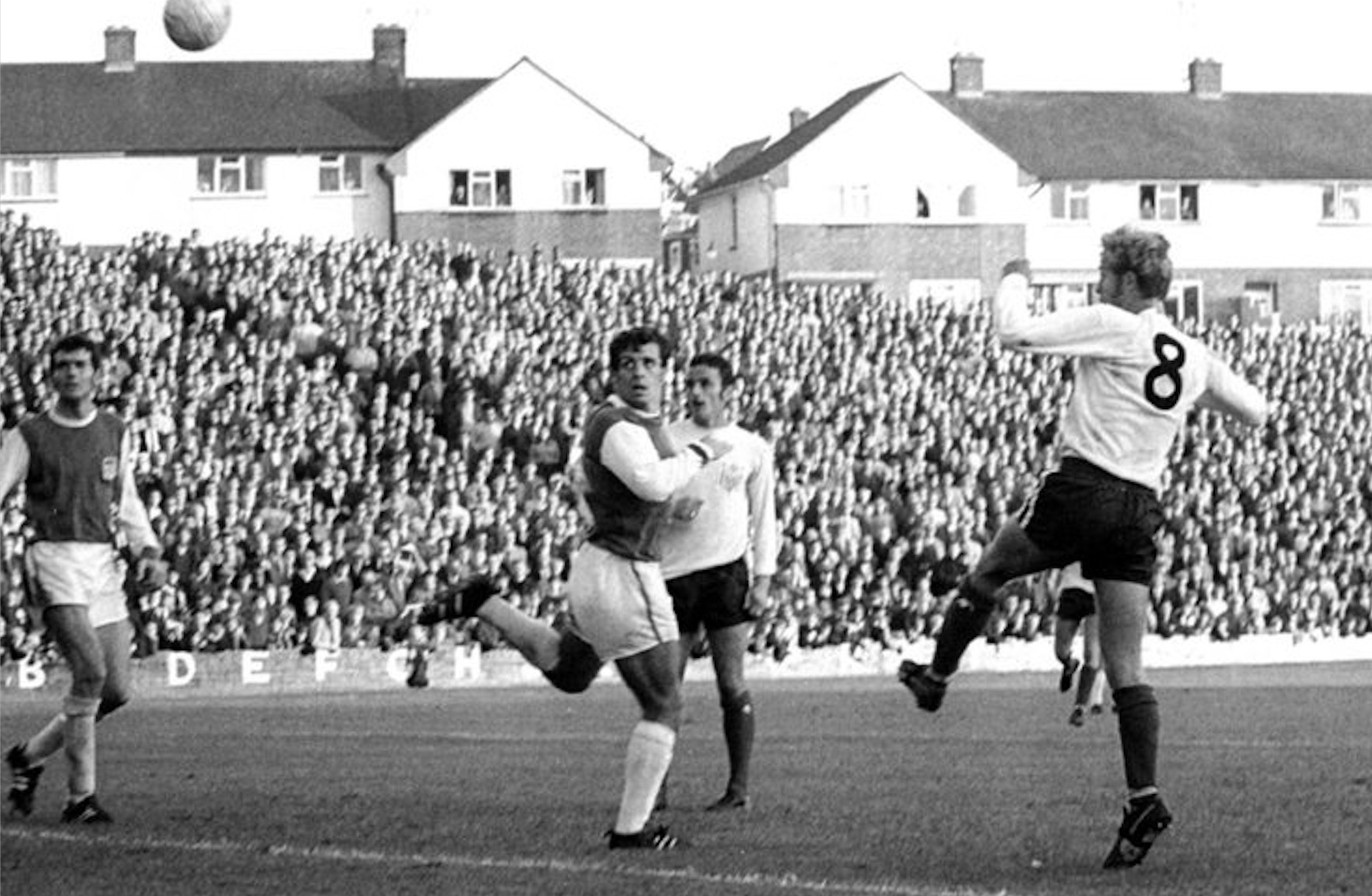
Lloyd is pictured below getting in a header against the Albion at the Goldstone, watched by John Napier (left) and Stewart Henderson. The packed East Terrace never looked like that by the time Lloyd was sitting in the Albion manager’s chair.

Lloyd at Goldstone

Fulham regained their tier two status in 1971 when they went up from Division III as champions. Manager Dodgin was sent packing in the summer of 1972, though, and Alec Stock took over, famously bringing in a number of top name players nearing the end of their careers – notably one Alan Mullery, along with Bobby Moore.

Lloyd remained part of the set-up but when Fulham surprised everyone by reaching the FA Cup Final against West Ham in 1975, he had to be content with what in those days was the single substitute’s berth on the bench, and didn’t get on.

Nonetheless, he chalked up 290 games for Fulham, before having brief spells at Hereford and Brentford (where Dodgin was the manager) and ending his playing days with Houston Hurricanes in the United States.

“I lived in Texas for a year. The league was never going to last but I learnt a lot about how the game can be promoted. They were very good at that over there,” he said in a matchday programme article. “Everyone was made to feel part of the club. It was an interesting experience; I’ve never regretted going.”

During his brief time at Hereford, Lloyd had an eye to the future and took his full coaching badge at Lilleshall, which wasn’t far away.

After his time in America came to an end, he got his first managerial experience with Yeovil Town (then a non-league club) and then headed to Sussex where he took Worthing from the Second Division of the old Isthmian League to runners-up in the Premier Division.

It was in 1986 when he got the call from Mullery to become reserve and youth team manager at the Albion. Dodgin was also on the staff.

lloyd desk

In January 1987, Mullery was unceremoniously dumped and Lloyd came out of the shadows to take charge. Perhaps what fans didn’t know at the time was that the day after Mullery left, Lloyd was summoned to a meeting with chairman Bryan Bedson and told to “get rid of everyone” because the club was going bust.

Against that backdrop, it was 15 games before the side managed to register a win under Lloyd and, unsurprisingly,  Albion were relegated. Some of the mainstays of the side, like Danny Wilson, Eric Young and Terry Connor were sold. Fortunately, Lloyd was able to re-invest part of the proceeds from those sales in some buys who gelled together to form a promotion-winning team.

Screen Shot 2021-05-03 at 20.37.12He returned to former club Chelsea to secure the signing of centre back Doug Rougvie who was made captain and he paired left winger Garry Nelson, a £72,500 signing from Plymouth, with tenacious Scot Kevin Bremner, from Reading, to lead the line. Nelson in particular was a revelation, scoring 32 goals and voted player of the season.

Lloyd reckoned the backbone of the side were two other shrewd signings: Alan Curbishley and Gary Chivers. “Alan was a very level-headed guy, an excellent passer and really disciplined,” he told Spencer Vignes in a matchday programme article. “Chivers was exactly the same, and a real joker at the same time. But there were a lot of great individuals in that side.”

The following two seasons saw Albion maintain their status with lower half finishes but, with the Goldstone Ground crumbling and debts mounting, there was little investment in the team and Lloyd had to use all his contacts to try to find some gems.

One was former England international winger Mark Barham, another was a former Soviet international, Sergei Gotsmanov, a real crowd-pleaser obviously capable of playing at a higher level (as was proved when he opted to join Southampton the following season).

Then, in 1990-91, he rescued two forwards languishing with also-ran clubs in Europe and together John Byrne and Mike Small were superb in attack as Brighton made it to the play-off final at Wembley only to lose 3-1 to Neil Warnock’s Notts County.

No-one had been expecting Brighton to get a tilt at promotion, particularly as the season had once again begun with big money departures of players like Keith Dublin and John Keeley.

But with Byrne and Small on fire and former Fulham and Chelsea winger Clive Walker added to the squad they clawed their way into contention and famously clinched the play-off spot on the last game of the season, courtesy of Dean Wilkins’ curling free kick past Ipswich Town’s Phil Parkes.

Another crucial signing that season was thanks to one of Lloyd’s old Chelsea teammates, George Graham. The Arsenal boss loaned cultured central defender Colin Pates to the Seagulls and he proved a mainstay in the final third of the season. Pates would later sign permanently.

Even though they were clearly beaten by the better side on the day, looking back now, I don’t think anyone could have realised what bad news it was for Albion not to win the final against County.

Starved of the funds promotion would have delivered, Lloyd was forced to sell star performers Small and Byrne and, 11 months after appearing at Wembley, Albion were relegated back to the third tier.

Lloyd had tried to repeat his previous successful European scouting mission with two former league players, but the hapless Mark Farrington turned out to be one of the worst buys ever, managing to score one solitary goal while former Arsenal youngster Raphael Meade fared slightly better but only just got into double figures.

Mark Gall, a £45,000 signing from Maidstone, arrived towards the end of October and ended up top goalscorer and was player of the season, but his 14 goals were still not enough to spare the team from the drop.

In the following season, the very survival of the club was under serious threat with the taxman chasing an unpaid bill. Lloyd rescued the club at the 11th hour by managing to secure a £350,000 fee for goalkeeper Mark Beeney (bought two years earlier from Maidstone for £25,000), former Albion winger Howard Wilkinson buying him for League Champions Leeds United.

With the financial issues continuing in the background, a run of only two wins in 18 league games in the first half of the 1993-94 season eventually brought the Lloyd era to an end – the axe wielded by chief executive David Bellotti, who had arrived only a month earlier.

Fans who were euphoric to see Lloyd go might well have felt differently if they’d known what would eventually transpire, but that’s a story for another day.

The record books show Lloyd made a total profit of £1.2m in his seven years at the helm and he certainly knew his way around the transfer market, particularly in Europe, when it was a lot less fashionable than it is today.

Another of his discoveries was Dean Wilkins, playing for FC Zwolle in Holland, and in 2007 – 14 years after he had left the Albion – Lloyd returned as chief scout during Wilkins’ reign as first team manager.

Also part of the set-up then was director of football Martin Hinshelwood, who had been Lloyd’s assistant during his time in the dugout. Lloyd later returned to the club to assist in the recruitment department but retired in 2021.

He died aged 75 on 28 September 2024 and players in the Chelsea v Brighton game that afternoon wore black armbands in tribute to him.

Lloyd in 2022

‘Yogi’ Baird knows about last game drama

A STRIKER who brought last-game-of-the-season smiles to the faces of Middlesbrough fans earned only notoriety in Brighton & Hove Albion’s final game at the Goldstone Ground.

Journeyman hard man forward Ian Baird earned his place in Teesside folklore by scoring two goals in an end-of-season clash that not only kept Boro up but prevented north east neighbours Newcastle from getting automatic promotion to the elite.

But Brighton fans witnessed Baird, captain at the time, being sent off just 18 minutes into the 1997 game against Doncaster Rovers which thankfully nonetheless ended up in victory courtesy of Stuart Storer’s memorable winner.

The dismissal meant, though, that Baird would not be able to play in what has since been recognised as the most important game in the club’s history: away to Hereford United.

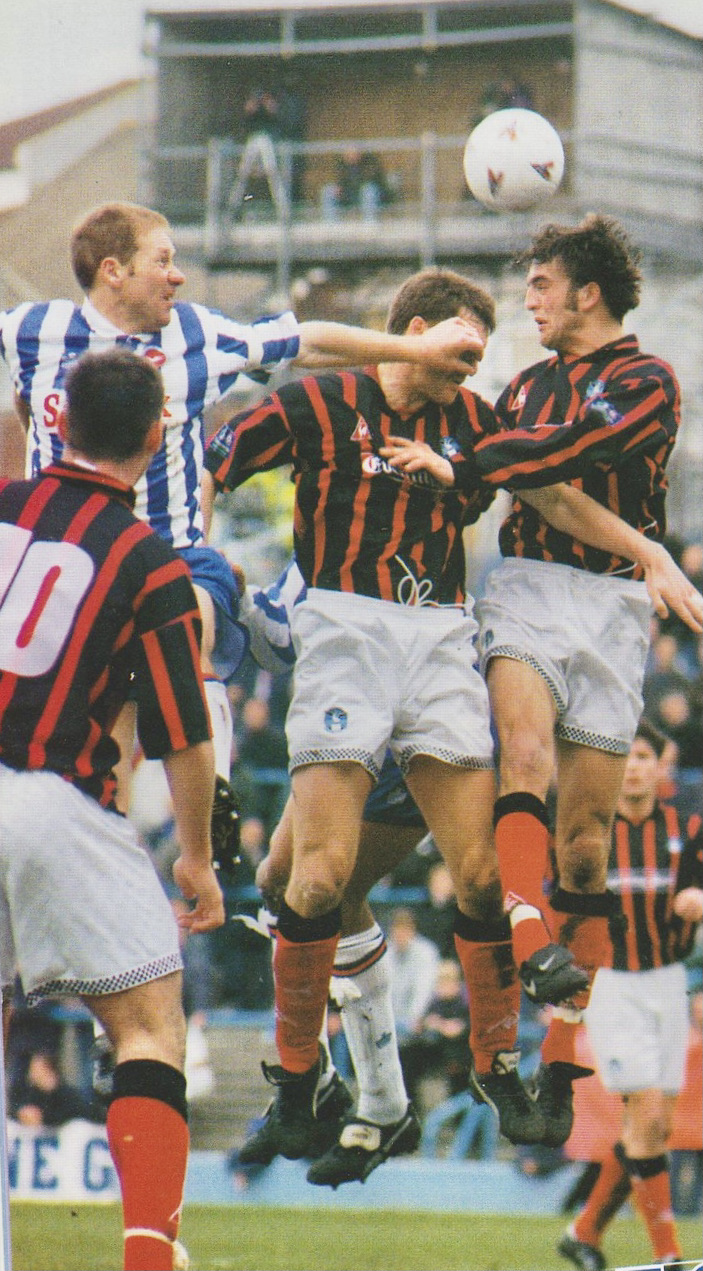
Perhaps we should not have been surprised. Baird was sent off 11 times in his career and he later told portsmouth.co.uk: “It was just a natural thing really. Sometimes my enthusiasm got the better of me. There were plenty of times I chinned someone or got into trouble.Bairdy leap

“The most stupid one was when me and Darren Moore had a fight. He was playing for Doncaster and I was playing for Brighton in the last game at their old Goldstone Ground.

“He came through the back of me, there was a bit of afters and I ended up trying to give him a right hook and there was a bit of a ruck.

“We had a bit of rough and tumble and I was just lucky he didn’t chase me up the tunnel because he’s huge!”

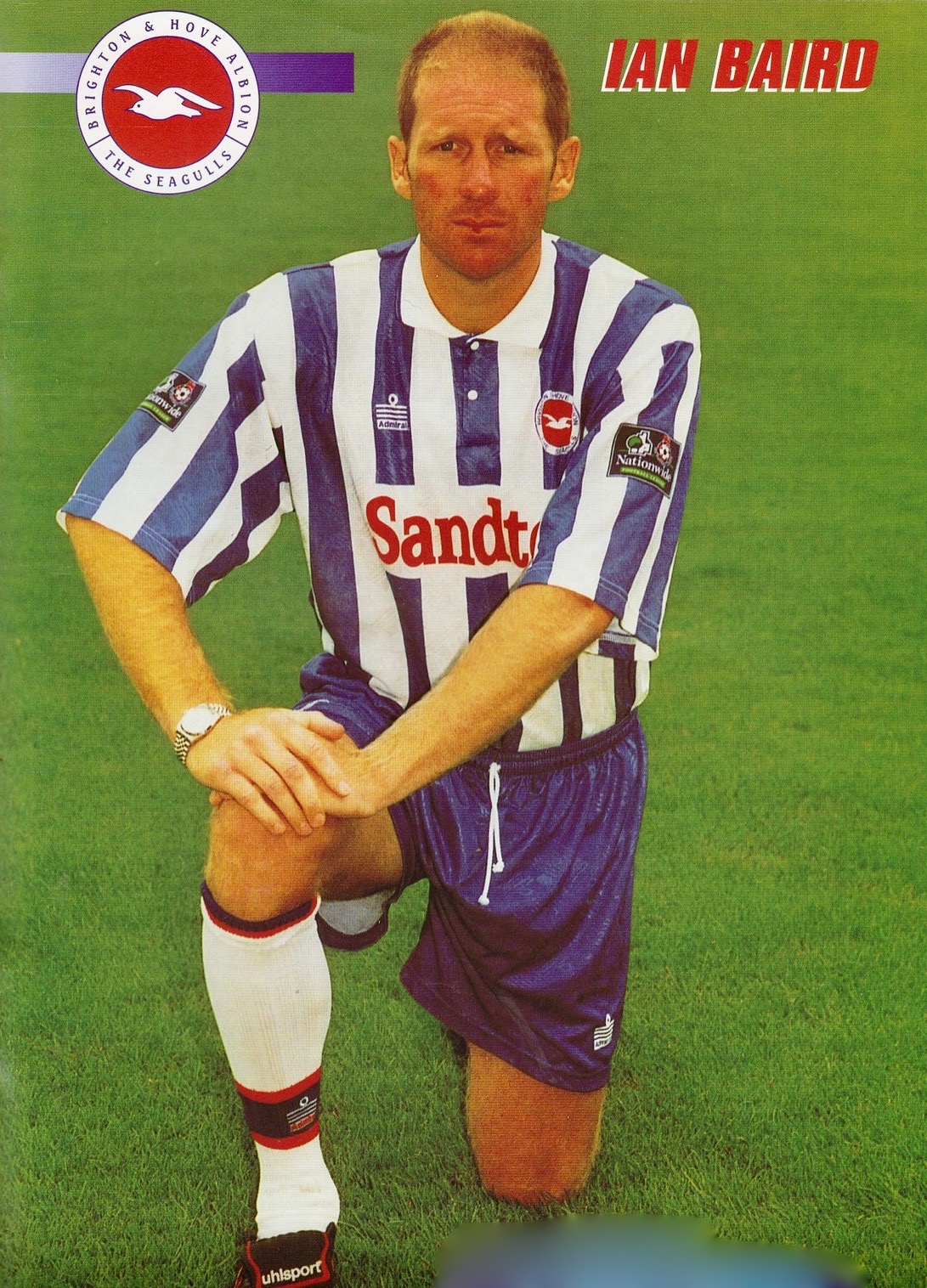
Screen Shot 2021-04-29 at 19.52.10To be fair, Baird had a reasonable goalscoring record at Brighton, netting 14 in 41 games following a £35,000 move from Plymouth Argyle.

Brighton was his 10th and last league club and over the 17 years of his league career he commanded a total of £1.7m in transfer fees, the £500,000 Boro paid Leeds being the highest.

At the start of the 1989-90 campaign, Baird scored the winner for Leeds against Newcastle at Elland Road and then, following his £500,000 January move to Teesside, scored twice in a 4-1 win over United on the final day of the season at Ayresome Park.

Those goals – along with a Bernie Slaven brace – helped prevent Boro going down and meant Newcastle missed out on automatic promotion (they then lost the play-off semi-final to Sunderland).

Years later Baird told chroniclelive.co.uk, ahead of the writing of his autobiography: “Yeah, I enjoyed that. That was some game, given what was at stake. And I loved playing for Boro. We had a great team eventually and Bernie Slaven and myself were a pretty decent partnership.”

Interviewed by Stuart Whittingham in 2013 for borobrickroad.co.uk, Baird explained how he moved to Boro because ex-Albion winger Howard Wilkinson, then manager of Leeds, signed Lee Chapman.

“I felt a little aggrieved and basically I spat the dummy out and asked for a move,” he said. “He (Wilkinson) said that he didn’t want me to go but I insisted and within 24 hours I was speaking to Bruce Rioch and Colin Todd and I was on my way to Middlesbrough.”

Undoubtedly his most successful playing years came at Leeds where in two spells he played more than 160 matches and scored 50 goals. In the 1986-87 season, manager Billy Bremner made him captain. The Yorkshire Evening Post spoke of “the powerhouse striker’s fearless commitment, no-holds-barred approach and goalscoring ability”.

The blurb introducing his autobiography Bairdy’s Gonna Get Ya! (written by Leeds fan Marc Bracha) says “he’s best remembered for his spells at Leeds, where goals, endless running, will to win and fearless approach ensured he was adored by the fans”.

On leaving Middlesbrough, Baird spent two years playing for Hearts in Scotland, persuaded to move north of the border by Joe Jordan, his former Southampton teammate, who was the manager there at the time.

A torn thigh muscle restricted the number of appearances he’d hoped to make and at the end of his deal he moved back to England and signed for Bristol City, initially under Russell Osman and then Jordan once again.

Baird was assistant manager at Sutton United under Paul Doswell for four and a half years between October 2014 and March 2019, and caretaker manager for a month after Doswell left. The pair were reunited as manager and assistant at Havant and Waterlooville in May 2019.

Pictures from the autobiography front cover and the Albion matchday programme.