Andy Arnott’s United dream dashed by injury

A PLAYER who was on the brink of signing for Man Utd for £100,000 ended up playing for the Albion in exile.

But for an untimely hernia injury, Andy Arnott would have been an Alex Ferguson signing at Old Trafford.

As it turned out, the moment passed and the opportunity didn’t arise again. He later made 28 appearances for the Seagulls during the 1998-99 season when home games were played at Gillingham’s Priestfield Stadium.

It was a ground Arnott was familiar with. Born in nearby Chatham on 18 October 1973, he joined Gillingham as a trainee and had only served one year of his apprenticeship when he was taken on as a professional.

Manager Damien Richardson gave him his debut for the Fourth Division club only four games into the 1991-92 season when he was just 17.

It couldn’t have gone better because he scored the Gills’ opening goal in a 2-0 home win over Scarborough.

This was a Gillingham side that included summer signing Paul Clark, who had been part of Alan Mullery’s successful Brighton side in the late 1970s, and Mike Trusson, who’d won promotion from the Third Division with the Seagulls under Barry Lloyd. A young Richard Carpenter was also breaking through.

Arnott scored three goals in 23 appearances by the season’s end although one goal and two appearances against Aldershot were later expunged from the records because the Shots were expelled from the league.

Nonetheless, the youngster’s emergence hadn’t gone unnoticed higher up the football pyramid and the offer of the chance to join United came along, ostensibly so that he could feature in their youth team’s involvement in the end-of-season Blue Star youth tournament in Zurich.

This was the era of the famous ‘Class of 92’ and Arnott found himself playing alongside David Beckham, Paul Scholes and Nicky Butt.

“After impressing during his spell with United, Ferguson made a £100,000 offer to Gillingham which was turned down by the then manager Damien Richardson,” Albion’s matchday programme noted.

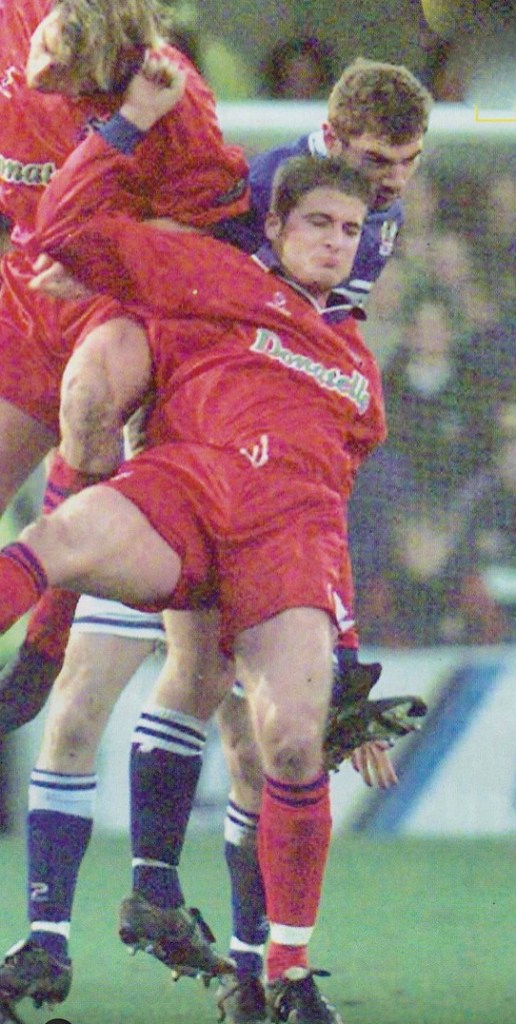
In action for Gillingham against Albion’s Nicky Bissett

The player then suffered a hernia injury that put him out of the game for a year, putting paid to any further interest from United.

“I was gutted at the time, but it was a case of just getting on with returning to fitness and playing football,” Arnott said.

Back at Gillingham, he played 50 matches and scored 12 goals but then, in January 1996, got a £15,000 move to Leyton Orient. He spent a season and a half with the Os under manager Pat Holland and played in every position to help out the team, including goalkeeper in one emergency.

Arnott played under Micky Adams at Fulham

In the summer of 1997, after Fulham’s promotion from Division Three under Micky Adams, Arnott moved to Craven Cottage for an undisclosed fee (thought to be £25,000).

Within a few months, Mohammed Al Fayed took over the club and sacked Adams.

“All of a sudden Fulham went from being an ordinary Second Division outfit to a multi-million pound club,” he said. “I felt sorry for Micky as he had done a fantastic job, but he did foresee what was coming and sorted out long term contracts for most of the players.”

The new management duo of Ray Wilkins and Kevin Keegan brought in their own players and Arnott found himself confined to the reserves with the likes of Mark Walton, winger Paul Brooker, and forward Darren Freeman.

He scored twice for Fulham Reserves in a 3-0 win over Albion’s reserve side on 21 October 1998, and that persuaded Brian Horton to take him on.

“A few clubs had shown an interest around that time, but Brighton were the first that I spoke to and I liked what I was hearing so I signed straight away,” he said.

Horton signed him by the end of the same month for £10,000, plus another appearance-related £10,000, and said in the matchday programme he was “absolutely tremendous” on his debut. It came in a 1-0 win in pouring rain at Barnet when Charlton loanee defender Emeka Ifejagwa scored the only goal of the game on his debut. “He (Arnott) and Jeff Minton forged a good partnership and I am looking for that to flourish,” said Horton.
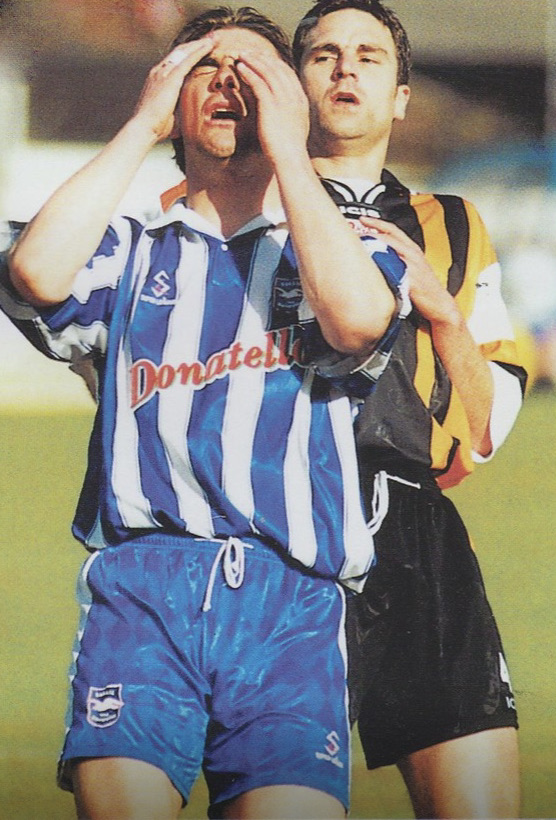
In his player-by-player commentary of performances, programme columnist Paul Camillin said: “Brilliant debut. He showed a good array of passing skills and he might have the bite we’ve been lacking.”

It was the wrong kind of bite he displayed in only his fourth game, though, when he was shown a red card in the 55th minute of Albion’s 2-0 win at Horton’s old club Hull City.

Defender Ross Johnson also went for an early bath for a second bookable offence but Albion’s nine men hung on for 35 minutes to complete their fourth successive away League win: the best such run for 62 years!

There’s little doubt Arnott’s arrival coincided with an upturn in the side’s form and in the matchday programme he took time to praise Albion’s loyal followers. “It is a fantastic advantage to have the number of away supporters we do,” he said. “It makes you want to play that little bit more to give them something back. They are absolutely magnificent.”

Arnott and Jamie Moralee

In the absence of Gary Hobson and Ian Culverhouse, Arnott was given the captain’s armband although that discipline was a bit questionable at times. He saw red for a second time, after Jeff Wood had taken over from Horton, for a second bookable offence at home to his old club Orient – Os captain Dean Smith (manager of relegation-threatened Leicester) also went for a second yellow – although Wood and Orient boss Tommy Taylor both slammed referee Rob Styles for his officiating.
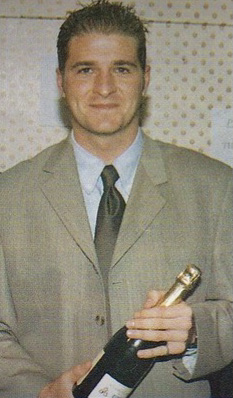
Man of the Match

Wood declared: “Too many officials want to stamp their authority on the game early and flash cards like they are going out of fashion.”

Although Arnott saw out the season in the starting line-up, when his old boss Adams took over from Wood, by the time the new season got under way back in Brighton, Adams had signed Paul Rogers and Charlie Oatway as his preferred midfield pair.

By the end of September, Arnott had been snapped up by Second Division Colchester United; initially on loan and then permanently when their new boss Steve Whitton completed a direct swap that saw Warren Aspinall join the Seagulls.

However, Arnott made only four starts plus eight appearances off the bench in that first season and his time with United was blighted by a long-standing groin injury.

“The whole thing has been an absolute nightmare. I have been struggling with the injury for 14 months and despite loads of rest, two operations and four cortisone injections, the problem is as bad as ever,” he told Colchester’s Daily Gazette in January 2001.

“I was really struggling just before Christmas and I visited the specialist who told me I’m pretty near to exhausting my options.

“When it’s at its worst the injury is unbearable, especially when I turn or attempt to hit a long ball.

“I’m still only 27 with what should be many years left in the game.”

Unfortunately, though, he was forced to call time on his professional playing career and dropped into non-league initially with then-Conference side Stevenage, then Dover Athletic, where he was captain, Welling United and Ashford Town.

After his playing days were over, he settled in Rochester and became a project manager for Dryspace Structures while retaining his football links as a coach for Ebbsfleet United’s under 16 team.
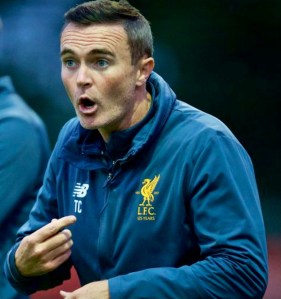
Brighton trial turned sour for Gerrard’s pal Tom Culshaw

A LOYAL MEMBER of Steven Gerrard’s backroom staff once tried to revive his playing career with Brighton after he’d been let go by Liverpool.

Tom Culshaw goes way back to schoolboy days with Gerrard and was a former youth team player alongside him at Liverpool.

He is now technical coach at Aston Villa, a role he held previously at Rangers after the pair also worked together with the Reds under 18s.

Back in September 1999, the central defender linked up with the fourth-tier Seagulls a few months into Micky Adams’ first reign as manager. Culshaw played for Ian Culverhouse’s reserve side on a trial basis on a drizzly night at Woodside Road, Worthing, and didn’t make the most of the opportunity.

Albion went down 3-2 to visitors Cambridge and a subsequent matchday programme didn’t hold back in apportioning blame.

With the score level at 1-1 it reported: “Albion fell further behind two minutes before the break when Culshaw made a mess of an attempted header back to (Mark) Ormerod, and (Nathan) Lamey picked up the loose ball and took his opportunity well, lobbing the Albion ‘keeper.”

Although Albion restored parity through Scott Ramsay, Daniel Chillingworth added a third for the visitors. Culshaw was subbed off in favour of Chris Beech, and wasn’t seen in an Albion shirt again.

The Brighton trial came as Culshaw desperately tried to get a foothold in the game after the disappointment of being let go after four years as a professional with Liverpool.

A few months earlier, he played for Norwich’s under 21 side against Bristol City in a friendly; he later linked up with Conference side Nuneaton Borough and went on to Northern League teams Leigh RMI and Witton Albion.

“When I left, I found it tough going on trials for lower league clubs,” Culshaw told liverpoolfc.com. “I got offered a couple of contracts at League Two clubs and I decided to knock them back thinking I could do a bit better.

“But when I started to go for trials it was taking longer and longer, and then eventually I just fell out of love with the game.”

He walked away from football for a while, joining up with a friend who had a tarmacking firm. He admitted: “It was hard, it was a tough few years for me. Especially when I saw my mates, the likes of Steven, Carra (Jamie Carragher), Michael Owen – lads who I’d come through the youth team with – progressing.

“I probably had my first bump in the road at 21 and I just really didn’t know how to handle it.”

Until that point, it had all been going so well. Born in Liverpool on 10 October 1978, Culshaw played street football with Gerrard in Ironside Road, on Huyton’s Bluebell Estate, where Culshaw’s grandparents lived. A friendship that included a mutual love of football began when they were pupils at Cardinal Heenan High School.

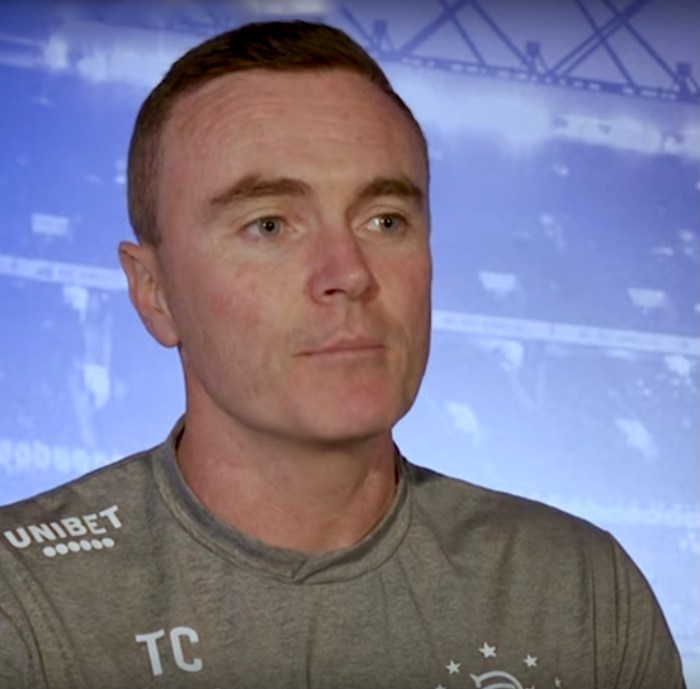
Culshaw became technical coach under Steve Gerrard at Rangers

“Steven is a year younger than Tom but they both played for me in the under 14 Liverpool Schoolboys FA team in 1992-93,” their former coach Dave Singleton told the Daily Record.

“Stevie was very small and didn’t start growing until he was 16 so I used to put him on the wing because schoolboys football was based on size and a lot of teams just picked the biggest lads who could plough their way through anything.

“So I put Stevie on the wing where he wouldn’t get hurt and could use his skill. Tom was a centre half and the captain of the team.

“He was a commanding centre half but exceptionally skilful too. He could play the ball out from the back.

“We had one game where he picked the ball up on the edge of our penalty area, dribbled the full length of the pitch and scored from the opposite penalty area.”

Singleton added: “He had a physical presence and was good in the air so he was great for set-pieces and comfortable with either foot but stronger on his right.

“They were exceptionally nice lads, a credit to their school, parents and city. It’s so great to see people like that go on and do well.”

An England Schoolboys international, Culshaw spent two years at the FA School of Excellence at Lilleshall at the same time as Owen and Carragher. Culshaw joined Everton at the time Gerrard signed for Liverpool but he was let go and moved to Tranmere Rovers, where his talents flourished.

He was named as captain of the Liverpool City Schoolboys team and Liverpool snapped him up. He joined Gerrard at the club’s Vernon Sangster Centre of Excellence, near Anfield, and he progressed through the under 18s under the guidance of Steve Heighway, Dave Shannon and Hughie McAuley, signing professional aged 17.

On stepping up to the reserves, who were managed by Sammy Lee, he was handed the captain’s armband. “I was around Ronnie Moran, Roy Evans, and all the old-school Boot Room staff,” he said. “I’d progressed and everything went well for me. The national school, playing for England, joining Liverpool, signing professional at 17, progressing to the reserves, captaining the reserves.

“I was a pro for four years. It was a great time at Melwood because everyone was on the same site. I was training with Jamie Redknapp, Robbie Fowler, and Steve McManaman and learned an awful lot from them.”

However, after those four years, and having seen his contemporaries make the step up to the first team that eluded him, Culshaw was forced to look elsewhere after manager Gerard Houillier overlooked him.

Disillusioned by his prospects in the UK, Culshaw moved abroad and started coaching youngsters in Spain. Having decided to pursue that career path, he returned to the UK in 2011 in a part-time role at Liverpool’s academy while studying for his badges.

In 2017, it was his boyhood pal Gerrard who turned his job into a full-time position by promoting him to become his under 18s assistant.

Gerrard said at the time: “When I started out full-time as an apprentice, Tommy was a year above me so I know everything about him and he knows everything about me. I thought he was the perfect partner to go into it.”

Receiving a coaching certificate from former England manager Steve McLaren

Culshaw has remained a key part of the close-knit group around Gerrard ever since, following him to Glasgow Rangers and then to Aston Villa. His particular focus is on set pieces as former Albion centre back Connor Goldson once explained in an interview for Rangers TV.

“Tom Culshaw the coach works on us before every game, different set pieces, defending and attacking, and how we’re going to set up,” he said. “We always know what we’re doing. We always know the routines or what’s happening.”

Captain James Tavernier added: “We work extremely hard on set-pieces in training. TC has us working hard with them all week and it shows in the games as they can effectively give you three points.”

In that interview with the Record, Singleton added: “Whenever I watch games on TV now and see them in the dugout together I feel immense pride.

“Steven’s career achievements speak for themselves and it’s great when the person who isn’t the figurehead gets some credit and there is nobody more deserving than Tom.

“When they were younger you’d have thought both of them would have gone on to make it but there’s a lot of luck in football, being in the right place at the right time.”