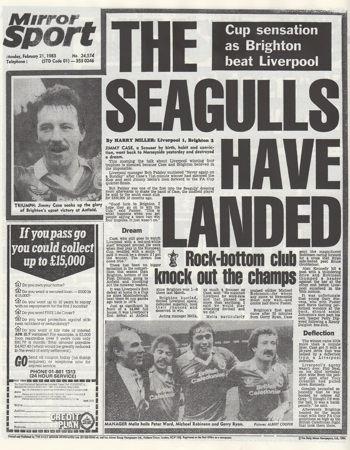
BRIGHTON’s unlikely run to the 1983 FA Cup Final was largely spearheaded by the incredible shooting power of Scouser Jimmy Case.
He’d picked up almost every medal there was to have in a decade with Liverpool but he’d missed out on a FA Cup winners’ gong – and Albion unexpectedly provided a golden opportunity to put that right.
Case, who scored for Liverpool at Wembley in the 1978 FA Cup Final but ended up losing 2-1 to Manchester United, had already scored for Brighton in the fourth round 4-1 hammering of Manchester City and would go on to score the quarter-final winner against Norwich City and the opener in the 2-1 semi-final defeat of Jack Charlton’s Sheffield Wednesday.
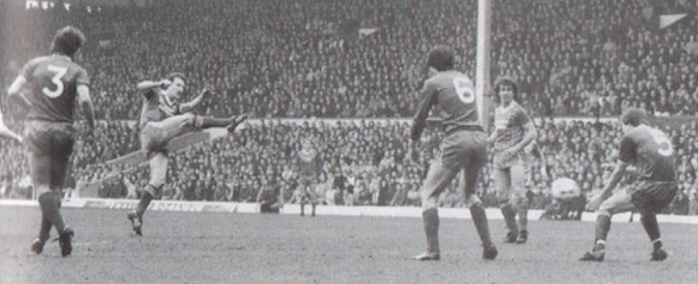
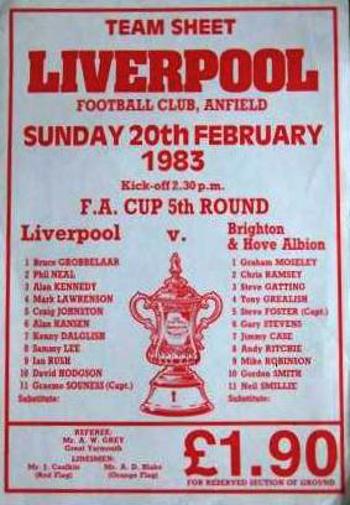
But who could forget the fifth round FA Cup tie winner he struck on Sunday 20 February 1983 against the club and manager (Bob Paisley) who’d ousted him from his spiritual home two years earlier.
The last of his 269 appearances for his boyhood club was as a late substitute for Kenny Dalglish in the 1981 European Cup Final win over Real Madrid in Paris. He had moved to Brighton that summer as part of the deal that saw Mark Lawrenson transfer from the Seagulls to Liverpool.
When top-of-the-table Liverpool drew bottom-of-the-league Brighton at home in the FA Cup, few gave the visitors a prayer of advancing further in the competition. However, 11 months earlier, Brighton had pulled off a surprise 1-0 league win at Anfield, so maybe it wasn’t such a foregone conclusion.
Games these days are played at all hours and on all days at the whim of broadcasters but back in 1983 it was the first ever match played at Anfield on a Sunday.
At the time, the Sunday Observance Act (1780) prohibited admission to a building by payment on a Sunday. Clubs got around this by allowing free admittance to their ground – but took payment from the sale of a team sheet to all fans going into the ground, as Dr Robin Gowers records on lfchistory.net.
Ryan wheels away after scoring
Cheered on by 5,000 supporters, after withstanding early pressure from Liverpool, Albion established a foothold in the game on 32 minutes when Case dispossessed Graeme Souness and set up the fleet-footed Michael Robinson who outpaced and outwitted Lawrenson before sliding a pass for Gerry Ryan to slot home.
Steve Foster and Gary Stevens had their work cut out containing Kenny Dalglish and Ian Rush and the Welshman got away with elbowing Stevens in the face in revenge for one robust tackle.
Left-back Alan Kennedy saw an effort hit the post before Liverpool got back in it shortly after sending on Australian Craig Johnston for David Hodgson.
The substitute didn’t take long to have an impact, scoring with an overhead kick after a Dalglish free kick fell kindly to him.
Cue the inevitable celebrations on the pitch and on the terraces but the whole place was stunned within minutes when ‘one of their own’ broke their hearts.
Tony Grealish and Ryan combined on the left side of the pitch and, almost from the byline, Ryan swung in a cross. Liverpool failed to deal with it and the ball fell to Case lurking in the centre five yards outside the penalty area.
The trusty right foot which he’d used so many times to Liverpool’s advantage leathered the ball goalwards and, with a deflection off Ronnie Whelan, left ‘keeper Bruce Grobbelaar groping thin air as the ball flew past him to put Albion ahead.
That precious advantage was precarious to say the least: only four minutes later, referee Alf Grey gave Liverpool a penalty but the normally reliable Phil Neal sent his effort wide of Perry Digweed’s left-hand post.
The home side forced a series of corners, Rush headed over with the goal at his mercy and Albion right-back Chris Ramsey, who’d earlier sliced a Souness cross over his own crossbar, twice came to the rescue, deflecting a Whelan effort for a corner and heading off the line when Lawrenson thought he’d levelled it with a header against his former club.
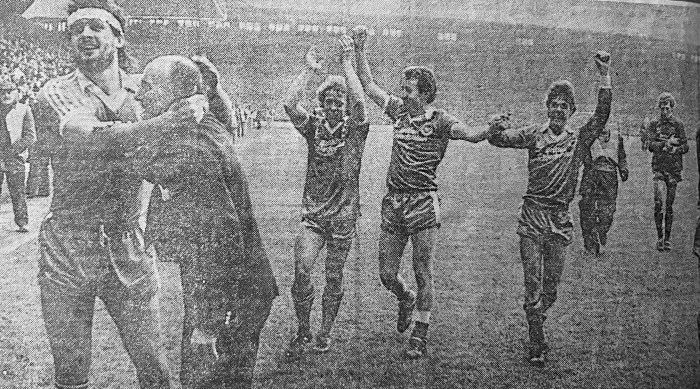
But Albion held out and Liverpool had lost for the first time in 64 home cup ties across eight years!
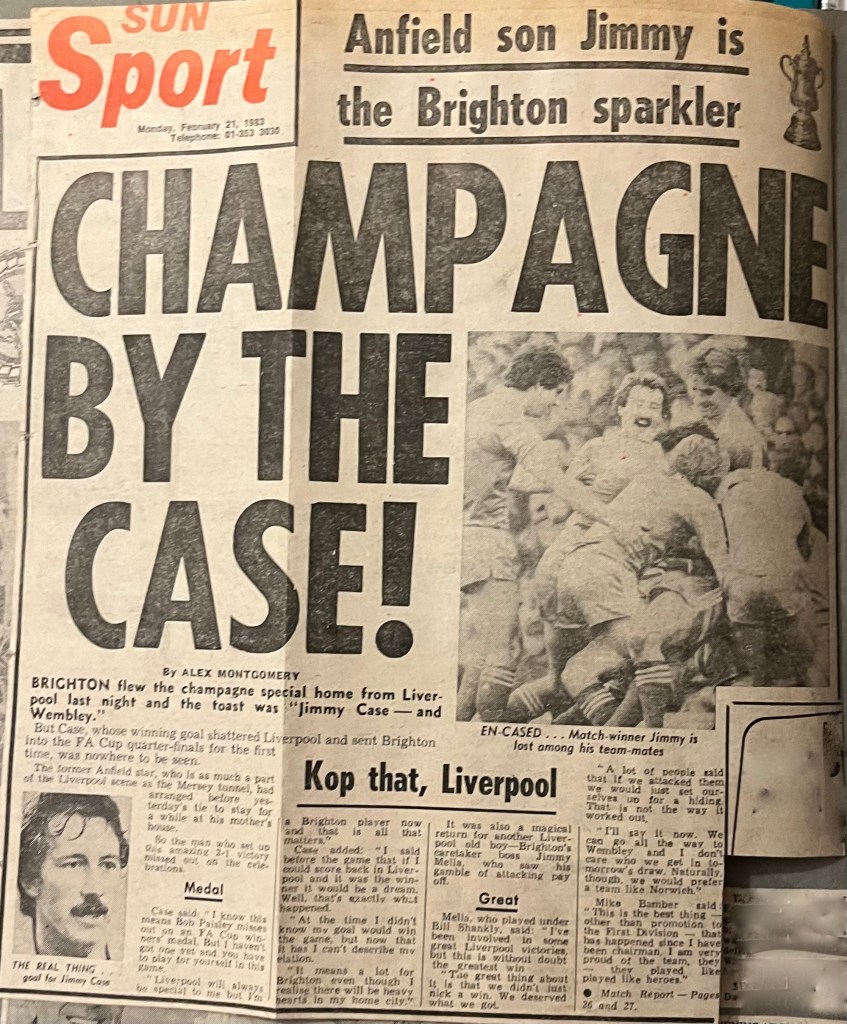
The newspapers had a field day because Case’s winner for Brighton denied his old boss Paisley the chance to wipe the board with trophies in what was his last season as manager.
It seemed every national and local newspaper headline revolved around the likeable Scouser: ‘It’s Case for Champagne’, ‘Jimmy sets out his case’, ‘Old boy Case kills off Liverpool hopes’, ‘Amazing Case’, ‘Killer Case’, ‘Case packs a super Cup punch’, ‘Case for Cup win’. The Daily Mirror made him their footballer of the month for February.
“Scoring the goal that knocked Liverpool out was a bizarre feeling”, Case admitted. “There wasn’t long left in the game and after taking a battering we were holding on for a replay.
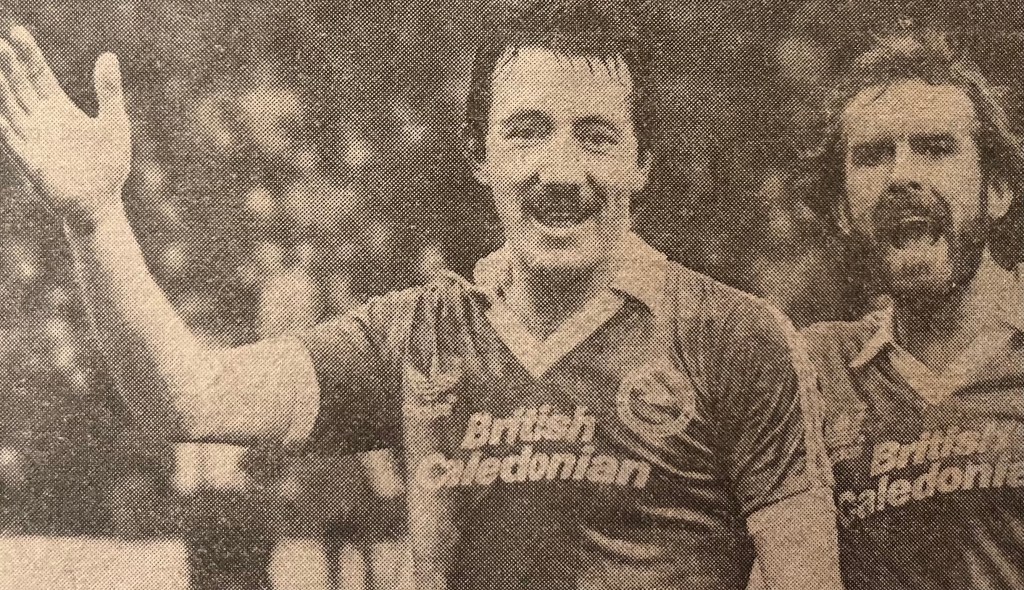
“I hit this shot from the edge of the box and it clipped Ronnie Whelan’s shoulder and looped over Bruce Grobbelaar. I didn’t celebrate. I just turned around and the other lads jumped on me.
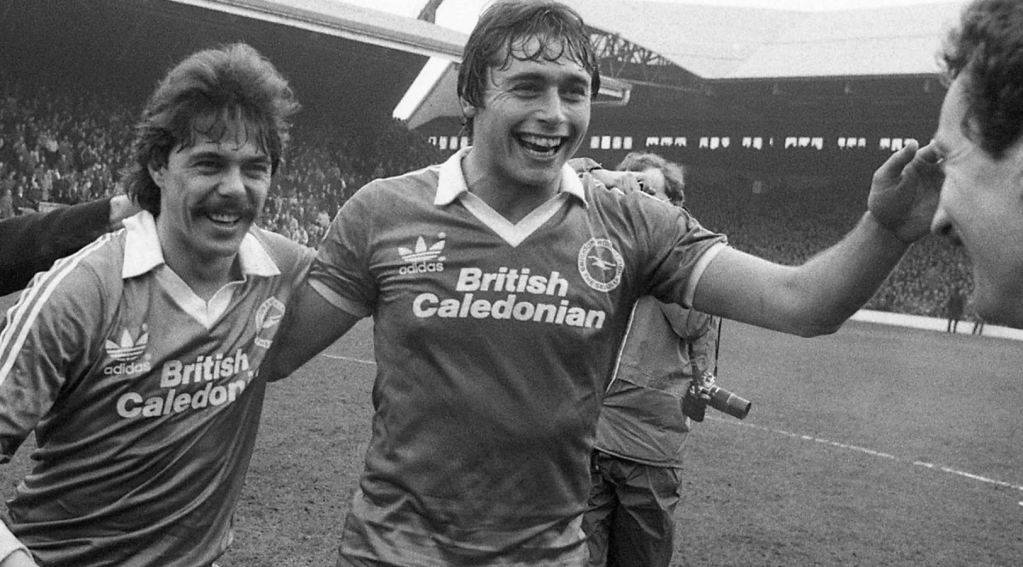
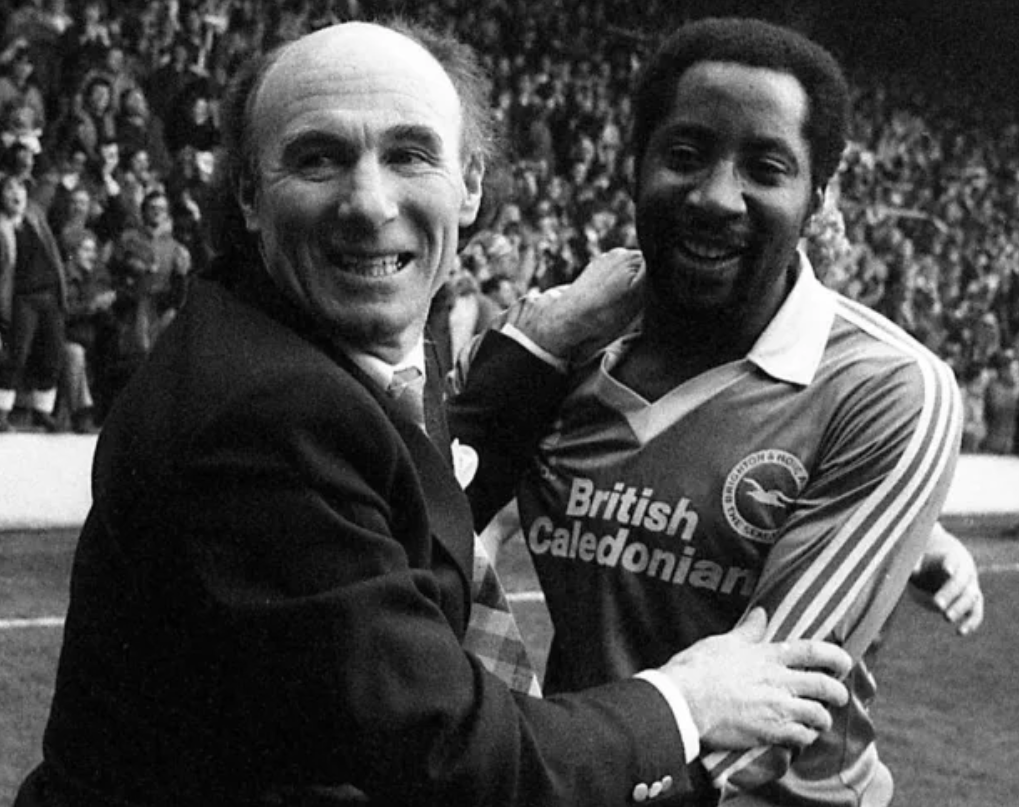
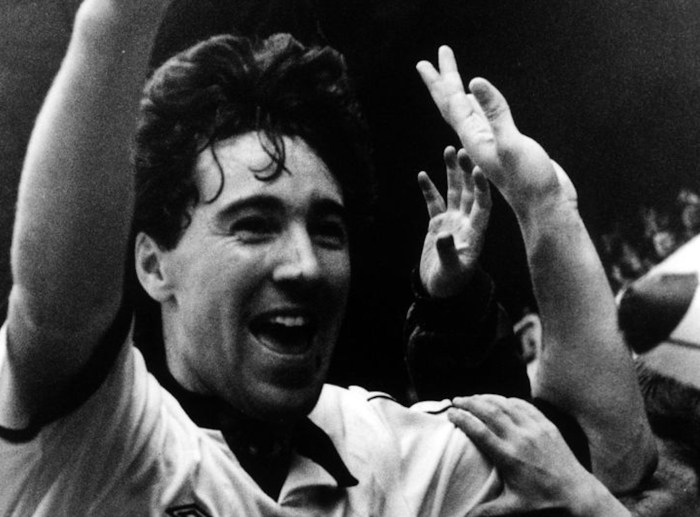
Case and Tony Grealish euphoric after the Anfield win
“As I was walking off the pitch after the final whistle what hit me was that the Kop were singing my name. I had just wrecked their hopes of winning the FA Cup and they chanted my name. You can’t buy those type of moments.
“As I came off the pitch this TV reporter shoved a bloody big microphone into my face and said, ‘Jimmy, do you realise that you just knocked Liverpool out of the FA Cup and robbed Bob Paisley of his last chance to win it before his retires, the only trophy he’s never won?’
“I just gave him a stare and said, ‘Well what about me, I’ve never won it either. Bob Paisley wouldn’t have lost any sleep thinking about me if we would have lost so I won’t either, that’s just the way it goes’.”
Case wasn’t the only former Red in the Albion dressing room celebrating. It was sweet too for Jimmy Melia, Albion’s chief scout-turned-acting-manager, who himself had scored 78 goals in 287 games for Liverpool between 1955 and 1964.
“I’ve been involved in some great Liverpool victories but this is without doubt the greatest win,” Melia told Alex Montgomery of The Sun. “The great thing about it is that we didn’t just nick a win. We deserved what we got. A lot of people said that if we attacked them, we would just set ourselves up for a hiding. That is not the way it worked out.”
It emerged after the game that John Manning, an old footballing friend of Melia’s, had been key to plotting the victory. Former Crewe, Bolton and Tranmere striker Manning, Albion’s scout in the north at the time, gave the players a pre-match rundown on what to expect.
“Best team talk we’ve ever had,” defender Stevens told the Daily Mail. “Liverpool played exactly the way he said they would and he was even right about which side Neal would send his penalty.”
Case later revealed how a good friend of his had been out of the country at the time of the game and sent him a postcard with only two words as its message: ‘You bastard’.
Liverpool legend Dalglish said: “Jimmy Case only did for them what he did for us many times, and that was to make a huge contribution.”
Indeed, Case had a trophy cabinet containing three European Cup winners’ medals, four Division 1 (Premiership equivalent) winners’ medals plus one each for winning the UEFA Cup, European Super Cup and the League Cup.
Brighton’s abysmal league form in the 1982-83 season saw them struggling to stay amongst the elite but in the FA Cup it was a different story and Case was once again in the headlines when he scored the only goal of the quarter-final against Norwich City at the Goldstone and the thunderbolt opener in the 2-1 semi-final defeat of Jack Charlton’s Sheffield Wednesday at Highbury.
The history books have on many occasions recalled just how close he came to securing a FA Cup winners’ medal with Brighton. Sadly, the day of Albion’s 2-2 drawn final against Man U ended in personal heartbreak for Case.
His mother Dolly died at his Hove house while he was at a reception in Brighton laid on for the team by civic leaders. His parents had travelled from their home in Liverpool for the game and back in Hove before he left for the event his mother had said she wasn’t feeling well.
Case left the reception early but on his return home there was an ambulance outside the house.
Dolly was only 63 and had not long retired after years cleaning school floors in Liverpool.
It was to Case’s immense credit that he took his place in the side for the replay just five days later.
He acknowledged in a 2018 interview with Ian Herbert of the Daily Mail that the famous Gordon Smith chance at the end of the first game was pivotal. “You knew there and then that was it,” Case reflected. “You knew that was our chance to win and there wouldn’t be another one.
“If I had our team lined up and had to choose one player in that scoring position it would always be Gordon Smith. Always. But you knew that was it.”
He added: “At Liverpool we called the ones who don’t win the nearly men. But it didn’t feel like that for us. What a day that was.”
• Case suffered further frustration in his bid for a FA Cup winners’ medal after he joined Southampton. He captained Saints to a 2-0 quarter-final win over the Albion in 1986 and then faced Liverpool in the semi-final played at White Hart Lane.
A win would have made Case the first player to appear in three FA Cup finals with different clubs. The game went into extra time with the score goalless on 90 minutes but Liverpool put paid to his dream winning 2-0 with a brace from Ian Rush (99th and 104th minutes).
JOHN RUGGIERO was one of four signings Alan Mullery made for newly promoted Albion in the summer of 1977.
That one of the quartet was Mark Lawrenson from Preston North End for £115,000 rather eclipsed Ruggiero’s arrival from recently relegated Stoke City for £30,000.
Nonetheless, Ruggiero made an immediate impact, scoring on his league debut as a substitute for Peter O’Sullivan to earn the Seagulls a 1-1 draw at Southampton.
Ruggiero had begun the season in the starting line-up in Albion’s home and away goalless draws against Ron Atkinson’s Cambridge United in the League Cup before relinquishing a starting berth for the opening Division Two fixture at The Dell.
His 77th minute equaliser, after Alan Ball had put the home side ahead just before half time, was added to a fortnight later and, for a brief moment, he was joint top scorer with Steve Piper – on two goals.
The pair were both on the scoresheet to help the Seagulls to a 2-1 win at Mansfield Town on 3 September; the home side’s first defeat at Field Mill in 38 matches.
Shoot! magazine previewed Ruggiero’s eager anticipation at returning to the Victoria Ground for a league game on 15 October but he was only a sub that day and, although he went on for fellow summer signing Eric Potts, Albion lost 1-0.
A young Garth Crooks taking on Chris Cattlinthe day Ruggiero returned to Stoke
After only seven league and cup starts (and three appearances off the bench), Ruggiero then had to wait six months for another sub appearance.
He went on as a second half substitute for injured Paul Clark in a 1-0 win at Blackburn, combining with Potts who went on to score the only goal of a game described by Argus writer John Vinicombe as “the most exhilarating match I have seen for years”.
Ruggiero didn’t make another start until the very last game of the season; but what a match to play in. A crowd of 33,431 packed in to the Goldstone to see the Seagulls take on Blackpool, with another possible promotion finely poised.
Albion dutifully won the game 2-1 (sending Blackpool down) with goals from Brian Horton and Peter Ward but their hopes of going up were cruelly dashed when Southampton and Spurs, who each only needed a draw to go up, lo and behold ground out a 0-0 draw playing each other.
As the Argus reported: “When news came of the goalless draw at The Dell there were cries of ‘fix’ and Albion had to suffer the bitter disappointment of missing promotion by the difference of nine goals.”
Before his recall for that clash, Ruggiero had continued to find the back of the net for the reserves – indeed he was the side’s top scorer for two seasons.
The Albion matchday programme reported his scoring exploits in some detail. For instance, in a 4-1 win away to Portsmouth. “John Ruggiero was the star of our win at Fratton Park with two fine goals and might have scored a hat-trick,” it said.
And in a 5-2 Goldstone win over Charlton Athletic, Ruggiero opened the scoring with a header from a Gary Williams cross, Steve Gritt pulled one back for the Addicks and Ruggiero volleyed in a fourth goal from the edge of the box.
Ruggiero, who lived in Shoreham with his wife Mary, discovered competition for a first team spot intensified after his summer signing: Clark from Southend adding steel to the midfield and Fulham’s Teddy Maybank taking over from Ian Mellor as Ward’s striking partner. O’Sullivan, meanwhile, comfortably stepped up to the higher level and kept his place.
When Albion were on course for promotion to the elite the following season, Ruggiero’s first team involvement was almost non-existent (a non-playing sub on one occasion).
He was sent out on loan to Portsmouth, then in the old Division 3, where he was a teammate of Steve Foster. Ruggiero scored once in six appearances, netting in a home 2-2 draw with Cambridge United on 27 December 1977.
He was released before Albion took their place amongst the elite and moved on to Chester City, signed by player-manager Alan Oakes, the former Manchester City stalwart.
Ruggiero joined just as ex-Albion teammate Mellor was moving on from Sealand Road, but, in a Chester team photo (above right), Ruggiero is standing alongside Jim Walker, who’d played at the Albion under Peter Taylor, and in the front row is a young Ian Rush.
Ruggiero scored within three minutes of his first league game for Chester, setting them on their way to a 3-2 win over Chesterfield. But he only made 15 appearances for them before dropping into the non-league scene.
The legendary England World Cup winner Gordon Banks, formerly of Stoke, signed Ruggiero for Telford United in the 1979-80 season when he was briefly manager of the Alliance Premier League side.
Born in Blurton on 26 November 1954 to Italian parents, the young Ruggiero went to Bentilee Junior School then Willfield High School. His prowess on the football field saw him represent Stoke Boys and the county Staffordshire Boys side and he was one of 24 young players who had a trial at Middlesbrough for the England Schoolboys side but missed the final cut.
He had the chance to join Stoke City at 15 but stayed on at school and passed five O levels: English Language, English Literature, Technical Drawing, History and Art.
“I had a lot of interest from many clubs: Blackpool, Leicester City, Derby County, Blackburn Rovers, Bolton Wanderers, Coventry City, West Brom and I even had a letter from Arsenal inviting me to go training with them,” Ruggiero told Nicholas Lloyd-Pugh for the svenskafans.com website in an April 2011 interview.
“I nearly signed for Coventry but the very last club to ask me was Stoke City and, once this happened, I knew where I would go. I joined as an apprentice when I was 16 in 1970.”
Ruggiero explained how he started in the A youth team, progressed to the reserve side and finally made his first team debut under Tony Waddington on 5 February 1977, in a home 2-0 defeat against league leaders Manchester City.
He had made his league debut the previous season during a short loan period with Workington Town, playing three games in Division Four, which gives him the relatively rare distinction of having played in all four divisions of English football.
Even as a reserve team regular at Stoke he got to play at big stadiums like Old Trafford, Anfield, Elland Road, Hillsborough and Goodison Park. “It was great for the young players but you always hoped to make the first team at some point,” he said.
“It was a real dream for me to have players like Gordon Banks, Geoff Hurst, Alan Hudson, Peter Shilton and many more being part of your life.
“Tony Waddington loved his team and he always went for experience, so the younger players found it really hard to make the first team. However, a few younger players did well such as Alan Dodd, Sean Haslegrave, Stewart Jump, Ian Moores and Garth Crooks.”
He continued: “Players like Terry Conroy and John Mahoney were really friendly and always had a word of advice for you. I really liked Alan Dodd; he was a much underrated player and would have played for England at a bigger club.”
Ruggiero also spoke warmly of Alan A’Court, Stoke’s first team coach who had played for Liverpool, who took him on a football holiday to Zambia in 1973 where he played for Ndola United. A’Court was Zambia’s national coach at the time.
Two years later, Ruggiero earned a ‘Player of the Tournament’ accolade while playing for Stoke in a youth tournament in Holland.
Waddington’s successor as manager, former player George Eastham, also played a part in Ruggiero’s development by arranging for him to play in South Africa for eight months in 1975 where he was a league and cup winner with Cape Town City.
“I knew that George liked me as a player so I felt that this could be good for me when he took over the team,” Ruggiero told Lloyd-Pugh. “He had already played me in a friendly match against Stockport which was a showcase for the return of George Best from America.
“Whilst Best, Hudson and Greenhoff were doing their party tricks, I was quietly having a good game and it was clear that I was ready for another chance.”
That came in a home game against Liverpool, Ruggiero playing in midfield. “The next 90 minutes was my best of all time,” he said. “We drew the game 0–0. I would like to think I was the man of the match and George spoke very highly of me to the press after the game. The Liverpool team included Kevin Keegan, Ray Kennedy, Ray Clemence and many other big names.”
Stoke had turned to youngsters like Ruggiero because big name players had been sold off to pay for a replacement Butler Street stand roof at the Victoria Ground.
And while the youngster kept his place after that impressive display v Liverpool, they only won one of their remaining nine games and were relegated. It was little consolation that he scored twice away to Coventry because they lost 5-2.
“After the Liverpool game I was on a high, I really thought I’d made the big time and would be a first team player at Stoke for years to come,” he said. “I played nearly all the games left that season and was pretty consistent in all of the games.
“I was just enjoying my time and never really thought about relegation.”
But the 1-0 last day defeat at Aston Villa would prove to be his last game for Stoke because Brighton, who had gained promotion from the third tier, were bolstering their squad to compete at the higher level.
Ruggiero signed for the Seagulls along with Lawrenson and Williams, who moved from Preston (swapping places with Graham Cross and Harry Wilson), and Sheffield Wednesday winger Potts.
While Lawrenson was on the path to greatness, and Williams established himself in Albion’s left-back spot, Potts found his involvement was mainly from the bench and Ruggiero’s early promise faded.
After his short football career was over, Ruggiero joined the police, serving in the Cheshire force, rising to the rank of detective sergeant and mainly working in the Crewe area.
When the Goldstone Wrap blog checked on him in 2014, they unearthed a Facebook message in which he said: “Loved my short time in Brighton. Would have liked to have played a few more games but still love the place and the team were buzzing at that time.”
And in 2020, a former police colleague, Steve Beddows, informed the Where Are They Now website that Ruggiero had retired and was continuing to live in the Stoke area.
“He remains a very fit man with a keen eye for precise action posed wildlife photography and undertakes huge amounts of charitable work,” said Beddows. “A great sense of humour but very dogged, smart and highly professional. He does masses for charity with Stoke City Old Boys Association still and had the nickname ‘Italian Stallion’ because of his good looks.
“I never heard a bad word about him from anyone and he can still run marathons and plays lots of golf.”
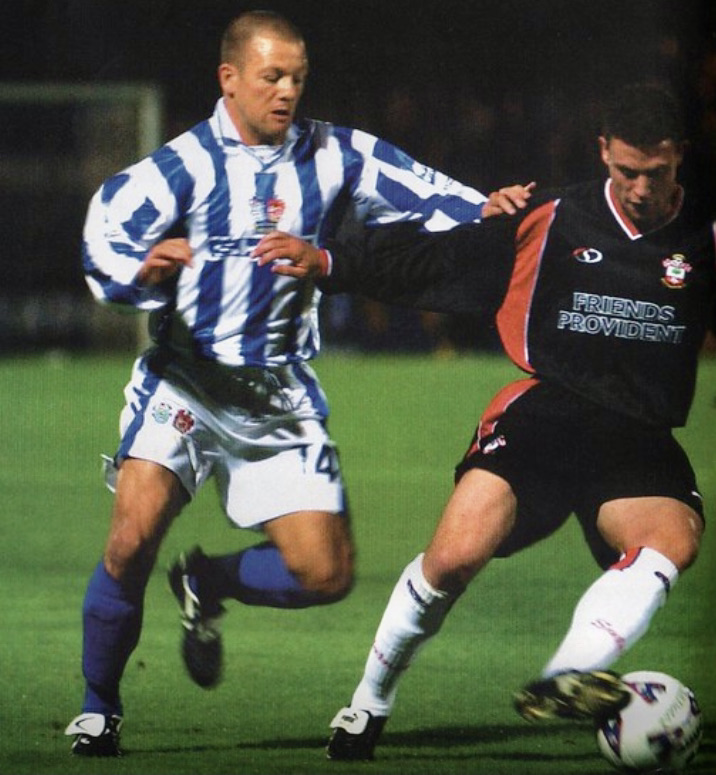
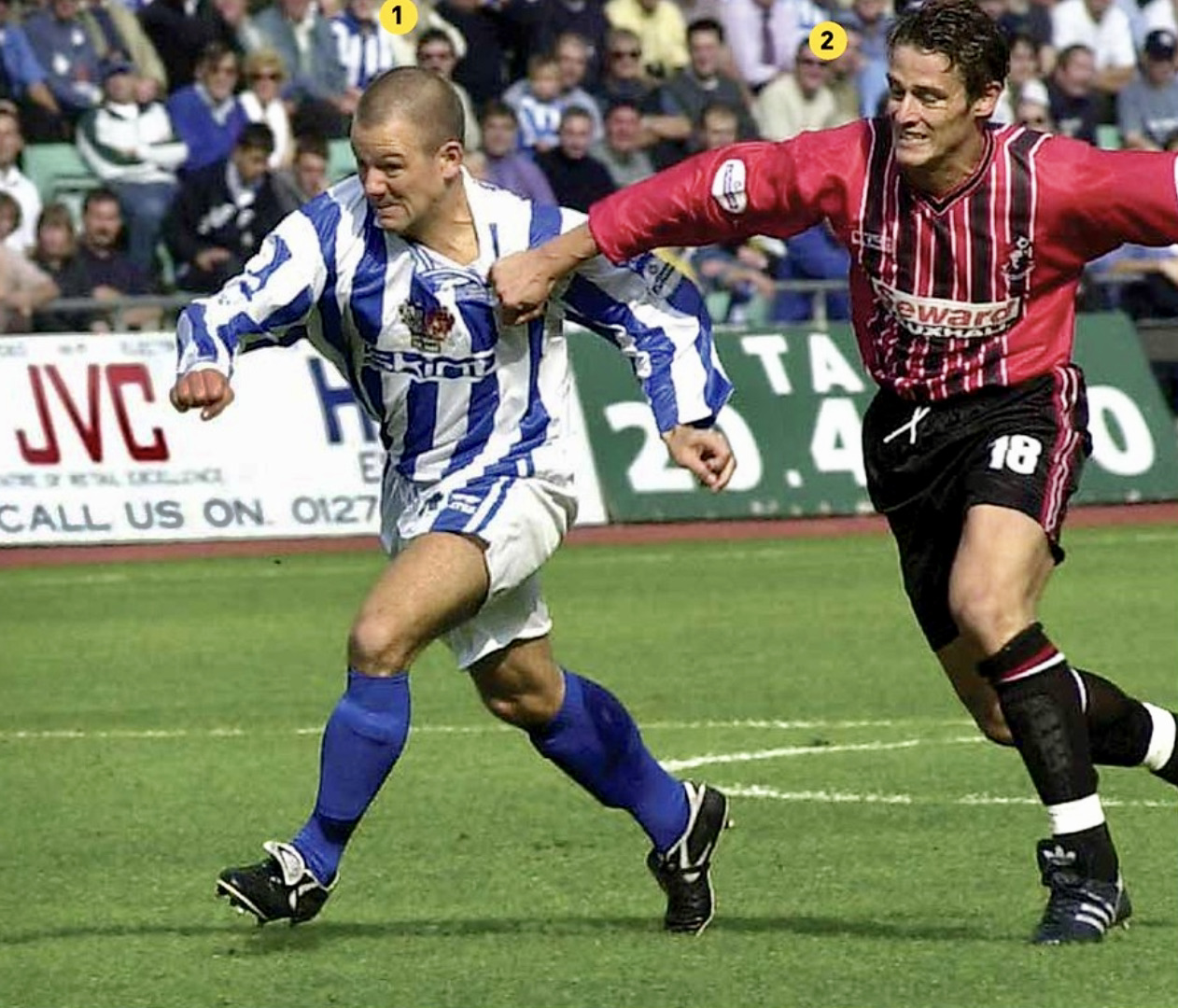
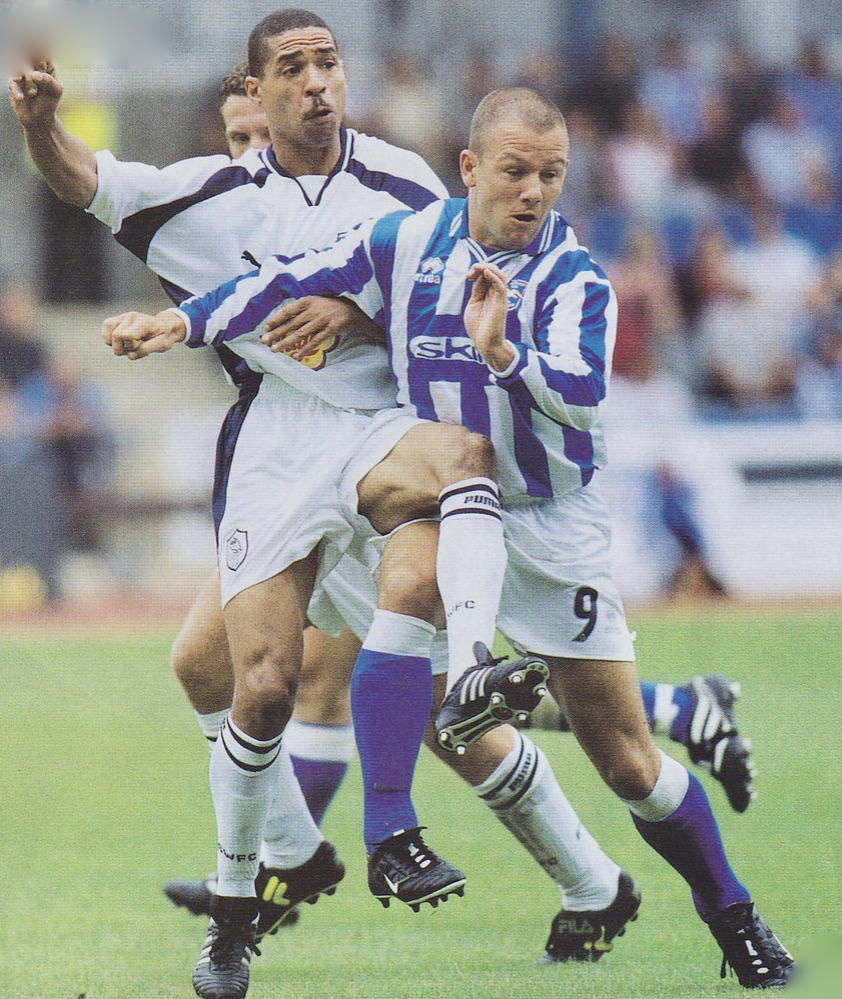
ONE-TIME Liverpool triallist Lee Steele was part of the Albion squad which won back-to-back promotions from the fourth and third tiers.
Unfortunately for him, a certain Bobby Zamora was almost always ahead of him in the pecking order, along with Gary Hart, so the diminutive striker often had to be content with involvement off the subs bench.
Nonetheless, he contributed important goals as the Seagulls under Micky Adams went up from League Two in 2001 and from League One in 2002 under Peter Taylor.
His first season at Brighton was marred by a drink-driving incident which, in hindsight, he believed tainted the rest of his time at the club. Indeed, as the season drew to a close, he was put on the transfer list and was at loggerheads with Adams.
“I told him I’d prove him wrong, and he said that only one player had said that to him before and gone ahead and done it,” Steele told Spencer Vignes in a matchday programme article. After shedding a few pounds and improving his fitness, he said: “I scored loads of goals in pre-season and worked my way into the side.
“I got a few more as the season began, and then he left and I was back to square one with Peter Taylor.” Steele said Taylor was easier to get on with than the “totally demanding and driven Adams” although he reckoned: “The intensity went from our game a fair bit.”
Nevertheless, in the 2001-02 season, he made 25 starts plus 19 appearances off the bench and the most important of his 10 goals was the 91st-minute winner in an Easter Monday 2-1 win over Bristol City at the Withdean after he’d gone on as a 30th-minute sub for Paul Brooker, who’d turned an ankle.
Argus reporter Andy Naylor pointed out how Steele had gone from villain to hero after getting himself sent off in a reserve game just as Zamora was ruled out for three games with a shoulder injury. As it turned out, that goal against City was his last in an Albion shirt.
In its end of season play-by-player analysis, the Argus said of Steele: “An enigma. More to offer than he has showed, although he would argue a regular run in the side would help. Still managed to finish with ten goals and has the pace and power to trouble defenders.”
However, there was no more to offer Brighton because Taylor’s departure that summer coincided with Steele’s Albion exit too.
Reflecting on his time at the Albion in another Vignes interview for the matchday programme, Steele said: “I wasn’t used to playing substitute all the time, which I found hard to adjust to. Then when I did come on, I used to put myself under so much pressure that I wouldn’t deliver the goods. It still haunts me actually. OK I was in Bobby’s shadow, but I was at a massive club and should have done better.”
He moved to Oxford United on a two-year deal, but didn’t enjoy a happy time under Ian Atkins, and then joined Leyton Orient where some vital goals – including one that earned the Os promotion while simultaneously relegating his old club out of the league – helped earn him a ‘fans favourite’ tag.
After the Os, he had a season with Chester City, then dropped out of the league to return to Northwich Victoria.
He moved on to semi-pro side Oxford City but was sacked for a homophobic tweet about Gareth Thomas, which he said was tongue-in-cheek. Northern Premier League side Nantwich took him on, although he only played one game for them.
Born in the Garston district of Liverpool on 2 December 1973, Steele was a ‘Red’ from an early age, first being taken to watch them aged six and idolising Ian Rush. He was educated at St Austin’s Catholic Primary School, Liverpool, Holmwood School and then St Mary’s College.
The young Steele harboured ambitions of becoming a professional golfer rather than a footballer but, when that didn’t work out, he started playing football with non-league Bootle while working for his uncle as a bricklayer.
“I managed to get a trial for Liverpool,” he told Andy Heryet in the Albion matchday programme. “I hoped they would ask me back, but I didn’t hear anything from them, which was disappointing as they promised me that I’d hear either way, but they never got back to me.”
It was Northwich Victoria who propelled him towards a career as a professional, signing him as cover ahead of a FA Trophy final against Macclesfield.
Steele scored five goals in three end of season games, earned a place on the bench at Wembley and got on for the last 20 minutes, although Victoria lost.
In his second season at Northwich, his reputation was growing as a prolific striker and Third Division Shrewsbury Town snapped him up for £40,000 – a decent-sized fee for a non-league player.
“I wanted to go. I’d always wanted to be a professional footballer, ever since it became clear I wasn’t going to make it as a golfer,” Steele told Heryet.
He spent the next three seasons with the Shrews although the club’s struggles at the wrong end of the league prompted him to look for a move.
While he was keen to go to Tranmere Rovers, who’d shown an interest, no deal was forthcoming, but Brighton went in for him and, having played against them the season before, he liked what he saw.
Steele has had several strings to his bow since finishing his playing career: he’s a qualified licensed UEFA B coach, a personal trainer and a nutrition advisor. Clients have included pro footballers, elite junior tennis players, 16-times PDC World Darts Champion Phil ‘The Power’ Taylor and Team GB age group triathletes.
He also spent a year as a fitness coach with Oldham Athletic during Lee Johnson’s reign as manager and two years as a scout for his old club, Leyton Orient.
Since 2008 he has been operations manager for Kickback Tax (a tax advisor agency for footballers) and, since December 2021, has been senior scout for Northampton Town.
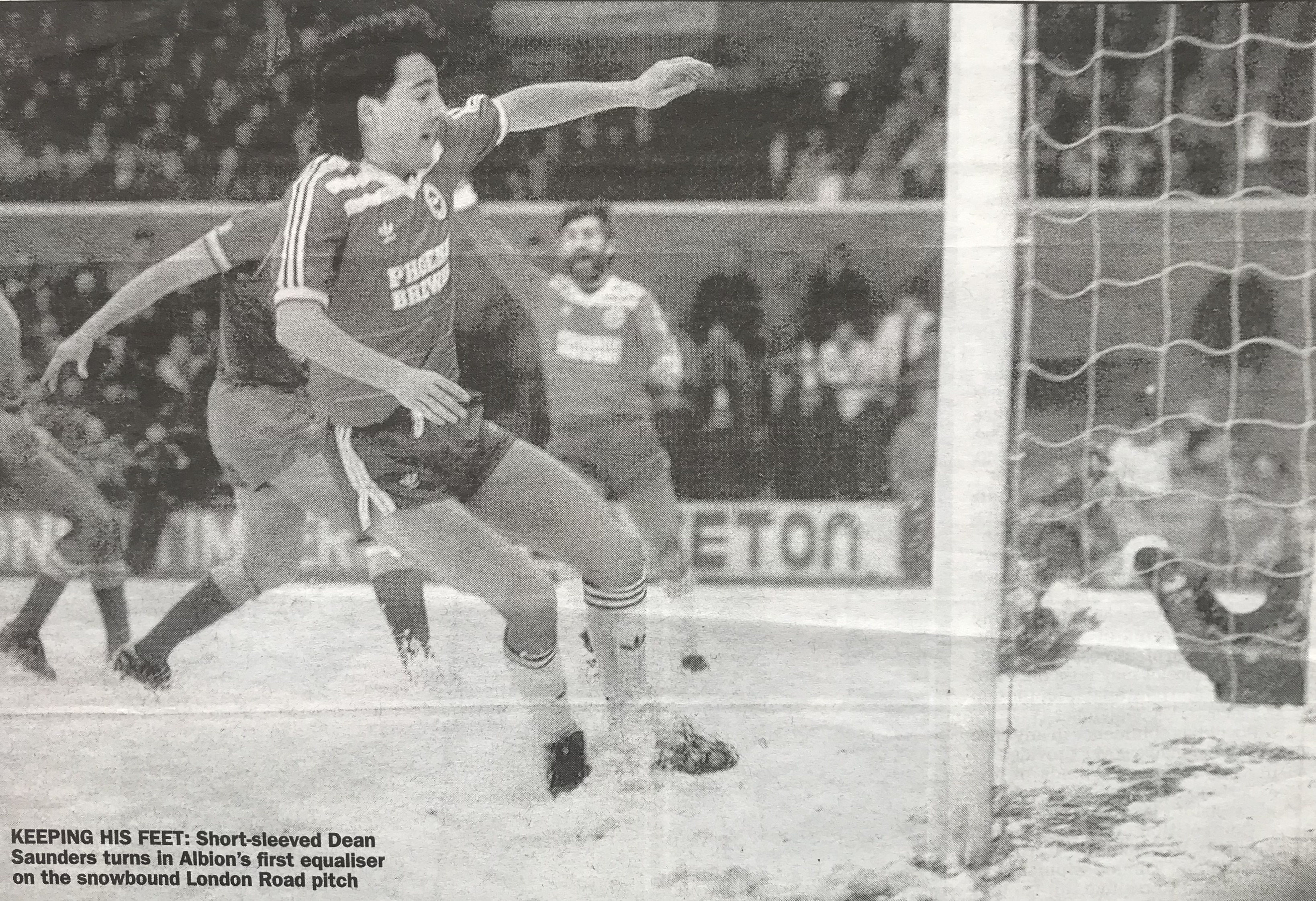
IT’S NOT often Brighton and Liverpool have had something in common but, when it came to striker Dean Saunders, they both sold him to raise money. And they weren’t alone.
In the Albion’s case, it happened in 1987 when manager Barry Lloyd was forced to cash in on the free transfer signing to raise £60,000 to go towards players’ wages.
For their part, five years later, Liverpool let the Welsh international depart Anfield for £2.3m because boss Graeme Souness wanted the money to buy a central defender.
When Saunders was remarkably transferred for £1m from the Maxwell-owned Oxford United to the Maxwell-owned Derby County, it prompted former Brighton and Liverpool defender Mark Lawrenson to quit as boss at the Manor Ground after he’d been promised there would be no transfers likely to weaken his squad.
Saunders’ long and much-travelled career began in Swansea, the place where he was born on 21 June 1964, the son of former Swansea and Liverpool wing-half Roy Saunders.
He attended GwrossydJunior School and was soon appearing in the school football team on Saturday mornings and playing minor football in the afternoons. He went on to Penlan Comprehensive in Swansea and his career began to blossom, playing in the school team at all levels under sports master Lee Jones, a former British gymanstics champion. Saunders played for the Swansea Schools representative sides at under 11, 13 and 15 levels.
“I can remember enjoying watching the Swansea players train when I was a lad,” he told Tony Norman in an Albion matchday programme article. “I was lucky because my dad was the assistant manager, so I could go to pre-season training and things like that.
“I used to kick a ball around on the sidelines and dream of playing for Swansea.” That dream turned to reality after he joined the Swans in 1980 as an apprentice (when John Toshack was the manager), turned professional in 1982, and made his debut in the 1983-84 season. He scored 12 times in 49 appearances but in his final year had a goalless four-game loan at Cardiff City.
Manager John Bond released him on a free transfer after a turbulent season in which the Swans only narrowly avoided relegation to the basement division and Chris Cattlin, who’d been impressed when he saw Saunders playing for Swansea Reserves at the Goldstone Ground, snapped him up for Brighton.
“I was amazed when the Welsh club let him go for financial reasons,” Cattlin wrote in his matchday programme notes for the opening game of the season. “He is young, quick and, if he works hard, he has a great chance.”
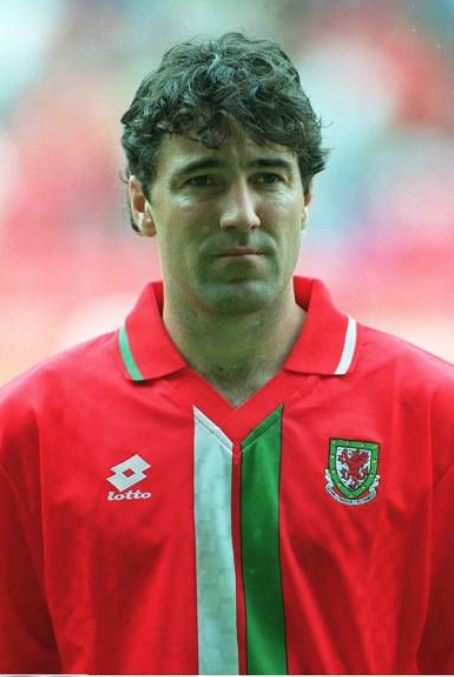
By the end of that season, Saunders had scored 19 goals in 48 league and cup games and was voted player of the season. His performances in the second tier for the Albion caught the eye of the Welsh national team manager, Mike England, and on 26 March 1986 Saunders made his full international debut for Wales as a substitute in a 1-0 win away to the Republic of Ireland. It was the first of 75 caps.
Saunders scored his first international goals when he netted twice in a 3-0 friendly win over Canada in Vancouver on 19 May 1986, after which England said: “He goes past defenders with his tremendous pace and his finishing against Canada was a revelation.
“The experience he gained at Brighton has done him the world of good. To finish top scorer in his first full season of Second Division football tells its own story.”
Saunders, who shared a house with Albion’s young Republic of Ireland international Kieran O’Regan, said being happy at home had helped him to settle down quickly.
“I liked Brighton from the day I arrived,” he said in a matchday programme article. “It reminds me of my home town of Swansea and I like living by the sea.”
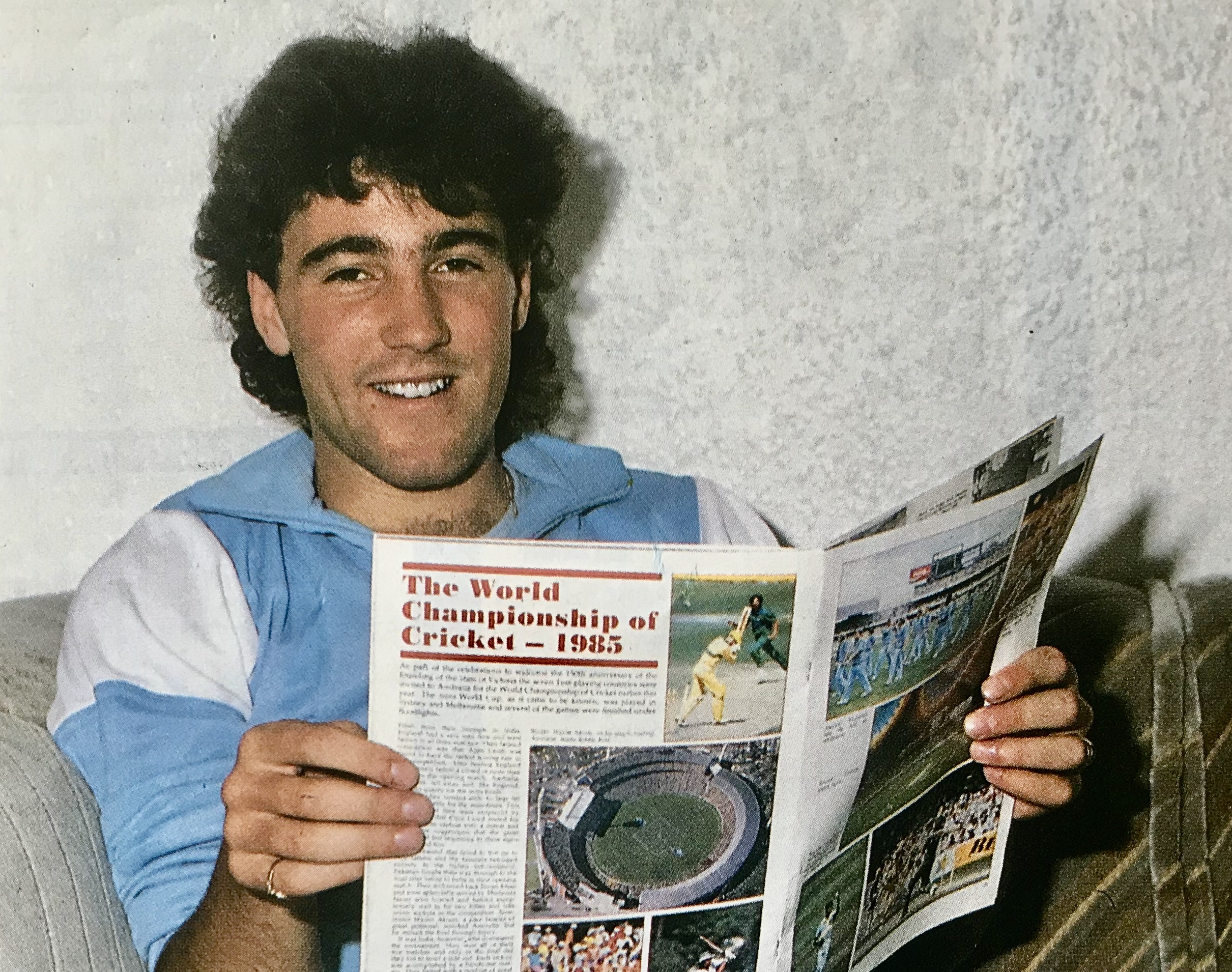
A lover of all sports, Saunders revealed how he liked to play cricket in the summer, when he turned out for Haywards Heath, and he played snooker with O’Regan and Steve Penney.
That summer, Saunders told Shoot! magazine: “I had both cartilages out of my left knee at 18 and had both Swansea and Cardiff turn me down. I’ve had my share of the downs. From the moment I joined Brighton, my career has turned for the better.”
The young striker continued: “Swansea just gave me away – despite the fact that I was top scorer in a team coming apart. Cardiff City gave me a few games but always seemed to have reasons for not playing me consistently when I was on loan there.
“So, I had every incentive to make the break from Welsh football and I joined Brighton. Brighton can go places.
“I was disappointed that we didn’t make the First Division first time around. But all the lads are convinced that we will get there next season. I’ve been given a three-year contract so there are tremendous incentives to do better.”
It didn’t work out that way, though. After only a mid-table finish, Cattlin was sacked and there were rumblings of financial issues beginning to reverberate around the corridors of the Goldstone. Alan Mullery returned as manager but had limited funds to invest in the team, and, with echoes of the Pat Saward era back in the early ‘70s, the club turned to fans for financial help to bring in players.
After Mullery’s unseemly swift departure halfway through the season, former Worthing boss Lloyd took over and fans were completely mystified as to how he could leave out Saunders in favour of Richard Tiltman, who Lloyd had plucked from local football. Since then, it has been suggested his omission was more to do with money than football ability.
There was great consternation that Albion collected only £60,000 when Lloyd sold Saunders to Oxford in early March 1987, especially as the Seagulls were fast hurtling back to a level of football they’d manage to avoid for ten years.
That was no longer a concern for Saunders who recovered the goalscoring touch he’d shown during his first season at the Goldstone Ground, scoring 33 goals in 73 games for Oxford before being sold to Derby for £1m against Lawrenson’s wishes 19 months after arriving at the Manor Ground.
A popular goalscorer for Derby
Meanwhile, the goals kept flowing for Saunders as he netted 57 in 131 games for Derby. The side finished fifth in the old First Division by the end of Saunders’ first season with the Rams, and he’d contributed 14 goals. The Derby Telegraph noted: “From the moment ‘Deano’ arrived, the players were inspired and the crowd enthused. The signing also suited the post-war tradition of 5ft 8in goalscoring heroes at the Baseball Ground – Raich Carter, Bill Curry, Kevin Hector and Bobby Davison.
“Derby fans were too wise to comment on height. What mattered was Saunders’ speed, eel-like turn and persistence. He scored six in his first five games, starting with two against Wimbledon when he captured supporters’ hearts with the immediacy of a Kevin Hector. A close-in header and long-range right-footer were beautiful appetisers.”
Despite Saunders scoring 24 goals for Derby in 1990-91, the side was relegated and Saunders and teammate Mark Wright were snapped up by Liverpool. Reds paid £2.9m to take Saunders to Anfield, boss Souness believing he’d be an ideal strike partner for their established Welsh international striker, Ian Rush.
Saunders made his Liverpool debut on 17 August 1991 in a 2-1 win over Oldham Athletic (Mark Walters and defender Wright also played their first league games for Liverpool); Ray Houghton and John Barnes scored Liverpool’s goals.
Saunders scored his first goal for the Reds 10 days’ later in a 1-0 win over QPR at Anfield but a Liverpool history website reckons he struggled to adapt to Liverpool’s passing game. “He was used to Derby’s counter-attacking style, scoring many of his goals by using his exceptional pace,” it said. “Saunders wasn’t very prolific in the league with about one goal every four games but flourished in the UEFA Cup with nine goals in five matches that included a quadruple against Kuusysi Lahti.”
Saunders scored twice in Liverpool’s successful FA Cup campaign, which culminated in them lifting the trophy at Wembley after beating Sunderland.
Although he scored twice in seven games at the start of his second season at Anfield, a cashflow issue meant Souness was forced to sell him to raise funds to dip into the transfer market.
Saunders explained: “Graeme called me in one day and told me he needed a centre-half [Torben Piechnik], and that he could raise the money by selling me to Aston Villa.
“I couldn’t believe he was prepared to let me go, but he said he didn’t think my partnership with Ian Rush had worked out, and Rushy wouldn’t be the one going anywhere. That was it.”
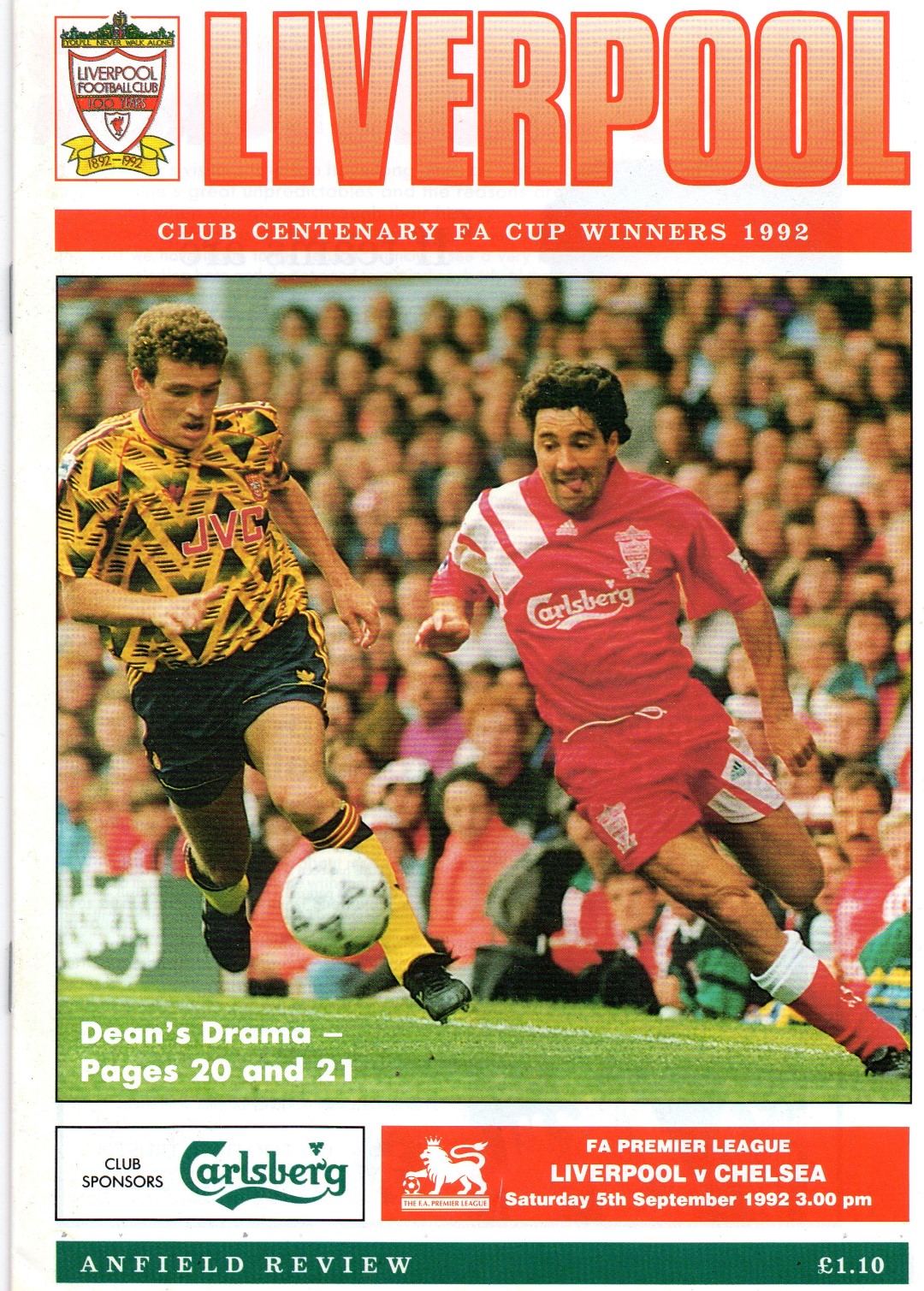
Saunders had scored 25 goals in 61 appearances for Liverpool, the last coming in a 2-1 home win over Chelsea (Jamie Redknapp scoring the other Liverpool goal) on 5 September 1992.
Among the goals again at Aston Villa
The Welshman had the last laugh, though, because only nine days after his departure from Liverpool he scored twice in Villa’s 4-2 victory over the Reds.
“Obviously I had a big incentive to do well today and I’m thrilled to have scored,” said Saunders. “Both my goals went through the goalkeeper’s legs.”
Signed by Ron Atkinson, Saunders spent three seasons at Villa, initially developing a formidable strike partnership with Dalian Atkinson, and then pairing up with Dwight Yorke. Saunders’ brace in the 1994 League Cup final helped beat Manchester United 3-1.
Villa history site lerwill-life.org.uk remembers him as “a spring-heeled attacker and very popular with the supporters” and adds: “Not big in size, he was very speedy and scored some spectacular goals including a 35-yard spectacular against Ipswich.”
His time at Villa Park came to an endwhen Brian Little took over as manager, and Saunders was reunited with his old Liverpool boss Souness in Turkey. A £2.35million fee took him to Galatasaray for the 1995-96 season and he netted 15 goals in 27 Turkish League matches.
Next stop for Saunders was back in the UK at Nottingham Forest, but the 1996-97 was an unhappy one as the manager who signed him, Frank Clark, was sacked in December after a bad run of defeats and Forest’s slide towards relegation continued under Stuart Pearce and Dave Bassett.
Sharpshooter for the Blades
By the time Forest had bounced straight back up, Saunders had left the club, moving in December 1997 to second-tier Sheffield United for a year under Nigel Spackman and caretaker managers Russell Slade and Steve Thompson. United made the play-offs but lost out to Sunderland in the semi-finals. In December 1998, Saunders moved abroad again to link up with Souness a third time, at Benfica in Portugal.
Up front for the Bantams
The following summer, he returned to England and joined Bradford City, where his former Brighton teammate Chris Hutchings was assistant manager, then briefly manager. Saunders was a regular in his first season at Valley Parade, when the Bantams managed to narrowly avoid relegation from the Premier League, but he played only a handful of games in 2000-01, when they were relegated. Saunders retired as a player shortly before his 37th birthday and became a coach at Bradford before linking up with Souness again, this time as a coach.
He joined him at Blackburn Rovers and then Newcastle United, but when Newcastle sacked Souness early in 2006, Saunders lost his job as well.
In the following year he began taking the Certificate in Football Management course run by the University of Warwick; and this led to him being granted his UEFA Pro Licence coaching badge, a qualification that allowed him to be appointed as assistant to John Toshack with the Welsh national team.
In October 2008, Saunders replaced Brian Little as manager of Wrexham, newly relegated to the Conference. He eventually managed to steer the north Wales outfit into the play-offs in the 2010-11 season, but they were knocked out by Luton Town and, in September 2011, Saunders was appointed manager of then Championship club Doncaster Rovers.
Unfortunately, he couldn’t save Rovers from relegation and they went back down to League One with only 36 points from their 46 League fixtures.
Having guided Rovers to second place in League One, Saunders was appointed manager of Wolverhampton Wanderers in January 2013, but he couldn’t prevent them being relegated from the Championship and he was sacked three days after relegation was confirmed courtesy of a 2-0 defeat at the hands of Gus Poyet’s Albion.
Suffering relegation with Wolves
Saunders told the media after the game: “We have to get some players in who think like I’m thinking, who want to win, fresh minds, no damage done to them, no confidence issues, no ‘been here too long’ issues, no ‘I don’t know if the manager likes me’ issues. Once I get my own team on the pitch, imagine what the supporters will be like.”
Saunders, with only five wins from his 20 games in charge, didn’t get that chance and rather ruefully said of his opponents that day: “A few years ago they were bankrupt and without a stadium, but they’ve shown what is possible and, with the momentum, they have could well get into the Premier League.”
Just after Christmas 2014, Saunders was named as the interim manager of Crawley Town after the previous incumbent John Gregory stood down for health reasons.
Saunders then became manager of League One side Chesterfield on 13 May 2015 but his stay there lasted only five months.
In June 2016, Saunders was part of the BBC pundit team for their coverage of the Welsh national team’s games at Euro 2016 and made the headlines during the tournament when it was revealed that he had incurred parking charges of over £1,000 from Birmingham Airport’s short stay car park as he wasn’t expecting Wales to progress as far as they did. The charge was eventually waived by the airport who asked him to make a donation to charity instead.
His subsequent involvement in football has been as a pundit on BT Sport’s Saturday afternoon Score programme as well as on the radio with talkSPORT. He hit the headlines in 2019 when he was jailed for failing to comply with a roadside breath test but the initial punishment was quashed and changed to a suspended sentence. Via the League Managers’ Association, Saunders issued a statement in which he said: “I made a terrible error of judgment for which I have been rightly punished, and I wholeheartedly regret that it happened.”
Pictures from the Albion matchday programme and various online sources.
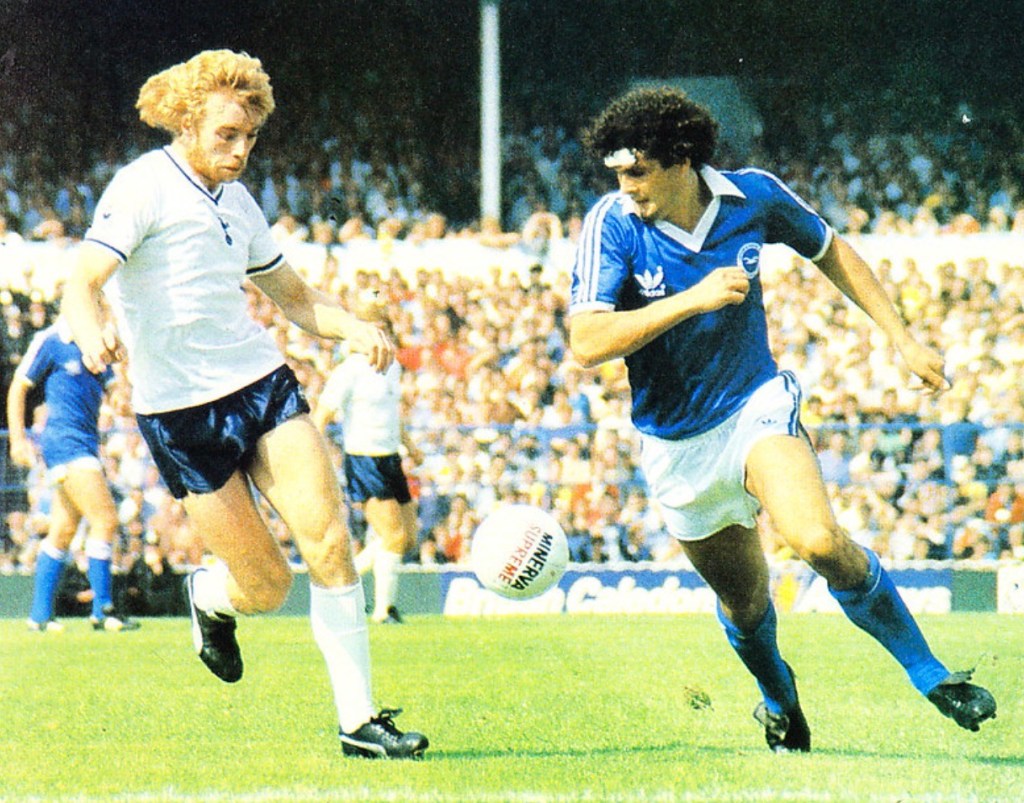
Steve Foster challenges Spurs’ Steve Archibald at White Hart Lane
LEGEND is overused far too much in football circles but, in some circumstances, it is justified. That applies to Steve Foster.
He played 800 games in a 21-year career which included nine years with Brighton in two separate spells.
His performances in the top-flight for Brighton led him to play for England at the 1982 World Cup and he lifted the League Cup in 1988 as the captain of Luton Town.
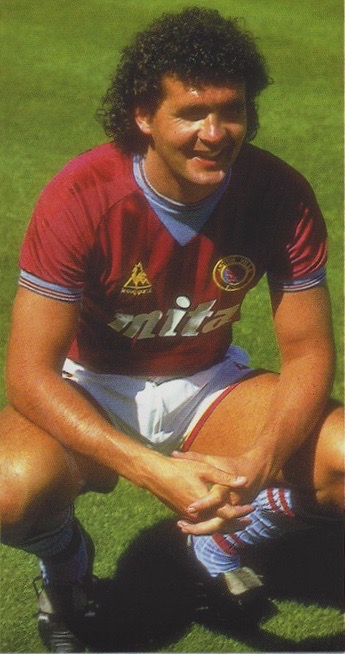
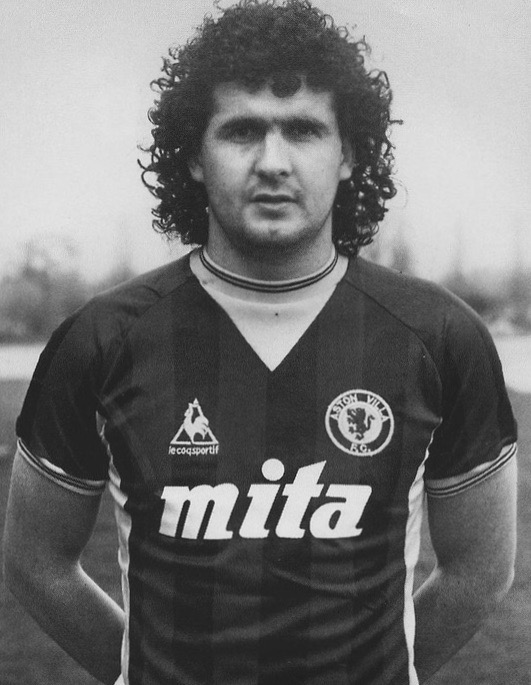
He might have enjoyed a longer spell at Aston Villa if the European Cup-winning manager who signed him hadn’t been unceremoniously dumped by ‘Deadly’ Doug Ellis.
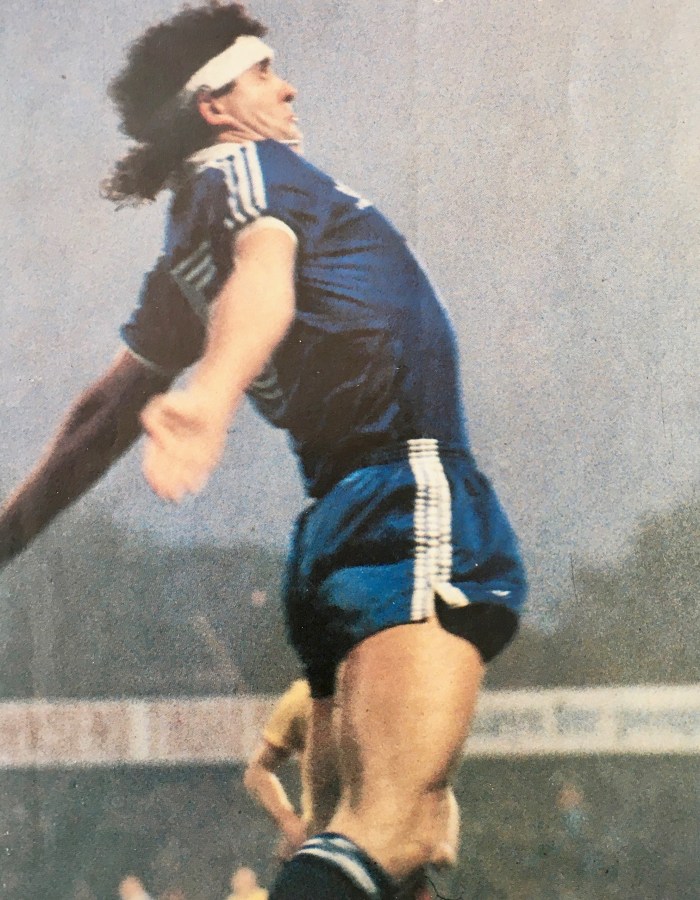
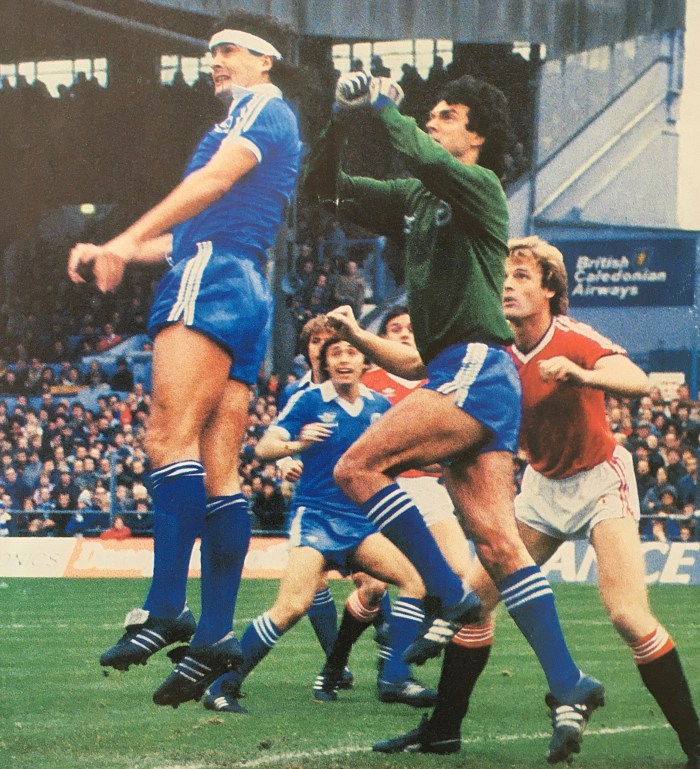
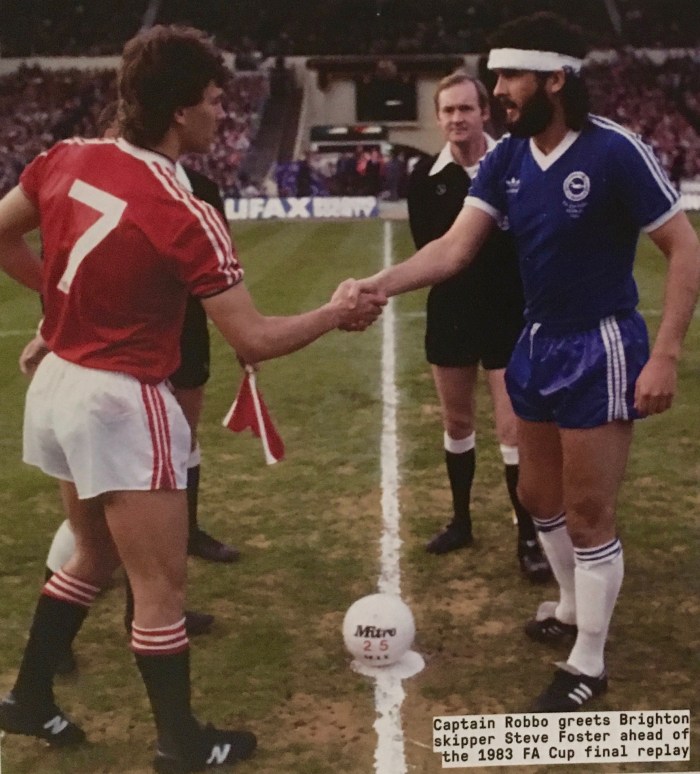
Foster became – and, to older fans, still is – synonymous with Brighton & Hove Albion, and football followers the world over could readily identify the captain with the white headband.
In several interviews over the years, he has explained how the distinctive headpiece was actually a piece of padded white towel designed to protect a forehead split open in collisions with centre forwards Andy Gray and Justin Fashanu.
I wonder if physio Mike Yaxley’s wife Sharon, who made up the dressing before every game, realised at the time the key role she played in helping to make Foster one of the most identifiable characters in football.
Foster’s illustrious career is warmly documented in Spencer Vignes’ excellent 2007 book A Few Good Men (Breedon Books Publishing), featuring an interview with the player himself and those who played with him.
For example, Gerry Ryan told Vignes: “Fozzie was a huge player with a huge personality, a real leader and deceptively quick for a big man.
“When he played against the best, like Ian Rush and Kenny Dalglish, he was the best. People talk about giving 100 per cent, but Fozzie gave 150 per cent in everything he did, and I mean off the field as well.”
Gordon Smith added: “He was a fantastic person, great fun and a terrific centre half.”
Vignes himself observed: “Steve’s willingness to put his neck on the line for the cause earned him hero status among the fans, together with the complete respect of the dressing room.”
Unsurprisingly, Foster pulls no punches in describing the various characters and events surrounding his colourful career, for instance describing Chris Cattlin as “definitely the wrong man. I told him the truth and what I thought of him.” And, of predecessor Jimmy Melia: “When Jimmy took over it was more like a circus than a football club.”
Foster said the two biggest influences on his career were Frank Burrows, the manager of his first club, Portsmouth, who taught him about balance as the key to strength on the pitch, and Brian Horton, the dynamic midfield driving force he succeeded as Albion captain.
“He shouted and screamed for 90 minutes to help us get results, and to keep everyone on their toes,” said Foster. “If he made a mistake, 10 other people would shout and scream at him, and he would take it. When I was captain at Brighton, and my other clubs, that’s how I tried to be.”
Such a recognisable figure as Albion’s centre-half
Fortunately, sufficient archive film footage remains for fans of different generations to see what a dominant force Foster was at the heart of Brighton’s defence, while I retain plenty of now-yellowing cuttings from the numerous columns of newsprint he filled during his pomp.
Born on 24 September 1957 in Portsmouth, Foster went to St Swithin’s Junior School before moving on to St John’s College. A centre-forward in the early days, he played for the Portsmouth Schools under-12s side but it was Southampton who took him on as an associate schoolboy.
He played in the same youth team as Steve Williams and Nick Holmes, who both went on to have long careers.
But Saints boss Lawrie McMenemy let Foster go at 16, urging him to go elsewhere and prove him wrong. After Foster won his first England cap, McMenemy sent him a congratulatory telegram. “That was class, nothing but class,” Foster told Vignes.
Southampton’s loss was Portsmouth’s gain, courtesy of a tip off from local schoolteacher Harry Bourne to Pompey youth team coach Ray Crawford (who’d previously held a similar role under Pat Saward at Brighton). Bourne ran the Portsmouth and Hampshire schools teams.
Crawford describes in his excellent autobiography Curse of the Jungle Boy (PB Publishing 2007) how he called at the family’s house in Gladys Avenue, Portsmouth, but Foster’s mother was at a works disco at the local Allders store. Wasting no time, he immediately went in pursuit and, against a backdrop of deafening music and flashing lights, shouted above the din that they were interested in signing her son.
Foster called the club the following day and he was invited to play in a youth team game for Portsmouth – against Southampton! “I scored twice because I was playing as a centre-forward then, and they ended up offering me an apprenticeship on £5 per week which was my entry into the professional game,” said Foster.
Reg Tyrell, a respected former chief scout from Crawford’s time at Ipswich, watched the young striker in a youth team training game and declared: “That no.9, he’s no centre-forward but he’d make a good number 5.” A few weeks’ later, manager Ron Tindall’s successor, Ian St John (later Saint and Greavsie TV show partner of Jimmy Greaves), gave Foster his debut as a centre half!
Foster played more than 100 games during Pompey’s slide down through the divisions, and, at 21, had developed something of a fiery reputation. But Brighton boss Alan Mullery saw him as “big and brave, strong in the tackle and good in the air” providing “much-needed stability at the back” as the Seagulls began their first adventure into the top-flight of English football in 1979. He was signed for £150,000.
A couple of disciplinary issues in the early days of the new season looked like proving the doubters right to have warned Mullery off signing him, but an injury to first choice centre back Andy Rollings forced the manager to backtrack on a temporary ban he’d handed out. Foster made the most of his reprieve and never looked back.
By the end of a season in which the side grew collectively Foster was named Player of the Year and he earned international recognition, gaining an England under 21 cap as a substitute for Terry Butcher in a 1-0 defeat against East Germany in Jena on 23 April 1980 (Peter Ward was playing up front).
While the 1980-81 season saw Albion struggle and flirt with relegation, Foster’s tussles with some of the top strikers in the game saw his reputation grow, and he even chipped in with a vital goal in the final home game of the season against Leeds.
When Horton and Mullery departed at the end of that season, Foster took over the captaincy under new boss Mike Bailey, and, even though fans didn’t much like the way Bailey set up his side, Foster thrived with the emphasis on defence first.
England boss Ron Greenwood, who lived in Hove, was in the process of shaping his squad for the 1992 World Cup in Spain and, with injuries affecting some of the other centre backs in contention, Foster was given a chance to prove himself.
I can remember travelling to Wembley on 23 February 1982 to watch him make his debut against Northern Ireland, a game England won 4-0 courtesy of goals from Ray Wilkins, Kevin Keegan, Bryan Robson and Glenn Hoddle.
I had been to the stadium 10 years before to watch another Albion player – Willie Irvine – make his international comeback in a 1-0 win for the Irish, but it was something special – and rare – to see a Brighton player line up for England.
To break through to the senior team in a World Cup year was a notable achievement, although, by his own admission, he accepted his good fortune directly correlated to injuries ruling out other players.
Although the record books show Foster earned three caps, in fact he represented the country four times that year.
A month after his debut against Northern Ireland, on 23 March, Foster played for an England XI in Bilbao against Athletic Bilbao. The game finished 1-1 with Keegan scoring for England. It didn’t qualify for a cap because it was a testimonial match for retiring Bilbao player Txetxu Rojo, but Greenwood used the fixture to familiarise the players with what was the venue for England’s opening round matches at the World Cup.
Foster also featured in a 2-0 friendly win over the Netherlands (goals by Tony Woodcock and Graham Rix) on 25 May as Greenwood continued to assess his options.
Foster (circled) in Ron Greenwood’s 1982 World Cup squad
When it was clear neither Alvin Martin nor Dave Watson would be fit for the tournament in Spain, Foster was selected as back-up to first choice centre back pairing Terry Butcher and Phil Thompson. Ahead of the third group match, Greenwood didn’t want to risk a ban for the already-booked Butcher, so Foster played alongside Thompson and England won 1-0 against Kuwait; Trevor Francis getting the England goal.
When England didn’t progress past the second phase, Greenwood’s spell as boss came to an end and he was replaced by Bobby Robson who, for his first game in charge, partnered Russell Osman with Butcher – both having played under him at Ipswich Town.
Foster didn’t play for England again.
Much has been written already about the 1982-83 season and Albion’s path to the FA Cup Final. Foster demonstrated real heroism in the semi-final at Highbury, playing through the pain of a septic elbow, and, memorably, towards the end of the game, launched into an overhead kick to clear a goal-bound shot to safety (pictured above).
History records Foster being suspended for the Cup Final – a well-documented appeal to the High Court against a two-game ban for accumulated bookings couldn’t get the decision reversed – but, as is often the case in football, his misfortune presented a golden opportunity for stand-in Gary Stevens who capped a man-of-the-match performance with the equalising goal. What he did that day persuaded Spurs to sign him.
Foster, of course, eventually got his Wembley chance in the replay but with a rampant Manchester United running out easy 4-0 winners, their fans also rather cruelly derided the Albion skipper with the chant I can still hear ringing around Wembley that evening: “Stevie Foster, Stevie Foster, what a difference you have made!”
In truth the whole defence lacked balance in the replay because manager Melia had elected to fill the right-back berth vacated by injury to Chris Ramsey with the left-footed Steve Gatting. He figured Stevens couldn’t be moved from the centre where he had performed so well on the Saturday, but it was a mistake, especially as Stevens had often played right back previously.
The relegation that went in tandem with Albion’s Wembley loss sparked the beginning of a big clear-out of the best players. First to go was Stevens, closely followed by Michael Robinson.
It wasn’t until the following March that Foster followed them through the exit, although, according to Foster, he might have gone sooner – even though he didn’t want to leave; a point he made clear in an interview with Match Weekly shortly after he signed for Villa for £150,000.
“I never wanted to move,” he said. “I had nearly seven years of my contract to run at Brighton and would have quite happily played out my career there. It’s a great little club.
“But economies dictated otherwise and, although manager Chris Cattlin wanted to keep me, he was under pressure to sell me and help ease the club’s financial problems.
“It was a wrench to leave Brighton because the club has treated me tremendously well and I’ve had some great times there – not least the FA Cup run last season.”
Cattlin had a slightly different take about the transaction in his matchday programme notes. “I feel that Steve Foster has been a fine player during his four-and-a-half years at the Goldstone, but I felt that the time was right and the offer good enough to let him go,” he said.
“I hope the move will benefit both Steve and the club. I hope it rejuvenates his career because he has been unlucky with injuries this season. It gives me breathing space for Eric Young to develop and it will also allow me to strengthen other positions if necessary.”
In a rather oblique reference to the need to get rid of high-earning players, Cattlin added in another matchday programme article: “Certain players have left Brighton in moves which I feel are important for our future. Salaries and bonuses of individual players are confidential and obviously I cannot disclose details, but the moves I have made I am certain are right.”
He added: “I can’t explain all the matters that have been considered but I will once again emphasise that we are building for the future and every move I make in the transfer market is being made with this in mind.”
Foster revealed that Villa boss Tony Barton, a former coach at Foster’s first club, Portsmouth, had tried to sign him twice before, but the clubs hadn’t been able to agree on a fee. Eventually, the transfer saw defender Mark Jones (who’d made seven top-flight appearances for Villa that season) move in the opposite direction, in addition to a £150,000 fee.
Barton wanted Foster to tighten up a leaky defence, to fill the position previously occupied by former European Cup winning centre-half Ken McNaught, who had moved to West Brom.
The relatively inexperienced Brendan Ormsby had been playing alongside McNaught’s former partner, Allan Evans, and the signing of Foster put his nose well and truly out of joint. “It’s obvious that I’m just going to be used as cover for Steve Foster or Allan Evans now and so it’s probably in my best interests to try and find another club,” he told Match Weekly.
As it turned out, it was Barton who was ousted; Ormsby stayed, and new manager Graham Turner decreed it would be Foster who was the odd one out. But I jump ahead too soon.
Foster’s arrival at Villa Park as featured on a matchday programme cover
A picture of Foster being introduced to the Villa faithful appeared on the front cover of the programme for the 17 March home game against Nottingham Forest although he didn’t make his Villa debut until 14 April 1984, away to Leicester City, which ended in a 2-0 defeat.
Foster made seven appearances by the end of the season and he got on the scoresheet in only his third game, netting together with future Albion player Dennis Mortimer, in a 2-1 win over Watford on 21 April.
Villa finished the season in 10th place but it wasn’t good enough for the erratic chairman Ellis. Suddenly Foster found the man who signed him had been sacked, and the side Barton had led to European Cup success was gradually dismantled.
To the astonishment of the Villa faithful, Barton was succeeded by former Shrewsbury Town boss Turner.
Foster played 10 games under the new boss, and scored twice, once in a 4-2 win over Chelsea on 15 September and then again the following Saturday in a 3-3 draw away to Watford.
He’d started the season alongside Evans but Turner then offered a way back to Ormsby. While Foster played a couple of games alongside Ormsby, Turner preferred Evans and Ormsby together, making the new man surplus to requirements.
His last game for Villa was away to Everton on 13 October and the following month he was sold to Luton for £70,000 – less than half the fee Villa had paid for him eight months earlier. Foster simply put it down to his face not fitting with the new man.
It was a completely different story with Luton boss David Pleat and Foster’s time at Kenilworth Road coincided with the club’s most successful period in their history, even though Pleat left to manage Spurs.
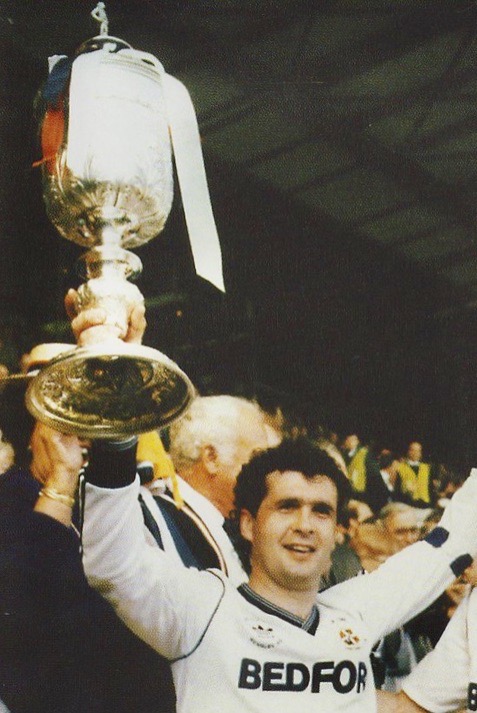
Alongside representing his country, Foster said the best moment of his career was captaining the Hatters as they won the League Cup (then sponsored by Littlewoods) at Wembley in 1988 with a 3-2 win over Arsenal, his former Brighton teammate Danny Wilson scoring one of their goals (Brian Stein got the other two).
They reached the final of the same competition the following year too, but on that occasion lost 3-1 to Nottingham Forest. By then Foster was assistant manager to Ray Harford, and it looked like he was on a path to become a boss in his own right.
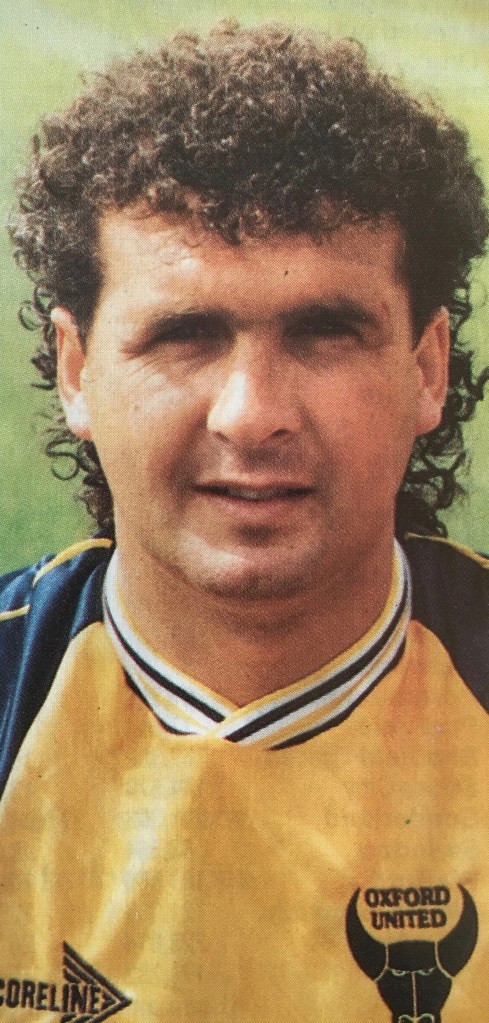
But that summer, when his old Albion captain, Horton, who had taken over from Mark Lawrenson as the manager of Oxford United, asked him to join him as a player at the Manor Ground, he was unable to resist and a new chapter in his career began.
It meant a drop down a division but Foster accepted the challenge and went on to play more than 100 games for United, many being quite a struggle as the side fought for survival at the foot of the second tier.
In the autumn of 1991, injury sidelined Foster from the U’s team and he believed it could have been the end of his career.
However, when the following summer he was contemplating whether or not to retire, he gave Brighton boss Barry Lloyd a call and asked if he could keep his fitness going by joining in pre-season training with the Seagulls.
Lloyd could see that the former skipper was still able to perform and, although the club was in a downward spiral, Foster seized the opportunity to extend his career and help out his old side.
Another veteran of that side, Clive Walker, told Vignes for A Few Good Men: “Fozzie might not have been so mobile then but his positional sense was absolutely brilliant, as was his ability in the air.”
Foster said: “Funnily enough during that second period I played probably some of my best football. I had to because of the position the club was in. There was no money so you had to pull out all the stops.”
Foster continued to play after Lloyd had departed, and he vented his anger publicly about the off-field shenanigans new boss Liam Brady was having to operate under.
Foster eventually called it a day at the end of the 1995-96 season, saddened at the club’s plight. He was granted a testimonial match against Sheffield Wednesday, played as a pre-season friendly in July 1996. Throughout Foster’s career he had continued to live in Hove and he retains his affection for the Albion to this day.
During his second spell at the club, Foster was the PFA rep and he had to deal with the heartbreak of telling the parents of a young player (Billly Logan) that an ankle injury was going to end his career. The youngster got just £1,500 compensation.
As a result, after his own playing days were over, Foster set up an insurance business (Pro-Secure) which continues to this day, making sure players are properly covered and get suitably recompensed if things don’t turn out as they’d hoped.
Although Foster hasn’t always been popular with the Albion’s hierarchy (courtesy of suggested involvement in potential takeovers), his association with the club hasn’t dimmed and Seagulls fans of two generations took him to their hearts for his on-field performances and leadership spanning a total of 332 games.
• Pictures from my scrapbook, the Albion matchday programme over several seasons, and some online sources.
WHEN Michael Robinson died of cancer aged 61 on 28 April 2020, warm tributes were paid in many quarters to the former Brighton, Liverpool and Republic of Ireland international who became a big TV celebrity in Spain.
“We have lost a very special guy, a lovely person and someone I’m proud to have known both on and off the pitch,” his former teammate Gordon Smith told Spencer Vignes. “He was one of the boys, one of the good guys.”
It seemed like half a world away since Robinson had charged towards Gary Bailey’s goal in the dying moments of the 1983 FA Cup Final only inexplicably to pass up the opportunity of scoring a Wembley winner to lay the ball off to Smith.
“With Michael bursting forward and having turned the United defence inside out, I was genuinely expecting him to shoot and had put myself in a position to pick up any possible rebound,” Smith recounted. “Instead he squared it to me and we all know what happened next.”
Robinson’s next two competitive matches also took place at Wembley:
He once again led the line for Brighton when the Seagulls were crushed 4-0 by Manchester United in the cup final replay on 26 May. It turned out to be his last game for the Albion.
Three months later he was in the Liverpool side who lost 2-0 to United in the FA Charity Shield season-opening fixture between league champions and FA Cup winners, following his £200,000 move from relegated Brighton.
It was hardly surprising Robinson didn’t hang around at the Goldstone: the Seagulls had given him a platform to resurrect a career that had stalled at Manchester City, but the striker had several disputes with the club and the newspapers were always full of stories linking him with moves to other clubs.
Perhaps it was surprising, though, that champions Liverpool were the ones to snap him up, particularly as Ian Rush and Kenny Dalglish were in tandem as first choice strikers.
But at the start of the 1983-84 season, Joe Fagan’s Liverpool had several trophies in their sights and Robinson scored 12 times in 42 appearances as the Merseyside club claimed a treble of the First Division title, the League Cup, and the European Cup.
It took him a while to settle at the Reds because by his own admission he was in awe of the players around him but advice from Fagan to play without the metal supports he’d worn in his boots for six years previously (to protect swollen arches) paid off.
“It made a hell of a difference,” he said. “I felt a lot sharper and so much lighter on my feet.” In the first game without them, Robinson scored twice in a European game at Anfield, then he got one in a Milk Cup tie versus Brentford and scored a hat-trick in a 3-0 league win at West Ham.
Nevertheless, asked many years later to describe his proudest moment in football, he maintained: “Scoring the winning goal in the FA Cup semi-final that meant that a bunch of mates at Brighton were going to Wembley in 1983.”
One of two sons born to Leicester publican Arthur Robinson on 12 July 1958, Michael followed in his father’s footsteps in playing for Brighton. Arthur played for the club during the Second World War when in the army, and also played for Leyton Orient.
When he was four, Robinson moved to Blackpool where his parents took over the running of a hotel in the popular seaside resort. The young Robinson first played football on Blackpool beach with his brother.
After leaving Thames Primary School, it was at Palatine High School that he first got involved in organised football, and, before long, he caught the eye of the local selectors and represented Blackpool Schools at under 15 level, even though he was only 13.
Amongst his teammates at that level was George Berry, who ironically was Robinson’s opponent at centre half in his first Albion match, against Wolverhampton Wanderers.
The young Robinson also played for Sunday side Waterloo Wanderers in Blackpool and when still only 13 he was invited for trials at Chelsea, by assistant manager Ron Suart, who had played for and managed Blackpool.
Although he was asked to sign schoolboy forms, Robinson’s dad thought it was too far from home. Coventry, Blackpool, Preston and Blackburn were also keen and the North West clubs had the edge because he wouldn’t have to leave home.
Eventually he chose Preston and on his 16th birthday signed as an apprentice. At the time, Mark Lawrenson was also there, training with the youngsters, and Gary Williams was already on the books.
After two years as an apprentice, he signed professional and began to push for a first team place with the Lillywhites. With former World Cup winner Nobby Stiles in charge, in 1978-79, Robinson scored 13 goals in 36 matches, was chosen Preston fans’ Player of the Year and his form attracted several bigger clubs.
In a deal which shocked the football world at the time, the flamboyant Malcolm Allison paid an astonishing £756,000 to take him to Manchester City. It was a remarkable sum for a relatively unproven striker.
The move didn’t work out and after scoring only eight times in 30 appearances for City, Robinson later admitted: “I’d never kicked a ball in the First Division and the fee was terrifying. If I had cost around £200,000 – a price that at that time was realistic for me – I would have been hailed as a young striker with bags of promise.”
It was Brighton manager Alan Mullery, desperate to bolster his squad as Albion approached their second season amongst the elite, who capitalised on the situation.
“I received the go ahead to make some major signings in the summer of 1980,” Mullery said in his autobiography. Mullery, had the support of vice-chairman Harry Bloom – current chairman Tony Bloom’s grandfather – even though chairman Mike Bamber was keener to invest in the ground.
“I could see he’d lost confidence at City and I made a point of praising him every chance I got,” said Mullery. “I asked him to lead the line like an old-fashioned centre forward and he did the job very well.”
Robinson told the matchday programme: “When Brighton came in for me, I needed to think about the move…12 months earlier I had made the biggest decision of my life and I didn’t want to be wrong again.”
In Matthew Horner’s authorised biography of Peter Ward, He shot, he scored, Mullery told him: “When I signed Michael Robinson it was because I thought Ward was struggling in the First Division and that Robinson could help take the pressure off him. Robinson was big, strong, and powerful and he ended up scoring 22 goals for us in his first season.”
The first of those goals came in his fourth game, a 3-1 league cup win over Tranmere Rovers, and after that, as a permanent fixture in the no.9 shirt, the goals flowed.
With five goals already to his name, Robinson earned a call up to the Republic of Ireland squad. Although born in Leicester, his mother was third generation Irish and took out Irish citizenship so that her son could qualify for an Irish passport. It was also established that his grandparents hailed from Cork.
He made his international debut on 28 October 1980 against France. It was a 1982 World Cup qualifier and the Irish lost 2-0 in front of 44,800 in the famous Parc des Princes stadium.
Nevertheless, the following month he scored for his country in a 6-0 thrashing of Cyprus at Lansdowne Road, Dublin, when the other scorers were Gerry Daly (2), Albion teammate Tony Grealish, Frank Stapleton – and Chris Hughton!
In April 1982, Robinson, Grealish and Gerry Ryan were all involved in Eire’s 2-0 defeat to Algeria, played in front of 100,000 partisan fans, and for a few moments on the return flight weren’t sure they were going to make it home. The Air Algeria jet developed undercarriage problems and had to abort take-off. Robinson told the Argus: “I thought we were all going to end up as pieces of toast. But the pilot did his stuff and we later changed to another aircraft.”
Although not a prolific goalscorer for Ireland, he went on to collect 24 caps, mostly won when Eoin Hand was manager. He only appeared twice after Jack Charlton took charge.
But back to the closing months of the 1980-81 season…while only a late surge of decent results kept Albion in the division, Robinson’s eye for goal and his never-say-die, wholehearted approach earned him the Player of the Season award.
As goal no.20 went in to secure a 1-1 draw at home to Stoke City on 21 March, Sydney Spicer in the Sunday Express began his report: “Big Mike Robinson must be worth his weight in gold to Brighton.”
However, the close season brought the shock departure of Mullery after his falling out with the board over the sale of Mark Lawrenson and the arrival of the defensively-minded Mike Bailey.
Bailey had barely got his feet under the table before Robinson was submitting a written transfer request, only to withdraw it almost immediately.
He said he wanted a move because he was homesick, but after talks with chairman Bamber, he was offered an incredible 10-year contract to stay, and said the club had “fallen over themselves to help me”.
Bamber told the Argus: “I have had a very satisfactory talk with Robinson and now everybody’s contracts have been sorted out. It has not been easy to persuade him to stay.”
Even though Bailey led the Seagulls to their highest-ever finish of 13th, it was at the expense of entertainment and perhaps it was no surprise that Robinson’s goal return for the season was just 11 from 39 games (plus one as sub).
The 1982-83 season had barely got underway when unrest in the club came to the surface. Steve Foster thought he deserved more money having been to the World Cup with England and Robinson questioned the club’s ambition after chairman Bamber refused to sanction the acquisition of Charlie George, the former Arsenal, Derby and Southampton maverick, who had been on trial pre-season.
Indeed, Robinson went so far as to accuse the club of “settling for mediocrity” and couldn’t believe manager Bailey was working without a contract. Bamber voiced his disgust at Robinson, claiming it was really all about money.
The club tried to do a deal whereby Robinson would be sold to Sunderland, with Stan Cummins coming in the opposite direction, but it fell through.
Foster and Robinson were temporarily left out of the side until they settled their differences, returning after a three-game exile. But within four months it was the manager who paid the price when he was replaced in December 1982 by Jimmy Melia and George Aitken.
Exactly how much influence the managerial pair had on the team is a matter of conjecture because it became a fairly open secret that the real power was being wielded by Foster and Robinson.
On the pitch, the return of the prodigal son in the shape of Peter Ward on loan from Nottingham Forest had boosted crowd morale but didn’t really make a difference to the inexorable slide towards the bottom of the league table.
Albion variously tried Gerry Ryan, Andy Ritchie and, after his replacement from Leeds, Terry Connor, to partner Robinson in attack. But Connor was cup-tied and Ryan bedevilled by injuries, so invariably Smith was moved up from midfield.
Robinson would finish the season with just 10 goals to his name from 45 games (plus one as sub) – not a great ratio considering his past prowess.
The fearless striker also found himself lucky to be available for the famous FA Cup fifth round tie at Liverpool after an FA Commission found him guilty of headbutting Watford goalkeeper Steve Sherwood in a New Year’s Day game at the Goldstone.
The referee hadn’t seen it at the time but video evidence of the incident was used and the blazer brigade punished him with a one-match ban and a £250 fine. Robinson claimed it had been an accident…but it was one that left Sherwood needing five stitches. The ban only came into effect the day after the Liverpool tie, and he missed a home league game against Stoke City instead.
In the run-up to the FA Cup semi-final with Sheffield Wednesday, Robinson was reported to be suffering with a migraine although he told Brian Scovell it was more to do with tension, worrying about the possibility of losing the upcoming tie.
Nevertheless, he told the Daily Mail reporter: “When I was with Preston, I suffered a depressed fracture of the skull and have had headaches ever since. This week it’s been worse with the extra worry about the semi-final.”
Manager Melia, meanwhile was relieved to know Robinson would be OK and almost as a precursor to what happened told John Vinicombe of the Evening Argus: “Robbo is a very important member of our team and he’s the man who can win it for us.
“It is Robbo who helps finish off our style of attacking football and I know he’ll do the business for us on the day.”
Reports of the semi-final were splashed across all of the Sunday papers, but I’ll quote the Sunday Express. Under the headline MELIA’S MARVELS, reporter Alan Hoby described the key moment of the game.
“In a stunning 77th minute breakaway, Case slipped a beauty forward to the long-striding Gordon Smith whose shot was blocked by Bob Bolder.
“Out flashed the ball to Smith again and this time the cultured Scot crossed for Mike Robinson to rap it in off a Wednesday defender.”
Other accounts noted that defender Mel Sterland had made a vain attempt to stop the ball with his hand, but the shot had too much power.
When mayhem exploded at the final whistle, a beaming Robinson appeared on the pitch wearing a crumpled brown hat thrown from the crowd to acknowledge the ecstatic Albion supporters.
In one of many previews of the Final, Robinson was interviewed by Shoot! magazine and sought to psyche out United by saying all the pressure was on them.
“That leaves us to stride out from that tunnel with a smile and a determination to make everyone proud of us,” he said.
“Nobody seems to give us a prayer. They all seem glad that ‘little’ Brighton has reached the Final, but only, I suspect, because they expect to see us taken apart by United.”
Everyone knows what happened next and quite why the normally-confident Robinson didn’t take on his golden opportunity to win the game for Brighton in extra time remains a mystery.
However, as mentioned earlier, within months ‘little’ Brighton was a former club and Robinson had taken to a much bigger stage. This is Anfield reflected on his short time at Anfield as “a golden opportunity for him” and recalls that it turned out to be “the best and most successful season of his career”.
He had yet more Wembley heartache during a two-year spell with Queen’s Park Rangers, being part of their losing line-up in the 3-0 league cup defeat to Oxford United in 1986.
The move which would lay the foundations for what has become a glorious career on TV arose in January 1987 when Robinson moved to Spain to play for Osasuna, scoring 12 times in 59 appearances before retiring through injury aged 31.
Robinson completely embraced the Spanish way of life, learned the language sufficiently to be an analyst for a Spanish TV station’s coverage of the 1990 World Cup, and took Spanish citizenship.
His on-screen work grew and the stardom Robinson achieved on Spanish TV attracted some of the heavyweight English newspapers to head out to Spain to find out how he had managed it.
Meanwhile, in a truly remarkable interview Spanish-based journalist Sid Lowe did with Robinson for The Guardian in 2004, we learned how that FA Cup semi-final goal was his proudest moment in football and that Steve Foster was his best friend in football.
In June 2017, his TV programme marked the 25th anniversary of Barcelona’s first European Cup win at Wembley, with some very studious analysis. On Informe Robinson (‘Robinson Report), he said: “Wembley was a turning point in the history of football. Cruyff gave the ball back to football.”



















 Perhaps it was surprising, though, that champions Liverpool were the ones to snap him up, particularly as Ian Rush and Kenny Dalglish were in tandem as first choice strikers.
 Nevertheless, asked many years later to describe his proudest moment in football, he maintained: “Scoring the winning goal in the FA Cup semi-final that meant that a bunch of mates at Brighton were going to Wembley in 1983.”


 He had yet more Wembley heartache during a two-year spell with Queen’s Park Rangers, being part of their losing line-up in the 3-0 league cup defeat to Oxford United in 1986.


 In parallel lines