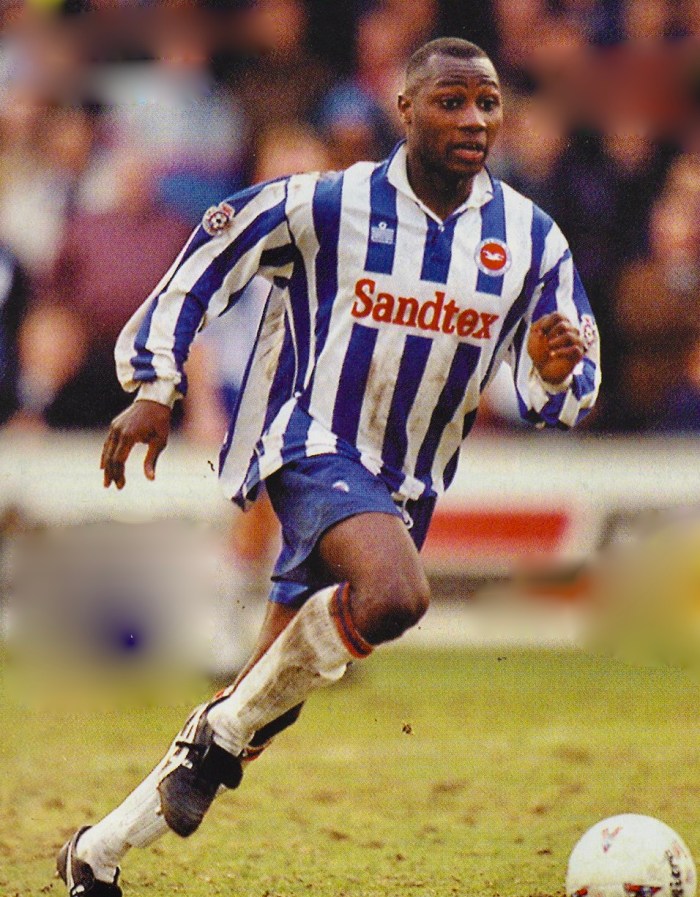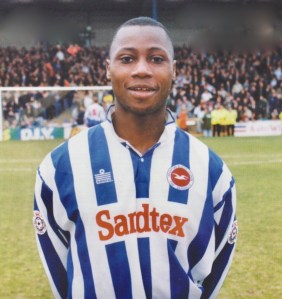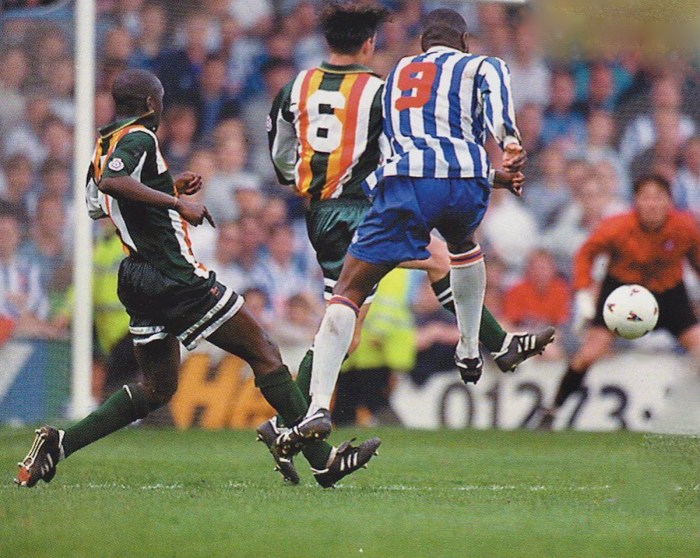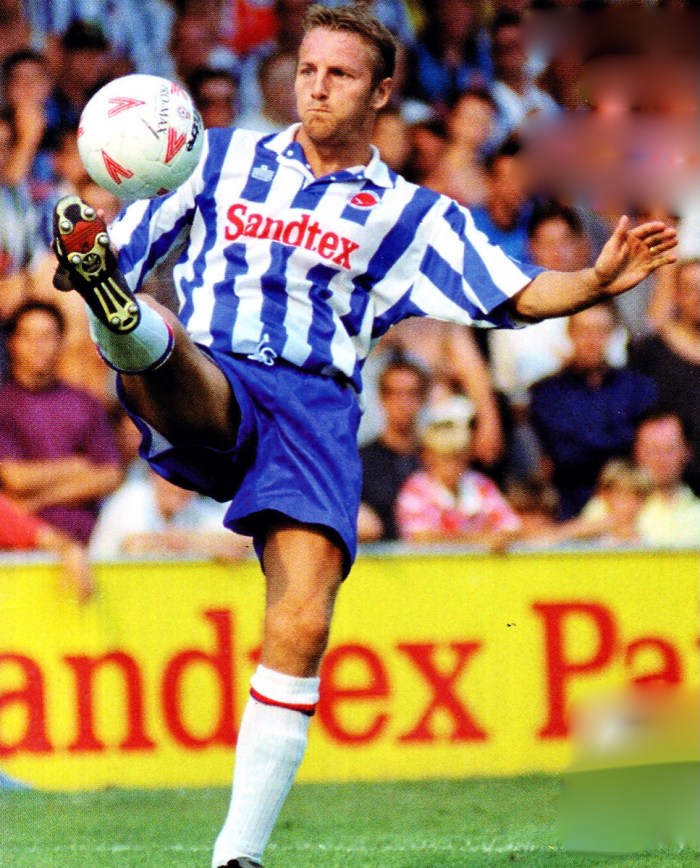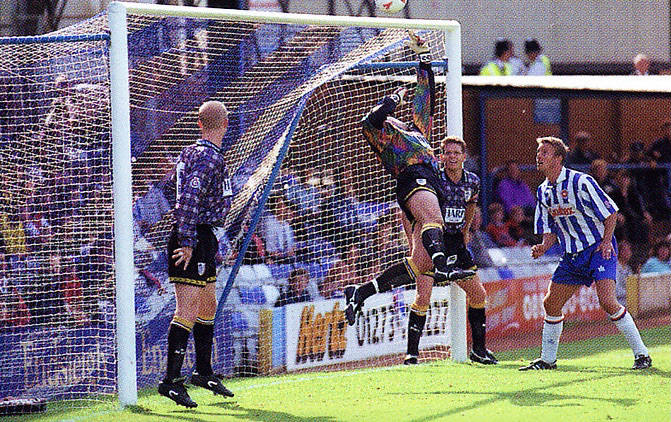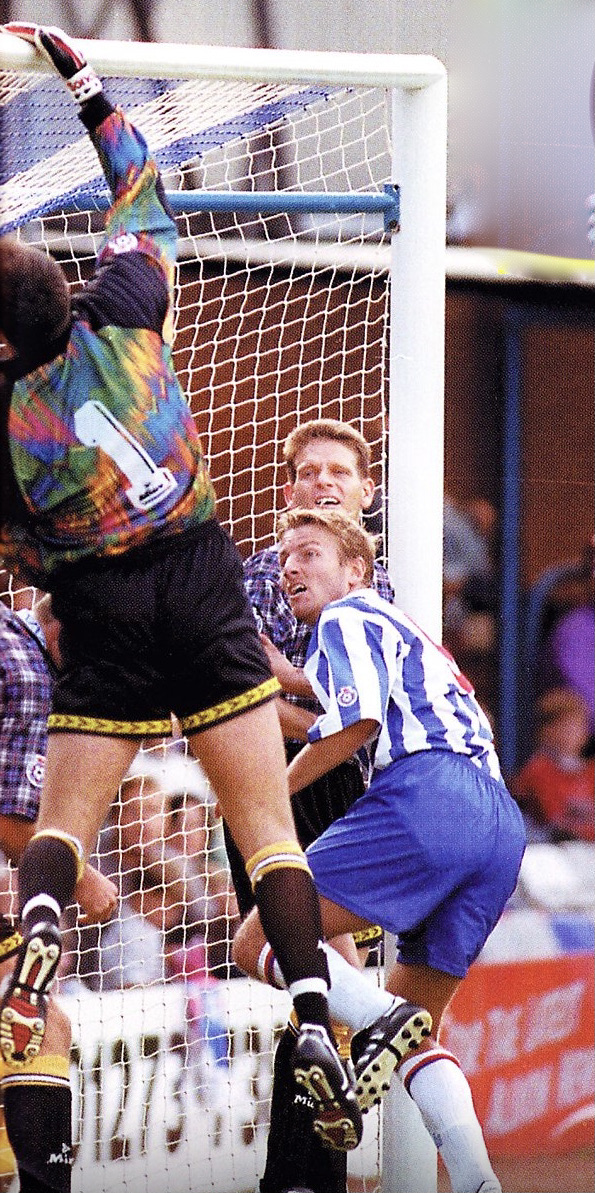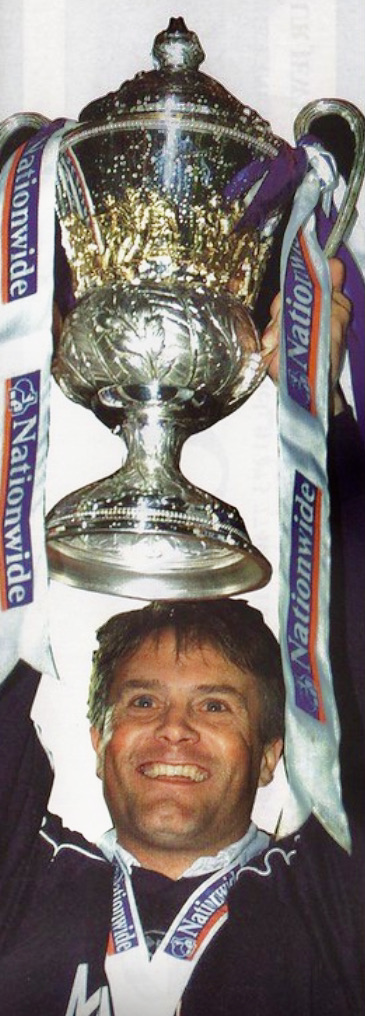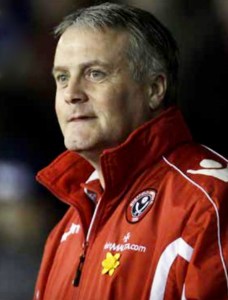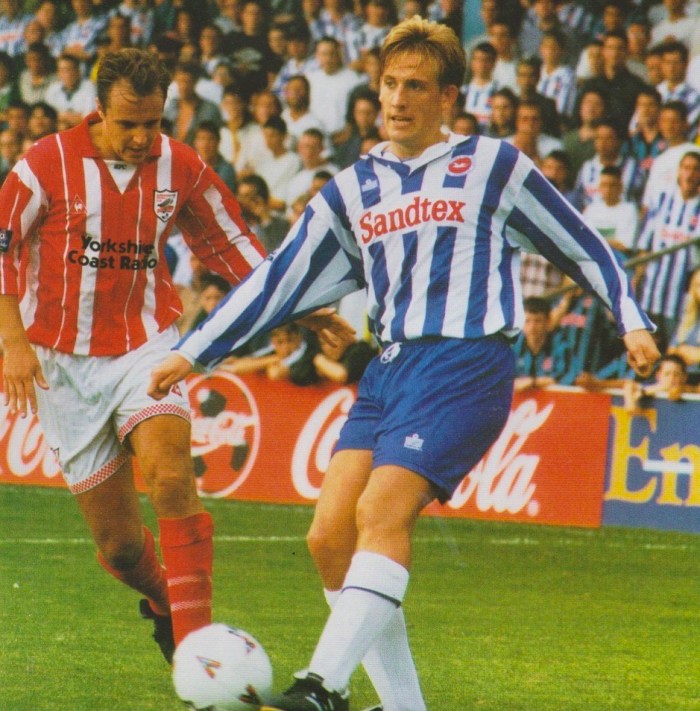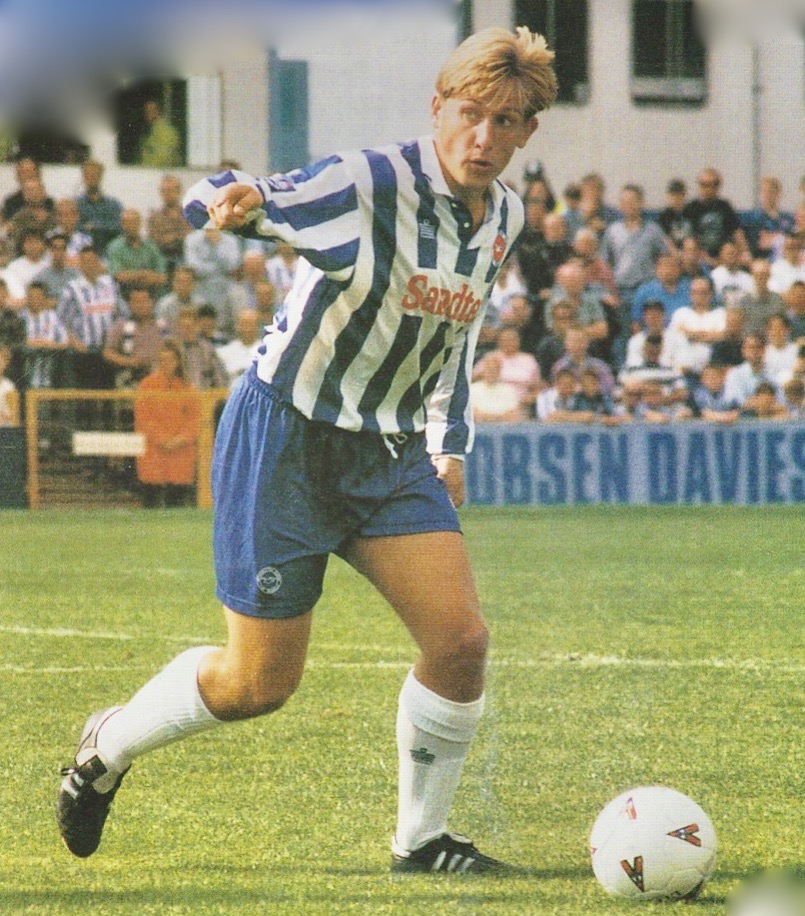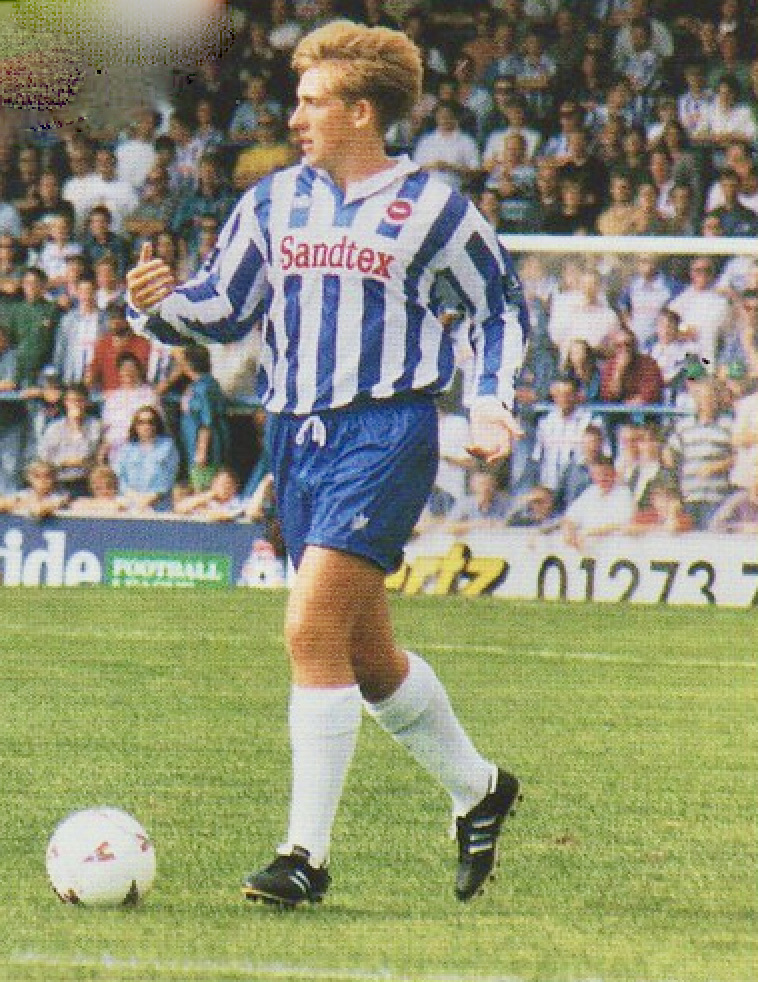
Zeke Rowe’s three goals and a red card as Albion went down

CHELSEA loanee Zeke Rowe scored three goals in nine matches for doomed Brighton and ended his spell with the ignominy of being sent off.

Rowe, a 22-year-old striker who had scored plenty at youth level for Chelsea,  was one of five new faces to join Jimmy Case’s relegation-bound Seagulls in the spring of 1996.

Winger Paul McDonald and striker Craig Maskell joined permanently from Case’s old club, Southampton, together with Saints defender Derek Allan, on loan initially and then permanently. Future captain Gary Hobson signed from Hull City.

All found themselves plunged into what turned out to be a fruitless battle to avoid relegation against a toxic backdrop created by the people running the club at that time – the hated Archer / Stanley / Bellotti regime – who tried to sell the club’s home without having a new ground to move to.

In the same matchday programme that announced the arrival of the five new players, the publication also detailed the impending departures of the likes of former first team regulars Steve Foster, Ian Chapman, Dean Wilkins, John Byrne, Stuart Myall and Stuart Munday; not to mention directors Bernard Clarke, Peter Kent, Dudley Sizen and Denis Sullivan. To misquote Shakespeare: Something was definitely rotten in the state of Hove!

Rowe made his debut in a 1-1 draw at home to Rotherham United, on 30 March, and then got off the mark with a goal away to Swindon Town four days later, although the Albion went down 3-2 (Jeff Minton scored the other).

Rowe’s picture adorned the front cover of the matchday programme for the 9 April home match v Burnley when his goal earned the Seagulls a win.

And his solitary goal also proved to be the decider in another 1-0 home win, over fellow strugglers Carlisle United, managed at the time by Mervyn Day.

Rowe’s dismissal for fighting with York City’s John Sharples came in a Thursday morning game, played five days after the official end of the season, in front of a post-War record low gate of 2,106 fans at the Goldstone.

The fixture had been rearranged because the original game 12 days previously had been abandoned after disgruntled Albion supporters had stormed the pitch in protest at the proposed sale of the ground and broken both crossbars.

It drew hysterical reaction in some quarters (probably because it was only a few weeks before England played host to Euro 96) but had the desired effect of bringing the rogue direction of the club to the attention of the football authorities who somewhat late in the day intervened to stop the Albion going out of business.

The original York game had looked like being the last ever at the Goldstone but a stay of execution saw the club stay for one more season before the site was redeveloped and the Seagulls were forced to groundshare at Gillingham.

The only happy supporters at the Goldstone on 9 May 1996 were around 400 followers of the Minstermen because their side overcame going a goal down to a Maskell opener to win 3-1, a result which prevented them joining Albion in the drop. Gary Bull, who had enjoyed a successful time on loan with Brighton at the start of that season, had equalised for York.

One City fan, Simon Worden, wrote an amusing blog about the whole occasion, and explained: “Whilst I should have been in a lecture at university at Preston, as I was only 19 at the time, I decided that the match was too important to miss and travelled down the day before to watch the match and stayed in a very cheap B&B.”

After witnessing the win, he said: “All the York fans were jumping around on a Thursday morning singing ‘We are staying up’ and enjoying the sunshine.

“One of the best days even and, whilst I was very tired, it was an enjoyable (but expensive) trip back to Preston where I had to catch up with my studies!”

Also watching on was Michael Knighton, chairman of Carlisle United, who, as a consequence of the result, were relegated with the Albion. Greg Wood, covering the game for The Independent, spiced up his report with a couple of choice quotes from him.

“Once York had gone 2-1 ahead, Brighton just weren’t interested,” said Knighton. “We’ve been relegated and we’ll never know if we should have been. This competition should be based on fairness, and towards us it hasn’t been.”

Wood also observed: “After York’s third goal, a member of their board turned to Knighton and made some distinctly unsporting gestures. Ordinary supporters have probably been expelled for less.”

Born in Hackney on 30 October 1973, Rowe was a frequent goalscorer in Chelsea junior teams playing alongside the likes of Neil Shipperley, Muzzy Izzet, Michael Duberry and Craig Burley.

But a first team breakthrough eluded him and before his time at Brighton he had scored twice in 10 games on loan at Barnet and had a trial with Swindon Town that didn’t work out.

When Chelsea let him go in the summer of 1996, he moved to Second Division Peterborough United under Barry Fry and was quickly off the mark netting the Posh opener in a 3-3 home draw with Millwall on 10 September 1996.

He was on target again, four days later, ironically against York City, in a 2-2 draw. But the season didn’t end well for Posh, because they were relegated. Rowe only scored once more in his 15 starts and 14 appearances off the bench that season.

Over the next two seasons, he only made four more starts for United and 13 appearances as a sub, while also going out on loan to Kettering Town and Doncaster Rovers.

Rowe later moved to Welling United where, according to the fanzine Winning Isn’t Everything, he was a disappointment after a bright start. It said: “Ezekiel Bartholomew Rowe, to give him his full name. Another in the long line of loanees from Uncle Barry Fry, he was brought in late in the 1998-99 season as the club attempted another Houdini act. Joined permanently in the summer, was on fire pre-season and then… he was shit. Had an impressive tattoo, erm, apparently.”

At King’s Lynn, Rowe played under his former Peterborough teammate Tony Spearing, who won the FA Youth Cup with Norwich City. (That 1983 success saw the Canaries draw 5-5 with Everton over two legs – Mark Farrington scoring four of Everton’s goals – before edging a replay 1-0).

Rowe ended his playing days with Conference North side Hinckley United where he was a teammate of Stuart Storer, who famously scored the last ever goal at the Goldstone – against Doncaster Rovers – a year after Rowe’s dismissal at that much-loved old stadium.

Fiery Ian Baird saw red in crucial last Goldstone game

FIERY Ian Baird was no stranger to yellow and red cards – in five games for Newcastle United he was booked three times!

And in Brighton’s last ever game at the Goldstone Ground, against Doncaster Rovers, Baird was sent off long before the game had even reached half time.

Something of a disciple of Joe Jordan, the tenacious centre forward who starred for Leeds United and Manchester United, Baird was his teammate at Southampton and played under the Scot at Hearts in Scotland and at Bristol City.

Baird didn’t fear incurring the wrath of supporters, happily playing for arch-rival clubs in his pursuit of goals. Indeed, on Teesside he earned a place in fans’ folklore by scoring two goals in an end-of-season clash that not only kept Middlesbrough up but prevented their noisy north-east neighbours Newcastle from getting automatic promotion to the elite (to make matters worse, they then lost a play-off semi-final to Sunderland).

Baird scored twice in that 4-1 win over United on the final day of the 1989-90 season at Ayresome Park, and earlier the same season he’d scored a winner for Leeds United against Newcastle at Elland Road.

Baird played on the south coast for both Southampton and Portsmouth before making the Albion his 10th and last English league club. He joined for £35,000 from Plymouth Argyle when the club was in turmoil off the field and floundering at the bottom of the basement division. But he went on to net 14 goals in 41 games.

He spoke about the move to Tim Ashton of the Sutton and Croydon Guardian in July 2016. “I was at Plymouth, and Jimmy Case took me on and explained all the problems to me about the likes of (David) Bellotti,” he said.

“To be honest, as a player, all you are bothered about is making sure you get your wage, and you’re not really taking any notice of what he is saying.

“I played at Brighton on many occasions, I have been there with Leeds and Middlesbrough, and it was always a favourite place of mine to go – and as soon as I got there as a player, I knew the importance of survival.”

Baird continued: “Brighton are a big club, and I could not believe what was happening. It took a strain on Jimmy, that’s for sure, and he was not the man he was normally with all the pressure.

“Then he was sacked and we were 12 points adrift at Christmas – they brought in Steve Gritt, and he brought a different kind of management.

“It got to February and March time, then all of a sudden Doncaster Rovers and Hereford were sucked into it – we had to beat Doncaster in the final (home) game.”

Sent off 11 times in his career, it was his dismissal just 18 minutes into that game in 1997 that threatened the very existence of the club – and he was captain that day!

Baird later told portsmouth.co.uk: “It was just a natural thing really. Sometimes my enthusiasm got the better of me. There were plenty of times I chinned someone or got into trouble.

“The most stupid one was when me and Darren Moore had a fight. He was playing for Doncaster and I was playing for Brighton in the last game at their old Goldstone Ground.

“He came through the back of me, there was a bit of afters and I ended up trying to give him a right hook, and there was a bit of a ruck.

“We had a bit of rough and tumble and I was just lucky he didn’t chase me up the tunnel because he’s huge!”

Thankfully, Albion famously still won that match courtesy of Stuart Storer’s memorable winner. Because red card bans were delayed for 14 days back then, Baird was able to play in what has since been recognised as the most important game in the club’s history: away to Hereford United.

As the history books record, it was Robbie Reinelt, on as a sub, who stepped into the breach to rescue a point for the Albion, enough to preserve their league status and to send the Bulls down.

In November of the following season, Baird still had six months left on his Brighton contract, but a surgeon told him he should not play pro football any more because of a troublesome knee, so he decided to retire.

But, when he had turned 35, he said: “I had a phone call from Mick Leonard (former Notts County and Chesterfield player) who played in Hong Kong, and he said they were desperate for a striker.

“I went for a month’s trial and ended up signing an 18-month deal. My knee flared up again and they offered me a coaching role, and it ended up with me managing the side.”

He added: “Then I was put in charge of the national side for the Asian Cup qualifiers and we played in Jakarta in front of 75,000 people, and then in Cambodia in front of 1,200 people – it was certainly an experience that is for sure.”

Over the 17 years of his league career, Baird commanded a total of £1.7m in transfer fees; £500,000 Boro paid Leeds being the highest.

Although born in Rotherham on 1 April 1964, the family moved first to Glasgow and then Southampton when Baird was small, his father having sailed from the south coast port when working on the Queen Mary.

The always comprehensive saintsplayers.co.uk notes the young Baird survived meningitis as a six-year-old and later came to the attention of Southampton when appearing in the same boys team, Sarisbury Sparks, as their manager Lawrie McMenemy’s son, Sean.

The excellent ozwhitelufc.net.au details how Baird’s footballing ability saw him play for Bitterne Saints, St. Mary’s College, Southampton, Southampton and Hampshire Schools, before earning England Schoolboy caps in 1978-79 alongside the likes of Trevor Steven and Mark Walters.

He was offered terms by Swindon Town but he chose to stay closer to home and Southampton took him on as an apprentice in July 1980. He turned professional in April 1982 but McMenemy’s preference for old stagers Frank Worthington and the aforementioned Jordan limited his opportunities and he made just 21 appearances for Saints, plus three as a sub, scoring five times.

He was sent out on loan a couple of times: to Cardiff City in November 1983, where he scored six goals in twelve League games, and that spell at Jack Charlton’s Newcastle in December 1984 where aside from a booking in each of his four starts and one appearance from the bench, he scored once – in a 2-1 defeat at West Brom on Boxing Day.

Taking the advice of former teammate Jordan, Baird signed for Eddie Gray at Second Division Leeds in March 1985 and undoubtedly his most successful playing years were there, in two separate spells.

He played more than 160 matches and scored 50 goals. In the 1986-87 season, Gray’s successor, Billy Bremner, made him captain. The Yorkshire Evening Post spoke of “the powerhouse striker’s fearless commitment, no-holds-barred approach and goalscoring ability”.

In the blurb introducing his autobiography Bairdy’s Gonna Get Ya! (written by Leeds fan Marc Bracha) it says “he’s best remembered for his spells at Leeds, where goals, endless running, will to win and fearless approach ensured he was adored by the fans”.

In the 1987-88 season, though, he was wooed by the prospect of playing at the higher level he had just missed out on with Leeds (they’d lost in end-of-season play-offs) and signed for Alan Ball at Portsmouth for £250,000; he later described it as “the worse move I ever made”.

The season was disrupted by injury and disciplinary problems, and he returned to Leeds the following season, being named their Player of the Year in 1989.

But when ex-Albion winger Howard Wilkinson, then manager of Leeds, signed Lee Chapman, Baird sought the move to Boro. He told Stuart Whittingham in 2013 for borobrickroad.co.uk:

“I felt a little aggrieved and basically I spat the dummy out and asked for a move.

“He (Wilkinson) said that he didn’t want me to go but I insisted and within 24 hours I was speaking to Bruce Rioch and Colin Todd and I was on my way to Middlesbrough.”

Curiously, though, when Leeds won promotion at the end of the season, Baird picked up a medal because he had played his part in the achievement.

At the end of the 1990-91 season, Baird spent two years playing for Hearts under Jordan, although a torn thigh muscle restricted the number of appearances he’d hoped to make and at the end of his deal he moved back to England and signed for Bristol City, initially under Russell Osman and then Jordan once again.

After his experience in Hong Kong, Baird returned to Hampshire to put down roots back in Southampton, and pursued business interests in vehicle sales/leasing and the sports gear industry. He also spent five years managing Eastleigh before becoming Paul Doswell’s assistant at Sutton United. He then followed him to Havant & Waterlooville in May 2019.

‘Goal machine’ Bully’s place in Premier League history

GARY BULL had good family connections to offer hope to Liam Brady’s Brighton at the start of the 1995-96 season.

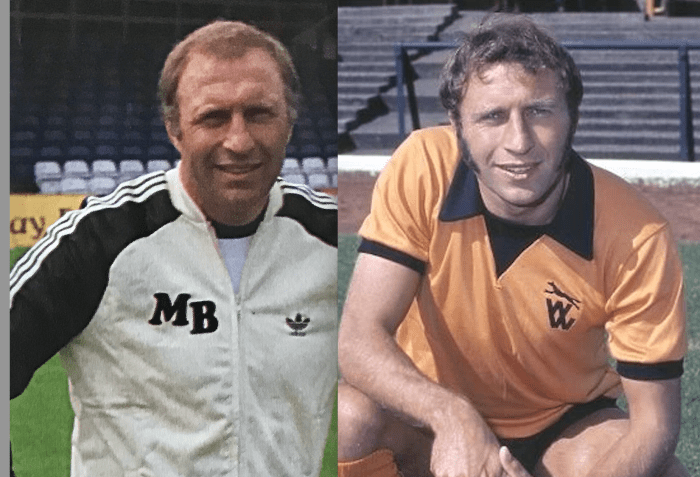
Unfortunately, the Nottingham Forest loanee was often in the shadow of his cousin Steve, a Wolves goalscoring legend who went on to play for England.

Gary arrived at the Goldstone in August 1995 against the backdrop of off-the-pitch disquiet caused by the underhand machinations of the despised directors of the club at that time.

Bull scored three times in 11 appearances for the Seagulls but the cash-strapped club couldn’t afford to keep him on.

Although Bull had made a name for himself as a goalscorer lower down the football pyramid, he had made only four starts plus eight appearances as a sub for Forest over the previous two seasons, scoring just the once.

However, that goal did put him amongst an elite group of players: he was the second of only four players to score on their single Premier League appearance.

Perhaps it was all the sweeter because it secured Forest a 1-0 home win over Crystal Palace that took them up to fourth place in the table.

Interviewed by premierleague.com, Bull said: “It was fate, I would imagine. I was in the right place at the right time.

“It was an inswinging corner. A couple of people missed it and I was about three yards out. It was unmissable really, although I tell my kids it was a screamer.”

Bull had his brief moment in the limelight because first choice striker Stan Collymore pulled out of the match on 2 January 1995 due to illness.

The striker had spent three months on loan at Birmingham City the previous autumn, scoring an impressive six goals in 10 matches (he was in the City side who won 1-0 at the Goldstone in October 1994).

Bull only had one more sniff of first team action for Forest that season, once again against Palace, when he went on as a substitute for Scot Gemmill in a 2-1 fourth round FA Cup defeat on 28 January.

With Collymore in fine scoring form (24 in 43 matches that season), and Dutchman Bryan Roy also a regular up front, manager Frank Clark didn’t turn to Bull again, and Forest finished in an impressive third place in the Premier League.

Bull had to be content with a cameo role in an end-of-season fixture, netting Forest’s third goal in a 3-1 win over Singapore’s national team in an exhibition match in Singapore in May 1995.

Even though Collymore was sold to Liverpool for £8.5m that summer, Bull had to look elsewhere for first team chances and Brady was happy to bring him in to boost Albion’s attacking options.

He got off the mark in his third game, although Albion lost 2-1 at home to Wycombe Wanderers in front of just 5,360 fans.

Bull later scored twice away at Cambridge United in a 4-1 win in the Auto-Windscreens Shield trophy (it was the game in which former Ipswich and England centre back Russell Osman made his debut for the Albion).

But a 1-0 defeat at Rotherham on 7 October was his last game in the stripes and, not long after his return to the City Ground, he was given a free transfer and joined Birmingham on a permanent basis.

Born in West Bromwich on 12 June 1966, his first club was Paget Rangers in the Midlands League but in 1986 he joined Southampton as a trainee under youth team boss Dave Merrington. Jimmy Case and Craig Maskell were in the Saints first team at the time; Kevan Brown in the reserves.

It wasn’t until Bull moved on to Chris Turner’s Cambridge United in March 1988 that he made his professional breakthrough, scoring four in 19 games.

His prowess in front of goal really began to flourish when he dropped out of the league to help Barnet FC win the Conference. Tony Hammond – a Barnet FC devotee known as ‘Reckless’ – reckoned the £2,200 fee manager Barry Fry paid for him was “one of the bargains of the century”.

In four seasons at Barnet, Bull netted an impressive 121 goals in 219 appearances, becoming an Underhill icon. In his blog, Hammond quoted Fry as saying: “He was bloody good that Bully, I never had to worry about him being in the right place at the right time in front of goal it was always just pure instinct.”

Bull was buzzing for Bees

When Bees finally won promotion to the Football League in 1990-91, Bull scored 35 goals – including two four-goal hauls and a hat-trick – and was voted Player of the Year.

Bull’s scoring form continued during Barnet’s first season in the Fourth Division. He bagged 33 as the Bees reached the play-offs where they only narrowly lost a two-legged tie against Blackpool.

In 1992-93, Bull and strike partner Mark Carter were prominent again, as Barnet finished third in the table, clinching promotion to what was then a reorganised Division Two.

Sadly, Barnet were in deep financial trouble and were forced to shed players. Bull was signed by Premier League Forest’s newly appointed manager Frank Clark in July 1993.

“I would have stayed at Barnet but I had a family to look after and had no choice but to move on,” Bull told Hammond. “It was a memorable four years and certainly a period that I look back on with pride,” he added.

The subsequent move to Birmingham reunited Bull with his old boss Barry Fry, although a somewhat cynical view of the move was espoused by writer John Tandy in When Saturday Comes.

“It took Fry 18 months of sustained and public pressure to talk the board into signing Gary Bull. Eventually, in November 1995, we landed the Tipton Tyke. Six games and some time on the bench later he was on his way to York,” he wrote.

Bull spent two seasons at York. The highlight of his stay came in a second round League Cup tie at home to Everton. Bull put the Minstermen 2-1 ahead in the 57th minute, tapping in a rebound off the post and York went on to win it 3-2.

It was one of 11 goals Bull scored in 84 games for City before spending time in Lincolnshire. While he only scored once in 31 games for Scunthorpe, his scoring boots were well and truly back on at Grantham Town: 68 goals in 125 games.

He then moved on to Lincoln United for two years before finishing his career with a flourish at United Counties League Boston Town. During the 2006–07 season, he scored a club record 57 goals! He later went on to become their all-time top scorer with over 200 goals,

Bull only retired from playing aged 45 in 2012.

He then became a postman and told premierleague.com: “I’m one of those people who gets up and actually enjoys going to work and getting the physical aspect of it.

“We probably do between 10 and 12 miles a day. Some would say I do more now than I did on the pitch.”

John ‘Stonewall’ Jackson a loyal George Petchey disciple

NOT TO BE confused with the founder and first manager of Brighton & Hove Albion, that man’s namesake, John Jackson, was a coach at the Goldstone in the ‘80s and the ‘90s.

Less well known was that he could have been in goal for Albion for the 1983 FA Cup Final. Rather like Steve Foster, back-up ‘keeper Perry Digweed was serving a suspension when the game against Manchester United came round.

Digweed had been sent off in a reserve match in early May 1983 and was banned for the final and the replay. So, if anything had happened to first choice Graham Moseley – and let’s face it, he had been known to have off-field mishaps at other times during his Albion career – the man between the sticks at Wembley could well have been Jackson.

Jackson had signed on emergency Combination forms in February 1983 and played for the Reserves in a 1-1 draw at home to Luton when Moseley and youth team ‘keeper Martin Hyde were both injured. He stayed on and helped coach the youth team alongside John Shepherd and with Moseley fully fit was not needed for first team duty (in those days, there were no substitute goalkeepers on the bench).
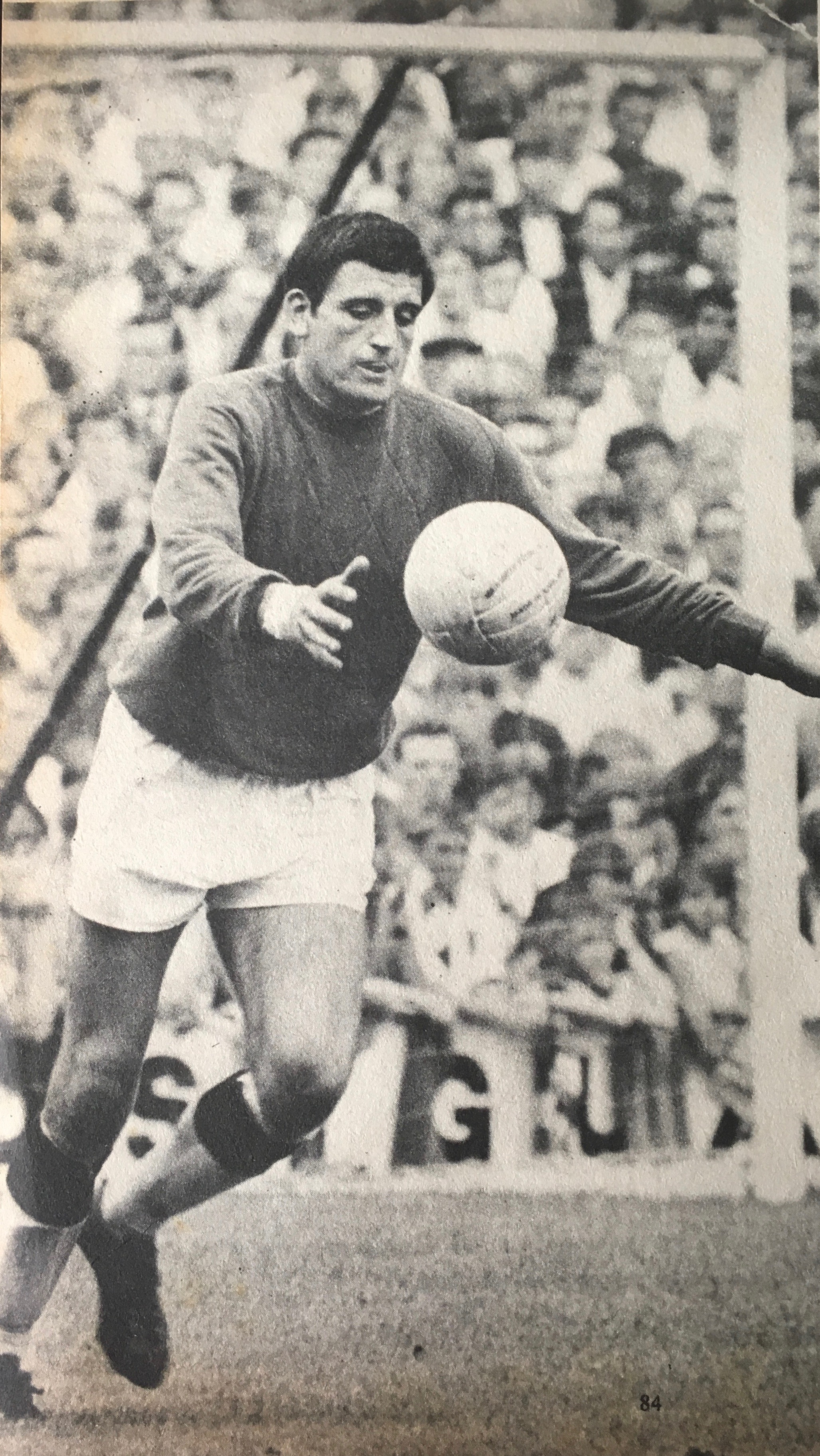
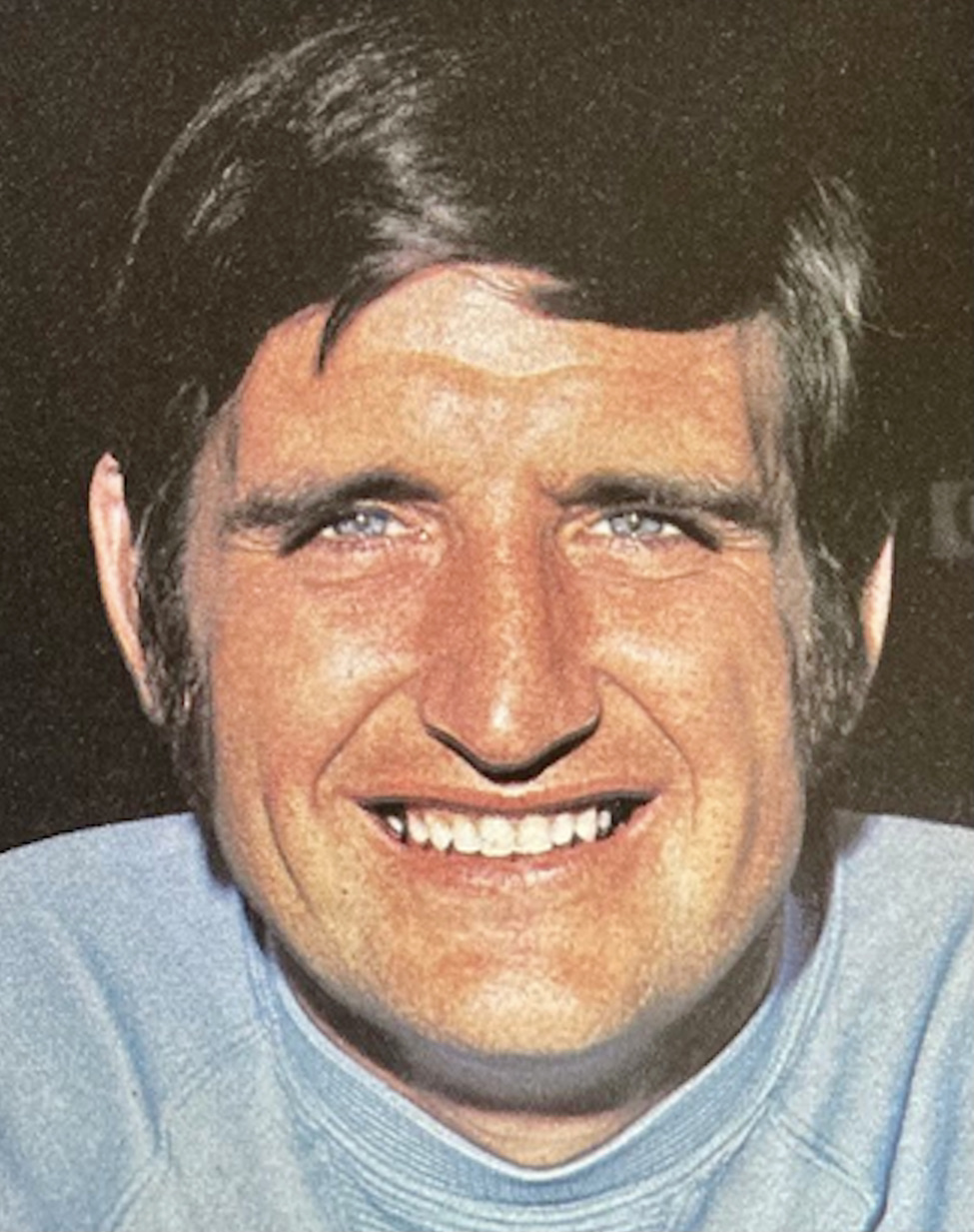
Jackson, who died aged 80 four days after Christmas 2022, had spent the earlier part of the 1982-83 season at Hereford United, who had just finished bottom of the Fourth Division. He had appeared in six matches at the end of a 19-year career. bullsnews.blogspot.com reveals that Jackson was the oldest league player to turn out for United. He was six days past his 40th birthday when he played against Darlington on 11 September 1982.

It was all a far cry from the days when he was Crystal Palace’s first choice goalkeeper for eight seasons. He subsequently followed his former Palace coach George Petchey to Orient (where he played in the same side as Albion’s 1983 FA Cup Final captain Tony Grealish) and Millwall.

It seemed wherever Petchey went, Jackson was sure to go too. When Petchey was Chris Cattlin’s assistant manager at Brighton, he brought in Jackson to coach the Albion goalkeepers once a week. It was certainly a job close to home for Jackson, who lived in Hangleton with his wife and three daughters.

In an interview with Football Weekly News in 1979, Jackson said: “Petchey was coach at Palace, and manager of Orient, when I was with them, therefore I felt it was right to join the devil you know than the one you don’t know! I find George a straightforward and honest man to work with.”

When Petchey returned to the Albion in January 1994, as part of Liam Brady’s backroom team, it wasn’t long before Jackson was added to the staff to help his mentor develop young players.

And after Brady’s departure and Petchey’s elevation to become Jimmy Case’s assistant, Jackson took over running the youth team.

Jackson remained in post throughout the managerial upheavals of Case’s departure, the Steve Gritt reign, and the arrival of Brian Horton. But he left at the end of the 1997-98 season when Horton brought in Martin Hinshelwood as director of youth and former captain Dean Wilkins as youth team coach.

Born in Hammersmith on 5 September 1942, Jackson went to St Clement Danes School and spent time with Brentford as a junior. But it was Palace who swooped to sign him up, as Jackson explained in a 2019 cpfc.co.uk interview.

“Arthur Rowe spotted me playing for a London grammar school against an FA youth XI made up of players from other London teams and he got in touch with my teacher, and from that conversation I ended up having a couple of games with the Palace reserve side aged 18. Then, when I joined full-time, I eventually took the opportunity with both hands, literally!”

Jackson was often described as the best goalkeeper England never had. While he was unfortunate not to earn a full international cap, he played seven times for England Youth between February and May 1961, his teammates including the likes of Bert Murray, Ron Harris, Francis Lee and David Pleat.

He signed as a trainee at Palace in March 1962, and in the 1964-65 season initially shared the ‘keeper’s jersey with Welsh international Tony Millington (whose younger brother Grenville was briefly back-up ‘keeper to Brian Powney at Brighton).

Once Jackson established himself as first choice, he kept the shirt for the next eight seasons. At one stage, he played 222 consecutive games for Palace.

On the where-are-they-now.co.uk website, contributor Martin Wiseman said: “He was definitely one of the best goalkeepers I ever saw as Palace were pretty terrible most of the time and often he was the only thing that kept us in the game. When we played one of the bigger teams, the game was often just a succession of John Jackson saves. Brilliant player.”

Indeed, he was nicknamed ‘Stonewall’ Jackson (after the famous American Civil War Confederate general). Of his mentor Petchey, he said: “He used to work me hard but the harder you worked at your game the more you learned and the better you would become. He made me a more confident player.”

Unluckily for Jackson, it was an era when England were blessed with a string of fine goalkeepers. Apart from Gordon Banks, there was Gordon West (Blackpool and Everton), Jim Montgomery (Sunderland), Peter Bonetti (Chelsea) and, at under 23 level, Peter Grummitt was preferred.

The closest Jackson came to senior international recognition came on 17 March 1971 when he kept goal for a Football League XI that beat a Scottish League XI 1-0 at Hampden Park. Ralph Coates scored the only goal of the game and the English line up included World Cup winners Bobby Moore and Geoff Hurst. Playing in defence alongside Moore were Paul Reaney (Leeds), Roy McFarland (Derby) and Derek Parkin (Wolves).

Jackson’s reign between the sticks for Palace came to an end when flamboyant Malcolm Allison took over as manager. Palace fans were not happy. In the book We All Follow The Palace edited by Tony Matthews (Eagle Eye 1993), Keith Brody wrote: “When Jacko left us, it marked the end of an era, culturally as well as football-wise.

“It is oddly fitting that he was swept away with the same disrespect that has come to symbolise the generation that replaced his ilk. Even though we have plenty to thank Big Mal for, his treatment of our hero means it should always be done through clenched teeth.

“It would have been offensive if a loyal, but crap, goalkeeper had been replaced by Paul Hammond and Tony Burns, but to do it to Jacko was unthinkable.

“Watching the ineffective Hammond for three long years after the joys of Jackson was almost unbearable. Every game was spent pondering on the value of what we’d given away.”

It was on 16 October 1973 that Jackson followed his former coach Petchey to Orient for £25,000 (Gerry Queen, Phil Hoadley, Bill Roffey and David Payne were other ex-Palace players who made that switch) and at Bloomfield Road he went on to attract a whole new band of admirers. Indeed, in Tony McDonald’s book Orient in the 70s, Jackson is described as “Orient’s greatest ever goalkeeper”.

Palace did give Jackson a testimonial match, however, and on 11 December 1973, a Selhurst Park crowd of 11,628 turned out for a match opponents Chelsea won 3-1.

Orient were a second tier side throughout Jackson’s time at the club, during which they had some unsuccessful tilts at promotion but enjoyed some exciting FA Cup runs, including making it to the semi-final in 1978 before losing 3-0 to Arsenal.

Their run to the semis included a memorable fifth round replay win over Chelsea, with Jackson pulling off a superb save to deny Clive Walker an equaliser as Orient clung on to a 2-1 lead courtesy of two Peter Kitchen goals.

Jackson had taken over from Ray Goddard as Orient’s no.1 and it must have been a very happy Christmas for him when promotion contenders Orient beat Palace 3-0 at home on Boxing Day 1973 in front of a bumper crowd of 20,611.

Come the end of the season, they missed out on promotion by a single point to Carlisle United after failing to beat Aston Villa (it was 1-1) in front of another huge crowd of 29,766, and the LWT cameras for The Big Match.  Days earlier Villa had lost 2-0 at Carlisle for whom Graham ‘Tot’ Winstanley proved an able deputy for suspended captain Bill Green.

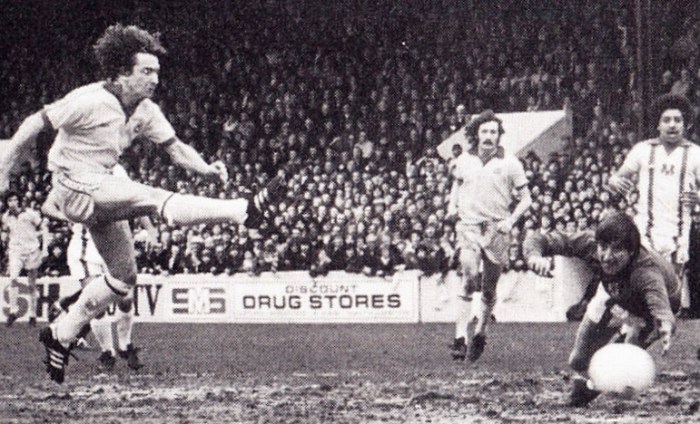
Another memorable game filmed for The Big Match saw Jackson concede three on 7 April 1979 when Albion were on their way to promotion from the Second Division. Orient took the lead at Brisbane Road but Brighton equalised thus: “Paul Clark cracked in a seemingly unstoppable shot, miraculously John Jackson parried the effort but only to Peter Sayer, and (pictured above) the little Welshman slammed the ball joyfully into the home goal,” the matchday programme recorded. The game eventually finished 3-3, Albion’s other goals coming from Martin Chivers (his only one for Brighton) and Clark.

Three years earlier, Orient were finalists in the rather curious Anglo-Scottish Cup tournament of that time: 16 English teams and eight Scottish sides played a mix of group stage games and two-legged knockout matches.

Orient topped their group above Norwich, Chelsea and Fulham; they beat Aberdeen 2-0 on aggregate in the quarter finals and Partick Thistle 4-2 in the semis. They eventually lost out 5-1 on aggregate to Nottingham Forest, but it was Brian Clough’s first piece of silverware as Forest manager, and he said in his biography: “Those who said it was a nothing trophy were absolutely crackers. We’d won something, and it made all the difference.”

In common with many other English players at the time, Jackson tried his luck in the United States and in 1977 played for St Louis Stars, returning in 1978 when they became Californian Surf. His head coach was John Sewell, who’d been a playing colleague at Crystal Palace and Orient. Ironically, his predecessor at St Louis was Bill Glazier, the former Coventry City ‘keeper, who’d also been his predecessor at Palace.

It was the arrival of former West Ham ‘keeper Mervyn Day at Brisbane Road that signalled the end of Jackson’s time in Leyton and, in August 1979, Petchey, who’d taken over from Gordon Jago as boss at Millwall, signed him for £7,500.

“I have been in the game too long to end it in the reserves and decided that if I was to finish playing, it would be in the first team,” Jackson told Football Weekly News.

The then Third Division Lions went on to win the league. Jackson played a total of 53 matches for them that season and he was chosen by his fellow professionals in the 1979-80 PFA team of the year. (Former Brighton winger Tony Towner played 50 games for Millwall that campaign and scored 13 goals)

After two years with Millwall, by a curious turn of events, Bobby Robson signed him for the previous season’s First Division runners up Ipswich Town as a back-up to Paul Cooper.

His one league appearance for Ipswich was in a top-of-the-table clash against Manchester United, with Ipswich needing to win to stay in with a chance of winning the League Championship. And they did, 2-1, with John Wark scoring both and John Gidman replying for United.

The game was played in front of a 25,763 crowd at Portman Road and Jackson was given a standing ovation at the end after he’d pulled off three important saves. Robson was quoted in the Guardian as saying: “We have paid him a year’s salary to make those saves, but it was worth it!”

However, while Ipswich finished the season five points ahead of United, they were once again runners up, finishing four points behind champions Liverpool.

Even a second placed finish was enough to convince the English FA to give Robson the job of replacing Ron Greenwood as England manager after the country’s unbeaten exit from the World Cup in Spain.

While Jackson might have thought his playing days were over, they weren’t quite. Frank Lord signed him for Fourth Division Hereford United. Lord wasn’t long in the job, though, and he was succeeded by the Bulls’ long-serving former ‘keeper Tommy Hughes, who had played on loan for Brighton in 1973.

Jackson’s move into goalkeeper coaching at Brighton under Cattlin was to prove a career-defining moment for another top goalkeeper of that era: former Manchester City custodian Joe Corrigan.

“I got talking to him and it inspired me to look into doing something similar,” Corrigan told the Manchester City matchday programme on 29 September 2018. “So, it was down to Brighton indirectly that I moved into the next phase of my career.”

Corrigan had been signed by Jimmy Melia and was coming to the end of his illustrious playing career. He fell out with Melia’s successor, Cattlin, and went on loan to Stoke City, but eventually was forced to quit after being injured in an Albion reserve match.

He went on to become goalkeeper coach at Liverpool for 10 years, and also worked at Stockport, West Brom and Hull.

Jackson took a variety of different jobs outside of football – fitting blinds, working for a golf magazine, selling golf equipment and as a courier for Lewes Council. During his second spell back at the Albion, amongst the youngsters he took through was goalkeeper Will Packham.

Jackson signed him on as a YTS trainee after he left Blatchington Mill School in Hove, and he spent nine years on the club’s books.

Sammy Lee’s ugly u-turn left Hyypia in the lurch

FORMER Liverpool player and assistant manager Sammy Lee took an unpalatable u-turn after agreeing to become no.2 to Sami Hyypia at Brighton.

When in 2014 a second successive bid to reach the Premier League via the Championship play-offs had faltered at the semi-final stage, Oscar Garcia quit the Seagulls and Albion installed the inexperienced Hyypia as his successor.

The Finnish international former Liverpool centre back had earmarked Lee to bring valuable nous to his backroom team having already been turned down for the job by his first choice, Jan Moritze Lichte, from Bayer Leverkusen, where Hyypia had made his managerial bow.

Lee agreed to take on the role on 25 June 2014 and a formal announcement was made the following day. But by the morning of Monday 29 June, the bombshell news dropped that Lee was moving elsewhere on the south coast instead.

Rather than help to guide the fledgling managerial career of a player he had coached at Liverpool, Lee opted to join Dutchman Ronald Koeman at Southampton.

“I’m let down because I thought that I knew him,” Hyypia told Sky Sports, when interviewed at Lancing. “Everything was sorted and everything was agreed and he should have been here today. The way it happened was very disappointing and I couldn’t actually believe it.”

An apologetic Lee said: “I was thrilled to be offered the job at Brighton and I was excited at the prospect of working with Sami Hyypia again – but, totally unexpectedly, I have been given an opportunity to work in the Premier League.

“I fully appreciate that this is not an ideal set of circumstances and I am very sorry for the inconvenience, and any embarrassment, my change of mind, after the announcement was made, has caused.

“However, at this stage of my coaching career the opportunity to work again at the very top level of English football was not something I felt I could turn down.”

Some might argue Lee’s decision ultimately brought about the swift demise of Hyypia’s reign in the Albion hotseat: the efforts he made to implement a specific style of play have since been lauded, but a dismal set of results told a different story, and there was a parting of the ways with more than half the season still to be played.

If Albion fans hadn’t been overly impressed by Lee’s decision to leave Hyypia in the lurch that summer, they weren’t the only supporters not to be enamoured by the little man’s involvement in their club.

In a retrospective look at Lee’s brief tenure as manager of Bolton Wanderers, Marc Iles, chief football writer for the Bolton Evening News, wrote: “Lee’s frenetic 170 days in charge contained 14 games, three victories, 12 signings and the complete disintegration of the structure which had helped Wanderers secure four top-eight finishes in four years.

“The stormy period was characterised by dressing room upheaval, boardroom bitterness and the sad fall from grace of an honourable man who had the club at heart.”

Lee, previously Sam Allardyce’s assistant at the Reebok Stadium, had been handed the reins just 24 hours after Allardyce quit on 29 April 29 2007 to take over at Newcastle.

Lee was always better suited to a supporting role and, as well as at Bolton, he’s worked under Allardyce at Crystal Palace, Everton and West Brom (and during Allardyce’s brief England spell).

He rose through the coaching ranks at Liverpool after Graeme Souness took him back to Anfield at the end of his playing days.

He became a first team coach under Gerard Houllier and between 2008 and 2011 was assistant manager to Rafa Benitez.

Born in Liverpool on 7 February 1959, Lee made his way through the Reds’ youth ranks and made his first team debut in April 1978.

Sammy Lee in action for Liverpool up against Albion’s Steve Foster

As chronicled on lfchistory.net, he earned a regular spot in the 1980-81 season, pretty much taking over the midfield berth previously occupied by Jimmy Case, who, at the end of that season, Bob Paisley sold to Brighton.

Albion fans of a certain generation will surely not fail to be moved by the story of Lee’s close friendship with Michael Robinson, the former Albion striker who was the midfielder’s former team-mate at Liverpool and Osasuna.

Robinson and Lee were together in a Liverpool side that in 1983-84 did the treble of the league, the League Cup and the European Cup.

Ahead of an August 2021 friendly match between the two sides to honour Robinson after his untimely death from cancer aged 61 in April 2020, Lee told The Athletic: “It is a fitting tribute and a fitting venue to have the game at, in front of the Kop.

“Michael did fantastic for Liverpool while he was there. It will be a very emotional night for everybody, particularly for Michael’s wife Chris and their children.

“He was not only a fantastic guy, a great colleague, but I consider him a brother, to be honest, I can’t put it any higher than that.”

Lee told reporter Dermot Corrigan: “Michael was very important for my professional life after Liverpool.

“You tend to think you will stay at Liverpool forever, you know, but it doesn’t happen. Michael had gone to Queens Park Rangers and he helped me to go there, and I had a nice time there. Subsequently he moved on to Osasuna, and he got me to go there. So he had a massive influence on my professional career.”

Injury eventually brought Lee’s Spanish playing days to an end and although he managed three games for Southampton and four for Third Division Bolton, it was coaching where his future lay.

In 2001, Lee became a part-time coach to the England national side under Sven-Goran Eriksson and three years later left Liverpool to join the national set up full time.

Liverpool chief executive Rick Parry said at the time: “We are very sorry that Sammy has decided to leave, but he goes with all our very best wishes for the future.

“Sammy’s been a wonderful servant to Liverpool as both player and coach. He should be proud of his contribution to the successes achieved at the club in recent years.”

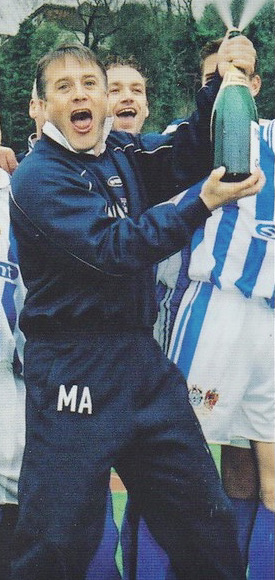
Confrontation was seldom far away in Micky Adams’ career

THE FIRST player ever to be sent off in a Premier League game managed Brighton twice.

Fiery Micky Adams saw red playing for Southampton when he decked England international midfielder Ray Wilkins.

“People asked me why I did it. I said I didn’t like him, but I didn’t really know him,” Adams recalls in his autobiography, My Life in Football (Biteback Publishing, 2017).

It was only the second game of the 1992-93 season and Adams was dismissed as Saints lost 3-1 at Queens Park Rangers.

Adams blamed the fact boss Ian Branfoot had played him in midfield that day, where he was never comfortable.

“He (Wilkins) was probably running rings around me. I turned around and thumped him. I was fined two weeks’ wages and hit with a three-match ban.”

It wasn’t the only time he would have cause not to like Wilkins either. The former Chelsea, Manchester United and England midfielder replaced Adams as boss of Fulham when Mohammed Al-Fayed took over.

His previously harmonious relationship with Ray’s younger brother, Dean, turned frosty too. When Adams first took charge at the Albion, he considered youth team boss Dean “one of my best mates”. But the two fell out when Seagulls chairman Dick Knight decided to bring Adams back to the club in 2008 to replace Wilkins, who’d taken over from Mark McGhee as manager.

“He thought I had stitched him up,” said Adams. “I told him that I wanted him to stay. We talked it through and, at the end of the meeting, we seemed to have agreed on the way forward.

“I thought I’d reassured him enough for him to believe he should stay on. But he declined the invitation. He obviously wasn’t happy and attacked me verbally. I did have to remind him about the hypocrisy of a member of the Wilkins family having a dig at me, particularly when his older brother had taken my first job at Fulham.

“We don’t speak now which is a regret because he was a good mate and one of the few people I felt I could talk to and confide in.”

With the benefit of hindsight, Adams also regretted returning to manage the Seagulls a second time considering his stock among Brighton supporters had been high having led them to promotion from the fourth tier in 2001. The side that won promotion to the second tier in 2002 was also regarded as Adams’ team, even though he had left for Leicester City by the time the Albion went up under Peter Taylor.

Adams first took charge of the Seagulls when home games were still being played at Gillingham’s Priestfield Stadium.  Jeff Wood’s short reign was brought to an end after he’d failed to galvanise the side following Brian Horton’s decision to quit to return to the north. Horton took over at Port Vale, where Adams himself would subsequently become manager for two separate stints.

Back in 1999, though, Adams had been at Nottingham Forest before accepting Knight’s offer to take charge of the Albion. He’d originally gone to Nottingham to work as no.2 to Dave Bassett but Ron Atkinson had been brought in to replace Bassett and Adams was switched to reserve team manager.

The Albion job gave him the opportunity to return to front line management, a role he had enjoyed at Fulham and Brentford before regime changes had brought about his departure from both clubs.

On taking the Albion reins, Adams said: “For too long now this club has, for one reason and another, had major problems. The one thing that has remained positive is the faith the supporters have shown in their club.

“The club has to turn around eventually and I want to be the man that helps to turn it around.”

The man who appointed him, Knight, said: “Micky is a formidable character with a proven track record. He knows what it takes to get a club promoted from this division. But, more than that, Micky shares our vision of the future and wants to be part of it. That is why I have offered him a four-year contract and he has agreed to that commitment.”

Not long after taking over the Albion hotseat, he was happy to say goodbye to the stadium he’d previously known as home when a Gillingham player in the ‘80s and it was a revamped squad he assembled for the Albion’s return to Brighton, albeit within the confines of the restricted capacity Withdean Stadium.

Darren Freeman and Aidan Newhouse, two players who’d played for Adams at Fulham, scored five of the six goals that buried Mansfield Town in the new season opener at the ‘Theatre of Trees’.

Considering he was only too happy to be photographed supporting the campaign to build the new stadium at Falmer, it’s disappointing to read in his autobiography what he really thought about it.

“My mates and I nicknamed it ‘Falmer – my arse’ although I never said this to Dick’s face,” he said. “There was always so much talk and we never felt like it was going to get done.”

The turning point in his first full season in charge was the arrival of Bobby Zamora on loan from Bristol Rovers. “The first time I saw him he came onto the training ground; he looked like a kid. But he was tall and gangly with a useful left foot; there was potential there.”

Interestingly, considering Adams makes a point of saying he usually ignored directors who tried to get involved on the playing side, he took up Knight’s suggestion that the side should switch to a 4-4-2 formation – and the Albion promptly won 7-1 at Chester with Zamora scoring a hat-trick!

After a so-so first season back in Brighton, not long into the next season Adams was forced to replace his no.2, Alan Cork, with Bob Booker because Cork was offered the manager’s job at Cardiff City, at the time owned by his former Wimbledon chairman, Sam Hammam. Adams reckoned Booker’s appointment was one of the best decisions he ever made.

Surrounded by players who had served him well at Fulham and Brentford, together with the additions of Zamora, Michel Kuipers and Paul Rogers, Adams and Booker steered Albion to promotion as champions. Zamora was player of the season and he and Danny Cullip were named in the PFA divisional XI.

Not long into the new season, the lure of taking over as manager at a Premier League club saw Adams quit Brighton, initially to become Bassett’s no.2 at Leicester City, but with the promise of succeeding him.

“While I thought I had a shot at another promotion, it wasn’t a certainty,” Adams explained. “I knew I had put together a team of winners, and I knew I had a goalscorer in Bobby Zamora, but football’s fickle finger of fate could have disrupted that at any time.”

He admitted in the autobiography: “Had I been in charge at the age of 55, rather than 40, then I perhaps would have taken a different decision.”

While Albion enjoyed promotion under Taylor, what followed at Leicester for Adams was a lot more than he’d bargained for and, to his dismay, he is still associated with the ugly shenanigans surrounding the club’s mid-season trip to La Manga, to which he devotes a whole chapter of his book, aiming to set the record straight.

On the pitch, he experienced relegation and promotion with the Foxes and he doesn’t hold back from lashing out about ‘moaner’ Martin Keown, “one of the worst signings of my career”. Eventually, he’d had enough, and walked away from the club with 18 months left on his contract.

After a break in the Dordogne area of France, staying with at his sister-in-law and her husband’s vineyard, he looked for a way back into the game. He was interviewed for the job of managing MK Dons but was put off by a Brighton-style new-ground-in-the-future scenario. Then Peter Reid, a former Southampton teammate, was sacked by Coventry City. He put his name forward and took charge of a Championship side full of experienced players like Steve Staunton and Tim Sherwood.

The side’s fortunes were further boosted by the arrival of Dennis Wise, but, in an all-too-familiar scenario Adams had encountered elsewhere, the chairman who appointed him (Mike McGinnity) was replaced by Geoffrey Robinson. It wasn’t long before it was obvious the relationship was only going to end one way. As Adams tells it, Robinson was influenced by lifelong Sky Blues fan Richard Keys, the TV presenter, and it was pretty much on his say-so that Adams became an ex-City manager after two years in the job.

With an ex-wife and three children to support as well as his partner Claire, Adams couldn’t afford to be out of work for long and fortunately his next opportunity came courtesy of Geraint Williams, boss of newly promoted Colchester United, who took him on as his no.2.

However, it only got to the turn of the year before he was out of work once again, although, from what he describes, he wasn’t enjoying his time with the U’s anyway because Williams kept him at arm’s length when it came to tactics and team selection.

He was amongst the ranks of the unemployed once again when Albion chairman Knight gave him a call, but, with the benefit of hindsight, he said: “Going back turned out to be one of the biggest mistakes of my life.”

Adams blamed the backdrop of “the power struggle” between Knight and Tony Bloom on the lack of success during his second stint in the hotseat, and he reckons it was Bloom who “demanded my head on a platter”. The fateful meeting with Knight, when a parting of the ways was agreed, famously took place in the Little Chef on the A23 near Hickstead.

Looking back, Adams conceded he bowed to pressure from Knight to make certain signings – namely Jim McNulty, Jason Jarrett and Craig Davies in January 2009 – who didn’t work out. He reflected: “I shouldn’t have taken the job in the first place. I’d let my heart rule my head but, in fairness, I didn’t have any other offers coming through and it seemed like a good idea at the time.

“I wouldn’t ever say he (Knight) let me down, but he had his idea about players. I did listen to him, and maybe that’s where I went wrong.”

He added: “Going back to a club where success had been achieved before felt good, yet, the second time around, the same spark wasn’t there no matter how hard I tried.”

Born in Sheffield on 8 November 1961, Micky was the second son of four children. It might be argued his penchant for lashing out could have stemmed from seeing his father hitting his mother, which he chose to spoke about at his father’s funeral. Adams is obviously not sure if he did the right thing but he felt the record should be straight.

The Adams family were always Blades rather than Wednesdayites and, at 15, young Micky was in the youth set-up at Bramall Lane having made progress with Sunday league side Hackenthorpe Throstles.

While he thought he had done well under youth coach John Short during (former Brighton player) Jimmy Sirrel’s reign as first team manager, Sirrel’s successor, Harry Haslam, replaced Short and, not long afterwards, Adams was released.

However, Short moved to Gillingham and invited the young left winger to join the Gills. Adams linked up with a group of promising youngsters that included Steve Bruce.

In September 1979, he had a call-up to John Cartwright’s England Youth side, going on as a sub in a 1-1 draw with West Germany, and starting on the left wing away to Poland (0-1), Hungary (0-2) and Czechoslovakia (1-2) alongside the likes of Colin Pates, Paul Allen, Gary Mabbutt, Paul Walsh and Terry Gibson.

Adams honed his craft under the tutelage of a tough Northern Irishman Bill ‘Buster’ Collins and began to catch the attention of first team manager Gerry Summers and his assistant Alan Hodgkinson, who had played 675 games in goal for Sheffield United.

He made his debut aged just 17 against Rotherham United but didn’t properly break through until Summers and Hodgkinson were replaced by Keith Peacock (remember him, he was the first ever substitute in English football, in 1965, when he went on for Charlton Athletic against John Napier’s Bolton Wanderers) and Paul Taylor.

“Keith saw me as a full-back and that was probably the turning point of my career,” Adams recalled.

Once Adams and Bruce became regulars for the Gills, scouts from bigger clubs began to circle and at one point it looked like Spurs were about to sign Adams. That was until he came up against the aforementioned Peter Taylor, who was playing on the wing for Orient at the time (having previously played for Crystal Palace, Spurs and England).

“He nutmegged me three times in front of the main stand and, to cut a long story short, that was the end of that. Gillingham never heard from Spurs again,” Adams remembered.

Even so, Adams did get a move to play in the top division when Bobby Gould signed him for Coventry City. Managerial upheaval didn’t help his cause at Highfield Road and when John Sillett preferred Greg Downs at left-back, Adams dropped down a division to sign for Billy Bremner’s Leeds United (pictured below right with the legendary Scot).

“He had such a big influence on my career and life that I wouldn’t have swapped it for the world,” said Adams. But life at Elland Road changed with the arrival of Howard Wilkinson, and Adams found himself carpeted by the new boss after admitting punching physio Alan Sutton for making what an injured Adams considered an unreasonable demand to perform an exercise routine even though he was in plaster at the time.

Nevertheless, Adams admits he learned a great deal in terms of coaching from Wilkinson, especially when an improvement in results came about through repetitive fine-tuning on the training pitch.

“It is the one aspect of coaching that is extremely effective, if delivered properly,” said Adams. “I learnt this from Howard and took this lesson with me throughout my coaching and managerial career.”

However, Adams didn’t fit into Wilkinson’s plans for Leeds and he was transferred to Southampton, managed by former Aston Villa, Saints and Northern Ireland international Chris Nicholl. Adams joined Saints in the same week as Neil ‘Razor’ Ruddock and the pair were quickly summoned by Nicholl to explain the large size of the hotel bills they racked up.

Adams moved his family from Wakefield to Warsash and he went on to enjoy what he reflected on as “the best few years of my playing career”. He was at the club when a young Alan Shearer marked his debut by scoring a hat-trick and the “biggest fish in the pond at the Dell” was Jimmy Case.

Adams described the appointment of Branfoot in place of the sacked Nicholl as a watershed moment in his own career. “Overall he was decent to me and I found his methods good,” he said. And he pointed out: “I was getting older, I’d started my coaching badges and I already had one eye on my future.”

Adams recalled an incident during a two-week residential course at Lilleshall, after he had just completed his coaching badge, when he dislocated his shoulder trying to kick Neil Smillie.

“I was left-back and he was right-wing, and he took the piss out of me for 15 minutes. The fuse came out and I decided to boot him up in the air,” Adams recounted. “The only problem was that I missed. I fell over and managed to dislocate my shoulder hitting the ground. It was the worst pain I’ve ever had.”

If life was sweet at Southampton under Branfoot, that all changed when he was replaced by Alan Ball and the returning Lawrie McMenemy. Adams and other older players were left out of the side. Simon Charlton and Francis Benali were preferred at left-back. Eventually Adams went on a month’s loan to Stoke City, at the time managed by former Saints striker Joe Jordan, assisted by Asa Hartford.

On his return to Southampton, and by then 33, Adams was given a free transfer.

Former boss Branfoot came to his rescue, inviting him to move to League Two Fulham as a player-coach in charge of the reserve team. Branfoot also signed Alan Cork and he and Adams began a longstanding friendship that manifested itself in becoming a management pair at various clubs.

On the pitch, Branfoot struggled to galvanise Fulham and, with the team second from bottom of the league, he was sacked – and Adams replaced him. He kept Fulham up by improving fitness levels and introducing more of a passing game.

But he knew big changes were needed if they were going to improve and he gave free transfers to 17 players, despite clashing with Jimmy Hill, who had different ideas.

An admirer of what Tony Pulis was doing at Gillingham, Adams signed three of their players: Paul Watson, Richard Carpenter and Darren Freeman. He also got in goalkeeper Mark Walton and centre back Danny Cullip. Simon Morgan was one of the few who wasn’t let go, and Paul Brooker emerged as a skilful winger. All would later play under him at Brighton.

Promotion was secured and Adams was named divisional Manager of the Year but after all the celebrations had died down Mohamed Al-Fayed bought the club and things changed dramatically.

“The club was in a state of flux as it tried desperately to come to terms with its new status as a billionaire’s plaything,” Adams acerbically observed. “From having nothing, we had everything.”

Before too long, in spite of being given a new five-year contract, Adams was out of the Craven Cottage door, replaced by Wilkins and Kevin Keegan.

But he wasn’t out of work for long because Branfoot’s former deputy, Len Walker, introduced him to the chairman of Swansea City, who were on the brink of relieving Jan Molby of his duties as manager.

Various promises were made regarding funds that would be made available to him but when they were not forthcoming he realised something was not right and he quit, leaving Cork, the deputy he’d taken with him, to take over.

By his own admission, if he hadn’t been sitting on the £140,000 pay-off he’d received from Fulham, he probably would have stayed. As it was, he was out of work once again…..until he had a ‘phone call from David Webb, the former Chelsea and Southampton defender who was the owner of Brentford, but in the process of trying to sell the club.

His brief was to keep the side in the league and to make it attractive to potential purchasers. It was at Griffin Park that he first met up with the aforementioned Bob Booker, who was managing the under 18s at the time. “He is one of the most loyal and trustworthy friends I have ever known,” said Adams. “He would do anything for you.”

However, although he signed the likes of Cullip and Watson from Fulham, he wasn’t able to stop the Bees from being relegated. During the close season, former Palace chairman Ron Noades bought the club and announced he was also taking over as manager.

Once again, Adams was out of a job but his next step saw him appointed as no.2 to Dave Bassett at Nottingham Forest.

Which brings us almost full circle in the Adams career story, but not quite.

After the debacle of his second stint in charge of Brighton, he was twice manager at Port Vale, each spell straddling what turned out to be a disastrous period in charge of his family’s favourite club, Sheffield United.

It was Adams who gave a league debut to Harry Maguire during his time at Bramall Lane, but the side were relegated from the Championship on his watch, and he was sacked.

Adams took charge of 249 games as Vale boss but quit after a run of six defeats saying he’d fallen out of love with the game.

It didn’t prevent him having another go at it, though. He went to bottom of the league Tranmere Rovers and admitted in his book: “It was arrogance to think I could turn round a club that had been relegated twice in two seasons.”

In short, he couldn’t and he ended up leaving two games before the end of what was their third successive relegation.

“It was a really poor end to a career that had started so promisingly at Fulham,” he said.

Big money signing Peake hit a trough at the Albion

EXPENSIVE FLOP Jason Peake was a victim of the problems clouding Brighton’s very existence in the mid-1990s.

The blond-haired midfielder heralded elsewhere for his “excellent left foot” and “one of the best passers of the ball in the lower leagues” failed to live up to expectations at the Goldstone and was dubbed Jimmy Case’s “biggest blunder”.

Leicester-born Peake had played alongside Case for Halifax Town, where he’d moved after making only a handful of appearances with his hometown club.

Former Albion loanee centre half John McGrath, assisted by Frank Worthington, failed to halt the Shaymen dropping out of the league in 1993, and Peake spent a season in the Conference before reviving his league career with Rochdale. Nine goals in 103 appearances attracted suitors and it was Albion who bought him for a fee set by tribunal of £80,000 – a huge sum for a cash-strapped club.

A further £15,000 was to be paid after 20 games and another £25,000 if he got to 40 appearances. He made 35 appearances before being frozen out by Case’s successor, Steve Gritt. It was to be a familiar pattern: changes of manager often led to him moving on.

Apart from the bigger picture shenanigans going on at the Albion under the hated Archer-Bellotti regime, Peake’s personal issues centred around relocation expenses he said he was entitled to – but Bellotti refused to pay up.

According to fansnetwork.co.uk: “Peake was being forced to commute from Leicester following several broken promises by the Brighton board. Peake’s dream move turned into nothing short of a nightmare for him.”

The midfielder had trials at Northampton and Cambridge before he finally managed to get away, in October 1997, signing for First Division Bury. He rather diplomatically said: “The situation at Brighton has been well documented over the past year and just let’s say when I got there the situation was not as I’d been led to believe it would be.

“I have not been happy there for some time and the new consortium have been great in letting me get away.”

The official version in the matchday programme said: “Jason had problems in settling in the South after his move from Rochdale and the move has suited him and his family. Should Bury sell him for a fee at any time, Albion are assured of a share in any such deal.”

As ever, the season had begun with great expectations and in his matchday programme notes welcoming new signings Peake and Ian Baird, Case said: “They are both quality players and I am sure that they will be great acquisitions for the club this coming season.

“I firmly believe we now have a skilful blend of experienced and young players that can mount a serious challenge for promotion at the first attempt and I believe we will surprise many teams this season.”

Peake went straight into the side in the no.8 shirt but after he’d played 19 games on the trot Albion were anchored at the foot of the table.

After Case was sacked, Peake found himself on the bench more than in the starting line-up; local lad Kerry Mayo taking over from him.

Supporters were certainly not impressed by Peake, perhaps summed up by ‘Lenny Rider’ on North Stand Chat who said: “Huge outlay for where the club was at the time. His kinder critics would say he was disappointing, the more cynical amongst us would argue he was actually nicking a living at the Goldstone.”

New Albion chairman Dick Knight cut Albion’s losses by giving Peake a free transfer to Bury in exchange for the relocation cash dispute being dropped.

Bury boss Stan Ternent was lauded for pulling off something of a coup, and Peake told the Lancashire Telegraph: “It is a fantastic chance for me to prove myself. It has taken me a long time to get into the First Division and I don’t want to blow the opportunity.”

Sadly, those words came back to haunt him because he ended up playing just six times for the Shakers, three as a left-back and three as a sub.

To quote fansnetwork.co.uk again: “Peake’s silky skills didn’t really fit in with the kick and rush tactics of Ternent’s Bury team, and Peake found himself stranded back in the reserves.”

The following summer, a return to Rochdale, where he had first made a name for himself, looked like an ideal solution but things didn’t go well under the management team of Graham Barrow and Joe Hinnigan, who left the club at the end of the 1998-99 season.

In something of a twist of Peake’s usual fortunes when there had been a managerial change, his career began to blossom again under new boss Steve Parkin.

“The free flowing style of football on offer was much more suited to Peake’s natural style,” according to fansnetwork.co.uk. “Peake was awesome in the opening months of the 1999-2000 season and was at the heart of a side which led the table early on.”

He got amongst the goals including “a superb overhead kick from the edge of the area against old team Halifax Town, which saw him win the club’s goal of the season competition and awarded ‘Better than Pele’ status on Sky’s Soccer AM”.

Nevertheless, the season ended on a sour note, as the clarkechroniclersfootballers blog explained: “We lost two re-arranged home games against Peterborough and Northampton in April which would have secured us a play-off place. Jason featured in both games and Steve Parkin singled him out as the scapegoat accusing him of ‘going missing’. It’s always easier for a manager to castigate a player he didn’t sign but we knew there was some truth in it.”

With his contract up at the end of the season, Peake chose to move on, this time to Plymouth Argyle, at the time managed by Argyle legend Kevin Hodges.

Argyle move didn’t work out

It began well enough for him personally and, of Argyle’s 2-0 home win over Carlisle on 16 September, BBC Sport said: “Plymouth doubled their lead in the 17th minute when man of the match Jason Peake scored a superb opportunist goal.

“Peake’s initial attempt came back off visiting central defender Julian Darby and the Plymouth midfielder reacted with a brilliant dipping volley which gave keeper Luke Weaver no chance.

“Weaver denied Peake a second goal in the 80th minute, making a tremendous backward save to keep out the home player’s far post header.”

It followed him scoring four days earlier in a 4-1 defeat at Shrewsbury and was only the second win out of eight. When the next three games were lost, Hodges was replaced by Paul Sturrock, who didn’t take long to decide Peake’s future.

Before Christmas, the midfielder was dispatched to Nuneaton Borough on loan and the move was made permanent in February 2001. Although his league career was over, Peake played 54 games for Borough but was sidelined for periods with a troublesome Achilles tendon injury and he eventually retired in 2003 and became a full-time chiropodist in Leicester.

Born in Leicester on 29 September 1971, Peake played for England schoolboys and was taken on as a trainee by the Foxes.

Manager David Pleat gave him his first team debut in a 2-1 defeat at Charlton Athletic in a Full Members Cup game on 14 November 1989.

It was another year before he made his league debut in the old Division Two, as a sub in a 2-2 draw away to Oxford United.

The same month he also went on as a sub in a 1-0 home defeat to Wolves in the Full Members Cup, played in front of a paltry 4,705 crowd. Four days later he started but was subbed off against Newcastle in a game that remarkably finished 5-4 to the Foxes.

His involvement straddled the end of the Pleat regime and the caretaker manager spell of former Everton boss Gordon Lee, who, in the season Albion reached the play-off final v Notts County, managed to keep Leicester up by only two points while West Brom were relegated along with bottom club Hull City. (Lee died aged 87 in March 2022).

Across three months, Peake had three more starts (and was subbed off in two of them) plus three more games off the bench. Three days after City lost 3-0 at Brighton (goals from Mike Small, Dean Wilkins and Bryan Wade), Peake made a rare start and scored his only goal for the club in a 2-1 home win over Barnsley on 23 February 1991.

Earlier that month (on 6 February 1991), he earned an England under-19 cap when he was sent on as a sub for Aidan Newhouse as England lost 5-1 to Denmark at the Manor Ground, Oxford.

Peake’s last game for Leicester was against Newcastle United on 2 March 1991. He didn’t get a look-in under Pleat’s successor Brian Little and, in February 1992, he joined Hartlepool on loan, playing six matches and scoring once.

The goalscoring legend who slipped through Brighton’s net

ONES that got away always make for fascinating stories and a striker who went on to become a goalscoring legend slipped through the net at both Brighton and Burnley.

Ian Muir is hailed an all-time hero by fans of Tranmere Rovers for whom he scored 180 goals in all competitions during what many regard as the best period in Rovers’ history. If it hadn’t been for injury, he could have played in the Premier League and Europe for Leeds United.

But he’s barely remembered for the struggles he had to get games at Brighton, let alone in a month with the Clarets.

Success could have eluded himf it hadn’t been for the time he spent at Brighton alongside the legendary Frank Worthington. He was considering a move to non-league Maidstone United, but, when Worthington quit Brighton in the summer of 1985 to take his first step into management on the Wirral, he made Muir his first signing.

“Ian Muir was a fantastic forward with great touch,” Worthington told Spencer Vignes in an Albion matchday programme interview. “He did things in training you just wouldn’t believe, yet he wasn’t even making the side at Brighton under Chris (Cattlin).”

Cattlin had taken the youngster on after he had been given a free transfer by Birmingham City where he’d made just one League Cup appearance in the 1983-84 season under Ron Saunders. But competition for forward places was intense with the likes of initially Alan Young and Terry Connor, then Worthington, Mick Ferguson and later Alan Biley.

Muir’s first involvement with the Albion first team was as a non-playing substitute for the home 3-0 win over Leeds on 24 March 1984. He made his debut the following Saturday at Fratton Park in place of the injured Young and was brought down in the penalty area only 20 minutes into the game to earn Brighton a spot kick, which Danny Wilson successfully buried to put the Seagulls ahead.

Muir in his Brighton days

Connor had a chance to put Albion further ahead and, as the matchday programme reported, “Muir sliced wide as Connor made the opening” before Pompey began a devastating fight back.

Albion had been hoping to complete a fourth win in a row for the first time in six years, but it wasn’t to be, and, into the bargain, Muir couldn’t cap his debut with a goal, instead firing wide when set up by winger Steve Penney.

Unfortunately, this was the game when former Spurs and Arsenal centre back Willie Young, on loan from Norwich City, was given the runaround by Pompey centre forward Mark Hateley, and, courtesy of a second half blitz, the home side ran out 5-1 winners.

Alan Young was restored to the no.9 shirt in the next match and scored twice as Albion beat Grimsby Town 2-0 at the Goldstone, but Muir was drafted in to take Connor’s place in the away game at Shrewsbury Town.

That match ended in a 2-1 defeat, but the News of the World angled its report on an unlucky afternoon for the young forward.

“It just wasn’t Ian Muir’s day,” wrote reporter Brian Russell. “The Brighton teenager (actually he was 20) playing only his second league game could so easily have taken the limelight from Shrewsbury two-goal hero, 17-year-old Gerry Nardiello.

“Young Muir headed the ball home in the eighth minute from Jimmy Case’s corner, but it was ruled out (for a foul by centre-half Eric Young).”

Alan Young produced a powerful header from a Muir cross that Steve Ogrizovic (later of Liverpool and Coventry City fame, of course) saved brilliantly.

Russell continued: “With Brighton battling to cancel out Nardiello’s 23rd-minute opportunist goal, striker Muir suffered. His delicate chip left the ‘keeper clutching thin air, but Shrewsbury skipper Ross McLaren headed out.

“Brighton levelled it with 15 minutes to go (through Eric Young). But, five minutes later, Nardiello pounced on Chick Bates’s chested pass to beat Joe Corrigan.”

Muir was on the scoresheet when Albion’s reserve side began the 1984-85 season with a 1-0 win over reserve team boss George Petchey’s old club, Millwall. It was a very experienced team featuring Corrigan in goal, full-backs Chris Ramsey and Graham Pearce – who had both played for the Seagulls in the FA Cup Final the year before – along with Steve Gatting and Neil Smillie. Giles Stille and Alan Young were also in the line-up.

Muir had to wait until 13 October for his next first team opportunity when he was a non-playing sub as Albion went down 2-1 at Oxford United. He then got on as a sub for Connor in a 0-0 home draw with Barnsley, but the game was so dire that Cattlin very publicly forfeited a week’s wages.

After three goalless games straddling October and November 1984, Cattlin paired Muir with Worthington away to Blackburn on 10 November but still the drought couldn’t be breached, and Albion went down 2-0. The next game, Cattlin tried Ferguson and Connor as his front pair – same outcome: a 1-0 defeat at Leeds.

Muir didn’t get another chance with the Albion but in the spring of 1985 was sent out on loan to Lou Macari’s Swindon Town, where he played in three matches (and his teammates included Ramsey, who’d been released by Cattlin, and Garry Nelson, who would later become a promotion winner with the Seagulls).   

Somewhat curiously, when commenting on Muir’s departure from the club that summer, Cattlin said in the matchday programme: “I am sure Ian will get goals at whatever level he plays.”

Sure enough, Prenton Park eventually became his spiritual home and, although Tranmere struggled to stay in the fourth tier initially, Muir’s goalscoring exploits were synonymous with four years in which Rovers were promoted twice and appeared at Wembley five times. Highlights saw Muir score in the FA’s centenary celebrations in 1988 and an acrobatic and precise volley in Tranmere’s Leyland DAF Trophy victory over Bristol Rovers in 1990.

Muir and strike partner Jim Steel

He particularly began to prosper after Worthington’s successor, Johnny King, brought in tall target man Jim Steel alongside him in 1987.

Steel, who later became a police officer on Merseyside, said King, a Bill Shankly devotee, would compare him and Muir to John Toshack and Kevin Keegan. “That’s the way football was at the time,” he told the Liverpool Echo. “You looked for a little mobile player to feed off a tall striker.

“Muiry was one of the best finishers in the game at the time. If I’m honest, the intelligence of the partnership was down to Muiry, who was very good at reacting to things off me,” he said.

“I wasn’t the most technically gifted of players compared to the likes of Johnny Morrissey and Jim Harvey. But things happened around me and Muiry was very good at picking up the crumbs.”

Muir was Tranmere’s leading scorer from 1986 to 1990 and, in the 1989-90 season, he scored 35 goals in 65 games.

Such is the esteem in which Muir is held in those parts that a mural depicting him and all-time-appearances record holder Ray Matthias adorns the side of a house close to Prenton Park. A lounge at the ground is also named after him.

Born in Coventry on 5 May 1963, Muir played for the City’s schools side and Bedworth Juniors and won four England Schoolboy caps (against Wales, Scotland and two v West Germany) featuring alongside the likes of Tommy Caton, Ian Dawes, Terry Gibson and Kevin Brock.

He joined QPR as an apprentice aged 17 in 1980 and was a Hoops player for four years in total during Terry Venables’ reign as manager. In October 1982, he went on a one-month loan to Burnley. The respected all-things-Burnley writer, Tony Scholes, takes up the story.

“When Burnley played on QPR’s plastic pitch at Loftus Road in 1982 we came home with more than we’d bargained for. Two Trevor Steven goals in front at half time, we’d suffered a 3-2 defeat in the end although we managed to acquire a striker.”

Scholes pointed out how Muir had progressed into the first team squad at Loftus Road, but after a goalscoring start had fallen out of favour.

“He made a dramatic start to his first team career, scoring twice on his debut in a 5-0 thrashing of Cambridge United in April 1981,” said Scholes. “He kept his place for the one remaining game of the 1980-81 season but by the time he arrived at Turf Moor, well over a year later, he was still looking for his third game.”

It eventually came with Burnley, when he went on as a substitute in a 2-1 defeat at Charlton, replacing skipper Martin Dobson. He then started and scored Burnley’s goal in a 3-1 defeat at Leeds.

“He impressed, but the home fans never saw him and. at the end of the month, he was dispatched back to West London, his Burnley career over,” said Scholes.

Ian Muir alongside Terry Fenwick when Terry Venables managed QPR

Unable to get back into Terry Venables’ side at Loftus Road, Muir joined Birmingham and subsequently Brighton.

Finally given a platform to shine, the striker scored the majority of his 180 Tranmere goals between 1985 and 1991 and spearheaded the side that vaulted two divisions in three seasons between 1988 and 1991, before eventually being edged out by the arrival of John Aldridge.

The Liverpool Echo remembered: “It was inevitable his subtle skills and clinical finishing would make him a target for a larger club. Muir knew of Leeds’s interest as Tranmere campaigned to secure a place in the Third Division playoffs in 1990-91.

Muir told the newspaper: “Howard Wilkinson was sending scouts to watch me and coming along himself. When I went along to the ticket office before games, the Leeds scout was sometimes at the kiosk and I’d chat to him. He told me what was happening.

“Mark Proctor, who joined us from Middlesbrough the following season and worked under Wilkinson, knew about the deal and told me.”

Muir was arguably in his prime at the age of 27, but he suffered what would be a fateful knee ligament injury in a game against Chester City on 23 March 1991.

When Tranmere visited Leeds in a League Cup tie early in the following season, Muir hobbled into Elland Road on crutches. Muir recalled: “Before the game Gordon Strachan asked our midfielder, Neil McNab, where I was. Neil pointed to me standing there on crutches.

“Then Strachan said: ‘Ian is the unluckiest man in the world because we were going to sign him’. Leeds went on to win the league that season and I could have been with them, playing at the highest level playing in Europe the following season.

“I was gutted. I was so close and the injury changed everything. But that’s football. You get your ups and downs.

“I could never complain about the fantastic career I had at Tranmere and I wouldn’t swap my memories of the years at Prenton Park for anything.”

He wasn’t granted a testimonial after a decade with Rovers, but in 2020 there were moves afoot amongst their supporters to help him publish his autobiography.

Adulation has not waned and a young writer who didn’t even get to see him play wrote warmly about the striker’s achievements in this tribute.

In 1995, Muir returned to Birmingham City for a £125,000 fee but he played only twice before he suffered a groin injury. In an effort to get fit, he spent a month on loan at Darlington, and scored a goal, but his league career was over.

He went to play in Hong Kong, scoring a hat-trick on his debut for Sing Tao, and later played for Happy Valley. In June 2011, he recalled in an interview with the Liverpool Post: “The warm climate was a big help. Then the medical people found the cause of the groin problem was my spine. The pelvis wasn’t lined up properly. It could get out of joint just by lying in bed.

“One of the lads on the medical side was able to click me back into place. I have to say I have not had many problems with it since.”

Muir returned to the UK, and his native West Midlands and joined Nuneaton Borough.

“We won the league by 20 points and got into the Conference,” Muir told the Post. “We were top of the league after three months of the following season then it all went pear-shaped.”

The newspaper reported that Muir stepped down a level to Stratford Town, where his football days finished.

He did some voluntary coaching in schools and took a job in a factory for a year, and subsequently joined a friend in a business fitting out pubs and shops.

• Pictures from various online sources.

The Christmas presence at the heart of Albion’s ‘90s defence

INJURIES beset Derek Allan’s promising career but he played 100 games at the heart of Brighton’s defence during turbulent times and remembers warmly “a wonderful club”.

In an exclusive interview with In Parallel Lines, Allan reveals the niggles that affected him and recalls the people who helped to shape his playing career.

The Scot remains involved in the game as an academy coach at Greenock Morton and his only lament is that the sports nutrition and science today’s footballers are able to call on to prevent and cure injury wasn’t available when he was playing.

Born in Irvine, on the West Coast of Scotland, on Christmas Eve 1974, Allan’s first steps towards a professional career came with selection for Scottish schools’ representative sides, being picked at all levels from 12 through to 16.

Ayr United, the club based a 20-minute drive from his home town, took him on as a YTS trainee and he moved quickly through the ranks before signing as a professional at the age of 17.

George Burley, the former Ipswich and Scotland international full-back, was beginning his managerial career with The Honest Men at that time but it was his assistant, Dale Roberts, who’d also played for The Tractor Boys, who helped Allan the most.

“Dale was a huge figure in my early days: a fantastic guy,” said Allan. “He had me out every day striking footballs; he was an incredible guy.” Roberts sadly died from cancer aged 46 in 2003.

After only five appearances for United in the 1992-93 season, Allan was sold to Southampton for £75,000. He explained how the move came about. “I was spotted playing for Ayr at Hamilton Accies on a cold Tuesday night in 1993. Ian Branfoot (Southampton manager at the time) came to watch someone else and took me instead.”

It must have been quite an upheaval to leave home and family to start a career on the south coast, but Allan said it was the making of him.

“It was a huge learning curve for me and I wasn’t really prepared to leave family and friends at that time.

“But that few months after leaving set me up for life. It made me the person I am today.”

Scottish under-18 and under-21 honours were added to his schoolboy recognition but his progress during three years at Southampton was hampered by injury.

“It was the story of my career, really,” he said. “Looking back, I lost 18 months of a three-year contract to injury and it was a crucial time in my development.

“In hindsight, I could have done more myself to look after myself better, although there were no sports scientists back then to help with nutrition, recovery etc.”

That backdrop of injury meant he was restricted to just one first team appearance for the Saints, when he was a late substitute for Matthew Bound in a 1-0 defeat at Manchester City on 1 May 1993.

Ken Monkou was at the heart of the Saints defence at the time and a certain Micky Adams was left-back with Jason Dodd also prominent.

It was in March 1996 when former Saint Jimmy Case, by now rather reluctantly in the hotseat at the Albion, went back to his old club to take the young centre-back on loan in the same week that future captain Gary Hobson was signed permanently from Hull City, and forward Zeke Rowe from Chelsea.

Seagulls’ ex-Saints quartet: Maskell, McDonald, Allan and Case

“I felt at that time Jimmy, with his connection to Saints, and his understanding of the game would be ideal for me,” Allan recalled. “Unfortunately, we all know what happened.”

Nevertheless, he was certainly among familiar faces because Case had not long previously persuaded his old club to part with Paul McDonald and Craig Maskell.

Allan took over the no.5 shirt from Ross Johnson for his debut but was on the losing side as Albion went down 3-2 at Swindon Town.

After an initial eight games, Allan’s move became permanent and he often appeared alongside Hobson in the heart of the defence, although, with a combination of poor results, injuries and frequent managerial changes, he wasn’t always an automatic starter.

The likes of Johnson, the experienced Mark Morris and, for a while, young Kevin McGarrigle provided competition as Albion bumped around the basement.

However, in his first full season with the Seagulls, 1996-97, Allan played 32 matches as the club scrabbled to avoid dropping out of the league, surviving only courtesy of the last-game 1-1 draw at Hereford. By then, of course, Steve Gritt had taken over from Case and Allan rated him highest of the different bosses he played under.

“Steve Gritt was definitely the best for me personally, it’s just a shame the injuries I got stopped me from showing what I could do consistently,” he said.

The off-the-field shenanigans, with rogue directors trying to sell the ground for redevelopment without having a new ground to move to, must also have been a difficult backdrop for any of the side at that time.

Allan said: “It’s easy to see the problems they had at that time and it’s a very different club now. The fans were unbelievable back then and they supported us every week even though we played under some huge pressure.

“I didn’t do myself justice really, playing with injuries and stuff like that, but it’s a wonderful club and fanbase. The fans never really got to see the best of me, which was a shame.”

Towards the end of his time with the Seagulls, he went on the transfer list and didn’t see eye to eye with Brian Horton, who’d returned to the club as manager. Allan declared it was “just the usual disagreements that happen between player and manager” which is now all water under the bridge.

“I actually saw Brian years later and we had a laugh about it,” he said. “He was an angry man, the same as me!”

At the end of his Albion stint, Allan stepped into the Conference with Kingstonian — a “great club with a great manager in Geoff Chapple” — and he made 75 appearances in two years.

Allan was on the bench when Kingstonian beat Kettering Town 3-2 to win the FA Trophy in front of 20,034 fans at Wembley in May 2000. Geoff Pitcher, who later played briefly for the Seagulls in the 2001-02 season, was in Kingstonian’s midfield that day.

“I finished my last season there as Player of the Year and Players’ Player of the Year,” said Allan. “I think that was the beginning of my thoughts of shifting to getting a new career long term. It was the best decision I ever made.”

Problems off the field meant in 2001 he moved back to Scotland, where he joined Queen of the South on a semi-professional basis for three years. During his time there, they won the Bell’s Cup and the Scottish Football League Division 2 Championship.

After 60 appearances for The Doonhamers, Allan’s last port of call as a semi-pro player was at Scottish Division Two Dumbarton for the 2004-05 season, making five appearances plus one as a sub.

Asked to sum up his career, he issues an upbeat thought, saying: “Great promise, bad luck, brilliant life memories and no regrets. Not many people can say they played for these wonderful clubs. I have memories that will last a lifetime.”

Before those playing days had ended, in 2002, Allan began a new career as a technical recruitment consultant, spending 11 years with NES Global Talent. Since 2013, he has been head of recruitment and talent acquisition for engineering services provider Booth Welsh, part of the global Clough Group.

He obtained the UEFA Advanced Youth A coaching licence in 2014 and is currently the under-18 academy coach at Greenock Morton.

“We have brought through some great young guys who have careers in the game,” he said. “I still love the competitive side and it’s great still to be involved.”

Today, Allan occasionally exchanges messages with former Albion teammates Hobson and Kerry Mayo but he is in more regular contact with McDonald, who only stood down in July 2021 after 18 years as an academy coach at Kilmarnock.

• Pictures from Albion matchday programmes and various online sources.

Irish midfield maestro’s arrival created buzz of excitement

AN AIR of excitement swept around the crumbling terraces of the Goldstone Ground when one of the finest midfield players of his generation became Brighton’s manager.

Liam Brady had been the darling of Highbury in the 1970s, won titles in Italy with Juventus and then brought the curtain down on a glorious playing career in three years with West Ham United.

After six years watching Brighton’s fortunes fluctuate under the low profile guidance of Barry Lloyd, fans who craved a return to the glory days of Alan Mullery’s first reign had great expectations when such a well-known footballing figure as Brady arrived at the Goldstone in December 1993.

But how did it come about? Brady’s first foray into management – at Glasgow giants Celtic – had not gone well and he was unemployed having resigned in early October.

With only four wins in 26 games, Lloyd’s near-seven-year reign at the Goldstone was in its final throes as autumn turned to winter, and in early December he was said to have left “by mutual consent”.

The managerial vacancy caught the eye of former Albion favourite – and Brady’s former Irish international teammate – Gerry Ryan, who’d been forced to retire from playing and was running a pub in Haywards Heath, and he got in touch.

“He asked if I’d be interested. I saw it as another part of my learning curve as a manager and was happy to take it,” said Brady.

Ryan was promptly installed as Brady’s assistant and before long he’d persuaded Jimmy Case to return to the Seagulls at the age of 39 (he’d been playing non-league for Sittingbourne) to bring experience to the battle against relegation and lend a hand on the coaching side.

Brady takes charge at the Albion

By a strange quirk of fate, the opponents for Brady’s first game in charge, Bradford City, were managed by his former Arsenal and Eire teammate, Frank Stapleton, who the following season he recruited for a couple of games.

Unlike the effect of Brian Clough’s arrival at the Goldstone 20 years previously, the gate for the Bradford match the Saturday before Christmas was only 6,535. Albion lost 1-0 but in the next four games, played over the course of 13 days, there were two wins and two draws. Steady improvement on the pitch was helped by the introduction on loan of two exciting youngsters from Brady’s old club Arsenal – firstly Mark Flatts and then Paul Dickov.

The threat of relegation lifted and, looking back, Brady said his favourite match in charge came on 6 April 1994.

“We beat Swansea 4-1 in an evening game towards the end of my first season, when we had (Paul) Dickov on loan in a very good partnership with Kurt Nogan,” he said.

“There was a real buzz that we were going to avoid relegation. The players believed the club was going places again, as we all did.”

At the start of the following season, Brady picked up two youngsters from Arsenal’s north London neighbours, Spurs, in lively forward Junior McDougald and midfielder Jeff Minton.

Right-back Peter Smith, who assistant manager Ryan had spotted playing in a non-league charity match, was brought on board and crowned his first season by being named player of the season.

Brady also brought in the former England international Mark Chamberlain, but the balance of the side remained youthful and, with money remaining tight, a mid-table finish was not entirely unexpected.

In a matchday programme article in 2015, Brady reflected on how relegation had been avoided against the ugly backdrop of what the directors were doing to the club (selling the ground with no new home to go to) and realised subsequently that he should have left at the end of that second season.

“I became aware that Bill Archer had no intention of taking the club forward, despite his public announcements to the contrary. I could tell that the club was going nowhere.

“Archer and Bellotti were winding the club down and it wasn’t right. But it wasn’t a case of me walking away. I was living in Hove, I had grown attached to the club, the fans, and feelings were running high.”

After 100 games in charge of the Seagulls, he quit in November 1995, handing the reins to Case, who was reluctant to take on the job.

Brady’s fondness for the club remained undiminished, though, and he was subsequently involved in Dick Knight’s consortium trying to wrestle control of the club out of Archer’s hands.

It had been planned that he would return as manager but as the negotiations dragged on he was offered the opportunity to return to Arsenal as head of youth development and couldn’t turn it down.

“I had a family to think about and it was a dream job for me. Dick understood, particularly as there were no guarantees with what was happening at the time at Brighton.”

The fact he had the Arsenal job for the following 25 years meant he probably made the right decision! Even after leaving that role, Brady retained his links with Arsenal by becoming an ambassador for the Arsenal Foundation.

Brady was born into a footballing family in Dublin on 13 February 1956 – a great uncle (Frank) and older brother, Ray, were internationals, older brother Frank played for Shamrock Rovers and another brother, Pat, played for Millwall and QPR.

Brady went to St Aidan’s Catholic Boys School but left at 15 in 1971 to join Arsenal after their chief scout, Gordon Clark, had spotted him and Stapleton playing for Eire Schoolboys.

A Goal magazine article of 7 October 1972 featured boss Bertie Mee talking about the pair as future first team players – even though they were only aged just 15 and 16.

Mee said: “Brady is almost established as a regular in the reserve side. He needs building up but has the potential to become a first-team player. Stapleton has made quite an impact in his first season and, providing he maintains a steady improvement, he could also follow the path of Brady.”

It was only Brady’s second season and Clark said at first he thought he would be better suited to becoming a jockey because he was so small and frail!

He quickly changed his mind when he saw his ability with a football. “He was like a little midget, but he had so much confidence. He’s really shot up now and although he’s still not very tall, he’s strong enough to hold his own,” said Clark. “Liam’s got a very mature head on his shoulders. His maturity shows in his play.”

Brady became a professional at 17 in 1973 and made his debut in October that year as a substitute in a league game against Birmingham City. Mee used him sparingly that season and he picked up the nickname Chippy – not for any footballing prowess but for his liking of fish and chips!

Initially dovetailing with former World Cup winner Alan Ball in Arsenal’s midfield, he eventually took over as the key man in the centre of the park. He became a first team regular in 1974-75 and began to thrive when Terry Neill took over as manager with Don Howe returning to Arsenal as coach. In the second part of the decade, Brady was named the club’s player of the year three times and, in 1979, he won the prestigious Players’ Player of the Year title from the PFA.

Brady played in three successive FA Cup finals for Arsenal – in 1978,1979 and 1980 – winning the competition in the 1979 classic against Manchester United, courtesy of his driving run and pass to Graham Rix whose sublime cross from the left wing into the six-yard area allowed Alan Sunderland a simple tap-in for the winner.

Having lost to Ipswich Town the year before, it was Brady’s first trophy with the Gunners and he said: “It was just wonderful to experience being a Wembley winner. It’s something I’ll never forget.”

The opening game of the following season saw Brady line up for Arsenal at the Goldstone in Albion’s very first top level match.

There was nothing more likely to rile Arsenal than a former Spurs captain claiming beforehand what his team were going to do to the Gunners.

Arsenal promptly romped to a 4-0 win and Brady recalled: “Alan Mullery was shooting his mouth off. Brighton had arrived in the big time and were going to turn Arsenal over.

“Mullers was good at motivating players but he motivated us that day.

“We all thought it was going to be a hard game, but once we got the first goal we settled down and Brighton were in awe of us. I scored a penalty and we ran out comfortable winners.”

However, it was the start of Brady’s last season as an Arsenal player. The following May, Arsenal lost to Trevor Brooking’s headed goal for West Ham in the FA Cup Final and Arsenal also lost to Valencia in the Cup Winners’ Cup Final in a penalty shoot-out – Brady and Rix missing their spot kicks in Brussels.

Nevertheless, having played 307 games (295 starts + 12 as sub), arsenal.com recalls one of their favourite sons warmly: “Chippy had everything a midfielder could want – skill, vision, balance, strength, a powerful shot and the ability to glide past opponents at will.

“Like all great players he always had time on the ball and almost always chose the right option. On a football pitch, Brady’s brain and feet worked in perfect harmony.”

Brady moved on to Italy where he spent seven years, initially with Juventus, winning two Italian league titles and then with Sampdoria, Inter Milan and Ascoli. In his second season at Brighton, Brady had the Seagulls wearing the colours of Inter as their change kit – I still consider it to be the best the club has had.

As well as a highly successful club career, Brady won a total of 72 caps for his country. He made his Republic of Ireland debut on 30 October 1974 in a 3-0 home win over the Soviet Union and went on to win 72 caps for his country.

He retired from internationals ahead of qualification for the 1990 World Cup and, although he later made himself available for selection, manager Jack Charlton decided to choose only those who had helped Eire qualify for the finals.

Brady had returned to the UK in March 1987 to enjoy three years at West Ham in which he scored 10 goals in 119 appearances. His first somewhat ironically came against Arsenal while he reckoned his best was a 20-yarder past Peter Shilton that proved to be the winner in a league game against Derby County.

Brady explained the circumstances of his move to the Hammers in an interview with whufc.com. He nearly ended up joining Celtic instead, but he’d given his word to West Ham boss John Lyall and, because he’d retained an apartment in London, it made sense to return there.

Brady in action for West Ham at the Goldstone, faced by ex-Hammer, Alan Curbishley

In only his fourth West Ham game, he found himself up against Arsenal and was mobbed after netting the final goal in a 3-1 win at the Boleyn Ground.

“With ten minutes remaining, I won the ball on half-way before running to the edge of the 18-yard box, where I hit a low curler around David O’Leary and beyond Rhys Wilmott’s dive, into the bottom right-hand corner,” he said. “The place went wild! I certainly wasn’t going to just walk back to the centre-circle without celebrating my first goal for my new team.”

While the Hammers finished 15th that campaign, they were relegated in 1989 which brought about the departure of Lyall. Brady clearly didn’t see eye to eye with his successor, Lou Macari, but was pleased when he was replaced by Hammers legend Billy Bonds.

Brady eventually called time on his playing days in May 1990, Wolves and West Ham players lining up to give him a guard of honour as he took to the pitch for the final game of the season.

He was substitute that day but went on for Kevin Keen and rounded off his remarkable career by scoring in a 4-0 win.

“Having scored at the Boleyn Ground with my last-ever kick in professional football, I couldn’t have written a better script,” he told whufc.com.

After not making the move to Celtic as a player, his first step into management came at Celtic Park as successor to former club legend Billy McNeill in June 1991. He was the first manager not to have played for the Hoops.

It was a big step to take for a novice manager, and hindsight suggested the players he signed didn’t do him any justice. He later admitted: “I didn’t do particularly well as Celtic boss. Second place behind Rangers was seen as a failure and, even if you’ve had a good reputation as a player, it counts for little as a manager.”

Brighton (well, Hove actually) would prove to be as far from the cauldron of Glasgow as he could possibly get, but the club management game clearly didn’t suit Brady, and he didn’t take on any other senior managerial hotseats after the Seagulls.

Alongside his youth team responsibilities at Arsenal, he did assist his country’s national team between 2008 and 2010. He was assistant to Giovanni Trapattoni during his time in charge, also working alongside Brady’s former Juventus teammate Marco Tardelli.

Brady still lives in Sussex and he told whufc.com how he occasionally meets up with Billy Bonds at Plumpton Races and enjoys a round of golf with Trevor Brooking.