BRIAN CLOUGH and Peter Taylor were shrewd operators in the transfer market but their first signing for Brighton was a flop.
Possibly panicked into making changes to a side shipping goals at an alarming rate, their spending of £20,000 on Ken Goodeve was money wasted.
The former Manchester United youth captain managed only six appearances and left the club seven months later.
In the autumn of 1973, fresh with a transfer fund previous manager Pat Saward could only have dreamt of, the former Derby County managerial duo bought Goodeve from Luton Town, where he’d struggled for games after leaving Old Trafford.
Clough and Taylor had been less than impressed with the squad they’d inherited at the Goldstone Ground – particularly after witnessing successive capitulations to Bristol Rovers (8-2) and non-league Walton & Hersham (4-0).
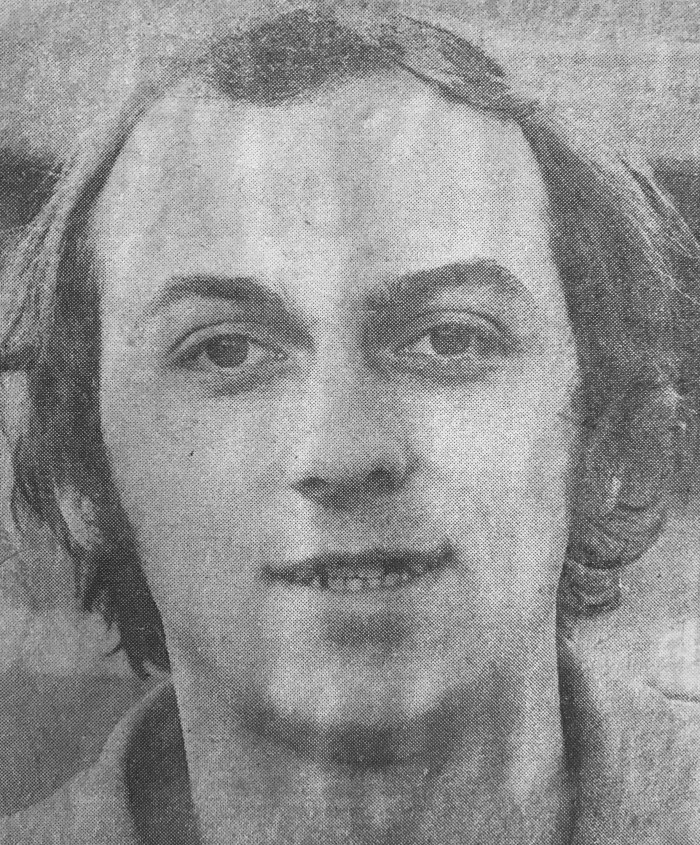
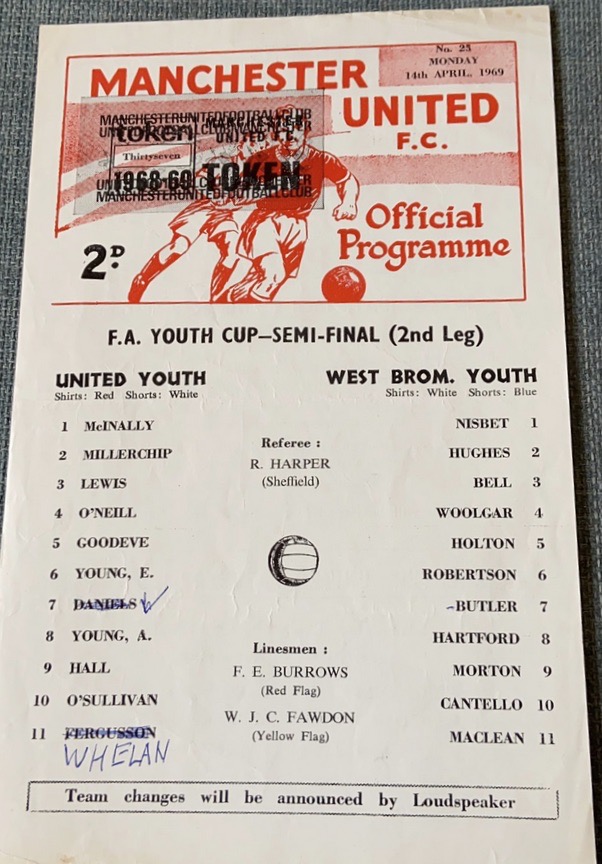
As they sought to shape the side with their own players, the first arrival through the door was Goodeve, who would at least have found one familiar face in the dressing room. He and Peter O’Sullivan played in the same Manchester United youth and reserve sides (see programme line-ups below).
In April 1969, they had reached the FA Youth Cup semi-finals where West Brom beat them 5-3 on aggregate, winning 3-2 at home in the first leg and 2-1 at Old Trafford, when it was reported a crowd of 20,000 were watching.
Goodeve and O’Sullivan played in the same United reserve side as the likes of Jimmy Rimmer in goal, John Fitzpatrick, Nobby Stiles and Don Givens.
In April 1970, Goodeve was one of four fringe United players – Givens, Jimmy Ryan and Peter Woods were the others – who were sold to Luton for a combined total of £35,000.
In two seasons at Kenilworth Road, Goodeve captained the Town reserve side but managed only nine appearances, plus six as a sub for the first team.
He was still only 23 when he joined the Albion. He was handed the no.6 shirt alongside Norman Gall for the away game at Tranmere Rovers on 8 December, along with fellow debutant Peter Grummitt, initially on loan from Sheffield Wednesday, in goal.
But neither new boy could halt the slump, as Albion caved in to a 4-1 defeat. Left-back George Ley didn’t play another game for the club after that game at Prenton Park.
Young Steve Piper was drafted in to play alongside Gall in the following match – a 1-0 defeat at Watford – and Goodeve was handed Eddie Spearritt’s no.4 shirt instead.
He retained his place in the side for the Boxing Day clash with Aldershot (when Burnley youngsters Harry Wilson and Ronnie Welch made their debuts) but this time in place of Ronnie Howell in midfield. Again, Albion lost 1-0.
Clough and Taylor continued to chop and change and Goodeve was dropped to the bench for the next four matches, only getting a brief look-in on the action when going on for Welch in the 2-1 home win over Rochdale on 19 January.
John Vinicombe, Albion writer for the Evening Argus, was not impressed. “The chief disappointment so far has been the failure of Ken Goodeve to recapture his Luton form. Goodeve, who started in the back four with Albion at Tranmere, has subsequently appeared in midfield and so far not made his mark,” he wrote.
Goodeve found himself playing in the reserves with a growing band of former first-teamers and, it wasn’t until 25 March that he got another sniff of first team action.
That was when he stood in at right-back for Paul Fuschillo away to Wrexham (0-1) and five days later at York City (0-3). But that was it. After five starts and one appearance as a sub, he didn’t play for the Albion again.
In the close season, he was offloaded to Watford for half the amount Albion had forked out seven months earlier.
At last, at Vicarage Road, he got plenty of playing time under his former Luton teammate, Mike Keen, who had taken over as Hornets manager.
Indeed, in only the second month of the new season, Goodeve was back at the Goldstone in the Watford side beaten 2-0 courtesy of goals by Ricky Marlowe and Welch.
Goodeve in action for Watford against Albion’s Fred Binney
Born in Manchester on 3 September 1950, Goodeve joined United on schoolboy terms in October 1965 and was signed up as an apprentice the following year. In September 1967, he signed a professional contract at Old Trafford.
By the time he departed Old Trafford in April 1970, he’d not managed to make the step up to the United first team.
At Luton, his teammates included John Moore, who’d previously been on loan with Brighton, Barry Butlin, who played five games on loan at Brighton in 1975, and Don Shanks, who was a Mike Bailey signing in 1981.
After the sparse playing time with Brighton, Goodeve played 69 consecutive games for Watford between 1974 and 1976 but a groin strain ended his professional career.
He was able to pursue a non-league career at Bedford Town for five years and was in their 1980-81 side that won the Southern League Cup.
He subsequently played for a number of non-league outfits in the same region, as detailed in this Watford FC archive and ended up as player-manager of Bedfordshire side Wootton Blue Cross between 1993 and 1997.
According to the Hatters Heritage website, Goodeve continued to play football until he was 47 before becoming customer care manager for Galliard Homes in London, commuting from Wootton every day.
TOUGH-TACKLING midfielder Bobby Smith made more than 200 appearances for Manchester United’s reserve side.
He played alongside emerging talents such as George Best and Nobby Stiles but wasn’t able to follow them in making the step up to the first team.
Like many before and since, he had to look elsewhere to establish a career in the game, and 85 of his 307 senior career appearances came in the colours of Brighton & Hove Albion, the fourth of seven clubs he served as a player.
Smith stayed in the game as a manager and coach for 26 years after hanging up his boots, his most notable achievement coming in December 1979 as boss of Third Division Swindon Town when they overcame the mighty Arsenal in a thrilling League Cup quarter final.
Born in Prestbury, Cheshire, on 14 March 1944, Smith won six England Schoolboys (under 15s) caps, playing right-half with future World Cup winner Martin Peters playing on the left.
He went on to win two England Youth caps: on 9 March 1961, he was in an England side (which also included John Jackson in goal and future Luton and Spurs boss David Pleat) that lost 1-0 to the Netherlands in Utrecht and three days later was again on the losing side, this time 2-0, to West Germany in Flensburg, when teammates included John Milkins, Portsmouth’s ‘keeper for many years, and striker John O’Rourke, who played for various clubs. Smith turned professional with United the following month.
I’ve discovered an old programme (above) for a Man Utd reserve fixture against West Brom during that era. It shows Smith alongside Wilf Tranter (who also later played for Brighton, and was Smith’s assistant manager at Swindon), Nobby Stiles in midfield, and George Best on the left wing.
In 1964, when a first team call-up continued to elude Smith, he lowered his sights and went to play for a former United colleague at Scunthorpe United. That colleague was Freddie Goodwin who would later be his manager at Brighton as well.
At Scunthorpe, Smith finally saw league action and played 87 games in two seasons before being transferred for £8,000 to Grimsby Town. In two years with the Mariners, he played 56 games before joining the Albion in June 1968.
My distant memory of Smith was of a tough-tackling midfielder who was in the shadow of the likes of Nobby Lawton and Dave Turner when it came to his popularity with supporters. And manager Goodwin hit back strongly when a section of fans voiced their disapproval of the player.
Smith scored the only goal of the game after only 50 seconds away to Stockport County on 23 January 1970, but in the previous home game (a 2-1 win over Bradford City) there had been a few shouts from the terraces in Smith’s direction.
In his weekly article for the Brighton and Hove Herald, Goodwin said: “I was most disappointed to hear certain sections of the crowd getting at Bobby Smith.
“He has done nothing to warrant this behaviour. He is a 90-minute aggressive player and his value to the team lies in his ability to win the ball from the opposition.
“He is well aware of his limitations as a player, but there is no-one who can accuse him of ever giving less than 100 per cent.
“This sort of behaviour by a small minority of spectators does nothing to help the team or the individual players.
“Any player who takes the field as a representative of Brighton and Hove Albion does so because he has been selected for the team by me.
“It is my responsibility that a player represents the Albion. So, to barrack any player is most unfair to him.”
Smith in action against the backdrop of the packed East Terrace at the Goldstone. Albion won 4-0
His 85 games for the Albion came across three seasons: 33 in 1968-69 and 26 in each of the following two seasons. Goodwin’s successor, Pat Saward, released him at the end of the 1970-71 season, and, in June 1971, he went on a free transfer to Chester City.
After only four months in the North West, he switched to the North East, joining Hartlepool United, initially on loan. Over two years, in which Len Ashurst’s side only just avoided the old re-election places, Smith played in 76 matches before moving on to Bury in August 1973. He signed as a player-coach but didn’t feature in the league side, instead taking over as manager – aged only 29 – from Allan Brown in December 1973.
It was the start of a coaching and managerial career that would span more than a quarter of a century.
He took Bury to promotion from the fourth tier by the end of that 1973-74 season, and remained in charge for just under four years, He was at the helm for a total of 215 games; the record books showing he achieved a 41.9 per cent win rate.
A six-month stint followed at Port Vale, between November 1977 and May 1978, but, of his 33 games in charge, he only presided over six wins (there were 14 draws and 13 defeats).
Swindon paid £10,000 compensation to lure him to the County Ground, where, as mentioned, his assistant manager was the aforementioned Tranter.
The official Swindon website remembered: “Despite being a relatively young manager, he guided Swindon to a promotion challenge in his first season in charge – missing out by three points, after losing the last two games of the season.”
Part of the secret had been Smith’s signing of strikers Andy Rowland and Alan Mayes.
Smith (far right) as manager of Swindon, with Tranter (far left), Chris Kamara (circled back row) and skipper Ray McHale (centre front row).
His major achievement came the following year, when Town beat Arsenal 4-3 in a replay to reach the League Cup semi-final.
When one considers the size of League Cup game crowds now, it seems extraordinary to discover around 7,000 Swindon fans (in a gate of 38,024) had made the trip to Highbury for the initial tie, which finished 1-1.
The Gunners had famously lost to lowly Swindon in the 1969 League Cup Final at Wembley, so the humble Wiltshire club smelled history repeating itself.
In the replay, with 21,795 packed into the County Ground, Steve Walford and John Hollins scored own goals and future Brighton manager Liam Brady scored twice for Arsenal. One of the key players for Swindon was future Sky Sports reporter Chris Kamara.
Unsurprisingly, the giant killing attracted plenty of media attention and Smith was interviewed live on Football Focus by presenter Bob Wilson.
Smith pointed out that his side had been well grounded and, after the initial draw against Arsenal, had thumped his old club Bury 8-0, equalling Swindon’s biggest winning margin in a league game. Amongst the scorers were Rowland and Billy Tucker – two of four ex-Bury players in Swindon’s starting line-up. Another was Brian Williams – Bury’s youngest ever player – and one of the other goalscorers, Ray McHale, (later to play for Brighton in the top division) went on to have a loan spell at Gigg Lane later in his career.
The Robins beat top-flight opponents Wolverhampton Wanderers 2-1 at home in the first leg of the semi-final but went down 3-1 at Molineux in controversial circumstances, Wolves scoring the decisive goal five minutes from the end.
“We were so unfortunate because Wolves should have been down to 10 men,” Kamara told the Swindon Advertiser. “Alan Mayes got hit by the goalkeeper (Paul Bradshaw). He came out of his goal, didn’t get anywhere near the ball and he clattered Alan and broke his two front teeth and his nose but didn’t get sent off.
“I know everyone looks at situations and says ‘You were unlucky’ but that was a turning point in the game, and we ended up losing.”
It later emerged that the tie could have had a dramatic impact on Kamara’s playing career. In a 2010 interview with FourFourTwo magazine, he explained how he was once on Manchester United’s radar during Ron Atkinson’s reign.
“I was at Swindon and my manager Bobby Smith said, ‘Big Ron’s coming to watch you.’ We were playing in the 1980 semi-final of the League Cup against Wolves, but I had the ’flu and didn’t play so well. I’m not saying that’s the reason he didn’t sign me, but Ron went back to his old club, West Brom, and signed Remi Moses instead.”
With the benefit of hindsight, the cup run took its toll on the Swindon side. Before the semi, they were just five points from a promotion place, with four games in hand. But only five of their last 18 games were won, and they lost nine away games on the trot, resulting in a disappointing 10th place finish.
Smith had spent large – by Swindon’s standards – including £250,000 on two players, David Peach and Glenn Cockerill, both of whom never fitted in at the club.
When Swindon lost their first five matches of the 1980-81 season, Smith was relieved of his duties.
He later took charge at Newport County and Swansea City, as well as coaching at the Swans, Blackpool, Cardiff City, and Sheffield Wednesday, together with a spell as assistant manager of Hereford United.
He was assistant manager to Frank Burrows at the Vetch Field but when the chairman at the time announced his intention to sell up, and no funds were being made available for new players, Burrows left of his own accord and Smith became caretaker manager.
Contributor Colin_swansea, on the fans website scfc2.co.uk, observed: “After Tosh left we had caretakers Doug Livermore for 30 days, Les Chappell for 23 days prior to Tosh returning, and after Tosh had left for a second time on the 5th March 1984 Les returned as caretaker until the end of the season.
“Our manager’s position was even more farcical after Frankie Burrows left with his assistant Bobby Smith taking over until a bust up during the Xmas period when Doug Sharp wouldn’t sanction the buying of rubber studded boots to combat the winter conditions.
Smith interviewed after his Swindon side held Spurs to a 0-0 draw in the FA Cup
“Smith left on 22 December 1995, Jimmy Rimmer was caretaker to 7 February 1996, Kevin Cullis became manager for a week, a two-game spell of two defeats, Rimmer returned for eight days as caretaker, before Jan Molby’s appointment on 22 February 1996. Molby’s replacement as manager on 9 October 1997 was Micky Adams who lasted 13 days and three league defeats with his assistant Alan Cork taking over until the end of the season.
“Cork didn’t fit the profile for the club’s new owners, Silver Shield, and he was offloaded at the end of the season. Ironically his successor, John Hollins, didn’t sign one player the following season when the club reached the play offs.
“Never a dull moment being manager of the Swans during the 80s and 90s!”
TEDDY MAYBANK signed for the Seagulls for what at the time was a club record transfer in November 1977 and went on to score Brighton’s first ever top division goal.
But the new signing came in for some flak from the terraces and, over two years, never really delivered a significant return on the investment.
Maybank himself reckons the club forced him to play on with an injured knee when he shouldn’t have, which led to irreparable damage and ultimately a premature end to his career.
The former Chelsea centre-forward was signed to replace Ian Mellor, Peter Ward’s prolific strike partner in the 3rd Division, after Brighton had won promotion to the second tier.
“We let Ian Mellor go because we felt that he had reached a certain age and had probably peaked,” Alan Mullery told Matthew Horner, in his Peter Ward biography, He Shot, He Scored. “When Teddy Maybank became available, we thought that he was probably a better option.”
Born in Lambeth on 11 October 1956, Maybank lived the first 15 years of his life in Brixton and went to Christchurch Primary School, close to his home, where one of his playground footballing mates was Ray Lewington — now loyal deputy to Roy Hodgson — who, together with Maybank, went on to play for Chelsea and Fulham.
At the age of 11, Maybank moved to Stockwell Manor Secondary School and played various age group levels for South London Boys. One of the representative matches he played in took place at the Goldstone Ground on 25 September 1971, against Brighton Boys.
The Maybank family moved to Mitcham, close to the Chelsea training ground, and, when Teddy was 15, he joined them straight from school.
Maybank and Lewington progressed through Chelsea’s youth ranks at a time when the club’s focus was on bringing through home-grown talent. “It was a good time at Chelsea,” he said. “We had such a good youth side and I loved playing under Ken Shellito.”
That team, which won the South-East Counties Championship four years in a row, included Ray and Graham Wilkins, Lewington and John Sparrow.
Maybank’s first-team debut came in a 2-0 defeat at Tottenham Hotspur in April 1975 aged just 18, and he scored in only his second game, a 1-1 home draw against Sheffield United, but Chelsea were relegated from the top division that year.
The following campaign saw Maybank, still a teenager, become a first-team regular under Eddie McCreadie, grabbing five goals in 26 appearances between August and February.
After falling out of favour, he went out on loan to Fulham just before Christmas 1976 and then signed permanently for a £65,000 fee later that season.
Back in the ‘70s, Chelsea were a long way from the force they are now and Maybank admitted: “I wouldn’t say I ever played that well at Chelsea. I didn’t find it easy to score goals there.”
It was a different story at Craven Cottage. After scoring more than a goal every other game – 17 times in 31 games – Maybank was sold to Brighton for £238,000, which gave Fulham a swift and substantial profit that they used to pay off money owed on their recently-built Eric Miller Stand (now, the Riverside Stand).
Blond locks flying, Maybank comes up against QPR’s Dave Clement in a 1978 pre-season friendly. (Above right) This overhead kick against Sunderland at The Goldstone scraped the bar … otherwise would have been a Goal of the Season candidate!
Maybank made a good enough start for the Seagulls, scoring after just six minutes on his debut in a 2-2 home draw with Blackburn Rovers, played on a bitterly cold day in front of a crowd of 26,467. Tony Towner scored the Albion’s other goal and another debutant in that game was tough-tackling midfield player, Paul Clark.
Maybank was on the scoresheet again in the very next game as Albion recorded their first ever win, 1-0, at Blackpool.
It was in a game against Orient a week before Christmas that Maybank got a kick on his knee from defender Dennis Rofe (who later played for Leicester and Southampton) which caused an injury which he maintains wasn’t properly managed by the club.
He told fulhamfc.com in 2013: “They kept giving me injections, taking all the fluid out every Sunday after the game.
“I was barely training. I could run in a straight line but any time I put weight on my leg I would fall over. I wouldn’t feel any pain because of the injections, but I just fell over.”
The Brighton fans thought they had bought Bambi and were soon on his back, leading to a “pretty terrible time” that Maybank never really recovered from.
“The club should never ever have allowed me to play in that situation,” he said. “A surgeon saw me outside of the club, opened me up and said: ‘if you ever play football again, you’ll be the luckiest bloke in the world’.
“Brighton had told me, basically, that I couldn’t do any more damage. They wouldn’t do it now, but because I was the highest transfer fee they ever paid, they didn’t really take my welfare into consideration at all. In the end, it ruined my career.”
Shoot! article and (above right) Maybank goes full length to head the second of his three goals against Cardiff on Boxing Day 1978.
In an article in Shoot! magazine at the time, Maybank talked about how he hadn’t had the best of starts with his new club. He said: “I wasn’t playing well. I knew that. My early form was a disappointment to the fans. They expected me to come in and start scoring regularly and doing incredible things.
“It’s always hard when you change clubs and you need a while to settle in. I have to adjust to my new team-mates but they’ve also had to change and adapt to playing with me.”
Mansfield were trounced 5-1 at the Goldstone on 21 January 1978 when Peter Ward shone with a hat-trick. Maybank also got one, but it was his last of the season. He made only six more appearances between January and the end of the season and new signing Malcolm Poskett seized his chance alongside Ward.
Albion narrowly missed out on promotion (by goal difference) and during the close season Maybank went under the knife for a cartilage operation.
Fit for the new season, Maybank was among the goals as Albion beat Millwall 4-1 at The Den on 2 September. He got a brace that day but in the same month was in trouble with the manager who’d had an anonymous tip-off that the star striker and Welsh international winger Peter Sayer had been seen in a nightclub on the eve of what turned out to be a 4-1 defeat by Leicester City.
Mullery made an example of the pair and they were both ‘persuaded’ to donate a fortnight’s wages to the local Guide Dogs for the Blind Association.
On the pitch, the goals dried up for Maybank until Boxing Day when he netted a hat-trick in a 5-0 win over Cardiff City. In an Albion matchday programme in 2015-16, Maybank admitted to Spencer Vignes: “The crowd started getting on my back, and I got in a pretty dark place.
“When I got that hat-trick, I went from villain to hero and yet it had got so bad that the day before Alan Mullery picked the squad I’d told him I never wanted to play for the club again.
“From the changing room before a game, I used to hear the crowd boo my name when the team was read out over the tannoy.”
In total, Maybank scored 10 times as Albion won promotion, and he was leading the line in the famous promotion-clinching 3-1 win at Newcastle on 5 May 1979.
In that season’s Rediffusion Player of the Year competition, Maybank finished third behind winner Mark Lawrenson and runner-up Brian Horton.
In much the same way Pascal Gross was feted for scoring Brighton’s first-ever goal in the Premiership, so Maybank scored the Albion’s very first goal in the top division.
After being hammered 4-0 by Arsenal in the opening fixture at the Goldstone, the Seagulls were away to Aston Villa in the second game.
Arms aloft, Maybank celebrates Albion’s first ever top division goal with skipper Brian Horton and Peter O’Sullivan. (Above right) Maybank battles with Arsenal’s David O’Leary watched by John Hollins and O’Sullivan.
Latching on to a John Gregory through pass and, with the very last kick of the first half, Maybank buried a shot past ‘keeper Jimmy Rimmer.
Albion lost the game 2-1 but the national newspapers were full of praise for the newcomers to the division.
Frank Clough in The Sun wrote: “Teddy Maybank and Peter Ward tore great holes in Villa’s jittery defence and were only stopped by inadequate finishing and fine goalkeeping by Rimmer.”
It was the first of three Maybank goals at the top level, but, according to Ward, the striker had a big falling out with Mullery. The manager brought in Ray Clarke as his first choice centre-forward and, in December 1979, Maybank was sold back to Fulham for £150,000.
He had scored a total of 16 goals in 64 appearances for the Seagulls, less than half the ratio he’d been scoring when bought.
After just 19 games for Fulham, Maybank joined Dutch side PSV Eindhoven for £230,000 in August 1980 (Fulham making another tidy profit on the player).
His debut for the Dutch giants came in front of a packed house at the Nou Camp, where Barcelona were staging a four-team tournament with Vasco da Gama and River Plate.
However, only a few games later his knee flared up again.
“They opened me up and saw what a state my knee was in,” Maybank explained in that 2013 interview with fulhamfc.co.uk. “I was told in no uncertain terms that if I didn’t retire I would be playing with the youth team or reserves. I think they thought they’d been taken for a ride.”
Maybank was left with no choice. At the age of 24, he retired from the game.
Pictures from my scrapbook sourced from Shoot! magazine and the matchday programme.






 TOUGH-TACKLING midfielder Bobby Smith made more than 200 appearances for Manchester United’s reserve side.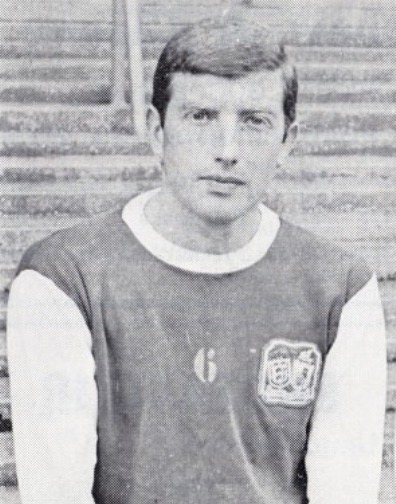


 Smith (far right) as manager of Swindon, with Tranter (far left), Chris Kamara (circled back row) and skipper Ray McHale (centre front row).


 In parallel lines