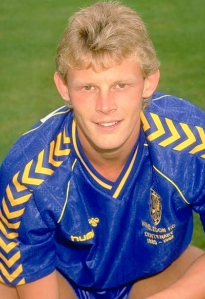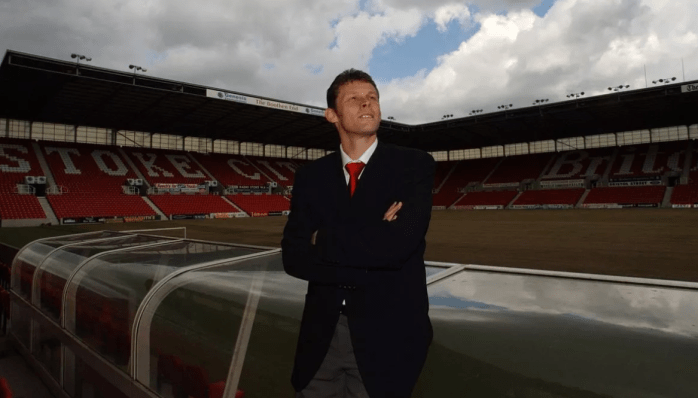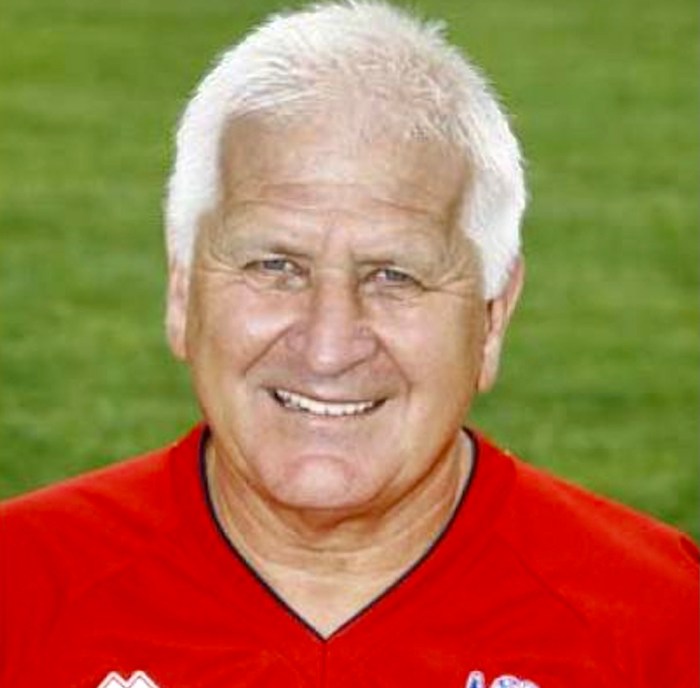
Steve Cotterill hit the goal trail at Brighton and Bournemouth

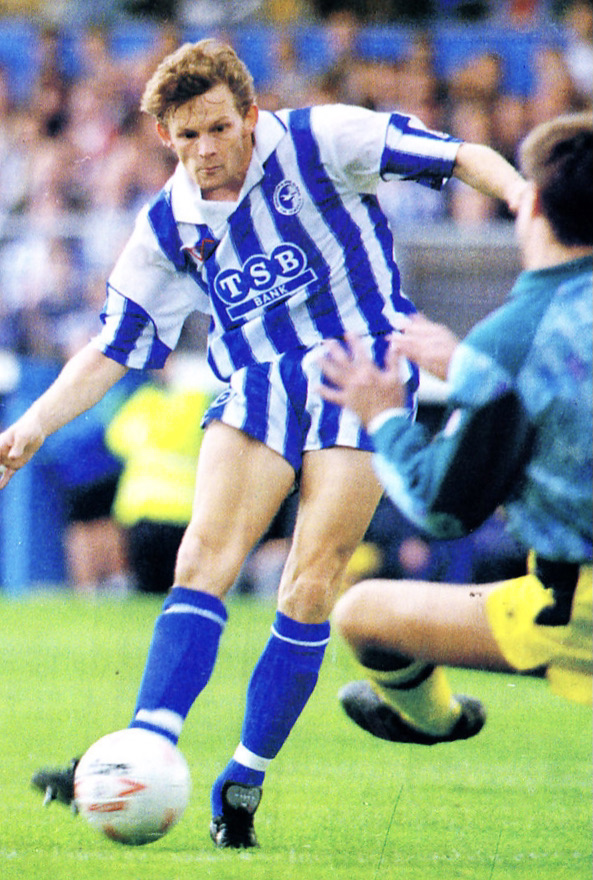
STEVE COTTERILL, who made a lasting connection with Brighton fans after impressing during an all-too-brief spell in 1992, saw his injury-plagued playing career come to a juddering halt at Bournemouth.

Cotterill today is back where it all began managing his hometown club, Cheltenham Town, but back in the day he was an old school bustling centre forward who began to get his career back on track with Barry Lloyd’s cash-strapped Seagulls.

The West Country striker, affectionately nicknamed Wurzel (after TV character Wurzel Gummidge) by Albion veteran Steve Foster (back with the club he left in 1984) because of the distinctive Gloucestershire burr when he spoke, was desperate to get back playing regular league football after spending 14 months sidelined with an anterior cruciate ligament injury to his knee while playing for Wimbledon, who were just about to compete in the inaugural season of the Premier League.

“When Brighton asked for me on loan, I desperately wanted the chance to show what I could do,” he said. “I think that Martin Hinshelwood (Lloyd’s deputy) was impressed when he saw me a couple of years ago in a tournament at Arundel.”

Wimbledon didn’t tend to loan players out but manager Joe Kinnear, a former Brighton player himself back in the 1970s, agreed for Cotterill to make the move to try to regain his fitness.

Lloyd was managing on a shoestring after Albion had been relegated back to the third tier having missed out on leaving the second tier in the opposite direction the year before when losing the play-off final at Wembley to Neil Warnock’s Notts County.

He’d been forced to sell the prolific striking duo of Mike Small, to West Ham, and John Byrne, to Sunderland, and their replacements had been a huge disappointment.

Mark Gall, signed from Maidstone, offered a glimmer of hope, but one-time Arsenal striker Raphael Meade and former Everton trainee Mark Farrington failed to convince.

As the 1992-93 season got under way, Gall was unavailable due to a knee injury that eventually forced him to retire, Meade had departed and questions continued over Farrington, so Lloyd opened the season with loan signings Cotterill and Paul Moulden (who’d been at Bournemouth for seven months after leaving Manchester City) from Oldham Athletic (also in the Premier League that season), where he was surplus to requirements.
Each were on the scoresheet in Albion’s opening day 3-2 defeat at Leyton Orient and Cotterill scored again in a home 2-1 win over Bolton Wanderers and an away 3-2 win at Exeter City.

It looked like Lloyd had cracked it as the pair combined well and also enjoyed their partnership, as Moulden told Brian Owen in an interview with the Argus in October 2016. “One of the reasons I loved playing for Brighton was Mr Banter himself, Steve Cotterill. We met up like we had never been apart. I’d start the banter and he’d finish it or vice versa.

“We destroyed many a centre-half partnership during that three months. I was gutted to leave. I mean that very sincerely – absolutely gutted. I couldn’t believe nobody would have bought me and Steve as a pairing.
“We were both out of favour with our clubs and we hit it off so well. But it wasn’t to be – at Brighton or at any club.”

Cotterill had certainly hinted at making the move more permanent, saying in a programme interview: “I am glad to be playing again and scoring the odd goal. Who knows what may happen from here?”

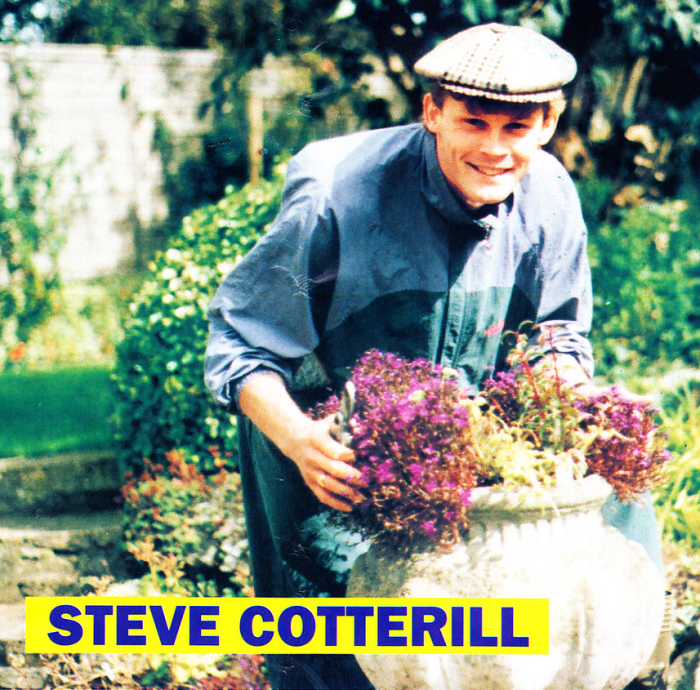
A somewhat unusual programme shot of Cotterill enjoying a spot of gardening

He signed off by scoring the only goal of the game that beat Wigan Athletic at the Goldstone.

Unfortunately, parent club Wimbledon, playing in the inaugural season of the Premier League, wanted the sort of fee for Cotterill that, at the time, Albion couldn’t afford.

He’d scored four times in 11 matches – and on his return to the Dons promptly scored both of their goals in a 2-2 draw away to Southampton. But with John Fashanu and Dean Holdsworth ahead of him, he managed just a handful of games for the Dons.

He did get a start ahead of Holdsworth at home to Liverpool in January 1993 and scored the Dons second goal (Fashanu scored a penalty in the first half) as the Reds were put to the sword 2-0 at Selhurst Park (where Wimbledon played home games at the time).

Cotterill added to his Dons goal tally the following month, in the second minute of added on time in a fifth round FA Cup tie at Spurs, but it was simply a consolation as the home side ran out 3-2 winners. Cotterill had replaced Roger Joseph for the second half.

In the summer of 1993, Bournemouth found the £80,000 that Wimbledon wanted for Cotterill and he signed for the Cherries under manager Tony Pulis.

Pulis paired Cotterill with Steve Fletcher, who eventually went on to become a Cherries legend after a slow start. Fletcher spoke highly of his former teammate when interviewed by Neil Perrett for the Bournemouth Echo in March 2010.

In their first season together, their fortunes were quite contrasting. Cotterill scored 14 goals and was crowned supporters’ Player of the Year while Fletcher endured a second barren year following a £30,000 move from Hartlepool.

Cotterill in action for Bournemouth against Burnley in 1993. Photo: Paul Collins.

“Steve took me under his wing,” recalled Fletcher. “My first couple of years were hard. I started playing alongside Efan Ekoku and was a lone striker after he had been sold.

“I was young and needed someone to come in and help me out. Steve had experience of playing at a higher level with Wimbledon and was happy to pass it on.

“He used to sit me down and we would talk through things. He would back me up in the paper and I remember him jumping to my defence when someone criticised me at a fans’ forum.

“Things like that stick in your mind. I had moved down from Hartlepool and it was tough. Steve really looked after me during those early years and it is something I’ve always appreciated. I’ve kept in touch ever since.”

It was during their second season together that their fortunes reversed. Cotterill’s career was prematurely cut short following a serious knee injury sustained against Chester City in September 1994, with only 10 games of the season played. Fletcher went on to be crowned Player of the Year.

Cotterill said: “I had a good time at Bournemouth, but unfortunately my lasting memory was my last game.

“Snapping my cruciate ligament was the thing I remember because it was the last thing I did and it’s the thing that lives with me. I still remember doing it and it’s a bad memory really, but I did have some good times there and it’s a great part of the world.”

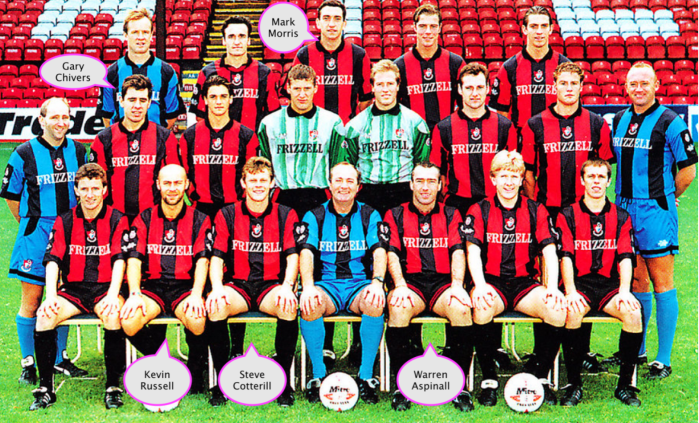
Pulis was succeeded by former player Mel Machin and in that campaign’s team photo there were two teammates who had played for Brighton in Gary Chivers and Kevin ‘Rooster’ Russell and two who would do so in the future: Mark Morris and Warren Aspinall.

Cotterill recalled in a 2023 interview with gloucestershirelive.co.uk: “I know Rooster very well. I played with him at Bournemouth and he’s a great guy and a good coach.

“I liked him when I played with him because he used to stick crosses on a sixpence for me. I remember scoring a few goals from his crosses.”

Born in Cheltenham on 20 July 1964, Cotterill’s first football was played at primary school but his secondary school years were spent at rugby-playing Arle Comprehensive so it was a relief to resume the game he loved for the then semi-professional Cheltenham Town youth team.

He progressed to the reserves and first team of what at the time was a Southern League Premier Division club before his friend Tim Harris, assistant manager at Alvechurch, persuaded him to switch clubs, while he was working full time for a builder’s merchant.

“I must have impressed there because they cashed in and sold me for £4,000 to Burton Albion,” he recalled in a matchday programme interview.

His progress for the side who a dozen years earlier had unearthed the talent of Peter Ward saw him net 44 goals in 74 games for the Brewers between 1987 and 1989

“I have a great affection for Burton Albion and for all those people that work there and I’ll never forget my time there,” he said in a 2018 interview after his Birmingham side played his old club in the FA Cup.

Such a prolific scoring rate caught the eye of Bobby Gould, whose Wimbledon side were punching way above their weight in the old First Division, and the previous season had achieved an historic FA Cup win over Liverpool.

Wimbledon reportedly paid more than £100,000 to take him to south London and he recalled: “I scored on my league debut on 29 April 1989 in a 4-0 win against Newcastle and I thought I was on my way.

“But I didn’t get much of a look-in in the following season and then, when Ray Harford took over, I played a few games before I suffered a horrendous knee injury.”

Cotterill was out for 14 months and only managed a couple of reserve games towards the end of the 1991-92 season, before making the temporary move to Brighton.

Interesting to note in an Albion programme interview with him during his loan spell that he ended it by saying: “I want to stay in the game and I’d like to become a coach or manager.”

He certainly did that and what he did in those capacities is a story in itself. His first assignment was in Ireland where he succeeded his former Wimbledon teammate Lawrie Sanchez at League of Ireland’s Sligo Rovers.

But his hometown club Cheltenham Town offered him a management opening back in England in 1997, and he steered them from Southern League football into the Conference and then into the bottom tier of the Football League. He twice won the Manager of the Year title and earned another promotion, to the third tier, via a play-off final victory over Rushden & Diamonds.

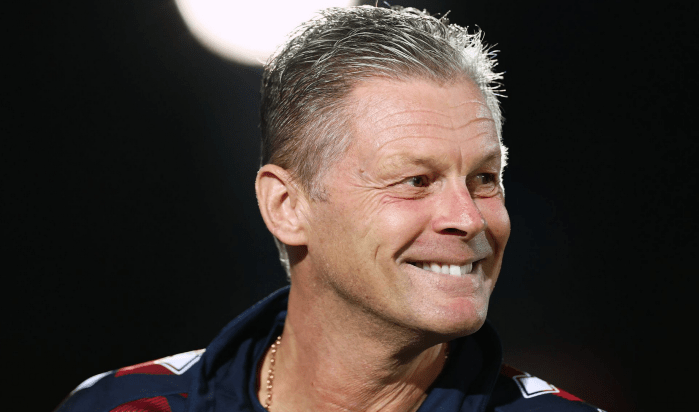
After management and coaching posts at 12 clubs in various parts of the country, he returned to Cheltenham after a 23-year absence in September 2025 and was subject of an extensive feature on Sky Sports hailing his messianic return at the age of 61.

In between, he managed Stoke, Burnley, Notts County, Portsmouth, Nottingham Forest, Bristol City, Birmingham, Shrewsbury Town and Forest Green Rovers.

A brief stay in the Potteries

He cut short his tenure at Stoke in the autumn of 2002 after just 13 games to become assistant manager at Sunderland under Howard Wilkinson, but their stay on Wearside was also short lived, the pair being dismissed after only 27 games in March 2003.

Before taking up the Burnley post, Cotterill was briefly a coach under Micky Adams at Leicester and he was twice a coach under Harry Redknapp: at Birmingham, before taking over as manager, then again at QPR for the second half of the 2012-13 season.

Cotterill has certainly been on the wrong end of some trigger-happy club owners over the years but one of the toughest challenges he’s faced during his long career was during his time as boss of League One Shrewsbury during the Covid-19 pandemic. He was twice admitted to Bristol Royal Infirmary, spending time in intensive care, suffering badly from the virus and pneumonia.

Cotterill left the Shrews job in June 2023 and was out of work until January 2024, when he took charge of Forest Green Rovers.

He was unable to stave off relegation from the Football League, but he rebuilt the side during the summer of 2024 to push for promotion back to League Two. When Southend United visited The New Lawn in the National League on 15 March 2025, the 2-2 draw was Cotterill’s 1,000th game as a manager.

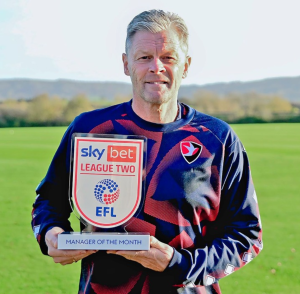
Now back at Whaddon Road, he’s steered the Robins clear of the bottom-of-the-league spot they occupied when he returned.

A manager of the month award shortly after his return to Cheltenham

At his first game back, a banner in the stands referenced the return of the king, and Cotterill declared: “I felt the whole of Cheltenham behind me that day. Not that I have not felt it since too, by the way, because they have been incredible ever since I have been back.

“Even when I was at other clubs, this club has always been important to me. It is my hometown.”

Nonetheless, the Albion has always occupied a soft spot, as he once wrote in his programme notes prior to a Cheltenham v Brighton fixture: “I thoroughly enjoyed my time at Brighton and, whenever we’ve gone there, I’ve always had a great reception from their supporters. They’ve been terrific.”

Sparks flew in Brighton v Chelsea FA Cup clashes

BRIGHTON v Chelsea in the FA Cup sparks memories for supporters of my generation stretching back several decades.

Many began as Albion followers the day the then First Division side from Stamford Bridge visited the Goldstone Ground in February 1967 when a dubious refereeing decision denied Third Division Brighton a shock win.

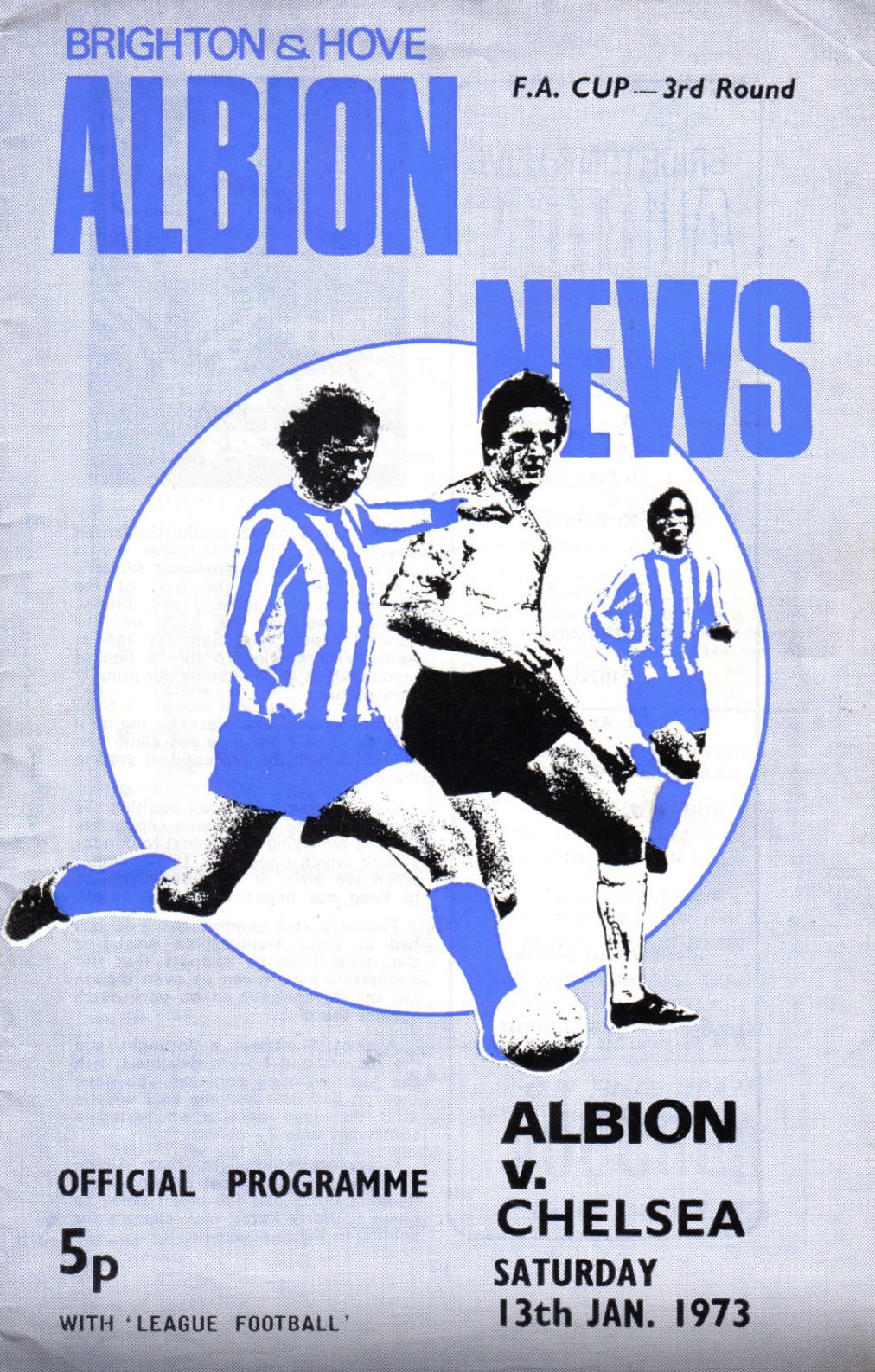
Others, me included, recall a fiery encounter in Hove six years later when Second Division strugglers Brighton were beaten 2-0 courtesy of two Peter Osgood goals in a game marred by violence on and off the pitch.

That third-round tie in January 1973 was dubbed “a day of shame” in the newspapers after two players were sent off, five were booked and crowd trouble erupted.

The chance for lower ranked teams to pitch their lesser talents against the big boys has always been at the heart of the FA Cup’s appeal.

That was certainly the case when Archie Macaulay’s mid-table Albion hosted Tommy Docherty’s top 10 Chelsea on 18 February 1967. To give it musical context, Georgy Girl by The Seekers had just taken over from The Monkees’ I’m A Believer at no.1 in the pop charts!

At a time when home crowds were normally 12,000 – 13,000, a sell-out gate of 35,000 packed into the Goldstone.

Cup fever had certainly captured the imagination of the Sussex public. In the previous round, 29,208 watched Albion beat Aldershot 3-1 in a third-round replay for the chance to take on the top division Pensioners (as Chelsea were called back then).

The two clubs hadn’t met in any other competition for 34 years – back in January 1933 Brighton beat the London side 2-1 in a third round FA Cup tie.

After such a long gap, maybe it was understandable that Albion’s young captain, Dave Turner, at 22, fell off the settee at home in excitement when he saw the cup draw made on the television.

Canny Brighton decided to sell tickets for the game at a reserve home fixture against Notts County, meaning a stunning 22,229 paid to watch the second string win 1-0 in order to secure their entry to the big game.

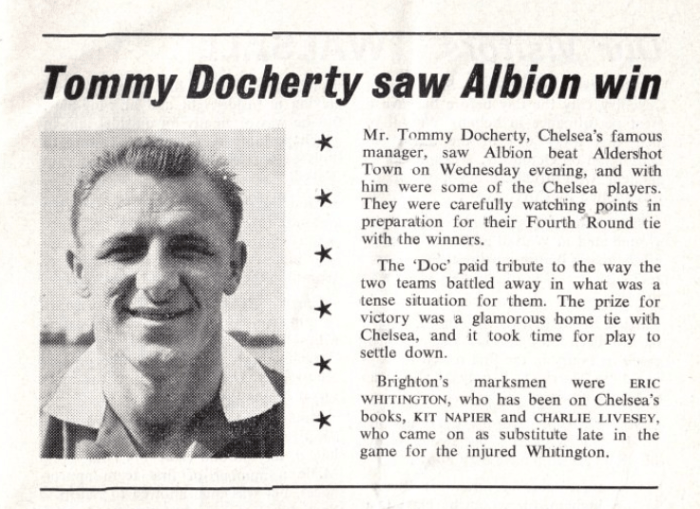
The matchday programme revealed how Docherty and several of his players had watched the Aldershot match to check out what would be in store for them.

Docherty meanwhile was very complimentary in his programme notes, declaring: “Chelsea know that we have a hard and difficult task today, and are not facing it in a complacent manner.”

He added: “We know that there is great potential for the Albion club. They have a First Division set-up at the Goldstone Ground, and First Division ideas, as well as a first-class pitch.

“The day cannot be very far away when they become one of our top clubs, and I am just one of many people in the game who will welcome their promotion to a higher class.”

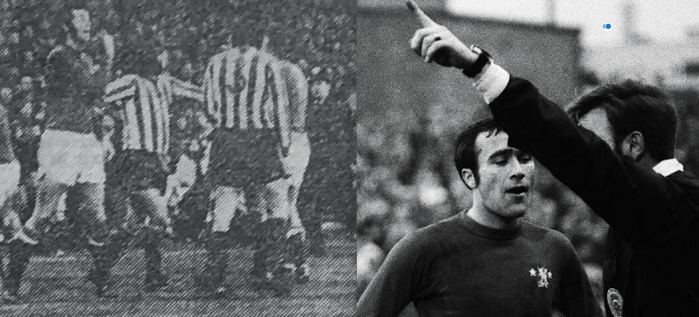
However, the game was only five minutes old when Bobby Tambling gave Chelsea the lead. But before half-time, Chelsea’s John Boyle (who would several years later joined Albion on loan) was sent off for kicking Wally Gould. And just four minutes into the second half, Turner gave Albion parity.

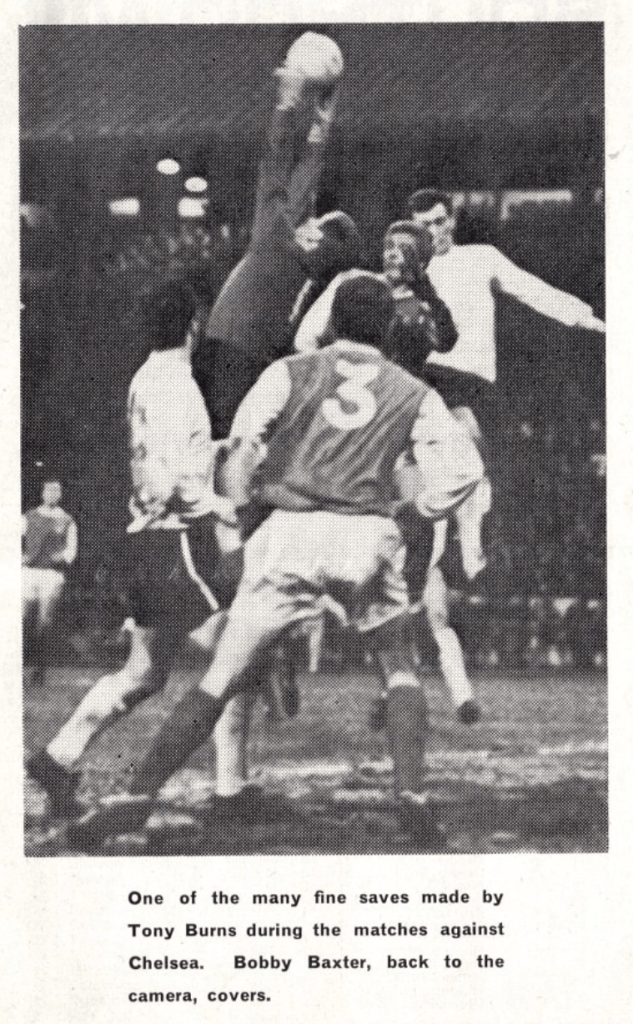
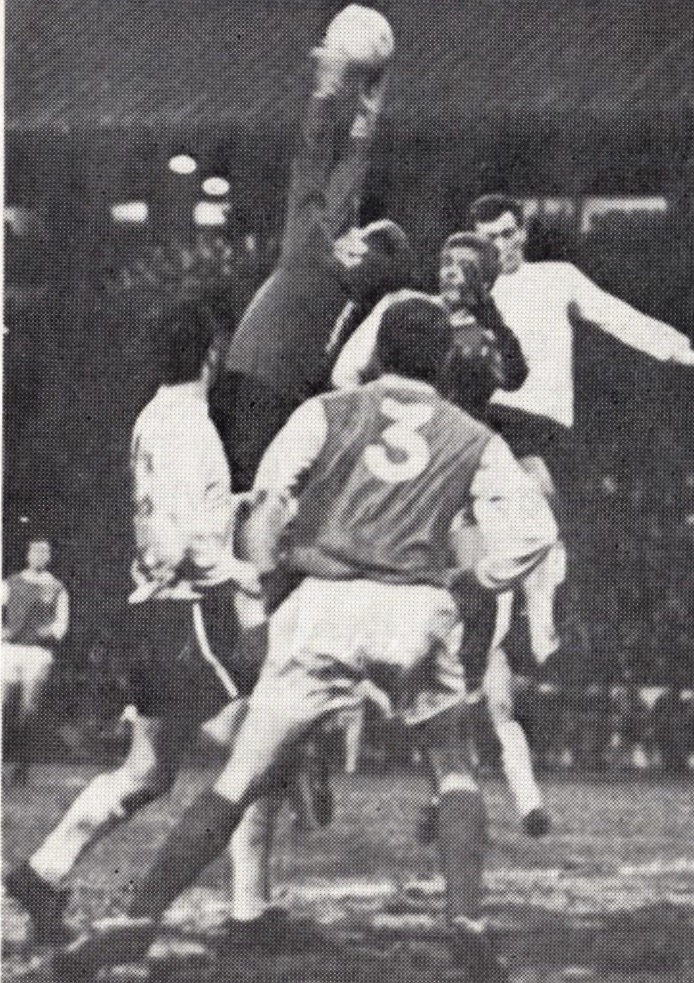
Goalkeeper Tony Burns, who had top flight experience with Arsenal, made several decent saves in the game and, with the clock ticking down, a cracking strike by winger Brian Tawse in the closing minutes of the game looked to have won it for the Third Division side.

“I smashed a volley past Peter Bonetti from 20 yards out with the score at 1-1 and thought I’d got the winner,” Tawse told Brian Fowlie of the Sunday Post in 2015. “It was a goal that could have made my career – but the referee chalked it off.”

Unfortunately, the official had spotted an infringement by Kit Napier and the ‘goal’ was disallowed.

As Brighton would discover again only too painfully in the 1983 final, these winning chances rarely happen twice, and, sure enough, in the replay at Stamford Bridge Chelsea ran out 4-0 winners in front of a massive crowd of 54,852.

Chelsea went on to reach that season’s final at Wembley only to lose 2-1 to a Spurs side that had Joe Kinnear at right-back and Alan Mullery in midfield.

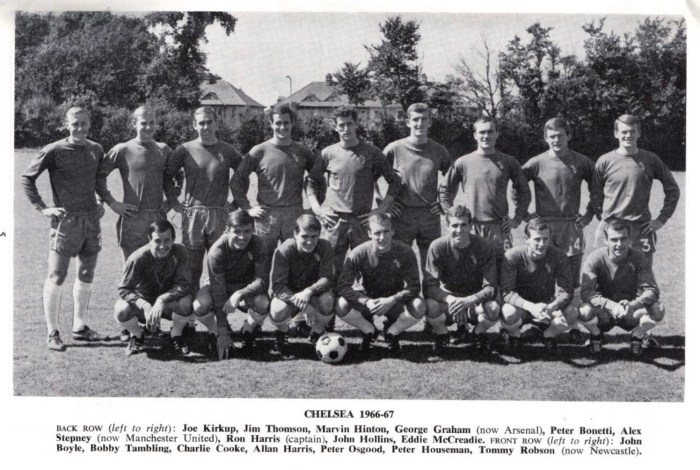
Hardman Ron ‘Chopper’ Harris, their captain in 1967, was still leading the side by the time of the 13 January 1973 game and John Hollins and Tommy Baldwin also played in both. The dismissed Boyle was on the Chelsea bench in 1973. Only John Templeman (right) played in both games for Brighton.

The UK had just joined the European Economic Community (as it was then called) and You’re So Vain by Carly Simon was no.1 in the charts. Albion had moved up a division under Pat Saward having won promotion the previous May, but the side was struggling at the foot of the Second Division, unable to cope at the higher level.

Nevertheless, there were two players looking forward to the cup tie: Bert Murray and £28,000 signing Barry Bridges had both won silverware at Chelsea in the 1960s.

Barry Bridges slots home for Chelsea in a FA Cup tie v Peterborough and, pictured by the Daily Mirror’s Monte Fresco, ahead of the 1973 match against his old club.

“It’s a tremendous draw for the club and a dream draw for Bert Murray and myself who both started our careers at Chelsea,” Bridges told Goal magazine. “Personally, it will be nice to see most of the Chelsea lads again. I grew up with Peter Bonetti, Ron Harris and Ossie (Peter Osgood).”

Unfortunately the Albion game was one of several former Worthing schoolboy Bonetti missed through injury and illness in the 1972-73 season, John Phillips deputising in goal at the Goldstone.

How this young supporter recorded the team info in his scrapbook

Dave Sexton, a promotion winner with Brighton in 1958, saw his Chelsea side put the ball in Albion’s net within the first 10 seconds of the game but Bill Garner’s effort was ruled out for offside, to the bemusement of the football writers watching. As the game unfolded, not only did it end in defeat for the Albion but it attracted ugly headlines for all the wrong reasons as Harris and Brighton left back George Ley were sent off.

Ley was dismissed in the 85th minute for bringing down Baldwin from behind and then getting involved in a punch-up with England international Osgood, the scorer of Chelsea’s goals in the 17th and 60th minutes, who himself was booked for his part in the altercation.

Albion’s Eddie Spearritt had been the first to go in the book on 23 minutes (for a foul on Alan Hudson) and on 73 minutes was involved in the incident which led to Harris being sent off for the first time in his career.

Esteemed football writer Norman Giller recorded it like this: “Harris got involved in a tussle with Spearritt, and, as he pushed him, Spearritt went down holding his face as if he had been punched. The referee directed Ron to an early bath. All the bones he had kicked, and here was Harris being sent off for a playground push.”

1970 Cup winner Dave Webb went in the book for wiping out Spearritt, joining colleague Steve Kember who was cautioned for fouling Steve Piper. Albion’s Graham Howell also went into referee Peter Reeves’ notebook for taking down Baldwin.

The kicking and aggression on the pitch led to fighting on the terraces with 25 people arrested. And Leicester referee Reeves had to be given a police escort off the pitch.

Former Spurs captain-turned-journalist Danny Blanchflower, writing in the Sunday Express: declared: “This FA Cup third-round tie was as disgraceful as any match I’ve ever seen.”

In the opinion of Albion scribe John Vinicombe in the Evening Argus: “Football anarchy gripped the Goldstone during the last 20 minutes of Albion’s FA Cup tie with Chelsea.

“In the frenzy, players fought one another, hacked and kicked, and the violence tiggered an all-too-predictable chain reaction on the terraces where rival factions became one mass of writhing, mindless hooligans.”

Interestingly, Harris’ dismissal was subsequently overturned, Giller recording: “A Brighton-supporting vicar, with a pitchside view, wrote to the Football Association telling them what he had witnessed, and ‘Chopper’ was vindicated.”

Chelsea made it through to the quarter-finals of that season’s tournament before losing 2-1 to Arsenal in a replay. Arsenal lost in the semis to Sunderland, the Second Division side who stunned the football world at the time by beating Leeds United in the final.

Lift engineer Hughton took Seagulls to a different level!

TOTTENHAM HOTSPUR was a key part of Chris Hughton’s life for more years than any of the other clubs he went on to serve.

While Brighton fans will always appreciate his four-year tenure taking the Seagulls from the Championship into the Premier League, he spent the first 19 years of his playing career at Spurs as well as 14 and a half years as a coach (and occasional caretaker manager) at White Hart Lane.

Hughton joined Tottenham’s youth set-up at the tender age of 13 in 1971, as he recounted in an In The Spotlight feature in the Spurs matchday programme for their September 2024 game v Brentford. It was the year the club won the League Cup captained by Alan Mullery with a side that included Phil Beal, Joe Kinnear and Martin Chivers, who scored both goals in the 2-0 victory over Aston Villa.

Hughton attended inner city school St Bonaventure’s in Newham, many years later attended by loanee striker Chuba Akpom who told Andy Naylor in an exclusive for the Argus: “When I was in school there used to be pictures of the gaffer there. The kids used him like an inspiration and motivation. I did as well: seeing someone come from the same area and the same school as me to become such a big and successful person.”

Other footballing St Bon’s alumni included Hughton’s brother Henry, John Chiedozie, Jermaine Defoe and Martin Ling (briefly an Albion player under Micky Adams).

Hughton’s progress as a youngster took a slightly unconventional turn when, at 16, Spurs told him he hadn’t done quite enough to be taken on as an apprentice.

“There was still that chance, though – a small window of opportunity,” he recounted to coachesvoice.com. “So, while I started a four-year apprenticeship as a lift engineer, I stayed on at Tottenham as an amateur.

“That meant working all day, then on two nights a week getting the bus or train to the training ground – apart from those days when I ended up working late and just couldn’t get there in time. Then, on Saturdays, I’d play for the youth team. I lived that life for two years.”

Football-wise, by the age of 18 Hughton had done enough to persuade Spurs to offer him a professional contract – but he didn’t want to cut short his lift engineer apprenticeship, so he turned them down but continued playing for the club as an amateur.

“I was fortunate,” he said. “My window of opportunity stayed open, and at 20 I finally became a professional footballer for Tottenham… as well as a qualified lift engineer.”

It was during Keith Burkinshaw’s eight-year reign as manager that Hughton enjoyed most of his success as a Spurs player, usually filling the left-back spot of a side that won the FA Cup in 1981 and 1982 and the 1984 UEFA Cup.

“It was a period that had a big impact on me, and on who I became,” said Hughton, who played alongside the likes of World Cup winners Ossie Ardiles and Ricky Villa, the gifted Glenn Hoddle and goalkeeper Ray Clemence, and Steve Perryman, “the best captain I played under”.

Born in Forest Gate, east London, on 11 December 1958, it might have been West Ham territory but it was Spurs that took on trial a group of five lads who had been playing in the district of Newham side.

“I ended up staying there,” he told the Argus in a November 2017 interview. “My upbringing was different. I was always playing. Although my dad is very much now a football fan, I didn’t have a family background of football.

“I think I went to West Ham once, a family friend took me. I was a football fanatic but always playing. I never really had an allegiance to any team. But I’m very much a West Ham lad.”

Hughton qualified to play for the Republic of Ireland – home of his mother Christine. His father Willie was Ghanaian (Hughton later became that country’s coach).

He made his debut for Eire in 1979 and won 53 caps over the next 12 years, including playing in three matches at the 1988 Euros. Although he was in the 1990 World Cup squad, he didn’t play any matches. He was the Republic’s assistant manager to Brian Kerr between 2003 and 2005.

Being of mixed race, Hughton suffered plenty of racial abuse both from the terraces and from opposition players, as he revealed in an interview with broadcaster Ian ‘Moose’ Abrahams for whufc.com in November 2023.

“You suffered it by yourself because you were the only one who was receiving that type of abuse, you were the only one that almost understood it, and being the only black player in the team you took all of that on your own shoulders,” he said.

“Sometimes it’s hard to think back now and comprehend how you coped with that, and the coping mechanism is because firstly you are used to it, and secondly your mentality had to be that you’re better than that. You generally suffered by yourself.”

Hughton continued: “There were numerous times over that period, especially in the reserve team, and yes, even in the first team that I suffered racial abuse [from opposing players].

“I reacted to it, but I knew the boundaries, because you knew if you went too far you were going to get sent off.”

A knee injury at the age of 28 was a signal for Hughton to begin to consider what he might do once his playing days were over, and he did some coaching sessions at soccer schools. “I started to think this was what I wanted to do,” he said.

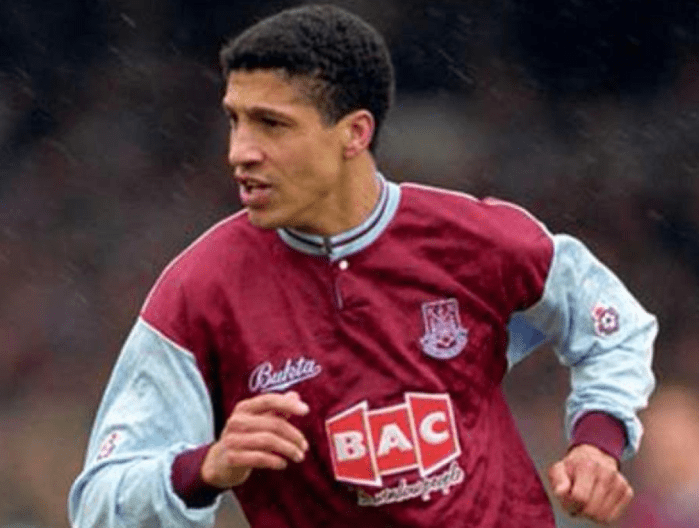
When he was no longer guaranteed a starting berth at Spurs, Hughton moved across London to the club closest to where he grew up: West Ham. Hughton signed for the Hammers initially on loan in November 1990 to cover for the injured Julian Dicks, and then permanently on a free transfer.

“My parents still live in Upton Park, so I was born and brought up very close to the stadium,” Hughton recalled in a November 2017 Argus interview.

Signed by Billy Bonds, he was with the Hammers for just over a year, helped them win promotion from the old Division Two in 1990-91and played a total of 43 matches (plus one as a sub).

“It was a really enjoyable period of time,” he said. “Billy Bonds was the manager. He was not only a great manager but a great individual.”

In February 1992, he moved on a free transfer to then Third Division Brentford, whose squad included Neil Smillie and Bob Booker. Graham Pearce was a coach. They won the divisional title but the following season Hughton’s troublesome knee forced him to retire at the age of 34.

“By the time I signed for Brentford at the age of 33 I was certain that I wanted to coach,” Hughton told coachesvoice.com. “I was taking far more interest in things like tactics and the thinking behind training sessions. Brentford’s manager at the time, Phil Holder, even allowed me to take a few sessions.”
Hughton added: “It actually set me up for my coaching career as I learned a lot in that time.”

After he’d called time on his playing days, he didn’t have to wait long for an opportunity to open up for him as a coach because his former teammate Ardiles, who’d not long since taken over as Spurs manager, invited him to help out back at White Hart Lane.

“We’d been good friends since our days playing for the club, so he knew all about my coaching aspirations and brought me in as the under-21s’ and reserve team coach,” Hughton explained. “I’ve always been very grateful to him for giving me that first opportunity.”

For the first year or so, he worked alongside the former West Ham player Pat Holland, who he described as “an excellent tactical and technical coach”.

Hughton explained it was a period in which he discovered how to transition from being a player to a coach. “As much as you’ve been part of a changing room thousands of times as a player, taken part in countless training sessions and listened to more team talks than you can remember, none of those things have ever been your responsibility before.

“In that respect, football is no different to any other aspect of life. If someone has spent years working on a shop floor, then moves up to management and has to govern a group of people, they have to make that same transition. It’s not easy.”

As managers came and went, Hughton remained on the coaching staff. After Ardiles came Gerry Francis and Christian Gross. Hughton was in caretaker charge for six matches before George Graham took over from Gross. Next in the hot seat was Glenn Hoddle, followed by Jacques Santini and then Martin Jol.

“Such a long apprenticeship might not be for everyone and some can go straight from player to manager at a young age, but I wouldn’t have been ready,” said Hughton.

“There was always something new to learn and experience. It was exciting to see what each new manager would be like, how he would involve me and what I would learn.

“The club could easily have said, ‘Now that the manager has left we won’t be keeping you on’, but they showed faith in my abilities and, in return, I provided some continuity.”

Hughton was assistant manager to Jol and said: “We had three years together, and in terms of league positions they were successful ones.”

By the time he was shown the door at Spurs, along with Jol, after a difficult start to the 2007-08 season, he felt ready to become a manager in his own right.

But before that happened, a different proposition emerged when Kevin Keegan asked him to become first team coach at Newcastle United.

“I’d spent my entire playing and coaching career in London, but any apprehension I felt at relocating to another part of the country was outweighed by the excitement,” he told leadersinperformance.com.

“I was going to a legendary club with an incredible tradition, rich history and great fan base and I was going to assist Kevin Keegan. I learned a lot from him during our time together, especially from his strengths in man-management.”

• What happened next in Hughton’s career is the subject of my next blog post. Thanks for reading!

Top Hatter Moore a temporary plug in Albion’s leaky defence

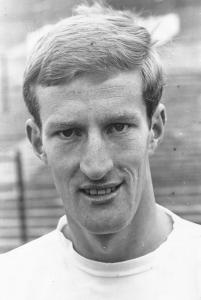
LUTON TOWN legend John Moore had a 32-year association with the Hatters as a player, coach and manager. He had a less remarkable one month’s loan in the stripes of Brighton.

As manager Pat Saward rather too rapidly dismantled Albion’s 1972 promotion-winning side, the experienced Moore was one of several old hands brought in to try to help Albion adapt to the old Second Division.

Saward was light on numbers in a defence which had conceded 23 goals in 12 games, and he had just parted company with former skipper John Napier, while injury-prone Ian Goodwin was in hospital having a knee cartilage operation. The side had only won once in the league in 12 starts.

But the arrival of Moore, together with Lewes-based Stan Brown from Fulham, gave the side an unexpected fillip and the Albion earned a surprise 2-0 victory away to Huddersfield Town (Eddie Spearritt and Barry Bridges the scorers) on 14 October 1972.

Saward was certainly impressed by the impact of his two new acquisitions. “The new men played a major part in our success,” he said. “It was quite remarkable really the way they slotted into the side as if they had been playing for Albion all season. John did exceptionally well in his role as sweeper.

“They are, of course, experienced professionals who have been around the game a long time. But even the best professionals sometimes take time to settle into new environments and this is why the performances of these two was so outstanding.”

Unfortunately, it was the only win of Moore’s brief stay. Albion drew the next three games and his final outing came in a 3-0 defeat at Millwall. That loss at The Den was the first of 12 consecutive league defeats.

Ironically, Albion only returned to winning ways when Moore was in opposition, lining up in the Luton side that lost 2-1 at the Goldstone on 10 February 1973. Ken Beamish scored both Albion goals, while future Albion signings Don Shanks and Barry Butlin were playing for the opponents that day.

Moore subsequently moved on to Northampton Town, where future Albion player John Gregory was beginning to make his way in the game, but the Scot ended his playing days after only 14 appearances.

Born on 21 December 1943 in the village of Harthill (halfway between Glasgow and Edinburgh), Moore played initially for local side North Motherwell Athletic. In 1962, he joined Scottish League side Motherwell on a part-time basis, while also working in a factory.

He was a centre-forward when he initially went to Fir Park but in the only three games he played he started twice in midfield and once in defence. Given a free transfer in May 1965, a Luton scout in Scotland pointed him in the direction of then manager George Martin.

In a 2011 interview with Matthew Parsfield, for the Talk of the Town blog, he recalled: “George Martin flew up to Scotland to sign me. I remember sitting down with him in my living room with my family, and, it sounds far-fetched nowadays, but there were no contract negotiations and no haggling at all.

“He said ‘What do you want?’ He was actually talking about a signing-on fee, but I just said ‘I want an opportunity.’ He certainly gave me that.”

One particular long-standing fan, Mick Ogden, remembered Moore’s arrival with affection. Writing on the Hatters Heritage website, he recalled him turning up at a supporters’ club gathering in the company of manager Martin in May 1965.

“Despite the fact that he had travelled down from Glasgow that day, John spent the whole evening with us, firstly playing billiards against our members and then later we sat around listening to John talking about his life and obvious love of football,” wrote Mick.

“He told us he had signed from Motherwell and how he sat for many hours during the week talking football with his father, who was a Rangers fan. Apparently, these chats would often carry on until the early hours of the next day. John clearly had a great love and affection for his father.”

Another fan who remembered the player from his early Luton-watching days, ‘Mad Hatter’, said: “Moore wasn’t like other defenders; slender in physique compared to those he played alongside, he was more than a match for most of the opponents he came up against.

“Whilst on the books of the Hatters, Moore made 274 league appearances and more than played his part in helping Luton Town climb from Division 4 to Division 2.”

John Moore in action for Luton against West Ham’s Geoff Hurst

Indeed as well as under Martin, Moore also featured under Alan Brown, Alec Stock and Harry Haslam.

After his playing days were over, he spent time as manager of non-league Dunstable Town but when David Pleat took over as Luton manager, he took Moore back to the club as a coach.

After Pleat had moved on to take the hot seat at Spurs, Moore stepped up to become manager.

It was the 1986-87 season in the top-flight and Moore led the Hatters to a club-best seventh-place finish. But it appears he didn’t enjoy the limelight of such a position and he stepped down, handing over the reins to Ray Harford, assisted by Steve Foster. Luton went on to win the League Cup (then known as the Littlewoods Cup) beating Arsenal 3-2, with another ex-Albion skipper, Danny Wilson, one of the goalscorers.

When former player Jim Ryan took over as manager, Moore returned to the club as a coach for a third stint and stayed in that role under Pleat again, Terry Westley, Lennie Lawrence, Ricky Hill, Mick Harford, Joe Kinnear and Mike Newell until he reached the age of 60 in 2003 and chose to retire.

In the interview with Parsfield, he gave an insight into his approach. “When I became youth coach I always treated the boys like adults.

“I wasn’t interested in making them successful youth players, the only way to make a living is to become a first team player.

“I told them they had to work harder than the first team, because those older guys down the corridor aren’t going to just give you their first team place and their luxury lifestyle, you’ve got to work for it.”

He added: “Nobody’s career flows in a straight line, careers bob and weave, and players need the attitude of ‘When it gets hard, I don’t give in’. It’s when someone has the talent but not the attitude, that’s what frustrates you the most.”

On leaving Luton, Moore got involved in schools coaching in Bedford. But at Kenilworth Road, there is a permanent reminder of the player courtesy of The John Moore Lounge.

Tony Burns handled the art of goalkeeping for decades

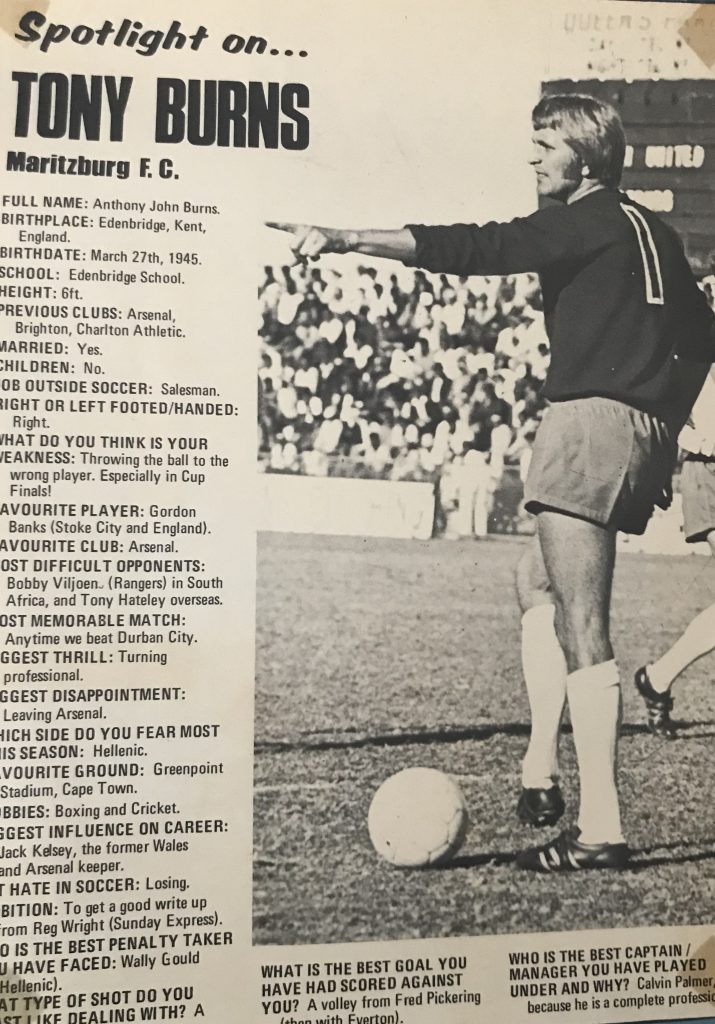
A GOALKEEPER with film star looks signed for Brighton from Arsenal just after England lifted the World Cup.

Tony Burns had kept goal for the Gunners in 31 top-flight matches and Albion boss Archie Macaulay, who had played for Arsenal himself, went back to his old club to sign a no.1 to challenge the emerging local lad, Brian Powney.

It wasn’t difficult for Burns to settle at the Goldstone because the dressing room included Northern Irish full-back Jimmy Magill and winger Brian Tawse, familiar faces from his time in north London who’d also made the switch to Brighton.

It also wasn’t long before female fans who admired his smouldering good looks were sending in letters to the office inquiring about his eligibility!

Burns relived his career in detail in 2020 when interviewed by 17-year-old would-be journalist Jed Vine, who watches games at the Amex with his mother, and games at the Emirates with his dad.

Born in Edenbridge, Kent, on 27 March 1944, Burns first showed his goalkeeping prowess during his schooldays in the town before he joined Southern League club Tonbridge (now Tonbridge Angels) who he returned to twice more and later managed three times.

He made his Southern League debut against Yiewsley (later to become Hillingdon Borough) in February 1963 and only his third game for Tonbridge was as an 18-year-old against Arsenal at Highbury.

With long term custodian Jack Kelsey retiring, Arsenal were looking around for likely successors and, liking what they saw of Burns, offered him a contract.

“In his early days at Highbury, he showed immense potential and, after benefitting from Kelsey`s coaching, made encouraging strides,” a 2020 Pitching In piece for the Southern League recalled.

Manager Billy Wright gave him his senior Arsenal debut in a friendly against Enschede in Holland in August 1963, with Magill in defence, and he got his first taste of South Africa on a five-game tour the following May when he was in goal for Arsenal’s 5-1 win over a Western Province XI and their 6-0 win over an Eastern Province XI.

But his big breakthrough came when he made his league debut in a 3-2 home win over Burnley in October 1964 (three days earlier he’d played in goal in a 7-0 friendly win over non-league Corinthian Casuals).

“I felt on top of the world. I had always wanted to play for the Gunners and here I was keeping goal for them, and on the winning side at that,” he told the Albion matchday programme. “There’s only one first match and I’ll never forget this one.”

Once he got the shirt, he had a run of 26 games (32 including friendlies) from October 1964 through to the end of March 1965.

He generally played in front of a defence featuring the likes of Don Howe, Frank McLintock and Ian Ure with John Radford and Joe Baker up front.

During the first half of the 1965-66 season, Burns appeared in seven league games and three friendlies, but his final Gunners first team appearance came on 27 December 1965 in a 4-0 defeat away to Sheffield Wednesday.

Jim Furnell was Wright’s preferred first choice, and, as the season wore on, the emerging Bob Wilson was getting the nod ahead of him as stand-in (although it wasn’t until 1968 that Wilson finally ousted Furnell).

Disappointed to leave, Burns nonetheless went in search of regular football by joining Third Division Brighton for £2,000 in July 1966.

He made his first appearance for the Albion on 17 September 1966, when he took over from the injured Powney, but Brighton went down 2-0 to Grimsby Town.

Powney returned the following week and Burns had to wait until January for his next games – two FA Cup ties against Aldershot.

Burns in action versus Chelsea

He kept his place for the big fourth round FA Cup game against First Division Chelsea at the Goldstone which finished 1-1 when his former Arsenal teammate Tawse controversially had what he thought was a cracking late winner ruled out for a foul by Kit Napier.

Unfortunately, Burns conceded four in the replay at Stamford Bridge as the superior Chelsea side made the most of home advantage to ease their way through comfortably, 4-0. That was the season they went all the way to the final only to lose 2-1 to Tottenham Hotspur, whose ranks included Alan Mullery and Joe Kinnear.

By the end of the season, Burns had played 18 matches against Powney’s 37. But Burns had the upper hand in 1967-68 featuring in 29 games compared to Powney’s 21.

He also started the 1968-69 season as first choice but his 54th and final game for the Albion was in the 2-1 home defeat to Northampton in the second round of the FA Cup on 20 December 1968.

New manager Freddie Goodwin brought in former Wolves and Aston Villa ‘keeper Geoff Sidebottom to challenge Powney and let Burns leave on a free transfer in March 1969.

He joined Charlton Athletic, where he made 10 appearances in their unsuccessful tilt at promotion, but declined what he saw as a derisory contract offer. He returned to Tonbridge briefly and in January 1971 headed off to play in South Africa, initially for Durban United, and later, Maritzburg.

In his interview with Jed, he recalls playing in an English All Stars team managed by Malcolm Allison who invited him to return to England with Crystal Palace when his contract was up.

Burns made the move in October 1973 after previous Palace no.1 (and later Albion youth coach) John Jackson had moved to Orient.

He shared goalkeeping duties with Paul Hammond, playing a total of 90 matches between the sticks for Palace over the next four years under Allison and his successor Terry Venables.

In 1977, Burns played half a dozen games on loan for Brentford before heading off to the States like a lot of ageing players did at that time.

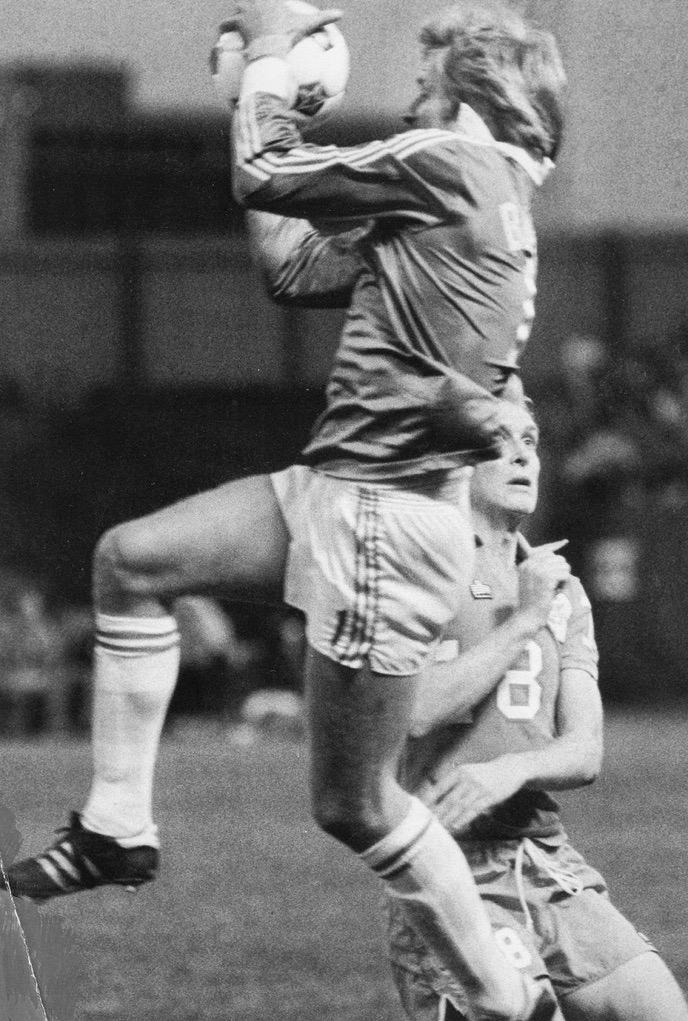
The ‘keeper played a dozen games for Memphis Rogues in the North American Football League. They were coached by former Chelsea defender and manager Eddie McCreadie although Burns had gone there to team up with former boss Allison who was sacked without a ball being kicked because he hadn’t signed enough players!

Burns played for Memphis Rogues in the USA

Among Burns’ teammates were a young Neil Smillie, who’d been struggling for games at Palace, Phil Beal, who had left Brighton the year before, John Faulkner, the one-time Leeds and Luton defender, and the flamboyant Alan Birchenall, beloved by Leicester City supporters of many generations.

Back in the UK in 1978, Burns joined Plymouth Argyle as cover for Martin Hodge, and ended his league playing days in this country appearing in 11 games in the first half of the 1978-79 season.

However, he left Home Park to rejoin Tonbridge Angels for a third time and he also played for Hastings United and Dartford.

After his playing days were over, Burns had three spells in charge of Tonbridge, from August 1980 to December 1982, August 1989 to May 1990, and in a caretaker role from November 2001 to May 2002 (by which time he was goalkeeping coach at Millwall, who he joined in 1992 under Mick McCarthy.

Burns served as goalkeeper coach under several Millwall managers.
Picture: Brian Tonks.

He also spent seven years as manager of Gravesend and Northfleet (who became Ebbsfleet United) between 1982 and 1989.

But it was at Millwall where he finally found a permanent home, working under no fewer than 18 different managers, including Steve Gritt and Mark McGhee.

He was even at the helm himself for a while, working as co-caretaker manager with former Lions boss Alan McLeary after Dave Tuttle’s departure in April 2006, when Millwall’s relegation had already been confirmed.

The appointment of Nigel Spackman the following month led to Burns’ departure in July 2006, when he took up a similar role at his old club Palace, working under former Albion boss Peter Taylor coaching Julian Speroni and Scott Flinders.

Goalkeeping coach at Palace under Peter Taylor

He left Selhurst in November 2007 when Taylor lost his job, and Speroni told yourlocalguardian.co.uk: “It was sad to lose Tony Burns because we worked well with him. During last season when I wasn’t playing regular football, Tony was the one who kept me going which was very important.”

Burns moved with Taylor to Conference side Stevenage Borough but later returned to Millwall under Kenny Jackett before stepping down in 2012, when he was succeeded by Kevin Pressman.

Still, he wasn’t finished with the game, though, and at the age of 70, in the summer of 2014, he teamed up with Taylor yet again to become goalkeeping coach at Gillingham. He joined them on a part-time non-contract basis as a replacement for Carl Muggleton.

100 goals in Scotland and England for Neil Martin

2 MartinSCOTTISH international Neil Martin remains a legend at one of his homeland clubs but his brief time at Brighton was more like a bad dream after a goalscoring start.
QoS Martin

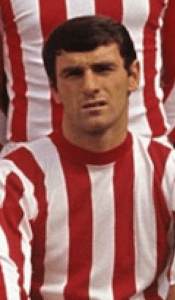
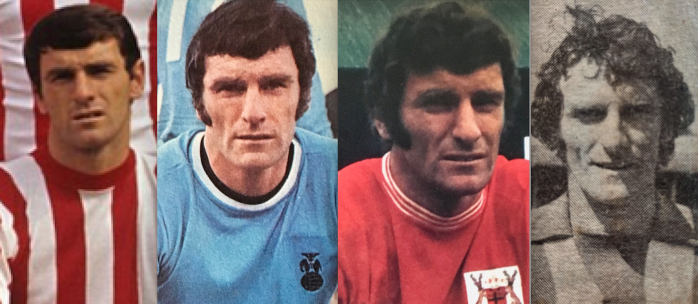
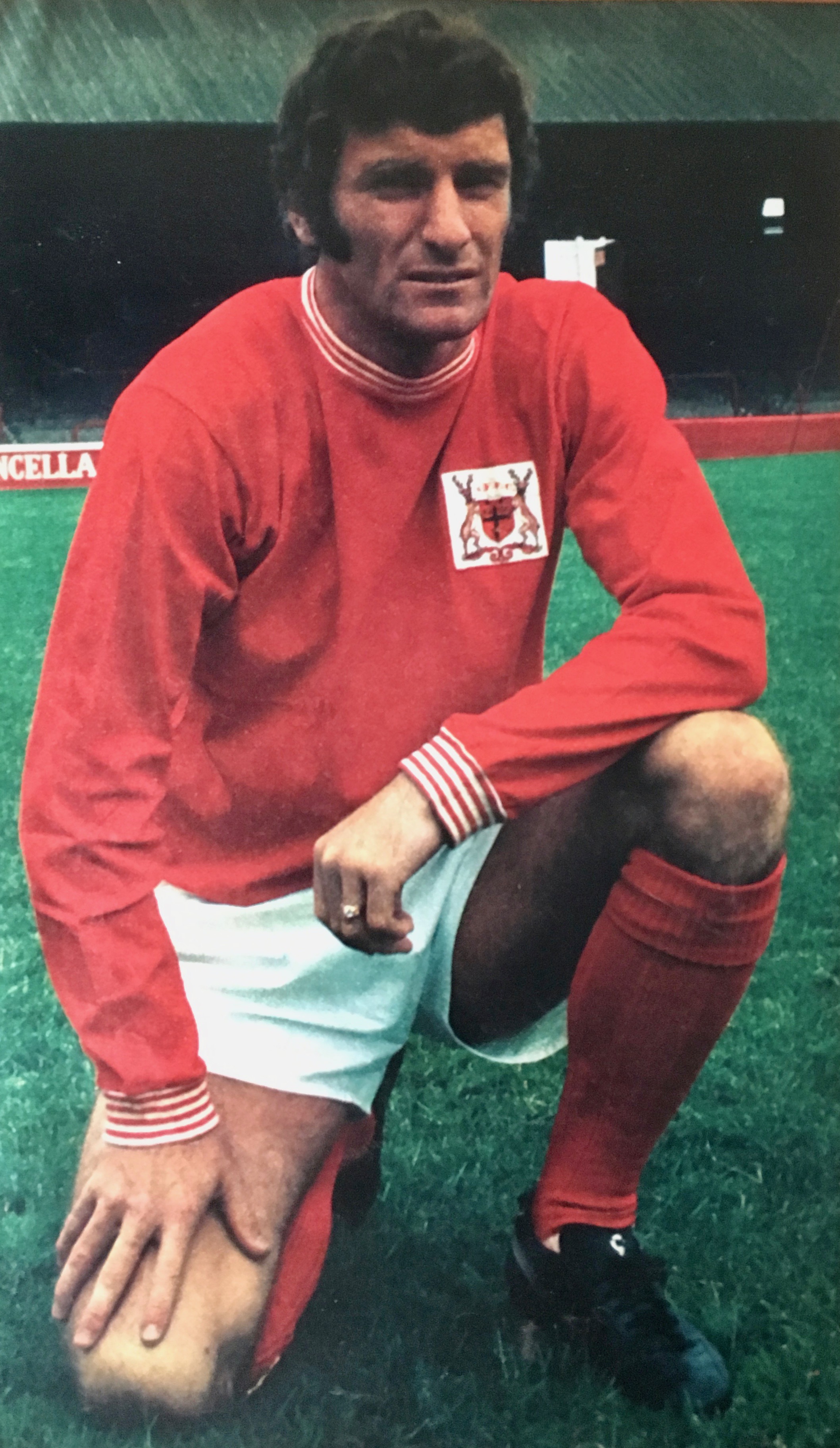
The striker’s youthful picture can still be found on the legends section of Queen of the South FC’s website where it notes he was among the first players to score 100 league goals in both Scotland and England.

It was while playing for the Wearsiders that he gained three Scotland international caps, all in 1965.

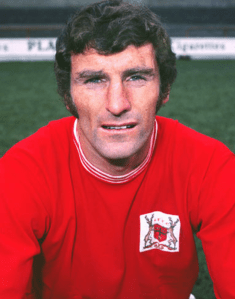
IMG_5147Martin scored 28 goals in 119 games for Nottingham Forest having moved down from Scotland in the 1960s and begun his English league career with Sunderland.

Martin partnered the legendary Denis Law up front in World Cup qualifiers against Poland and Finland and his third and final cap was earned in a 1-0 win over Italy playing alongside Tottenham’s Alan Gilzean.

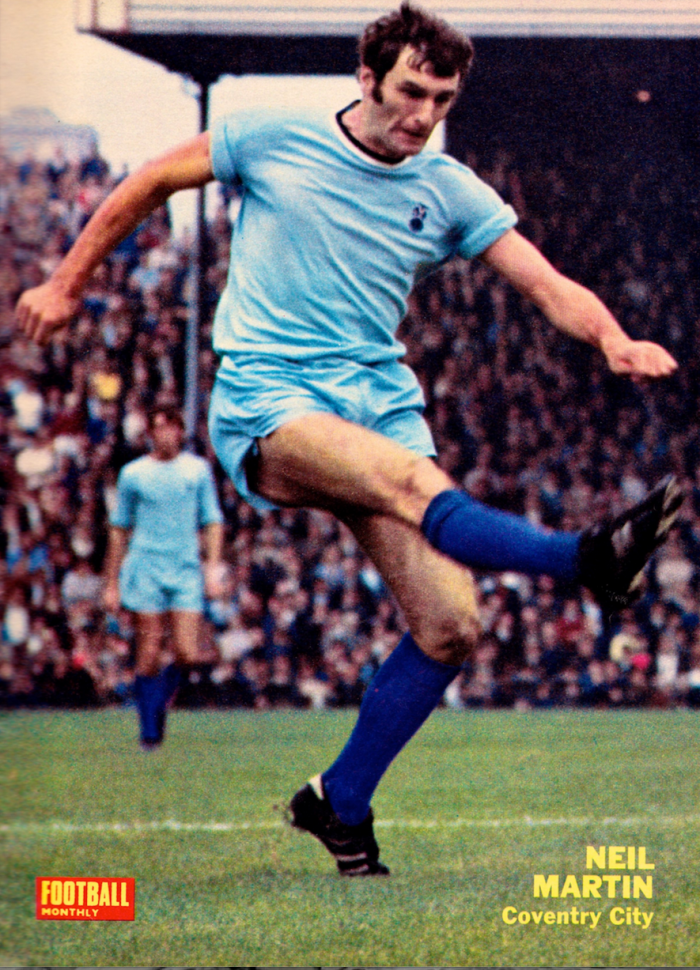
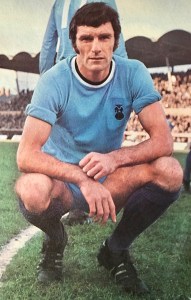
IMG_5146One of his most prolific spells was at Coventry City (above) where, in three years, between 1968 and 1971, he scored 40 goals in 106 appearances.

He was slightly less prolific for Forest (although he was on the scoresheet in Clough’s first game in charge) before Peter Taylor brought him to the Albion on 26 June 1975.

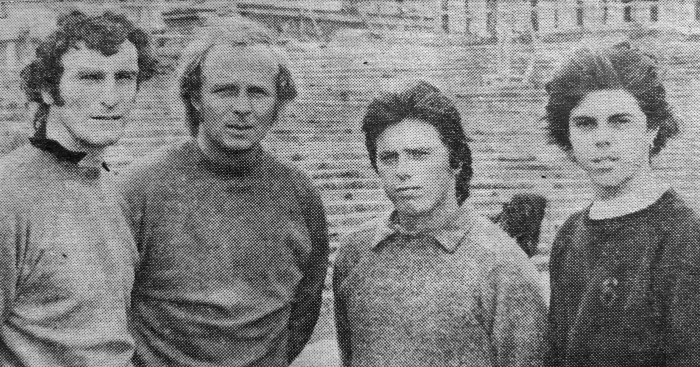
Four new players were presented to the assembled press that pre-season and standing alongside Martin was one Peter Ward.

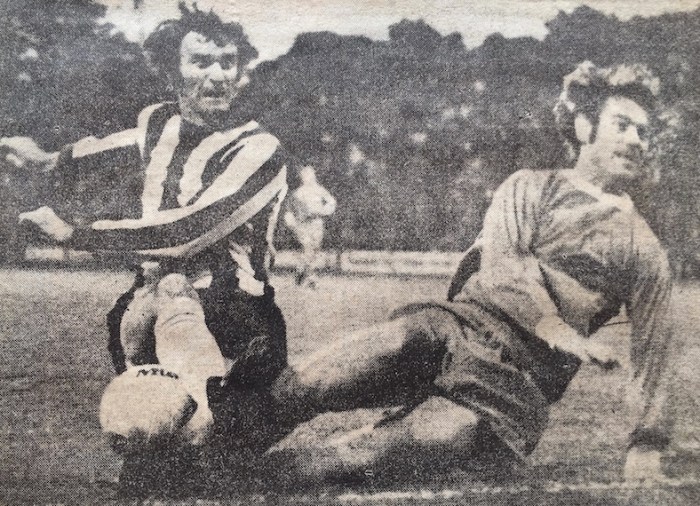
Martin scored on his league debut for Brighton as Rotherham United were dispatched 3-0 but he didn’t stay in the side long because Taylor brought in loan signing Barry Butlin, also from Forest, for five games to play up front alongside Fred Binney and Gerry Fell.

Martin did get a run back in the side during the autumn, when he added to his goals tally. But Taylor obviously felt the attack needed something extra and the £30,000 arrival of Northern Ireland international Sammy Morgan from Aston Villa spelt the beginning of the end of Martin’s short spell at the club.

He scored eight league goals and one in the FA Cup in 18 starts (plus four substitute appearances) but it all ended somewhat acrimoniously.

The Argus reported on February 13 1976 that the 32-year-old former Scotland international had been transfer listed and banned from the Goldstone.

Words had evidently been exchanged after Martin had been subbed off in a reserves game and, try though he did, reporter John Vinicombe couldn’t find out exactly what had gone on.

Taylor was renowned for his tough stance with players. He suspended six players in the September that season and he had fallings out with Ian Mellor, Joe Kinnear and reserve ‘keeper Derek Forster.

Martin didn’t play for the club again, instead being moved on to Crystal Palace where he scored just the once in nine appearances.

At the end of the season, he joined what was a familiar exodus for ageing English league players at the time and played alongside England’s World Cup winning captain Bobby Moore, and ex-Arsenal full back Bob McNab, for San Antonio Thunder in America.

It wasn’t unfamiliar territory for Martin because, in the summer of 1967, he was part of the Sunderland contingent who played in the NASL as Vancouver Royal Canadians. The 16-man squad also included the above-mentioned Forster.

After Martin’s 1976 stint at San Antonio, he didn’t play in England again. His final playing days were in the Republic of Ireland, interestingly being given a lifeline by another former international striker who’d played for Brighton – Barry Bridges.

The former Chelsea, Birmingham, QPR and Millwall striker had a couple of seasons managing Dublin side St Patrick’s Athletic, where Martin joined him.

The Scot had a brief managerial foray with Walsall, mainly in tandem with Alan Buckley, but it didn’t end well and he left the club in 1982.

Born in Tranent, just east of Edinburgh, on 20 October 1940, Martin’s break into the professional game came at Alloa Athletic. His 25 league and cup goals in the 1960-61 season brought about a move to Queen of the South where he continued to score plenty of goals – 33 in 61 appearances.

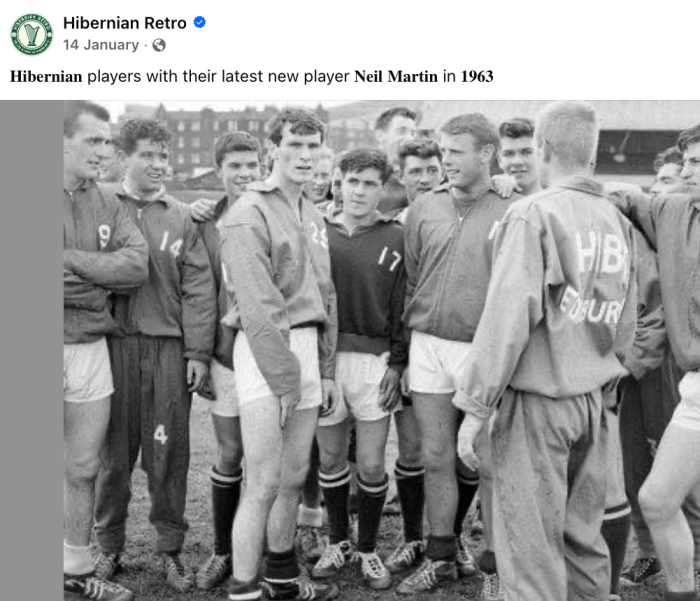
A £7,500 transfer fee took him to Hibernian in 1963. He’d supported them as a boy and after Jock Stein took over as manager in 1964, Martin netted 29 league and cup goals in the 1964-65 season. He said later that Stein was the biggest influence on his career.

It was top-tier Sunderland who paid £45,000 to take Martin south of the border. His goalscoring in his first taste of English football wasn’t quite as prolific as it had been in Scotland, mainly due to the Wearsiders not being able to decide on the best strike partner for the Scot.

Eventually, in 1968, he moved on to Coventry City, newly-promoted to the old First Division. He spent three years at Highfield Road, developing good partnerships with Ernie Hunt and John O’Rourke, with the emerging talents of Willie Carr and Dennis Mortimer providing good service from midfield.

His switch to Nottingham Forest towards the end of the 1970-71 season helped them survive the drop, but they went down the following season and that was the last Martin saw of top-flight football.

1 Martin
3 Martin