Seething Knight dumped O’Callaghan for telling him how to run the Albion

CORK-BORN George O’Callaghan had something of a yo-yo footballing career after bursting onto the professional scene as a talented teenager.

Eyed by Arsenal and Spurs when he was in his formative years at Port Vale (then in the Championship), he turned to drink when ex-Albion captain and manager Brian Horton dropped him from the Vale first team.

Although the tall midfielder worked his way back into contention, he returned home to Ireland to rebuild his career before making several other attempts to succeed in the English game.

Over the course of five years, he was an influential cog in Cork’s League of Ireland side, the highlight coming with a championship win in 2005 when he scored eleven goals from midfield and was voted League Player of the Season.

He survived meningitis in 2006 just a handful of months before another Championship side, Ipswich Town, gave him another opportunity to make it in England but he struggled to hold down a place at Portman Road.

After only 13 appearances, the Tractor Boys were prepared to offload him to third tier Brighton. A deal was agreed in August 2007 but he made the move on loan rather than permanently because he still thought he could make it in Suffolk.

By then 28, the player brought experience and creativity to Dean Wilkins’ largely young side, slotting in effectively in the centre of Albion’s midfield alongside Dean Hammond, making 16 starts and one appearance off the bench.

But his Irish gift of the gab brought it all to a messy end. He publicly criticised chairman Dick Knight’s handling of contract negotiations in an explosive article in The Argus and didn’t play for the Seagulls again.

The Irishman told reporter Andy Naylor he thought the team was in danger of falling apart because chairman Knight had been too slow to sort out contracts and loans.

Knight countered: “We have given him the chance to shine and show his talents. It’s not George O’Callaghan’s business to tell the club what we should be doing.”

The midfielder spoke out after Albion capitulated 3-0 at Millwall on Boxing Day. He told Naylor: “There are a lot of lads who are very important to this team that don’t know if they are coming or going and I think it’s about time the club got a grip on it and sorted it out, because it has dragged on for too long and I feel it is starting to affect the players.

“I just don’t think it is right and it’s something the club needs to look at. It used to happen at Cork City when I was there and we lost a lot of good players. We lost Kevin Doyle and Shane Long for peanuts over contracts not being sorted out early and quickly.

“It makes you angry as a player. I can cope with it, because I am a lot older than the other lads, but the young lads are really upset and it’s not right.”

O’Callaghan’s version of events the club would have wanted to keep to themselves plainly differed from Knight’s while Wilkins was stuck in the middle.

“I know the manager tries his best behind the scenes,” said O’Callaghan. “He is fantastic. I think he works with a very small budget. It must be more frustrating for him, because he has built a team and it could easily fall apart now.

No holding back where O’Callaghan was concerned

“Things should have been sorted out a lot quicker. It has been a big thing in the squad in the last few weeks. I’ve mentioned it and the club need to sort it out now.”

The Irishman said he had encountered something similar at Ipswich the previous season, pointing out players just needed to know where they stood.

“I don’t want to stay and then see our best lads go, like Hammo,” he reasoned. “If we want to make that push for the play-offs and get back into the Championship it needs to be sorted.”

Knight was in no mood to take that sort of broadside from a loan player and told the reporter: “The team’s performance was absolutely woeful. I think certain players should be looking at themselves before trying to deflect criticism elsewhere. I thought it was a disgrace.

“George O’Callaghan is totally out of order. I would suggest he is trying to deflect attention away from his own performance, which was frankly poor, and he wasn’t the only one.

“Young players within the club are dealt with contract wise as and when the time is right.”

Knight maintained that he’d already agreed with Ipswich that both O’Callaghan and fellow Town loanee Matt Richards could extend their loans until the end of the season but neither player wanted to commit to it until they’d explored other options.

Unsurprisingly, O’Callaghan’s stay with the Seagulls came to an abrupt end and he returned to Portman Road.

Sidestepping the spat with Knight, O’Callaghan reckoned his return to Ipswich was his decision, telling The Argus: “I enjoyed playing regularly at Brighton but I spoke with the gaffer and decided it is right to try again at Ipswich and try to get first team action.

“They are a good bunch of lads at Brighton and I enjoyed playing with them so I hope things work out for them.”

When a month later there was no look-in happening with the Tractor Boys, he returned to Ireland once again to play for his old club, Cork City. It was part of a familiar pattern.
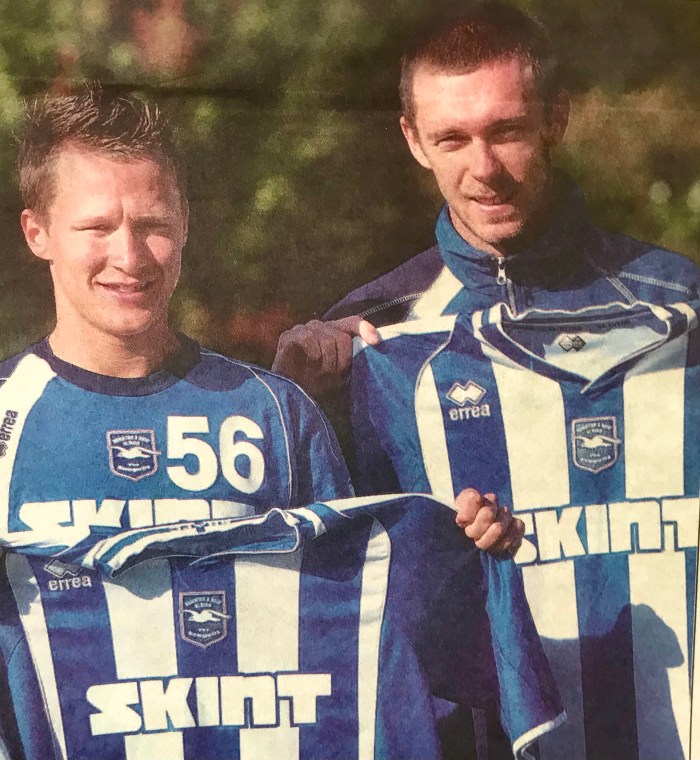
Deadline day signings David Martot and George O’Callaghan

O’Callaghan had joined the Albion on loan (the same day David Martot signed a similar arrangement from Le Havre) on August transfer deadline day having rejected a permanent move earlier that month (the clubs had agreed a £60,000 deal plus £15,000 based on appearances).

The player said at the time: “It would be a shame to leave Ipswich because the supporters have been brilliant to me, even though they never saw enough of me, and all the lads are fantastic, but I need to be playing regular football.”

Town manager Jim Magilton praised O’Callaghan’s ability and attitude and empathised with his frustration at not getting a run in the side. He said: “I don’t want to lose George but I wouldn’t stand in his way. He has been great since he has been here. He is very popular in the dressing room and he has done very well.

Tractor Boy O’Callaghan

“But he is 28 years of age and needs to be playing games. I have been there, so totally understand how frustrating it can be. We will do anything we can to help him.

“I have absolutely no problems with George. He has been top class since he came here. His attitude is first-class in training and in games.”

O’Callaghan had impressed Knight in a reserves match when Ipswich beat the Seagulls’ second string.

When O’Callaghan finally agreed the temporary move, Albion also wanted his Town teammate Richards on loan, but he too prevaricated, only to change his mind the following month. It was the first of three loan spells with the Albion. Brighton also wanted a third Ipswich player, injury-prone Dean Bowditch, who had briefly been on loan the previous season, and he eventually returned for a month in 2008.

Born in Cork on 5 September 1979, O’Callaghan left Ireland as a teenager to pursue his football dream and in a March 2020 podcast with the Irish Examiner, he talked about his early days at Port Vale when he was regarded as one of the hottest properties in football.

“Arsenal came in for me when I was 18,” he said. “I was waiting outside the manager John Rudge’s office and Pat Rice, who was Arsene Wenge’s assistant at the time, came out and said: ‘George, we can’t get you this time, we’ll get you next time,’.”

When the youngster protested to Rudge, he was told Arsenal had only offered £1m for him and Vale wanted £2m. O’Callaghan continued to progress in Vale’s Championship team but when Rudge was replaced by Horton, he was demoted back to the youth team.

In another podcast, A Footballer’s Life, O’Callaghan admitted to Graham Cummins that he turned to drink as his promising career stalled. “You’re responsible for your own actions so it’s ultimately your own fault. But nobody looked out for me or had my back at the club. Nobody caught me and said, ‘George, what’s going on, you’re not yourself’.

“Those days, the clubs didn’t care, it was old school, you were put out to do the job and if you didn’t you were replaced.

“You never asked anyone for help in those days. I kind of went into meltdown. Everything unravelled, I didn’t know what I was doing.”

When he eventually got back in the first team picture, he said Arsenal’s north London rivals Spurs then showed an interest in him. “David Pleat tried to sign me for Tottenham. But Brian Horton said: ‘You’re doing really well,’ and offered me a two-year deal and doubled my money.”

He asked Rudge’s opinion about the situation and when told he should stay at Vale because he’d struggle to get games for Spurs, he stayed put. “I took his advice and signed the contract. Within about 14 months I was finished, sent home.

“It was a massive mistake, a big, big mistake. I was too comfortable in the situation I was in. I probably didn’t have the guts to go ahead with it. I loved playing for Port Vale but I should have pushed for Arsenal and Tottenham. And then you can always go out on loan if it doesn’t work out.”

One of O’Callaghan’s early matches for Albion was against his old club and unsurprisingly he was a natural interviewee before the game. “It is a very special club to me because I started off my career there when I was only 15,” he told The Argus.

The Irishman scored four goals in 22 league starts plus 12 sub appearances for Vale and felt he probably had a point to prove coming up against them (Albion won 1-0 with a goal from Alex Revell).

“I never showed Port Vale fans what I can do,” he said. “I took a few wrong roads when I was a kid and it has taken me a while to get back to where I am now.

“It will be nice to put on a good performance and show them what they have missed; the player I have turned into. I never fulfilled my potential there.

“I started off doing well there as a kid but I didn’t really have the right guidance and it all went pear-shaped. As soon as John Rudge left as manager and Brian Horton came in, my chances were limited. I think that is where it all went wrong.

“Obviously, I wasn’t his type of footballer. People said he was a good footballer, but he wanted physical lads.

“Maybe at the time I wasn’t physical enough and he didn’t fancy me. I don’t blame him in any way because at the end of the day it is all down to yourself and how you look after yourself.”

He added: “I had so many knocks there that it took the fire out of me. I had to go back to Cork to get that fire back into me and build my career again.

“It was a big learning curve in my life. I lost my career in English football for a while and had to battle hard to get back.”

The player’s topsy-turvy career continued back at Cork City before he had another go in England, spending eight months at Tranmere Rovers. Once again he returned to Ireland, this time to play for Dundalk, but the lure of the English game beckoned again.

O’Callaghan linked up with Yeovil Town in the summer of 2009 and played in three pre-season friendlies. In the opening months of the season, he made 15 appearances (including six from the bench) but found it difficult to break into the team past the partnership of Jean-Paul Kalala and Shaun MacDonald.

Next stop, in December that year, was Waterford but before long he was back at Cork City once again. Brentford took him on a two-week trial but nothing came of it and instead he went to then Conference side Cambridge United but didn’t feature.

The wandering Irishman at one point tied his luck with Brunei side Duli Pengiran Muda Mahkota but he got into trouble for failing to bow to the Crown Prince.

His old Brighton and Ipswich teammate Nicky Forster took him on at Dover Athletic but he only played once for the Conference South team, and he announced his retirement on Christmas Eve 2012.

He briefly managed Sabah in the Malaysia Premier League in 2014 but he struggled to deal with El Hadji Diouf and was sacked in January 2015 when he started missing training sessions.

Four years after playing what he thought was his last game, he turned out for junior Cork club Rockmount.

After packing up playing, O’Callaghan became an agent and spent a year as a business development manager for William Hill. He was a general manager for gym chain Anytime Fitness for two years and later co-founded agency TEN Sports Management.

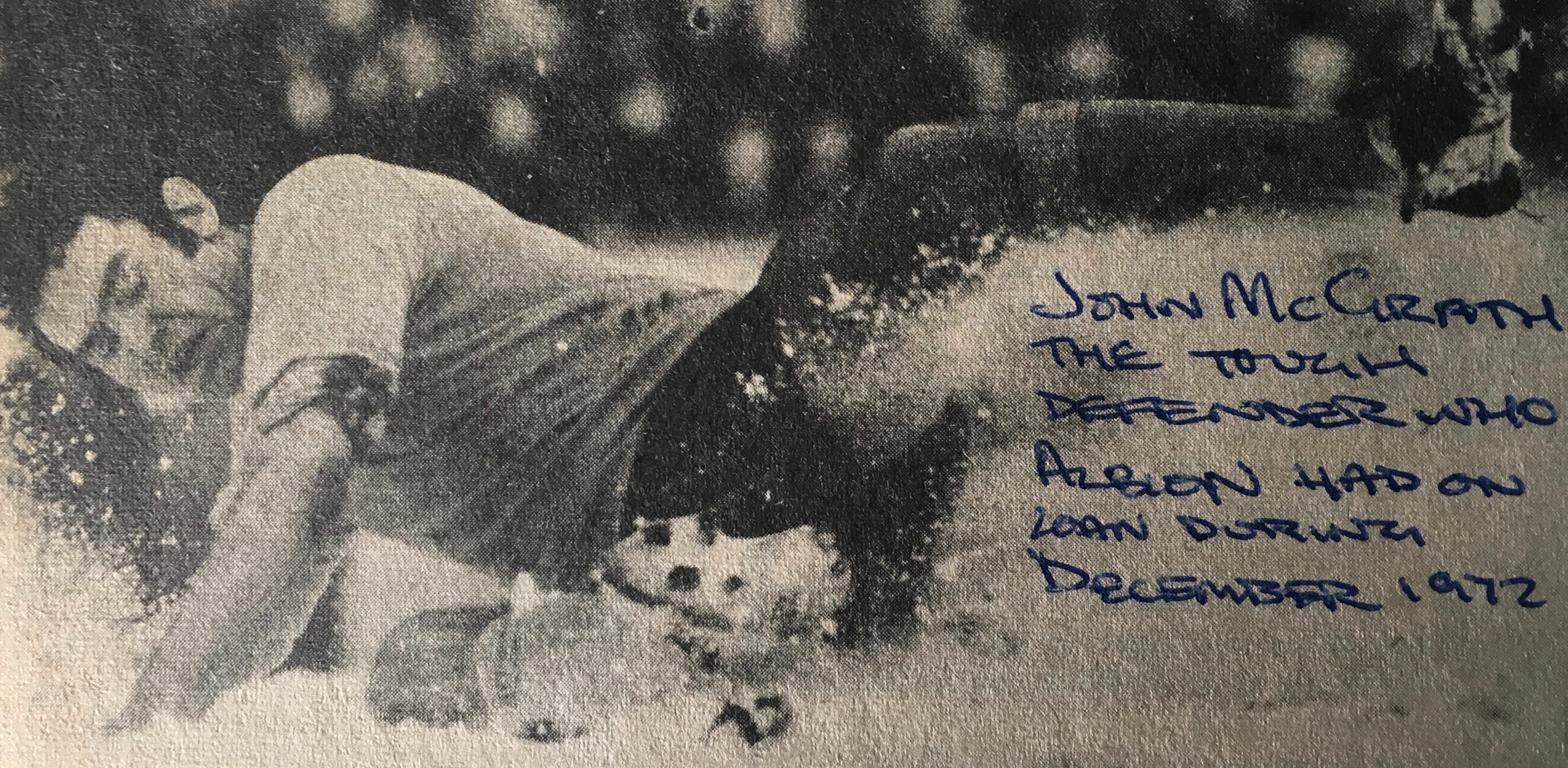
Even fearsome John McGrath couldn’t stop the rot

IN ALBION’S bleak midwinter of 1972-73, manager Pat Saward was desperate to try to reverse a worrying run of defeats.

The handful of additions he’d made to the squad promoted from the old Third Division in May 1972 had not made the sort of improvements in quality he had hoped for.

An injury to Norman Gall’s central defensive partner Ian Goodwin didn’t help matters and Saward chopped and changed the line-up from week to week to try to find the right formula.

Previously frozen out former captain John Napier was restored for a handful of games (before being sold to Bradford City for £10,000). The loan ranger’ (as Saward was dubbed for the number of temporary signings he brought in) then tried Luton Town’s John Moore in Goodwin’s absence.

Youngster Steve Piper was given his debut at home to high-flying Burnley, but Albion lost that 1-0. Then Saward tried left-back George Ley in the middle away to Preston, but that didn’t work either. North End ran out comfortable 4-0 winners with Albion’s rookie ‘keeper Alan Dovey between the sticks after regular no.1 Brian Powney went down with ‘flu.

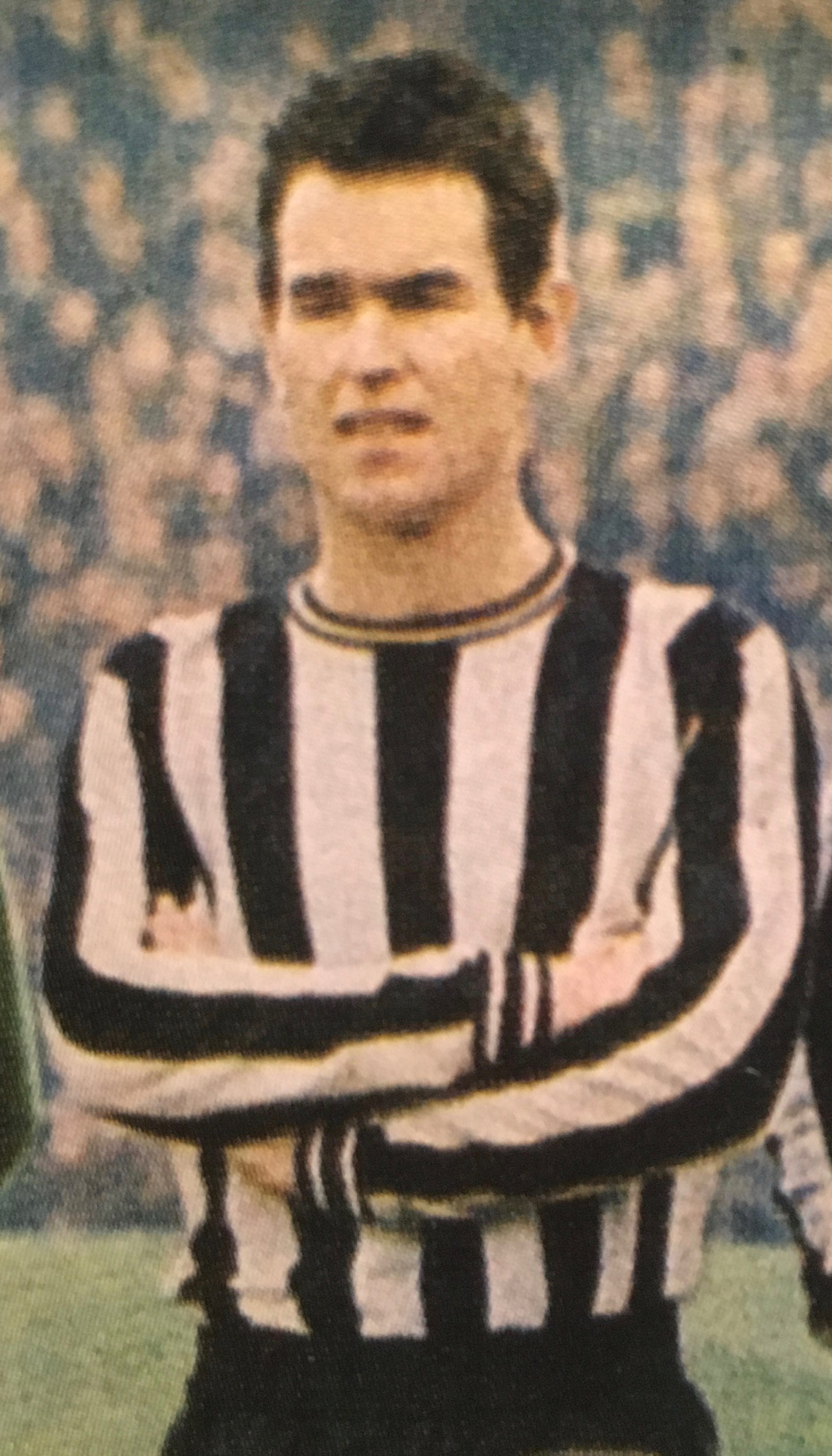
As December loomed, and with Goodwin still a couple of weeks away from full fitness after a cartilage operation, Saward turned to John McGrath, a no-nonsense, rugged centre-half who had played close on 200 games for Southampton over five years.

“With his rolled-up sleeves, shorts hitched high to emphasise implausibly bulging thigh-muscles, an old-fashioned haircut and a body dripping with baby oil, ‘Big Jake’ cut an imposing figure,” to quote the immensely readable saintsplayers.co.uk.

In Ivan Ponting’s obituary in the Independent following McGrath’s death at 60 on Christmas Day 1998, he reckoned his “lurid public persona was something between Desperate Dan and Attila the Hun”.

Although McGrath had begun the 1972-73 season in the Saints side, the emerging Paul Bennett had taken his place, so a temporary switch to the Albion offered a return to first team football.

Albion had conceded eight goals in three straight defeats and hadn’t registered a goal of their own, so, even though the imposing centre-half was approaching the end of a playing career that had begun with Bury in 1955, it was hoped his know-how defending against some of the best strikers in the country might add steel in the heart of the defence, and stem the flow of goals.

In short, it didn’t work. McGrath played in three matches and all three ended in defeats, with another eight goals conceded.

In his first match (above left), Middlesbrough won 2-0 at the Goldstone. At least the deficit was slimmer in his second game: a 1-0 loss away to George Petchey’s Orient in which Lewes-born midfielder Stan Brown played the last of nine games on loan from Fulham.

McGrath’s third match saw Albion succumb to a thrashing at Carlisle United. By then, Brighton had lost five in a row and still hadn’t managed to score a single goal. Stalwart Norman Gall was dropped to substitute to allow the returning Goodwin to line up alongside McGrath, and Bert Murray led the side out resplendent in the second strip of red and black striped shirts and black shorts.

Carlisle hadn’t read the script, though, and promptly went 5-0 up. To compound Albion’s agony, with 20 minutes still to play, goalkeeper Powney was carried off concussed and with a broken nose.

In those days before substitute goalkeepers, Murray (who’d swapped to right-back that day with Graham Howell moving into his midfield berth) took over the gloves. Miraculously, Albion won a penalty and because usual spot kick taker Murray was between the sticks, utility man Eddie Spearritt took responsibility having relinquished the job after a crucial miss in a game in 1970.

Thankfully, he buried it, finally to make a much-awaited addition to that season’s ‘goals for’ column.

No more was seen of McGrath, however. Gall was restored to the no.5 shirt and was variously partnered by Goodwin, Piper and, towards the end of the season, Spearritt.

After another heavy defeat, 4-0 at Sunderland, which had seen another rare appearance by Dovey in goal, he was transfer-listed along with Gall and Bertie Lutton, as Saward pointed the finger. Lutton got a surprise move to West Ham but Gall stayed put and Dovey was released at the end of the season without playing another game.

The run of defeats eventually extended to a total of 13 and was only alleviated after a big shake-up for the home game versus Luton Town on 10 February.

Powney, who’d conceded five at Fulham in the previous game, was replaced by Aston Villa goalkeeper Tommy Hughes on loan; out went experienced striker Barry Bridges in favour of rookie Pat Hilton and exciting teenage winger Tony Towner made his debut. Albion won 2-0 with both goals from Ken Beamish, and the monkey was finally off their backs.

Although the following two games (away to Bristol City and Hull) were lost, results did pick up, but it was all too little too late and Albion exited the division only 12 months after their promotion.

Born in Manchester on 23 August 1938, McGrath sought unsuccessfully to get into the game as an amateur with Bolton Wanderers but at 17 he joined Bury who were in the old Division Two at the time.

Although they were subsequently relegated, McGrath was part of the 1961 side that went on to win the Third Division Championship. By the time they lifted the trophy, though, he had moved on to Newcastle United for a fee of £24,000, with Bob Stokoe (later renowned for steering Second Division Sunderland to a famous FA Cup win over Leeds United in 1973) a makeweight in the transfer.

It was a busy time for the young defender. On 15 March 1961, he made his one and only England Under-23 appearance against West Germany at White Hart Lane, Tottenham, playing alongside future World Cup winners George Cohen at right-back and the imperious Bobby Moore.

Also in the young England side for that 4-1 win was Terry Paine, who would later become a teammate at Southampton.

Newcastle had hoped the defender would prevent their relegation from the top flight, but it didn’t happen as they went down having conceded 109 goals; their worst ever goals against tally.

Joe Harvey eventually succeeded Charlie Mitten as manager as Newcastle adapted to life back in the Second Division, and McGrath (below left and, in team picture, back row, far left) played 16 matches in a side in which full-back George Dalton (below, back row, far right) had started to emerge.

Future Brighton captain Dave Turner was one of the successful FA Youth Cup-winning side Harvey inherited, but his first team outings were rare and he was sold to the Albion in December 1963.

Meanwhile, McGrath really established himself, featuring in 41 games in 1963-64 (Dalton played in 40) as Newcastle finished in a respectable eighth place.

The 1964-65 season saw McGrath ever-present as Toon were promoted back to the First Division, pipping Northampton Town to the Second Division championship title by one point. McGrath – “a monster of a centre-half, who was as tough as he was effective” was “the cornerstone” of the promotion side, according to newcastleunited-mad.co.uk.

McGrath retained his place in Toon’s first season back amongst the elite but the arrival of John McNamee and the emergence of Bobby Moncur started to restrict his involvement.

That pairing became Harvey’s first choice, and young Graham Winstanley was in reserve too, so, after playing only 11 games in the first half of the 1967-68 season, McGrath, by then 29, was sold to Southampton for £30,000. He’d played 181 games for United.

In Ted Bates’ Saints side, McGrath was a rock at the back alongside Jimmy Gabriel, although, as saintsplayers.co.uk records, he wasn’t too popular with opposing managers: Liverpool’s Bill Shankly accusing Southampton of playing “alehouse football”.

He went on to make 194 appearances (plus one as a sub) for Saints, before becoming youth coach at the club, part of the first team coaching staff when Southampton won the FA Cup in 1976, and then reserve team manager.

Not content with a backroom role, McGrath took the plunge into management and made his mark with two clubs in particular: managing Port Vale on 203 occasions and Preston North End in 205 matches.

According to Rob Fielding he became a cult hero at Vale Park with his unorthodox ways, once putting FIFTEEN players on the transfer list…which resulted in a six-match unbeaten run!

Winger Mark Chamberlain, who went on to play for Stoke and England, and later Brighton, was one of the young players McGrath introduced.

Long-serving Vale defender Phil Sproson, who was originally signed by former Albion midfielder Bobby Smith, rose to prominence under McGrath and said: “I’ll always be grateful because he taught me how to play centre-half.”

Fielding reckoned McGrath’s finest hour was steering Vale to promotion from the old Fourth Division in 1982-1983, even though by then he had sold Chamberlain to Stoke.

Against a backdrop of player unrest and what were perceived to be ill-judged moves in the transfer market, McGrath was sacked in December 1983 and replaced by his assistant, John Rudge.

He wasn’t out of work for long, though, and took the reins at basement side Chester City where he was in charge for just under a year. Most notably in that time, he gave future Arsenal and England defender Lee Dixon his first taste of regular football.

While success eluded him at Chester, his arrival at Preston in 1986 proved fruitful, North End striker Gary Brazil recalling: “It needed a catalyst and it needed a change and very fortunately for the club and for the players, John McGrath came walking through the door who was like a Tasmanian devil. He came in and the world changed really, really quickly for the better.”

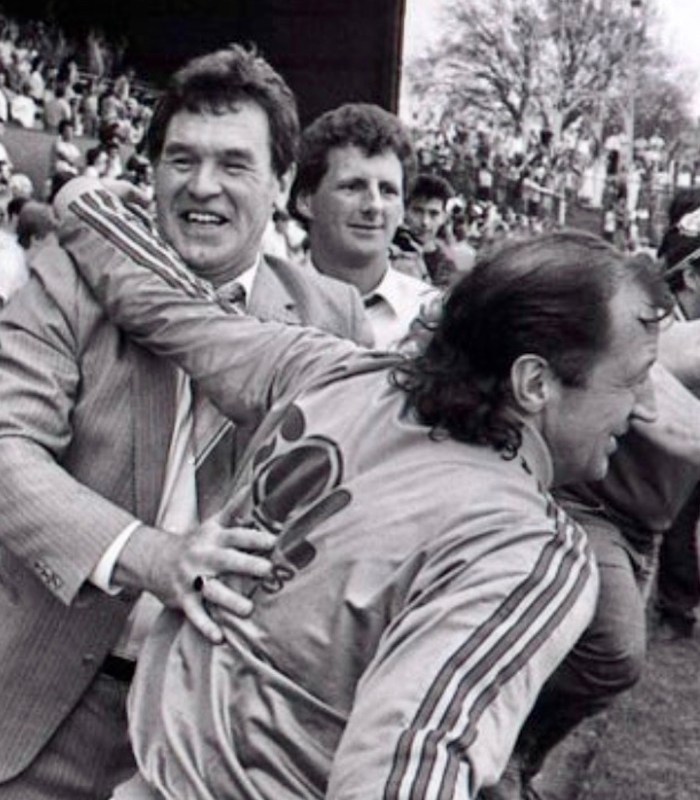
McGrath led Preston to promotion from the bottom tier in 1987 with a squad built around Sam Allardyce and veteran Frank Worthington.

Manager McGrath and Frank Worthington celebrate promotion

“Frank Worthington was a delight to have around and set a real high standard for a lot of us in terms of how we train,” said Brazil. “He just stunned me how he was always first out training.”

The turnround McGrath oversaw, with Deepdale crowds rising from below 3,000 to more than 16,000, rejuvenated the club and the city.

Brazil reminisced: “It was the best year of my football life that year that we got promoted. It wasn’t just an experience playing but an experience of a group of players and how well they could bond and John was integral to that. He was a very, very clever man.”

Indeed McGrath was viewed as having saved North End from the ignominy of losing their league status, the club having had to apply for re-election the season before he arrived at Deepdale.

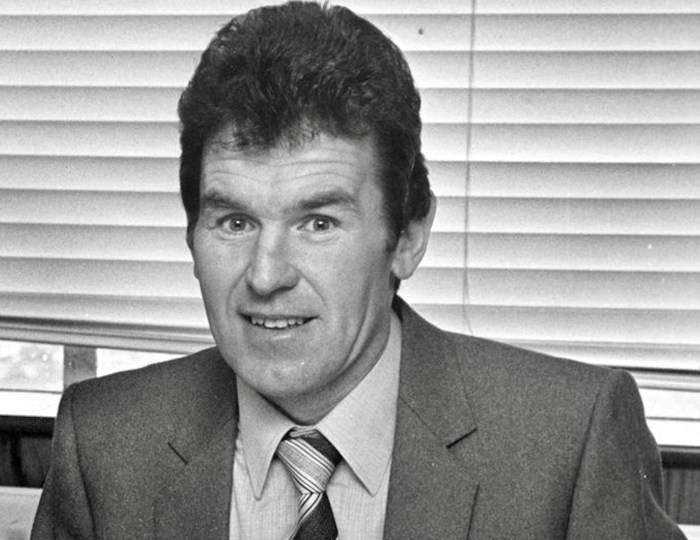
Edward Skingsley’s book, Back From The Brink, features a black and white photograph of McGrath on its cover and tells the story of North End’s transformation under his direction.

Describing his appointment as “a masterstroke” he reckoned the club owed him a massive debt for masterminding their resurgence and subsequent stability.

“Without him, it is debatable whether Preston North End would even exist today, never mind play in the latest fantastic incarnation of Deepdale,” said Skingsley. “Thank goodness he caught Preston North End before it died.”

McGrath left Preston in February 1990 and had one last stab at management, this time with Halifax Town. He succeeded Saints’ FA Cup winner Jim McCalliog and was in charge at The Shay for 14 months but left in December 1992. Five months later they lost their league status, finishing bottom of pile.

The silver-tongued McGrath was subsequently a popular choice on the after-dinner speaking circuit and a pundit on local radio in Lancashire but died suddenly on Christmas Day 1998.

When football didn’t deliver the right break for Colin Dobson

THE architect of Brighton’s humiliating 8-2 home defeat to Bristol Rovers in 1973 was none other than a player who might have been wearing Albion’s stripes if injury hadn’t struck.

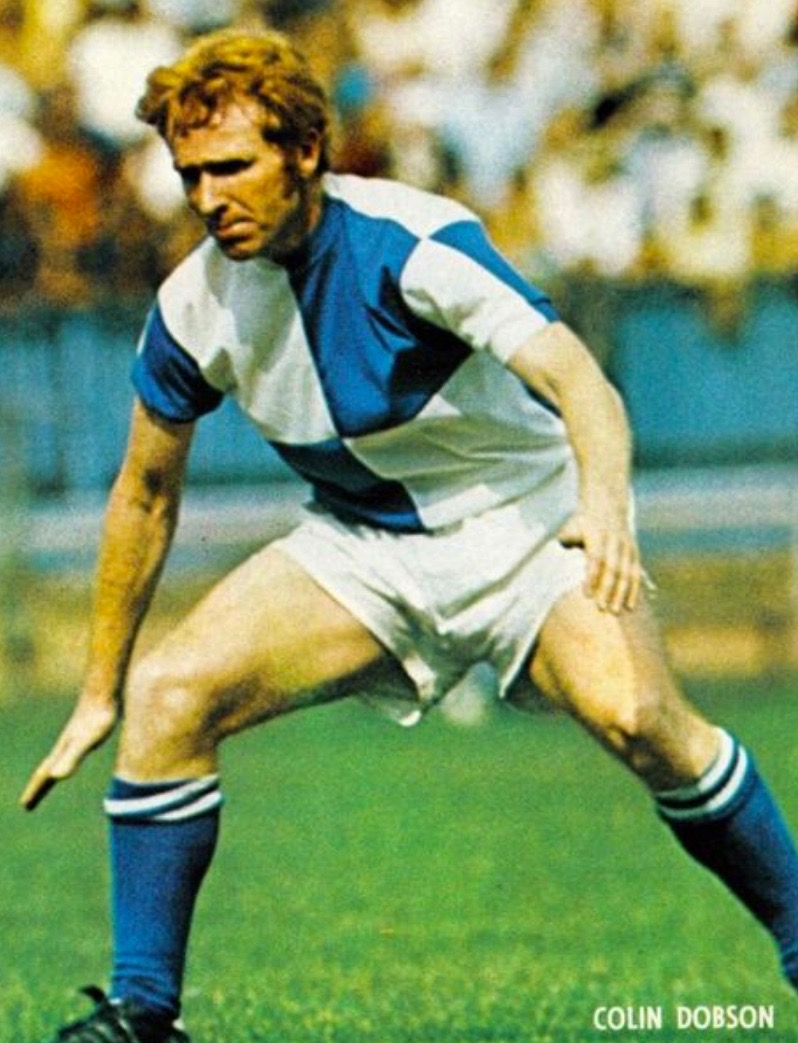
Goalscoring winger Colin Dobson turned goal provider the day Rovers were rampant at the Goldstone Ground. Twenty-one months earlier he’d left the same pitch on a stretcher, not certain that he’d ever be able to play again.

Dobson had joined Brighton on loan in January 1972, making his debut in a mid-season friendly against his parent club, Huddersfield Town, on 18 January.

Ironically, his first meaningful Albion action came against Rovers when he was a substitute in a 2-2 draw at Eastville on 22 January.

Dobson was also on the bench for the home 1-0 win over Swansea City the following Saturday. He was elevated to the starting line-up away to Wrexham on 5 February, when goals from Willie Irvine and Peter O’Sullivan sealed a vital 2-1 win.

It was during his full home debut against Walsall on 12 February that his short-lived Albion career came to a sudden halt. Albion lost 2-1 and Dobson suffered an ankle fracture.

It had been expected that Albion would sign him permanently, and he told the Evening Argus that he had been offered a good deal to do so, but the injury put paid to the transfer being completed.

With Pat Saward’s side heading towards promotion with Aston Villa, the Irish manager instead went back to Wolverhampton Wanderers to sign Bertie Lutton, who had been on loan earlier in the season.

Lutton duly played his part as the Seagulls acquired the necessary points to earn promotion, while Dobson nursed an injury which at the time threatened to end his playing days.

His six-year Huddersfield career at an end, in the summer of 1972 he accepted a role as player-coach at Bristol Rovers, working under his former Sheffield Wednesday teammate, Don Megson.

Dobson Rovers

Thus it was that he was part of a Rovers side who had gone 18 matches unbeaten when they showed up at the Goldstone on a cold winter’s day on the first day of December 1973 to tackle Brian Clough’s Albion in front of The Big Match television cameras.

The game was only five minutes old when Dobson played in Alan Warboys who beat Norman Gall before passing to his strike partner Bruce Bannister to open the scoring.

Seven minutes later, Dobson took Warboys’ pass and laid on a pinpoint centre for Gordon Fearnley to score with a header. The game was still six minutes short of half-time when another Dobson centre was met by Warboys to make the score 5-1 to the visitors.

John Vinicombe, Albion reporter for the Argus, declared in his summary: “To Colin Dobson, freed by Albion when a broken ankle looked like ending his career, the accolade for a thinking player.

“He masterminded the operation in unbelievably generous space. Bruce Bannister knifed through for the early, killing goals, and Alan Warboys, superbly balanced and fast on the slightly frozen pitch, looked the perfect striker, taking his four goals so cleanly.”

An incandescent Clough told the media: “I was ashamed for the town and the club that 11 players could play like that. I feel sick. We were pathetic. This side hasn’t got enough heart to fill a thimble.”

Rovers went on to win promotion to the second tier that season and Dobson eventually completed 63 league and cup games for them before retiring at the end of the 1975-76 season.

Born on 9 May 1940 in Eston, North Yorkshire, Dobson joined Sheffield Wednesday at 15, and made a name for himself with the Owls in the days when they played in the top tier of English football.

He earned a reputation as a goalscoring winger after making his debut in 1961 and scored 52 goals in 193 games over the next five years.

He was twice capped by England Under 23s: on 29 May 1963, he came on as a substitute for Alan Suddick as England beat Yugoslavia 4-2 in Belgrade. Alan Hinton scored a hat-trick for England and the other goal was a penalty by Graham Cross, then with Leicester but later a Brighton player. Future England World Cup winner George Cohen was the side’s right-back.

Four days later, with Ernie Hunt leading the line, Dobson started for England when they lost 1-0 to Romania in Bucharest.

In 1966, Dobson made the switch to second division Huddersfield for a £21,000 fee and he was Town’s top scorer in the 1967-68 season (with 14 goals) and 1968-69 (with 11).

Although full international honours eluded him, in the summer of 1968, he was selected for the Football Association Commonwealth tour of the USA, New Zealand, Malaysia and Hong Kong.

He was also part of the side Ian Greaves led to the 1969-70 Second Division title, but he only made a handful of top-flight appearances, and his last Huddersfield appearance was against Stoke City in an FA Cup fourth-round replay in January 1971.

Once his playing days were over, Dobson worked for a whole host of clubs in a coaching or scouting capacity, including Port Vale, Coventry City, Aston Villa, clubs in the Middle-East (Bahraini side West Riffa; Al Rayyan in Qatar; Kuwaiti side Al Arabi, and Oman’s Under-17s), Portugal’s Sporting Lisbon, Gillingham, Watford and Stoke, where he renewed his acquaintance with John Rudge, who he had known at Huddersfield and Bristol Rovers, who was director of football for the Potters.

It was during his time with Stoke that he discovered the future Manchester United and England goalkeeper Ben Foster, a chef playing part-time non-league football at the time.

Foster later told the Birmingham Mail: “There was a scout called Colin Dobson who worked for Stoke but was living in Warwick.

“One night he saw some floodlights, stopped off and had a watch of the game and I caught the eye. That was it. He made a note of it and came to watch me a few more times.

“I owe it all to him. Top man. Whether I’d still be working as a chef if he hadn’t spotted me, I don’t know.”

Dobson died in Middlesbrough aged 82 on 16 February 2023.

  • Pictures from my scrapbook. Originally sourced from the Evening Argus, Shoot! and Goal magazines.