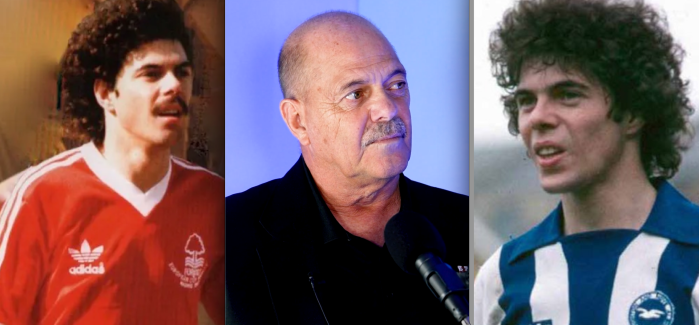
Crunching tackler ‘Tank’ Clark: a legend at two seaside clubs

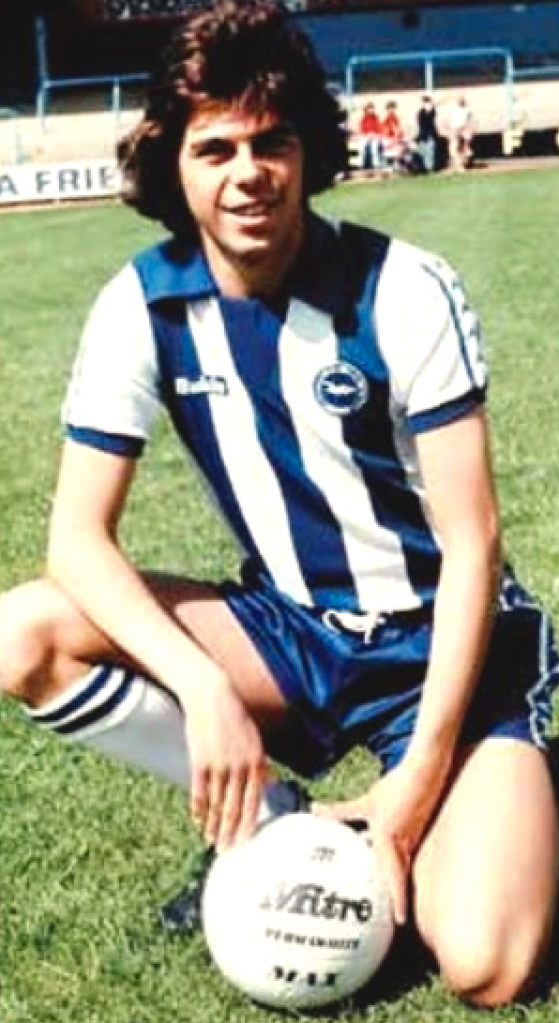
VIKING lookalike Paul Clark made a lasting impression on plenty of players with robust tackling which earned him ‘legend’ status among fans of Brighton and Southend United.

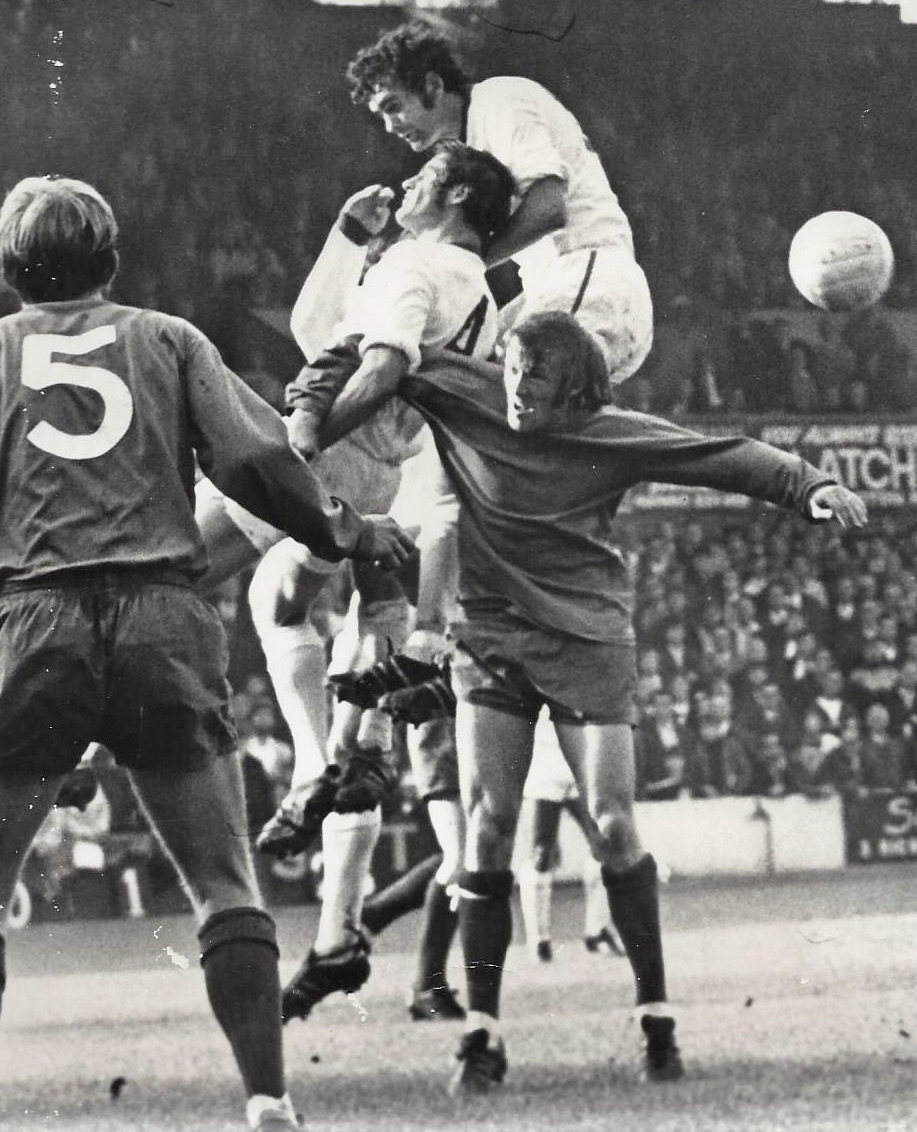
Described in one programme article as “the big bustling blond with the biting tackle”, Clark was given the nickname ‘Tank’ for his no-nonsense approach. A Southend fan lauded “his crunching tackles and never say die attitude”.

Clark himself reflected: “Wherever you go the supporters tend to like someone who is wholehearted and when it came to 50-50 challenges, or even sometimes 60-40, I didn’t shy away from too many, and the supporters just took to it.”

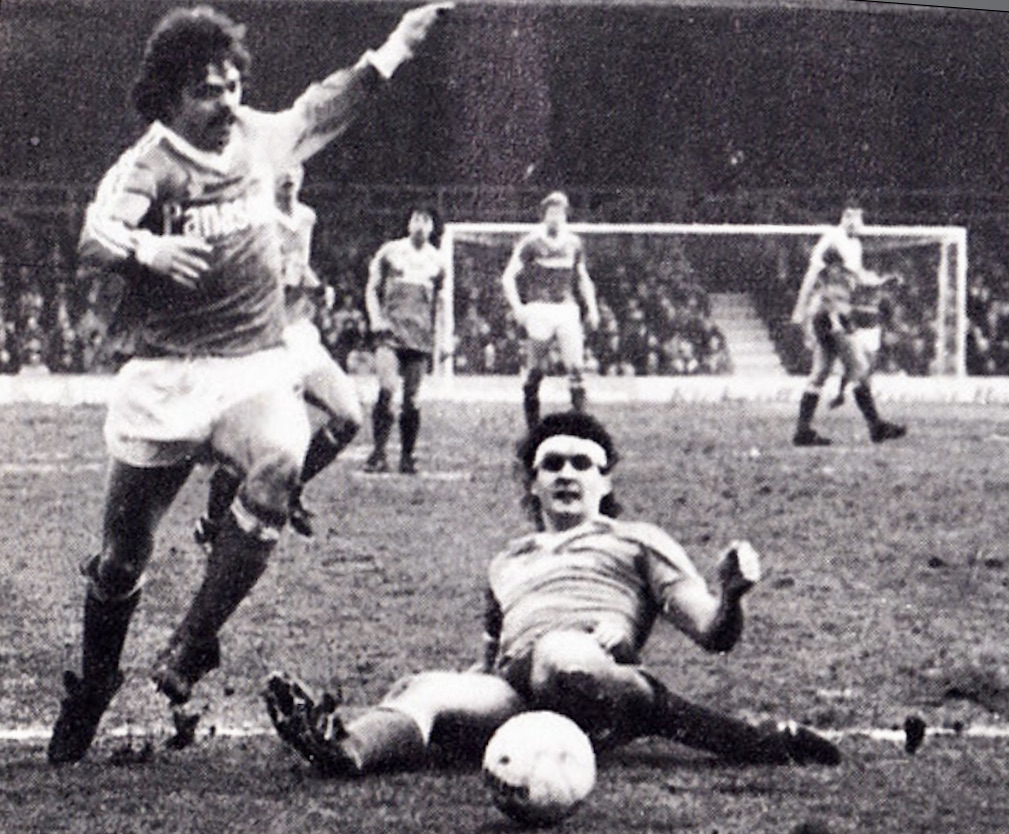
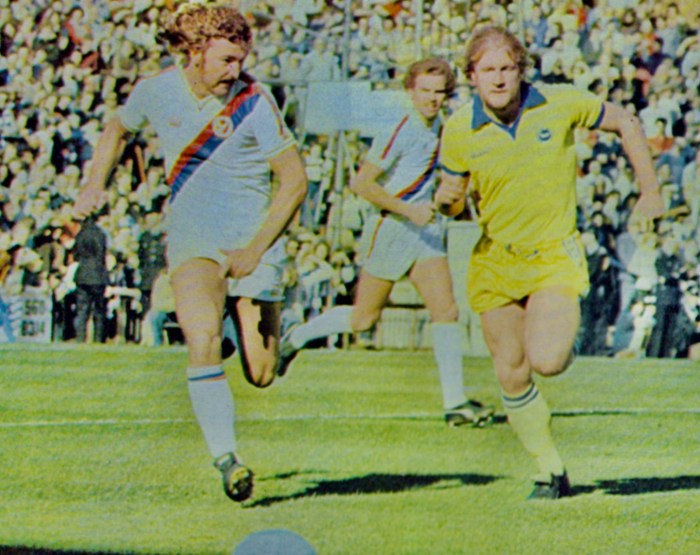
In Albion yellow against Palace

Giving further insight to his approach, he said: “You can go right up to the line – as long as you don’t step over it, then you’re OK.

“I used to pick up a booking during the first five or 10 minutes, then I knew I had to behave myself for the rest of the game. Despite the reputation I had, I was never sent off in over 500 games.”

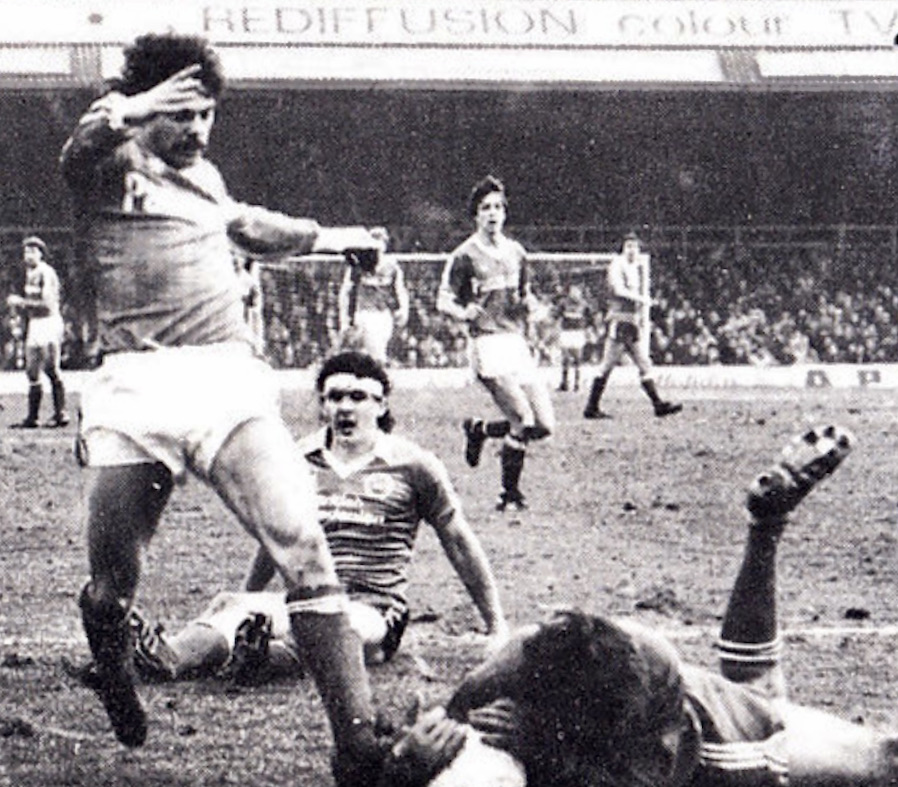
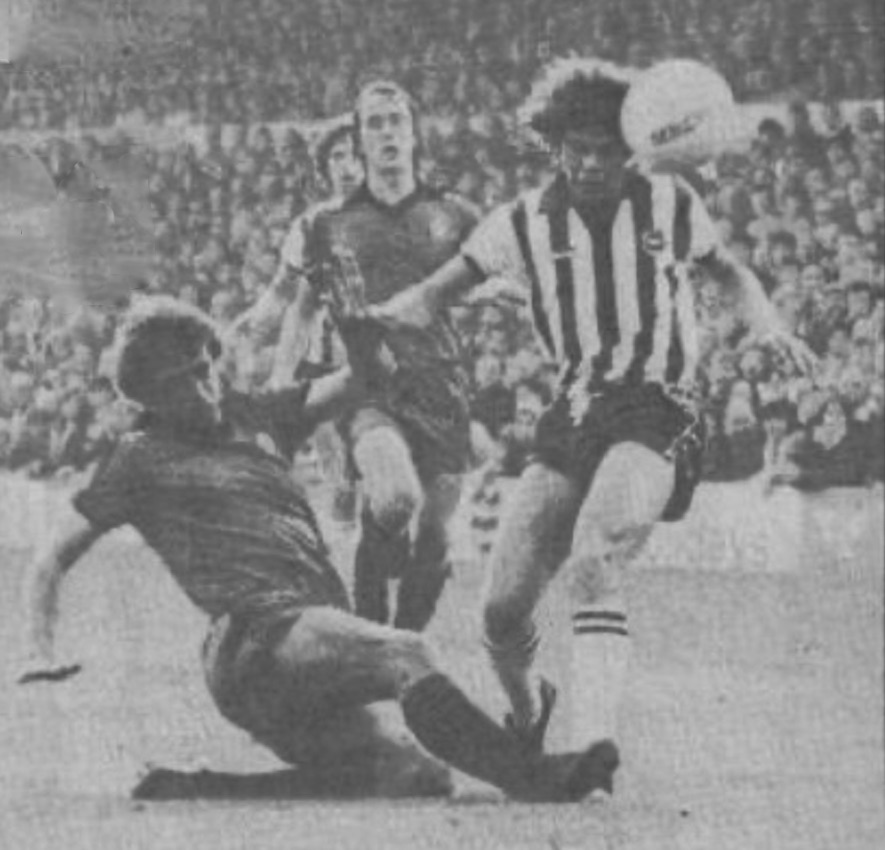
A trademark strike at home to West Ham

Former teammate Mark Lawrenson said of him: “You would hate to have to play against him because quite often he would cut you in two. With him and ‘Nobby’ (Brian Horton) in the side, we definitely didn’t take any prisoners. One to rely on.”

A former England schoolboy international, it was said of the player in a matchday programme:

“Paul is the first to admit that skill is not his prime asset but there is no doubt as to the strength of his tackle. He is a real competitor and is also deceptively fast, being one of the best sprinters on the Goldstone staff.”

Born in south Benfleet, Essex, on 14 September 1958, Clark went to Wickford Junior School where he played for the school football team and the district primary schools’ side. When he moved on to Beauchamp Comprehensive, selection for his school team led to him playing for the Basildon Schools’ FA XI.

Clark as an England schoolboy

This in turn led to him being selected to play for England Schools at under 15 level, featuring against Scotland, Ireland, Wales, West Germany and France before going on a tour of Australia with the same age group. Contemporaries included future full time professionals Mark Higgins, Ray Deakin, Kevin Mabbutt and Kenny Sansom.

Clark left school at 16 before taking his O levels when Fourth Division Southend offered him an apprenticeship. He made his first team debut shortly before his 18th birthday in a 2-1 win over Watford.

Two months later, he won the first of six England Youth caps. He made his debut in the November 1976 mini ‘World Cup’ tournament in Monaco against Spain and West Germany alongside future full England internationals Chris Woods, Ricky Hill and Sammy Lee.

The following March, he played in England’s UEFA Youth tournament preliminary match against Wales when they won 1-0 at The Hawthorns. Sansom was also in that side. And he featured in all three group matches at the tournament that May (England beat Belgium 1-0, drew 0-0 with Iceland and 1-1 with Greece). Teammates included Russell Osman and Vince Hilaire.

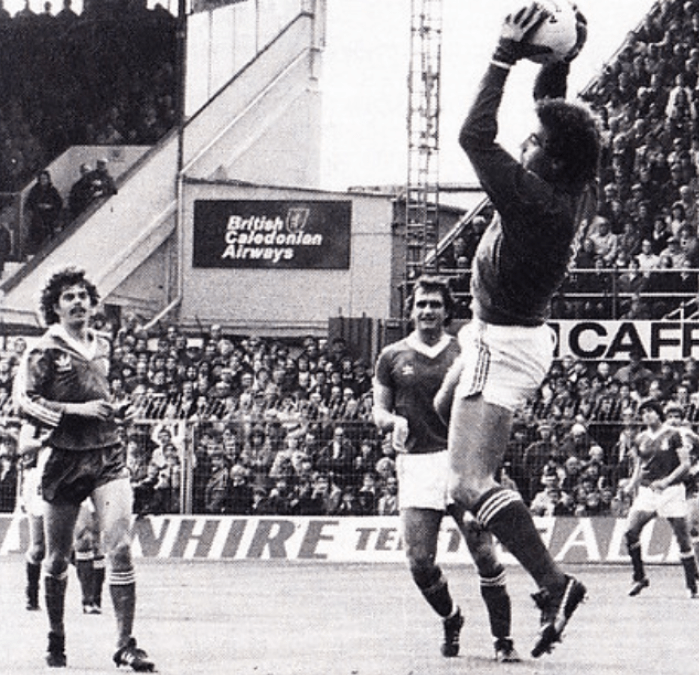
Clark was only a third of the way into his second season at Southend when Alan Mullery sought to beef up his newly-promoted Brighton side in the autumn of 1977, and, in a part exchange deal involving Gerry Fell moving to Roots Hall, Clark arrived at the Goldstone. He made his debut for the Seagulls in a goalless draw at White Hart Lane on 19 November 1977 in front of a crowd of 48,613. And he came close to crowning it with a goal but for an outstanding save by Spurs ‘keeper Barry Daines.

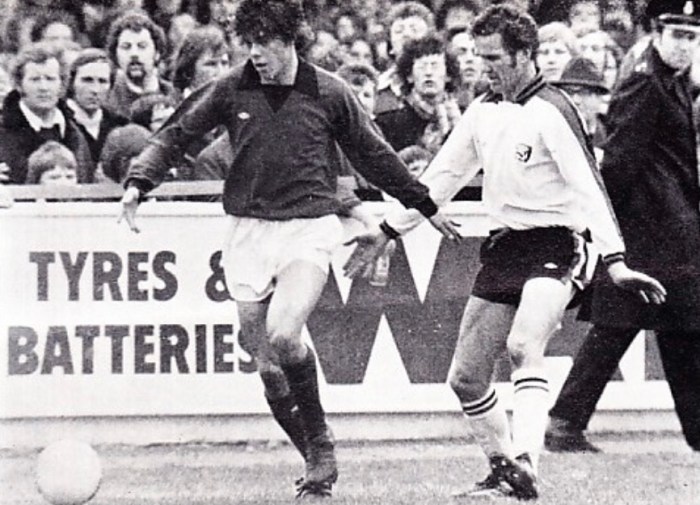
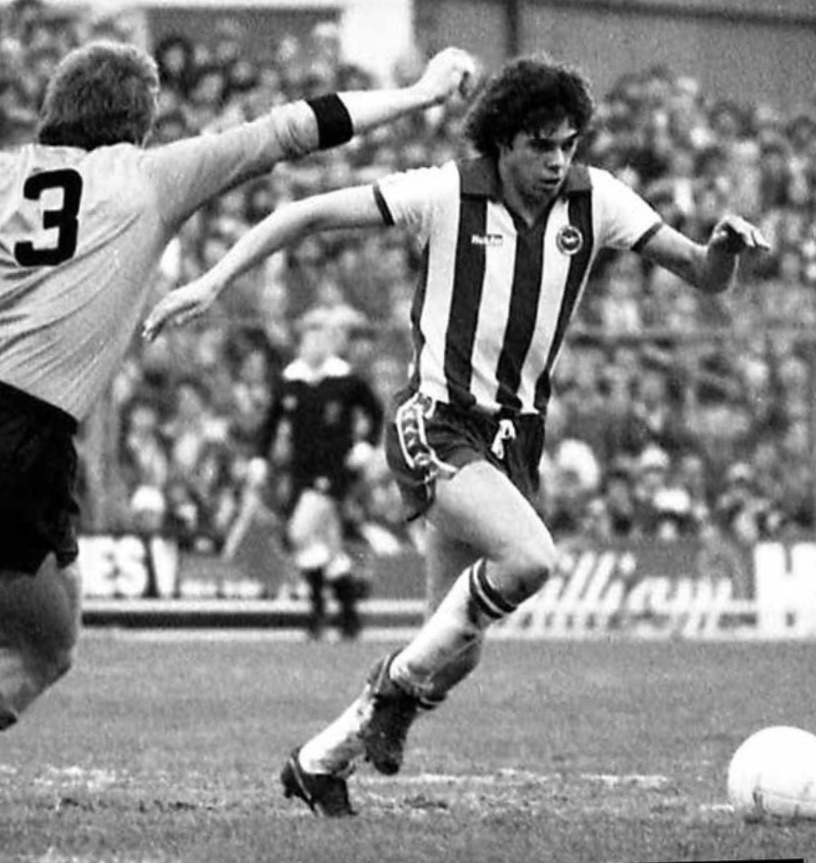
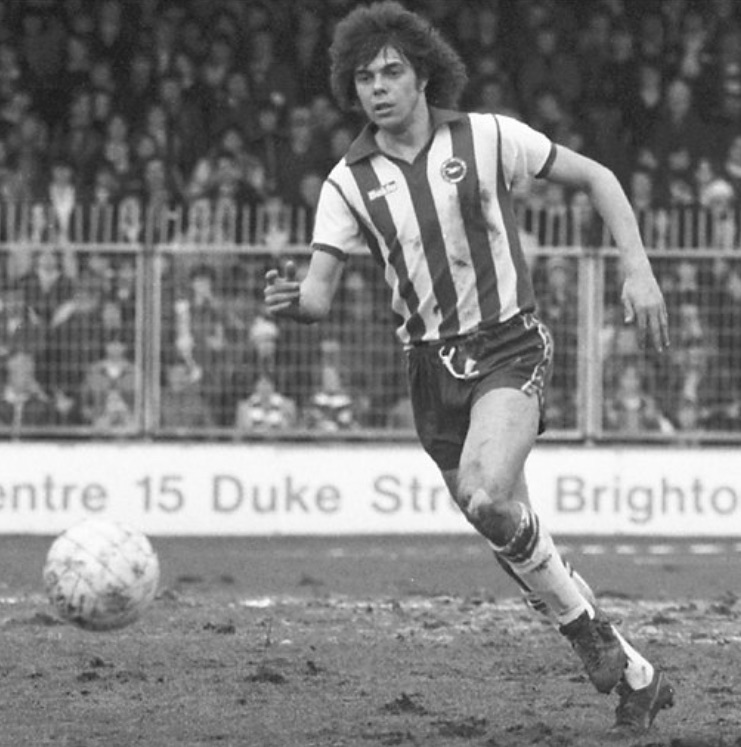
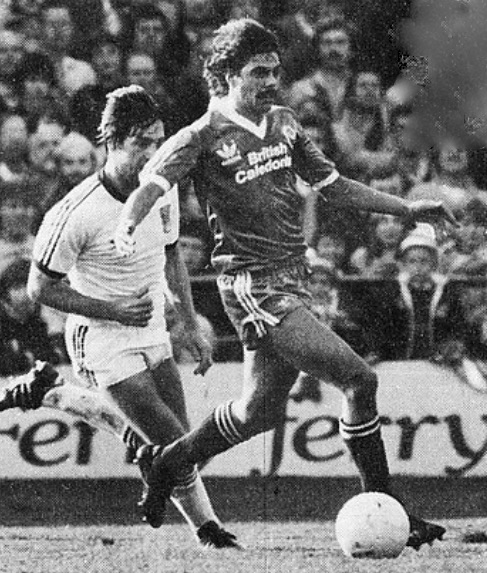
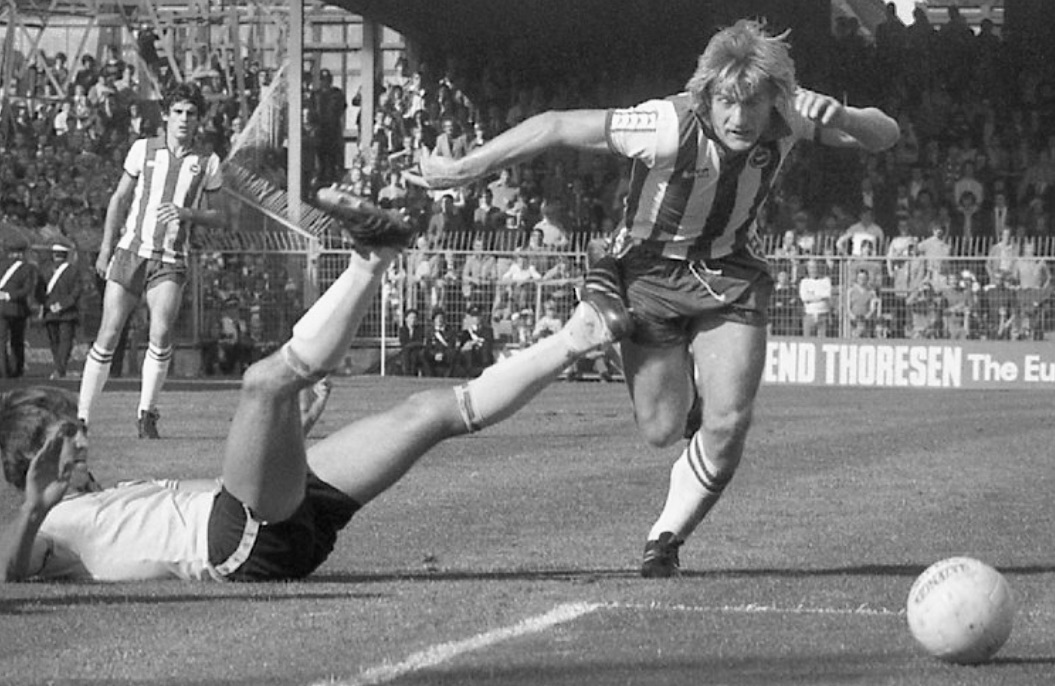
In full flight, as captured by photographer George Erringshaw

When Spurs visited the Goldstone later that season, Clark put in a man of the match performance and scored a memorable opener, following a solo run. A subsequent matchday programme article was suitably poetic about it.

“It showed all the qualities looked for in a player: determination, speed, skill and most of all the ability to finish….if any goal was singled out, Paul’s was certainly one to treasure.”

Albion went on to beat Spurs 3-1, although the game was remembered more because it was interrupted twice when the crowd spilled onto the pitch.

After only 12 minutes, referee Alan Turvey took the players off for 13 minutes while the pitch was cleared of Albion fans who’d sought safety on the pitch from fighting Spurs’ hooligan fans.

In the 74th minute, with Spurs 3-1 down and defender Don McAllister sent-off, their fans rushed the pitch to try to get the game abandoned. But police stopped the invasion getting out of hand and the game continued after another four-minute delay.

Clark’s goal on 16 minutes had been cancelled out six minutes later when Chris Jones seized on a bad goal kick by Eric Steele but defender Graham Winstanley made it 2-1 just before half-time.

Albion’s third goal was surrounded in controversy. Sub Eric Potts claimed the final touch but Spurs argued bitterly that Malcolm Poskett was offside.

Clark remembered the game vividly when interviewed many years later by Spencer Vignes for the matchday programme. The tenacious midfielder put in an early crunching tackle on Glenn Hoddle and after the game the watching ex-Spurs’ manager Bill Nicholson told him: “Well done. You won that game in the first five minutes when you nailed Hoddle.”

Said Clark: “I was 19 at the time so to get a pat on the back from him was much appreciated.”

It was one of three goals Clark scored in his 26 appearances that season (nine in 93 overall for Albion) but he wasn’t always guaranteed a starting berth and in five years at the club had a number of long spells stuck in the reserves.

Midfield enforcer or emergency defender were his primary roles but Clark was capable of unleashing unstoppable shots from distance and among those nine goals he scored were some memorable strikes.

For instance, as Albion closed in on promotion in the spring of 1979, at home to Charlton Athletic, Clark opened the scoring with a scorching 25-yard left foot volley in the 11th minute. Albion went on to win 2-0.

The following month, Clark demonstrated his versatility at St James’ Park on 3 May 1979 when Albion beat Newcastle 3-1 to win promotion to football’s elite level for the first time. Clark played in the back four alongside Andy Rollings because Mark Lawrenson was out injured with a broken arm.

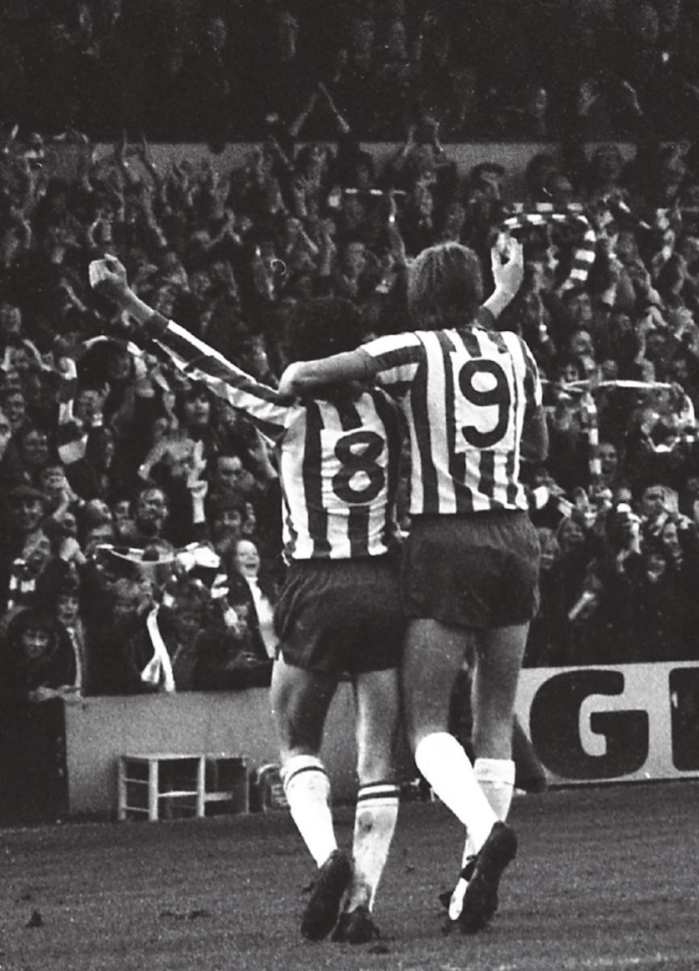
Celebrating promotion with Peter O’Sullivan and Malcolm Poskett

“Not many people can say they played in a side that got Brighton up to the top flight,” said Clark. “It’s something I’m still immensely proud of.”

Once they were there, Clark missed the opening two matches (defeats at home to Arsenal and away to Aston Villa) and had an ignominious start to life at the higher level when he conceded a penalty within three minutes of going on as a sub for Rollings away to Manchester City on 25 August 1979.

Some observers thought Clark had played the ball rather than foul Ray Ranson but referee Pat Partridge thought otherwise and Michael Robinson stepped up to score his first goal for City from the resultant penalty. It put the home side 3-1 up: Teddy Maybank had equalised Paul Power’s opener but Mike Channon added a second before half-time.

Partridge subsequently evened up the penalty awards but Brian Horton blazed his spot kick wide of the post with Joe Corrigan not needing to make a save. Peter Ward did net a second for the Seagulls but they left Maine Road pointless.

Ahead of Albion’s fourth attempt to get league points on the board, Clark played his part in beating his future employer Cambridge United 2-0 in a second round League Cup match.

Three days later, he was on the scoresheet together with Ward and Horton as Albion celebrated their first win at the higher level, beating Bolton Wanderers 3-1 at the Goldstone.

It was Clark’s neat one-two with Ward that produced the opening goal and on 22 minutes, Maybank teed the ball up for Clark, who “belting in from the edge of the box, gave it everything and his shot kept low and sped very fast past (‘Jim’) McDonagh’s right hand,” said Evening Argus reporter John Vinicombe.

Gerry Ryan replaced Clark late in the game and after 12 starts, when he was subbed off three times, and four appearances off the bench, his season was over, and it wasn’t even Christmas.

A colour photo of a typical Clark tackle (on QPR’s Dave Clement) adorned the front cover of that season’s matchday programmes throughout but he didn’t start another game after a 4-0 League Cup defeat at Arsenal on 13 November.

Programme cover shot

He was sub for the following two games; the memorable 1-0 win at Nottingham Forest and a 1-1 draw at Middlesbrough, but Mullery had signed the experienced Peter Suddaby to play alongside Steve Foster, releasing Lawrenson to demonstrate his considerable repertoire of skills in midfield alongside skipper Horton and Peter O’Sullivan.

Young Giles Stille also began to press for a place and later in the season, Neil McNab was added to the midfield options, leaving Clark well down the pecking order in the reserves. Portsmouth wanted him but he rejected a move along the coast, although he had a brief loan spell at Reading, where he played a couple of games.

But Clark wasn’t finished yet in Albion’s colours and, remarkably, just over a year after his last first team appearance, with the Seagulls struggling in 20th spot in the division, he made a comeback in a 1-0 home win over Aston Villa on 20 December 1980.

Albion had succumbed 4-3 to Everton at Goodison Park in the previous match and Mullery told the Argus: “We badly needed some steel in the side and I think Clark can do that sort of job.”

Under the headline ‘The forgotten man returns’ Argus reporter Vinicombe said Mullery hadn’t changed his opinion that Clark was not a First Division class player, but nevertheless reckoned: “Paul’s attitude is right and I know he’ll go out and do a good job for me.”

For his part, Vinicombe opined: “The strength of Clark’s game is a daunting physical presence. His tackling is second to none in the club and Mullery believes he will respond to the challenge.”

Clark kept the shirt for another nine matches (plus one as a sub), deputising for Horton towards the end of his run, but his last first team game was in a 3-1 defeat at Norwich at the end of February.

Clark remained on the books throughout Mike Bailey’s first season in charge (1981-82) but, with Jimmy Case, Tony Grealish and McNab ahead of him, didn’t make a first team appearance and left on a free transfer at the end of it.

Back to Southend

He returned to Southend where he stayed for nine years and was player-manager on two occasions. Fans website shrimperzone.com moderator ‘Yorkshire Blue’ summed up his contribution to their cause thus: “In the top five all-time list for appearances, an inspiration in four promotions, one of the toughest tacklers of all-time and a man whose commitment for his home-town club could never be doubted.”

Clark was still only 27 when he had his first spell as manager, in caretaker charge after Dave Webb had quit following a bust-up with the club chairman, and he managed to steer United to promotion back to the third tier.

When Webb’s successor Dick Bate lasted only eight games of the new season, Clark was back at the helm, in turn becoming the youngest manager in the league.

His first hurdle ended in a League Cup giant killing over top flight Derby County (who included his old teammate John Gregory) when the Us had another former Albion teammate, Eric Steele, in goal.

A Roy McDonough penalty past England goalkeeper Peter Shilton at Roots Hall settled the two-legged tie (the second leg was goalless at the Baseball Ground) which the writer described as “arguably their biggest ever cup shock”.

In the league, player-manager Clark guided Southend to a safe 17th place but it went pear-shaped the following season. Clark only played 16 games, Southend were relegated, and Webb returning midway through the season as general manager.

Back-to-back promotions in 1989-90 and 1990-91 proved to be a more than satisfactory swansong to his Southend career, and in the first of those he found himself forming an effective defensive partnership with on-loan Guy Butters in the second half of the season.

In 1990-91, he missed only six games all season as the Shrimpers earned promotion to the second tier for the first time in their history, and he had a testimonial game against Arsenal.

But, after a total of 358 games for Southend, he left Roots Hall to join Gillingham on a free transfer.

Over three seasons, he played 90 league games, and was caretaker manager in 1992, before retiring at the end of the 1993-94 season. Gillingham’s top goalscorer with 18 that season was a young Nicky Forster and other Albion connections in that squad included Mike Trusson, Paul Watson, Neil Smillie, Andy Arnott and Richard Carpenter.

After Gillingham, Clark played non-league for Chelmsford City but left to become assistant manager to Tommy Taylor at Cambridge United. In 1996 he followed Taylor in a similar role to Leyton Orient.

Southend fans hadn’t heard the last of him, though – quite literally. He became a co-commentator on Southend games for BBC Radio Essex.

In the 2009-10 season, Clark was temporarily assistant manager to Joe Dunne at Colchester United.

Sparks flew in Brighton v Chelsea FA Cup clashes

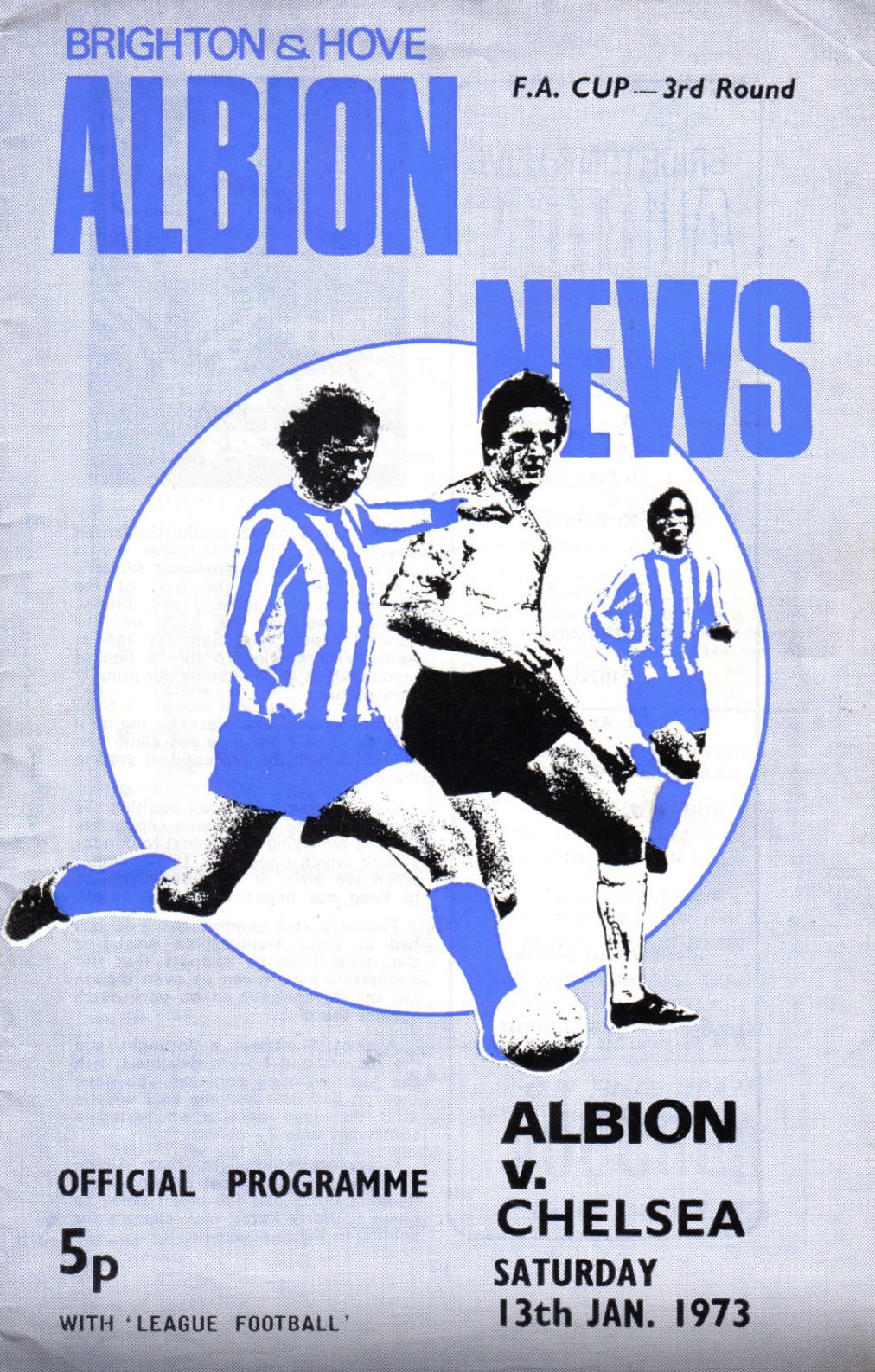
BRIGHTON v Chelsea in the FA Cup sparks memories for supporters of my generation stretching back several decades.

Many began as Albion followers the day the then First Division side from Stamford Bridge visited the Goldstone Ground in February 1967 when a dubious refereeing decision denied Third Division Brighton a shock win.

Others, me included, recall a fiery encounter in Hove six years later when Second Division strugglers Brighton were beaten 2-0 courtesy of two Peter Osgood goals in a game marred by violence on and off the pitch.

That third-round tie in January 1973 was dubbed “a day of shame” in the newspapers after two players were sent off, five were booked and crowd trouble erupted.

The chance for lower ranked teams to pitch their lesser talents against the big boys has always been at the heart of the FA Cup’s appeal.

That was certainly the case when Archie Macaulay’s mid-table Albion hosted Tommy Docherty’s top 10 Chelsea on 18 February 1967. To give it musical context, Georgy Girl by The Seekers had just taken over from The Monkees’ I’m A Believer at no.1 in the pop charts!

At a time when home crowds were normally 12,000 – 13,000, a sell-out gate of 35,000 packed into the Goldstone.

Cup fever had certainly captured the imagination of the Sussex public. In the previous round, 29,208 watched Albion beat Aldershot 3-1 in a third-round replay for the chance to take on the top division Pensioners (as Chelsea were called back then).

The two clubs hadn’t met in any other competition for 34 years – back in January 1933 Brighton beat the London side 2-1 in a third round FA Cup tie.

After such a long gap, maybe it was understandable that Albion’s young captain, Dave Turner, at 22, fell off the settee at home in excitement when he saw the cup draw made on the television.

Canny Brighton decided to sell tickets for the game at a reserve home fixture against Notts County, meaning a stunning 22,229 paid to watch the second string win 1-0 in order to secure their entry to the big game.

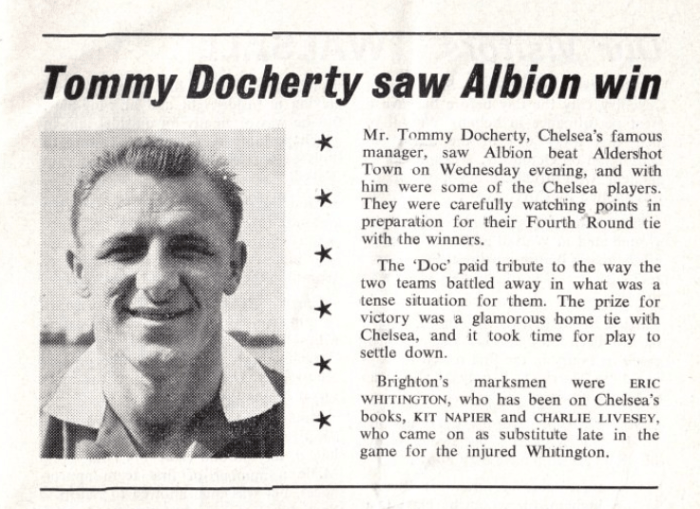
The matchday programme revealed how Docherty and several of his players had watched the Aldershot match to check out what would be in store for them.

Docherty meanwhile was very complimentary in his programme notes, declaring: “Chelsea know that we have a hard and difficult task today, and are not facing it in a complacent manner.”

He added: “We know that there is great potential for the Albion club. They have a First Division set-up at the Goldstone Ground, and First Division ideas, as well as a first-class pitch.

“The day cannot be very far away when they become one of our top clubs, and I am just one of many people in the game who will welcome their promotion to a higher class.”

However, the game was only five minutes old when Bobby Tambling gave Chelsea the lead. But before half-time, Chelsea’s John Boyle (who would several years later joined Albion on loan) was sent off for kicking Wally Gould. And just four minutes into the second half, Turner gave Albion parity.

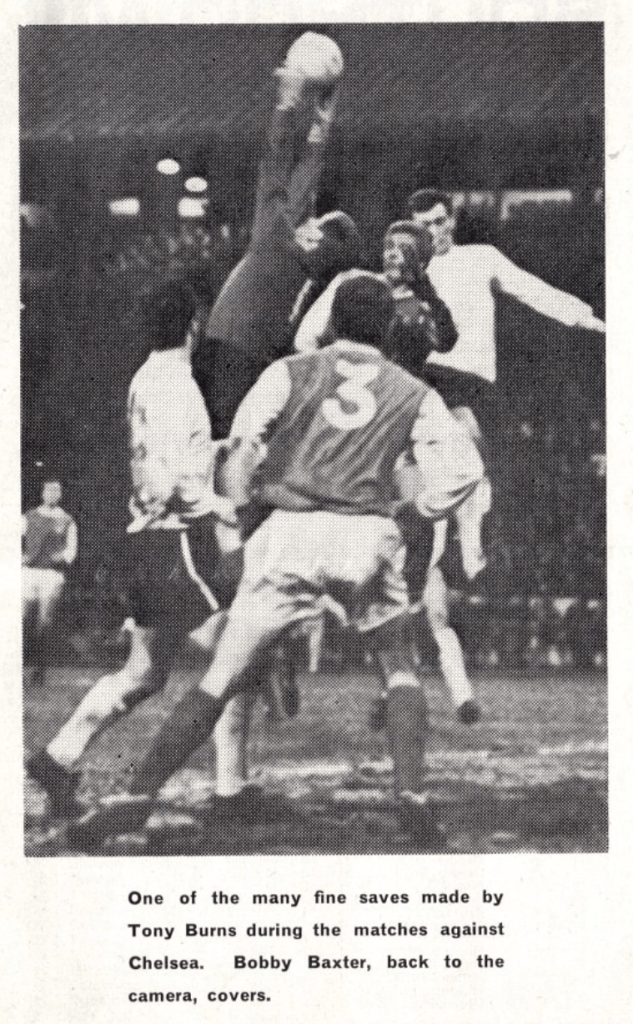
Goalkeeper Tony Burns, who had top flight experience with Arsenal, made several decent saves in the game and, with the clock ticking down, a cracking strike by winger Brian Tawse in the closing minutes of the game looked to have won it for the Third Division side.

“I smashed a volley past Peter Bonetti from 20 yards out with the score at 1-1 and thought I’d got the winner,” Tawse told Brian Fowlie of the Sunday Post in 2015. “It was a goal that could have made my career – but the referee chalked it off.”

Unfortunately, the official had spotted an infringement by Kit Napier and the ‘goal’ was disallowed.

As Brighton would discover again only too painfully in the 1983 final, these winning chances rarely happen twice, and, sure enough, in the replay at Stamford Bridge Chelsea ran out 4-0 winners in front of a massive crowd of 54,852.

Chelsea went on to reach that season’s final at Wembley only to lose 2-1 to a Spurs side that had Joe Kinnear at right-back and Alan Mullery in midfield.

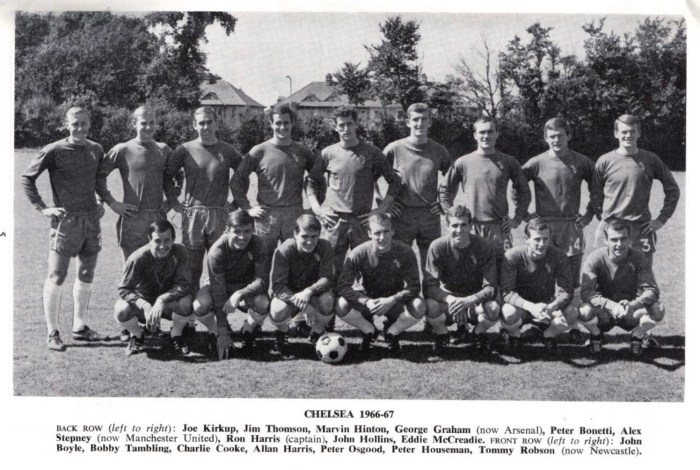
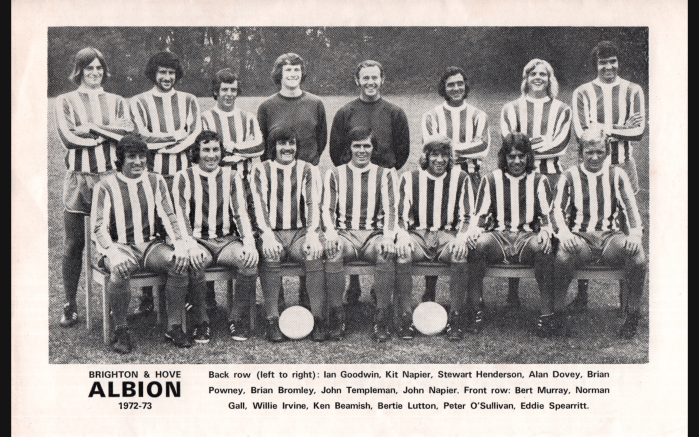
Hardman Ron ‘Chopper’ Harris, their captain in 1967, was still leading the side by the time of the 13 January 1973 game and John Hollins and Tommy Baldwin also played in both. The dismissed Boyle was on the Chelsea bench in 1973. Only John Templeman (right) played in both games for Brighton.

The UK had just joined the European Economic Community (as it was then called) and You’re So Vain by Carly Simon was no.1 in the charts. Albion had moved up a division under Pat Saward having won promotion the previous May, but the side was struggling at the foot of the Second Division, unable to cope at the higher level.

Nevertheless, there were two players looking forward to the cup tie: Bert Murray and £28,000 signing Barry Bridges had both won silverware at Chelsea in the 1960s.

Barry Bridges slots home for Chelsea in a FA Cup tie v Peterborough and, pictured by the Daily Mirror’s Monte Fresco, ahead of the 1973 match against his old club.

“It’s a tremendous draw for the club and a dream draw for Bert Murray and myself who both started our careers at Chelsea,” Bridges told Goal magazine. “Personally, it will be nice to see most of the Chelsea lads again. I grew up with Peter Bonetti, Ron Harris and Ossie (Peter Osgood).”

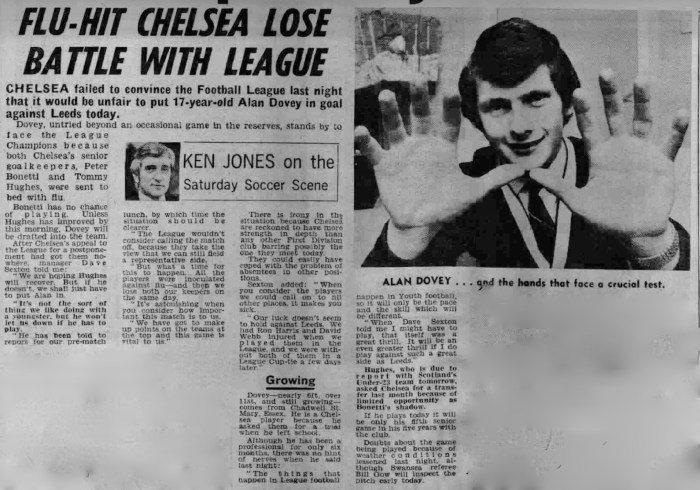
Unfortunately the Albion game was one of several former Worthing schoolboy Bonetti missed through injury and illness in the 1972-73 season, John Phillips deputising in goal at the Goldstone.

How this young supporter recorded the team info in his scrapbook

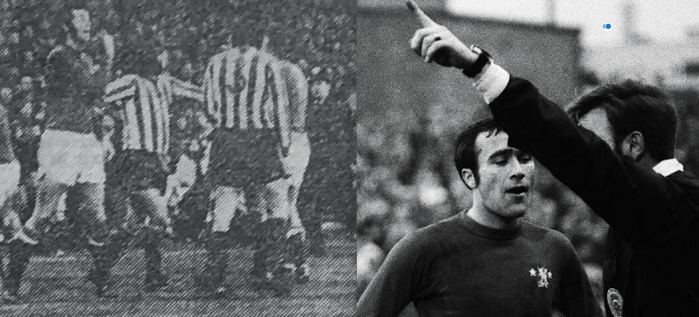
Dave Sexton, a promotion winner with Brighton in 1958, saw his Chelsea side put the ball in Albion’s net within the first 10 seconds of the game but Bill Garner’s effort was ruled out for offside, to the bemusement of the football writers watching. As the game unfolded, not only did it end in defeat for the Albion but it attracted ugly headlines for all the wrong reasons as Harris and Brighton left back George Ley were sent off.

Ley was dismissed in the 85th minute for bringing down Baldwin from behind and then getting involved in a punch-up with England international Osgood, the scorer of Chelsea’s goals in the 17th and 60th minutes, who himself was booked for his part in the altercation.

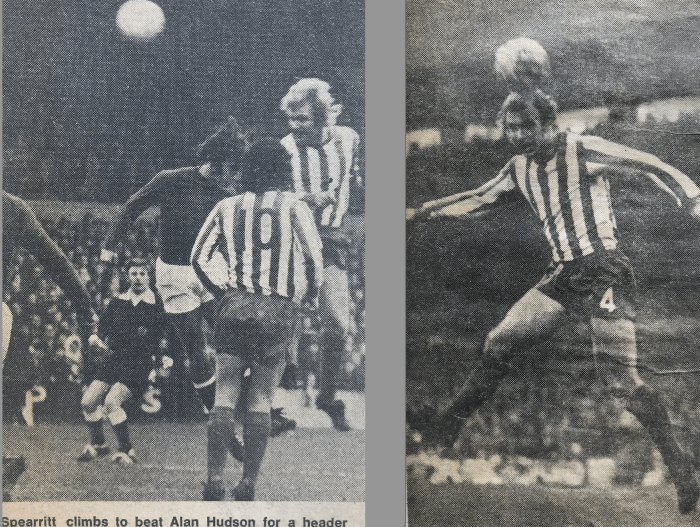
Albion’s Eddie Spearritt had been the first to go in the book on 23 minutes (for a foul on Alan Hudson) and on 73 minutes was involved in the incident which led to Harris being sent off for the first time in his career.

Esteemed football writer Norman Giller recorded it like this: “Harris got involved in a tussle with Spearritt, and, as he pushed him, Spearritt went down holding his face as if he had been punched. The referee directed Ron to an early bath. All the bones he had kicked, and here was Harris being sent off for a playground push.”

1970 Cup winner Dave Webb went in the book for wiping out Spearritt, joining colleague Steve Kember who was cautioned for fouling Steve Piper. Albion’s Graham Howell also went into referee Peter Reeves’ notebook for taking down Baldwin.

The kicking and aggression on the pitch led to fighting on the terraces with 25 people arrested. And Leicester referee Reeves had to be given a police escort off the pitch.

Former Spurs captain-turned-journalist Danny Blanchflower, writing in the Sunday Express: declared: “This FA Cup third-round tie was as disgraceful as any match I’ve ever seen.”

In the opinion of Albion scribe John Vinicombe in the Evening Argus: “Football anarchy gripped the Goldstone during the last 20 minutes of Albion’s FA Cup tie with Chelsea.
“In the frenzy, players fought one another, hacked and kicked, and the violence tiggered an all-too-predictable chain reaction on the terraces where rival factions became one mass of writhing, mindless hooligans.”

Interestingly, Harris’ dismissal was subsequently overturned, Giller recording: “A Brighton-supporting vicar, with a pitchside view, wrote to the Football Association telling them what he had witnessed, and ‘Chopper’ was vindicated.”

Chelsea made it through to the quarter-finals of that season’s tournament before losing 2-1 to Arsenal in a replay. Arsenal lost in the semis to Sunderland, the Second Division side who stunned the football world at the time by beating Leeds United in the final.

Steady Eddie had plenty of strings to his bow

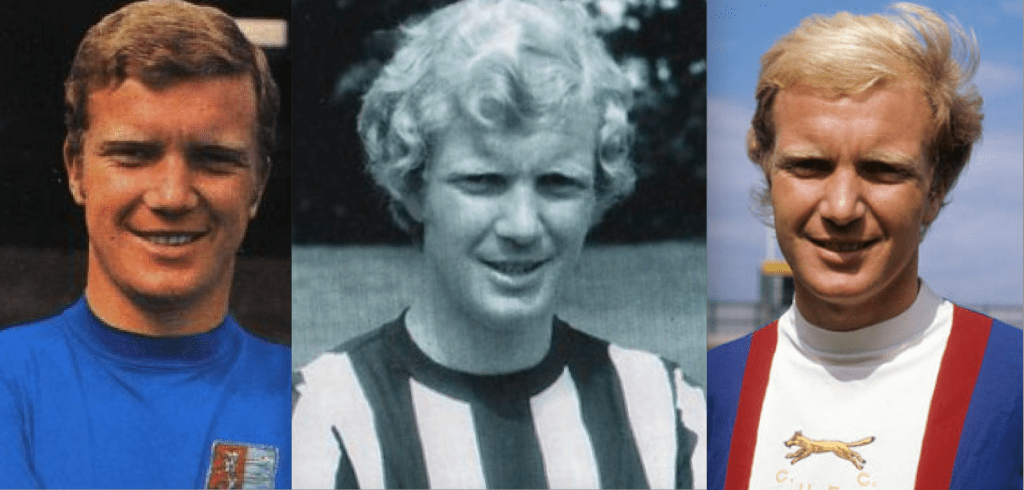
ONE TIME Albion captain and utility player Eddie Spearritt played in the top flight for Ipswich Town and Carlisle United.

He made five starts and five appearances off the bench for second tier champions Ipswich at the beginning of the 1968-69 season before joining third tier Brighton for £20,000 in January 1969.

Play anywhere Spearritt was then a permanent fixture in the Albion line-up for almost five years, making 225 appearances, before Brian Clough turfed him out at the end of the 1973-74 season.

But he found himself back amongst the elite when newly promoted Carlisle United snapped him up for their one and only season (1974-75) amongst the big boys.

Spearritt made 17 starts and six appearances as a sub for the Cumbrians but, in spite of a superb winning start when they briefly topped the division, United finished the season in bottom spot.

Spearritt shapes to challenge Aston Villa’s Ray Graydon

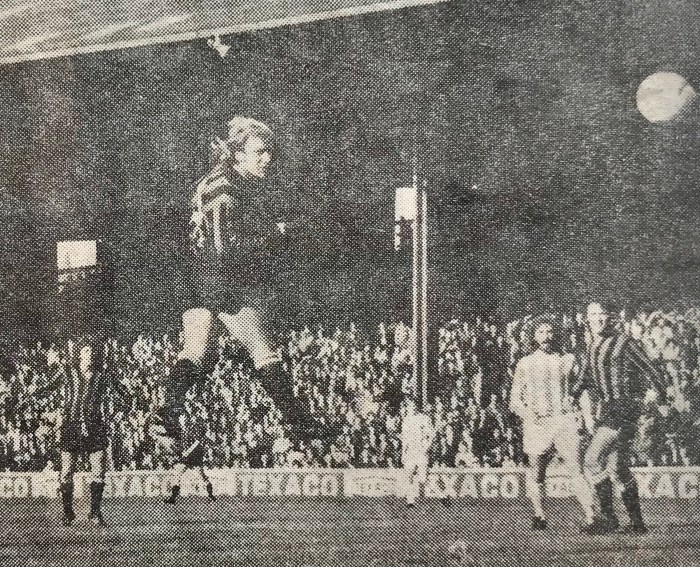
Equally comfortable playing in midfield, at full back or sweeper, Spearritt had on-off spells as Albion’s chosen penalty-taker as well as chipping in with goals from open play. He even turned his hand to goalkeeping when necessary.

Another key attribute to his game was an ability to send in long throw-ins which could sometimes be as effective as a free kick or corner. It was a skill which earned him a place in a Longest Throw competition staged by BBC’s sport show Grandstand in 1970-71, although he didn’t win it.

Born in Lowestoft on 31 January 1947, Spearritt went to Lowestoft Grammar School and on leaving school was picked up by Arsenal. But when the Gunners didn’t keep him on, he returned to East Anglia and joined Ipswich as an apprentice in August 1963.

He signed a professional contract with Town in February 1965 and, as Tim Hodge details on prideofanglia.com, he made his league debut in the 1965-66 season in a 1-0 win away to Preston in the old Division Two.

That was the season when substitutes were first introduced into the English game and the record books show that Spearritt was the first Ipswich sub to score a goal.

He went on for Irish international Danny Hegan in a match away to Derby County on 15 January 1966 and scored Ipswich’s second goal. The game finished 2-2; Gerry Baker having scored Town’s first.

Over the next three years, Spearritt made a total of 69 appearances (plus 10 as sub) for Bill McGarry’s side, scoring 14 goals along the way. Twenty of those games came in the 1967-68 season when Ipswich won the old Second Division.

A 1-0 home defeat to Spurs in October 1968 was his last for the Suffolk club and he parted company with Town shortly after McGarry left Portman Road to take over at Wolverhampton Wanderers.

A debut v Crewe (left) and slaloming through the Plymouth Argyle defence (right)

Spearritt was one of Freddie Goodwin’s first signings for Brighton – just a few weeks before my first ever Albion game. He made his debut in a 3-1 home win over Crewe Alexandra and kept the number 10 shirt to the end of the season, by which time he had scored five times, including both Albion’s goals in a 2-2 draw at home to Tranmere Rovers.

In the 1969-70 season, not only was he part of the Third Division Albion side who pushed his old manager McGarry’s First Division Wolves side all the way in a memorable third round League Cup tie, it was his header from Kit Napier’s free kick that put the Albion 2-1 ahead just before half-time.

Scottish international Hugh Curran scored twice in eight second half minutes to clinch the win for Wolves but a bumper Goldstone Ground crowd of 32,539 witnessed a terrific effort by their side.

A few weeks’ later, in a marathon FA Cup second round tie with Walsall that required three replays before the Saddlers finally prevailed 2-1, Spearritt took over in goal during the second replay when a concussed Geoff Sidebottom was stretchered off on 65 minutes. Albion hung on for a 1-1 draw.

Spearritt was a midfield regular in his first two seasons but Goodwin’s successor, Pat Saward, switched him to left back halfway through the 1970-71 season and that’s where he stayed throughout 1971-72 when Albion won promotion from the old Third Division as runners up behind Saward’s old club, Aston Villa.

It was in the first half of that season that Spearritt took a call from ex-Ipswich teammate Ray Crawford, the former England international centre forward, who had returned homesick from a short stint playing in South Africa.

He persuaded Saward to offer Crawford a trial and although he didn’t make the league side he scouted upcoming opponents, played for the reserves and subsequently ran the youth team.

Meanwhile, Spearritt was a key part of the promotion side and player-of-the-season Bert Murray generously declared the award could have gone to Eddie for his consistency that season. As it happened, Spearritt did get the award the following season, although somewhat more ignominiously considering Albion were relegated.

All smiles as Pat Saward’s side toast promotion in 1972

In the close season after promotion, Spearritt tied the knot with Penelope Biddulph, “an accomplished professional dancer,” the matchday programme told us, and they moved into a new home in Kingston-by-Sea.

Spearritt started out at left back in Division Two but after ten games was ousted by the arrival of George Ley from Portsmouth. He then switched back into midfield, but by the end of that relegation season was playing sweeper alongside Norman Gall (for nine games) and Steve Piper (for two).

He scored (pictured above), along with Barry Bridges, in a 2-0 win at Huddersfield on 14 October but the team went on a disastrous run of 16 games without a win, although Spearritt did get on the scoresheet three times, including notching two penalties.

When Albion went to that footballing outpost Carlisle on 16 December, they had lost five in a row without managing a single goal. Carlisle were 5-0 up, goalkeeper Brian Powney was carried off with a broken nose, replaced between the sticks by Murray, then Albion won a penalty.

Spearritt took up the story in a subsequent matchday programme. “I used to be the club’s penalty taker but, after I had missed an important one at Mansfield in 1970, I lost the job. Penalty-taking is really all about confidence,” he said. “After I had missed that one at Mansfield, which cost us a point, the players lost confidence in me and the job went first to John Napier and was then taken over by Murray.

“Bert would have taken the penalty at Carlisle. He has already scored two this season. But he had gone in goal and it was decided it was too risky to fetch Bert out of goal to take the penalty.

“Nobody else seemed to want to take it so I just picked the ball up and put it on the spot. We were 5-0 down by then but I thought from a morale point of view that it was extremely important that I scored. You can understand my relief when I saw the ball hit the back of the net.

“Everybody was beginning to wonder when we would score again. I suppose with the run of bad luck we have been having it was almost inevitable that we should break our goal famine from the penalty spot.”

Towards the end of the dismal run, Albion drew First Division Chelsea at home in the third round of the FA Cup. The game was won 2-0 by Chelsea but it was an ugly, violent affair – The Argus labelled it ‘Goldstone day of shame’ – in which five players were booked and each side had a player sent off.

Spearritt, the first to be booked, found himself caught up in a huge controversy which resulted in Chelsea hard man Ron Harris being sent off by Leicester referee Peter Reeves; remarkably the only time in his career he was dismissed.

The Brighton man insisted he’d been hit by the defender and Saward said in diplomatic terms after the game: “Spearritt said he was struck on the mouth and that it was not an involuntary action but a blow. From what I saw, I couldn’t understand it.”

Esteemed football writer Norman Giller subsequently recorded it like this: “Harris got involved in a tussle with Spearritt, and, as he pushed him, Spearritt went down holding his face as if he had been punched. The referee directed Ron to an early bath. All the bones he had kicked, and here was Harris being sent off for a playground push.

“A Brighton-supporting vicar, with a pitchside view, wrote to the Football Association telling them what he had witnessed, and ‘Chopper’ was vindicated.”

Whatever the truth of the matter, Spearritt told Argus Albion reporter John Vinicombe that he’d been threatened by a Chelsea player after the incident. “He spoke to me several times and made it quite clear what he had in mind.”

Albion’s Ley was sent off for bringing down Tommy Baldwin and then getting involved in an altercation with Peter Osgood, who scored both Chelsea goals. Two minutes later David Webb went into the book for a ‘blatant foul’ on Spearritt.

Albion finally returned to winning ways the following month with a 2-0 win over Luton (on 10 February), and then beat Huddersfield, Carlisle and Swindon, prompting Saward to refer to “some outstanding individual performances” and adding: “I have been particularly pleased with the way Eddie Spearritt has been playing in recent weeks.

“He has maintained a high level of consistency this season and his work in defence and in midfield has been invaluable as the side has plugged away trying to turn the tide of results.”

Saward made Spearritt Albion’s captain at the start of the 1973-74 season back in Division Three and with the return of central defender Ian Goodwin and then the emergence of Piper in the sweeping role, he was soon back in midfield.

But when Saward was sacked in October and sensationally replaced by former Derby County League title winning management duo Brian Clough and Peter Taylor, Spearritt was one of the first to have his nose put out of joint by the new arrivals.

Journalist Spencer Vignes described what happened in Bloody Southerners (Biteback Publishing, 2018), his excellent book about that era.

Clough sought out long-serving centre back Norman Gall and, because he hailed from the same part of the country (ie the north east), told him he was making him the captain. Gall told Vignes: “Suddenly I’m captain, which I was really happy about. Eddie Spearritt didn’t like it though. He’d been captain up until then. In fact, he didn’t talk to me after that. That was the beginning of the end for Eddie.”

Spearritt was part of the side who capitulated 4-0, 8-2 and 4-1 in successive games against Walton & Hersham, Bristol Rovers and Tranmere Rovers, and he was dropped for six games, along with Ley (who never played for Albion again). Clough went into the transfer market and brought in midfielder Ronnie Welch and left back Harry Wilson from Burnley.

Although Spearritt was restored to the team in mid January, and had a run of seven games — including his 200th league game for Albion — when he was subbed off in a home win over Hereford United on 10 March 1974, it was to be his last appearance in an Albion shirt.

In five years he’d played 225 games (plus seven as sub) and scored 25 goals.

Come the end of the season, Spearritt was one of 12 players released by the club in what became known as the great Clough clear-out.

Perhaps surprisingly, though, his next step was UP two divisions to play in the First Division with then newly promoted Carlisle United.

One of his teammates there was defender Graham Winstanley, who later joined the Albion. The side was captained by Chris Balderstone, who was also a top cricketer. Journeyman striker Hugh McIlmoyle played up front while John Gorman, who later played for Spurs and became Glenn Hoddle’s managerial sidekick, was also in the team.

They memorably topped the division after three games…but predictably finished bottom of the pile by the end. In his two-year stay with the Cumbrians, Spearritt played 29 times, was sub twice and scored a single goal.

He moved back south in August 1976, signed by Gerry Summers at Gillingham, and made his debut in a League Cup first round second leg tie against Aldershot, then made his league debut against Reading.

In total, he made 22 appearances in his one season at the club — one of them at the Goldstone Ground on December 29 1976, when the Albion won 2-0 on a slippery, snow-covered pitch. Spearritt scored just the once for the Gills, from the penalty spot against Rotherham United at Priestfield.

He emigrated to Australia the following summer and settled in Brisbane where he played 56 games for the Brisbane Lions between 1977 and 1980 and was their head coach in 1979. He subsequently coached Rochedale Rovers in the Brisbane Intermediate League, steering them to promotion to the Premier League in 1983.

Outside of football, he became estates manager for L’Oréal and in later years was better known as the uncle of Hannah Spearritt, once of the pop group S Club 7, who became an actress in the ITV drama Primevil.

Ball-playing defender Colin Pates a captain at just 22

ENGLAND World Cup winning hat-trick hero Geoff Hurst gave Colin Pates his Chelsea debut as an 18-year-old – and what an extraordinary footballing baptism it was.

Replacing the injured Micky Droy for a visit across London in a second tier match against Orient, young Pates was involved in a madcap 10-goal match that saw Chelsea win 7-3.

“It was an amazing feeling to go out there but it was chaos, “ he told chelseafancast.com in a 2021 podcast.

And in another interview, he recalled: “It certainly wasn’t a good advertisement for defenders but as long as you come away with the win the fans are happy. It’s one of those days where you’re so fired up it just goes so quickly.

“You come off the pitch at the end and have no recollection of what happened really. I was up against some good, experienced pros and it was quite daunting, but I really enjoyed it.”

That game at Brisbane Road marked the start of a Chelsea first team career that spanned 346 matches, 137 of them as captain, in a turbulent period for the club.

Pates’ future Brighton teammates Gary Chivers and Clive Walker were also in that side at Orient and Walker scored two of Chelsea’s hatful (Lee Frost (3), Micky Fillery and Ian Britton the others).

Pates and Robert Codner celebrate reaching the Wembley final

Fast forward 12 years and Pates was reunited with Chivers and Walker when he joined Brighton on loan from Arsenal in February 1991 to help out after young Irish centre-back Paul McCarthy was sidelined by injury.

Manager Barry Lloyd pulled off something of a coup to persuade his old Chelsea teammate, George Graham, then manager of Arsenal, to loan Pates to the Seagulls for three months.

The Argus Albion reporter John Vinicombe described it as a “masterstroke” and doubted that Albion would have made it to the divisional play-off final at Wembley without him.

Match magazine pic of Pates at Wembley

Lloyd’s faithful no. 2, Martin Hinshelwood, said Pates got better and better over the three months, pointing out: “He has steadied us a little bit. He talks to players, he is a great trainer and he has brought a lot to our back four.”

The player himself told Luke Nicoli of the Albion website in a 2021 interview: “Although I was dropping down a division, it didn’t matter to me – I was just happy to be playing football.

“I immediately struck up a partnership at the back with Gary, and it was like the good old days at Chelsea again.

“I spent three months at the club and I loved every minute; I loved the area, the Goldstone, the club, the fans and, of course, we went all the way to Wembley that season in the play-offs – where the turnout from our fans in the final was incredible.

“We lost (3-1) to Notts County, which was one of those games where it just wasn’t meant to be.”

It has since emerged that Lloyd’s insistence on changing a successful formula by playing Romanian international Stefan Iovan as a sweeper in that match upset the players.

But Pates said: “I know we changed formation that day, and maybe that contributed to our defeat, but I didn’t look at it like that – it was just one of those games where it wasn’t meant to be.”

“We came with a fantastic late run in the league, but it proved to be a game too far for us,” he recalled in a matchday programme article. “We made a slow start to the game and that defeat still hurts, knowing what it meant to everyone connected with the club.”

In another interview, Pates said: “The result in the play-off final didn’t go our way but it was a fantastic experience for the team to play at Wembley, the side was so close to the Premiership, or First Division as it was called then.

“I’d been lucky to have played there before but to others it was the pinnacle of their careers.”

Indeed, the last time Pates had played there was five years previously when he made history by becoming the first-ever Chelsea player to lift a trophy – the Full Members Cup – at the iconic stadium (when Ron Harris lifted the FA Cup in 1970 it was at Old Trafford, where the replay had taken place after a 2-2 draw at Wembley). That was arguably the pinnacle of his career.

The Full Members Cup was a short-lived competition between North and South clubs from the top two divisions of the league, with the regional winners meeting in a national final. It was introduced after English clubs were banned from competing in Europe following the Heysel disaster. In truth, it struggled to be taken seriously and it was a surprise it lasted as long as seven seasons.

The most remarkable element of Chelsea’s win was that the game took place the day after they’d played a league game at Southampton – when Pates scored the only goal of the game with a deflected free kick past Peter Shilton in Southampton’s goal.

Chelsea beat Manchester City 5-4 but extraordinarily were cruising at 5-1 before City scored three in the last six minutes (one an 89th minute own goal by Doug Rougvie!).

“When the referee blew his whistle, was I relieved!” said Pates. “It’s great to play at Wembley with thousands of fans screaming their heads off, and once you’re on the pitch you don’t care what cup it is, you just want to win it.”

Born on 10 August 1961 in Wimbledon, Pates went to school only five miles from Stamford Bridge and was a Chelsea fan as a boy. He signed for the club aged 10, starting training with them in 1971, the year they won the European Cup Winners’ Cup having won the FA Cup the previous year. Pates worked his way through the different age levels and as an apprentice cleaned the boots of hardman defender Ron Harris.

He made that first team debut on 10 November 1979, by which time he had already played five times for England Youth that autumn. A further six appearances followed in 1980, alongside the likes of Micky Adams, Gary Mabbutt, Paul Walsh and Terry Gibson. Mark Barham, Steve Mackenzie and Terry Connor featured in the early 1980 games.   

Pates in action for Chelsea against Albion’s Terry Connor, a former England Youth teammate

Simultaneously, Droy’s lack of fitness meant young Pates got an extended run in the side. However, because he was comfortable on the ball and could play in a number of positions, manager Hurst often used him as something of a utility player.

For example, in 1980-81, his 15 appearances were spread across all back four positions. But when John Neal took over for the 1981-82 season, Pates was ever present in the centre alongside Droy.

While the side’s league fortunes didn’t improve under the new man (they finished 12th), they had the consolation of reaching the quarter finals of the FA Cup after beating reigning European champions Liverpool 2-0 in the fifth round (Pates had the job of man-marking Graeme Souness).

Remarkably, Chelsea only narrowly avoided relegation to the old Third Division in 1983, and, as a result, manager Neal had a clear-out of the ‘old guard’ and Pates’ performances and attitude earned him the captain’s armband just before his 22nd birthday.

“I think he wanted someone who had come through the ranks and knew the club,” Pates said. “I was fortunate enough to be one of the few players – along with the likes of John Bumstead – who he kept on from before.”

Pates has nothing but praise for Neal and his assistant Ian McNeill (who played more than 100 games for Brighton between 1959 and 1962) and their eye for good players, like Pat Nevin, Joe McLaughlin, Nigel Spackman, David Speedie and Kerry Dixon, who were brought in to rebuild the club.

“I loved John Neal, he was a man of few words but when he said something you listened because it was going to be something poignant or important,” said Pates. “He was a good man-manager and would always take care of you if you had problems and be there for a chat. You wanted to play for him.”

Combined with the new arrivals, Pates and his pal Bumstead were part of a core of local lads Neal relied on (it included Dale Jasper, Chivers and Fillery): they all came from the same estate in Mitcham.

In his first season wearing the armband, “Pates stepped into the role with ease and led the team to the Second Division title” wrote Kelvin Barker.

“Colin’s classy displays in the top division catapulted him into the limelight, his impressive captaincy of a club on the up particularly catching the eye.

“A string of niggly injuries after Christmas led to him missing a handful of matches and his importance to the defence was highlighted when, in his absence, Chelsea slipped to consecutive defeats at Coventry and Ipswich.

“Pates made a total of 48 appearances during the 1984-85 campaign and scored once, the goal coming in a stunning 4-3 win at Goodison Park against the season’s champions, Everton.”

It had been a proud moment when Pates led Chelsea out at Highbury for the 1984-85 season-opener against Arsenal. The game finished 1-1, Paul Mariner opening the scoring for the Gunners on 35 minutes, Dixon equalising for the visitors four minutes later.

Chelsea made a decent fist of their return to the big time, finishing sixth. They also reached the semi-finals of the League Cup only to be knocked out over two legs by a Clive Walker-inspired Sunderland.

Chelsea did make it to Wembley the following year but it would be fair to say winning

that Full Members Cup final ultimately damaged their progress in the league. Chelsea were riding high in the top flight at the time and being spoken of as title contenders but immediately after that trophy win they were beaten 4-0 at home by West Ham on Easter Saturday and 6-0 by QPR at Loftus Road on Easter Monday.

Pates’ future Brighton teammate John Byrne scored twice for the Rs playing alongside Michael Robinson and Gary Bannister, who got a hat-trick. Substitute Leroy Rosenior (father of Liam) scored the other.

Byrne later remembered: “There were some big name players in the Chelsea line-up, including centre-back Doug Rougvie who seemed like he wanted to kill somebody when the score was 5-0! He was certainly looking for blood!

“We had the Milk Cup Final coming up and I remember saying to Banna with about 15 minutes to go ‘I ain’t going anywhere near Rougvie’. And Gary replied: ‘Neither am I!’ So we both ended up playing on the wings with no one in the middle!”

Pates and Doug Rougvie both played for Chelsea and Brighton

There was talk that Pates might force his way into the England squad for the Mexico World Cup that summer but Terry Butcher, Alvin Martin and Terry Fenwick were ahead of him.

Competition at club level emerged at the start of the following season when centre-half Steve Wicks was recruited and Pates was moved to left-back. However, injuries to Wicks meant Pates was soon back in the middle.

In his sporting-heroes.net piece, Barker continued: “As Chelsea’s farcical season went from bad to worse, he found himself being played in midfield again. With the Blues looking down the barrel of a drop into Division Two, Colin was returned to the centre of defence and relegation was averted.”

An injury-disrupted 1987-88 season also saw Pates have the captaincy taken off him and given to fellow defender Joe McLaughlin. Pates actually missed the start of the season having had a cartilage operation and when he returned in October the team were on something of a downward spiral. Injured again at the end of March, by the time he was fit to return, Chelsea were heading close to the relegation trapdoor.

At the time, as part of a restructuring plan to reduce the top division’s number of teams from 22 to 20, the team finishing fourth bottom of Division One had to play-off against the third, fourth and fifth-placed teams in Division Two. The top two in Division Two were promoted automatically and the bottom three in Division One went down.

Chelsea ended up fourth from bottom and had to play Middlesbrough (who’d finished third in Division Two) over two legs.

Boro won the first leg at Ayresome Park 2-0 but Chelsea only won their home leg 1-0, so they were relegated. However, history has since remembered the match more for the riotous behaviour of Chelsea supporters.

gazettelive.co.uk recalled: “There was trouble before, during and after the high-stakes game. Chelsea fans invaded the pitch on the whistle and stormed the away end sparking hand to hand fighting with barely a steward in sight.

“And it was only the intervention of mounted police that eventually cleared the pitch. The trouble didn’t stop there with more attacks outside the ground as Boro fans returned to their cars, coaches and the tube.”

Boro striker Bernie Slaven remembered: “We were locked in the dressing room celebrating promotion for maybe an hour while the police dealt with the trouble and cleared the pitch then we went out and celebrated again with the Boro fans who had been kept back in the stadium.

“The trouble and the ugly atmosphere was a real shame because it took all the headlines away from what we had achieved.”

John Hollins resigned as manager and was replaced by Bobby Campbell. One of his first moves was to sign the powerful central defender Graham Roberts who he made captain.

Pates was given a testimonial as part of the pre-season friendly fixtures (a 0-0 draw with Spurs) but the season was only three months old when he suddenly found himself unwanted at the Bridge.

As Pates returned to the dressing room at the end of a 2-2 Littlewoods Cup home draw with Scunthorpe United, Campbell informed him Charlton Athletic manager Lennie Lawrence was upstairs waiting to sign him, the club having already agreed terms over the transfer (a £400,000 fee).

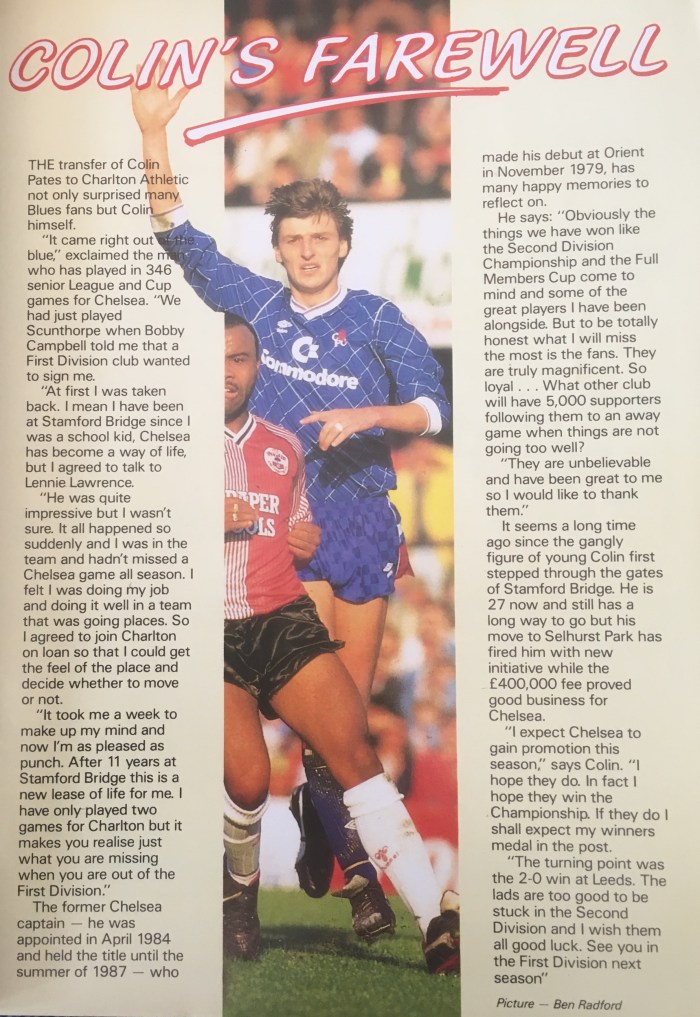
“It came right out of the blue,” said Pates. “At first, I was taken aback. I have been at Stamford Bridge since I was a schoolkid. Chelsea has become a way of life.”

When the Albion visited Chelsea for a Division 2 league game on 29 October 1988, the matchday programme carried an article headlined ‘Colin’s farewell’, detailing the circumstances.

“The transfer of Colin Pates to Charlton Athletic not only surprised many Blues fans but Colin himself,” it began.

And reflecting on what happened many years later, Pates told Luke Nicoli: “I was allowed to leave and did so with a heavy heart as I wanted to stay.”

Nevertheless, the move at least presented the defender with the chance to return to playing in the top division, and he admitted: “After 11 years at Stamford Bridge, this is a new lease of life for me.”

Charlton, who had to play home matches at Crystal Palace’s Selhurst Park at the time, finished 14th by the end of that 1988-89 season, but Pates had left for Arsenal by the time the Addicks were relegated in 19th place at the end of the following season.

Despite those moves across London, and to the south coast, Chelsea hadn’t seen the last of Pates, though. He subsequently became head of football at the independent Whitgift School in South Croydon, where he coached most sports and was the first football coach in what had previously been a rugby-dominated school and pupils Victor Moses and Callum Hudson-Odoi both went on to play for the Blues.

Pates was also seen back at the Bridge on matchdays working in the hospitality lounges.

Should Mike Bailey have had longer to realise his ambition?

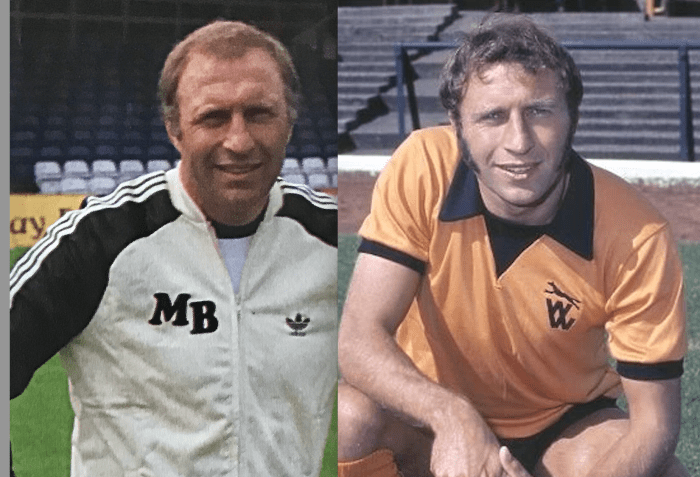
FOR 40 YEARS, Mike Bailey was the manager who had led Brighton & Hove Albion to their highest-ever finish in football.

A promotion winner and League Cup-winning captain of Wolverhampton Wanderers, he took the Seagulls to even greater heights than his predecessor, Alan Mullery.

But the fickle nature of football following has remembered Bailey a lot less romantically than the former Spurs, Fulham and England midfielder.

The pragmatic way Brighton played under Bailey turned fans off in their thousands and, because gates dipped significantly, he paid the price.

Finishing 13th in the top tier in 1982 playing a safety-first style of football counted for nothing, even though it represented a marked improvement on relegation near-misses in the previous two seasons under Mullery, delivering along the way away wins against Tottenham Hotspur, Liverpool and then-high-flying Southampton as well as a first-ever victory over Arsenal.

Bailey’s achievement with the Albion was only overtaken in 2022 with a ninth place finish under Graham Potter; since surpassed again with a heady sixth and European qualification under Roberto De Zerbi.

Fascinatingly, though, Bailey had his eyes on Europe as far back as the autumn of 1981 and laid his cards on the table in a forthright article in Shoot! magazine.

Bailey’s ambition laid bare

“I am an ambitious man,” he said. “I am not content with ensuring that Brighton survive another season at this level. I want people to be surprised when we lose and to omit us from their predictions of which clubs will have a bad season.

“I am an enthusiast about this game. I loved playing, loved the atmosphere of a dressing room, the team spirit, the sense of achievement.

“As a manager I have come to realise there are so many other factors involved. Once they’re on that pitch the players are out of my reach; I am left to gain satisfaction from seeing the things we have worked on together during the week become a reality during a match.

“I like everything to be neat – passing, ball-control, appearance, style. Only when we have become consistent in these areas will Brighton lose, once and for all, the tag of the gutsy little Third Division outfit from the South Coast that did so well to reach the First Division.”

Clearly revelling in finding a manager happy to speak his mind, the magazine declared: “As a player with Charlton, Wolves and England, Bailey gave his all, never hid when things went wrong, accepted responsibility and somehow managed to squeeze that little bit extra from the players around him when his own game was out of tune.

“As a manager he is adopting the same principles of honesty, hard work and high standards of professionalism.

“So, when Bailey sets his jaw and says he wants people to expect Brighton to win trophies, he means that everyone connected with Albion must forget all about feeling delighted with simply being in the First Division.”

Warming to his theme, Bailey told Shoot!: “This club has come a long way in a short time. But now is the time to make another big step…or risk sliding backwards. Too many clubs have done just that – wasted time basking in recent achievements and crashed back to harsh reality.

“I do not intend for us to spend this season simply consolidating. That has been done in the last few seasons.”

Mike Bailey had high hopes for the Albion

If that sounds a bit like Roberto De Zerbi, unfortunately many long-time watchers of the Albion like me would more likely compare the style under Bailey to the pragmatism of the Chris Hughton era: almost a complete opposite to De Zerbi’s free-flowing attacking play.

It was ultimately his downfall because the court of public opinion – namely paying spectators who had rejoiced in a goals galore diet during Albion’s rise from Third to First under Mullery – found the new man’s approach too boring to watch and stopped filing through the turnstiles.

Back in 2013, the superb The Goldstone Wrap blog noted: “Only Liverpool attracted over 20,000 to the Goldstone before Christmas. The return fixture against the Reds in March 1982 was the high noon of Bailey’s spell as Brighton manager.

“A backs-to-the-wall display led to a famous 1-0 win at Anfield against the European Cup holders, with Andy Ritchie getting the decisive goal and Ian Rush’s goalbound shot getting stuck in the mud!”

At that stage, Albion were eighth but a fans forum at the Brighton Centre – and quite possibly a directive from the boardroom – seemed to get to him.

Supporters wanted the team to play a more open, attacking game. The result? Albion recorded ten defeats in the last 14 matches.

At odds with what he had heard, he very pointedly said in his programme notes: “It is my job to select the team and to try to win matches.

“People are quite entitled to their opinion, but I am paid to get results for Brighton and that is my first priority.

“Building a successful team is a long-term business and I have recently spoken to many top people in the professional game who admire what we are doing here at Brighton and just how far we have come in a short space of time.

“We know we still have a long way to go, but we are all working towards a successful future.”

Dropping down to finish 13th of 22 clubs, Albion never regained a spot in the top half of the division and The Goldstone Wrap observed: “If Bailey had stuck to his guns, and not listened to the fans, would the club have enjoyed a UEFA Cup place at the end of 1981-82?”

Bailey certainly wasn’t afraid to share his opinions and, as well as in the Shoot! article, he often vented his feelings quite overtly in his matchday programme notes; hitting out at referees, the football authorities and the media, as well as trying to explain his decisions to supporters, urging them to get behind the team rather than criticise.

It certainly didn’t help that the mercurial Mark Lawrenson was sold at the start of his regime as well as former captain Brian Horton and right-back-cum-midfielder John Gregory, but Bailey addressed the doubters head on.

“I believe it was necessary because while I agree that a player of Lawrenson’s ability, for example, is an exceptional talent, it is not enough to have a handful of assets.

“We must have a strong First Division squad, one where very good players can come in when injuries deplete the side.

Forthright views were a feature of Bailey’s programme notes

“We brought in Tony Grealish from Luton, Don Shanks from QPR, Jimmy Case from Liverpool and Steve Gatting and Sammy Nelson from Arsenal. Now the squad is better balanced. It allows for a permutation of positions and gives adequate cover in most areas.”

One signing Bailey had tried to make that he had to wait a few months to make was one he would come to regret big time. Long-serving Peter O’Sullivan had left the club at the same time as Lawrenson, Horton and Gregory so there was a vacancy to fill on the left side of midfield.

Bailey had his eyes on Manchester United’s Mickey Thomas but the Welsh wideman joined Everton instead. When, after only three months, the player fell out with Goodison boss Howard Kendall, Bailey was finally able to land his man for £350,000 on a four-year contract.

Talented though Thomas undoubtedly was, what the manager didn’t bargain for was the player’s unhappy 20-year-old wife, Debbie.

She was unable to settle in Sussex – the word was that she gave it only five days, living in a property at Telscombe Cliffs – and went back to Colwyn Bay with their baby son.

Thomas meanwhile stayed at the Courtlands Hotel in Hove and the club bent over backwards to give him extra time off so he could travel to and from north Wales. But he began to return late or go missing from training.

After the third occasion he went missing, Bailey was incandescent with rage and declared: ”Thomas has s*** on us….the sooner the boy leaves, the better.”

At one point in March, it was hoped a swap deal could be worked out that would have brought England winger Peter Barnes to the Goldstone from Leeds, but they weren’t interested and so the saga dragged out to the end of the season.

After yet another absence and fine of a fortnight’s wages, Bailey once again went on the front foot and told Argus Albion reporter John Vinicombe: “He came in and trained which allowed him to play for Wales.

“He is just using us, and yet I might have played him against Wolves (third to last game of the season). Thomas is his own worst enemy and I stand by what I’ve said before – the sooner he goes the better.”

Thomas was ‘shop windowed’ in the final two games and during the close season was sold to Stoke City for £200,000.

In his own assessment of his first season, Bailey said: “Many good things have come out of our season. Our early results were encouraging and we quickly became an organised and efficient side. The lads got into their rhythm quickly and it was a nice ‘plus’ to get into a high league position so early on.”

He had special words of praise for Gary Stevens and said: “Although the youngest member of our first team squad, Gary is a perfect example to his fellow professionals. Whatever we ask of him he will always do his best, he is completely dedicated and sets a fine example to his fellow players.”

The biggest bugbear for the people running the club was that the average home gate for 1981-82 was 18,241, fully 6,500 fewer than had supported the side during their first season at the top level.

“The Goldstone regulars grew restless at a series of frustrating home draws, and finally turned on their own players,” wrote Vinicombe in his end of season summary for the Argus.

He also said: “It is Bailey’s chief regret that he changed his playing policy in response to public, and possibly private, pressure with the result that Albion finished the latter part of the season in most disappointing fashion.

“Accusations that Albion were the principal bores of the First Division at home were heaped on Bailey’s head, and, while he is a man not given to altering his mind for no good reason, certain instructions were issued to placate the rising tide of criticisms.”

If Bailey wasn’t exactly Mr Popular with the fans, at the beginning of the following season, off-field matters brought disruption to the playing side.

Steve Foster thought he deserved more money having been to the World Cup with England and he, Michael Robinson and Neil McNab questioned the club’s ambition after chairman Bamber refused to sanction the acquisition of Charlie George, the former Arsenal, Derby and Southampton maverick, who had been on trial pre-season.

Robinson went so far as to accuse the club of “settling for mediocrity” and couldn’t believe Bailey was working without a contract.

Bamber voiced his disgust at Robinson, claiming it was really all about money, and tried to sell him to Sunderland, with Stan Cummins coming in the opposite direction, but it fell through. Efforts were also made to send McNab out on loan which didn’t happen immediately although it did eventually.

All three were left out of the side temporarily although Albion managed to beat Arsenal and Sunderland at home without them. In what was an erratic start to the season, Albion couldn’t buy a win away from home and suffered two 5-0 defeats (against Luton and West Brom) and a 4-0 spanking at Nottingham Forest – all in September.

Other than 20,000 gates for a West Ham league game and a Spurs Milk Cup match, the crowd numbers had slumped to around 10,000. Former favourite Peter Ward was brought back to the club on loan from Nottingham Forest and scored the only goal of the game as Manchester United were beaten at the Goldstone.

But four straight defeats followed and led to the axe for Bailey, with Bamber declaring: “He’s a smashing bloke, I’m sorry to see him go, but it had to be done.”

Perhaps the writing was on the wall when, in his final programme contribution, he blamed the run of poor results simply on bad luck and admitted: “I feel we are somehow in a rut.”

It didn’t help the narrative of his reign that his successor, Jimmy Melia, surfed on a wave of euphoria when taking Albion to their one and only FA Cup Final – even though he also oversaw the side’s fall from the elite.

“It seems that my team has been relegated from the First Division while Melia’s team has reached the Cup Final,” an irked Bailey said in an interview he gave to the News of the World’s Reg Drury in the run-up to the final.

Hurt by some of the media coverage he’d seen since his departure, Bailey resented accusations that his style had been dull and boring football, pointing out: “Nobody said that midway through last season when we were sixth and there was talk of Europe.

“We were organised and disciplined and getting results. John Collins, a great coach, was on the same wavelength as me. We wanted to lay the foundations of lasting success, just like Bill Shankly and Bob Paisley did at Liverpool.

“The only problem was that winning 1-0 and 2-0 didn’t satisfy everybody. I tried to change things too soon – that was a mistake.

“When I left (in December 1982), we were 18th with more than a point a game. I’ve never known a team go down when fifth from bottom.”

Bailey later expanded on the circumstances, lifting the lid on his less than cordial relationship with Bamber, when speaking on a Wolves’ fans forum in 2010. “We had a good side at Brighton and did really well,” he said. “The difficulty I had was with the chairman. He was not satisfied with anything.

“I made Brighton a difficult team to beat. I knew the standard of the players we had and knew how to win matches. We used to work on clean sheets.

“With the previous manager, they hadn’t won away from home very often but we went to Anfield and won. But the chairman kept saying: ‘Why can’t we score a few more goals?’ He didn’t understand it.”

Foster, the player Bailey made Albion captain, was also critical of the ‘boring’ jibe and in Spencer Vignes’ A Few Good Men said: “We sacked Mike Bailey because we weren’t playing attractive football, allegedly. Things were changing. Brighton had never been so high.

“We were doing well, but we weren’t seen as a flamboyant side. I was never happy with the press because they were creating this boring talk. Some of the stuff they used to write really annoyed me.”

Striker Andy Ritchie was also supportive of the management. He told journalist Nick Szczepanik: “Mike got everyone playing together. Everybody liked Mike and John Collins, who was brilliant. When a group of players like the management, it takes you a long way. When you are having things explained to you and training is good and it’s a bit of fun, you get a lot more out of it.”

Born on 27 February 1942 in Wisbech, Cambridgeshire, he went to the same school in Gorleston, Norfolk, as the former Arsenal centre back Peter Simpson. His career began with non-league Gorleston before Charlton Athletic snapped him up in 1958 and he spent eight years at The Valley.

During his time there, he was capped twice by England as manager Alf Ramsey explored options for his 1966 World Cup squad. Just a week after making his fifth appearance for England under 23s, Bailey, aged 22, was called up to make his full debut in a friendly against the USA on 27 May 1964.

He had broken into the under 23s only three months earlier, making his debut in a 3-2 win over Scotland at St James’ Park, Newcastle, on 5 February 1964.He retained his place against France, Hungary, Israel and Turkey, games in which his teammates included Graham Cross, Mullery and Martin Chivers.

England ran out 10-0 winners in New York with Roger Hunt scoring four, Fred Pickering three, Terry Paine two, and Bobby Charlton the other.

Eight of that England side made it to the 1966 World Cup squad two years later but a broken leg put paid to Bailey’s chances of joining them.

“I was worried that may have been it,” Bailey recalled in his autobiography, The Valley Wanderer: The Mike Bailey Story (published in November 2015). “In the end, I was out for six months. My leg got stronger and I never had problems with it again, so it was a blessing in disguise in that respect.

“Charlton had these (steep) terraces. I’d go up to them every day, I was getting fitter and fitter.”

In fact, Ramsey did give him one more chance to impress. Six months after the win in New York, he was in the England team who beat Wales 2-1 at Wembley in the Home Championship. Frank Wignall, who would later spend a season with Bailey at Wolves, scored both England’s goals.

“But it was too late to get in the 1966 World Cup side,” said Bailey. “Alf Ramsey had got his team in place.”

During his time with the England under 23s, Bailey had become friends with Wolves’ Ernie Hunt (the striker who later played for Coventry City) and Hunt persuaded him to move to the Black Country club for a £40,000 fee.

Thus began an association which saw him play a total of 436 games for Wolves over 11 seasons.

In his first season, 1966-67, he captained the side to promotion from the second tier and he was also named as Midlands Footballer of the Year.

Wolves finished fourth in the top division in 1970-71 and European adventures followed, including winning the Texaco Cup of 1971 – the club’s first silverware in 11 years – and reaching the UEFA Cup final against Tottenham a year later, although injury meant Bailey was only involved from the 55th minute of the second leg and Spurs won 3-2 on aggregate.

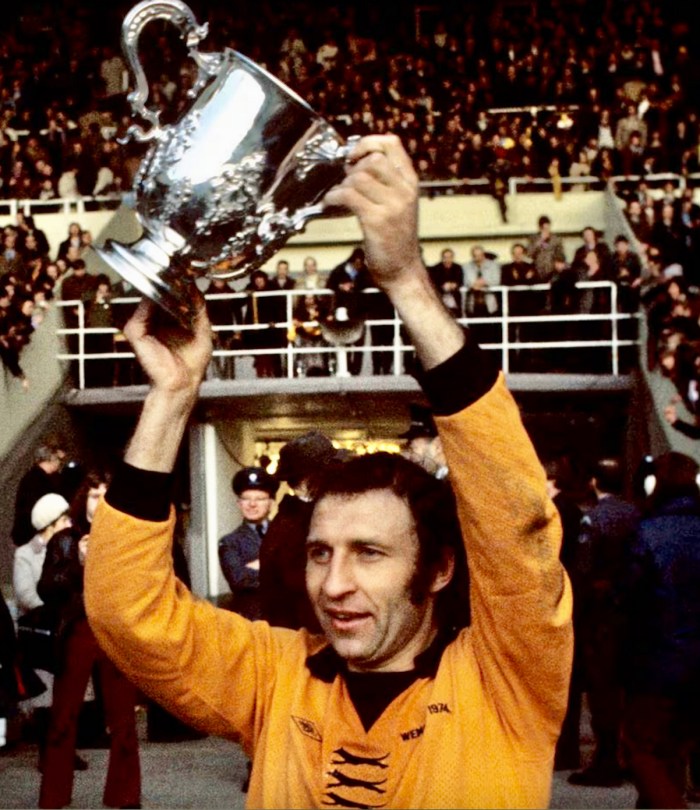
Two years later, Bailey, by then 32, lifted the League Cup after Bill McGarry’s side beat Ron Saunders’ Manchester City 2-1 at Wembley with goals by Kenny Hibbitt and John Richards. It was Bailey’s pass to Alan Sunderland that began the winning move, Richards sweeping in Sunderland’s deflected cross.

Bailey lifts the League Cup after Wolves beat Manchester City at Wembley

This was a side with solid defenders like John McAlle, Frank Munro and Derek Parkin, combined with exciting players such as Irish maverick centre forward Derek Dougan and winger Dave Wagstaffe.

Richards had become Dougan’s regular partner up front after Peter Knowles quit football to turn to religion. Discussing Bailey with wolvesheroes.com, Richards said: “He really was a leader you responded to and wanted to play for. If you let your standards slip, he wasn’t slow to let you know. I have very fond memories of playing alongside him.”

In a lengthy tribute to Bailey in the Wolverhampton Express & Star to mark his 80th birthday, journalist Paul Berry interviewed several of his former teammates.

“He gave me – just as he did with all the young players coming into the team – so much help and guidance in training and matches on and off the pitch,” said Richards.

“There were so many little tips and pieces of advice and I remember how he first taught me how to come off defenders. He would say ‘when I get the ball John, just push the defender away, come towards me, lay the ball off and then go again’.

“There was so much advice that he would give to us all, and it had a massive influence.”

Midfielder Hibbitt, another Wolves legend who made 544 appearances for the club, said: “He was the greatest captain I ever played with.”

Steve Daley added: “Mike is my idol, he was an absolute inspiration to me when I was playing.”

Winger Terry Wharton added: “He was a great player…a bit of a Jekyll and Hyde character as well. On the pitch he was a great captain, a winner, he was tenacious and he was loud.

“He got people moving and he got people going and you just knew he was a captain. And then off the pitch? He could have been a vicar.”

When coach Sammy Chung stepped up to take over as manager, Bailey found himself on the outside looking in and chose to end his playing days in America, with the Minnesota Kicks, who were managed by the former Brighton boss Freddie Goodwin.

He returned to England and spent the 1978-79 season as player-manager of Fourth Division Hereford United and in March 1980 replaced Andy Nelson as boss at Charlton Athletic. He had just got the Addicks promoted from the Third Division when he replaced Mullery at Brighton.

In a curious symmetry, Bailey’s management career in England (courtesy of managerstats.co.uk) saw him manage each of those three clubs for just 65 games. At Hereford, his record was W 32, D 11, L 22; at Charlton W 21, D 17, L 27; at Brighton, W 20 D 17, L 28.

In 1984, he moved to Greece to manage OFI Crete, he briefly took charge of non-league Leatherhead and he later worked as reserve team coach at Portsmouth. Later still, he did some scouting work for Wolves (during the Dave Jones era) and he was inducted into the Wolves Hall of Fame in 2010.

In November 2020, Bailey’s family made public the news that he had been diagnosed with dementia hoping that it would help to highlight the ongoing issues around the number of ex-footballers suffering from it.

Perhaps the last words should go to Bailey himself, harking back to that 1981 article when his words were so prescient bearing in mind what would follow his time in charge.

“We don’t have a training ground. We train in a local park. The club have tried to remedy this and I’m sure they will. But such things hold you back in terms of generating the feeling of the big time,” he said.

“I must compliment the people who are responsible for getting the club where it is. They built a team, won promotion twice and the fans flocked in. Now is the time to concentrate on developing the Goldstone Ground. When we build our ground, we will have the supporters eager to fill it.”

Pictures from various sources: Goal and Shoot! magazines; the Evening Argus, the News of the World, and the Albion matchday programme.

John Ruggiero scored on his Brighton league debut

JOHN RUGGIERO was one of four signings Alan Mullery made for newly promoted Albion in the summer of 1977.

That one of the quartet was Mark Lawrenson from Preston North End for £115,000 rather eclipsed Ruggiero’s arrival from recently relegated Stoke City for £30,000.

Nonetheless, Ruggiero made an immediate impact, scoring on his league debut as a substitute for Peter O’Sullivan to earn the Seagulls a 1-1 draw at Southampton.

Ruggiero had begun the season in the starting line-up in Albion’s home and away goalless draws against Ron Atkinson’s Cambridge United in the League Cup before relinquishing a starting berth for the opening Division Two fixture at The Dell.

His 77th minute equaliser, after Alan Ball had put the home side ahead just before half time, was added to a fortnight later and, for a brief moment, he was joint top scorer with Steve Piper – on two goals.

The pair were both on the scoresheet to help the Seagulls to a 2-1 win at Mansfield Town on 3 September; the home side’s first defeat at Field Mill in 38 matches.

Shoot! magazine previewed Ruggiero’s eager anticipation at returning to the Victoria Ground for a league game on 15 October but he was only a sub that day and, although he went on for fellow summer signing Eric Potts, Albion lost 1-0.

A young Garth Crooks taking on Chris Cattlin the day Ruggiero returned to Stoke

After only seven league and cup starts (and three appearances off the bench), Ruggiero then had to wait six months for another sub appearance.

He went on as a second half substitute for injured Paul Clark in a 1-0 win at Blackburn, combining with Potts who went on to score the only goal of a game described by Argus writer John Vinicombe as “the most exhilarating match I have seen for years”.

Ruggiero didn’t make another start until the very last game of the season; but what a match to play in. A crowd of 33,431 packed in to the Goldstone to see the Seagulls take on Blackpool, with another possible promotion finely poised.

Albion dutifully won the game 2-1 (sending Blackpool down) with goals from Brian Horton and Peter Ward but their hopes of going up were cruelly dashed when Southampton and Spurs, who each only needed a draw to go up, lo and behold ground out a 0-0 draw playing each other.

As the Argus reported: “When news came of the goalless draw at The Dell there were cries of ‘fix’ and Albion had to suffer the bitter disappointment of missing promotion by the difference of nine goals.”

Before his recall for that clash, Ruggiero had continued to find the back of the net for the reserves – indeed he was the side’s top scorer for two seasons.

The Albion matchday programme reported his scoring exploits in some detail. For instance, in a 4-1 win away to Portsmouth. “John Ruggiero was the star of our win at Fratton Park with two fine goals and might have scored a hat-trick,” it said.

And in a 5-2 Goldstone win over Charlton Athletic, Ruggiero opened the scoring with a header from a Gary Williams cross, Steve Gritt pulled one back for the Addicks and Ruggiero volleyed in a fourth goal from the edge of the box.

Ruggiero, who lived in Shoreham with his wife Mary, discovered competition for a first team spot intensified after his summer signing: Clark from Southend adding steel to the midfield and Fulham’s Teddy Maybank taking over from Ian Mellor as Ward’s striking partner. O’Sullivan, meanwhile, comfortably stepped up to the higher level and kept his place.

When Albion were on course for promotion to the elite the following season, Ruggiero’s first team involvement was almost non-existent (a non-playing sub on one occasion).

He was sent out on loan to Portsmouth, then in the old Division 3, where he was a teammate of Steve Foster. Ruggiero scored once in six appearances, netting in a home 2-2 draw with Cambridge United on 27 December 1977.

He was released before Albion took their place amongst the elite and moved on to Chester City, signed by player-manager Alan Oakes, the former Manchester City stalwart.

Ruggiero joined just as ex-Albion teammate Mellor was moving on from Sealand Road, but, in a Chester team photo (above right), Ruggiero is standing alongside Jim Walker, who’d played at the Albion under Peter Taylor, and in the front row is a young Ian Rush.

Ruggiero scored within three minutes of his first league game for Chester, setting them on their way to a 3-2 win over Chesterfield. But he only made 15 appearances for them before dropping into the non-league scene.

The legendary England World Cup winner Gordon Banks, formerly of Stoke, signed Ruggiero for Telford United in the 1979-80 season when he was briefly manager of the Alliance Premier League side.

Born in Blurton on 26 November 1954 to Italian parents, the young Ruggiero went to Bentilee Junior School then Willfield High School. His prowess on the football field saw him represent Stoke Boys and the county Staffordshire Boys side and he was one of 24 young players who had a trial at Middlesbrough for the England Schoolboys side but missed the final cut.

He had the chance to join Stoke City at 15 but stayed on at school and passed five O levels: English Language, English Literature, Technical Drawing, History and Art.

“I had a lot of interest from many clubs: Blackpool, Leicester City, Derby County, Blackburn Rovers, Bolton Wanderers, Coventry City, West Brom and I even had a letter from Arsenal inviting me to go training with them,” Ruggiero told Nicholas Lloyd-Pugh for the svenskafans.com website in an April 2011 interview.

“I nearly signed for Coventry but the very last club to ask me was Stoke City and, once this happened, I knew where I would go. I joined as an apprentice when I was 16 in 1970.”  

Ruggiero explained how he started in the A youth team, progressed to the reserve side and finally made his first team debut under Tony Waddington on 5 February 1977, in a home 2-0 defeat against league leaders Manchester City.

He had made his league debut the previous season during a short loan period with Workington Town, playing three games in Division Four, which gives him the relatively rare distinction of having played in all four divisions of English football.

Even as a reserve team regular at Stoke he got to play at big stadiums like Old Trafford, Anfield, Elland Road, Hillsborough and Goodison Park. “It was great for the young players but you always hoped to make the first team at some point,” he said.

“It was a real dream for me to have players like Gordon Banks, Geoff Hurst, Alan Hudson, Peter Shilton and many more being part of your life.

“Tony Waddington loved his team and he always went for experience, so the younger players found it really hard to make the first team. However, a few younger players did well such as Alan Dodd, Sean Haslegrave, Stewart Jump, Ian Moores and Garth Crooks.”

He continued: “Players like Terry Conroy and John Mahoney were really friendly and always had a word of advice for you. I really liked Alan Dodd; he was a much underrated player and would have played for England at a bigger club.”

Ruggiero also spoke warmly of Alan A’Court, Stoke’s first team coach who had played for Liverpool, who took him on a football holiday to Zambia in 1973 where he played for Ndola United. A’Court was Zambia’s national coach at the time.

Two years later, Ruggiero earned a ‘Player of the Tournament’ accolade while playing for Stoke in a youth tournament in Holland.

Waddington’s successor as manager, former player George Eastham, also played a part in Ruggiero’s development by arranging for him to play in South Africa for eight months in 1975 where he was a league and cup winner with Cape Town City.

“I knew that George liked me as a player so I felt that this could be good for me when he took over the team,” Ruggiero told Lloyd-Pugh. “He had already played me in a friendly match against Stockport which was a showcase for the return of George Best from America.

“Whilst Best, Hudson and Greenhoff were doing their party tricks, I was quietly having a good game and it was clear that I was ready for another chance.”

That came in a home game against Liverpool, Ruggiero playing in midfield. “The next 90 minutes was my best of all time,” he said. “We drew the game 0–0. I would like to think I was the man of the match and George spoke very highly of me to the press after the game. The Liverpool team included Kevin Keegan, Ray Kennedy, Ray Clemence and many other big names.”

Stoke had turned to youngsters like Ruggiero because big name players had been sold off to pay for a replacement Butler Street stand roof at the Victoria Ground.

And while the youngster kept his place after that impressive display v Liverpool, they only won one of their remaining nine games and were relegated. It was little consolation that he scored twice away to Coventry because they lost 5-2.

“After the Liverpool game I was on a high, I really thought I’d made the big time and would be a first team player at Stoke for years to come,” he said. “I played nearly all the games left that season and was pretty consistent in all of the games.

“I was just enjoying my time and never really thought about relegation.”

But the 1-0 last day defeat at Aston Villa would prove to be his last game for Stoke because Brighton, who had gained promotion from the third tier, were bolstering their squad to compete at the higher level.

Ruggiero signed for the Seagulls along with Lawrenson and Williams, who moved from Preston (swapping places with Graham Cross and Harry Wilson), and Sheffield Wednesday winger Potts.

While Lawrenson was on the path to greatness, and Williams established himself in Albion’s left-back spot, Potts found his involvement was mainly from the bench and Ruggiero’s early promise faded.

After his short football career was over, Ruggiero joined the police, serving in the Cheshire force, rising to the rank of detective sergeant and mainly working in the Crewe area.

When the Goldstone Wrap blog checked on him in 2014, they unearthed a Facebook message in which he said: “Loved my short time in Brighton. Would have liked to have played a few more games but still love the place and the team were buzzing at that time.”

And in 2020, a former police colleague, Steve Beddows, informed the Where Are They Now website that Ruggiero had retired and was continuing to live in the Stoke area.

“He remains a very fit man with a keen eye for precise action posed wildlife photography and undertakes huge amounts of charitable work,” said Beddows. “A great sense of humour but very dogged, smart and highly professional. He does masses for charity with Stoke City Old Boys Association still and had the nickname ‘Italian Stallion’ because of his good looks.

“I never heard a bad word about him from anyone and he can still run marathons and plays lots of golf.”

Back-up ‘keeper Alan Dovey’s limited chances to shine

THE LIFE of a back-up ‘keeper can be pretty soul destroying, with first team opportunities often few and far between.

Such was the lot of former Chelsea youngster Alan Dovey, who was deputy to longstanding no.1 Brian Powney at the start of the 1970s, and only played eight first team matches for Brighton in two years.

Dovey initially joined on loan in March 1971. Powney’s rival for the no.1 shirt at the start of the season had been the experienced Geoff Sidebottom but he had been forced to retire because of a head injury.

Saward subsequently brought in Ian Seymour from Fulham on a temporary basis when Powney was out for three games, but Chelsea boss Dave Sexton, who’d previously played for the Albion, did his old side a favour by lending them youth team goalie Dovey until the end of the season.

He had to wait until the last two games before getting his chance to shine, making his debut in a 3-1 win away to Bristol Rovers and then appearing in the season’s finale at Wrexham, which ended in a 1-1 draw.

The loan became a permanent transfer that summer, Albion securing the young ‘keeper’s services for £1,000.

He played three times in Albion’s 1971-72 promotion season, and manager Pat Saward appeared content with the youngster, telling Goal magazine “It’s hard having to leave him out again, but what can you do. Chelsea manager Dave Sexton did us a great favour when he let Alan go for £1,000.”

His first game of the season was at Carrow Road, Norwich, when Albion were knocked out in the second round of the League Cup 2-0.

However, under the headline ‘Dovey’s daring display’ the matchday programme declared: “Despite the 2-0 defeat, the former Chelsea goalkeeper had a fine game and thrilled spectators with some daring saves. He had been nursing an injury and this was an in-at-the-deep-end experience but he came through it with great credit.”

It was more than three months before he got his next first team outing, but he once again earned rave notices for his performance in a 2-1 win away to York City, earning Albion’s Man of the Match accolade from Evening Argus reporter John Vinicombe.

The following matchday programme reported: “It was ‘all go’ for Alan. He had to race out of his goal in one York raid and was booked for an infringement, and also had numerous adventures in keeping out shots, centres and breaking up penalty box scrambles.”

Dovey was only ever back-up to Brian Powney

Saward didn’t next call on Dovey until 15 March, a 1-0 home defeat to Oldham Athletic which temporarily put the brakes on Albion’s bid for automatic promotion. Remarkably, that game against Oldham (which also saw a debut as substitute from new signing Ken Beamish) was the first time Dovey had played in front of the Goldstone faithful.

When Albion entertained Exeter City in the first round of the League Cup on 16 August 1972, the crowd may have been 6,500 down on the attendance for the season opener against Bristol City four days earlier but the game presented Dovey with another chance to show what he could do. (The game also saw the return of former captain John Napier to the centre of defence, although he was most likely being ‘shop windowed’ with a view to a transfer).

It is interesting to read an Exeter-angled summary of the game, which declared: “There was no denying that the first half belonged to City, and they deservedly led after 22 minutes with Fred Binney’s goal. There were a few moments early on when the back four and reserve goalkeeper Alan Dovey were little more than strangers in the night. 

“Eventually the pattern knitted together and Dovey gained confidence to make two fine saves in the last 20 minutes from Binney (who two years later joined the Albion in exchange for John Templeman and Lammie Robertson) and Dick Plumb – shots that could so easily have caused a shock defeat.”

Albion eventually prevailed thanks to goals from Willie Irvine and Beamish.

The two league matches Dovey featured in that season were not games he’d look back on fondly. Away to Preston North End on 25 November, Albion’s rookie ‘keeper conceded four when he deputised for ‘flu-hit Powney.

It was the same scoreline at Sunderland, who hadn’t won in 11 games, but who went on to reach that season’s FA Cup Final in which they famously beat Leeds United 1-0.

The Wearsiders hadn’t won at home since September but Brighton went to Roker Park having lost their previous nine matches and, according to the Sunderland Echo, “The winning margin could well have been doubled…. they applied themselves to the task of mastering Brighton’s strong-arm tactics and taking them apart.”

Sunderland took the lead in the ninth minute. Joe Bolton’s hammered left-foot shot struck Dovey in the face, knocking him over, and Billy Hughes pounced on the rebound to drive home a low shot.

Dennis Tueart added a second in the 45th minute and Brighton found the going tougher still in the second half.

After surviving a goalmouth scramble, Sunderland got their third goal in the 58th minute. A free-kick against George Ley for pushing Tueart was taken by Bobby Kerr, whose well-placed drive to the near post was brilliantly headed into goal by Hughes.

Hughes twice came close to completing a hat-trick but it was Bolton who hit what the Echo described as the goal of the game: “a right-foot drive, of such power that Dovey had no chance”.

Struggling to come up with a solution to the disastrous run, Saward went public and started to point the finger at players who he reckoned weren’t cutting it.

Dovey was transfer-listed along with veteran defender Norman Gall and Bertie Lutton. Lutton got a surprise move to West Ham but Gall stayed put and Dovey was released at the end of the season without playing another game.

Born in Stepney on 18 July 1952, Dovey grew up in Chadwell St Mary in Essex and played for Thurrock Boys before joining Chelsea straight from school in 1968 after writing to them to ask for a trial.

He became a youth team regular as well as playing a handful of games for the reserves. On 18 January 1969, he was in goal for a Chelsea side (which also included future first teamer and England international Alan Hudson) when they beat Brighton 5-2 in a South East Counties League youth team fixture.

It was always going to be difficult for Dovey to progress at Stamford Bridge because Worthing-born Peter Bonetti was an almost permanent fixture in Chelsea’s first team and he was understudied initially by Scotland under-23 international Tommy Hughes (who later played three games for the Albion on loan from Aston Villa in 1973) and then future Welsh international John Phillips, who was briefly Graham Moseley’s back-up during Albion’s second season (1980-81) in the First Division.

However, Dovey made national newspaper headlines when he came close to making a first team appearance on 10 January 1970.

Both Bonetti and Hughes went down with ‘flu ahead of a key match between third-placed Chelsea and Leeds United, who were in second place. Chelsea tried to get the game postponed but the Football League wouldn’t hear of it.

The Daily Mirror reported: “Chelsea failed to convince the Football League last night that it would be unfair to put 17-year-old Alan Dovey in goal against Leeds today.

“Dovey, untried beyond an occasional game in the reserves, stands by to face the League Champions.”

Veteran football reporter Ken Jones wrote: “Bonetti has no chance of playing. Unless Hughes has improved by this morning, Dovey will be drafted into the team.”

Chelsea boss Sexton told Jones: “We are hoping Hughes will recover. But if he doesn’t, we shall just have to put Alan in.

“It’s not the sort of thing we like doing with a youngster, but he won’t let us down if he has to play.”

Jones noted that although Dovey had only been a professional for six months, he didn’t display any nerves when interviewed.

“The things that happen in League football happen in youth football,” Dovey told him, “so it will only be the pace and the skill which will be different.

“When Dave Sexton told me I might have to play, that itself was a great thrill. It will be an even greater thrill if I do play against such a great side as Leeds.”

As it turned out, Hughes was adjudged fit after all, although he might have regretted it. In what was only his fifth senior game in five years at the club, he shipped five goals as United won 5-2 in front of a Stamford Bridge crowd of 57,221.

In August that year, Dovey was once again on standby to step up to the first team squad when Hughes suffered a broken leg. But Sexton went into the transfer market instead and bought Phillips from Aston Villa.

The Goldstone Wrap in 2014 noted Dovey stepped away from full-time football after the Albion let him go to pursue a career in insurance. Nevertheless, he played part-time for various Sussex clubs.

Notably he was at Southwick, along with former Albion teammate Paul Flood, at the same time as Ralf Rangnick, later to take temporary charge of Manchester United, was on their books.

Dovey also played for Worthing for three seasons, in their double promotion-winning squad of the early ‘80s, until, in April 1984, manager Barry Lloyd publicly criticised him, telling the Argus: “Alan has done exceptionally well for us over the past three years, but he’s not really aggressive enough in this premier division.”

Facing Franz Beckenbauer the highlight of John Napier’s career

FIFTY years ago, Brighton spent the summer preparing for life in the old Second Division having won promotion in front of 30,000+ crowds at the Goldstone Ground. For one player, though, his five years at the heart of the Albion’s defence – many as the club captain – were drawing to a close.

Seven years later, John Napier moved permanently to the United States to embark on a new life. Today, at the age of 75, he is still coaching. NICK TURRELL’s In Parallel Lines blog caught up with him for a trip back down memory lane. 

Here, in the first of five articles, John reflects on the highlight of his career, how he came to join the Albion, and his appointment as club captain.

A BRIGHTON captain in the making faced Uwe Seeler, Franz Beckenbauer and Co in a warm-up game for the 1966 World Cup tournament in England.

It was the one and only time John Napier appeared as a full international for Northern Ireland, but that day on 7 May 1966 has lived with him into his old age.

Napier at 75 still treasures his Irish international shirt

“Walking out at Windsor Park, Belfast, against West Germany was probably the biggest highlight of my soccer career,” he said. “All my family were there watching and afterwards we had a large dinner and I was sat directly across from Uwe Seeler and Franz Beckenbauer. It was some night I will never forget.”

A crowd of 22,000 at Windsor Park saw the country who’d two months later take England into extra time at the World Cup final secure a 2-0 win courtesy of goals by Seeler and Fredy Heiß.

The call-up was reward for Napier’s form with second tier Bolton Wanderers, where he had just been named Player of the Season.

Against the Germans, Napier, aged just 19, played alongside Terry Neill and in front of the great Pat Jennings. One of the full-backs that day, Jimmy Magill, who was coming to the end of his international career, had already moved from Arsenal to Brighton by then. Magill came from the same town, Lurgan, as Napier.

Napier did get selected to play for his country again, after he’d joined the Albion. He was due to play in a friendly against Israel in Tel Aviv in 1968.

But as Napier recalled: “Before we were due to fly out from Heathrow, we were told that there had been an uprising in the Middle East, and it would not be safe to play the game under those circumstances.

“I was looking forward to that game as Terry Neill had an injury and it was a chance for me to get back in the national side again, so it was disappointing.”

By the time the fixture was rearranged (in September the same year), Napier was out of the picture. For the record, Northern Ireland won 3-2; Napier’s future Albion teammate Willie Irvine scored twice with Derek Dougan netting the other.

“Although I loved my time at Brighton, I felt the international chances did not come back as I would have liked,” Napier reflected. “I did get selected a few times but I also got injured and missed a chance to play against England. There was also a Scotland game at Hampden which clashed with a Brighton League Cup game where I was not released. Being behind Terry Neill (the Arsenal skipper) did not help either because he never missed many games.”

At £25,000, 20-year-old Napier was a record signing by the Albion when Archie Macaulay persuaded him to leave Burnden Park and head for the south coast at the start of the 1967-68 season.

“£25,000 was a lot back then,” Napier recalled. “Brighton had come in with a £20,000 first offer which Bolton refused. I don’t think at the time that Bolton wanted to let me go, so I was told, so they kept refusing offers from Brighton. There were a couple of other clubs in at the time, so that is why the fee went to £25,000.”

The Irishman continued: “It was a difficult decision because I was still young and ambitious. But, at the same time, I felt I needed to break from Bolton for a fresh start and Brighton came in with a very good offer that Bolton accepted.

“I had gone through a sticky patch the last few months at Bolton, being in and out of the first team. I had made my debut at Bolton before my 19th birthday and was an ever present in the first team for a long time. I was voted Bolton Player of the Year in 1966 so I was well liked in the town and never felt like I would be anywhere else.”

Nevertheless, he admitted that he asked for a transfer because he was not getting on with the Bolton management. “I was strong willed and I went to talk to Nat Lofthouse (the club’s legendary former centre forward who was part of the second team training staff).

“I always admired him as a person and a player,” said Napier. “He did not say go but he did say I was still very young and had my whole career in front of me. So, it was a big decision, but it was also a large financial decision, because I did make a good amount through signing-on fees, wages and also a bonus from Bolton because I had been there since I was 15. So, financially, I was so much better off at Brighton.”

He continued: “When you are young like I was, things change fast, and they sure did for me. I left many of the players I had grown up with in the Bolton youth teams and many great players I was playing with: Francis Lee, big Wyn Davies, Freddie Hill, Eddie Hopkinson – all internationals.”

At Brighton, Napier quickly established a formidable partnership with Norman Gall at the back, so what was the secret of their success?

Napier and Gall at the heart of the team picture – as well as defence

“I loved playing at the back alongside Norman,” Napier explained. “We had a good understanding of what was needed in the middle at the back.

“We hit it off straight away and played many times together, and so consistently. We were tough and could read and feed of each other.

“I was good in the air and was able to master tall number 9s, as we had a lot back then. Norman was quicker than me and could handle speedy players alongside the big guys, so it was a good combination.

“I was more sit back in the pocket, and Norman would venture forward more, but we were defenders in the old tradition.”

It turns out one of Napier’s biggest fans was the renowned comedian, actor and musician Norman Wisdom, who was an Albion director in the ‘60s. “He was always at our games and brought a laugh into the dressing room even if we lost,” said Napier. “A great character. I was thrilled in later years when I read that I had been his favourite player at Brighton. I hope he wasn’t joking!”

How the matchday programme reported a first Albion goal for the Irish defender

The Irishman received Albion’s first-ever Player of the Season award (below centre, as featured in Seagulls! The Story of Brighton & Hove Albion FC by Tim Carder and Roger Harris) for his consistent performances at the heart of Albion’s defence in the 1968-69 season. He played in all 52 Albion matches that season.

“I was very proud of getting that award especially as it came from the fans at the Goldstone Ground,” he said. “It was a surprise to me at the time, I loved playing there and I think the crowd did appreciate the work we put in.

“I had a good rapport with the fans; I felt that they respected the way I played, always giving my best output. I also did a lot of work in the community at the time, as did most of the players. We were always out somewhere. I remember coaching a local team in the evenings.”

He added: “Brighton was a good club; it was a club that players wanted to come to, and the club took care of us well. We travelled like a First Division outfit and we stayed at the best hotels at the time. Sometimes on trains travelling north we would be in close quarters with Arsenal or Tottenham players, and I would be meeting up with old teammates like Pat Jennings, Pat Rice, Terry Neill, on the same trains. Brighton had a reputation for bringing in big name players through the years.”

Typical of Napier’s contribution to the Albion at that time was this high praise from John Vinicombe, the reporter who covered the club for the Evening Argus. After a 3-0 win at Reading on 21 April 1971, he wrote: “This was a magnificent display by John Napier. He was absolutely commanding and this rated as his best performance of the campaign. Nothing beat him and this mastery inspired confidence in all around.”

Remarkably the Napier-Gall partnership straddled the reigns of three managers: Macaulay, Freddie Goodwin and Pat Saward.

“Macaulay was a no-nonsense type of manager,” said Napier. “I enjoyed playing for him. He had success with most of his clubs, he knew how he wanted his line up and would go after players for specific positions. Most of the daily training work was done by coaches; I think Joe and Glen Wilson were involved at the time.”

And Goodwin? “For me he was the best man manager I had the pleasure to play for. He brought different ideas to the club, he had been a good player and also had coached in the USA. He was a coach that would be able to lift you as an individual, both as a person and as a player.

“I remember my individual conversations with him. He was so positive in those areas that I felt I wanted to take that onto the field and strive. I think he was the same with most of the players. We had a good group that felt very comfortable with his playing style. As professionals, we are all different in how we respond to management, sometimes good and sometimes bad.

“It is a tough role and obviously not easy to get players on the same page. He managed to do it most of the time before he left to go to Birmingham City.

“I remember him introducing us to a new powder he brought from America called Gatorade we used to dilute in water and drink for energy. That was the first time Gatorade was seen in the UK; now look at it today!”

Napier continued: “Also, he would bring in fancy-coloured boots from companies for us to try out instead of the old black and white ones. That was so funny: we would wear bright blue boots in training but I don’t think anyone wanted to wear them in a game in case the crowd got on to them. How times have changed!

“I loved them; they were softer and very comfortable, but I’m not sure who the manufacturer was.”

Goodwin appointed Napier club captain and the former defender pointed out: “I wanted to be that person, to be a leader and to continue to try to bring success to the club. I always felt that Brighton was a sleeping giant back then.”

He continued: “I personally as a player had some of my best spells under Freddie. We had a good group. It is never easy getting results in the lower divisions. I really can’t remember any of the big games, but we were close, and I think everyone knew it was only a matter of time before Brighton went forward.

“When Freddie left to take the Birmingham job it was disappointing for the players. We knew it was because he was doing such a great job with us, but it was still hard to swallow.”

Napier and the 1969-70 Albion squad

• In the next instalment, Napier reveals how his amazing Albion appearance record came to a shuddering halt.

First signing Goodeve was bad day for Clough and Taylor

BRIAN CLOUGH and Peter Taylor were shrewd operators in the transfer market but their first signing for Brighton was a flop.

Possibly panicked into making changes to a side shipping goals at an alarming rate, their spending of £20,000 on Ken Goodeve was money wasted.

The former Manchester United youth captain managed only six appearances and left the club seven months later.

In the autumn of 1973, fresh with a transfer fund previous manager Pat Saward could only have dreamt of, the former Derby County managerial duo bought Goodeve from Luton Town, where he’d struggled for games after leaving Old Trafford.

Clough and Taylor had been less than impressed with the squad they’d inherited at the Goldstone Ground – particularly after witnessing successive capitulations to Bristol Rovers (8-2) and non-league Walton & Hersham (4-0).

As they sought to shape the side with their own players, the first arrival through the door was Goodeve, who would at least have found one familiar face in the dressing room. He and Peter O’Sullivan played in the same Manchester United youth and reserve sides (see programme line-ups below).

In April 1969, they had reached the FA Youth Cup semi-finals where West Brom beat them 5-3 on aggregate, winning 3-2 at home in the first leg and 2-1 at Old Trafford, when it was reported a crowd of 20,000 were watching.

Goodeve and O’Sullivan played in the same United reserve side as the likes of Jimmy Rimmer in goal, John Fitzpatrick, Nobby Stiles and Don Givens.

In April 1970, Goodeve was one of four fringe United players – Givens, Jimmy Ryan and Peter Woods were the others – who were sold to Luton for a combined total of £35,000.

In two seasons at Kenilworth Road, Goodeve captained the Town reserve side but managed only nine appearances, plus six as a sub for the first team.

He was still only 23 when he joined the Albion. He was handed the no.6 shirt alongside Norman Gall for the away game at Tranmere Rovers on 8 December, along with fellow debutant Peter Grummitt, initially on loan from Sheffield Wednesday, in goal.

But neither new boy could halt the slump, as Albion caved in to a 4-1 defeat. Left-back George Ley didn’t play another game for the club after that game at Prenton Park.

Young Steve Piper was drafted in to play alongside Gall in the following match – a 1-0 defeat at Watford – and Goodeve was handed Eddie Spearritt’s no.4 shirt instead.

He retained his place in the side for the Boxing Day clash with Aldershot (when Burnley youngsters Harry Wilson and Ronnie Welch made their debuts) but this time in place of Ronnie Howell in midfield. Again, Albion lost 1-0.

Clough and Taylor continued to chop and change and Goodeve was dropped to the bench for the next four matches, only getting a brief look-in on the action when going on for Welch in the 2-1 home win over Rochdale on 19 January.

John Vinicombe, Albion writer for the Evening Argus, was not impressed. “The chief disappointment so far has been the failure of Ken Goodeve to recapture his Luton form. Goodeve, who started in the back four with Albion at Tranmere, has subsequently appeared in midfield and so far not made his mark,” he wrote.

Goodeve found himself playing in the reserves with a growing band of former first-teamers and, it wasn’t until 25 March that he got another sniff of first team action.

That was when he stood in at right-back for Paul Fuschillo away to Wrexham (0-1) and five days later at York City (0-3). But that was it. After five starts and one appearance as a sub, he didn’t play for the Albion again.

In the close season, he was offloaded to Watford for half the amount Albion had forked out seven months earlier.

At last, at Vicarage Road, he got plenty of playing time under his former Luton teammate, Mike Keen, who had taken over as Hornets manager.

Indeed, in only the second month of the new season, Goodeve was back at the Goldstone in the Watford side beaten 2-0 courtesy of goals by Ricky Marlowe and Welch.

Goodeve in action for Watford against Albion’s Fred Binney

Born in Manchester on 3 September 1950, Goodeve joined United on schoolboy terms in October 1965 and was signed up as an apprentice the following year. In September 1967, he signed a professional contract at Old Trafford.

By the time he departed Old Trafford in April 1970, he’d not managed to make the step up to the United first team.

At Luton, his teammates included John Moore, who’d previously been on loan with Brighton, Barry Butlin, who played five games on loan at Brighton in 1975, and Don Shanks, who was a Mike Bailey signing in 1981.

After the sparse playing time with Brighton, Goodeve played 69 consecutive games for Watford between 1974 and 1976 but a groin strain ended his professional career.

He was able to pursue a non-league career at Bedford Town for five years and was in their 1980-81 side that won the Southern League Cup.

He subsequently played for a number of non-league outfits in the same region, as detailed in this Watford FC archive and ended up as player-manager of Bedfordshire side Wootton Blue Cross between 1993 and 1997.

According to the Hatters Heritage website, Goodeve continued to play football until he was 47 before becoming customer care manager for Galliard Homes in London, commuting from Wootton every day.

‘Rattling good’ Tranter’s 50-plus Albion games

WILF TRANTER, who died in July 2021, was one of a number of former Manchester United players to pitch up at Brighton in the 1960s.

He arrived at the Goldstone Ground on 5 May 1966, signed by Archie Macaulay, and made his debut the following day, taking over Derek Leck’s no.4 shirt in a 3-1 defeat at Shrewsbury Town.

A back injury kept him out of action at the start of the 1966-67 season and he had to wait until the end of October to return to the first team, in a home 1-1 League Cup draw against Northampton Town. He must have been thankful to have been a non-playing sub for the replay at Northampton as the Cobblers smashed Albion 8-0 to progress to the fifth round.

Restored to the side for the 5 November 2-0 home win over Oldham Athletic, Tranter settled into a regular slot and, according to the matchday programme, had a run of “rattling good games”.

“Strongly-built Tranter has played his part in our recent recovery and climb up the league table,” it declared. He only missed three games over the following four months, through to the beginning of March.

He then dropped right out of the picture, with Albion flirting dangerously close to the drop, before returning in a much-changed line-up for the last game of the season (a 1-1 draw away to Doncaster) after safety had been secured two games previously, courtesy of a 1-1 home draw against Middlesbrough.

Tranter and fellow defender Norman Gall

With big money signing John Napier preferred alongside Norman Gall in the centre, and young Stewart Henderson looking to take over the right-back shirt from the ageing Jimmy Magill, there was stiff competition for places in defence.

However, at the start of the 1967-68 season, Tranter made the right-back spot his own and even managed to get on the scoresheet with a goal in Albion’s 3-1 win at Mansfield on 21 October 1967.

The Albion programme said Tranter raced through and caught Town by surprise before hammering home and Evening Argus Albion reporter John Vinicombe described the goal as “a truly splendid effort”. It was Tranter’s only goal for the club. One of the other scorers that day, John Templeman, notched his first for the Albion. Charlie Livesey had opened the scoring.

A familiar face arrived at the Goldstone that autumn when former United midfielder Nobby Lawton joined for a £10,000 fee from Preston North End. Tranter missed only a handful of matches as Albion hovered in mid-table but his time at the club drew to a close with 55 league and cup appearances to his name, plus two as a sub.

His final start for Brighton came in an ignominious 4-0 defeat at Watford on 23 March 1968. He did appear as a substitute for Dave Turner in a 1-1 home draw with Barrow on 27 April but, at the season’s end, he was one of seven players transfer listed.

Maybe if he’d stuck around, his Albion career would have been longer because by the end of that year another of his former United colleagues, Freddie Goodwin, took over as manager, and among his first signings was former Busby Babe Alex Dawson.

But, by then, Tranter was playing for Baltimore Bays in the North American Soccer League (NASL), featuring in 12 matches during a six-month spell alongside former Manchester United inside forward Dennis Viollet. The side was coached by Gordon Jago, later QPR and Millwall manager.

Tranter in action for Baltimore Bays

On his return to the UK in January 1969, Tranter signed for Fulham where he played 23 matches in three years. Among his teammates at Craven Cottage were Barry Lloyd, who later managed Brighton, together with goalkeeper Ian Seymour and midfielder Stan Brown, who both had loan spells with the Albion.

Tranter returned to the UK at Fulham

Tranter was born in Pendlebury on 5 March 1945 and went to St Gregory’s Grammar School, Ardwick Green, Manchester, from 1956 until 1961.

He progressed from his school team to become captain of Manchester Boys and also played for Lancashire Boys before signing apprentice forms with United in September 1961.

Although he was taken on as a professional in April 1962, he had to be content with reserve team football for the majority of his time at Old Trafford. In United’s reserve side, Tranter played alongside Bobby Smith (who also later played for Brighton) and Nobby Stiles in midfield, when George Best was on the left wing.

On 7 March 1964, Tranter got to make his one and only first team appearance for United in a 2-0 win away to West Ham.

A crowd of 27,027 at the Boleyn Ground saw him take Bill Foulkes’ place in the side. While United’s goals were scored by David Herd and David Sadler, by all accounts Tranter did well to quell the threat of Hammers’ striker Johnny Byrne.

Manager Matt Busby rested Denis Law, Best and Bobby Charlton for the game – because United were facing the Hammers in the FA Cup semi-final the following Saturday. The weakened Reds might have won the league game but the back-to-full-strength side lost the Cup semi-final 3-1 in front of 65,000 at Hillsborough.

In the final at Wembley, the Hammers won the cup 3-2, beating Preston North End, captained by the aforementioned midfielder, Lawton. Hammers conceded two goals, one scored by the also-referrred-to Dawson.

After his previous post-Albion stint in the States, Tranter returned four years later and played 14 NASL matches for St Louis Stars. Amongst his teammates in Missouri was John Sewell, the former Charlton, Crystal Palace and Orient defender, who later managed the Stars.

Back in the UK, Tranter dropped into non-league football with Dover Town but in the late ‘70s linked up with fellow former United reserve Smith as assistant manager at Swindon Town.

His time in the County Ground dugout proved eventful in more ways than one.

Towards the end of the 1978-79 season, when Town and Gillingham were both chasing promotion, a fiery encounter at Priestfield in March (when a fan got on the pitch and knocked out the referee!) was followed by an even more explosive encounter between the two clubs in May.

The whole story is told from different angles but Town midfielder Ray McHale, who would later join Brighton, was at the centre of some ugly tackling by the Gills. In the tunnel after the game Tranter was alleged to have made some “unsavoury” remarks which led to someone punching him in the face. He had to go to hospital for treatment.

Two Gillingham players – future Albion coach Dean White and Ken Price – were accused of inflicting Tranter’s injuries but they were subsequently found not guilty at Swindon Crown Court.

The following season, Swindon memorably beat Arsenal in the League Cup after forcing a draw at Highbury, although Tranter was lucky to be at the game. On the eve of the match, he escaped serious injury when his car spun out of control in heavy rain and skidded through a gap in a roadside hedge before landing safely in a field.

After leaving Swindon, Tranter had spells managing non-league sides, notably following in the footsteps of his old United teammate Foulkes by taking the reins at Southern Midland Division side Witney Town.

He then had a season in charge at Banbury United and took over at Hungerford Town between 1992 and 1993. At Hungerford, he is fondly remembered for overseeing the refurbishment of the old changing rooms, leaving a 20-year legacy at the club.

According to the Pitching In title, Tranter eventually left the game to focus on business interests in property and care homes.

His wife Carol died aged 70 in 2016 and Tranter died in his sleep aged 76 on 2 July 2021.

• Pictures from matchday programmes and online sources.