

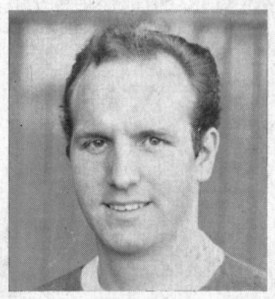
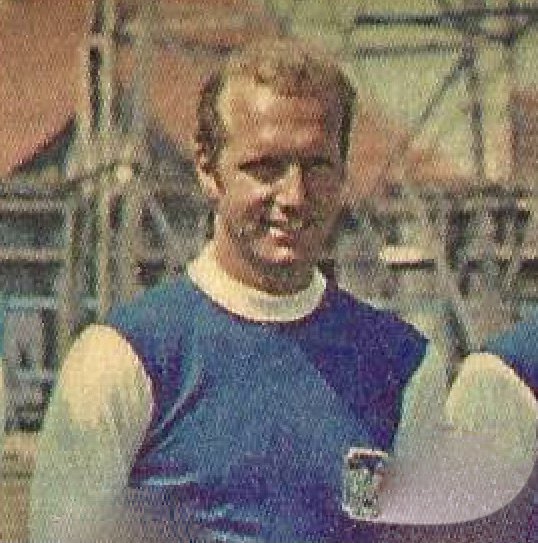
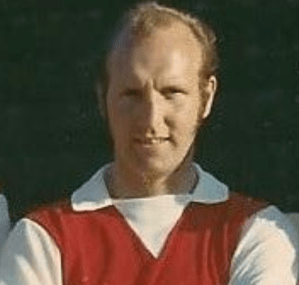
WHEN ANDY RITCHIE scored at the Goldstone Ground on 7 September 1996, it was a very different place to the stadium he’d graced as Player of the Year 14 years previously.
Ritchie was in his 20th season as a professional when he scored his 200th career goal for Scarborough against his former Albion teammate Jimmy Case’s Seagulls in a Nationwide Division 3 match.
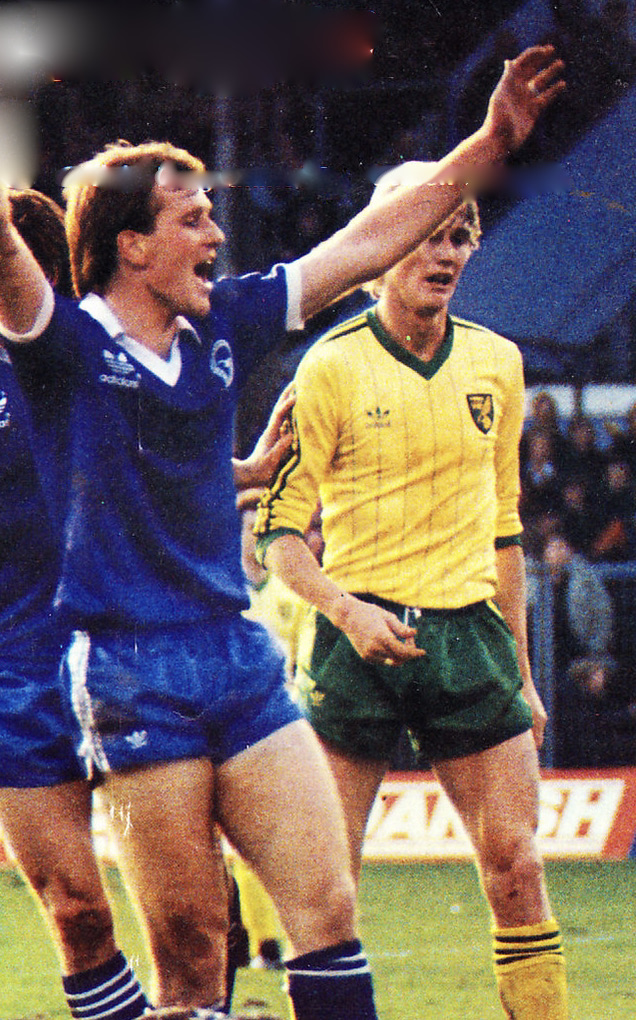
Just 4,008 hardy souls dotted around the crumbling old stadium supported the Albion that afternoon compared to the sell-out 28,800 crowd who packed in to see Ritchie’s last home match in Albion’s attack when they beat Norwich City 1-0, courtesy of a Case goal, in a quarter-final of the 1983 FA Cup.
Ritchie’s last endeavours in Albion’s colours came a week later and, ironically, were in front of 36,700 at Old Trafford on 19 March 1983 when he had a goal disallowed against the club who sold him to the Seagulls for what at the time was a record £500,000.

The curiosity of that deal was covered in my 2017 blog post about Ritchie and I’ve since discovered how a number of observers were dumbfounded by Dave Sexton’s decision to let him leave United.
That Sexton more often preferred the strike pairing of Joe Jordan and Jimmy Greenhoff baffled football writer Mike Anderson who, after Ritchie’s switch to the Albion, detailed how the departed forward’s numbers were more favourable.
“Since making his debut for United against Everton three seasons ago he has proved himself to be a more consistent marksman than the Scottish international,” wrote Anderson.
“By the end of the 1978-9 season Ritchie had scored 10 goals in only 20 full League appearances, compared with Jordan’s nine goals in 44 games. And when last season finished he had hit 13 goals in 23 full games (plus six substitute appearances), whereas Jordan had taken his tally to only 22 goals in 76 games.”
Anderson’s opinion was shared by Tony Kinsella, writing in When Saturday Comes in November 1997, he described Ritchie as “a muscular whippet of a striker with two scorching feet, a delicious first touch, and a bonce of solid granite”.
Kinsella wrote: “In four frustrating campaigns, Ritchie notched an admirable average of a goal every two games, a somewhat superior rate to his cohorts. In retrospect, I guess Ritchie was in the right place at the wrong time. He possessed more skill than Jordan and cut a more daunting physical presence than Greenhoff, but fell short of both when it came to vice versa.
“Sexton, notorious for fielding sides greyer than a Mancunian sky, had the courage to blood a teenage goalkeeper, Gary Bailey, but got cold feet when dealing with the loose cannon that was Andy Ritchie.”
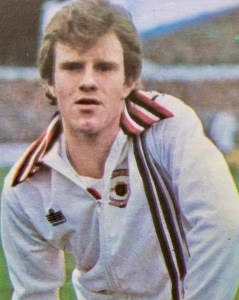
In a lengthy chat for the Fore Four 2 podcast, Ritchie revealed how it was Steve Coppell who took him under his wing as a newcomer to the United first team and ensured he got fixed up with a pension; something Ritchie hadn’t even considered.
And his roommate at United was wandering winger Mickey Thomas, who ended up following him to Brighton and also to Leeds!
While Sexton may have had reservations about Ritchie, plenty of other managers were keen to take him from United. Tommy Docherty, who had first signed Ritchie for the Red Devils, had wanted to take him to Queen’s Park Rangers but he was sacked as Rangers’ manager before a bid was in the offing. Chelsea and Newcastle made inquiries too.
Aston Villa offered United £350,000 for him but, after attending with his dad a face-to-face meeting with the glum-faced manager Ron Saunders, they turned down the move feeling he hadn’t conveyed that he really wanted him.
Ritchie also declared: “United were my home town team and I loved it at Old Trafford.
“It had been my aim since joining the United staff to be a success in their first team. I would have got a large amount of money had I gone to Villa, but I put self-satisfaction before money. I had received a lot of encouragement from the training staff at Old Trafford and I wanted to justify their faith in me by doing well at United.
“I knew that a transfer would mean adjusting to a side playing a different style of football. I felt that I might just as well spend that time proving I was worthy of a place at United where I was part of possibly the best club in the country. Unfortunately, I found myself playing reserve team football again until Brighton came in for me.”
In a 2019 interview with the Albion website, Ritchie remembered: “We always had a good team spirit and we all used to go out together. Everyone played golf and we’d be out in the nightclubs, Bonsoir and others where you had to wipe your feet on the way out.
“Great times, absolutely fantastic. And the spirit transferred itself onto the pitch. I used to joke at Q&As that we had so many great individuals but put us together and we were crap because the social life got in the way of our football. But no, it was a fantastic club to be involved in.”
Ritchie attended a rugby-playing grammar school and played cricket and hockey for Cheshire, only turning to football at 13 or 14. He played for Manchester and Stockport Boys and scored six goals in nine games for England schoolboys under skipper Brendan Ormsby, who went on to play for Aston Villa.
In the 1983 Shoot! album, Ritchie explained: “It was while I was playing for Stockport Boys that I first realised I had a chance of a career as a professional footballer.
“I was selected for the England Under-15 side and played at Wembley Stadium. The first was against Wales. We won 4-2 and I scored a couple of goals. I then scored another when England beat France 6-1. They were great moments for me and my family.
“Appearing for England was definitely the highlight of my young career but I also enjoyed playing for Stockport and in local Sunday football.
“I played for a team called Whitehill, who were sponsored by Manchester City. It was then that I realised I could play for the Maine Road club.
“I had trials with Leeds United, Burnley and Aston Villa, but I only wanted to play for City.”
It was while playing for Stockport Boys v Manchester Boys that former United captain Johnny Carey, scouting for his old club, spotted Ritchie and made an approach.
“I went down to The Cliff (United’s training ground) and never looked back,” he said. “It didn’t take me very long to soak in the atmosphere and appreciate the tradition and name of Manchester United and, in the end, I was quite happy to sign for the Old Trafford club.”
Ritchie was 15 when he put pen to paper, and he turned professional on 5th December 1977.
Handed his first start in United’s first team shortly after his 17th birthday, he played four matches without scoring but had caught the eye of the England Youth selectors. He made four appearances under joint managers Brian Clough and Ken Burton, making his debut in a 3-1 win over France on 8 February 1978. England drew the return leg of that UEFA Youth tournament preliminary match 0-0.
He went with the England squad to Poland for the 31st UEFA Youth tournament in May 1978, played in a 1-1 draw v Turkey and a 1-0 defeat v Spain but a trapped nerve in his hip meant he sat out the 2-0 defeat to Poland that meant England didn’t qualify from their group. That squad included Terry Fenwick and Vince Hilaire, Tony Gale and Ray Ranson.
“The following year I was selected for England Youth again for the Mini World Cup in Austria. Unfortunately, I went over on my ankle in training and could not make the trip,” Ritchie recalled.
Ritchie hoped his move to Brighton might boost his chances of gaining a full England cap, but he ended up winning a solitary England under-21 cap when he was called up by the same Dave Sexton who’d sold him from United! “That really was a bit bizarre,” Ritchie later recalled.
He featured in a 2-2 draw with Poland at West Ham’s Boleyn Ground on 7 April 1982. Fellow striker Mark Hateley scored both England’s goals.
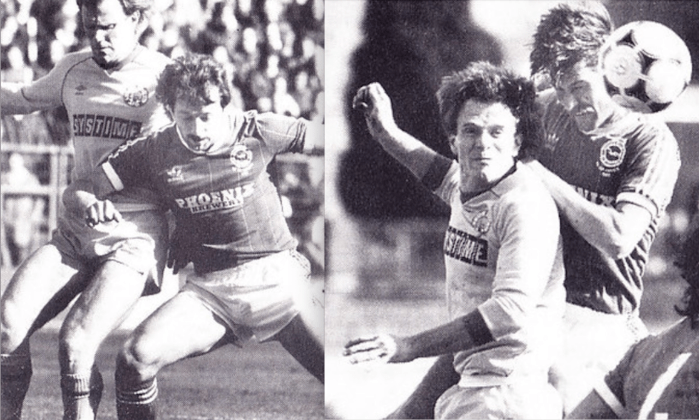
Ritchie’s time with Leeds was something of a mixed bag. The record books show he scored 44 times in 159 matches after he was signed by player-manager Eddie Gray. Playing in the second tier at the time, Leeds still had Gray, Peter Lorimer and David Harvey from the Revie era but Ritchie joined a mainly young side where the likes of John Sheridan, Tommy Wright and Scott Sellars were developing.
As Tony Hill observed on motforum.com: “Much of his time at Leeds was spent in dispute over his contract and for over a year he was on a weekly contract before moving to Oldham Athletic for £50,000 in August 1987.”
It was at Oldham where Ritchie really made his mark, scoring 82 goals in 217 league games (including 30 as a substitute) and helping them reach the League Cup Final and the FA Cup semi-final in 1990 and to win the old Second Division in 1991.
In 2020 the club’s official website declared: “Andy Ritchie is regarded as a club legend at Oldham Athletic and one of the greatest players to play for the club, having served Latics as a player as well as having a spell as manager.”
That goalscoring return to the Goldstone with Scarborough in early September 1996 came a year after he had joined the Seadogs as player coach on a free transfer. It was one of 17 he netted in the league from 59 starts and nine appearances from the bench.
By then a couple of months short of his 36th birthday, thankfully the Seagulls prevailed 3-2 courtesy of goals from Stuart Storer and two from Craig Maskell (the 99th and 100th of his career).
It certainly wasn’t the first time Ritchie had netted against the Seagulls. Twenty months after departing the Goldstone he scored the only goal of the game, tapping in from eight yards out, when Leeds beat the Seagulls at Elland Road.
He also scored for Oldham to knock Albion out of the FA Cup when the Latics won 2-1 in the fourth round on 27 January 1990. In a 1-1 draw at the Goldstone two months later, Ritchie missed a penalty but he made amends the following season scoring home and away against the Albion, netting twice in their 1 December 1990 6-1 thumping of the Seagulls on Oldham’s plastic pitch and scoring both when the Latics left the Goldstone 2-1 winners on 2 March.
He returned to Oldham on 21 February 1997 after Neil Warnock took him to Boundary Park as his player-assistant manager. He scored three times in 32 appearances, many of which were as a sub.
But when Warnock left to join Bury at the end of the following season, Ritchie was appointed as his successor. He managed 179 games, winning 59, drawing 45 and losing 75 with a win percentage of 32.96%.
After being sacked in 2001, he was out of work for three months before being appointed academy director at Leeds at a time when fellow ex-Man Utd player and coach Brian Kidd was head coach under Terry Venables and David O’Leary.
He found himself out of work again in 2003 when Peter Reid took charge but six months later he joined Barnsley, initially as academy manager before becoming first team coach under Paul Hart.
When Hart left Barnsley in March 2005, Ritchie was appointed caretaker manager and then landed the position permanently in two months later.
At the end of the following season, he led the club to a penalty shoot-out win over Swansea City in the League One play-off final at the Millennium Stadium, Cardiff.
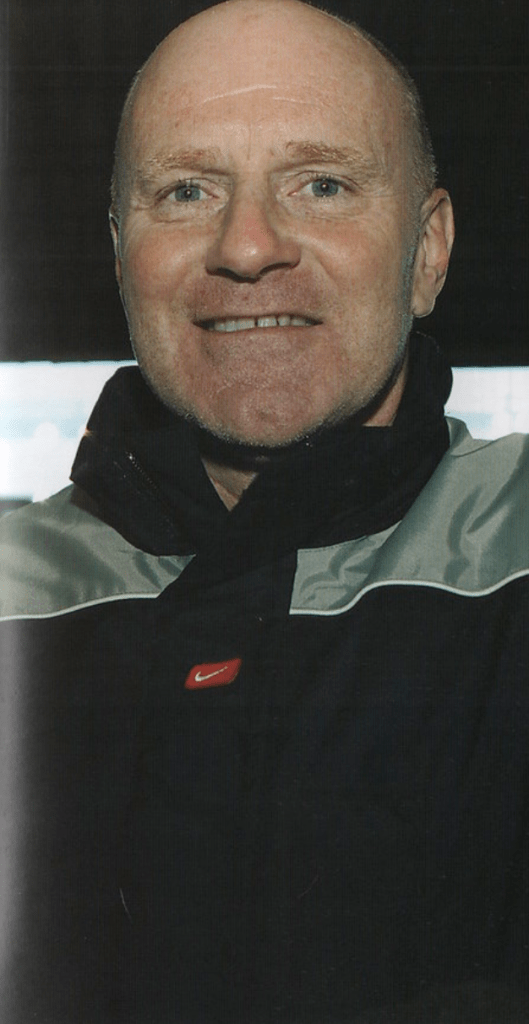
But the Championship season was only four months old when Ritchie was relieved of his duties with the Tykes struggling in the relegation zone.
Four months later, he was appointed manager of League One Huddersfield Town and told the club’s website: “There’s such massive potential here.
“There is no doubt that the club is geared up for promotion to the Championship and that has to be the aim now. It’s now a case of getting the players re-motivated and once we get into the Championship, we can reassess the situation.
“I tasted promotion last season and it was a great feeling – now I want to do it again as soon as possible.”
Unfortunately, he wasn’t able to steer the Terriers to that goal and, after a 4-1 defeat against his former employers Oldham, he parted company in April 2008.
They won only 22 of his 51 games in charge although they did enjoy their best FA Cup run for 10 years which only came to an end in the fifth round when they were beaten 3-1 by a Chelsea side under Avram Grant that included Wayne Bridge and Steve Sidwell.
After all that, Ritchie returned in a watching brief to where it all began: at Old Trafford.
On matchdays, he worked as an ambassador in a hospitality lounge, and contributed to MUTV and Radio Manchester.



 In parallel lines