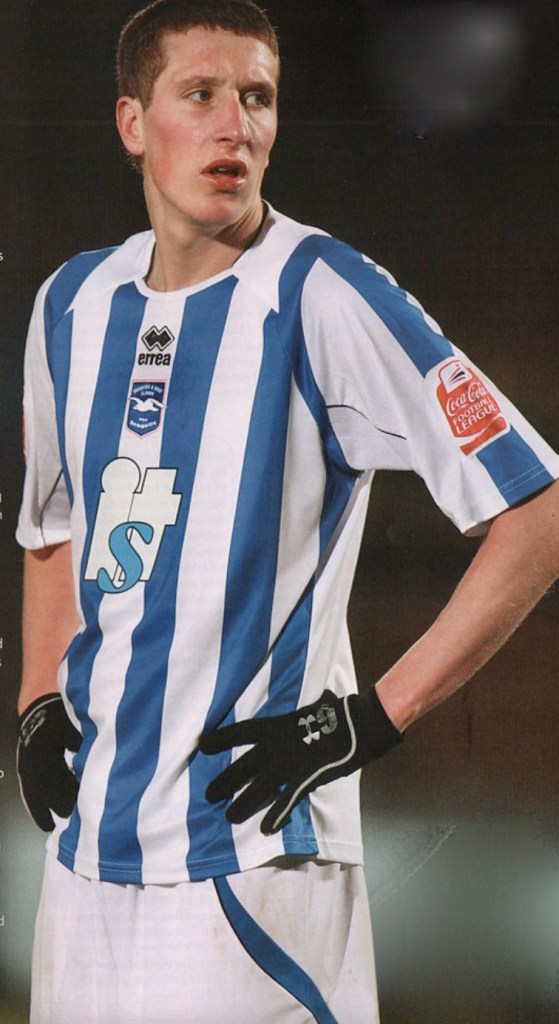
‘Glove-wearing gazelle’ played only 16 Albion games

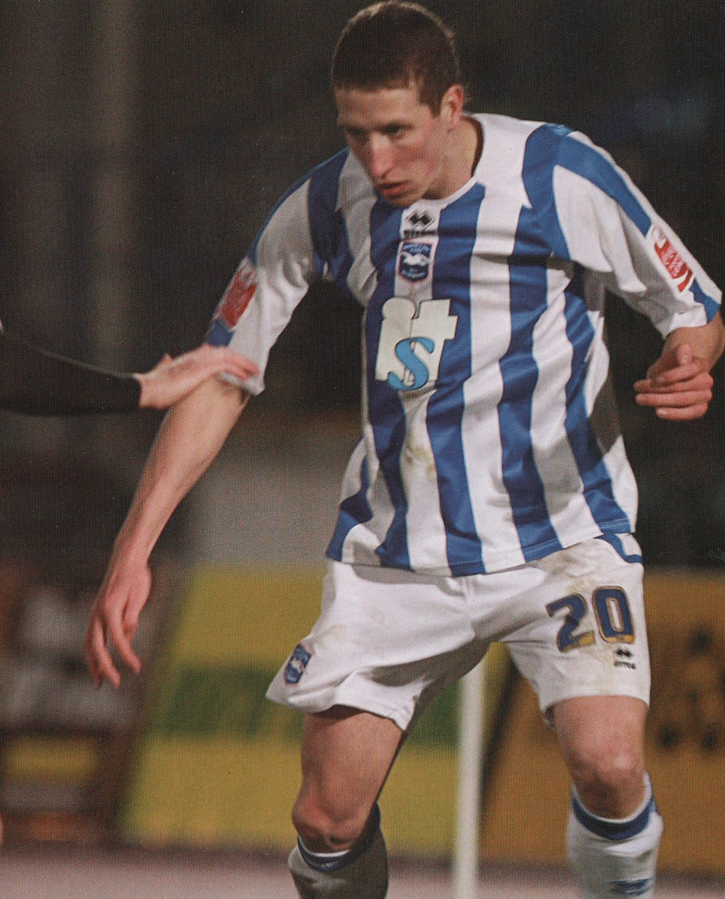
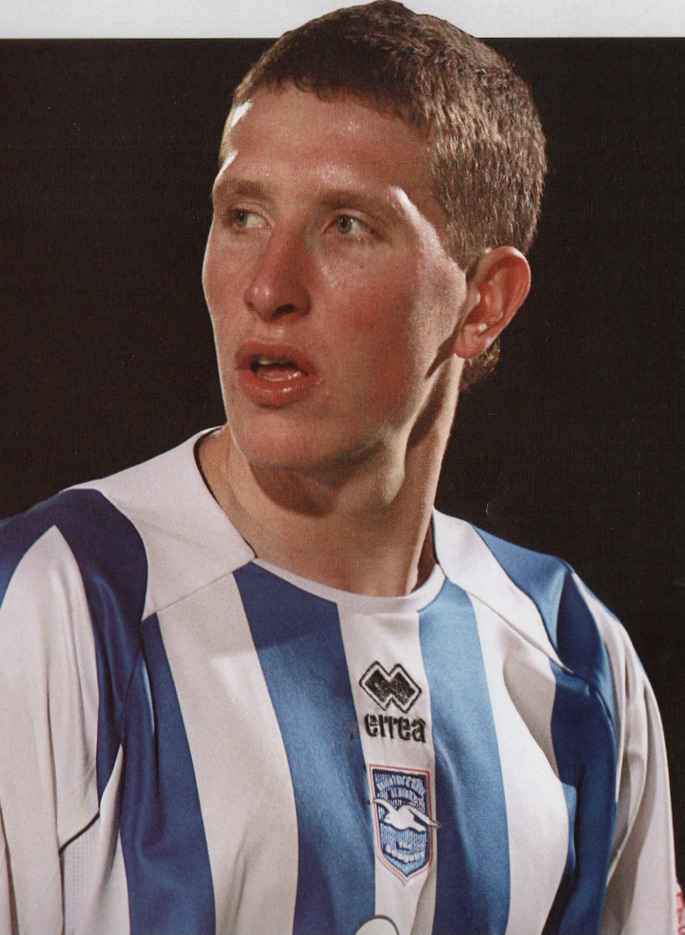
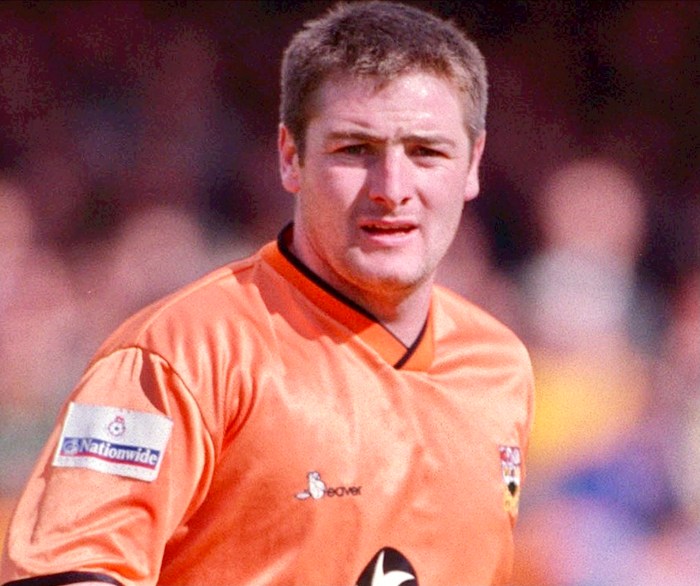
SCOUSE defender Jim McNulty, who played alongside Wayne Rooney at Everton as a schoolboy, will probably always be remembered by Brighton fans for a horror injury he suffered in a match at Withdean.

After an on-off transfer saga in which McNulty initially rejected Albion’s desire to sign him, the £150,000 signing from Stockport County scored on his debut and less than three weeks later was involved in an accidental collision that threatened to end his career at 23.

In only his fifth game after under-pressure boss Micky Adams finally landed the left back, a seemingly innocuous challenge as a Crewe defender caught him with his knee in his side quickly became much more serious when he started passing blood.

“Having walked back to the changing room I remember having the sensation of needing to go to the toilet and it was then that blood started spurting out,” he recounted. “I was also throwing up and the real scary part was the look of concern on the medical team’s faces.

“I was rushed to the Royal Sussex County Hospital for an MRI scan and had a catheter inserted as my belly was swelling up. It was then that I discovered one of my kidneys had capitulated.
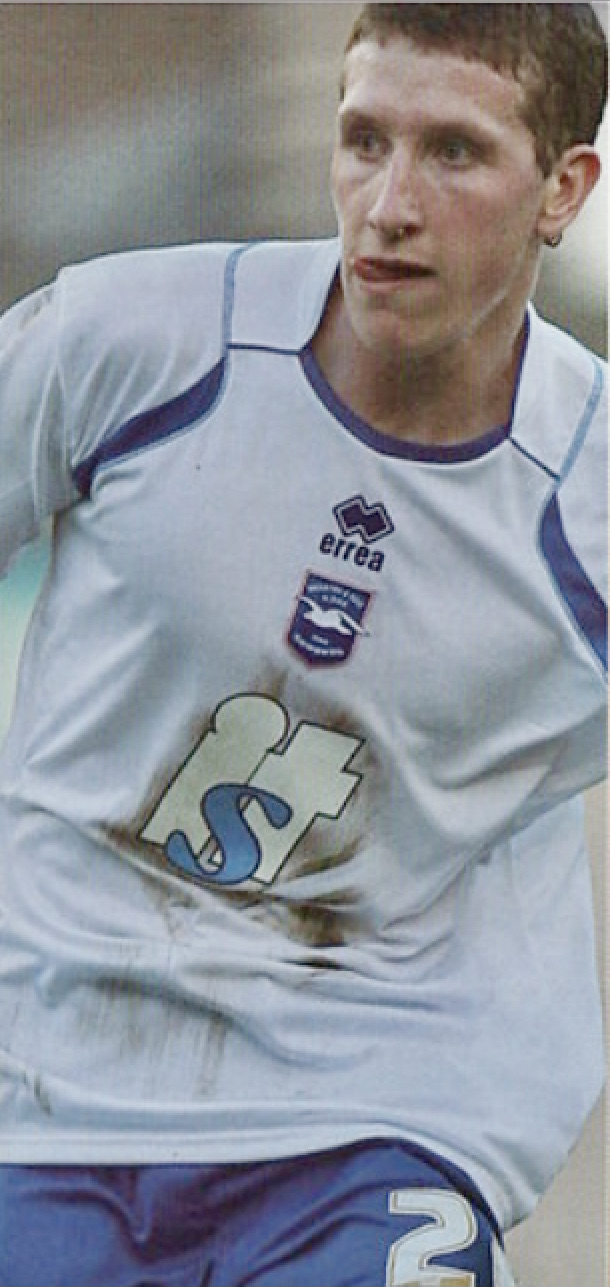
“I was on the bed in the hospital after the scan when the surgeon said 90 per cent of the kidney is mush and I don’t believe you can play again,” McNulty told the club’s official website.

Nine years later, ahead of facing Harry Kane for Rochdale against Spurs in the FA Cup, McNulty told Ivan Speck of the Express: “It was instant tears. I was there with my father and fiancée, at the time. I remember crying into my dad’s chest.

“It was probably a bit of everyday information for him but, for me, football was my life and he should have stayed quiet until he was better informed. It still winds me up now.

“The FA actually got wind of the news and their doctor spoke with our club doctor. They had spoken to some rugby guys in the southern hemisphere because it’s a more common injury in rugby than it is in football.

“It was nonsense to suggest it would end my career.”

Initially, because he was a professional sportsman, the medics tried two operations to save the kidney but, when he was still passing blood three weeks later, the decision was taken to remove it.

McNulty described incredible pain he had to endure but realised once he had gone through with the operation that he would be able to play football again.
Amazingly, he was able to return to training within three months although he had a lot of work to do to rebuild his fitness. Within four weeks he was even able to play in a couple of pre-season friendlies.

However, McNulty went on to suffer a number of knock-on injuries because his posture was affected by having an empty space on the right side of his body.

“I had multiple ankle injuries because my pelvic alignment was a nightmare from that point on,” he said.

The first came just when it looked like he would make a return to league action in September 2009. He damaged his ankle ligaments on a local park pitch while training ahead of the 7-1 defeat at Huddersfield and was ruled out for a further four weeks.

His long-awaited return to first team action came in a Johnstone’s Paint Trophy tie away to Leyton Orient on 6 October, which Albion lost 1-0.

“Just to get out on the pitch and on the ball was fantastic,” he said. “I cramped up after about 70 minutes but the reaction from our fans was tremendous.”

McNulty told the matchday programme: “I have no intention of just sitting around, hoping to break into the side. I want to be playing every week now. I’m fit, raring to go and I want to help us get up the table.”

The unlucky McNulty then missed the following Saturday’s match at MK Dons, enduring yet more pain when he had to have two wisdom teeth extracted.

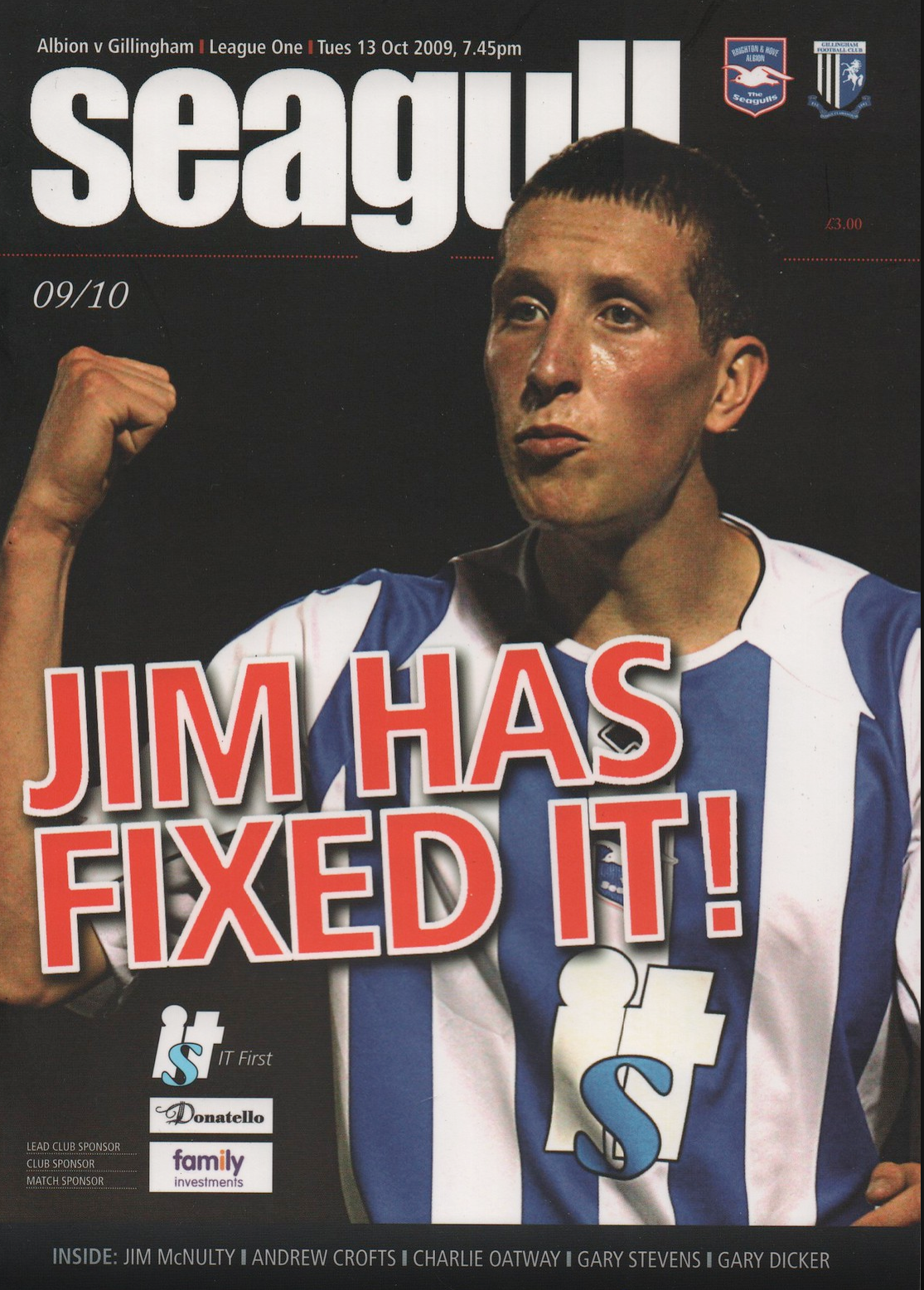
Nevertheless, McNulty’s eventual return to league action followed on 13 October in a 2-0 Withdean win over a Gillingham side which featured former Albion loanee Simon Royce in goal.

Astonishingly, the following Saturday, he lasted only 27 minutes before injury struck again in a 2-1 defeat away to Tranmere. He limped off with an ankle injury and Jake Wright was sent on to replace him. Glenn Murray scored a penalty consolation for the Albion and was then sent off for a second yellow card.

By the time McNulty was fit enough to return, the second manager of his brief time at the Albion, Russell Slade, had been replaced by Gus Poyet. His first involvement under the new boss saw him go on as a sub against: Charlton at home on 1 December.

He then went on as an 87th minute substitute for his good friend Gary Dicker at Exeter and provided the all-important cross from which Andrew Crofts headed the only goal of the game in the 92nd minute.

He had what one observer described as a man of the match involvement as a sub in the next match, a 2-1 home defeat v Colchester United. Saying the left back was “the epitome of Poyet’s ‘bravery on the ball’ mantra”, Richie Morris wrote: “Jimmy McNulty, like a rampaging glove-wearing gazelle, mercilessly attacked the left flank. Time and again he delivered teasing crosses, and time and again the ball simply would not nestle in the net.”
McNulty celebrates with goalscorer Tommy Elphick

That performance was rewarded with four starts on the trot – but then Poyet brought in the cultured Marcos Painter as his preferred left-back. McNulty was in the Albion side that put on a decent show in a 3-2 fourth round FA Cup defeat at Aston Villa, because Painter was ineligible, but he didn’t make another start that season. And, as it turned out, he didn’t play for the club again. He’d actually only played 16 times for the Albion.

Before the end of the season, to get some games, McNulty actually stepped up a level, going on loan to Scunthorpe United in the Championship, where he made two starts and a sub appearance under Nigel Adkins.

He rejoined The Iron in July 2010 on a six-month loan arrangement and played six games. But he suffered a recurrence of his ankle issues, so returned to Brighton in December.

When Albion kicked off a new era playing Championship football at the Amex, McNulty had stayed at the same level but with Barnsley, where he was voted players’ player of the year in his first season, and was made captain in his second season at Oakwell.

McNulty certainly wasn’t bitter about the way things turned out for him in Sussex. He said: “I couldn’t speak more highly of my time with Brighton. It is an unbelievable club, an unbelievable fan base, and it was an incredible place to live.

“My daughter was born there and we had a brilliant time, despite the fact that I was horrendously injured for pretty much all of that time.

“I’ve always been a 40-game-a-season man wherever I’ve been, but at Brighton I hardly played at all. Saying that, it was the club I had the best time at.”

Born in Runcorn on 13 February 1985, Liverpool and Everton were both interested in him when he was young, but it was Everton who put a contract offer in front of him.

“At the time I actually played for Everton against Liverpool in a game at Melwood,” he explained. “This would have been in the under-9s and we absolutely destroyed them.

“Ourselves and Arsenal dominated in that particular age group, right up to the under-16s – every week, every game, every season. Everton were a very dominant team and it gave me a great grounding, so I chose the right team.”

Initially a central midfield player, McNulty was switched to left-back during his time at Everton. Although Rooney was in the year below him, from under-10s, he was put up an age level. “I played with him for about four years until he jumped up again,” said McNulty. “He was playing two or three years up during the teenage years. I was just always playing at my own age.

“He was incredible, incredible. It was like watching a man play with boys in terms of his strength and aggression. He was pinging balls 70 yards as a 10- or 11-year-old boy.

“We couldn’t really lift it off the floor yet. His technique and the power that he had as a young boy, he was devastating at that age. He’d score eight goals every week. He’s one of the reasons we were so rampant as a team. Probably the main reason.”

McNulty moved on to Wrexham to make his breakthrough at senior level, ironically going on as a sub against Stockport in a Northern Section Football League Trophy game which the Welsh side lost 5-4 after extra time.

Because he had a Scottish mother, Englishman McNulty was selected for Scotland at under-17 and under-19 level, although one of his worst footballing memories came while playing for Scotland against France when they were beaten 5-0 in the European Under-19s Championship.

“I always remember being particularly mentally scarred by one player,” he said. “He was a winger and I was at left-back – and he scored four, so obviously that was mentally scarring. His name was Jimmy Briand.”

Briand went on to have a 20-year playing career in France and Germany and played five times for the senior French national team, but McNulty didn’t make it to the Scots full international side.

“There was a time when I had some genuine belief that it might happen,” he told The Sunday Post. “I had a good season in my first year at Barnsley in the Championship, in 2011, and ended up being named player of the year and made captain of the club.

“At the time, Scotland were having a bit of a defender crisis, and there was an opportunity there. I actually thought, ‘My name might come out of the hat here.’ But they ended up choosing a couple of guys who were playing in League One at the time ahead of me. That was a bit of a disappointment.”

But back to those early days, and when he didn’t make further progress at Wrexham he dropped down to League of Wales level to play for Bangor City and Caernarfon Town, but in June 2006, former Albion skipper and manager Brian Horton signed him for Macclesfield Town.

“I appreciate what Brian did for me, bringing me back into league football,” he said. “I was playing non-league football in Wales and he gave me a chance to come back and prove myself.”

He spent 18 months at Macclesfield, where he also played under Paul Ince, before moving to Stockport on a free transfer in January 2007. He became part of the County side that won promotion via the League Two play-off final at Wembley, when they beat another of his future employers, Rochdale, 3-2 in front of a crowd of 35,000.

McNulty was reluctant to give up a League One promotion tilt at County to join struggling Albion but chairman Dick Knight and manager Adams spoke of the club’s ambition and he was finally persuaded.

Albion needed a left back after loan signing Matt Richards had returned to Ipswich and

Adams said: “He fits the profile of what we are looking for. He likes getting forward and, without being disrespectful to anyone who has played there before, he is a natural defender, and he is six-foot two. At one stage it looked like we had lost out, so I am delighted to get him.”

Knight and Adams finally persuade their man to sign for the Albion

McNulty was not alone as Knight sanctioned quite a spending spree on new signings – Craig Davies, Calvin Andrew, Seb Carole, Jason Jarrett and Chris Birchall also arrived in that window, all financed by Tony Bloom, a low-profile investor at that time.

“I am very satisfied,” said Adams. “Finding a left back was a major priority. We haven’t been scoring the amount of goals we should, so we needed to look at avenues to open up teams. We have got Carole and Birchall for that.

“We also needed two strikers (Davies and Andrew) to increase the striking options and we needed a bit more physical strength in midfield, which is why Jason (Jarrett) is there, so I can’t complain.

“I had to be patient to make sure the right type of player was available and at the right price. Two of them were money buys and I am delighted that the board have backed me.”

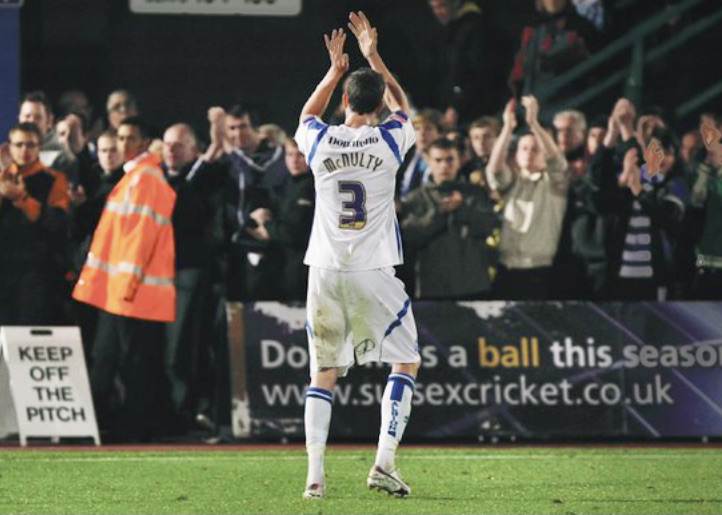
Both Davies and McNulty were on the scoresheet when Peterborough visited the Withdean on 10 February but Barry Fry’s side took away the three points courtesy of a 4-2 win; Craig Mackail-Smith scoring for Posh along with strike partner Aaron McLean (two) and Dean Keates.

With only one League One win in six and a hoped-for tilt at silverware – the Johnstone’s Paint Trophy – gone in a penalty shoot-out defeat to Luton Town, the second coming of Adams was over. That horrendous injury to McNulty came while Dean White was caretaker manager and, when new boss Russell Slade arrived, one of his first tasks was to bring in Gary Borrowdale on loan from QPR to cover McNulty’s absence.

A change in manager often spells bad news for certain players and, after those successful first two seasons at Barnsley, McNulty found his face didn’t fit when David Flitcroft succeeded Keith Hill as manager. He’d only had one first team outing in a Capital One Cup tie against Southampton.

He grabbed the chance to join Tranmere Rovers on loan in November 2013, although he told the Liverpool Echo: “I have not even had a chance there.  I think I should still be playing for Barnsley.

“They are struggling defensively this season and had been conceding a lot of goals. But now I’m thinking about helping Tranmere.”

Rovers boss Ronnie Moore said: “Jim is a knowledgeable player and a good talker. He settled in quickly here. He is a footballing centre-back, rather than the Terry Butcher type. I don’t think you will see too many cuts and bandages around Jim’s head. He is clever. He drops off and picks the ball up.”

In January 2014, McNulty reached a mutual agreement with Barnsley to terminate his contract and he switched to Bury under old boss Flitcroft. He played 51 times for the League Two Shakers before beginning a long association with Rochdale in 2015.

McNulty in control with the Shakers

Over eight seasons, McNulty played a total of 237 matches for Dale, eventually combining coaching with playing. In August 2022, he found himself in interim charge for three matches after the club sacked Robbie Stockdale.

Former Morecambe boss Jim Bentley was appointed manager but when his services were dispensed with in March 2023, with Rochdale at the foot of League Two, 2023, McNulty once again stepped in as boss.

He was unable to prevent the club’s 102-year reign as a league club coming to an end but, in May 2023, he was appointed manager on a two-year deal.

“The opportunity to lead our team and represent our club, which the fans cherish, has always been a dream of mine,” he said.

“To be given the opportunity at a club so close to mine and my family’s hearts, is really special to me.
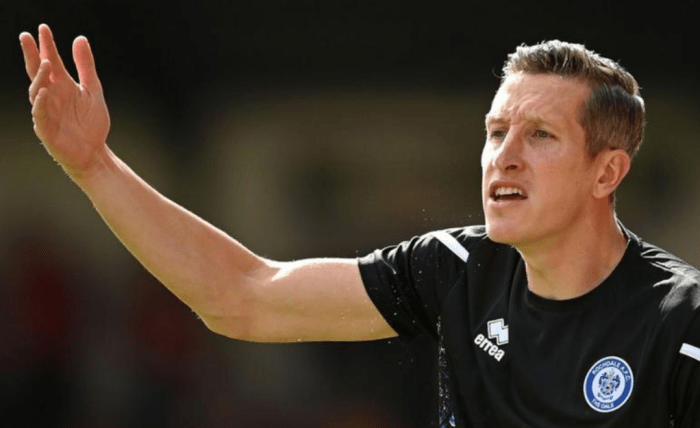
“As a boy, first and foremost, I dreamt of becoming a footballer, then when I did, I very quickly knew I wanted to become a manager thereafter.

“Within a couple of years of being a Dale player, I knew that this would be the club where I hoped to fulfil that ambition.”
How the gaffes of goalie González worked both ways

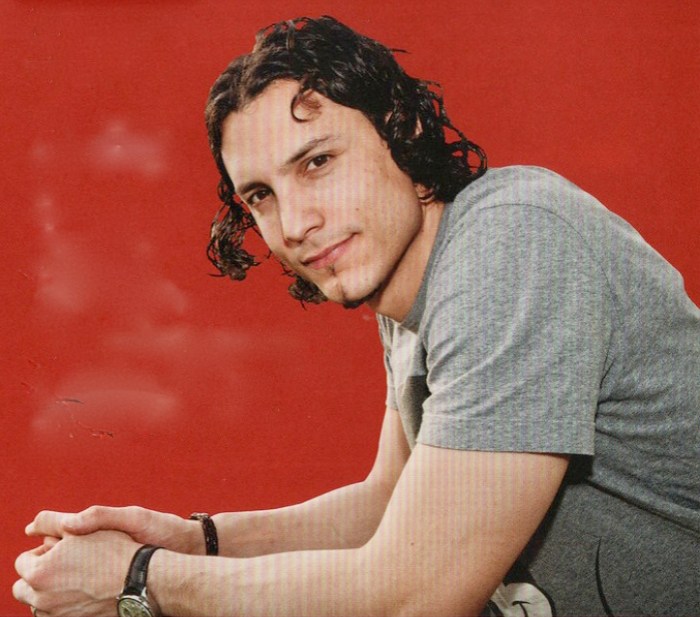
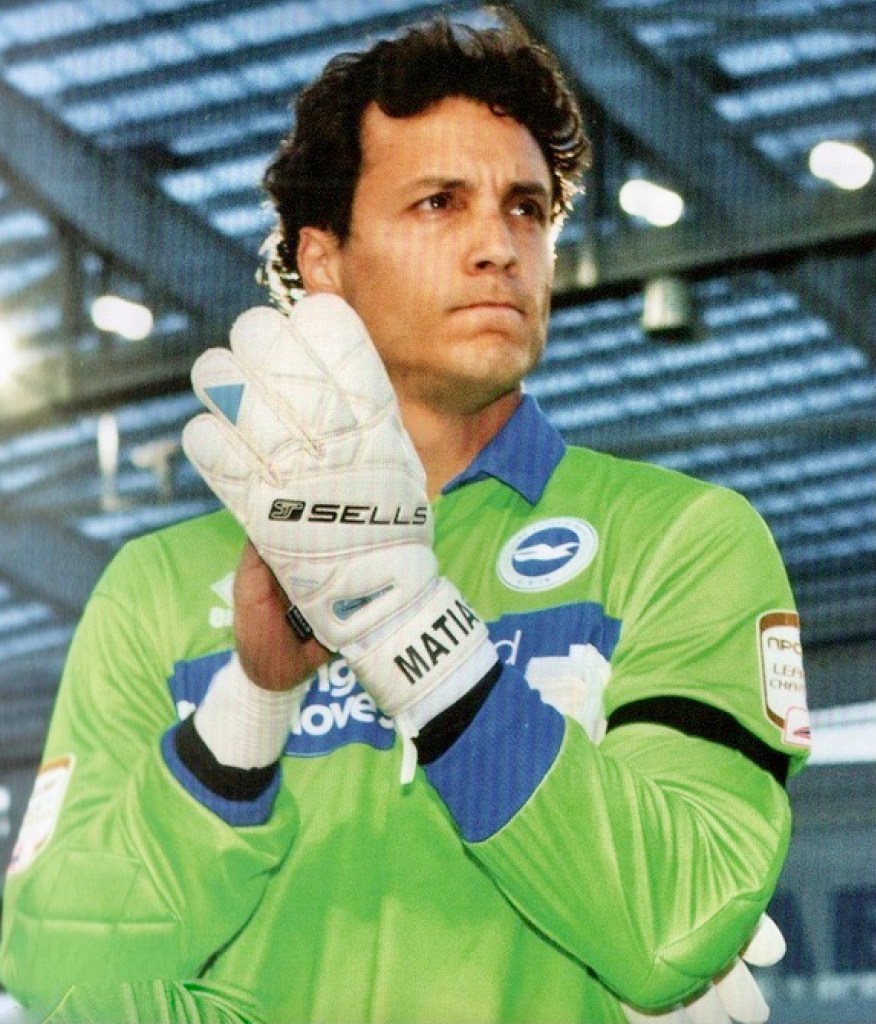
DAVID GONZÁLEZ might well have been an experienced international goalkeeper but conceding a soft goal on his debut didn’t go down well with the Albion faithful.

Brighton fans were a whole lot happier when the same player shipped five AGAINST the Seagulls four months later.

Columbian González, who’d spent two years as a Manchester City back-up ‘keeper, only played twice for the Seagulls during a short-term deal in 2012.

After signing him in January that year, manager Gus Poyet finally gave him a chance at the end of the season after Peter Brezovan had conceded six in a thrashing at West Ham. González was one of six changes to the line-up that had capitulated at the Boleyn Ground.

But, against Watford at the Amex three days later, there were only six minutes on the clock when the Colombian saw Sean Murray’s cracker of a free-kick sail over him into the net.

When González did make a routine save, supporters in the North Stand greeted it with sarcastic applause, which incensed Poyet. In his post-match interview with the Argus, he said: “If David had let a goal in through his legs I wouldn’t agree but I would understand that sometimes we take the mickey out of somebody, but it wasn’t like that so they need to be careful.

“I don’t like it because they are being unfair to an unbelievable group of players who are bringing plenty of joy to this football club and attacking any single person is attacking the whole club.”

The ‘keeper’s debut hadn’t got much better when Troy Deeney put Watford 2-0 up with a penalty a minute before half-time. Thankfully Albion hit back in the second half and forced a draw with goals from captain Inigo Calderon and former Hornet Will Buckley.

Ironically, the Watford ‘keeper that night, Tomasz Kuszczak, was brought in by Poyet that summer and González ended up at Barnsley – the side he made his only other Albion appearance against in the last game of the season.

González keeps goal for Albion at Barnsley and, below, sees five go past him when playing FOR the Tykes at the Amex at the start of the next season

At least he didn’t concede at Oakwell, although the 0-0 bore draw was a dire spectacle: a typical end-of-season encounter.

Almost the only things of note were that Barnsley included a young John Stones in their line-up together with David Button in goal and former Albion flop Craig Davies was up front.

In one of those strange quirks of football, González was back at the Amex at the end of August having been drafted in by the Tykes to cover a goalkeeping injury crisis.

It was not a happy return. As the Yorkshire Post reported: “Brighton were 2-0 up after only 14 minutes, with goals from Ashley Barnes and former England defender (Wayne) Bridge, with Barnsley goalkeeper David González at fault on both occasions.”

González dropped a free-kick by Craig Noone for Barnes to tap in after three minutes and the Colombian was “simply a bystander” when Bridge beat him to his left with a low drive from 25 yards. It was Bridge’s first league goal for nine years.

Ashley Barnes wheels away after scoring past Albion’s former ‘keeper

Barnsley pulled a goal back with a 36th-minute penalty from Davies after Andrew Crofts fouled Jacob Mellis, but Craig Mackail-Smith got the final touch on Barnes’s shot a minute later.

Mackail-Smith scored again four minutes after half-time with a close-range header and Barnes made it 5-1 10 minutes from time, slotting home Kazenga LuaLua’s cross.

Barnsley boss Keith Hill said afterwards: “We had 12 players out but I have no excuses whatsoever. It was inept and I include myself in that. The opposition were excellent and it could have been up to 10-1.”

Born in Medellín on 20 July 1982, González began his career at his hometown club Independiente Medellín and he played more games for them than any other club he subsequently joined (he returned for a four-year spell between 2015-19). And in June 2022 he was appointed their manager.

González also had two separate spells with another Columbian side, Deportivo Cali (he ended his playing career with them in 2020) and left South America for Turkey in 2007, spending two seasons with Çaykur Rizespor.

After failing to make an impression with Argentinian side Club Atlético Huracán he had a successful trial at Manchester City in late 2009 during Roberto Mancini’s reign. He wasn’t named in their 2010-11 Premier League squad but he was the reserve side’s regular ‘keeper until, in the second half of the season, he was sent on loan to Leeds, where he remained back-up behind Kasper Schmeichel and Shane Higgs.

He was unlucky not to get a chance back at City when he sustained an injury at the same time as Shay Given and no.2 Stuart Taylor. Marton Fulop was brought in on loan from Sunderland instead.

At the start of the following season, González was sent on a six-month loan arrangement to Aberdeen, where he hoped his performances would catch Mancini’s eye.

“I want to have a good spell at Aberdeen and to show Mancini that I should be considered for the team,” he told the Daily Record. “But Man City have so much money they can go out and buy just about any player they want.

“The way things are going they will become the best team in the world and I see that happening sooner than a lot of people think.”

The goalkeeper featured in 14 games for the Scottish Premier League club when first choice Jamie Langfield was sidelined following a seizure. On his return to Manchester, his contract was terminated by mutual consent and the free agent was taken on by Brighton, where Poyet had just dropped Casper Ankergren and installed Brezovan as his first choice ‘keeper.

Poyet told seagulls.co.uk: “David is an international with an excellent pedigree, playing over 300 senior games at the top level in South America, Turkey and Scotland. He has won the league in Colombia and has been capped by the national team.

“The idea is for David to compete with Peter and Casper to be first choice. Peter has come in recently and done very well, and is currently number one, but it’s now up to both David and Casper to put pressure on him to be first choice.”

That mauling at the Amex in August 2012 was one of only three Championship games González played for Barnsley and in Albion’s matchday programme he had admitted he saw his time with the Tykes as a shop window.

“I want people to come and have a look, to see what I’m capable of, but nothing else has been said really,” he said. “I’m just here for the time being while the boys are out with injury and suspension, so I’m just going to enjoy it and try to do the best I can.” Oops!

The following year he moved back to Columbia, initially playing for Deportivo Pasto, then Águilas Doradas before returning to Independiente Medellín in 2015.

Talent spotter John Doolan now eyeing forwards for Brighton

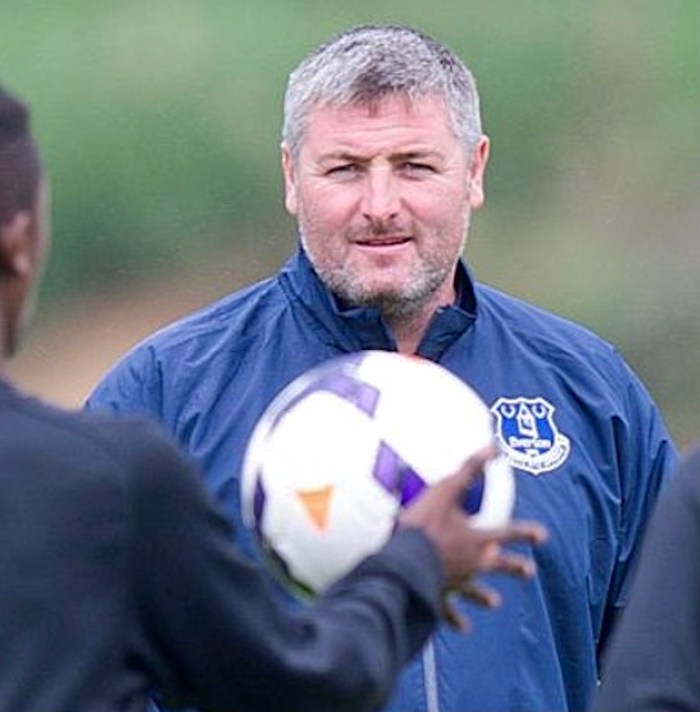
THE SCOUSER searching for Brighton’s next Evan Ferguson had Everton blue coursing through his veins from an early age.

But John Doolan’s long association with the Merseyside club came to an end in February 2023 when he swapped places with another backroom man, Lee Sargeson, who joined Everton as their head of scouting operations. Sargeson spent more than five years working in Albion’s much-admired scouting set up.

Now Doolan, a former Everton academy player, has been tasked by another well-known Evertonian, Albion technical director David Weir, and head of recruitment, Sam Jewell, with scouting forwards for the Seagulls.

Although not making it into Everton’s first team himself, Doolan helped to develop the likes of Shane Duffy, Tom Davies and Ross Barkley at Finch Farm.

During more than a decade working behind the scenes, he coached youth teams, worked on player and team development and rose through the scouting and recruitment departments.

After being released by the Toffees on a free transfer, Doolan’s own playing career spanned 550 matches for six clubs in the lower leagues, starting at Mansfield Town. His former Everton coach, Colin Harvey, took him to Field Mill where he’d become assistant manager to another ex-Evertonian, Andy King.

Simon Ireland (Albion’s under 21s coach for 21 months between June 2013 and February 2015) was a teammate at Mansfield. In a matchday programme pen picture of Doolan, when the Third Division Stags visited the Goldstone, it said: ‘Big things are expected of this stylish midfield player.’

He played 151 games for Town in a four-year spell before moving on to Barnet for a £60,000 fee in 1998. In five years with John Still’s Barnet, Doolan made one short of 200 appearances and was a teammate of skilful wideman Darren Currie, who later proved a popular signing for Mark McGhee’s Albion side in the Championship.

He was also at the club when they lost their Football League status in 2001 and became regarded as one of the best midfielders in the Football Conference.

Doolan switched to fellow Conference side Doncaster Rovers for a small fee in March 2003 and helped them gain promotion back to the League via the play-offs.

Described on Donny’s website as “a combative but skilled midfielder” he was a key member of the side that won the Third Division championship in 2003-04 and, in total, made 92 senior appearances for Rovers, scoring three goals.

In a Bred a Blue podcast interview reflecting on his career, he said: “Donny was the best. We won the league twice. The lads were great. It was like Kelly’s Heroes; a bunch of misfits put together and we went on a double promotion. There were some very good players in there.”

The only period of his playing career he regretted was when he was drawn to League One Blackpool by money. By then he was 31, and the move only lasted six months. “I had to play 25 games to get a new deal and I played 24,” he said.

He went on loan to League Two Rochdale in January 2006 and made the move permanent within 10 days. Doolan had already begun to think ahead and had taken some coaching badges while still playing. In just short of two and a half years with Rochdale he clocked up 90 appearances before, aged 34, taking his next steps in the game.

When he left Dale in May 2008 to take up a player-coach role at Blue Square North side Southport,  

Dale boss Keith Hill said: “John is a fantastic character and will be missed. He always gave 100 per cent and provided a fantastic example to the young players in the dressing room.”

He added: “I cannot speak highly enough of him and I am sure he will make a real success of coaching because he is a natural.”

Neil Dewsnip, who worked at Everton’s academy for 17 years, had already taken Doolan back to Everton as a part-time youth coach after they’d met on a coaching course. It was at the time Everton’s youth development centre was moving from Netherton to Finch Farm, and Doolan started coaching a couple of days a week while also fulfilling his duties at Southport before returning full time.

In the years that followed, he worked with all the different age groups and, under Kevin Reeves (the chief scout during the reign of Roberto Martinez) he moved into talent identification, watching promising young players across the region.

Born in Liverpool on 7 May 1974, Doolan joined Everton as a 14-year-old schoolboy, having been picked up after playing for Liverpool Schoolboys.

He started training two days a week – David Unsworth and Billy Kenny were contemporaries – before signing as a youth trainee. “My YTS days were the best days of my footballing career,” he told the podcast. “I loved every single minute of it.”

Doolan described to Bred a Blue the enjoyment he got when getting involved with the first team in training but, as a right-back, he had stiff competition and when Everton signed Paul Holmes he saw the writing was on the wall.

“I realised I wasn’t good enough,” he said. “They brought in Paul Holmes and that was like a kick in the teeth. They paid a fee for him (£100,000 from Birmingham City) and they were always going to prefer him.”

There was a momentary glimmer of a chance under Howard Kendall, but he broke an ankle in a youth cup game and the opportunity was gone.

He was sent to Bournemouth for a brief loan spell under Tony Pulis and on his return to Merseyside was told he wasn’t going to feature. “I still had a year on my contract but I decided to leave,” he said. “When I left Everton and went to Mansfield I changed position and went into midfield. I never played at the back again.”

Bred a Blue says of Doolan: “His is a story of how the adversity of being released can be overcome by resolve, hard work and confidence in your own ability.”

Doolan was one of a trio of senior scouts (Pete Bulmer and Charlie Hutton were the others) who were made redundant by the Albion in November 2024 as part of a shake-up of the recruitment department.

Liam Bridcutt was the Real deal for Poyet’s Brighton

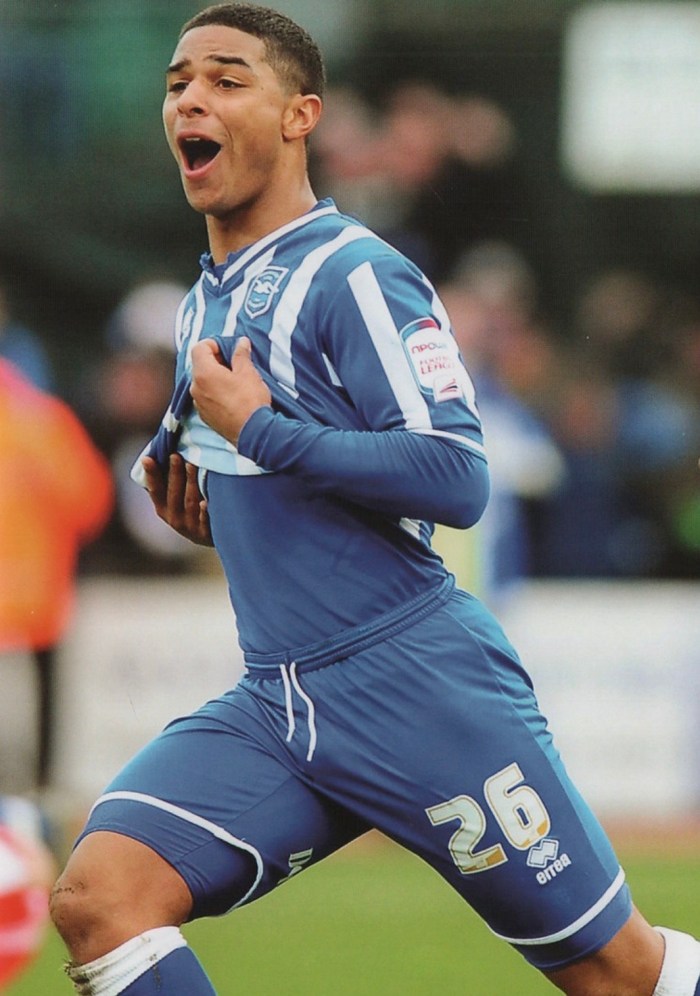
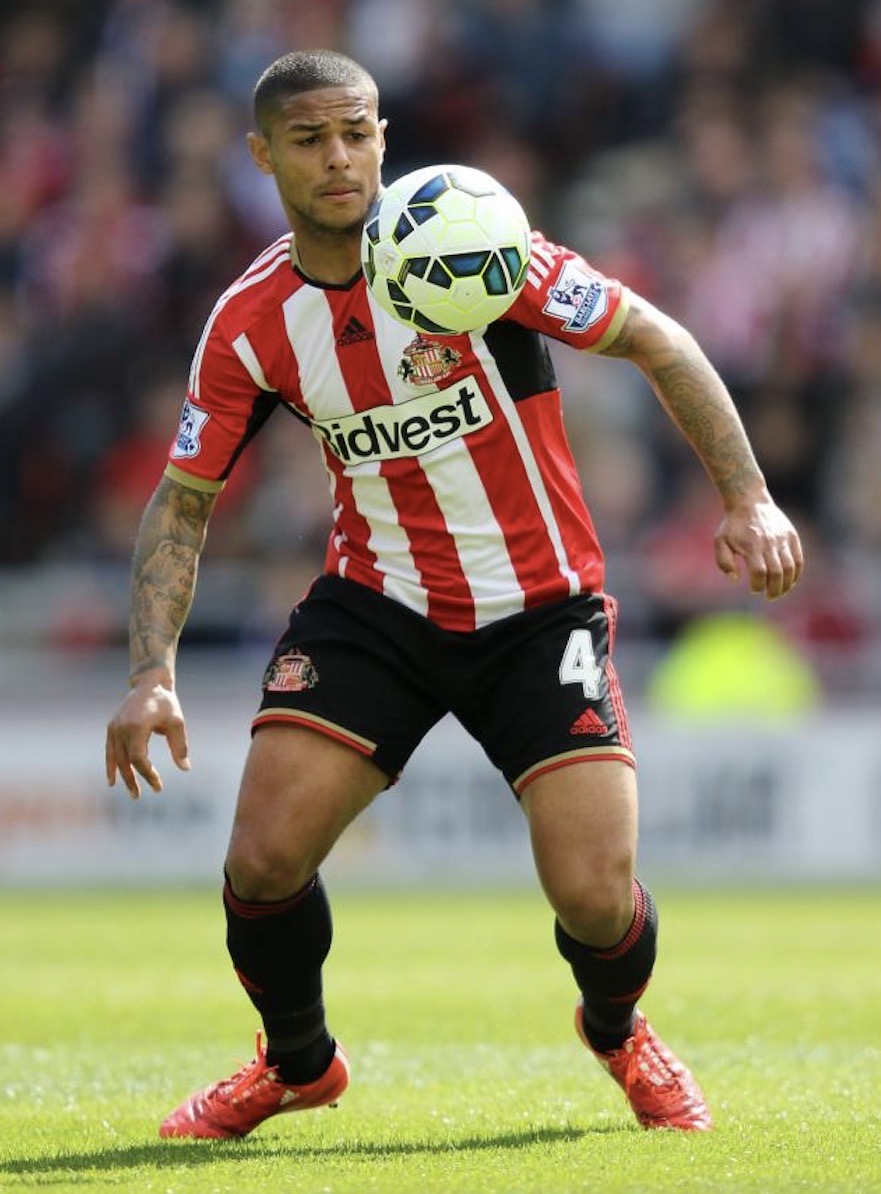
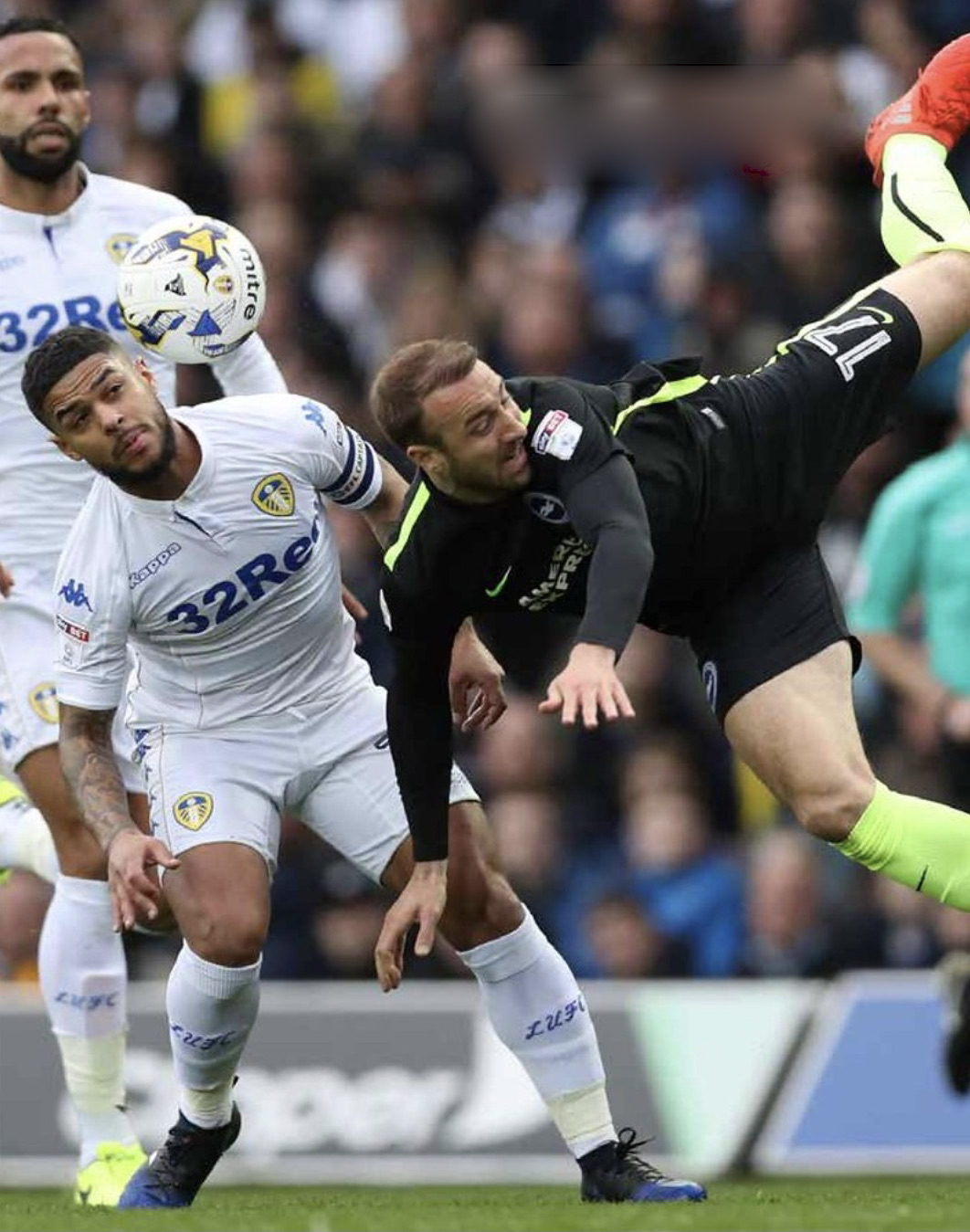
LIAM BRIDCUTT won back-to-back Player of the Season awards at Brighton and later went on to captain Leeds United.

The diminutive midfielder was a stand-out defensive midfielder who Seagulls supporters took to their hearts.

He was pivotal to the new style of play Gus Poyet introduced, sitting in front of the back four, and comfortably acting as the conduit for the side’s highly effective passing game.

Having been brought through as a youngster at Stamford Bridge, he had witnessed close up the role Claude Makelele executed so efficiently for Chelsea, and, when his former Stamford Bridge colleague Poyet gave him an initial five-month contract at Brighton, he seized the chance.

“Chelsea made me the player I am today and they gave me the best of everything in terms of facilities and training with some of the biggest names in football,” he said shortly after signing for the Albion.

“My favourite player was Dennis Wise. I always wanted to be like him in that central midfield role. Then, as I got older, the team changed and it was Makele who I watched. Chelsea wanted more of a Makele player out of me.”

With so many star names ahead of him, it was inevitable Bridcutt would have to look elsewhere to progress. Initially he went on loan to Watford, managed by Brendan Rodgers, who he’d played under for Chelsea’s youth side and reserves.

“I played in some really big games, jumping from reserve football – full of kids and not that physical – into games where players are literally fighting for their careers,” he said.

“My first game was against Doncaster, where I was named Man of the Match, and then it was Spurs in the quarter-finals of the Carling Cup. I was up against Jermaine Jenas and Jamie O’Hara. I loved the adrenalin and pushing myself against all these players.”

It meant he didn’t fancy returning to reserve football and went out on loan again, playing more than 20 games for Stockport County in League One – including being sent off playing against the Seagulls! “It was another good learning curve for me,” he said.

When released by Chelsea, he had trials at Crystal Palace, Wycombe Wanderers and Dagenham and Redbridge – without success – but Chelsea let him return to train with them for three weeks and, during that time, Ray Wilkins suggested him to Poyet, who gave him an initial five-month contract to show what he could do.

After his debut against Orient, he told the matchday programme: “The manager has been saying to me that he needs a player in there who can control the game, break things up and play. I aim to prove I am that player.”

Mission accomplished, Bridcutt earned a two-year deal and he told the Argus: “It was one of my goals when I first signed here, to get a longer deal, and I’ve done that.

“I have been rewarded for my hard work. All I’ve got to do now is settle down and think about my future and look forward to next season.

“There was no hesitation from me really. I want to be here as long as I can. I can see what Gus has done here is brilliant. It’s a big club on the way up, so I was more than happy to sign.”

Bridcutt helped Albion win League One and is particularly remembered for a stunning long-range volley at Withdean on 5 March 2011 that proved to be the winner in a 4-3 win over Carlisle United. He was also on the scoresheet when Albion twice came from behind against Dagenham and Redbridge and eventually won another 4-3 thriller to clinch promotion back to the second tier.

Comfortably taking the step up in class in his stride, Bridcutt was pivotal to Albion reaching the Championship play-offs, but, after Poyet’s departure, rumours began to swirl that the young midfielder would follow him to the north east.

It didn’t happen immediately but, after handing in a transfer request, he finally made the move in January 2014 after featuring in 151 games for the Seagulls.

Given the opportunity to reflect on that time, Bridcutt admitted to the excellent podcast Football, the Albion and Me that he should never have left but, at the time, he didn’t feel the Albion did enough to persuade him to stay when Premier League and Championship clubs were sniffing around.

“Because they had so many good offers, they didn’t try to keep me,” he said. “I didn’t want to leave the club. I was very much happy there. But at the time I had other offers. The club knew about this and were back and forth with other clubs and turned down lots of offers.

“All I wanted was to be rewarded for the time I had given to the club,” he said, maintaining that, regardless of Poyet going, he wanted to part of the club’s long term goal of getting to the Premier League.

Scotland cap

In March 2013, Bridcutt’s consistent Albion form earned him a call-up to the Scotland international squad. Newly appointed manager Gordon Strachan gave him his first cap against Serbia, although the 2-0 defeat ended the Scots’ hopes of qualifying for the 2014 World Cup, and Bridcutt collected a booking in the 77th minute.

It wasn’t until three years later, during his spell at Leeds, that Bridcutt earned his second and only other cap. It came when he was a second half substitute in a 1-0 win over Denmark and some observers considered Bridcutt lucky not to see red for a robust tackle in the game at Hampden Park.

Although born in Reading, on 8 May 1989, he qualified to play for Scotland through his Edinburgh-born grandfather.

In July 2021, Bridcutt gave an illuminating and excoriating insight into his move and time on Wearside to a Sunderland podcast.

He recalled how on the day he signed for the club Poyet called him at midnight informing him he’d be playing the next day in the Tyne-Wear derby game and, before putting the phone down, said: “You better not be shit because I’ve pushed hard to get you here!”

Thankfully, Bridcutt had an outstanding debut in place of the injured Lee Cattermole in a 3-0 win for the Black Cats over their arch rivals.

Poyet purred: “Liam Bridcutt knows the defensive midfielder role I want us to play perfectly. So I was not worried.

If there’s one person that knows the role better than anyone else in the world, it is Liam and the best thing for him is that we won, we kept a clean sheet and he got through 90 minutes having not played all month.”

Poyet was rarely shy in singing Bridcutt’s praises, once telling the Mail: “If I was coach of Real (Madrid) I would take him because he deserves to go to the highest level.

“As a holding midfielder, there is no better player in the division. The best thing about Liam is that he understands me to an incredible level. The way he understands what I want from him is spectacular.”

However, Bridcutt reckoned a lot of players Poyet inherited at Sunderland were scared to play the sort of football Albion’s players had readily embraced and he also questioned their professionalism, saying: “It was almost like he (Poyet) was fighting a losing battle because there was literally lads out every other night and you could see that in our performances. We were terrible.”

Supporters piled on the pressure too and, although Bridcutt reckoned he could cope with the barbs, someone like Marcos Alonso responded badly to the stick but proved he was a decent player after he moved to Chelsea.

After keeping Sunderland in the Premier League against the odds, Poyet signed a new two-year contract in May 2014 but was sacked the following March. His successor, Dick Advocaat, froze Bridcutt out and, eventually, in November 2015, Steve Evans took him on loan at Leeds United.

In the early part of 2016, ahead of playing against Brighton at the Amex, Bridcutt confessed he’d be open to a return to the south coast. He told the Argus: “It was probably my best period in football. That was my opportunity to properly showcase what I could do and I had brilliant times there.

“I know the place well and I’d call it home. My first child was born there and it’s where my family started. It’s where my career really started and it’s a club where, if there was the right opportunity to go back at some stage, I definitely would.

“Even when I first joined, the club always had direction. There was always a plan. Nothing happened by accident. They hit a bit of a rocky patch after losing Gus (Poyet) but, like most clubs, it happens. They seem to have got their stability back. I’m happy to see that.”

As it was, Bridcutt stayed at Elland Road until the end of the season and, after Garry Monk’s appointment as manager, he was signed on a permanent basis in August 2016. A month later he was appointed Leeds captain, taking over the role from Sol Bamba.

A delighted Bridcutt said: “It’s a real honour, the manager has shown great faith in me by giving me the captaincy.

“It puts a little bit more pressure on me but that’s something I like. I’ve always been a player that’s thrived under pressure, and I think that’s the way to get the best out of me.”

Unfortunately a broken foot saw Bridcutt miss a large part of the season and the managerial revolving door at Leeds saw Monk replaced in the summer of 2017 by Thomas Christiansen.

After 53 games for United, Bridcutt also found himself heading for the exit, joining Mark Warburton’s Nottingham Forest on a three-year deal for a fee thought to be around £1m.

Former Forest favourite Garry Birtles was suitably impressed by the new signing, telling the Nottingham Post: “He’s 28 so you’d think he will hit his peak for Forest, having signed a three-year deal.

“He was Leeds United’s captain last season as they finished in seventh place in the Championship. I saw him play for Leeds and, I have to say, he was very impressive. He’s got that creative ability, and his all-round game was good.”

While Bridcutt played plenty of games under Warburton, when another managerial change saw the arrival of Aitor Karanka, his game time dried up.

Bridcutt spent the first part of the 2019-20 season on loan at League One Bolton Wanderers, where he was made captain by boss Keith Hill, and was reunited with former Albion and Sunderland teammate Will Buckley.

But after his recall to Forest in January 2020 he was then dispatched on loan to Lincoln City for the remainder of the season.

It wasn’t long before Bridcutt was captaining the Imps and in August 2020 he joined them on a permanent basis after his Forest contract expired.

Injury sidelined Bridcutt from Colin Appleton’s side as Lincoln beat Sunderland over a two-legged League One play-off semi-final in May 2021 but Bridcutt skippered the Imps as they narrowly lost 2-1 to Blackpool in the final at Wembley.

Ahead of the Sunderland clash, Lincoln fan Gary Hutchinson, of The Stacey West Lincoln fan website, told SB Nation Roker Report: “I love Bridcutt. He is the pivot around which our entire side function. Playing in the four role he picks the ball deep, protects the back four and is always willing to add to an attack. There are options in the middle of the park – Jorge Grant usually deputises there and Max Sanders who recently signed from Brighton is the long-term heir-apparent for Bridcutt.”

Released by Lincoln at the end of the 2021-22 season, Bridcutt, aged 33, was eventually reunited with Appleton at Blackpool; his signing on a one-year contract for the Championship side announced on 30 September 2022.

“I’m excited to be here and working with the manager again,” Bridcutt told the Blackpool website. “He was brilliant for me over the last two years – he put a lot of trust and faith in me.

“We’ve got a good understanding in terms of what he wants from his teams and his players day-to-day. I get that and it’s how I work and how I’ve always worked. He knows what I’m like and what he can get out of me.”

Appleton added: “We know the quality and the experience he’s got – at Premier League and Championship level – and he’s a fantastic character who will also bring a lot of things off the pitch as well. His addition will be a real plus.”

One-goal striker Craig Davies a Seagulls flop

THE PHRASE ‘journeyman striker’ sits perfectly with Welsh international Craig Davies who, despite success later in his career, fired blanks for Wolverhampton Wanderers and Brighton.

To use that rather amusing, though well-worn phrase, he couldn’t hit a cow’s arse with a banjo during his time with the Seagulls.

He arrived on the south coast in January 2009 during Micky Adams’ second, unsuccessful, spell in Albion’s managerial chair.

Oldham Athletic received a reported £150,000 for his signature and, in 23 games for Brighton, he managed just the one goal – on his debut!

That strike came at Withdean – the opening goal in what ended up a 4-2 defeat to Peterborough United (for whom a certain Craig Mackail-Smith equalised).

When a 4-0 home thrashing by Crewe Alexandra meant it had been six games on the trot without a win, Adams was fired by Dick Knight at a Little Chef on the A23. He’d managed just seven wins in 34 matches, and ‘fireman’ Russell Slade arrived just in time to rescue the Seagulls from the League One relegation trapdoor.

Many different striker permutations were tried that season, with main men Nicky Forster and Glenn Murray sidelined by injury, and Albion’s survival was largely due to the goals of loan arrival Lloyd Owusu. Davies huffed and puffed but simply couldn’t make a meaningful connection when the goal beckoned.

Typical of the fans’ eye view was this observation by wearebrighton.com: “That Adams actually paid money for Craig Davies remains one of the more startling moments of his reign of terror.

“Rarely has a Brighton player enraged the Seagulls support like Davies, a man who mixed incompetence – such as the ability to put the ball over the bar when faced with an open goal three yards away – with a complete lack of effort.”

There had been such promise on his arrival, with chairman Dick Knight telling the matchday programme: “Craig is an exciting player with loads of potential, he is lightning-quick and his direct approach can be a nightmare for defenders. This is a major career move for him and he has every chance to be a crucial part of our future.”

Davies himself clearly thought he’d finally found a place to further his career, saying: “I’ve had a few ups and downs through my career but hopefully now I can get settled at Brighton and start knocking in the goals here.

“The gaffer seems to have a bit of faith in me so hopefully I can repay that by putting in some performances and getting a few goals.”

Albion cut their losses on Davies and loaned him to Yeovil Town (he didn’t score in four games for them, either) and then Adams re-signed him, this time for League Two Port Vale, where he finally managed to find the back of the net again.

In the summer of 2010, Davies came to a mutual agreement to end his Brighton nightmare and he joined League Two Chesterfield, from where his career began an amazing upward trajectory.

Born in Burton-upon-Trent on 9 January 1986, Davies began his career as a schoolboy at Shrewsbury Town, but did his apprenticeship at Manchester City. In August 2004, he moved on to League Two Oxford United, where he made his league debut the same month in a 1-0 win at Notts County.

In two seasons with Oxford, managed by former Ipswich and Arsenal midfielder Brian Talbot, he scored eight times in 55 appearances. In the summer of 2005, he made his debut for Wales (qualifying because he had a Welsh grandfather) as a substitute in a 0-0 draw v Slovenia. Reports linked him with a move to Premier League Charlton Athletic, but nothing came of it and instead, in January 2006, he moved to Italy to join Hellas Verona for a £85,000 fee.

It proved to be too big a step for someone who was then only 20, and he referred to feelings of homesickness in an interview with the BBC.

Remarkably, Davies hit the headlines in May 2006, when in the sixth of seven games he played for the Wales under-21 side (which featured Gareth Bale, Andrew Crofts and Arron Davies) he scored a hat-trick in a 5-1 win over Estonia, and it earned him a recall to the full international side.

Wales under-21 manager Brian Flynn told the BBC: “Craig has sometimes been frustrating to watch, but he has skill and we will help him, and them all, to flourish.”

Davies hoped the international goals would attract a club to rescue him from Italy. “I have found it very hard to settle in Italy,” he told the BBC. “Verona want me to come back and have a year on loan somewhere and then they will look at the situation again when I have a bit more experience.”

It was Wolves, then in the Championship, who offered him a lifeline back in the UK and he moved to Molineux on loan, playing 23 games, mainly in the first half of the 2006-07 season.

The only goals he scored for Wolves both came in a FA Cup tie against Oldham Athletic who, ironically, turned out to be his next club. He joined them for an undisclosed fee from Hellas in June 2007.

Davies netted 13 times for a League One Latics side in 2007-08 but, after a 10-game barren spell the following season, he was sent on loan to Stockport County where he scored six times in 13 games, including bagging a hat-trick against Bristol Rovers, and scoring a penalty against Albion as County won 2-0.

When Adams rescued Davies from his Seagulls horror spell, he was rewarded with seven goals in 24 matches for League Two Port Vale between January 2010 and the end of the season.

Chesterfield stepped in to sign him on a one-year deal for the 2010-11 season – and he was promptly sent off in his first competitive game for the Spireites!

Things did get much better, though, and he ended the season with 25 goals to his name, Chesterfield were promoted, and Davies was chosen in the divisional PFA select team for the season.

Such success drew attention from other clubs and he opted to join Championship side Barnsley under Keith Hill. He struggled to find the net in the opening nine matches but eventually finished the season with 11 goals in 42 appearances.

In September 2012, Davies scored FOUR goals in the space of 19 minutes in a 5-0 demolition of Birmingham City at St Andrews and, with nine goals in 22 appearances to his name in the first half of the 2012-13 season, Bolton Wanderers came forward with a £300,000 bid to take him to the Reebok Stadium.

He scored four goals in 18 Championship games for Wanderers but another of his barren spells struck in the opening half of the following season. Wanderers loaned him to League One Preston and he got a goal on his debut as well as a hat-trick in a 6-1 thrashing of Carlisle United. North End reached the play-offs, and Davies made his way back to Bolton having scored five in 15 games.

Hamstring injury issues plagued him in 2014-15 and manager Neil Lennon released him at the end of the season.

He didn’t have far to travel for his next port of call when newly-relegated Wigan Athletic offered him a two-year contract. He only scored twice in 30 appearances, but Wigan won promotion as League One champions.

With just one goal in 14 Championship games in the first part of the 2016-17 season, Davies was on the move again, this time linking up with League One Scunthorpe United until the end of the season. Cue another barren spell: no goals in 21 games.

The 2017-18 season saw Davies return to his old club, Oldham Athletic, and despite scoring 14 goals in 44 appearances, could not prevent the club being relegated to League Two. Davies had strong views about the ownership of the club as he departed for Mansfield Town.

He signed a two-year deal with the Stags, but injury curtailed his involvement in 2018-19.

C Davies Wales