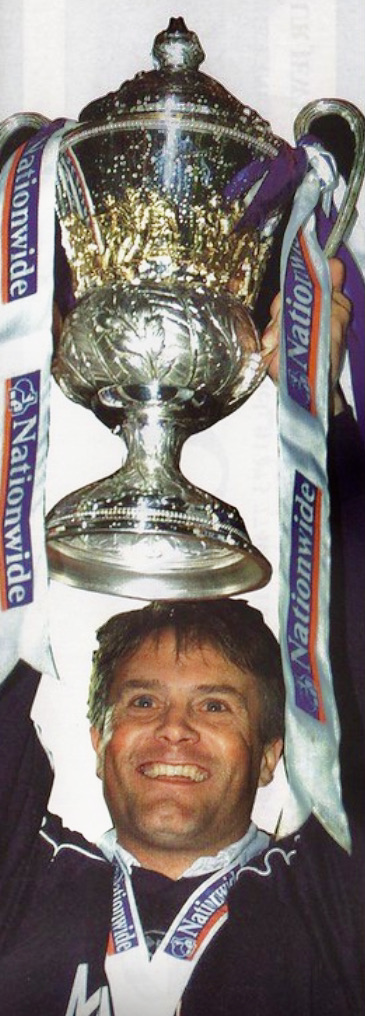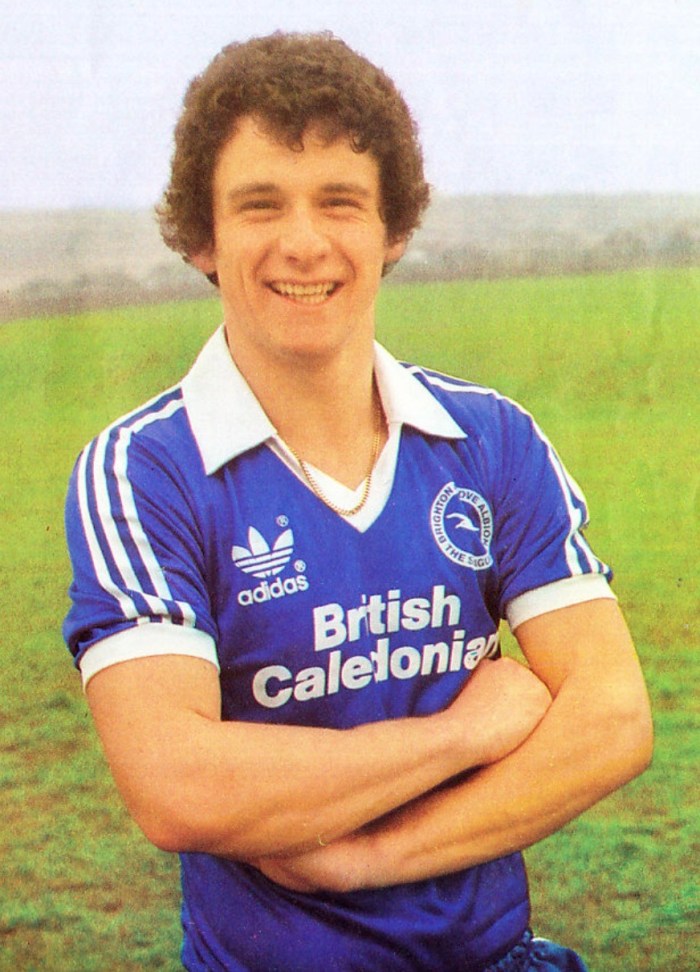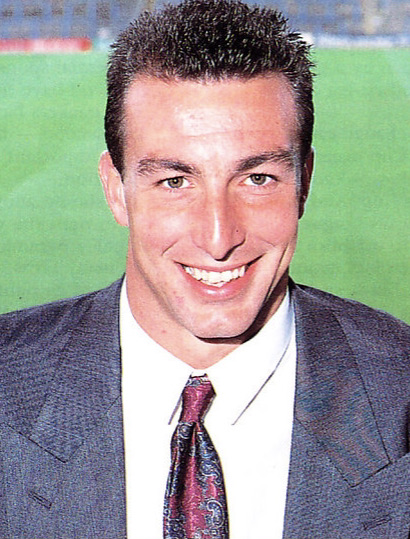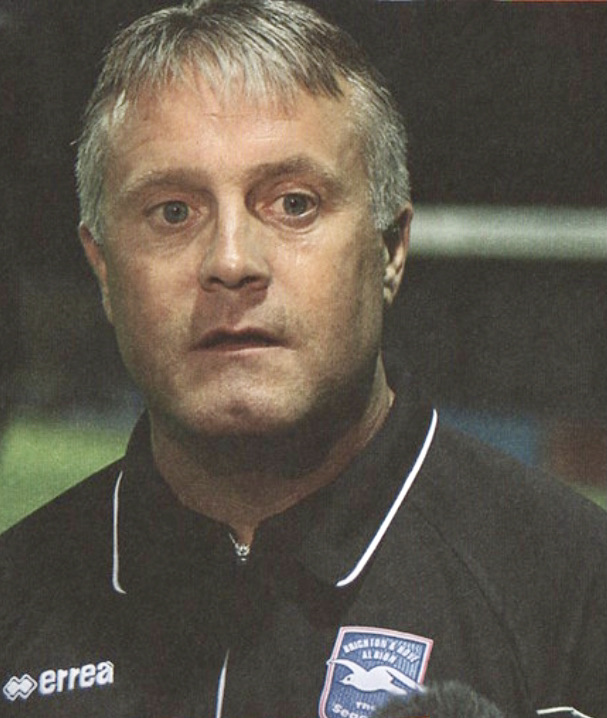
Confrontation was seldom far away in Micky Adams’ career

THE FIRST player ever to be sent off in a Premier League game managed Brighton twice.

Fiery Micky Adams saw red playing for Southampton when he decked England international midfielder Ray Wilkins.

“People asked me why I did it. I said I didn’t like him, but I didn’t really know him,” Adams recalls in his autobiography, My Life in Football (Biteback Publishing, 2017).

It was only the second game of the 1992-93 season and Adams was dismissed as Saints lost 3-1 at Queens Park Rangers.

Adams blamed the fact boss Ian Branfoot had played him in midfield that day, where he was never comfortable.

“He (Wilkins) was probably running rings around me. I turned around and thumped him. I was fined two weeks’ wages and hit with a three-match ban.”

It wasn’t the only time he would have cause not to like Wilkins either. The former Chelsea, Manchester United and England midfielder replaced Adams as boss of Fulham when Mohammed Al-Fayed took over.

His previously harmonious relationship with Ray’s younger brother, Dean, turned frosty too. When Adams first took charge at the Albion, he considered youth team boss Dean “one of my best mates”. But the two fell out when Seagulls chairman Dick Knight decided to bring Adams back to the club in 2008 to replace Wilkins, who’d taken over from Mark McGhee as manager.

“He thought I had stitched him up,” said Adams. “I told him that I wanted him to stay. We talked it through and, at the end of the meeting, we seemed to have agreed on the way forward.

“I thought I’d reassured him enough for him to believe he should stay on. But he declined the invitation. He obviously wasn’t happy and attacked me verbally. I did have to remind him about the hypocrisy of a member of the Wilkins family having a dig at me, particularly when his older brother had taken my first job at Fulham.

“We don’t speak now which is a regret because he was a good mate and one of the few people I felt I could talk to and confide in.”

With the benefit of hindsight, Adams also regretted returning to manage the Seagulls a second time considering his stock among Brighton supporters had been high having led them to promotion from the fourth tier in 2001. The side that won promotion to the second tier in 2002 was also regarded as Adams’ team, even though he had left for Leicester City by the time the Albion went up under Peter Taylor.
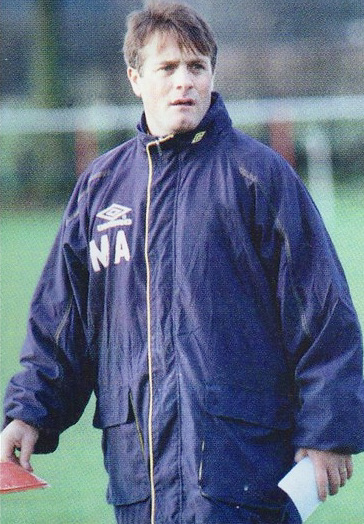
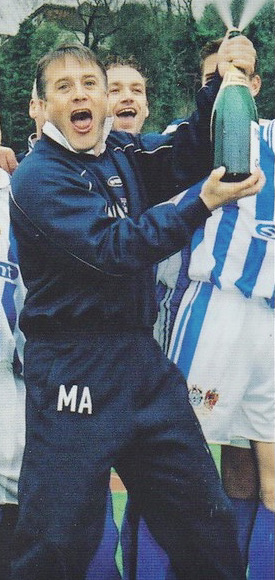
Adams first took charge of the Seagulls when home games were still being played at Gillingham’s Priestfield Stadium.  Jeff Wood’s short reign was brought to an end after he’d failed to galvanise the side following Brian Horton’s decision to quit to return to the north. Horton took over at Port Vale, where Adams himself would subsequently become manager for two separate stints.

Back in 1999, though, Adams had been at Nottingham Forest before accepting Knight’s offer to take charge of the Albion. He’d originally gone to Nottingham to work as no.2 to Dave Bassett but Ron Atkinson had been brought in to replace Bassett and Adams was switched to reserve team manager.

The Albion job gave him the opportunity to return to front line management, a role he had enjoyed at Fulham and Brentford before regime changes had brought about his departure from both clubs.

On taking the Albion reins, Adams said: “For too long now this club has, for one reason and another, had major problems. The one thing that has remained positive is the faith the supporters have shown in their club.

“The club has to turn around eventually and I want to be the man that helps to turn it around.”

The man who appointed him, Knight, said: “Micky is a formidable character with a proven track record. He knows what it takes to get a club promoted from this division. But, more than that, Micky shares our vision of the future and wants to be part of it. That is why I have offered him a four-year contract and he has agreed to that commitment.”

Not long after taking over the Albion hotseat, he was happy to say goodbye to the stadium he’d previously known as home when a Gillingham player in the ‘80s and it was a revamped squad he assembled for the Albion’s return to Brighton, albeit within the confines of the restricted capacity Withdean Stadium.

Darren Freeman and Aidan Newhouse, two players who’d played for Adams at Fulham, scored five of the six goals that buried Mansfield Town in the new season opener at the ‘Theatre of Trees’.

Considering he was only too happy to be photographed supporting the campaign to build the new stadium at Falmer, it’s disappointing to read in his autobiography what he really thought about it.

“My mates and I nicknamed it ‘Falmer – my arse’ although I never said this to Dick’s face,” he said. “There was always so much talk and we never felt like it was going to get done.”

The turning point in his first full season in charge was the arrival of Bobby Zamora on loan from Bristol Rovers. “The first time I saw him he came onto the training ground; he looked like a kid. But he was tall and gangly with a useful left foot; there was potential there.”

Interestingly, considering Adams makes a point of saying he usually ignored directors who tried to get involved on the playing side, he took up Knight’s suggestion that the side should switch to a 4-4-2 formation – and the Albion promptly won 7-1 at Chester with Zamora scoring a hat-trick!

After a so-so first season back in Brighton, not long into the next season Adams was forced to replace his no.2, Alan Cork, with Bob Booker because Cork was offered the manager’s job at Cardiff City, at the time owned by his former Wimbledon chairman, Sam Hammam. Adams reckoned Booker’s appointment was one of the best decisions he ever made.

Surrounded by players who had served him well at Fulham and Brentford, together with the additions of Zamora, Michel Kuipers and Paul Rogers, Adams and Booker steered Albion to promotion as champions. Zamora was player of the season and he and Danny Cullip were named in the PFA divisional XI.

Not long into the new season, the lure of taking over as manager at a Premier League club saw Adams quit Brighton, initially to become Bassett’s no.2 at Leicester City, but with the promise of succeeding him.

“While I thought I had a shot at another promotion, it wasn’t a certainty,” Adams explained. “I knew I had put together a team of winners, and I knew I had a goalscorer in Bobby Zamora, but football’s fickle finger of fate could have disrupted that at any time.”

He admitted in the autobiography: “Had I been in charge at the age of 55, rather than 40, then I perhaps would have taken a different decision.”

While Albion enjoyed promotion under Taylor, what followed at Leicester for Adams was a lot more than he’d bargained for and, to his dismay, he is still associated with the ugly shenanigans surrounding the club’s mid-season trip to La Manga, to which he devotes a whole chapter of his book, aiming to set the record straight.

On the pitch, he experienced relegation and promotion with the Foxes and he doesn’t hold back from lashing out about ‘moaner’ Martin Keown, “one of the worst signings of my career”. Eventually, he’d had enough, and walked away from the club with 18 months left on his contract.

After a break in the Dordogne area of France, staying with at his sister-in-law and her husband’s vineyard, he looked for a way back into the game. He was interviewed for the job of managing MK Dons but was put off by a Brighton-style new-ground-in-the-future scenario. Then Peter Reid, a former Southampton teammate, was sacked by Coventry City. He put his name forward and took charge of a Championship side full of experienced players like Steve Staunton and Tim Sherwood.

The side’s fortunes were further boosted by the arrival of Dennis Wise, but, in an all-too-familiar scenario Adams had encountered elsewhere, the chairman who appointed him (Mike McGinnity) was replaced by Geoffrey Robinson. It wasn’t long before it was obvious the relationship was only going to end one way. As Adams tells it, Robinson was influenced by lifelong Sky Blues fan Richard Keys, the TV presenter, and it was pretty much on his say-so that Adams became an ex-City manager after two years in the job.

With an ex-wife and three children to support as well as his partner Claire, Adams couldn’t afford to be out of work for long and fortunately his next opportunity came courtesy of Geraint Williams, boss of newly promoted Colchester United, who took him on as his no.2.

However, it only got to the turn of the year before he was out of work once again, although, from what he describes, he wasn’t enjoying his time with the U’s anyway because Williams kept him at arm’s length when it came to tactics and team selection.

He was amongst the ranks of the unemployed once again when Albion chairman Knight gave him a call, but, with the benefit of hindsight, he said: “Going back turned out to be one of the biggest mistakes of my life.”

Adams blamed the backdrop of “the power struggle” between Knight and Tony Bloom on the lack of success during his second stint in the hotseat, and he reckons it was Bloom who “demanded my head on a platter”. The fateful meeting with Knight, when a parting of the ways was agreed, famously took place in the Little Chef on the A23 near Hickstead.

Looking back, Adams conceded he bowed to pressure from Knight to make certain signings – namely Jim McNulty, Jason Jarrett and Craig Davies in January 2009 – who didn’t work out. He reflected: “I shouldn’t have taken the job in the first place. I’d let my heart rule my head but, in fairness, I didn’t have any other offers coming through and it seemed like a good idea at the time.

“I wouldn’t ever say he (Knight) let me down, but he had his idea about players. I did listen to him, and maybe that’s where I went wrong.”

He added: “Going back to a club where success had been achieved before felt good, yet, the second time around, the same spark wasn’t there no matter how hard I tried.”

Born in Sheffield on 8 November 1961, Micky was the second son of four children. It might be argued his penchant for lashing out could have stemmed from seeing his father hitting his mother, which he chose to spoke about at his father’s funeral. Adams is obviously not sure if he did the right thing but he felt the record should be straight.

The Adams family were always Blades rather than Wednesdayites and, at 15, young Micky was in the youth set-up at Bramall Lane having made progress with Sunday league side Hackenthorpe Throstles.

While he thought he had done well under youth coach John Short during (former Brighton player) Jimmy Sirrel’s reign as first team manager, Sirrel’s successor, Harry Haslam, replaced Short and, not long afterwards, Adams was released.

However, Short moved to Gillingham and invited the young left winger to join the Gills. Adams linked up with a group of promising youngsters that included Steve Bruce.

In September 1979, he had a call-up to John Cartwright’s England Youth side, going on as a sub in a 1-1 draw with West Germany, and starting on the left wing away to Poland (0-1), Hungary (0-2) and Czechoslovakia (1-2) alongside the likes of Colin Pates, Paul Allen, Gary Mabbutt, Paul Walsh and Terry Gibson.

Adams honed his craft under the tutelage of a tough Northern Irishman Bill ‘Buster’ Collins and began to catch the attention of first team manager Gerry Summers and his assistant Alan Hodgkinson, who had played 675 games in goal for Sheffield United.

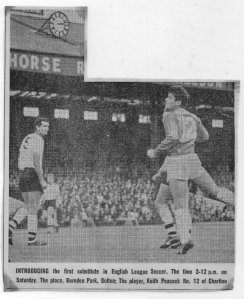
He made his debut aged just 17 against Rotherham United but didn’t properly break through until Summers and Hodgkinson were replaced by Keith Peacock (remember him, he was the first ever substitute in English football, in 1965, when he went on for Charlton Athletic against John Napier’s Bolton Wanderers) and Paul Taylor.

“Keith saw me as a full-back and that was probably the turning point of my career,” Adams recalled.

Once Adams and Bruce became regulars for the Gills, scouts from bigger clubs began to circle and at one point it looked like Spurs were about to sign Adams. That was until he came up against the aforementioned Peter Taylor, who was playing on the wing for Orient at the time (having previously played for Crystal Palace, Spurs and England).

“He nutmegged me three times in front of the main stand and, to cut a long story short, that was the end of that. Gillingham never heard from Spurs again,” Adams remembered.

Even so, Adams did get a move to play in the top division when Bobby Gould signed him for Coventry City. Managerial upheaval didn’t help his cause at Highfield Road and when John Sillett preferred Greg Downs at left-back, Adams dropped down a division to sign for Billy Bremner’s Leeds United (pictured below right with the legendary Scot).

“He had such a big influence on my career and life that I wouldn’t have swapped it for the world,” said Adams. But life at Elland Road changed with the arrival of Howard Wilkinson, and Adams found himself carpeted by the new boss after admitting punching physio Alan Sutton for making what an injured Adams considered an unreasonable demand to perform an exercise routine even though he was in plaster at the time.

Nevertheless, Adams admits he learned a great deal in terms of coaching from Wilkinson, especially when an improvement in results came about through repetitive fine-tuning on the training pitch.

“It is the one aspect of coaching that is extremely effective, if delivered properly,” said Adams. “I learnt this from Howard and took this lesson with me throughout my coaching and managerial career.”

However, Adams didn’t fit into Wilkinson’s plans for Leeds and he was transferred to Southampton, managed by former Aston Villa, Saints and Northern Ireland international Chris Nicholl. Adams joined Saints in the same week as Neil ‘Razor’ Ruddock and the pair were quickly summoned by Nicholl to explain the large size of the hotel bills they racked up.

Adams moved his family from Wakefield to Warsash and he went on to enjoy what he reflected on as “the best few years of my playing career”. He was at the club when a young Alan Shearer marked his debut by scoring a hat-trick and the “biggest fish in the pond at the Dell” was Jimmy Case.

Adams described the appointment of Branfoot in place of the sacked Nicholl as a watershed moment in his own career. “Overall he was decent to me and I found his methods good,” he said. And he pointed out: “I was getting older, I’d started my coaching badges and I already had one eye on my future.”

Adams recalled an incident during a two-week residential course at Lilleshall, after he had just completed his coaching badge, when he dislocated his shoulder trying to kick Neil Smillie.

“I was left-back and he was right-wing, and he took the piss out of me for 15 minutes. The fuse came out and I decided to boot him up in the air,” Adams recounted. “The only problem was that I missed. I fell over and managed to dislocate my shoulder hitting the ground. It was the worst pain I’ve ever had.”

If life was sweet at Southampton under Branfoot, that all changed when he was replaced by Alan Ball and the returning Lawrie McMenemy. Adams and other older players were left out of the side. Simon Charlton and Francis Benali were preferred at left-back. Eventually Adams went on a month’s loan to Stoke City, at the time managed by former Saints striker Joe Jordan, assisted by Asa Hartford.

On his return to Southampton, and by then 33, Adams was given a free transfer.

Former boss Branfoot came to his rescue, inviting him to move to League Two Fulham as a player-coach in charge of the reserve team. Branfoot also signed Alan Cork and he and Adams began a longstanding friendship that manifested itself in becoming a management pair at various clubs.

On the pitch, Branfoot struggled to galvanise Fulham and, with the team second from bottom of the league, he was sacked – and Adams replaced him. He kept Fulham up by improving fitness levels and introducing more of a passing game.

But he knew big changes were needed if they were going to improve and he gave free transfers to 17 players, despite clashing with Jimmy Hill, who had different ideas.

An admirer of what Tony Pulis was doing at Gillingham, Adams signed three of their players: Paul Watson, Richard Carpenter and Darren Freeman. He also got in goalkeeper Mark Walton and centre back Danny Cullip. Simon Morgan was one of the few who wasn’t let go, and Paul Brooker emerged as a skilful winger. All would later play under him at Brighton.

Promotion was secured and Adams was named divisional Manager of the Year but after all the celebrations had died down Mohamed Al-Fayed bought the club and things changed dramatically.

“The club was in a state of flux as it tried desperately to come to terms with its new status as a billionaire’s plaything,” Adams acerbically observed. “From having nothing, we had everything.”

Before too long, in spite of being given a new five-year contract, Adams was out of the Craven Cottage door, replaced by Wilkins and Kevin Keegan.

But he wasn’t out of work for long because Branfoot’s former deputy, Len Walker, introduced him to the chairman of Swansea City, who were on the brink of relieving Jan Molby of his duties as manager.

Various promises were made regarding funds that would be made available to him but when they were not forthcoming he realised something was not right and he quit, leaving Cork, the deputy he’d taken with him, to take over.

By his own admission, if he hadn’t been sitting on the £140,000 pay-off he’d received from Fulham, he probably would have stayed. As it was, he was out of work once again…..until he had a ‘phone call from David Webb, the former Chelsea and Southampton defender who was the owner of Brentford, but in the process of trying to sell the club.

His brief was to keep the side in the league and to make it attractive to potential purchasers. It was at Griffin Park that he first met up with the aforementioned Bob Booker, who was managing the under 18s at the time. “He is one of the most loyal and trustworthy friends I have ever known,” said Adams. “He would do anything for you.”

However, although he signed the likes of Cullip and Watson from Fulham, he wasn’t able to stop the Bees from being relegated. During the close season, former Palace chairman Ron Noades bought the club and announced he was also taking over as manager.

Once again, Adams was out of a job but his next step saw him appointed as no.2 to Dave Bassett at Nottingham Forest.

Which brings us almost full circle in the Adams career story, but not quite.

After the debacle of his second stint in charge of Brighton, he was twice manager at Port Vale, each spell straddling what turned out to be a disastrous period in charge of his family’s favourite club, Sheffield United.

It was Adams who gave a league debut to Harry Maguire during his time at Bramall Lane, but the side were relegated from the Championship on his watch, and he was sacked.
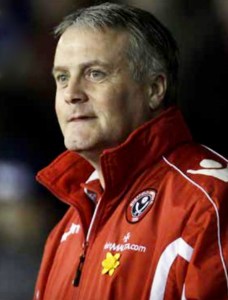
Adams took charge of 249 games as Vale boss but quit after a run of six defeats saying he’d fallen out of love with the game.

It didn’t prevent him having another go at it, though. He went to bottom of the league Tranmere Rovers and admitted in his book: “It was arrogance to think I could turn round a club that had been relegated twice in two seasons.”

In short, he couldn’t and he ended up leaving two games before the end of what was their third successive relegation.

“It was a really poor end to a career that had started so promisingly at Fulham,” he said.

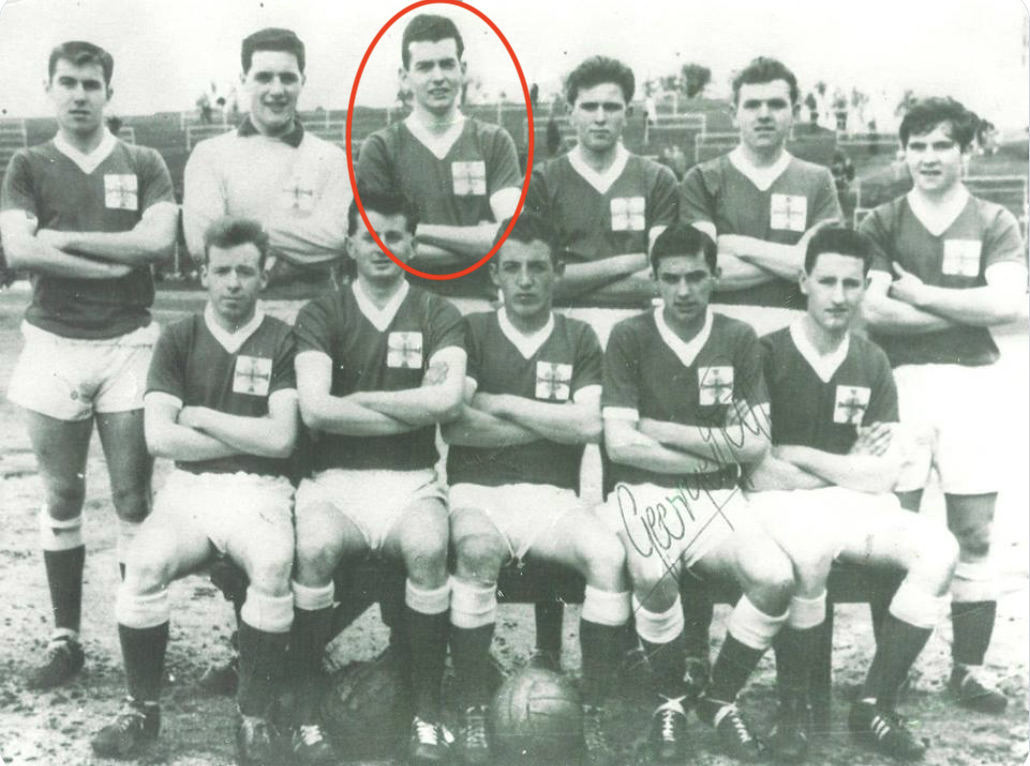
Lanky Lurgan lad lined up alongside George Best

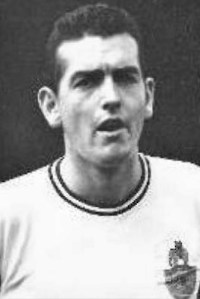
JOHN NAPIER is still coaching youngsters in America at the age of 75. NICK TURRELL’s In Parallel Lines blog caught up with him for a trip down memory lane.  Here, in the third of five articles, we look at how it all began.

This cracking Bolton News picture shows Napier leading out Bolton’s under 18 side at Bromwich Street in January 1963, during the big freeze of that winter.

JOHN NAPIER was born in Lurgan, 18 miles south west of Belfast, on 23 September 1946.

Napier was football daft from a young age and he said: “Looking back at my childhood, I always wanted it from a young age. It was my dream. I had two uncles that played at pro level in Northern Ireland and they worked with me at a young age.

“I would say they toughened me up. I was never afraid to try new things. I left home at 15 to pursue my dreams, and it worked out. It was not easy – it never is – but you must keep at it. Failure was not an option in those times.”

In another interview, Napier said he adopted Spurs as his favourite side when he was 10 or 12. He had three uncles living in north London who were all avid Tottenham supporters and they would send him programmes, pictures and pennants that the youngster put up on his bedroom wall.

𝗟𝘂𝗿𝗴𝗮𝗻 𝗜𝗻𝘁𝗲𝗿𝗺𝗲𝗱𝗶𝗮𝘁𝗲 – 𝗜𝗿𝗶𝘀𝗵 𝗦𝗰𝗵𝗼𝗼𝗹𝘀 𝗦𝗲𝗻𝗶𝗼𝗿 𝗖𝘂𝗽, 𝗠𝗶𝗱-𝗨𝗹𝘀𝘁𝗲𝗿 𝗟𝗲𝗮𝗴𝘂𝗲 𝗮𝗻𝗱 𝗖𝗮𝗳𝗼𝗹𝗹𝗮 𝗖𝘂𝗽 𝘄𝗶𝗻𝗻𝗲𝗿𝘀 𝟭𝟵𝟲𝟭

Napier was good enough to represent his country at every level. He played for the schoolboy side at under 15 and under 16 level, and was the youngest Irish player, at 17, in the youth side that reached the final of the UEFA European Under-18 Championship tournament in April 1963.

In front of a crowd of 34,582 at Wembley, he had the misfortune to score an own goal with his head after only five minutes and England went on to beat the Irish 4-0 (Ray Whittaker, Jon Sammels and John Sissons scoring the other goals).

Remarkably, Northern Ireland’s greatest ever player, George Best, only played in two youth internationals for his country.

Napier was in the same side as Best when the Irish drew 1-1 with England at Boundary Park, Oldham, on 11 May 1963.

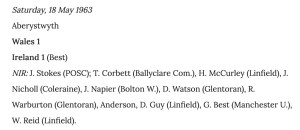
A week later they were selected together again and Best scored his country’s goal as they drew 1-1 with Wales in Aberystwyth.

After winning his only full cap against West Germany in 1966 (see previous article), Napier won two Under-23 caps, also both against Wales. He was in the side that beat Wales 2-1 at Windsor Park, Belfast on 22 February 1967, although the game was abandoned on 72 minutes because of a waterlogged pitch and Welsh and Irish sources differ as to whether the result stood.

Napier had moved to the Albion by the time he made his second appearance; this time the game took place at Ninian Park, Cardiff, on 20 March 1968 and the Irish included the likes of Pat Rice, Tommy Jackson, Dave Clements, Bryan Hamilton and Sammy Todd, who all became established full internationals. But the game was the last of Napier’s international career, at the age of 21.

As Napier said above, he was only 15 when he joined Bolton, choosing them over Everton and Sunderland, who had also shown an interest.

“I really enjoyed my early experience at Bolton,” he told thefootballnetwork.net. “George Taylor and George Hunt, my first coaches at Bolton, and also Nat Lofthouse had a lot to do with my early development. I used to talk to Nat a lot about my game.”

Napier training with Francis Lee and Brian Bromley

Napier rose through the youth ranks alongside the likes of Brian Bromley, Dave Hatton and future England and Manchester City star Francis Lee.

The boots of longstanding centre half Bryan Edwards were big ones to fill but Bolton boss Bill Ridding gave Napier the opportunity to stake his claim. He made his first appearances in the senior side in the final two games of the 1964-1965 season.

Napier helped the side keep clean sheets against Leyton Orient and Cardiff City as the Trotters just missed out on promotion, finishing third, as Newcastle went up as champions along with runners up Northampton Town.

As well as Lee and Bromley, Bolton at that time had a side that included Welsh international striker Wyn Davies (often Napier’s roommate for away matches), England international goalkeeper Eddie Hopkinson and Gordon Taylor, who went on to become chairman of the PFA.

For the following 18 months, Napier was a regular at the heart of the Bolton defence, missing just three games in his first full season and playing a part in the game against Charlton Athletic which saw the Addicks’ Keith Peacock become the first substitute used in English football when replacing goalkeeper Mike Rose in a game at Burnden Park on 21st August 1965.

The Ulsterman himself was involved in the first ever Bolton substitution when, following injury, he was replaced in the 3-2 defeat at home to Southampton by Gordon Taylor.

• In the next instalment of this five-part series of articles, Napier describes the camaraderie that existed amongst the Brighton players during his time at the club, and his approach to the opponents he faced.

Putney printer Pearce went to Wembley with the Albion

HE took a circuitous route back to his hometown club but full-back Graham Pearce eventually made it to Brentford’s first team after Brighton had resurrected his career and given him a chance to play at the top level of the English game.

Pearce was first on Brentford’s books as a teenager between 1971 and 1976, but he didn’t make it as a pro with the Bees and, after also being turned down by QPR, he went non-league, initially with Hillingdon Borough for three years and then Barnet.

When Pearce lined up for Barnet in a FA Cup third round tie on 2 January 1982, it must have been beyond his wildest dreams to imagine just over a year later he’d be playing in that competition’s final at Wembley.

But the steady, assured performances 21-year-old Pearce put in as Alliance Premier League Barnet held Brighton 0-0 before losing 3-1 in a replay at the Goldstone impressed the watching Albion boss Mike Bailey sufficiently to sign him up for the Seagulls.

Although he was itching to join, he had to serve a week’s notice with the Putney printer where he had a full-time job because they weren’t in a position to release him sooner.

Just over a year later, when injuries depleted Jimmy Melia’s cup hopefuls the closer they got to a dream Wembley date, Pearce seized his chance to put his own name in print. Circumstances fell just right for him, but it might not have happened if the experienced left-back Sammy Nelson hadn’t been sidelined.

A packed East Terrace at the Goldstone the backdrop as Pearce faces Newcastle in the FA Cup

Pearce played in the third round 1-1 Goldstone draw with Newcastle – one of six games he played in January 1983 – but he missed the 4-0 demolition of Manchester City in the fourth round and didn’t feature again until 22 March when he was sub for the 2-2 home draw with Liverpool.

Because versatile Gary Stevens was more than capable of playing alongside Steve Foster, normal centre back partner Steve Gatting was preferred at left-back for 14 matches from the end of January.

But when right-back Chris Ramsey was suspended for the semi-final against Sheffield Wednesday, Stevens took his spot, Gatting returned to the middle and Pearce slotted in at left-back.

Because Foster was suspended for the final against Man Utd, Stevens paired up with Gatting in the middle and Pearce retained his place.

Even when Foster returned for the replay, Pearce kept his place because Ramsey had been crocked in the first match and wasn’t fit to play (Melia making the mistake of putting left-footed Gatting at right-back instead of Stevens).

In a pre-match interview with the Daily Mail, Pearce said: “There’s money to be made from appearing at Wembley but the thrill for me is just being there – a player from non-League who thought his chance of playing league football had gone.”

Pearce retained the no.3 shirt at the start of the 1983-84 season back in the second tier but, when Chris Cattlin took over from Melia, he made it clear he wanted someone with more experience in that position.

In his matchday programme notes he wrote: “With Kieran (O’Regan), Eric Young and Graham Pearce all playing together, we have three players who haven’t been long out of non-League football.

“Normally these players would have been blooded slowly into the side, instead of being plunged in the deep end. They have done well and shown the right attitude, but when we play against aggressive sides away from home, some of their inexperience has been exposed.”

Until a suitable replacement could be found, Pearce remained in the side and even poked home his first Albion goal in a 4-3 win away to Cambridge United on 29 October 1983.

But four weeks later, after a 2-2 draw at home to Shrewsbury Town, Cattlin was typically forthright in his next programme notes, declaring: “I was unhappy with our defence and our failings in this department cost us the game.”

Pearce and fellow full-back Ramsey were promptly dropped; the left-back berth going to new signing Chris Hutchings from Chelsea.

Cattlin had high praise for his new recruit as he said: “Chris Hutchings is an enthusiastic, strong and determined defender and has a lot to offer, he’s also a fine footballer.”

After 18 consecutive games, Pearce found himself out of the side for the rest of the season.

It’s interesting to note that the reserve side for the 1 May 1984 fixture at home to Southampton featured five players (Pearce, Ramsey, Gary Howlett, Gerry Ryan and Neil Smillie) who’d been in the FA Cup Final squad a year earlier.

The new season was almost three months’ old before Pearce was seen in the first team again, and, ironically, the opponent was once again Shrewsbury.

The game at the Goldstone finished a goalless draw and, with Hutchings having been switched to right-back, Pearce got a run in the side extending to 19 matches.

Unluckily for him, he was then left out of the side in favour of Martin Keown, who Cattlin managed to bring in on loan from Arsenal, and the future England international quickly proved his calibre.

Pearce made one further appearance, in a 2-1 defeat at Middlesbrough, before the end of the season but in the 1985-86 season he finally cemented his place in the side and played a total of 41 matches.

Three days after Christmas 1985, he scored a rare goal as the Seagulls beat Leeds 3-2 at Elland Road. Ian Baird – later to play for the Albion in the old Fourth Division – missed a penalty but scored one of Leeds’ goals and Pearce clinched the winner on a pitch rutted by a rugby league game played on it only two days earlier.

The matchday programme described the goal thus: “Pearce played a one-two with (Steve) Jacobs and found himself with only Mervyn Day to beat and Leeds screaming for offside. The trusty left foot of the Londoner lobbed goalwards, Day was stranded, and Pearce had scored his first goal in 26 months to give Albion another three valuable points.”

Not such a memorable game came in a 3-0 defeat away to Norwich City on 5 April 1986. The full-back went into the referee’s notebook for a foul on future Albion winger Mark Barham, who was substituted shortly afterwards. Albion had a great chance to pull a goal back when Pearce was through one-on-one with Chris Woods, but the England ‘keeper saved his effort comfortably. Then, eight minutes from time, Pearce fouled Wayne Biggins in the penalty area and Welsh international David Williams buried City’s third from the penalty spot.

Pearce played in Albion’s final game of the season, a 2-0 defeat at Hull City under George Petchey, following Cattlin’s sacking, and it turned out to be his last match in a Brighton shirt.

The returning Alan Mullery explained in his programme notes for the opening game of the new season that he released Jacobs and Pearce because “I felt we had too many defenders”.

Pearce switched to Third Division Gillingham under Keith Peacock and played a total of 48 matches as the Gills narrowly missed out on promotion when losing a play-off final replay against Lou Macari’s Swindon Town in 1987.

Following a disappointing second season with the Gills, when they finished mid-table, Pearce returned to hometown club Brentford where he played 14 times (+ 8 as sub) in Steve Perryman’s 1988-89 side. One of his teammates was fellow former Albion cup star Smillie.

Pearce joined up with Peacock again for Maidstone United’s debut season (1989-90) in the Fourth Division, which culminated in a play-off semi-final defeat at the hands of a Cambridge United side featuring Dion Dublin up front.

The following season, under Phil Holder, Pearce was back at Brentford as first team and reserve coach. He subsequently had spells as player-manager with Isthmian League clubs Enfield and Molesey. He later became a PE teacher at Homefield Preparatory School in Sutton.

Born in Hammersmith on 8 July 1959, Pearce was one of seven children (five boys, two girls) and attended Grove Park Primary School, where he was captain of their under-9 football side. He went on to play for the Middlesex County side and Middlesex Wanderers before his stop-start professional career began.

• Pictures from my scrapbook and matchday programmes.

How Shots stopper Mark Beeney’s move saved the Albion

MARK BEENEY has coached young goalkeepers at Chelsea for nearly 20 years, but Brighton fans who saw him play remember his most important ever save.

The proceeds from his sale to Leeds United for £350,000 on 20 April 1993 quite literally saved the Albion from being wound up by the Inland Revenue.

Beeney had played 55 league and cup games in the Albion goal that season (missing only one because of a suspension) and he didn’t have much say in what happened next, as he remembered in an interview with the Argus in 2001.

“Albion were at Plymouth and the night before the game manager Barry Lloyd told me that he had given Leeds permission to talk to me and that he wanted me to negotiate a deal otherwise the club were history,” he said.
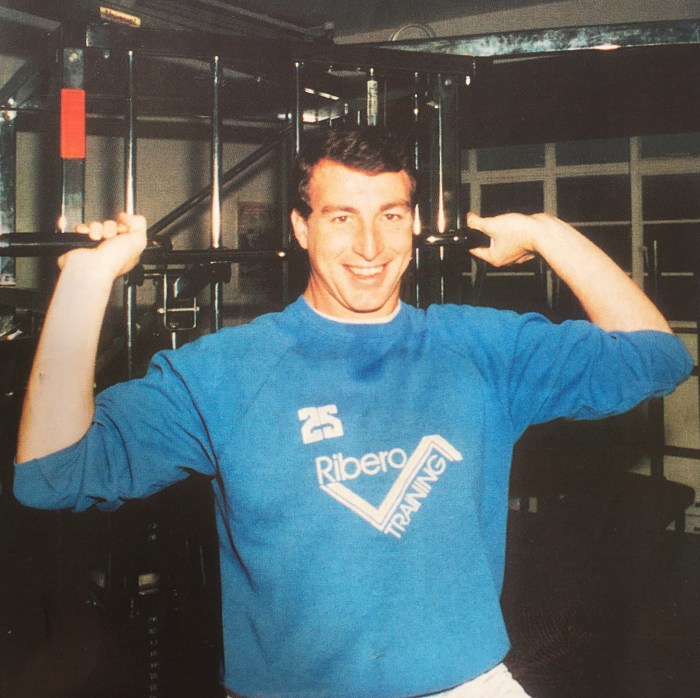
“I didn’t really have much choice because if I’d have turned down the chance I’d have been unemployed anyway with the financial situation at Albion.”

Howard Wilkinson, the former Albion winger who had led Leeds to the old Division One title the previous season, had been looking for a ‘keeper to compete with the ageing John Lukic, and Beeney fitted the bill….as well as footing the bill for Brighton where the taxman was concerned.

The move was certainly an upheaval in terms of geographical location but it presented Beeney with the chance to leap from third tier football into the Premier League.

It didn’t quite pan out as he might have hoped – most of his action was for Leeds’ reserve side! – but over the course of six years he played 49 games in the Premiership and 68 first team games in total for the Elland Road outfit.

Born in Pembury, near Tunbridge Wells, on 30 December 1967, Beeney went to St Francis Primary School in Maidstone then to St Simon Stock, a Catholic secondary school.

He first came to the attention of talent spotters when playing for Ringlestone Colts, a successful Maidstone junior side, and he was invited to join Gillingham, Kent’s only professional side at the time, as an associate schoolboy.

He made sufficient progress to be taken on as an apprentice by the Gills and turned professional in August 1985. He only played two first team games, though, and was given a free transfer by manager Keith Peacock.

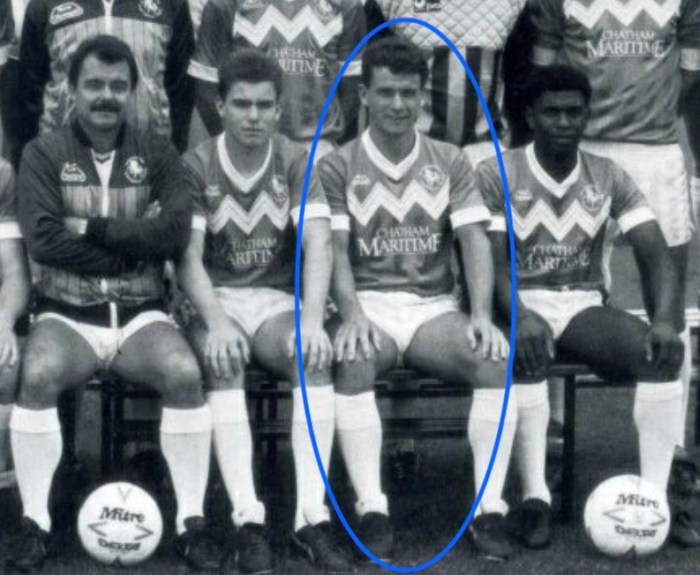
Beeney, circled, when with the Maidstone United squad who won promotion to the league

He joined Maidstone United in January 1987 and, although they were in the GM Vauxhall Conference at the time, he helped them to gain promotion to the Football League in 1989.

His form for Maidstone led to international recognition when he played as a second half substitute for the England C (semi-professional) side in a 1-1 draw away to Italy on 29 January 1989. The game at Stadio Alberto Picco in La Spezia saw Fabrizio Ravanelli, a Champions League winner with Juventus seven years later, score the Italians’ goal.

Back at Maidstone, it wasn’t the best news for Beeney when Peacock arrived as manager. He ended up going on loan to Aldershot, where he played seven games. On his return, Maidstone’s goalkeeping coach Joe Sullivan recommended him to Brighton boss Barry Lloyd and the Seagulls paid a £25,000 fee to take him to the Goldstone in March 1991 as back-up to Perry Digweed.

Wheeler-dealer Lloyd had sold John Keeley to Oldham Athletic for £238,000 a year before – not a bad return for a player who cost £1,500 – and with the inexperienced Brian McKenna not really a meaningful challenger for Digweed’s place, Beeney was ideally suited to the Seagulls.

However, he had a rather ignominious start when, on 20 April 1991, Albion lost 3-0 at home to Oxford United but he kept a clean sheet second time around when he was between the sticks for a 1-0 win at Hull City before Digweed returned to star in the end-of-season excitement that culminated in a trip to Wembley for the play-off final.

Beeney’s third senior Albion appearance couldn’t have come in stranger circumstances, and I was at close quarters to witness it. I was a guest in the directors’ box at The Den, Millwall, on the evening of 4 September and tracksuited Beeney was sat a couple of rows behind me, having travelled but not been included in what in those days was a 13-man squad.

During the warm-up, Digweed suddenly pulled up with an injury and, after physio Malcolm Stuart attended to him, it was evident he wouldn’t be able to take part in the game. But the referee was poised to start the match, so the ‘keeper’s jersey was handed to Gary Chivers to go between the posts to avoid delaying the kick-off.

A discussion between the managers and the officials gave the green light to allow Albion to replace Digweed with a recognised ‘keeper and, although he hadn’t been due to be involved, Beeney was summoned from the stand to enter the fray as an emergency substitute.

Eight minutes of play had elapsed by the time he’d managed to leg it down to the changing room and get himself ready for action. John Crumplin, who had started the game in Chivers’ right-back slot instead of being on the bench, was forced to come off without having broken into a sweat, and a relieved Chivers resumed his more traditional defensive position.

Into the bargain, the eventful evening saw the Seagulls come away with a 2-1 win – their second successive victory at The Den, having won 2-1 there in the second leg of the play-off semi-finals four months earlier.

Digweed’s injury meant Beeney then had his first extended run in the side, playing in 30 of the following 31 league and cup games (loan American goalkeeper Juergen Sommer deputising in a 0-0 away draw at Cambridge United) before Digweed was finally restored to the no.1 spot in early February. Only five of the remaining 16 games were won and Albion were relegated back to the third tier.

When the new season got under way, Beeney had stepped up to become first choice ‘keeper, and, when interviewed in a matchday programme article, said: “I came as second string ‘keeper as I knew Perry was the number one but I have always wanted to establish myself and this season I have had my chance.”

As referred to earlier, his final Albion appearance came away to Plymouth on 17 April, and Beeney left the club having featured in 87 games plus that one as sub. He told the Argus he retained great affection for the Seagulls. “I remember it as a friendly club even though they didn’t have much to be cheerful about with the taxman trying to shut them down and the players were wondering whether they would get paid.

“There was a good spirit in the dressing room with experienced types like Fozzie (Steve Foster) and Johnny Byrne around the place who had seen it all before.

“I spent the least time there but it is the one former club that makes me most welcome. I appreciate that.”

With Beeney transferred, Digweed returned for the final three games of the season, but the 3-2 home win over Chester turned out to be his last game for the club, and Albion began the following season with 18-year-old Nicky Rust as their first-team ‘keeper.

Because Beeney’s transfer had gone through outside of the window, Leeds gained special dispensation from the FA and their opponents, Coventry City, to allow him to make his debut in the final game of the 1992-93 season, there being nothing of consequence at stake with both sides comfortably sitting in mid-table.

Beeney conceded three in the game at Highfield Road but the game finished 3-3, diminutive Rod Wallace a hat-trick hero, rescuing a point for Leeds with goals in the 87th and 90th minutes to add to his first half strike.

In his first full season at Elland Road, Beeney shared the no.1 spot with Lukic, but the former Arsenal stopper had the upper hand in the following two seasons.

And just when Beeney thought he would make the breakthrough, Leeds signed Nigel Martyn from Crystal Palace to take over from Lukic.

Beeney told the Argus: “I thought I was going to be no. 1 and Paul Evans no. 2 in 1996 and both Paul and I were told a deal with Nigel was not going through. A couple of days later he had joined. I was disappointed. But I decided to buckle down as we were happy at the club and in the North with my family. I ended up playing more than 400 reserves games, I was hardly ever injured, and it was frustrating.”

Beeney handles ouotside the box at Old Trafford and is sent off

One time when he did get a start, against Manchester United at Old Trafford, on 14 April 1996, he was sent off after 16 minutes! Wilkinson never picked a sub keeper, so defender Lucas Radebe had to go in goal.

The excellent Leeds archive website ozwhitelufc.net.au remembers Beeney as:A big keeper, his meticulous planning left him well prepared as he keenly watched videos of potential penalty-takers. He proved a capable deputy for John Lukic, taking over from him when his form dipped. His contract was extended in June 1996 for a further two years, but he had to retire due to injuries sustained in a reserve game at Stoke City when he ruptured an Achilles tendon in March 1999.”

In fact, he ruptured it twice in the space of eight months, he told the Argus, and he quit playing professionally after taking the advice of Leeds’ boss at the time, David O’Leary, whose own career had ended with a similar injury.

“The medical people said the Achilles would not hold up to what was needed at the level I was at,” he said. “I sought a second opinion afterwards and was told the Achilles was strong but it’s so short it doesn’t give me the spring I need to play at the top.”

Beeney set up an executive chauffeur business – Victoria Beckham was among his clients – but a former playing colleague at Aldershot, Steve Wignall, had taken over as manager at Doncaster Rovers, and offered him a return to playing.

“I just wanted somewhere to train,” Beeney told the Argus. “He (Steve) said they needed cover as a goalkeeper so I might as well sign on. I played four reserve games and was substitute for the first team.”

Eventually, after eight years living in Yorkshire, Beeney moved the family back to Kent so sons Mitchell and Jordan could be nearer their grandparents. He linked up with Dover Athletic as a back-up ‘keeper and played in a couple of pre-season friendlies but was mainly standby to first choice Paul Hyde.

In October 2001, he switched to Sittingbourne as manager, and also began working two days a week with the young goalkeepers at Chelsea (under 21s, under 17s and under 16s).

He left Sittingbourne in 2004 when the role at Chelsea was made a permanent position, and he’s been coaching the Premier League club’s reserve and academy ‘keepers ever since, although he did work with the first team ‘keepers temporarily when Jose Mourinho was in charge in 2007.

Beeney the goalkeeping coach pictured in 2010

Both his sons went through the Chelsea academy as goalkeepers. Mitchell was at Chelsea from 2007 until 2018. He came close to first-team action as a non-playing substitute for a home 1-1 draw with Liverpool in May 2015, which he spoke about in an interview with the42.ie and he did get to play league football out on loan at Newport County and Crawley Town. When he finally left Chelsea, he moved to Ireland to play for Sligo Rovers and returned to the UK in 2019 to join Hartlepool United.

Younger son Jordan left Chelsea in 2014 after seven years and joined Charlton Athletic where he spent four years before being given a free transfer.

Pictures from Albion matchday programmes and online sources.