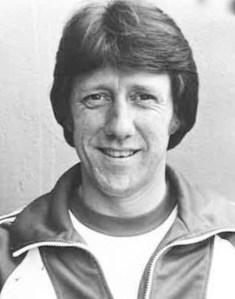
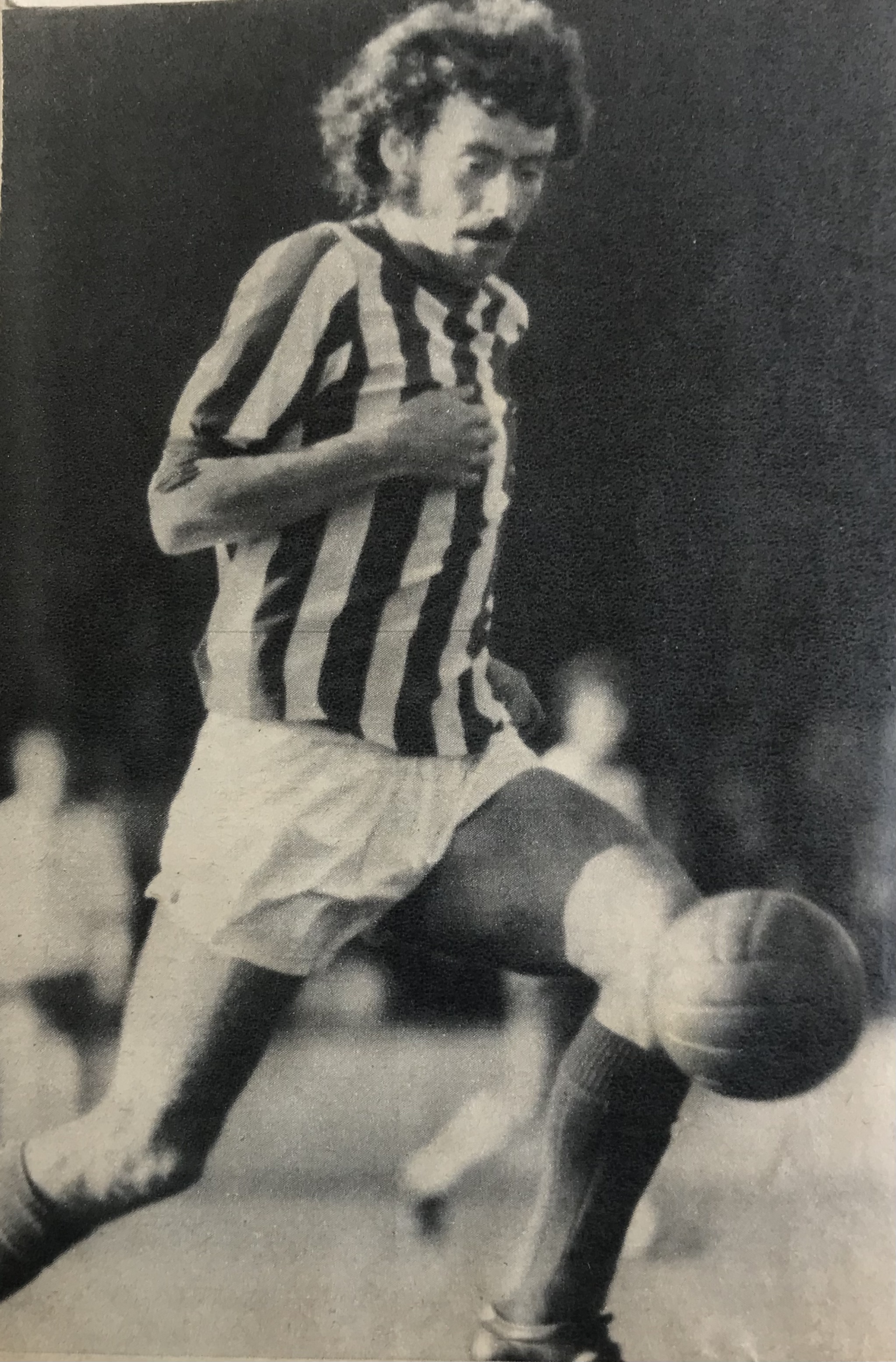
Shankly ‘disciple’ George Aitken coached Mariners and Seagulls

MEDIA-friendly Jimmy Melia stole all the limelight as Brighton stormed to the final of the 1983 FA Cup but a quiet, wavy-haired Scot alongside him played a big part in the achievement.

George Aitken was joint caretaker manager with Melia for three months after Mike Bailey’s dismissal in December 1982, and he’d previously been in the dugout alongside Alan Mullery and Ken Craggs during Albion’s rise through the divisions having originally been brought to the club by Peter Taylor.

.When he died aged 78 in August 2006, Jimmy Case told the Cumbrian Times & Star: “George was a great character, a great friend and coach right the way through my time at the club. “Jimmy Melia was in the front line with his white shoes but George was right there in terms of the workings of the club and picking the team. He was well respected for his knowledge of the game.”

Mark Lawrenson also paid tribute in an interview with Argus reporter Paul Holden, telling him: “George never got carried away. He had seen it all before. He was a very wily old fox. He was from the old school, a good, honest, true, loyal man.

“He knew his football, knew his players and liked a laugh. He had one of those infectious laughs.”

Micky Adams said: “He was a great football man, George. When I first joined Brighton as manager, he was one of my biggest allies. He always popped into the office to chew the cud and talk football. He loved Brighton and was a well-respected man who loved the game.”

Holden also reported that at Aitken’s testimonial dinner in 1988, former Albion secretary, Stephen Rooke, said: “He may never have reached the dizzy heights attained by many of his friends and acquaintances over the years but he represents a rare breed, in fact the very lifeblood of our national game.

Aitken tiler sully 78

Aitken puts Ken Tiler and Peter O’Sullivan through their paces in pre-season training in 1978

“Deep down George is a very private person but his reliability and honest, down-to-earth approach has, quite rightly, earned him enormous respect throughout the football world.”

Aitken had been a manager in his own right at Workington, and he and Melia had both been players under one of the game’s legends – Bill Shankly.

Shankly managed Workington between 6 January 1954 and 15 November 1955, when Aitken was a strong and commanding centre back for the Cumbrian side, and five of Melia’s 10 years playing for Liverpool were under Shankly’s managership.

Born in Dalkeith, Scotland, on 13 August 1928, Aitken was educated at Dalkeith High School and played football for Midlothian Schools.

His step up to senior football came at Edinburgh Thistle, which was essentially a feeder side for Hibernian.

David Jack, remembered as the first player ever to score at Wembley, had become manager of Middlesbrough in 1944, and took Aitken to Ayresome Park after the war.

“I was 20 at the time and it took me two seasons to reach the first team,” Aitken recalled in an Albion matchday programme article.

“Middlesbrough had a great team at the time and I played alongside the likes of (England internationals) Wilf Mannion and George Hardwick.”

Aitken made his debut against Fulham in 1951-52, but only made 18 top division appearances and, in July 1953, was sold to nearby Workington for £5,000.

It was the beginning of a long-standing relationship with a club who in those days played in the basement division of the Football League and is now in the Northern Premier League – the seventh tier of English football.

Aitken amassed 262 league appearances for Workington and, in the 1957-58 season, played against the famous Busby Babes at home in the 3rd round of the FA Cup in front of a record 21,000 crowd – just a month before the Munich air crash. Dennis Viollet scored a hat-trick for United in a 3-1 win.

“The game was an experience that I’ll never forget,” said Aitken, who kept on the wall of his house a picture of him with United’s skipper that day, Roger Byrne, who not long after that match perished in the Munich air crash.

Aitken retired as a player in 1960 but he stayed on at Borough Park as a coach, initially under Joe Harvey, who later enjoyed success at Newcastle United, and then Ken Furphy, who went on to manage Watford, Blackburn and Sheffield United before moving to the USA and taking charge of four different clubs.

Aitken had a brief spell as Workington manager between March and June 1965 (stepping in after Keith Burkinshaw – later famously boss of Spurs – had left) but then followed Furphy to Watford in 1965 as his coach. During that time, Watford, then in Division Two, famously beat Shankly’s Liverpool 1-0 in the quarter-finals of the FA Cup before losing to eventual winners Chelsea in the semi-finals.

The lure of Workington was to draw him back to the north west, though. When the manager’s job became vacant in 1971, Aitken took over and stayed for three seasons, eventually leaving in October 1974.

grimsby 75

In the 1975-76 season, he was trainer-coach during Tommy Casey’s spell managing Grimsby Town (where, as in picture, one of the players was former Albion defender Steve Govier), but left the Lincolnshire outfit to join Peter Taylor’s coaching set-up at Brighton in 1976. The Scot ended up staying for 10 years.

Aitken and wife Celia had three children and I well remember one of them, Bruce, appearing for Worthing FC.Aitken 2

George was clearly football daft, and in a matchday programme feature of September 1985, Celia told Tony Norman: “Football has always been his hobby, as well as his way of earning a living. He really loves the game. It’s not unusual for us to be driving somewhere and to stop because George has seen a game going on in a park by the road. He can’t resist watching for a while.”

During Chris Cattlin’s reign as manager, Aitken was the reserve team manager and chief scout, and in the programme article he said: “I can look back on some very happy memories. I was assistant manager when we took the club to Wembley and that experience is something I’ll never forget. But that is all in the past and what really matters to me is the future for Brighton Football Club. So, I enjoy going out to look for youngsters who could do a good job for us in years to come.”

After being sacked by Brighton, Aitken did scouting work for Graham Taylor during his spells at Watford and Aston Villa and then had three years working for the FA during Taylor’s reign as England manager. His last football role  was at Bolton Wanderers when Colin Todd was the manager.

end shot aitken armchair

Pictures from a variety of sources including the matchday programme, online sites and the Argus.

‘Unsung hero’ Dave Turner was Brighton captain at 22

3 Turner portrait

DAVE TURNER, one of Brighton & Hove Albion’s youngest ever captains in the 1960s, had already been at the Albion just over five years by the time I got to see my first game.

Over the course of eight and a half years with the club, he played 338 games, scoring 34 goals. In old-fashioned parlance, Turner was a wing half – what today would be known as a predominantly left-sided midfield player.

Born in Retford, Nottinghamshire, on 7 September 1943, as a youngster he played for Notts Boys and had two trials for England Boys before joining Second Division Newcastle United straight from school as an apprentice in 1960.

He was part of the Newcastle side which beat Wolves 2-1 in the 1962 FA Youth Cup, playing alongside Toon’s future legendary captain Bobby Moncur and long-serving Northern Irish full back David Craig.

Newcastleunited-mad.co.uk says he was “highly thought of when he helped Newcastle win the Youth Cup in 1962, but never broke into the first team”. In fact, that wasn’t quite true because he was given his first team debut in the very last game of the 1961-62 season, a 3-0 home defeat to Leeds United.

He made one more appearance for the Magpies under new manager Joe Harvey but became Archie Macaulay’s first signing for a fee when he headed to Sussex in December 1963 for the princely sum of £6,000.

Turner made his debut in a 2-0 home win over Darlington on 7 December 1963 and, in only his second season at the Goldstone Ground, he made 40 appearances and scored twice as Albion marched to the Fourth Division championship.

“That was a great season,” Turner told Goal magazine in 1970. “Bobby Smith (former Tottenham and England international) was with us then. I was very surprised he joined Brighton, but what an asset he was.

“We scored plenty of goals, the crowds flocked back, the atmosphere was great.”

The following year, Dave was appointed captain – the youngest Albion ever had.

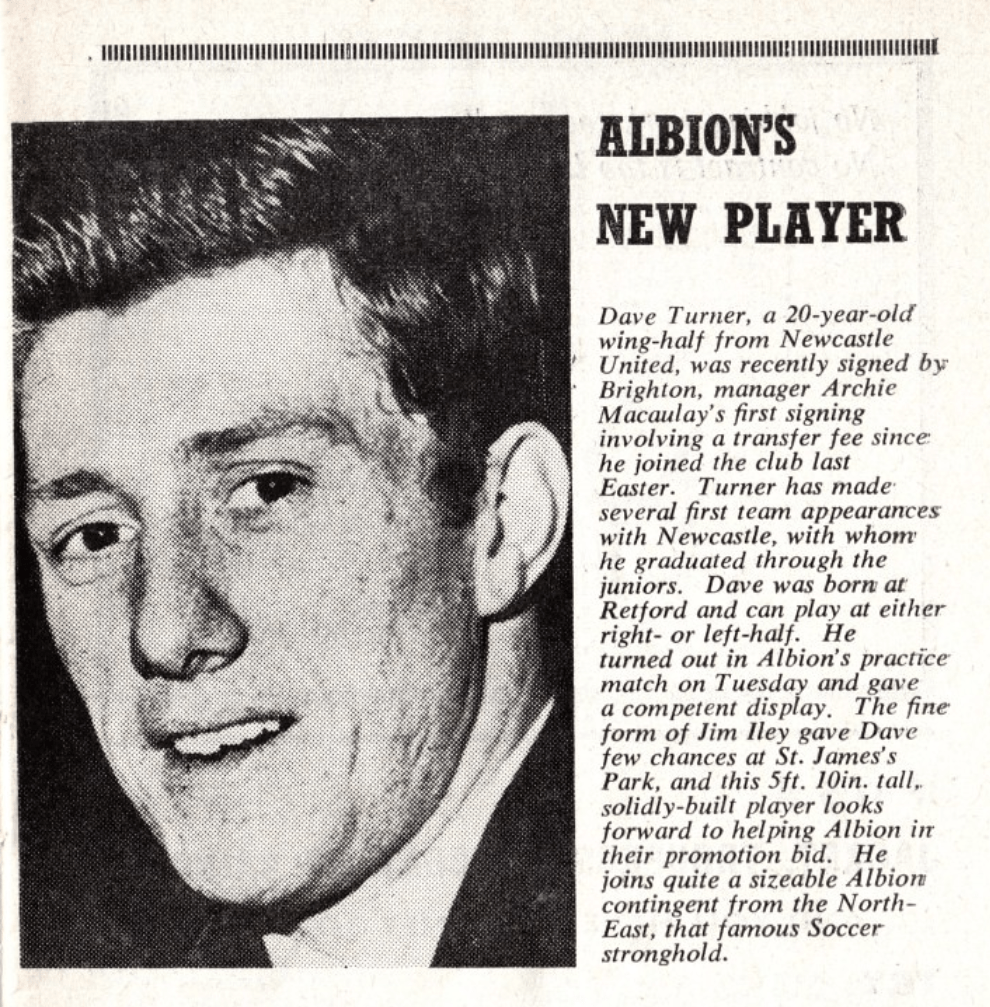
Albion’s matchday programme introduces the new young captain

“I was surprised but very pleased,” Dave told the magazine. “There were several players older than I was, so it was a great honour to be made skipper.

“I was a bit frightened at first but after a game or two I realised that the rest of the team were backing me up, so everything was all right.”

It was only when the experienced former Preston North End skipper Nobby Lawton arrived in 1967 that Turner relinquished the job.

“He had a fine reputation and I asked to be relieved of the job, suggesting Nobby should take over,” he said.

Remarkably both Turner and Norman Gall, another player hailing from the North East, reached the milestone of their 285th Albion game at the same time.

Brighton were looking odds on for promotion under Freddie Goodwin in the 1969-70 season and it was rare for a Third Division team to get coverage in Goal, a popular national football magazine at the time.

The article began: “Dave Turner is one of the unsung heroes of Brighton. He has played nearly 300 games for the club, been involved in a Fourth Division Championship victory, and is now in the middle of another bid for glory.

“Brighton are fighting hard to get into the Second Division and the 26-year-old midfield star is a key man in their battle.

“Ever since he joined them from Newcastle in December 1963, Turner has played a vital role in the Brighton set-up.

“Stars like Rodney Marsh, Hugh Curran and Bruce Rioch, all of whom have gone on to better things, have played against (and been overshadowed by) Brighton’s non-stop wing half.

“It is Turner’s consistency which is helping Brighton in their promotion struggle. And he thinks they can do it.”

2 turner colour portrait

Turner told the magazine: “I’m pretty confident we can go up. But so can any of the top 10 at the moment. We’ve been playing well all season, but early on we just couldn’t get the right results. Everyone was getting a bit disappointed.

“Then everyone started getting stuck in a bit more – it began to pay off. We had a long undefeated run in the League after November and conceded only one goal in nine games. Even that was a penalty.

“The defence has been playing well and the whole team has been coming back and doing its share of the work. It would be nice to score a few more goals but if you don’t let any in it means you have at least one point before you start.”

Unfortunately although Brighton were top after a 2-0 win over Reading on 27 March 1970, they blew the chance of promotion with four defeats in the remaining five games and ended up fifth.

In the following two seasons under Pat Saward, Turner was hard hit by injuries and only made 19 appearances in the 1971-72 Third Division promotion campaign, appearing in his suit in the champagne-raising dressing room picture after promotion was achieved.

In its pen pictures of each of the members of the squad, the Argus said of him: “Turner never knows when he is beaten and few players have achieved greater popularity with the Goldstone crowd.”

The arrival of the cultured Brian Bromley to occupy his midfield berth meant Turner was given a free transfer in the summer of 1972 and, together with Kit Napier, he joined Ken Furphy’s Blackburn.

Turner made 25 appearances for Rovers but his injury issues returned and he was forced to retire in 1974. He followed his former boss Furphy to Bramall Lane where he was youth coach for a while. He then moved on to Aldershot before heading to Canada.

He coached at Toronto Blizzard under former Watford and Sheffield United midfielder Keith Eddy and stayed under Eddy’s successor, Bob Houghton, who was a former Brighton teammate. Houghton was at the Goldstone in 1969-70 although he didn’t feature in the first team. He famously managed Swedish side Malmo when they lost 1-0 to Nottingham Forest in the 1979 European Cup Final.

Turner stayed in Canada with Toronto Blizzard and had a season with Toronto Dinamo but he returned to the UK in 1990 and rejoined the coaching staff at Aldershot.

1 turnerleadsout
4 Turner promotion dressing room
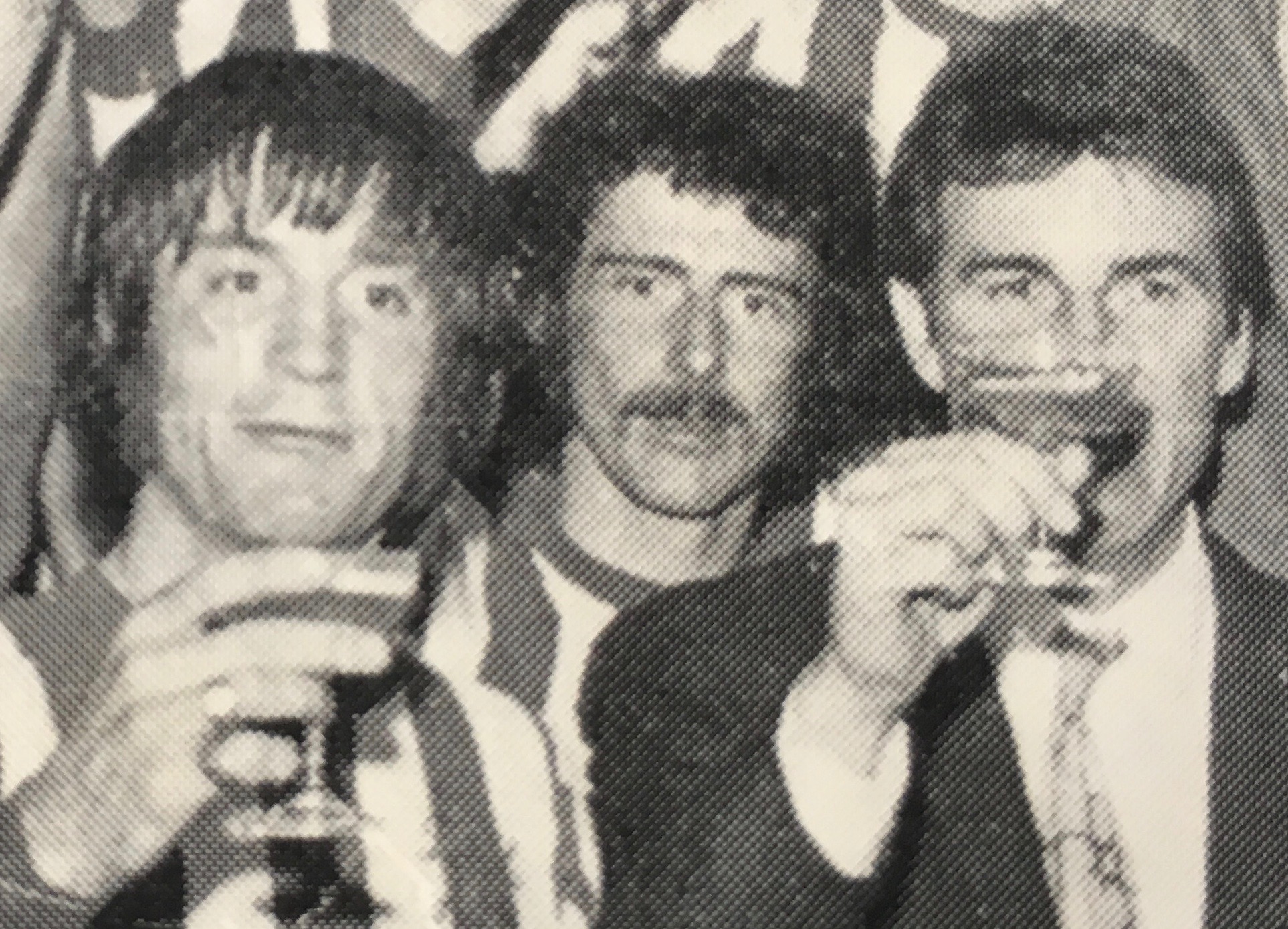
  • Pictures from my scrapbook show Turner leading out the Albion at the Goldstone, as featured in Goal, part of a team line-up in 1969-70, a portrait from the Argus in the 1971-72 season, joining in the 1972 promotion celebrations alongside Ian Goodwin with Brian Bromley (front left) and physio Mike Yaxley.

Turner the coach: at Toronto Blizzard with Bob Houghton and some well-known English players, and at Sheffield United and Aldershot.

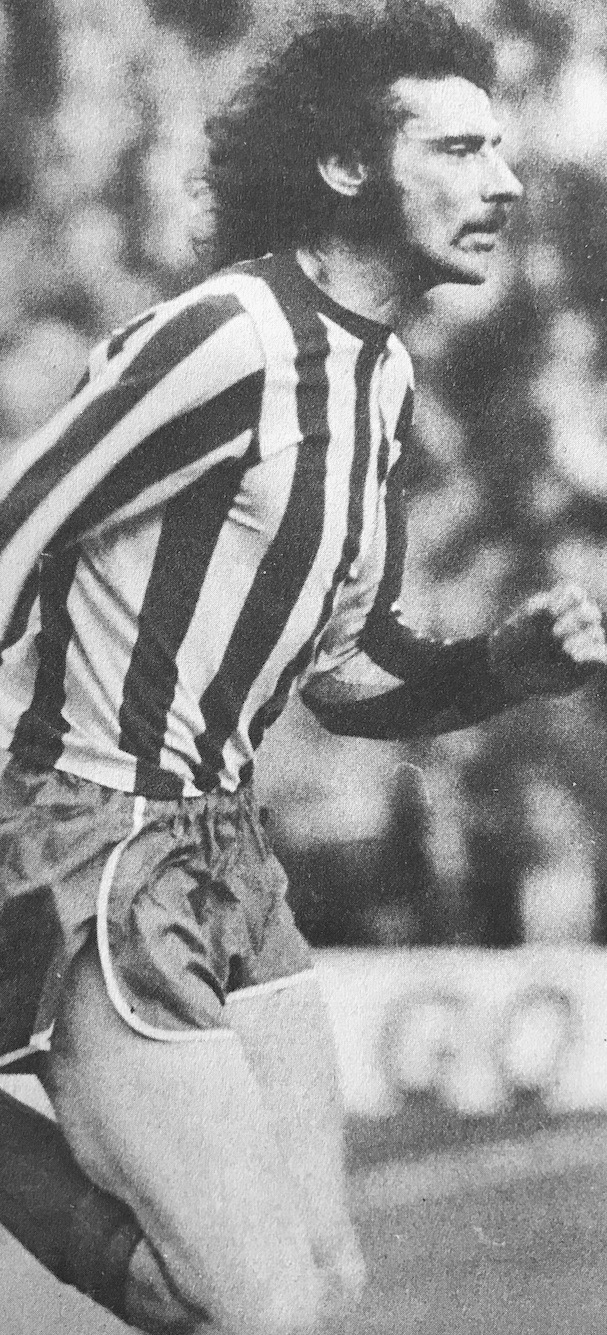
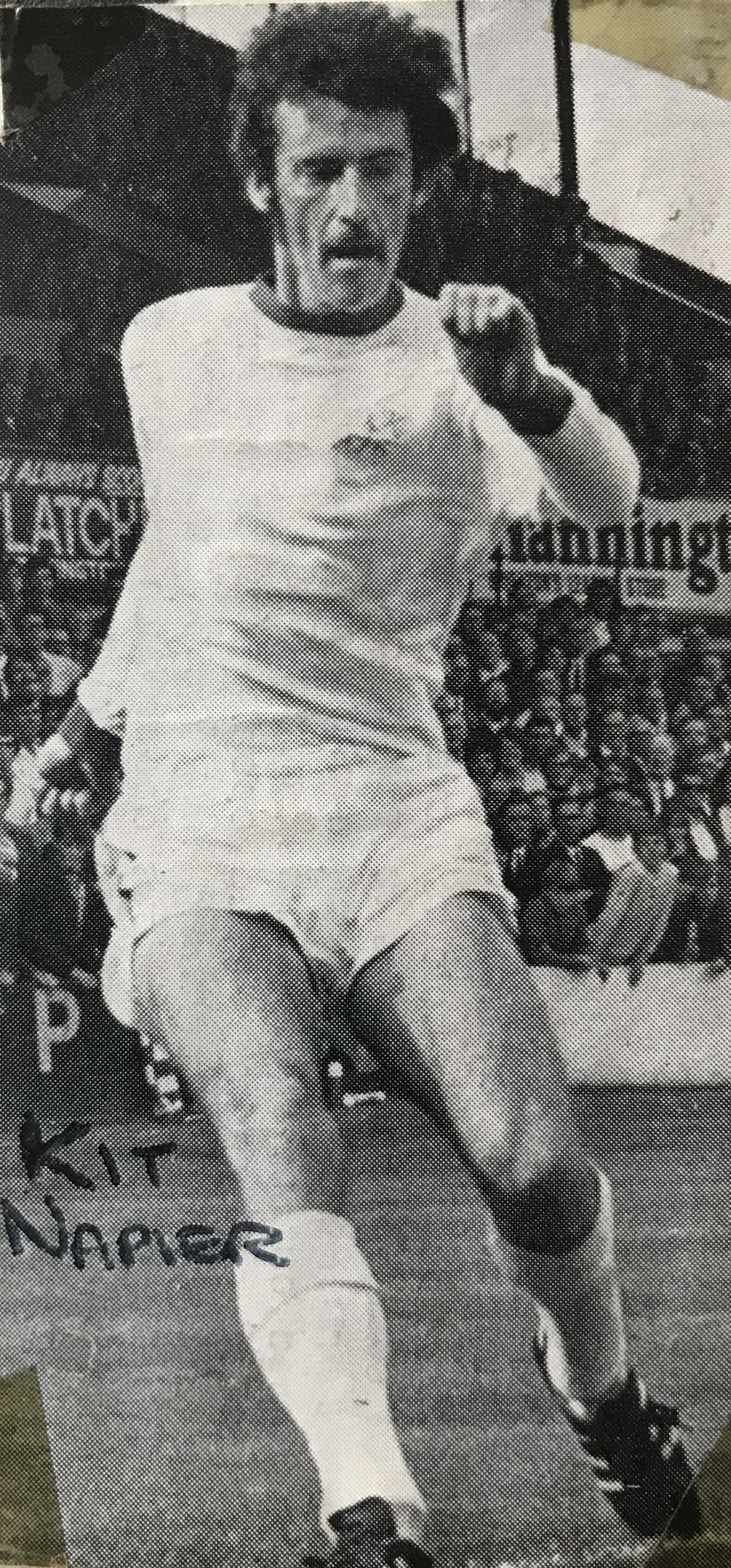
Kit Napier top scorer for Brighton in five of six seasons

FORMER Newcastle United centre forward Kit Napier, who moved from the Magpies to Brighton in 1966, was playing up front alongside Alex Dawson when I first started watching the Albion (in 1969).

Kit Napier at full stretch to score against Bournemouth in front of a packed Goldstone Ground on Boxing Day 1971

Born in Dunblane on 26 September 1943, Kit’s promise as a schoolboy prompted his headmaster to put his name around as a future footballing talent and he left Scotland to join Blackpool (then playing in the top tier) as a junior before turning professional in 1960. But he only played twice for the Tangerines before moving on to Second Division Preston North End in 1963-64. Things didn’t work out there either, though, and he dropped down a further division to Workington, where it all started to click.

Workington were newly-promoted to the Third Division and Napier was on the scoresheet during what has been described as the club’s proudest night, a 5-1 win in a Football League Cup 3rd round replay against First Division Blackburn Rovers on 22 October 1964.

In a team managed by Ken Furphy, who later enjoyed success as manager of Watford, one of Napier’s teammates was Keith Burkinshaw, who several years later would become manager of Tottenham Hotspur.

The Workington archive also recalls the fifth round tie, on 25 November 1964, when Workington hosted Chelsea at Borough Park.  At the time, Chelsea were riding high in the top flight of English football and were unbeaten on their travels when they arrived in west Cumbria.  Reds were fourth in the old Third Division at the time.

“In front of a record League Cup attendance (17,996), Reds gave Tommy Docherty’s Chelsea the fright of their lives by holding them to a 2-2 draw having been 0-2 down early in the game,” the archive records.  “Dave Carr and Kit Napier scored for the Reds and we had a ‘goal’ disallowed late in the game for an offside offence.

“We eventually lost the replay, 0-2, but the crowd at Stamford Bridge was 10,000 fewer than the gathering at Borough Park.”

Napier scored 25 goals in 58 games for the Cumbrian side which attracted the attention of the Geordie giants at St James’ Park. He was still only 22 when they paid £18,000 for him.

KN NUFCHe made his Newcastle debut on 6 November 1965 in a 2-0 home win over Blackpool. But it probably didn’t help his cause that Newcastle lost six of his seven other games, and drew the other!

His last game was in the Tyne-Wear derby game on 3 January 1966 when Sunderland triumphed 2-0.

Toon1892.com, a veritable mine of Newcastle history, says of Napier: “He was seen as a forward who had great potential. Unfortunately, he struggled to come to terms with the First Division and despite having all the ‘tricks’ he could not put the ball into the net.

An autographed Evening Argus photograph of Kit Napier from the 1970-71 season

“Being given only eight games to prove himself, one wonders whether he was given a real chance or not, but the arrival of (Welsh international) Wyn Davies settled any argument and Kit was off to Brighton.”

That move came early in the 1966-67 season when Brighton – bottom of the league table at the time – paid £9,000 to bring him south. He made an instant impression, scoring twice on his debut in a 5-2 win over Peterborough.

It was the perfect start to what was to be the most successful period of his career.

Over Easter in 1971, Napier scored in all three of Albion’s matches – a 1-0 home win over Aston Villa on Good Friday, a 2-0 home win over Reading the following day, and a 3-2 away win at Bradford City on Easter Monday.

The matchday programme for the following home game declared: “This gift of marksmanship blends very nicely with his ball control and general skill in possession. Not to mention the times when he lets fly at goal from outside the penalty area.

“We’ve seen some thrilling thunderbolts from him, including several during 1967-68 season when he broke Albion’s post-war individual scoring record with 30 goals, 24 of them in the league.”

He was top goalscorer in five of his six seasons with the club and, by the time he left, he’d netted 99 goals in just short of 300 appearances, including 19 in the 1971-72 promotion-winning side. Against Shrewsbury at the Goldstone, on 30 October 1971, he netted his 100th career league goal (see below). At that time, his Albion tally was 75.

IMG_4445

The superb The Goldstone Wrap blog did an extended piece on him in which they said: “Kit Napier is rightly considered an Albion legend. He was a ball-playing attacker, skilful with both feet, and with tremendous talent for goalscoring. At the Goldstone, Napier’s class and quick-witted play endeared him to the crowds.”

Aside from the goals, three things about him stand out in my memory:

• Kit had an amazing talent for scoring direct from corners: quite some skill. The first came in a 2-0 home win over Bury on 27 December 1969.

• In a game against Preston, on 27 February 1971, when Napier was shaping to take a penalty in front of the South Stand, Alan Duffy, promptly stepped forward, pushed his teammate out of the way and took the penalty himself – and missed!

• The following season, in a home game against Wrexham, Napier had been having a bit of an off day and the crowd were getting on his back. Eventually manager Pat Saward subbed him off and, as he trudged towards the tunnel, rather than the polite applause that tends to accompany today’s substitutions there were lots of ironic cheers to greet his withdrawal. Napier responded by waving a two-fingered salute to all corners of the ground! I’m pretty sure nothing came of it although, of course, in this day and age he’d no doubt have been hauled before the powers that be.

irvine napier saward

Kit Napier celebrates promotion with Willie Irvine, left, and manager Saward.

With Albion promoted, Saward knew he needed to strengthen the side and he clearly didn’t think Napier was up to playing at the higher level and put him on the transfer list.

Although he made a handful of starts in the 1972-73 Second Division campaign, by the end of August he’d been sold to Blackburn Rovers (who were in the Third Division at the time) for £15,000 as Albion sought to recoup some of the £29,000 record fee they spent bringing former England international Barry Bridges to the club from Millwall.

Napier had two seasons at Ewood Park and brought down the curtain on his English league career with a further 10 goals in 54 appearances. When he returned to the Goldstone with Rovers, he was made captain for the day. “I still get goosebumps and feel emotional at how the whole crowd gave me a standing ovation,” Kit remembered many years later.

He moved to South Africa to play for Durban United and, after packing up playing, had a very successful career as a Ford car salesman in the city (he was national sales manager of the year seven years in a row) alongside his former Albion teammate Brian Tawse. An Albion matchday programme reported how they both also turned out for a local Sunday league side in Durban.

Napier’s later years were blighted by emphysema and he died in Durban on 31 March 2019 at the age of 75.

6F15B25C-FBBC-4A75-8119-94BA0BDC7DBC_1_201_a