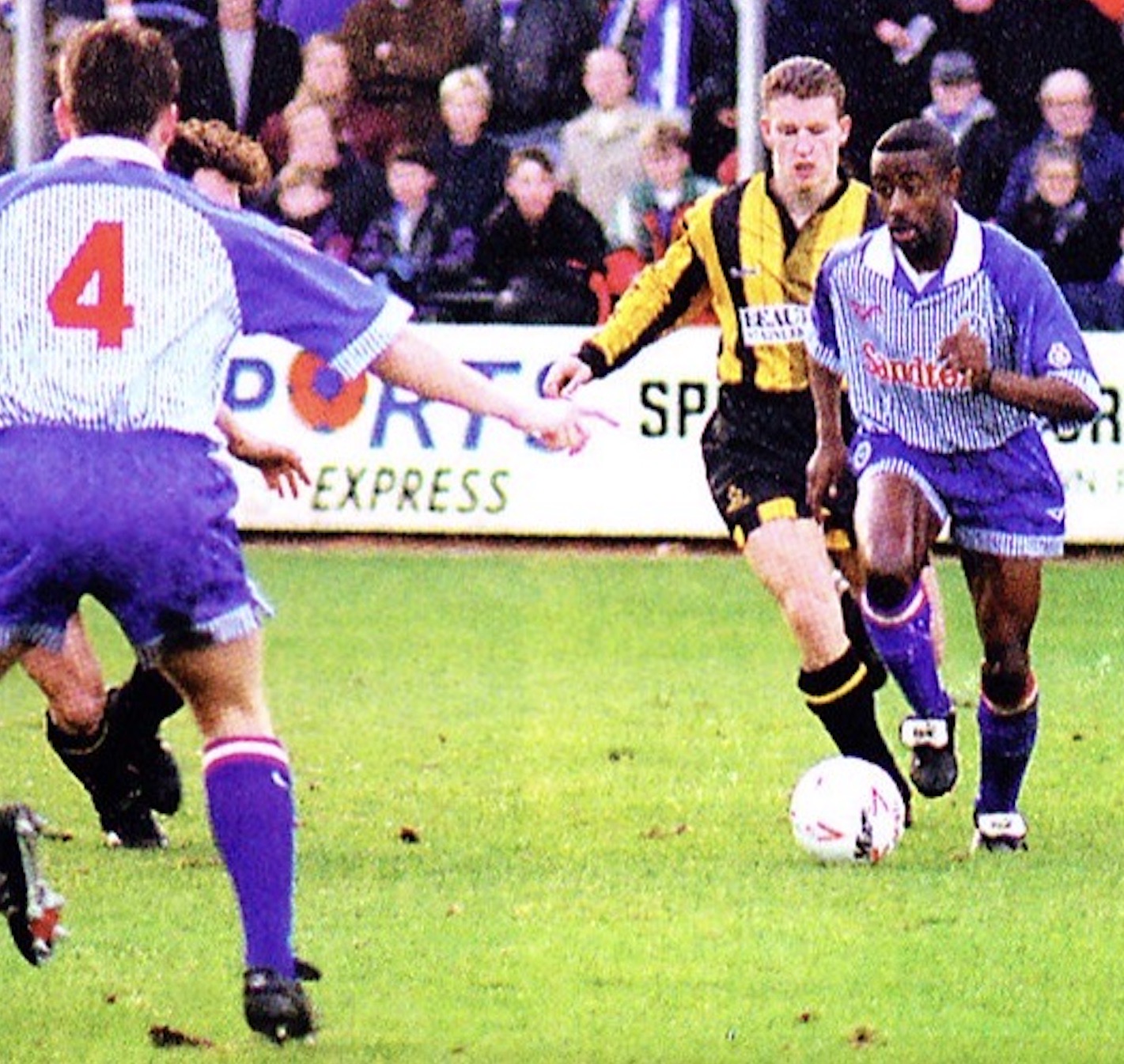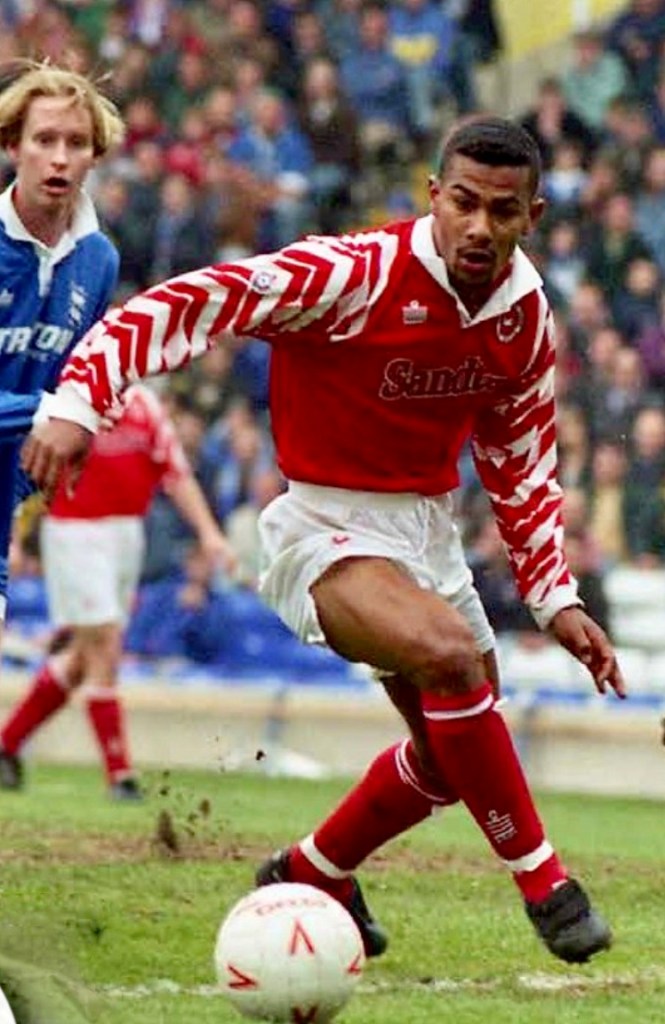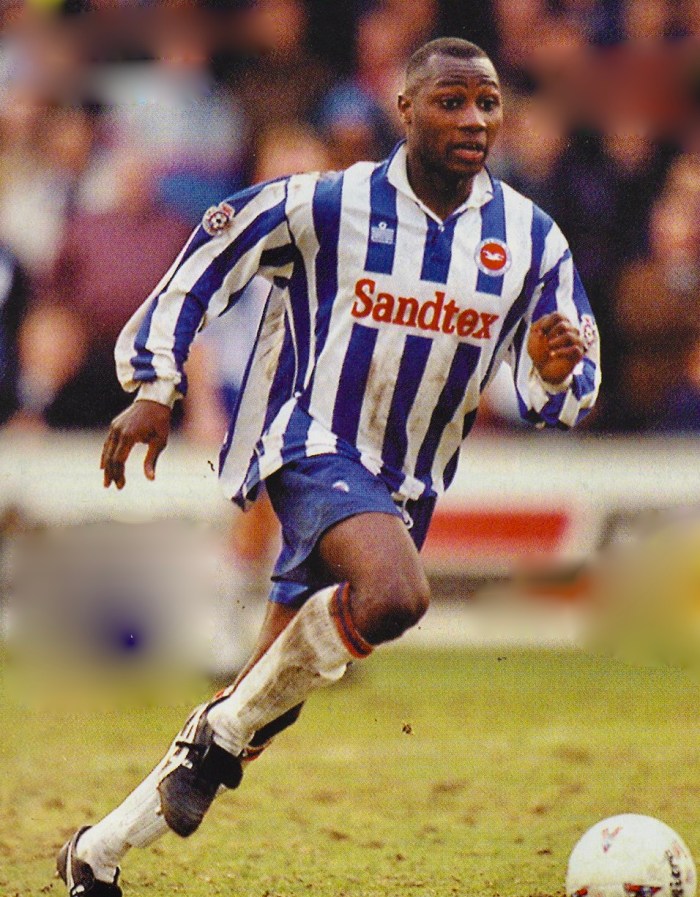
Zeke Rowe’s three goals and a red card as Albion went down

CHELSEA loanee Zeke Rowe scored three goals in nine matches for doomed Brighton and ended his spell with the ignominy of being sent off.

Rowe, a 22-year-old striker who had scored plenty at youth level for Chelsea,  was one of five new faces to join Jimmy Case’s relegation-bound Seagulls in the spring of 1996.

Winger Paul McDonald and striker Craig Maskell joined permanently from Case’s old club, Southampton, together with Saints defender Derek Allan, on loan initially and then permanently. Future captain Gary Hobson signed from Hull City.
All found themselves plunged into what turned out to be a fruitless battle to avoid relegation against a toxic backdrop created by the people running the club at that time – the hated Archer / Stanley / Bellotti regime – who tried to sell the club’s home without having a new ground to move to.

In the same matchday programme that announced the arrival of the five new players, the publication also detailed the impending departures of the likes of former first team regulars Steve Foster, Ian Chapman, Dean Wilkins, John Byrne, Stuart Myall and Stuart Munday; not to mention directors Bernard Clarke, Peter Kent, Dudley Sizen and Denis Sullivan. To misquote Shakespeare: Something was definitely rotten in the state of Hove!

Rowe made his debut in a 1-1 draw at home to Rotherham United, on 30 March, and then got off the mark with a goal away to Swindon Town four days later, although the Albion went down 3-2 (Jeff Minton scored the other).

Rowe’s picture adorned the front cover of the matchday programme for the 9 April home match v Burnley when his goal earned the Seagulls a win.
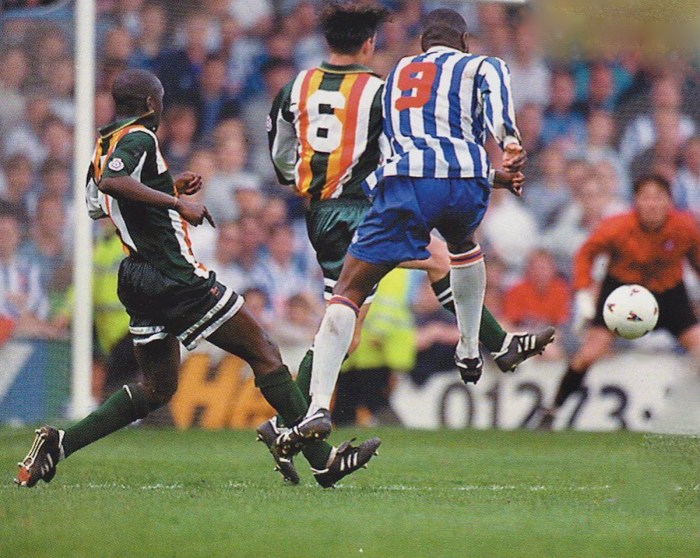
And his solitary goal also proved to be the decider in another 1-0 home win, over fellow strugglers Carlisle United, managed at the time by Mervyn Day.

Rowe’s dismissal for fighting with York City’s John Sharples came in a Thursday morning game, played five days after the official end of the season, in front of a post-War record low gate of 2,106 fans at the Goldstone.

The fixture had been rearranged because the original game 12 days previously had been abandoned after disgruntled Albion supporters had stormed the pitch in protest at the proposed sale of the ground and broken both crossbars.

It drew hysterical reaction in some quarters (probably because it was only a few weeks before England played host to Euro 96) but had the desired effect of bringing the rogue direction of the club to the attention of the football authorities who somewhat late in the day intervened to stop the Albion going out of business.

The original York game had looked like being the last ever at the Goldstone but a stay of execution saw the club stay for one more season before the site was redeveloped and the Seagulls were forced to groundshare at Gillingham.

The only happy supporters at the Goldstone on 9 May 1996 were around 400 followers of the Minstermen because their side overcame going a goal down to a Maskell opener to win 3-1, a result which prevented them joining Albion in the drop. Gary Bull, who had enjoyed a successful time on loan with Brighton at the start of that season, had equalised for York.

One City fan, Simon Worden, wrote an amusing blog about the whole occasion, and explained: “Whilst I should have been in a lecture at university at Preston, as I was only 19 at the time, I decided that the match was too important to miss and travelled down the day before to watch the match and stayed in a very cheap B&B.”

After witnessing the win, he said: “All the York fans were jumping around on a Thursday morning singing ‘We are staying up’ and enjoying the sunshine.

“One of the best days even and, whilst I was very tired, it was an enjoyable (but expensive) trip back to Preston where I had to catch up with my studies!”

Also watching on was Michael Knighton, chairman of Carlisle United, who, as a consequence of the result, were relegated with the Albion. Greg Wood, covering the game for The Independent, spiced up his report with a couple of choice quotes from him.

“Once York had gone 2-1 ahead, Brighton just weren’t interested,” said Knighton. “We’ve been relegated and we’ll never know if we should have been. This competition should be based on fairness, and towards us it hasn’t been.”

Wood also observed: “After York’s third goal, a member of their board turned to Knighton and made some distinctly unsporting gestures. Ordinary supporters have probably been expelled for less.”

Born in Hackney on 30 October 1973, Rowe was a frequent goalscorer in Chelsea junior teams playing alongside the likes of Neil Shipperley, Muzzy Izzet, Michael Duberry and Craig Burley.

But a first team breakthrough eluded him and before his time at Brighton he had scored twice in 10 games on loan at Barnet and had a trial with Swindon Town that didn’t work out.

When Chelsea let him go in the summer of 1996, he moved to Second Division Peterborough United under Barry Fry and was quickly off the mark netting the Posh opener in a 3-3 home draw with Millwall on 10 September 1996.

He was on target again, four days later, ironically against York City, in a 2-2 draw. But the season didn’t end well for Posh, because they were relegated. Rowe only scored once more in his 15 starts and 14 appearances off the bench that season.

Over the next two seasons, he only made four more starts for United and 13 appearances as a sub, while also going out on loan to Kettering Town and Doncaster Rovers.

Rowe later moved to Welling United where, according to the fanzine Winning Isn’t Everything, he was a disappointment after a bright start. It said: “Ezekiel Bartholomew Rowe, to give him his full name. Another in the long line of loanees from Uncle Barry Fry, he was brought in late in the 1998-99 season as the club attempted another Houdini act. Joined permanently in the summer, was on fire pre-season and then… he was shit. Had an impressive tattoo, erm, apparently.”

At King’s Lynn, Rowe played under his former Peterborough teammate Tony Spearing, who won the FA Youth Cup with Norwich City. (That 1983 success saw the Canaries draw 5-5 with Everton over two legs – Mark Farrington scoring four of Everton’s goals – before edging a replay 1-0).

Rowe ended his playing days with Conference North side Hinckley United where he was a teammate of Stuart Storer, who famously scored the last ever goal at the Goldstone – against Doncaster Rovers – a year after Rowe’s dismissal at that much-loved old stadium.

How the career of high rise Flatts came tumbling down

MARK FLATTS was destined for a glittering career after breaking into Arsenal’s first team when only eighteen.

It was the season when George Graham’s side finished in a disappointing 10th place in the league but won the League Cup and the FA Cup, beating Sheffield Wednesday in both competitions.

Flatts got seven starts plus four appearances off the bench and the following season, after he’d been troubled with a few injuries, Graham sent him out on loan to get some games under his belt.

His first loan was at Cambridge United, then in January 1994 Flatts joined forces with former Gunners legend Liam Brady at Brighton.

The former midfield maestro who’d graced the game at the highest level as a player had not long arrived at the Goldstone Ground, creating a buzz of anticipation amongst the largely disillusioned Albion faithful.

Brighton were bumping along around the foot of the third tier table when he arrived and it augured well that Brady could use his connections with his former club to secure the services of a prodigious young talent who’d already played a handful of matches in the Premier League.

He made his debut in a cracking 4-1 New Year’s Day home win over Cambridge United when Kurt Nogan scored a hat-trick and he was only on the losing side twice during his two months at the club, helping the Albion move away from the relegation zone.

Brady wrote about it in his autobiography Born To Be A Footballer, describing how “livewire” Flatts had heated up “a freezing Goldstone” on that debut day. “He’s a lovely young kid off the field but on the park there’s a strut about him. That’s exactly what we need. He’s full of tricks.”

Flatts started nine matches, came on as a sub once, and scored one of Albion’s goals in a 3-2 home win over Blackpool, but it was his skill on the ball and pace that fans enjoyed most.

After he had returned to Highbury, Brady thanked him for his contribution and said in his programme notes: “He gave the place a tremendous lift. He’s a very confident lad and he did us a real favour and hopefully he’s got something out of it as well. I think he has and I think he enjoyed his time with us.”

Flatts confirmed as much recently. Although he has kept a low profile for many years, in 2020, online from his home in Norfolk, he appeared in two podcasts talking about his career.

On the Shoot the Defence podcast in April 2020, Flatts talked admiringly of his time under Brady at Brighton – “He still had it in training” – as well as the experience of playing alongside senior pros Jimmy Case and Steve Foster at the Goldstone Ground.

“Loyal fans as well. It was a good time,” he said. “I got on well with the fans and a few of them still text me, so that’s nice. Liam Brady and Jimmy Case had seen me in a few games, said they wanted me on loan, and I went there and enjoyed it.”

Born in Islington on 14 October 1972 and brought up in Wood Green, Flatts played for Haringey Borough and Middlesex County school teams and he was playing for Enfield Rangers when he caught the eye of professional clubs.

He spent time training with Watford and West Ham, but his mum and older brother were Arsenal fans so, when they invited him to join them, it was no contest. The scout responsible for picking him up for the Gunners was the former Brighton wing-half, Steve Burtenshaw.

Flatts was one of the country’s top talented 14-year-olds who went through the FA National School of Excellence at Lilleshall before becoming a trainee at Highbury after graduating.

In the first edition of a new fans’ podcast Over and Over and Over Again on 20 August 2020, Flatts talked about how he, Andy Cole and Paul Dickov up front, Ray Parlour and Ian Selley in midfield, Scott Marshall at the back and Alan Miller in goal were all going through from youth team to reserves at the same time. “It was a good strong youth team,” he said. “Pat Rice was the youth team manager who brought us through. He was a good coach.”

Flatts signed professional in December 1990 and he progressed to the reserve side who were managed by another Arsenal legend, George Armstrong.

One particular reserve match stands out as memorable – but not because Flatts scored a goal in a 2-2 draw. Ordinarily, Flatts was accustomed to playing in front of a few hundred supporters for the second string, but on 16 February 1991 it’s reckoned more than 10,000 turned up.

The Ovenden Papers Football Combination game against Reading was originally scheduled to be an away fixture but freezing conditions meant the game was swapped to Highbury because it had undersoil heating.

The reason for the surge of interest was the match saw the return to playing of Tony Adams after his release from prison, having served half of his four-month sentence for drink driving. The amazing response of the Arsenal faithful was remembered in this football.london article in February 2018.  

Often niggled by injuries, Flatts was sidelined by one he hadn’t even been aware of, other than what felt like a small discomfort. “I got a stress fracture on my ankle and was playing on it for a month without realising,” he said.

Physio Gary Lewin arranged for him to see a Harley Street specialist and it was only after he was put through tests on a running machine that the problem was diagnosed. The injury required surgery that put him out of action for over a year.

Flatts got his first real involvement with the first team on a pre-season tour of Norway ahead of the 1992-93 season, getting on as a substitute against Stabaek and Brann Bergen. He was a non-playing sub in two subsequent pre-season friendlies away to Wolves and Peterborough.

It was back to reserve team football at the start of the season but Graham selected him to travel with the squad for an away game at Sheffield United on 19 September and he made his competitive debut as a 71st minute substitute for Anders Limpar, shortly before Ian Wright netted an equaliser for the Gunners.

His next involvement came in a third round League Cup encounter with Derby County. He was a non-playing sub in the away tie but started in Limpar’s place for the replay on 1 December 1992, when Arsenal edged it 2-1.

Flatts (right) celebrates Arsenal’s League Cup win with some familiar faces

He kept his place for the league game which followed four days later but was subbed off as Arsenal lost 1-0 at Southampton.

At one point, the Islington Gazette declared Flatts, Neil Heaney, Parlour and Dickov as the “next crop of Arsenal starlets who will take the club forward”.

As the year drew to a close, on 19 December, Flatts earned rave reviews for his showing in a 1-1 home draw against Lennie Lawrence’s Middlesbrough.

“It’s very unusual to have a quick player with a brain,” said manager Graham. “Mark has skill but he also has the application to go with it.”

Writing about how brightly Flatts shone in the game, Trevor Haylett, of the Independent, said: “He possesses an easy and deceptive running style which frequently carried him away from markers, and has a confidence that few of his colleagues shared in a desultory first 45 minutes.”

Haylett observed: “The problem for Graham is that his most productive line-up, with Merson in the ‘hole’ to distribute and ghost into scoring areas, leaves no room for Flatts, who amply justified his manager’s contention that he has a ‘very big future in the game’.”

Flatts kept his place for the following match, a goalless Boxing Day home draw against Ipswich Town, and was back on the bench away to Aston Villa three days later but came on for the second half in a game Arsenal lost 1-0.

The game he remembers most fondly came just over a fortnight later away to Manchester City at Maine Road. He sped past two players and crossed it for Paul Merson to score with a near post header that gave Arsenal a 1-0 win.

But competition for places was intense and he didn’t next get a start until 1 March against Chelsea at Stamford Bridge, another game that finished goalless.

He had to wait until May for his next involvement, as a sub in a 1-0 defeat away to Sheffield Wednesday, who his teammates would play twice in the space of five days later that month to win the FA Cup on penalties, both games having ended in draws.

With the first of those matches only four days away, Graham put out a young side to face Spurs in the last league game of the season, and Flatts was part of a side who lost the north London derby 3-1, Dickov getting the Arsenal goal.

After his loan spell at Brighton, Flatts got back into the first team picture at Arsenal towards the end of the 1993-94 season, featuring in three successive league games: as a sub in a 1-1 draw with Wimbledon and starting in a 2-1 win at Villa and a 1-1 home draw against QPR.

While he travelled to Copenhagen with the squad for the European Cup Winners’ Cup Final on 4 May 1994, he didn’t play in the Gunners’ 1-0 win.

Flatts wasn’t back in the Arsenal first team set-up until December 1994, when he had a four-game spell, starting in a 2-2 draw away to Nottingham Forest, being a non-playing sub away to Manchester City and then coming on as a sub in a 3-1 defeat at home to Leeds on 17 December and in the goalless Boxing Day home match with Aston Villa.

He came off the bench in a third round FA Cup replay defeat to Millwall on 18 January 1995 but the following month the manager who had supported his development was sacked, and the young wideman went out on loan to Bristol City.

Flatts didn’t reckon much of the man management skills of Graham’s temporary successor, Stewart Houston, but it was the manager who eventually succeeded him who showed the youngster the door.

“Bruce Rioch took over, and said: ‘No, you’re not good enough’ and that was it,” Flatts recalled. He had another short loan spell, this time at Grimsby Town, in the 1995-96 season, but when his contract was up in 1996, he was given a free transfer.

When Flatts left the famous marble halls of Highbury, all that early promise rapidly evaporated and despite a handful of trials at several clubs, his career fizzled out, the player admitting he fell out of love with the game.

Initially, he headed off to Italy to try his luck with Torino in Serie B. He said while he enjoyed his few months there, a limit on the number of foreign players who could play at any one time edged him out of the picture.

According to arseweb.com, back in the UK he had trial periods with Manchester City (September 1996) and Watford (October 1986), although the scathing Hornets fans website, Blind, Stupid and Desperate has a less than flattering summary of his efforts to impress at Vicarage Road. He was briefly at Kettering Town in December 1996, then Barnet (1997-98 pre-season) and Colchester United (1999-00 pre-season) but none of them took him on.

Former Arsenal striker Martin Hayes, manager at Ryman League Division One side Bishop’s Stortford, signed him during the 1999-00 season.

And his last appearance on a team-sheet was as an unused substitute for Queens Park Rangers in a 2000-01 pre-season 4-2 away defeat at Dr Martens League Premier Division side Crawley Town.

Flatts told host Richie Wakelin on Over and Over and Over Again that he kept on picking up niggling injuries too regularly. “With fitness concerns, I just lost interest,” he said. “I ain’t got no regrets. I loved it at Arsenal. I loved playing football. George Graham had faith in me and he gave me a go.”

He said his teenage son and daughter both play football and he has done some coaching at a local level and has considered setting up his own coaching school. He has also done some scouting work for Cambridge United and Norwich City.

Flatts looks back at his football career during a 2020 podcast

Pictures from Albion’s matchday programmes and various online sources.

Spurs’ Junior acted the Dream after scoring for the Seagulls

JUNIOR MCDOUGALD played professional football for 23 years and managed to combine it with acting, featuring in Sky 1’s Dream Team series.

Brighton fans of a certain vintage will remember him as a nippy, diminutive forward who scored 22 goals in 88 matches (+ seven as sub) during a difficult period for the club.

By his own admission (in an interview with the Argus), he left too soon, and a move to Rotherham United didn’t work out.

Born in Big Spring, Texas, on 12 January 1975, McDougald grew up in the UK and his early potential saw him associated with Tottenham Hotspur from the age of nine.

He was subsequently chosen as part of a group of the country’s top 25 14-year-old footballing prospects to be nurtured at the FA’s National School at Lilleshall.

On his graduation from Lilleshall in 1991, he joined Spurs as a trainee. Alongside McDougald both at Lilleshall and Tottenham was Sol Campbell, the defender who went on to star for Spurs and Arsenal, as well as England. Campbell told tottenhamhotspur.com: “I’ve some fond memories of Junior. We used to play against each other when we were 13, then we were at Tottenham and Lilleshall when we were 14.

“He’s a smashing lad and I can’t speak highly enough of him. He’s a good bloke, a good man and a fabulous footballer.”

McDougald joined the full professional ranks at White Hart Lane in the summer of 1993, but when he didn’t make the breakthrough to their first team, he made the switch to Brighton.

He described his time at Spurs as “a dream come true” and, in an article on tottenhamhotspur.com, said: “I know it’s an old cliché but I’d always supported Spurs.

“I think it’s well documented now that I even wrote to Jim’ll Fix It to ask to go training with them!”

He added: “It was a great experience, a positive experience and it was always my dream to play for the club.”

Spurs fanzine My Eyes Have Seen The Glory (mehstg.com), recalled him as “a young striker who scored a large number of goals for the Tottenham junior sides, but progressed no further than the reserves at White Hart Lane. Blessed with good pace, but a little on the short and light side.”

Unfortunately, while his contemporary Campbell went on to superstardom, McDougald was released at the age of 19.

“It was very disappointing to leave,” he said. “But at the same time, I was ambitious and, when Liam Brady at Brighton called me, I saw it as a great opportunity. I wanted first team football.

“Any disappointment was hidden by excitement. It was a new start.”

I can remember seeing McDougald make his debut in the opening game of the 1994-95 season, away to Swansea City at their old Vetch Field ground; Albion resplendent in the turquoise and black striped shirts in the style of the kit once worn by boss Brady at Inter Milan.

McDougald’s subsequent one-in-four scoring ratio with the Seagulls was set against the backdrop of financial turmoil at the club and he was there when the club was relegated to the fourth tier.

“There was no stability off the field and that could transfer itself on to it,” he told the Argus. “I was very young and Liam Brady was a great help. I was pleased to have played with legends like Steve Foster, although he was coming to the end of his career.

“The supporters were fantastic and really good to me as a young player. Overall, I had two enjoyable years there and I’m delighted to see them doing so well now. They’ve always had the potential and the fans deserve the success.”

Towards the end of his second season with the club, he was loaned to Chesterfield, where he scored once in nine games, and he then chose to move to Rotherham United for £50,000 in August 1996.

“It is only when you leave somewhere sometimes that you realise how good a club it was,” he told the Argus. “I have fantastic memories of Brighton. The support was so good and they have such potential.

“I thought I was doing the best thing for my career when I left. I wasn’t to know I would go to Rotherham, score on my debut, get injured in the same game and not play for three months.”

He had a relatively successful six-month spell at Toulon in France but efforts to re-establish himself back in the UK with Cambridge, Millwall and Orient didn’t work out.

“With the gift of hindsight maybe I would have stayed at Brighton for another season or two and established myself,” McDougald said in the Argus interview.

It was only when he signed for Dagenham & Redbridge in 1999 that he got back in the headlines, in particular when, in January 2001, he scored in the FA Cup 3rd round as the non-league Essex side held Alan Curbishley’s then Premier League Charlton Athletic to a 1-1 draw.

The 4th round draw paired the winners of the tie with Spurs, so it looked like it would be a perfect match for the former Spurs youngster, but the Addicks edged the replay 1-0 in extra time to spoil his dream.

Nevertheless, his form for Dagenham saw him selected for the England semi-professional side at a Four Nations Trophy tournament in 2002, where he was up against his clubmate Tony Roberts, the former Spurs goalkeeper.

Alongside the serious business of earning a living from playing football, McDougald also appeared for the fictional Harchester United side in Sky’s Dream Team, together with former Albion players Peter Smith and Andy Ansah.

“It was through Andy who actually recruits the players,” he said. “Pete Smith told me it was fun and it is. We just do what footballers do and are filmed playing, in changing rooms and night clubs. It is a good little avenue.”

By the time Dagenham made it into the Football League, McDougald had moved on to St Albans and, in the 2003-04 season, he was part of a Canvey Island squad that also included former Brighton players Mickey Bennett, the aforementioned Peter Smith, and Jeff Minton.

He later played for Kettering Town, Histon, and Cambridgeshire side St. Ives.

McDougald, a Born-again Christian, has since become the co-founder and director of children’s charity Sports Connections Foundation which uses sport to help and inspire children.

Brighton’s heroic captain Cullip clashed with Warnock

AFTER three promotions and one relegation in five years, Danny Cullip left Brighton for Sheffield United in December 2004.

Hard-up Albion needed the cash at the time and Cullip was keen to join a side who were pushing for promotion to the Premier League.

“They were a massive side and I felt that it was too good an opportunity to miss,” Cullip said in Match of My Life (knowthescorebooks.com), edited by Paul Camillin. “I felt if I didn’t take the opportunity, I would end up regretting it, and although things didn’t work out, I don’t regret it, as I would have lived the rest of my life wondering what might have happened.”

Cullip was virtually ever-present during his three months with the Blades but a clash of personalities with fiery manager Neil Warnock saw him offloaded on loan to Watford before the end of the season.

DC focusThe player who had been an inspirational captain for the Seagulls has chosen not to go into detail about what happened although Warnock had plenty to say in his autobiography, ghostwritten by journalist Oliver Holt.

“At Sheffield United I bought a centre-half, Danny Cullip, with a view to him being my leader on the pitch, my captain,” he said. “I thought he was a good talker. I realised within a week he talked a better game than he played. The only answer was to get shot of him quickly.”

Cullip swerved the controversy in an Albion matchday programme interview in 2019-20, saying instead: “We won my first three games in succession and ended up taking maximum points from five of the first six games.

“It was a great start and I was really enjoying my football but then, out of the blue, Neil said he wanted to bring in another striker, Danny Webber from Watford.

“Ray Lewington, who was coach at Watford at the time and knew me from out time together at Brentford, said they would only sanction it if they could get me in return. It was going to be a permanent move but ended up being a loan as Ray was sacked the following week, which wasn’t ideal.

“My Sheffield United career was over though before it had even begun, which was so disappointing because I’d been playing well and we’d been getting results.”

butts + DC Sheffield United’s Cullip gets to grips with ex- Albion teammate Guy Butters
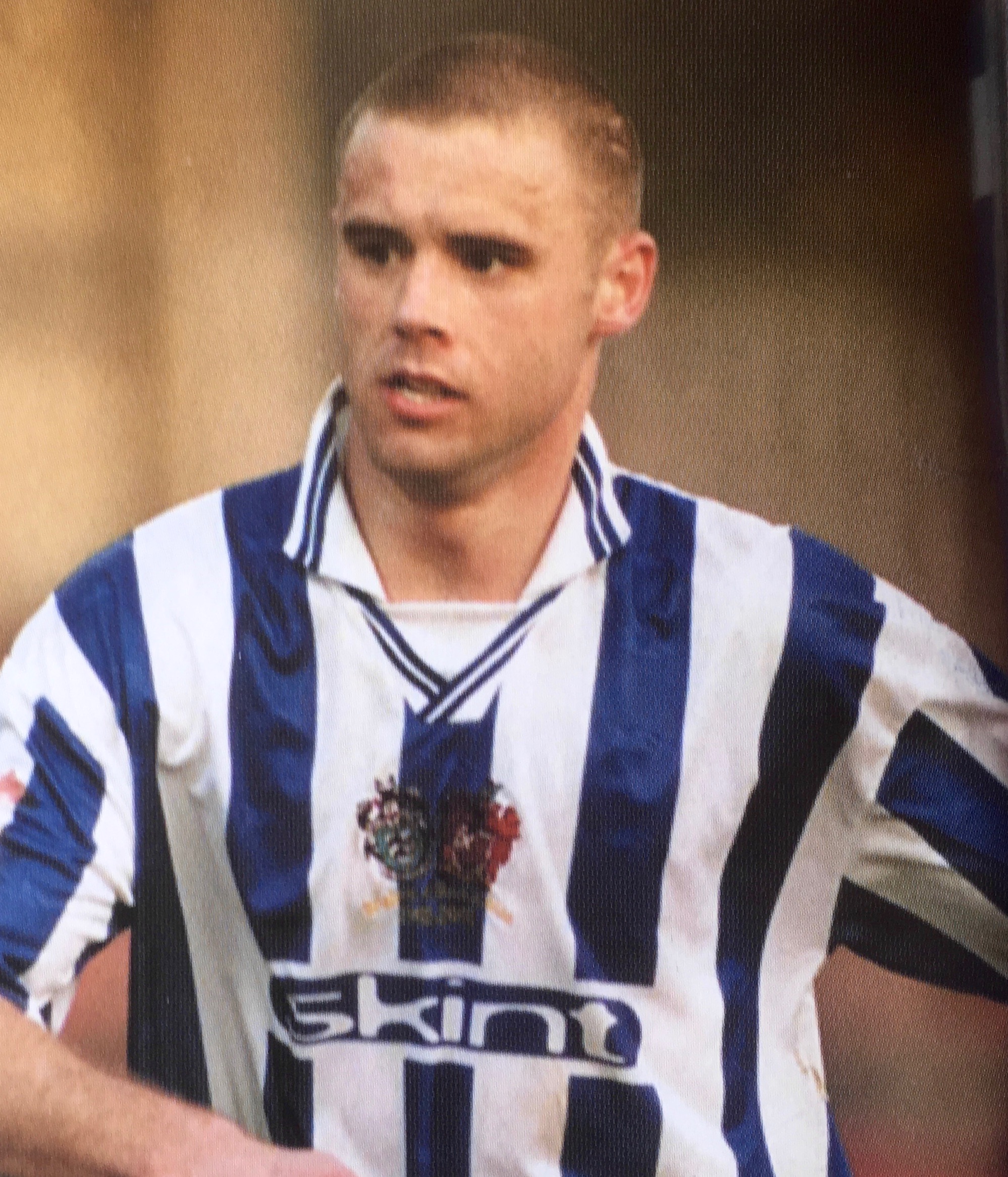
Lee Connor on footballleagueworld.co.uk reckoned Cullip was one of the top 5 most pointless signings in Sheffield United’s history which seems a harsh assessment of a player who made 216 appearances for Brighton.

The £250,000 fee Brighton received for their captain was certainly much needed at the time and was a good return on the £50,000 they invested in signing him from Brentford for £50,000 on 13 October 1999.

Born on 17 September 1976 in Bracknell, Berkshire, Cullip was scouted by Oxford United while playing Sunday football and shone during a set of trial games. After getting into their under-16s, he then earned a two-year YTS apprenticeship where he was coached by future England manager Steve McLaren.

Oxford were managed by that redoubtable former centre half Denis Smith at the time and Cullip was given a one-year professional contract but faced stiff competition to make the breakthrough to the first team, where future Leicester City stalwart Matt Elliott was excelling.

“I went out on loan to Kettering Town in the Conference,” Cullip told fulhamfocus.com. “Gary Johnson was their manager and I learned a lot from him and played well there.”

Cullip had a trial at Shrewsbury and could have joined them or Kettering. But he chose to join then Fourth Division Fulham because his dad was a Fulham fan, he told fulhamfc.com in an April 2016 interview. Micky Adams had been newly appointed in his first managerial job and handed Cullip his league debut in the first game of the 1996-97 season.

It was a season fondly remembered by Fulham fans because they won promotion but the regime change the following year, when Mohammed Al Fayed took over, saw Adams dumped in favour of Kevin Keegan and Ray Wilkins and eventually Cullip rejoined Adams at Brentford in exchange for a £75,000 fee in February 1998.

Cullip found himself back in the basement division when the Bees were relegated and then on the treatment table for much of the season after suffering a cruciate knee ligament injury.

Having not played a first team game for 13 months because of the injury, Cullip was thrown a lifeline when Adams, by now in charge at Brighton, took him on a month’s loan in September 1999.

CullipHe impressed sufficiently for Adams to persuade chairman Dick Knight to make the transfer permanent, beginning an association with the club which continues to this day.

Cullip became a mainstay of the defence during the back-to-back promotions of 2001-02 and 2002-03 and famously scored the headed winner in a 1-0 win over Chesterfield at Withdean that clinched the third-tier championship.

Cullip took over the captaincy from Paul Rogers and recalls the “unbelievable day” he lifted the play-off final trophy at the Millennium Stadium, Cardiff, in 2004.

After his Blades spell was cut short, and his brief Watford loan came to an end, Cullip joined Nottingham Forest where his manager was Gary Megson. “I really liked him,” said Cullip. “He was an honest guy; what you see is what you get with him.

“Unfortunately, I missed my first pre-season with Forest due to what was ongoing at United, so I was playing catch-up with the rest of the lads and ended up suffering a hamstring injury. It was a problem that would dog me for the rest of my career.”

He was restricted to a handful of appearances in his first season with Forest but he eventually became a regular in a three-man defence alongside Wes Morgan and Ian Breckin.

DC Forest Cullip in action for Forest, marking Albion’s Alex Revell

In January 2007, he was on the move again, to Queens Park Rangers, where former Albion player John Gregory was in charge. But his 18-month deal was terminated early after one of their many managerial changes saw him surplus to requirements.

With his family based in Sussex, Cullip looked for an opening in the south and spent six weeks training with Millwall before linking up with Gillingham, where he played from February 2008 to the end of the 2007-08 season.

He then played non-league with Lewes but, after a season, the hamstring injury forced him to retire.

Alongside his former Albion centre half partner Guy Butters, Cullip is now a coach with the Albion in the Community scheme.