The FA Youth Cup winner with a sweet left foot

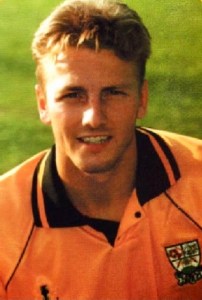
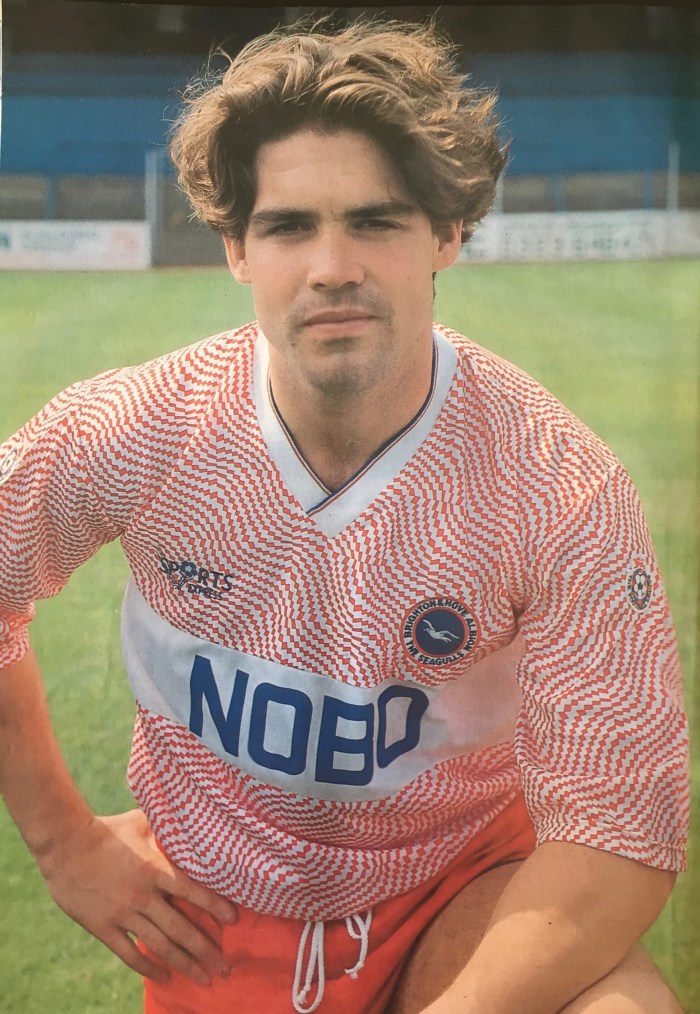
PACY DARREN HUGHES made his Everton first team debut two days after Christmas 1983 while still a member of the club’s youth team.

That game at Molineux ended in a 3-0 defeat for the young defender against bottom-of-the-table Wolves who had Tony Towner on the wing and John Humphrey at right-back.

Exactly three years later, a picture of Hughes in full flight was on the front cover of Albion’s programme for their home festive fixture against Reading, the Scouser having signed for the second-tier Seagulls for £30,000.
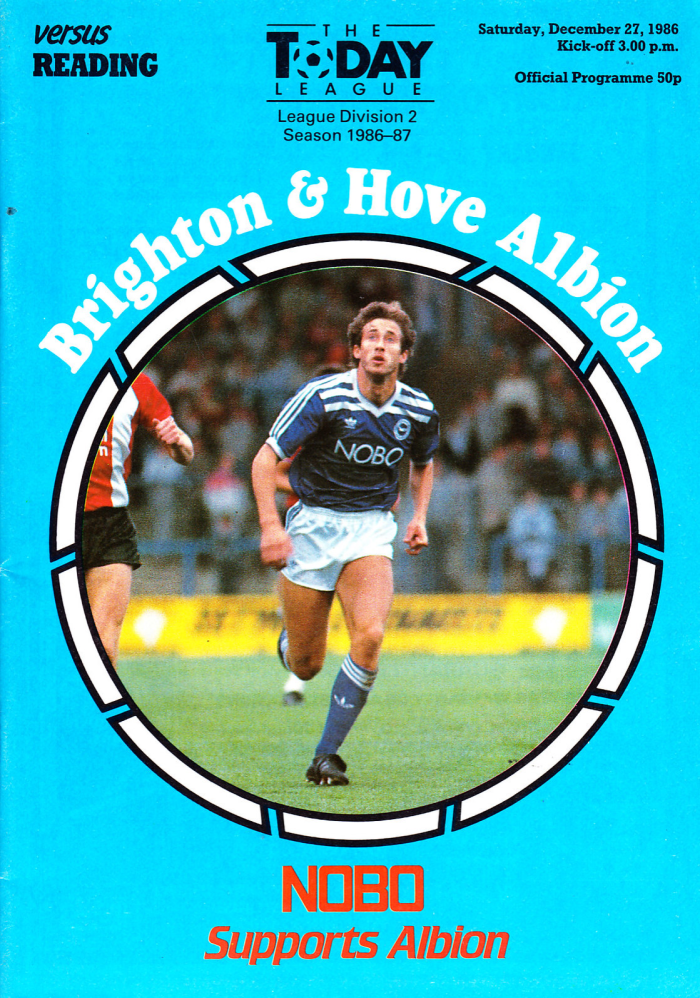
The money to buy him came from the supporter-funded Lifeline scheme which also helped to buy goalkeeper John Keeley for £1,500 from non-league Chelmsford and striker Gary Rowell, from Middlesbrough.

Hughes had made only two more first team appearances for Everton before a free transfer move took him to second tier Shrewsbury Town, for whom he made 46 appearances.

It was while playing for the Shrews in a 1-0 win over Brighton that he had caught the eye of Alan Mullery, back in the Albion hotseat at the start of the 1986-87 season.

In his matchday programme notes, Mullery wrote: “Darren could become a really good player here. I was impressed with him when he played against us recently.

“He started at Everton and came through their youth scheme and had already played in their first team at 18. The grounding he received at Goodison should stand him in good stead.

“He has already shown he is the fastest player we have here, in training he even beat Dean Saunders in the sprints.”

Interviewed for the matchday programme, Hughes told interviewer Tony Norman: “I was quite happy at Shrewsbury. But when the manager told me Brighton were interested in signing me I thought it would be another step up the ladder. It’s a bigger club with better prospects and it’s a nice town as well.”
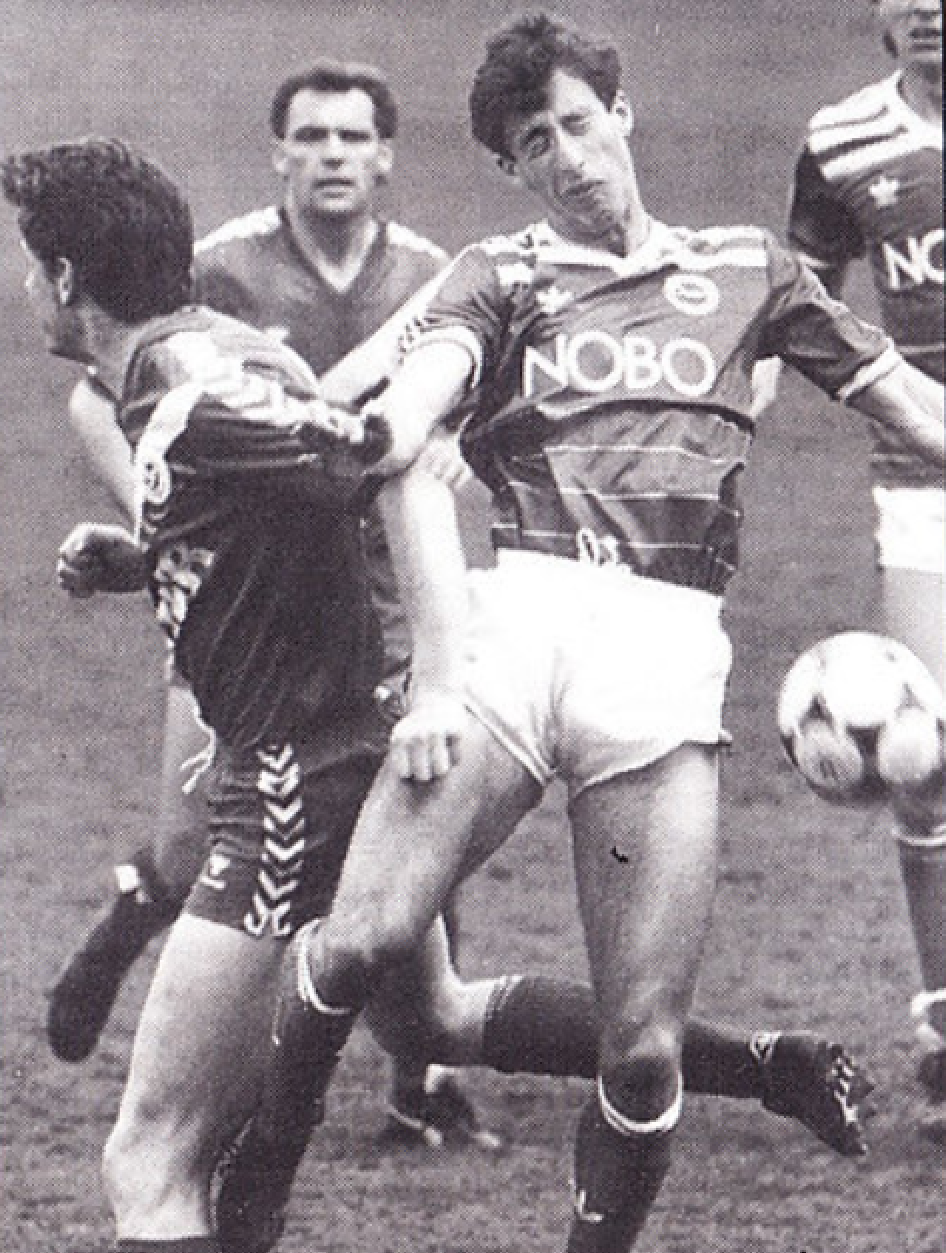
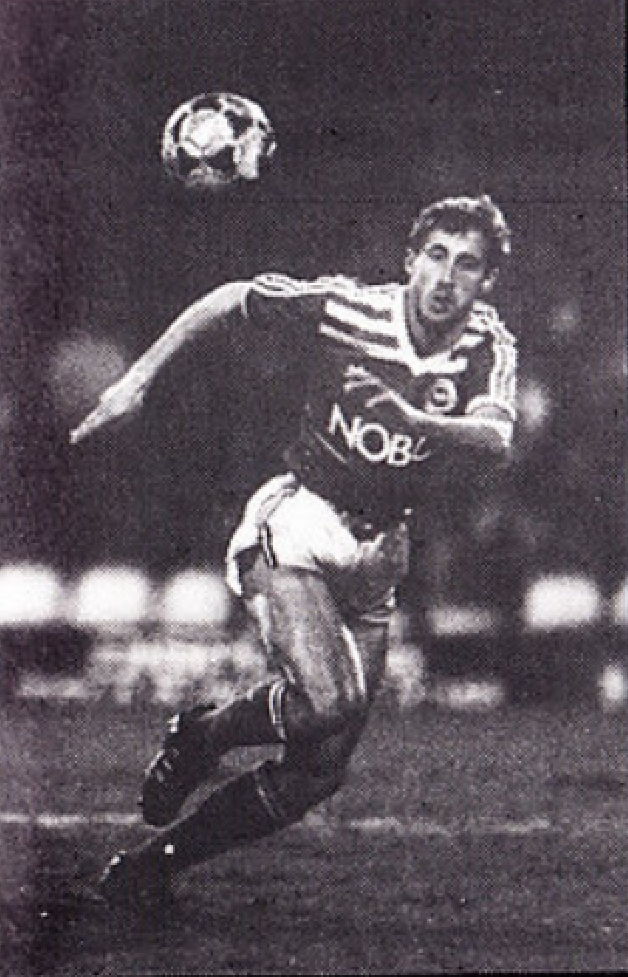
Hughes moved into digs in Hove run by Val and Dave Tillson where a few months later he was joined by Kevan Brown, another new signing, from Southampton.

Hughes meanwhile had made his Albion debut in a 3-0 defeat at home to Birmingham in the Full Members Cup on 1 October 1986 and his first league match came in a 1—0 home win over Stoke City three days later courtesy of a Danny Wilson penalty.

He scored his first goal for the Seagulls in a 2-2 Goldstone draw against Bradford City as Mullery continued to see points slip away. With financial issues continuing to cloud hoped-for progress, 1987 had barely begun before Mullery’s services were dispensed with.

Hughes played 16 games under his successor Barry Lloyd but those games yielded only two wins and the Albion finished the season rock bottom of the division, dropping the Albion back into the third tier for the first time in 10 years.
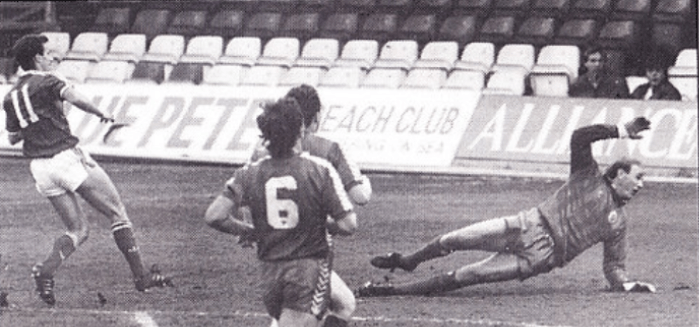
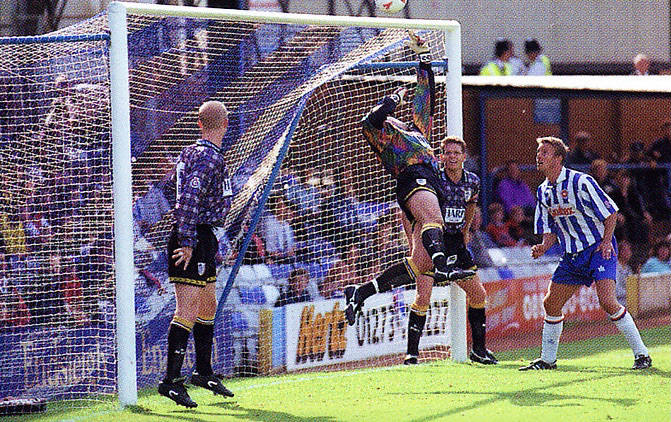
A rare happy moment during that spell was (pictured above) when Hughes slotted past George Wood in a 2-0 home win over Crystal Palace on Easter Monday although that game is remembered more for violent clashes between supporters outside the Goldstone Ground after fans left before the game had finished.

What turned out to be his 25th and final league appearance in a Seagulls shirt came in a 1-0 home defeat to Leeds when he was subbed off in favour of youngster David Gipp.
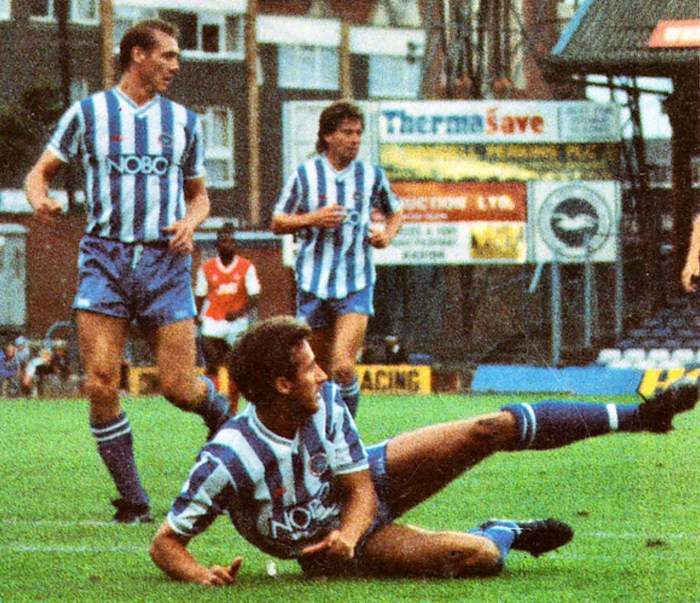
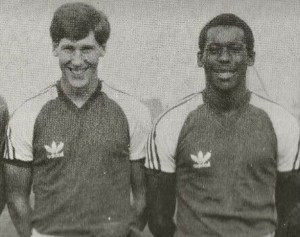
Going to ground in a pre-season friendly against Arsenal

Hughes did start at left-back in a pre-season friendly against Arsenal at the Goldstone in early August (when a Charlie Nicholas hat-trick helped the Gunners to a 7-2 win) but when league action began he was on the outside looking in.
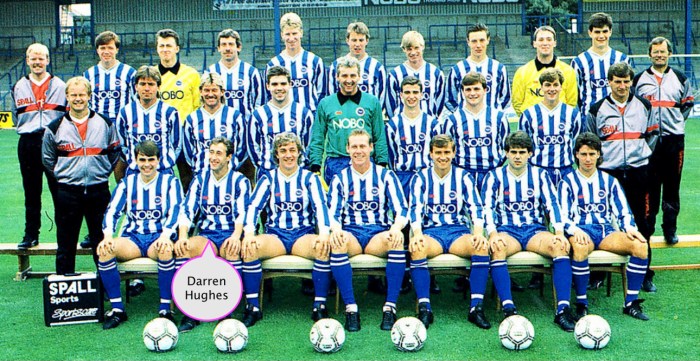
He was in the front row of the official team photo line-up for the start of the 1987-88 season, but Lloyd was building a new side with several new signings, such as Keith Dublin and Alan Curbishley, and young Ian Chapman was also beginning to stake a claim.

Hughes earned mentions in dispatches for his performances in the reserves’ defeats to Portsmouth and Spurs but come September he switched to fellow Third Division side Port Vale, initially on loan before making the move permanent.

Perhaps it was inevitable that when the Seagulls travelled to Vale Park on 28 September, Hughes was on the scoresheet, netting a second goal for the home side in the 84th minute to complete a 2-0 win.

Born less than 10 miles from Goodison Park, in Prescot, on 6 October 1965, Hughes went to Grange Comprehensive School in Runcorn and earned football representative honours playing for Runcorn and Cheshire Boys. He joined Everton as an apprentice in July 1982.
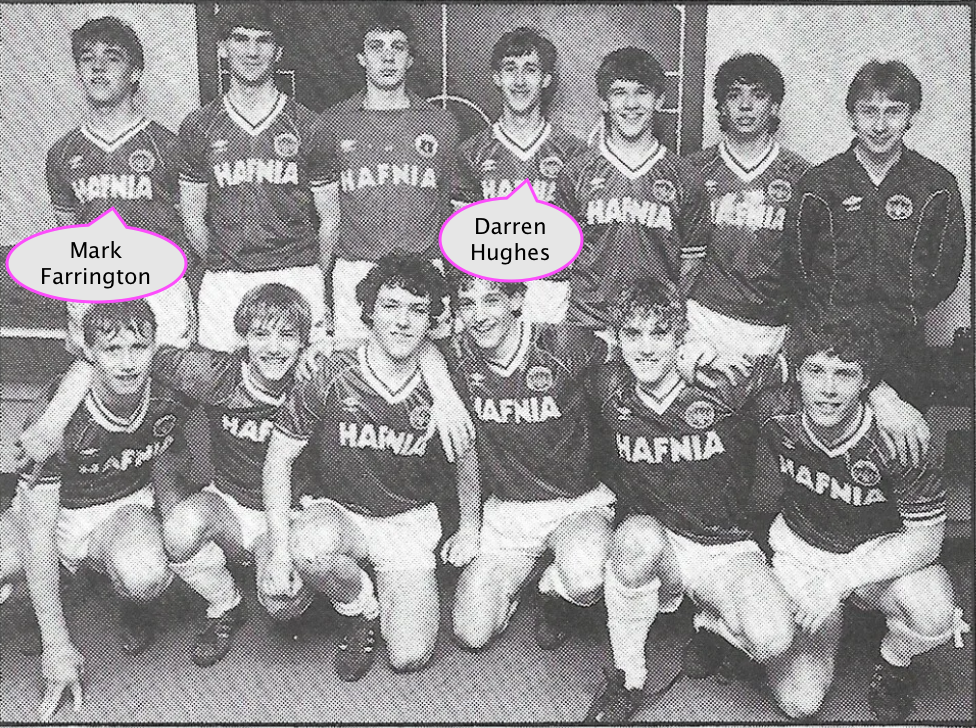
Originally a midfield player, he switched to left-back in the two-legged 1983 FA Youth Cup semi-final against Sheffield Wednesday (when Mark Farrington scored four in Everton’s 7-0 second leg win).

In the final against Norwich City, two-goal Farrington missed a late penalty in the first leg in front of an extraordinary 15,540 crowd at Goodison Park. The tie was drawn 5-5 but the Canaries edged it 1-0 in a replay to win the trophy for the first time.

If that was so near and yet so far, youth team coach Graham Smith saw his young charges make up for it the following year. Hughes was on the scoresheet as Everton won the FA Youth Cup for the first time in 19 years.
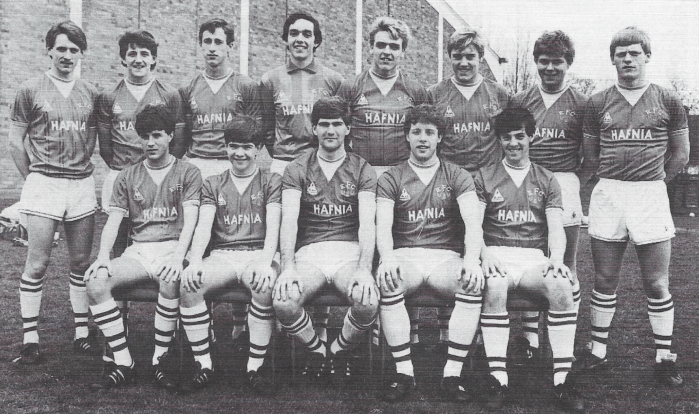
This is how the Liverpool Echo reported it: “Everton’s brave youngsters survived a terrific onslaught to take home the Youth Cup when beating Stoke City Youth 2-0 and winning by a 4-2 aggregate.

“And the man to set them on their way was 18-year old full-back Darren Hughes, who set the game alight in the 62nd minute with a brilliant goal.

“The Everton left-back picked the ball up on the halfway line and surged into the Stoke half before sending a wicked, bending drive past keeper Dawson.”

Eleven days later, there were even more Goodison celebrations when the first team won that season’s FA Cup, beating Watford 2-0 at Wembley.

Not long into the following season, Hughes learnt the hard way not to take anything for granted, as the website efcstatto.com revealed.

Manager Howard Kendall saw Everton Reserves, 2-0 up at half-time, concede six second half goals and lose 6-2 to Sheffield Wednesday Reserves.

He didn’t like the attitude he saw in several players and promptly put five of them, including Hughes, on the transfer list.

“It was important that we showed the players concerned how serious we were in our assessment of the game,” said Kendall. “Attitude in young players is so important. These lads would not be here if we did not think they have skill or we thought they would not have a chance of becoming First Division players.

“At some time, however, they must come to learn that football is not always a comfortable lifestyle. There are times when the only course of action is to roll up your sleeves and battle for yourself, your teammates and your club.”

Even though they were put on the transfer list, he said that they still had a future at the club as long as they behaved accordingly.

“What it does mean is that we shall be watching them very carefully over the next few months to see whether they have the right attitude in them – because it is a must,” said Kendall.

Hughes did knuckle down and at the end of what has come to be regarded as perhaps Everton’s greatest-ever season – they won the league (13 points clear of runners up Liverpool) and the European Cup Winners’ Cup (beating Rapid Vienna 3-1) and were runners up to Manchester United in the FA Cup (0-1) – he played two more first team games.

They were the penultimate and last matches of the season but were ‘dead rubbers’ because Everton had already won the league title and Kendall could afford to shuffle his pack to keep players fresh for the prestigious cup games that were played within four days of each other.

Hughes was in the Everton side humbled 4-1 at Coventry City, for whom Micky Adams opened the scoring (Cyrille Regis (2) and Terry Gibson also scored; Paul Wilkinson replying for Everton).

Two days later, he was again on the losing side when only two (Neville Southall and Pat Van Den Hauwe) of the team that faced Man Utd in the FA Cup Final were selected and the visitors succumbed 2-0 to a Luton Town who had Steve Foster at the back.

With the experienced John Bailey and Belgian-born Welsh international Van Den Hauwe in front of Hughes in the Everton pecking order, Kendall gave the youngster a free transfer at the end of the season.
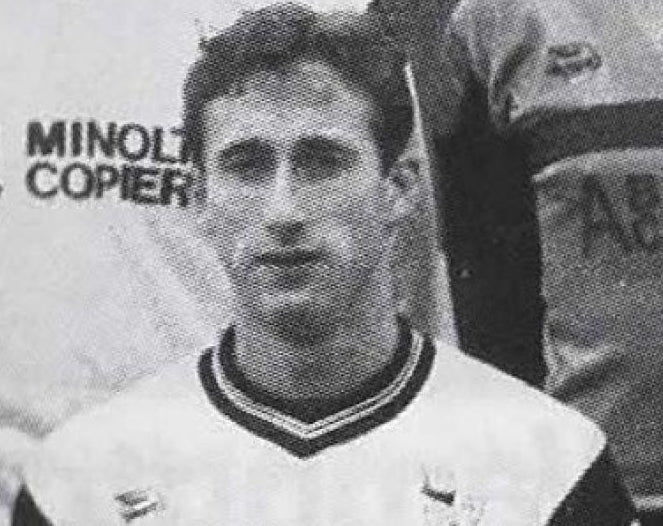
After he left Brighton, Hughes enjoyed some success at Vale, and according to onevalefan.co.uk formed one of the club’s best full-back partnerships together with right-back Simon Mills.

A highlight was being part of the side that earned promotion to the second tier in 1988-89, but his time with Vale was punctuated by two bad injuries – a hernia and a ruptured thigh muscle.

Vale released him in February 1994 but he initially took the club to a tribunal for unfair dismissal. He was subsequently given a six-week trial in August to prove his fitness and, upset with that treatment, he left the club in November 1994.

Between January and November 1995, he played 22 games for Third Division Northampton Town. He then moved to Exeter City, at the time managed by former goalkeeper Peter Fox, and made a total of 67 appearances before leaving the West Country club at the end of the 1996-97 season.
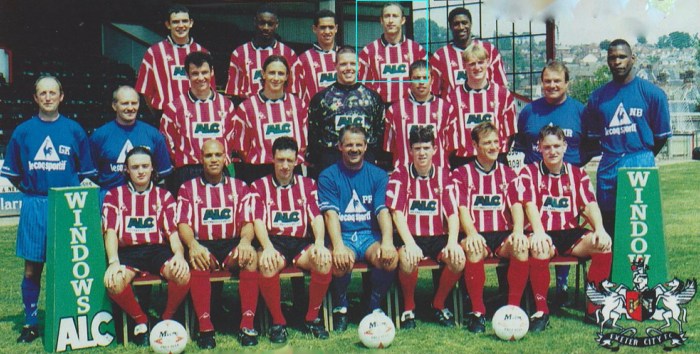
Hughes in an Exeter City line-up

He ended his career in non-league football with Morecambe and Newcastle Town. After his playing days were over, according to Where Are They Now? he set up a construction business.
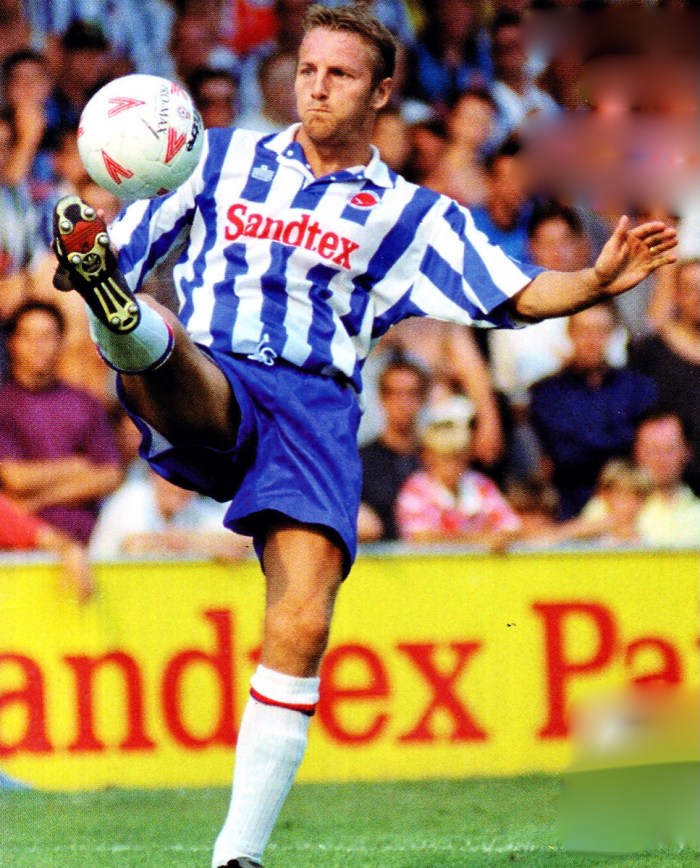
‘Goal machine’ Bully’s place in Premier League history

GARY BULL had good family connections to offer hope to Liam Brady’s Brighton at the start of the 1995-96 season.

Unfortunately, the Nottingham Forest loanee was often in the shadow of his cousin Steve, a Wolves goalscoring legend who went on to play for England.

Gary arrived at the Goldstone in August 1995 against the backdrop of off-the-pitch disquiet caused by the underhand machinations of the despised directors of the club at that time.

Bull scored three times in 11 appearances for the Seagulls but the cash-strapped club couldn’t afford to keep him on.

Although Bull had made a name for himself as a goalscorer lower down the football pyramid, he had made only four starts plus eight appearances as a sub for Forest over the previous two seasons, scoring just the once.

However, that goal did put him amongst an elite group of players: he was the second of only four players to score on their single Premier League appearance.

Perhaps it was all the sweeter because it secured Forest a 1-0 home win over Crystal Palace that took them up to fourth place in the table.

Interviewed by premierleague.com, Bull said: “It was fate, I would imagine. I was in the right place at the right time.

“It was an inswinging corner. A couple of people missed it and I was about three yards out. It was unmissable really, although I tell my kids it was a screamer.”

Bull had his brief moment in the limelight because first choice striker Stan Collymore pulled out of the match on 2 January 1995 due to illness.

The striker had spent three months on loan at Birmingham City the previous autumn, scoring an impressive six goals in 10 matches (he was in the City side who won 1-0 at the Goldstone in October 1994).

Bull only had one more sniff of first team action for Forest that season, once again against Palace, when he went on as a substitute for Scot Gemmill in a 2-1 fourth round FA Cup defeat on 28 January.

With Collymore in fine scoring form (24 in 43 matches that season), and Dutchman Bryan Roy also a regular up front, manager Frank Clark didn’t turn to Bull again, and Forest finished in an impressive third place in the Premier League.

Bull had to be content with a cameo role in an end-of-season fixture, netting Forest’s third goal in a 3-1 win over Singapore’s national team in an exhibition match in Singapore in May 1995.

Even though Collymore was sold to Liverpool for £8.5m that summer, Bull had to look elsewhere for first team chances and Brady was happy to bring him in to boost Albion’s attacking options.

He got off the mark in his third game, although Albion lost 2-1 at home to Wycombe Wanderers in front of just 5,360 fans.

Bull later scored twice away at Cambridge United in a 4-1 win in the Auto-Windscreens Shield trophy (it was the game in which former Ipswich and England centre back Russell Osman made his debut for the Albion).

But a 1-0 defeat at Rotherham on 7 October was his last game in the stripes and, not long after his return to the City Ground, he was given a free transfer and joined Birmingham on a permanent basis.

Born in West Bromwich on 12 June 1966, his first club was Paget Rangers in the Midlands League but in 1986 he joined Southampton as a trainee under youth team boss Dave Merrington. Jimmy Case and Craig Maskell were in the Saints first team at the time; Kevan Brown in the reserves.

It wasn’t until Bull moved on to Chris Turner’s Cambridge United in March 1988 that he made his professional breakthrough, scoring four in 19 games.

His prowess in front of goal really began to flourish when he dropped out of the league to help Barnet FC win the Conference. Tony Hammond – a Barnet FC devotee known as ‘Reckless’ – reckoned the £2,200 fee manager Barry Fry paid for him was “one of the bargains of the century”.

In four seasons at Barnet, Bull netted an impressive 121 goals in 219 appearances, becoming an Underhill icon. In his blog, Hammond quoted Fry as saying: “He was bloody good that Bully, I never had to worry about him being in the right place at the right time in front of goal it was always just pure instinct.”

Bull was buzzing for Bees

When Bees finally won promotion to the Football League in 1990-91, Bull scored 35 goals – including two four-goal hauls and a hat-trick – and was voted Player of the Year.

Bull’s scoring form continued during Barnet’s first season in the Fourth Division. He bagged 33 as the Bees reached the play-offs where they only narrowly lost a two-legged tie against Blackpool.

In 1992-93, Bull and strike partner Mark Carter were prominent again, as Barnet finished third in the table, clinching promotion to what was then a reorganised Division Two.

Sadly, Barnet were in deep financial trouble and were forced to shed players. Bull was signed by Premier League Forest’s newly appointed manager Frank Clark in July 1993.

“I would have stayed at Barnet but I had a family to look after and had no choice but to move on,” Bull told Hammond. “It was a memorable four years and certainly a period that I look back on with pride,” he added.

The subsequent move to Birmingham reunited Bull with his old boss Barry Fry, although a somewhat cynical view of the move was espoused by writer John Tandy in When Saturday Comes.

“It took Fry 18 months of sustained and public pressure to talk the board into signing Gary Bull. Eventually, in November 1995, we landed the Tipton Tyke. Six games and some time on the bench later he was on his way to York,” he wrote.

Bull spent two seasons at York. The highlight of his stay came in a second round League Cup tie at home to Everton. Bull put the Minstermen 2-1 ahead in the 57th minute, tapping in a rebound off the post and York went on to win it 3-2.

It was one of 11 goals Bull scored in 84 games for City before spending time in Lincolnshire. While he only scored once in 31 games for Scunthorpe, his scoring boots were well and truly back on at Grantham Town: 68 goals in 125 games.

He then moved on to Lincoln United for two years before finishing his career with a flourish at United Counties League Boston Town. During the 2006–07 season, he scored a club record 57 goals! He later went on to become their all-time top scorer with over 200 goals,

Bull only retired from playing aged 45 in 2012.

He then became a postman and told premierleague.com: “I’m one of those people who gets up and actually enjoys going to work and getting the physical aspect of it.

“We probably do between 10 and 12 miles a day. Some would say I do more now than I did on the pitch.”

Chances were few and far between for Greg Campbell

ONE OF West Ham’s less well-known ‘Boys of ‘86’ tried to boost his stuttering career on a month’s loan with the Seagulls.

Hammers fans still laud the achievements of John Lyall’s title-chasing side of the 1985-86 season because they finished third, the club’s highest-ever position in the top division.

The form of twin strikers Frank McAvennie (26 goals) and Tony Cottee (20) meant chances were few and far between for Greg Campbell, a youngster trying to get a break into the first team.

However, by virtue of one start and two substitute appearances early on in that famous season, Campbell can claim a place amongst the ‘Boys of 86’ whose achievements have since been captured in a book and in a video.

The group of ex-players, that included George Parris who later played for Brighton, regularly get back together for social occasions to raise funds for various charities.

It was in the season following West Ham’s close finish behind champions Liverpool and runners up Everton that Campbell sought to get some first team football at Brighton.

In his matchday programme notes, manager Barry Lloyd said: “He is a young player who has learned the game at West Ham and I believe he has something to offer as a conventional target man.”

Unfortunately for him he joined a club that was sliding inexorably towards relegation from the second tier, Lloyd having taken over as boss the previous month after the controversial sacking of Alan Mullery only six months into his return to the scene of past glories.

When Campbell joined, Lloyd had presided over five straight defeats in which 10 goals were conceded and Albion had dropped to second from bottom in the table.

The manager shook things up for the visit to West Brom on 28 February, dropping goalkeeper John Keeley, Darren Hughes and Terry Connor and putting Campbell, who had made his debut in the Reserves against Norwich, on the substitute’s bench (in the days of only one sub).

A dour 0-0 draw was ground out to earn a much-needed point but Campbell didn’t get on. He led the line for the reserves in a midweek 2-0 defeat at home to Fulham and had to wait until the following Saturday to make his first team debut.

Then, he was sent on as a substitute for Steve Penney in the home game against Derby County but to no avail as Albion succumbed to a 1-0 defeat. It was Dean Saunders’ last game for Brighton; shortly afterwards he was sold to Oxford United for just £60,000 (four years later, Liverpool bought him for nearly £3m).

Four days later, Campbell scored for the reserves in a 4-1 defeat at Swindon Town, but it still wasn’t enough to gain a starting spot. Away to Barnsley the following Saturday, once again Campbell found himself on the bench, the restored Connor and ex-Worthing striker Richard Tiltman preferred up top. Tiltman scored but once again Albion were on the losing side, going down 3-1.

When Ipswich Town visited the Goldstone on 21 March, only 8,393 turned up (700 down on the previous home game) and the increasingly frustrated faithful saw the Albion lose again, 2-1.

Campbell once more only got on as a substitute, replacing right-back Kevan Brown, and that was his last involvement in a Seagulls shirt.

Born in Portsmouth on 13 July 1965, Campbell had footballing footsteps to follow into: his dad Bobby Campbell (a great friend of Jimmy Melia’s) played for Liverpool and Portsmouth, coached Arsenal and QPR, and was manager of Fulham, Pompey and Chelsea.

Campbell and George Parris line up for West Ham’s youth team

After progressing through West Ham’s youth and apprentice ranks, the young Campbell was given his first team debut by Lyall, up front alongside Cottee and Bobby Barnes in a 3-1 home win over Coventry on 4 September 1984.

He made his second start just four days later, in a 2-0 home victory over Watford, but a broken jaw put paid to his involvement in that game.

The injury meant he had a long wait before he was next on first team duty, making a return as a substitute in a 1-0 home defeat to Luton Town on 24 August 1985.

He appeared from the bench again two days later in a 2-0 defeat at Manchester United before making his only start of the aforementioned 1985-86 campaign in a 1-1 draw at Southampton.

He started alongside McAvennie but was replaced by Cottee and that appearance at The Dell on 3 September 1985 was Campbell’s last in the Hammers first team.

After he was released by West Ham, he tried his luck in Holland, playing 15 games for Sparta Rotterdam in the 1987-88 season, during Hans van der Zee’s reign as manager.

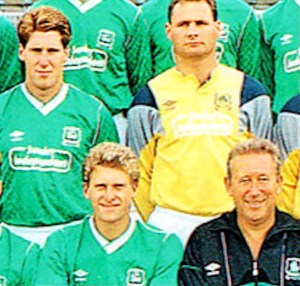
On his return from Holland in November 1988, Campbell joined Plymouth Argyle where the former West Ham defender and Norwich City manager, Ken Brown (see picture below), was in charge.

As the excellent greensonscreen.co.uk website records, Campbell’s first match was against his dad’s Chelsea side in the Simod Cup at Stamford Bridge.

It wasn’t a happy return to English football, though, because Chelsea ran out 6-2 winners.

Nevertheless, he celebrated his Argyle league debut two weeks later with a goal in a 3-0 home win over Oldham Athletic.

Campbell spent 18 months with the Devon side and scored six times in 24 starts plus 15 games as a sub.

He moved on to Division Four Northampton Town, where former Cobblers stalwart Theo Foley had returned as manager.

Campbell (circled) lines up for Northampton Town

Campbell teamed up with former West Ham teammate Barnes, who went on to become a respected administrator for the PFA for more than 20 years.

Campbell scored seven goals in 47 appearances for the Cobblers before retiring from the game at the age of 27 in 1992.

Isaac’s long, long wait for an Albion win

IT seems extraordinary to think Robert Isaac had to wait FOURTEEN MONTHS to experience a win as a Brighton player after joining the club from Chelsea.

The young defender who had realised every schoolboy’s dream by playing for the team he’d always supported left a disgruntled dressing room at Stamford Bridge only to join a side sliding inexorably toward the relegation trapdoor of what is now the Championship.

“I must admit it was a bit depressing at first because we just couldn’t do anything right,” Isaac told Dave Beckett in an Albion matchday programme article. “We just had no luck at all; if we had I think we might well have survived in Division Two.”

Isaac also appears to have gone out of the frying pan into the fire. Telling thegoldstonewrap.com how he’d left Chelsea because the management was losing support of the players and he wanted regular first team football, he added: “When I joined Brighton in February 1987 they were in freefall. The dressing room was even more at odds with the manager than at Chelsea.

Barry Lloyd dropped Dean Saunders, our only hope of surviving the drop. I found Barry rather rude. He’d blank me in the corridor and make me train on my own.”

The young defender made his Seagulls debut on 21 February 1987 in a 2-1 defeat at home to Oldham Athletic and featured in four draws and five defeats by the season’s dismal end.

Back at what was for so long Albion’s normal level of third tier football, Lloyd’s side did begin to pick up points – but Isaac wasn’t involved because of a groin strain and a troublesome hernia injury that sidelined him for months.

“I had stomach trouble quite a lot but no-one could put their finger on the problem until I saw a specialist in Harley Street,” he explained.

“After the operation, I was out of action for the best part of six months and at times I didn’t think I would get back to full fitness. I had around 40 internal stitches and even when I began playing again they would stretch and pull and I felt sick after games.”

It wasn’t until March 1988, with Albion in sixth spot, that Lloyd shook things up, initially drafting Isaac in at right-back in place of Kevan Brown, and then selecting him to replace suspended captain – and Isaac’s former Chelsea teammate – Doug Rougvie at centre back alongside Steve Gatting.

Isaac also stepped in when Rougvie missed a couple of games with a ‘flu virus and, although a win in Seagulls’ colours continued to elude him in his first three games back in the side (a defeat and two draws), he kept the no.5 shirt ahead of the rugged Scot. That elusive win finally came in a 2-1 away win at Notts County on 4 April.

Five wins and a draw followed and the successful run-in saw promotion gained as divisional runners-up behind Sunderland. Isaac was one of three former Chelsea players in that back four, with Gary Chivers (who’d arrived from Watford) at right-back and Keith Dublin at left-back.

Dublin had played for England under 19s with Isaac three years earlier. They both played four games in Dave Sexton’s side at the Toulon Tournament in the south of France in 1985 (England beat Cameroon 1-0 and Mexico 2-0, lost 2-0 to the USSR and succumbed 3-1 to France in the final at the Stade Mayol in Toulon).

Sadly, the subsequent fortunes of the two players went in opposite directions: Dublin went on to become such a success with the Seagulls that he was the 1989-90 Player of the Year and was sold to Watford for £275,000; the injury-beset Isaac had to quit the game after only 33 matches in a Brighton shirt.

After Albion bounced back to the second tier, the defender played in the first 11 matches of the 1988-89 season – eight of which were defeats – but his appearance in a 1-0 defeat away to Leicester turned out to be his last as an Albion player.

“I got injured at Leicester,” he recalled. “I didn’t feel it until the next day and then it really hit me. My knee just blew up. Come Monday morning I couldn’t even walk.”

He required an operation to repair the patella tendon in his left knee and, as he sought to regain fitness, spent a fortnight at the National Rehabilitation Centre at Lilleshall.

Meanwhile, Lloyd signed experienced central defender Larry May (whose own playing career would be ended by injury later that season) and, subsequently, Nicky Bissett.

A programme item in the 1989-90 season reminded supporters that Isaac was still around, although he hadn’t played at all throughout 1989.

Looking ahead to 1990, Isaac said: “I just hope I have a better year. I’d like to think that I deserve it after all the frustrations of the last few years with two major operations.”

Sadly, it didn’t happen and in August 1990, he was forced to quit football. After retiring, he worked as a chauffeur for the Maktoums, the ruling family in Dubai, before running his own vehicle business.

Born in Hackney on 30 November 1965, Isaac was Chelsea through and through from an early age.

“We lived in Chelsea and my great grandfather went to the first ever match at Stamford Bridge,” he told thegoldstonewrap.com. “My family have been going to matches home and away since. I went to see Chelsea play Stoke in the (1972) League Cup Final aged six.”

Isaac went on to join the club as a junior, made his reserve team debut at the tender age of 15 and was named Chelsea’s young player of the year in 1984.

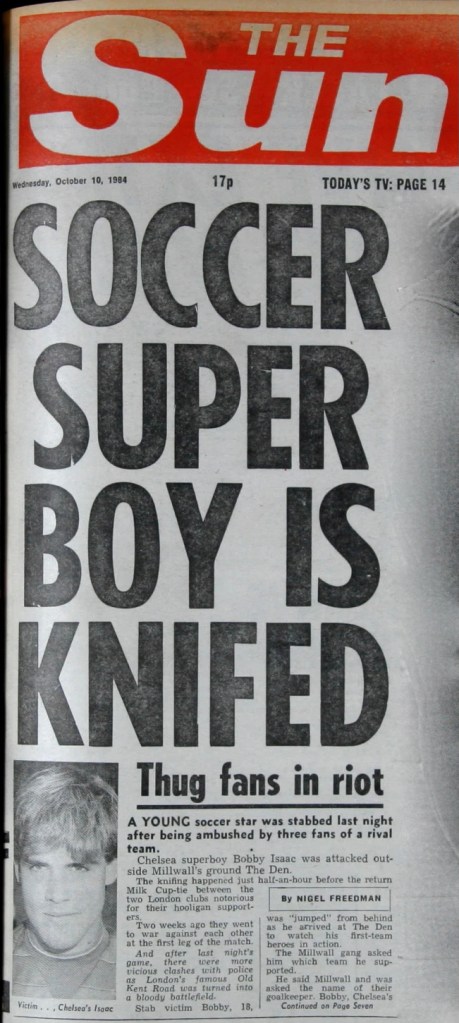
It was on 9 October 1984 that his promising career could have been snuffed out before it had even begun: it’s a horrifying tale, told the following day on the front page of The Sun, and covered in detail by that1980sportsblog.

Three knife-wielding Millwall thugs slashed his back from his shoulder to the base of his spine in a dark alley near the south London club’s notorious old stadium, The Den.

Isaac needed 55 stitches to repair the damage and only the thickness of a leather coat he was wearing prevented the wound being potentially life-threatening.

Remarkably, later the same season, in March, he had recovered well enough to make his Chelsea first team debut in a 3-1 win at Watford, although Eddie Niedzwiecki, a Chelsea coach who later worked with Mark Hughes for Wales and at several clubs, told Kelvin Barker’s Celery! Representing Chelsea in the 1980s: “He was a young, up-and-coming apprentice at the time and luckily he managed to pull through, although he never really recovered from it.”

In the 1985-86 season, Isaac played two league cup games for Chelsea and three times in the league. The following season saw him get a mini-run in the side, playing four consecutive league games in November, but his fifth match – a 4-0 home defeat by Wimbledon in which Rougvie was sent off in the first 10 minutes for headbutting John Fashanu – proved to be his last.

The website sporting-heroes.net said of him: “A steady, reliable centre-half and occasional full-back, Robert did little wrong during his time in the Chelsea first-team, but was unfortunate to play for the club at a time when Colin Pates, Joe McLaughlin and, a little later, Steve Wicks, were all demonstrating their considerable talents at the heart of the defence.”

Isaac asked for a transfer after a disagreement with manager John Hollins and his assistant Ernie Walley, and that led to his transfer to Brighton for a £50,000 fee.

Elite career eluded Darren Hughes after cup-winning start

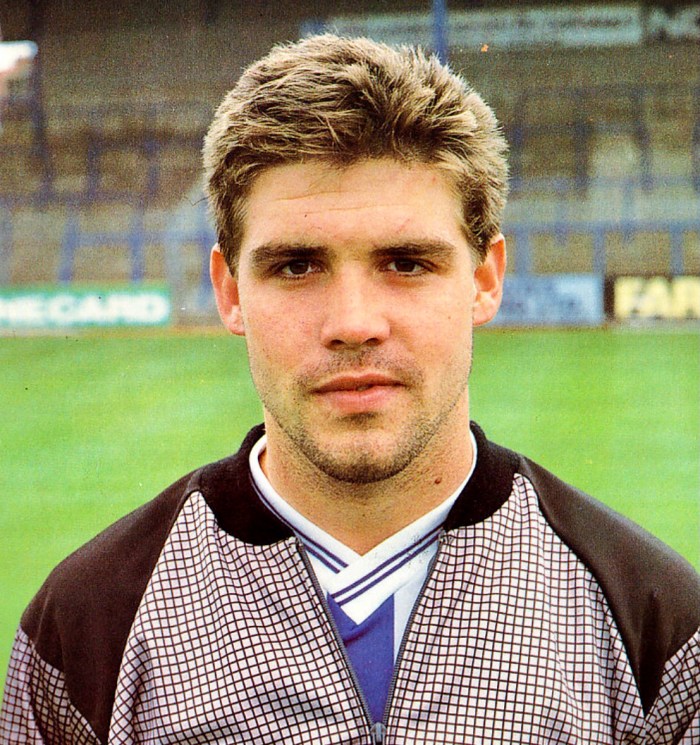
HughesDARREN Hughes won the FA Youth Cup with Everton but it was lower down the league where he built a long career which included a season with second tier Brighton & Hove Albion.

Born in Prescot on Merseyside on 6 October 1965, left-back Hughes played for Everton in two successive FA Youth Cup finals.

He was on the losing side against Norwich City in 1983 (when among his Everton teammates was centre forward Mark Farrington, who later proved to be a disastrous signing for Barry Lloyd’s Brighton).

The tie went to a third game after it was 5-5 on aggregate over the first two legs. The Canaries won the decider 1-0 at Goodison Park. The following year, Hughes was a scorer, and collected a winners’ medal, as Everton beat Stoke City 4-2 on aggregate.

Meanwhile, the young Hughes had broken into Everton’s first team as an understudy to stalwart John Bailey, making his Everton debut two days after Christmas in 1983.

Unfortunately, the game ended in a 3-0 defeat away to Wolverhampton Wanderers, for whom former Albion winger Tony Towner was playing.

It wasn’t until May 1985 that Hughes next got a first team opportunity, featuring in a 4-1 defeat to Coventry City at Highfield Road and a 2-0 defeat to Luton Town – manager Howard Kendall resting some of the first-choice players after the League title had already been won and ahead of the European Cup Winners’ Cup Final against Rapid Vienna.

With the experienced Bailey and Pat Van Den Hauwe in front of Hughes in the pecking order, Kendall gave the youngster a free transfer at the end of the season, and he joined Second Division Shrewsbury Town, where he made 46 appearances.

Hughes played against Albion for Shrewsbury at Gay Meadow on 16 September 1986, and, two weeks’ later, Alan Mullery, back in charge of the Seagulls for a second spell, signed the 21-year-old for a £30,000 fee.

D Hughes blue

Not for the first time, hard-up Albion had devised a scheme to raise transfer funds from supporters, and the money for the purchase of Hughes came from the Lifeline fund which also helped Mullery to buy goalkeeper John Keeley for £1,500 from non-league Chelmsford and striker Gary Rowell, from Middlesbrough.

Hughes made his Albion debut in a 3-0 defeat at home to Birmingham in the Full Members Cup on 1 October 1986 and his first league match came in a 1—0 home win over Stoke City three days later.

“I was quite happy at Shrewsbury,” Hughes told matchday programme interviewer, Tony Norman. “But when the manager told me Brighton were interested in signing me I thought it would be another step up the ladder. It’s a bigger club with better prospects and it’s a nice town as well.”

The single lad, whose parents were living in Widnes, moved into digs in Hove run by Val and Dave Tillson. He was later joined there by Kevan Brown, another new signing, from Southampton.

Hughes said away from football he enjoyed golf and had played rounds with Steve Penney, Dean Saunders and Steve Gatting.

Brown, in a similar programme feature, said Hughes had been a big help in him settling into his new surroundings. “He has been showing me around the area and we’ve become good friends,” he said. “I’m glad I wasn’t put in a hotel on my own.”

Unfortunately for Hughes, life on the pitch didn’t go quite according to plan.

Mullery was somewhat controversially sacked on 5 January 1987 and, although Hughes played 16 games under successor Lloyd, those games yielded only two wins and the Albion finished the season rock bottom of the division.

The only consolation for Hughes was scoring in a 2-0 home win over Crystal Palace on 20 April. His final appearance in a Seagulls shirt came in a 1-0 home defeat to Leeds when he was subbed off in favour of youngster David Gipp.

Having played only 29 games, mostly in midfield, for Brighton, Hughes joined Third Division Port Vale in September 1987, initially on loan, before a £5,000 fee made the deal permanent.

It must have given him some satisfaction to score for his new employer in a 2-0 win against Brighton that very same month.

Hughes spent seven years with the Valiants, helping them to win promotion from the Third Division in 1989, making a total of 222 appearances, mainly as a left back.

His time with Vale was punctuated by two bad injuries – a hernia and a ruptured thigh muscle – and they released him in February 1994.

However, he gradually managed to restore his fitness and in 1995, between January and November, he played 22 games for Third Division Northampton Town.

He then moved to Exeter City, at the time managed by former goalkeeper Peter Fox, where he made a total of 67 appearances before leaving the West Country club at the end of the 1996-97 season.

He ended his career in non-league football with Morecambe and Newcastle Town but could look back on a total of 388 league and cup appearances for six clubs over a 14-year career.

After his playing days were over, according to Where Are They Now? he set up a construction business.
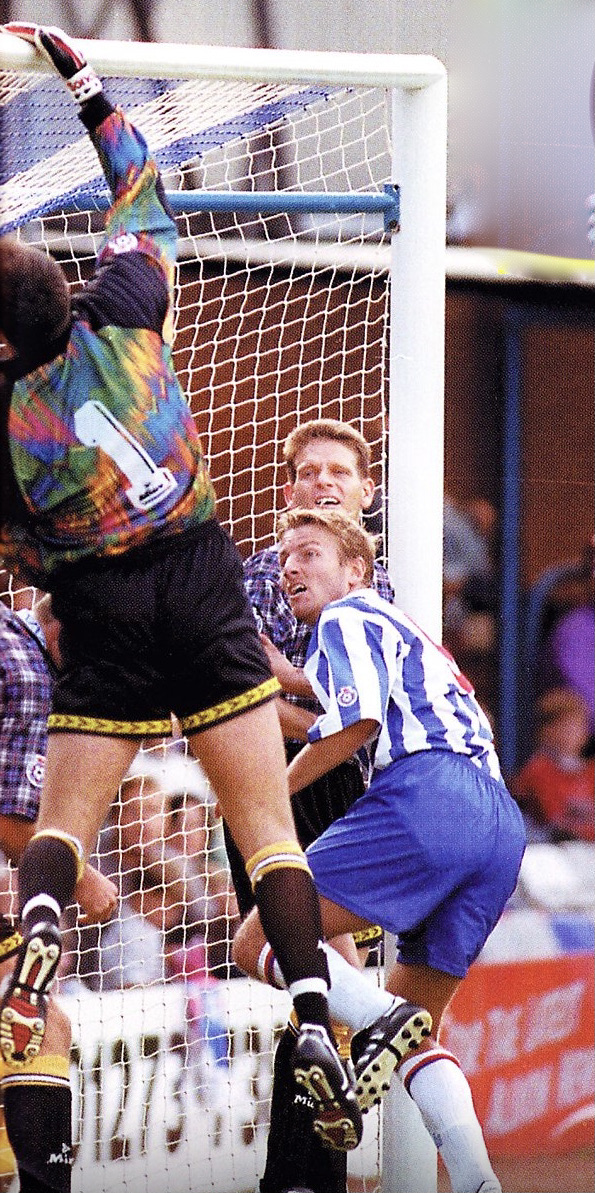
D hughes by tony gordon

Pictures: matchday programme.