When the ball hits the goal it’s not Shearer or Cole it’s Zamora!

EVERY NOW AND AGAIN as a football supporter a truly special player stands out well above the rest you’ve watched. Bobby Zamora was most definitely in that category.

As the new year dawns on what will be my 55th year supporting Brighton & Hove Albion, it is perhaps fitting to spend a little time remembering just how good Zamora was for the Seagulls before his outstanding ability to score goals was taken to higher levels: Tottenham Hotspur, West Ham, Fulham and ultimately, and, quite deservedly, England.

That he came back to the Albion from QPR as his career began to ebb was nothing short of a bonus­ – and, while I’m not a big gambler, I was delighted to get a modest return from the bookies when my punt on him being the last goalscorer came good after he had gone on as a sub at Elland Road on 15 October 2015 and chipped the winner (below) to register his first goal since rejoining!

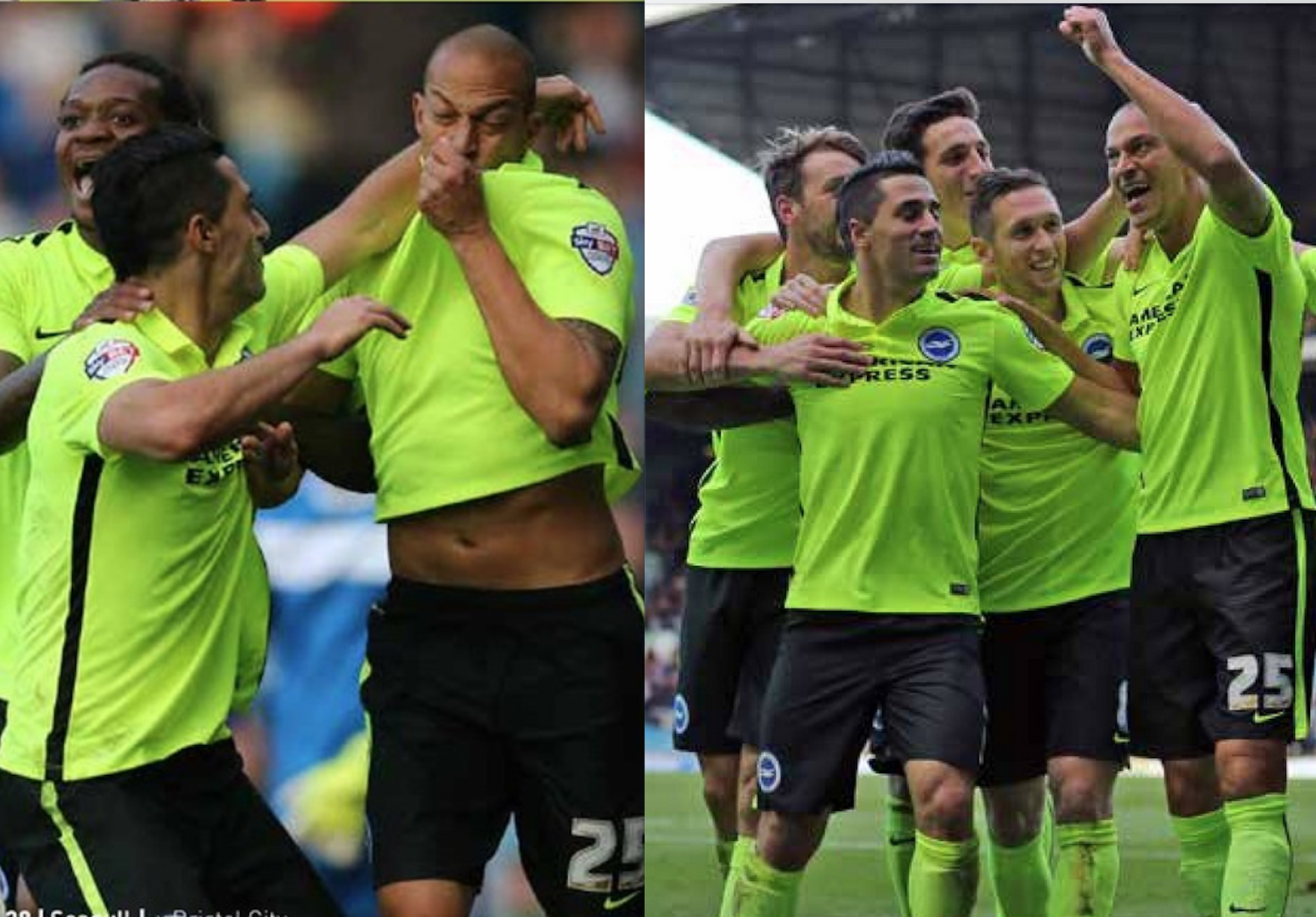
“That goal was definitely the highlight of my season,” Zamora told interviewer Adam Virgo in a Seagulls World interview. “It was my first goal since coming back and to score the winner so late in the game was unbelievable. It was a special moment for me, and it settled the nerves knowing that we’d got the three points.”

Just four days later, Zamora repeated the feat going on as a 76th-minute substitute for Tomer Hemed at home to Bristol City and beating goalkeeper Frank Fielding with a low shot from 15 yards out. Albion won 2-1; Sam Baldock having levelled things up against his former club after Derrick Williams opened the scoring for City.

Unfortunately, Zamora managed just five more in that second spell. He made 10 starts plus 16 as a sub in Chris Hughton’s side but he was struggling with a hip injury.

It eventually caught up with him and prevented him from contributing further to Albion’s aim of promotion back to the elite; his last game being as a sub in a 0-0 draw at home to Sheffield Wednesday on 8 March 2016. “If I was fit, I would have scored some goals and we’d have been promoted automatically,” he told the UndrThe Cosh podcast (pictured above).

Thankfully another returning striker in the shape of Glenn Murray completed that task the following season and went on to cement his own place in Albion’s history: his 111 goals in 287 appearances putting him second in the list of Brighton’s all-time top goalscorers.

Golden goalscorers: Zamora + Murray

Each of the different eras I’ve watched the Albion has thrown up truly memorable players who have generated their own air of excitement and anticipation because of the goals they scored.

The first one for me was Alex Dawson, who netted seven in the first five games I watched in 1969. Then along came Willie Irvine whose goalscoring in third tier Albion’s promotion-winning season of 1972 earned him an unexpected recall to the Northern Ireland side – and an appearance (that I went to watch) in a 1-0 win against England at Wembley.

Next, of course, was the truly outstanding Peter Ward, who jinked his way past defenders with apparent ease and scored goals for fun, his 36 goals in 1976-77 smashing a decades-old record. Like Zamora, he came back to the scene of past glories (albeit only on loan) and scored a magnificent winner against the team he supported as a boy, Manchester United.

Garry Nelson, with 32 goals, and Kevin Bremner were a superb front pair in another third tier promotion-winning line-up in 1988 while, in 1990-91, Mike Small and John Byrne combined brilliantly to take the Seagulls within a hair’s breadth of a return to the big time.

The arrival of a beanpole of a kid with an eye for goal in Zamora completely transformed Albion’s fortunes under Micky Adams and he was the talisman in back-to-back promotions following years in the doldrums.

Zamora’s Albion story is pretty well known but let’s remind ourselves of how it all began.

Depending on whose account you believe more, it was either Dick Knight or Adams who had the foresight to bring Zamora to the Withdean.

Adams said: “The first time I saw him he came onto the training ground; he looked like a kid. But he was tall and gangly with a useful left foot; there was potential there.”
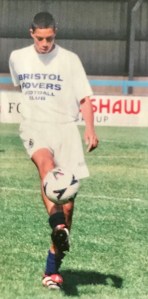
In fact, Zamora might never have arrived in Sussex if Albion had been successful in securing a permanent deal for on-loan Lorenzo Pinamonte. When Brentford outbid Brighton for the services of the Bristol City loanee, Albion turned their attention to Zamora (left), a Bristol Rovers player who was only getting sub appearances under Ian Holloway but had scored eight goals in six games on loan at nearby non-league Bath City.

“He was six foot one and we knew he had a very good first touch and could hold the ball up well, the type of player we wanted,” Knight recounted in his autobiography Mad Man: From The Gutter to the Stars (Vision Sports Publishing, 2013).

Zamora duly arrived on loan and scored six in six matches (including a hat-trick in a 7-1 away win at Chester). He scored an equaliser and was named Man of the Match on his debut v Plymouth and by the end of February was Player of the Month.

Hat-trick ball at Chester

While Knight and Adams wanted him to stay, he insisted on returning to Rovers where he thought he might force his way into Holloway’s starting line-up. But it was back only to the bench as Nathan Ellington, Jason Roberts and Jamie Cureton were ahead of him in the pecking order.

As preparations began for the new season, Albion offered £60,000 for Zamora but Rovers chairman Geoff Dunford wanted £250,000. An incredulous Knight said he wouldn’t go higher than £100,000 and couldn’t believe they could demand such a figure for someone who hadn’t actually started a first team game.

Zamora had Rovers’ youth team coach Phil Bater to thank for forcing through the move. He accompanied the shy youngster into a meeting with Holloway, who tried to say he’d get some games if he stayed. Bater reckoned the youngster was being strung along and argued Zamora’s cause saying he stood more chance of playing if Rovers let him join the Albion.

After some brinkmanship from each club’s respective chairmen, with Knight threatening to walk away from the deal, it finally went through two days before the start of the season, although Albion’s chairman reluctantly agreed to a 30 per cent sell-on clause for the player.

Zamora instantly became one of the top earners on £2,000 a week with a goal bonus built in.

“It was an absolute coup that we had finally secured this player,” said Knight. “I could only see good things in him, could only see that he would be a huge asset to us.

“Football is all a matter of opinions. There is little science to it. For me, Zamora was the best signing I ever made.”
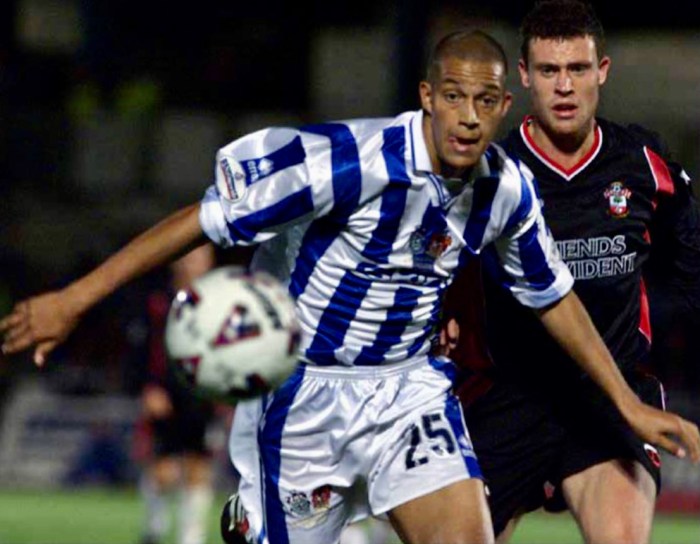
Zamora has eyes on the ball closely watched by a young Wayne Bridge for Southampton

Not only did Zamora manage to score 31 goals as Albion won promotion from the basement division, he went one better when they went straight to the top of the third tier the following season, netting 32 times in 46 matches.

A significant number of those goals came courtesy of Zamora’s excellent understanding with left-footed right-back Paul Watson, of whom he said: “He created a lot of goals for me with those quick free kicks. He didn’t put a foot wrong too often and was very underrated. He never got the credit his hard work deserved.”

Expanding on it in another interview, he said: “Whenever Watto got the ball I knew precisely where I needed to run to and he knew where to deliver it. It was such a great connection: Watto has an absolutely wonderful left foot and it made my job as a striker so much easier when you get deliveries like that.”

Declaring that even in the Premiership he hadn’t come across anybody with a better left foot, he added: “I was very lucky to have played in the same team as him; he created numerous goals for me; not only with his deliveries but with his intelligent play as well.”

Watson had arrived at the club with Charlie Oatway and was part of a cluster of players who had served under Adams at Brentford and Fulham. When Adams and assistant Bob Booker steered Albion to promotion as fourth tier champions, Zamora was player of the season and he and Danny Cullip were named in the PFA divisional XI.

Not long into the following season, the lure of taking over as manager at a Premier League club saw Adams quit Brighton, initially to become Dave Bassett’s no.2 at Leicester City, but with the promise of succeeding him.

“While I thought I had a shot at another promotion, it wasn’t a certainty,” Adams explained. “I knew I had put together a team of winners, and I knew I had a goalscorer in Bobby Zamora, but football’s fickle finger of fate could have disrupted that at any time.”

His successor, Peter Taylor, knew how fortunate he was to inherit an experienced squad, and said: “Of course the greatest asset we had was Bobby Zamora. Having him meant that we could play a front two at home and away from home we could play him on his own and he would still get us a goal out of nothing. He was an incredible player and miles too good for that level.”

And Zamora wasn’t only a star on the pitch, as Knight spoke about in his autobiography. “When he was at his zenith at Brighton, the requests we got for him to visit schools, hospitals and go to prize-givings far outweighed all the other players together, but he was always amenable. He was never starry, never refused. I couldn’t speak more highly of Bobby Zamora as a person.”

Knight recounted in his book how, after a 1-0 win at Peterborough, when Zamora missed a penalty but also scored the only goal of the game, Albion’s promotion to the second tier was confirmed and in his own inimitable way Posh boss Barry Fry said to Brighton’s star striker: “You’re a fucking great player and you’ll play for England one day, I’m fucking sure of it.”

Zamora was still only 21 when Tottenham signed him from relegated Brighton in July 2003. He left the south coast having scored a total of 83 goals in 136 appearances but in his last season in the stripes he netted just 14 as the Seagulls battled unsuccessfully to retain their tier two status.

Unfortunately, he missed eleven matches with a dislocated shoulder and, had former Premier League striker Paul Kitson been fit to play alongside him (he managed only seven starts plus three off the bench), the season may well have had a different outcome.

Everton’s Bill Kenwright had offered £3m for Zamora during the season but their manager Walter Smith seemed less convinced and, with Kevin Campbell and Wayne Rooney likely to be ahead of him, Zamora stayed in Sussex.

But chairman Dick Knight promised not to stand in his way if an opportunity was presented at the end of the season and that came from Tottenham. Manager Glenn Hoddle and assistant Chris Hughton had been to see Zamora in action at the Withdean on a number of occasions.

Spurs chairman Daniel Levy played hardball over the deal. Eventually, Knight settled on a £1.5m fee but, because of the original sell-on clause, £450,000 was due to Bristol Rovers.

Hoddle told The Guardian: “He has got good pace and great movement on and off the ball. No disrespect to Brighton, they have got a good team down there, but we have got players here who can make the most of his movement.”

The player’s agent Phil Smith told the newspaper: “The fee for Bobby is £1.5m which is a decent price in today’s market for a Second Division striker.

“It has been a long time coming for Bobby but he is delighted to be going into the Premiership. It has always been an ambition.”

Disappointed Albion manager Steve Coppell observed: “It is a big move for Bobby and nobody really expected we could hang onto him for much longer. But it has blown a big hole in any plans I had. I don’t have a better option than playing with Bobby Zamora up front.”

When he arrived at Spurs, one of the senior pros who took him under his wing was none other than Gus Poyet.

“As a young guy coming into the team, he was one of the senior pros who would always talk to me and encourage me,” Zamora told the matchday programme. “He didn’t have to do that, but he went out of his way to do so and you could see he had coaching qualities. He would often point things out on the pitch that you’d pick up on, and when he spoke, you’d listen.

“He wasn’t starting every game either, so in training I did more things with him than maybe the rest. I really got on well with him.”
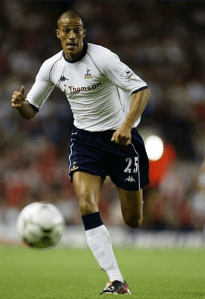
As it turned out, Zamora made only 18 appearances for Spurs (11 as a substitute) and only scored once – ironically a single goal that knocked West Ham out of the Carling Cup in October 2003.

In January 2004, Spurs chose to use him as a makeweight in taking Jermain Defoe from the Boleyn Ground to White Hart Lane.

Phlegmatic Zamora didn’t look on it as a failure but embraced the “learning curve” of training alongside the likes of Poyet, Robbie Keane, Darren Anderton and Jamie Redknapp.

“I came away a better player and with more experience,” he said. “Glenn Hoddle had signed me and then he got sacked not long afterwards. David Pleat took charge and we didn’t really see eye-to-eye, but the lads and the club were brilliant and I learned so much from my time there.

“I took a chance by stepping back down to the Championship with West Ham – but it was the opportunity of playing regular football again that was the pull for me.”

A lifetime in football for Mike Trusson the enforcer

MIKE TRUSSON has spent a lifetime in football since Plymouth Argyle spotted his raw teenage talent, took him on as an apprentice and gave him his professional debut at 17.

After playing more than 400 matches over 15 years, he became prominent in football marketing, coaching and scouting, often in association with his good friend Tony Pulis, who he played alongside at Gillingham after leaving the Albion.

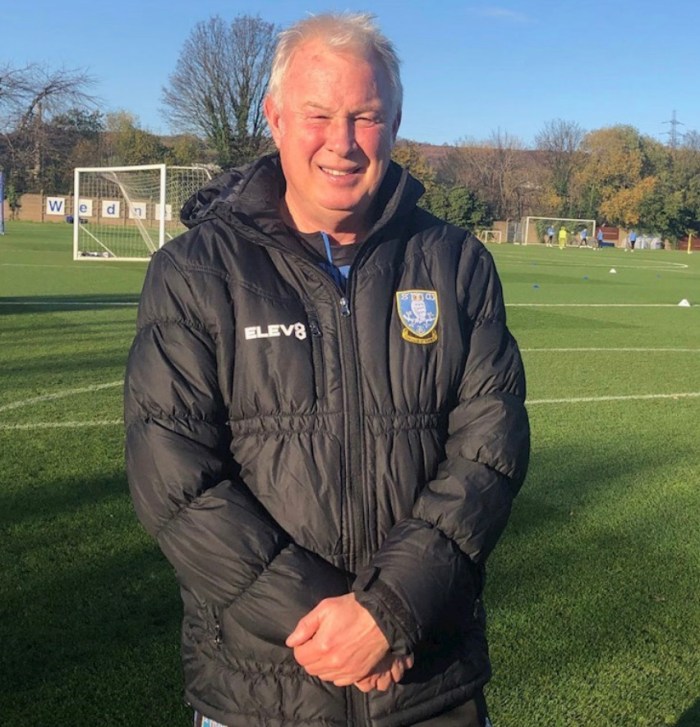
As recently as late 2020 he was assistant manager to Pulis for an ill-fated brief spell at Sheffield Wednesday.

Much fonder memories of his time in the steel city were forged when he was twice Player of the Year at Sheffield United.

In an exclusive interview with the In Parallel Lines blog, Trusson told Nick Turrell about his time with the Seagulls, his first coaching job at AFC Bournemouth and the formative years of his career.

A goalscoring home debut for Mike Trusson

A MOVE TO SUSSEX in the summer of 1987 ticked all the right boxes for Mike Trusson.

An experienced midfielder with more than 300 games under his belt already, he welcomed the opportunity to be part of the rebuilding job Barry Lloyd was undertaking at the Goldstone following the club’s relegation back to the third tier. He was one of seven new signings.

The move also brought him a whole lot closer to his family in Somerset than south Yorkshire, where he’d lived and played for seven years.

And it gave him the chance to earn more money.

The only problem was he had a dodgy left knee – it was an injury that prevented him making his first team debut for the Seagulls for four months, and it troubled him throughout his first season.

Frequent leaping to head the ball had resulted in a torn patella knee tendon that had needed surgery during the latter days of the player’s time at Rotherham United, where for two years his manager had been the legendary former Leeds and England defender Norman Hunter.

Prior to the injury, Blackburn Rovers had bid £200,000 to sign him, but nothing came of it and a contractual dispute with the Millers (who were not keen to give him what he said he was entitled to because of the injury) led to him being given a free transfer (Hunter subsequently signed former Albion midfielder Tony Grealish).

Trusson fancied a move south to be nearer his folks and had written to several clubs, Albion included, who he thought might be interested in his services (these were the days before agents).

Although Millwall and Gillingham had shown an interest, it was a call from Martin Hinshelwood, Lloyd’s no.2, that saw Trusson head to Sussex for an interview where he met the management pair, chairman Dudley Sizen and director Greg Stanley.

Trusson looks back on the encounter with amusement because not only did they agree to take him on but they offered him more money than he was asking for because they said he’d need it in view of the North-South disparity in property prices.

“Brighton was a big club. Only four years earlier they’d been in the Cup Final and some of those players from that time were still at the club,” he said. “From my point of view, it was a big career move. It ticked all the boxes.”

Initially Trusson shared a club house in East Preston with fellow new signings Kevin Bremner, Garry Nelson and Doug Rougvie before moving his wife and daughter down and settling in Angmering, close to the training ground (Albion trained at Worthing Rugby Club’s ground at the time).

Before he could think about playing, though, he had to get fit. Scar tissue after the operation on his knee had left him in a lot of pain, and although he passed his medical, the pain persisted.

New physio Mark Leather told him straight that he wouldn’t be able to train, let alone play, with the leg in the condition it was. It had shrunk in size due to muscle wastage so his first two months at the Albion were spent building it back up and regaining match fitness in the reserves.

In the meantime, former full-back Chris Hutchings was keeping the no.8 shirt warm until he finally got a move to Huddersfield that autumn.

Trusson recalled: “I was aware there was a rebuilding process going on. It was a very different group to ones I’d experienced at other clubs. A lot of the lads travelled down from London so there was not much socialising.”

There was certainly lots of competition for places during his time at the club. Sometimes Dale Jasper would get the nod over him and he could see Lloyd preferred the ball-playing types like Alan Curbishley and Dean Wilkins, and later Robert Codner and Adrian Owers.

“I thought if I was going to play, I had to change,” Trusson reflected. “I became more of a midfield enforcer and left it to the better players to play.”

As such, he was surprised yet delighted to score on his home debut, albeit, more than 30 years on, he doesn’t remember much about it.

For the record, it was on 12 December 1987, in front of a rather paltry 6,995 Goldstone Ground crowd, that Trusson scored the only goal of the game against Chester City as Albion extended an unbeaten run to 15 matches. (Chester’s side included former Albion Cup Final midfielder Gary Howlett, who was on loan from Bournemouth).

In that injury-affected first season, he played 18 games plus seven as sub. He had been on the subs bench for three games as the season drew to an exciting climax, but he was not involved in the deciding game when Bristol Rovers were beaten 2-1 at the Goldstone.

Teaming up with Garry Nelson against Arsenal in the FA Cup

When the 1988-89 season got under way, Trusson was on the bench for the first two league games and he got a start in a 1-0 defeat away to Southend in the League Cup. After the side suffered eight defeats on the trot, Trusson was back in the starting line-up for the home game v Leeds on 1 October and Albion chalked up their first win of the season (1-0).

Unsurprisingly, Trusson kept his place for the next clutch of games, although Curbishley returned and kept the shirt for an extended run.

It wasn’t until the new year that he won back a starting place but then he had his best run of games, keeping the shirt through to the middle of April.

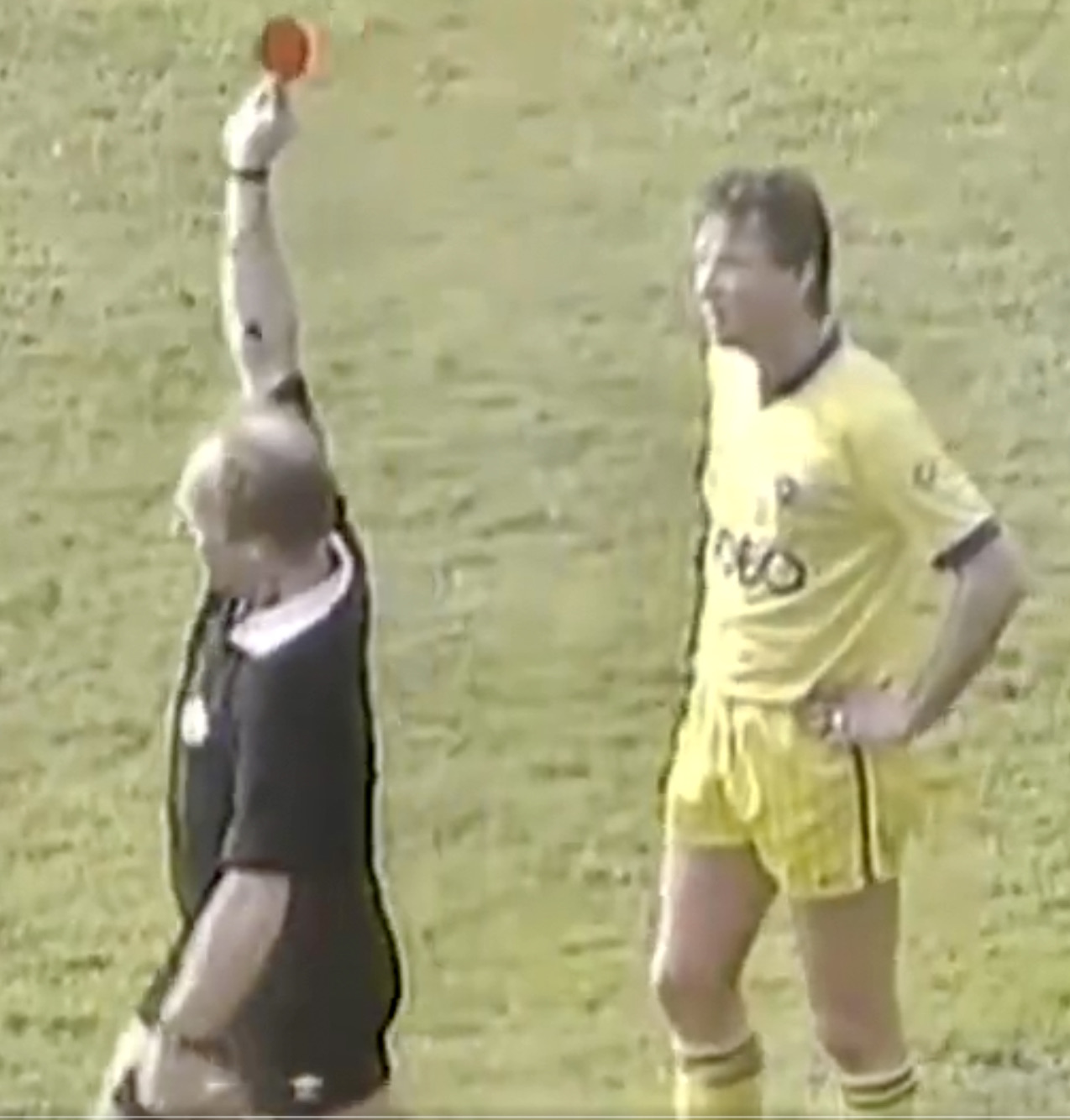
The previous month he was sent off (above) in the extraordinary match at Selhurst Park which saw referee Kelvin Morton award five penalties in the space of 27 minutes, as well as wielding five yellow cards and Trusson’s red. Four of the penalties went to Palace – they missed three – but they went on to win 2-1 against the ten men. Manager Lloyd said: “I don’t think I’ve ever been involved in such a crazy game – we could have lost 6-1 but were unfortunate not to gain a point.”

Looking back, Trusson reckoned: “I was always conscious I wasn’t Barry’s type of player.” With a gentle but respectful sense of understatement, he said: “He was not the most communicative person I have met in my life!”

In essence, perhaps not surprisingly, Trusson would seek an explanation as to why he wasn’t playing when he thought he deserved to, but it wasn’t always forthcoming. He recalled that defender Gary Chivers, who he was reunited with at Bournemouth and who he stays in touch with, used to call Lloyd ‘Harold’ after the silent movie star!

Nevertheless, he said: “Tactically Barry was a good manager. When he did talk, he talked a lot of sense.”

It was during his time at Brighton that Trusson started running end-of-season soccer schools for youngsters. He was honest enough to admit they gave him an opportunity to earn a bit of extra money to put towards a holiday rather than laying the foundations for his future career as a coach.

That was still a little way off when, at 29, he left the Albion in September 1989 having played 37 games. By then, Curbishley, Codner and Wilkins were firmly ensconced as the preferred midfield trio, and he wanted to get some regular football. Cardiff wanted him but his family were settled in West Sussex so he opted for Gillingham, which was driveable, although he stayed in a clubhouse the night before matches.

It was at Priestfield where he began to establish a close friendship with Tony Pulis, who was winding down his playing career and was similarly commuting to north Kent (from Bournemouth).

“We had always kicked each other to bits when we played against each other but often ended up having a drink and a chat afterwards, and got on,” said Trusson. “We were also keen golfers, and both talkers; we had our views (even if we didn’t always agree) and the friendship developed.”

This is a good point to go back to the beginning because it was his early appreciation of the art of coaching that would ultimately become the foundation for what followed later.

Born in Northolt on 26 May 1959, Trusson had trials with Chelsea as a schoolboy but a bout of ‘flu put the kibosh on any progress. It also wasn’t helped by the family relocating to Somerset, not a renowned hotbed for nurturing football talent.

The young Trusson went to Wadham Comprehensive School in Crewkerne and his hopes for another crack at professional football were given a huge boost when a Plymouth Argyle vice-president, who was involved with the local youth football side he played for, organised for him to have a trial at Home Park.

Argyle liked what they saw and offered him an apprenticeship, and the excellent greensonscreen.co.uk website details his career in the West Country.

It was Trusson’s good fortune that former England goalkeeper Tony Waiters – a coach ahead of his time – was Argyle boss and he gave him a first team debut aged just 17 in October 1976.

Waiters was a great believer in giving youngsters their chance to shine at an early age; he’d already worked for the FA as a regional coach, for Liverpool’s youth development programme, and been manager of the England Youth team, before being appointed Argyle manager. He later went on to manage the Canadian national team at the 1986 World Cup.

Waiters and his assistant Keith Blunt, who later took charge of the Spurs youth team in the 1980s (and was technical director at the English National Football School at Lilleshall between 1991 and 1998) together with Bobby Howe, the former West Ham and Bournemouth defender, completely opened Trusson’s eyes to what could be achieved through good coaching.

“They were in the vanguard of English coaching in the mid to late ‘70s,” he said. “I joined Plymouth as a kid having never been coached. Growing up in Somerset, we just used to play games.

“From when I was 15 to 17, they taught me so much, talking me through so many aspects of the game, and coaching me to understand why I was doing certain things on the pitch, giving advice about things like timing and angled runs.”

In an Albion matchday programme interview, Trusson told reporter Dave Beckett: “They kept us in a youth hostel and looked after us really well, even providing us with carefully planned individual weight and fitness programmes.

“Certainly you couldn’t fault them on their ideas. Out of the 20 apprentices I knew brought on by the scheme, 17 made the grade as pros. That’s an astonishingly high return by anybody’s standards.”

Although Argyle were relegated in his first season, Trusson kept his place under Waiters’ successors in the hotseat: Mike Kelly, Lennie Lawrence and Malcolm Allison. Bobby Saxton was in charge by the time he left Plymouth in the summer of 1980 to join then Third Division Sheffield United.

He was signed by Harry Haslam but, halfway through a season which it was hoped would see Blades among the promotion contenders, things went horribly wrong when Haslam moved ‘upstairs’ and former World Cup winner Martin Peters took over the running of the team. United were relegated to the fourth tier for the first time in their history.

Peters and Haslam quit the club and former Sunderland FA Cup Final matchwinner Ian Porterfield, who had just won the Division Three title with Rotherham, took charge.

Player of the Year at Sheffield United

Blades bounced straight back as champions, losing only four games all season, and Trusson was their Player of the Year. He earned the accolade the following season as well, when they finished 11th in Division Three.

The side’s prolific goalscorer at that time, Keith Edwards, a former teammate who now works as a co-commentator covering Blades matches for Radio Sheffield recently told the city’s daily paper The Star: “He was such a likeable character in the dressing room.

“I had a great understanding with him. He was a great team man, good for the dressing room and could play in a lot of positions. Every now and then he got himself up front with me and he worked his heart out.

“He looked after you as a player, he could be a tough lad. We played Altrincham one week and he got sent off for whacking someone that had done me a previous week. He was handy.

“And he was such a good character to have in the team.”

After three years at Bramall Lane, and 126 appearances, (not to mention scoring 31 goals), he was then swapped for Paul Stanicliffe and, instead of involvement in a promotion bid, found himself in a relegation fight at Rotherham United.

Trusson enjoyed his time with the Millers under George Kerr and over four years he played 124 games and chipped in with 19 goals. It was a regime change, and the aforementioned injury, that saw life at Millmoor turn sour.

A brief spell playing for Sing Tao in Hong Kong followed the end of his time with Gillingham and on his return to the UK his pal Pulis, who had taken over as Bournemouth manager from Harry Redknapp, invited him to become youth team coach at Dean Court.

Linking up with former Gillingham teammate Tony Pulis at Bournemouth

“I loved it and, when David Kemp moved on, I got the opportunity to coach the first team,” he said.

“We were very young and we were struggling to avoid relegation,” he recalled. “We kept them up and it was great experience. We both learned so much and we spent a lot of time together.”

When Pulis was sacked, Trusson was staggered to be offered the job as his replacement but turned it down out of loyalty to his friend.

The pair have since worked together at various clubs. For example, he was a senior scout at Stoke City and head of recruitment at West Brom.

“I’ve worked for him as a scout at pretty much every club he’s been at,” said Trusson, who cites trust, respect and judgement as the attributes Pulis saw in him.

Trusson was also once marketing manager for football-themed restaurant Football, Football in London – he managed to woo Sean Bean, the actor who is a well-known Blades fanatic, to the opening – and he had a marketing job for the PFA.

He runs his own online soccer coaching scheme and was working as a European scout for Celtic when, in an unexpected return to football’s frontline in November 2020, he was appointed assistant manager of Sheffield Wednesday.

Assistant manager at Wednesday

Pulis replaced Garry Monk at Hillsborough and turned to Trusson as his no.2. In that interview with The Star, Edwards said: “He’s a great lad. I was slightly surprised to see him get the job at Wednesday, but it was completely understandable.

“He’s a clever bloke, knows his football and has stayed in the game all this time, which is to his credit. His experience of scouting, coaching and having played in several different positions makes him a massive asset to any football club, I’d say.”

Edwards recalled how his former teammate had an eye for coaching from a young age. “He was always keen to get into that, he always wanted to lend a hand to the coaches,” he said.

“Some players would get off as quickly as they could to their families or whatever they were doing with their time. He wasn’t like that, he bought into the club thing. Some players were always around the place and he was like that, very understanding and willing to help out.

“I had massive fall-outs with the odd person, you know how it is, but I never saw Truss like that. He was always so calm and understanding of other people’s opinion. That’s how and why he’s stayed in the game throughout all this time. That either comes naturally to you or it doesn’t.

“I remember he always had a way of talking to people, whether that’s players or fans or board members or coaches. That’s stuck with him today.”

Ridgy rides in to shore up injury-ravaged defence

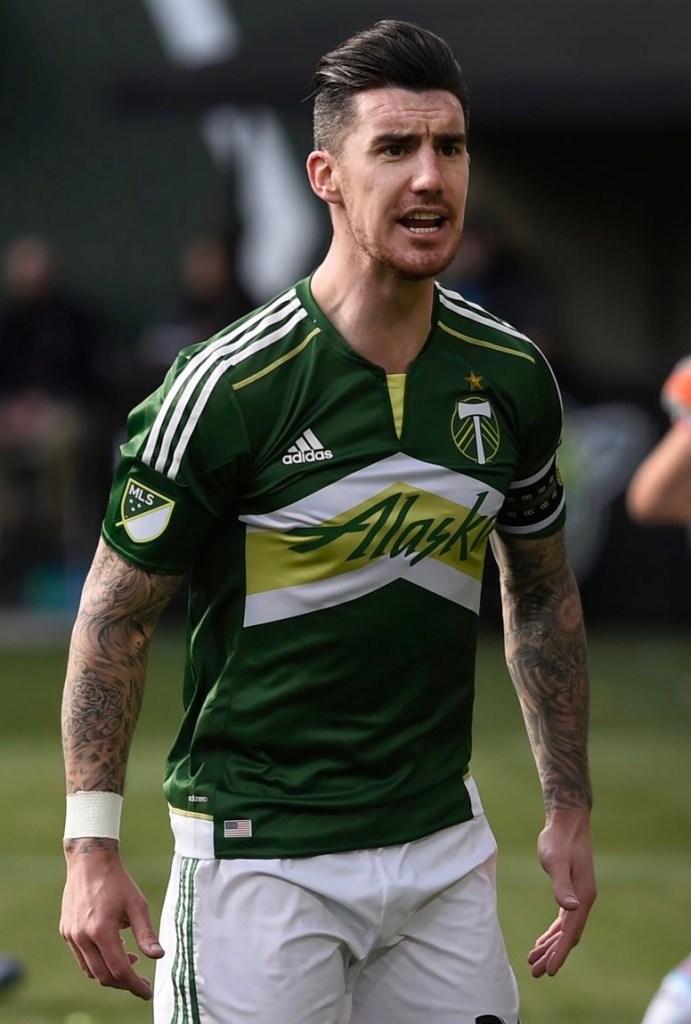
FORMER WEST BROM defender Liam Ridgewell played six games on loan for Brighton in the early part of 2016.

Ridgewell helped out when first choice left-back Gaetan Bong and deputy Liam Rosenior were both out injured.

He made six starts, starting in the FA Cup away to his old boss Steve Bruce’s Hull City, who won the tie with a single goal. His next game was also away, at Rotherham United, where Albion went down 2-0.

After that, he was on the winning side four times, as Albion beat Blackburn Rovers away and Huddersfield, Brentford and Bolton at home.

Albion’s matchday programme devoted a double-page spread to the loanee

Brighton wanted to extend the experienced defender’s loan but his parent club – MLS (Major League Soccer) outfit Portland Timbers – wouldn’t allow it and he returned to the States.

Albion manager Chris Hughton told The Argus: “He has certainly brought us a wealth of experience. We have to abide by the situation. In any way we could extend it for whatever, a further week or so, we’d be delighted to be able to do that, but I certainly can’t speak out of turn when he’s not our player.

Ridgewell returned to Portland Timbers after his brief loan with the Seagulls

“We have to respect everything his parent club want. He has certainly fitted in very well.”

Ridgewell explained the background to joining the Seagulls in an Argus interview with Andy Naylor, and on clinching the deal, Hughton said: “I know Liam very well from my time as manager at Birmingham City, and he is an excellent and important addition for us.

“He will bring extra experience to our defence at a crucial time and will give me an option both in the centre of defence and at left-back.

“Liam has played the vast majority of his career in the Premier League with more than 350 senior appearances and he’s also got experience of the Europa League and Championship from his time at Birmingham.”

Born in Bexleyheath on 21 July 1984, Ridgewell went to Bexleyheath School and was on West Ham’s books for two years between 1999 and 2001.

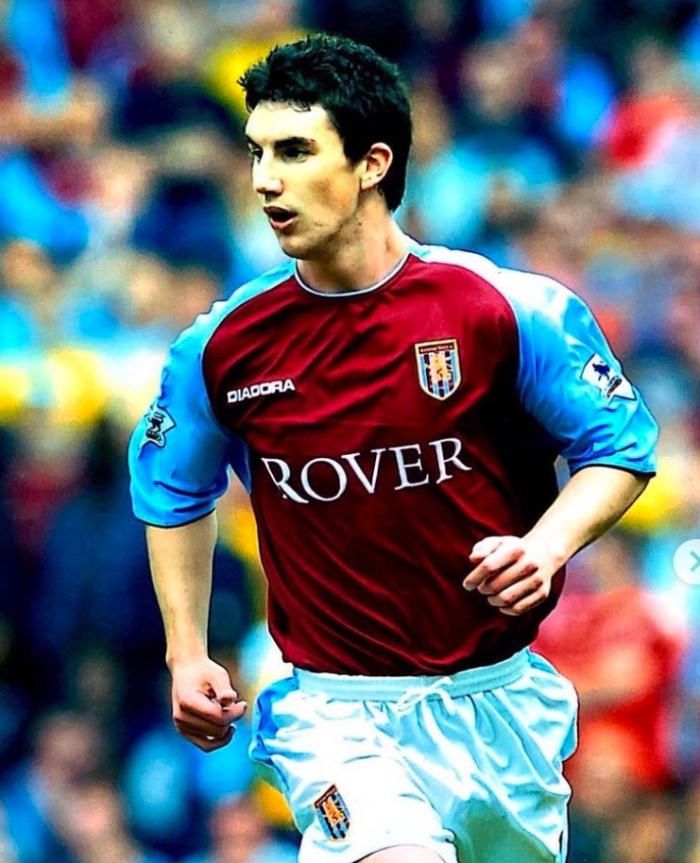
After looking at the quality of players breaking through there, he took the bold decision to quit the Hammers and join Aston Villa’s youth set-up instead, which he spoke about in an interview with the Birmingham Mail.

“I had looked at what was already in the team – you had Michael Carrick coming through, Joe Cole, Rio Ferdinand, Richard Garcia – and I thought it might be time for a change.

“I was a south London boy, grew up around there and had all my friends there. But I thought if I got away it might focus me a bit more. It was a tough decision.

A youthful-looking Ridgewell made his breakthrough with Aston Villa

“I used to leave school early on a Friday afternoon to travel up to Villa for the weekends.

“I used to get the bus from my house to the train station, get a tube from Charing Cross to Euston and a train from London up to Birmingham all on my own.”

After joining Villa in February 2001, he was part of their 2002 FA Youth Cup winning side. They beat an Everton team featuring Wayne Rooney 4-2 over two legs. Villa’s goalkeeper was another Wayne – Henderson – who would later move to Brighton. The side also included Steven Davis, who went on to play for Southampton.

In the same year, Ridgewell was selected for the England under-19s and was sent out on loan to AFC Bournemouth, then in Division 3, where he made his league debut as part of a five-game loan spell.

Back at Villa Park, former England boss Graham Taylor gave him his first-team debut in a FA Cup tie against Blackburn in January 2003 when he came on as a substitute in a 4-1 defeat. He had to wait until December that year before getting his Premier League bow, again as a substitute, but this time in a 3-0 win over Fulham. He went on to make 11 appearances by the season’s end.

Under David O’Leary and, for a season, Martin O’Neill, Ridgewell made a total of 93 appearances for Villa before making what some fans would consider a controversial move.

In August 2007, Ridgewell became the first Villa player in 23 years to be transferred to bitter city rivals Birmingham. Des Bremner, brother of one-time Brighton striker Kevin, had been the last one, in 1984.

Steve Bruce’s £2m signing then found himself wearing the captain’s armband on his debut. “It’s one of the greatest achievements in my career,” Ridgewell told the Birmingham Mail. “It’s a real honour. I thank the gaffer for that. Hopefully I can continue as captain for a few more games before a few of the others come back in.

“It was fantastic to do it. I only found out before the game when we were on the pitch. The gaffer came up to me and asked would I have any problems doing it? I said none at all. It’s what I’m made for, it’s what I want to do. I want to captain sides and have a responsibility on me.”

Ridgewell subsequently played under Alex McLeish and Hughton for the Blues, winning promotion back to the Premier League in 2009 and the League Cup in 2011.

After a total of 175 appearances in four years, and on the back of a 6-0 win for Birmingham at Millwall, Ridgewell joined West Brom on deadline day in January 2012.

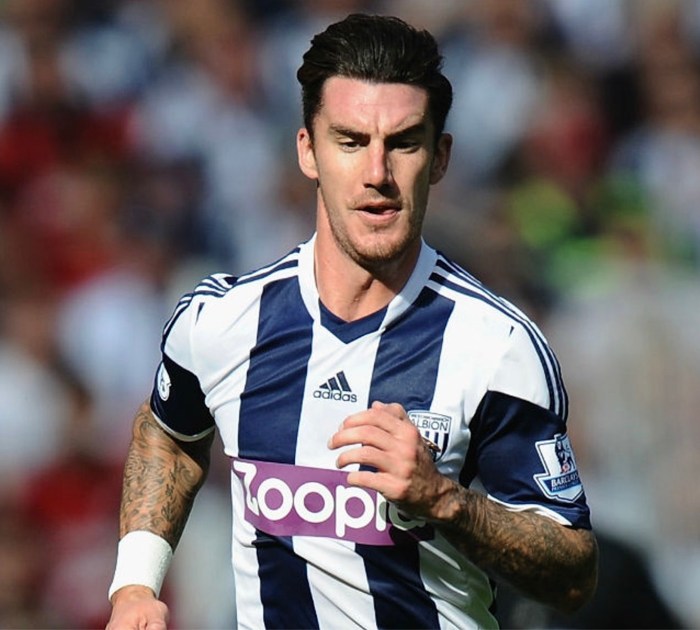
Ridgewell settled in quickly at West Brom

He couldn’t have wished for a better debut, as Albion recorded a memorable 5-1 win over Black Country rivals Wolverhampton Wanderers.

The Baggies were managed by Roy Hodgson at the time and, having initially been flirting with relegation from the Premier League, stayed up with results like a 4-0 victory over Sunderland and a 1-0 win over Chelsea that cost Andre Villas-Boas his job.

“Roy Hodgson was brilliant,” Ridgewell told The Athletic, in an interview in 2020.  “Roy knew how to make players feel and perform better than they were,” he said. “Everything was positional based. He let you do your own thing but he gave you the tools and the words to make sure you did it to the best of your ability in your own position. It was a clear message for me of how a manager gets the best out of players.”

When Hodgson left to manage England, Ridgewell continued as a Baggies regular for the next two seasons under Steve Clarke. Baggies escaped the drop by just three points in 2014, after Pepe Mel had taken over the managerial hotseat in January.

That summer, Ridgewell wanted to try something different and headed for the States to join Major League Soccer’s Portland Timbers.

In his five years with the Timbers, one of his highlights was captaining the side to a 2-1 MLS Cup win over Columbus Crew, a few weeks before his loan spell with Brighton during the American season’s winter break.

The previous season he’d returned to the UK in a similar arrangement to play six games on loan for Wigan Athletic in the Championship.

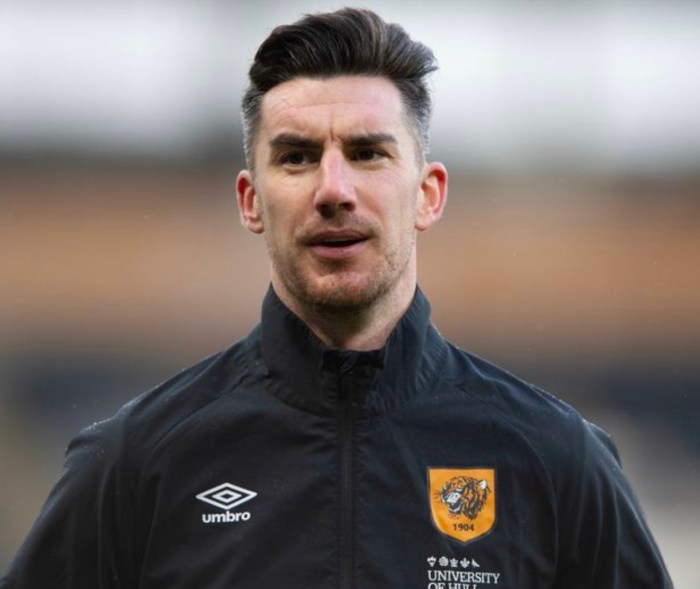
Ridgewell spoke about his time in the States on his return to the UK in January 2019, when he joined Hull City until the end of the season.

Back in the UK, Ridgewell spent half a season at Hull City

“I wanted to try something different and go out there with an open mind,” he told the Hull Daily Mail. “The league is completely different to what a lot of people expect. It’s grown bigger and stronger. I feel as fresh and as fit as when I first went there.”

To illustrate the point, he mentioned how he’d been up against the likes of Miguel Almiron, who subsequently joined Newcastle United for £20m.

“I loved it, it was great, really refreshing for me. It gave me another lease of life. It was something I needed to do, and I really loved it.”

In the summer of 2019, Ridgewell joined League One Southend United, but, having made only one appearance by December, quit playing to take up coaching.

He took to Instagram to reflect on his career, writing: “Football has given me the best life any little boy could wish for. There have been some massive highs and lows but now it’s time to hang up my boots and move on to the next chapter of my career.

“I’d like to say a massive thank you to all the coaches and managers who moulded me into the player I was. A special thank you to the late, great Graham Taylor for giving me my debut and the reason I was able to pursue my dream.”

In April 2020, Ridgewell spoke at length to Gregg Evans for an article on The Athletic, describing how lockdown had interrupted his plans to drop in on some of his old managers to gain knowledge and information in pursuit of his goal of becoming a manager.

“Moving into management has always been my aim,” he said. “I’ve always had a speaking role at every club I’ve been at. Whether it’s on the training pitch or during a game, I’ve always tried to help people out, too. With me being so vocal, I try to marshal teams in a certain way.”

He did some work with Aston Villa’s youngsters towards the end of 2020 but took on his first official coaching post in December 2020, as first team coach at Dover Athletic under former Gillingham boss Andy Hessenthaler.

It’s no surprise to discover Ridgewell (or Ridgy 6 as he’s known) has a veritable army of followers on Twitter – more than 42,000. Away from football, Ridgewell co-owns luxury swimwear business Thomas Royall, with fellow footballers John Terry and Sam Saunders.

Pictures from various online sources, and the Albion matchday programme.

South Coast suited utility man Paul Wood at Brighton, Bournemouth and Pompey

paul wood (red)

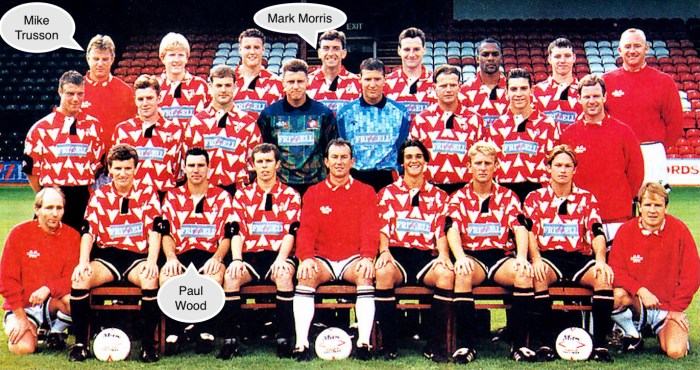
THE quote at the top of an Albion matchday programme feature about Paul Wood sums up his Brighton career perfectly.

“I’ve played so many positions at the Albion. I’m not sure that I consider myself a centre-forward any more.

“Actually, playing on the right as I am now takes my career virtually full circle – I always used to be a winger before I joined Portsmouth.”

Manager Barry Lloyd bought Wood from Portsmouth for £40,000 in the summer of 1987 to play up front alongside Kevin Bremner, with Garry Nelson wide on the left.

Nelson, of course, thought otherwise – and 32 goals in a promotion season playing down the middle rather proved him right.

Thus Wood found himself deployed in that rather dubious-sounding role of ‘utility player’.

“A couple of goals would have done me great guns when I got a chance up front,” Wood admitted. “I don’t think I let anybody down when Nelson and Bremner were injured but I wasn’t putting them away.

“It didn’t really bother me too much. I was most happy just to be getting first team football, especially as I had spent the previous year at Portsmouth, while they got promoted to Division One, watching from the stands.”

A pelvis ligament problem had sidelined Wood at Fratton Park so the new lease of life as part of a promotion-winning squad was a welcome break.

After making his Albion debut in a 2-0 home win over Fulham on 29 August 1987, Wood admitted: “I found it very tiring after playing only one hour of reserve football in the last nine months. But I enjoyed the experience and I’m looking forward to creating and taking more chances.”

PW colBorn in Saltburn-by-the-Sea in the north east on 1 November 1964, at one point it was thought Wood’s football career was over almost before it had begun.

As a talented schoolboy footballer, he was spotted playing for Middlesbrough Boys as the side won the English Schools’ Trophy. His school headteacher had connections at Elland Road so he went for a trial but only 15 minutes into the game broke a leg.

It seems he had broken a knuckle at the back of his knee and the Leeds physio, Bob English, took a look at the injury and said: “Sorry son, you’ve broken your leg, ripped all the ligaments, and I think you’re finished.”

Thankfully for the budding young footballer, the dire diagnosis was wrong, but it put him off trying to make it at Leeds and instead he got picked up by Portsmouth whose scout in the north had seen him playing for Guisborough under-16s.

It was a long way from home, but he appreciated the club’s more caring nature and when a homesick Wood mentioned how he was feeling, manager Frank Burrows took £30 from his own pocket to send the youngster home for a break.

Wood’s Pompey debut eventually came, ironically at Middlesbrough, after Bobby Campbell had taken over in the manager’s chair.

Originally, he had only travelled with the squad so that he could visit friends and relatives but a couple of players fell ill and Wood got his big chance.

“Before I knew it, I was in the team,” he said. “I think that’s the best game I’ve ever played, although it flew past so fast.”

Another favourite moment came when he scored two in a 4-0 win over Shrewsbury. England World Cup winner Alan Ball had succeeded Campbell as manager and said after the 21-year-old’s performance ‘a star is born’. Wood told portsmouth.co.uk: “That will stay with me for the rest of my life. For somebody who has achieved what he has in football and the respect he commands to come out and give me that compliment was a great feeling.

“It was a game where everything seemed to go right. I scored a couple and was in confident form.”

A run in the team followed for Wood, who made 25 league appearances as Pompey fell just short of promotion.

The following season, he only played seven games at the start of the season before sustaining the pelvic injury he put down to playing three times on plastic pitches in the space of three weeks.

paul wood portrait

By the time Wood had made his recovery, Pompey were playing in the top flight and he had fallen down the pecking order. The move to Brighton came about after Wood scored a hat-trick for Portsmouth’s reserves.

He told portsmouth.co.uk: “I was disappointed to go because I never really wanted to leave but I had a mortgage to pay and no bonuses on appearance money was forthcoming.”

Ironically it was the long-term injury problems to crowd favourite Steve Penney that presented Wood with a lot of his games at Brighton and when Penney got back into the side in 1989, Wood put in a transfer request because he felt he was doing well enough to merit a place.

Penney was to move on before Wood but eventually, after two and a half seasons with the Seagulls in which he played 88 games + 17 as sub, and scored just eight goals, he was sold.

That canny transfer market operator Lloyd had acquired the services of one-time England international wideman Mark Barham, who had been written off elsewhere because of injury issues, so he dispensed with Wood’s services by selling him to promotion-chasing Sheffield United.

On 5 May 1990, Wood was on the scoresheet as Dave Bassett’s United beat Leicester City 5-2 to earn promotion to the top division. Playing alongside him were future Blades manager Chris Wilder, former Albion assistant manager Bob Booker and Mark Morris, who went on to play for Bournemouth and Brighton.

In 1991, Wood played 21 games for Bournemouth on loan from United, before making the move permanent, and in three years with the Cherries he scored 18 times in 78 appearances.

Then, in a deal that saw the Cherries acquire out-of-favour Portsmouth striker Warren Aspinall (known to BBC Radio Sussex listeners as a matchday summariser) Wood returned to Fratton Park.

He said: “It was fantastic for me to get the opportunity to return to the club.”

Pompey used him as more of a utility player than ever before, Jim Smith playing him in midfield and his successor Terry Fenwick even trying him at wing-back. Sadly, though, he suffered a bad knee injury that curtailed his professional career, causing him to retire in 1996.

He managed to play 20 games and score 15 goals for a Hong Kong side, Happy Valley, in 1997-98 and back in the UK linked up with National League South side Havant & Waterlooville.

He spent five years there, retiring at the end of the 2002-03 season after playing 137 games and scoring 48 goals.

Wood now runs his own Bournemouth-based decorating business.

Read more at: http://www.portsmouth.co.uk/sport/football/pompey/big-interview-paul-wood-1-7109817

Midfielder Alan Curbishley helped Seagulls to promotion

Screenshot

ALAN Curbishley completed a hat-trick of promotions with new clubs when he was part of Brighton’s successful third tier side in 1988.

He’d previously been promoted after switching from West Ham to Birmingham City and also when moving from Aston Villa to Charlton Athletic.

Curbishley was what you might call West Ham through and through.

Born at Forest Gate on 8 November 1957, within a mile of West Ham station, he was one of five children (elder brother Bill famously promoted and managed The Who and Led Zeppelin and was producer of the films Tommy and Quadrophenia).

Curbishley first played in Brighton at under 11 level, in a Newham Boys side against Brighton Boys at Longhill School, in May 1967. He was later capped for England Boys aged 15 and after joining the Hammers straight from school played for England Youth.

Curbishley won nine England Youth caps under Ken Burton, scoring on his debut in a 1-1 draw against Poland in Las Palmas on 21 January 1975 when England went on to win the Atlantic Cup. Among his teammates were future England captain Bryan Robson, Peter Barnes and Keith Bertschin.

He vied for a starting berth with Mark Nightingale (Palace, Bournemouth, Norwich, Peterborough), making six starts and three appearances off the bench. His last appearance was in a 1-0 win over Wales in Cardiff on 11 February 1976, playing alongside Glenn Hoddle and Gary Owen.

Almost a year earlier, on 29 March 1975, he had made his first team Hammers debut at the tender age of 17, lining up in midfield alongside Trevor Brooking and Graham Paddon in a 1-0 home defeat against Chelsea. Mervyn Day was in goal for West Ham and guarding the opposition net was John Phillips.

At the time, Curbishley was the youngest to play in the senior team although that record was subsequently eclipsed by Paul Allen.

A contemporary of Geoff Pike, Paul Brush and Alvin Martin, they were all in the West Ham youth team defeated 5-1 on aggregate by Ipswich in the 1975 FA Youth Cup Final.

In a midfield dominated by Brooking, Paddon and Pat Holland, and later Alan Devonshire and Pike, Curbishley found first team chances limited, although in 1977-78 he made 36 appearances.

After 85 matches for the Hammers, in 1979 he moved to Birmingham for £275,000. Manager Jim Smith used the proceeds of the £1m transfer of Trevor Francis to Nottingham Forest to buy Curbishley, Frank Worthington, Colin Todd and Archie Gemmill. Curbishley was still only 21 when he made his debut for the Blues on 18 August 1979 in a 4-3 defeat at home to Fulham and he went on to be ever present for Birmingham in that 1979-80 season.

Curbishley earned his one and only England Under 21 cap in a 5-0 thrashing of Switzerland at Portman Road when Justin Fashanu was among the scorers. He had hopes of going to the 1982 World Cup with England, having broken into the England B squad but fractured a kneecap sliding into a tackle with Albion’s Brian Horton. “I missed the rest of the season and the start of the next, and the World Cup squad which I might have broken into otherwise,” he said. “It was the worst disappointment I’ve ever faced.”

He was on the front cover of the matchday programme for a game I went to watch at St Andrew’s on 27 March 1982 when he played for Ron Saunders’ Blues in a 1-0 win over Brighton. But financial issues meant the side was broken up and, the following year, after a total of 155 games, he committed what today seems to be viewed as a cardinal sin by signing for Villa for £100,000, ironically making his debut against Birmingham in a 1-0 win on 4 April 1983.

“I had high hopes of success there with them just having won the European Cup,” he told Dave Beckett in an Albion matchday programme article. “It was soon obvious though that Tony Barton was under pressure from the moment he took over and all the players thought it was just a matter of time before he was sacked.

“He got a raw deal. That season we finished ninth in the league, got to the semis of the League Cup and were knocked out of the UEFA Cup in the last minute on the away goals rule. Villa have never been near that form since, but Tony Barton’s face didn’t fit and he was soon on his way along with all the men he signed.”

After only 36 appearances, scoring once, Curbishley returned to London, dropping back down to the 2nd division, to begin what would be a long association with Charlton Athletic, punctuated only by his spell at Brighton.

Amazingly, although homeless at the time and playing at Selhurst Park, Charlton won promotion back to the 1st Division. Unfortunately Curbishley sustained an achilles tendon injury and only played 10 games in the 1986-87 season.

“I knew I had an achilles injury but the operation was delayed until a week before the start of the new season and consequently I wasn’t fit again until December,” he said. “The manager bought two new midfield players, which I understood, but when I was fit again I couldn’t get back into the side.

“It became apparent that I wouldn’t get much of a chance unless something drastic happened so I’m pleased to have a fresh start.”

After 13 seasons playing in the top two divisions, he left Charlton having scored six times in 63 games and dropped down to the Third to join the Albion for £32,500.

He made his debut in a goalless draw at Chesterfield on 22 August 1987 in front of a crowd of just 2,286.

After the departure of Jimmy Case in 1985, the centre of Albion’s midfield had been crying out for someone who could put their foot on the ball and pass it, and Curbishley stepped neatly into that role, scoring six goals – mostly penalties – in 34 appearances as Brighton won promotion.

“Alan was a very level-headed guy, an excellent passer and really disciplined,” Albion boss Barry Lloyd told Spencer Vignes in a matchday programme article.

In total, over three years on the south coast, Curbishley played 127 games (plus five as sub)  – making his 400th league appearance during the 1988-89 season – and scored 15 goals.

curbs penThe Albion matchday programme featured Curbishley when the Seagulls hosted the Hammers for a Barclays League Division 2 game on 16 September 1989. Describing his time with the East London club, he said: “It was a brilliant set up although I was definitely a bit headstrong in my early days.

“I didn’t really grow up until I moved to St Andrew’s and that’s where I had my best playing days.”

Lou Macari’s side in 1989 included Curbishley’s old pal Alvin Martin and future Albion manager Liam Brady but the Seagulls ran out 3-0 winners (goals from Kevin Bremner, Robert Codner and Garry Nelson).

In 1990, Curbishley began his coaching career, returning to Charlton initially as player-coach under Lennie Lawrence. When Lawrence left in 1991, Charlton made the somewhat unusual decision to appoint joint managers: Curbishley and Steve Gritt (who would later be at the helm when Albion narrowly escaped dropping out of the league).

Curbishley’s first signings for Charlton were former Albion teammates Nelson and Steve Gatting and he later plundered young winger John Robinson from the Seagulls. After four years, Curbishley took sole charge at The Valley and led Charlton to some of the most successful times in their history.

Considering their resources, Curbishley turned Charlton into a steady top flight club and model of stability, consistently securing a mid-table finish.

Sean Cole in The Bleacher Report described him as “one of the most promising managerial talents of the new millennium” and in 2006, in the wake of Sven-Goran Eriksson’s departure as England manager, Curbs had ‘tea and biscuits’ with then chief executive Brian Barwick – but Steve McLaren got the job instead.

In December 2006, Curbishley landed what surely would have been considered his dream job – manager of West Ham.

It was quite a reunion of old pals when Brighton visited Upton Park for one of his first games in charge, in the third round of the FA Cup in January 2007. Albion boss Dean Wilkins and coach Ian Chapman had both been teammates while physiotherapist Malcolm Stuart was still wielding the magic spray.

In front of 32,874, Hammers ran out fairly comfortable 3-0 winners with Mark Noble scoring his first senior West Ham goal and Carlos Tevez a real handful up front. These were the respective line-ups:

West Ham: Carroll, Dailly, Ferdinand (Spector 45), Gabbidon, McCartney, Benayoun, Mullins, Noble, Boa Morte (Newton 73), Cole (Bobby Zamora 68), Tevez.
Subs not used: Green, Sheringham. Goals: Noble 49, Cole 58, Mullins 90.

Brighton: Wayne Henderson, Joe O’Cearuill, Joel Lynch, Guy Butters, Kerry Mayo, Tommy Fraser (Gary Hart 51), Adam El-Abd, Dean Hammond, Alexandre Frutos (Sam Rents 67), Alex Revell (Joe Gatting 84), Jake Robinson. Subs not used: Michel Kuipers, Richard Carpenter.

Fans’ website westhamtillidie recalled: “Perhaps Curbs’ greatest legacy at the club was the £7m signing of his former Charlton protégé Scott Parker, who went on to win the Hammer of the Year prize three times and pick up a Football Writers’ Player of the Year Award during his time at the club.”

Sadly, though it was to all end in tears and Curbishley quit in protest at the then Icelandic owners’ failure to consult him over the sale of defenders Anton Ferdinand and George McCartney.

In what must have been a tough heart-v-head decision, he resorted to a legal resolution of the situation and eventually won a case for constructive dismissal, eventually receiving £2.2m in compensation. But it was the last manager’s job he had.

“It took me a year to sort out my problem at West Ham,” he told The Independent. “And then, after that, I was perhaps a little too picky. I was told by other senior managers ‘don’t be out too long’ but I was waiting for a job that I thought was the job for me.”

Job vacancies came and went, Curbishley’s name was generally on all the shortlists, but he never again made it through to the manager’s chair. There was a brief moment at Fulham when he was technical director assisting Rene Meulensteen but when Meulensteen was swiftly axed, new manager Felix Magath brought in his own people.

He rejoined the Fulham coaching staff in March 2015 and took charge of training in November 2015 when Kit Symons was relieved of his managerial duties but Stuart Gray took charge of the team before Slavisa Jokanovic was appointed.

In 2016, Curbishley brought out a book, Game Changers: Inside English Football: From the Boardroom to the Bootroom (published by HarperSport) and was a regular pundit on the Football on 5 programme covering Football League games.

Further reading

https://www.westhamtillidie.com/posts/2014/11/07/preview-aston-villa

http://bleacherreport.com/articles/1415997-the-curious-case-of-alan-curbishley-footballs-forgotten-man

https://www.whufc.com/club/history/managers/alan-curbishley#C1vPoA9yPR1kYluJ.99

  • Pictures show westhamtillidie’s image of Curbishley in West Ham colours; the midfielder on the front of a Birmingham matchday programme 1982; in Villa’s colours from a Match Weekly annual, an Argus shot of Curbs scoring a penalty for Brighton against Man City, and other images from the Albion match programme.

Winger Mark Barham was no stranger to Wembley

1 Barham progBRIGHTON’S wingers in the 1991 Division Two play-off final had previously been on opposing sides in a Wembley final.

Mark Barham was a winner with Norwich City as they beat Sunderland 1-0 in the 1985 League Cup Final and Clive Walker missed a penalty for the Wearsiders.

Six years on, Barham had levelled for Albion in the first leg of the semi-final at home to Millwall (more of which later) and Walker got the third when the Seagulls upturned the form book and beat Bruce Rioch’s side 4-1.

The 6-2 aggregate victory pitched the Albion against Neil Warnock’s Notts County under the shadow of the famous Twin Towers of Wembley.

Walker saw a Wembley post prevent him from scoring as Brighton’s dream of promotion was ended in a 3-1 defeat.

Folkestone-born Barham joined the Seagulls on a two-year contract after an initial trial and made his debut as a substitute for Kevin Bremner in a 1-0 home defeat to Oxford United on 30 December 1989.

He got his first start two days later in a 3-0 defeat at West Brom, who he’d played for briefly under ex-Ipswich and Arsenal midfielder Brian Talbot earlier that season.

On the second Saturday of the new decade he scored his first Albion goal in a 1-1 draw at home to Barnsley and had played 18 games by the end of the season.

Young John Robinson was beginning to get first team opportunities but Barham managed 42 appearances in 1990-91, culminating in that Wembley appearance against Notts County, although he was subbed off on 10 occasions.

That play-off first leg game against Millwall was Lloyd’s selection in Paul Camillin’s 2009 Match of My Life book (www.knowthescorebooks.com). He said: “Perry Digweed put in one of his incredibly long punts and the ball was about to bounce on the edge of the Millwall box when the centre half (David) Thompson ducked under it, I think intending to allow it to bounce through to Brian Horne in the visitors’ goal.

“But as he took his eye off the ball he also turned his back and the ball actually landed on the back of his head and squirted off right into Mark’s path. The little winger raced in and cracked the ball into the bottom corner. It really was a vital goal so close to the interval and the fans knew it.”

The goal also gave Barham much personal pleasure because he’d not seen eye-to-eye with Millwall boss Rioch when he’d been his manager at Middlesbrough.

With Robinson winning the shirt more frequently in the disastrous relegation season of 1991-92, Barham managed 25 appearances plus two as a sub but he was released at the end of the season and moved on to Shrewsbury Town.

Born on 12 July 1962, Barham’s football career began when he joined Norwich as an apprentice in 1978.

He was part of the City youth team that won the South East Counties League in 1979-80 and in the same season, at the tender age of just 17, manager John Bond gave him his first team debut. No fairytale start, though, as City lost 5-0 to Manchester United at Old Trafford.

However, he went on to make himself a regular in the City first team, making 213 appearances and scoring 25 goals for the Canaries.

Screenshot
Barham in action for England v Australia

He also won two full England caps on the 1983 tour of Australia in a side captained by Peter Shilton and also featuring Trevor Francis and Terry Butcher. Barham spoke warmly of Bond when he died in 2012 telling the local pinkun:

“When I first came up from Folkestone I had what you might call long hair. The first time he played me in a five-a-side in training he told me ‘I’m letting you play this one but if you don’t go out and get your hair cut you won’t be playing another one’.”

Barham continued: “He was my first manager, he gave me my debut at 17 and I went on to play for England so he must have done something right.

“He loved wingers but you had to adhere to certain rules. You had to play wide with your foot on the line, it was your responsibility to score goals, get crosses in and defend at the same time.”

A knee injury suffered in a match against Spurs was a major blow to Barham’s career. He ruptured cruciate ligaments in his left knee and he ended up in plaster for 14 months.

Although he remained at Carrow Road for four more seasons, Dale Gordon and Ruel Fox emerged as challengers for his place and eventually, in July 1987, Barham moved on to Huddersfield Town.

It was there that he teamed up with former Albion full back Chris Hutchings who spoke favourably about his time on the south coast with the Seagulls. Barham only played 27 games for the Terriers and, with former England striker Malcolm MacDonald replacing Steve Smith as manager, found himself released on a free transfer in 1988.

He joined Middlesbrough on an 18-month contract but as Rioch’s Middlesbrough were relegated he only played four games in eight months and was on the move again, ending up at non-league Hythe Town.

Determined he still had what it took to hold down a league career, Barham wrote to all 92 clubs. He joined Division Two West Brom and played four times for them but they didn’t keep him on.

Barham tight crop“I knew I hadn’t suddenly become a bad player and that I could succeed again,” Barham told the Albion matchday programme in March 1990. “So I wrote to all the clubs again and that’s when Barry (Lloyd) contacted me. His was only one of six replies.

“Since being here I’ve found that all Hutch said about the club and the area was right and now I want to prove myself, show that managers were wrong to ignore me and enjoy my time in Brighton in the hope that my two-year contract will be extended.”

After the disappointments elsewhere, Barham certainly got his career going again at Brighton.

He scored once in eight matches for the Shrews but his career was on the wane in 1992-93 and he had short spells in Hong Kong and played non-league with the likes of Sittingbourne, Southwick and Fakenham Town, who he managed for 20 months from April 1996.

According to Mike Davage’s excellent article Canaries Flown From The Nest in the 1998-99 club handbook, Barham joined Mulbarton in February 1998.

At a Norwich centenary dinner in 2002, Barham told Davage he’d had more than 20 operations on his knee. By the time he was interviewed by Spencer Vignes for Albion’s matchday programme in 2015, he’d had 38 operations on it!

After retiring from the game he ran a toolhire business in Norwich and according to his LinkedIn profile he’s now a business development manager with facilities management company, Mitie.

2 Barham stripesBarham 1

  • Pictures show Barham in Albion’s NOBO kit, from the Wembley play-offs programme, a portrait from a matchday programme and in a team line-up wearing the dreadful pyjama kit.

Cattle auctioneer Kevin Bremner gave clubs a promotion prod

bremner-portraitAS GOALSCORING partnerships go, the pairing of Kevin Bremner and Garry Nelson was something of a masterstroke by Albion manager Barry Lloyd.
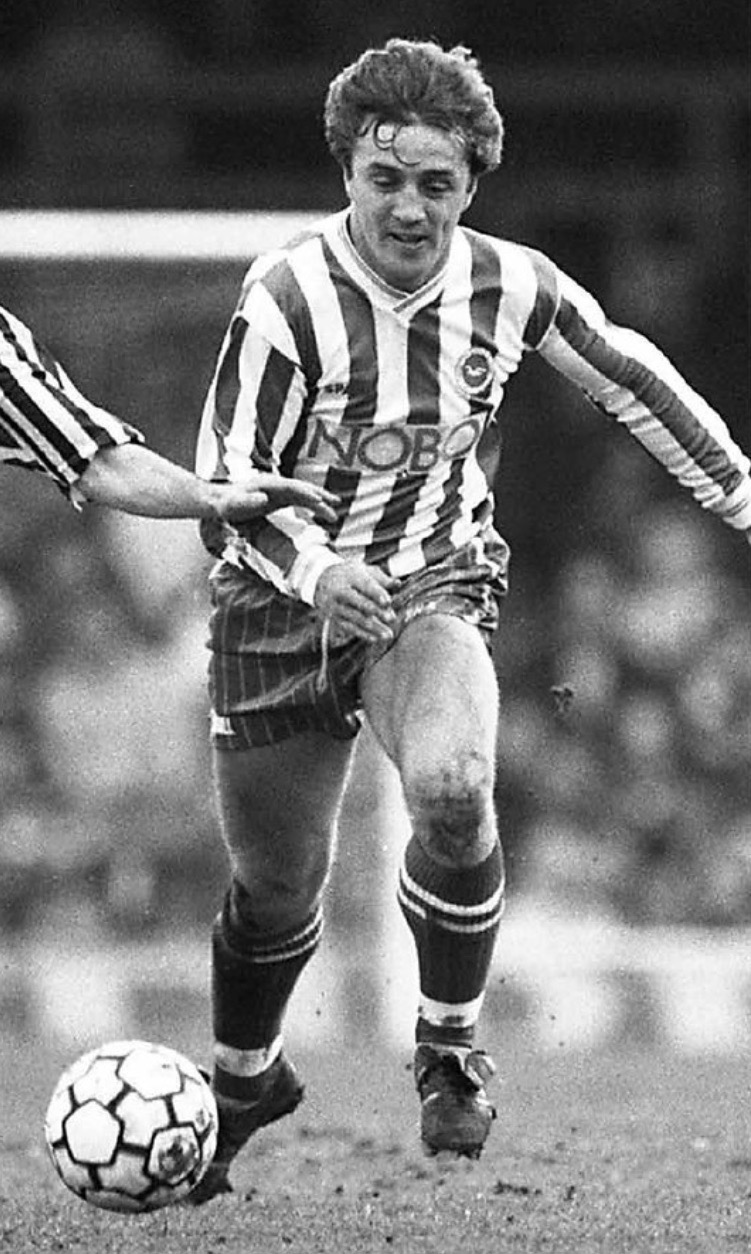
Having to readjust to life back in Division 3 after relegation in 1987 meant cashing in on some of the better players – the sale of Terry Connor, Danny Wilson and Eric Young raised over £400,000 – and replacing them with bargain buys.

At £65,000 for Bremner and £72,500 for Nelson, Lloyd showed how shrewd an operator he could be in the transfer market. When Nelson was injured and sidelined for a while, £80,000 was paid to bring in Paul Wood to play alongside Bremner.

Bremner was born on 7 October 1957 in Banff in the Scottish Highlands and worked as an auctioneer in the cattle market in his home town as well as playing Highland League football.

He didn’t make his start in the English league until the relatively late age of 23. That was with Colchester United and he made his debut in a 2-2 home draw with Barnsley in Division 3 on 11 October 1980.

He went on to make 93 consecutive appearances for Colchester in the third and fourth divisions and scored 35 goals while Bobby Roberts was in charge. All was going well until Bremner got in a dispute with the club and found himself out of the side.

Division 1 Birmingham took him on a month’s loan and, after he’d scored a goal in his four games there, Roberts’ repplacement at Colchester, former Ipswich and Northern Ireland centre half Allan Hunter, recalled him to Layer Road. However, former boss Roberts had moved on to Division 3 Wrexham, and he took Bremner on loan at the Racecourse, where he also got on the scoresheet.

“He wanted to take me on permanently but they couldn’t afford it so my next stop was Home Park, and a spell at Plymouth Argyle,” he told the Albion matchday programme. “It was touch and go whether or not I’d stay there in the long term, but once Lincoln and Millwall showed an interest I knew that I’d soon be on my way.”

He chose Millwall – “it was closer” – and joined the Lions in December 1982 for a £25,000 fee. He was one of eight new signings made by manager George Graham as Millwall were floundering at the bottom of Division 3 at the time. In a remarkable turn-round, they picked up 27 points in 12 games to escape relegation.

He was then part of the Millwall side who won promotion from Division 3 in 1984-85. In total, Bremner scored 33 goals in 87 games for the Lions. “It was a fabulous couple of years even though the side was struggling when I joined,” he said. “Playing at The Den is great – it’s wicked for away teams because the atmosphere is so strong.”

Next stop was Reading for a £35,000 fee. He spent two seasons with the Royals and enjoyed a successful partnership with lofty Trevor Senior which helped the Royals to promotion as champions from Division 3 in 1986.

I can remember going to watch Albion play Reading in November 1986 and Bremner scored twice in a 2-1 win for the Royals at Elm Park. He finished the season with 15. Albion signed him from Reading for £65,000 in July 1987.

Brem flowAfter a flying start with Brighton, in which he scored 11 goals, the league goals dried up for Bremner but strike partner Nelson couldn’t stop scoring as Albion powered their way to automatic promotion.
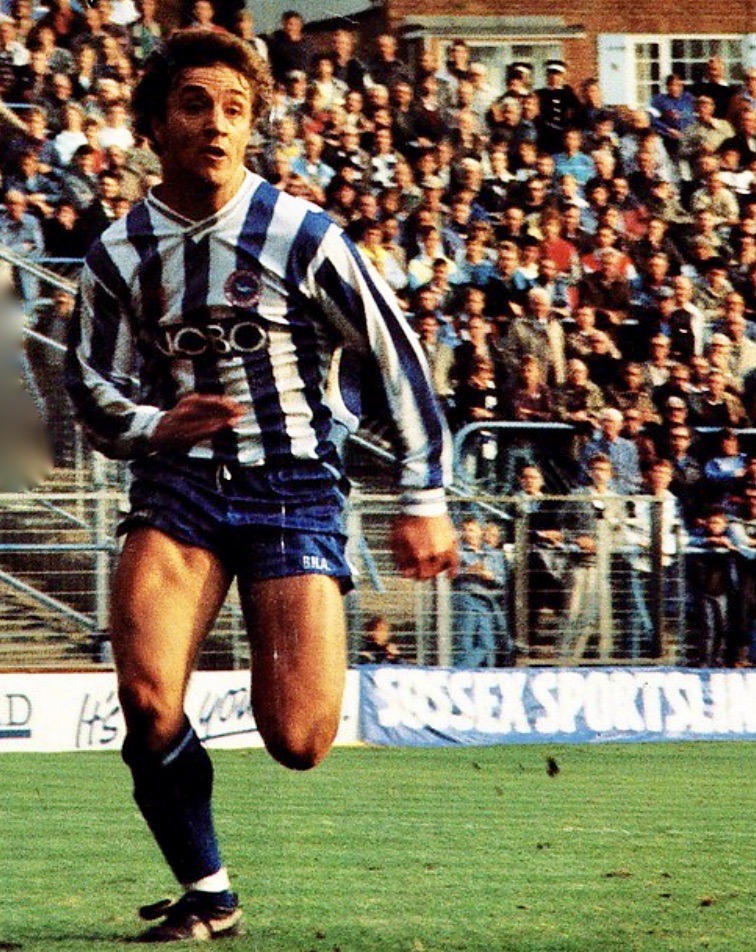
Second spot behind Sunderland was clinched via a 2-1 Goldstone win over Bristol Rovers on 7 May, Bremner finally ending his goal drought with a diving header, and Nelson, inevitably, getting the winner – his 32nd goal of the season.

What was all the more remarkable about the pairing was that it was the first season Nelson had played as an out-and-out striker.

Back in the second tier in 1988-89, Albion struggled to make an impression against better quality opponents although Bremner did score 15 goals, including a hattrick in a New Year’s Eve 4-0 mauling of Birmingham City. In September 1988, he took over the goalkeeper gloves (below) at home against West Brom when Perry Digweed was forced off with a serious groin injury.

In a matchday programme interview, Bremner said: ”I’m probably enjoying the game more than at any time before. I regret not coming into the professional game earlier but I’m delighted at the way things have turned out.

“We always thought we could do well at the Goldstone and after two years of hard work I’d like to think that we can put the club back on the map and, besides, I’d like another try in the First Division.”

The programme notes declared: “It’s his consistent scoring record that has opposing defenders on tenterhooks. His total commitment invariably creates an opportunist goal and he is a popular player with the fans.”

Brem runBremner scored 12 in the 1989-90 season, five of them coming in the space of a week at the start of the season! He was virtually ever-present but Albion struggled in the lower half of the table for most of the season. His goal in a 1-1 draw away to Blackburn in the final game of that campaign was his last for the club. In 134 games (plus three as sub), he’d scored 36 goals.

He moved on to Peterborough United in the close season as manager Lloyd had a new strike partnership up his sleeve in the shape of John Byrne and Mike Small.

After a year at Peterborough, Bremner moved back to Scotland to play for Dundee but in the spring of 1992 had a month’s loan spell at Shrewsbury Town.

Back in the far north of Scotland he had spells as player-manager with Brora Rangers and his old club Deveronvale then in 1995 he became youth team manager at Gillingham and stayed for eight years, and was then academy coach at Millwall for three years. He subsequently coached youngsters in Kent, at an academy and at an independent school.

  • Pictures show the front page of the Evening Argus following Albion’s promotion from Division 3 in 1988 with Bremner diving to score; a shot of Bremner in action against West Ham that appeared on the front of a matchday programme, a portrait from a matchday programme at the beginning of the 1989-90 season, and other action pictures from matchday programmes.

Barry Lloyd’s turbulent time as Brighton boss

Screen Shot 2021-05-05 at 09.51.14

HISTORY may have judged Barry Lloyd’s reign as Brighton manager unfairly: while bleak times cloud the memory, the former Fulham captain did chalk up some successes.

For instance, it’s worth remembering he put together two of the most entertaining strike partnerships in Albion’s history.

However, when managers start getting involved in the boardroom, it’s probably not going to end well and that certainly proved to be the case after Lloyd was handed the role of managing director.

Frankly, there is probably not enough space in one blog post to cover the various off-the-field shenanigans that were an ugly backdrop to the Lloyd era.

From an outsider’s perspective, it appeared he was the unfortunate public figure put up to deal with a huge amount of flak generated by others wielding power in the background.

Inheriting the hotseat at a time of financial turmoil, from a distance it could be said he did well to win promotion as well as coming mighty close to restoring the elite status lost in 1983.

But fans who had seen huge success under high profile bosses were not best pleased to see their club’s fortunes put in the hands of someone who had previously only managed outside of the league.

Let’s look first at Lloyd’s playing career because, from early on, he was obviously a shrewd observer who made contacts he would be able to call on in later years.

Born in Hillingdon on 19 February 1949, Barry’s early footballing ability was rewarded with selection for the Middlesex and South of England schoolboy sides. He was signed up by Chelsea and was in their 1964-65 youth team alongside former Albion right-back Stewart Henderson in defence and future England international and Chelsea legend Peter Osgood up front.

In an extended interview with Fulham’s club historian, Dennis Turner, Lloyd recalled: “I chose Chelsea because under Tommy Docherty’s management they were an exciting team, with the likes of Osgood, Charlie Cooke and Bobby Tambling.”

Former Albion player Dave Sexton was the reserve-team manager – “a really nice man and terrific coach” – and Lloyd says in his four years at Stamford Bridge he learned a lot.

He made his debut in the top flight in April 1967 aged just 18, but competition for places was tough and, after only 10 first team appearances, in January 1969 he moved to neighbours Fulham with their centre half John Dempsey moving in the opposite direction.

lloyd-fulham-goal

Fulham were struggling for survival in the old Second Division having been relegated from the top flight and the man who signed him, Bill Dodgin, was their fourth manager in a year.

They dropped down into the old Third Division but as part of his rebuilding, Dodgin made Lloyd captain in succession to the legendary Johnny Haynes, who was coming to the end of his career.

Lloyd is pictured below getting in a header against the Albion at the Goldstone, watched by John Napier (left) and Stewart Henderson. The packed East Terrace never looked like that by the time Lloyd was sitting in the Albion manager’s chair.

Lloyd at Goldstone

Fulham regained their tier two status in 1971 when they went up from Division III as champions. Manager Dodgin was sent packing in the summer of 1972, though, and Alec Stock took over, famously bringing in a number of top name players nearing the end of their careers – notably one Alan Mullery, along with Bobby Moore.

Lloyd remained part of the set-up but when Fulham surprised everyone by reaching the FA Cup Final against West Ham in 1975, he had to be content with what in those days was the single substitute’s berth on the bench, and didn’t get on.

Nonetheless, he chalked up 290 games for Fulham, before having brief spells at Hereford and Brentford (where Dodgin was the manager) and ending his playing days with Houston Hurricanes in the United States.

“I lived in Texas for a year. The league was never going to last but I learnt a lot about how the game can be promoted. They were very good at that over there,” he said in a matchday programme article. “Everyone was made to feel part of the club. It was an interesting experience; I’ve never regretted going.”

During his brief time at Hereford, Lloyd had an eye to the future and took his full coaching badge at Lilleshall, which wasn’t far away.

After his time in America came to an end, he got his first managerial experience with Yeovil Town (then a non-league club) and then headed to Sussex where he took Worthing from the Second Division of the old Isthmian League to runners-up in the Premier Division.

It was in 1986 when he got the call from Mullery to become reserve and youth team manager at the Albion. Dodgin was also on the staff.

lloyd desk

In January 1987, Mullery was unceremoniously dumped and Lloyd came out of the shadows to take charge. Perhaps what fans didn’t know at the time was that the day after Mullery left, Lloyd was summoned to a meeting with chairman Bryan Bedson and told to “get rid of everyone” because the club was going bust.

Against that backdrop, it was 15 games before the side managed to register a win under Lloyd and, unsurprisingly,  Albion were relegated. Some of the mainstays of the side, like Danny Wilson, Eric Young and Terry Connor were sold. Fortunately, Lloyd was able to re-invest part of the proceeds from those sales in some buys who gelled together to form a promotion-winning team.

Screen Shot 2021-05-03 at 20.37.12He returned to former club Chelsea to secure the signing of centre back Doug Rougvie who was made captain and he paired left winger Garry Nelson, a £72,500 signing from Plymouth, with tenacious Scot Kevin Bremner, from Reading, to lead the line. Nelson in particular was a revelation, scoring 32 goals and voted player of the season.

Lloyd reckoned the backbone of the side were two other shrewd signings: Alan Curbishley and Gary Chivers. “Alan was a very level-headed guy, an excellent passer and really disciplined,” he told Spencer Vignes in a matchday programme article. “Chivers was exactly the same, and a real joker at the same time. But there were a lot of great individuals in that side.”

The following two seasons saw Albion maintain their status with lower half finishes but, with the Goldstone Ground crumbling and debts mounting, there was little investment in the team and Lloyd had to use all his contacts to try to find some gems.

One was former England international winger Mark Barham, another was a former Soviet international, Sergei Gotsmanov, a real crowd-pleaser obviously capable of playing at a higher level (as was proved when he opted to join Southampton the following season).

Then, in 1990-91, he rescued two forwards languishing with also-ran clubs in Europe and together John Byrne and Mike Small were superb in attack as Brighton made it to the play-off final at Wembley only to lose 3-1 to Neil Warnock’s Notts County.

No-one had been expecting Brighton to get a tilt at promotion, particularly as the season had once again begun with big money departures of players like Keith Dublin and John Keeley.

But with Byrne and Small on fire and former Fulham and Chelsea winger Clive Walker added to the squad they clawed their way into contention and famously clinched the play-off spot on the last game of the season, courtesy of Dean Wilkins’ curling free kick past Ipswich Town’s Phil Parkes.

Another crucial signing that season was thanks to one of Lloyd’s old Chelsea teammates, George Graham. The Arsenal boss loaned cultured central defender Colin Pates to the Seagulls and he proved a mainstay in the final third of the season. Pates would later sign permanently.

Even though they were clearly beaten by the better side on the day, looking back now, I don’t think anyone could have realised what bad news it was for Albion not to win the final against County.

Starved of the funds promotion would have delivered, Lloyd was forced to sell star performers Small and Byrne and, 11 months after appearing at Wembley, Albion were relegated back to the third tier.

Lloyd had tried to repeat his previous successful European scouting mission with two former league players, but the hapless Mark Farrington turned out to be one of the worst buys ever, managing to score one solitary goal while former Arsenal youngster Raphael Meade fared slightly better but only just got into double figures.

Mark Gall, a £45,000 signing from Maidstone, arrived towards the end of October and ended up top goalscorer and was player of the season, but his 14 goals were still not enough to spare the team from the drop.

In the following season, the very survival of the club was under serious threat with the taxman chasing an unpaid bill. Lloyd rescued the club at the 11th hour by managing to secure a £350,000 fee for goalkeeper Mark Beeney (bought two years earlier from Maidstone for £25,000), former Albion winger Howard Wilkinson buying him for League Champions Leeds United.

With the financial issues continuing in the background, a run of only two wins in 18 league games in the first half of the 1993-94 season eventually brought the Lloyd era to an end – the axe wielded by chief executive David Bellotti, who had arrived only a month earlier.

Fans who were euphoric to see Lloyd go might well have felt differently if they’d known what would eventually transpire, but that’s a story for another day.

The record books show Lloyd made a total profit of £1.2m in his seven years at the helm and he certainly knew his way around the transfer market, particularly in Europe, when it was a lot less fashionable than it is today.

Another of his discoveries was Dean Wilkins, playing for FC Zwolle in Holland, and in 2007 – 14 years after he had left the Albion – Lloyd returned as chief scout during Wilkins’ reign as first team manager.

Also part of the set-up then was director of football Martin Hinshelwood, who had been Lloyd’s assistant during his time in the dugout. Lloyd later returned to the club to assist in the recruitment department but retired in 2021.

He died aged 75 on 28 September 2024 and players in the Chelsea v Brighton game that afternoon wore black armbands in tribute to him.

Lloyd in 2022