

INJURIES beset Derek Allan’s promising career but he played 100 games at the heart of Brighton’s defence during turbulent times and remembers warmly “a wonderful club”.
In an exclusive interview with In Parallel Lines, Allan reveals the niggles that affected him and recalls the people who helped to shape his playing career.
The Scot remains involved in the game as an academy coach at Greenock Morton and his only lament is that the sports nutrition and science today’s footballers are able to call on to prevent and cure injury wasn’t available when he was playing.
Born in Irvine, on the West Coast of Scotland, on Christmas Eve 1974, Allan’s first steps towards a professional career came with selection for Scottish schools’ representative sides, being picked at all levels from 12 through to 16.
Ayr United, the club based a 20-minute drive from his home town, took him on as a YTS trainee and he moved quickly through the ranks before signing as a professional at the age of 17.
George Burley, the former Ipswich and Scotland international full-back, was beginning his managerial career with The Honest Men at that time but it was his assistant, Dale Roberts, who’d also played for The Tractor Boys, who helped Allan the most.
“Dale was a huge figure in my early days: a fantastic guy,” said Allan. “He had me out every day striking footballs; he was an incredible guy.” Roberts sadly died from cancer aged 46 in 2003.
After only five appearances for United in the 1992-93 season, Allan was sold to Southampton for £75,000. He explained how the move came about. “I was spotted playing for Ayr at Hamilton Accies on a cold Tuesday night in 1993. Ian Branfoot (Southampton manager at the time) came to watch someone else and took me instead.”

It must have been quite an upheaval to leave home and family to start a career on the south coast, but Allan said it was the making of him.
“It was a huge learning curve for me and I wasn’t really prepared to leave family and friends at that time.
“But that few months after leaving set me up for life. It made me the person I am today.”
Scottish under-18 and under-21 honours were added to his schoolboy recognition but his progress during three years at Southampton was hampered by injury.
“It was the story of my career, really,” he said. “Looking back, I lost 18 months of a three-year contract to injury and it was a crucial time in my development.
“In hindsight, I could have done more myself to look after myself better, although there were no sports scientists back then to help with nutrition, recovery etc.”
That backdrop of injury meant he was restricted to just one first team appearance for the Saints, when he was a late substitute for Matthew Bound in a 1-0 defeat at Manchester City on 1 May 1993.
Ken Monkou was at the heart of the Saints defence at the time and a certain Micky Adams was left-back with Jason Dodd also prominent.
It was in March 1996 when former Saint Jimmy Case, by now rather reluctantly in the hotseat at the Albion, went back to his old club to take the young centre-back on loan in the same week that future captain Gary Hobson was signed permanently from Hull City, and forward Zeke Rowe from Chelsea.
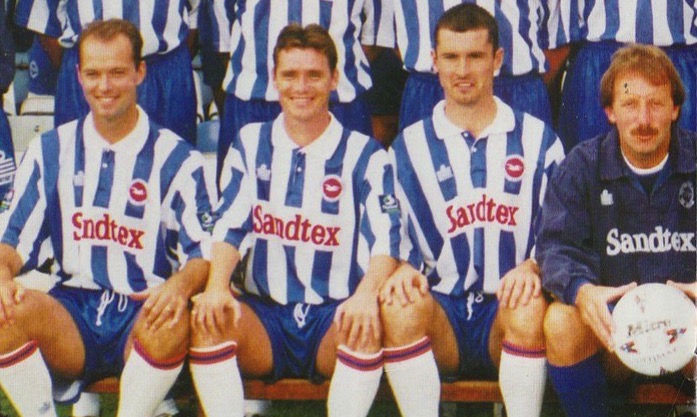
“I felt at that time Jimmy, with his connection to Saints, and his understanding of the game would be ideal for me,” Allan recalled. “Unfortunately, we all know what happened.”
Nevertheless, he was certainly among familiar faces because Case had not long previously persuaded his old club to part with Paul McDonald and Craig Maskell.
Allan took over the no.5 shirt from Ross Johnson for his debut but was on the losing side as Albion went down 3-2 at Swindon Town.
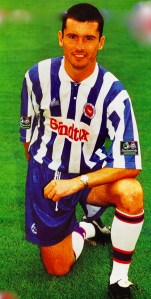
After an initial eight games, Allan’s move became permanent and he often appeared alongside Hobson in the heart of the defence, although, with a combination of poor results, injuries and frequent managerial changes, he wasn’t always an automatic starter.
The likes of Johnson, the experienced Mark Morris and, for a while, young Kevin McGarrigle provided competition as Albion bumped around the basement.
However, in his first full season with the Seagulls, 1996-97, Allan played 32 matches as the club scrabbled to avoid dropping out of the league, surviving only courtesy of the last-game 1-1 draw at Hereford. By then, of course, Steve Gritt had taken over from Case and Allan rated him highest of the different bosses he played under.
“Steve Gritt was definitely the best for me personally, it’s just a shame the injuries I got stopped me from showing what I could do consistently,” he said.
The off-the-field shenanigans, with rogue directors trying to sell the ground for redevelopment without having a new ground to move to, must also have been a difficult backdrop for any of the side at that time.
Allan said: “It’s easy to see the problems they had at that time and it’s a very different club now. The fans were unbelievable back then and they supported us every week even though we played under some huge pressure.

“I didn’t do myself justice really, playing with injuries and stuff like that, but it’s a wonderful club and fanbase. The fans never really got to see the best of me, which was a shame.”
Towards the end of his time with the Seagulls, he went on the transfer list and didn’t see eye to eye with Brian Horton, who’d returned to the club as manager. Allan declared it was “just the usual disagreements that happen between player and manager” which is now all water under the bridge.
“I actually saw Brian years later and we had a laugh about it,” he said. “He was an angry man, the same as me!”
At the end of his Albion stint, Allan stepped into the Conference with Kingstonian — a “great club with a great manager in Geoff Chapple” — and he made 75 appearances in two years.

Allan was on the bench when Kingstonian beat Kettering Town 3-2 to win the FA Trophy in front of 20,034 fans at Wembley in May 2000. Geoff Pitcher, who later played briefly for the Seagulls in the 2001-02 season, was in Kingstonian’s midfield that day.
“I finished my last season there as Player of the Year and Players’ Player of the Year,” said Allan. “I think that was the beginning of my thoughts of shifting to getting a new career long term. It was the best decision I ever made.”
Problems off the field meant in 2001 he moved back to Scotland, where he joined Queen of the South on a semi-professional basis for three years. During his time there, they won the Bell’s Cup and the Scottish Football League Division 2 Championship.

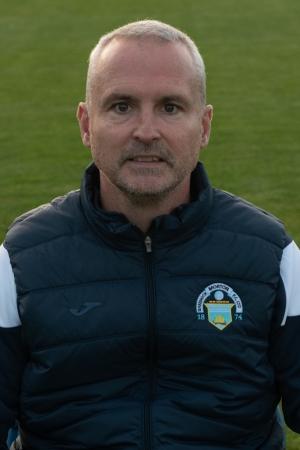
After 60 appearances for The Doonhamers, Allan’s last port of call as a semi-pro player was at Scottish Division Two Dumbarton for the 2004-05 season, making five appearances plus one as a sub.
Asked to sum up his career, he issues an upbeat thought, saying: “Great promise, bad luck, brilliant life memories and no regrets. Not many people can say they played for these wonderful clubs. I have memories that will last a lifetime.”
Before those playing days had ended, in 2002, Allan began a new career as a technical recruitment consultant, spending 11 years with NES Global Talent. Since 2013, he has been head of recruitment and talent acquisition for engineering services provider Booth Welsh, part of the global Clough Group.
He obtained the UEFA Advanced Youth A coaching licence in 2014 and is currently the under-18 academy coach at Greenock Morton.
“We have brought through some great young guys who have careers in the game,” he said. “I still love the competitive side and it’s great still to be involved.”
Today, Allan occasionally exchanges messages with former Albion teammates Hobson and Kerry Mayo but he is in more regular contact with McDonald, who only stood down in July 2021 after 18 years as an academy coach at Kilmarnock.

• Pictures from Albion matchday programmes and various online sources.
 In parallel lines