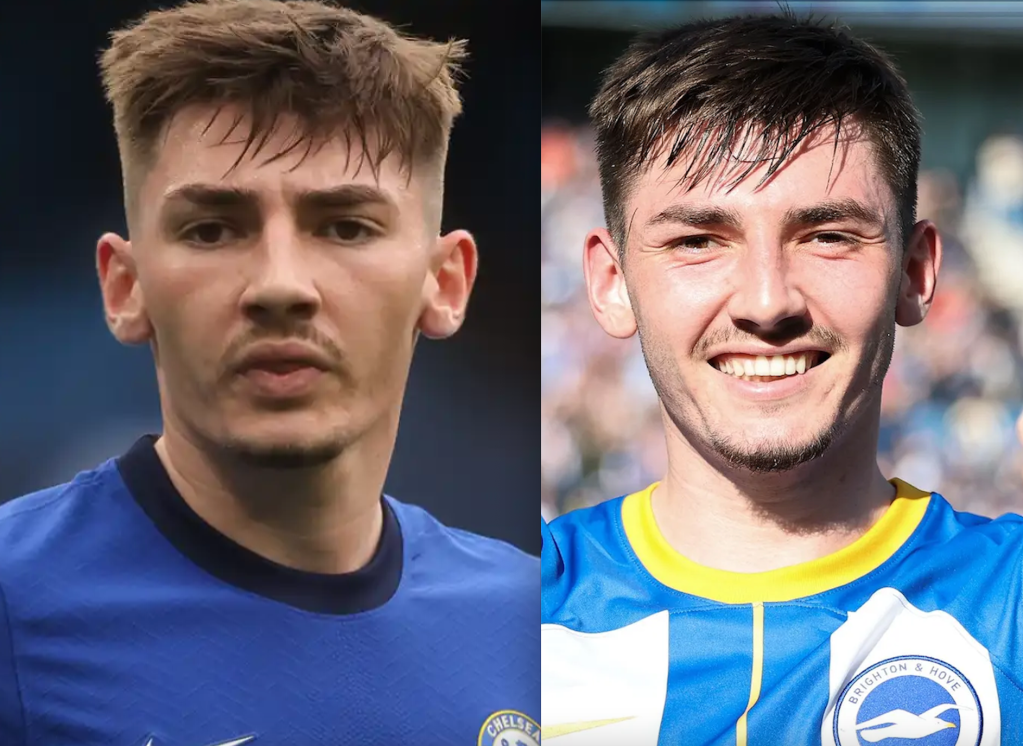
High hopes have followed Billy Gilmour on his football journey

NAPOLI might well be riding high in Serie A but it’s mainly a watching brief for midfielder Billy Gilmour who moved to the Italian club from Brighton in August 2024.

The former Chelsea midfielder has found game-time harder to come by than fellow countryman Scott McTominay, who has shone in midfield as Antonio Conte’s side have been involved in an intriguing Italian title race with Atalanta and Inter Milan.

Most of Gilmour’s involvement has been from the bench apart from during October and November 2024 when he started five consecutive league matches. Stanislas Lobotka has more often been Conte’s pick for the no 6 role.

Nonetheless Conte said: “I’m happy that we have him here, he is a great player. He is an important option for us.”

While some Brighton supporters lamented Gilmour’s departure, it could be seen as a shrewd piece of business considering the Seagulls received a reported fee of £12m plus £4m in add-ons, turning a profit on the £9m paid to Chelsea two years earlier.

Veteran Albion watcher Andy Naylor reckoned Gilmour was a key player, citing Opta stats highlighting Gilmour’s 92.15 per cent passing accuracy in 2023-24 to back up his view. “He helps to control games and dictate the tempo with slick and reliable passing,” he wrote for The Athletic.

Indeed, after Gilmour had once again earned plaudits playing for his country at the 2024 Euros tournament, Naylor declared that the player “is going to become increasingly important to Brighton” even going so far as to say: “The midfielder is the future for his club under new head coach Fabian Hurzeler.” As it happened, that couldn’t have been more wrong.

The arrival of two £25m signings in Dutch international Mats Wieffer from Feyenoord and Danish international Matt O’Riley from Celtic, together with the emerging influence of young Carlos Baleba must have sounded a warning signal to the Scot. And a central midfield starting berth for veteran James Milner meant Hurzeler had something quite different in mind. Not to mention other midfield options of Jack Hinshelwood and Yasin Ayari.

Although Gilmour went on as a sub in the opening day 3-0 win at Everton and started alongside Milner in the 2-1 home win over Manchester United, the growing rumours of his imminent departure to Italy proved true as former Chelsea manager Conte signed him along with McTominay from Manchester United.

Gilmour admitted in an interview with AreaNapoli: “Scott arrived here before me, and we were texting each other, in the days when I was also hoping to move to Naples.

“When Scott told me he was on the plane to come here, all that was left to do was close my transfer. The day I arrived in Naples was something incredible. I got off the plane, ran to do the medical and then went to the stadium.”

Gilmour and McTominay together at Napoli

Gilmour added: “My dream as a footballer is to reach the highest levels and win trophies here in Naples. That’s what I will try to do.”

Apart from starting one cup match, and the autumn run referred to earlier, Gilmour’s had to reprise the situation he found himself in at Brighton when he first arrived – he only made six starts plus seven appearances off the bench as Moises Caicedo, Alexis Mac Allister and Pascal Gross lorded it in midfield.

Gilmour heard only good things about Brighton from former Chelsea teammate Tariq Lamptey before making the move south, and on arrival there was also a familiar face behind the scenes in David Weir, who he’d known from his days at Glasgow Rangers.

After that low key start to life with the Seagulls, in April 2023 Roberto De Zerbi decided to rest key players for the home game with Wolves and give Gilmour and striker Deniz Undav starts. Albion won 6-0 and the manager confessed afterwards: “Gilmour, I think, was the best player on the pitch and I must admit possibly in the past I made some mistakes with him and with Undav because I didn’t give them many possibilities to play.

“But for me it’s difficult. To play without Mac Allister, Mitoma, Solly March, Moises Caicedo, it’s difficult.”

Once Mac Allister and Caicedo had flown the Seagulls nest, De Zerbi showed his faith in Gilmour, giving him 32 starts and nine appearances off the bench as Albion competed in the Europa League for the first time.

“Billy is a unique player,” reckoned De Zerbi. “We have only one playmaker in our squad and he is Billy Gilmour.”

Gilmour in action for the Albion v Arsenal

In early December 2023, he was full of praise for the young Scot, telling the media: “The improvement of Gilmour is incredible. I completely love him, because now he is playing very much like a leader on the pitch.

“Big quality, big attitude, big player. He is improving in the quality of the pass, in the personality, how he can drive and control the game, drive the team. To understand the play before he receives the ball.

“He understood when he has to play a long ball and a short pass because the defensive space starts from how long is the pass. In his reaction, when we lose the ball. I am very pleased for his performances.”

Born on 11 June 2001 in Irvine, Ayrshire, Gilmour grew up in the county’s coastal town of Ardrossan where he went to Stanley Primary School. He moved on to Grange Academy in Kilmarnock which was part of the Scottish FA performance school programme.

When he and fellow graduate Nathan Patterson made it into the full international squad, programme director Malky Mackay told The Scotsman: “Billy is someone I’ve been impatient about for a number of years now. We took him to the Toulon tournament with Scotland under-21s when he was 17 because I had a firm belief this kid is something special.

“He ended up playing, becoming the breakthrough player at a tournament of that esteem, scoring a goal and captaining the team. It was only a matter of time but it’s terrific he and Nathan have been picked for the squad. That makes me more happy than you could ever know.”

At a young age, Gilmour spent three months at Celtic (his dad supported the Hoops) but switched to Rangers (who his mum supported) because it was easier to get to training.

He progressed through the youth ranks and was still only 15 when he was called up to train with the first team squad during Mark Warburton’s reign as manager.

“I came on the scene at a young age and there was a lot of talk, a lot of people putting my name out there, but you have to learn to live with that – and the best way is by playing well and keeping your consistency,” Gilmour told the Albion matchday programme.

It was a disappointing snub by Rangers caretaker manager Graeme Murty that led to his £500,000 departure from Glasgow to London, as recounted by sports writer Ewan Paton in rangersreview.co.uk.

Gilmour was due to become Rangers’ youngest-ever player at 15 years old in a Scottish Cup tie against Hamilton in March 2017; Murty indicating the teenager would be on the bench and would get the chance to fulfil his lifelong dream of playing for Rangers.

But, just hours before kick-off, Murty changed his mind, with Gilmour being left out of the matchday squad.

“I felt like I was going to be on the bench and maybe even come on that game. It works in its weird ways, so it does, football,” said Gilmour.

Two months later, when he was eligible to turn professional aged 16, the incident was in the back of his mind and he opted to move to Chelsea.

“Of course, I would’ve loved to have played for Rangers,” he said. “But I ended up moving on and maybe it’s a wee part of my journey that made the decision a bit easier.”

Remarkably, Gilmour scored in each of his first three games for Chelsea’s under 18 side and he signed a professional contract aged 17 in July 2018.

A year later, it was newly-appointed manager Frank Lampard who gave him his senior debut in a pre-season friendly. His league debut was as a late substitute for Tammy Abraham against Sheffield United and his first start was shortly afterwards in a 7-1 EFL Cup thrashing of Grimsby Town, a game in which Reece James made his debut.

Lampard said afterwards: “I thought Billy Gilmour ran the game from midfield, and Marc Guehi was solid. They’ve been outstanding this year.”

After making 11 league and cup appearances for Chelsea in each of 2019-20 and 2020-21, Gilmour went on a season-long loan to Norwich City where, although he got more games (23 starts, five off the bench), he didn’t enjoy the experience and wasn’t a permanent fixture in the struggling Canaries side that eventually ended up being relegated.
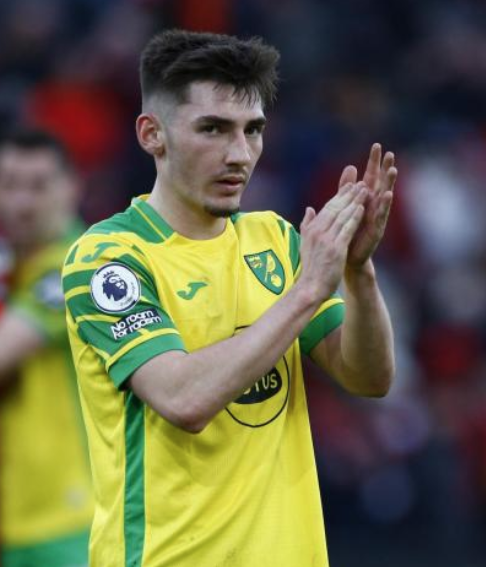
Gilmour didn’t enjoy his time at Norwich

“Things had been going so well and then I went on loan to Norwich which I thought would be good for me,” Gilmour told Men’s Health. “It turned out to be a fight, a battle. I learned a lot.”

He continued: “I was just a young kid and it was a low time for me.

“I learned how strong I was. I put a smile on my face, even though I was hurting, especially when I was living on my own in Norwich. Some nights, I’d be sitting there thinking, ‘This is c**p’, but that’s where my family helped me. You can only learn from that.”

Gilmour, when aged just 20, was named man of the match in his first full start for Scotland as they held England to a 0-0 draw at Wembley in a Euro 2020 match (played in June 2021 because of Covid).
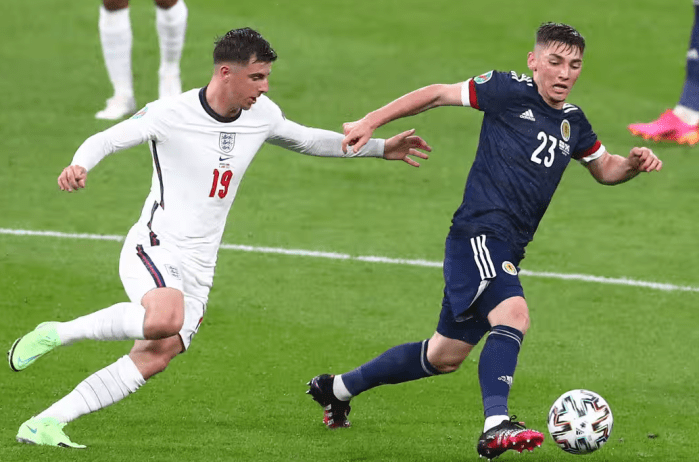
“The ease with which he has transitioned into international football implies that he possesses some very special skills,” reckoned Ewan Murray, writing in The Guardian.

“It was his big moment and he didn’t let us down,” said Scotland manager Steve Clarke. “Nobody is surprised by that. Not in our camp.”

But a word that has hung heavy around Gilmour’s neck is expectation. When the permanent move to Brighton came about, Tuchel admitted that Chelsea hadn’t wanted to let him go and would rather he had only left on loan.

He told reporters: “We had high hopes [for him] and he played for us in the first half a year when I was at Chelsea. He played some important matches for us and looked for a new challenge that did not go so well for him with Norwich.

“We expected more, he expected more so it was like, without pointing a finger, but it is difficult also for him and for us to not succeed, to not play at Norwich, to be relegated and then suddenly be a central midfielder for Chelsea and competing for top four and for every title.

“There’s a huge step in between so we were looking. The ideal solution would have been maybe that he goes again on loan as the concurrence is huge for us in central midfield and we felt like he is not the age where he can live again with five or six or seven matches during a whole season to fulfill his own potential so, ideally, it would have been another loan.

“Billy did not want to go on loan, it was a no-go for him so in the end, we agreed to a sale.”

Gilmour’s version of events differed a little, as he revealed in an interview with talkSPORT in September 2023, saying that after his season-long loan at Norwich, he was told he wasn’t part of the first-team plans at Chelsea and would have to be content with playing in the reserves.

That was despite Chelsea exercising an option to extend his contract to the end of the 2023-24 season earlier that summer.

“When I came back from my loan from Norwich, I came back and had pre-season and I just wasn’t in the plans,” Gilmour told talkSPORT host Jim White. “At that point I was thinking, well, I want to be at a club that really appreciates me and I want to be part of the team.

“I want to play first-team football. I’ve had a taste for it. I’ve played for my country, so I want to try and push on now. For me, it was the right time to leave. I spoke with the manager at the time, and he thought the same.

“I want to play football, I want to really settle down and try and find a house and home and be here and give my all.”

It remains to be seen where the young Scot’s career goes next but even though his playing time in Italy hasn’t quite lived up to expectations, the midfielder told broadcaster DAZN: “I am fit and well, I’m enjoying it.  Of course, we are doing well as a team, so we want to keep building on that.”

Why the ‘hook’ at Edgar Street was a great relief to ex-Saint Paul McDonald

Paul McD on ballIF PAUL MCDONALD hadn’t been subbed off in that infamous game away to Hereford United in 1997, Brighton might have gone out of existence.

That’s some statement to make, but it’s a thought that has crossed the diminutive wideman’s mind over the years.

It was McDonald who gave way for substitute Robbie Reinelt to enter the fray and, as the history books thankfully record, it was he who buried the equalising goal to restore Albion’s status as a Football League club and condemn Hereford to relegation instead.

Even as recently as August 2017, in a preview to the Albion’s opening Premier League game against Manchester City, the current day Kilmarnock academy director shared his thoughts with the Daily Record (pictured below).

paul mcdonald Daily Record

“The prospect of top-flight football would have been the furthest thing from anyone’s mind at full time at Hereford but I’m over the moon to see them in the position they are in now,” said McDonald.

“I’m often reminded of that game and I’m actually claiming the assist because Robbie Reinelt replaced me. I’m just glad the chance didn’t fall to me or they might well have ended up as a non-league club!

“Seriously, it was a huge day for Brighton. I’ve never been involved in a game with so much at stake.

“It is a massive club and to be in the position they were in was bad.

“If we had lost to Hereford then in an extreme circumstance they could have folded but businessman Dick Knight had come in as chairman and he may not have let that happen.”

Born in Motherwell on 20 April 1968, McDonald was spotted playing local boys club football in his home town by Hamilton Academical and he was taken on in June 1986.

Over the course of seven years, he made a total of 215 appearances for the Accies before trying his luck south of the border.

Premier League Southampton paid £75,000 for his services but he failed to make a breakthrough and managed just three substitute appearances for Saints.

During the 1995-96 season, he was loaned out to Jimmy Mullen’s third tier Burnley where he made 11 appearances in two months, his only goal coming in a 2-0 Auto Windscreens Shield win away to Peterborough.

However, one of his matches included a 3-0 win over Brighton (in which one of the Clarets’ scorers was Kurt Nogan) and, according to the excellent clarets-mad.co.uk, McDonald so impressed watching Brighton manager Jimmy Case that day that it prompted him to sign the winger the following February.

Case persuaded hard-up Albion to part with £25,000 (or £40,000 according to the matchday programme)  to take McDonald along the coast, where at last he managed to get plenty of game-time.

In two years with the Seagulls, he played more than 60 games and scored five times. The first came in a 2-1 defeat away to Exeter City; he was also on the scoresheet in a 3-0 home win over Hull City, then scored from the spot in a 3-2 home win over Fulham in the Auto Windscreens Shield three days later.

He was twice more successful from the penalty spot, one coming five minutes from the end of the game to secure an unforgettable 4-4 draw with Orient at the Goldstone, the other in a 2-0 home win over Cardiff.

At the start of the following season, with the Albion in exile at Gillingham, McDonald was on the scoresheet in a 1-1 draw with Macclesfield, the toxic atmosphere around the proceedings captured by The Independent.

As financial constraints forced Albion to let go of five senior players in December 1997, McDonald returned to Scotland with Dunfermline. He then moved onto Partick Thistle and Greenock Morton before finishing his playing career back where it started at Hamilton Academical.

McDonald stayed in the game, initially working at Hamilton as youth development manager, before becoming the SFA community coach at Kilmarnock in 2003.

In 2013, he became academy director and in October 2017, McDonald was appointed caretaker manager of Kilmarnock after Lee McCulloch stepped down as boss with the club bottom of the table.

The never forgotten miss by FA Cup Final scorer Gordon Smith

3 and smith must score“NEVER in my wildest dreams – or should that be nightmares? – did I think that, more than 20 years later, that miss in front of goal would still be getting replayed on television and mentioned in the media wherever I go.”
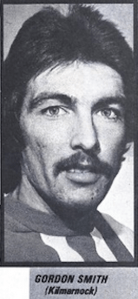
The words could only have been said by one man and they appear in the autobiography…And Smith Did Score (Black and White Publishing, 2005).

Gordon Smith’s football career included being a treble trophy winner with Glasgow giants Rangers, top scorer of the season for Manchester City, and becoming chief executive of the Scottish FA.

But it is what happened in the final seconds of extra time in the 1983 FA Cup Final that he is most remembered for.

Gordon Duffield Smith was born in Kilwinning (20 miles south of Glasgow) on 29 December 1954 and followed in his grandfather Mattha’s footsteps in becoming a pro footballer.

He was at Kilmarnock for five years, scoring 36 goals in 161 appearances, during which time he earned international honours with Scotland’s under-23 side, twice starting and three times going on as a substitute.

“It’s always a tremendous thrill to be selected in a squad for my country,” Smith said in a 1976  Shoot / Goal! magazine article. “It’s great to think Mr (Willie) Ormond considers me good enough for selection. I always do my very best for Scotland. I don’t need any further incentive other than pulling on that dark blue jersey.”

The item was highly complimentary of the player, saying: “The Kilmarnock dazzler is a player of poise and balance. He is one of the swiftest in Scotland and is certainly one of the most gifted. He has the talent to show the ball to the full-back then leave him helpless with astonishing acceleration.

“Smith can make and take goals. Some of his scores have been in the ‘unbelievable’ category. The flash down the wing, the cut-in, the race along the bye-line and then, with the ‘keeper expecting the cut-back, the explosive shot to finish the move in grandstand fashion – the ball zipping between the ‘keeper and the near post.”

In 1977, having joined Rangers for a fee of £65,000, he also collected an under-21 cap as an overage player, in a 1-0 defeat to Wales, but he was never selected for the full international side.

In his first season at Rangers, they won the domestic treble and he scored 27 goals from midfield. To cap it off he scored the winning goal in the 1978 Scottish League Cup Final against Celtic.

Alan Mullery paid £400,000 to take him to Brighton in 1980, and talked about the deal in his autobiography. “Sadly, Gordon Smith is remembered as the man who missed the last-minute chance to win the FA Cup in 1983,” said Mullers. “That’s a shame because he was one of the best players I ever worked with. He reminded me of Trevor Brooking. A midfield player with silky skills who could read the game perfectly.”

Smith played 38 games in his first season at Brighton and scored 10 goals. “I couldn’t ask for more than that,” said Mullery. But when Mullery quit the club in the summer of 1981, the rest of Smith’s time at the Goldstone could at best be described as turbulent.

He didn’t get on with Mullery’s replacement, Mike Bailey, or his assistant John Collins, mainly because of their more defensive style of play. In March 1982, the Argus reported Smith was pondering his future having been left out of the side, with Gerry Ryan and Giles Stille being selected ahead of him.

“I am just wondering what is happening now that I’m not even travelling with the team. I don’t know what my standing is at all,” he told reporter John Vinicombe.

Bailey accused some players of lacking commitment following a 4-1 reverse at Notts County, and Smith was dropped for the following game.

Smith voiced his displeasure at being made a scapegoat and told the Argus: “It seems that every time we lose, I get dropped. Then I read the manager’s remarks about lack of commitment. What other inference can I draw?

“He asked me to play defensively at Notts and I don’t think I let him or the team down. Throughout my career, I have never shown any lack of effort.”

In the 1981-82 season, Smith played 27 matches plus four as sub. He started 15 of the first 16 games of the 1982-83 season but, as Bailey and Collins tried to find the right formula, he lost his place to summer signing Neil Smillie and decided to take the opportunity to return to Rangers on loan.

He only played three matches, but one of them happened to be a League Cup Final defeat against Celtic at Hampden Park!

Almost as soon as Bailey and Collins had left, on Smith’s return to the south coast Jimmy Melia restored him to the first team, hence his subsequent involvement in the 1983 FA Cup Final.

“I had said I would never kick another ball for Brighton, but that was because I had been told there was no place for me as a regular first team player,” Smith said in the run-up to the big game.

“The change of manager altered that and obviously now I am looking forward to playing at Wembley within six months of taking part at Hampden Park. I just hope the result is different.”

Interestingly, the Express said: “The Wembley stage may just suit Smith’s style of game; he’s a studious player with a capacity to drift past people and quite capable of producing telling passes from the bye-line.”

It didn’t help Brighton’s striker options that Brian Clough had refused to allow Peter Ward’s loan from Nottingham Forest to continue until the end of the season, nor that Melia had organised a deal that saw striker Andy Ritchie swap places with Leeds United’s Terry Connor – who was already cup-tied, thus ineligible to play cup games for the Seagulls.

But, in an amazingly prescient pre-match comment, Melia said: “Gordon can be a matchwinner in his own right…he can play a very key part in this final.”

As the title of Smith’s autobiography reflects, the Scot silenced Manchester United followers the world over by opening the scoring for Brighton on that memorable May afternoon in 1983.

In only the 13th minute of the game, young midfield player Gary Howlett found Smith with a delightful chipped diagonal pass over United centre back Kevin Moran and Smith arched a header past Gary Bailey to put the Seagulls in dreamland (below, Smith celebrates the goal with Michael Robinson).

After United had taken the lead, and Gary Stevens had equalised for Brighton, the game went into extra time and the stage was set for one of the most talked about moments in the club’s history.

Interestingly, United ‘keeper Bailey believes Smith has been given a raw deal over the years.

He told the Argus: “It was not the best save I ever made and not the greatest ever seen in English football, but it was a decent one because of my reaction after I’d blocked it.

“I managed to keep my eyes open to make sure I got to the loose ball before Gordon. Often in those 50-50 situations your eyes close and the forward just taps it in but I watched and reacted quickly that time. I want to take credit for it because it came at such a vital time.

“Gordon has taken a lot of stick for what happened, and it was a crucial moment in Brighton’s history, but he shouldn’t get the blame. It is not justified at all. He didn’t score, but he didn’t miss the target.”

On the 25th anniversary of the 1983 final, Argus reporter Andy Naylor interviewed Smith at The Grand Hotel, Brighton, and asked if he ever got sick and tired of being asked about the incident.

“Not really. In life, you have to be able to get over things and deal with them,” Smith explained. “If you become famous for something you don’t do, a lot of people throw it in your face and take the mickey out of you, so you have to show a bit of character and I think I’ve done that.

“I am able to handle it and talk about it and I have no problem at all in taking full responsibility.

“I should have scored. I would love to have scored. I am sorry for the fans, my teammates, the management, everybody who suffered as a result. I suffered greatly too because I’m a perfectionist and I always wanted to be at my best. Everybody else’s disappointment can’t match my own.

“You just have to live with it. There are two choices, either hide away or come out and deal with it. I have put it into perspective. I swapped shirts with Alan Davies after the game. He got a winner’s medal and I didn’t. He’s dead now. He committed suicide. So winning didn’t change his life for the better.”

And, with the benefit of hindsight, would he have done anything differently? “I would have delayed my shot,” said Smith. “I thought Gary would come to me to shut me down. That is why I took a touch and hit it early, hard and low to his side, which meant he would never have got down to it. I scored a few goals in my time like that.

“For some strange reason, I don’t know why, Gary decided to dive. He dived the wrong way and it stuck in his legs. If I had delayed my shot for another split second, he was going down and I would have just chipped it over him.”

To personalise the situation just for a few short moments: Smith’s parents were travelling back to Sussex on the same coach as me that day, and I’ll never forget what happened. We had all gradually drifted back to our seats on the coach and there was understandably an excited hubbub of chatter mixed with the disappointment of seeing Brighton come so close and yet so far from winning the fabled trophy. As Gordon’s parents boarded the coach, an almighty silence descended. You could hear a pin drop. No-one quite knew what to say.

Of course, no-one would have known it at the time, but less than a year later, Smith was no longer with the club.

The new season back in the second tier of English football was barely a couple of months old before manager Melia was on his way, succeeded by Chris Cattlin, the former player who had been drafted in as coach by the chairman, Mike Bamber.

G Smith cover

Smith fell out with Cattlin and was ostracised for five months – ordered to train with the youth team and banned from anything to do with the first team and reserve team.

Looking back many years later, Smith told journalist Spencer Vignes: “He (Cattlin) told me one day that I wasn’t passionate about football and I just found that unacceptable…and I told him so.He just misread me totally.”

During that time, I can remember travelling by coach to Brighton’s FA Cup tie at Watford on 18 February 1984 and, as we were headed along the motorway, Smith was sitting in the front seat of a minibus of fans heading in the same direction.

Nine months earlier, he had scored – and missed – for the Seagulls at Wembley, and, here he was, reduced to a minibus passenger travelling to watch his pals because the club wouldn’t allow him to use any of their official transport.

His first team exile was suddenly lifted unexpectedly for just one more game, and he scored in a 3-0 away win at Derby County on 17 March 1984. But, within days, he was sold to then second-tier Manchester City for just £45,000.

A tad ironically for an ex-Rangers player, it was legendary Celtic captain Billy McNeill who took him to Maine Road. He made his debut in a home game against Cardiff City on 24 March 1984.

Thirty-eight of his 46 appearances for City came in the 1984-85 season, when he was top scorer with 14 goals.

Smith recalls the details of his spell at the club in the autobiography but, in short, he fell out with McNeill and made his last appearance for City on 4 November 1985, at home to Sunderland. He eventually moved to nearby Oldham Athletic, where he played nine games.

In 1987, he had the chance to play for Austrian side Admira Wacker, where he featured in 38 games, and the following season he switched to FC Basel in Switzerland, playing 25 games.

Eventually, in 1988, he returned to Scotland and finished his playing career at Stirling Albion.

Smith subsequently became an agent, representing the likes of Paul Lambert and Kenny Miller, but relinquished that work when he was appointed the chief executive of the Scottish FA, a job he held for three years. He was later director of football at Rangers during the 2011-12 season.

In June 2018, the Daily Record reported Smith’s daughter Libby had given birth to a baby boy and she’d taken on board her dad’s suggestion to call him Edson Thunder after the legendary Pele!!