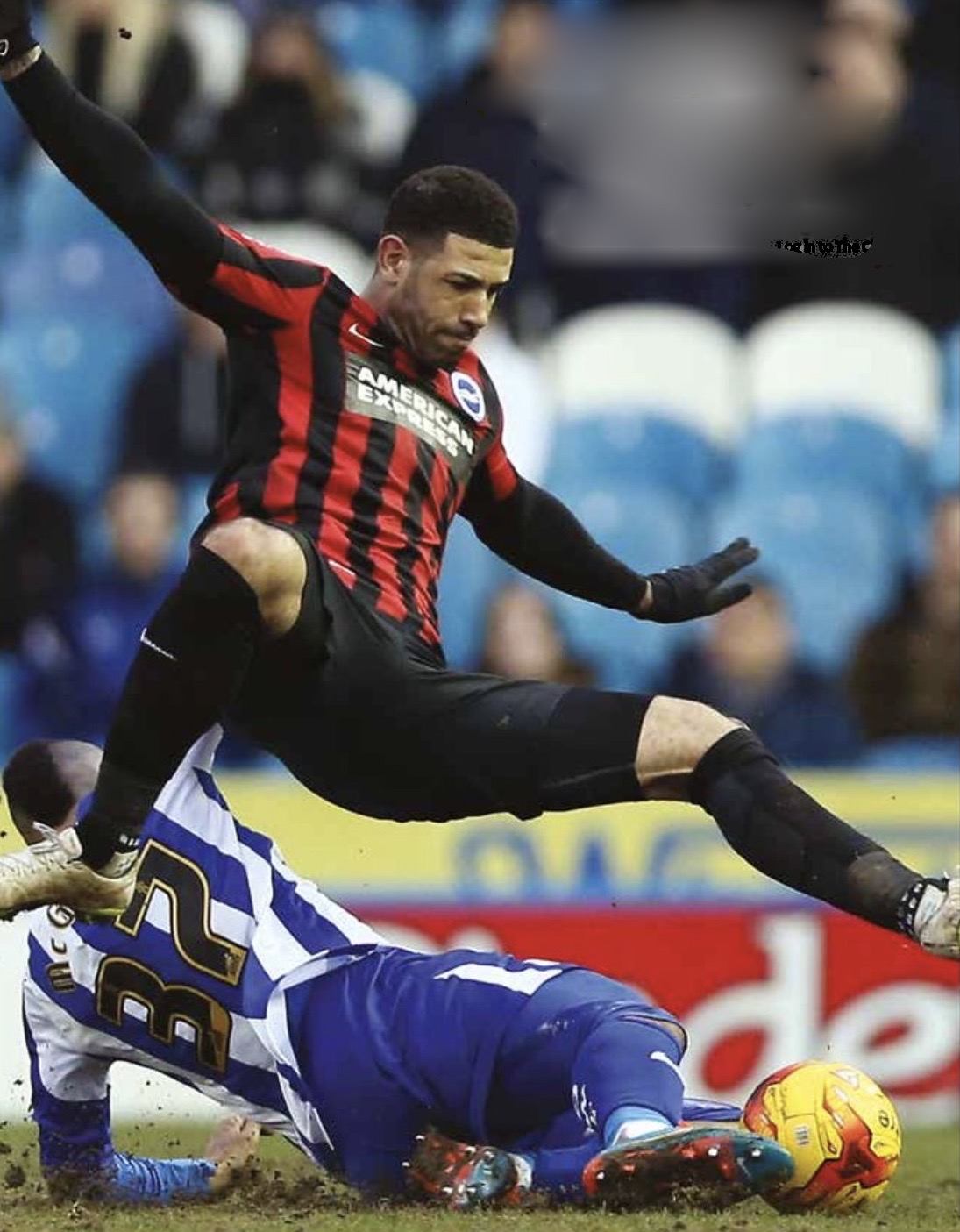
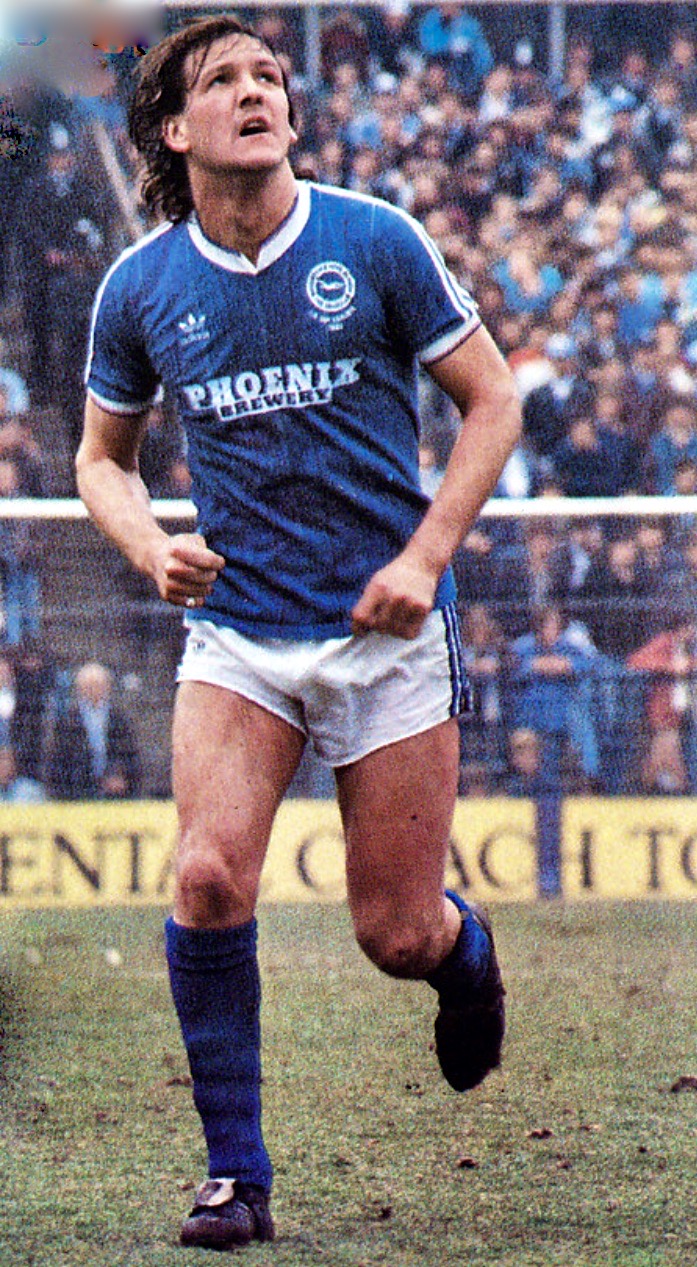
The spectre of Trelford haunted them for ages at St James’

BRIGHTON travel to Newcastle in the fifth round of the FA Cup with the backdrop of having won there twice in the competition in the 1980s – not to mention a 1-0 win in the Premier League this season.

The 1-0 third round win at St. James’ Park in January 1983 set Albion en route to that season’s FA Cup final – but Toon supporters of that era blamed the game’s unusually-named referee, Trelford Mills, from Barnsley, for their exit.

Think I’m exaggerating? Newcastle fans’ website themag.co.uk had this to say ahead of another FA Cup game between the two sides in 2013: “It is doubtful that anything could match the anger and frustration that many of us felt nearly thirty years ago.

“Wednesday 12 January 1983 will always be synonymous with the name Trelford Mills, etched into the consciousness of an entire generation of Newcastle fans, convinced he cheated us out of the FA Cup. Well, a chance of the fourth round anyway!”

Neil Smillie, goalscorer Peter Ward, Steve Gatting, Chris Ramsey and Andy Ritchie celebrate after the 1983 win.

Mills disallowed two Newcastle ‘goals’ while Albion nicked it courtesy of a penalty area pounce by Peter Ward, back at the club on loan from Nottingham Forest, on 62 minutes. They did it without captain Steve Foster who was suspended (as, of course, he would be for the final too).

The game was a third round replay four days after the sides drew 1-1 at the Goldstone Ground when Andy Ritchie’s mis-hit shot in the 56th minute put Albion ahead and Terry McDermott (below right, with Tony Grealish) equalised on 77 minutes.

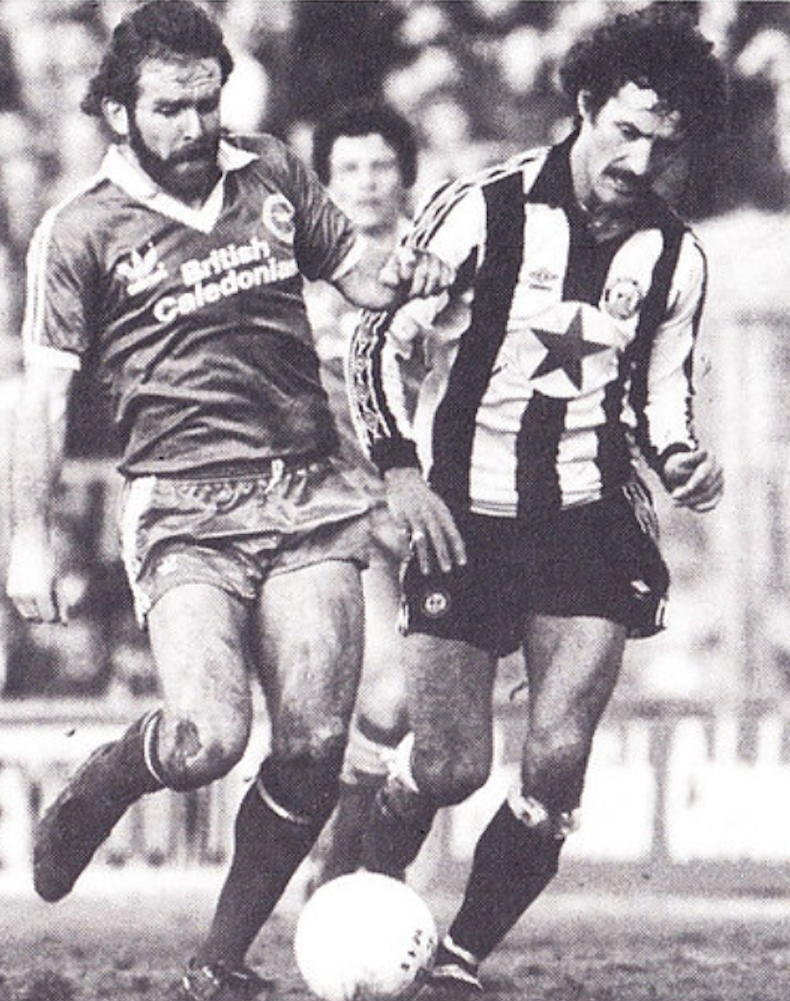
Even though the Magpies were in the old Division Two at the time, they had Kevin Keegan and Chris Waddle in their line-up, and they fully expected to win because Brighton hadn’t previously won away that season.

Albion, competing in the top division for the fourth season in a row, with joint caretaker managers Jimmy Melia and George Aitken in charge, had goalkeeper Graham Moseley to thank for some heroic stops to keep them in the first game.

The replay at St. James’s Park was in front of a typically noisy crowd of 32,687 and Newcastle did everything but score: they had shots cleared off the line and hit the woodwork and, when they thought they’d scored, Mr Mills disallowed them – twice!

In the meantime, Ward made the most of a counter attack to put the Seagulls ahead. It turned out to be the last goal he scored for the Albion, although he was in the side that pulled off a shock 2-1 win at Anfield to knock out Liverpool in the fifth round.

Enterprising reporter Tim Hodges searched out Mr Mills all those years later to hear his version of the events.

“I remember Brighton went one up, then Imre Varadi went through on goal, but quite clearly controlled the ball with his wrist,” said Mills.

“I think the Brighton keeper realised this, just as most of the players did, and let the ball go into the goal just to waste a bit of time. I just restarted with a free kick. I have spoken to Imre since. I think he accepts my version now.”

Mills continued: “Jeff Clarke managed to win a ball in the penalty area, but only because he had his arm around the defender’s neck. Keegan bundled the ball into the goal, but I had blown up a few seconds before it went in.

“Keegan did his Mick Channon cartwheel arm in front of the Gallowgate end, but I just jogged across to where I wanted the free kick taken from and indicated as to why I had disallowed the goal.”

Mills also recalled how he and his fellow officials needed a police escort away from the ground after the match. “When we sat in the dressing room after the match, I remember chatting to one of my linesmen, John Morley, when this police officer turns up,” he said. The copper said to him: “You’d better hang on here a while, Trelford. There are 2,000 Geordies outside and they all want your autograph!”

Three years later, the status of the teams had been reversed with Newcastle promoted back to the top division in 1984 and Albion back in the second tier, relegated the same year as the cup final appearance.
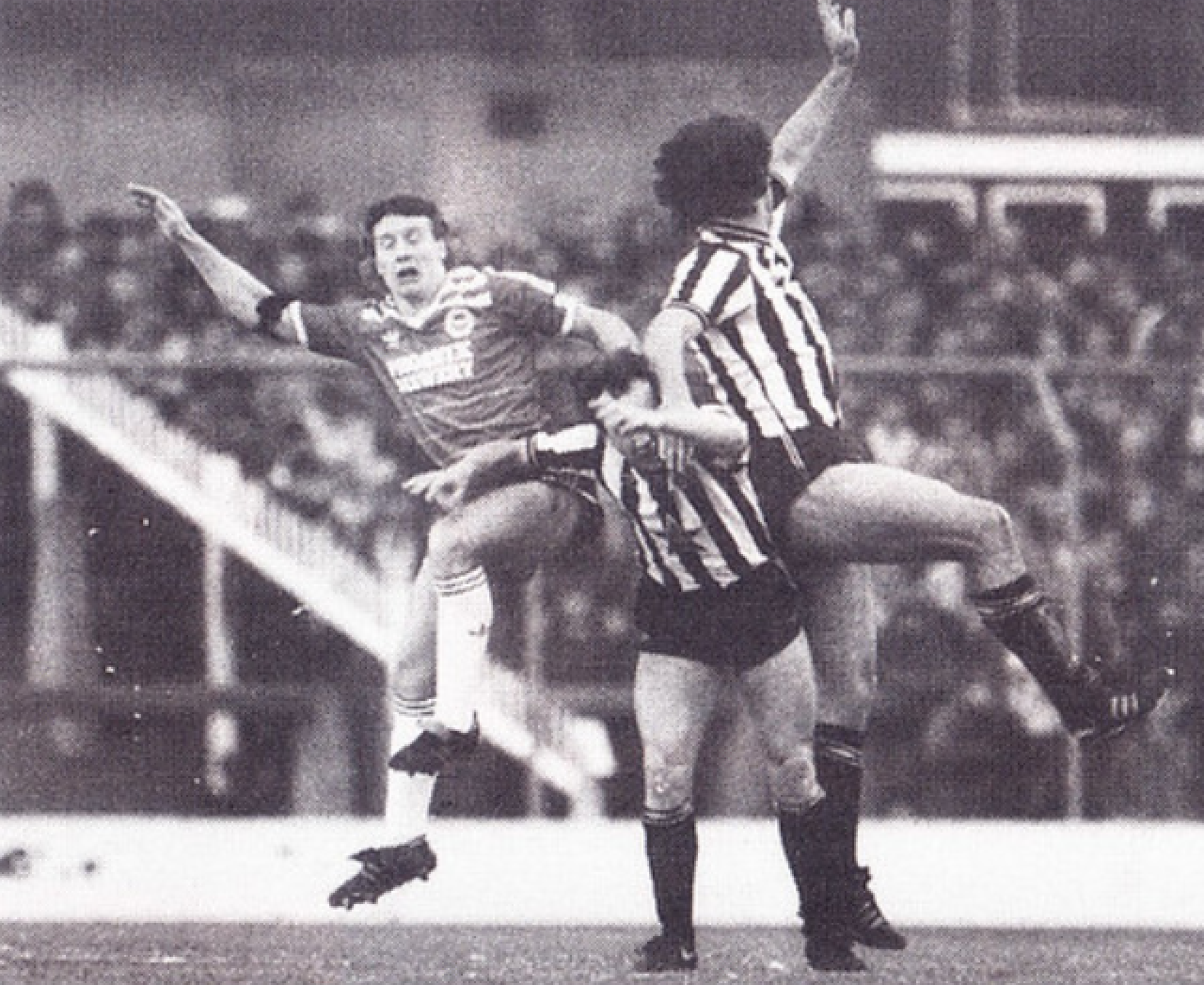
While Keegan had retired, Willie McFaul’s side had a young Paul Gascoigne in midfield and Peter Beardsley in the forward line. Clarke, who’d played four games on loan at Brighton two years earlier, was still in the centre of United’s defence and it was his foul on Terry Connor in the first minute of the game that saw Albion take a shock early lead.

Danny Wilson floated in a free kick from 30 yards out on the right which found centre back Eric Young on the far edge of the penalty box. He hooked the ball into the Newcastle net with only 50 seconds on the clock!

Albion, wearing their change strip of red, had to endure a relentless series of attacks (Toon had 23 corners to Albion’s one!) and Perry Digweed in Brighton’s goal put in a man of the match performance between the sticks, notable saves keeping out shots from John Bailey, Beardsley and Billy Whitehurst.

With five minutes left of the game, against the run of play, a quick throw-in by Graham Pearce found Dean Saunders and he rifled home an unstoppable shot past Martin Thomas for his 10th goal of the season.

Manager Chris Cattlin summed up afterwards: “It was really tough and we had a little luck on our side, but to go away to a club who have won the cup no fewer than six times and come away winners was quite an achievement.

“With the Geordie fervour up there the noise their supporters created was something special, but our efforts speak volumes for everyone connected with our club.”

There would be no fairytale ending that season, though, with Albion being dumped out of the cup 2-0 by Southampton in a quarter-final tie at the Goldstone Ground.

John Barnes and Steve Harper were on pundit duty for ESPN for the 2012 match

Younger fans will doubtless recall two more recent FA Cup meetings between Brighton and Newcastle, in consecutive seasons during Gus Poyet’s reign, at the Amex in 2012 and 2013.

The Championship Seagulls beat the Premier League Magpies on both occasions – 1-0 in the fourth round in 2012 and 2-0 in the third round the following year.
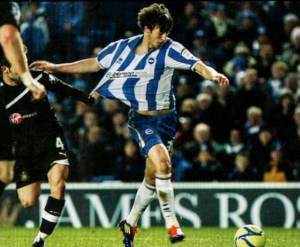
Getting to grips with Will Buckley

A Mike Williamson own goal was enough to give Albion the edge over Alan Pardew’s side in the first of those games; Will Buckley’s 76th minute shot deflecting off the defender and looping over Tim Krul for the only goal of the game. Leon Best, who would later have a torrid time at Brighton, missed two good chances for the visitors.

The 2013 fixture was a more convincing win for Brighton against a weakened Newcastle side who had Shola Ameobi sent off. Andrea Orlandi gave Albion the lead on the half-hour mark and substitute Will Hoskins added a second late on.
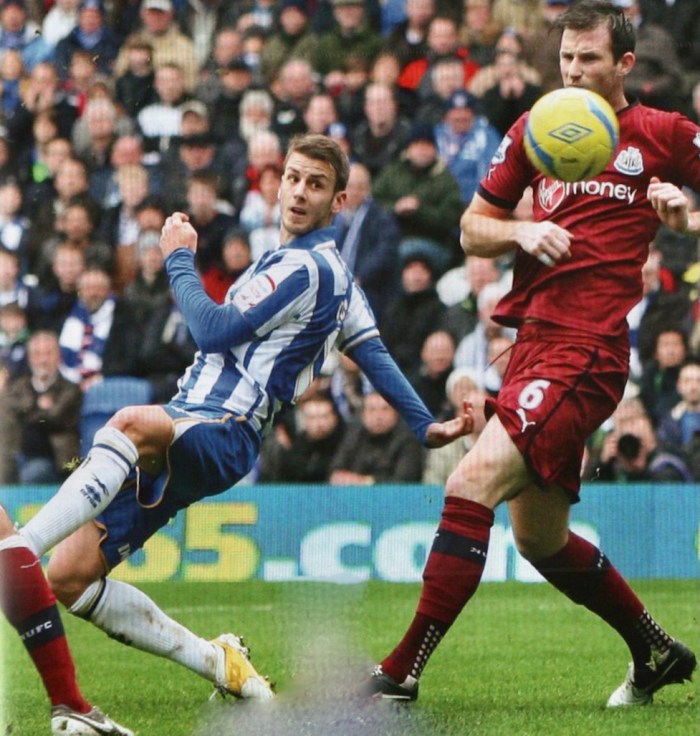
Andrea Orlandi hooks in Albion’s first goal
Praise for Liam Bridcutt

“This was an impressive victory for Brighton, a result that will add to the optimism that surrounds this upwardly mobile club and strengthen their resolve to host Newcastle in next season’s Premier League,” wrote Ben Smith, for BBC Sport. “The cool passing game of Liam Bridcutt at the heart of their midfield was tremendous.”

The reporter added: “Sharper to the ball, and swifter to make use of it, the Seagulls toyed with their more celebrated opponents for much of the opening 45 minutes, producing some stylish attacking moves while tackling, battling and dominating territory in their uncomplicated and effective way.”
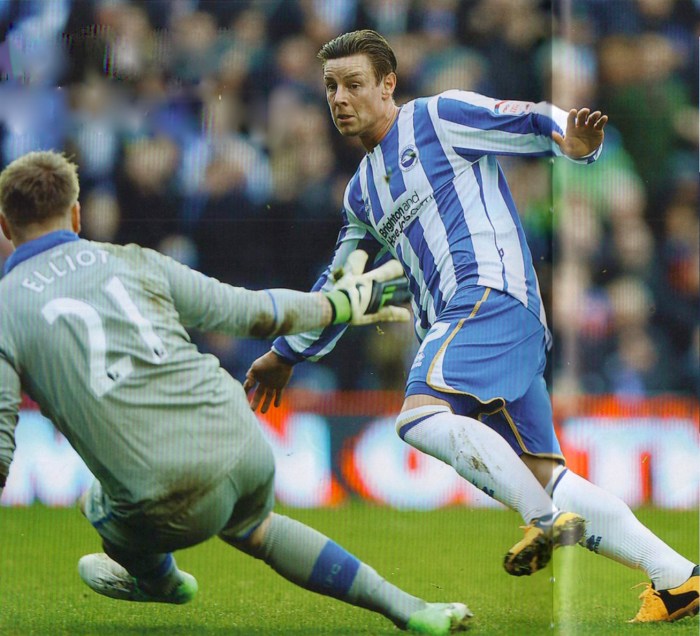
Will Hoskins buries Albion’s second goal in 2013

Class act Lallana helped lift Albion to a new level

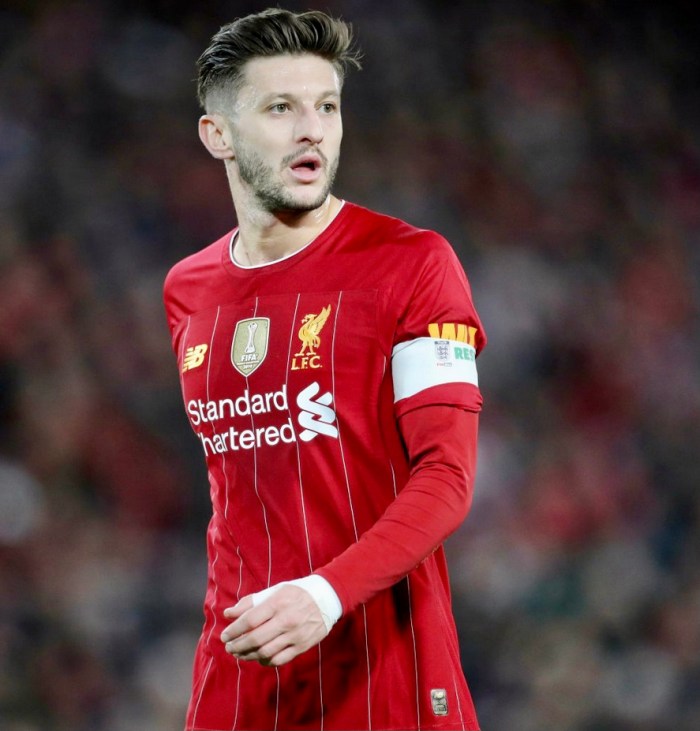
IT WAS SOMETHING of a coup when multiple trophy winner and England international Adam Lallana joined Brighton from Liverpool in 2020.

His best years might have been behind him, but Lallana’s football intelligence and astute movement were a joy to watch and were, perhaps, a sign that once-humble Albion were getting serious about challenging for the top spots in the Premier League. The club twice achieved top 10 finishes during his four years at the Amex.

As much as anything, Lallana observed in an early interview that his new side would improve with a bit more belief. “That comes with time, with the development of players and with confidence,” he explained. “The more times we play well, the more we’ll get that belief and with that we’ll score more goals and get more wins, but we need to be a little bit patient. Empires aren’t built in a day.”

One of Lallana’s trademarks, as observed in an early profile on Liverpool’s website, was “turning markers inside-out with impulsive twists or burrowing through swathes of players with fine close-control”.

The player said: “Pace isn’t a huge part of my game, but playing the percentages, mathematically, if you can add an extra yard of pace or a couple of percentage points to your game, then that’s massive nowadays.

“I still do a lot of work in the gym to improve my pace, power and strength to try to get that little bit more explosive power to my game. I’m always working to improve.”

Players used to performing at the highest level week in week out don’t suffer fools gladly and it was no surprise to learn that Lallana had a few fallings out in his early days at Brighton, for example with Neal Maupay.

Younger players certainly enjoyed the experience of learning from someone who had played at the very top, for example, Columbian international Steven Alzate, who said: “On and off the pitch he is a leader and when he’s got the ball at his feet he can really show people what he can do. Training with him is an honour; he’s a great guy.”

Those leadership qualities were drawn on by both Graham Potter and Roberto De Zerbi, even though the ageing player’s minutes on the pitch had to be managed carefully.

Lallana even stepped up to support coach Andrew Crofts with first team training in between the reigns of the two managers.

Towards the end of his time at Brighton, Lallana went off in international breaks to work with Lee Carsley preparing the England under 21s ahead of matches.

Born in St Albans on 10 May 1988, Lallana’s family moved to the Ilford area of Bournemouth when he was five and he went to the local Corpus Christi School and St Peter’s Catholic School.

If the surname doesn’t sound Anglo Saxon, that’s because he has Spanish roots: his grandad was from Madrid.

From kicking a ball around with his young pals, Lallana began to harness his footballing talent at the AFC Bournemouth centre of excellence. Southampton paid a £3,000 fee to take him into their own junior ranks when he was just 12 years old. They made subsequent payments totalling £15,000 as he progressed to scholarship and full professional levels.

Lallana was grateful for the quality of the Southampton academy set-up and in particular referenced George Prost, his under-17 coach, as someone who instilled a lot of the attributes that helped to develop his career.

Lallana was in the same Saints youth team as Theo Walcott and Leon Best (Gareth Bale was only on the bench!) that lost the 2005 FA Youth Cup final to Ipswich Town. He was also in the side that lost in the semi-final to Liverpool the following year.

The same year, he made his first team debut in a 5-2 League Cup win over Yeovil Town. Saints loaned him back to Bournemouth in 2007, when he played three games, but he returned to Southampton, then in League One, and was part of their back-to-back promotion-winning side that went from League One to the Premier League.

Having helped Southampton under captain Dean Hammond to the League One runners up spot – behind Brighton – in the 2010-11 season, he was a key member of the side that gained promotion from the Championship in second spot behind Reading (Brighton finished 10th). Over the course of eight years with Southampton, he made 235 appearances, scoring 48 goals.

In the Premier League, Lallana was made Saints captain and he admitted he struggled at first. But the arrival of Mauricio Pochettini had a positive influence on him, as he explained in a matchday programme interview. “He had a big part in moulding me into the player I am today – he took me to that next level.

“When he came to the club he could see that I had pressure on my shoulders, that I wasn’t playing freely – and we just spoke about it and he talked it out of me. By the end of the season and the next season, I was playing the best football of my life I think and a big credit goes to him for that.

“He could see I was a talented player and probably wasn’t playing to my best, but he knew it was because I wasn’t playing freely. We had lots of conversations and him knowing that and speaking to me about it was amazing because instantly it was like a balloon that just popped – immediately it took the pressures off. That was one of many things he did for me at Southampton.”

Lallana said Pochettino also helped him to become fitter and introduced him to the art of pressing. “My love of winning the ball back – that came under Mauricio.”

It was Brendan Rodgers who signed Lallana for Liverpool for £25m after the 2014 World Cup in Brazil where he had been a member of the England squad that finished bottom of its group. Lallana had made his England debut the previous November in a 2-0 friendly defeat v Chile.

In the red of Liverpool

Ten of his 34 caps for England were won in 2016 when he was voted by supporters as the country’s player of the year.  By then 28, he scored his first international goal in a last-gasp win over Slovakia in September and two months later netted again against Scotland and Spain at Wembley.

Taking instructions from England boss Gareth Southgate

“This award is a huge honour,” Lallana told The FA.com. “The last three winners were Rooney (2015), Rooney (2014) and Steven Gerrard (2012) so that just goes to show what a great achievement this is.”

By then, Rodgers had been replaced by Jurgen Klopp under whom Lallana blossomed and developed (they were also close neighbours in Formby) as together they went on to win the Premier League title and the Champions League.

In a 2022 documentary about Klopp, made by The Anfield Wrap, Lallana said: “He has the X factor doesn’t he? It’s as simple as that. The amazing ability he has to motivate players. If he’s left you out for 10, 11, 12 games you’re a bit down but somehow with him, you’ve still got so much respect for him even though you aren’t happy.

“I don’t know how he does it but he just has the ability to get you motivated because of who he is, so you’re fighting for the team and for him and that’s the art. It just shows how good he is at being a manager.”

According to thisisanfield.com: “2015-16 was arguably Lallana’s best, as he started 38 games and helped push Liverpool on to the League Cup and Europa League finals.

“One of his finest performances in red came in the Europa League semi-final against Villarreal. With Liverpool trailing 1-0 from the first leg in Spain, an emotionally charged Anfield were put at ease when an early own goal drew them level.

“From then on, Lallana was brilliant for Liverpool in an attacking line-up also featuring Roberto Firmino, Philippe Coutinho and Daniel Sturridge. The latter got the second goal after 63 minutes, but it was Lallana who sealed the game and sent the Reds through to the final, with a composed flick into the net.”

Summing up the Liverpool mindset, Lallana said in a matchday programme interview: “At Liverpool, where the expectations are so high, it was all about just dealing with those pressures.

“We had to forget about what the supporters want, the trophies that are expected, and just believe in what we as a team believed in – and that was playing high-intensity football and being motivated in every game to fight for each other.”

In another interview, this time with the Liverpool Echo, he said: “Playing six years with the intensity of that club takes over your life.”

Nonetheless, when he finally left Anfield for the Albion, he said: “I’m desperate for a new challenge and I’m desperate to play a bit more.

“I still feel like I’ve got plenty more football ahead of me and I’m thoroughly excited by this next challenge and what that will bring.”

A sign of the respect Liverpool fans still had for Lallana was demonstrated at the end of Albion’s 2-2 draw at Anfield in October 2022. As fans sang his name, Lallana tapped his chest and clapped every stand before walking down the tunnel.

Lallana helped lift Brighton to a new level

Reds supporter Aaron Cutler wrote on social media: “Pleased Lallana got a deserved (and delayed) ovation. Easy to forget how integral he was at the start of Klopp’s reign. While injuries limited his game time towards the end he clearly remained an influential presence within the squad. Could have done with him today!”

Of course, during his time with Brighton, Lallana was able to see at close quarters the emergence of Alexis Mac Allister, and he was full of praise in an interview with Graham Hunter:

“What a special player and special person,” he said. “He’s a player that is so pure with how he plays. The way he lends the football, uses others, there’s no selfishness in the way he plays.

“It was so special watching him during the World Cup, not playing to begin with then getting used and proving himself. Then playing so well that there’s no way he doesn’t play, by the end Messi is looking for him.”

Speaking of Mac Allister’s “footballing intelligence” Lallana said: “OK he’s not the quickest or strongest, but so smart. Knows that the football is faster than anyone, Alexis is of that ilk.

“He had to battle tough moments here at the beginning. He’s a very introverted, shy guy.”

With an eye to a likely future in the game as a coach, Lallana enjoyed a great relationship with De Zerbi and told BBC Radio Sussex: “I feel like we’ve helped each other an awful lot in the two years and I’m extremely grateful for how he’s managed me.

“At times I can’t train every day and my body probably lets me down, but he’s been so supportive of me and he’s managed me differently to most other players, probably because of the history I’ve had with injuries and the age I’m at. I know as a footballer that doesn’t often happen.

“Our relationship goes beyond player and coach, he’s like an older brother to me.”

When Lallana decided to leave Brighton at the end of the 2023-24 season and return to Southampton, he had made 64 starts for the Seagulls plus 40 appearances off the bench.

Albion had finished 16th and ninth under Potter then sixth and eleventh under De Zerbi.

In an extended interview with The Athletic, Lallana said: “What has happened is everything I thought was possible. I wouldn’t have said in my first interview we are going to be in Europe in three years, but that is the genius of Tony Bloom (owner-chairman) and Dan Ashworth (former technical director).”

The geography was all wrong for O’Grady’s Seagulls excursion

SHEFFIELD UNITED and Brighton once went head to head for the services of journeyman striker Chris O’Grady.

It might be said many Albion followers were somewhat disappointed that the Seagulls pipped the Blades to signing the player from Barnsley in the summer of 2014!

It wasn’t long, however, before United, then in League One, landed their man when he failed to score in 11 appearances and struggled to settle in Sussex.

On taking O’Grady on loan, United manager Nigel Clough said: “There aren’t too many strikers of Chris’s calibre around at the moment.

“We liked him last season at Barnsley and he has got good Championship experience. Chris was a target for us in the summer but Brighton came in with a deal we simply couldn’t match in terms of wages and what they could have been potentially offering him as a playing challenge.”

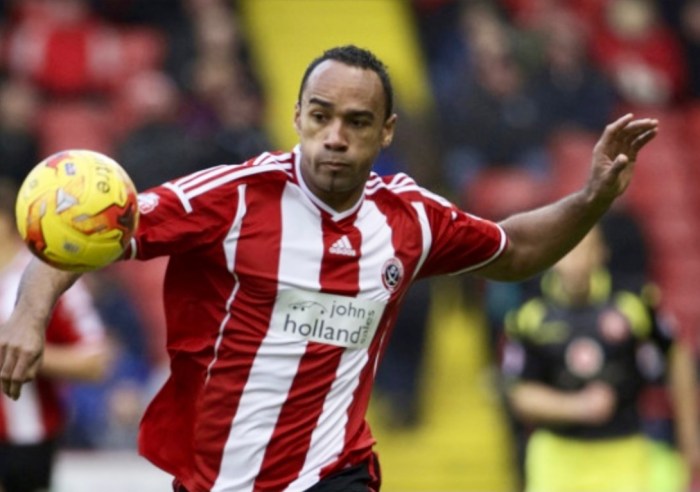
The 28-year-old impressed in four Blades starts, scoring once in a draw with Walsall at Bramall Lane, and Clough remained hopeful of eventually doing a permanent deal for the player.

But Albion head coach Sami Hyypia left the club shortly before Christmas and O’Grady was recalled to cover a mini injury crisis amongst the available forwards.

Under caretaker manager Nathan Jones, O’Grady was introduced off the bench at Fulham and set up a goal for Solly March in a 2-0 win.

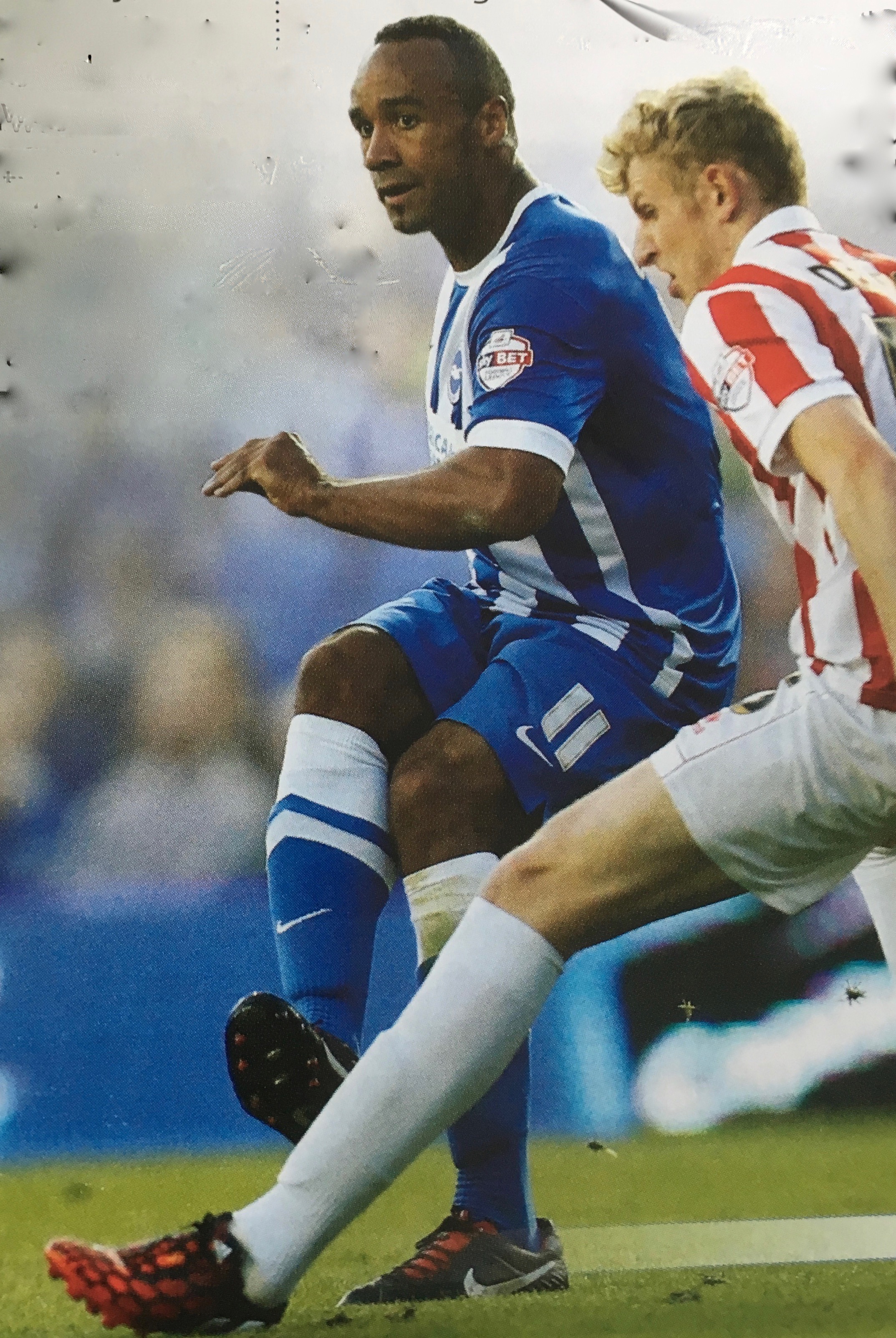
Then, in Chris Hughton’s first match in charge, a third round FA Cup tie at Brentford, O’Grady bagged his first Seagulls goal in another 2-0 win. On as a 67th minute substitute for Mackail-Smith, O’Grady hit a post, saw an effort trickle wide and then scored a decisive stoppage time second goal against the Bees to secure Albion’s passage through to the fourth round.

It was in the third minute of added on time when, put clear through by Adam Chicksen, he doubled the lead gained when Lewis Dunk headed in an 88th-minute opener at Griffin Park, thus helping Hughton’s reign get off to a winning start against Mark Warburton’s side.

After the match, O’Grady opened up about his struggles in an interview with BBC Sussex. “It’s been extremely tough,” he said. “It has tested a lot of relationships in my life. Thankfully the strongest one, my family, is still together which is the most important thing.”

O’Grady had spent all of his career playing in the Midlands, Yorkshire or the North West and said settling on the south coast with his partner and three children had proved difficult.

“We’ve been trying to settle in the area and it’s not quite happened on the pitch,” he said.

“We’ve got a home we’ve had for quite a few years back up north and we’ve been half in that and half down here as we don’t know what’s going on.

“I’ve been doing my best but it was not working out. I got a chance to go back up north and find myself and get some fitness.

“My whole career I have performed for people who believe in me. I felt I wasn’t sure why I was here.”

O’Grady was fighting an uphill battle at the Albion from the moment he was signed by head of football, David Burke. The Seagulls had banked £8m from the sale of Leonardo Ulloa to Leicester and obtaining O’Grady’s services from relegated Barnsley (he’d scored 15 goals as they went down) was seen by fans as inadequate recompense, even though the club tried to insist it wasn’t a like-for-like transaction.

Hyypia said at the time: “This is an area we want to strengthen, and Chris is a good start. He is a strong, physical presence and gives us something different to the other strikers we already have here at the club.

“You need that option in the squad of a forward with power and strength, and Chris can give us that – as well as scoring goals.

“We still want some extra attacking additions, and in other areas of the team, but I’m pleased we have another one of our targets.”

Those “extra attacking additions” turned out to be Adrian Colunga and Sam Baldock the following month and both largely put paid to O’Grady’s hopes of gaining a regular starting spot.

Not that O’Grady felt overawed by the challenge. “For the past two seasons I’ve hit double figures and that has been a reflection of the desire and hunger that I have to succeed at this level,” he said.

“Having played for Leicester City and Sheffield Wednesday in the past, I know what it’s like to play for a big club – and Brighton certainly fall into that category.

“Earlier in my career playing for those clubs might have been a bit daunting for me, but at my age I know how to deal with the expectation and to win the fans over. It’s fantastic to be joining a club with such big ambitions and to be joining in the peak years of my career.”

O’Grady started the first three games of the season, but the presence of incumbent Craig Mackail-Smith plus the late August signings of Colunga and Baldock soon indicated competition for forward places was going to get a lot tougher.

Injuries to Baldock and Mackail-Smith gave him some limited game time but Hyypia told the Argus he expected more from the bustling big man.

“He is training well, he’s doing his work and he can be a tricky player for the centre-backs because he is so strong.

“I know that he can be dangerous. Sometimes I wish he would go forward a little bit more.

“He’s not slow so he could give the centre-backs more problems if he didn’t always come to the ball.”

Nigel Clough’s Sheffield United were keen to sign O’Grady permanently

It seemed the FA Cup suited O’Grady because he also pulled a goal back for the Seagulls in the 50th minute of the glamour fourth round tie against holders Arsenal, in front of a 30,278 crowd, although they eventually lost 3-2.

Although Clough was keen to take O’Grady back to south Yorkshire, Hughton made it plain he wanted him to stay and fight for his place

“This is a player that came here and had a difficult time, went away on loan and has been excellent for us since he came back,” Hughton told the Argus. “I must admit I’m still getting to know him. I knew him from his time at Barnsley, I don’t know him as much from his time here.

“He certainly couldn’t have done any more than he has in the last two games. He is no different to any other player, you want to be playing and involved, and if you are you are generally happier. At the moment, I think he’s in a nice place.”

O’Grady admitted: “I’m just getting a chance to play. I’m taking it and doing my very best for however long I am wanted here.

“I am being professional and doing my very best. Since I’ve been back, there is a freshness and a chance to get involved and contribute. That’s all I’ve ever really wanted.”

Buoyed by the change in management, and with his family settled, O’Grady told the Argus in early February: “I’ve succeeded at all the clubs I’ve been at in the past five years, which has led me to be here.

“I started in League Two and if you do fail at any club at any time then you are only going to go down. Failure is not really an option. You have to work as hard as possible to succeed.

“Even though the first half of the season didn’t go well, it would have been too easy to give up and just write it off as ‘this one didn’t really work out’.

“That’s a lesson that if you persevere with a situation it will eventually come good if you deserve it.”

Unfortunately, Hughton thought Leon Best on loan from Blackburn Rovers might be a better option, and Baldock or Mackail-Smith invariably were ahead of him as the manager shuffled his pack in a battle to stay in the division.

It wasn’t until 10 March 2015 when O’Grady, making a rare start away to Reading, scored his first – and only – league goal for the Seagulls, netting from the penalty spot as the Albion went down 2-1.

Come the start of the 2015-16 season, Tomer Hemed and the returning Bobby Zamora made O’Grady’s future involvement a lot less likely.

His only action came in two League Cup matches, away to Southend and Walsall, and he missed a penalty as the Saddlers dumped out the Albion 2-1.

So, it was no surprise he was sent out on a season-long loan to Nottingham Forest, the club who’d let him go as a young boy. During that temporary return to Forest in 2015-16, he scored twice in 21 games.

In the last year of his Albion contract, 2016-17, he was reunited with Nigel Clough, this time at Burton Albion, (pictured in action below) where he scored once in 26 games. While he was a regular in the first half of the season, he made only five appearances after the turn of the year following the arrivals of Cauley Woodrow, Luke Varney and Marvin Sordell.

Born in Nottingham on 25 January 1986, O’Grady was at Forest from the age of 10 to 13. “I dropped out of football for a while but then got back into it at 15,” he told Albion’s matchday programme. “I wrote to the clubs local to me: Leicester and Derby. Leicester were doing open trials at the time, and I progressed through that, then on to proper trials at the training ground, and I eventually got signed up.”

A young Chris O’Grady in his Leicester days

It was during his time at Leicester that he took up yoga, inspired by the knowledge Ryan Giggs was an advocate of it. “It definitely helps,” said O’Grady. “I was a young lad in the youth team at Leicester and quite big physically but not very flexible with it.

“I was also picking up injuries at the time so I just knew I needed to do something. Once I started with the yoga all the injuries kind of went away and I’ve never really had a muscle injury since.”

After he’d got on the scoresheet regularly at under 18 and reserve level, former Albion boss Micky Adams gave him his first team chance with the Foxes.

He also won an England Youth cap in a 3-0 defeat away to France in Limoges on 13 November 2002. When he couldn’t pin down a regular place at City, he had loan stints with Notts County and Rushden and Diamonds and, although he returned to Leicester and played a handful of games in the Championship, in January 2007 he was sold to Rotherham United, where he spent 18 months.

Next up was Oldham but, in two years on their books, he had loan spells at Bury, Bradford City, Stockport County and Rochdale.

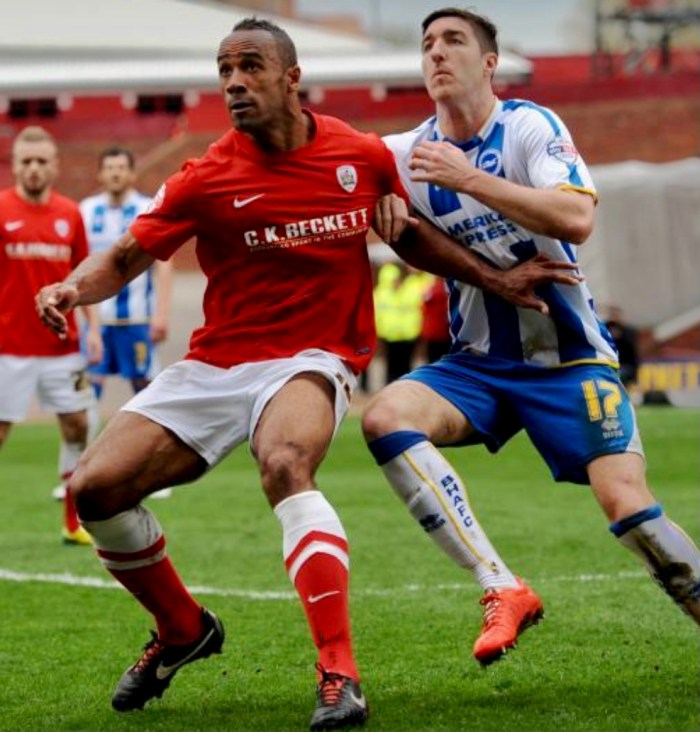
O’Grady in action for Barnsley against Albion’s Stephen Ward

His 31 goals in 95 matches for Dale earned him a move to Sheffield Wednesday on a three-year deal in the summer of 2011 but on transfer deadline day in January 2013 he made the short journey to Barnsley and then made the move permanent that summer.

At the end of his three-year Brighton deal, O’Grady moved to League Two Chesterfield for a season, but when they lost their league status he moved on in 2018-19 to his former club, Oldham Athletic, by then in League Two, where he scored eight goals in 47 matches.

The following season he moved up a division and played for League One Bolton Wanderers but their relegation to League Two brought down the curtain on O’Grady’s league playing days.

After he was released, he spent a year out of football. But in May 2022 he signed for Southern League Premier Division Central side Ilkeston Town, where he scored seven goals in 19 games. The side’s manager Martin Carruthers declared on signing him: “Chris is an excellent addition to our squad and brings with him a wealth of experience.

“He is a big, powerful unit and super fit, he will certainly be of huge benefit to our current strikers who will all be able to learn and develop from Chris this season.

“He will give us different attacking options and I’m sure will bring plenty of goals to the team.This is a real coup for the club.”

In February 2023, at the age of 37, O’Grady joined ‘The Gingerbreads’ – Northern Premier League Division One East side Grantham Town – where he played alongside former Nottingham Forest and Derby County forward Nathan Tyson. He scored just the once in eight matches, in a 3-0 win over Brighouse Town (Tyson scored the other two).

Goal-shy journeyman striker Leon Best drew derision

FOR SOMEONE purporting to be a striker, Leon Best fired blanks at a good many of the clubs he played for.

Such was his time at Brighton where he failed to get on the scoresheet in 13 games (six as a starter, seven as a substitute).

When he featured for AFC Bournemouth in the third tier, he fared slightly better. He managed three goals in 14 starts plus three as a substitute when on loan from Premier League Southampton during the 2006-07 season.

The somewhat derogatory phrase ‘journeyman’ was tailor-made for the likes of Best, who appeared for 13 different league clubs, failing to score for five of them and only registering double figure tallies at three.

Brighton supporters, on the whole, are normally supportive of anyone who appears for their team, but feelings boiled over at Best’s apparent lack of desire when pulling on the Seagulls stripes.

He was part of the struggling 2014-15 side which narrowly avoided the drop from the Championship, and I recall him being booed when he came on as a substitute at the Amex. On reflection, of course, such derision was unlikely to improve his demeanour.

The keyboard warriors of North Stand Chat weren’t slow to vent their anger, with one correspondent suggesting: “We’ve not seen much in the way of desire, endeavour, hunger or appetite from someone you would hope feels he has something to prove.”

Chris Hughton had not long been in the manager’s chair when he was casting around for players to help Albion climb away from the foot of the table.

Perhaps not unreasonably, he turned to a player who’d scored goals for him in the Premier League during his time at Newcastle United.

Hughton told the Argus: “I know Leon very well, having signed him during my time at Newcastle and I am delighted to have him here.

Screen Shot 2021-06-10 at 14.55.50“He is a strong, physical presence, he knows the Championship and knows the position we are in. We wanted new faces, to freshen up the squad, and Leon will add competition alongside our existing strikers.

“I signed him previously at Newcastle. I know he can be a very good player and he did very well for me both in the Championship and Premier League. He also had a very good spell with Newcastle after I left the club.”

Best scored 10 in 46 games for the Magpies but, at his next club, Blackburn Rovers, he managed only two in 16, hence them sending him out on loan.

While Best had scored five in 16 playing on loan at Sheffield Wednesday in 2013-14, he scored a big fat zero in 20 games for Derby County earlier in the 2014-15 season so perhaps expectations should not have been high when he arrived at Brighton on 20 January 2015.

Nevertheless, Hughton told Brian Owen: “I am very pleased he is here. He gives us another attacking option and I hope he can produce the same form he did for me when we worked together at Newcastle.” In short, he didn’t.

Born in Nottingham on 19 September 1986, his first steps into the professional game came with his local side Notts County. When international recognition came calling, he chose to represent his mother’s birth country, the Republic of Ireland, and was capped at under 17, under 19 and under 21 levels before gaining seven full caps in 2009-10.

Southampton snapped up Best in 2004 and gave him his league debut aged 18, ironically against his future employer, Newcastle.

But opportunities were limited with the Saints and over the course of three years on their books they loaned him out to QPR, Sheffield Wednesday, Bournemouth and Yeovil Town.

In 2007, Best transferred to then Championship side Coventry City for £650,000 and arguably his most successful goalscoring spell came during his time there, as he netted 23 goals in 104 appearances over three seasons.

It prompted Hughton to spend £1.5m of Mike Ashley’s money to take Best to Tyneside on 1 February 2010.

Maybe the warning bells should have been sounding in those first few months on Tyneside when he didn’t register a goal in 13 Championship appearances and fell behind Andy Carroll and Peter Lovenkrands in the pecking order.

Although he managed a couple of goals in pre-season matches, the early part of the 2010-11 season was marred by a cruciate knee ligament injury. Nevertheless, when he returned to action in the January, he did it in some style, bagging a hat-trick in a 5-0 win over West Ham. He got a further three goals before injury ruled him out once again.

3490663In the following season, he went 12 games without scoring but in the summer of 2012, Blackburn Rovers paid £3m to take him to Ewood Park – only for him to pick up an anterior cruciate knee injury one month into the season, ruling him out of action for six months.

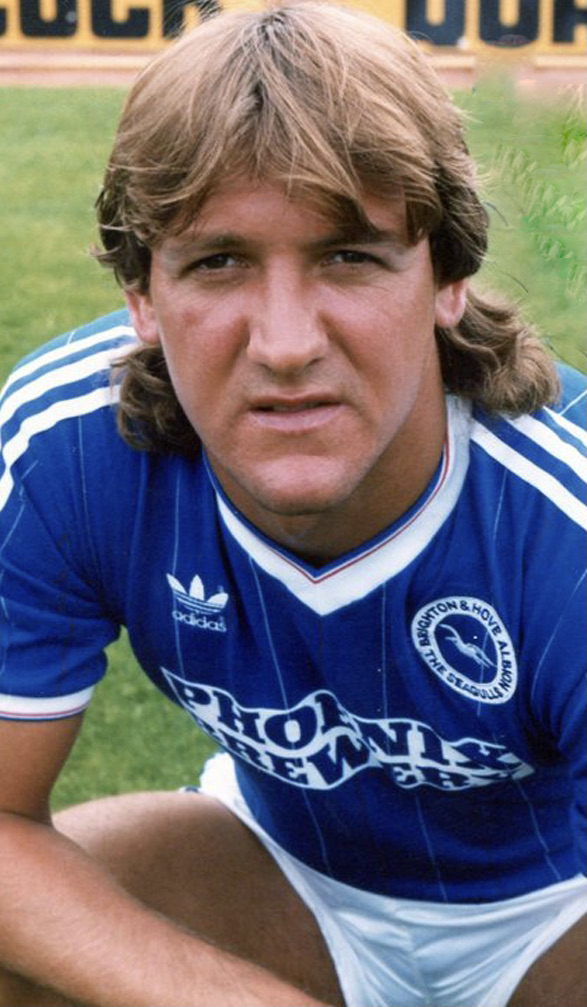
The temporary move to Brighton was one of three loans away from Blackburn before they finally released him by mutual consent in July 2015.

It wasn’t until November 2015 he managed to find another club, pitching up for six months at Championship side Rotherham United. When he couldn’t agree terms on a new deal with the Millers, he instead moved to Ipswich Town, ostensibly as a replacement for Daryl Murphy.

He made six starts and six appearances as a substitute without scoring and, by January 2017, manager Mick McCarthy had lost patience with him and declared he wouldn’t play another game for the club.

Released by Town in the summer of 2017, Best managed to secure a two-month deal with Charlton Athletic in November 2017 but he sustained a knee injury on New Year’s Day 2018 and hasn’t played since.

Twelve goals in 26 games for Scottish striker Alan Young

GARY LINEKER’S former strike partner at Leicester City had a good goals to appearances ratio for Brighton & Hove Albion.

Sadly, Scotsman Alan Young only managed 26 appearances in his one season (1983-84) with the Albion, although his 12 goals meant he finished second top goalscorer behind Terry Connor.

His brief Brighton career got off to a great start with a memorable debut goal, an overhead kick to net against Chelsea at the Goldstone. Young twice scored braces for the Seagulls but his season was injury-hit and, with manager Chris Cattlin bringing in his old pal Frank Worthington for the 1984-85 season, Young was sold to Notts County.

In more recent times, Young courted controversy as a radio pundit sharing his opinions about Leicester, and in 2014 BBC Radio Leicester dropped him from his role supporting commentator Ian Stringer.

alanyoung6 2

Back in September 2013, Young was berated online for his criticism of winger Anthony Knockaert. Foxello, on ja606.co.uk, wrote: “If there’s one thing that annoys me more than just about anything else at this football club, it is that grumpy, nasty egotist Alan Young and his never-ending agenda against certain members of the football club.”

The correspondent bemoaned: “Knocky is now the butt of every joke, and the object of every jibe Young throws out…. It’s almost as if he doesn’t want us to have skilful players who occasionally misplace a pass due to their advanced vision, and just have hoofers and cloggers like in his day.”

So let’s take a look back at ‘his day’. Born in Kirkcaldy on 26 October 1955, Young was football-daft and showed sufficient promise to earn Scottish schoolboy international honours.

His boyhood favourite team was Raith Rovers, whose star player at the time was Ian Porterfield, who famously scored the winning goal when Second Division Sunderland beat Leeds in the 1973 FA Cup Final.

Surprisingly overlooked by Scottish professional clubs, Young also experienced early disappointment in England when Nottingham Forest rejected him. “Nottingham Forert didn’t want me and I left there thinking I was no good,” he told Shoot! magazine.

Nonetheless, when he was playing as an unattached player for Scotland Schoolboys against England at Old Trafford, Oldham Athletic scout Colin McDonald, a former Burnley and England international goalkeeper, noted his promise and persuaded the young forward to head south of the border to begin his professional career.

In five years at Boundary Park he scored 30 goals in 122 games, and, to a large extent, learned his trade from old pro Andy Lochhead, a prolific goalscorer in his day for Burnley, Leicester and Aston Villa.

In the 1978-79 season, Young netted a hat-trick against Leicester which caught the eye of fellow Scot and former Rangers boss, Jock Wallace, who had taken over at Filbert Street and was building a team with his fellow countrymen at its core.

When Young joined Leicester, and played alongside his boyhood pal Martin Henderson, it began a love affair with Leicester that endures to this day.

In three years at Leicester, Young scored 26 times in 104 games, eventually forming a partnership with the emerging Lineker. TV’s favourite football frontman was generous enough to pen the foreword to Young’s 2013 autobiography, Youn9y (written in conjunction with Simon Kimber and published by the historypress.co.uk) and said of him: “He was an old-fashioned, aggressive centre forward. He possessed, though, a delicate touch and finesse that belied his big target man status – the perfect partner for a nippy little goalhanger trying to make a name for himself.”

Screenshot
Leicester strike partner for Gary Lineker

Young scored on his full debut for City in a league cup game v Rotherham and followed it up with two on his league debut at home to Watford.

The only time Young was sent off while playing for Leicester was, ironically, at the Goldstone Ground in 1981, at Easter, which was the second of four games at the end of the season that Albion won to stay in the top division.

Young was dismissed for two bookable offences, the first for clattering into goalkeeper Graham Moseley and the other a clash with Steve Foster, although, in his autobiography, he says Foster play-acted a knee injury, which the referee bought. Foster even teased him about it when he joined the Seagulls two years later. In that Easter 1981 fixture, Young’s teammate Kevin McDonald was also sent off, Brighton won 2-1 – and Leicester ended up being relegated together with Norwich and bottom-placed Crystal Palace.

Back in the old Second Division, Young did his cartilage in a game on QPR’s plastic pitch which he says was the beginning of the end of his career, because his knee was never the same afterwards (years later he had a knee replacement).

He also had the disappointment of losing to Spurs in the 1982 FA Cup semi final, although he maintains if a certain Chris Hughton had been sent off for two fouls on Lineker, it might all have been a different story.

Before the next season kicked off, Jock Wallace, the manager he idolised, decided to move back to Scotland to manage Motherwell and his successor at Filbert Street, Gordon Milne, swiftly chose to pair the emerging Alan Smith up front with Lineker, signalling the exit for Young.

Managerial upheaval was to become a familiar cause of Young’s departures in the years that followed, too. But I am getting ahead of myself.

Ian Porterfield, his footballing hero from yesteryear, had taken over as manager at Fourth Division Sheffield United and, although he didn’t really want to drop down the leagues, the Blades were a big club so Young moved to Bramall Lane.

A year later, though, after Brighton’s relegation from the elite in 1983, striker Michael Robinson was sold to Liverpool so there was a centre forward vacancy – and manager Jimmy Melia chose Young to fill it.

The fee was either £140,000 or £150,000 depending on which account you believe, but Young was happy because he pocketed a £20,000 signing on fee (four times what he had received only a year earlier when moving to Sheffield).

His first involvement with the squad was on a close-season tour of the Balearic Islands (with associated eye-opening tales recalled by thegoldstonewrap.com) but he also picked up an injury that was to dog his season on the south coast.

While Young had a lot of time for Melia, when Cattlin took over it was a different story and, in his book, there are plenty of colourful expletives used to describe exactly what he thought! He also castigates physio Mike Yaxley – “the most useless physio I have ever worked with” – although he says the team spirit was very good…seemingly fuelled by long post-training ‘sessions’ in Woody’s wine bar.

A youngHe said: “The football was very enjoyable there and never more so than when Jimmy Case and I were playing together; I loved playing with Jimmy.”

For a short time in that 1983-84 season, Albion had three Youngs in their squad, none of whom were related. Along with Young the forward, there were centre backs Eric Young and on-loan Willie Young.

When Cattlin decided to bring in his old Huddersfield teammate Worthington the following season, Young was on his way, this time to Notts County. The manager who signed him was the former Liverpool and Nottingham Forest defender Larry Lloyd, but his tenure in the managerial chair was very short so, once again, Young found himself playing for a manager who hadn’t chosen him.

In two years at Meadow Lane, Young scored 12 in 43 games for County. He moved on to Rochdale where the Leeds legend Eddie Gray was in charge, but injury took its toll and he only scored twice in 28 games in the 1986-87 season before retiring at 31. He had scored a career total of 89 goals in 349 appearances.

While there were a few non-league appearances, he eventually landed a job back at Notts County in the early days of community football schemes. He made a success of the job, obtained his coaching qualifications and eventually they combined the community scheme with the centre of excellence.

Brighton fans will be interested to know that among the young lads who emerged during Young’s time there were Will Hoskins and Leon Best. The star player, though, was Jermaine Pennant.

Young has fond memories of Neil Warnock’s time as County manager, because of his interest in the work being done at grassroots level. However, the mood changed when Sam Allardyce took over.

Allardyce initially cut Young’s salary and then showed him the door. “I can’t and I never will forgive Sam Allardyce,” he said.

Away from football, Young has had a tempestuous love life – read the book to gather the detail – and has three sons and a daughter. While he also had spells working for Chesterfield and Leeds, he dropped out of the game and then had a very dark period dominated by heavy drinking in isolation, including a time living alone in a caravan on the banks of Loch Lomond.

Eventually a return to England and his break into radio punditry brought him back from the brink.

In 2013, his autobiography Youn9y was published, the sleeve notes describing the story of “a talented, brave striker who played at the highest level of the domestic game but also experienced human misery at its lowest once his playing career was over”.

The notes add: “Youngy doesn’t just recount the good times of his playing career; he also offers valuable insight and moments of perception and understanding of some of the darkest days of his life.”

After four years as match summariser, in 2014 BBC Radio Leicester dispensed with his services and replaced him with another former Fox, Gerry Taggart.

However, Young still gives his opinions about Leicester on the community radio station Hermitage FM.

Pictures show a shot of Alan on Brighton seafront from an Albion matchday programme; the front cover of his autobiography; other matchday programme action shots, and in the Hermitage FM radio studio from Twitter.