THE NEW season opening game 26 years ago saw Darren Freeman score a hat-trick as the back-in-Brighton Seagulls hammered Mansfield Town 6-0.
For Freeman, who’d previously played under Micky Adams at Fulham and Brentford, it really couldn’t have been a better debut for his hometown club as the 1999-2000 season got under way at the Withdean Stadium.
Freeman hit the headlines again when he scored the first league goal of the millennium, crashing home a volley after only two minutes in a noon kick-off 4-2 Withdean win over Exeter City on 3 January 2000. It also earned him a magnum of champagne from league sponsor Nationwide.
Headline-maker
“It was a dream come true to play for my hometown club,” Freeman later admitted. After he’d scored that hat-trick at Withdean, he managed to pick out his dad’s face in the 5,582 crowd and fondly recalled his ‘That’s my boy!’ look of pride.
If the start of the season was spectacular, trouble was lurking round the corner with Freeman ending up suspended for seven matches – all in the first half of the season. He incurred a three-game ban after being dismissed for a stamping incident at Cheltenham and worse was to follow after he spat in Plymouth defender Jon Beswetherick’s face.
Beswetherick said: “He caught me in the face with his fist just inside the 18-yard box. I ran after him to have a word in his ear and on the way back up the pitch he just spat in my face.
“He had to go. Footballers all say that is the lowest thing you can do. It was probably in the heat of the moment, but I am sure he regrets it now.”
Not only did he receive a four-game suspension, manager Adams fined him a week’s wages and said: “He let himself down, the club down, his family down and everybody connected with Brighton. He knows that and he is full of remorse. He has been left in no doubt at all that it’s not good enough.”
Freeman was top scorer with 13 goals by the end of the season but a new goalscoring hero had begun to emerge in the shape of raw teenager Bobby Zamora!
That’s not to say Freeman’s days in the stripes were over, but his second season was dogged by injuries. Two hernia operations ruled him out from the start of September to the middle of December, then, after he had worked his way back into the starting line-up, in February 2001 he put in a transfer request after being left out of the side for a home game against Blackpool, sparking an angry reaction from Adams.
“I picked a side against Blackpool which I thought would win us the game and he wasn’t in it,” he said. “He is entitled not to agree, but there is a wrong way and a right way of knocking on my door and he chose the wrong way.
“I’ve never had one player ask to leave a club where I have been a manager. This is somebody as well who I had the utmost time and respect for, having taken him to two of my previous clubs.”
Freeman had a change of heart the following month after Adams restored him to the bench.
“I want to be a part of things,” he explained. “Obviously I’ve had a bad season with injuries and a lot of it was frustration.
“When me and Micky had a chat and I asked for a transfer we both said a few things. We didn’t have a massive fall-out. We are both adults and we have got to get on with it.”
The Argus revealed Freeman’s mentor, and former Albion forward and Northern Ireland international Gerry Armstrong played a part in the decision.
“I speak to Gerry a couple of times a week,” Freeman said. “A man of his experience can only give you good advice. I’ve had a number of conversations with him. It was my own choice to come off the transfer list, but Gerry has talked some great sense into me.”
Albion finished the season as division champions but by then Freeman was having a third hernia operation having made just six starts plus 12 appearances off the bench.
“I admit that as much as I was pleased for the lads, I felt gutted I wasn’t really part of it,” Freeman admitted. He went to Lilleshall and worked through the summer in an effort to regain fitness and earn a new contract.
But it was an uphill battle and although he struggled through pre-season and played in Albion’s opening friendly at his old club Worthing, he told the Argus: “I could hardly walk after the game. I was up all night in absolute agony.”
He was sent to see Harley Street specialist Jerry Gilmore who delivered devastating news: “There is no way you can carry on playing professional football. You are in a right mess, but hopefully we can do something to give you a better quality of life.”
A fourth hernia operation followed but not being able to resume his career hit him hard.
“The club have played an absolutely massive part in helping me through and all of my family and friends, because it has really been a rough time,” he told the Argus.
“It has been great working with him (Adams). He gave me the opportunity to experience promotions, the freedom to express my way of playing and the opportunity to fulfil my ambition.”
In a matchday programme interview several years later, Freeman told Spencer Vignes: “On reflection, I was lucky. Some people play their entire career and don’t win anything, and yet every club I played for got promoted.”
Born in Brighton on 22 August 1973, Freeman went to Varndean School, started playing football with Hollingbury Hawks and then joined Whitehawk as a teenager before playing at Isthmian League level for Worthing and Horsham.
“I came through the non-league system and was given the opportunity to fulfil my dreams,” he told Vignes. “I wasn’t the greatest player but what I can say is I gave everything for every club I played for.”
Freeman turned professional with Gillingham under Tony Pulis in August 1994, where he played alongside future Fulham and Albion teammates Richard Carpenter and Paul Watson. He recalled how it was while he was playing for the Gills against Fulham that Adams’ no.2 Alan Cork got in his ear and told him not to sign a new contract at Priestfield because Fulham wanted to sign him.
Sure enough, as Freeman admitted to Vignes: “Once I knew Fulham were interested, then I was interested. They were, and are, a massive club and it was nice that a team like that wanted me.”
Impressed by Adams’ man-management skills, he said: “He made me feel wanted and that I was a big part of his plans for the 1996-97 season. He sold Fulham to me, saying we were going to do well. And we did, because we won promotion.”
In full flow for Fulham
Fulham fans website HammyEnd.com recalled: “The £15,000 Micky Adams paid to Gillingham for the services of shaggy-haired Darren Freeman proved to be a bargain.
“The popular forward quickly became a firm favourite with the Fulham faithful on account of his ability to terrorise defenders, either out wide or through the middle as a conventional centre forward.
“Injuries robbed Freeman of the chance to make good on his undoubted talented, but he still scored nine goals as the Whites went up from Division Three in 1997.”
In an interview with fulhamfc.com, Freeman said: “Micky brought in a great bunch of lads and the togetherness was fantastic. The team morale was really, really good.
“He was quite a young manager, I think he’d actually played that season, but he’d got a great bunch of lads together and we really kicked on.
“When you consider that it was Micky’s first full season as a manager, it’s incredible what he achieved. He went about his business and did his job fantastically.”
He added: “Micky had a lot of faith in me and I feel very privileged to have achieved my goals and my ambitions from when I was a kid, and to be a part of Fulham was the icing on the cake.
“We were paid to do a job but, when I look back at it, it was a dream come true and I don’t think you realise until later on in life how important it was. Fulham, to me, the fans and the whole club, it was just a special time for me.”
As with many others at Craven Cottage, Freeman’s fortunes changed when Kevin Keegan and Ray Wilkins were installed as managers by Mohamed Al Fayed and he joined something of an exodus across London to Brentford.
Coincidentally, Freeman scored on his league debut for Brentford in a 3-0 win over Mansfield (the Stags must have loved him!) and his teammates in that 1998-99 season included Watson, Lloyd Uwusu, Warren Aspinall and Charlie Oatway. Owusu ended the season as top scorer with 25 goals (Freeman scored nine) as the Bees won the Third Division championship.
After his playing days were brought to a premature end, Freeman spent five years as manager of his first club, Whitehawk, leading them to three promotions (from the Sussex County League to the Conference South) and in 2012 to winning the Sussex Senior Cup.
He briefly managed Peacehaven and Telscombe before occupying the manager’s chair at Lewes for nearly three years.
He subsequently became a football agent, initially spending 18 months with Sports Total, one of Europe’s leading football agencies, before joining forces with his former Brentford team at Dirk Hebel Sports Consulting (Hebel named one of his sons Darren after his teammate!).
Freeman told Vignes he relishes the opportunity to pass on his knowledge of the game to current players. “They say nothing compares to playing, but I find it very rewarding. It’s the next best thing to being out there, definitely.”
RUSSELL SLADE had an eye for picking up footballing gems for nothing and he worked an unlikely miracle to spare relegation-bound Albion from the drop.
The one-time PE teacher who never played professional football himself was only Brighton manager for eight months but keeping them in League One in an end-of-season nailbiter was a much-lauded achievement.
He did it with some astute forays into the loan market and snapping up free agent Lloyd Owusu who made a crucial contribution to Albion’s injury-hit misfiring forward line.
Some years earlier, when youth team manager at Sheffield United, Slade famously picked up three young players – Phil Jagielka, Nick Montgomery and Michael Tonge – discarded by other clubs who went on to become Blades stalwarts.
At Brighton, his summer re-shaping of the squad he inherited put down the foundations on which his successor Gus Poyet was able to build a successful side capable of promotion.
In particular, Slade took great pride in bringing Andrew Crofts to the Albion on a free transfer from Gillingham, the club later selling him on to Norwich City for what was believed to be £300,000.
Slade signing Elliott Bennett, bought from Wolverhampton Wanderers for £200,000, was later sold to the Canaries for a fee believed to be £1.5million.
“The majority of my player signings went on to play crucial roles in this promotion season,” Slade asserts on his LinkedIn profile. “During my closed season I began what proved to be an extremely successful transitional period.”
If Slade had failed to keep Albion up at the end of that 2008-09 season, it is doubtful Poyet would have been drawn to the task of lifting the side through the leagues and possibly there would have been a longer wait to see Championship football at the Amex.
Slade’s tenure at the Albion may well have been longer if Tony Bloom hadn’t taken over control of the club from Dick Knight, who was chairman at the time Slade was brought in to replace Micky Adams.
Adams reckoned he was a victim of the power struggle between the two and it seems clear that Bloom wanted to install his own man once he was fully in the driving seat of the club.
Although Slade’s achievement in keeping Albion up was rewarded with a permanent two-year deal in the summer of 2009, the new season got off to a terrible start with no wins in the first six games, one of which saw Albion on the wrong end of a 7-1 thumping at Huddersfield.
Time was up for Slade after rocky start to the season
With only three wins and three draws in the next 10 games, after a 3-3 home draw against Hartlepool at the end of October, Slade was sacked with the side only out of the relegation zone on goal difference.
Bloom said: “It is not a decision we have taken lightly and one taken with a heavy heart. Russell is a good man – which made it an even harder decision to take – but it is one which has been made in the club’s best interests.
“Like all Albion fans, I am extremely grateful for Russell’s achievements at the end of last season, as he kept us in League One against the odds.”
When he reflected on his tenure in the Albion book Match of My Life, Slade explained: “Despite the club’s perilous position, I felt it was a great opportunity. I signed on a short-term deal, with the incentive to keep the club in the division.
“I inherited a huge squad but it was decimated by injuries and many of the players were loan signings or youngsters, but, in spite of that, I still thought there was enough within the squad to keep Brighton up.”
With 14 games to save the club from the drop, the first two ended in defeats but when Slade’s previous employer Yeovil Town were thumped 5-0 at the Withdean, there was cause for optimism.
A 3-2 Withdean win for Swindon, for whom Gordon Greer and Billy Paynter scored, threatened Brighton’s survival but it turned out to be the only defeat in the last seven games.
Albion memorably lifted themselves out of the relegation zone three games from the end of the season when they won 2-1 at Bristol Rovers, long-serving Gary Hart teeing up goals for Owusu and Palace loanee Calvin Andrew. Both players were also on target to earn a point in a 2-2 draw at Huddersfield.
After safety was secured in the last game of the season courtesy of barely-fit substitute Nicky Forster’s goal against Stockport, fans invaded the pitch and Slade was carried shoulder high by the Albion faithful.
“My hat got nicked and my head scratched, but it didn’t really matter,” he said. “When I finally got back to the office, I sat there with Bob Booker and Dean White and was absolutely exhausted – both emotionally and physically.”
Born in Wokingham on 10 October 1960, Slade’s route into professional football didn’t follow the traditional path.
“At 18 I had a chance to go to Notts County but I got into university so I went away to get a degree in sport instead,” he said. After completing his degree over four years at Edge Hill University in Ormskirk, Lancashire, he became a PE teacher at Frank Wheldon Comprehensive School in Nottingham (it later became Carlton Academy).
“My experiences helped me be more prepared and organised,” he explained. “I took numerous coaching courses and it allows you to be really open minded and dealing with different situations.
“I had qualifications to be a coach in swimming, athletics, badminton, basketball, cricket and tennis. It not only broadens your horizons but allows you to look at things in different ways.”
While he was qualifying as a teacher, he joined Notts County as a non-contract amateur player, appearing in their reserves and manager Neil Warnock appointed him an assistant youth coach under youth team head coach Mick Walker.
When Warnock was sacked in January 1993, County were bottom of football’s second tier (having been relegated from the top flight in the final season before the Premier League started), and Walker and Slade took charge of the first team, keeping them up with three points to spare.
The pair almost took County to the play-offs the following season, only missing out by three points, and also reached the final of the Anglo-Italian Cup, where they lost 1-0 to Brescia at Wembley.
After only one win at the start of the 1994-95 season, Walker was sacked in September and Slade took over as caretaker manager.
After managing only six wins and five draws in 23 matches, Slade reverted to assistant when ex-Everton boss Howard Kendall was appointed manager.
Kendall only lasted three months at Meadow Lane and Slade left the club at the same time but he later acknowledged how much he had learned from Kendall, Warnock and Jimmy Sirrel (an ex-Albion player who was a Notts County legend as manager and general manager).
“I’ve had a good upbringing,” he said. “The one for player management and for talking to players was Howard Kendall, without a doubt.
“He was terrific – had something about him. He had that X factor and you would listen to Howard – and when he coached you took it on board as well.”
Slade told walesonline.co.uk: “Working with Howard was massive because of his man management and his ability to give a football club direction.
“Neil was the big motivator out of all the coaches and managers I have worked with over the years.
“He took County into the top flight and his best work came at 10 minutes to three. He was exceptional, able to get every last drop of effort and energy from his team.”
Slade dropped into non-league football as manager of Southern League Midland Division Armitage but when they finished bottom of the division and then went into liquidation, Slade followed the chairman Sid Osborn to his new club, Leicester United.
That side finished 16th in the Southern League Midland Division, but they too went out of business in August 1996.
Kendall, in charge of Sheffield United, recruited Slade as youth team coach at Bramall Lane and even tried to take him with him when he returned to Everton in June 1997, but Blades demanded a compensation payment the Toffees weren’t prepared to pay.
Kendall said some while later: “I wanted Russell, who I knew from Notts County, to come and coach my kids. He was at Sheffield United at the time, and they didn’t want to lose him. He’s a talented coach who would have been a popular figure at Goodison.”
Slade remained in Sheffield and, in an interview with The Guardian in October 2013, recalled: “My best three spots were when I was at Sheffield United [in 1998].
“At the time I was doing a lot of work on released players because we needed to strengthen our youth squad and in one evening I took Phil Jagielka, Nick Montgomery and Michael Tonge – all for nothing.”
Montgomery made just short of 400 appearances for United and Tonge and Jagielka both played more than 300 games for the club. Jagielka became one of the best defenders in the top flight (at Everton) and won 40 England international caps.
“That was my best night’s work ever,” said Slade. “You don’t half get a buzz when you see those. When we played Everton in the [Capital One] Cup last season Phil gave me a signed shirt with ‘Thanks very much, Russ’ written on it.”
It was in March 1998 that Slade found himself in caretaker charge of the United first team after the departure of Nigel Spackman, overseeing a draw and a defeat, and he also stepped in for two games in November 1999 when Adrian Heath left the club, again overseeing a draw and a defeat before Warnock arrived at Bramall Lane.
It was at Scarborough where Slade landed his first full-time job as a league manager in his own right. During a three-year spell, he helped rescue the club from relegation, resigned when they went into administration but withdrew it when a fans petition urged him to stay.
A highlight was guiding the side on an excellent FA Cup run, when they memorably played Premier League Chelsea in a televised home tie. The Seadogs were only defeated 1-0 by a Chelsea side that included a young Alexis Nicolas in their line-up.
Next up for Slade was the first of two spells as manager of Grimsby Town. Supporters were calling for his head when they only managed a mid-table finish in the 2004-05 season, but an upturn the following season saw them flirt with automatic promotion and have a good run in the League Cup, beating Derby County and Tottenham.
Slade’s Mariners beat a Spurs side that included Jermaine Jenas, Michael Carrick, Robbie Keane and Jermaine Defoe 1-0. In the next round they went down 1-0 at home to a Newcastle United side managed by Graeme Souness, a goal from Alan Shearer sealing it for the visitors.
Grimsby slipped into the play-offs on the last day of the season and beat local rivals Lincoln City in the semi-finals to reach the play-off final at the Millennium Stadium.
But they missed out on promotion when Cheltenham Town edged the tie 1-0, and Slade was on his way.
He might not have reached League One with Grimsby but he was taken on by Yeovil Town on a three-year contract, declaring when appointed: “It is a fantastic opportunity for me as I think Yeovil are a very progressive club. They are going through a period of transition and I am really looking forward to the challenges that are ahead.”
Slade once again found himself a play-off final loser when the Glovers, captained by Nathan Jones, lost 2-0 to Blackpool in the 2007 League One end-of-season decider at Wembley.
It was a heartbreaking finish especially after Yeovil pulled off one of the most remarkable comebacks in the history of play-off football by coming from 2-0 down to beat Nottingham Forest 5-4 on aggregate in the semi-finals.
“Russell Slade’s side gained many plaudits for an impressive campaign in which they almost went up despite being one of the pre-season favourites for relegation,” said somersetlive.co.uk.
Small consolation for Slade was to receive the League One Manager of the Year award, but disappointment followed in 2007-08 when they won only four games in the second half of the season to leave them only four points clear of relegation.
When things didn’t improve in 2008-09, a frustrated Slade reportedly fell out with Yeovil chairman John Fry over a lack of transfer funds and he left Huish Park by mutual consent in February 2009.
The vacancy at the Albion was almost tailor-made for Slade, and chairman Dick Knight admitted he had spoken with the aforementioned former Seagull, Nathan Jones, about the managerial candidate.
“I had a long chat with Nathan and he told me some good stuff,” Knight told the Argus. “It was a very honest appraisal and I took that into account.
“When I met with Russell initially he impressed me greatly. His CV speaks for itself and his confidence and tactical shrewdness were obvious when I interviewed him.
“He has delivered at this level. He has an extremely competent track record at clubs who have punched above their weight, like Grimsby and Yeovil.
“His players like him. He will convey confidence to our squad and give them a lift.”
Stockport chief Jim Gannon had turned down the job and former England international Paul Ince didn’t even want to hold talks.
“The quality of applications was tremendous, even up to the last minute, from the top of the top league in Romania to one from Portugal which was very interesting but not appropriate at this time,” said Knight.
“By handing the mantle to Russell at this stage, the club is in good hands to address the task right now of staying in League One. We have got a very good and capable man.”
The rest, as they say, is history and, to borrow another familiar phrase, it was a case of not keeping a good man down after his departure from the Seagulls.
It wasn’t long before Barry Hearn, the sports promoter owner of Leyton Orient, was hiring Slade to try to improve the fortunes of the East London minnows.
It turned out to be a great move because Orient was where Slade had his longest ever spell as a manager, presiding over 241 matches with a 42 per cent win ratio.
Amongst the players he recruited were two who had played under him at Brighton: Andrew Whing and Dean Cox. Ex-Seagull from another era, Alex Revell, also joined and a certain Harry Kane took his first steps into competitive football on loan from Spurs on Slade’s watch.
The manager’s trademark baseball cap that he could be seen wearing at each of the clubs he served even had its own sponsor at Orient. City of London tax advisory firm Westleton Drake put their logo on the headwear.
Slade repeated the magic touch he’d shown at Brighton to keep Orient in League One and in his first full season in charge took them to seventh place, only missing out on the play-offs by one place.
Along the way was a memorable fifth round FA Cup tie with Arsenal, forcing a 1-1 draw at home before succumbing 5-0 at the Emirates.
There was certainly no questioning Slade’s commitment to the Os’ cause, as Simon Johnson, writing for the Evening Standard on 23 September 2010, observed: “His wife Lisa and four children are living more than 200 miles away in Scarborough, meaning he is all alone most evenings to worry about the side’s plight.”
Slade lived in one of the flats next to the stadium and told Johnson: “Most people get the chance to get away from the office if they have a bad day, but I wouldn’t want it any other way.
“I come back from training and work in the office for a few hours and then go to my flat. I love my job and enjoy the fact my finger is on the pulse and I’m right on top of things.”
When Sheffield United sacked manager David Weir (later to become Albion’s director of football) in October 2013, there was speculation Slade might be in the running for the job, but the out of work Nigel Clough was appointed.
The following Spring, Slade once again found himself in charge of a team in the final of the League One play-offs. Although Orient drew 2-2 with Rotherham United, they missed their last two penalties in the shoot-out to decide the winner and once again he left Wembley disappointed. His only consolation was once again being named League One Manager of the Year.
Even though the club narrowly missed out on the step up to the Championship, Slade himself made it shortly into the new season. After a change of ownership at Orient, Slade resigned and was appointed manager at Cardiff City in October 2014, succeeding Ole Gunnar Solskjaer.
History records Slade’s reign being heavily hampered by a lack of finance and being forced to cut the wage bill significantly and cancelling the contracts of several highly paid players. There was even an embargo on new signings during his second season.
The Bluebirds finished mid-table in his first season and then missed out on the play-offs the following season, losing 3-0 at Sheffield Wednesday in the penultimate game of the season to dash hopes of a top six finish.
Slade was removed from his post to be replaced by his head coach Paul Trollope (later Albion assistant manager to Chris Hughton) but was retained as Head of Football.
Slade decided it wasn’t for him and switched to a more familiar dugout job at Charlton Athletic.
Given a three-year contract by unpopular owner Roland Duchatelet, Slade lasted just 16 matches before he was sacked, although a club statement said: “The club would like to thank Russell for his tireless work during his time at The Valley, particularly the processes and disciplines he has instilled at the training ground.”
He wasn’t out of work for long, though, because Coventry City, sitting 21st in League One and enduring their worst run of results for 43 years, appointed him.
On the wrong end of a 4-1 defeat at Bristol Rovers in his opening match, on Boxing Day, he oversaw just three wins in 16 games and was sacked on 5 March.
In circumstances similar to the atmosphere at The Valley, Sky Blues fans were in dispute with the club’s owners, and the Ricoh Stadium was empty week after week.
Surprisingly, he guided the club to a Checkatrade Trophy final – Coventry later won the competition in front of more than 40,000 of their supporters at Wembley – but by then Slade had been sacked, having equalled the record for the most games (nine) without a win for a City manager before winning at the tenth attempt.
Andy Turner, writing for the Coventry Evening Telegraph, pulled no punches when he said: “Russell Slade will go down in Coventry City history as arguably the worst manager to have taken charge of the club.”
Slade’s take on it was: “It was not a good decision for me to go there, I didn’t do my homework enough before going there.”
Once again, though, Slade was back in work just over a month later when he returned to one of his former clubs, Grimsby Town.
Succeeding Marcus Bignot, Slade took charge with Grimsby 14th in League Two and they won two and drew another of their remaining five matches to stay in that position by the season’s end.
After making an encouraging enough start to the 2017-18 season, the side’s form dipped badly over the festive period, and with no wins on the board the club sank like a stone towards a relegation battle. Slade was sacked after a run of 12 games without a win, including eight defeats.
There was no swift return to management after his Grimsby departure, though, and it was another 18 months before he next took charge of a side, National League North side Hereford United, with former Albion full-back Andrew Whing as his assistant.
Not long afterwards, though, Slade started up his own business, Global Sports Data and Technology, and his tenure with the Bulls lasted only five months, club chairman Andrew Graham saying: “Unfortunately the existing business commitments of Russell Slade do not meet with the current demands of this football club.” Hereford had recorded only one win in 18 games at the time.
The ever-resilient Slade was back in the game the following month when his former player, Alex Revell, appointed manager at Stevenage, invited him to join his staff as a managerial consultant.
Revell, who played under Slade at Orient and Cardiff, said: “I have always respected Russ and it will be a great boost to be able to use his experience around the training ground and on matchdays.”
Plenty of disgruntled fans from clubs where Slade had been less than successful took to social media to mock the appointment.
Nevertheless, Revell was certainly right about experience because Slade could reflect on a managerial career that saw him serve 11 different clubs, taking charge of 865 matches, winning 314, drawing 240 and losing 311.
In his new venture, Slade champions the cause of the way performance data information is handled, as described in a BBC news item in October 2021.
It focuses on companies who take data and process it without consent. “It’s making football – and all sports – aware of the implications and what needs to change,” he said.
NICKY FORSTER played for and managed Brentford as well as captaining Brighton and scoring a vital relegation-saving goal into the bargain.
The Surrey-born striker, who played alongside David Beckham for England under-21s, scored more than 200 goals in 700 games and it always seemed a shame that his time with the Seagulls didn’t come sooner in his career.
He built a reputation for finding the back of the net at first club Gillingham and was prolific in his first spell with the Bees but he viewed his six years leading the line for Reading as his most successful time in the game.
Forster plundered 67 goals in 179 games (plus 35 as a sub) in six years with the Royals, mostly playing under Alan Pardew and Steve Coppell, but he left for pastures new before they reached the Premier League.
A free transfer took him to Ipswich Town, where Joe Royle’s side were competing in the Championship, and, although Forster top-scored for the Tractor Boys, his total of seven typified a rather lacklustre campaign. One of those goals came against Brighton on Easter Saturday when the relegation-bound Seagulls pulled off a shock 2-1 win courtesy of goals from on-loan Gifton Noel-Williams and young Joel Lynch.
Forster scored in each of the three remaining games that season but they were his last for Town because he moved to link up with his former Reading teammate, Phil Parkinson, at Hull City, who paid £250,000 for the striker’s services. Forster scored six times for City as the side battled to retain their tier two status. Albion tried to sign Forster in January, but Parkinson’s successor Phil Brown wanted to keep him, and they rejected Albion’s £100,000 bid.
Albion finally got their man for £25,000 less in the summer that year, and, in a side largely made up of promising youngsters, in Forster they gained more than just an experienced striker.
Brighton fans were given an idea of what to expect from the new signing when his former Reading teammate Bas Savage told the Argus: “I played a few games with him in the first team and he will definitely bring goals. He is proven wherever he has been.
“He is also a very intelligent player. He makes good runs, works hard, has got very good pace and he can finish, so he will be an asset to Brighton, especially in League One. I think he will really shine.
“He will fit in easily to the dressing room as well. He was a joker at Reading, very funny and a good, bubbly character to have around.”
Savage added: “He was one of the top strikers at Reading and I learnt off all of them.
“I was a young boy at the time and, whoever it is that plays, Alex Revell, Nathan (Elder), Gatts (Joe Gatting), I can see them working well with Fozzy.
“It will be good to link up with him again and hopefully show our stuff together. I know Fozzy’s strengths and I will be looking to help him along in the same way that he can help me along. He brings experience to the team.”
Emerging defender Tommy Elphick was certainly appreciative of the new arrival. “Apart from in games, he brings a competitive edge to training,” he said. “In my eyes he is a bit of a legend really, the model pro on and off the pitch.”
When interviewed by Mike Ward for the matchday programme later that season, Forster declared: “I really am enjoying it here at Brighton. I like being on the training ground and I enjoy playing.
“I am now getting old in football terms, but I have got as much enthusiasm and energy for the game now as I had when I started. I feel that I am a better player now and I am enjoying my football as much as ever.”
Sure enough, with 19 goals in 48 appearances in the 2007-08 season, there was no question Forster proved a great addition to Dean Wilkins’ squad, and he took over as captain when Dean Hammond left the club under a cloud.
In the second half of the season, after Glenn Murray was signed from Rochdale for £300,000, manager Wilkins declared to the Argus: “I think we have got one of the best strike pairs in the division, one of the most threatening.
“When we have got possession and play with a bit of quality they are a really potent pair. If you have got a pair that score 20 goals a season you would expect to be quite successful.”
Unfortunately, seventh place in League One (seven points off the play-off places) was not quite successful enough for chairman Dick Knight, who turned to former boss Micky Adams to steer Albion’s fortunes in the 2008-09 season (a furious Wilkins declining the offer of continuing as first team coach).
While Forster got off to a great start under Adams, scoring a last-minute goal to seal a 2-1 win for the Seagulls in the season-opener at Crewe Alexandra, the Albion’s fortunes gradually unravelled as Adams chopped and changed the side with what, on reflection, were too many loan signings.
For a while, things didn’t look too clever after Russell Slade had been parachuted in to try to stave off the threat of relegation.
At a time when the new boss could really have done with Forster and Murray firing on all cylinders, both were sidelined with injuries. Forster missed eight matches with what was thought might be an anterior cruciate ligament injury in his knee.
Thankfully another former Brentford striker, Lloyd Owusu, stepped into the breach to score some vital goals, together with loan signing Calvin Andrew and the rejuvenated Gary Hart.
Nevertheless, going into the last game of the season, at home to Stockport County at Withdean, Albion still needed to win to avoid the relegation trapdoor.
When Hart left the action early and his replacement Andrew had to be withdrawn at half-time with what turned out to be a bad ACL injury, Slade had no option but to turn to the by-no-means-fit Forster to enter the fray from the bench for a crucial second half.
Fortunately, after County ‘keeper Conrad Logan could only parry a shot from Gary Dicker, Forster was on hand to stab in the only goal of the game from six yards, sparking massive celebrations.
Forster later conceded in an Argus interview: “It wasn’t quite right but I got through the game and the goal was a gift. I didn’t have to be particularly mobile to score it.
“I dosed up on tablets and rehabbed and was really determined to be involved in that game. Thankfully it worked out for me and for Brighton. But I wasn’t 100 per cent. I still had that niggling feeling.”
In a subsequent exploratory operation, it turned out that torn cartilage had been Forster’s problem and he underwent surgery during the close season, somewhat ironically the procedure being delayed a little while because the surgeon involved was operating on Andrew!
“When they took me down to the anaesthetist’s room, there was a guy in there before me,” said Forster. “I had to wait ten or 15 minutes and they said it was an ACL reconstruction going on. I didn’t realise it was Calvin.”
Tony Bloom took over from Dick Knight as Albion chairman that summer and, when the new season got under way, Slade had decided to give the captain’s armband to defender Adam Virgo (Forster remained club captain).
The opening part of the season went horribly wrong and, with only three wins in their first 15 matches, Slade was replaced by effervescent Uruguayan Gus Poyet.
By the end of January, Forster had scored 15 times in 27 matches (plus three as sub), but the beginning of the end of his time with the Albion was nigh when a contractual dispute went public.
The player, by then 36, wanted to know whether he was going to be offered a contract the following season, but that commitment wasn’t forthcoming. Forster aired his dissatisfaction in the media and Poyet left him out of the side.
Forster subsequently clarified his position in a statement on the club website, saying: “I have thoroughly enjoyed my playing years with Brighton and genuinely hoped – and still do – that I would remain at Brighton until the end of my playing days, hopefully with the opportunity to take up a training role.
“The decision to delay the offering of contracts makes life very difficult, particularly for players of my age. I have always been totally committed to Brighton and will continue to be so.”
While the air was cleared, and he was restored to the line-up for a 1-1 draw away to Leeds, that turned out to be his last start for the Albion. Only a matter of weeks later he was sent out on loan to Charlton Athletic until the end of the season, once again linking up with former teammate Parkinson.
Nevertheless, his 51 goals across two and a half seasons at the club were the best measure of his contribution and he was later a more than interested onlooker of Brighton’s fortunes when his stepson, Jake Forster-Caskey forced his way into Poyet’s Championship side.
Born in Caterham, Surrey, on 8 September 1973, Forster was comparatively late into the game, staying on at school to take A-levels.
But he had a lucky break when he played for non-league Horley Town against Gillingham in a friendly. “It was a real right-place-at-the-right-time scenario,” he told Ward in another Albion matchday programme interview.
Gillingham offered him the chance to become a professional and after impressive displays for their youth and reserve sides, he duly signed professional terms in May 1992 when Damien Richardson was in the manager’s chair.
The Gills sent him out on loan to Southern League Margate and Hythe Town. Forster’s career stats are comprehensively recorded by the Margate history website, even though he only played one game for them, when he scored with a clever lob after three minutes of his debut.
Back with the Gills, Forster made his first team debut in September 1992, going on as sub in a 4-1 home win over Wrexham. He went on to establish himself in the side under former Charlton striker Mike Flanagan in the 1993-94 season, top scoring with 18 goals. It was an achievement which prompted Brentford to pay a fee of £320,000 to take him to Griffin Park in June 1994.
The 1994-95 season is firmly etched in the annals of Brentford’s history because David Webb’s side were denied promotion to the elite when a one-off organisational blip meant the fledgling Premier League only took one promoted side from the division below – and the Bees finished second!
Forster had proved a major hit at his new club alongside strike partner Robert Taylor, with the pair netting 47 goals between them (Forster got 26 of them). But automatic promotion was denied when Brentford “choked” in the last month of the season and their agony was compounded when they lost on penalties to Neil Warnock’s Huddersfield in the play-off semi-finals.
For Forster personally, however, his goalscoring prowess brought him to the attention of the international selectors and in June 1995 he earned four England under 21 caps at the Toulon tournament in France, making his debut in a 2-0 defeat against Brazil in a team featuring future full internationals Beckham and Phil Neville.
Forster scored England’s only goal in his third match for Ray Harford’s side, as they beat Angola. He also played in the 2-0 win over Malaysia and in the semi-final against France, when they lost 2-0.
The Bees failed to follow up their near miss the following season, finishing 15th and, although at one point there was talk of Crystal Palace preparing a £2m bid for Forster’s services, it came to nothing. The striker damaged knee ligaments in October 1995 and managed to find the net just the eight times by the season’s end.
It promised to be a different story in 1996-97, though. With Carl Asaba and Marcus Bent supplementing the Forster and Taylor strikeforce, Brentford got off to a flyer and topped what is now the Championship courtesy of an 11-match unbeaten run at the start of the season.
However, the bcfctalk blog was incredulous at what happened next. “We were coasting at the top of the league when the quite staggering decision was taken in January to sell Nicky Forster to arch-nemesis Birmingham City for a mere £700,000.
“He was never replaced, the prolific Carl Asaba was mysteriously shifted out wide to the left wing and the remaining 17 league matches produced a mere 18 points. We failed to score in ten of our last fourteen games and won only once at home after Christmas.”
Forster’s desire to progress his career didn’t play out well with the supporters of Brentford or Gillingham.
“I get booed every time I go there,” he told Brighton’s matchday programme. “It’s sad because I feel I did well for both clubs. And what they paid for me wasn’t a huge amount, so value-for-money wise I feel I did very well for them. It’s not something I worry greatly about, but I do think it’s time they learnt to forgive and forget.
“I don’t think they can really begrudge a player wanting to move on and better himself, better his career. Sometime fans can be a bit fickle!”
While Forster hoped to establish himself at Birmingham, he struggled to get a starting berth in a side managed by former Blues playing legend Trevor Francis. Paul Furlong and Peter Ndlovu were preferred up front, and later Dele Adebola. Forster invariably had to be content with involvement of the bench. Indeed, 46 of his 75 Blues appearances were as a substitute and, when he left for Reading in June 1999, he’d got just 12 goals to his name.
That all changed once he’d made the switch to the Madejski Stadium. The goals flowed (in 2002-03 there were two hat-tricks included in his season’s tally of 17) and in his six seasons with the Royals he notched 67 goals in 214 appearances (35 of which were as a sub).
His form tailed off in his final season with Reading and he began to look elsewhere because he wanted a longer contract than the club were prepared to offer.
Nevertheless, he respected manager Coppell and, when later in his career he took over as boss at Brentford, he said: “I was with Steve Coppell at Reading and I like his manner and demeanour. He is not a ranter and raver. I just like the way he goes about his business.
“He is quite a subdued guy when he speaks, but he speaks a lot of sense. When he talked to me, whether I liked it or not, I couldn’t really argue because it made a lot of sense.”
When Forster returned to Griffin Park as a player at the start of the 2010-11 season, he reflected: “The club holds many happy memories for me. Both the club and I have moved on over the years but I still have the hunger and the mobility to give a good account of myself.”
Manager Andy Scott added: “His goalscoring is a major attraction as that is an area where we have struggled to compete with other teams.
“His ambitions match those of the management team. He is a very dedicated footballer who will add experience, competition and, more importantly, goals to the team.”
Sadly, it didn’t pan out well with Forster only making 12 starts and scoring once. After a topsy turvy six months, Scott and his assistant Terry Bullivant were dismissed and Forster took over as caretaker boss, assisted by Mark Warburton.
When the Bees collected 14 points from six games, the temporary stint was extended until the end of the season.
Remarkably during his brief tenure, Forster took charge of Brentford at Wembley for the final of the Johnstone’s Paint Trophy, which they lost 1-0 to Carlisle United.
Brentford centre back Leon Legge said later: “Growing up, Wembley was always a sacred ground that not many people get to play at. I wanted to win so bad but it was just a shame we came second-best, especially against Carlisle, who we’d played just over a week earlier and beaten 2-1. Everything went for them that day.
“I know the gaffer at the time [Nicky Forster] made a few changes and I don’t think many agreed with it – for example, Marcus Bean didn’t play when he’d been such a good player leading up to that game. I think that made a difference.
“I still remember looking at the crowd of 40,000 and to play in such a sacred ground in front of that many fans, whether we won or lost, it was a good experience.”
Despite leading Brentford to a mid-table finish, Forster was told he was not in the running for the job on a permanent basis, and Uwe Rösler was appointed instead.
Nonetheless, Forster decided management was his next step and announced an end to his playing days.
“I have had a fantastic career, but the time has come to cross over into management,” he said.
“I’ve scored 200 goals in 700 games and haven’t got anything left to achieve as a player, so I want to concentrate on management.”
The eloquent Forster popped up on Sky Sports, covering Football League matches, and also brought his boots back out to play for Sussex County League side Lingfield.
Then, in September 2011, Forster was appointed player-manager of Blue Square Bet South clubDover Athletic, whose chairman Jim Parmenter said: “Nicky has had an impressive playing career at some big clubs and did very well during his time as manager at Brentford.
“As well as having both UEFA ‘A’ and ‘B’ licences, he is also a great man manager and motivator. Nicky is totally enthused by the prospect of managing the club and we look forward to a very successful future.”
Among his signings were former Brighton teammates Steven Thomson and young goalkeeper Mitch Walker.
Forster said: “I am delighted get Thommo down here at Crabble, especially as his signature was being chased by a number of other clubs both in our league and above. He is an experienced professional who is still hungry for success.”
Sadly, after a run of five successive defeats, his time in charge at Dover was brought to an end in January 2013 when he was replaced by the club’s former manager Chris Kinnear.
Two years later, Forster gave management another go taking charge of Conference South side Staines Town. But he quit after a year, telling getsurrey.co.uk: “I enjoyed every moment even though we had some low times, but it’s a learning experience and I left on good terms with the chairman and the fans who were great to me.”
In September 2016, Forster set up his own gym – The Spot Wellness Centre – in Godstone. As well as running that, he is now self employed and, on LinkedIn, describes himself as a goal setting coach and keynote speaker.
• Pictures from the Argus, Albion’s matchday programme and online sources.
JOURNEYMAN striker Calvin Andrew is unlikely to forget his eventful months playing for the Seagulls on loan from Crystal Palace.
The Luton-born forward got off to a great start in January 2009 when he scored a 90th-minute winner on his debut for the Seagulls.
In only his fourth game, he damaged a hamstring against his hometown club – a match that turned out to be the last for the manager who’d brought him in on loan.
While Andrew was back at Selhurst Park recovering from the injury, a new boss – but familiar face – took charge at the Withdean.
Andrew rejoined the Seagulls but couldn’t force his way into the starting line-up because Lloyd Uwusu had arrived to take centre stage. However, the loanee scored two vital goals in Albion’s ‘Great Escape’ when going on as a substitute.
To cap it all, in the nail-biting last game of the season, when Brighton just preserved their League One status with a 1-0 win over Stockport County, Andrew suffered a horrific injury which sidelined him for six months.
Andrew, who had lost his place at Palace after picking up an injury at the start of the season, had joined the Seagulls as part of a major January transfer window overhaul Micky Adams oversaw in an attempt to revive the club’s flagging League One fortunes.
When he signed, Adams said: “Calvin is a young centre-forward and will complement our existing forwards by giving us an added physical presence up front.
“He is over six-foot tall and the type of striker who makes things happen and can be a real handful for opposing defenders.”
The player himself, who had only joined Palace the previous summer for a £30,000 fee, said: “I went there and at the start of the season I was playing games and I was doing well. But then the situation changed. I got injured and since then I haven’t been able to get back in the team.
“The team has been doing really well and it’s totally understandable from my point of view. Neil Warnock still rates me highly, but he wants me to go out and get some games and get myself ready for when my chance does come.
“It was quite an easy decision. There were a few clubs in for me, but Brighton is relatively close to where I’m living so it was an easy choice. It’s a good club.
“I didn’t know any of the players, but I knew the manager. He’s a great manager and I’m looking forward to playing for him. Everybody knows about Nicky Forster. He’s an experienced player and there’s always something to learn as well as forming a good partnership.”
With Forster scoring Albion’s first against Hartlepool United at the Withdean on 31 January 2009, the script looked like it had been perfectly written when Andrew netted a winner in the last minute to seal a 2-1 victory.
Unfortunately, successive home defeats – 4-2 to Peterborough United and 2-0 to Carlisle United – in five days followed by elimination from the Johnstone’s Paint Trophy at Luton the following week was too much for Adams to stomach and he decided to quit after meeting chairman Dick Knight the day before the next match, which ironically saw Albion win 1-0 at Millwall.
Andrew wasn’t involved because he’d picked up a hamstring injury at Kenilworth Road, a ground where he’d made a first team debut as a 17-year-old in the 2004-05 season. Born in Luton on 19 December 1986, Andrew was a prolific goalscorer as a youth player at his hometown club.
When he was sent out on loan to gain experience at League Two Grimsby Town in 2005, he played nine matches under manager Russell Slade.
And it was Slade who was parachuted in at the Withdean to try to steer Albion away from the League One relegation trapdoor in the Spring of 2009.
Even though Albion picked up only four points from Slade’s first seven games in charge, the former Yeovil boss slowly turned things around with four wins in the next five games to lift the Seagulls out of the bottom four.
Andrew spoke about the change in fortunes in an Argus interview. He told reporter Steve Hollis: “We have shown different qualities which I don’t think we had when I was at the club before my injury. There is some real resilience now.
“I know Russell Slade quite well and he asks all of his teams to show some grit when the going gets tough. He demands you stick in there when you are struggling and to keep going.”
Andrew was buoyant having headed the winner from Gary Hart’s cross in the 52nd minute at Bristol Rovers after leaving the bench before half-time to replace the injured Dean Cox.
“That was a big goal,” he said. “It was important for me because I am coming back from injury but it was more important for the club and the town.
“I usually hang around the back post when I am playing on the left but Dean White told me to get into attacking positions and it was a cross you dream about from Hart.”
He told Hollis: “When I initially had the injury, my fear was that I wouldn’t play again this season. I had a very bad tear in two places in the hamstring and was told it would take a very long time to repair.
“Fortunately, I seem to recover pretty quickly, and I am glad because I want to play a part in helping Albion stay up. It means a lot for me that Brighton stay up, even though I am only on loan.
“I have been made to not only feel part of the team but part of the town and it would be awful to go down.
“The supporters have been great and welcomed me even though I am from a rival team, so it is my duty to give 110 per cent. Just because I am on loan doesn’t make any difference.”
Andrew had to contend himself with another appearance from the bench in the following match but, again, he made a positive impact after replacing Hart, who limped off injured after only nine minutes of the game at Huddersfield.
The young striker levelled up the game after Town had taken the lead and Owusu continued his purple patch of form by netting a second equaliser to give Albion a share of the spoils.
Palace boss Warnock had been contemplating recalling Andrew but was told he would start in Albion’s crunch final home game against Stockport County. In fact, Slade once again opted to use Gary Hart in the starting line-up instead but Andrew was sent on in injured Hart’s place after only 17 minutes and went close to breaking the deadlock with a header that hit the top of the bar.
Forster, who had also been troubled by injury throughout the season, had to replace Andrew for the second half because he picked up an anterior cruciate knee ligament injury which ultimately prevented him playing for six months.
It wasn’t until October 2009 that Andrew got back playing for Palace reserves, and their assistant manager, Mick Jones told the club’s website: “Calvin played for half-an-hour on Monday. He is miles ahead of schedule following one of the worst injuries I have ever seen.”
The 2009-10 season saw Palace in all sorts of trouble: going into administration, Warnock departing as a result, Paul Hart taking over as manager, and the side only narrowly avoiding relegation. Andrew got 13 starts as Palace battled at the wrong end of the Championship, but he was more often a substitute, coming off the bench on 19 occasions.
With game time limited under new boss George Burley the following season, Andrew once again went out on loan: briefly to feature in three games for fellow Championship side Millwall in November, and in the New Year to League One Swindon Town, where his old Palace boss Hart was in charge.
Although he was involved in the Palace set-up at the start of the 2011-12 season, by the following March he went out on loan again, this time reuniting with Slade at Leyton Orient. He only started two matches, though, and didn’t score in any of the 10 games played while he was at Brisbane Road.
At the end of the season, Palace boss Dougie Freedman didn’t offer Andrew a new contract. His next stop saw him link up with League Two Port Vale on a two-month deal under former Albion boss Adams.
While he managed to earn a contract until the end of the season, he only started eight matches and was used as a substitute on 15 occasions.
With no new deal in the offing, he then switched to another League Two side, Mansfield Town, for the first part of 2013-14 before joining York City in the closing months.
It was in the summer of 2014 that he finally found a more permanent berth, at Rochdale, who’d been newly promoted to League One.
In six seasons at Spotland, Andrew scored 28 goals in 231 appearances and over four years was recognised as a ‘community champion’ for the amount of work he did in the local community, including school visits and involvement with the club’s women’s teams. In 2020, he was declared the League One PFA Community Champion.
One blot on his copybook came in 2016 when he was handed a 12-match FA ban (later reduced to nine games) after video evidence found him guilty of elbowing Oldham’s Peter Clarke in the face in an incident the referee missed.
After leaving Rochdale, he didn’t get fixed up with a new club until March 2021, when he joined Barrow AFC until the end of the season.
IN THE TUMULTUOUS days after Albion dispensed with the services of Micky Adams in early 2009, virtually half the side was made up of loan players.
Away to Leyton Orient on 7 March 2009, five loanees were involved, including Al Bangura, a 21-year-old midfielder from Watford.
Goalkeeper Mikkel Andersen was on loan from Reading, QPR’s Gary Borrowdale was left-back and Lloyd Owusu, released by Cheltenham, was up front.
Colchester United’s Matt Heath scored Albion’s only goal in a 2-1 defeat, as well as conceding a penalty, while Bangura was considered fortunate to escape with just a yellow card for a high challenge on Charlie Daniels.
The game saw new boss Russell Slade take charge for the first time, inheriting signings authorised by caretaker manager Dean White, who said of Bangura: “Al is someone we have been aware of for some time. He is a lively, energetic and tenacious midfielder.”
Bangura was just grateful to be playing in the UK having come close to being deported back to his native Sierra Leone the previous year.
Six years later, he revealed to the BBC that he was originally brought to Europe from Guinea by a human trafficker in order to be used as a male prostitute.
He had a lucky escape but the experience prompted him to take action to work with the Premier League to prevent other vulnerable young people being similarly caught up.
Bangura was profiled in the matchday programme
Bangura started six games for the Albion, and he said: “It’s not bothering me that I’m dropping down a division because I want to make sure I help them out of trouble and do my best for them.”
In his third game, he was alongside Jason Jarrett in the centre of midfield when Albion thrashed Yeovil Town 5-0 at Withdean, threading through a pass for Nicky Forster to score.
However, at the expiry of his loan, he returned to Watford but was released at the end of the season and joined Blackpool who were in the Championship at the time.
Limited to just 10 games for the Tangerines, Bangura headed for Turkey to play for Mersin Idmanyurdu and then played five games for Azerbaijani team Gabala, managed by the former Arsenal captain Tony Adams.
His former youth coach at Watford, Dave Hockaday (left, who briefly managed Leeds United) signed him for Conference Premier outfit Forest Green Rovers in 2011, and he completed 91 appearances for them before getting a chance to return to league action with Coventry City.
The aforementioned Hockaday had become under 21 manager at the Sky Blues and Bangura won a short-term contract after a successful trial, although he didn’t feature in Tony Mowbray’s league side.
After spending time working with the Premier League on the issue of the growing number of African boys being tricked into leaving their home for the promise of a football career in Europe, he returned to playing in the National League, initially with St Albans City and then Nuneaton Town.
In October 2016, Bangura spoke to the Santa Marta Group – an alliance of international police chiefs, bishops, religious communities and NGOs – at an international conference in Rome to tackle human trafficking and modern slavery.
Born in Freetown, Sierra Leone, on 24 January 1988, Alhassan Bangura sensed trouble when his family expected him to get involved in some kind of secret society at the age of 14 so he ran away to Guinea where he met a Frenchman who promised to help him realise his dream of pursuing a football career in the UK.
That dream very nearly turned into a nightmare when he realised on arrival in England aged only 15 that he was being lined up as a male prostitute. Luckily, he screamed out, escaped the room where he was being held, and pleaded for help from a Nigerian passer-by who directed him towards the Home Office to get official assistance.
The ’system’ thankfully came to his aid and before long a Watford scout spotted him playing football in a park and signed him up to the Hertfordshire club’s youth academy, where he was nurtured by assistant academy director Chris Cummins, who was also recognised for helping Hameur Bouazza, Adrian Mariappa and Lloyd Doyley to make it through to the first team.
Bangura was just 17 when then Watford boss Ray Lewington, better known as Roy Hodgson’s loyal assistant, gave Bangura his first team debut in April 2005, away to Stoke City at the Britannia Stadium.
Eleven months later he scored his first goal. It came at Vicarage Road v Derby County – a right-footed 20-yard half-volley in the fourth of six minutes of stoppage time to earn Watford a point in a 2-2 draw.
Bangura was voted Watford’s Young Player of the Season in 2005-06, a year in which he made 37 appearances (24 of them as substitute).
After Watford won promotion in May 2006, Bangura made his first Premier League appearance against Man Utd in August 2006. He was still only 18, and came on as a sub for Gavin Mahon on 30 minutes.
While everything seemed to be going well, Bangura faced a bombshell in November 2007 when a deportation tribunal failed to extend his right to stay in the country.
Watford led a successful campaign for him to be granted asylum and, on 14 January 2008, Bangura won his appeal for a work permit, receiving support from FIFPro (world representative organisation for pro footballers), Watford MP Claire Ward, Sir Elton John, former Watford manager Aidy Boothroyd and former Home Secretary David Blunkett.
FEW Brighton players have made such an impact in such a short time as Lloyd Owusu, a Ghana international who in 2009 struck seven goals in 14 appearances to help Russell Slade’s Albion retain their League One status.
The popular Slough-born goalscorer also earned legendary status amongst Sheffield Wednesday fans even though his playing time for the Owls was similarly fairly limited. His most prolific time as a striker came in two spells at Brentford, but he was happy to travel and ended up playing in Australia.
Born in Slough on 12 December 1976, Owusu started his career with local GM Vauxhall Conference club Slough Town, managed at the time by future Reading boss Brian McDermott.
Owusu rose through the ranks at youth and reserve team level before breaking into the first team in September 1996. Owusu marked his full league debut for Slough with four goals in a 6-0 win over Telford United.
In 1998, after netting 18 goals in 59 appearances for Slough, Brentford, then managed by former Palace chairman Ron Noades, took him to Griffin Park for a fee of £25,000, but it was under future Albion boss Steve Coppell that saw the majority of his best playing days.
Owusu scored 76 goals in two spells with the Bees, and, in the 1998-99 season, his 24 goals in 53 games in all competitions saw him lead the scoring charts in Nationwide Division Three (now Football League Two) with Brentford crowned champions.
While two below par seasons followed, in 2001-02 he was back on top form, scoring 22 goals to help Brentford reach the Division Two play-off final at the Millennium Stadium. However, the Bees lost 2-0 to Stoke City and Owusu’s contract was not renewed.
Sheffield Wednesday, then in the Championship, signed him on a free transfer and he became an instant Wednesday legend. Coming on as a substitute in a typical fierce Steel City derby match against Sheffield United, he headed a goal with his first touch.
“Scoring with my first touch for Wednesday was a dream come true. I actually dreamt that I was going to score on my debut with my first touch,” Owusu told beatsandrhymesfc.com. “All I remember was the ball coming off the cross bar from a (Shefki) Kuqi header and me being there to put it in the net past Paddy Kenny.”
Although the Owls went on to win the match 2-0, Owusu subsequently had limited game time, starting only 13 games out of a possible 34 in all competitions in that 2002-03 season.
“I missed pre-season due to a knee operation so I was always on the backburner and could never reproduce my best performances,” Owusu explained.
When a similar story followed in 2003-04, he went on loan to Reading, and then moved permanently to the Royals in the summer of 2004. In the 2004-05 season, Owusu scored six goals in 14 league starts.
The striker rejoined Brentford on a free transfer in the summer of 2005, the same year he won his first cap for Ghana. Unfortunately, he tore a groin muscle in a friendly match playing for Ghana in April 2006 and was sidelined for nearly a year.
He finally made his comeback in March 2007, but he was released by Brentford two months later and signed on a free transfer for Russell Slade’s Yeovil Town in July 2007.
In September that year, he was a scorer at the Withdean Stadium as the Glovers left with all three points courtesy of a 2-1 win. But on transfer deadline day, 1 September 2008, Owusu joined Coca-Cola League 1 side Cheltenham Town on a one-year deal.
It was in March 2009, with Cheltenham looking to cut costs, that Owusu linked up with the Seagulls on loan until the end of the season. “Going to Brighton was one of my best memories of my career,” Owusu told gloucestershirelive.co.uk.
Owusu grabbed the headlines as he scored seven goals in 14 League appearances for Brighton, helping Russell Slade’s side to avoid relegation from League One. He was even named Powerade League One player of the month for April 2009.
On the strength of his performances, Owusu was offered an extended contract by the Seagulls but he chose to try his luck in Australia, where he has since returned to work.
He initially joined A-League side Adelaide United on a two-year deal but was struck by swine flu and pneumonia, and struggled to make an impact on the pitch. He had a short spell at Chinese Super League club Guangzhou Evergrande, but his contract was terminated by mutual consent at the end of December 2010.
Back in the UK, he linked up with Luton Town, at the time trying to get back into the Football League. He scored seven in 13 games but the team missed out on promotion after losing on penalties to AFC Wimbledon in the play-off final at the City of Manchester Stadium (as it was then).
After spending pre-season with Cypriot side AEP Paphos in the summer of 2011, Owusu returned to the UK to make a handful of appearances for Barnet and Hayes & Yeading United (on loan), but picked up an injury and left Barnet after his contract expired.
In February 2012, he re-signed for Slough to help manager, and former teammate, Steve Bateman achieve promotion, before returning to Adelaide with White City. He has since developed a coaching and acting career Down Under.
Owusu took his coaching badges in Australia and, as well as coaching at some of the top private schools in Sydney, has launched his own coaching company, XL Soccer.
“There has also been a bit of modelling, TV commercials and the odd appearances in a documentaries and movies,” he told gloucestershirelive.co.uk. “I was in Gods of Egypt with Gerard Butler and also appeared in the TV shows Danger5 and Deadly Women along with ads for OPSM (opticians) and HomeAway (holiday rentals).”
His LinkedIn profile says his current role is general duties master at Cranbrook School in Sydney.
THE PHRASE ‘journeyman striker’ sits perfectly with Welsh international Craig Davies who, despite success later in his career, fired blanks for Wolverhampton Wanderers and Brighton.
To use that rather amusing, though well-worn phrase, he couldn’t hit a cow’s arse with a banjo during his time with the Seagulls.
He arrived on the south coast in January 2009 during Micky Adams’ second, unsuccessful, spell in Albion’s managerial chair.
Oldham Athletic received a reported £150,000 for his signature and, in 23 games for Brighton, he managed just the one goal – on his debut!
That strike came at Withdean – the opening goal in what ended up a 4-2 defeat to Peterborough United (for whom a certain Craig Mackail-Smith equalised).
When a 4-0 home thrashing by Crewe Alexandra meant it had been six games on the trot without a win, Adams was fired by Dick Knight at a Little Chef on the A23. He’d managed just seven wins in 34 matches, and ‘fireman’ Russell Slade arrived just in time to rescue the Seagulls from the League One relegation trapdoor.
Many different striker permutations were tried that season, with main men Nicky Forster and Glenn Murray sidelined by injury, and Albion’s survival was largely due to the goals of loan arrival Lloyd Owusu. Davies huffed and puffed but simply couldn’t make a meaningful connection when the goal beckoned.
Typical of the fans’ eye view was this observation by wearebrighton.com: “That Adams actually paid money for Craig Davies remains one of the more startling moments of his reign of terror.
“Rarely has a Brighton player enraged the Seagulls support like Davies, a man who mixed incompetence – such as the ability to put the ball over the bar when faced with an open goal three yards away – with a complete lack of effort.”
There had been such promise on his arrival, with chairman Dick Knight telling the matchday programme: “Craig is an exciting player with loads of potential, he is lightning-quick and his direct approach can be a nightmare for defenders. This is a major career move for him and he has every chance to be a crucial part of our future.”
Davies himself clearly thought he’d finally found a place to further his career, saying: “I’ve had a few ups and downs through my career but hopefully now I can get settled at Brighton and start knocking in the goals here.
“The gaffer seems to have a bit of faith in me so hopefully I can repay that by putting in some performances and getting a few goals.”
Albion cut their losses on Davies and loaned him to Yeovil Town (he didn’t score in four games for them, either) and then Adams re-signed him, this time for League Two Port Vale, where he finally managed to find the back of the net again.
In the summer of 2010, Davies came to a mutual agreement to end his Brighton nightmare and he joined League Two Chesterfield, from where his career began an amazing upward trajectory.
Born in Burton-upon-Trent on 9 January 1986, Davies began his career as a schoolboy at Shrewsbury Town, but did his apprenticeship at Manchester City. In August 2004, he moved on to League Two Oxford United, where he made his league debut the same month in a 1-0 win at Notts County.
In two seasons with Oxford, managed by former Ipswich and Arsenal midfielder Brian Talbot, he scored eight times in 55 appearances. In the summer of 2005, he made his debut for Wales (qualifying because he had a Welsh grandfather) as a substitute in a 0-0 draw v Slovenia. Reports linked him with a move to Premier League Charlton Athletic, but nothing came of it and instead, in January 2006, he moved to Italy to join Hellas Verona for a £85,000 fee.
It proved to be too big a step for someone who was then only 20, and he referred to feelings of homesickness in an interview with the BBC.
Remarkably, Davies hit the headlines in May 2006, when in the sixth of seven games he played for the Wales under-21 side (which featured Gareth Bale, Andrew Crofts and Arron Davies) he scored a hat-trick in a 5-1 win over Estonia, and it earned him a recall to the full international side.
Wales under-21 manager Brian Flynn told the BBC: “Craig has sometimes been frustrating to watch, but he has skill and we will help him, and them all, to flourish.”
Davies hoped the international goals would attract a club to rescue him from Italy. “I have found it very hard to settle in Italy,” he told the BBC. “Verona want me to come back and have a year on loan somewhere and then they will look at the situation again when I have a bit more experience.”
It was Wolves, then in the Championship, who offered him a lifeline back in the UK and he moved to Molineux on loan, playing 23 games, mainly in the first half of the 2006-07 season.
The only goals he scored for Wolves both came in a FA Cup tie against Oldham Athletic who, ironically, turned out to be his next club. He joined them for an undisclosed fee from Hellas in June 2007.
Davies netted 13 times for a League One Latics side in 2007-08 but, after a 10-game barren spell the following season, he was sent on loan to Stockport County where he scored six times in 13 games, including bagging a hat-trick against Bristol Rovers, and scoring a penalty against Albion as County won 2-0.
When Adams rescued Davies from his Seagulls horror spell, he was rewarded with seven goals in 24 matches for League Two Port Vale between January 2010 and the end of the season.
Chesterfield stepped in to sign him on a one-year deal for the 2010-11 season – and he was promptly sent off in his first competitive game for the Spireites!
Things did get much better, though, and he ended the season with 25 goals to his name, Chesterfield were promoted, and Davies was chosen in the divisional PFA select team for the season.
Such success drew attention from other clubs and he opted to join Championship side Barnsley under Keith Hill. He struggled to find the net in the opening nine matches but eventually finished the season with 11 goals in 42 appearances.
In September 2012, Davies scored FOUR goals in the space of 19 minutes in a 5-0 demolition of Birmingham City at St Andrews and, with nine goals in 22 appearances to his name in the first half of the 2012-13 season, Bolton Wanderers came forward with a £300,000 bid to take him to the Reebok Stadium.
He scored four goals in 18 Championship games for Wanderers but another of his barren spells struck in the opening half of the following season. Wanderers loaned him to League One Preston and he got a goal on his debut as well as a hat-trick in a 6-1 thrashing of Carlisle United. North End reached the play-offs, and Davies made his way back to Bolton having scored five in 15 games.
Hamstring injury issues plagued him in 2014-15 and manager Neil Lennon released him at the end of the season.
He didn’t have far to travel for his next port of call when newly-relegated Wigan Athletic offered him a two-year contract. He only scored twice in 30 appearances, but Wigan won promotion as League One champions.
With just one goal in 14 Championship games in the first part of the 2016-17 season, Davies was on the move again, this time linking up with League One Scunthorpe United until the end of the season. Cue another barren spell: no goals in 21 games.
The 2017-18 season saw Davies return to his old club, Oldham Athletic, and despite scoring 14 goals in 44 appearances, could not prevent the club being relegated to League Two. Davies had strong views about the ownership of the club as he departed for Mansfield Town.
He signed a two-year deal with the Stags, but injury curtailed his involvement in 2018-19.
DUCK-loving Matt Heath didn’t shirk a challenge and came to Brighton’s rescue in 2009 when injury and suspension decimated Albion’s available defenders.
Albion were fighting for their League One lives and were in between managers when Heath arrived in March to plug a gap caused by Tommy Elphick, Adam Hinshelwood and Adam Virgo all being sidelined.
Experienced former Leicester City central defender Heath joined on loan from Colchester United, signed at the same time as striker Lloyd Owusu, who undoubtedly made more of a noteworthy contribution with some vital goals and his famous ‘raising the roof’ goal celebration.
As well as defensive problems, Albion also had Nicky Forster, Glenn Murray and loan signing Calvin Andrew out injured as they approached a period of games vital to their chances of staying in the division.
On signing the pair, caretaker manager Dean White told the Argus: “The injury situation meant it was vital to bring players in and Matt and Lloyd are two good additions. They certainly strengthen the squad and both have good experience at this level and higher.”
The 6ft 4ins Heath had made 11 appearances for Colchester that season but only one start since the turn of the year.
He played in six games and scored on his debut away to Leyton Orient on 8 March, the game which marked the beginning of Russell Slade’s period in charge of the Seagulls. Ultimately a recurrence of groin trouble brought an end to his brief Albion career.
Ironically, it was Slade’s predecessor at the Withdean, Micky Adams, who’d been Heath’s manager at Leicester, Coventry City and Colchester.
Born in Leicester on 11 January 1981, Heath came through the Foxes academy, made his debut in the 2001-02 season and went on to play 60 first team games for the club, including 17 Premier League games alongside Ricardo Scimeca. During the 2003-04 season, he had an eight-game loan spell with Stockport County.
In 2005, Adams went back to his old club to take Heath to Coventry City for a £45,000 fee. He played 26 games for the Sky Blues in 2005-06 but only eight games the following season and, in November 2006, was loaned out to Leeds United who made the move permanent in January 2007.
Heath relished his time playing under manager Dennis Wise and his assistant Gus Poyet but after playing 50 games for Leeds, Wise’s successor Gary McAllister deemed him surplus to requirements at Elland Road and Heath once again went to play for Adams, this time at Colchester.
He initially joined on loan but then spent five seasons on the Us’ books, making a total of 106 appearances, albeit during his time with them he had a couple of spells out on loan.
One of those was that brief stint at Brighton and the following season he played four games for Southend United.
When his contract was up at Colchester, he switched to Northampton Town, where the manager was one of his old Colchester bosses, Aidy Boothroyd, but he didn’t make any first team appearances and left the club to join non-league Harrogate Town in January 2008 where he made 29 appearances. Next up was Harrogate Railway FC.
However, Heath simultaneously pursued an education role in sport, and he became a course manager and lecturer at Askham Bryan College in York having studied football coaching at the University of East Anglia.
In March 2019, Askham Bryan College announced it was becoming a sports hub for Leeds United, with Heath playing a prominent role.
Heath talked about the importance of former professional players having a plan for life after football in an interview with Non-League Yorkshire.
He said: “I’ve had so many good friends in the pro game and they’re all five years younger than me and I’ve told all of them to do something because you have so much time on your hands when you’re playing pro football.
“I’ve said: ‘Get a qualification or do something because when it all finishes, you either get lucky and fall into something like myself or you’ll be in a place where you’re not sure what to do’.
“I think most of the lads in the pro game don’t realise that it just stops like that.”
In 2015, Heath combined his day job with captaining Northern League – North West Division side Tadcaster Albion and then became assistant manager for two years, working under Billy Miller, who was his boss (head of sports and public services) at Askham before being promoted to a director.
Heath subsequently became a teacher-coach in Leeds’ education department, working with a group of would-be footballer students in Nottingham.
“The kids finish their GCSEs and want to carry on in education and the college provide a programme where they carry on with their education, get a Level 3 BTEC-extended Diploma and we link it alongside training every day and play in the National League as well, ” he explained to Jonathan Waldron of the Colchester Gazette, in a February 2021 interview.
“So the kids get the training, the education and luckily I’ve got a role there where I’m part of both of it, in the classroom and out on the training field as well and matchdays for our college.”
Telling the reporter that he still looks out for the results of all the clubs he used to play for, he added: “It’s nice to reminisce but my family just tell me to shut up if I go on about it!
“I was lucky; dedication and hard work gets you a long way in football and you have to have a bit of a rub of the green, along the way and managers and coaches who take an interest in you and see something and then roll with it a little bit.


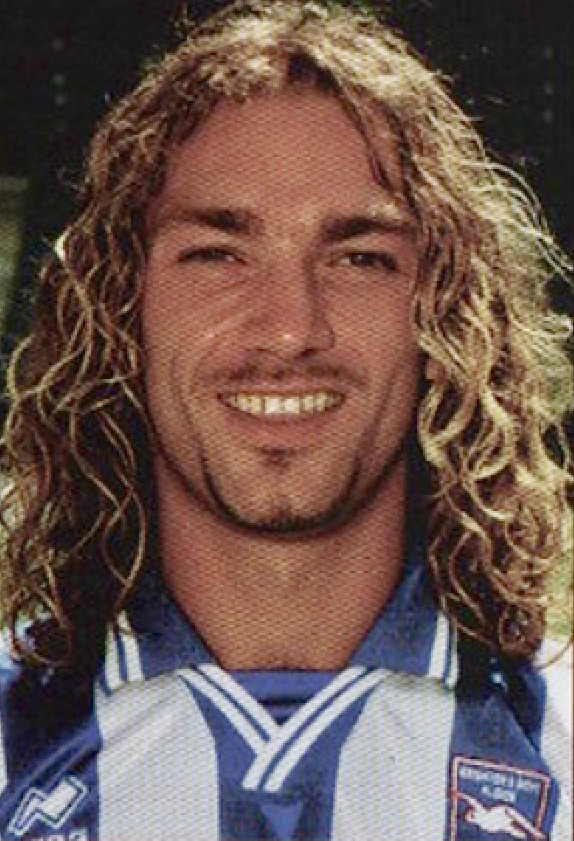

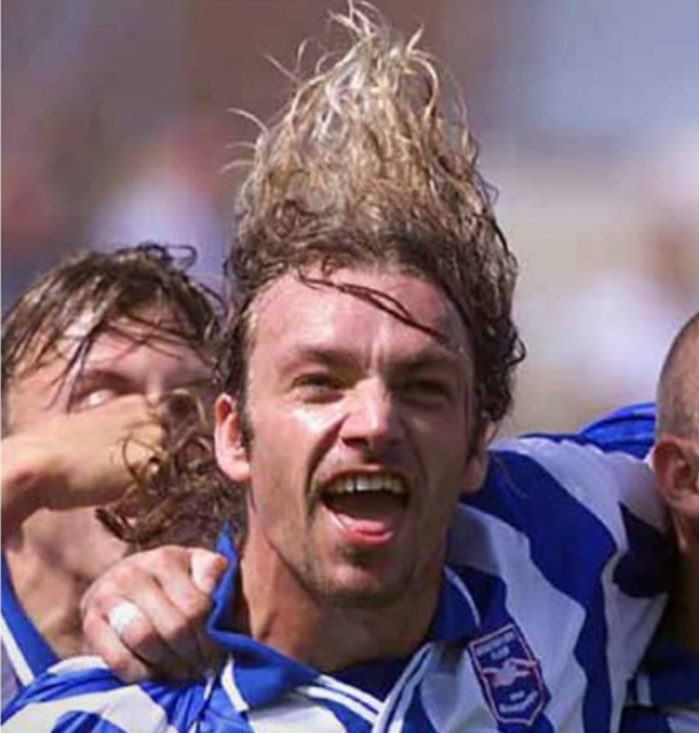
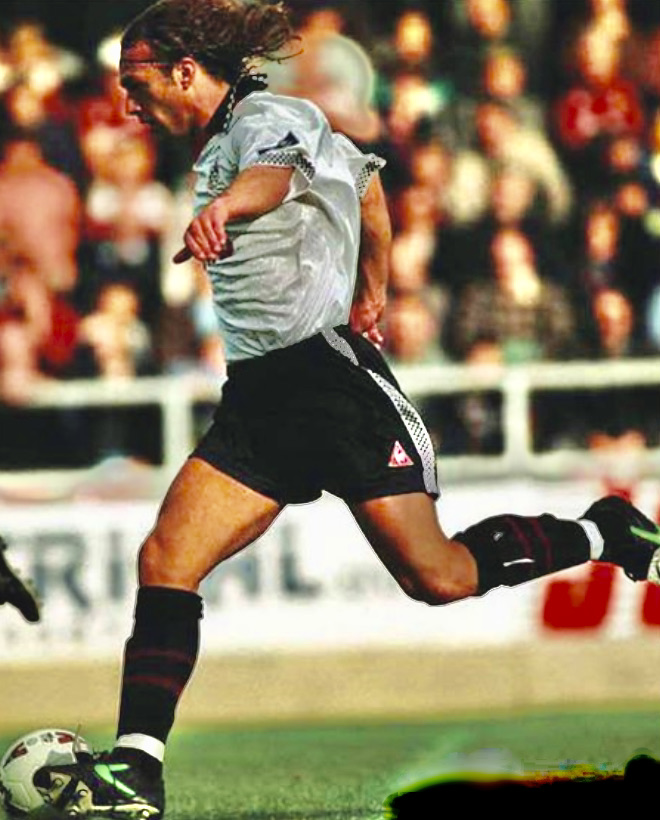


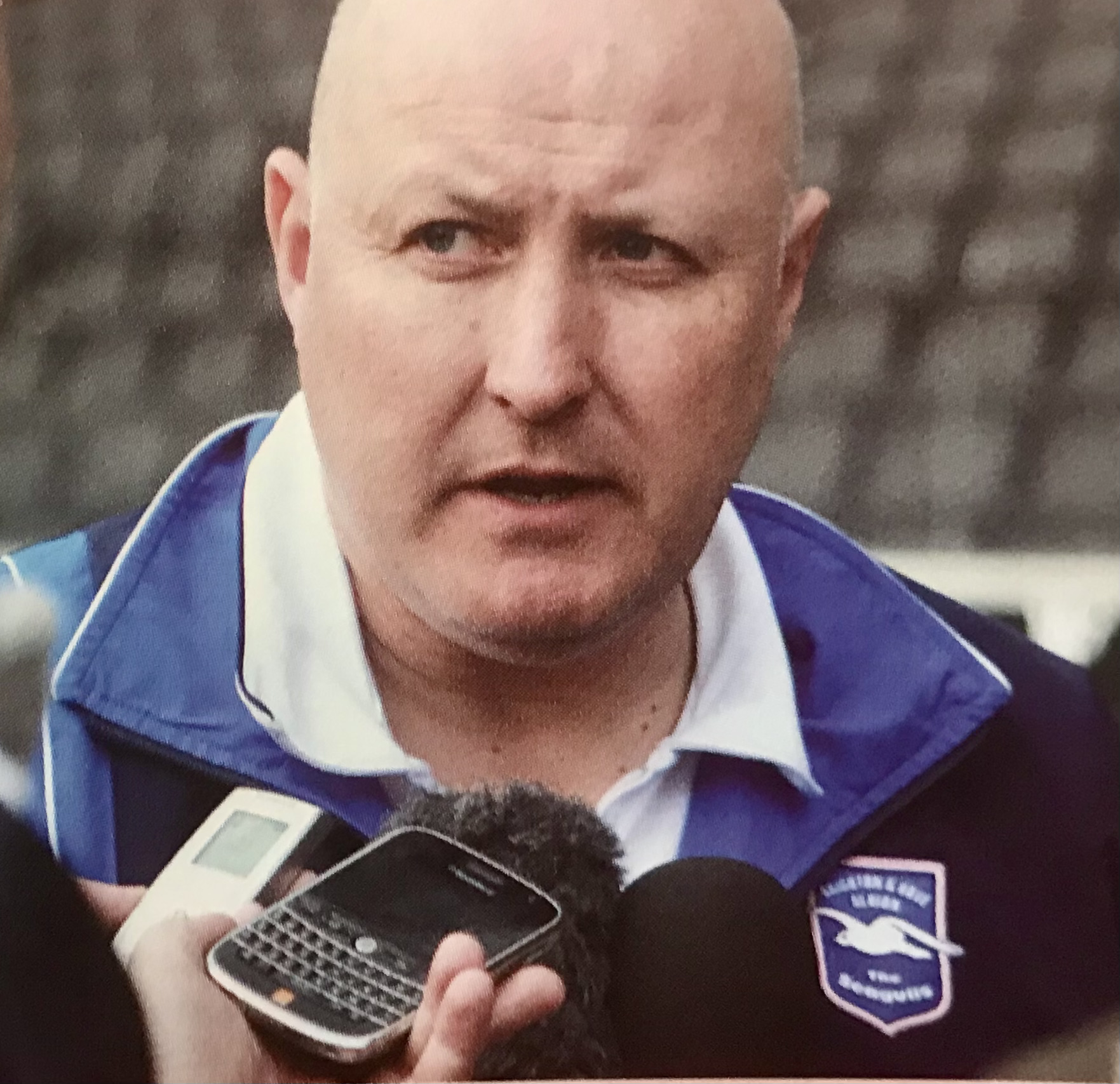
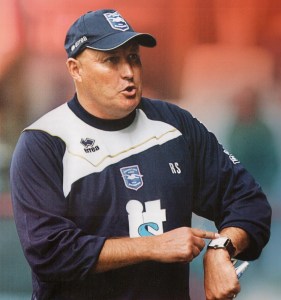

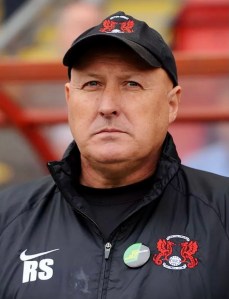


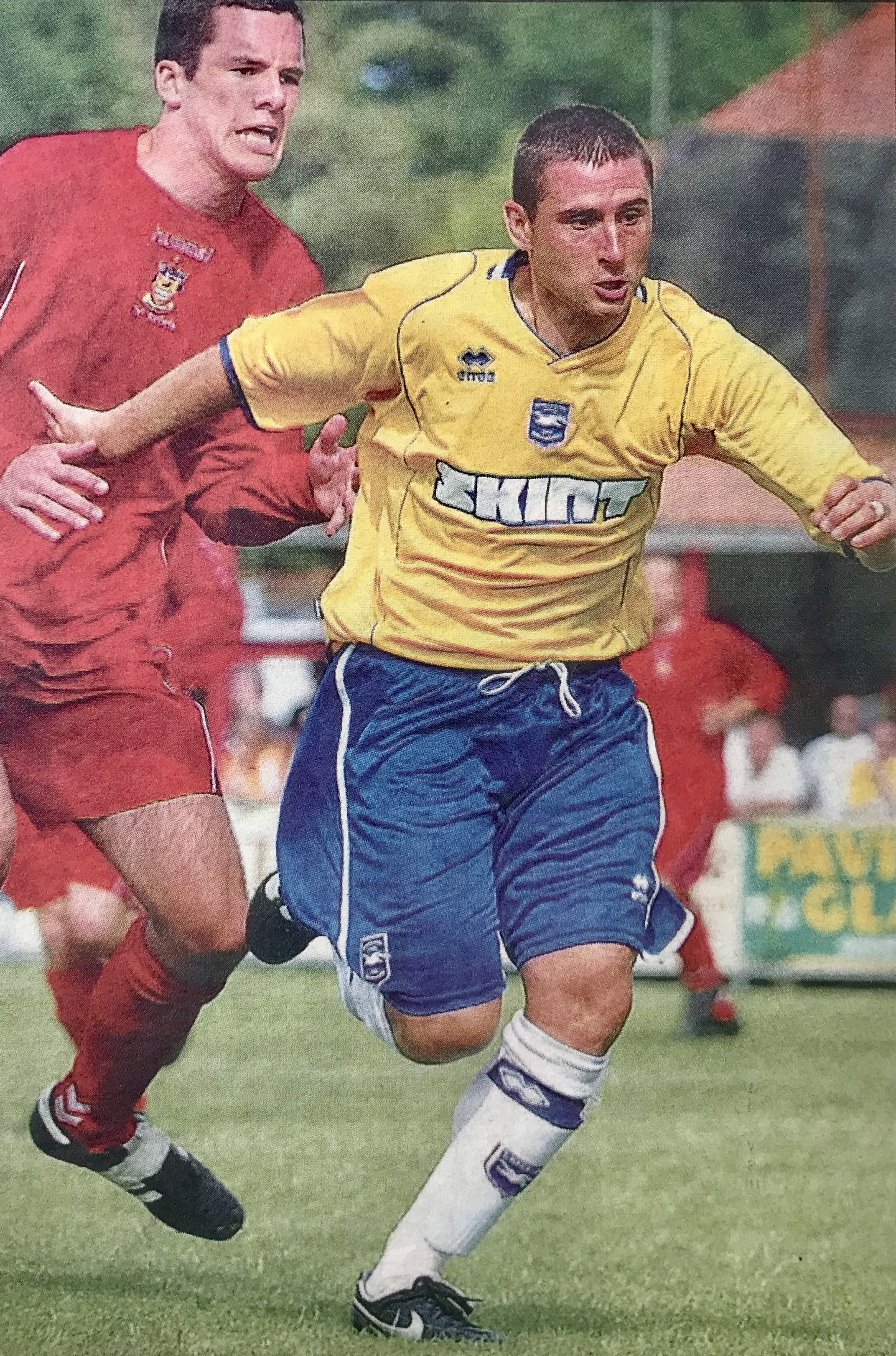

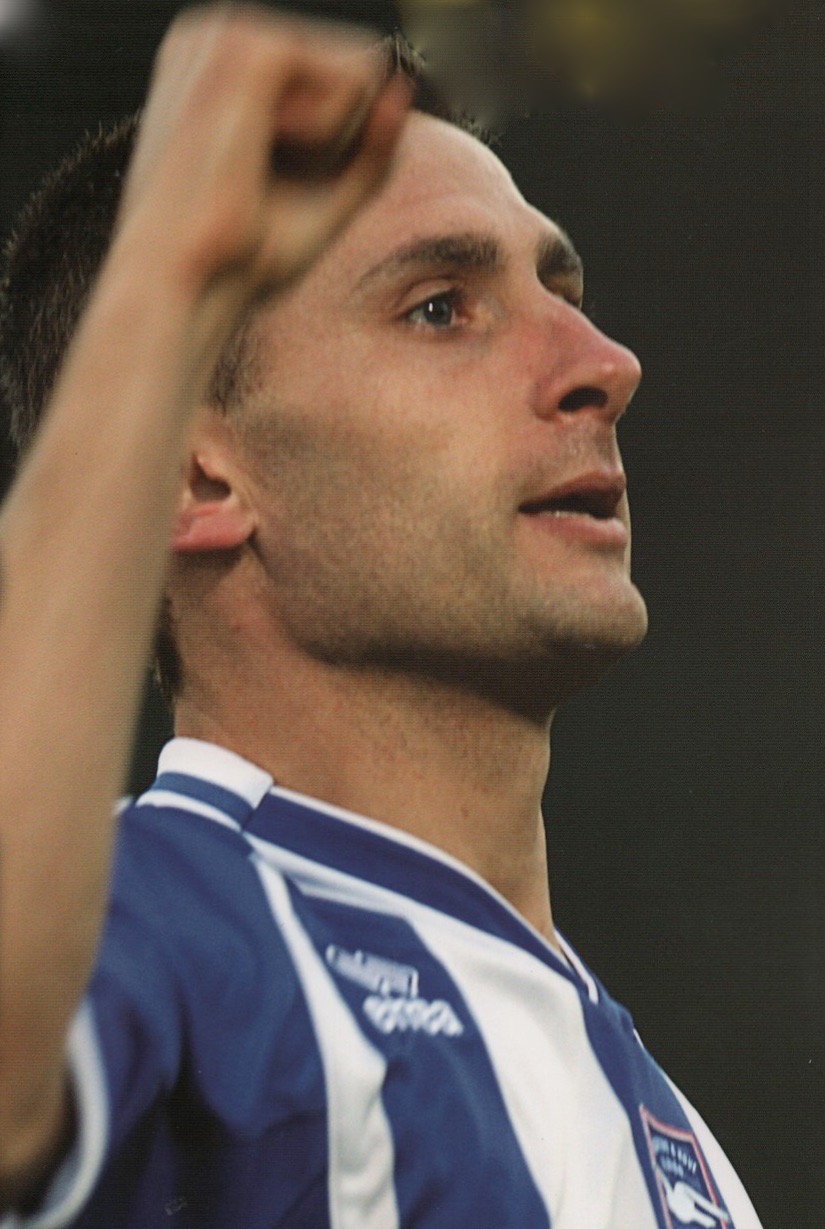

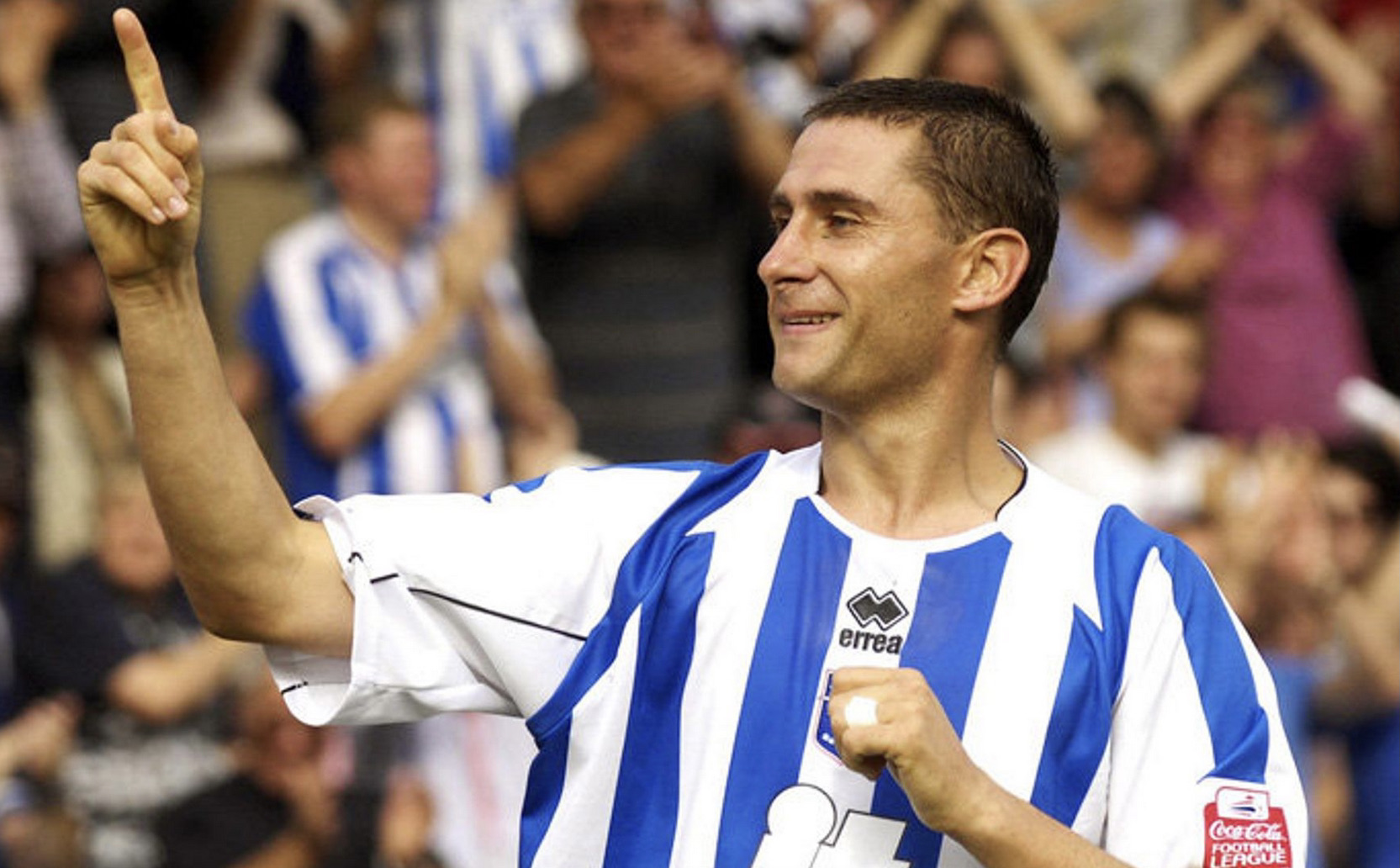



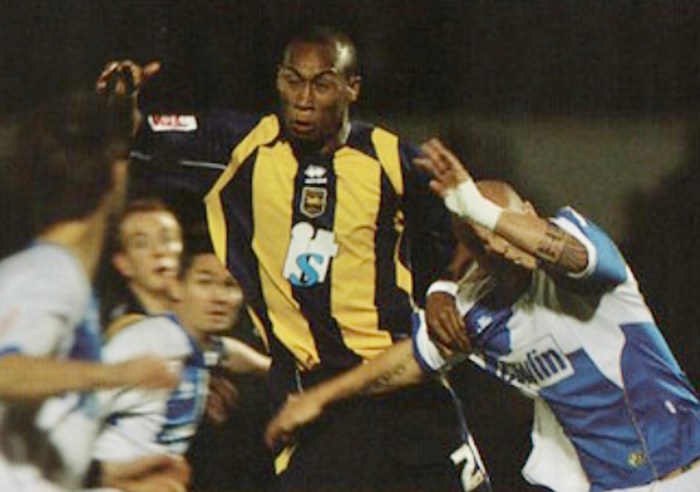
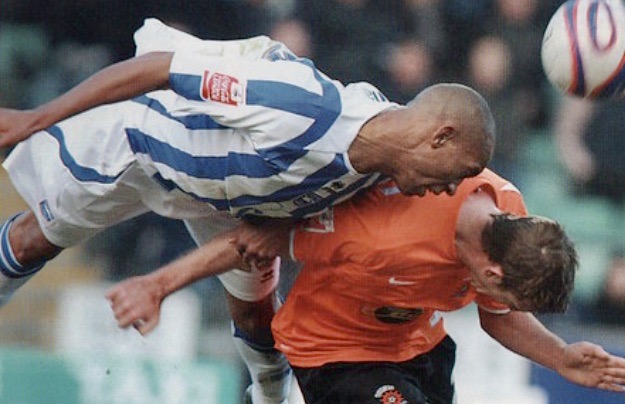


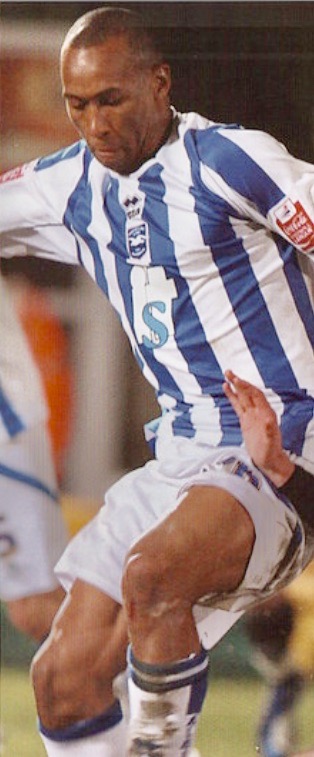


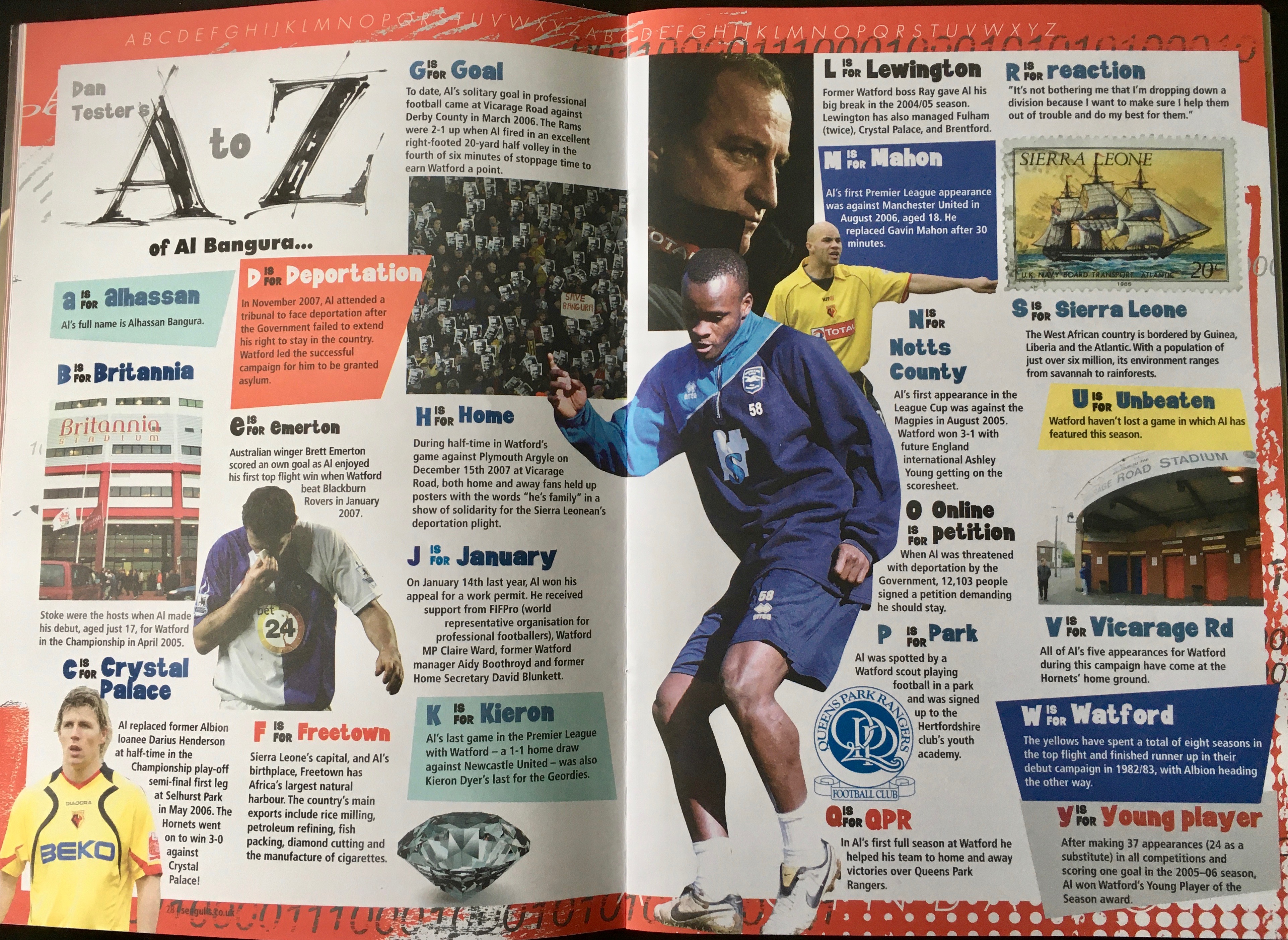 Bangura was profiled in the matchday programme
 His former youth coach at Watford, Dave Hockaday (left, who briefly managed Leeds United) signed him for Conference Premier outfit Forest Green Rovers in 2011, and he completed 91 appearances for them before getting a chance to return to league action with Coventry City.
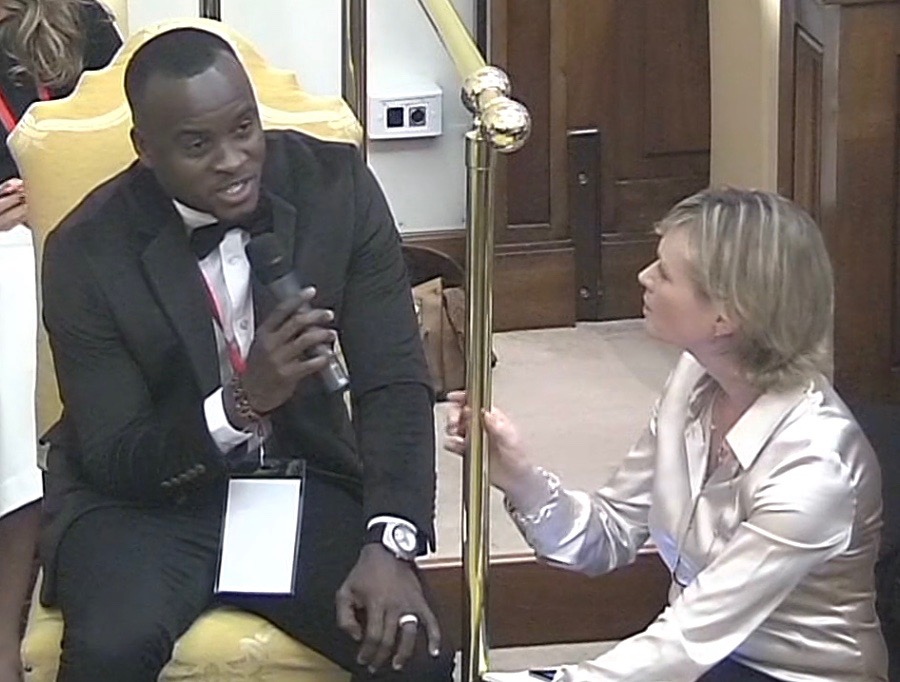 In October 2016, Bangura
 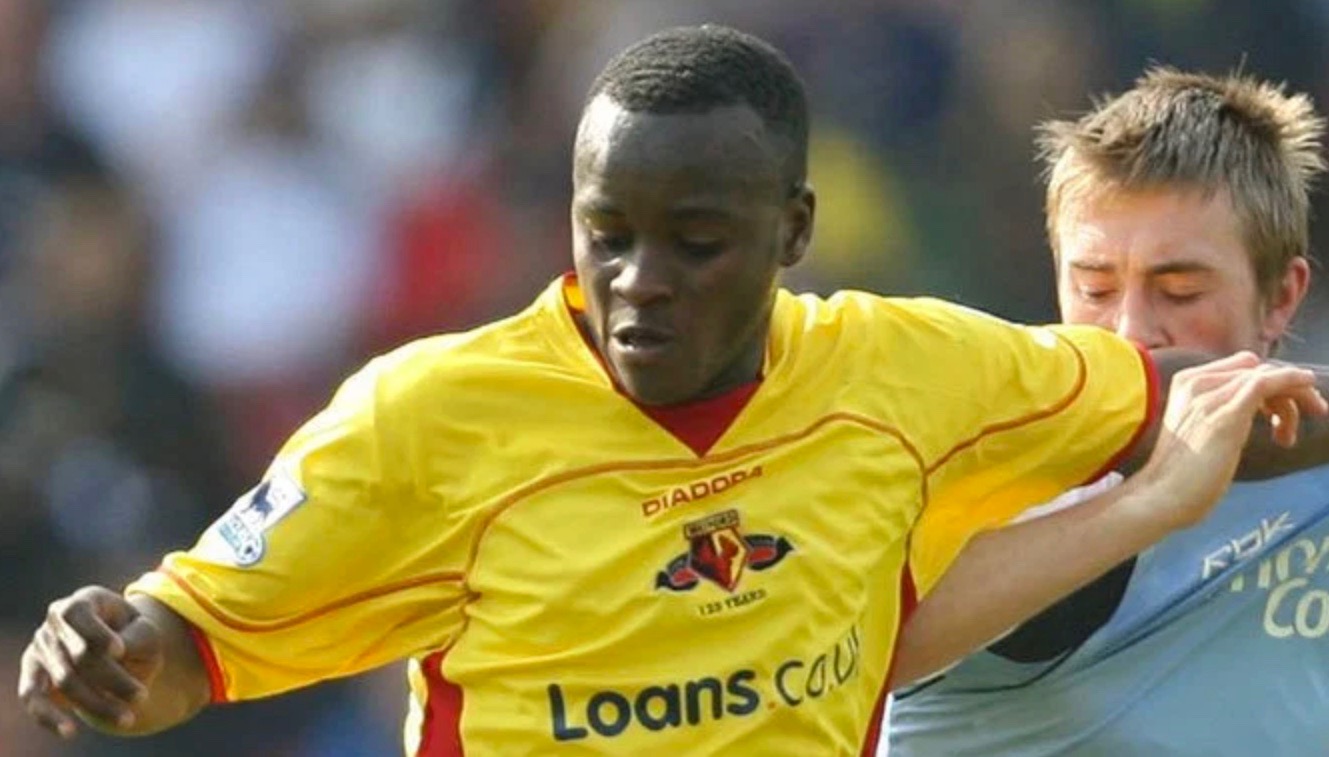 The ’system’ thankfully came to his aid and before long a Watford scout spotted him playing football in a park and signed him up to the Hertfordshire club’s youth academy, where he was nurtured by assistant academy director Chris Cummins, who was also recognised for helping Hameur Bouazza, Adrian Mariappa and Lloyd Doyley to make it through to the first team.

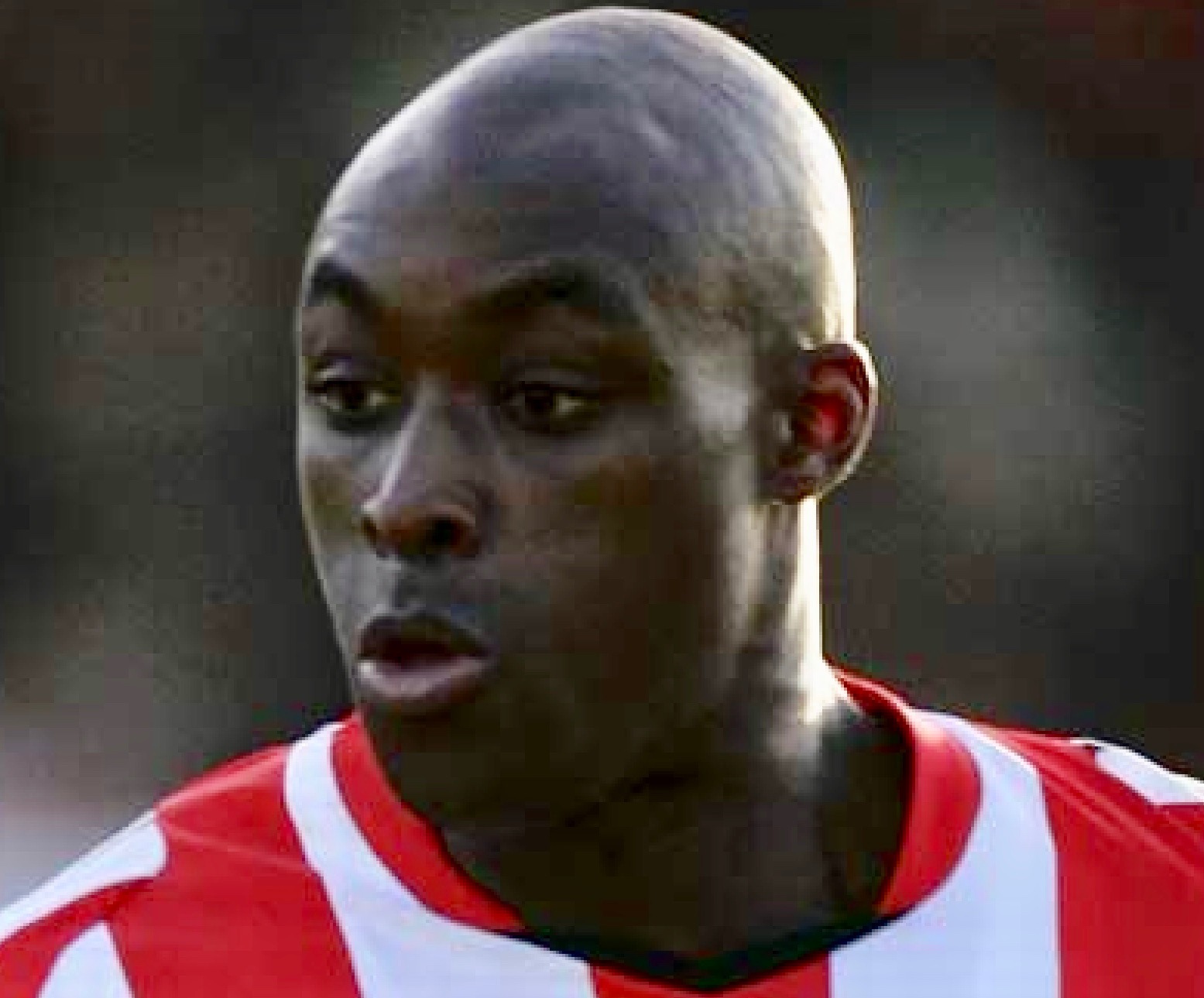 Owusu scored 76 goals in two spells with the Bees, and, in the 1998-99 season, his 24 goals in 53 games in all competitions saw him lead the scoring charts in Nationwide Division Three (now Football League Two) with Brentford crowned champions.


 When a 4-0 home thrashing by Crewe Alexandra meant it had been six games on the trot without a win, Adams was fired by Dick Knight at a Little Chef on the A23. He’d managed just seven wins in 34 matches, and ‘fireman’ Russell Slade arrived just in time to rescue the Seagulls from the League One relegation trapdoor.
 Born in Burton-upon-Trent on 9 January 1986, Davies began his career as a schoolboy at Shrewsbury Town, but did his apprenticeship at Manchester City. In August 2004, he moved on to League Two Oxford United, where he made his league debut the same month in a 1-0 win at Notts County.
 DUCK-loving Matt Heath didn’t shirk a challenge and came to Brighton’s rescue in 2009 when injury and suspension decimated Albion’s available defenders.


 In parallel lines