Boss feistily defended crowd-heckled Bobby Smith

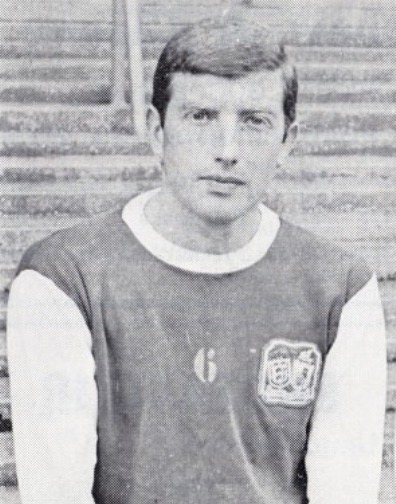
B Smith white actionTOUGH-TACKLING midfielder Bobby Smith made more than 200 appearances for Manchester United’s reserve side.
He played alongside emerging talents such as George Best and Nobby Stiles but wasn’t able to follow them in making the step up to the first team.

Like many before and since, he had to look elsewhere to establish a career in the game, and 85 of his 307 senior career appearances came in the colours of Brighton & Hove Albion, the fourth of seven clubs he served as a player.

Smith stayed in the game as a manager and coach for 26 years after hanging up his boots, his most notable achievement coming in December 1979 as boss of Third Division Swindon Town when they overcame the mighty Arsenal in a thrilling League Cup quarter final.

Born in Prestbury, Cheshire, on 14 March 1944, Smith won six England Schoolboys (under 15s) caps, playing right-half with future World Cup winner Martin Peters playing on the left.

He went on to win two England Youth caps: on 9 March 1961, he was in an England side (which also included John Jackson in goal and future Luton and Spurs boss David Pleat) that lost 1-0 to the Netherlands in Utrecht and three days later was again on the losing side, this time 2-0, to West Germany in Flensburg, when teammates included John Milkins, Portsmouth’s ‘keeper for many years, and striker John O’Rourke, who played for various clubs. Smith turned professional with United the following month.

MUFC REs v WBA

I’ve discovered an old programme (above) for a Man Utd reserve fixture against West Brom during that era. It shows Smith alongside Wilf Tranter (who also later played for Brighton, and was Smith’s assistant manager at Swindon), Nobby Stiles in midfield, and George Best on the left wing.

In 1964, when a first team call-up continued to elude Smith, he lowered his sights and went to play for a former United colleague at Scunthorpe United. That colleague was Freddie Goodwin who would later be his manager at Brighton as well.

At Scunthorpe, Smith finally saw league action and played 87 games in two seasons before being transferred for £8,000 to Grimsby Town. In two years with the Mariners, he played 56 games before joining the Albion in June 1968.

My distant memory of Smith was of a tough-tackling midfielder who was in the shadow of the likes of Nobby Lawton and Dave Turner when it came to his popularity with supporters. And manager Goodwin hit back strongly when a section of fans voiced their disapproval of the player.

Smith scored the only goal of the game after only 50 seconds away to Stockport County on 23 January 1970, but in the previous home game (a 2-1 win over Bradford City) there had been a few shouts from the terraces in Smith’s direction.

In his weekly article for the Brighton and Hove Herald, Goodwin said: “I was most disappointed to hear certain sections of the crowd getting at Bobby Smith.

“He has done nothing to warrant this behaviour. He is a 90-minute aggressive player and his value to the team lies in his ability to win the ball from the opposition.

“He is well aware of his limitations as a player, but there is no-one who can accuse him of ever giving less than 100 per cent.

“This sort of behaviour by a small minority of spectators does nothing to help the team or the individual players.

“Any player who takes the field as a representative of Brighton and Hove Albion does so because he has been selected for the team by me.

“It is my responsibility that a player represents the Albion. So, to barrack any player is most unfair to him.”

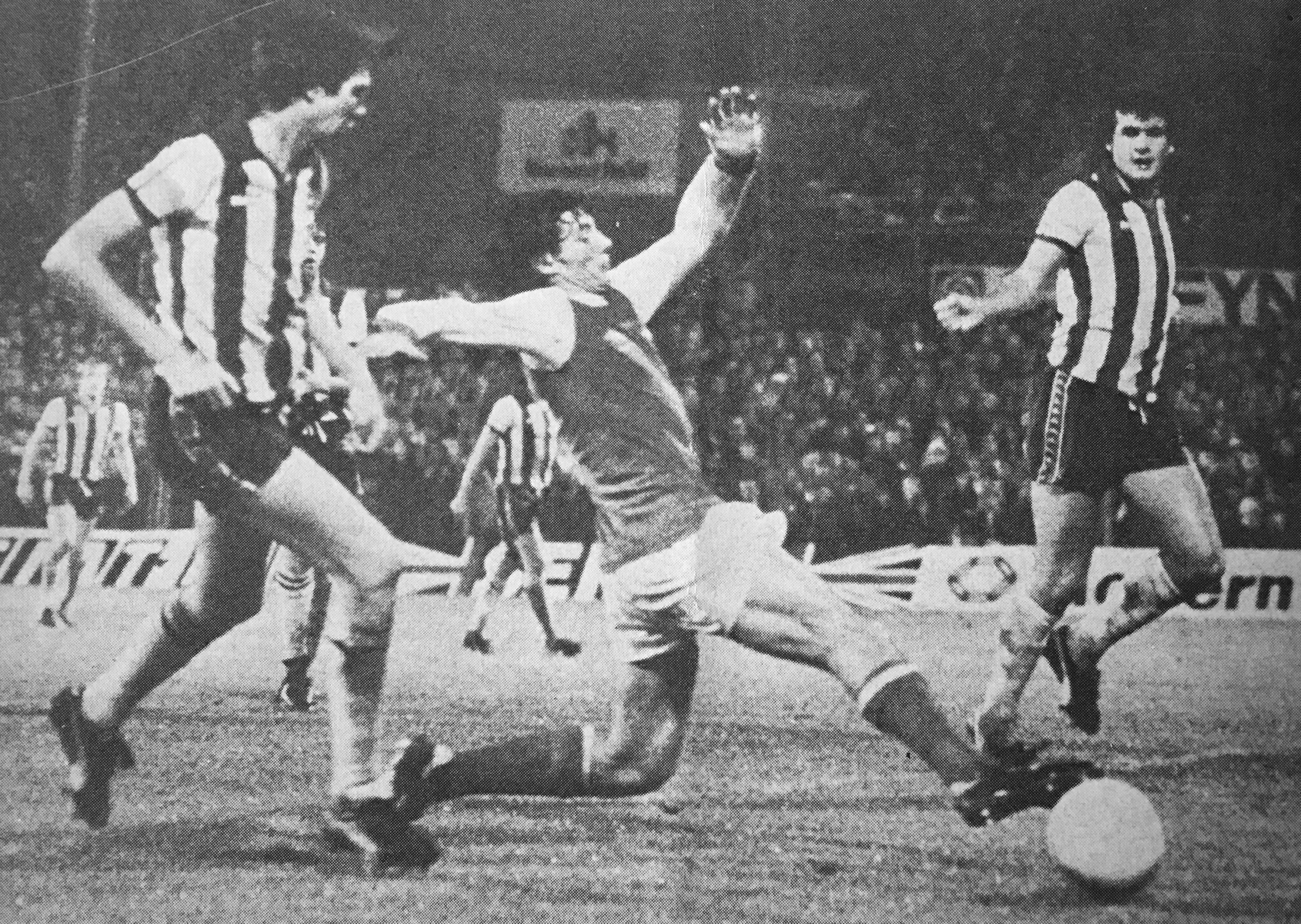
Smith in action against the backdrop of the packed East Terrace at the Goldstone. Albion won 4-0

His 85 games for the Albion came across three seasons: 33 in 1968-69 and 26 in each of the following two seasons. Goodwin’s successor, Pat Saward, released him at the end of the 1970-71 season, and, in June 1971, he went on a free transfer to Chester City.

After only four months in the North West, he switched to the North East, joining Hartlepool United, initially on loan. Over two years, in which Len Ashurst’s side only just avoided the old re-election places, Smith played in 76 matches before moving on to Bury in August 1973. He signed as a player-coach but didn’t feature in the league side, instead taking over as manager – aged only 29 – from Allan Brown in December 1973.

It was the start of a coaching and managerial career that would span more than a quarter of a century.

He took Bury to promotion from the fourth tier by the end of that 1973-74 season, and remained in charge for just under four years, He was at the helm for a total of 215 games; the record books showing he achieved a 41.9 per cent win rate.

A six-month stint followed at Port Vale, between November 1977 and May 1978, but, of his 33 games in charge, he only presided over six wins (there were 14 draws and 13 defeats).

Swindon paid £10,000 compensation to lure him to the County Ground, where, as mentioned, his assistant manager was the aforementioned Tranter.

The official Swindon website remembered: “Despite being a relatively young manager, he guided Swindon to a promotion challenge in his first season in charge – missing out by three points, after losing the last two games of the season.”

Part of the secret had been Smith’s signing of strikers Andy Rowland and Alan Mayes.

Swindon w BS WTSmith (far right) as manager of Swindon, with Tranter (far left), Chris Kamara (circled back row) and skipper Ray McHale (centre front row).

His major achievement came the following year, when Town beat Arsenal 4-3 in a replay to reach the League Cup semi-final.

When one considers the size of League Cup game crowds now, it seems extraordinary to discover around 7,000 Swindon fans (in a gate of 38,024) had made the trip to Highbury for the initial tie, which finished 1-1.

The Gunners had famously lost to lowly Swindon in the 1969 League Cup Final at Wembley, so the humble Wiltshire club smelled history repeating itself.

In the replay, with 21,795 packed into the County Ground, Steve Walford and John Hollins scored own goals and future Brighton manager Liam Brady scored twice for Arsenal. One of the key players for Swindon was future Sky Sports reporter Chris Kamara.

Striker Rowland, who scored an extra time winner, relived the momentous occasion in an interview with SwindonWebTV.

Smith on Focus

Unsurprisingly, the giant killing attracted plenty of media attention and Smith was interviewed live on Football Focus by presenter Bob Wilson.

Smith pointed out that his side had been well grounded and, after the initial draw against Arsenal, had thumped his old club Bury 8-0, equalling Swindon’s biggest winning margin in a league game. Amongst the scorers were Rowland and Billy Tucker – two of four ex-Bury players in Swindon’s starting line-up. Another was Brian Williams – Bury’s youngest ever player – and one of the other goalscorers, Ray McHale, (later to play for Brighton in the top division) went on to have a loan spell at Gigg Lane later in his career.

The Robins beat top-flight opponents Wolverhampton Wanderers 2-1 at home in the first leg of the semi-final but went down 3-1 at Molineux in controversial circumstances, Wolves scoring the decisive goal five minutes from the end.

“We were so unfortunate because Wolves should have been down to 10 men,” Kamara told the Swindon Advertiser. “Alan Mayes got hit by the goalkeeper (Paul Bradshaw). He came out of his goal, didn’t get anywhere near the ball and he clattered Alan and broke his two front teeth and his nose but didn’t get sent off.

“I know everyone looks at situations and says ‘You were unlucky’ but that was a turning point in the game, and we ended up losing.”

It later emerged that the tie could have had a dramatic impact on Kamara’s playing career. In a 2010 interview with FourFourTwo magazine, he explained how he was once on Manchester United’s radar during Ron Atkinson’s reign.

“I was at Swindon and my manager Bobby Smith said, ‘Big Ron’s coming to watch you.’ We were playing in the 1980 semi-final of the League Cup against Wolves, but I had the ’flu and didn’t play so well. I’m not saying that’s the reason he didn’t sign me, but Ron went back to his old club, West Brom, and signed Remi Moses instead.”

With the benefit of hindsight, the cup run took its toll on the Swindon side. Before the semi, they were just five points from a promotion place, with four games in hand. But only five of their last 18 games were won, and they lost nine away games on the trot, resulting in a disappointing 10th place finish.

Smith had spent large –  by Swindon’s standards –  including £250,000 on two players, David Peach and Glenn Cockerill, both of whom never fitted in at the club.

When Swindon lost their first five matches of the 1980-81 season, Smith was relieved of his duties.

He later took charge at Newport County and Swansea City, as well as coaching at the Swans, Blackpool, Cardiff City, and Sheffield Wednesday, together with a spell as assistant manager of Hereford United.

He was assistant manager to Frank Burrows at the Vetch Field but when the chairman at the time announced his intention to sell up, and no funds were being made available for new players, Burrows left of his own accord and Smith became caretaker manager.

Contributor Colin_swansea, on the fans website scfc2.co.uk, observed: “After Tosh left we had caretakers Doug Livermore for 30 days, Les Chappell for 23 days prior to Tosh returning, and after Tosh had left for a second time on the 5th March 1984 Les returned as caretaker until the end of the season.

“Our manager’s position was even more farcical after Frankie Burrows left with his assistant Bobby Smith taking over until a bust up during the Xmas period when Doug Sharp wouldn’t sanction the buying of rubber studded boots to combat the winter conditions.

Smith interviewed after his Swindon side held Spurs to a 0-0 draw in the FA Cup

“Smith left on 22 December 1995, Jimmy Rimmer was caretaker to 7 February 1996, Kevin Cullis became manager for a week, a two-game spell of two defeats, Rimmer returned for eight days as caretaker, before Jan Molby’s appointment on 22 February 1996. Molby’s replacement as manager on 9 October 1997 was Micky Adams who lasted 13 days and three league defeats with his assistant Alan Cork taking over until the end of the season.

“Cork didn’t fit the profile for the club’s new owners, Silver Shield, and he was offloaded at the end of the season. Ironically his successor, John Hollins, didn’t sign one player the following season when the club reached the play offs.

“Never a dull moment being manager of the Swans during the 80s and 90s!”

‘Bright prospect’ James Wilson faded after great start

JW v WolvesGREAT things were expected of James Wilson after he scored two goals on his Manchester United debut.

Caretaker manager Ryan Giggs gave the 18-year-old the opportunity to prove himself at first-team level in a home game against Hull City in 2014 and he was instantly repaid.

Wilson UtdA few months later, Wilson signed a four-year contract, with new manager Louis van Gaal describing him as “one of the brightest young English prospects”.

But that early promise evaporated as injury problems and the emergence of the talented Marcus Rashford overshadowed his progress.

“I wanted to get out of my comfort zone on loan at Brighton and while I was there Rashford came through,” Wilson told ESPN. “I came back and never really got that chance again. Injuries were a big thing.”

The Biddulph-born striker eventually severed ties with Old Trafford in the summer of 2019 having first joined United in 2002 aged only seven.

In the season after his impressive debut against Hull, he made a further 17 appearances for United and scored two more, but he appeared in only one Premier League game and one League Cup game in 2015-16, and didn’t feature for United’s first team again.

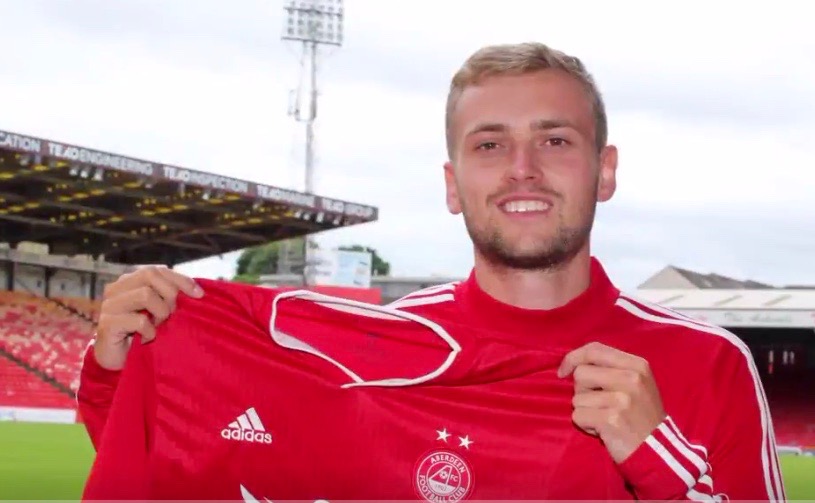
JW England u21Wilson represented England at under 16, under 19, under 20 and under 21 levels but a career in England’s top-flight proved elusive and he is now playing for Scottish Premiership side Aberdeen.

One of several loan spells Wilson had away from United saw him join Brighton’s ultimately unsuccessful bid for promotion from the Championship in November 2015.

Although he showed glimpses of real quality, and scored five goals, he often seemed to be fatigued and ended up making just 12 starts plus 15 more from the bench.

Perhaps, rather unfortunately, he is best remembered for being caught by the TV cameras vomiting on the pitch immediately before a game against Wolves on New Year’s Day.

Wilson’s start for the Seagulls was impressive enough: a goal on his full debut in a 3-2 win over Charlton Athletic. “I remember picking the ball up on the edge of the D and just drove at the centre backs. They backed off, I managed to get my shot away and it went through their ‘keeper’s legs,” he said in a subsequent Albion matchday programme.

He followed that one with the opener in a 2-2 draw away to Derby County.

Tomer Hemed and Sam Baldock were more often than not manager Chris Hughton’s preferred selection up front although Wilson rewarded Hughton’s decision to give him his first start for two months in place of Hemed in a home game against Reading on 15 March. He scored the only goal of the game and Albion edged into second place as the promotion race hotted up.

JW scores v DerbyHe also scored (above) in the fifth minute of added on time to secure Albion a point in their penultimate league game at home to Derby, but when runners-up spot eluded the Seagulls courtesy of the last-game 1-1 draw at Middlesbrough, and when Albion failed to overcome Sheffield Wednesday in the Championship play-offs, Wilson returned to Old Trafford.
At the start of the following season, he was on his travels again, this time to Derby, but his season-long loan ended prematurely in October 2016 when he sustained an anterior cruciate ligament knee injury that sidelined him for months.

While he eventually returned to action in United’s under 23 side, he didn’t get a first team chance under Jose Mourinho and instead spent the second half of the 2017-18 season on loan to Sheffield United where he scored once in nine appearances.

He spent the whole of the 2018-19 season on loan at Aberdeen, scoring four goals in 32 games and then signed for them permanently in the summer of 2019, aiming to reignite his career. But having not scored in 16 games in the latter part of 2019, he was allowed to return to the Manchester area, signing on 31 January 2020 for League Two Salford City.

James Wilson Aberdeen

An all-too-fleeting, injury-dogged career for the late Bernie Gallacher

WELL-known names from the football world paid their respects at the funeral of tenacious left-back Bernie Gallacher.

Gallacher, who played for Aston Villa and Brighton, died in Sutton Coldfield in August 2011, aged 44, after a short illness.

Ginger-haired Gallacher was born in Johnstone, near Paisley, in Scotland, on 22 March 1967 and he played football for his school teams, St Peter’s Primary and St Aelred’s High.

His brother John played for Scotland schoolboys but Bernie missed out because he broke a leg just before a big game. Nevertheless, scouts from Leicester City and Villa had been tracking him and, at 16, he chose to join Villa, who’d won the European Cup the year before.

“Football was his life and he often played two or three games a day when we were growing up in Johnstone,” his other brother Charlie told the Paisley Daily Express. “I’ll never forget his debut for Villa because it was against Manchester United at Old Trafford and I remember thinking it didn’t get any better than that.”

It was the final game of the 1986-87 season and Villa were already heading back down to the old Division Two (now Championship). In an Albion matchday programme article, Gallacher said: “The Old Trafford match was a great occasion, but a bit unnerving in front of a cpacity crowd.

“The crowd seemed to be breathing down my neck – at that time I was used to only a couple of hundred watching the reserve side.”

The opportunity came under Graham Taylor after Gallacher successfully made it through the apprentice ranks. Taylor told the Birmingham Mail: “Bernie was reliable, wanted to do well and was never going to cause any trouble. He was a manager’s dream.

“He wanted to do his best and he wasn’t going to cause me any problems on or off the pitch.

“There are a number of players who don’t get recognised in football and Bernie was one of those. He would come out and give us a seven out of ten performance every week.

“If he’d had more confidence and belief in himself we might have seen some nine out of ten performances.”

Gallacher made a total of 72 appearances for Villa between 1985 and 1990, but former Villa teammate, Pat Heard, recalled: “Bernie became a cult hero during the 1987-88 promotion season and never gave less than 100 per cent every game.”

That season he played in all but one of Villa’s league games as they earned automatic promotion back to the top tier. But he only played 13 more top-flight games for Villa, seven of which came in the 1989-90 season when the Midlands club were runners up behind Liverpool, seven points ahead of third-placed Tottenham Hotspur. His final appearance in a Villa shirt came against Chelsea at Stamford Bridge in November 1990.

He had a brief loan spell at Blackburn Rovers and also played a couple of games for Doncaster Rovers before heading south to join Barry Lloyd’s second tier Brighton in the autumn of 1991, having been released by Villa.

Gallacher took over the left-back slot when Sussex lad Ian Chapman was injured and made his debut in a 1-0 defeat away to Blackburn on 2 November.He kept his place through to the end of what proved to be a disastrous season with Albion relegated in 23rd spot. While defending was his no.1 priority, Gallacher got on the scoresheet in a 2-1 Boxing Day defeat at Leicester.

North Stand Chat contributor, Blue Seagull, recalled: “The ball was played to him on the left touchline right in front of me; he cut inside one, went past another, and unleashed a shot from the edge of the area. Great goal!”

Gallacher took over the captain’s armband when normal skipper Gary Chivers and club captain Dean Wilkins were both unavailable, but it wasn’t the first time he had led a side. At Villa he’d captained the youth and reserve sides.

“Captaining a side is a privilege and I’ll be happy to do it until either Deano or Chivs is back,” he said.

He played 45 games for Brighton in total but his career was cut short by a bad injury. “Unfortunately, he suffered a horrendous cruciate ligament injury which all but ended a fantastic career,” his brother recalled in 2011. “We were all extremely proud of Bernie, as he really did make a name for himself at Villa Park and is still remembered fondly for his time with the club.”

He made a couple of appearances for Northampton Town after he left Brighton, but he was forced to retire from the game aged just 27. He later worked in the probation service.

Gordon Cowans, Brian Little and Steve Staunton were among the former Villa heroes who paid tribute to him at his funeral.

Paul Moulden chipped in with goals for Bournemouth and Brighton before batter days

MouldyWORLD RECORD youth level goalscorer Paul Moulden now runs a successful chippy in Bolton but he was once in the firing – rather than frying – line for AFC Bournemouth and Brighton & Hove Albion.

The career of the prodigious goalscoring wonderkid tailed off early although it may have taken a new direction in Sussex if the cash-strapped Seagulls had been able to afford to buy him.

Born in Farnworth, near Bolton, on 6 September 1967, Moulden went to the town’s Thornleigh Salesian College where, having excelled for the school football team, he went on to play for England Schools. He also played for Bolton Lads Club under-15s: his staggering personal goal tally of 289 goals in 40 games in a single season earned him a place in the Guinness Book of Records.

He was snapped up by Manchester City as an associate schoolboy during John Bond’s reign as manager and signed on as an apprentice before turning professional on his 17th birthday. He was part of City’s FA Youth Cup winning side in 1986, although manager Billy McNeill had already blooded him in the first team on New Year’s Day that year in a 1-0 home win over Aston Villa.

Moulden CityHe made two further substitute appearances for the first team that season and finished top scorer for City’s reserves. By late 1986, he had earned a regular place but a broken leg sustained in training restricted him to just three appearances in 1987-88.

In the 1988-89 season, Moulden was City’s top scorer with 13 goals as they won promotion from the old First Division back to the elite. But the young striker elected not to take up the offer of a new contract in the summer of 1989 and ended up joining Bournemouth, where Harry Redknapp was beginning his managerial career. Moulden was valued at £160,000 as the makeweight in a deal which saw Bournemouth’s Ian Bishop move to Maine Road.

City boss Mel Machin, himself something of a legend at Bournemouth (a Cherries player, manager and director of football) spelled the end of Moulden’s career at City.

Moulden told FourFourTwo magazine: “Machin just didn’t fancy me. I was offered a contract but it was a contract you’d have been a fool to sign, so I didn’t sign it and I became for sale. All the backroom staff and everyone else concerned was upset that I was going but to have tied yourself down for three years on the contract they were offering, you would have been a fool. That was the lever to get me out.” The Lancashire lad’s move to Dorset proved to be a success on the pitch – but was brief.

He scored six goals in his first three home league matches, including a hat-trick in a 5-4 win over Hull and both goals in a 2-1 win over Newcastle. “I remember the two goals against Newcastle,” Moulden told the Bournemouth Echo in 2016. “One was a three-inch tap-in and the other was a run from the halfway line.”

While he said in the Echo interview how much he enjoyed his time with the Cherries, he told efl.com: “Moving to Bournemouth was a huge move for me. At the time, I was single and it was exciting, but the novelty soon wore off and I found it hard to settle.

“It was a lovely club but I was delighted to return home and back to Oldham.”

Moulden told FourFourTwo: “Bournemouth had some good players, like Luther Blissett, Paul Miller and goalkeeper Gerry Peyton. The thing that struck me was how many old players they had – I was 22 at the time – but Harry was just starting out and I suppose for his first job he wanted security around himself.

“It was a small club and I’d imagine he had to get success quickly. Harry was a nice guy, a decent manager.”

SOCCER
PAUL MOULDEN – OLDHAM ATHLETIC

After just seven months at Bournemouth, and with 13 goals in 37 starts to his name, he was snapped up by Oldham Athletic on transfer deadline day in March 1990.

A £225,000 fee meant a decent profit for Bournemouth but, with Oldham flying high at the time, and Moulden struggling with injuries, he only managed 19 games for the Latics in two and a half seasons. He spent two months at Molde in Norway restoring his match fitness and when Oldham manager Joe Royle suggested he look for a new club, the move to Brighton looked like the ideal opportunity to resurrect his career.

Newly-relegated back to the third tier, Albion desperately needed some inspiration up front and manager Barry Lloyd thought he’d hit the jackpot in securing on loan the services of strike pairing Moulden and Steve Cotterill, from Wimbledon.

Each got themselves a goal in an opening 3-2 defeat to Orient so the signs were promising and the new men duly delivered the goods on the pitch.

The two goals Moulden scored as Albion beat Preston North End 2-0 in September 1992 were especially sweet, as he explained to Brian Owen of the Argus in 2016.

In total, Moulden scored five goals in 11 league appearances and Cotterill four, but the Albion couldn’t afford to sign either of them permanently.

The void was ultimately filled by the arrival of free transfer Kurt Nogan, who subsequently became a prolific goalscorer for the Seagulls. Moulden, meanwhile, ended up being sold to Birmingham later the same season for £150,000 and Cotterill, also deemed too expensive for Albion, was sold to Bournemouth for £80,000 the following summer.

In an interview with Howard Griggs of the Argus, in January 2011, Moulden explained how he would dearly have liked to have made the move to Brighton permanent.

“I played at Bournemouth two seasons before,” he said. “I liked the south coast and I had the chance to go to either Brighton or Plymouth. I jumped at the chance to go to Brighton and I thoroughly enjoyed my time there. I struck up a good understanding with Steve Cotterill.”

Moulden spoke particularly highly of assistant manager Martin Hinshelwood – “he was different class, absolutely brilliant” – and said: “It felt just right from the start. I did well with Steve Cotterill. We both scored goals for the team.”

As an ex-City player, Moulden was particularly miffed that Oldham boss Joe Royle would not let the outcast striker play for Albion against Manchester United in the League Cup that autumn, and he added: “If Brighton had had the money I certainly would have signed.”

He told Griggs: “Manchester City was certainly good, and I enjoyed my time at Birmingham under Terry Cooper, but there were plenty of good times and I can honestly say my two months at Brighton was up there.”

One of Moulden’s best games came in a 2-1 home win over Huddersfield as Albion won 2-1. Steve Foster, back at the club for a second spell, put Albion ahead on 17 minutes with a header from a John Robinson corner. Although Huddersfield equalised through a Iwan Roberts penalty, livewire Moulden popped up with the winner six minutes from time.

The Terriers would ultimately be Moulden’s next destination after leaving Birmingham in 1995 but he made only two appearances before switching to nearby Rochdale where he played 16 times in the 1995-96 season.

In total, Moulden suffered four broken legs and his league career came to a premature end at 28, although he played non-league with Accrington Stanley and Bacup Borough.

He later coached at his old boys’ club and also spent three years with the Manchester City academy but sensibly he had an eye for a career outside of football too and followed in his mum and dad’s footsteps by opening up Paul’s Chippy in Bolton.

Pictures: Albion matchday programme and online sources.

Winger Walker a genuine crowd-pleasing entertainer

CW Nobo 91 progIN MY OPINION, one of the best wingers ever to pull on the famous blue and white stripes was Clive Walker, an evergreen player who remarkably played more than 1,000 games for eight clubs.

Although well into his 30s when he arrived at the Goldstone Ground, the balding former Chelsea and Fulham wideman was an effervescent talent with the ball at his feet.

Asked by the Argus to preview the squad ahead of the 1991 Division Two play-off final at Wembley, Brighton coach Martin Hinshelwood said of him: “Alias Phil Collins. A great character. The dressing room buzzes when he is around. He is good on the ball, a great crosser and has scored some great goals this season.”

Both Albion’s wingers for that game had Wembley experience behind them having been on opposing sides in in the 1985 League Cup Final.

Walker had missed a penalty for Sunderland as Mark Barham’s Norwich City won 1-0 and six years later, against Neil Warnock’s Notts County, Walker’s bad luck continued when a Wembley post denied him as Brighton’s dream of promotion ended in a 3-1 defeat.

Both had played big parts in Albion reaching Wembley, though: Barham levelled for the Seagulls in the first leg of the semi-final at home to Millwall and Walker got the third when the Seagulls upturned the form book and beat Bruce Rioch’s side 4-1.

Born on 26 May 1957 in Oxford, Walker joined Chelsea in 1973, made his league debut in a 1-0 defeat away to Burnley on 23 April 1977 and was a first team squad regular between December 1977 and the summer of 1984, although, in 1979, Chelsea loaned Walker to Fort Lauderdale Strikers (as pictured below) where he scored nine goals in 22 appearances.

CW Fort Laud

“Those were exciting, lively times and we loved our football. We were a bunch of young lads growing up together and, in my last couple of years there, I played with the likes of Kerry Dixon for the side who brought good times back on the pitch,” Walker told Mike Walters of the Mirror. “We were a close-knit bunch with a great sense of camaraderie, and a lot of teams these days would probably envy us in that regard.”

A fast winger with the knack of scoring stunning goals, Walker netted 17 in 1981-1982 and the next season, with Chelsea looking set to be relegated to Division Three, fans still remember how he scored the winner at Bolton Wanderers to maintain their status.

Details of many of his memorable moments at Chelsea are highlighted by the Sporting Heroes website.

And a Chelsea fans’ blog, Game of the People emphasised the impact he had at Stamford Bridge, pointing out: “He was left-footed, as quick as a sprinter and awkward to knock off the ball. And he could shoot! Those that liked wingers were excited by his willingness to run between players and take a pot shot at goal. Put simply, he was exciting to watch.”

In what is an otherwise interesting and informative piece about Walker in 2014, they unfortunately failed to mention his successful stint with the Seagulls.

Although he began the 1983-84 season well, he sustained a broken jaw which put him out for several weeks and, during his absence, another nippy winger – Pat Nevin – seized the opportunity to claim a first-team spot and Walker’s Stamford Bridge days were numbered.

3-2 N v Sun CWalker

Come the end of the season, he was allowed to join Sunderland (above in action v Newcastle) for a fee of £70,000. “He returned to torment Chelsea in the Football League Cup semi-final second leg, scoring twice in what was a dreadful night for the club,” Game of the People observed. “Walker was abused from the stands, too, which was especially heartbreaking for those that appreciated his efforts at the Bridge.”

After two years in the north-east, Walker returned to London in September 1985, initially via a £75,000 move to Jim Smith’s First Division (Premier League equivalent) QPR, where he played 28 games in the 1986-87 season, alongside the likes of David Seaman, Michael Robinson and John Byrne. Just 20 months later, he left on a free transfer to Third Division Fulham for whom he made 127 appearances in three years, scoring 32 goals.

His debut was certainly memorable as he scored twice in a 3-1 home win over York City. Writer Ian McCulloch remembered the occasion in an article on fulhamfc.com.

“Fulham were in the doldrums, on the brink of extinction, owned by property developers, and going nowhere fast. And then, in the midst of all the doom and gloom, appeared one of football’s all-time, genuine crowd-pleasing entertainers. Walker ran the show that night, scored twice, and generally lifted both the fans and the team.”

Walker recalled: “That game really does stand out. And in the pouring rain as well! To score two goals on your debut is very special, and I just look back at it as a fabulous memory. Very, very enjoyable.”

Walker explained that it was Ray Lewington who took him to Craven Cottage, adding: “I had a great rapport with him – of course we were both apprentices at Chelsea – and we’re still good friends today. But then other managers came in, and you couldn’t escape the feeling that the club was going backwards and that was very, very sad because I had a lovely time at Fulham and I’ve got some very fond memories of those years. I loved playing at the Cottage and on the Cottage pitch.”

Walker picked up Fulham’s 1989-90 Player of the Year award before former Fulham captain Barry Lloyd went back to his old club to secure Walker’s services for the Seagulls in the summer of 1990. Even though he was the wrong side of 30, he pulled on the no.11 shirt on his debut away to Barnsley (in a side containing his old Chelsea teammate Gary Chivers in defence) and missed only one game all season as Albion nearly made it back to the elite level.

After that Wembley disappointment and only three games into the new season, Walker suffered another blow when he sustained a serious knee ligament injury away to Barnsley which sidelined him for several weeks.

With the previous season’s goalscoring duo Mike Small and John Byrne having been sold for big money, the side struggled, and eventually ended up being relegated.

Emerging young winger John Robinson had slotted into Walker’s place in the side during his absence although it was Barham who was the odd man out when Walker was fit to return to the line-up.

Back in the third tier the following season, although the return of Steve Foster in defence was a plus point, off the field the rumblings of financial meltdown grew louder and louder. Young Robinson was sold to Charlton Athletic and only the proceeds of the sale of goalkeeper Mark Beeney to Leeds United kept the taxman at bay when there was a winding-up order threat hanging over the club.

Three cup games against Manchester United were rare highlights in that precarious season and one of my favourite Walker moments came at Old Trafford in a League Cup replay on 7 October 1992.

Having managed a 1-1 draw against United in the first game, Albion gave United quite a scare in the replay, largely through Walker giving England full-back Paul Parker a torrid time. I watched the game sat amongst United supporters and they were full of praise for the veteran winger, albeit that United edged it 1-0.

Walker’s final appearance in an Albion shirt came on 24 April 1993 when he came on as a substitute for Matthew Edwards in a 2-1 home defeat to Rotherham United. Alas, as he recounted in an interview with Spencer Vignes for the matchday programme, his time with the Albion came to a sour end.

Together with Chivers and Perry Digweed he was let go by Lloyd apparently because he said as the highest earners the club could no longer afford them. He was unceremoniously ushered out of the door with his boots in a bin bag. “That was the thank-you we got from Brighton,” he said.

When most players would be considering hanging up their boots, at the age of 36, Walker left Brighton and moved into non-league with Woking where he scored 91 goals in 210 games.

A poster called NewAdventuresinWiFi, on Sunderland’s readytogo.net fans website, recalled watching Walker play for Woking, and said: “Walker was an absolute class act when he fancied it. He was instrumental in the cup run of 96-97 when Millwall and Cambridge were dispatched and Premiership Coventry given an almighty fright.

“Also remember a Conference game against Altrincham when we put seven past them and Walker was unplayable that day…to the point the opposition full back ended up getting a straight red for a frustrated desperate two footed ‘challenge’ he attempted on Clive after yet another glorious attacking run.”

Another poster, JumpingAnaconda, remembered: “I saw him playing for Woking in a minor cup final at Vicarage Road, in the season where he won a few big games for them in their FA Cup run. He was 40 years old and he was absolutely quality, up and down the line all night. That season there was some talk of Premiership sides looking at him to come in to do a job for them. His level of fitness was incredible. He ran around like a 20-year-old. He was probably the closest we would get to another Stanley Matthews in the Premiership era in terms of a winger that kept his pace, creativity, ability to beat a man and make crosses into his 40s.”

From Woking, he had a spell as the assistant manager at Brentford under Eddie May but then went back to playing, at Cheltenham Town. Finally, after winning the FA Trophy and the League, he retired at the grand old age of 43, although he continued to turn out for Chelsea Veterans teams.
He had a brief excursion into management with Molesey but a career in the media took off and he became a regular and well-known voice with BBC London, and for Sky TV’s coverage of Conference football.

CW on Chels TVWalker has also worked for Talksport and appears regularly with former Chelsea and Spurs player Jason Cundy on Chelsea TV and radio (as above).

Pictures from a variety of sources but mainly the Albion matchday programme.

Eagles’ Cup Final scorer Gary O’Reilly had two Seagulls spells

GARY O’REILLY was one of those rare players who had two different spells with Brighton – and played for rivals Crystal Palace in between.

Indeed, his career highlight came when he played – and scored – in the 1990 FA Cup Final for Crystal Palace against Manchester United.

It was from Phil Barber’s free-kick on the right that O’Reilly put Palace ahead after 18 minutes, his header looping over goalkeeper Jim Leighton.

United recovered to lead 2-1 before Ian Wright, only six weeks after breaking his leg, came on to score twice, in the 72nd minute and again at the start of extra-time. But Mark Hughes got an equaliser for United seven minutes from the end of extra-time, and, just as they had against Brighton in 1983, United went on to win the replay.

Born in Isleworth on 21 March 1961, O’Reilly started to make a name for himself with the Essex Boys team and, as a schoolboy, played for both England and the Republic of Ireland because his father was from Dublin and his mother English.

Arsenal wanted him on associate schoolboy forms, but it was Spurs who snapped him up at the age of 13. His youth team-mates at White Hart Lane included Kerry Dixon and Mick Hazard.

O’Reilly also had the offer of a sports scholarship at Columbia University before signing for Spurs as a professional. Among a total of 45 first-team appearances in five seasons at Tottenham were games in the Charity Shield at Wembley against Liverpool and a quarter-final victory in the UEFA Cup over German giants Bayern Munich.

Ironically it was the arrival of Gary Stevens from Albion shortly after the 1983 FA Cup Final that began to signal the end of his time at White Hart Lane, together with the emergence of Danny Thomas.

Even though he still had two years of his contract remaining, O’Reilly requested a transfer and, in August 1984, he became part of Chris Cattlin’s Albion squad after signing for a fee of £45,000.

Cattlin recalled: “I watched him eight times before signing him, and six times with Tottenham Reserves he had stinkers. But I thought then he had great potential.”

O’Reilly made his debut at right-back in a notorious home game against Notts County which saw centre-backs Jeff Clarke and Eric Young both hospitalised after clashes with County’s Justin Fashanu, meaning the new arrival hastily shifting into his more familiar position in the centre.

In what was an eventful first few weeks, he also joined that illustrious list of players to score a winning goal AGAINST Palace. That came on 15 September 1984 when 15,044 at the Goldstone Ground saw O’Reilly score the only goal of the game.

His centre-back partner that day – and for most of his time at the Goldstone – was Young, who also later joined the Eagles, having left Brighton for Wimbledon.

O’Reilly made 79 appearances in three seasons with Albion, scoring three goals, and was virtually an ever-present for the first two seasons.

GO'R by the pierOff the field, he became a popular figure with a social conscience, leading a campaign to help youngsters fight drug addiction and becoming president of the Junior Seagulls.

Unfortunately, injuries, including a worrying hamstring condition, restricted him to just eight games in the ill-fated 1986-87 season.

Then, on 3 January 1987, manager Alan Mullery reluctantly sold him to Palace for £40,000. Mullery later recounted: “I remember Gary O”Reilly coming in the day before we were going up to Grimsby. I asked him: ‘Do you want your wages next month?’ He thought it was some kind of quiz question, but I said ‘If you do, you are going to have to leave the club’. That’s how bad it was. We couldn’t afford the wages.” Albion won 2-1 at Grimsby but two days later, Mullery was gone himself – his second spell as manager ending in a sacking.

O’Reilly played 70 times in his first four seasons at Selhurst Park but he did not figure in Steve Coppell’s plans in the 1990-91 season and had just one game on loan with Birmingham City.

At the age of 30, the versatile defender returned to the Seagulls and was given a two-year contract by Barry Lloyd.

“There’s no substitute for first-team football,” he said. “There is nothing like playing regularly to give a player the right degree of confidence.”

Although he made 31 appearances in the 1991-92 season, he was unable to prevent Albion’s relegation back to the third tier and, after a series of unsuccessful knee operations, he was forced to retire from the game in April 1993.

After hanging up his boots, he embarked on a successful broadcasting career for Sky Sports, BBC, ART Prime in Dubai and Trans World International’s Premier League international feed.

On Twitter, with the handle @mythreeleftfeet, he describes himself as “global TV presenter, co commentator, ex professional football player all round sports broadcaster, writer, amateur photographer & someone you might just like…”

worldsoccertalk.com caught up with him in May 2017 to discuss a new venture in which O’Reilly is joint host (alongside stand-up comedian Chuck Nice) of a weekly podcast in America Playing With Science, which explores fascinating topics linking sport and science.

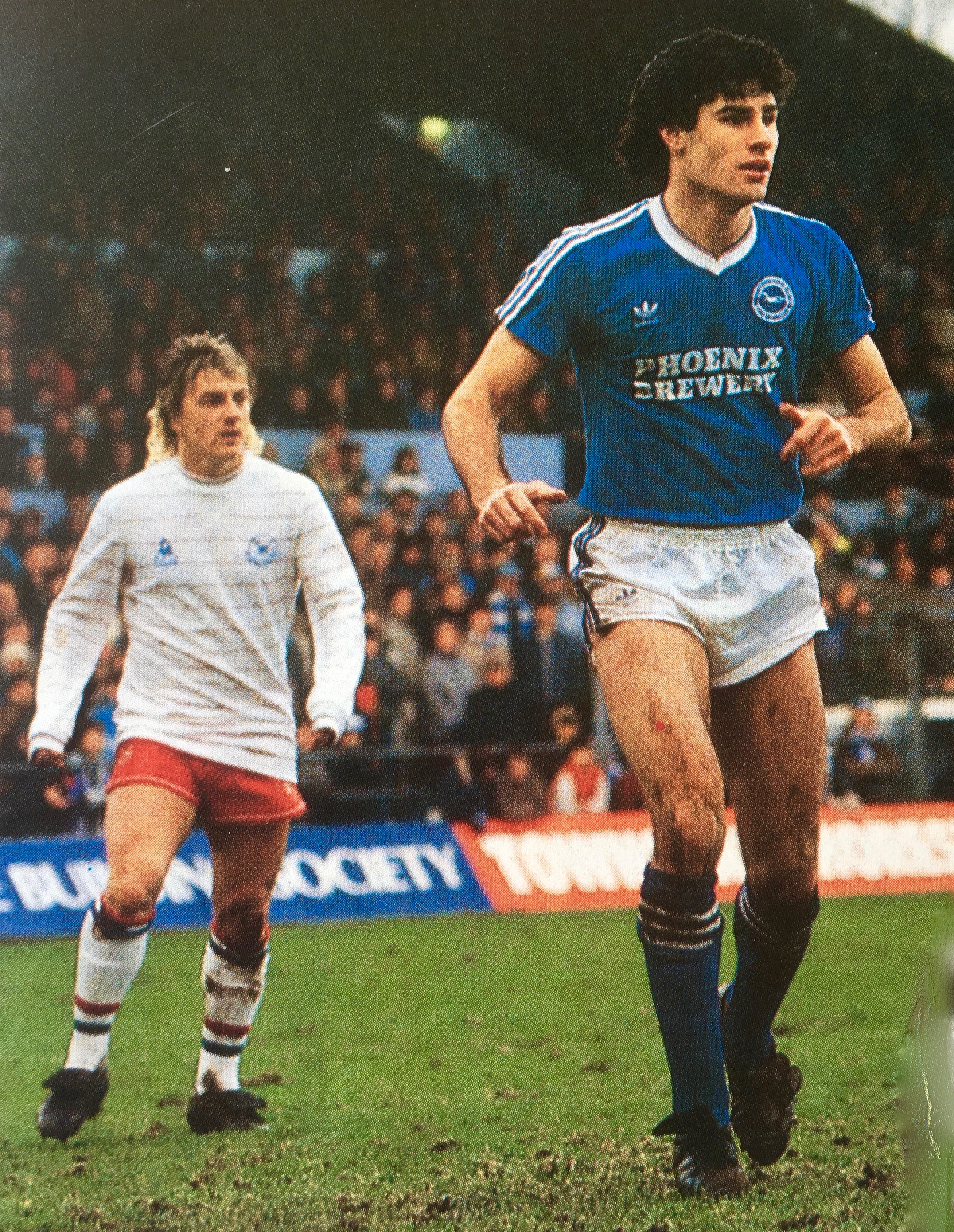
Phoenix O'R w Pompey's Biley

Pictures mainly from the matchday programme.

Above, defending against Portsmouth’s Alan Biley, who later played alongside him.

Gerry Ryan – ‘a special player and one of football’s nice people’

THERE WAS no shortage of tributes paid to Gerry Ryan when the former Albion winger died at the age of 68 on 15 October 2023.

Fellow Irish international Liam Brady, who appointed Ryan as his assistant when he took charge of the Seagulls in 1996, said: “Gerry was a wonderful team-mate. He was a very quick winger, very brave, and he took people on.

“We had some great games together and then we ended up on opposite sides, for Brighton and Arsenal, in the old First Division.”

Although Ryan and Brady’s time in charge happened during a turbulent time off the pitch, Brady pointed out: “We did a pretty good job in what were, of course, difficult circumstances, and I could see then just what Brighton meant to him – he was in love with the club so much.

“Off the pitch, Gerry was just a really nice guy. He was affable, unassuming and got on with everyone he came in contact with.”

That sentiment was echoed by teammate Gordon Smith who told the Albion website: “Gerry was always fired up to play.

“He was not always first choice, but he was still a very good player. He had this ability to be able to turn games around because he was quick and he could score goals.

“He was so reliable – he could fit into any position with his levels of fitness, ability and positional play.

“We were a very close group; we socialised a lot, we played golf, went to the races and Gerry was a key part of that – he was a really good laugh.”

Turlough O’Connor, another former team-mate, from his early days playing for Bohemians in Dublin, told the Irish Independent: “He was the most easygoing guy you’d ever meet, very laidback and always in a happy mood, and a very good footballer as well.

“He was comfortable both left and right, very good on the ball, and very quick, which helped. A very good crosser, he went by people, and was always a threat. He helped so many times laying on goals for me.”

Ryan was one of the most likeable Albion players for a huge number of fans, and I was one of them.

A versatile trier who was good enough to represent the Republic of Ireland on 18 occasions, the wholehearted Ryan might not make it into the all-time best Brighton XI but, if it was judged on affability, his name would be first on the team sheet.

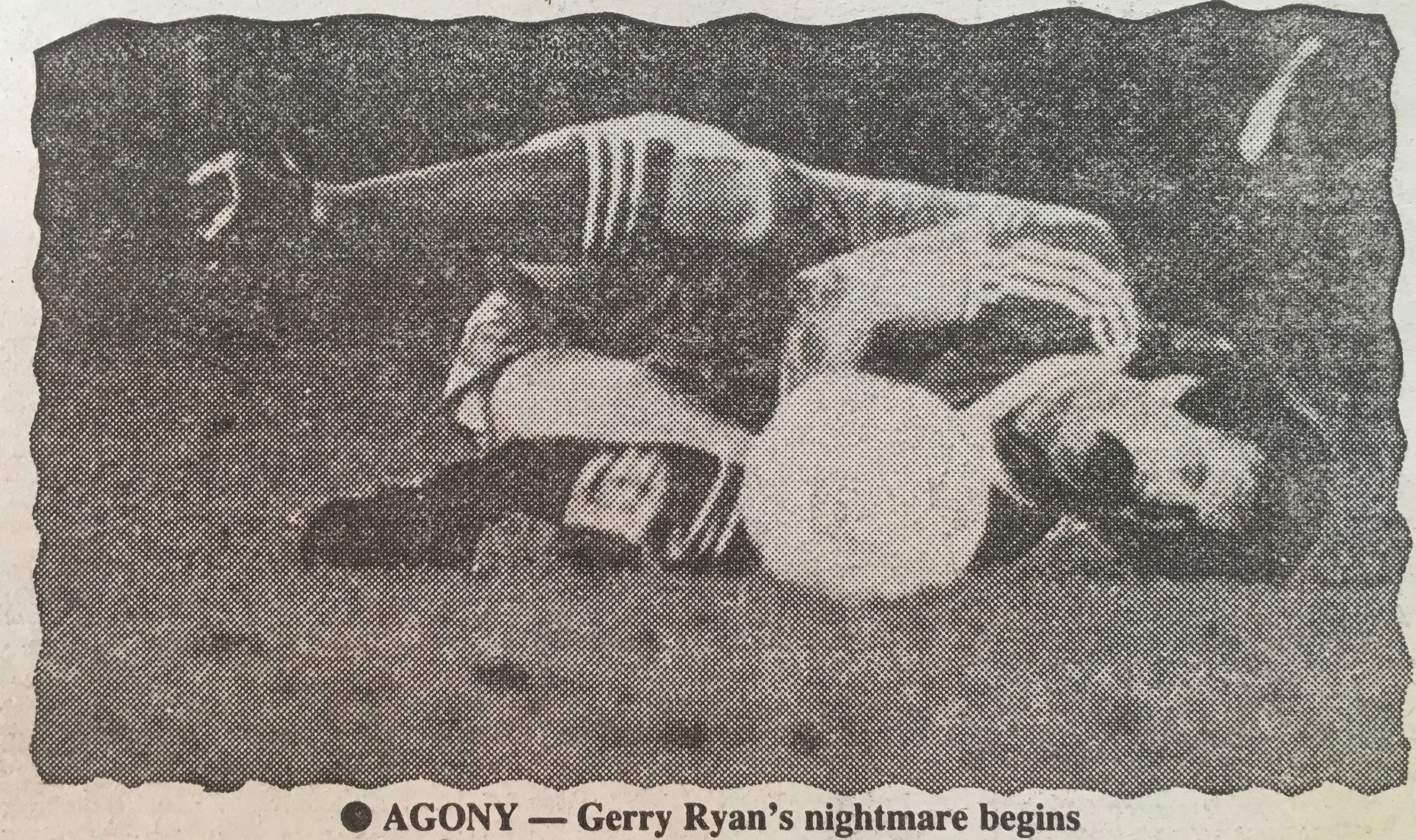
A cruel twist of fate saw his career ended in a tackle made by his Irish teammate (and former Albion boss) Chris Hughton’s brother, Henry. Typically, Ryan bore no grudges, as stressed by former Argus Albion reporter John Vinicombe in an article published in May 1986 when the genial Irishman finally accepted that his career was over.

Describing “the immense dignity and true manliness that Ryan displayed in refusing to condemn or indeed utter any harsh word against the player responsible,” he added: “Where others have sued and raged, slandered, cursed and threatened, Ryan said nothing.”

GR leg break

It was 2 April 1985 when his career was ended by that Hughton tackle in a 1-1 draw with Crystal Palace at Selhurst Park.

“Never in his life has he shirked a tackle and the one that ended his career so unfortunately at Crystal Palace was typical of many he faced in his career,” said Alan Mullery, the manager who signed him for the Seagulls.

“As a person, he is a lovely and typical Irish personality,” Mullery said in the programme for the player’s testimonial game against Spurs at the Goldstone on 8 August 1986. “I can honestly say that I have never met a player who dislikes him or has a bad word to say about him. I will remember Gerry Ryan as being a special player and one of football’s nice people.”

Mullery also referred to a Sunday lunch he and his family had with Ryan and his wife at the time he signed. “When Gerry ordered roast beef and chips I must have known then that I had a very special sort of player. At the time, I was a little dubious but afterwards I had no regrets.”

Mullery had been over in Dublin watching Albion’s Mark Lawrenson playing for the Republic of Ireland and Derby’s Ryan was playing in the same side. He had been having talks about moving to Stoke City but Mullers persuaded him to join Brighton instead, and, in a strange quirk of fate, he made his debut in a 2-2 draw away to Stoke.

After they’d become teammates, Lawrenson was among those players appreciative of Ryan’s “mercurial” qualities. He said in a matchday programme: “He wasn’t the most confident of players but he had loads of ability. For a wide player, he would come in and get goals for you.”

GR capsA week after joining the Seagulls, Ryan became an instant hit with Albion fans when he scored on his home debut in a 5-1 win over Preston. He notched a total of nine goals in 34 appearances in that first season and went on to score 39 in a total of 199 games.

Born in Dublin on 4 October 1955, Ryan was one of eight children. His early education was at the local convent in Walkinstown, a suburb to the south of Dublin where the family lived. At the age of eight he moved on to Drimnagh Castle School (it covered primary and secondary age groups).

At that stage, he was playing Gaelic football and hurling, at which he was capped at under-15 level by Dublin Schools. He didn’t play competitive football until he was 16 when he was introduced to a Dublin football club called Rangers AFC. He played alongside Kevin Moran, who later played for Manchester United, and Pat Byrne, who later played for Leicester City. Byrne and Ryan also played together for Bohemians, the oldest football club in Dublin.

Ryan joined the Dublin Corporation as a clerical officer on leaving school and played for Bohs as an amateur initially before becoming a part-timer on professional terms. By 18, Ryan was a first-team regular and, after collecting a League of Ireland Championship medal, was watched by Manchester United boss Tommy Docherty.

Docherty didn’t pounce then but, after Ryan had stayed four years with Bohemians, the ebullient Scot eventually returned to take him to England as his first signing for Derby County for a fee of £55,000.

The newly-appointed Docherty was determined to shake-up the club and while long-serving goalkeeper Colin Boulton was discarded along with striker Kevin Hector, Ryan, Scottish internationals Bruce Rioch and Don Masson, and Terry Curran and Steve Buckley were all introduced.

Ram Ryan

Ryan spoke about the way Docherty’s attitude towards him changed in an interview with Brian Owen of The Argus in 2016.

“One minute you were the blue-eyed boy, the next he wouldn’t even talk to you,” he said. Ryan made a hamstring injury worse by playing when Docherty insisted he was fit enough, and ended up sidelined for three months. “He didn’t like me then! That’s the way he was, he would turn on you, and he turned on me.”

Within a year, Docherty accepted Brighton’s £80,000 offer for Ryan and, as he was weighing up whether to choose the Seagulls or Stoke City, Ryan consulted the legendary Republic of Ireland and ex-Leeds midfielder Johnny Giles to ask his opinion.

“Gilesy said ‘Stoke have been in and out of the First Division forever but there is something going on down at Brighton. They get great crowds and it’s a beautiful place.’ I went to Brighton that weekend and absolutely loved it,” Ryan told Owen.

It was on 25 September 1978 winger Ryan arrived, prompting the departure of popular local lad Tony Towner after eight years at the Albion.

Five months before Ryan arrived at the Goldstone, he made his international debut, featuring for the first time in April 1978 in a 4-2 win over Turkey at Lansdowne Road. He only scored once for the Republic, but it was a cracking overhead kick in a 3-1 defeat against West Germany.

Ryan Eire

He was one of four regular Eire internationals playing for Albion at the time: Lawrenson, Tony Grealish and Michael Robinson the others.

His final appearance for his country came in a 0-0 draw against Mexico at Dalymount Park in 1984.

Ryan was part of some all-time history-making moments during his time with the Albion – scoring at St James’s Park in the 3-1 win over Newcastle on 5 May 1979 to clinch promotion to the top division for the first time, and burying the only goal of the game as unfancied Albion beat Brian Clough’s European champions Nottingham Forest, who’d previously not lost at home for two and a half years.

Ryan scoresMy personal favourite came on 29 December 1979 at the Goldstone when he ran virtually the entire length of a boggy, bobbly pitch to score past Joe Corrigan in the goal at the South Stand end to top off a 4-1 win over Manchester City. Ryan himself reckoned it was “the best goal I ever scored” as he recounted in a May 2020 BBC Sussex Sport interview with Johnny Cantor.

It was one of the most superb individual goals I saw scored and, when he was trying to recuperate from the horrific leg break which ultimately ended his career, I wrote to him in hospital to say what a special memory it held for me.

I was delighted to receive a grateful reply from him, and he has held a special place in my Albion memory bank ever since.

There were other stand-out occasions, two of which came against Liverpool:

in February 1983 at Anfield when he opened the scoring in Albion’s memorable 2-1 FA Cup triumph en route to the final, and, in the following season, at the Goldstone when he and Terry Connor were on target in Second Division Albion’s 2-0 win over the Reds in the same competition, the first-ever live FA Cup match (other than finals) to be shown (previously any television coverage of FA Cup ties was only ever recorded highlights).

If the modern-day reader can’t quite put the feat in perspective, it is worth pointing out that Liverpool, managed by Joe Fagan, went on to win the League Cup, the League title and the European Cup that season.

Danny Wilson hadn’t long since joined the Albion and, in an interview with the Seagull matchday programme in 2003, he recalled: “That has to be my favourite memory from all my time at the Goldstone. Back then, Liverpool were just awesome, and to beat them like we did was virtually unheard of.”

Ryan’s involvement in the 1983 Cup run was hampered by a hamstring injury which meant he missed out on the semi-final. But, in the days of only one substitute, he was on the bench for the final and, when the injured Chris Ramsey couldn’t continue, Ryan went on at Wembley and did a typically thorough job at right-back.

GR prog snow

Following Albion’s relegation, as the big-name players departed the Goldstone, Ryan’s versatility and play-anywhere attitude came to the fore and, in his last two seasons with the club he was often selected as a centre-forward, although he was not a prolific goalscorer from that position.

After he was forced to quit playing, Ryan took what was then quite a familiar route for ex-players and became a pub licensee, running the Witch Inn at Lindfield, near Haywards Heath. Ryan and goalkeeper Graham Moseley, who he’d known from his days at Derby, were neighbours in Haywards Heath.

GR pots

However, when another of his former Republic of Ireland teammates, Liam Brady, was appointed Albion manager in 1994, it was an inspired choice for him to appoint Ryan as his assistant.

When that all-too-brief managerial spell came to a messy close, Ryan returned to his pub, and then moved back to the family home in Walkinstown. Ryan’s son Darragh played 11 games for the Albion in the late 1990s.

Sadly, in August 2007, Ryan suffered a stroke, and three years later he was diagnosed with kidney cancer. On his death, his family paid tribute to the care he was given by the staff of Our Lady’s Hospice, Harold’s Cross and to the staff of Lisheen Nursing Home, Dr Brenda Griffin, the Beacon Renal Unit, Tallaght, and Tallaght Hospital Renal Unit “for the excellent care given to Gerry over the past number of years”.

Pictures from a variety of sources but mainly from my scrapbook, the matchday programme and The Argus.

Goal machine Frank Stapleton ended his playing days in a Brighton shirt

stapleton stretch

FRANK STAPLETON hit the heights as a goalscorer for Arsenal and Manchester United but his prize-winning playing days came to an end in a Brighton & Hove Albion shirt.

Stapleton was the scorer of the first top flight goal at the Goldstone Ground – unfortunately, it was the opener in Arsenal’s 4-0 win in 1979! He was also one of the Manchester United scorers in the 1983 FA Cup Final against Brighton, having moved to Old Trafford two years earlier (above, however, he just fails to connect for Arsenal against Brighton with Steve Foster and Gary Williams looking on).

His two appearances for Brighton came in 1995 when his old pal Liam Brady brought him in to try to improve the front line of an ailing side.

Born in Dublin on 10 July 1956, the promising young Stapleton was rejected by United as a teenager but the Gunners reaped the benefit of that decision by snapping him up at the tender age of 15 on chief scout Gordon Clark’s recommendation.

Arsenal’s confidence in the prospects for the promising young Irish duo were reflected in a Goal magazine article of 7 October 1972 in which boss Bertie Mee talked about them as future first team players. At the time, they were still part of the club’s junior ranks, aged just 15 and 16.

goal cutting

Mee said: “Brady is almost established as a regular in the reserve side. He needs building up but has the potential to become a first-team player. Stapleton has made quite an impact in his first season and, providing he maintains a steady improvement, he could also follow the path of Brady.”

It was only Brady’s second season and Clark, the Arsenal chief scout who unearthed him, said, at first, he thought he would be better suited to becoming a jockey because he was so small and frail!

He quickly changed his mind when he saw his ability with a football. “He was like a little midget but he had so much confidence. He’s really shot up now and although he’s still not very tall, he’s strong enough to hold his own,” said Clark.

Stapleton, at 15, joined Arsenal in the summer of 1972 and quickly developed a reputation as a goalscorer, netting 11 goals in seven games.

“Frank is tall and very good in the air,” said Clark. “He seems to get up and hang for the ball. He is also very good on the floor and reads the game intelligently for a youngster.”

As expected, Stapleton progressed to the first team and made his debut in 1975 against Stoke City. He initially formed an impressive partnership with England striker Malcolm Macdonald and in three successive seasons was Arsenal’s leading goalscorer.

Such prowess brought him to the attention of the Republic of Ireland international selectors and player-manager Johnny Giles gave him his full debut aged just 20 in 1976 against Turkey in Ankara.

It was the first of a total of 71 caps for his country, during which time he became their captain and scorer of 20 goals. He led Eire when they famously beat England 1-0 at the Euro 1988 finals in Germany. Although he was part of the 1990 World Cup squad – alongside former Albion boss, Chris Hughton –  he was by then behind Niall Quinn, John Aldridge and Tony Cascarino in the pecking order.

Stapleton was part of Arsenal’s three successive FA Cup final teams (1978, 1979, 1980), scoring against United in Arsenal’s 3-2 win in 1979.

When the Gunners sold Brady to Juventus in 1980, Stapleton started to question the club’s ambition and, the following year, on expiry of his contract, decided he would move on himself.

He had scored 108 goals in 300 appearances for Arsenal – some strike rate! – and it wasn’t a popular move to join a major rival in the same division, but he wasn’t the first or last player to have done so.

In the Sixties, United had taken David Herd from the marble halls of Highbury to lead their line and, of course, in more recent times, United signed Alexis Sanchez.

stapleton utd

When Robin van Persie made the same transfer switch from Arsenal to Manchester United in 2012, the Daily Mail took Stapleton back 30 years to talk about the circumstances of his own move.

Stapleton was Ron Atkinson’s first major signing for United and in his first season was partnered up front with Garry Birtles. Stapleton was the leading scorer for United in that first season, with 13 goals in 41 league games.

Subsequently, his main strike partner was the Northern Ireland international, Norman Whiteside.

img_4637

Stapleton scored United’s first goal, a 55th minute equaliser, in the 2-2 Cup Final draw against Brighton: one of 19 he notched during the 1982-83 season in which he played in 59 of United’s 60 games.

By the end of the following season, Stapleton’s regular strike partner was Mark Hughes and he scored in the 1985 FA Cup semi-final against Liverpool to set up yet another Wembley appearance, this time collecting his third winners’ medal when Whiteside’s winner beat Everton.

Despite a good start to the following season, with Stapleton once again amongst the goals, poor league form eventually cost Atkinson his job and his successor, Alex Ferguson, began rebuilding the side.

After six years at United, Stapleton, by then 30, was amongst those to be let go, and he was sold to Ajax of Amsterdam, lured by the fact they were managed by Johan Cruyff. But the move failed to live up to expectations, as detailed by the42.ie, and he ended up having a spell on loan at Anderlecht.

It was the first of a series of moves which didn’t really work out for him, although in the 1988-89 season he found himself playing in France alongside fellow Irish international – and future Brighton striker – John Byrne for Le Havre.

stapleton 4 derby

Derby County offered him a platform back in the UK game and he featured 10 times for them in 1987-88 and, after his stint in France came to an end, he spent two seasons with Blackburn Rovers.

He played once for lowly Aldershot and five times for Huddersfield Town before landing a player-manager’s post with Bradford City. In three years at Valley Parade, he made 68 appearances before the axe fell, and he answered Brady’s call for help at the Goldstone Ground.

The brilliant The Goldstone Wrap detailed his brief involvement in a March 2015 post, explaining how he featured as a substitute in a 0-0 draw at home to Bournemouth and started in a 3-0 defeat away to Cardiff City.

It was a final swansong for his playing career, as he looked to get back into coaching or management. He had two stints working under his former United teammate Ray Wilkins: at QPR and, in 2014, with the Jordan national side.

Stapleton spent eight months in 1996 as the first head coach of American Major Soccer League side New England Revolution, of Massachusetts.

His last appointment in the English game was briefly as a specialist striker coach at Bolton Wanderers, appointed during Sam Allardyce’s reign, in 2003-04.

Nowadays, Stapleton is more likely to be found talking about his illustrious career, his availability for bookings listed by football-speakers.com.

Fans took Alan Duffy to their hearts after debut goal

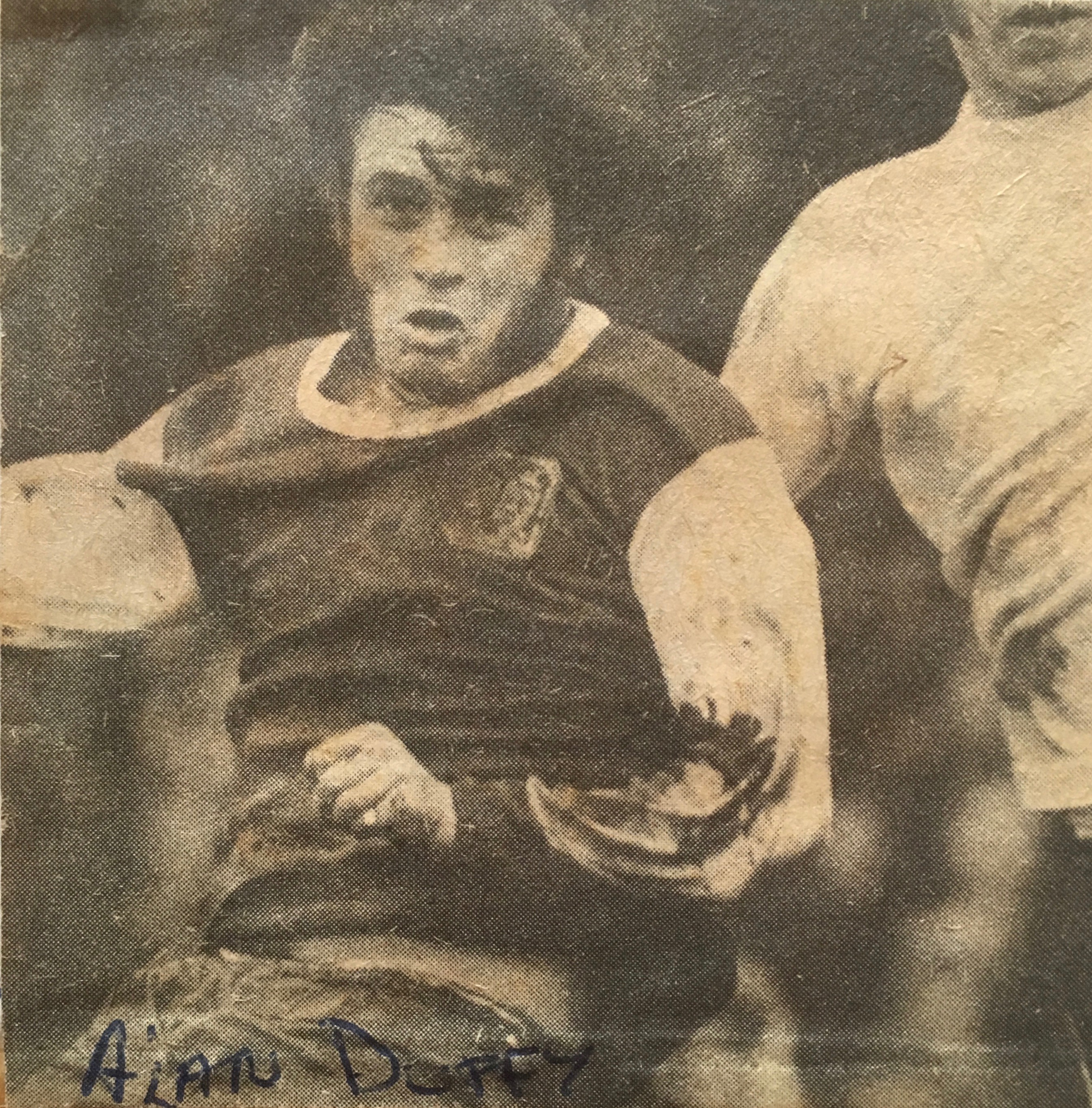
TWENTY-year-old Alan Duffy couldn’t have wished for a better start to his Brighton career than scoring a belter on his debut.

A £10,000 signing from Newcastle United, he was quickly off the mark on 17 January 1970 in a 2-1 Third Division win over Bradford City.

He appeared to be “the Third Division answer to George Best by beating two Bradford players and smashing a ferocious shot in off the crossbar” according to Seagulls TV, which recounted he was a “stocky striker with a robust style”.

Fan Mo Gosfield, posting on North Stand Chat in January 2011, described the goal as “one of my top 10 Albion moments, because it took your breath away”.

Mo added: “He had all the makings of a cult figure at Brighton. The swagger, the shock of hair, the slight beer belly. I loved him, but he never quite lived up to that sensational start.”

The fans in the old North Stand adapted the Hare Krishna chant to incorporate his name and, after that promising debut, the young striker kept his place in the starting line-up through to the end of the season.

He repaid manager Freddie Goodwin’s faith in him with five more goals. Particularly memorable were Duffy’s two goals in Albion’s 2-1 win over Reading on Good Friday when a huge crowd of 32,036 packed into the Goldstone.

2 AD action BW.jpg

Brighton were top of the league going into the game and looking a good bet for promotion.

Former goalkeeper Brian Powney discussed that game – and Duffy – when he was interviewed by Brian Owen for an article in the Argus on 20 February 2017.

There were question marks over both Duffy’s goals – a suspicion of handball for one, the other possibly offside – but, while both stood, a seemingly good goal from the youngster was ruled out later on.

Looking back on the game was a painful reminder for Powney, who dislocated a finger which physio Mike Yaxley had to put back while out on the pitch, it being the era long before substitute goalkeepers were available.

Unfortunately, too, Albion blew their promotion chances by losing four of the last five games after that Easter win over the Royals.

The only other points collected came in the penultimate game, a 2-1 home win over Rotherham, when Duffy again scored twice – one a penalty.

Asked about Duffy in that 2017 interview, Powney said: “Alan was hit and miss, a bit madcap.

“He had a lot of talent and, had he applied himself, he would have had a longer career. He was a good player but not such a good pro.”

Like many a player before and since, a change of manager in that World Cup summer of 1970 didn’t help Duffy’s progress at Brighton although, according to Seagulls TV: “Weight issues and injury woes, starting with a thigh problem on the opening day, marred his 1970-71 campaign.”

Duffy began in the no.8 shirt for the opening two games of that season under Goodwin’s replacement,Pat Saward, but a thigh injury picked up away to Bristol Rovers proved more problematic than first thought and he missed a large part of the first half of the season.

Duffy was out of the side from mid-October to February and, on his return to the starting line-up, was involved in one of the most curious incidents I ever saw at the Goldstone.

On 27 February 1971, against Preston North End, Albion won a controversial penalty at the south stand end of the pitch after Duffy somewhat unconvincingly tumbled in the area.

Centre forward Kit Napier took the spot-kick;  ‘keeper Alan Kelly saved it, but referee Tom Reynolds ordered a retake because of encroachment. As Napier steadied himself for the retake, Duffy stepped forward, pushed his teammate out of the way, took the penalty himself – and missed!

In the Argus, reporter John Vinicombe wrote: “Napier watched aghast as the ball thudded against the bar. Duffy hung his head, as well he might.” The game finished in a disappointing 0-0 draw.

“The manager went mad at him afterwards,” Powney recalled, and Saward promptly dropped Duffy to the bench for the next two matches.

In the meantime, the manager brought in the experienced Bert Murray and Willie Irvine on loan to add some nous and quality. Although Duffy did get back in the side for six games, the rest of the time he was on the bench.

One time when he entered the fray from the bench against Aston Villa, a BBC radio commentator described him as “a square little man – an oddity” but he was soon singing his praises for a through ball that set up Napier to score.

His only goals of the season came in the same match – against Bradford City, in a 3-2 win at Valley Parade on Easter Monday. Duffy struck twice in the second half as Albion came back from being 2-1 down at half-time.

By the season’s end, he had made just 15 starts, and was subbed off on five occasions. There were seven appearances off the bench, plus three occasions when he was a non-playing sub.

In 1971-72, he made just one start – in a league cup match – and was only ever a substitute in the league, coming on 12 times and not being used on 10 other occasions.

A Brighton & Hove Gazette special publication noted that shortly after coming on as a substitute in a second round FA Cup game at home to Walsall in December 1971, he was booked for fighting with the Saddlers’ goalkeeper, Bob Wesson.

A subsequent post-match incident with the goalkeeper led to Duffy being suspended for six weeks. His final appearance saw him come on for Murray in a 4-2 win away to Oldham Athletic in mid-January 1972.

Saward clearly didn’t see Duffy as a long-term part of his plans and when he plunged into the transfer market on deadline day in March, the Geordie was used as a makeweight in the deal which brought Tranmere Rovers striker Ken Beamish to the Goldstone for a fee of £25,000. On the same day, Wolves’ Irish international Bertie Lutton returned to the Albion following a loan spell earlier in the season.

In two years at Prenton Park, Duffy made 33 appearances and scored just twice, before heading back to the north east in 1973 to join Darlington.

In the 1973-74 season, he played 24 games for Darlington without getting on the scoresheet and the following season drifted into non-league football, playing for Consett.

It was quite some fall from that glorious day on 21 September 1968 when he had made his Newcastle first team debut against Manchester United at Old Trafford in a 3-1 defeat.

Born on 20 December 1949 in Stanley, Co Durham, Duffy joined Newcastle in 1966 and on 7 April 1968 won an England Youth international cap when he featured in a 0-0 draw away to Bulgaria.

The game took place in Nimes, France, and was part of the UEFA Youth tournament. Amongst his teammates were Burnley’s Dave Thomas and Steve Kindon and fellow Magpie Alan Foggon.

After that debut at Old Trafford, Duffy didn’t play for the first team again until 9 August 1969, coming on as a sub in a 1-0 defeat v West Ham.

His next chance came on 20 September 1969 when he came on as a sub in a 1-1 draw with Southampton.

A week later, he got a start in another 1-1 draw, this time against Wolverhampton Wanderers. But Toon1892.com recounted: “In his time at Newcastle he was always considered to be Pop Robson’s deputy rather than a first team choice.”

When the Toon decided to let him join Brighton, Duffy had to admit he’d never previously ventured that far south before. At least there was a familiar face waiting for him when he arrived: at the time, Albion had a young Newcastle goalkeeper, Martin Burleigh, on loan.

The matchday programme revealed how manager Goodwin and club secretary Alan Leather had quite a journey travelling to the North East to clinch the deal for Duffy because bad weather caused them to alter their train and plane arrangements.

Leather then had to dash from Newcastle to the Football League headquarters at St Annes on the Lancashire coast to register the paperwork ahead of the 48-hour deadline for new signings so that Duffy would be eligible to play in Albion’s away game at Barrow. He managed it…..but then the match was postponed!

Pictures from my scrapbook either originated in the matchday programme or were published in the Evening Argus. Also featured, a special publication produced by the Brighton & Hove Gazette.

Steve Coppell not the first ex-Man U player to quit the manager’s chair

coppell cropSTEVE Coppell was not the first former Manchester United player I saw become manager of Brighton. More than 30 years previously Busby Babe Freddie Goodwin had been at the helm when my Albion-watching passion began.

Unfortunately, there was a parallel in their outcomes: both were wooed by better opportunities elsewhere (Goodwin to Birmingham; Coppell to Reading). One other parallel to record, though, is that each of their successors (Pat Saward and Mark McGhee) got Albion promoted.

Hindsight is a wonderful thing, but, if Coppell hadn’t been jet lagged the first time chairman Dick Knight interviewed him for the Brighton job, the 2002-03 season may have panned out differently…and Kolo Touré, a future Premier League winner with Arsenal and Manchester City, might have spent a season helping the Seagulls to retain their recently-won second tier status. Let me explain.

Coppell had been out of the country in Thailand during the summer of 2002 and, although Knight wanted to interview him with a view to appointing him as Peter Taylor’s successor, when the meeting in London eventually came about, Coppell began to nod off with the effects of his long-distance travel.

A frustrated Knight, under pressure on several fronts that summer (as told in his autobiography Mad Man: From the Gutter to the Stars, the Ad Man who saved Brighton) left him to it and took the decision to appoint third choice Martin Hinshelwood instead. (Knight had also considered German Winfried Schäfer, who had just managed Cameroon at the World Cup, but his poor command of English went against him).

As the opening to the season drew closer, Knight went with Hinshelwood to watch an Arsenal under 23 side in a friendly at Barnet. He was running the rule over Steve Sidwell with a view to taking him on a season-long loan but the stand-out player who caught his eye was Touré, and Albion’s cheeky chairman said he’d take the pair of them.

To his delight, Arsène Wenger and Liam Brady agreed…but astonishingly Hinshelwood said they weren’t needed because, in his opinion, they weren’t any better than Albion’s own youngsters, who he had been coaching, and who he was now intending to blood in the first team. An incredulous Knight kept schtum, believing he needed to support his new manager.

When they started the season with a 3-1 win at Burnley, it seemed maybe Hinshelwood had a point. But, after a disastrous run of 12 defeats, leading to the inevitable sacking of Hinshelwood, Knight reverted to Plan A and succeeded in attracting Coppell to manage the side.

He then swiftly went back to Arsenal to secure the loan services of Sidwell (who’d played for Coppell at Brentford the previous season). But he was too late as far as Touré was concerned. He’d already played his way into first team contention for the Gunners and was no longer available.

coppell + booker

With Albion at the foot of the table, Coppell had a rocky start at the helm of the Seagulls, including an embarrassing 5-0 defeat to Palace, but he quickly brought in some quality players such as Dean Blackwell and Simon Rodger, and, together with Bobby Zamora up front and the busy Sidwell in midfield, they put together some decent results that dared to suggest a great escape was possible.

Albion notched up some surprise results, including a 1-0 Boxing Day win at Norwich and a 4-1 home win over Wolves, who ended up in the play-offs. There was also a memorable 2-2 draw at Ipswich, a 4-0 home win over Watford and a 2-1 win at Reading, most notable for a rare appearance and goal from former Premiership striker Paul Kitson, who had been injured for much of the season.

Sadly, it wasn’t quite enough to keep the Seagulls in the division and they went down second from bottom, five points adrift of 21st placed Stoke City.

The following season was in its infancy when West Ham decided to sack Glenn Roeder as their boss. The Hammers were determined to replace him with Reading’s Alan Pardew; and Reading, once they realised their fight to keep Pardew was fruitless, turned to third tier Albion’s Coppell as his replacement.

Chairman Knight knew Reading could offer Coppell the opportunities that were still some way in the distance if he’d stayed at the Albion, so he did the next best thing which was to get a healthy sum in compensation which went a long way to funding that season’s wage bill.

Knight was a big fan of Coppell and admired his meticulous preparation for games through in-depth viewing of opponents.

In an interview with The Guardian, Knight said: “He is probably the most analytical mind brought to football management for many a year. His preparations are detailed to the point of fastidious. His briefings are second to none. He spent hours with the video in the afternoons breaking down moves in slow-mo to work out how the opposition operate. He is very perceptive.”

Knight added: “People say he’s cold and uncaring, but he came to one of our marches on the seafront to campaign about the new stadium at Falmer long after he left for Reading. That’s Steve. He left a big impression on us.”

coppell at reading.jpg

Coppell left the Albion with a 36.7 per cent win ratio over his 49 games in charge, just over three percentage points behind his first spell as Palace manager, but higher than his other three spells at Selhurst.

To avoid this blog post turning into War and Peace, I’m not going to cover the whole of Coppell’s career but, in the circumstances, it is worth touching on how he came to be a star on the wing for Manchester United and England.

The Liverpool lad went to the same Quarry Bank Grammar School that produced Joe Royle and Beatle John Lennon, but head teacher William Pobjoy ensured football mad Coppell stuck to his studies.

It didn’t deter Coppell from having a trial with Liverpool and playing for an Everton junior side a couple of nights a week. But both rejected him as too small and his dad Jim told playupliverpool.com: “He lost faith in ever becoming a footballer and took up golf and became quite good.” He still played football for a local side but that was just for pleasure.

A Tranmere Rovers scout made several approaches but Steve wasn’t interested, and decided he was going to go to Liverpool University to take a degree in economics and social history.

Ron Yeats, the famous colossus around who Bill Shankly built his Liverpool team in the 1960s, became Tranmere manager in the early 1970s. He remembered of Coppell: “We signed him so he could combine it with university.”

Around the same time, Coppell shot up from 4ft 11in to 5ft 7in in a year, and went on to play 38 times for Tranmere, scoring 10 goals.

Word reached Manchester United boss Tommy Docherty who paid a £35,000 fee to take him to Old Trafford. He was playing for United in the old second division while still completing the third year of his degree course. United’s deal with Tranmere had it built in that they’d pay an extra £20,000 if Coppell made it to 50 appearances. They paid it after only two games, such was the impact Docherty knew he was going to have.

Indeed, he went on to make 373 appearances for United and scored 70 goals; and the 207 games he played between 1977 and 1981 broke the record for the most consecutive appearances for an outfield Manchester United player, and still stands to this day.

coppell utd action

He played in three FA Cup Finals for United, in 1976, 1977 and 1979, only ending up with a winners’ medal when Liverpool were beaten 2-1 in 1977.

Coppell was still at United in 1983, and had been United’s top scorer on the way to the Milk Cup Final that season, but he was recovering from a cartilage operation on his damaged left knee so was unable to play in the FA Cup Final against Brighton.

He told Match magazine: “I was always fighting a losing battle against time to get fit for the final. In my heart of hearts, I knew when I had the cartilage operation that five weeks wasn’t enough time to get fit for a match of this importance. I was struggling to make it from the off.”

Coppell told Amy Lawrence of The Guardian: “’I had nine wonderful years there and I still remember running on at Old Trafford for the first time. It was a real heart-in-the-mouth moment, an incredible experience for a 19-year-old whose biggest crowd before then was probably about 5,000.”

He also won 42 caps for England and Sir Trevor Booking, one of his contemporaries in the England team, spoke in glowing terms about Coppell the player in his book My Life in Football (Simon & Schuster, 2014).

England international

“He was a winger at a time when wingers were unfashionable,” he said. “He had the pace to reach a 30-yard pass, the skill to wriggle past a defender and send over the perfect cross. But he also had the energy to run back and provide cover for his defensive team-mates down the right flank that set him apart from so many other wingers at that time.

“When his team lost possession, Steve didn’t hang about on the flank waiting for someone to win it back. He wanted to win it back himself. He was involved all the time – a quality that is a prerequisite for today’s wide players.”

Coppell made his England debut under Ron Greenwood against Italy at Wembley in 1977 in a very exciting line-up that saw him play on the right, Peter Barnes on the left, and Bob Latchford and Kevin Keegan as a twin strikeforce. It was a favoured foursome for Greenwood and when they all played together against Scotland in 1979, Coppell, Keegan and Barnes all scored in a 3-1 win.

It was while on England duty that Coppell picked up the injury that would eventually lead to a premature end to his career. Brooking recalled: “A tackle by the Hungarian József Tóth at Wembley in November 1981 damaged his knee and although he played on for a year or so more, the knee condition worsened.

“He was able to play in the first four games of the 1982 World Cup but the problem flared up after the goalless draw with West Germany and he had to miss the decisive match against Spain.”

From 2016, Coppell spent three years as a manager in India. Amongst the players he worked with at Kerala Blasters (owned by cricketing great Sachin Tendulkar) in 2016-17 was Aaron Hughes, who had a season with Albion.

The following season Coppell became the first head coach of newly-formed Jamshedpur, owned by Tata Steel, and for the 2018-19 season he took charge of Indian Super League club ATK, once part-owned by Atletico Madrid. Among its owners were former Indian cricket captain Sourav Ganguly.

thoughtful coppell