
 The mercurial footballing genius George Best used to clean the boots of the centre forward who scored twice in the very first Albion game I saw.
By the time of that 3-0 win v Walsall in 1969, Alex Dawson was on his way down the footballing pyramid, just over a decade after he came mighty close to perishing with some of his Manchester United teammates in the Munich air disaster.
Only five years earlier the swashbuckling centre forward had scored twice in the FA Cup Final at Wembley as his Preston North End side lost 3-2 to a Bobby Moore-led West Ham United.
The former Manchester United centre forward arrived at the Goldstone through a connection made at Old Trafford in that post-Munich era. Freddie Goodwin, another pitched from the United reserves into the first team as a consequence of the tragedy, made Dawson his first signing when he took over as Brighton manager in December 1968. A £9,000 fee brought him to Sussex from Bury.
At the Albion, he linked up with another familiar face in Nobby Lawton, a tenacious midfield player who had also been at Man U with him and then captained Preston in the aforementioned cup final.
Lawton, now sadly no longer with us, mentioned “that great striker Alex Dawson” in an interview he gave to the Lancashire Evening Post, published in May 2004.
“I’d known Alex since we were both on the groundstaff at Old Trafford,” Lawton recalled. “He was a bull of a centre-forward and was a Deepdale hero.
“He’s a lovely man and I was best man at his wedding. He hasn’t changed at all, and we are still great friends.
“Alex and the rest of the team would have graced any Premiership side today.”
Dawson certainly arrived with a bang on the south coast finding the net no fewer than 17 times in just 23 games, including three braces and four in an away game at Hartlepool.
The following season, Goodwin added Alan Gilliver to the strikeforce and he outshone Dawson in the scoring stakes, although the Scot still scored 12 in 36 games.
As is so often the case, it was a change of manager that marked the end of his time with the Albion. With Goodwin departed for Birmingham, replacement Pat Saward didn’t give him much of a look-in and he went out on loan to Brentford where he showed he could still find the back of the net with familiar regularity.
Greville Waterman, on bfctalk.wordpress.com in July 2014, shared a great magazine front cover featuring Dawson and recalled: “He was a gnarled veteran of thirty with a prominent broken nose and a face that surely only a mother could love, but he had an inspirational loan spell at Griffin Park in 1970 scoring seven times in eleven games including the winner in that amazing late, late show FA Cup victory against Gillingham. Typical of the times at Griffin Park, he departed after his loan spell as apparently the club was unable to agree terms with him. A classic example of both parties suffering given that Dawson never played another Football League game and Brentford lacked a focal point in their attack until the arrival of John O’Mara later that same season.”
Released by the Albion at the end of the 70-71 season, Dawson’s final footballing action was with non-league Corby Town.
Nevertheless, he could look back on a fantastic career as a goalscorer, with a strike rate the envy of many a modern day forward.
To this day, he is still the youngest player (at 18 years and 33 days) to have scored a hat-trick in a FA Cup semi-final (in Man U’s 5-3 1958 win over Fulham) and he is one of only nine players to score in each of his first three Man U games.
Originally from Aberdeen (he went to the same school as that United legend Denis Law), his parents had moved down to Hull and Dawson joined United straight from Hull Schoolboys. He made his United debut in April 1957 aged just 17.
On redcafe.net, Julian Denny recalled how Dawson once scored three hat-tricks in a row for a Man U reserve team that was regularly watched by crowds of over 10,000!
In researching for this piece, I’ve read some views that Dawson’s career with United may have panned out differently if he hadn’t been thrust into first team action at such a young age.
But that was one of the consequences of the Munich air disaster, which he has spoken about in several interviews since, usually around notable anniversaries of the tragedy.
It’s difficult to tell whether there were mental scars from the trauma of the crash but Dawson was just short of his 18th birthday when several of his close mates died. In an interview with Chris Roberts in the Daily Record (initially published 6 Feb 2008 then updated 1 July 2012), he recalled: “I used to go on those trips and had a passport and visa all ready but the boss just told me I wasn’t going this time. I had already been on two or three trips just to break me in. I know now how lucky I was to be left in Manchester. The omens were on my side.”
Dawson went on to describe the disbelief and the feelings they had at losing eight of the team, including Duncan Edwards several days later. “We were all so close and Duncan was also a good friend to me before the accident,” said Dawson. “Duncan was such a good player, there is no doubt about that.
“He was a wonderful fellow as well as a real gentleman.
“I will never, ever forget him because he died on my birthday, February 21, and before that he was the one who really helped me settle in.”
Just 13 days after the accident, Dawson took his place beside survivors Bill Foulkes and Harry Gregg as United faced Sheffield Wednesday in the fifth round of the FA Cup – and won 3-0.
That 5-3 semi-final replay win against Fulham was not surprisingly an early career highlight and when talking about it in 2013 (on the 55th anniversary of the disaster), Dawson told manutd.com: “In our first game with Fulham, Bobby Charlton scored twice in a 2-2 draw, and I was put on the right wing. I was a centre-forward really and when we played the replay at Highbury four days later, I was back in my normal position. Jimmy (Murphy) said before the game: ‘I fancy you this afternoon, big man. I fancy you to put about three in.’ I just said: ‘You know me Jim, I’ll do my best,’ but I couldn’t believe it when it happened.
“The first was a diving header, I think the second was a left-footer and the third was with my right foot.
“Nobody can ever take that afternoon away from me. It was a long time ago, of course, and it’s still a club record for the youngest scorer of a hat-trick in United’s history. Records are there to be broken and I’m surprised that it’s gone on for over half a century.
“I’m a proud man to still hold this record. Even when it goes, nobody can ever take the achievement away from me – I’ll remember that afternoon for as long as I live.”
In the two seasons following Munich, Dawson became a more established first team player although it would be wrong to describe him as a regular.
Another Scot, David Herd had scored a hat-trick for Arsenal against United and Matt Busby took him to Old Trafford in July 1961. It signalled the end of Dawson’s time with United.
Nevertheless, by the time he was sold to Preston in October 1961 for £18,000, he’d scored 54 goals in 93 United appearances.
And what about Best and his boots? It was the job of apprentices to look after the footwear of United’s first team players, and it was the young Best, who became a United apprentice in August 1961, who was detailed to keep Dawson’s scoring boots in good order.
In his 1994 book, The Best of Times (written with Les Scott), Best said: “Alex Dawson was a brawny centre forward whose backside was so huge he appeared taller when he sat down. To me, Alex looked like Goliath, although he was only 5’10”. What made him such an imposing figure was his girth.
“He weighed 13st 12lbs, a stone heavier than centre half Bill Foulkes who was well over 6ft tall. What’s more, there wasn’t an ounce of fat on Alex – it was all muscle.”
During a prolific time at Preston, Dawson scored 114 goals in 197 appearances, with the highlight that FA Cup Final in 1964.
Albertan on pne.net in 2012 said: “Alex Dawson was a super player … He was the complete centre forward – powerful, mobile and lethal with either foot or his head. He was also brave, committed and characterful.” While sliper on the same forum added: “In his prime Dawson was a powerhouse and great to watch.. I can safely say I’ve never seen a better header of a ball at Deepdale.”
Curlypete recalled: “You could literally see goalkeepers tremble when Dawson was running at them, it was either the ball, ‘keeper or more likely both who ended up in the net.”
Pictures:
• Top, pictured wearing the 1970-71 kit.
• Kneeling, from a 1969 Albion line-up.
• A magazine front cover.
• Brighton Herald’s black and white photograph in a 1969 Albion programme shows Dawson in goalmouth action watched by colleague John Napier (no.5).


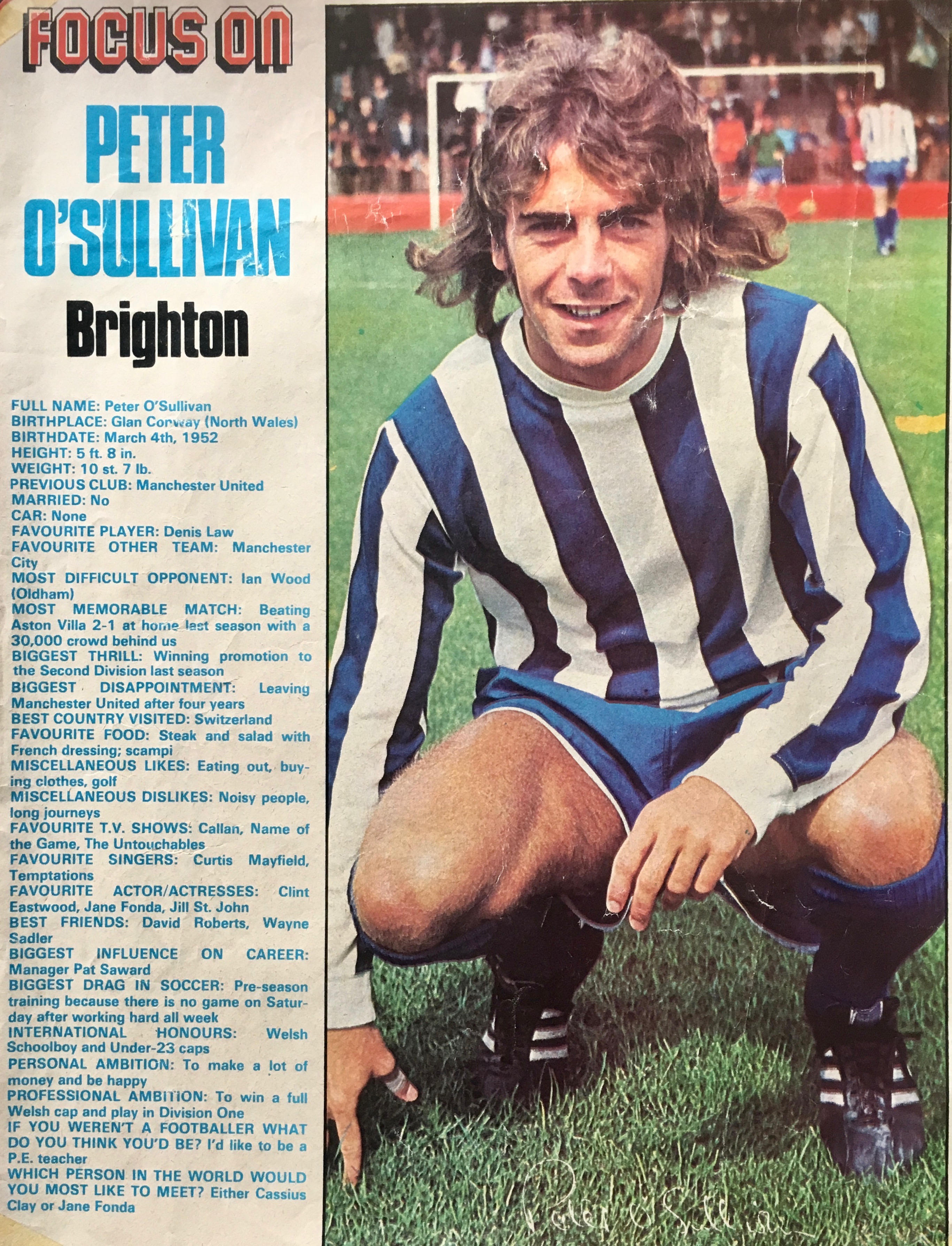


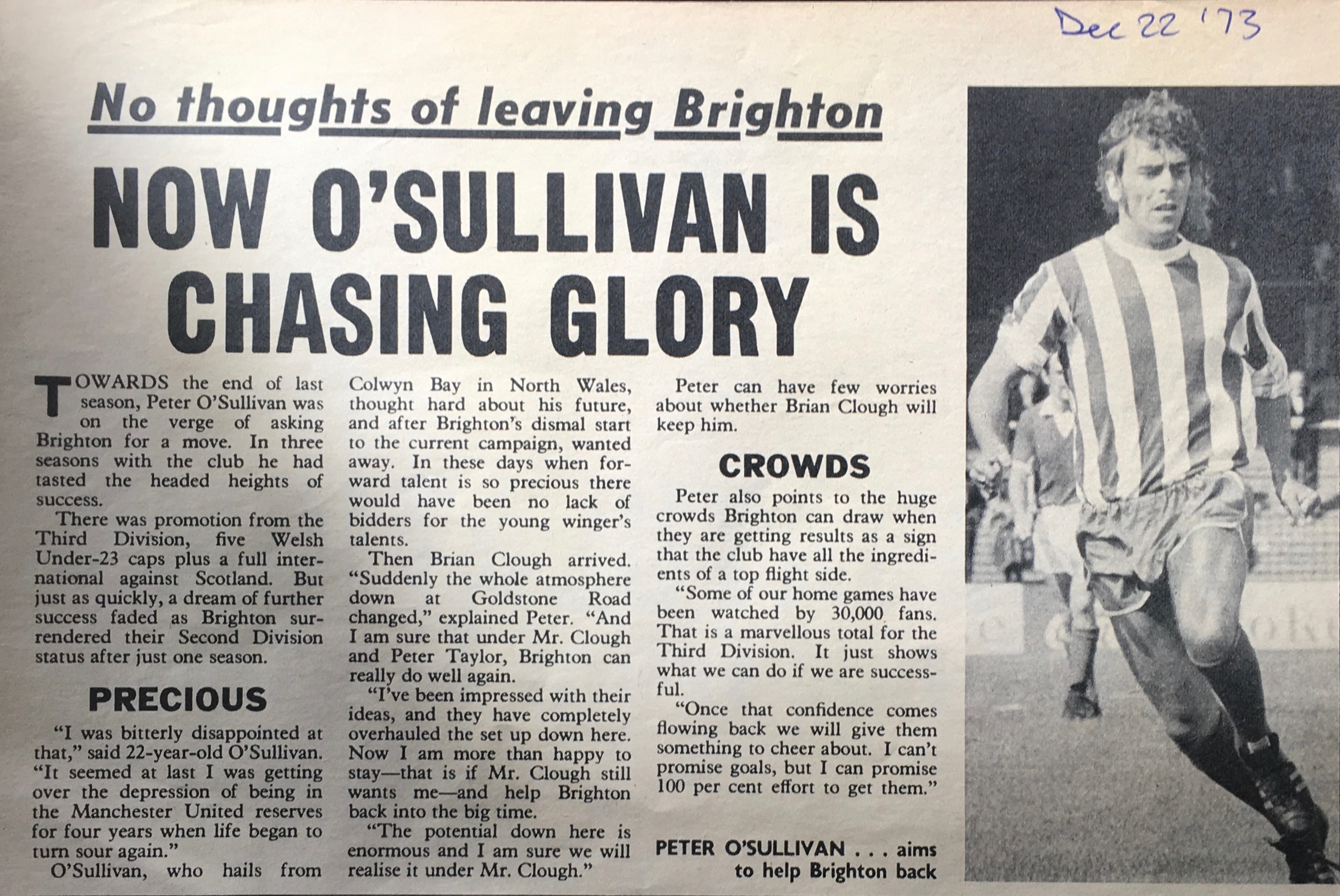
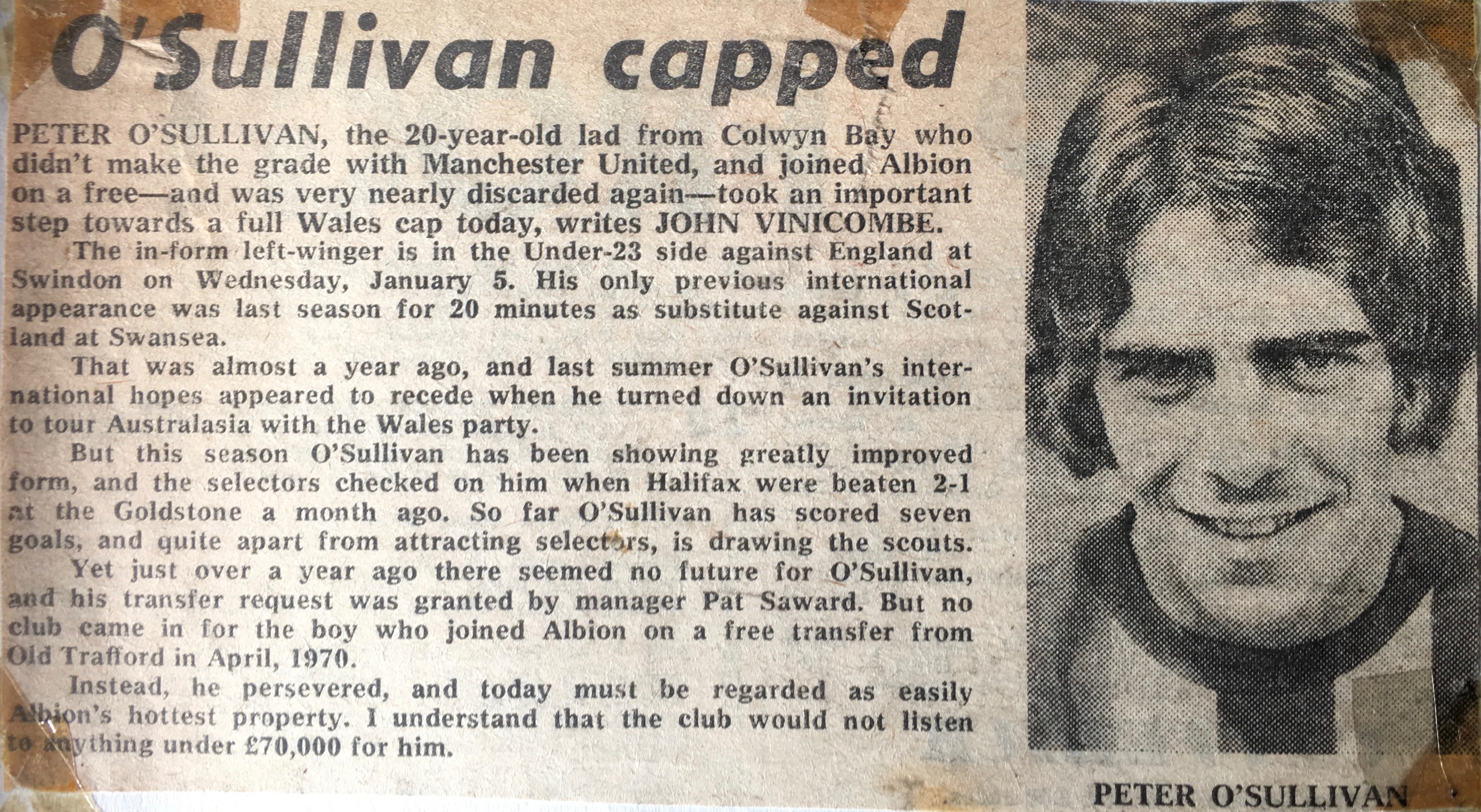 The performances of the lad from Colwyn Bay also saw him earn three international caps for Wales, two against Scotland and one in a rout against Malta when he also got on the scoresheet. Unfortunately for him, during the same period, a superb left-sided player called Leighton James was the first choice for the national side.
 In parallel lines