IT’S THE SEASON of giving and with the days coming in twelves this In Parallel Lines ‘special’ gives you a dozen players who’ve played for the Albion and post-Christmas opponents Arsenal.
A bit like an advent calendar, and with the slightest hint of Dickens’ A Christmas Carol, you’ll need to click on the link to see if the player has featured in a blog post of the past or is a blog post still to come!
Across several decades, there have been numerous connections between the clubs but with my own Brighton-watching journey beginning in 1969, I’m not looking at the likes of Irish international defender Jimmy Magill or manager Archie Macaulay because they were before my time.
Let’s start with goalkeepers. Over the years, there have been several who’ve worn the gloves at both clubs – Tony Burns, Nicky Rust or Mat Ryan for example. Younger readers will be more familiar with Ryan and, as an Australian international, he gets the nod as no.1.
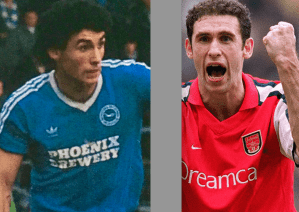
If international status gives a player the edge, it would be tempting to suggest Ben White at right-back but ahead of him I’d have to pick Martin Keown. More familiar to today’s football watchers as a TV pundit, those of us with a few more miles on the clock will remember him as a youngster spending two spells on loan with the Seagulls before he got his break with the Gunners, Aston Villa and Everton and won 43 caps for England.
Another TV and radio pundit who wore Albion’s stripes with aplomb having once been a £2m signing by Arsenal is Matthew Upson. He was Brighton’s player of the season in 2013-14.
The late Willie Young, one of that rare breed who played for Arsenal and north London rivals Spurs, comes into contention alongside him but he didn’t cover himself in glory at Brighton so I am plumping for Colin Pates. Pates first made a name for himself as Chelsea’s youngest-ever captain before becoming a reliable back-up defender during George Graham’s reign at Arsenal.
Brighton manager Barry Lloyd had been a teammate of Graham’s at Chelsea in the mid-1960s and the connection served Albion well when he agreed for Pates to join the Seagulls on loan to become part of the side that reached the 1991 play-off final at Wembley. He later rejoined the club on a permanent basis before injury forced him to retire.
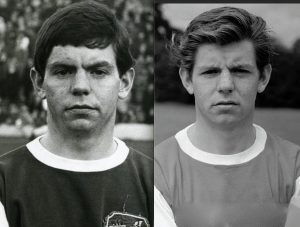
Mike Everitt might have merited inclusion at left-back but there’s really only one candidate for that position and that’s the seasoned Northern Irish international Sammy Nelson. He took over that spot at Arsenal from Bob McNab and made 339 league and cup appearances for the Gunners before losing his place to Kenny Sansom. He stayed in the top-flight, though, by joining Brighton under Mike Bailey. He had a spell as coach under Chris Cattlin before pursuing a career in the City.
Although he played most of his career in defence, for the purposes of this piece I’m selecting Steve Gatting in midfield – a position he was equally adept at filling. Another Bailey signing from Arsenal, Gatting remained at Brighton for 10 years and after his playing days were over returned to his first club as an academy and under-23s coach.
It is tempting to bend my own rules and select Liam Brady alongside him but, of course, while the mercurial Irishman was such a fine player for Arsenal, it was only from the dugout that Brighton enjoyed his influence.
Instead, I’ll plump for Steve Sidwell who, although never making a senior appearance for Arsenal, grew up in their academy and bookended his career playing for Brighton.
Barrett? Not even close!
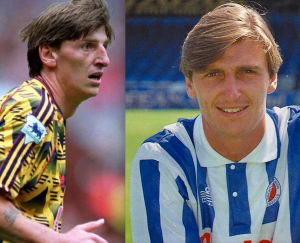
It’s out wide and in the middle of attack that the choices overwhelm although, to be honest, it is difficult to make a case for the lesser talents of Chuba Akpom, Graham Barrett or Raphael Meade over two of Mikel Arteta’s current picks – Viktor Gyökeres and Leandro Trossard (although Paul Dickov was in my thoughts).
Centre forward could have been Frank Stapleton who did his old Arsenal teammate Brady a favour by turning out twice for the Seagulls in 1994, but I’d have to settle for Danny Welbeck to lead the line. Let’s give Stapleton the no.12 shirt.
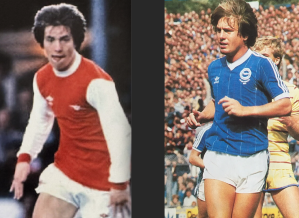
One old school indulgence would be out wide where, although Mark Flatts briefly impressed, and one day we might come to admire the talents of Amario Cozier-Duberry, perhaps there’s room for nippy winger Brian Tawse, who’d have had a field day supplying players of the quality of Gyökeres and Welbeck.
So, there you have it, the In Parallel Lines Arsenal-Brighton line-up is
Mat Ryan
Martin Keown Colin Pates Matt Upson Sammy Nelson
Steve Sidwell Steve Gatting
Brian Tawse Leandro Trossard Viktor Gyökeres
Danny Welbeck
Sub: Frank Stapleton
Thanks for reading. Enjoy the festive season and all the best for the new year. UTA!
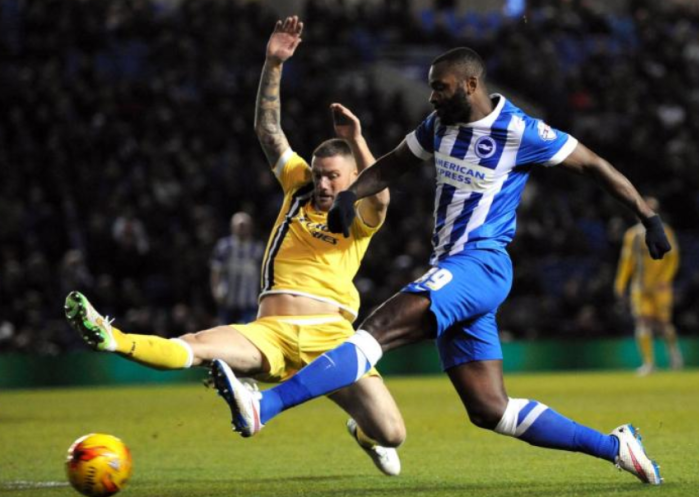
FORMER England striker Darren Bent, who now shares his opinion of the game with listeners to talkSPORT, was still only 30 when he pulled on the stripes of Brighton, one of nine clubs he represented in the Premier League and Championship.
He couldn’t have got off to a better start when he scored on his debut at the Amex, netting against one of his former clubs, Fulham. Unfortunately, the visitors turned the game on its head and won 2-1.
Timing is everything in football and perhaps if Bent had joined the Albion in happier circumstances, there may have been a better story to tell. The Seagulls were about the ditch the manager who brought him to the club – an all-too-familiar scenario Bent encountered on many occasions throughout an 18-year playing career.
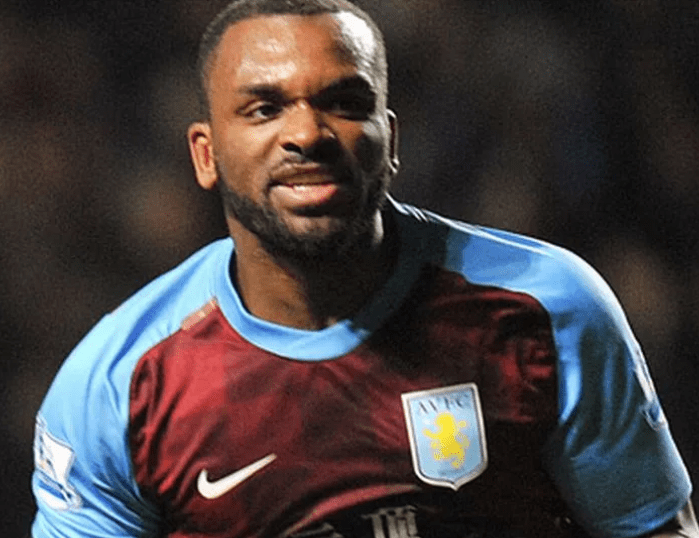
At Spurs he played under three different managers – he later described it as “the worst two years of my career” – and his temporary move from Aston Villa to Brighton came about because he’d been frozen out by Paul Lambert even though Gerard Houllier had smashed Villa’s transfer fee record to sign Bent from Sunderland for £18m in January 2011.
Bent arrived at the Amex in November 2014 with 184 goals in 464 career appearances behind him, and only three years earlier had won the last of 13 caps for England, for whom he scored four goals.
“His record speaks for itself,” said Albion boss Sami Hyypia. “He is a top-class striker with more than 100 Premier League goals with Charlton, Spurs, Sunderland and Aston Villa. I hope he will score plenty of goals for us during his time with us.
“There is no doubting his ability to score goals. He also wants to play regular games and that is evident in his willingness to step down from the Premier League to the Championship.”
The player himself told the matchday programme: “Anyone who knows me knows that all I care about is football.
“It has never been about money or anything like that. It has always been about playing football. I’m always at my happiest when I’m playing.”
Bent added: “Brighton felt like the perfect place to come and play football, especially for someone like Sami Hyypia, who I’ve played against many times over the years.
“As a manager, I think he is the right man. He is the kind of guy I want to play for.”
It was a generous assessment in the circumstances because Brighton had managed only two wins in 16 matches before Bent’s arrival.
The experienced striker’s second goal for the Albion looked like it might have earned the beleaguered coach a reprieve from the inevitable. He scored in the 10th minute away at Wolves, stooping to head Inigo Calderon’s first-time cross past goalkeeper Carl Ikeme. It was a lead that lasted until the 88th-minute but was cancelled out by a Danny Batth equaliser after Albion had played 30 second half minutes with 10 men following a red card shown to Bruno. Brighton parted company with the big Finn shortly afterwards.
Bent played one more game, under caretaker Nathan Jones, when Albion fought back from 2-0 down (both scored by on-loan Glenn Murray against his old club) to earn a home draw against Reading, but he was forced off injured after less than half an hour and the knock kept him out of the next game at Fulham, when Brighton won 2-0.
Hyypia’s replacement, Chris Hughton, spoke at his first press conference of trying to keep the player, but Bent had the chance to join a side at the opposite end of the Championship and he moved to promotion-seeking Derby County instead, scoring 12 times in 13 starts as the Rams missed out on a play-off spot by one point.
Released by Villa at the end of the season, he subsequently joined the Rams on a permanent basis in the summer of 2015. He saw even more managerial churn at Pride Park – Paul Clement and Darren Wassall in 2015-16 and three – Nigel Pearson, Steve McLaren and Gary Rowett – in 2016-17. Across the two seasons in the Championship, Bent scored 14 in 67 matches, but a hamstring injury sidelined him for the start of the 2017-18 season.
In January 2018 he went on loan to Championship strugglers Burton Albion under Nigel Clough where he scored twice in 14 appearances (nine starts + five off the bench) including netting the equaliser against his old club Sunderland when Burton’s 2-1 win relegated the Black Cats to the third tier of English football for only the second time in the club’s history. Burton also went down.
Released by Derby in the summer of 2018, he announced his retirement at 35 in July 2019.
Funny that he should end his career at Derby County because it was against them that he scored his first competitive goal for Tottenham in a 4–0 home victory in August 2007.
Bent had previously scored 37 goals in 79 matches over two seasons at Premier League Charlton Athletic before making what at the time was a record £16.5m move to White Hart Lane, where Dutch boss Martin Jol greeted him enthusiastically.
On target for Spurs
Although he already had Robbie Keane, Dimitar Berbatov, Jermain Defoe and Mido as forward options, Jol said of the new signing: “Darren’s strength is his stamina. Normally players will make runs three or four times in 45 minutes, he will do it all the time and if you manage to play balls behind the defence, he will be there.
“He has pace, he links play well and can see a pass – he can exploit the space and play as well.”
What happened subsequently is covered superbly in a 2019 article by Jack Beresford on Planet Football, but, to fast forward a little, Jol was shown the White Hart Lane exit and his replacement, Spaniard Juande Ramos (assisted by Gus Poyet) was a lot less enamoured by the big money signing.
Indeed, Beresford writes: “Bent later recalled how Tottenham became ‘a horrible place to be’ under Ramos, who regularly lambasted players over a lack of professionalism in regards to training and nutrition, demoting several senior figures to the reserves.”
Although Bent struggled to cement a regular starting spot in his first season at White Hart Lane, he was Spurs’ top scorer at the end of the 2008-09 campaign with 17 goals.
While things initially looked good under Bent’s third Spurs boss, Harry Redknapp, the manager’s decision to publicly humiliate the striker eventually brought an unhappy spell to an end.
Bent missed a golden chance to score in a match against Portsmouth and Redknapp told reporters after the game: “You will never get a better chance to win a match than that. My missus could have scored that one.
“Bent did not only have part of the goal to aim for, but he had the entire net – and he put it wide. Unbelievable. I was just so frustrated.”
Bent put in a transfer request and said: “No one goes out to deliberately miss. When you miss a chance and your manager comes out and supports you rather than criticises you, it’s a big help.”
Ironically, circumstances meant Bent went on to make 12 more appearances for Tottenham, scoring five times and his 12 league goals made him the club’s top scorer.
Although Redknapp said Bent had a future at the club, he signed Peter Crouch and Beresford reported Bent later said: “I didn’t feel Redknapp wanted me there. It’s massive to have the support of your manager and that’s not been the case for the last two years.
“My career stood still at Tottenham. There’s a lot of politics going on there. I scored a lot of goals, but it was the hardest two years of my life.”
In those two years, he scored 25 goals in 79 games for Tottenham, but 36 of those appearances had been as a substitute.
Born in Tooting, south London, on 6 February 1984, Bent seemed always destined to be a footballer because his dad Mervyn had been on the books of Wimbledon and Brentford as a youngster.
The family moved to Cambridgeshire when the young Bent was only 10 and his early football career was nurtured at Godmanchester Rovers.
Ipswich Town picked him up as a 14-year-old and nurtured him through their youth ranks until he signed his first professional deal on 2 July 2001. George Burley gave him his debut five months later as a sub in a 3-1 UEFA Cup win away to Helsingborgs IF.
He scored twice in seven league and cup appearances that first season but the Tractor Boys were relegated from the top flight. Burley was soon replaced, temporarily by Tony Mowbray, then Joe Royle, under whom he cemented a regular starting berth in the second tier over the next three seasons.
By the time he left Ipswich in 2005, he’d scored 56 goals in 141 appearances. Former Brighton midfielder Alan Curbishley was at the helm of the Addicks when they paid a fee of £2.5m to take him to The Valley.
He scored five goals in Charlton’s first four league games (including two in the opening day 3-1 win over future employer Sunderland), finished his first season with 22 league and cup goals and was named Charlton’s Player of the Year.
Bent top scored again the following season, with 15, but under three different managers – Iain Dowie, Les Reed and Alan Pardew – they were relegated to the Championship along with Watford and Sheffield United.
As described earlier, Spurs presented the opportunity for him to continue playing in the Premier League, and he continued playing at that level when Sunderland bought him for £16.5million in the summer of 2009. Demonstrating the knack he had at several clubs, he scored on his debut, giving the Black Cats a 1-0 win at Bolton.
Bent went on to score 24 league goals for the Black Cats in his debut season at the club – and you can only imagine how delighted he was (pictured below) to net two in a 3-1 win over Spurs at the Stadium of Light!
The first came after just 34 seconds of the game on 3 April 2010, and a 29th-minute penalty gave him his 23rd goal of the season, although incredibly Bent also saw two other penalties saved by Spurs ‘keeper Heurelho Gomes. He had also missed a penalty in the reverse fixture at White Hart Lane the previous November, when Spurs won 2-0.
He obviously wasn’t the most reliable from 12 yards: I witnessed a Bent penalty miss myself back in 2003 when he’d gone on as a sub for Ipswich against Brighton at Portman Road. With the score at 1-1, Richard Carpenter’s foul on Chris Makin gave Bent the chance to restore the home side’s advantage from the spot. But he blasted the ball over without goalkeeper Dave Beasant needing to make a save. Tony Rougier then put Albion ahead but a Martin Reuser thunderbolt evened it up.
Bent’s 18-month stay with Steve Bruce’s Sunderland proved to be his most prolific goalscoring spell in football, netting 38 goals in just 52 appearances.
In the first half of the 2010-11 season, his partner up front was young Manchester United loanee Danny Welbeck, but in the January 2011 transfer window Bent was on the move again, this time to Villa.
Once again, he got off to a great start for a new club, marking his debut with the only goal of the game in a win over Manchester City. It was the first of nine goals in 16 league appearances which put him joint top scorer with Ashley Young, even though he’d only arrived at the club in January.
After health issues forced Houllier to step down as Villa boss, Alex McLeish took over for what was a tumultuous and under-performing season when relegation was only avoided by two points, although Bent was top scorer with 10.
McLeish’s successor Lambert not only took the captaincy off Bent, he also froze him out, only selecting him for 13 Premier League appearances. If he thought it was difficult enough to have three different managers in three seasons at Villa, when he spent the whole of the 2013-14 season on loan to Fulham, they had three different managers in one season!
Bent’s old Spurs boss Jol was in charge as the campaign got under way but, with only two wins in 14, he was replaced by former Man Utd no.2 René Meulensteen in December before Felix Magath took over in February. All the upheaval saw Fulham relegated with a team that included David Stockdale, Steve Sidwell, Aaron Hughes and Dan Burn. Bent scored six in 14 starts + 15 sub appearances.
If Bent was used to managerial change at club level, it wasn’t much better with the England national team: he played under three different managers in five years!
He had previously earned selection for his country at under 15, 16, 19 and 21 levels – he scored nine in 14 matches for the under-21s – and he was first called up to the full squad by Sven-Goran Eriksson shortly after he’d made the move from Ipswich to Charlton, although he didn’t play in a 4-1 defeat to Denmark.
“Making my Premiership debut for a new club, scoring my first brace in the Premiership and then to get the England call-up on the back of that was just a dream come true,” he told the FA website.
It was another six months before he made his full England debut, in a 2-1 win over Uruguay but he didn’t do enough to stake a claim for a place in the World Cup squad.
His next cap came as an 80th minute substitute for Joe Cole in the 3-2 defeat to Croatia in November 2007 that cost Steve McLaren his job when England failed to qualify for the Euro 2008 tournament.
By the time he made his second start for England, on 14 November 2009, Fabio Capello was in charge. England lost 1-0 in a friendly to Brazil in Qatar when Bent’s teammates included Matthew Upson, Wayne Bridge and James Milner.
“Bent was struggling to make an impact as he attempted to convince Capello of his worth, not helped by a lack of service that rendered his task almost impossible,” reported the BBC’s Phil McNulty. “He had one opportunity, but could not direct a header on target from Milner’s cross.”
He didn’t make the cut for the 2010 World Cup squad but in September was back in the fold and scored his first England goal after going on as a 70th minute sub for Jermain Defoe as England beat Switzerland 3-1 in Basle.
By now at Villa, it was the first of three goals in three games (he also netted against Denmark and Wales) after which he told the Birmingham Mail: “I’d love to be No 9 for as long as possible, there are a lot of top strikers about but Fabio keeps picking me and hopefully I can keep producing the goods.
“Even when the goals weren’t going in, I always believed I was good enough to score at this level and hopefully it’s showing now. I’m finally getting my chance and getting a good run in the side. I’m delighted with it.
“It has been years since my first chance and it’s certainly been a long, long wait but it’s finally come.”
He started the 2-2 Euro 2012 qualifier with Montenegro in October 2011 and the following month was in the side that beat World Cup holders Spain 1-0 at Wembley; it was his header from Milner’s cross that rebounded off a post for Frank Lampard to nod in.
Three days later, he played what turned out to be his – and Capello’s – last game for England as a 70th minute sub for Bobby Zamora when England beat Sweden 1-0 at Wembley.
Yet another man was at the helm when it came to selection for the Euro 2012 tournament and Roy Hodgson didn’t reckon Bent had recovered sufficiently from an injury to merit inclusion.
For all the highs and lows of a lengthy playing career, nothing came close to what he suffered in front of a nation of TV quiz viewers: he scored only three points over two rounds of Celebrity Mastermind and admitted to talkSPORT listeners: “Honestly? It was probably the worst experience of my life!”
He explained: “As a footballer you get nervous before games, when you take a penalty in front of thousands of people, when you join a new club, but when you’re sitting in that chair opposite John Humphrys, it’s pitch black in there and all you can see is him, his eyes looking at you and he’s asking you questions and you just go blank.”
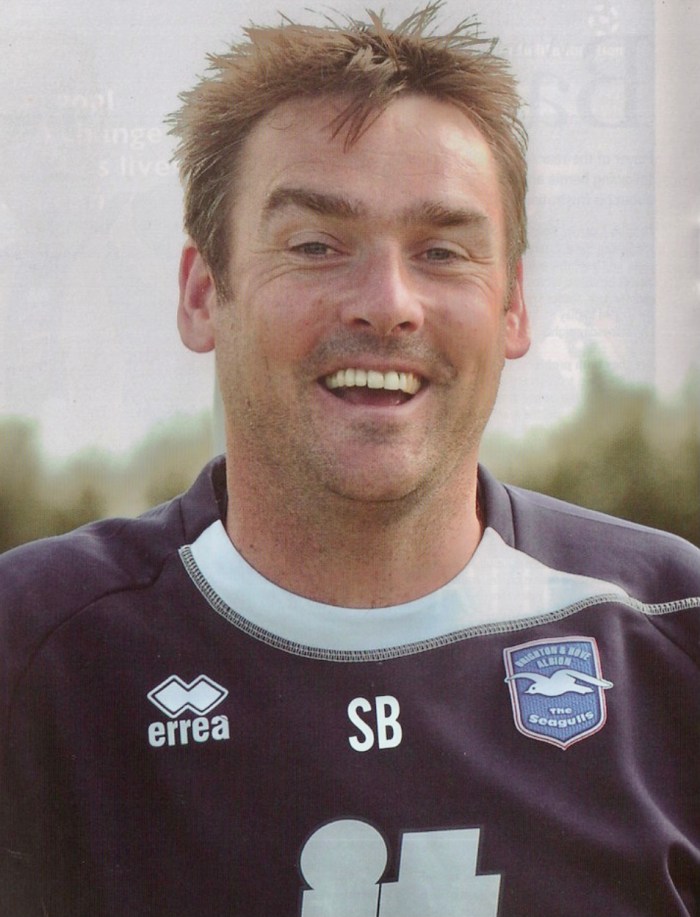
BRIGHTON-BORN Steve Brown walked out on the Albion as a schoolboy but later returned as an influential coach of the club’s emerging talent, including a young Lewis Dunk.
Previously, as reserve team coach at West Ham, Brown brought through the likes of Jack Collison, James Tomkins and Junior Stanislas.
Indeed, the former Charlton Athletic defender applied his aptitude for teaching budding young footballers to various settings, including Charlton and at Sussex independent schools Ardingly College and Lancing College (2017-19).
In his two-year spell as Albion youth team coach, between 2008 and 2010, 11 youth players signed professional contracts, and five made first-team appearances, including Dunk, Grant Hall and Jake Forster-Caskey.
In an end of season summary, Brown reported: “We have out-passed and out-played teams but not finished them off, and that is something the players need to learn to do, but the foundations are there.
“We have taken things on board from Gus (Poyet) and the first team, and we’ve tried to adapt that to the players in the youth team.”
He added: “The way the first team manager plays here, everyone has got to know what they are doing and be a very good forward-thinking football player – but at youth level you are going to get inconsistency because they are not at that level yet.”
Brown took on the Albion youth team job when Russell Slade was in charge, shortly after obtaining his UEFA A coaching licence, which he had been working towards at Charlton and West Ham, through the different stages of the badge process.
In an interview with the matchday programme, he admitted: “In some respects I’ve come home. In my playing career I had a couple of opportunities to come here and came very close when Steve Coppell was manager.
“I also had talks when Martin (Hinshelwood) was in charge and the two of us have stayed in contact ever since. So, when he phoned up to offer me the job, I grabbed it with both hands.”
Although at the time he dropped down a couple of levels, he said: “Your coaching philosophies don’t change whether you’re with a West Ham international or a Brighton youth team player. The message that you are trying to get across is the same – you want them to improve.
“It’s also my job here to make the players understand it’s not a cakewalk. They see the professionals and think it’s going to be a natural progression for them but it’s not.”
Born in Brighton on 13 May 1972, Brown went to Coldean Primary School and Patcham Fawcett High School.
His dad, Gary, had been a professional footballer in South Africa before returning to play non-league in Sussex, so it was little surprise his son developed a love for the game.
“You can definitely say that football was in the family genes,” Brown told doverathletic.com.
His performances for the Patcham Fawcett school team led him to be selected for East Sussex and Brighton Schoolboys, and the Albion signed him up on schoolboy forms for two years.
However, when 14, he admitted: “I just fell out of love with football for a time. When you’ve got a squad of 25 boys and only 11 can play, you spend a lot of time just training. I missed the competitive edge of matches and as a result I began to enjoy my football less and less.”
So, he walked away from the Albion and returned to playing for East Sussex and Brighton Schoolboys, as well as Whitehawk, where his dad was first team coach.
Fresh-faced Brown became an apprentice at Charlton Athletic
When he was 16, he was spotted by a Charlton scout, and was taken on as an apprentice. Reflecting on how hard he had to work to get a regular spot in the reserve side, before eventually signing as a professional, he said: “It’s really about how resilient you are.
“Lots of players get rejected once, twice, even three times before someone takes a chance on them. You just have to refuse to give up and learn not to take one person’s rejection as final.”
However, Brown’s career nearly ended before it had begun when he suffered a serious knee injury at 18, forcing him to completely reshape his game and the way he played.
“From that point, decision-making had to become his strength because his body would be permanently affected,” wrote Benjy Nurick in a blog about the defender. “I had a cruciate, the operation went wrong,” he said. “I’ve got nothing left in the right knee now.”
He told Benjy: “I don’t think people appreciated how bad the injury was. I’d say from about 26-27 years of age…from that point onwards, I was icing front and back after training and after games. I wasn’t a pill taker on a regular basis, but I did get put on some quite strong anti-inflammatories.
“I’d finish a match and for anybody that ever sort of said ‘where’s Browny?’ I had an ice pack on the front of my knee and I had an ice pack on the back of my knee and I was laying on the floor of the dressing room!”
Having made his first team debut alongside the likes of Garth Crooks and Tommy Caton, Brown established himself in the Addicks defence and played a crucial role in the club’s 1998 promotion via a memorable play-off against Sunderland at Wembley.
Brown put in a crucial tackle in extra time to ensure the score stayed 4-4 and then scored in the decisive penalty shoot-out, although he admitted: “It was an absolutely horrific experience.
“The pressure was unbelievable and once the ball went in, I didn’t care if anyone else in our side missed. I know that sounds selfish, but I was just so overwhelmed with relief at scoring.”
Brown earned a bit of a reputation as a stand-in goalkeeper too, as witnessed in May 1999, in a game against Aston Villa. After Addicks goalkeeper Andy Petterson had been sent off, Brown donned the gloves and made a number of crucial saves as his side ran out 4-3 winners.
Brown told Laura Burkin for whufc.com: “It was not the first time for me in goal, actually. I had gone in a couple of other matches over the years, against Manchester City and Southampton if I remember rightly.
“But the one with Aston Villa was the one that stands out. As soon as Andy had been sent off, the gaffer asked me and I said yes, no problem. I was quite pleased with myself, there was a dangerous cross and I got my hands to that well and a few corners as well, and I enjoyed it!”
Unfortunately, those heroics were unable to prevent Athletic returning to the second tier. But Brown was skipper when they won promotion as champions in 2000. “We broke a host of records on our way to the title. It was my best year in football,” he declared.
It’s widely felt by Addicks fans that Brown played some of the best football of his career alongside Richard Rufus at the heart of the defence under Alan Curbishley’s managership.
But what did Brown make of the former Albion midfielder as a boss? “He didn’t give out a lot of praise, you had to earn it, but he left no stone unturned in terms of our preparation for games.
“He could throw the odd teacup but was generally a level-headed guy who would work out ways for you to improve if he felt you needed it.”
Brown’s 12-year playing career at Charlton came to an end in 2002 and he joined former teammate Alan Pardew at Reading, making 40 appearances before retiring in 2005.
He told the Reading Chronicle: “I went from one very family-orientated, stable club which had seen some very good times straight into another one that was very much in a similar state.
Reading had come out of League One, was in the ascendancy, had a new stadium, the owner made the club financially responsible, they had Alan Pardew as manager who was doing well. You can leave one football club and walk into a bit of a nightmare…and I didn’t. It was a brilliant move for me.
“We got to the play-offs my first year at Reading. When I turned up, they’d just gotten rid of Matthew Upson who had been outstanding for them, so I had extremely big shoes to fill. And I slotted into his shoes and filled them quite nicely and we got to the play-offs.”
Unfortunately, although Reading had James Harper and Steve Sidwell pulling the strings in midfield, they lost Nicky Forster to injury in their semi-final first leg against Wolves, and went down 3-1 on aggregate.
“If it hadn’t been for the injury to Nicky, I think momentum would have carried us through,” said Brown. “But losing Nicky…he was our number one striker by some distance and losing him left us very short up top.”
A recurrence of that anterior cruciate ligament injury eventually forced Brown to stop playing and after a spell coaching in Charlton’s academy, he linked up with Pardew again after he’d taken over as West Ham manager before the management team changed in July 2007.
As well as working as head of football at Ardingly College, Brown also scouted for Charlton Athletic and covered first team matches as a radio co-commentator for BBC London. That radio work gradually expanded into coverage of Premier League and EFL matches.
On leaving Brighton in 2011, Brown joined his former teammate Forster at Conference South Dover Athletic, becoming his assistant manager. In the summer of 2013, he moved on to become manager of Ebbsfleet United, a role he held for 18 months.
Next stop was a brief stint in charge of Lewes before he moved on to become joint manager and director of football at Margate.
While working at Lancing College, Brown was also a regional scout for Stoke City, searching out potential players for the club’s development squad.
THE YOUNGEST goalkeeper to appear in a FA Cup final spent 20 months picking out future players for Brighton.
It was one of several different post-playing roles Mervyn Day filled for various clubs.
Day, who at 19 won a winners’ medal with West Ham in 1975, was Albion’s head of scouting and recruitment between November 2012 and the end of the 2013-2014 season under head of football operations David Burke.
At the time, his appointment was another indicator of the gear change taking place at the club as it built on the move to the Amex Stadium and sought to gain promotion from the Championship.
Day said in a matchday programme interview: “This club has come such a long way in such a short space of time.
“When you think of the debacle of the Goldstone, the wilderness of Gillingham, then Withdean, you only have to get a player through the front door at this wonderful stadium to have a chance of signing them.
“Hopefully, within the next year or so, the new training ground will be up and running and, when you’ve got that as well, you’ve got the perfect opportunity not only to encourage kids to sign but top quality players as well.
“If we are fortunate enough to get ourselves into the Premier League at some point, we’ll be able to attract top, top players.”
It was a case of ‘the goalkeepers union’ that led to him joining the Albion. Day explained he’d been chatting to Andy Beasley, Albion’s goalkeeping coach at the time, who had been a colleague when Day was chief scout at Elland Road. Beasley wondered if he’d like to help coach Albion’s academy goalkeepers but Burke, who he also knew, stepped in and offered something more substantial: the job of scouting and talent identification manager.
He certainly brought a wealth of experience to the task. He had previously been assistant manager to former Albion midfielder Alan Curbishley at Charlton and West Ham; manager and assistant manager at Carlisle United, a scout for Fulham and the FA (when Steve McClaren was England manager) and chief scout at Leeds until Neil Warnock took charge.
In addition to that background, in the days before full-time goalkeeper coaches, Day had worked at Southampton under David Jones, Chris Kamara at Bradford City and John Aldridge at Tranmere Rovers. Then in 1997 Everton came along and he joined Howard Kendall’s backroom team alongside Adrian Heath and Viv Busby. “I was living in Leeds at that time, so distance wasn’t an issue, but it was an interesting trip across the M62 in the winter months,” Day recalled in an October 2021 interview with efcheritagesociety.com.
Brighton made Day redundant at the end of the 2013-14 season following a reshuffle of the recruitment department amid criticism of the quality of signings brought in.
That assessment might have been rather harsh because during his time at the club there was a change in manager (Oscar Garcia taking over from Gus Poyet) and, although the season ended in play-off disappointment, the likes of former Hammer Matthew Upson (who’d played under Day when he was at West Ham) had signed permanently on a free transfer (having been on loan from Stoke City for half the previous season).
The experienced Keith Andrews and Stephen Ward also joined on season-long loan deals and played prominent roles in Garcia’s play-off reaching side.
It was under Day’s watch that the promising young goalkeeper Christian Walton was signed after a tip-off from Warren Aspinall. Aspinall told the Argus in 2015: “I went to Plymouth to do a match report. I set off early and took in a youth team game off my own back. He was outstanding, commanding his box. I reported straight back to Gus (Poyet). He told Mervyn Day. He went to see him, Mervyn liked him.”
It wasn’t the first time Day had played a role in securing a goalkeeper for the Albion. As far back as 2003 he had an influence on Ben Roberts’ arrival at the Albion. Manager Steve Coppell revealed: “He is one of three goalkeepers at Charlton and at the moment nearly all the Premiership clubs are very protective about their goalkeepers.
“I have seen him play a number of times, although I certainly haven’t seen him play recently. I spoke with Mervyn Day (Charlton coach) and he says Ben is in good form. It’s a little bit of a chance and it will certainly be a testing start for him, but he is looking forward to the challenge.”
Day was also sniffing around another future Albion ‘keeper when he was chief scout for Bristol City (between 2017 and 2019). According to Sky Sports commentator Martin Tyler, Mat Ryan was on their radar in the summer of 2017 when he swapped Belgium for England. In an interview with Socceroos.com, Tyler reveals he was asked by City’s ‘head of recruitment’ (thought to be Day) to glean the opinions of Gary and Phil Neville (manager and coach of Valencia at the time) on Ryan and whether he’d be suitable for the English game.
“I got a text saying, ‘Can you find out from the Nevilles whether they rate Mat Ryan’,” Tyler said. “It wasn’t my opinion they were looking for – quite rightly – it was Gary and Phil’s. I was able to do that and both Gary and Phil gave Mat the thumbs up.”
After leaving Brighton, Day moved straight into a similar role with West Brom, where he worked under technical director Terry Burton and first team manager Alan Irvine, but he was only there a year before linking up with the Robins. He has since been first team domestic scout for Glasgow Rangers, although based in his home town of Chelmsford.
Day was born in Chelmsford on 26 June 1955 and educated at Kings Road Primary School, the same school that England and West Ham World Cup hero Geoff Hurst attended. He moved on to the town’s King Edward VI Grammar School and represented Essex Schools at all levels. He joined the Hammers under Ron Greenwood on a youth contract in 1971.
“On my first day as an associate schoolboy I got taken by goalkeeping coach Ernie Gregory into the little gym behind the Upton Park dressing room and he had Martin Peters, an England World Cup winner, firing shots at me,” Day later recounted. “As a 15-year-old that was incredible.
“The bond got even closer when my father died when I was 17. I was an apprentice but Ron signed me as a full pro within a very short space of time to enable me to earn a little more money to help out at home. A short while later he gave me another increase. He was almost a surrogate father to me.”
In the early part of 1971, Day played in the same England Youth side as Alan Boorn, a Coventry City apprentice Pat Saward took from his old club to the Albion in August 1971.
The goalkeeper was just 18 when he made his West Ham United debut, on 27 August 1973, in a 3-3 home draw with Ipswich Town.
He went on to play 33 matches in his first season and only missed one game in the following three.
Tony Hanna, for West Ham Till I Die, wrote: “In only his eleventh game for the Hammers he received a standing ovation from the Liverpool Kop in a 0-1 defeat that could have been a cricket score but for his fine display and, in his next visit to Anfield, he saved a penalty in a 2-2 draw.”
Day recalled: “As a kid, I had no fear, I took to playing in the first team really, really well. At West Ham, the ‘keeper always had lots to do as we were an entertaining team. We had forward-thinking centre-backs in Bobby Moore and Tommy Taylor, and then after Bobby came Kevin Lock.”
Mervyn Day in action for West Ham against Brighton at the Goldstone Ground, Hove.
In 1974, Day progressed to England’s Under-23 side. He won four caps that year and a fifth in 1975 but it was a golden era for England goalkeepers at the time and he didn’t progress to the full international side, despite being touted for a call-up.
By the time Day won that last cap, he had been voted PFA Young Player of the Year and, at 19, had become the youngest goalkeeper to appear in a FA Cup Final, keeping a clean sheet as West Ham beat Fulham 2-0 at Wembley.
Hanna continued: “At times he was performing heroics in the West Ham goal and he was fast becoming a fans favourite. Tall and agile, he was a brilliant shot stopper and he was playing like a ‘keeper well beyond his years.”
However, by the 1977-78 season Day’s form had tapered off as the Hammers were relegated. “His confidence was so bad he was eventually dropped and he only played 23 games that season,” said Hanna. “There are several theories to what triggered the loss of form, but one thing that did not help the lad was the stick he was getting from the Hammers supporters.
“In hindsight Mervyn said that he was ill prepared for such a tough run of form. The early seasons had gone so well that he had only known the good times and when the bad ones came he struggled to come to terms with the pressure.”
In 1979, West Ham smashed the world record transfer fee for a goalkeeper to bring in Phil Parkes from QPR and Day was sold to Leyton Orient, where he replaced long-standing stopper John Jackson, who later became a goalkeeper coach and youth team coach at Brighton.
Day spent four years at Brisbane Road before moving to Aston Villa as back-up ‘keeper to Nigel Spink. After a falling-out with Villa boss Graham Turner, he switched to Leeds under Eddie Gray and then Billy Bremner. During Bremner’s reign, he had the humiliation of conceding six at Stoke City at the start of the 1985-86 season and, in spite of vowing it wouldn’t happen again, let in seven in the repeat fixture the following season. Amongst his Leeds teammates that day were Andy Ritchie and Ian Baird.
Nevertheless, he ended up playing more games (268) for Leeds than any of his other clubs. He rarely missed a game up to the end of 1989-90, the season when was he was named Player of the Year and collected a Second Division championship medal.
Howard Wilkinson offered him a post as goalkeeping coach for United’s first season back in the elite, having lined up a £1m move for John Lukic from Arsenal. Day had a couple of loans spells – at Luton Town and Sheffield United in 1992 – but was otherwise back-up for Lukic, alongside his coaching duties, until Wilkinson saved Brighton’s future by signing Mark Beeney from the Seagulls.
After eight years at Elland Road, Day moved to the Cumbrian outpost of Carlisle in 1993. When he moved into the manager’s chair at Brunton Park, he not only led them to promotion from the Second Division in 1997, but they also won the (Auto Windscreens Shield) Football League Trophy. United beat Colchester 4-3 on penalties at Wembley after a goalless draw; one of the scorers being the aforementioned Warren Aspinall, later of Brighton and Radio Sussex.
Day worked under Curbishley at Charlton for eight years between 1998 and 2006, helping the club stabilise in the Premier League.
And, in December 2006, he followed Curbishley as his No.2 to West Ham, where the duo spent almost two years.
It was in 2010 that he returned to Leeds as chief scout, working under technical director Gwyn Williams. United manager Simon Grayson said at the time: “We’re restructuring the scouting department under Gwyn and Mervyn will be both producing match reports and watching our opposition and working on the recruitment of players.
“Merv’s knowledge and experience will prove important to the football club as we look to progress and develop what we are doing.”
WHEN Wolverhampton Wanderers slipped into the third tier, they urgently needed to loan out some of their higher-paid players – hence, in August 2013, the arrival at Brighton of left-back Stephen Ward.
Most Seagulls supporters were not sure of his attributes having had the pleasure the previous season of watching the imperious Wayne Bridge shine in that position while on loan from Manchester City.
However, Albion fans were delighted to be proved wrong after Ward helped to shore up a defence that had leaked seven goals in the first eight days of the season. The Irish international defender went on to make a total of 47 appearances and was runner-up to Matt Upson as Albion’s 2013-14 player of the year.
Ward also chipped in with four goals, including the tide-turning equaliser at Nottingham Forest on the final day of the season.
Although injury-hit Albion failed to get past Derby County in the play-off semi-finals, it was thought Ward would sign permanently for the Seagulls that summer. But Burnley stepped in, offering Wolves and the defender more money, not to mention the more immediate chance of Premier League football.
Ward’s agent, Scott Fisher, later told the Argus that dithering or perhaps a bit of brinkmanship by then head of recruitment David Burke had scuppered the deal.
“We really tried our best to make Stephen Ward a permanent Brighton player. Had they done their business earlier this wouldn’t have happened,” he said.
Previously, as the season drew to a close, Ward told the Argus: “If I’m going to move on, I don’t see why this wouldn’t be one of the better options for me. I’ve been here for a year; I’ve really enjoyed it.
“I couldn’t say one bad thing about the club. The crowd we get, the stadium we have is phenomenal, probably the best in the Championship, and with the new training ground the club is on a real up and a real high.
“If I was to move on from Wolves, Brighton would definitely be high on the list. It’s not in my hands, it’s going to be in other people’s hands to discuss the future, but it has been a great move for me. I’ve really enjoyed it. It’s a really good club and one people should be privileged to play for.”
Ward went on to spend five years at Turf Moor, making 110 appearances, but only featured 11 times in the 2018-19 season, and manager Sean Dyche told punditarena.com: “He (Ward) has been brilliant for us, absolutely brilliant, he’s done a fantastic job.”
Perhaps it was no surprise that former Albion coach Nathan Jones stepped in to sign the experienced defender for Stoke City, where he’d taken on an often-perilous managerial hotseat.
Jones said: “He’s had a fantastic career, the only downside for him is his age, because he isn’t what we normally go for.
“But I feel we need to add certain things to the changing room and the environment and Stephen brings those.
“He’s a wonderful player, a great character, very experienced. He’s been promoted – won the Championship twice. He’s an Irish international, I worked with him, he’s technically very, very good so he ticks every box. It’s just the aging process is the only drawback.
“With Stephen, he’s a specialist in what we need and he will provide vital competition and good strength in that area.”
Unfortunately Ward couldn’t claim a regular starting place and in December 2019 picked up a calf injury which sidelined him for four months. Having made only 17 appearances for City, in August 2020 he switched to League One Ipswich Town on a free transfer.
After playing 29 games for them in the 2020-21 season, the club announced on 5 May 2021 he would be released at the end of the season (one more appearance would have triggered a 12-month extension to his contract).
Born in Dublin on 20 August 1985, Ward grew up in Portmarnock and, as a schoolboy, played football for Home Farm and Portmarnock before joining League of Ireland side Bohemians.
He attributed his eventual success in making it as a player to staying in Ireland when he was younger and continuing to live at home rather than going to play at a UK club’s academy.
In an excellent lengthy interview with the Irish Independent, he said: “I had a few trials – Leicester a couple of times, I went to Aston Villa a lot and Hibs for some reason – nothing worked out and I signed for Bohs. And the most important thing for me then was living at home and having my family around me.
“It does depend on the academy, but you are in a bubble from a young age. You train in a certain way, everything is done for you; I know you get your jobs, but not that many now, and sometimes there is a mentality that once you are in an academy, you’ve made it. I was 17 and played in a league where players were playing for their mortgages and to put food on the table.”
Originally a forward, he scored 26 goals in 93 appearances, and, having been looked at by Sunderland boss Mick McCarthy and deemed not quite ready, McCarthy kept tabs on him when he took over at Wolves.
“I signed for Wolves as a striker,” Ward told the Irish Independent. “I was not a typical number nine, scoring 20 or 30 a season, but an old-fashioned centre-forward running round, closing down.
“We signed a couple of strikers – Sylvan Ebanks-Blake and Chris Iwelumo – and I knew if I was going to play consistently it was probably not as a centre-forward. So, I went to left-wing for a bit.
“I played at left-back at Norwich for 30 minutes or so when we went down to nine men. We scraped a draw and afterwards Mick said, ‘You could make a career playing there.’ I thought, ‘Yeah, whatever’. Next season, three games in, and new left-back George Elokobi suffers an awful injury, the window was shut and Mick had no one else . . .”
On the international stage, Ward played through the age levels for the Republic of Ireland and had a dream full international debut in May 2011 as he scored in a 5-0 win over Northern Ireland.
He went on to play 50 times for his country before announcing his retirement from international football in March 2019.
ARTICULATE pundit Matthew Upson was deservedly player of the season after starring in Brighton & Hove Albion’s back line during the 2013-14 season.
Earlier, in a career spanning eleven clubs, he played more times (144 plus once as sub) for West Ham United than any of his other clubs. He also won 21 England caps.
Upson initially joined the Seagulls during the second half of the 2012-13 season, signing on loan from Premier League Stoke City, where, in two years, he’d only managed 21 games (plus four as sub) following four years with the Hammers.
On signing him for Brighton at the age of 33, manager Gus Poyet told seagulls.co.uk, “When we had the chance to bring a player with the quality of Matt until the end of the season we went for him.
“He’s experienced, he’s been a regular Premier League player and there were no doubts about it. He has presence, he’s a leader as well and it’s a good opportunity for us to use him the right way and for him to play football.”
Upson joined a side already blessed with the on-loan presence of another former England international in the shape of left-back Wayne Bridge, but unfortunately the side couldn’t get past arch rivals Crystal Palace in the play-offs to gain promotion from the Championship.
Although Poyet departed, Upson decided to make his move to Brighton permanent and played 41 games, mainly alongside skipper Gordon Greer. Unfortunately, Oscar Garcia’s squad also stumbled in the play-offs.
Hampered by an ankle injury towards the end of the season, although Upson played in the first leg 2-1 home defeat to Derby County – when he conceded a penalty with a clumsy foul – he was one of several players to miss out through injury in the away leg, when the Rams prevailed 4-1.
At the season’s end, Upson declined a new contract offer with the Albion and decided to seize the opportunity to return to Premier League football with newly-promoted Leicester City.
As it turned out, injury delayed his debut by seven months and he made just six appearances for the Foxes before ending his playing days with MK Dons, where he was limited to four full appearances plus three as a sub.
Upson is now a regular pundit on our TV screens, displaying verbally the sort of calm assuredness he demonstrated out on the pitch.
So where did it all begin? Born on 18 April 1979 in Eye, a small Suffolk market town, Upson went to Diss High School, over the border in Norfolk, and his football ability first shone at Diss Town FC. He went on to the Ipswich Town Centre of Excellence but it was Luton Town who took him on as a trainee after his Ipswich coach, Terry Westley, had switched to the Hatters.
It was to be a lucrative decision by Luton because, after signing him as a professional in April 1996, a year later they sold him to Arsenal for £2million. He only ever made one first team appearance for Luton and that was as an 88th minute substitute against Rotherham United in August 1996.
Unfortunately, his time with the Gunners was dogged by injury and lack of opportunity because of the solid form of the likes of Tony Adams, Steve Bould and Martin Keown.
Just as he was beginning to make a breakthrough in the 2001-02 season, taking the ageing Keown’s place, he broke his leg and missed out on the Gunners’ end-of-season League and FA Cup double, although he earned a league winners’ medal. At the season’s end, he’d made 16 appearances plus six as a sub.
While waiting for his chance at Arsenal, he had gone out on loan, to Nottingham Forest and Crystal Palace, then Reading after his return from the leg break. But after a total of 39 appearances, plus eight as a sub, for Arsenal spanning five and a half years, he made a £1m move to Birmingham City in January 2003.
City were halfway through their first season in the Premier League, under Steve Bruce, and Upson made 14 appearances as the side finished in 13th place.
Upson told the dailystar.co.uk: “I had a good four and a half years under him at Birmingham. We had quite a successful period there.”
It was during his time with the Blues, during which he made 127 appearances plus one as sub, that his form was recognised with a call up to the England squad.
He had played at youth level and 12 times for the under 21 side but his first call-up for the senior squad came in February 2003, when he was an unused sub for England’s 3-1 win over Australia.
Three months later, coach Sven-Göran Eriksson gave him his debut when he came on for the second half In England’s 2-1 win over South Africa in Durban on 22 May 2003.
His final international appearance also came in South Africa – when he scored in England’s 4-1 defeat to Germany which brought about their exit from the 2010 World Cup. His involvement in the tournament was keenly followed by relatives and the whole community back in Diss.
He was involved in the squad for two subsequent games in September that year, but didn’t get to play. In total, he won seven caps while with Birmingham and 14 under Fabio Capello, after he had moved to West Ham. Of his 21 England appearances, 16 were as a starter, five as a sub.
Birmingham boss Bruce was reluctant to lose him but, on the final day of the transfer window in January 2007, the recently appointed Hammers boss, Alan Curbishley, paid £6million to take him to Upton Park, where enjoyed the longest spell of his playing career.
As he’d experienced at previous clubs, injury hampered him early on but eventually he got a regular spot in the side and subsequently took on the captaincy after the departure of Lucas Neill in August 2009.
It was after relegation from the Premiership during Sam Allardyce’s tenure as manager that Upson finally left the Hammers at the end of the 2010-11 season.














 WHEN Wolverhampton Wanderers slipped into the third tier, they urgently needed to loan out some of their higher-paid players – hence, in August 2013, the arrival at Brighton of left-back Stephen Ward.

 Perhaps it was no surprise that former Albion coach Nathan Jones stepped in to sign the experienced defender for Stoke City, where he’d taken on an often-perilous managerial hotseat.


 In parallel lines