Coach Dean Wilkins fumed after falling out with Knight 

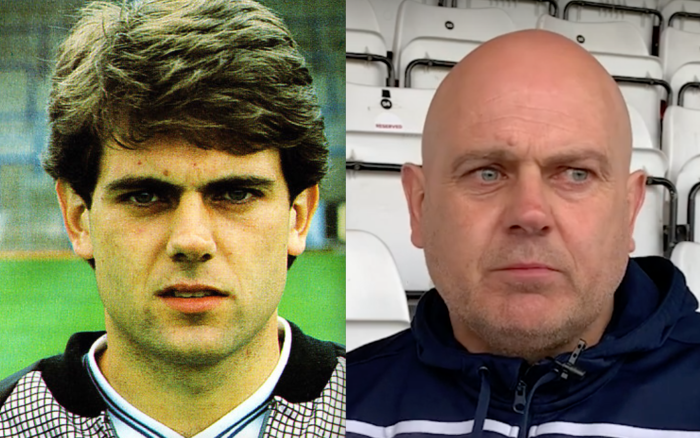
DEAN WILKINS might have lived in the shadow of his more famous elder England international brother Ray but he certainly carved out his own footballing history, much of it with Brighton.

Albion fans of a certain vintage will never forget the sumptuous left-footed free-kick bouffant-haired captain Wilkins scored past Phil Parkes at the Goldstone Ground which edged the Seagulls into the second-tier play-offs in 1991.

Supporters from the mid-noughties era would only recall the balding boss of a mid-table League One outfit at Withdean comprising mainly home-grown players who Wilkins had brought through from his days coaching the youth team.

After Dick Knight somewhat unceremoniously brought back Micky Adams over Wilkins’ head in 2008, he quit the club rather than stay on playing second fiddle and subsequently went west to Southampton where he worked under Alan Pardew and his successor Nigel Adkins as well as taking caretaker charge of the Saints in between the two reigns.

Wilkins’ initial association with the Seagulls went back to 1983, when Jimmy Melia brought him to the south coast from Queens Park Rangers shortly after Albion’s FA Cup final appearances at Wembley.

Melia’s successor Chris Cattlin only gave him two starts back then and although he pondered a move to Leyton Orient, where he’d had 10 matches on loan, he opted to accept to try his luck in Holland when his Dutch Albion teammate Hans Kraay set him up with a move to PEC Zwolle. Playing against the likes of Johann Cruyff, Marco Van Basten and Ruud Gullit proved to be quite the footballing education for Wilkins.
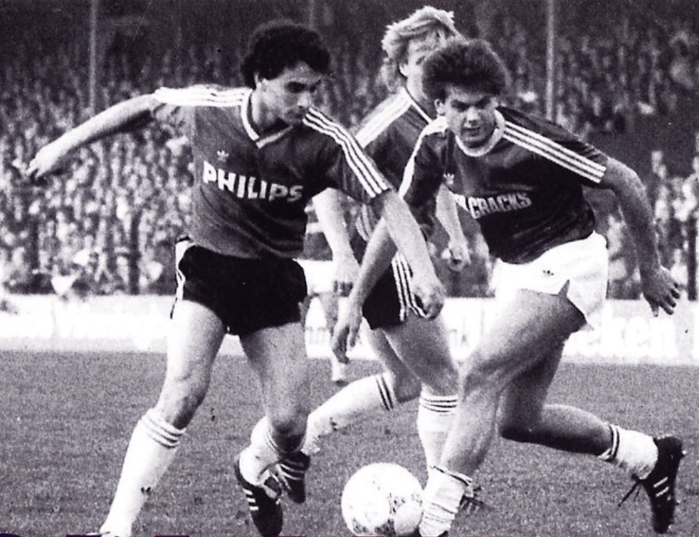
Wilkins in the thick of it in Dutch football for PEC Zwolle

After two years in the Netherlands, 25-year-old Wilkins rejoined the relegated Seagulls in the summer of 1987 as the club prepared for life back in the old Third Division under Barry Lloyd.

Relegation had led to the sale for more than £400,000 of star assets Danny Wilson, Terry Connor and Eric Young but more modest funds were allocated to manager Lloyd for replacements: £10,000 for Wilkins, £50,000 for Doug Rougvie, who signed from Chelsea and was appointed captain, Garry Nelson, a £72,500 buy from Plymouth and Kevin Bremner, who cost £65,000 from Reading. Midfield enforcer Mike Trusson was a free transfer.
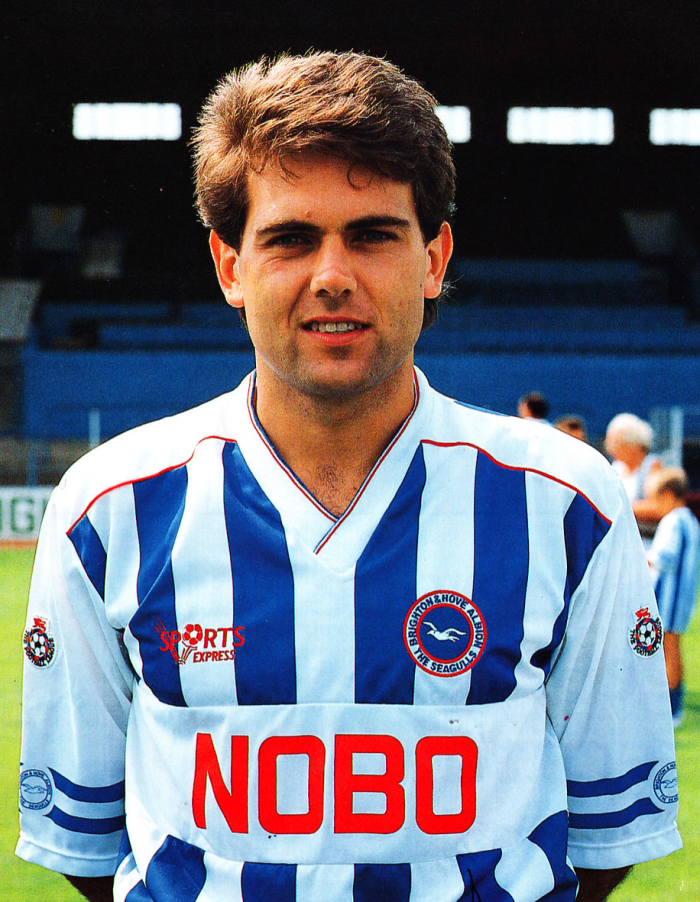
The refreshed squad ended up earning a swift return to the second tier courtesy of a memorable last day 2-1 win over Bristol Rovers at the Goldstone.

At the higher level, Wilkins had the third highest appearances (40 + two as sub) as Albion finished just below halfway in the table. The following season Wilkins was appointed captain and was ever-present as Albion made it to the divisional play-off final against Notts County at Wembley, having made it to the semi-final v Millwall courtesy of the aforementioned spectacular free kick v Ipswich.

Wilkins scored again at Wembley but it turned out only to be a consolation as the Seagulls succumbed 3-1 to Neil Warnock’s side.

As the 1992-93 season got underway, Wilkins, having just turned 30, was the first matchday programme profile candidate for the opening home game against Bolton Wanderers (a 2-1 win) when he revealed the play-off final defeat had been “the biggest disappointment of my career”.

The 1993-94 season was a write-off from October onwards when he damaged the medial ligaments in both his knees after catching both sets of studs in the soft ground at home against Exeter City.

Although injury plagued much of the time during Liam Brady’s reign as manager, the Irishman acknowledged his ability saying: “He is a very fine footballer and a tremendous passer of the ball and he possesses a great shot.”

Ahead of the start of the 1995-96 season, Wilkins was granted a testimonial game against his former club QPR, managed at the time by big brother Ray. But at the end of the season, when the Seagulls were relegated to the basement division, he was one of six players given a free transfer.

Born in Hillingdon on 12 July 1962, Wilkins couldn’t have wished for a more football-oriented family. Dad George had played for Brentford, Leeds, Nottingham Forest and Hearts and appeared at Wembley in the first wartime FA Cup final. While Ray was the brother who stole the limelight, Graham and Steve also started out at Chelsea.

In spite of those older brothers who also made it as professionals, Wilkins attributed his development at QPR, who he joined straight from school as an apprentice in 1978, to youth coach John Collins (who older fans will remember was Brighton’s first team coach under Mike Bailey).

He made seven first team appearances for Rangers, his debut being as a substitute for Glenn Roeder in a 0-0 draw with Grimsby Town on 1 November 1980. After joining the Albion in August 1983, he had to wait until 10 December that year to make his debut, in a 0-0 draw at Middlesbrough, in place of the absent Tony Grealish. He started at home to Newcastle a week later (a 1-0 defeat), this time taking the midfield spot of injured Jimmy Case.

Perhaps the writing was on the wall when Cattlin secured the services of Wilson from Nottingham Forest, initially on loan, and although Wilkins had a third first team outing in a 2-0 FA Cup third round win at home to Swansea City, boss Cattlin didn’t pick him again. Instead, he joined Orient on loan in March 1984.

A long career in coaching began when Wilkins was brought back to the Albion in 1998 by another ex-skipper, Brian Horton, who had taken over as manager. With Martin Hinshelwood as director of a new youth set-up, Wilkins was appointed the youth coach – a position he held for the following eight years.

Return to the Albion as youth coach

His charges won 4-1 against Cambridge United in his first match, with goals from Duncan McArthur, Danny Marney and Scott Ramsay (two).

That backroom role continued as managers came and went over the following years during which a growing number of youth team products made it through to the first team: people like Dan Harding and Adam Virgo and later Adam Hinshelwood, Joel Lynch, Dean Hammond and Adam El-Abd.

At the start of the 2006-07 season, with Albion back in the third tier after punching above their weight in the Championship for two seasons, Wilkins was rewarded for his achievements with the youth team with promotion to first team coach under Mark McGhee.

By then, more of the youngsters he’d helped to develop were in or getting close to the first team, for example Dean Cox, Jake Robinson, Joe Gatting and Chris McPhee.

After an indifferent start to the season – three wins, three defeats and a draw – Knight decided to axe McGhee and loyal lieutenant Bob Booker and to hand the reins to Wilkins with Dean White as his deputy. Wilkins later brought in his old teammate Ian Chapman as first team coach.
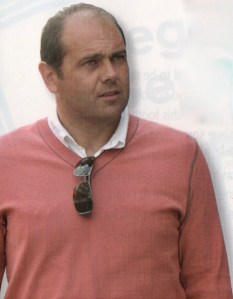
Into the manager’s chair

Tommy Elphick, Tommy Fraser and Sam Rents were other former youth team players who stepped up to the first team. But, over time, it became apparent Knight and Wilkins were not on the same page: the young manager didn’t agree with the chairman that more experienced players were needed rather than relying too much on the youth graduates.

Indeed, in his autobiography Mad Man: From the Gutter to the Stars (Vision Sports Publishing, 2013), Knight said Wilkins hadn’t bothered to travel with him to watch Glenn Murray or Steve Thomson, who were added to the squad, and he was taking the side of certain players in contract negotiations with the chairman.
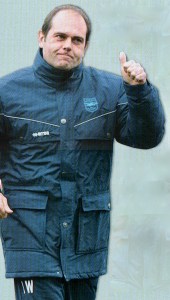
“In my opinion, his man-management skills were lacking, which was why I made the decision to remove him from the manager’s job,” he said. It didn’t help Wilkins’ cause when midfielder Paul Reid went public to criticise his man-management too.

Knight felt although Wilkins hadn’t sufficiently nailed the no.1 job, he could still be effective as a coach, working under Micky Adams. The pair had previously got on well, with Adams saying in his autobiography, My Life in Football (Biteback Publishing, 2017) how Wilkins had been “one of my best mates”.

But Adams said: “He thought I had stitched him up. I told him that I wanted him to stay. We talked it through and, at the end of the meeting, we seemed to have agreed on the way forward.

“I thought I’d reassured him enough for him to believe he should stay on. But he declined the invitation. He obviously wasn’t happy and attacked me verbally.

“I did have to remind him about the hypocrisy of a member of the Wilkins family having a dig at me, particularly when his older brother had taken my first job at Fulham.

“We don’t speak now which is a regret because he was a good mate and one of the few people I felt I could talk to and confide in.”

Youth coach

Knight knew his decision to sack the manager would not be popular with fans who only remembered the good times, but he pointed out they weren’t aware of the poor relationship he had with some first team players.

Knight described in his book how a torrent of “colourful language” poured out from Wilkins when he was called in and informed of the decision in a meeting with the chairman and director Martin Perry.

“He didn’t take it at all well, although I suppose he felt he was fully justified,” wrote Knight. “He was fuming after what was obviously a big blow to his pride.”

Reporter Andy Naylor perhaps summed up the situation best in The Argus. “The sadness of Wilkins’ departure was that Albion lost not a manager, but a gifted coach,” he said. “Wilkins was not cut out for management.”

Saints coach

One year on, shortly after Alan Pardew took over as manager at League One Southampton, he appointed Wilkins as his assistant. They were joined by Wally Downes (Steve Coppell’s former assistant at Reading) as first team coach and Stuart Murdoch as goalkeeping coach.

Saints were rebuilding having been relegated from the Championship the previous season and began the campaign with a 10-point penalty, having gone into administration. The club had been on the brink of going out of business until Swiss businessman Markus Liebherr took them over.

A seventh place finish (seven points off the play-offs because of the deduction) meant another season in League One and the following campaign had only just got under way when Pardew, Downes and Murdoch were sacked. Wilkins was put in caretaker charge for two matches and then retained when Nigel Adkins, assisted by ex-Seagull Andy Crosby, was appointed manager.

It was the beginning of an association that also saw the trio work together at Reading (2013-14) and Sheffield United (2015-16).

Adkins, Crosby and Wilkins were in tandem as the Saints gained back-to-back promotions, going from League One runners up to Gus Poyet’s Brighton in 2011, straight through the Championship to the Premier League. But they only had half a season at the elite level before the axe fell and Mauricio Pochettino took over.

When the trio were reunited at Reading, Wilkins, by then 50, gave an exclusive interview to the local Reading Chronicle, in which he said: “This pre-season has given me time to learn about the characters of the players we’ve got at Reading and find out what makes them tick.

At Reading with Crosby and Adkins

“It’s my job then to make sure every player maximises his potential. That’s what I see my role as, to bring out the very best of them from now on and make them strive to attain new levels of performance.

“I will always keep working toward that goal. If we can do that with every individual and get maximum performances out of them, I believe we will be in for a great season.

“We’re back together now and it’s going fantastically well. I have loved every minute of it. I’m used to working with Nigel and Andy and we are carrying out similar work to what we’ve done in the past.”

The Royals finished seventh, a point behind Brighton, who qualified for the play-offs, and the trio were dismissed five months into the following season immediately following a 6-1 thrashing away to Birmingham City.

Six months later the trio were back in work, this time at League One Sheffield United, but come the end of the 2015-16 season, after the Blades had finished in their lowest league position since 1983, they were shown the door.

Between January 2018 and July 2019, Wilkins worked for the Premier League assessing and reporting on the accuracy, consistency, management and decision-making of match officials.

In the summer 0f 2019, he was appointed Head of Coaching at Crystal Palace’s academy, a job he held for 15 months.

A return to involvement with first team football was presented by his former Albion player Alex Revell, who’d been appointed manager of League Two Stevenage Borough. Glad to support and mentor Revell in his first managerial post, Wilkins spent a year as assistant manager at the Lamex Stadium.

Class act Lallana helped lift Albion to a new level

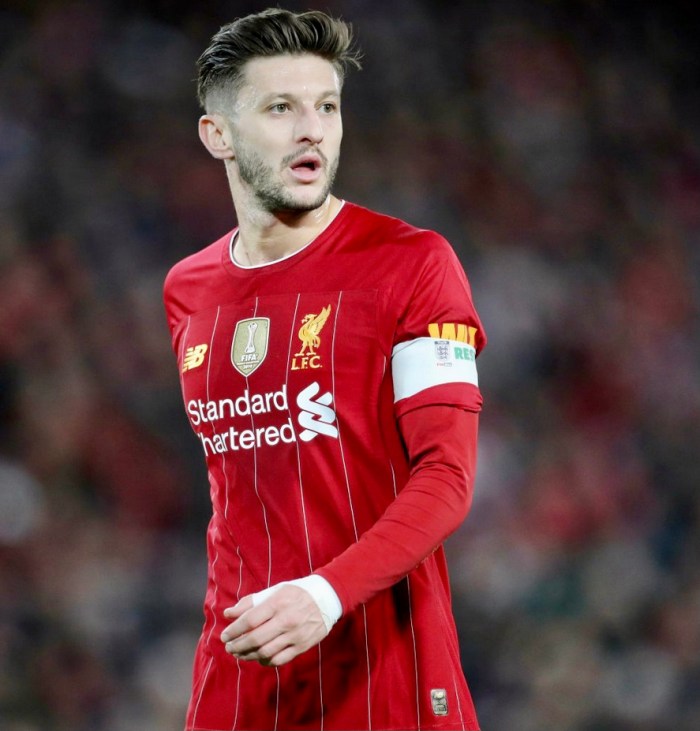
IT WAS SOMETHING of a coup when multiple trophy winner and England international Adam Lallana joined Brighton from Liverpool in 2020.

His best years might have been behind him, but Lallana’s football intelligence and astute movement were a joy to watch and were, perhaps, a sign that once-humble Albion were getting serious about challenging for the top spots in the Premier League. The club twice achieved top 10 finishes during his four years at the Amex.

As much as anything, Lallana observed in an early interview that his new side would improve with a bit more belief. “That comes with time, with the development of players and with confidence,” he explained. “The more times we play well, the more we’ll get that belief and with that we’ll score more goals and get more wins, but we need to be a little bit patient. Empires aren’t built in a day.”

One of Lallana’s trademarks, as observed in an early profile on Liverpool’s website, was “turning markers inside-out with impulsive twists or burrowing through swathes of players with fine close-control”.

The player said: “Pace isn’t a huge part of my game, but playing the percentages, mathematically, if you can add an extra yard of pace or a couple of percentage points to your game, then that’s massive nowadays.

“I still do a lot of work in the gym to improve my pace, power and strength to try to get that little bit more explosive power to my game. I’m always working to improve.”

Players used to performing at the highest level week in week out don’t suffer fools gladly and it was no surprise to learn that Lallana had a few fallings out in his early days at Brighton, for example with Neal Maupay.

Younger players certainly enjoyed the experience of learning from someone who had played at the very top, for example, Columbian international Steven Alzate, who said: “On and off the pitch he is a leader and when he’s got the ball at his feet he can really show people what he can do. Training with him is an honour; he’s a great guy.”

Those leadership qualities were drawn on by both Graham Potter and Roberto De Zerbi, even though the ageing player’s minutes on the pitch had to be managed carefully.

Lallana even stepped up to support coach Andrew Crofts with first team training in between the reigns of the two managers.

Towards the end of his time at Brighton, Lallana went off in international breaks to work with Lee Carsley preparing the England under 21s ahead of matches.

Born in St Albans on 10 May 1988, Lallana’s family moved to the Ilford area of Bournemouth when he was five and he went to the local Corpus Christi School and St Peter’s Catholic School.

If the surname doesn’t sound Anglo Saxon, that’s because he has Spanish roots: his grandad was from Madrid.

From kicking a ball around with his young pals, Lallana began to harness his footballing talent at the AFC Bournemouth centre of excellence. Southampton paid a £3,000 fee to take him into their own junior ranks when he was just 12 years old. They made subsequent payments totalling £15,000 as he progressed to scholarship and full professional levels.

Lallana was grateful for the quality of the Southampton academy set-up and in particular referenced George Prost, his under-17 coach, as someone who instilled a lot of the attributes that helped to develop his career.

Lallana was in the same Saints youth team as Theo Walcott and Leon Best (Gareth Bale was only on the bench!) that lost the 2005 FA Youth Cup final to Ipswich Town. He was also in the side that lost in the semi-final to Liverpool the following year.

The same year, he made his first team debut in a 5-2 League Cup win over Yeovil Town. Saints loaned him back to Bournemouth in 2007, when he played three games, but he returned to Southampton, then in League One, and was part of their back-to-back promotion-winning side that went from League One to the Premier League.

Having helped Southampton under captain Dean Hammond to the League One runners up spot – behind Brighton – in the 2010-11 season, he was a key member of the side that gained promotion from the Championship in second spot behind Reading (Brighton finished 10th). Over the course of eight years with Southampton, he made 235 appearances, scoring 48 goals.

In the Premier League, Lallana was made Saints captain and he admitted he struggled at first. But the arrival of Mauricio Pochettini had a positive influence on him, as he explained in a matchday programme interview. “He had a big part in moulding me into the player I am today – he took me to that next level.

“When he came to the club he could see that I had pressure on my shoulders, that I wasn’t playing freely – and we just spoke about it and he talked it out of me. By the end of the season and the next season, I was playing the best football of my life I think and a big credit goes to him for that.

“He could see I was a talented player and probably wasn’t playing to my best, but he knew it was because I wasn’t playing freely. We had lots of conversations and him knowing that and speaking to me about it was amazing because instantly it was like a balloon that just popped – immediately it took the pressures off. That was one of many things he did for me at Southampton.”

Lallana said Pochettino also helped him to become fitter and introduced him to the art of pressing. “My love of winning the ball back – that came under Mauricio.”

It was Brendan Rodgers who signed Lallana for Liverpool for £25m after the 2014 World Cup in Brazil where he had been a member of the England squad that finished bottom of its group. Lallana had made his England debut the previous November in a 2-0 friendly defeat v Chile.

In the red of Liverpool

Ten of his 34 caps for England were won in 2016 when he was voted by supporters as the country’s player of the year.  By then 28, he scored his first international goal in a last-gasp win over Slovakia in September and two months later netted again against Scotland and Spain at Wembley.

Taking instructions from England boss Gareth Southgate

“This award is a huge honour,” Lallana told The FA.com. “The last three winners were Rooney (2015), Rooney (2014) and Steven Gerrard (2012) so that just goes to show what a great achievement this is.”

By then, Rodgers had been replaced by Jurgen Klopp under whom Lallana blossomed and developed (they were also close neighbours in Formby) as together they went on to win the Premier League title and the Champions League.

In a 2022 documentary about Klopp, made by The Anfield Wrap, Lallana said: “He has the X factor doesn’t he? It’s as simple as that. The amazing ability he has to motivate players. If he’s left you out for 10, 11, 12 games you’re a bit down but somehow with him, you’ve still got so much respect for him even though you aren’t happy.

“I don’t know how he does it but he just has the ability to get you motivated because of who he is, so you’re fighting for the team and for him and that’s the art. It just shows how good he is at being a manager.”

According to thisisanfield.com: “2015-16 was arguably Lallana’s best, as he started 38 games and helped push Liverpool on to the League Cup and Europa League finals.

“One of his finest performances in red came in the Europa League semi-final against Villarreal. With Liverpool trailing 1-0 from the first leg in Spain, an emotionally charged Anfield were put at ease when an early own goal drew them level.

“From then on, Lallana was brilliant for Liverpool in an attacking line-up also featuring Roberto Firmino, Philippe Coutinho and Daniel Sturridge. The latter got the second goal after 63 minutes, but it was Lallana who sealed the game and sent the Reds through to the final, with a composed flick into the net.”

Summing up the Liverpool mindset, Lallana said in a matchday programme interview: “At Liverpool, where the expectations are so high, it was all about just dealing with those pressures.

“We had to forget about what the supporters want, the trophies that are expected, and just believe in what we as a team believed in – and that was playing high-intensity football and being motivated in every game to fight for each other.”

In another interview, this time with the Liverpool Echo, he said: “Playing six years with the intensity of that club takes over your life.”

Nonetheless, when he finally left Anfield for the Albion, he said: “I’m desperate for a new challenge and I’m desperate to play a bit more.

“I still feel like I’ve got plenty more football ahead of me and I’m thoroughly excited by this next challenge and what that will bring.”

A sign of the respect Liverpool fans still had for Lallana was demonstrated at the end of Albion’s 2-2 draw at Anfield in October 2022. As fans sang his name, Lallana tapped his chest and clapped every stand before walking down the tunnel.

Lallana helped lift Brighton to a new level

Reds supporter Aaron Cutler wrote on social media: “Pleased Lallana got a deserved (and delayed) ovation. Easy to forget how integral he was at the start of Klopp’s reign. While injuries limited his game time towards the end he clearly remained an influential presence within the squad. Could have done with him today!”

Of course, during his time with Brighton, Lallana was able to see at close quarters the emergence of Alexis Mac Allister, and he was full of praise in an interview with Graham Hunter:

“What a special player and special person,” he said. “He’s a player that is so pure with how he plays. The way he lends the football, uses others, there’s no selfishness in the way he plays.

“It was so special watching him during the World Cup, not playing to begin with then getting used and proving himself. Then playing so well that there’s no way he doesn’t play, by the end Messi is looking for him.”

Speaking of Mac Allister’s “footballing intelligence” Lallana said: “OK he’s not the quickest or strongest, but so smart. Knows that the football is faster than anyone, Alexis is of that ilk.

“He had to battle tough moments here at the beginning. He’s a very introverted, shy guy.”

With an eye to a likely future in the game as a coach, Lallana enjoyed a great relationship with De Zerbi and told BBC Radio Sussex: “I feel like we’ve helped each other an awful lot in the two years and I’m extremely grateful for how he’s managed me.

“At times I can’t train every day and my body probably lets me down, but he’s been so supportive of me and he’s managed me differently to most other players, probably because of the history I’ve had with injuries and the age I’m at. I know as a footballer that doesn’t often happen.

“Our relationship goes beyond player and coach, he’s like an older brother to me.”

When Lallana decided to leave Brighton at the end of the 2023-24 season and return to Southampton, he had made 64 starts for the Seagulls plus 40 appearances off the bench.

Albion had finished 16th and ninth under Potter then sixth and eleventh under De Zerbi.

In an extended interview with The Athletic, Lallana said: “What has happened is everything I thought was possible. I wouldn’t have said in my first interview we are going to be in Europe in three years, but that is the genius of Tony Bloom (owner-chairman) and Dan Ashworth (former technical director).”

Cucurella a Euros winner despite the boos backdrop 

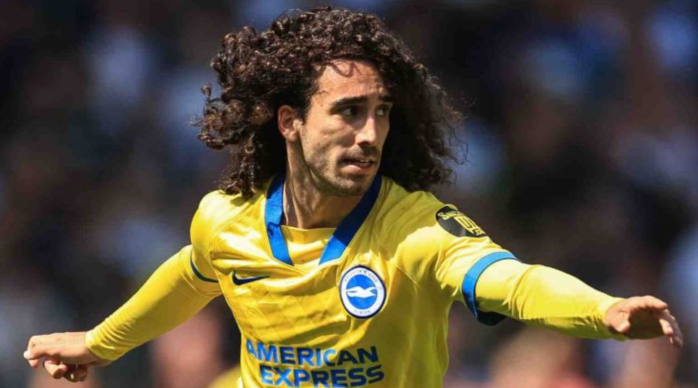
MARC CUCURELLA has got used to going from hero to zero in the eyes of fickle football fans.

A revelation in his one and only season playing for Brighton, he scored a stunning goal in a 4-0 thrashing of Manchester United and was crowned both Players’ Player and Player of the Season.

But he pushed for a transfer only one year into a five-year contract and, although he didn’t get his hoped-for move to Manchester City, joined Chelsea for £62m.

While his first few months at Stamford Bridge were tough on and off the pitch, he finished the season as a regular in Mauricio Pochettino’s side and then went on to bigger and better things for his country.

He became a cult hero for his impressive performances at left-back during Spain’s winning run to claim the European Championship in July.

Euro winners: Cucurella with Nico Williams

Capping an excellent tournament by supplying the inch-perfect pass for Mikel Oyarzabal’s late winner, Cucurella was justified in having a dig at pundit Gary Neville who’d previously said the defender was “probably one of the reasons why Spain could not go all the way” in the tournament.

“We went all the way, Gary. Thanks for your support,” was Cucurella’s social media retort after the 2-1 win over England rounded off a tournament that he might not have been involved in if Valencia’s Jose Gaya and Barcelona’s Alejandro Balde hadn’t been injured.

The left-back with the “massive” hair also let his feet do the talking in response to German fans who booed his every touch of the ball in the semi-final and final because they reckoned he was guilty of a handball in the penalty area against the host nation but a penalty wasn’t given.

“I did not care too much, but at the same time, it felt a bit sad that some people came to that game just to boo a single player,” Cucurella told The Athletic. “Some people wasted tickets that could have gone to fans who would have really enjoyed the match.”

But, he pointed out, it wasn’t a new experience because Brighton fans, angered by the manner of his big money departure from the club after only one season, reacted similarly when he returned to the Amex playing for Chelsea.

“It was another night when the boos were really loud every time I touched the ball, so I got used to it,” he said. “The first time I went through this… I won’t say it’s an unbearable feeling but it’s unpleasant. Now I’m more used to it.”

Some players move on stylishly, others go about it in what is perceived to be the wrong way – thus incurring the opprobrium of supporters who remain loyal to the club.

A sizeable enough contingent of Albion fans were aggrieved by the manner of Cucurella’s departure from the club to vent spleen whenever he touched the ball as a Chelsea player back at the Amex.

It was a toss-up between Cucurella and Graham Potter as to who was the bigger pantomime villain when Chelsea were thumped 4-1 at Falmer in October 2022. “The Spaniard was booed and jeered relentlessly for over an hour on his first game at Brighton since his transfer,” The Athletic noted.

The online sports news outlet continued: “According to Whoscored, Cucurella’s defensive output included no tackles, no interceptions and just one clearance.”

They noted it was the fourth time in five starts that Cucurella had been taken off early, and said: “This change would have hurt the most. The taunts grew louder as he made his way off the pitch and the look on his face spoke volumes.”

Things might not have been going well for him at the time, but Potter was not unduly concerned and said: “He’s a resilient character, he’s a really good person. Sometimes when you move clubs it goes really well, and sometimes it can be a little bit of an up-and-down period. Marc’s a little bit up and down but he’s a top player and he will show his quality.”

Cucurella was an unused sub when Albion clinched the double over the Londoners that season with a 2-1 win at Stamford Bridge. But the next time he faced his old teammates, he demonstrated a level of commitment that in some quarters earned him the man of the match accolade.

When Potter’s successor Mauricio Pochettino selected him at right-back in the Carabao Cup against Brighton in September 2023, previously critical Chelsea supporters couldn’t believe what they saw as the home side edged the match 1-0. One said: “Pocketed Mitoma and Joao Pedro . What a shift for him.”

Agreeing he was ‘man of the match’, another said: “Cucurella was absolutely brilliant in that second half, playing that well at right-back was not something that I expected, fair play to him, maybe he should be given more opportunities.”

Arguably, he answered Brighton supporters’ criticism even more effectively – in a similar style to what he did in the Euros final v England – on 15 May 2024 at the Amex when his pinpoint cross in the 34th minute was comprehensively buried in the back of Albion’s net by Cole Palmer’s head.

But let’s remember a much happier time, when the Spaniard was the toast of the Albion faithful with a quite magnificent contribution to that 4-0 thumping of Manchester United.

Muhammad Butt on squawka.com positively purred about Cucurella’s performance declaring his man of the match accolade as “a richly deserved reward for a player who could truly ascend to any height in the world game”.

The writer’s colourful report observed:“What Cucurella did to poor Diogo Dalot all afternoon recalled The Avengers when Hulk whipped Loki around like a caveman trying to dry a wet sock on some rocks.

“Cucurella has the instantly iconic look of a comic book hero, a wiry frame with a face that is all prominent eyebrows and colossal curly hair giving him an instantly iconic silhouette.

“And he plays with the kind of ceaseless energy that one would attribute to those spandex-adorned heroes for whom stamina never seems to be an issue.”

Warming to his theme, Butt continued: “Cucurella grabbed the game by the scruff of the neck and was the dominant force on the pitch. Even when he played no part in the goals, the overall pressure that was weighing on United and keeping them pinned back in their own half was born of the Catalan’s drive and determination.

‘Such was Cucurella’s power against United that when he scored Brighton’s second goal, arriving late in the box like some left-sided Frank Lampard to lash the ball home violently at the near-post leaving David de Gea in the early stages of a Bee Gees tribute dance, it wasn’t even surprising. It made perfect sense, as though he had been doing it all season when, in fact, it was his first goal of the campaign.”

Sadly for Brighton fans, that showing seemed to be like an audition for a bigger and better stage and he had only two more matches in Albion’s colours.

Born in the Catalan village of Allela on 22 July 1998, he played futsal with his local club before linking up with the junior sides of Espanyol, where he was made captain. From there, at the age of 14, he joined Catalan giants Barcelona in 201

A rare appearance for Barcelona

“Barcelona were always my team,” he told the Albion matchday programme. “I liked the style of play and the big players the club always attracted.”

He went on: “For me to join such a special club, at such a special time in its history, was a proud moment for my family.”

He made his debut for the club’s B team at the age of 18 but also had the chance to train with the stars of the first team.

“While I was still in the academy, I would sometimes train with Messi or Neymar, which was really exciting,” he said. “I’d train with Busquets, Jordi Alba, sometimes Suarez, and it was scary the first time I stepped up.

“I was very nervous, training alongside players I’d only seen on TV or on the PlayStation, but these are the moments you remember for the rest of your life.”

He only made one brief substitute appearance for the Barcelona first team, going on for Lucas Digne in a 3-0 Copa del Rey win at Real Murcia in October 2017, and he said: “It was a very nice moment for me but it was a shame I never got to play for the team at Camp Nou.”

Cucurella got to play in La Liga on loan at Eibar (in 2018-19) and Getafe (in 2019-2020) before moving permanently to Getafe for the 2020-21 season.

When Albion signed him, fellow former Barca B graduate and ex-Albion midfielder Andrea Orlandi, now a TV pundit, told the Albion matchday programme: “Marc is a super-energetic player whose main assets are his energy, attitude and intensity.

“He was in the top three in every physical study in La Liga for the last three seasons and can’t play without giving it 100 per cent. He has the perfect attributes to be a success in the Premier League.”

Perhaps it should be no surprise that he shone for Spain at the 2024 Euros because he had been selected by his country at almost every age group level and won a silver medal as part of the under-23 side at the 2020 Olympic Games.

His first senior appearance was in a friendly against Lithuania in June 2021 when he captained the side to a 4-0 win. A second cap followed in a 3-3 draw with Brazil at the Bernabeu in Madrid in March 2024. The run through to the final took his caps tally to 10.

In an in-depth interview with Pol Ballus for The Athletic in July 2024, Cucurella opened up on the turbulence he had suffered after making the move to Chelsea. “Until the summer of 2022, my football career had been great: a constant progression, always upwards with no setbacks. Then I arrived at a club where the expectations were so, so high.

“Until then, I had played at clubs where every victory felt really special, where every point is celebrated. Then you go to Chelsea, where you win a game because that’s what you have to do. There is no time to chill or enjoy.”

Not only was managerial change disruptive, things didn’t go well for him off the field. “I spent the first two months living in a hotel with my family, then soon after we found a place to live we had thieves breaking into our home. After this, I spent two days hospitalised for a virus. I lost a lot of weight and had to start from scratch to get in shape again. It wasn’t easy to come back. The team couldn’t find their way on the pitch, either.”

Cucurella said fans had expectations of him because of the size of the fee Chelsea played Brighton but he pointed out: “People expect that, with certain price tags, you need to be a machine. Sometimes it’s difficult to understand that we are normal people who have our own problems off the pitch. We have worse and better phases in our lives.”

He worked with a psychologist to try to help him through his struggles, admitting: “Confidence is the most important thing. You miss it when you struggle, but it flows when you thrive. I’ve worked a lot on this, to stabilise those moments.”

Certain he could improve, he knuckled down in training and eventually seized his chance when it was given.

Towards the end of the 2023-24 season, Pochettino tinkered with Chelsea’s formation and successfully deployed Cucurella in a midfield role, drawing praise from observers such as Nick Purewal in The Standard, who said: “Cucurella’s ability in possession, to act as an auxiliary pivot and progress the ball has transformed Chelsea.”

The player himself had some fun on social media in the summer (right) when, with a nod to the chant Brighton fans conjured up during his time at the Amex, he filmed himself with a bottle of Estrella and sang the song… “he drinks Estrella, eats paella…” but his normally “massive” hair was neatly matted down!