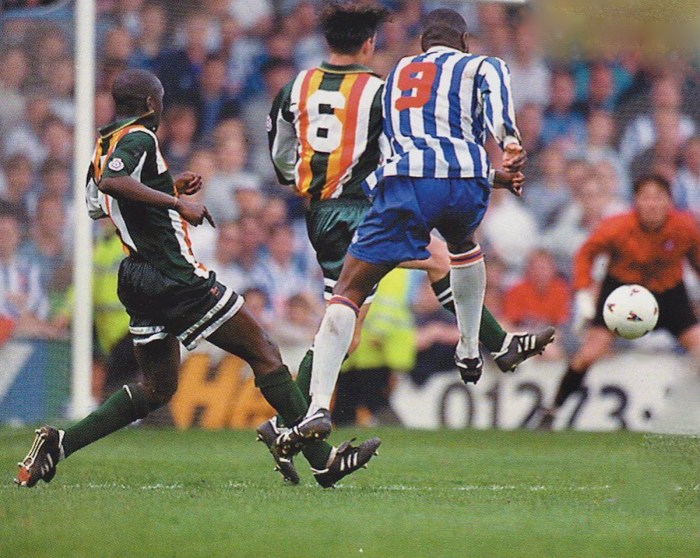
The Barking boy who became a Hammers play-off final hero

IT WAS A DREAM come true for Bobby Zamora to play for West Ham, the team he supported as a boy.

Born in Barking on 16 January 1981, he explained: “They were my local team and having been spotted by the club playing for my Sunday side, Senrab, I signed schoolboy forms and we’d be given tickets to watch the team on a Saturday afternoon at the Boleyn.”

Zamora’s favourite player was Tony Cottee and the side at that time included the likes of George Parris and Julian Dicks. “It was always a great atmosphere down there, singing ‘Bubbles’, and I count myself honoured and privileged to have played for the club that I grew up supporting,” he said.

Fellow Senrab players John Terry, Paul Konchesky, Ledley King and JLloyd Samuel were all snapped up by the Hammers at the same time but when the club decided to merge two centres of excellence they found themselves playing fewer games which prompted them all to leave.

Zamora joined Terry at Chelsea but suffered Osgood-Schlatter disease (which causes pain and swelling below the knee joint)and had to stop playing for six months. He described in the Undr The Cosh podcast how Norwich kept in touch with him to see how the injury was progressing so, when he was fit again he joined them and spent a season in Norfolk.

“They had a lot of London lads in their side but it was like playing in the Land of the Giants,” he explained in a matchday programme article. “They were all 15 going on 18, much bigger physically and taller than me, and I was released for being too small.”

His friend Luke Williams was also released but the pair of them were offered a trial by Bristol Rovers and, after only playing half a match, both were offered apprenticeships.

As described in my previous post, it was from Rovers that Zamora joined Brighton, while Williams played non-league before moving into coaching, which included a spell as development coach at Brighton.
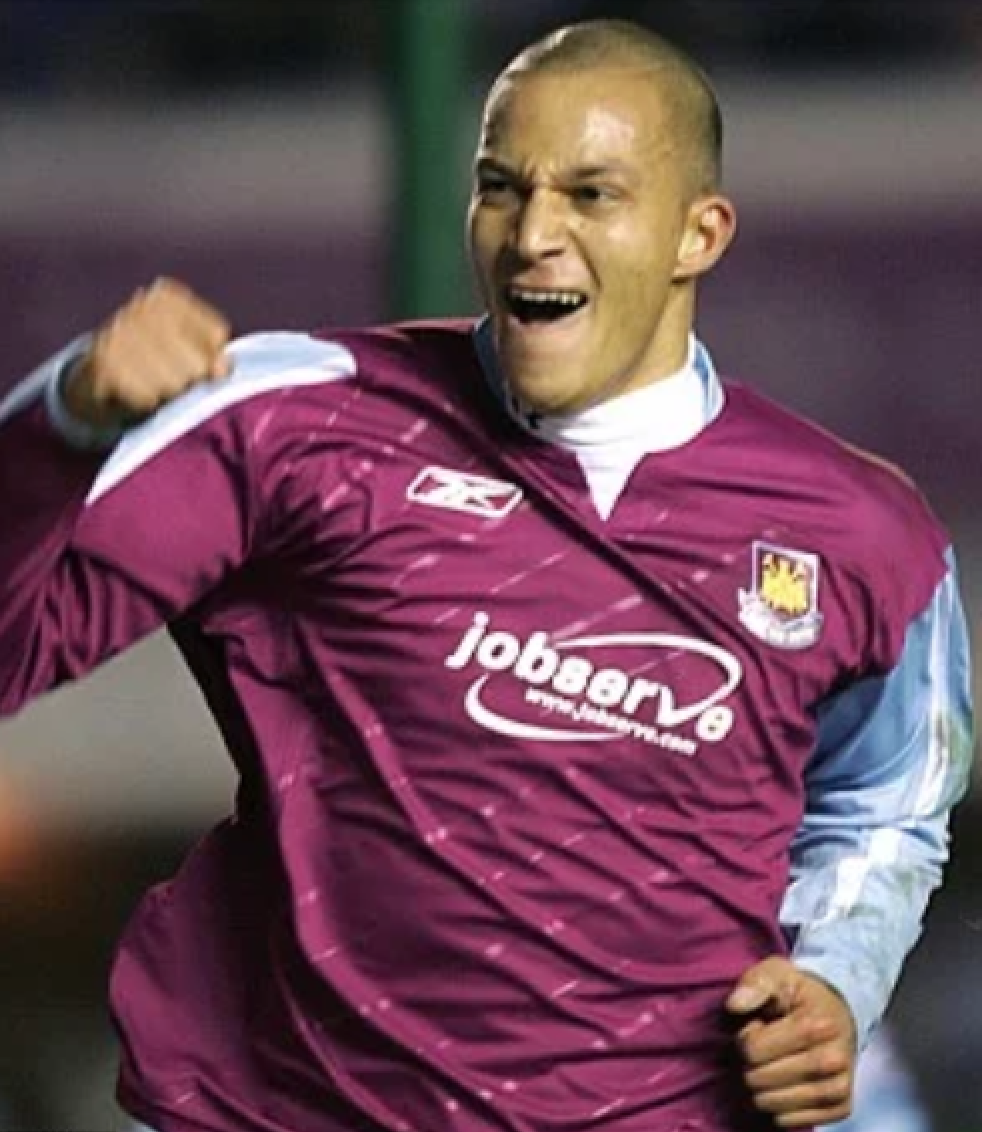
When Spurs decided to swap Zamora for Jermain Defoe, a move to the Boleyn was a bit of a no-brainer for the former fan, although Premier League Leeds United were also keen to take him.

“The pull of West Ham was too great and although it was a drop into the Championship, the squad they had under Alan Pardew was more than good enough to go up,” he said.

Zamora got off to a good start with the Hammers, scoring on his debut and again on his home debut. That first goal came after he had gone on as a sub in a 2-1 win at Bradford City on 7 February 2004. He followed it up with the only goal of the game in a home win over Cardiff on 28 February.

Three more goals followed before the end of the 2003-04 campaign, but the season ended in disappointment when the Hammers lost in the Championship play-off final at the Millennium Stadium, Cardiff, against Crystal Palace the day before Brighton’s famous League One play-off win against Bristol City in the same stadium.

Zamora had a first half effort saved at point blank range by Palace keeper Nico Vaesen and a second half ‘goal’ ruled out for offside before being subbed off on 68 minutes as Palace won promotion courtesy of a Neil Shipperley goal.

All was put right a year later, though, when at the same ground Zamora was the Hammers hero. It was his turn to score the only goal of the game, against Preston North End, getting on the end of a Matthew Etherington cross to slot home from six yards in the 57th minute.

Play-off final scorer

Across the season, Zamora made 20 starts and 19 sub appearances, scoring 13 goals. His first double for the club came in a 3-2 League Cup second round win over Notts County at Upton Park on 21 September 2004.

Competition for forward places was fierce with Marlon Harewood, Teddy Sheringham and Sergei Rebrov also pushing for a place up front.

As well as scoring in that play-off final, Zamora had emphasised his claim to a starting berth by scoring in the 2-2 semi-final first leg home draw with Ipswich then twice in a 2-0 win at Portman Road in the second leg.

Pete Ellis on claretandhugh.info reckoned Zamora “played a key role for the Hammers at a pivotal point in our recent history” and he added: “The promotion season in 2005, where he and Etherington played like men possessed in the play-offs, still fills me with great pride.”

Back in the Premiership, Zamora scored 10 goals in 20 starts and 22 appearances off the bench and Ellis remembered “some great displays showing his ability to hold the ball up and have the craft and guile to bag a few tasty goals in the process.
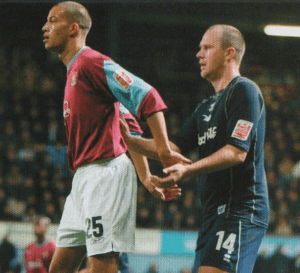
Zamora marked by former Brighton teammate Guy Butters who scored Albion’s goal in a 1-0 win for the Seagulls at the Boleyn Ground

“A proper character around the club, I enjoyed watching Bobby play and thought he never really got the plaudits that his talents and performances deserved.”

Amongst memorable goals in 2005-06 were a stunning solo effort in a 2-1 win at Birmingham and a goal in a 3-2 win at Highbury. Unfortunately, he’s also remembered for having his penalty saved by Pepe Reina in the FA Cup Final shoot-out with Liverpool.

The 2006-07 season saw Zamora make 30 starts and seven sub appearances, scoring 11 goals and named runner-up to Carlos Tevez in the Hammer of the Year contest.

A terrific start to the season saw him score five goals in his first four matches, including two against Charlton in a 3-1 opening day win.

A four-month barren spell came as the Irons struggled but he scored crucial goals against Blackburn, Everton, Middlesbrough and Arsenal (the last time West Ham played at Highbury).

Fans remember too his goal the following season – a chip over Jens Lehmann – that sealed a vital win for the Hammers at Arsenal’s new Emirates Stadium, with a heroic performance from ‘keeper Rob Green keeping out the Gunners at the other end.

The arrival of Craig Bellamy and return from injury of Dean Ashton added competition for Zamora, who missed seven months of the 2007-08 season with tendinitis.

His last Hammers goal was in a 2-1 win at the Boleyn against Derby on 19 April 2008, and his last game for the club was in a 2-2 draw at home to Aston Villa the following month. He had scored a total of 40 goals in 152 appearances for West Ham.

Even though he had missed a lot of games, and only scored once in 12 starts plus two off the bench across the whole season, he had no inkling he wouldn’t be offered a new contract.

“I went in at the start of the next season expecting to be talking about a new contract and they told me they’d agreed a deal to sell me to Fulham,” he told the Fulham website in a 2019 interview.

“It was obvious I wasn’t wanted and I made my way down to Motspur Park,” he said.

Zamora and team-mate John Paintsil moved to Fulham for a joint fee of £6.3m (Zamora was valued at £4.8m).

• I’ll explore how Zamora got on at Fulham ahead of Brighton’s game with them in March. His form with the Cottagers hit sufficient heights as to earn him two England caps.
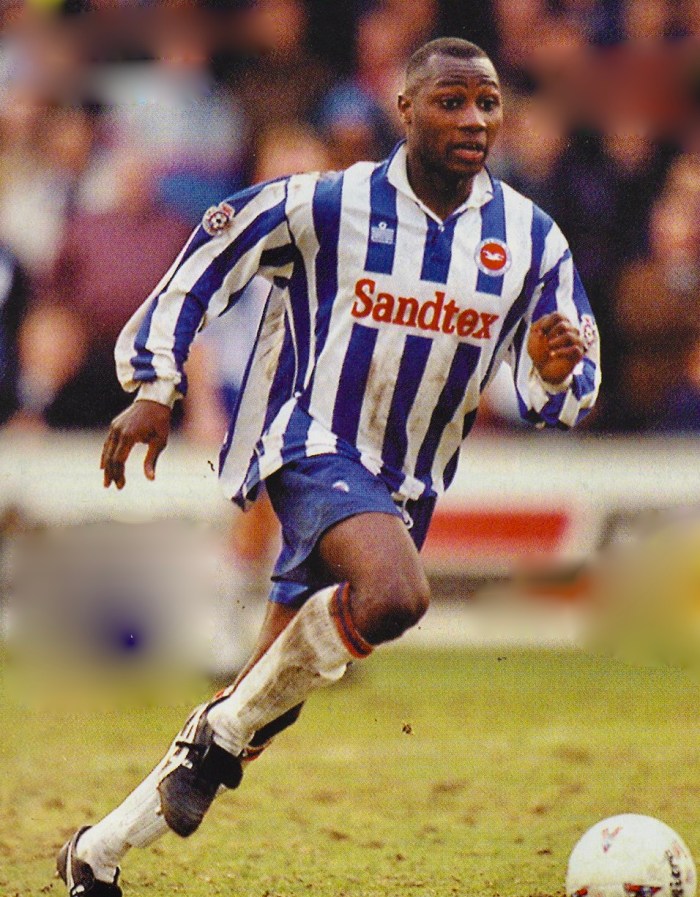
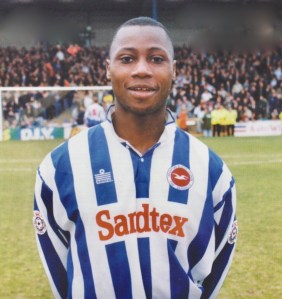
Zeke Rowe’s three goals and a red card as Albion went down

CHELSEA loanee Zeke Rowe scored three goals in nine matches for doomed Brighton and ended his spell with the ignominy of being sent off.

Rowe, a 22-year-old striker who had scored plenty at youth level for Chelsea,  was one of five new faces to join Jimmy Case’s relegation-bound Seagulls in the spring of 1996.

Winger Paul McDonald and striker Craig Maskell joined permanently from Case’s old club, Southampton, together with Saints defender Derek Allan, on loan initially and then permanently. Future captain Gary Hobson signed from Hull City.

All found themselves plunged into what turned out to be a fruitless battle to avoid relegation against a toxic backdrop created by the people running the club at that time – the hated Archer / Stanley / Bellotti regime – who tried to sell the club’s home without having a new ground to move to.

In the same matchday programme that announced the arrival of the five new players, the publication also detailed the impending departures of the likes of former first team regulars Steve Foster, Ian Chapman, Dean Wilkins, John Byrne, Stuart Myall and Stuart Munday; not to mention directors Bernard Clarke, Peter Kent, Dudley Sizen and Denis Sullivan. To misquote Shakespeare: Something was definitely rotten in the state of Hove!

Rowe made his debut in a 1-1 draw at home to Rotherham United, on 30 March, and then got off the mark with a goal away to Swindon Town four days later, although the Albion went down 3-2 (Jeff Minton scored the other).

Rowe’s picture adorned the front cover of the matchday programme for the 9 April home match v Burnley when his goal earned the Seagulls a win.

And his solitary goal also proved to be the decider in another 1-0 home win, over fellow strugglers Carlisle United, managed at the time by Mervyn Day.

Rowe’s dismissal for fighting with York City’s John Sharples came in a Thursday morning game, played five days after the official end of the season, in front of a post-War record low gate of 2,106 fans at the Goldstone.

The fixture had been rearranged because the original game 12 days previously had been abandoned after disgruntled Albion supporters had stormed the pitch in protest at the proposed sale of the ground and broken both crossbars.

It drew hysterical reaction in some quarters (probably because it was only a few weeks before England played host to Euro 96) but had the desired effect of bringing the rogue direction of the club to the attention of the football authorities who somewhat late in the day intervened to stop the Albion going out of business.

The original York game had looked like being the last ever at the Goldstone but a stay of execution saw the club stay for one more season before the site was redeveloped and the Seagulls were forced to groundshare at Gillingham.

The only happy supporters at the Goldstone on 9 May 1996 were around 400 followers of the Minstermen because their side overcame going a goal down to a Maskell opener to win 3-1, a result which prevented them joining Albion in the drop. Gary Bull, who had enjoyed a successful time on loan with Brighton at the start of that season, had equalised for York.

One City fan, Simon Worden, wrote an amusing blog about the whole occasion, and explained: “Whilst I should have been in a lecture at university at Preston, as I was only 19 at the time, I decided that the match was too important to miss and travelled down the day before to watch the match and stayed in a very cheap B&B.”

After witnessing the win, he said: “All the York fans were jumping around on a Thursday morning singing ‘We are staying up’ and enjoying the sunshine.

“One of the best days even and, whilst I was very tired, it was an enjoyable (but expensive) trip back to Preston where I had to catch up with my studies!”

Also watching on was Michael Knighton, chairman of Carlisle United, who, as a consequence of the result, were relegated with the Albion. Greg Wood, covering the game for The Independent, spiced up his report with a couple of choice quotes from him.

“Once York had gone 2-1 ahead, Brighton just weren’t interested,” said Knighton. “We’ve been relegated and we’ll never know if we should have been. This competition should be based on fairness, and towards us it hasn’t been.”

Wood also observed: “After York’s third goal, a member of their board turned to Knighton and made some distinctly unsporting gestures. Ordinary supporters have probably been expelled for less.”

Born in Hackney on 30 October 1973, Rowe was a frequent goalscorer in Chelsea junior teams playing alongside the likes of Neil Shipperley, Muzzy Izzet, Michael Duberry and Craig Burley.

But a first team breakthrough eluded him and before his time at Brighton he had scored twice in 10 games on loan at Barnet and had a trial with Swindon Town that didn’t work out.

When Chelsea let him go in the summer of 1996, he moved to Second Division Peterborough United under Barry Fry and was quickly off the mark netting the Posh opener in a 3-3 home draw with Millwall on 10 September 1996.

He was on target again, four days later, ironically against York City, in a 2-2 draw. But the season didn’t end well for Posh, because they were relegated. Rowe only scored once more in his 15 starts and 14 appearances off the bench that season.

Over the next two seasons, he only made four more starts for United and 13 appearances as a sub, while also going out on loan to Kettering Town and Doncaster Rovers.

Rowe later moved to Welling United where, according to the fanzine Winning Isn’t Everything, he was a disappointment after a bright start. It said: “Ezekiel Bartholomew Rowe, to give him his full name. Another in the long line of loanees from Uncle Barry Fry, he was brought in late in the 1998-99 season as the club attempted another Houdini act. Joined permanently in the summer, was on fire pre-season and then… he was shit. Had an impressive tattoo, erm, apparently.”

At King’s Lynn, Rowe played under his former Peterborough teammate Tony Spearing, who won the FA Youth Cup with Norwich City. (That 1983 success saw the Canaries draw 5-5 with Everton over two legs – Mark Farrington scoring four of Everton’s goals – before edging a replay 1-0).

Rowe ended his playing days with Conference North side Hinckley United where he was a teammate of Stuart Storer, who famously scored the last ever goal at the Goldstone – against Doncaster Rovers – a year after Rowe’s dismissal at that much-loved old stadium.

Goalscorer Craig Maskell among Town’s top 100 crowd favourites

Screenshot

CRAIG MASKELL had a decent near 1 in 3 goalscoring record for Brighton & Hove Albion but he’s possibly best remembered for a shot that didn’t go in.

When Maskell’s curling effort in the relegation decider at Hereford United on 3 May 1997 struck the post rather than going in, fortunately Robbie Reinelt was on hand to slot home the rebound to earn Albion the draw that ensured they stayed in the league.

Born Craig Dell Maskell on 10 April 1968 in Aldershot, perhaps it was his destiny to play for Southampton! (for younger readers, The Dell used to be Southampton’s home ground).

Indeed, Maskell started his professional career at Southampton, signing pro forms just after his 18th birthday. But he appeared in only six league games for the Saints before joining Huddersfield Town in May 1988 for a £20,000 fee.

His new teammates included former Seagulls Chris Hutchings and Kieran O’Regan and the goals really flowed for him in the 1988-89 season when he scored 28 times in 46 games.

Arguably his most memorable match came in the 1989-90 season when he scored four in a 5-1 win at Cardiff City, thus becoming only the third player in Huddersfield’s history to score four in an away match.

By the end of that season, he’d scored an impressive 43 goals in 87 games for Town and, at the time of Huddersfield’s centennial in 2006, Maskell’s prolific goalscoring for them led to his inclusion in The Fans’ Favourites, a book listing their top 100 Town players.

That prolific scoring record earned him a £250,000 move to Third Division Reading. He scored in a season-opening 3-1 win at Exeter City and had 10 goals by the season’s end as the Royals completed a mid-table finish under player-manager Mark McGhee, who later became Brighton boss.

With John Madejski settling in as the new owner, and McGhee finding his feet in the managerial chair, the 1991-92 season saw Reading finish 12th. Maskell ended up top scorer with 16 goals in 35 appearances (plus five as sub), three of them coming in a 4-2 win away to Darlington.

In the summer of 1992, player-manager Glenn Hoddle paid £250,000 to take Maskell to second tier Swindon Town (where he had previously spent a month on loan in 1987).

It was to prove a memorable season for the Robins as they won promotion to the top tier for the first time in their history, via a 4-3 play-off victory over Leicester City. Maskell was leading scorer with 23 goals in a side captained by central defender Colin Calderwood, later Chris Hughton’s assistant manager at Brighton.

Maskell made his Robins debut on the opening day of the 1992-93 season, in a 1-0 win over Sunderland, and scored his first goal in a 2-2 draw at Wolves in late August. He went on to net eight times in the opening ten games of the season before suffering a mini goal drought between December and April.

Nevertheless, Maskell bagged two in a 6-4 win at Birmingham before scoring in both legs of the play-off semi-final against Tranmere Rovers. He then scored Town’s second at Wembley, thumping a left-footed drive off the post and into the net.

Although he started the first two matches amongst the elite, he then struggled to get game time in the Premier League, often warming the bench as Jan Age Fjortoft,  Andy Mutch and Keith Scott started ahead of him.

He scored twice in a 3-3 draw at Sheffield Wednesday on 29 December 1993, but he left the club in February 1994, returning to former club Southampton for a £250,000 fee.

However, Saints already had a fair bit of striking talent in their ranks and once again he found his opportunities limited, this time by the likes of Matt Le Tissier, Neil Shipperley and Gordon Watson. As a result, he only managed 17 Premier League starts.

He had a five-game loan spell at Bristol City but then joined Brighton on 1 March 1996, making his debut the following day against Brentford. He didn’t have to wait long for his first Albion goal, scoring against Oxford United on 12 March and then hit two four days later at home to Hull City.

The off-field shenanigans at Brighton were a big distraction at the time but on the pitch Maskell managed to score a total of 20 goals in 69 games, crucially netting 14 of them in 37 games during that make-or-break 1996-97 season.

After 17 games the following season, he was one of five senior players whose contracts were terminated early, in December 1997, as the cash-strapped Seagulls in exile at Gillingham were forced to make drastic cuts to survive. Maskell had a brief spell playing for Happy Valley in Hong Kong before linking up with Leyton Orient for 18 months.

It is recorded in a number of places that Maskell decided to quit the professional game while walking off the turf at Wembley having played as a substitute in the Orient team beaten by Scunthorpe United in the Nationwide League third division play-off final.

“I turned to one of my team-mates and said: ‘That’s enough’,” Maskell said. “I’d spent too much time away from my family and too little time on the pitch at Orient.”

He had scored just twice in 23 games for the O’s, however, he continued playing at non-league level for several years, turning out for Hampton & Richmond Borough, Aylesbury United and Staines Town, as well as being coach and assistant manager to Steve Cordery.

In an article in The Times on 16 November 2000, just prior to a FA Cup first round tie between Hampton & Richmond Borough and Barnet, Maskell talked about what he had learned from the various managers he’d played under.

“I look to Glenn Hoddle for his ability to create flair in attack and Lawrie McMenemy because he was so good at man-management.

“Most of my ideas on defensive organisation I learnt from Dave Merrington, who was youth-team coach at Southampton. He was fantastic. You just have to look at the players he found for the club, not just myself but Matt Le Tissier, Alan Shearer, the Wallaces and another dozen or so less well-known players who had good careers.”