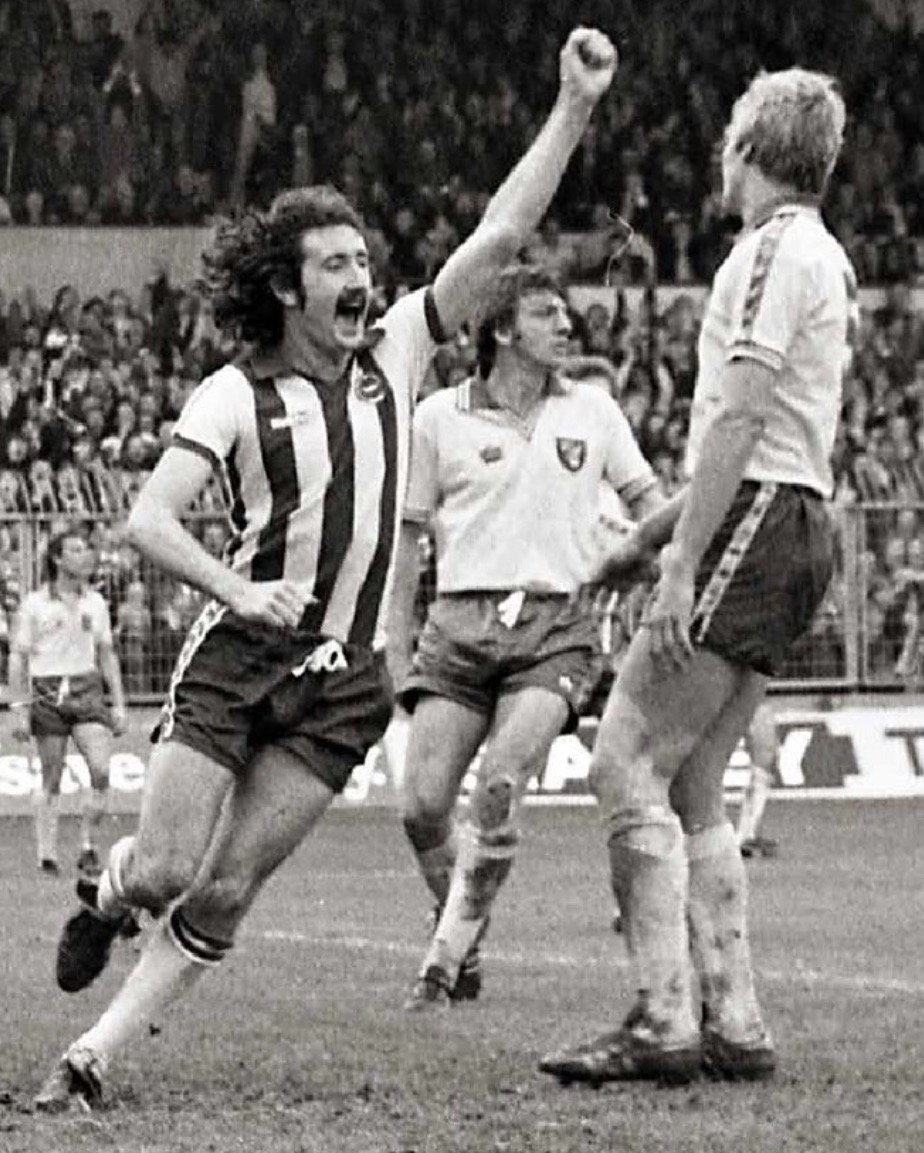
Wearside hero Gary Rowell blighted by injury after leaving Sunderland

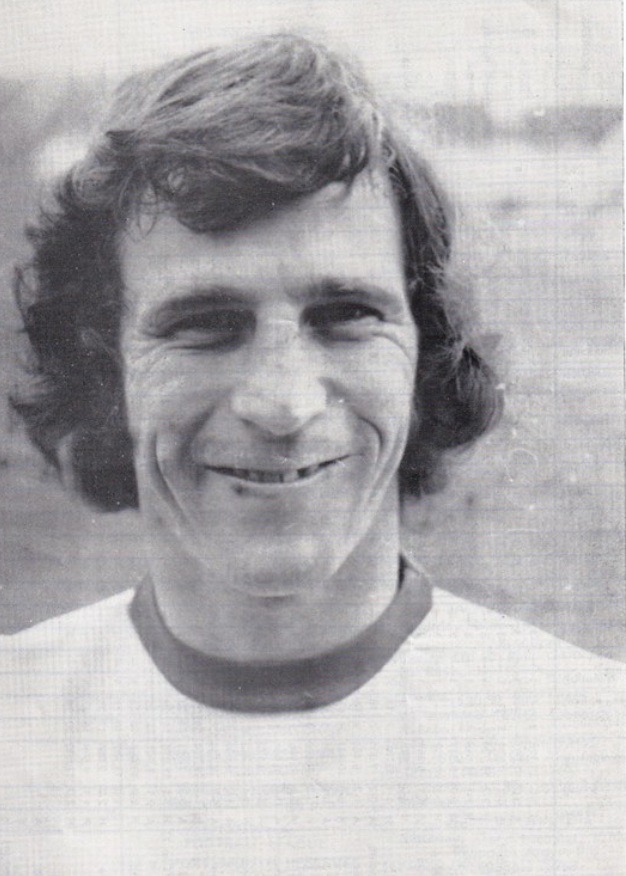
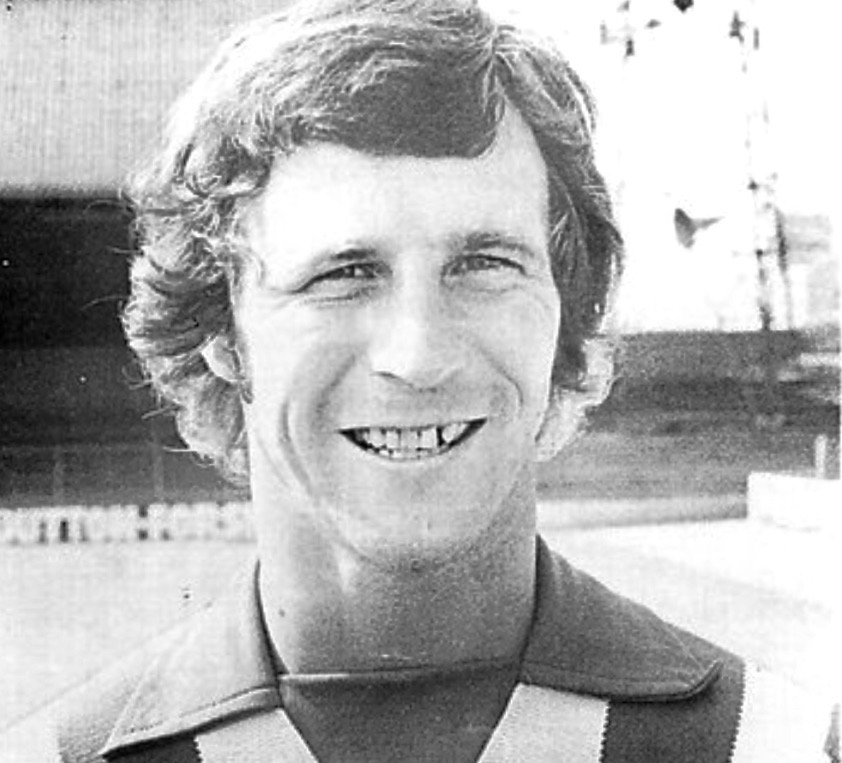
gary rowell tony normanBRIGHTON fans never got to witness the best of prolific goalscorer Gary Rowell who, to this day, Sunderland fans eulogise in the same way Albion fans still sing about Peter Ward.

He died aged 68 on 13 December 2025, exactly 50 years to the day of his first appearance for the Black Cats following a long battle with leukaemia.

Rowell has a place in Sunderland’s best all time XI selection, in 2005 he topped a Football Focus poll as Sunderland’s all-time cult hero and, in 2020, was inducted into the SAFC Hall of Fame, which he described as ‘the best night of my life’.

There is a website that details every one of the 103 goals the Seaham-born footballer scored for the Wearsiders in 297 games after making his debut as a 71st minute substitute for Mel Holden in a 1-0 Sunderland win over Oxford United at Roker Park.

Unfortunately, the free-scoring striker-turned-midfielder was struck by a knee injury which hampered the latter part of his career, including his spells with Norwich City and the Seagulls.

Having left Sunderland on a free transfer after 12 years at the club, Rowell tore ligaments in his right knee on a pre-season tour of Scandinavia with Norwich before he even managed to kick a ball in anger.

In a year at Carrow Road, he made only six appearances – four as a substitute – and scored just the once, coming off the bench to net against Aston Villa. Typical of this spell between August 1984 and July 1985, he was substituted after only 16 minutes of his reserve team debut.

The following season, a £35,000 fee took him back to the North East to play for Middlesbrough, but, at the time, they were in the middle of a financial crisis and lost their second-tier status. Rowell top-scored with 10 goals in 27 appearances – two of them against the Albion at the Goldstone in January 1986 – but Boro were relegated in second-to-last spot (Brighton finished in 11th place that season).

Brighton were not exactly flush with cash themselves in the summer of 1986 when Alan Mullery, the manager who’d previously led them from third tier to the elite, returned to the club to replace Chris Cattlin.

Mullery found a very different set-up to the one he’d left acrimoniously in the summer of 1981. With little money available to be spent on new arrivals, hard-up Albion, not for the first time, had turned to the supporters in an effort to raise transfer funds.

Money from a scheme called the Lifeline fund went towards buying goalkeeper John Keeley for £1,500 from non-league Chelmsford, Darren Hughes for £30,000 from Shrewsbury Town, and Rowell from Middlesbrough on a free transfer (the Lifeline funds being used to help with his relocation to the South Coast).

Mullery explained the Rowell signing thus in his programme notes: “I see his role with us as coming forward from midfield and adding to our power in the box.

“We know he can get goals and he is a versatile player. When we further improve the squad, we may use him a little differently.”

Rowell , who discovered Mullery had tried to sign him back in 1979 (but Sunderland hadn’t informed him), joined just after the start of the season, in time to be given a place on the bench for the away 1-1 draw with his former club Sunderland. He went on for Kieran O’Regan with 18 minutes left.

He kept the bench warm for two more matches before getting his first start in place of Northern Irish centre-forward Gerry Armstrong in a 2-2 draw away to Plymouth Argyle on 13 September.

Unfortunately, it wasn’t long before Mullery was reporting his absence from the side because of an ankle injury sustained in training.

Nevertheless, interviewed by Tony Norman in the matchday programme, Rowell, who was 29 and married with two small children, said: “I’m delighted with the move. I’ve found it to be a very friendly club and people have gone out of their way to make us feel at home. Now I want to repay the club by playing well for the team.”

The longest run of games he got in an Albion shirt came in November and December 1986 when he took over from winger Steve Penney for six matches (two wins, two draws, two defeats).

rowell BW HS

A broken toe and a troublesome hamstring made him feel injury-jinxed but, during his run back in the side, he had what Mullery described as “his best game since joining us” in a 3-0 win over Shrewsbury Town on 21 December. Six days later, the toe went again, and he didn’t play for the rest of the season.

Mullery was then controversially dismissed the following month and Rowell had to wait until the start of the following season for successor Barry Lloyd to select him.

He featured in three pre-season friendlies, all of which ended in defeats and wore the no.4 shirt in the opening two fixtures of the 1987-88 season, but those were his only first-team starts that campaign. His midfield berth was taken over by the experienced Alan Curbishley.

By October, the matchday programme reported Rowell and fellow midfielder Dale Jasper had been placed on the transfer list following long discussions with Lloyd. Curiously, it added: “However, both players are keen to stay with the club, regardless of any offers made, and will be battling hard for first team places.”

Rowell subsequently appeared seven times as a substitute for the first team, but he was largely confined to the Reserves for whom he made 20 appearances and scored once. In February 1988, he moved to Dundee on trial, but, when not taken on, moved the following month to Carlisle United.

After just seven games for the Cumbrians, he finished his professional career at Burnley, where he scored once in 19 appearances.

Born in Sunderland on 6 June 1957, Rowell grew up in the mining village of Seaham, became an apprentice at Sunderland in 1972 and two years later turned professional.

In 1976, when Sunderland were struggling in the First Division, manager Jimmy Adamson gambled on the introduction of the 19-year-old Rowell: it paid off in spades as he scored 44 goals in two and a half seasons.

During that prolific spell, Rowell was in the squad for two end of season England Under 21 Championship preliminary matches; he went on for Laurie Cunningham in a 1-0 win over Finland in Helsinki on 26 May 1977 but wasn’t involved in a 2-1 win over Norway in Bergen six days later. This was an England side including future full internationals Peter Barnes and Peter Reid.

He was also a non-playing member of Dave Sexton’s squad that assembled at the Goldstone Ground three months later, but he had to watch as an over-age Peter Ward (22), playing on home turf, of course, scored a hat-trick in a 6-0 win over Norway. The aforementioned Curbishley was also a non-playing onlooker in that squad.

footballinprint.comUndoubtedly, the stand-out moment of Rowell’s Sunderland career came when he scored a hat-trick in a 4-1 win over arch rivals Newcastle United at St James’ Park, which he referred to in a profile article (see above).

In a vote for Sunderland’s best players of the 1970s, Rowell was described as “a lovely footballer. Though not blessed with blistering pace, he would ghost into goal-scoring positions and his finishing was deadly.” Rowell was an expert penalty taker, scoring 25 of 26 he took for Sunderland.

Some observers reckon but for injury he would surely have gone on to gain full England international honours. However, his career was severely disrupted by a serious knee injury sustained in a March 1979 game against Leyton Orient.

After a lengthy recovery, he resumed scoring goals regularly but there were doubts over his being able to maintain fitness for the duration of a whole season.

As part of a big team rebuilding exercise carried out by manager Len Ashurst in 1984, Rowell was allowed to move to Norwich.

After his playing days ended, Rowell became a financial consultant in Burnley and those loyal Sunderland supporters still got to hear their hero because, for a number of years, he was a commentator on Sunderland games for Metro Radio.

  • Pictures mainly from matchday programmes. Sunderland profile article: footballinprint.com.
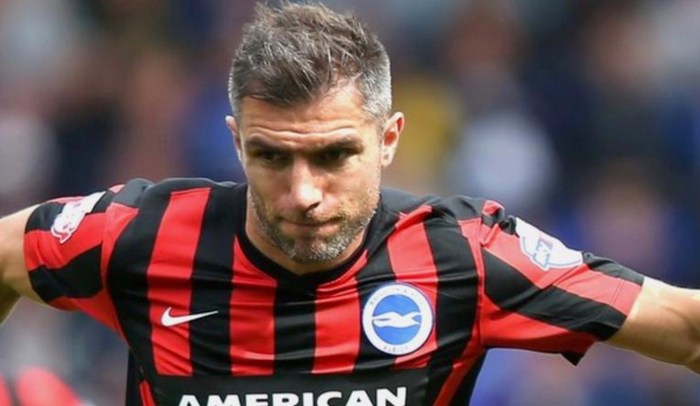
Northern Irish legend Aaron Hughes was talk of the Toon

AH red blackVETERAN Northern Irishman Aaron Hughes only brought down the curtain on his lengthy playing career in June 2019 at the age of 39.

On 12 June he finally confirmed his playing days were over in an emotional speech to his Northern Ireland team-mates in the Borisov Arena after the country’s 1-0 victory over Belarus.

Remarkably, Hughes had first been called up to the Northern Ireland squad at the age of 17, before he’d even broken through at Newcastle United.

“Having known Aaron Hughes for nearly 25 years, it was an honour to be present to witness his typically classy speech to all of the Northern Ireland players and staff to announce his retirement from the game after an amazing career,” former Newcastle keeper and current Northern Ireland coach Steve Harper told the Belfast Telegraph.

Amongst many others paying tribute, former international Paddy McCourt added: “Without doubt the best professional I encountered during my football career. I was fortunate enough to play alongside Aaron Hughes at Brighton and we also spent many years together with Northern Ireland. A true gentleman and brilliant player.”

He had just the one season with Brighton & Hove Albion – in 2014-15. Mainly a central defender, Hughes could also play comfortably in either full-back position or midfield.

He was the first Brighton signing of Sami Hyypia’s ill-fated spell as manager, and Hyypia told the club website: “We wanted to bring another experienced defender, and Aaron fits the bill – having played at Premier League, Champions League and international level.

“I have played against Aaron a few times during my time at Liverpool and also for Finland, and I know his qualities and what he will give us.

“He has a very good footballing pedigree, is an intelligent player, and he has a great mentality and good approach to the game.

“He has that experience I wanted to bring into the squad, which alongside our other senior players, will help our younger players continue to develop and progress in the first-team squad.”

As it turned out, Hughes was only used as cover and during his season with the Seagulls made only 13 appearances.

Nevertheless, Hughes’ stay on the south coast clearly left an impression and fellow Northern Ireland international Oliver Norwood described how Hughes played a part in persuading him to join the Seagulls in 2016.

“I spoke to Hughesy about his time here and he spoke so highly of the club, mentioning the facilities, the stadium and that it’s set up to go to the Premier League,” Norwood told the club website. “He’s a wonderful person that’s achieved so much.

“I know he didn’t get the game time he would have liked here, but if I have half the career he has, then I’ll be very happy.”

Born in Cookstown, County Tyrone, on 8 November 1979, Hughes joined Newcastle United’s youth ranks at 17 and, over eight years, he made 279 appearances for the Magpies.

A Hughes superb footy picsEyebrows were raised when former Northern Ireland manager Bryan Hamilton took Hughes to Portugal for a World Cup qualifier in October 1997, when he was still only 17, but Hamilton told the Belfast Telegraph: “There was something special in him, even at a young age, and I wanted him in the squad. I felt he could be an outstanding player for Northern Ireland and I knew that coming in early wouldn’t affect or faze him.”

Hughes had to wait until Lawrie McMenemy succeeded Hamilton to make his international debut the following March, and by then he’d made a memorable debut for Newcastle in November 1997 against Barcelona at the Nou Camp. Selected by manager Kenny Dalglish, despite the 1-0 defeat, the 18-year-old showed tremendous promise against the likes of Figo, Ronaldo and Stoichkov. He eventually held down a regular first team place under Dalglish’s successor Ruud Gullitt before Bobby Robson took the helm.

Hughes made his name at St James’s Park in the centre of Newcastle’s defence, playing alongside Sylvain Distin in a side also featuring Craig Bellamy, Gary Speed and Alan Shearer. He spoke about his time playing under Dalglish and Robson in an interview with the Guardian.

Discerning followers of Toon were quick to join in the tributes paid to Hughes when he announced his retirement. Elsewhere they have vented their spleen at the decision Graeme Souness took to sell him to Aston Villa.

Hughes had three seasons at Villa, having been signed by David O’Leary in the 2005-06 season. But Villa fans are a tough lot to please and, despite his previous success at Newcastle, it seems they expected more. “Hughes, despite filling his role admirably as a centre back, never felt integral to our defence as he found himself chopped and changed with (Olof) Melberg, and fellow signing Wilfried Bouma,” declared readastonvilla.com.

Eventually with injury-hit defender Martin Laursen returning to the side under new manager Martin O’Neill, Hughes became more of a squad player at Villa Park. He was allowed to leave to join Fulham and was signed by a former Northern Irish international teammate, Lawrie Sanchez.

hughes fulhamAt Fulham, he formed a formidable defensive partnership with Brede Hangeland and fulhamfc.com said: “The pair worked brilliantly together, with the fans soon referring to them as our very own Thames Barrier. Their styles complemented each other perfectly, and while Hughes wasn’t the tallest of centre-backs, his leap and reading of the game more than made up for it.”

Hughes was one of three ever-presents – with Mark Schwarzer and Danny Murphy – when Fulham finished seventh in the Premier League in 2008-09, which led to European qualification.

He was part of the side captained by Murphy, with Bobby Zamora up front, who went on a gloriously unexpected UEFA Cup journey in 2010, only to be pipped to the trophy in extra time by Atletico Madrid.

“The way we lost, right at the end of extra-time, still grates with me, so the final is a bitter-sweet memory,” Hughes reflected in a 2014 interview for Albion’s matchday programme. “The Juventus game stands out more, where we came back from 3-1 down from the first leg in Italy to win 4-1 at Craven Cottage.”

On transfer deadline day in January 2014, Hughes signed a short-term deal for Harry Redknapp’s Queens Park Rangers for whom he made 11 Championship appearances.

After his season with Brighton, even at the age of 36 Hughes had no intention of packing up playing. Instead, he headed to Australia and played for Melbourne City and then linked up with India’s Kerala Blasters before he joined Hearts for his final two seasons.

His last club game saw Hearts bring him on in the 68th minute of their final league game of the season, a 2-1 defeat to Celtic at Celtic Park. Upon replacing John Souttar, the 39-year-old Hughes took the captain’s armband for the final few minutes of a career stretching across an impressive 22 years.

Hughes won an amazing 112 caps for his country across 20 years – a record for an outfield player. He was second only to the legendary Pat Jennings as most-capped player and was captain of his country for eight years. Small wonder, then, that he should be so grateful to so many at the Irish FA for the longevity of his international career.

hughes NI

  • Pictures from various online sources.

Cattlin wasn’t backed to buy ex-City defender Jeff Clarke for £6,500

HARD-UP Albion wanted to sign dominant centre-back Jeff Clarke in 1984 but, unable to meet Newcastle United’s modest asking price, they were forced to walk away from a deal.

Clarke, who began his career at Manchester City, had plenty of experience to bring to a young Brighton side having played more than 300 games for north-east giants Sunderland and the Magpies.

At the start of the 1984-85 season, Clarke found himself on the outside looking in at St James’ Park, following the arrival of the legendary Jack Charlton as manager.

Although Arthur Cox had led them to promotion to the old First Division, he quit during the close season because he didn’t feel the club’s owners were investing enough in the playing side (some things never change!).

Former England World Cup winner Charlton, whose uncle ‘Wor’ Jackie Milburn was a Newcastle legend, took the hot seat and his preferred centre back pairing at the start of the season was John Anderson and Glenn Roeder.

Down on the south coast, Brighton boss Chris Cattlin was keen to bring some experience to the spine of the team he was rebuilding, and he took Clarke on loan to play alongside the emerging Eric Young, as well as introducing his old Huddersfield teammate Frank Worthington up front.

Clarke and Worthington made their debuts in an opening day 3-0 win at Carlisle United on 25 August (Danny Wilson, Terry Connor and Steve Penney the goalscorers).

The on-loan defender couldn’t have had a more eventful home debut three days later, in an ill-tempered evening game at home to Larry Lloyd’s Notts County, who had Justin Fashanu playing up front.

A clash between Fashanu and Clarke saw the defender come off worse, a back injury forcing him to be substituted with only 36 minutes gone (replaced by sub Neil Smillie).

In a game which saw seven players booked, fellow central defender Young joined him in hospital having been concussed by a stray Fashanu elbow. In the days before multiple substitutes, the Seagulls were forced to play the second half with only ten men, but nevertheless ran out 2-1 winners. Steve Jacobs opened the scoring on 22 minutes, Fashanu equalised on 55 but Worthington marked his home debut with the winner in the 67th minute. (The following June, Fashanu joined the Albion for a fee of £115,000).

jeff clarke BWClarke had sustained a fracture to a bone in his back but he was fit enought to return to the side on 22 September, in a 1-0 defeat away to Oldham Athletic, and was then on the winning side in the following two games: a 3-1 first leg Milk Cup win over Aldershot and a 2-0 home win over Fulham.
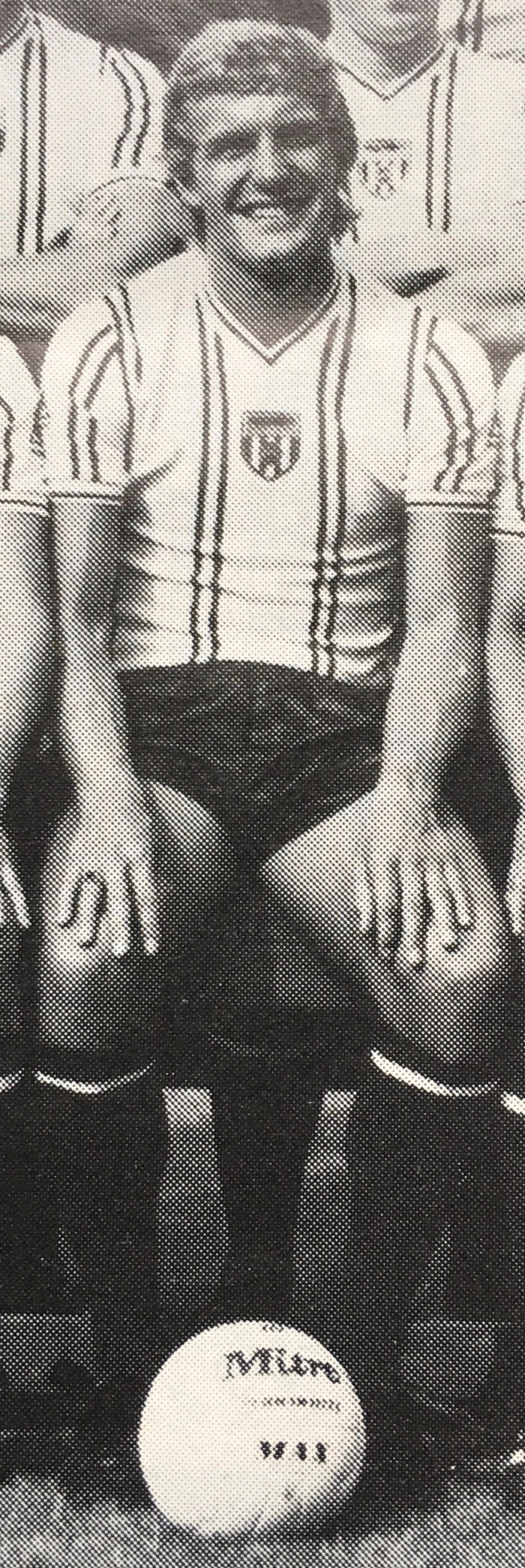
Unfortunately, that proved to be his last game for the Seagulls. Cattlin wanted to sign him permanently and Newcastle wanted just £6,500 for Clarke but the Albion board wouldn’t sanction the fee, as Cattlin explained at the Albion Roar live show in December 2018 (skip to 28 minutes in), which he believes signalled the beginning of the end of his time at the club.

In his matchday programme notes at the time, Cattlin said: “With the current cash crisis at the club, I could not finalise what I think is a very important deal in the long-term for this club. Clarke is a fine professional who, in many ways, reminds me of Peter Withe in his outstanding professionalism and leadership qualities.”

That sounds like he felt the captaincy of the side wasn’t in the right hands, and later in the same notes he explained how he had taken the job of skipper from Jimmy Case (“he needs to get his own game back to what we know he is capable of”) and given the role to Danny Wilson (“his leadership qualities on the park have become self evident”).

Born 18 January 1954 in the West Yorkshire mining town of Hemsworth, near Wakefield, Clarke was a Sheffield Wednesday fan as a boy and admired Owls central defender Vic Mobley.

However, it was on the other side of the Pennines that he made his breakthrough as a professional, with Manchester City.

Manager Tony Book handed Clarke his debut in a 4-0 home win over West Ham United on 17 August 1974 but he only played 15 games for the Maine Road outfit, his last game coming in a 2-1 home defeat to Carlisle United on 19 March 1975.

Clarke moved to Sunderland as a makeweight in the deal which saw the Sunderland and England international centre back Dave Watson move to City in the summer of 1975.

J Clarke Sund BW

The move to Roker Park finally saw his career take off and in seven years he made 213 appearances for the Wearsiders, many as captain (as seen in team photo above), including helping them to promotion to the top flight in 1976.

The excellent MatchDayMemories.com unearthed a Shoot/Goal profile of Clarke which revealed he had earned schoolboy under 18 international honours, his favourite food was peanut butter sandwiches and Brian Kidd, then of Arsenal, had been his most difficult opponent.

In 1982, at the age of 28, he switched to north east rivals Newcastle United on a free transfer, and stayed with the Magpies for five years.

When his two-month loan on the south coast wasn’t made permanent, he had other loan spells in Turkey and at Darlington but then returned to Newcastle and was restored to the first team, and featured in a New Year’s Day win over Sunderland in which future Albion winger Clive Walker was an opponent.

When Charlton quit as boss on the eve of the 1985-86 season, it signalled better fortunes for Clarke and under Willie McFaul he became a regular alongside Roeder, racking up 45 appearances and chipping in with three goals. The following season he played only seven games and hung up his boots in 1987.

Clarke stayed at St James’ Park in a coaching capacity after his playing days were over but simultaneously he took a degree in physiotherapy at the University of Salford, graduating in 1996.

He later became physio at former club Sunderland before moving to Leeds United in 2001. Made redundant at Elland Road in 2003, he moved to Dundee United in November the same year and has been the first team physio ever since.

Graham Winstanley: fledgling Magpie, Carlisle legend, able Albion deputy

GRAHAM Winstanley spent five years at Brighton but only made 70 appearances, plus one as a sub. Most of his time with the Seagulls was spent as a dependable reserve.

Manager Peter Taylor drafted in the central defender to replace Grimsby-bound Steve Govier in the autumn of 1974 and he kept the no.6 shirt for all but two games through to the end of the season.

Govier had only been signed from Norwich City in May that year (together with Andy Rollings and Ian Mellor) but, unlike his co-signings, who had long Albion careers, Govier lasted only 16 games.

Winstanley, a Carlisle United regular for several seasons, had been edged out of the first team picture at Brunton Park following their surprise rise to the top division.

He arrived at the Goldstone in October 1974, on loan initially, and was even made captain during that time. He signed permanently for £20,000 the following month, moved into a house in Shoreham with wife Joan, and stayed in the south for five years despite limited first-team opportunities.

Born in the small north-east village of Croxdale, three miles south of Durham, on 20 January 1948, Winstanley joined Newcastle United straight from Washington Grammar School and, after serving an apprenticeship, turned professional.

He made his first team debut on Christmas Eve 1966, in a 2-1 home defeat to Leeds United.

With the likes of Ollie Burton, John McNamee and Bobby Moncur ahead of him, Winstanley struggled to establish himself at St James’ Park, only featuring seven times for the first team, five times as a starter and twice as a substitute.

Newcastle sold him to Carlisle for £8,000 in 1969, and it was at Brunton Park where he carved out a reputation as a powerful centre back who could also play full back.

In June 1972, against the Italian giants Roma in the Olympic Stadium, he scored a goal for United seven minutes from time that sealed a famous 3-2 win in the Anglo-Italian Cup. Four-Four-Two magazine voted it 45th of 50 top Greatest European Moments!

It may seem implausible to today’s reader to believe that Carlisle could win promotion from the equivalent of the Championship and play a season in the Premier League but that’s exactly what the Cumbrians did in 1974. They finished in third place, in the days before play-offs, a point behind Luton Town and 16 points behind champions Middlesbrough.

Although Winstanley had been part of Alan Ashman’s promotion side, he was not a first choice in the top division, and, after 165 appearances for United, headed south to Brighton.

His influence initially alongside Rollings, and then Steve Piper, brought much needed stability to the defence but the side struggled for goals that season and eventually could only achieve 19th place.

In January 2014, the excellent blog The Goldstone Wrap reflected on Winstanley’s influence at that time, and reproduced an Argus article angled on how the player – nicknamed Tot (he was the youngest of three brothers) – wore contact lenses while playing.

Having taken over the Albion team captaincy from Ernie Machin, Winstanley was appointed club captain in August 1975 but, with the arrival of the cultured former Millwall and West Ham defender, Dennis Burnett, was dislodged from a starting berth and only played three more times that season.

Even when Taylor’s successor, Alan Mullery, dispensed with Burnett’s services, the 1976-77 season saw Graham Cross partner Rollings, restricting Winstanley to just five appearances.

The following season Mark Lawrenson arrived, so it wasn’t as though the competition for a place was getting any easier! However, in that season, Rollings missed several matches through injury and Winstanley proved an able deputy on 19 occasions.

One of his stints in the side included the final seven matches when Albion came so close to earning promotion and Winstanley even got on the scoresheet in the 3-1 home win over Tottenham Hotspur on 15 April 1978.

“It was from a free-kick that got played out wide to the left and when the ball came over I just sneaked in at the back and hit it,” he recalled in an Albion programme feature of 14 March 2009. “It spent a long time coming to me in the air and an even longer time before it hit the back of the net.” It happened in front of a crowd of 32,647 packed into the Goldstone, and the game was interrupted by trouble-making Spurs supporters.

He kept the shirt for the opening two fixtures of the 1978-79 season but only played three more times in that promotion-winning campaign, the last of which came in a 1-1 draw away to Luton Town on 21 April, when neither Lawrenson nor Rollings were available.

When his contract was up in July 1979, he was granted a free transfer and he returned to Carlisle where he made a further 69 appearances. “I could have stayed but I didn’t really fancy it to be honest,” he told Spencer Vignes in a matchday programme article. “I knew I only had a certain amount of ability. I was never a First Division player. That’s why it was the best thing to do.”

During his time in Sussex, he coached Sunday team Boundstone Old Boys and, after his playing career came to an end, he was manager of non-league Penrith for a while. However, he subsequently had a variety of jobs outside the game, in and around Carlisle. He worked for a wholesale electrical company, as a milkman, selling insurance, as a partner in a building supplies company, as well as working for the Post Office and a local newspaper.

Gerry Ryan – ‘a special player and one of football’s nice people’

THERE WAS no shortage of tributes paid to Gerry Ryan when the former Albion winger died at the age of 68 on 15 October 2023.

Fellow Irish international Liam Brady, who appointed Ryan as his assistant when he took charge of the Seagulls in 1996, said: “Gerry was a wonderful team-mate. He was a very quick winger, very brave, and he took people on.

“We had some great games together and then we ended up on opposite sides, for Brighton and Arsenal, in the old First Division.”

Although Ryan and Brady’s time in charge happened during a turbulent time off the pitch, Brady pointed out: “We did a pretty good job in what were, of course, difficult circumstances, and I could see then just what Brighton meant to him – he was in love with the club so much.

“Off the pitch, Gerry was just a really nice guy. He was affable, unassuming and got on with everyone he came in contact with.”

That sentiment was echoed by teammate Gordon Smith who told the Albion website: “Gerry was always fired up to play.

“He was not always first choice, but he was still a very good player. He had this ability to be able to turn games around because he was quick and he could score goals.

“He was so reliable – he could fit into any position with his levels of fitness, ability and positional play.

“We were a very close group; we socialised a lot, we played golf, went to the races and Gerry was a key part of that – he was a really good laugh.”

Turlough O’Connor, another former team-mate, from his early days playing for Bohemians in Dublin, told the Irish Independent: “He was the most easygoing guy you’d ever meet, very laidback and always in a happy mood, and a very good footballer as well.

“He was comfortable both left and right, very good on the ball, and very quick, which helped. A very good crosser, he went by people, and was always a threat. He helped so many times laying on goals for me.”

Ryan was one of the most likeable Albion players for a huge number of fans, and I was one of them.

A versatile trier who was good enough to represent the Republic of Ireland on 18 occasions, the wholehearted Ryan might not make it into the all-time best Brighton XI but, if it was judged on affability, his name would be first on the team sheet.

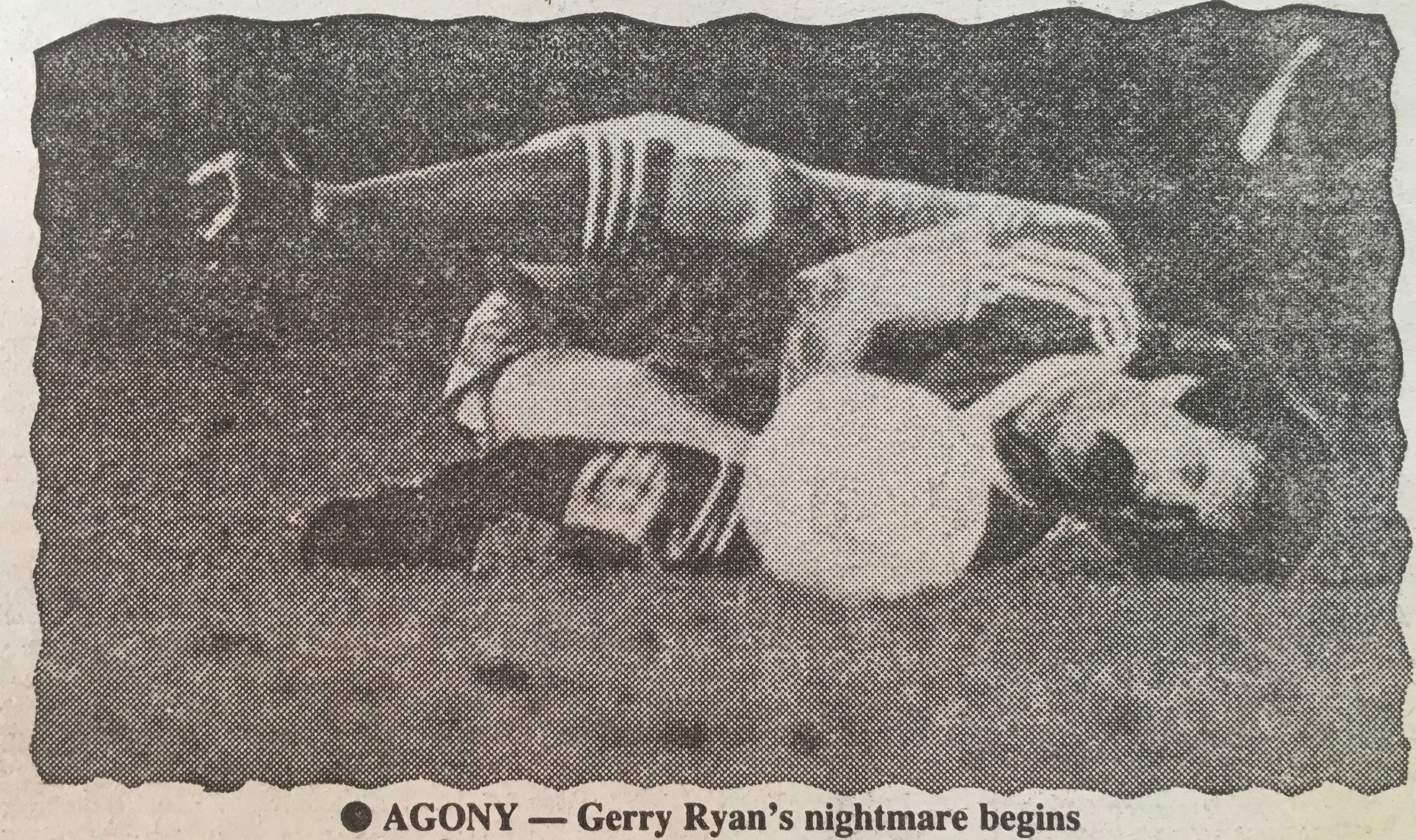
A cruel twist of fate saw his career ended in a tackle made by his Irish teammate (and former Albion boss) Chris Hughton’s brother, Henry. Typically, Ryan bore no grudges, as stressed by former Argus Albion reporter John Vinicombe in an article published in May 1986 when the genial Irishman finally accepted that his career was over.

Describing “the immense dignity and true manliness that Ryan displayed in refusing to condemn or indeed utter any harsh word against the player responsible,” he added: “Where others have sued and raged, slandered, cursed and threatened, Ryan said nothing.”

GR leg break

It was 2 April 1985 when his career was ended by that Hughton tackle in a 1-1 draw with Crystal Palace at Selhurst Park.

“Never in his life has he shirked a tackle and the one that ended his career so unfortunately at Crystal Palace was typical of many he faced in his career,” said Alan Mullery, the manager who signed him for the Seagulls.

“As a person, he is a lovely and typical Irish personality,” Mullery said in the programme for the player’s testimonial game against Spurs at the Goldstone on 8 August 1986. “I can honestly say that I have never met a player who dislikes him or has a bad word to say about him. I will remember Gerry Ryan as being a special player and one of football’s nice people.”

Mullery also referred to a Sunday lunch he and his family had with Ryan and his wife at the time he signed. “When Gerry ordered roast beef and chips I must have known then that I had a very special sort of player. At the time, I was a little dubious but afterwards I had no regrets.”

Mullery had been over in Dublin watching Albion’s Mark Lawrenson playing for the Republic of Ireland and Derby’s Ryan was playing in the same side. He had been having talks about moving to Stoke City but Mullers persuaded him to join Brighton instead, and, in a strange quirk of fate, he made his debut in a 2-2 draw away to Stoke.

After they’d become teammates, Lawrenson was among those players appreciative of Ryan’s “mercurial” qualities. He said in a matchday programme: “He wasn’t the most confident of players but he had loads of ability. For a wide player, he would come in and get goals for you.”

GR capsA week after joining the Seagulls, Ryan became an instant hit with Albion fans when he scored on his home debut in a 5-1 win over Preston. He notched a total of nine goals in 34 appearances in that first season and went on to score 39 in a total of 199 games.

Born in Dublin on 4 October 1955, Ryan was one of eight children. His early education was at the local convent in Walkinstown, a suburb to the south of Dublin where the family lived. At the age of eight he moved on to Drimnagh Castle School (it covered primary and secondary age groups).

At that stage, he was playing Gaelic football and hurling, at which he was capped at under-15 level by Dublin Schools. He didn’t play competitive football until he was 16 when he was introduced to a Dublin football club called Rangers AFC. He played alongside Kevin Moran, who later played for Manchester United, and Pat Byrne, who later played for Leicester City. Byrne and Ryan also played together for Bohemians, the oldest football club in Dublin.

Ryan joined the Dublin Corporation as a clerical officer on leaving school and played for Bohs as an amateur initially before becoming a part-timer on professional terms. By 18, Ryan was a first-team regular and, after collecting a League of Ireland Championship medal, was watched by Manchester United boss Tommy Docherty.

Docherty didn’t pounce then but, after Ryan had stayed four years with Bohemians, the ebullient Scot eventually returned to take him to England as his first signing for Derby County for a fee of £55,000.

The newly-appointed Docherty was determined to shake-up the club and while long-serving goalkeeper Colin Boulton was discarded along with striker Kevin Hector, Ryan, Scottish internationals Bruce Rioch and Don Masson, and Terry Curran and Steve Buckley were all introduced.

Ram Ryan

Ryan spoke about the way Docherty’s attitude towards him changed in an interview with Brian Owen of The Argus in 2016.

“One minute you were the blue-eyed boy, the next he wouldn’t even talk to you,” he said. Ryan made a hamstring injury worse by playing when Docherty insisted he was fit enough, and ended up sidelined for three months. “He didn’t like me then! That’s the way he was, he would turn on you, and he turned on me.”

Within a year, Docherty accepted Brighton’s £80,000 offer for Ryan and, as he was weighing up whether to choose the Seagulls or Stoke City, Ryan consulted the legendary Republic of Ireland and ex-Leeds midfielder Johnny Giles to ask his opinion.

“Gilesy said ‘Stoke have been in and out of the First Division forever but there is something going on down at Brighton. They get great crowds and it’s a beautiful place.’ I went to Brighton that weekend and absolutely loved it,” Ryan told Owen.

It was on 25 September 1978 winger Ryan arrived, prompting the departure of popular local lad Tony Towner after eight years at the Albion.

Five months before Ryan arrived at the Goldstone, he made his international debut, featuring for the first time in April 1978 in a 4-2 win over Turkey at Lansdowne Road. He only scored once for the Republic, but it was a cracking overhead kick in a 3-1 defeat against West Germany.

Ryan Eire

He was one of four regular Eire internationals playing for Albion at the time: Lawrenson, Tony Grealish and Michael Robinson the others.

His final appearance for his country came in a 0-0 draw against Mexico at Dalymount Park in 1984.

Ryan was part of some all-time history-making moments during his time with the Albion – scoring at St James’s Park in the 3-1 win over Newcastle on 5 May 1979 to clinch promotion to the top division for the first time, and burying the only goal of the game as unfancied Albion beat Brian Clough’s European champions Nottingham Forest, who’d previously not lost at home for two and a half years.

Ryan scoresMy personal favourite came on 29 December 1979 at the Goldstone when he ran virtually the entire length of a boggy, bobbly pitch to score past Joe Corrigan in the goal at the South Stand end to top off a 4-1 win over Manchester City. Ryan himself reckoned it was “the best goal I ever scored” as he recounted in a May 2020 BBC Sussex Sport interview with Johnny Cantor.

It was one of the most superb individual goals I saw scored and, when he was trying to recuperate from the horrific leg break which ultimately ended his career, I wrote to him in hospital to say what a special memory it held for me.

I was delighted to receive a grateful reply from him, and he has held a special place in my Albion memory bank ever since.

There were other stand-out occasions, two of which came against Liverpool:

in February 1983 at Anfield when he opened the scoring in Albion’s memorable 2-1 FA Cup triumph en route to the final, and, in the following season, at the Goldstone when he and Terry Connor were on target in Second Division Albion’s 2-0 win over the Reds in the same competition, the first-ever live FA Cup match (other than finals) to be shown (previously any television coverage of FA Cup ties was only ever recorded highlights).

If the modern-day reader can’t quite put the feat in perspective, it is worth pointing out that Liverpool, managed by Joe Fagan, went on to win the League Cup, the League title and the European Cup that season.

Danny Wilson hadn’t long since joined the Albion and, in an interview with the Seagull matchday programme in 2003, he recalled: “That has to be my favourite memory from all my time at the Goldstone. Back then, Liverpool were just awesome, and to beat them like we did was virtually unheard of.”

Ryan’s involvement in the 1983 Cup run was hampered by a hamstring injury which meant he missed out on the semi-final. But, in the days of only one substitute, he was on the bench for the final and, when the injured Chris Ramsey couldn’t continue, Ryan went on at Wembley and did a typically thorough job at right-back.

GR prog snow

Following Albion’s relegation, as the big-name players departed the Goldstone, Ryan’s versatility and play-anywhere attitude came to the fore and, in his last two seasons with the club he was often selected as a centre-forward, although he was not a prolific goalscorer from that position.

After he was forced to quit playing, Ryan took what was then quite a familiar route for ex-players and became a pub licensee, running the Witch Inn at Lindfield, near Haywards Heath. Ryan and goalkeeper Graham Moseley, who he’d known from his days at Derby, were neighbours in Haywards Heath.

GR pots

However, when another of his former Republic of Ireland teammates, Liam Brady, was appointed Albion manager in 1994, it was an inspired choice for him to appoint Ryan as his assistant.

When that all-too-brief managerial spell came to a messy close, Ryan returned to his pub, and then moved back to the family home in Walkinstown. Ryan’s son Darragh played 11 games for the Albion in the late 1990s.

Sadly, in August 2007, Ryan suffered a stroke, and three years later he was diagnosed with kidney cancer. On his death, his family paid tribute to the care he was given by the staff of Our Lady’s Hospice, Harold’s Cross and to the staff of Lisheen Nursing Home, Dr Brenda Griffin, the Beacon Renal Unit, Tallaght, and Tallaght Hospital Renal Unit “for the excellent care given to Gerry over the past number of years”.

Pictures from a variety of sources but mainly from my scrapbook, the matchday programme and The Argus.

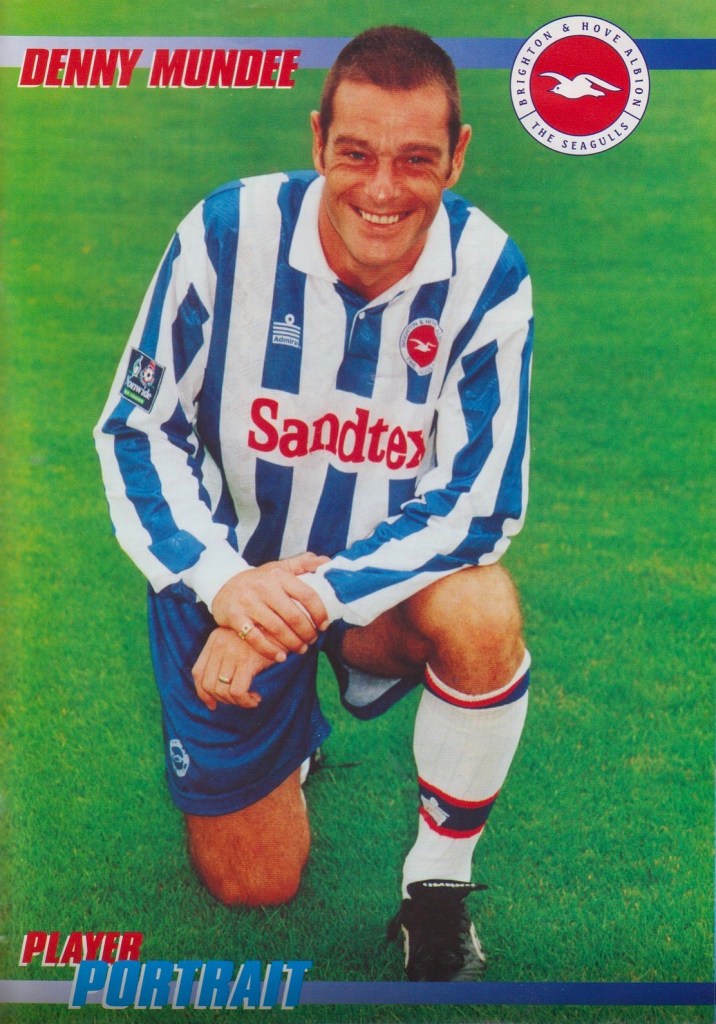
The spot kick highs and lows of penalty king Denny Mundee


SPOT KICK specialist Denny Mundee played for the Seagulls during the dark days when they nearly dropped out of the league having enjoyed better times with Bournemouth and Brentford.

His older brother, Brian, also played for the Cherries and another brother, Barry, was forced to quit football at 18 because of injury. It was a case of third time lucky when young Denny finally broke through into league football. Previous attempts to make it, at QPR and Swindon, had got nowhere.

Born Dennis William John Mundee in Swindon on 10 October 1968, Denny first showed his footballing talent at his local primary school (Liden), as a contemporary wrote some years later on the Brentford fans forum, Griffin Park Grapevine.

The poster, called ‘SmiffyInSpain’ said: “Went to primary school with Denny in Swindon and he was a class act then. Went to separate secondary schools, but still kept in contact with him as an opponent at school level football.

“Of all the players of the same age, Denny stood out by far. Of all the penalties he took against me, he never missed.”

Indeed, Mundee was noted for his success rate from the 12-yard spot, taking on the penalty taker duties at whichever side he played for.

The young Mundee was first offered an apprenticeship at Third Division Bournemouth but decided to join First Division QPR as a junior, where he spent a year.

Released in the summer of 1986, he joined home town team Swindon for a season, but again failed to make the grade. It took a drop down to Southern League Premier side Salisbury before things began to click. Scoring 20 goals in 34 appearances brought him back to the attention of Bournemouth, who snapped him up in March 1988.

Although he made his Bournemouth debut towards the end of the 1988-89 season, he had loan spells with Weymouth, Yeovil Town and Torquay United before establishing himself with the Cherries.

It was in 1991-92 that he laid claim to a regular place, and, as right-back, made 41 league appearances that season.

His winning spot-kick in a 4-3 penalty shoot-out decider in the third round of the FA Cup against Newcastle United in January 1992 earned Mundee hero status in a Cherries’ Legends Gallery put together by BBC Dorset.

United, managed at the time by Argentine legend Ossie Ardiles, were floundering at the bottom of the old Second Division, while Harry Redknapp’s Third Division Cherries had already held the Magpies 0-0 at Dean Court before taking the tie to penalties after the replay at St James’ Park had ended 2-2 on 90 minutes.

However, by the end of the following season, Mundee had become something of a utility player, slotting in to various positions, and, in August 1993, he chose to leave the south coast club on a free transfer.

In just over five years, he had started 93 games for the Cherries and come on as a sub in another 29 games.

Former Chelsea and QPR defender David Webb had taken over as manager at Brentford and Mundee was among his first signings.

Bees fans remember him being signed as a full back but, on being ‘thrown up top’, he was a revelation and finished his first season at Griffin Park with 11 goals.

Perhaps ironically, Brentford, in 16th, finished a point and a place above Bournemouth that 1993-94 season. Mundee scored 11 times, including a memorable hat-trick in a 4-3 defeat at home to Bristol Rovers.

DMHSSix of his goals that season came in a run of four consecutive games between 27 November and 27 December, four of them penalties.
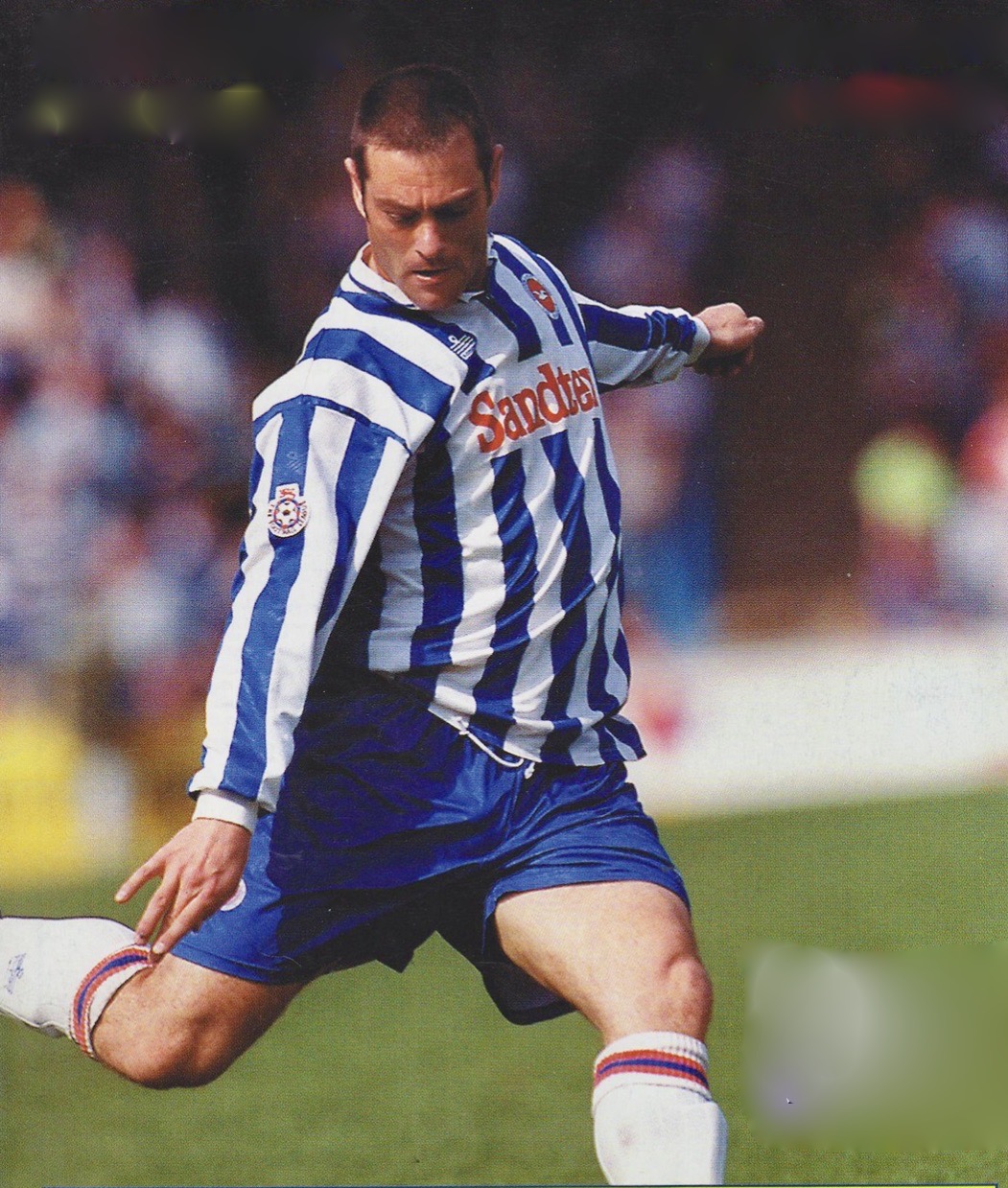
Mundee found himself part of a side that featured the free-scoring Nicky Forster in attack alongside Robert Taylor.

Described as “whole-hearted” and “a crowd pleaser”, Mundee earned something of a reputation for a shuffle, or a twiddle, he would deploy to get past opponents. ‘Brickie Chap’ on griffinpark.org said of him: “A player that always tried his best. Not the most gifted we have ever had down here but deffo one for providing quality entertainment.”

Unfortunately for a player normally so reliable from 12 yards, it was a penalty he failed to convert that Brentford fans have never really got over.

Mundee’s miss in a 1995 Division Two play-off match against Neil Warnock’s Huddersfield came in what was apparently the first-ever televised penalty shoot-out featured on Sky.

It was all the more galling because Mundee had scored twice from the spot past Town’s Steve Francis the previous season but, on this occasion, he blew the chance to put Brentford two goals ahead when he was outguessed by the ‘keeper. When Jamie Bates missed too, Brentford’s season was over.

Any other year, as runners-up, Brentford would have been promoted automatically, but, because of a reorganisation of the Premier League that year, only the top team went up automatically, hence their participation in the play-offs.

Mundee’s erstwhile primary school teammate wrote: “I watched the Huddersfield match in ‘95 and I would have put my mortgage on him netting like he did for Bournemouth at Newcastle a few years earlier.”

mundeeIn two years with the Bees, Mundee made 73 starts plus 25 appearances as a sub but, when his old Bournemouth teammate Jimmy Case took over the Albion’s managerial reins from Liam Brady, he and another ex-Cherry, Mark Morris, headed to the Goldstone Ground to try to help the Seagulls’ cause.

With the poisonous off-field developments at the club an ugly backdrop to the playing side, neither could do anything to halt Albion’s slide into the bottom tier.

Things went from bad to worse and on 1 February 1997, bottom of the league Brighton drew 1-1 at Mansfield Town, Mundee scoring for the Seagulls with a follow-up after his initial penalty was parried. Albion were nine points adrift and relegation from the league was looking virtually certain.

However, as we all now know, the drop was averted courtesy of that nail-biting draw at Hereford.

Although Mundee remained on the books for the following season, in December 1997 he, Morris, Craig Maskell, Paul McDonald and John Humphrey were all released to save money.

Mundee had played 58 games plus four as sub for the Albion, chipping in with eight goals.

Also burdened by ankle and back injuries, it spelled the end of his professional career although he did manage a handful of games with various non-league outfits.

Ten years ago, a cousin of Denny’s confirmed that he had moved to Throop, a village on the outskirts of Bournemouth, and was working for the same plastering business as brother Brian.

Teenage Teddy Maybank’s Chelsea promise dashed by injury at Brighton

TEDDY MAYBANK signed for the Seagulls for what at the time was a club record transfer in November 1977 and went on to score Brighton’s first ever top division goal.

But the new signing came in for some flak from the terraces and, over two years, never really delivered a significant return on the investment.

Maybank himself reckons the club forced him to play on with an injured knee when he shouldn’t have, which led to irreparable damage and ultimately a premature end to his career.

The former Chelsea centre-forward was signed to replace Ian Mellor, Peter Ward’s prolific strike partner in the 3rd Division, after Brighton had won promotion to the second tier.

“We let Ian Mellor go because we felt that he had reached a certain age and had probably peaked,” Alan Mullery told Matthew Horner, in his Peter Ward biography, He Shot, He Scored. “When Teddy Maybank became available, we thought that he was probably a better option.”

Born in Lambeth on 11 October 1956, Maybank lived the first 15 years of his life in Brixton and went to Christchurch Primary School, close to his home, where one of his playground footballing mates was Ray Lewington — now loyal deputy to Roy Hodgson — who, together with Maybank, went on to play for Chelsea and Fulham.

At the age of 11, Maybank moved to Stockwell Manor Secondary School and played various age group levels for South London Boys. One of the representative matches he played in took place at the Goldstone Ground on 25 September 1971, against Brighton Boys.

The Maybank family moved to Mitcham, close to the Chelsea training ground, and, when Teddy was 15, he joined them straight from school.

Maybank and Lewington progressed through Chelsea’s youth ranks at a time when the club’s focus was on bringing through home-grown talent. “It was a good time at Chelsea,” he said. “We had such a good youth side and I loved playing under Ken Shellito.”

That team, which won the South-East Counties Championship four years in a row, included Ray and Graham Wilkins, Lewington and John Sparrow.

Maybank’s first-team debut came in a 2-0 defeat at Tottenham Hotspur in April 1975 aged just 18, and he scored in only his second game, a 1-1 home draw against Sheffield United, but Chelsea were relegated from the top division that year.

The following campaign saw Maybank, still a teenager, become a first-team regular under Eddie McCreadie, grabbing five goals in 26 appearances between August and February.

After falling out of favour, he went out on loan to Fulham just before Christmas 1976 and then signed permanently for a £65,000 fee later that season.

Back in the ‘70s, Chelsea were a long way from the force they are now and Maybank admitted: “I wouldn’t say I ever played that well at Chelsea. I didn’t find it easy to score goals there.”

It was a different story at Craven Cottage. After scoring more than a goal every other game – 17 times in 31 games – Maybank was sold to Brighton for £238,000, which gave Fulham a swift and substantial profit that they used to pay off money owed on their recently-built Eric Miller Stand (now, the Riverside Stand).

                     Blond locks flying, Maybank comes up against QPR’s Dave Clement in a 1978  pre-season friendly. (Above right) This overhead kick against Sunderland at The Goldstone scraped the bar … otherwise would have been a Goal of the Season candidate!

Maybank made a good enough start for the Seagulls, scoring after just six minutes on his debut in a 2-2 home draw with Blackburn Rovers, played on a bitterly cold day in front of a crowd of 26,467. Tony Towner scored the Albion’s other goal and another debutant in that game was tough-tackling midfield player, Paul Clark.

Maybank was on the scoresheet again in the very next game as Albion recorded their first ever win, 1-0, at Blackpool.

It was in a game against Orient a week before Christmas that Maybank got a kick on his knee from defender Dennis Rofe (who later played for Leicester and Southampton) which caused an injury which he maintains wasn’t properly managed by the club.

He told fulhamfc.com in 2013: “They kept giving me injections, taking all the fluid out every Sunday after the game.

“I was barely training. I could run in a straight line but any time I put weight on my leg I would fall over. I wouldn’t feel any pain because of the injections, but I just fell over.”

The Brighton fans thought they had bought Bambi and were soon on his back, leading to a “pretty terrible time” that Maybank never really recovered from.

“The club should never ever have allowed me to play in that situation,” he said. “A surgeon saw me outside of the club, opened me up and said: ‘if you ever play football again, you’ll be the luckiest bloke in the world’.

“Brighton had told me, basically, that I couldn’t do any more damage. They wouldn’t do it now, but because I was the highest transfer fee they ever paid, they didn’t really take my welfare into consideration at all. In the end, it ruined my career.”

                      Shoot! article and (above right) Maybank goes full length to head the second of  his three goals against Cardiff on Boxing Day 1978.

In an article in Shoot! magazine at the time, Maybank talked about how he hadn’t had the best of starts with his new club. He said: “I wasn’t playing well. I knew that. My early form was a disappointment to the fans. They expected me to come in and start scoring regularly and doing incredible things.

“It’s always hard when you change clubs and you need a while to settle in. I have to adjust to my new team-mates but they’ve also had to change and adapt to playing with me.”

Mansfield were trounced 5-1 at the Goldstone on 21 January 1978 when Peter Ward shone with a hat-trick. Maybank also got one, but it was his last of the season. He made only six more appearances between January and the end of the season and new signing Malcolm Poskett seized his chance alongside Ward.

Albion narrowly missed out on promotion (by goal difference) and during the close season Maybank went under the knife for a cartilage operation.

Fit for the new season, Maybank was among the goals as Albion beat Millwall 4-1 at The Den on 2 September. He got a brace that day but in the same month was in trouble with the manager who’d had an anonymous tip-off that the star striker and Welsh international winger Peter Sayer had been seen in a nightclub on the eve of what turned out to be a 4-1 defeat by Leicester City.

Mullery made an example of the pair and they were both ‘persuaded’ to donate a fortnight’s wages to the local Guide Dogs for the Blind Association.

On the pitch, the goals dried up for Maybank until Boxing Day when he netted a hat-trick in a 5-0 win over Cardiff City. In an Albion matchday programme in 2015-16, Maybank admitted to Spencer Vignes: “The crowd started getting on my back, and I got in a pretty dark place.

“When I got that hat-trick, I went from villain to hero and yet it had got so bad that the day before Alan Mullery picked the squad I’d told him I never wanted to play for the club again.

“From the changing room before a game, I used to hear the crowd boo my name when the team was read out over the tannoy.”

In total, Maybank scored 10 times as Albion won promotion, and he was leading the line in the famous promotion-clinching 3-1 win at Newcastle on 5 May 1979.

In that season’s Rediffusion Player of the Year competition, Maybank finished third behind winner Mark Lawrenson and runner-up Brian Horton.

In much the same way Pascal Gross was feted for scoring Brighton’s first-ever goal in the Premiership, so Maybank scored the Albion’s very first goal in the top division.

After being hammered 4-0 by Arsenal in the opening fixture at the Goldstone, the Seagulls were away to Aston Villa in the second game.

                      Arms aloft, Maybank celebrates Albion’s first ever top division goal with skipper Brian Horton and Peter O’Sullivan. (Above right) Maybank battles with Arsenal’s David O’Leary watched by John Hollins and O’Sullivan.

Latching on to a John Gregory through pass and, with the very last kick of the first half, Maybank buried a shot past ‘keeper Jimmy Rimmer.

Albion lost the game 2-1 but the national newspapers were full of praise for the newcomers to the division.

Frank Clough in The Sun wrote: “Teddy Maybank and Peter Ward tore great holes in Villa’s jittery defence and were only stopped by inadequate finishing and fine goalkeeping by Rimmer.”

It was the first of three Maybank goals at the top level, but, according to Ward, the striker had a big falling out with Mullery. The manager brought in Ray Clarke as his first choice centre-forward and, in December 1979, Maybank was sold back to Fulham for £150,000.

He had scored a total of 16 goals in 64 appearances for the Seagulls, less than half the ratio he’d been scoring when bought.

After just 19 games for Fulham, Maybank joined Dutch side PSV Eindhoven for £230,000 in August 1980 (Fulham making another tidy profit on the player).

His debut for the Dutch giants came in front of a packed house at the Nou Camp, where Barcelona were staging a four-team tournament with Vasco da Gama and River Plate.

However, only a few games later his knee flared up again.

“They opened me up and saw what a state my knee was in,” Maybank explained in that 2013 interview with fulhamfc.co.uk. “I was told in no uncertain terms that if I didn’t retire I would be playing with the youth team or reserves. I think they thought they’d been taken for a ride.”

Maybank was left with no choice. At the age of 24, he retired from the game.

Pictures from my scrapbook sourced from Shoot! magazine and the matchday programme.

Mis-firing Mick Ferguson couldn’t repeat goalscoring prowess for Everton or Brighton

MICK FERGUSON was a prolific goalscorer for Coventry City but the goals dried up in spells with Everton and Brighton & Hove Albion.

Ferguson’s arrival at the Goldstone in the early autumn of 1984 was certainly not amid a great fanfare. The Albion, under new chairman Bryan Bedson, were wrestling with debt and, to bring in some much-needed funds, sold striker Alan Young to Notts County for £50,000 and full-back Mark Jones to Birmingham for £30,000.

Needing a cut-price replacement for Young, and with Ferguson unwanted at Birmingham having been responsible for getting them relegated (see below), he came to the Goldstone as part of the deal that took Jones to St Andrews.

In modern-day football, loan players don’t generally play against their parent clubs but, amazingly, at the end of the previous season, Ferguson was allowed to play against Birmingham while on loan at his old club Coventry, and ended up scoring a goal that kept the Sky Blues in the top division but sent Birmingham down.

It was such an unusual saga that as recently as May 2017, the Guardian revisited the tale, catching up with Ferguson to explain the circumstances.

As the article explains, shortly before the player’s 30th birthday, manager Ron Saunders offloaded him to Brighton, where the manager was Ferguson’s former Coventry teammate, Chris Cattlin. Just to prolong Saunders’ agony, Ferguson made his Seagulls debut in a 2-0 home win… over Birmingham! This time he didn’t score. And, for Brighton, that state of affairs existed for several months.

I remember his second game quite vividly. It was a midweek league cup tie away to Fourth Division Aldershot and I went to the game with my pal Colin Snowball, who at that time was living in nearby Bagshot. There wasn’t anything subtle about Albion’s tactics that night. Goalkeeper Graham Moseley would kick the ball long for Ferguson to get on the end of it.

But, as the striker tried to lay it off, all he succeeded in doing was heading it into touch – repeatedly. The new signing did not impress! Despite their superior status in the league, Albion succumbed 3-0 in what was a pretty humiliating exit. Ferguson was remarkably selected for the following Saturday’s game, an away defeat to Oxford, after which he was omitted for four games. Cattlin gave him another chance with a four-game spell but still the dismal form continued and he didn’t get another look-in for four months.

Freelance journalist Spencer Vignes did a retrospective article about Ferguson for the Albion matchday programme and discovered the striker didn’t have a high opinion of his former playing colleague. “Several of the players just didn’t get along with him, and I was one of them,” he said. “His man-management skills  left a lot to be desired. As a manager you need to have the players on-side. Chris certainly didn’t have us on-side.”

Ferguson admitted to being frustrated by Cattlin chopping and changing the side and said there were times he turned out when only 80 per cent fit, which didn’t do justice to himself, the team or the supporters. “My ankles weren’t great and towards the end I did struggle with my back, but I felt when I was fit I could certainly do a good job.”

The striker felt with the ability in the squad at the time they should have achieved more but pointed the finger at Cattlin for it not happening. “Some people aren’t cut out for management and I don’t think Chris was. It doesn’t surprise me that he never worked as a manager again.”

The history books (many thanks to Tim Carder and Roger Harris) recall him as the goalscorer in a 1-1 draw away to Portsmouth on 6 April 1986 but, having been to that game too, I seem to recall it was a rather desperate claim for what looked more like an own goal by Noel Blake.

The start of the following season saw the arrival of former £1m striker Justin Fashanu from Notts County and Dean Saunders, a free transfer from Swansea City, so Ferguson’s prospects of a starting place looked bleak.

However, the 1985-86 season was not very old before Cattlin had a striker crisis on his hands. Gerry Ryan was out long-term with the horrific leg break from which he never recovered, Terry Connor and summer signing Fashanu were also sidelined with injury and a big man was needed to play alongside Alan Biley.

Cattlin had little choice but to bring back the previously mis-firing Ferguson, and to everyone’s surprise and delight his goal touch returned, albeit briefly.

“I was virtually forced into the team through injury,” Ferguson admitted in a matchday programme interview. “But, fortunately, things turned out quite well. It was nice to get a goal against Blackburn in my first match back. That seemed to pave the way.”

The programme article had tried to give some perspective to the dismal form when he had first arrived. It said: “Mick’s confidence was affected by his loss of form, but he never lost an inner belief that he would pull himself out of the bad patch. And what a difference the goals make. He has shown great character this season and did a marvellous job for the team while Justin Fashanu was out with injury.”

Ferguson himself said: “It took us quite a while to settle down. We were in a flat at first and I was having a lot of problems, one way and the other, so it wasn’t an easy time.”

Eventually Ferguson, his wife and two daughters settled into a house in Hove, and the striker admitted: “When you’re having a bad time there is a tendency to bring your problems home. It’s unfair on your family. I didn’t notice at the time, but, looking back, I think I probably was a little snappy with my wife and children.

“I think you can reach the stage where you really start to wonder, but I always knew I could score goals for Brighton. I’ve scored goals everywhere else I’ve played. It was just a question of time and waiting for the right break.”

Indeed, Ferguson scored in three successive matches in September 1985, prompting Cattlin to give him a special mention in his programme notes for the league cup game at home to Bradford City. “The form of Mick Ferguson is bound to improve even more with the confidence he is gaining through his three goals in three games,” wrote the manager. “His header against Wimbledon was a true indication of his ability; it was of the highest class.”

The renewed confidence saw him add another consecutive pair the following month – before on-loan Martin Keown took over the no.9 shirt and demonstrated he could score goals as well as defend!

Sadly, the revival in Ferguson’s fortunes were not to last. When Fashanu was fit again, Ferguson was dropped and only stepped in a couple more times. His goal in a 4-3 home win over Huddersfield on 16 November was the last he scored for the club.

Apart from a lone outing in January, in a 3-0 defeat at Sheffield United, Ferguson was on the outside looking in until, to everyone’s astonishment, after a five-week absence from first team action, he was selected by Cattlin to lead the line in a FA Cup Sixth Round tie against First Division Southampton on 8 March 1986.

Ferg action Shilts Bond CaseFerguson, sandwiched between Kevin Bond and Jimmy Case, is foiled by Southampton goalkeeper Peter Shilton in what turned out to be the striker’s final Brighton game.

A crowd of 25,069 packed into the Goldstone – when the average attendance at the time often dipped below 10,000 – but it ended in a disappointing 2-0 defeat and the manager admitted he had made a mistake with his selection. It turned out to be Ferguson’s last game for the club.

Just over three weeks later, he moved to fourth-tier Colchester United – whose manager Cyril Lea was promptly sacked!

United’s reserve team manager, Mike Walker (who would later manage Everton) took over the first team as caretaker and, as the team went on an unbeaten run of eight games, Ferguson scored seven times, the first of which came in a 4-0 win over Leyton Orient on 8 April.

The following season he played 19 games and scored four times before leaving on 7 November 1986 to join non-league Wealdstone.

It was quite a fall from the heady days of the early Seventies.

Born in Newcastle on 3 October 1954, Ferguson was picked up by Coventry City’s youth scheme in 1970 and, although he made his debut in 1975, shortly after the sale of Scotland international Colin Stein, it wasn’t until the start of the 1976-77 season that he became a Highfield Road regular.

In tandem with Ian Wallace (who was later a strike partner of Peter Ward’s at Nottingham Forest), he really started to attract attention, as the Coventry Telegraph recounted when describing him as a “truly great goalscorer”.

The article reckoned he was strongly tipped for international honours at one point but injury and loss of form affected him over the next two seasons. Forest, Villa and Ipswich were all supposedly keen to sign him, with Brian Clough agreeing a £500,000 deal, then pulling out.

However, in the summer of 1981, he finally left City having scored 57 goals in 141 games (plus eight sub appearances) all in the top flight when Everton paid £280,000 for him. Ferguson scored six times in his first eight games – but the goals dried up after that and he was gone within less than a year having made only made 10 appearances (plus two as a sub).

In 2007, David Prentice, in the Liverpool Echo, sought out Ferguson for an explanation of his less than happy time on Merseyside.

Manager Howard Kendall initially loaned him to Birmingham City, before making the deal permanent, but injury disrupted his chances at St Andrews, hence the loan move back to Coventry.

After retiring from playing in 1987, Ferguson stayed in the game working in community development roles for Sunderland – for 10 years, until he fell out with manager Peter Reid – Newcastle United and Leeds United, where he was head of Football in the Community.

Pictures from Albion matchday programes and, via YouTube, from Coventry City’s Sky Blues TV.

Desk job at Leeds in later life

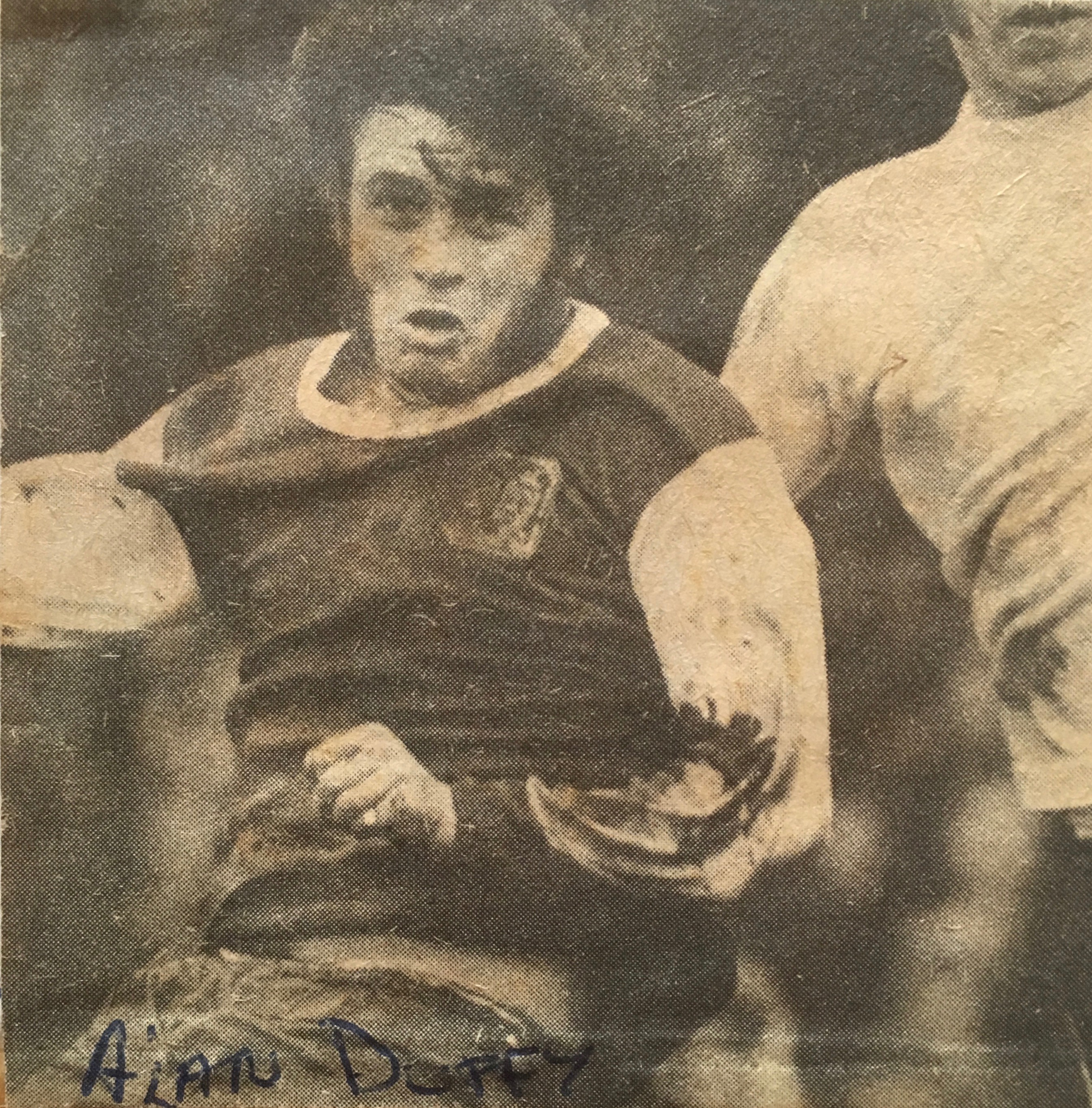
Fans took Alan Duffy to their hearts after debut goal

TWENTY-year-old Alan Duffy couldn’t have wished for a better start to his Brighton career than scoring a belter on his debut.

A £10,000 signing from Newcastle United, he was quickly off the mark on 17 January 1970 in a 2-1 Third Division win over Bradford City.

He appeared to be “the Third Division answer to George Best by beating two Bradford players and smashing a ferocious shot in off the crossbar” according to Seagulls TV, which recounted he was a “stocky striker with a robust style”.

Fan Mo Gosfield, posting on North Stand Chat in January 2011, described the goal as “one of my top 10 Albion moments, because it took your breath away”.

Mo added: “He had all the makings of a cult figure at Brighton. The swagger, the shock of hair, the slight beer belly. I loved him, but he never quite lived up to that sensational start.”

The fans in the old North Stand adapted the Hare Krishna chant to incorporate his name and, after that promising debut, the young striker kept his place in the starting line-up through to the end of the season.

He repaid manager Freddie Goodwin’s faith in him with five more goals. Particularly memorable were Duffy’s two goals in Albion’s 2-1 win over Reading on Good Friday when a huge crowd of 32,036 packed into the Goldstone.

2 AD action BW.jpg

Brighton were top of the league going into the game and looking a good bet for promotion.

Former goalkeeper Brian Powney discussed that game – and Duffy – when he was interviewed by Brian Owen for an article in the Argus on 20 February 2017.

There were question marks over both Duffy’s goals – a suspicion of handball for one, the other possibly offside – but, while both stood, a seemingly good goal from the youngster was ruled out later on.

Looking back on the game was a painful reminder for Powney, who dislocated a finger which physio Mike Yaxley had to put back while out on the pitch, it being the era long before substitute goalkeepers were available.

Unfortunately, too, Albion blew their promotion chances by losing four of the last five games after that Easter win over the Royals.

The only other points collected came in the penultimate game, a 2-1 home win over Rotherham, when Duffy again scored twice – one a penalty.

Asked about Duffy in that 2017 interview, Powney said: “Alan was hit and miss, a bit madcap.

“He had a lot of talent and, had he applied himself, he would have had a longer career. He was a good player but not such a good pro.”

Like many a player before and since, a change of manager in that World Cup summer of 1970 didn’t help Duffy’s progress at Brighton although, according to Seagulls TV: “Weight issues and injury woes, starting with a thigh problem on the opening day, marred his 1970-71 campaign.”

Duffy began in the no.8 shirt for the opening two games of that season under Goodwin’s replacement,Pat Saward, but a thigh injury picked up away to Bristol Rovers proved more problematic than first thought and he missed a large part of the first half of the season.

Duffy was out of the side from mid-October to February and, on his return to the starting line-up, was involved in one of the most curious incidents I ever saw at the Goldstone.

On 27 February 1971, against Preston North End, Albion won a controversial penalty at the south stand end of the pitch after Duffy somewhat unconvincingly tumbled in the area.

Centre forward Kit Napier took the spot-kick;  ‘keeper Alan Kelly saved it, but referee Tom Reynolds ordered a retake because of encroachment. As Napier steadied himself for the retake, Duffy stepped forward, pushed his teammate out of the way, took the penalty himself – and missed!

In the Argus, reporter John Vinicombe wrote: “Napier watched aghast as the ball thudded against the bar. Duffy hung his head, as well he might.” The game finished in a disappointing 0-0 draw.

“The manager went mad at him afterwards,” Powney recalled, and Saward promptly dropped Duffy to the bench for the next two matches.

In the meantime, the manager brought in the experienced Bert Murray and Willie Irvine on loan to add some nous and quality. Although Duffy did get back in the side for six games, the rest of the time he was on the bench.

One time when he entered the fray from the bench against Aston Villa, a BBC radio commentator described him as “a square little man – an oddity” but he was soon singing his praises for a through ball that set up Napier to score.

His only goals of the season came in the same match – against Bradford City, in a 3-2 win at Valley Parade on Easter Monday. Duffy struck twice in the second half as Albion came back from being 2-1 down at half-time.

By the season’s end, he had made just 15 starts, and was subbed off on five occasions. There were seven appearances off the bench, plus three occasions when he was a non-playing sub.

In 1971-72, he made just one start – in a league cup match – and was only ever a substitute in the league, coming on 12 times and not being used on 10 other occasions.

A Brighton & Hove Gazette special publication noted that shortly after coming on as a substitute in a second round FA Cup game at home to Walsall in December 1971, he was booked for fighting with the Saddlers’ goalkeeper, Bob Wesson.

A subsequent post-match incident with the goalkeeper led to Duffy being suspended for six weeks. His final appearance saw him come on for Murray in a 4-2 win away to Oldham Athletic in mid-January 1972.

Saward clearly didn’t see Duffy as a long-term part of his plans and when he plunged into the transfer market on deadline day in March, the Geordie was used as a makeweight in the deal which brought Tranmere Rovers striker Ken Beamish to the Goldstone for a fee of £25,000. On the same day, Wolves’ Irish international Bertie Lutton returned to the Albion following a loan spell earlier in the season.

In two years at Prenton Park, Duffy made 33 appearances and scored just twice, before heading back to the north east in 1973 to join Darlington.

In the 1973-74 season, he played 24 games for Darlington without getting on the scoresheet and the following season drifted into non-league football, playing for Consett.

It was quite some fall from that glorious day on 21 September 1968 when he had made his Newcastle first team debut against Manchester United at Old Trafford in a 3-1 defeat.

Born on 20 December 1949 in Stanley, Co Durham, Duffy joined Newcastle in 1966 and on 7 April 1968 won an England Youth international cap when he featured in a 0-0 draw away to Bulgaria.

The game took place in Nimes, France, and was part of the UEFA Youth tournament. Amongst his teammates were Burnley’s Dave Thomas and Steve Kindon and fellow Magpie Alan Foggon.

After that debut at Old Trafford, Duffy didn’t play for the first team again until 9 August 1969, coming on as a sub in a 1-0 defeat v West Ham.

His next chance came on 20 September 1969 when he came on as a sub in a 1-1 draw with Southampton.

A week later, he got a start in another 1-1 draw, this time against Wolverhampton Wanderers. But Toon1892.com recounted: “In his time at Newcastle he was always considered to be Pop Robson’s deputy rather than a first team choice.”

When the Toon decided to let him join Brighton, Duffy had to admit he’d never previously ventured that far south before. At least there was a familiar face waiting for him when he arrived: at the time, Albion had a young Newcastle goalkeeper, Martin Burleigh, on loan.

The matchday programme revealed how manager Goodwin and club secretary Alan Leather had quite a journey travelling to the North East to clinch the deal for Duffy because bad weather caused them to alter their train and plane arrangements.

Leather then had to dash from Newcastle to the Football League headquarters at St Annes on the Lancashire coast to register the paperwork ahead of the 48-hour deadline for new signings so that Duffy would be eligible to play in Albion’s away game at Barrow. He managed it…..but then the match was postponed!

Pictures from my scrapbook either originated in the matchday programme or were published in the Evening Argus. Also featured, a special publication produced by the Brighton & Hove Gazette.

Barça boy Orlandi twice denied promotion with the Seagulls

andrea-orlandi-brightonARTICULATE Andrea Orlandi would probably rank as one of my favourite Albion players of recent times. It was just a shame he seemed bedevilled by injuries which curtailed his contribution.
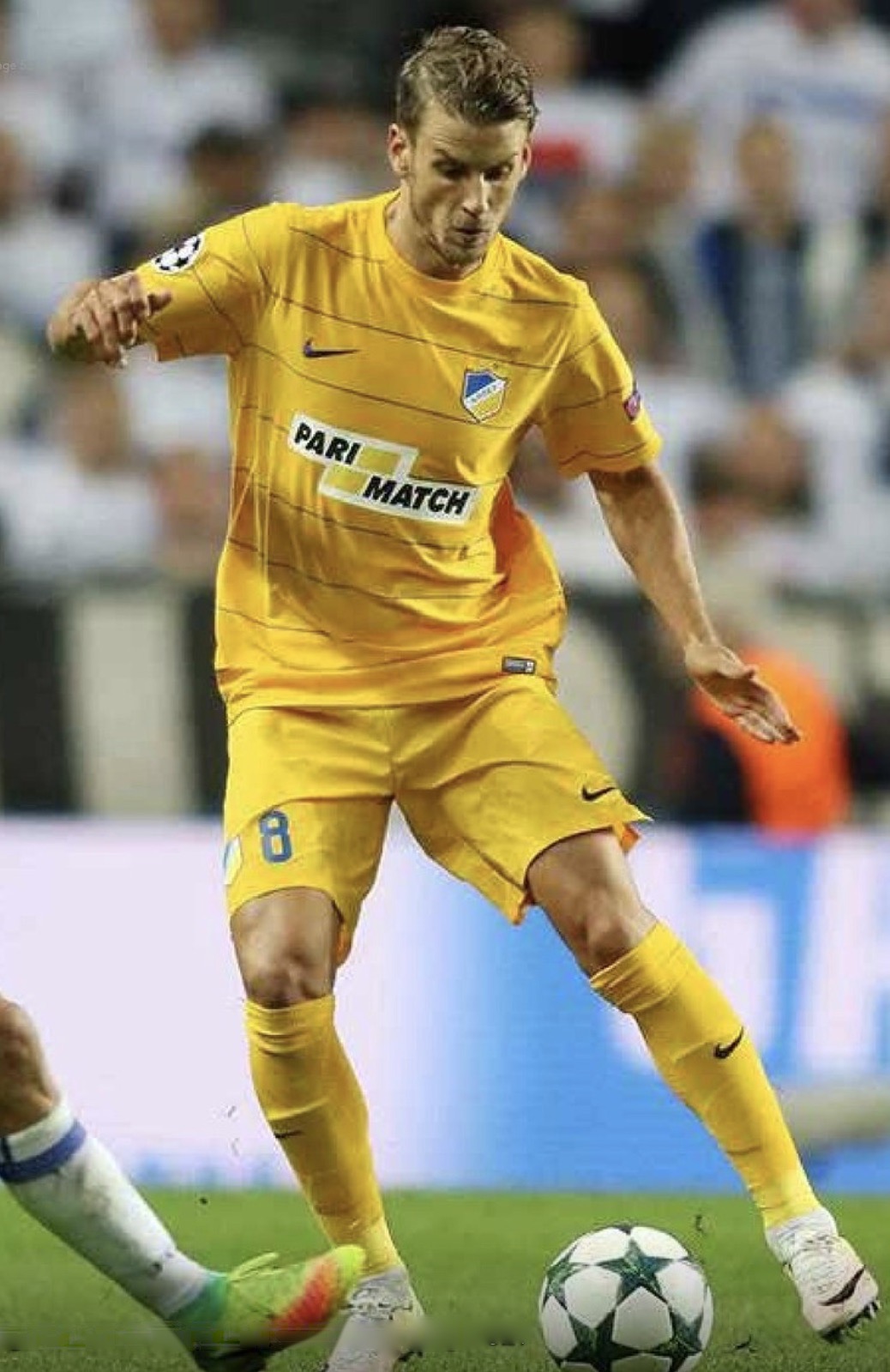
On his day, his technical ability definitely improved Brighton’s creativity going forward and I guess he’ll always be remembered for the goal he scored against Premier League Newcastle in the third round of the FA Cup on 5 January 2013 which he somehow guided in from what seemed an impossible angle.

On bbc.co.uk, the match report recorded: “A rejuvenated Wayne Bridge surged down the left flank, gathered Gordon Greer’s raking 50-yard pass and crossed for Orlandi, who flicked the ball up with his left foot and delightfully fired home with the outside of the same boot.”

Orlandi Newc goal

Orlandi was 28 when Gus Poyet signed him on a two-year contract on transfer deadline day in August 2012. “Andrea provides us with versatility and creativity across the midfield,” Poyet told the club’s official website.

“He can play as a typical winger, or more central in a number 10 role. He has played a lot of games in the Championship for Swansea, helping them win promotion, and he has played at the top level.”

It was crowd favourite Craig Noone’s departure to Cardiff that created the opening for Orlandi’s arrival, although they were very different players.

At Brighton, Orlandi had the chance to renew his great friendship with Seagulls legend Inigo Calderon, a former Alavés B side teammate, and there was quite a contingent of Spanish players at the club during that 2012-13 season.

As the Seagulls finished fourth and the Poyet era came to a close after the Palace play-off farce, Orlandi had played 30 games plus five as sub and added six league goals to that one in the FA Cup.

Under Poyet’s successor, Oscar Garcia, Orlandi picked up a knee injury in the opening game of the season, against Leeds, which required surgery.

“The doctor I went to see is regarded as one of the best in Europe so although it was disappointing that I had to undergo surgery, I was in the best hands,” he told the club website. “Although I was hoping rest would cure the problem, I was told I would risk further damage if I didn’t have surgery.”

As it turned out, he managed just 12 starts plus six as sub as the season culminated in yet more play-off heartache, this time at the hands of Derby County.

Orlandi played in both legs against the Rams and, although Garcia decided to quit, he recommended Orlandi be given a contract extension. As soon as Garcia had gone, though, head of football David Burke called him in to the club and told him he was being released.

Orlandi told the club website: “I’m sad. My youngest daughter was born here and I was hoping to stay here a lot longer but that is football.

“I really felt loved by everyone, especially the fans who were incredible to me whether I was on the pitch or off of it and that is something that nothing will ever take away from me.

“The city and all the people in it are wonderful and I wish everyone nothing but the best going forward and I hope the club can fulfil the dream of playing in the Premier League soon. I’m just sorry I couldn’t help to make that happen.

“It is a real shame that in my two years we got so close but we just couldn’t get over the finish line, but I will take away some magnificent memories with me.

“Once again I just want to pay tribute to the tremendous support I have felt during my time here.”

In a subsequent matchday programme article, Orlandi said: “Just running out at the Amex in front of a full house was an amazing experience – I loved every minute of my time at the club and loved playing for the fans.

“I will always hold Brighton close to my heart.”

Born in Barcelona on 3 August 1984 to Italian parents (a Juventus-supporting dad and an AC Milan-supporting mum), he played as a youth at Espanyol but at 17 moved to Alavés where he made 58 appearances for their B team between 2003 and 2005.

When loaned to Barcelona, he continued to be a B team player but he did play two first team games for the Catalan giants: as left back under Frank Rijkaard in a 3-1 defeat to Athletic Bilbao and a Copa Cataluyna win over Espanyol.

When Alavés released him in 2007, fellow Spaniard Roberto Martinez picked him up as a free agent and took him to Swansea City, where he stayed for five years.

Orlandi yellowManagerial changes at the Swans meant he wasn’t always first choice although on signing a contract extension in July 2011, chairman Huw Jenkins said: “He has grown into the squad over the past few years and his technical ability is well suited to the Premier League.”

He was part of Brendan Rogers’ squad promoted to the Premier League via a 4-2 play-off final win over Reading, appearing 24 times over the season, although he didn’t feature in the final at Wembley.

AO SwansIn one of his last Swansea games, on 28 April 2012, Orlandi scored after just 25 seconds of a Premier League game against already-relegated Wolves, but the game finished 4-4.

After his release from Brighton, he joined chaotic Championship side Blackpool, the day before the 2014-15 season started – with only a week to go, they had only eight registered professionals.

Under initially Jose Riga and then Lee Clark, Orlandi played 25 games plus five as sub, but the Tangerines finished rock bottom of the league, and the club was in disarray.

Orlandi revealed some of the strange goings-on in a weekly blog he wrote for Spanish website am14, including the time the goalkeeper Joe Lewis had to wear an autographed shirt intended for a presentation to a sponsor because there was no other top available.

In April 2015, Orlandi wrote: “When you first arrive in England in mid-April you imagine yourself spending your Sundays in the garden or having a drink on the terrace… you don’t imagine yourself stuck at home, listening to the wind and spending hours hiding from a hurricane.

“I have been living in England for almost eight years and the sun has always shone. This year is nothing like that, not in any sense. I will be patient and hopefully the nice weather will arrive before the end of the month. In terms of the football, the sun did not appear for Blackpool either.”

Orlandi also used the blog to talk about a defeat at Ipswich. “We started well, I scored a good goal thanks to a great assist from Cameron, and we lost. In part, this was thanks to my mistake which helped lead to their second goal.

“It was an error without explanation. ‘The pitch condition, the bounce of the ball, it came from a rebound’… excuses do not sit well with me. Unfortunately, sometimes we make inexplicable errors and that happened to me. I have to take responsibility, accept it and move on. The worst is that we equalised again and finally conceded 3-2 due to another silly play. It is the story of this season.

“When the league is finished, I will look at all the results and I shudder to think of the points that we have lost in, to put it mildly, a stupid fashion. Maybe we would not have avoided relegation but we would be in a different position, that is for sure.”

As the scorer of four goals, he was Blackpool’s second highest goalscorer for the season and, despite relegation, they hoped to keep him, but he invoked a release clause in his contract and became a free agent.

In August 2015, Orlandi signed for Cypriot First Division side Anorthosis Famagusta on a one-year deal but it didn’t sound like it was the greatest of experiences when Argus reporter Brian Owen caught up with him in February 2016, with Orlandi disappointed he hadn’t been able to find another English club in the Championship.

Orlandi switched clubs in Cyprus and joined APOEL but his one-year deal was terminated in January 2017 after he’d made 19 appearances.

He switched to Italy where he played 31 matches for Novara Calcio in Serie B and then joined his old pal Calde to spend half a season in the Indian Super League at Chennaiyin (under head coach John Gregory). On returning to Italy and signing for Serie C side Virtus Entella, during the medical a cardiologist discovered he’d got scarring in the left ventricle of his heart, and he was forced to retire without playing a game.

The popular Spaniard revealed in Richard Newman’s Football the Albion and Me podcast how he has gone on to become a scout for an agency as well as working as a TV pundit on La Liga and writing a column on that competition for the Evening Standard.Orlandi pundit

Pictures from various online sources and the Albion matchday programme