Utility man Jamie Campbell a magnet for frustration

JAMIE CAMPBELL played in the top flight for Luton Town and later filled the left-back berth in the opening months of the season when Albion returned to Brighton after two years in exile at Gillingham.

However, by the time Albion won promotion from the fourth tier in May 2000, Campbell was on the outside looking in, Kerry Mayo having taken his place, and he was given a free transfer halfway through his two-year contract.

Campbell had been one of numerous new arrivals brought in by Micky Adams ahead of the 1999-2000 season having been given a free transfer by newly promoted Cambridge United where he had only missed one match in two years.

Although Albion famously beat Mansfield Town 6-0 in the season opener at the Withdean Stadium, subsequent form had some pondering whether it had been a flash in the pan.

Campbell, the only ever-present defender after eight games (three wins, two draws, three defeats), reassured supporters when he told the Argus: “At Cambridge we had some terrible hiccups at the start of the season. It was a new team, the same as Micky has put together here, and it does take time to gel.

“It’s early days yet. There are a lot of points to be played for and it’s a long old season. It’s far too early to start panicking. Let’s give it until Christmas, see where we are, and take it from there.”

In truth, there were few highlights for Campbell to enjoy in his time with the Seagulls. He put through his own net in only his fourth league outing, heading past the recalled Mark Walton at Darlington when filling in at centre back, although Gary Hart subsequently levelled it up.

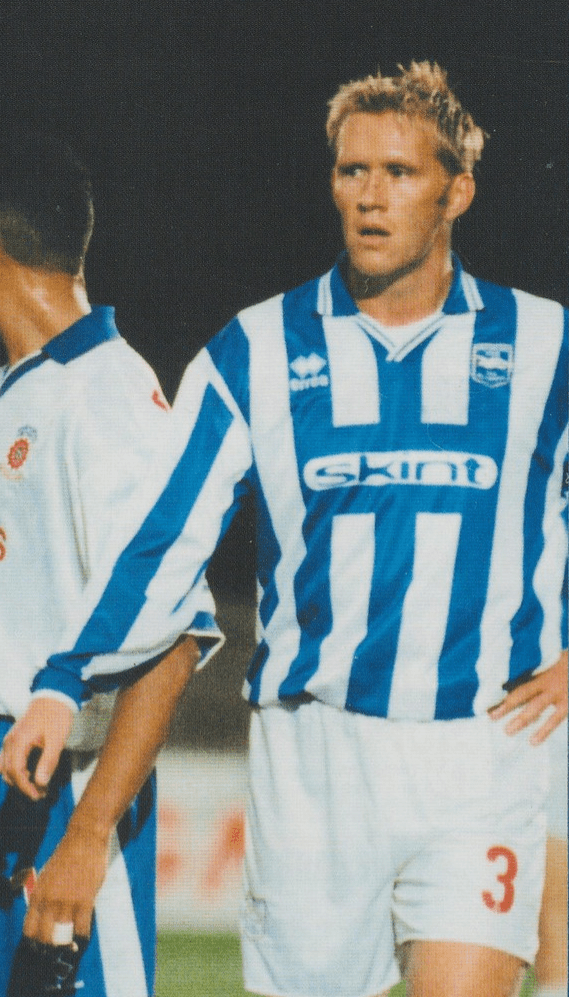
He did score (left) in the right end to bag the only goal of the game in a Withdean win over Hartlepool on 6 November 1999, but the following month, when Albion were up against it with several players injured, ill or suspended, Campbell got himself sent off after only 25 minutes in a 2-0 defeat at Swansea City prompting Adams to drop him and relegate him to the reserves.

Campbell was shown the red card by Premiership referee Dermot Gallagher after twice sliding in recklessly on Jason Price in the space of just over a minute. He was Albion’s sixth player to be suspended that season.

“Campbell’s stupidity couldn’t have come at a worse time as a flu-ravaged squad had a hard enough task against the eventual Division Three champions without having to play for over an hour with 10 men,” recalled wearebrighton.com.

Campbell clears from Orient’s Martin Ling

Boss Adams, who had already fined Darren Freeman for a red card at Plymouth, told the Argus: “The boy will be disciplined. They’ve got to learn. In wet conditions like that, good defenders stay on their feet, it’s as simple as that.

“Obviously it’s a worry because with small squads in the third division you can’t afford too many sendings-off.”

Having lost his place, things then got worse for Campbell in February of the new century when he had to undergo a hernia operation, dashing any hopes he might have had of winning back a starting place. With Mayo and new arrival Nathan Jones vying for the left back spot, Campbell became surplus to requirements.

He moved on to Exeter City where he was almost ever-present in the 2000-01 season under Noel Blake and was named the Grecians’ player of the year.
Not long into his first season at St James’s Park, he was interviewed by the local paper and compared the situation at City to his experience with Brighton, because Blake, like his former Leeds teammate Adams, had assembled a new squad of players.

“You’ve got to quickly get to know everyone’s strengths and weaknesses so you can gel as a team,” he said. “He (Blake) has got standards and he wants people to believe in them.

“The boss runs things very professionally, he thrives on running the club like a First Division or even a Premiership club.

“And the good thing with the boss is that he admits he is still learning and his door is always free for us to knock on.”

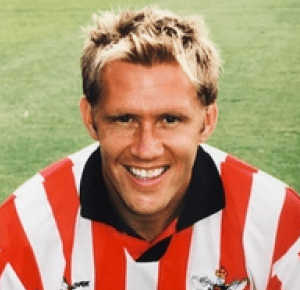
On his return to the Withdean in the red and white stripes of Exeter three days before Christmas 2000 (above), Campbell’s penchant for own goals once again came to the fore when he deflected a Gary Hart effort that was going wide past the City ‘keeper to contribute to a 2-0 win for the Seagulls.

Not long into the 2001-02 season, Blake was replaced by former City player John Cornforth and, although Campbell played 20 games for the Grecians that season, he switched to Conference side Stevenage Borough in March 2002, where he linked up with former Albion players Simon Wormull and Andy Arnott.

The website boroguide.co.uk seems to be singularly underwhelmed by the Wayne Turner signing declaring: “It was perhaps indicative of the poor form that we found ourselves in that Campbell was often a beacon of mediocrity.

“In defence or midfield, the utility player often had little impact; frustration becoming a buzz word when describing JC’s performances.

“So, it was only natural therefore, that he ended up at Woking. Like many other former Boro’ players who didn’t live up to expectations, all roads lead to Kingfield.”

That move took place in February 2003, and he moved on again a year later, to Havant & Waterlooville where he stayed until July 2005, when he retired from playing.

Born in Birmingham on 21 October 1972, he was a trainee at Luton before signing professional in July 1991. He broke through under David Pleat in the 1991-92 season when Town were relegated from the top flight after 10 seasons at that level.

Young Hatter Campbell

 Campbell made four starts plus nine appearances off the bench as the Hatters lost their place amongst the elite. Pleat’s squad also included a young Kurt Nogan and combative midfielder Chris Kamara.

On other occasions Campbell was part of Town line-ups that included one-game Albion loanee goalkeeper Juergen Sommer and Arsenal loanee striker Paul Dickov. The excellent Hatters Heritage website said of him: “Jamie was regarded as a utility man at Kenilworth Road with his versatility meaning that he was used mainly as a substitute, which sadly ensured that he could never claim a permanent position in the Hatters side.” Somewhat ignominiously, the fans podcast We Are Luton Town named the defender in their worst-ever Hatters XI.

When he found first team opportunities were limited at Kenilworth Road, Campbell went on loan to Mansfield Town and Cambridge United and left Luton in July 1995 to sign for Barnet.

During two seasons at Underhill, Campbell featured in 67 league matches (and scored five goals) before moving back to Cambridge on a permanent basis in August 1997.

While playing for the Us, Campbell put the ball in the wrong net but ended up on the winning side in a memorable second round second leg League Cup match in 1998.

Roy McFarland’s basement league United side knocked out Premier League Sheffield Wednesday 2-1 on aggregate, having nicked a 1-0 win at Hillsborough in the first leg.

Campbell for Cambridge tries to block a cross by Albion’s Paul Armstrong

Fan Matt Ramsay recalled: “Jamie Campbell’s freak headed 20-yard own goal summarised the cruel nature the sport can possess as it handed the big guns the initiative.

“Yet just as supporters began to embrace the familiar underdog emotion of consoling each other with the knowledge that at least it was a valiant effort, the magic moment arrived.

“Just as football is cruel when it goes against you, the success brings delirium. As Trevor Benjamin thumped home a right wing freekick to put United back into the lead, and as the final whistle fifteen minutes later heralded a major cup upset, there was proof that there is reward for the eternal hope that all fans of all clubs require.”

Mis-firing Mick Ferguson couldn’t repeat goalscoring prowess for Everton or Brighton

MICK FERGUSON was a prolific goalscorer for Coventry City but the goals dried up in spells with Everton and Brighton & Hove Albion.

Ferguson’s arrival at the Goldstone in the early autumn of 1984 was certainly not amid a great fanfare. The Albion, under new chairman Bryan Bedson, were wrestling with debt and, to bring in some much-needed funds, sold striker Alan Young to Notts County for £50,000 and full-back Mark Jones to Birmingham for £30,000.

Needing a cut-price replacement for Young, and with Ferguson unwanted at Birmingham having been responsible for getting them relegated (see below), he came to the Goldstone as part of the deal that took Jones to St Andrews.

In modern-day football, loan players don’t generally play against their parent clubs but, amazingly, at the end of the previous season, Ferguson was allowed to play against Birmingham while on loan at his old club Coventry, and ended up scoring a goal that kept the Sky Blues in the top division but sent Birmingham down.

It was such an unusual saga that as recently as May 2017, the Guardian revisited the tale, catching up with Ferguson to explain the circumstances.

As the article explains, shortly before the player’s 30th birthday, manager Ron Saunders offloaded him to Brighton, where the manager was Ferguson’s former Coventry teammate, Chris Cattlin. Just to prolong Saunders’ agony, Ferguson made his Seagulls debut in a 2-0 home win… over Birmingham! This time he didn’t score. And, for Brighton, that state of affairs existed for several months.

I remember his second game quite vividly. It was a midweek league cup tie away to Fourth Division Aldershot and I went to the game with my pal Colin Snowball, who at that time was living in nearby Bagshot. There wasn’t anything subtle about Albion’s tactics that night. Goalkeeper Graham Moseley would kick the ball long for Ferguson to get on the end of it.

But, as the striker tried to lay it off, all he succeeded in doing was heading it into touch – repeatedly. The new signing did not impress! Despite their superior status in the league, Albion succumbed 3-0 in what was a pretty humiliating exit. Ferguson was remarkably selected for the following Saturday’s game, an away defeat to Oxford, after which he was omitted for four games. Cattlin gave him another chance with a four-game spell but still the dismal form continued and he didn’t get another look-in for four months.

Freelance journalist Spencer Vignes did a retrospective article about Ferguson for the Albion matchday programme and discovered the striker didn’t have a high opinion of his former playing colleague. “Several of the players just didn’t get along with him, and I was one of them,” he said. “His man-management skills  left a lot to be desired. As a manager you need to have the players on-side. Chris certainly didn’t have us on-side.”

Ferguson admitted to being frustrated by Cattlin chopping and changing the side and said there were times he turned out when only 80 per cent fit, which didn’t do justice to himself, the team or the supporters. “My ankles weren’t great and towards the end I did struggle with my back, but I felt when I was fit I could certainly do a good job.”

The striker felt with the ability in the squad at the time they should have achieved more but pointed the finger at Cattlin for it not happening. “Some people aren’t cut out for management and I don’t think Chris was. It doesn’t surprise me that he never worked as a manager again.”

The history books (many thanks to Tim Carder and Roger Harris) recall him as the goalscorer in a 1-1 draw away to Portsmouth on 6 April 1986 but, having been to that game too, I seem to recall it was a rather desperate claim for what looked more like an own goal by Noel Blake.

The start of the following season saw the arrival of former £1m striker Justin Fashanu from Notts County and Dean Saunders, a free transfer from Swansea City, so Ferguson’s prospects of a starting place looked bleak.

However, the 1985-86 season was not very old before Cattlin had a striker crisis on his hands. Gerry Ryan was out long-term with the horrific leg break from which he never recovered, Terry Connor and summer signing Fashanu were also sidelined with injury and a big man was needed to play alongside Alan Biley.

Cattlin had little choice but to bring back the previously mis-firing Ferguson, and to everyone’s surprise and delight his goal touch returned, albeit briefly.

“I was virtually forced into the team through injury,” Ferguson admitted in a matchday programme interview. “But, fortunately, things turned out quite well. It was nice to get a goal against Blackburn in my first match back. That seemed to pave the way.”

The programme article had tried to give some perspective to the dismal form when he had first arrived. It said: “Mick’s confidence was affected by his loss of form, but he never lost an inner belief that he would pull himself out of the bad patch. And what a difference the goals make. He has shown great character this season and did a marvellous job for the team while Justin Fashanu was out with injury.”

Ferguson himself said: “It took us quite a while to settle down. We were in a flat at first and I was having a lot of problems, one way and the other, so it wasn’t an easy time.”

Eventually Ferguson, his wife and two daughters settled into a house in Hove, and the striker admitted: “When you’re having a bad time there is a tendency to bring your problems home. It’s unfair on your family. I didn’t notice at the time, but, looking back, I think I probably was a little snappy with my wife and children.

“I think you can reach the stage where you really start to wonder, but I always knew I could score goals for Brighton. I’ve scored goals everywhere else I’ve played. It was just a question of time and waiting for the right break.”

Indeed, Ferguson scored in three successive matches in September 1985, prompting Cattlin to give him a special mention in his programme notes for the league cup game at home to Bradford City. “The form of Mick Ferguson is bound to improve even more with the confidence he is gaining through his three goals in three games,” wrote the manager. “His header against Wimbledon was a true indication of his ability; it was of the highest class.”

The renewed confidence saw him add another consecutive pair the following month – before on-loan Martin Keown took over the no.9 shirt and demonstrated he could score goals as well as defend!

Sadly, the revival in Ferguson’s fortunes were not to last. When Fashanu was fit again, Ferguson was dropped and only stepped in a couple more times. His goal in a 4-3 home win over Huddersfield on 16 November was the last he scored for the club.

Apart from a lone outing in January, in a 3-0 defeat at Sheffield United, Ferguson was on the outside looking in until, to everyone’s astonishment, after a five-week absence from first team action, he was selected by Cattlin to lead the line in a FA Cup Sixth Round tie against First Division Southampton on 8 March 1986.

Ferg action Shilts Bond CaseFerguson, sandwiched between Kevin Bond and Jimmy Case, is foiled by Southampton goalkeeper Peter Shilton in what turned out to be the striker’s final Brighton game.

A crowd of 25,069 packed into the Goldstone – when the average attendance at the time often dipped below 10,000 – but it ended in a disappointing 2-0 defeat and the manager admitted he had made a mistake with his selection. It turned out to be Ferguson’s last game for the club.

Just over three weeks later, he moved to fourth-tier Colchester United – whose manager Cyril Lea was promptly sacked!

United’s reserve team manager, Mike Walker (who would later manage Everton) took over the first team as caretaker and, as the team went on an unbeaten run of eight games, Ferguson scored seven times, the first of which came in a 4-0 win over Leyton Orient on 8 April.

The following season he played 19 games and scored four times before leaving on 7 November 1986 to join non-league Wealdstone.

It was quite a fall from the heady days of the early Seventies.

Born in Newcastle on 3 October 1954, Ferguson was picked up by Coventry City’s youth scheme in 1970 and, although he made his debut in 1975, shortly after the sale of Scotland international Colin Stein, it wasn’t until the start of the 1976-77 season that he became a Highfield Road regular.

In tandem with Ian Wallace (who was later a strike partner of Peter Ward’s at Nottingham Forest), he really started to attract attention, as the Coventry Telegraph recounted when describing him as a “truly great goalscorer”.

The article reckoned he was strongly tipped for international honours at one point but injury and loss of form affected him over the next two seasons. Forest, Villa and Ipswich were all supposedly keen to sign him, with Brian Clough agreeing a £500,000 deal, then pulling out.

However, in the summer of 1981, he finally left City having scored 57 goals in 141 games (plus eight sub appearances) all in the top flight when Everton paid £280,000 for him. Ferguson scored six times in his first eight games – but the goals dried up after that and he was gone within less than a year having made only made 10 appearances (plus two as a sub).

In 2007, David Prentice, in the Liverpool Echo, sought out Ferguson for an explanation of his less than happy time on Merseyside.

Manager Howard Kendall initially loaned him to Birmingham City, before making the deal permanent, but injury disrupted his chances at St Andrews, hence the loan move back to Coventry.

After retiring from playing in 1987, Ferguson stayed in the game working in community development roles for Sunderland – for 10 years, until he fell out with manager Peter Reid – Newcastle United and Leeds United, where he was head of Football in the Community.

Pictures from Albion matchday programes and, via YouTube, from Coventry City’s Sky Blues TV.

Desk job at Leeds in later life