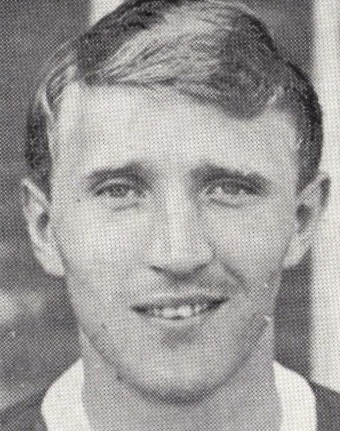
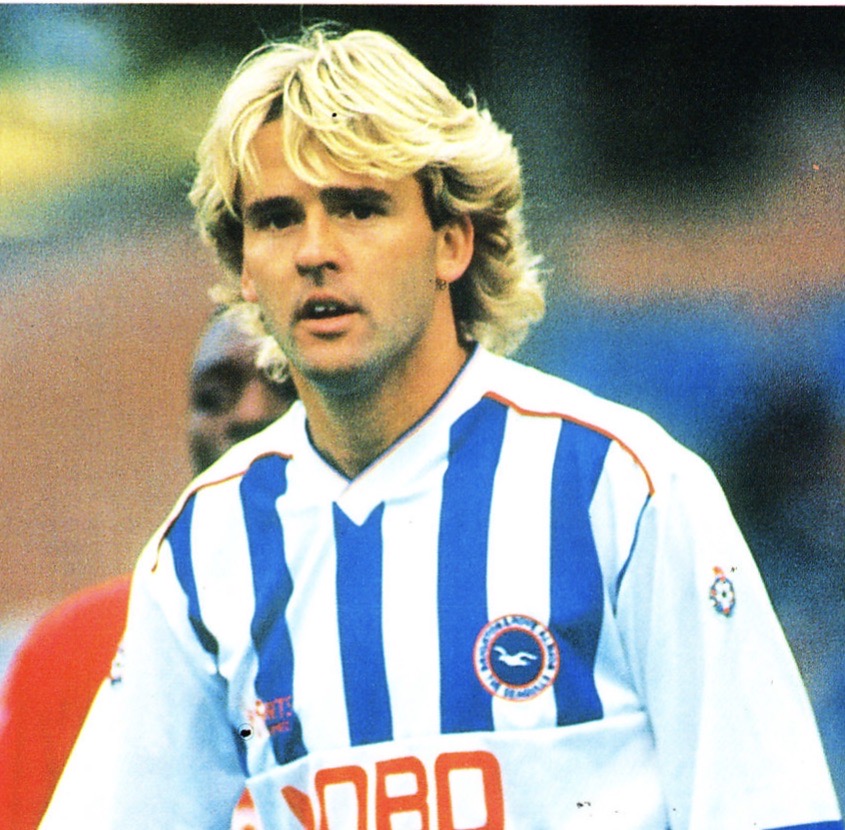
Big Chiv’s Brighton cameo at the end of an illustrious career

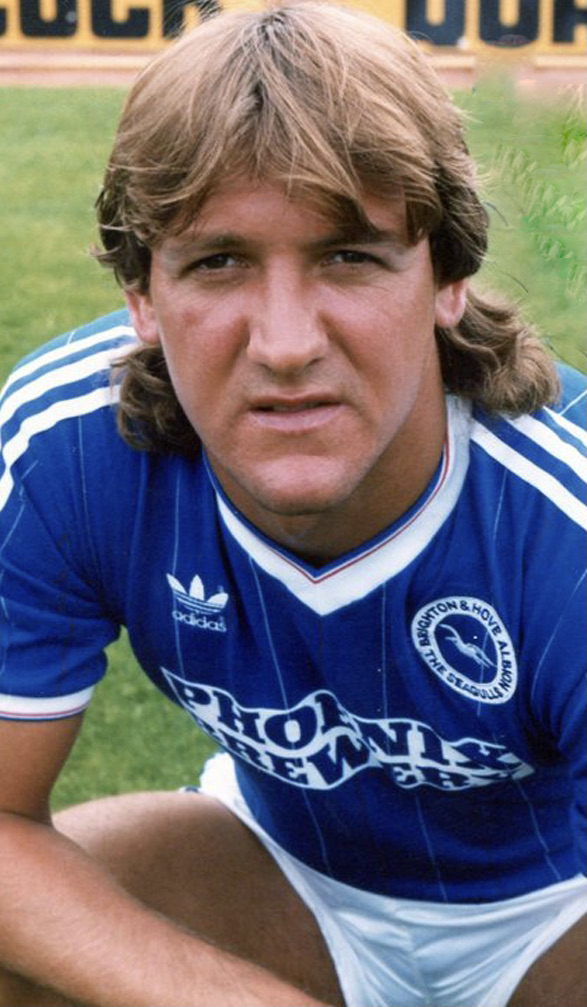
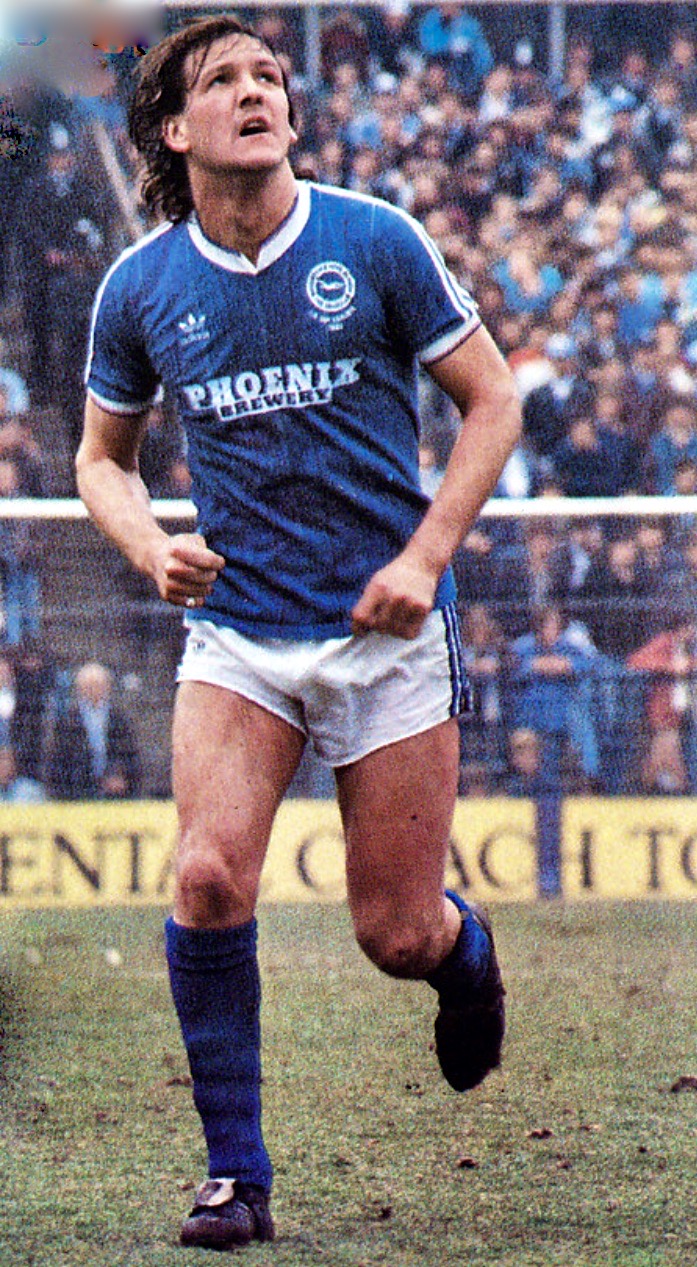
FORMER England international Martin Chivers rose majestically to head home a goal in a 3-3 draw between Leyton Orient and Brighton & Hove Albion.

It was textbook Chivers – a replica of so many similar goals he’d scored for Spurs and England during his glory days – and it put Albion 2-1 up. It turned out to be his one and only goal for the Albion.

It came in one of just five games he played for the Seagulls as his illustrious playing career drew to a close. In Teddy Maybank’s absence through suspension just as Brighton inched closer to promotion to the elite for the first time ever, Chivers – once one of this country’s top centre forwards – was an ideal stand-in.

The game at Brisbane Road on 7 April 1979 saw former Spurs League Cup winning teammates Chivers and Ralph Coates on opposing sides and, a 3-3 thriller was a cracking match for ITV’s The Big Match to have chosen for showing the following Sunday afternoon.

A month later Albion would travel to St James’s Park, Newcastle and clinch that dream promotion.

John Vinicombe, faithful chronicler of Albion’s fortunes for the Evening Argus, declared: “Make no mistake, Albion are First Division bound after that tremendous match at Orient.”

Mike Calvin in the Sunday Mirror, said: “Chivers’ bullet like header became an instant candidate for ITV’s goal of the season.”

While Ian Jarrett in The Sun said: “Martin Chivers’ 32nd minute goal came straight out of the former England striker’s scrapbook. ‘It was a dream goal. I’d like to have it on tape so that I could watch it being played back again and again,’ Chivers told him.

In the days when strikers invariably hunted in pairs, Chivers had previously starred for Tottenham Hotspur alongside the late Scot, Alan Gilzean, as Spurs put silverware in the White Hart Lane trophy cabinet in three successive seasons.

The team captain during that successful period was Alan Mullery and after the midfielder had hung up his boots and taken charge of the Seagulls, he turned to his old teammate in his hour of need.

With regular striker Maybank facing a two-match suspension, Mullery bought the 34-year-old Chivers for £15,000 from Norwich City just before transfer deadline day in March 1979 and he made his debut in a home 0-0 draw against Notts County on 31 March.

Chiv v CharltonEven a crocked Chivers (by his own admission, a troublesome Achilles tendon restricted his fitness) could do a job for the Albion in an emergency, the young manager believed.

“I took a bit of a chance on him, but he was terrific for us,” Mullery recalled in a retrospective matchday programme article. “He was a proven goalscorer and helped us both on and off the pitch.”

Chivers explained exactly how it came about in his autobiography, Big Chiv – My Goals in Life, which he discussed in an interview with the Argus in 2009.

Maybank returned to the side for the successful promotion run-in and, during the summer, Chivers had an operation on his Achilles. The new season, amongst the elite for the first time, was 13 games old before Chivers saw action for the Seagulls.

He appeared as a substitute in a 2-1 defeat away to Coventry City on 20 October, and the national media singled him out for mention.

“When Chivers came on for Ward 11 minutes after the break, the game at last came to life. From then on, Brighton were more decisive in attack and played with more confidence,” said the Daily Telegraph.

Sunday Express reporter William Pierce added: “Martin Chivers went on as a substitute for the out-of-touch Peter Ward and the ex-England striker twice might have scored.”

That contribution earned Chivers a starting place at Maybank’s expense in the next game, a 4-2 home defeat to his old club Norwich, and he stayed up top, this time partnering Maybank, in a 0-0 home draw with Arsenal in the fourth round of the League Cup.

But that was the last time he appeared in the first team. Mullery turned instead to another former Spur, Ray Clarke, and he and Ward were the preferred front pairing for the rest of the season.

Chivers remained with the club, appearing regularly in the Reserves through to the end of the season, and doing some scouting work, but his top-flight career was finally over.

But let’s take a look back at what had gone before. It was an impressive rise to fame.

Born in Southampton on 27 April 1945, Chivers was a pupil at the city’s Taunton’s Grammar School and wrote to his local club asking for a trial. His prowess as a goalscorer grew rapidly.

chiv SaintAfter playing regularly for Southampton’s youth side, his breakthrough came in September 1962 when just 17. He made his first-team debut against Charlton Athletic and signed as a full-time professional in the same week. He became a first-team regular the following season.

In February 1964, Chivers and future teammate Mullery were called up (along with future Albion goalkeeper Peter Grummitt) by Alf Ramsey as Reserves for the England under 23 side for a 3-2 win over Scotland, played in front of 34,932 fans at St James’s Park, Newcastle.

Two months later, at Stade Robert Diochon in Rouen, shortly before his 19th birthday, Chivers made a goalscoring debut for the Under 23s when coming on as a substitute for Geoff Hurst as England drew 2-2 with France.

It was the start of a record-breaking Under 23 career; in four years he appeared 17 times.

Southampton skipper Terry Paine, who was part of England’s 1966 World Cup winning squad, played alongside Chivers as he developed. “The potential was always there, especially when he made the Southampton first team. But the one thing he may have lacked was determination,” he told Goal magazine.

On Saints’ promotion to the top division in 1966, Bates supplemented his attacking options with the addition of established international Ron Davies from Norwich.

Davies and Chivers proved a twin threat to opponents but Chivers was somewhat overshadowed by the Welshman, and Paine said: “They just weren’t compatible. It didn’t work having two big blokes up there together. Chivers was playing second fiddle. He was no match for Ron in the air, there was never any doubt about that.”

It eventually led to Chivers putting in a transfer request in December 1967 and, a month later, having scored 106 goals in 190 appearances for Southampton, he was transferred to Tottenham for £80,000 with winger Frank Saul, an FA Cup winner with Spurs in 1967, a £45,000 makeweight going in the opposite direction.

Saints fans had a new hero in the emerging Mike Channon and inevitably comparisons were drawn between the two. “Martin had more finesse on the ball when he was Mike’s age, without punching his weight,” said Southampton boss Ted Bates. “Mike, however, has more drive and desire, a ruthless approach which Martin never had.”

Indeed, even in the early days at Spurs, fans failed to see why Spurs had shelled out what at the time was the biggest ever transfer fee in the country for the striker, with the legendary Jimmy Greaves and Scot Alan Gilzean the preferred front pairing.

It didn’t help matters when he was sidelined for months by a serious knee injury, although Bates felt the spell out actually proved to be a turning point in his career.

“During that long spell out of action I think he must have taken a good, long look at the game and examined himself thoroughly,” said Bates. “The result is that he now uses the full range of his talents.”

Bates believed he lacked belief in his own power and seemed reluctant to use his size to his advantage. “We were always trying to get Martin to use his physique properly,” said Bates. “He knew he had to be more aggressive, but in those days a big, strong centre-half could swallow him.”

It looked as though Chivers was going to be an expensive flop and, in an interview with Ray Bradley for Goal magazine, he admitted he’d been through a crisis at Spurs and his career had been at a crossroads.

“It was a hell of a frustrating time for me,” he said. “No matter how hard I tried I just couldn’t strike form. I suppose I was really battling to regain confidence again after injury.

“The fans, disgruntled with the form we had been showing, were gunning for me and finally they got their way when I was dropped.

“Things looked black for me but I was determined to fight my way back into the side. The turning point for me, I think, came in a reserve game against Northampton at the end of the season.”

Reserve team manager, Eddie Baily, took him aside and had a private chat, telling him the only way he’d get back his confidence was to fight for it on the pitch.

“He instilled in me that I must be more aggressive, that I must put myself about more if I was to win back my first team place,” said Chivers. “That little pep talk seemed to do the trick. It was a wet pitch and I really gave it all I had and ended up by scoring five goals.

“His words of encouragement after the match made me realise that it was up to myself if I wanted to succeed.”

With Greaves having departed the club for West Ham, once Chivers was back in the first team he did well up against Jack Charlton and Norman Hunter of Leeds, and he began to recapture his form. A good start to the 1970-71 season saw everything start to slot into place.

“I’ve always liked scoring goals,” he said. “Ever since I was a boy I liked to see the ball hit the back of the net.”

After scoring twice to help Spurs beat Aston Villa in the 1971 League Cup Final, Chivers said: “I feel fabulous. That’s the only way to describe how I feel after scoring two goals in my first-ever appearance at Wembley.

“Spurs are back on the glory trail and those two goals have really sealed my comeback this season.”

In a series of Goal articles about Chivers in November 1971, writer Warwick Jordan declared: “There have been few more exciting centre forwards to grace the game and there is little reason to dispute the claim that the Tottenham striker could become one of the best ever,”

A whole raft of top division players and managers were happy to put on record their admiration for the centre-forward. Everton boss Harry Catterick described him as “the new John Charles” and claimed: “Chivers has emerged this year as the most talented centre-forward in Britain.”

Leeds manager Don Revie was a big admirer, saying: “Chivers is a better player than Geoff Hurst. The comparison is appropriate as both men possess a high degree of skill not normally found in strikers of their heavy build.

“It’s hard to choose between them, but I consider Chivers has the slight edge as he does not rely so much on the men around him. He has the ability to take the ball through on his own and create chances out of nothing.”

Manchester City team boss Malcolm Allison said: “This boy is the best all-round centre-forward in Britain. He’s big, strong, skilful and exciting. A tremendous player who will always get goals.”

Stoke midfielder Mike Bernard told the magazine: “Chivers has got guts, skill, aggression, ball control and tremendous determination. You can’t fault the guy.”

Teak-tough centre back John McGrath, who once had a brief spell on loan to the Albion from Southampton, added: “That bad injury has helped to make him a much more determined player. When your career is in the balance it gives you a greater determination to succeed. Chivers has come back to the game a different player.

“He’s a much more physical player now. A more confident player than he was before. He’s developed more character.

“People don’t realise how fast he is. He’s got a sort of loping run, a bit ungainly. But it’s deceptive because he is gathering speed all the time.”

Despite gaining that record number of England under 23 caps, it wasn’t until early 1971 that he got his chance on the full international stage. His reinvigorated Spurs form led to him making his full England debut away to Malta on 3 February 1971, when England gained a 1-0 win under the captaincy of his Spurs teammate Mullery.

He scored his first goal for England two months later in a 3-0 win against Greece at Wembley.

It was said Chivers really arrived as an international star after a powerful two-goal performance in a 3-1 win over Scotland at Wembley on 22 May 1971.

“This has been the greatest day of my life,” said Chivers, after that win. “I didn’t know I was playing until lunchtime on the same day. I was determined to show I was worth my place.

“I know a lot depended on my display in that game. I know I could have jeopardised my international future if I had not grabbed the opportunity.”

Afterwards, though, he declared: “Now I feel I have established myself as an England player.”

Fellow England striker Francis Lee told Goal’s Jordan: “He’s a football manager’s dream. At his present rate of progress, he could become the greatest centre-forward this country has seen.

“His tremendous potential blossomed during that game in Switzerland (scored in a 3-2 win in Basle, 13 October 1971) where his performance made the difference between victory and possible defeat.

“But his finest game for England so far was the one against Scotland. Today he is the hottest soccer property in the game. He’s going to be a big winner for England.”

In total, he scored 13 times in 22 starts plus two appearances from the subs bench, but, in less than three years, Chivers’ England career was over.

He never played for his country again after being subbed off in the crucial game that meant England wouldn’t qualify for the 1974 World Cup – a 1-1 draw with Poland at Wembley in 1973.

In eight years at Spurs, Chivers scored 174 goals in 367 games, his greatest success coming between 1970 and 1973, when he scored more than 20 goals in successive seasons, and was a key part of the side that won the 1971 and 1973 League Cups, finished third in the league in 1971, and picked up the 1972 UEFA Cup.

He had two seasons in Switzerland, playing for Servette, before returning to the English game with Norwich in 1979-80, before the move to Brighton.

On leaving Brighton, he went initially to Southern League Dorchester Town as player-manager, then Norwegian side Vard and finished playing 10 games for Barnet in 1982-83.

It was a phenomenal scoring record to notch 255 goals in 546 appearances.

After he’d finished playing, Chivers became a hotelier in Hertfordshire (during which time I got to speak to him in a professional capacity, helping to promote my client’s involvement in his business) and for several years he was a matchday host at White Hart Lane.

Chivers died at the age of 80 on 7 January 2025.

Pictures from a variety of sources, especially Goal and Shoot magazines and matchday programmes.


Much-travelled Ade Akinbiyi a big hit in brief Seagulls spell

A STRIKER with wildly differing fortunes in a varied and much-travelled career made a good early impression when joining Albion on loan from Norwich City back in the autumn of 1994.

Ade Akinbiyi had not long since broken through to the City team as a teenager and he scored four times in seven games on loan to the Seagulls.

Just turned 20, Akinbiyi arrived at a time when Liam Brady’s Albion hadn’t registered a win for 11 games and, although Albion lost the first game he played in, the remaining six produced three wins and three draws.

AA scores

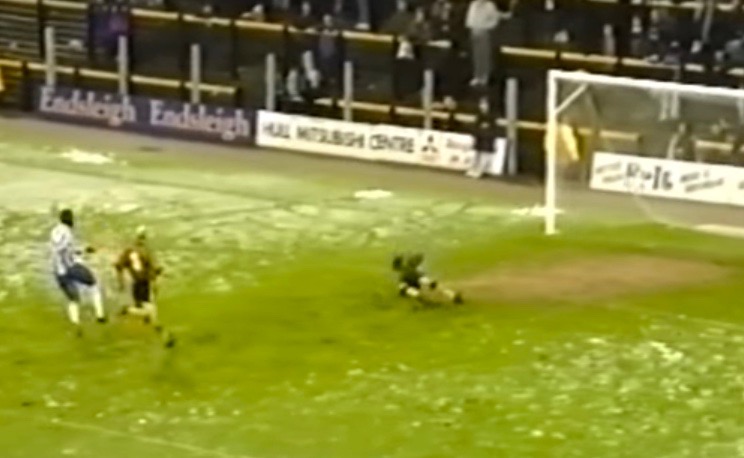
There is some YouTube footage of him scoring Albion’s second goal on a snowy pitch at Hull City’s old Boothferry Park ground in a game that finished 2-2.

“He is powerful and big and he can take knocks and we have missed having somebody in that mould,” Brady wrote in his matchday programme notes.

Later in his career Akinbiyi would prove to be a real handful for the Seagulls – I recall him shrugging off a powder-puff challenge from a young Dan Harding at Withdean and muscling his way to a winning goal for Stoke City. Manager Mark McGhee subbed Harding off and publicly lambasted him afterwards.

Born in Hackney on 10 October 1974, Akinbiyi was more interested in athletics at an early age, as he told the Lancashire Telegraph.

“I was interested in football but not massive on playing it,” he said. His school PE teacher persuaded him otherwise. “I went to play for my district team, Hackney, and it all started from there.”

From Hackney, Akinbiyi joined nearby Senrab, the team that blooded the likes of Bobby Zamora, Leon Knight, John Terry and Jermain Defoe.

His age group earned a place in a children’s tournament in Great Yarmouth called the ‘Canary Cup’ where he was spotted by a scout for nearby Norwich, who signed him as a schoolboy.

“The schoolboy and youth team system was second to none, as it still is now,” said Akinbiyi. But he found it hard living away from home, missing his mum’s native Nigerian cooking.

But after finding new digs with a few of his team-mates, he stuck at it and earned a dream debut as a substitute against Bayern Munich in the return leg of their UEFA Cup second round game, less than a month after his 19th birthday.

“I thought my debut would come in a cup game, perhaps against lower league opposition, not against Bayern Munich,” he said. “Not many people make their debut in a European cup competition.”

Although Akinbiyi made 51 league appearances for Norwich, his Canaries career never really took off, hence the Brighton loan spell and a similar move to Hereford United.

Eventually, though, a manager who believed in him, Tony Pulis, made him a record £250,000 buy for Gillingham in January 1997. Akinbiyi repaid Pulis’ faith in him with 29 goals in 67 starts, leading to Bristol City paying £1.2million for the striker following their promotion to the old Division One (now the Championship).

akinbiyi + colin lee

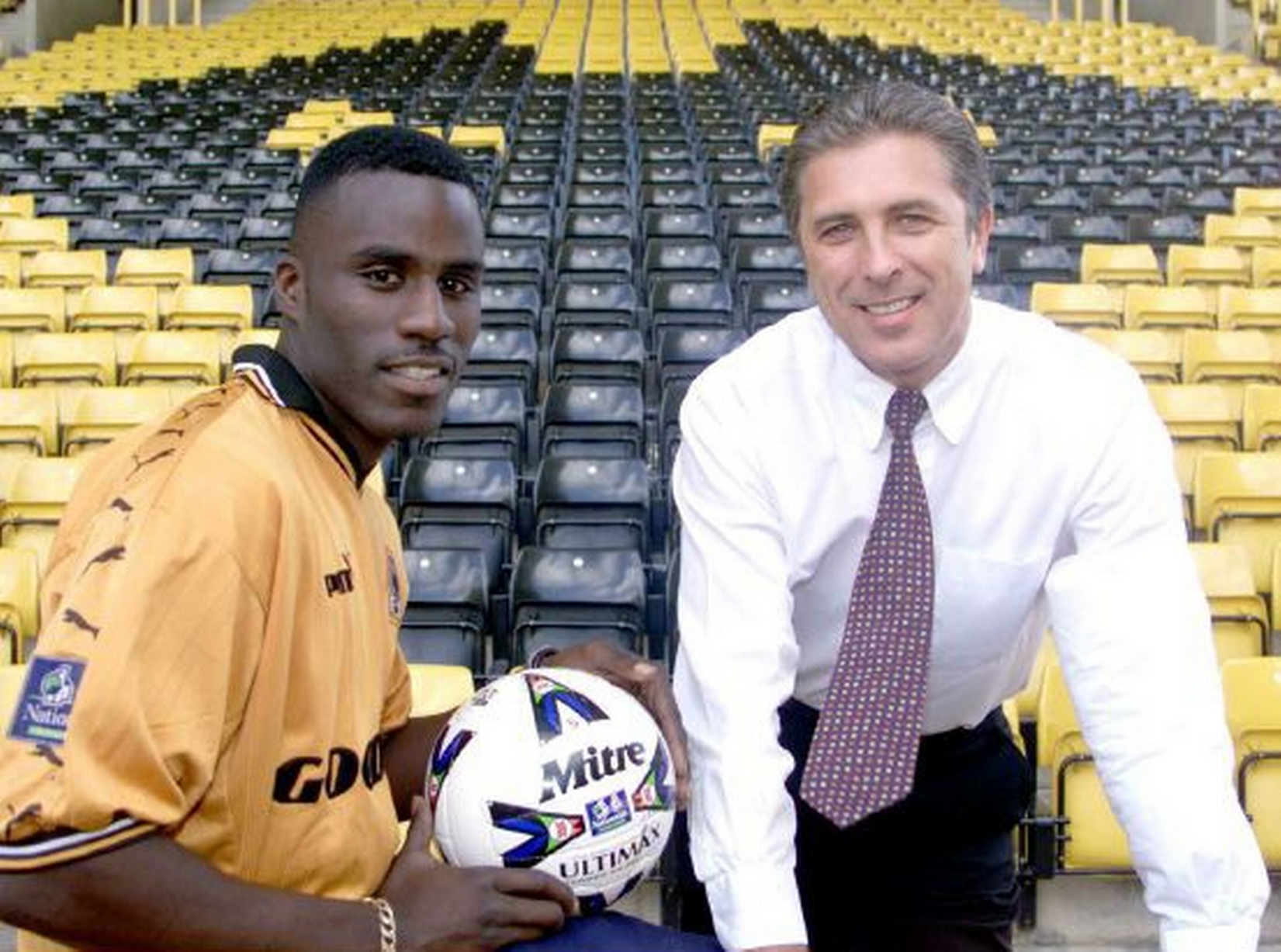
After scoring 21 goals in 47 league appearances for the Robins, in 1999 he completed a £3.5m move to Wolverhampton Wanderers. In the same year, he played his one and only game for Nigeria, in a friendly against Greece in Athens.

He made a great start at Wolves, scoring eight times in his first 12 games for Colin Lee’s side, but a year later, switched to Premier League Leicester City, after the Foxes’ boss Peter Taylor (later to replace Micky Adams at Brighton) paid out a £5m fee for the striker.

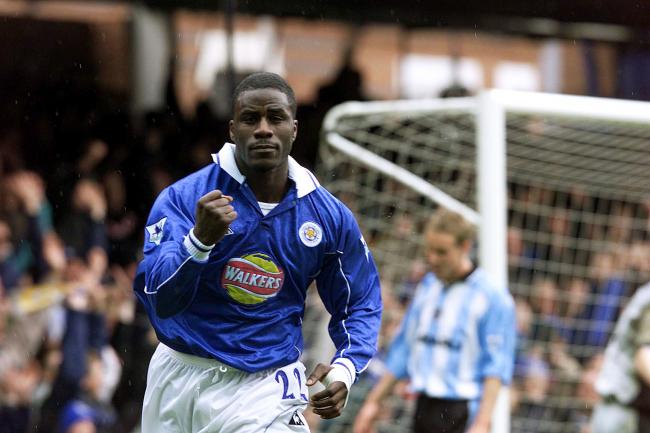
Ade A LeicesterAkinbiyi was brought in to replace Emile Heskey, a real Filbert Street hero who had been sold to Liverpool for £11m. However, his goal touch eluded him and he managed to score only 11 goals in 58 league appearances for the club – some Leicester fans dubbing him Ade Akin-Bad-Buy!

Akinbiyi looked back on it in an interview with Four Four Two magazine and said: “I came in as Emile Heskey’s replacement, but he is a different breed of footballer.

“He’s big, strong and scores goals, but, back then, if Heskey wasn’t scoring a lot he could get away with it. He was the local hero. I was a different player – I’d be running in behind and trying to cause people problems. But Leicester looked at my record in the Championship and thought I’d come and do the same thing.”

Eventually they cut their losses and sold him to Division One Crystal Palace for £2.2m. At Selhurst, he was rather ignominiously given the number 55 shirt! Having scored just one goal in 14 league and cup appearances, in 2003 he was loaned to Stoke City, under his old boss Pulis.

He scored twice – the second goal coming in the last game of the 2002-03 season, when the Potters won 1-0 against Reading to seal their Division One (now the Championship) status (the season Albion were relegated).

Akinibiyi discussed the events in an interview with another ex-Stoke, Burnley and Brighton striker, Chris Iwelumo, for Stoke City FC TV.

AA chat with CIIt led to Akinbiyi joining on a permanent basis, on a free transfer, and he became a cult hero with the Stoke City crowd.

In March 2005, Burnley signed him for £600,000 – and he was promptly sent off on his debut! The game was only two minutes old when he head-butted George McCartney of Sunderland, and was shown a straight red.

Less than a year later, he was on the move again, switching to Sheffield United in January 2006 for what was then a club record £1.75m fee.

He scored on his Blades debut against Derby County but by October that year he was in the news for his alleged involvement in a training ground bust-up with team-mate Claude Davis.

In all, Akinbiyi made only five appearances for the Blades in the Premiership in 2006 and, on New Year’s Day 2007 he returned to Burnley for a £650,000 fee, with add-ons.

He scored in his first game back, against Reading, but only notched three by the season’s end. Burnley fans have some good memories of him, particularly in a brief spell when he played alongside loan signing Andrew Cole, but on 2 April 2009, Burnley offloaded him to Houston Dynamo.

Dave Thomas, a prolific writer on all things Burnley, talked about Akinbiyi’s cult hero status among Burnley fans, telling thelongside.co.uk: “Ade certainly had a talent and that talent was scoring goals. The story that he was utterly bad at this is totally inaccurate, but that is the legend that developed, at one club in particular, Leicester City.

“In truth, at Burnley too, he missed sitters that Harry Redknapp might say his wife could have scored. But then so do all other players and, in many games, he displayed all the things that he was good at, and the attributes that he had in abundance.”

After he was released by Houston, back in the UK he played 10 games for Notts County, as they won the League Two title In 2009-10, and the following season pitched up in south Wales to play for then non-league Newport County.

In July 2013, Akinbiyi became a player-coach for Colwyn Bay, managed by his former Burnley teammate Frank Sinclair, but both resigned in January 2015 after a 5-0 defeat at Boston.

Akinbiyi now lives in Manchester and in 2015 was interviewed about work he has done as an ambassador for Prostate Cancer UK after his father died from the disease.

Mis-firing Mick Ferguson couldn’t repeat goalscoring prowess for Everton or Brighton

MICK FERGUSON was a prolific goalscorer for Coventry City but the goals dried up in spells with Everton and Brighton & Hove Albion.

Ferguson’s arrival at the Goldstone in the early autumn of 1984 was certainly not amid a great fanfare. The Albion, under new chairman Bryan Bedson, were wrestling with debt and, to bring in some much-needed funds, sold striker Alan Young to Notts County for £50,000 and full-back Mark Jones to Birmingham for £30,000.

Needing a cut-price replacement for Young, and with Ferguson unwanted at Birmingham having been responsible for getting them relegated (see below), he came to the Goldstone as part of the deal that took Jones to St Andrews.

In modern-day football, loan players don’t generally play against their parent clubs but, amazingly, at the end of the previous season, Ferguson was allowed to play against Birmingham while on loan at his old club Coventry, and ended up scoring a goal that kept the Sky Blues in the top division but sent Birmingham down.

It was such an unusual saga that as recently as May 2017, the Guardian revisited the tale, catching up with Ferguson to explain the circumstances.

As the article explains, shortly before the player’s 30th birthday, manager Ron Saunders offloaded him to Brighton, where the manager was Ferguson’s former Coventry teammate, Chris Cattlin. Just to prolong Saunders’ agony, Ferguson made his Seagulls debut in a 2-0 home win… over Birmingham! This time he didn’t score. And, for Brighton, that state of affairs existed for several months.

I remember his second game quite vividly. It was a midweek league cup tie away to Fourth Division Aldershot and I went to the game with my pal Colin Snowball, who at that time was living in nearby Bagshot. There wasn’t anything subtle about Albion’s tactics that night. Goalkeeper Graham Moseley would kick the ball long for Ferguson to get on the end of it.

But, as the striker tried to lay it off, all he succeeded in doing was heading it into touch – repeatedly. The new signing did not impress! Despite their superior status in the league, Albion succumbed 3-0 in what was a pretty humiliating exit. Ferguson was remarkably selected for the following Saturday’s game, an away defeat to Oxford, after which he was omitted for four games. Cattlin gave him another chance with a four-game spell but still the dismal form continued and he didn’t get another look-in for four months.

Freelance journalist Spencer Vignes did a retrospective article about Ferguson for the Albion matchday programme and discovered the striker didn’t have a high opinion of his former playing colleague. “Several of the players just didn’t get along with him, and I was one of them,” he said. “His man-management skills  left a lot to be desired. As a manager you need to have the players on-side. Chris certainly didn’t have us on-side.”

Ferguson admitted to being frustrated by Cattlin chopping and changing the side and said there were times he turned out when only 80 per cent fit, which didn’t do justice to himself, the team or the supporters. “My ankles weren’t great and towards the end I did struggle with my back, but I felt when I was fit I could certainly do a good job.”

The striker felt with the ability in the squad at the time they should have achieved more but pointed the finger at Cattlin for it not happening. “Some people aren’t cut out for management and I don’t think Chris was. It doesn’t surprise me that he never worked as a manager again.”

The history books (many thanks to Tim Carder and Roger Harris) recall him as the goalscorer in a 1-1 draw away to Portsmouth on 6 April 1986 but, having been to that game too, I seem to recall it was a rather desperate claim for what looked more like an own goal by Noel Blake.

The start of the following season saw the arrival of former £1m striker Justin Fashanu from Notts County and Dean Saunders, a free transfer from Swansea City, so Ferguson’s prospects of a starting place looked bleak.

However, the 1985-86 season was not very old before Cattlin had a striker crisis on his hands. Gerry Ryan was out long-term with the horrific leg break from which he never recovered, Terry Connor and summer signing Fashanu were also sidelined with injury and a big man was needed to play alongside Alan Biley.

Cattlin had little choice but to bring back the previously mis-firing Ferguson, and to everyone’s surprise and delight his goal touch returned, albeit briefly.

“I was virtually forced into the team through injury,” Ferguson admitted in a matchday programme interview. “But, fortunately, things turned out quite well. It was nice to get a goal against Blackburn in my first match back. That seemed to pave the way.”

The programme article had tried to give some perspective to the dismal form when he had first arrived. It said: “Mick’s confidence was affected by his loss of form, but he never lost an inner belief that he would pull himself out of the bad patch. And what a difference the goals make. He has shown great character this season and did a marvellous job for the team while Justin Fashanu was out with injury.”

Ferguson himself said: “It took us quite a while to settle down. We were in a flat at first and I was having a lot of problems, one way and the other, so it wasn’t an easy time.”

Eventually Ferguson, his wife and two daughters settled into a house in Hove, and the striker admitted: “When you’re having a bad time there is a tendency to bring your problems home. It’s unfair on your family. I didn’t notice at the time, but, looking back, I think I probably was a little snappy with my wife and children.

“I think you can reach the stage where you really start to wonder, but I always knew I could score goals for Brighton. I’ve scored goals everywhere else I’ve played. It was just a question of time and waiting for the right break.”

Indeed, Ferguson scored in three successive matches in September 1985, prompting Cattlin to give him a special mention in his programme notes for the league cup game at home to Bradford City. “The form of Mick Ferguson is bound to improve even more with the confidence he is gaining through his three goals in three games,” wrote the manager. “His header against Wimbledon was a true indication of his ability; it was of the highest class.”

The renewed confidence saw him add another consecutive pair the following month – before on-loan Martin Keown took over the no.9 shirt and demonstrated he could score goals as well as defend!

Sadly, the revival in Ferguson’s fortunes were not to last. When Fashanu was fit again, Ferguson was dropped and only stepped in a couple more times. His goal in a 4-3 home win over Huddersfield on 16 November was the last he scored for the club.

Apart from a lone outing in January, in a 3-0 defeat at Sheffield United, Ferguson was on the outside looking in until, to everyone’s astonishment, after a five-week absence from first team action, he was selected by Cattlin to lead the line in a FA Cup Sixth Round tie against First Division Southampton on 8 March 1986.

Ferg action Shilts Bond CaseFerguson, sandwiched between Kevin Bond and Jimmy Case, is foiled by Southampton goalkeeper Peter Shilton in what turned out to be the striker’s final Brighton game.

A crowd of 25,069 packed into the Goldstone – when the average attendance at the time often dipped below 10,000 – but it ended in a disappointing 2-0 defeat and the manager admitted he had made a mistake with his selection. It turned out to be Ferguson’s last game for the club.

Just over three weeks later, he moved to fourth-tier Colchester United – whose manager Cyril Lea was promptly sacked!

United’s reserve team manager, Mike Walker (who would later manage Everton) took over the first team as caretaker and, as the team went on an unbeaten run of eight games, Ferguson scored seven times, the first of which came in a 4-0 win over Leyton Orient on 8 April.

The following season he played 19 games and scored four times before leaving on 7 November 1986 to join non-league Wealdstone.

It was quite a fall from the heady days of the early Seventies.

Born in Newcastle on 3 October 1954, Ferguson was picked up by Coventry City’s youth scheme in 1970 and, although he made his debut in 1975, shortly after the sale of Scotland international Colin Stein, it wasn’t until the start of the 1976-77 season that he became a Highfield Road regular.

In tandem with Ian Wallace (who was later a strike partner of Peter Ward’s at Nottingham Forest), he really started to attract attention, as the Coventry Telegraph recounted when describing him as a “truly great goalscorer”.

The article reckoned he was strongly tipped for international honours at one point but injury and loss of form affected him over the next two seasons. Forest, Villa and Ipswich were all supposedly keen to sign him, with Brian Clough agreeing a £500,000 deal, then pulling out.

However, in the summer of 1981, he finally left City having scored 57 goals in 141 games (plus eight sub appearances) all in the top flight when Everton paid £280,000 for him. Ferguson scored six times in his first eight games – but the goals dried up after that and he was gone within less than a year having made only made 10 appearances (plus two as a sub).

In 2007, David Prentice, in the Liverpool Echo, sought out Ferguson for an explanation of his less than happy time on Merseyside.

Manager Howard Kendall initially loaned him to Birmingham City, before making the deal permanent, but injury disrupted his chances at St Andrews, hence the loan move back to Coventry.

After retiring from playing in 1987, Ferguson stayed in the game working in community development roles for Sunderland – for 10 years, until he fell out with manager Peter Reid – Newcastle United and Leeds United, where he was head of Football in the Community.

Pictures from Albion matchday programes and, via YouTube, from Coventry City’s Sky Blues TV.

Desk job at Leeds in later life

The never forgotten miss by FA Cup Final scorer Gordon Smith

3 and smith must score“NEVER in my wildest dreams – or should that be nightmares? – did I think that, more than 20 years later, that miss in front of goal would still be getting replayed on television and mentioned in the media wherever I go.”
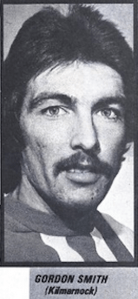
The words could only have been said by one man and they appear in the autobiography…And Smith Did Score (Black and White Publishing, 2005).

Gordon Smith’s football career included being a treble trophy winner with Glasgow giants Rangers, top scorer of the season for Manchester City, and becoming chief executive of the Scottish FA.

But it is what happened in the final seconds of extra time in the 1983 FA Cup Final that he is most remembered for.

Gordon Duffield Smith was born in Kilwinning (20 miles south of Glasgow) on 29 December 1954 and followed in his grandfather Mattha’s footsteps in becoming a pro footballer.

He was at Kilmarnock for five years, scoring 36 goals in 161 appearances, during which time he earned international honours with Scotland’s under-23 side, twice starting and three times going on as a substitute.

“It’s always a tremendous thrill to be selected in a squad for my country,” Smith said in a 1976  Shoot / Goal! magazine article. “It’s great to think Mr (Willie) Ormond considers me good enough for selection. I always do my very best for Scotland. I don’t need any further incentive other than pulling on that dark blue jersey.”

The item was highly complimentary of the player, saying: “The Kilmarnock dazzler is a player of poise and balance. He is one of the swiftest in Scotland and is certainly one of the most gifted. He has the talent to show the ball to the full-back then leave him helpless with astonishing acceleration.

“Smith can make and take goals. Some of his scores have been in the ‘unbelievable’ category. The flash down the wing, the cut-in, the race along the bye-line and then, with the ‘keeper expecting the cut-back, the explosive shot to finish the move in grandstand fashion – the ball zipping between the ‘keeper and the near post.”

In 1977, having joined Rangers for a fee of £65,000, he also collected an under-21 cap as an overage player, in a 1-0 defeat to Wales, but he was never selected for the full international side.

In his first season at Rangers, they won the domestic treble and he scored 27 goals from midfield. To cap it off he scored the winning goal in the 1978 Scottish League Cup Final against Celtic.

Alan Mullery paid £400,000 to take him to Brighton in 1980, and talked about the deal in his autobiography. “Sadly, Gordon Smith is remembered as the man who missed the last-minute chance to win the FA Cup in 1983,” said Mullers. “That’s a shame because he was one of the best players I ever worked with. He reminded me of Trevor Brooking. A midfield player with silky skills who could read the game perfectly.”

Smith played 38 games in his first season at Brighton and scored 10 goals. “I couldn’t ask for more than that,” said Mullery. But when Mullery quit the club in the summer of 1981, the rest of Smith’s time at the Goldstone could at best be described as turbulent.

He didn’t get on with Mullery’s replacement, Mike Bailey, or his assistant John Collins, mainly because of their more defensive style of play. In March 1982, the Argus reported Smith was pondering his future having been left out of the side, with Gerry Ryan and Giles Stille being selected ahead of him.

“I am just wondering what is happening now that I’m not even travelling with the team. I don’t know what my standing is at all,” he told reporter John Vinicombe.

Bailey accused some players of lacking commitment following a 4-1 reverse at Notts County, and Smith was dropped for the following game.

Smith voiced his displeasure at being made a scapegoat and told the Argus: “It seems that every time we lose, I get dropped. Then I read the manager’s remarks about lack of commitment. What other inference can I draw?

“He asked me to play defensively at Notts and I don’t think I let him or the team down. Throughout my career, I have never shown any lack of effort.”

In the 1981-82 season, Smith played 27 matches plus four as sub. He started 15 of the first 16 games of the 1982-83 season but, as Bailey and Collins tried to find the right formula, he lost his place to summer signing Neil Smillie and decided to take the opportunity to return to Rangers on loan.

He only played three matches, but one of them happened to be a League Cup Final defeat against Celtic at Hampden Park!

Almost as soon as Bailey and Collins had left, on Smith’s return to the south coast Jimmy Melia restored him to the first team, hence his subsequent involvement in the 1983 FA Cup Final.

“I had said I would never kick another ball for Brighton, but that was because I had been told there was no place for me as a regular first team player,” Smith said in the run-up to the big game.

“The change of manager altered that and obviously now I am looking forward to playing at Wembley within six months of taking part at Hampden Park. I just hope the result is different.”

Interestingly, the Express said: “The Wembley stage may just suit Smith’s style of game; he’s a studious player with a capacity to drift past people and quite capable of producing telling passes from the bye-line.”

It didn’t help Brighton’s striker options that Brian Clough had refused to allow Peter Ward’s loan from Nottingham Forest to continue until the end of the season, nor that Melia had organised a deal that saw striker Andy Ritchie swap places with Leeds United’s Terry Connor – who was already cup-tied, thus ineligible to play cup games for the Seagulls.

But, in an amazingly prescient pre-match comment, Melia said: “Gordon can be a matchwinner in his own right…he can play a very key part in this final.”

As the title of Smith’s autobiography reflects, the Scot silenced Manchester United followers the world over by opening the scoring for Brighton on that memorable May afternoon in 1983.

In only the 13th minute of the game, young midfield player Gary Howlett found Smith with a delightful chipped diagonal pass over United centre back Kevin Moran and Smith arched a header past Gary Bailey to put the Seagulls in dreamland (below, Smith celebrates the goal with Michael Robinson).

After United had taken the lead, and Gary Stevens had equalised for Brighton, the game went into extra time and the stage was set for one of the most talked about moments in the club’s history.

Interestingly, United ‘keeper Bailey believes Smith has been given a raw deal over the years.

He told the Argus: “It was not the best save I ever made and not the greatest ever seen in English football, but it was a decent one because of my reaction after I’d blocked it.

“I managed to keep my eyes open to make sure I got to the loose ball before Gordon. Often in those 50-50 situations your eyes close and the forward just taps it in but I watched and reacted quickly that time. I want to take credit for it because it came at such a vital time.

“Gordon has taken a lot of stick for what happened, and it was a crucial moment in Brighton’s history, but he shouldn’t get the blame. It is not justified at all. He didn’t score, but he didn’t miss the target.”

On the 25th anniversary of the 1983 final, Argus reporter Andy Naylor interviewed Smith at The Grand Hotel, Brighton, and asked if he ever got sick and tired of being asked about the incident.

“Not really. In life, you have to be able to get over things and deal with them,” Smith explained. “If you become famous for something you don’t do, a lot of people throw it in your face and take the mickey out of you, so you have to show a bit of character and I think I’ve done that.

“I am able to handle it and talk about it and I have no problem at all in taking full responsibility.

“I should have scored. I would love to have scored. I am sorry for the fans, my teammates, the management, everybody who suffered as a result. I suffered greatly too because I’m a perfectionist and I always wanted to be at my best. Everybody else’s disappointment can’t match my own.

“You just have to live with it. There are two choices, either hide away or come out and deal with it. I have put it into perspective. I swapped shirts with Alan Davies after the game. He got a winner’s medal and I didn’t. He’s dead now. He committed suicide. So winning didn’t change his life for the better.”

And, with the benefit of hindsight, would he have done anything differently? “I would have delayed my shot,” said Smith. “I thought Gary would come to me to shut me down. That is why I took a touch and hit it early, hard and low to his side, which meant he would never have got down to it. I scored a few goals in my time like that.

“For some strange reason, I don’t know why, Gary decided to dive. He dived the wrong way and it stuck in his legs. If I had delayed my shot for another split second, he was going down and I would have just chipped it over him.”

To personalise the situation just for a few short moments: Smith’s parents were travelling back to Sussex on the same coach as me that day, and I’ll never forget what happened. We had all gradually drifted back to our seats on the coach and there was understandably an excited hubbub of chatter mixed with the disappointment of seeing Brighton come so close and yet so far from winning the fabled trophy. As Gordon’s parents boarded the coach, an almighty silence descended. You could hear a pin drop. No-one quite knew what to say.

Of course, no-one would have known it at the time, but less than a year later, Smith was no longer with the club.

The new season back in the second tier of English football was barely a couple of months old before manager Melia was on his way, succeeded by Chris Cattlin, the former player who had been drafted in as coach by the chairman, Mike Bamber.

G Smith cover

Smith fell out with Cattlin and was ostracised for five months – ordered to train with the youth team and banned from anything to do with the first team and reserve team.

Looking back many years later, Smith told journalist Spencer Vignes: “He (Cattlin) told me one day that I wasn’t passionate about football and I just found that unacceptable…and I told him so.He just misread me totally.”

During that time, I can remember travelling by coach to Brighton’s FA Cup tie at Watford on 18 February 1984 and, as we were headed along the motorway, Smith was sitting in the front seat of a minibus of fans heading in the same direction.

Nine months earlier, he had scored – and missed – for the Seagulls at Wembley, and, here he was, reduced to a minibus passenger travelling to watch his pals because the club wouldn’t allow him to use any of their official transport.

His first team exile was suddenly lifted unexpectedly for just one more game, and he scored in a 3-0 away win at Derby County on 17 March 1984. But, within days, he was sold to then second-tier Manchester City for just £45,000.

A tad ironically for an ex-Rangers player, it was legendary Celtic captain Billy McNeill who took him to Maine Road. He made his debut in a home game against Cardiff City on 24 March 1984.

Thirty-eight of his 46 appearances for City came in the 1984-85 season, when he was top scorer with 14 goals.

Smith recalls the details of his spell at the club in the autobiography but, in short, he fell out with McNeill and made his last appearance for City on 4 November 1985, at home to Sunderland. He eventually moved to nearby Oldham Athletic, where he played nine games.

In 1987, he had the chance to play for Austrian side Admira Wacker, where he featured in 38 games, and the following season he switched to FC Basel in Switzerland, playing 25 games.

Eventually, in 1988, he returned to Scotland and finished his playing career at Stirling Albion.

Smith subsequently became an agent, representing the likes of Paul Lambert and Kenny Miller, but relinquished that work when he was appointed the chief executive of the Scottish FA, a job he held for three years. He was later director of football at Rangers during the 2011-12 season.

In June 2018, the Daily Record reported Smith’s daughter Libby had given birth to a baby boy and she’d taken on board her dad’s suggestion to call him Edson Thunder after the legendary Pele!!

Steve Gatting’s three Brighton Wembley dates after missing out with Arsenal

1 MAIN gat sees GS goal.jpgSTEVE Gatting played at Wembley three times for Brighton having twice been denied the opportunity by Arsenal.

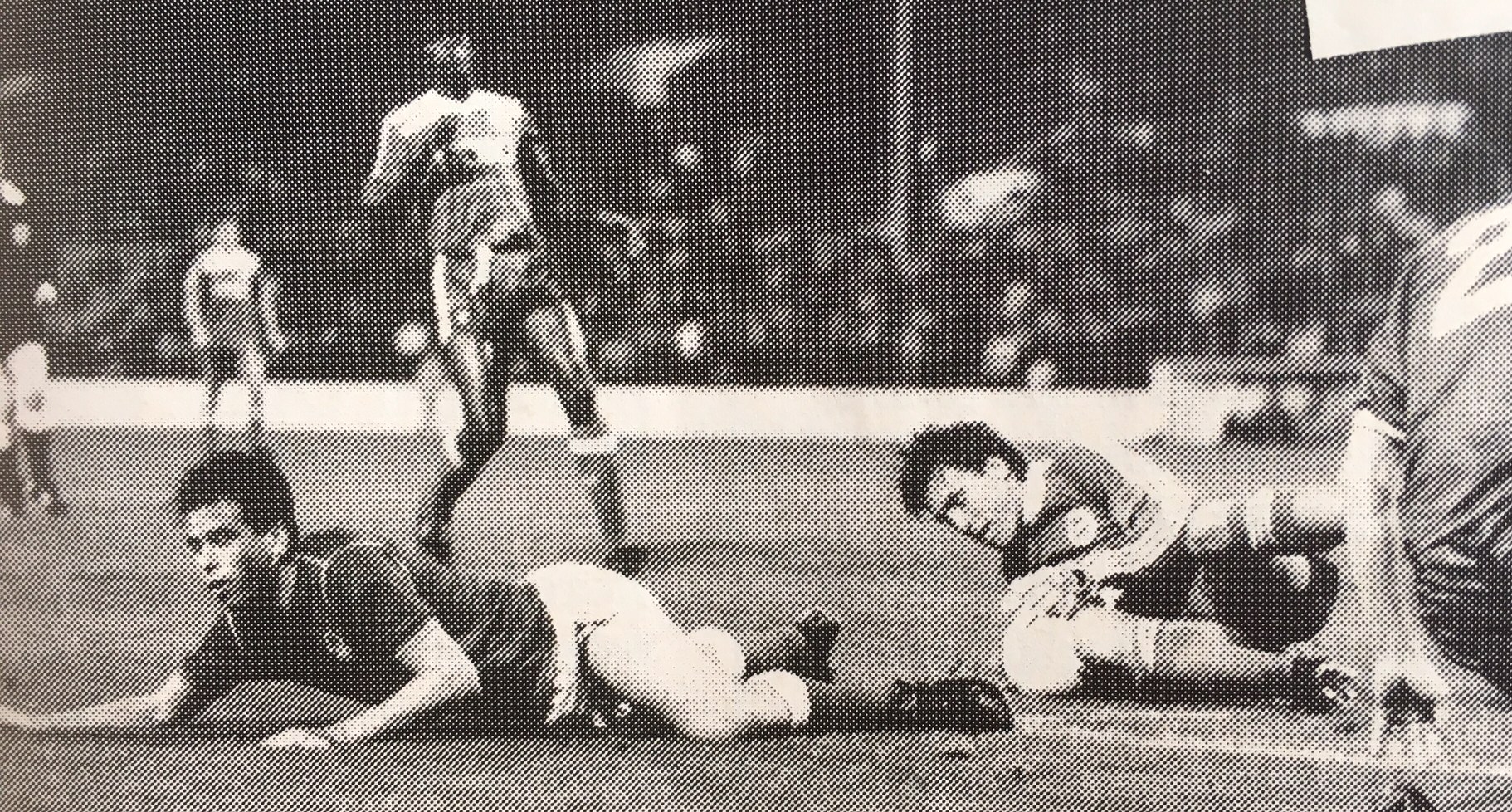
After being left out of Arsenal’s FA Cup Final sides in both 1979 and 1980 he finally got to step out onto the hallowed turf twice in the space of five days in 1983.

And his appearance in Brighton’s 3-1 defeat to Notts County in the 1991 play-off final at the famous old stadium was also his last in an Albion shirt after 10 years at the club.

In Match Weekly’s 1983 Cup Final preview edition, Gatting revealed his heartache at missing out with Arsenal in 1979. “I expected to be at least substitute after playing in five of the games leading up to Wembley, including the semi-final,” he said. “I was desperately sick when I didn’t get a chance. Although I really wanted the lads to do well, I couldn’t help feeling pangs of regret as the cup was paraded around the ground.”

Born on 29 May 1959 in Park Royal, London, two years after his famous brother Mike, the former Middlesex and England cricket captain, Steve was no mean batsman himself.

Instead of joining the ground staff at Middlesex County Cricket Club, though, Gatting shone at football with Middlesex and London Schoolboys teams and became an associate schoolboy with Arsenal before joining as an apprentice in July 1975. Terry Neill signed him as a professional at the age of 17 and a year later he made his First Division debut against Southampton at Highbury.

Gatting made 76 appearances for Arsenal over three seasons, his most memorable being the 1979 FA Cup semi-final against Wolves at Villa Park. He said his biggest disappointment was missing out on the May 1980 European Cup Winners Cup Final against Valencia in Brussels.

In his youth career, Gatting played in the centre of the back four but Arsenal generally played him in midfield, where competition for places was fierce with the likes of Liam Brady and Graham Rix. He admitted after joining Brighton: “When they bought Brian Talbot from Ipswich, I sensed I was on my way out.”

It was rumoured Albion would take Gatting as part of a swap deal that would see Mark Lawrenson join Arsenal but, of course, Lawrenson went to Liverpool instead. Albion were still interested in Gatting, though, and in September 1981 new manager Mike Bailey met him and his displaced colleague Sammy Nelson at Gatwick Airport and agreed terms to buy the pair of them; £200,000 the fee for the young Gatting.

Albion offered Gatting the chance of regular first team football and, although the expectation was for him to occupy a midfield spot, he quickly stepped in alongside Steve Foster in the back four and completed 45 appearances that season.

Aside from a rare couple of spells back in midfield, he remained a defender for the rest of his career, often slotting in at left back – apart from when he played right-back in the Cup Final replay.

Gatting had a terrific game alongside Gary Stevens in the 2-2 drawn first game against Man United, but Jimmy Melia unwisely chose to play the left-footed Gatting in place of injured Chris Ramsey (he should have put Stevens there) and the back line was noticeably unbalanced as they went down 4-0.

The Paul Camillin / Stewart Weir book Albion The first 100 years said: “Played out of position at right-back in the replay, he endured an uncomfortable evening in an unfamiliar role.”

Even so, interviewed three years later in the Albion matchday programme, Gatting spoke fondly about his memories of the whole occasion.

“The helicopter flight to Wembley was a new experience. We flew over the stadium and saw all our fans below,” he said. “That was a great moment. We landed and drove to the ground and went straight out onto the pitch to get a taste of the atmosphere. I met my brother Mike out there and to be honest he was more nervous than me!

“The greatest part of the whole day was walking out of the tunnel and seeing all the fans and being deafened by the cheering. That is an ambition every footballer has, to play in the Cup Final at Wembley. It was a dream come true for us and I think it lifted our game.”

Gatting had made only eight first team appearances in the 1984-85 season before, in November 1984, he sustained a serious pelvic injury which threatened his career. After five months, it was decided the only solution was a bone graft to the pelvis.

He had to remain motionless in hospital for a month and then rest on his couch when he was allowed home.

His wife Joy told Tony Norman in March 1986: “I felt sorry for Steve. He’s usually such an active person but suddenly he just had to sit there. It must have been very difficult. But Steve never got into self-pity. He stayed very positive and I respected him for that.”

Norman reported: “It was a long hard road for Steve. He started taking long walks in July, to build up strength and that progressed into jogging, light training and finally full training. He made his comeback game in the Reserves on 26 October.

Gatting told the interviewer: “When you are playing regularly, you tend to take things for granted. But when something like a serious injury comes along, it makes you realise how lucky you are to be fit and playing the game you enjoy so much. When you’re sitting on the sidelines week in week out it brings it home to you.”

The injury restricted him to only 17 appearances in the 1985-86 season but he was restored fully to the side in 1986-87 when financial issues clouded Alan Mullery’s return to the manager’s chair and successor Barry Lloyd couldn’t stop the inexorable slide to relegation from the second tier.

In a League Cup game replay away against First Division leaders Nottingham Forest, Gatting had to take over in goal when Perry Digweed  was forced off with a broken cheekbone. Gatting completed 45 appearances that season and said: “Dropping into the Third Division was far worse than going out of the First.

'keeper Gatt - webb on ground

Makeshift ‘keeper Gatting claims the ball with Nottingham Forest’s Neil Webb grounded

“All the players at the time felt they were good enough to stay up, but it didn’t happen and we gave a lot of silly goals away.

“The whole club was unsettled, too, but things became better again. Getting back into the Second Division was a boost for everybody.”

Gatting was ever-present in the 1987-88 promotion-winning campaign, even though in July 1987 Lloyd had given him a free transfer! The defender had other ideas and managed to play his way back into contention to such an extent that he ended up the season as captain, taking over from Doug Rougvie.

“It was nice to know I was wanted, particularly after relegation the year before,” he said.

Having made his 200th league appearance for the Albion against Chester on 12 December 1987, it was no surprise he viewed with some relish a FA Cup tie against his old club.

“Quite honestly, as a Third Division club, we don’t expect to go all the way, but I think we have the ability to scrape a result against Arsenal,” he said. “It gives me the opportunity to renew old friendships with Kenny Sansom, David O’Leary, Graham Rix and Paul Davis who were all members of the Arsenal staff when I was there.”

Albion pushed the Gunners all the way in front of a packed house and Garry Nelson rifled a memorable goal, but Arsenal prevailed 2-1.

Evening Argus Albion reporter John Vinicombe profiled Gatting warmly in a piece produced for a pre-season supplement ahead of the 1989-90 season, headlined “ice-cool Gatt”.

He described Gatting as “surely one of the most laid-back of individuals, whose natural personality is quiet and reserved”.

The report continued: “He shuns being the centre of attention, but the fact that he stays cool, even in nerve-wracking situations, is an important consideration when assessing leadership qualities.

“Leadership runs in the family, and many would say that older brother Mike was unlucky to lose the captaincy of England’s cricket team.”

On another occasion, Gatting said of his brother: “I’m proud of what Mike has achieved and I keep up to date with the latest news and enjoy watching the highlights on TV.

“We are close, we always have been, but the funny thing is I hardly ever go to see Mike play. When I do go, he never seems to make runs. So I think it’s best to stay at home and watch the Tests on TV.”

As mentioned previously, Steve was a good batsman in his own right and played for Middlesex Second XI. In Sussex, he enjoyed a summer tour with Brighton Brunswick as well as making runs for Preston Nomads.

Vincombe wrote: “Gatting occupies a special niche in the affections of Albion regulars. They see in him a thoroughly decent and well-behaved person whose standards on and off the field are high. Albion have been good to him and Gatting, after not a few periods of uncertainty, has been good for Albion.”

Gatting for his part said: “I’ve seen a lot of changes since arriving here, and I’ve played under five managers who have all had different ideas.”

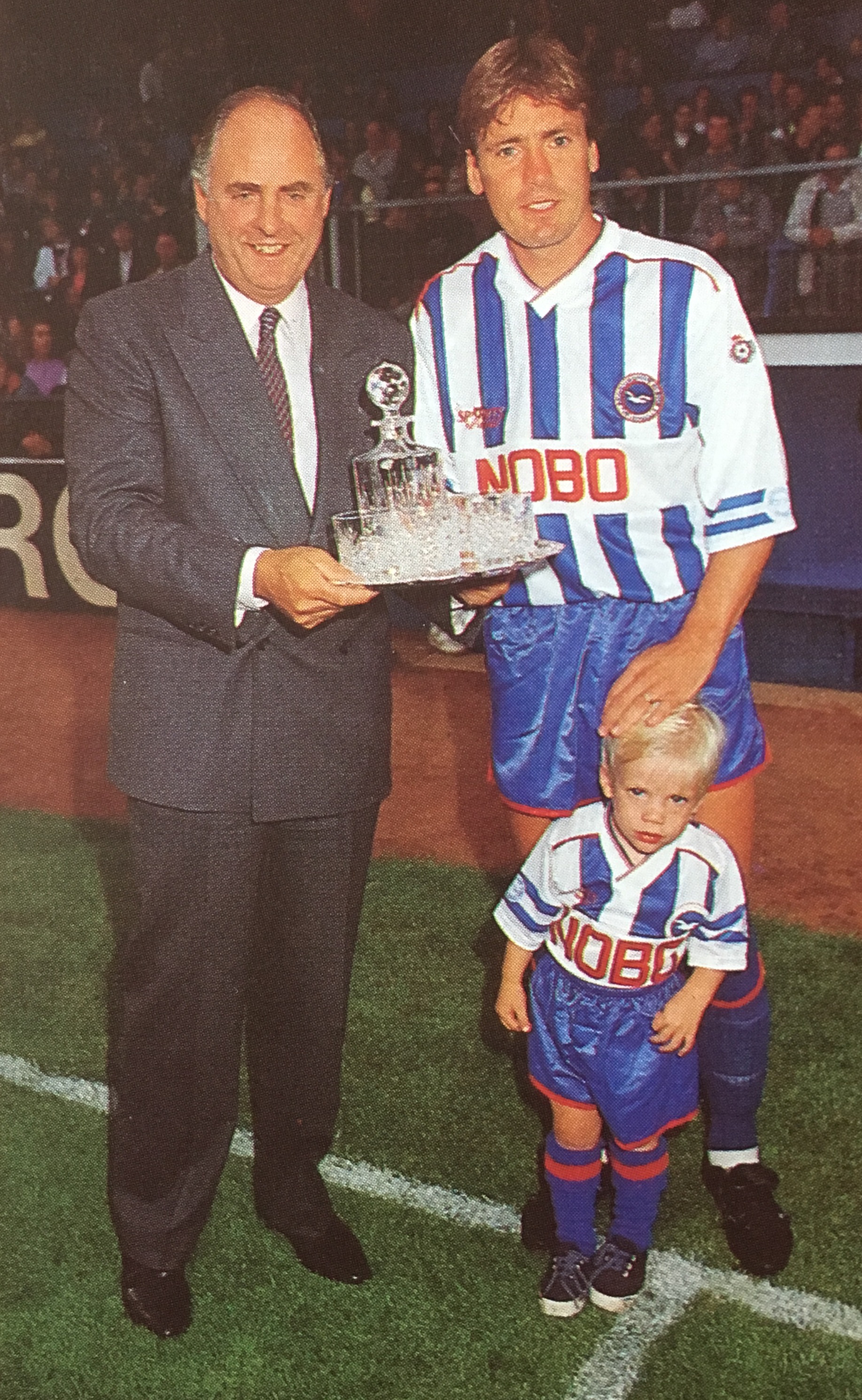
testimonialA cut glass decanter and glasses from chairman Dudley Sizen at Gatting’s testimonial

He was granted a testimonial for his long service and a curtain-raiser to his 10th season with the club saw Albion draw 2-2 with Arsenal in front of a crowd of 5,517. The Gunners included their recent big money signings David Seaman, Andy Linighan and Anders Limpar.

Injury niggles continued to plague him towards the end of his 10 years at the club but he worked his way back into the side in 1990-91, slotting in at left-back and culminating in that 1991 play-off final against Notts County at Wembley.

Long after all the other members of the Brighton 1983 Cup Final side had departed, Gatting was still pulling on the stripes, and, but for those injuries, he would surely have made many more appearances than the 366 + three as sub (21 goals) that stand as his record.

Given another free transfer in 1991, he departed for Second Division Charlton Athletic along with Garry Nelson, linking up with former Albion teammate Alan Curbishley who at the time was joint manager with Steve Gritt.

Charlton only narrowly missed out on a play-off place while Albion were relegated!

By the end of the following season, when Gatting retired, he had played a total of 64 games for the Addicks.

He then turned his attention to coaching and spent seven years at independent school Christ’s Hospital, Horsham, before returning to Arsenal in 2007 to work as an academy coach. Gatting was working as Arsenal’s under-23s coach until May 2018 when he and his assistant Carl Laraman were suspended after accusations of bullying were made against them, and neither returned to their roles.

Gatting subsequently joined League Two Stevenage as assistant coach under Dino Maamria just before Christmas 2018 but he left the Hertfordshire club shortly before the end of the 2018-19 season.

• There have not been many father-son combos during my time watching Albion (Gerry and Darragh Ryan were the first that spring to mind) but it must have given Steve great pride to see his son Joe make it through the youth ranks at Brighton and go on to play for the first team. He made 44 appearances and I recall an away game at Carrow Road when Steve and Uncle Mike were both watching the youngster in Albion’s forward line. Eventually, after he left the Seagulls in 2008, he turned to cricket and was good enough to play at county level for Sussex and Hampshire.

Twelve goals in 26 games for Scottish striker Alan Young

GARY LINEKER’S former strike partner at Leicester City had a good goals to appearances ratio for Brighton & Hove Albion.

Sadly, Scotsman Alan Young only managed 26 appearances in his one season (1983-84) with the Albion, although his 12 goals meant he finished second top goalscorer behind Terry Connor.

His brief Brighton career got off to a great start with a memorable debut goal, an overhead kick to net against Chelsea at the Goldstone. Young twice scored braces for the Seagulls but his season was injury-hit and, with manager Chris Cattlin bringing in his old pal Frank Worthington for the 1984-85 season, Young was sold to Notts County.

In more recent times, Young courted controversy as a radio pundit sharing his opinions about Leicester, and in 2014 BBC Radio Leicester dropped him from his role supporting commentator Ian Stringer.

alanyoung6 2

Back in September 2013, Young was berated online for his criticism of winger Anthony Knockaert. Foxello, on ja606.co.uk, wrote: “If there’s one thing that annoys me more than just about anything else at this football club, it is that grumpy, nasty egotist Alan Young and his never-ending agenda against certain members of the football club.”

The correspondent bemoaned: “Knocky is now the butt of every joke, and the object of every jibe Young throws out…. It’s almost as if he doesn’t want us to have skilful players who occasionally misplace a pass due to their advanced vision, and just have hoofers and cloggers like in his day.”

So let’s take a look back at ‘his day’. Born in Kirkcaldy on 26 October 1955, Young was football-daft and showed sufficient promise to earn Scottish schoolboy international honours.

His boyhood favourite team was Raith Rovers, whose star player at the time was Ian Porterfield, who famously scored the winning goal when Second Division Sunderland beat Leeds in the 1973 FA Cup Final.

Surprisingly overlooked by Scottish professional clubs, Young also experienced early disappointment in England when Nottingham Forest rejected him. “Nottingham Forert didn’t want me and I left there thinking I was no good,” he told Shoot! magazine.

Nonetheless, when he was playing as an unattached player for Scotland Schoolboys against England at Old Trafford, Oldham Athletic scout Colin McDonald, a former Burnley and England international goalkeeper, noted his promise and persuaded the young forward to head south of the border to begin his professional career.

In five years at Boundary Park he scored 30 goals in 122 games, and, to a large extent, learned his trade from old pro Andy Lochhead, a prolific goalscorer in his day for Burnley, Leicester and Aston Villa.

In the 1978-79 season, Young netted a hat-trick against Leicester which caught the eye of fellow Scot and former Rangers boss, Jock Wallace, who had taken over at Filbert Street and was building a team with his fellow countrymen at its core.

When Young joined Leicester, and played alongside his boyhood pal Martin Henderson, it began a love affair with Leicester that endures to this day.

In three years at Leicester, Young scored 26 times in 104 games, eventually forming a partnership with the emerging Lineker. TV’s favourite football frontman was generous enough to pen the foreword to Young’s 2013 autobiography, Youn9y (written in conjunction with Simon Kimber and published by the historypress.co.uk) and said of him: “He was an old-fashioned, aggressive centre forward. He possessed, though, a delicate touch and finesse that belied his big target man status – the perfect partner for a nippy little goalhanger trying to make a name for himself.”

Screenshot
Leicester strike partner for Gary Lineker

Young scored on his full debut for City in a league cup game v Rotherham and followed it up with two on his league debut at home to Watford.

The only time Young was sent off while playing for Leicester was, ironically, at the Goldstone Ground in 1981, at Easter, which was the second of four games at the end of the season that Albion won to stay in the top division.

Young was dismissed for two bookable offences, the first for clattering into goalkeeper Graham Moseley and the other a clash with Steve Foster, although, in his autobiography, he says Foster play-acted a knee injury, which the referee bought. Foster even teased him about it when he joined the Seagulls two years later. In that Easter 1981 fixture, Young’s teammate Kevin McDonald was also sent off, Brighton won 2-1 – and Leicester ended up being relegated together with Norwich and bottom-placed Crystal Palace.

Back in the old Second Division, Young did his cartilage in a game on QPR’s plastic pitch which he says was the beginning of the end of his career, because his knee was never the same afterwards (years later he had a knee replacement).

He also had the disappointment of losing to Spurs in the 1982 FA Cup semi final, although he maintains if a certain Chris Hughton had been sent off for two fouls on Lineker, it might all have been a different story.

Before the next season kicked off, Jock Wallace, the manager he idolised, decided to move back to Scotland to manage Motherwell and his successor at Filbert Street, Gordon Milne, swiftly chose to pair the emerging Alan Smith up front with Lineker, signalling the exit for Young.

Managerial upheaval was to become a familiar cause of Young’s departures in the years that followed, too. But I am getting ahead of myself.

Ian Porterfield, his footballing hero from yesteryear, had taken over as manager at Fourth Division Sheffield United and, although he didn’t really want to drop down the leagues, the Blades were a big club so Young moved to Bramall Lane.

A year later, though, after Brighton’s relegation from the elite in 1983, striker Michael Robinson was sold to Liverpool so there was a centre forward vacancy – and manager Jimmy Melia chose Young to fill it.

The fee was either £140,000 or £150,000 depending on which account you believe, but Young was happy because he pocketed a £20,000 signing on fee (four times what he had received only a year earlier when moving to Sheffield).

His first involvement with the squad was on a close-season tour of the Balearic Islands (with associated eye-opening tales recalled by thegoldstonewrap.com) but he also picked up an injury that was to dog his season on the south coast.

While Young had a lot of time for Melia, when Cattlin took over it was a different story and, in his book, there are plenty of colourful expletives used to describe exactly what he thought! He also castigates physio Mike Yaxley – “the most useless physio I have ever worked with” – although he says the team spirit was very good…seemingly fuelled by long post-training ‘sessions’ in Woody’s wine bar.

A youngHe said: “The football was very enjoyable there and never more so than when Jimmy Case and I were playing together; I loved playing with Jimmy.”

For a short time in that 1983-84 season, Albion had three Youngs in their squad, none of whom were related. Along with Young the forward, there were centre backs Eric Young and on-loan Willie Young.

When Cattlin decided to bring in his old Huddersfield teammate Worthington the following season, Young was on his way, this time to Notts County. The manager who signed him was the former Liverpool and Nottingham Forest defender Larry Lloyd, but his tenure in the managerial chair was very short so, once again, Young found himself playing for a manager who hadn’t chosen him.

In two years at Meadow Lane, Young scored 12 in 43 games for County. He moved on to Rochdale where the Leeds legend Eddie Gray was in charge, but injury took its toll and he only scored twice in 28 games in the 1986-87 season before retiring at 31. He had scored a career total of 89 goals in 349 appearances.

While there were a few non-league appearances, he eventually landed a job back at Notts County in the early days of community football schemes. He made a success of the job, obtained his coaching qualifications and eventually they combined the community scheme with the centre of excellence.

Brighton fans will be interested to know that among the young lads who emerged during Young’s time there were Will Hoskins and Leon Best. The star player, though, was Jermaine Pennant.

Young has fond memories of Neil Warnock’s time as County manager, because of his interest in the work being done at grassroots level. However, the mood changed when Sam Allardyce took over.

Allardyce initially cut Young’s salary and then showed him the door. “I can’t and I never will forgive Sam Allardyce,” he said.

Away from football, Young has had a tempestuous love life – read the book to gather the detail – and has three sons and a daughter. While he also had spells working for Chesterfield and Leeds, he dropped out of the game and then had a very dark period dominated by heavy drinking in isolation, including a time living alone in a caravan on the banks of Loch Lomond.

Eventually a return to England and his break into radio punditry brought him back from the brink.

In 2013, his autobiography Youn9y was published, the sleeve notes describing the story of “a talented, brave striker who played at the highest level of the domestic game but also experienced human misery at its lowest once his playing career was over”.

The notes add: “Youngy doesn’t just recount the good times of his playing career; he also offers valuable insight and moments of perception and understanding of some of the darkest days of his life.”

After four years as match summariser, in 2014 BBC Radio Leicester dispensed with his services and replaced him with another former Fox, Gerry Taggart.

However, Young still gives his opinions about Leicester on the community radio station Hermitage FM.

Pictures show a shot of Alan on Brighton seafront from an Albion matchday programme; the front cover of his autobiography; other matchday programme action shots, and in the Hermitage FM radio studio from Twitter.

Winger Mark Barham was no stranger to Wembley

1 Barham progBRIGHTON’S wingers in the 1991 Division Two play-off final had previously been on opposing sides in a Wembley final.

Mark Barham was a winner with Norwich City as they beat Sunderland 1-0 in the 1985 League Cup Final and Clive Walker missed a penalty for the Wearsiders.

Six years on, Barham had levelled for Albion in the first leg of the semi-final at home to Millwall (more of which later) and Walker got the third when the Seagulls upturned the form book and beat Bruce Rioch’s side 4-1.

The 6-2 aggregate victory pitched the Albion against Neil Warnock’s Notts County under the shadow of the famous Twin Towers of Wembley.

Walker saw a Wembley post prevent him from scoring as Brighton’s dream of promotion was ended in a 3-1 defeat.

Folkestone-born Barham joined the Seagulls on a two-year contract after an initial trial and made his debut as a substitute for Kevin Bremner in a 1-0 home defeat to Oxford United on 30 December 1989.

He got his first start two days later in a 3-0 defeat at West Brom, who he’d played for briefly under ex-Ipswich and Arsenal midfielder Brian Talbot earlier that season.

On the second Saturday of the new decade he scored his first Albion goal in a 1-1 draw at home to Barnsley and had played 18 games by the end of the season.

Young John Robinson was beginning to get first team opportunities but Barham managed 42 appearances in 1990-91, culminating in that Wembley appearance against Notts County, although he was subbed off on 10 occasions.

That play-off first leg game against Millwall was Lloyd’s selection in Paul Camillin’s 2009 Match of My Life book (www.knowthescorebooks.com). He said: “Perry Digweed put in one of his incredibly long punts and the ball was about to bounce on the edge of the Millwall box when the centre half (David) Thompson ducked under it, I think intending to allow it to bounce through to Brian Horne in the visitors’ goal.

“But as he took his eye off the ball he also turned his back and the ball actually landed on the back of his head and squirted off right into Mark’s path. The little winger raced in and cracked the ball into the bottom corner. It really was a vital goal so close to the interval and the fans knew it.”

The goal also gave Barham much personal pleasure because he’d not seen eye-to-eye with Millwall boss Rioch when he’d been his manager at Middlesbrough.

With Robinson winning the shirt more frequently in the disastrous relegation season of 1991-92, Barham managed 25 appearances plus two as a sub but he was released at the end of the season and moved on to Shrewsbury Town.

Born on 12 July 1962, Barham’s football career began when he joined Norwich as an apprentice in 1978.

He was part of the City youth team that won the South East Counties League in 1979-80 and in the same season, at the tender age of just 17, manager John Bond gave him his first team debut. No fairytale start, though, as City lost 5-0 to Manchester United at Old Trafford.

However, he went on to make himself a regular in the City first team, making 213 appearances and scoring 25 goals for the Canaries.

Screenshot
Barham in action for England v Australia

He also won two full England caps on the 1983 tour of Australia in a side captained by Peter Shilton and also featuring Trevor Francis and Terry Butcher. Barham spoke warmly of Bond when he died in 2012 telling the local pinkun:

“When I first came up from Folkestone I had what you might call long hair. The first time he played me in a five-a-side in training he told me ‘I’m letting you play this one but if you don’t go out and get your hair cut you won’t be playing another one’.”

Barham continued: “He was my first manager, he gave me my debut at 17 and I went on to play for England so he must have done something right.

“He loved wingers but you had to adhere to certain rules. You had to play wide with your foot on the line, it was your responsibility to score goals, get crosses in and defend at the same time.”

A knee injury suffered in a match against Spurs was a major blow to Barham’s career. He ruptured cruciate ligaments in his left knee and he ended up in plaster for 14 months.

Although he remained at Carrow Road for four more seasons, Dale Gordon and Ruel Fox emerged as challengers for his place and eventually, in July 1987, Barham moved on to Huddersfield Town.

It was there that he teamed up with former Albion full back Chris Hutchings who spoke favourably about his time on the south coast with the Seagulls. Barham only played 27 games for the Terriers and, with former England striker Malcolm MacDonald replacing Steve Smith as manager, found himself released on a free transfer in 1988.

He joined Middlesbrough on an 18-month contract but as Rioch’s Middlesbrough were relegated he only played four games in eight months and was on the move again, ending up at non-league Hythe Town.

Determined he still had what it took to hold down a league career, Barham wrote to all 92 clubs. He joined Division Two West Brom and played four times for them but they didn’t keep him on.

Barham tight crop“I knew I hadn’t suddenly become a bad player and that I could succeed again,” Barham told the Albion matchday programme in March 1990. “So I wrote to all the clubs again and that’s when Barry (Lloyd) contacted me. His was only one of six replies.

“Since being here I’ve found that all Hutch said about the club and the area was right and now I want to prove myself, show that managers were wrong to ignore me and enjoy my time in Brighton in the hope that my two-year contract will be extended.”

After the disappointments elsewhere, Barham certainly got his career going again at Brighton.

He scored once in eight matches for the Shrews but his career was on the wane in 1992-93 and he had short spells in Hong Kong and played non-league with the likes of Sittingbourne, Southwick and Fakenham Town, who he managed for 20 months from April 1996.

According to Mike Davage’s excellent article Canaries Flown From The Nest in the 1998-99 club handbook, Barham joined Mulbarton in February 1998.

At a Norwich centenary dinner in 2002, Barham told Davage he’d had more than 20 operations on his knee. By the time he was interviewed by Spencer Vignes for Albion’s matchday programme in 2015, he’d had 38 operations on it!

After retiring from the game he ran a toolhire business in Norwich and according to his LinkedIn profile he’s now a business development manager with facilities management company, Mitie.

2 Barham stripesBarham 1

  • Pictures show Barham in Albion’s NOBO kit, from the Wembley play-offs programme, a portrait from a matchday programme and in a team line-up wearing the dreadful pyjama kit.

Howard Wilkinson – aka ‘Sergeant Wilko’ – began coaching at Albion

wilko bhaYORKSHIREMAN Howard Wilkinson was a key part of the first Albion side I watched. The former Sheffield Wednesday player was a speedy winger in Freddie Goodwin’s 1969 team.

But away from The Goldstone, he had already been sowing the seeds of his future coaching and managerial success.

My father was a founder of local amateur side Shoreham United, a Brighton League team, and the future “Sergeant Wilko” (as the press liked to dub him) was brought in to do some expert coaching with United’s first team.

I well remember as a young boy sitting on the sidelines in Buckingham Park, Shoreham, watching him put the players through their paces with various routines.

I waited eagerly with my autograph book as Wilkinson shared the benefit of his skills and experience with the willing amateurs.

I was chuffed to bits when he rewarded my patience with his signature at the end of the session but who would have thought the man before me would go on to manage League Champions Leeds United as well as the England national team!

I’ve since discovered how Wilkinson had taken his preliminary coaching badge shortly after joining Brighton in the summer of 1966. Readers of the matchday programme were told how Wilkinson was one of six Albion players who were taking the badge at Whitehawk under former Brighton wing half Steve Burtenshaw, who’d turned to coaching that year after his Albion playing career had come to an end.

By the summer of 1968, Wilkinson had already taken his full FA coaching badge at Lilleshall when only 25, and, as well as Shoreham United, he was coaching youngsters at Fawcett Secondary School, Brighton Boys, Sussex University and the Sussex County XI.

Born in the Netherthorpe district of Sheffield on 13 November 1943, he earned early recognition for his footballing ability playing for Yorkshire Grammar Schools and England Grammar Schools.

Wilkinson earned five caps for England Youth in 1962. He scored on his debut in a 4-0 win over Wales at the County Ground, Swindon, on 17 March 1962 in a side that also featured future full England international Paul Madeley (Leeds United).

He also appeared in the UEFA Youth Tournament in Romania the following month when England were beaten 5-0 by Yugoslavia, 3-0 by the Netherlands and drew 0-0 with Bulgaria. The following month he was in the England side beaten 2-1 by Northern Ireland in Londonderry in the Amateur Youth Championship for the British Association.

Wilkinson played local football with Hallam when he started to attract attention and was initially on the books of Sheffield United but it was city rivals Wednesday who took him on as a professional. The manager at the time was Vic Buckingham, known as the pioneer of ‘total football’, the philosophy later adopted by his protege Johann Cruyff.  But it wasn’t until the 1964-65 season under Alan Brown that Wilkinson broke into the first team, making his debut on 9 September 1964.

“My football league debut was a tough one against Chelsea, who were then top of the league, at Stamford Bridge,” he said. “We forced a 1-1 draw and I quite enjoyed the match.” He also played the following Saturday in the return fixture when they lost 3-2 at home to Chelsea (Bert Murray scored two of Chelsea’s goals). Wilkinson made 12 appearances across the season as Wednesday finished sixth in the old First Division.

The following season he scored both Wednesday goals in a 4-2 defeat away to West Ham United on 16 October 1965 and on 8 January he was on the scoresheet in a home 2-1 defeat versus Leicester City, but he only made eight appearances all season, playing his last game for the Owls on 19 March 1966. He wasn’t part of the Wednesday team who lost 3-2 to Everton in the 1966 FA Cup Final.

Wilkinson left Hillsborough for the Albion a few days after England won the World Cup and scored on his debut in the opening match of the season as Brighton drew 2-2 at home to Swindon Town. He was on the mark again two games later getting Albion’s goal in a 1-1 draw at Reading. He was also a scorer in one of the few highlights of that first season, when third tier Brighton beat Jimmy Hill’s top tier Coventry City 3-1 in a League Cup replay.

The winger from Wednesday continued to earn rave reviews for his performances until suffering concussion and a fractured cheekbone during a match away to Middlesbrough. In the days when medicine still had a long way to go, Wilkinson was out of the side for ages.

“I seemed to be out for an eternity after that injury,” Wilkinson told journalist Spencer Vignes in a matchday programme article. “They didn’t have the technology back then that they do today to mend injuries like that. I had an operation, they reset it, and I was on fluids for ages. It wasn’t nice.”

I’m grateful to the excellent Albion retro blog, The Goldstone Wrap, for digging out a quote from Wilkinson’s 1992 book, Managing to Succeed, in which he revealed this nugget about life on the south coast:

“When I was a player at Brighton, under manager Archie Macaulay’s guidance, we had some remarkable preparations for important matches and cup-ties. There were liberal doses of sherry and raw eggs, calves foot jelly, fillet steak, and plenty of walks on the seafront where we were taken to fill our lungs with the ozone.”

In five years with Brighton, he made 130 appearances (plus 17 as a sub), scoring 19 goals. He always had an eye towards what would happen after his playing days, explaining: “It was during my last year at Brighton that I decided to try and do a teaching qualification combined with a degree, ready for when I finished playing.”

He moved on from the Albion at the end of Pat Saward’s first season, having made only 18 starts under the new Irish manager. Jim Smith had contacted him to ask if he would join him at Boston United as player-coach. “It turned out that I would be on just as much money as I was at Brighton, even though Boston were non-league, so I went.”

Wilkinson enrolled on a degree course in Physical Education at Sheffield University and over four years combined coaching and playing with being a student, a husband and a father. On top of that, he ended up as manager after Smith left. Boston won the Northern Premier League title four times in his six years at the club and people started to take notice.

The FA appointed him as their regional coach for the Sheffield area and by 1978 he was helping out Dave Sexton and Terry Venables with the England under-21s. In December 1979, he joined Notts County as a coach under Jimmy Sirrel, eventually taking over as team manager for the 1982-83 season when County were a top-tier side.

In June 1983, he returned to Wednesday as manager and, in his first season in charge, steered them to promotion from the second tier. He kept them among the elite for four seasons.

Undoubtedly the pinnacle of his career was guiding Leeds United to the League Championship in 1992. He moved to Elland Road in 1988 and built a decent side captained by the future Scotland manager Gordon Strachan.

They won the last of the old Football League Division One titles and, remarkably, to this day Wilkinson remains the last English manager to achieve that feat. Not surprisingly he was that season’s Manager of the Year.

United fanzine The Square Ball had only good things to say about the man in a 2011 article. “Howard Wilkinson gave Leeds three fantastic seasons of unforgettable glory in 1989/90, 1990/91 and 1991/92; and the Charity Shield at Wembley and the European glory nights against Stuttgart and Monaco stand with the best memories of Leeds’ modern era. More than that, he gave Leeds United back its sense of justifiable self-worth; no longer living in the past, no longer derided in playgrounds, Leeds were a proper football club again, fit for the modern era.”

Sacked by Leeds in 1996, he then began to move ‘upstairs’ so to speak and was appointed as the Football Association’s technical director as the forerunner to several executive-style appointments.

However, he twice found himself in temporary charge of the England national team, firstly after Glenn Hoddle was forced to resign.

He oversaw a 2-0 defeat to France in a friendly at Wembley before Kevin Keegan took the reigns. Twenty months later he stepped into the breach again when Keegan quit and took charge of a World Cup preliminary match in Helsinki, England drawing 0-0 against Finland.

After England, he had a brief unsuccessful spell at Sunderland, assisted by Steve Cotterill, and later was involved in and around the boardroom back at Hillsborough.

Wilkinson’s work as technical director of the FA between 1998 and 2002 has been hailed as having a major impact and influence on the domestic game, providing a blueprint for the subsequent building of the National Football Centre at St. George’s Park.

In the 2024 New Year Honours List, having just turned 80, Wilkinson was awarded an OBE for his services to football and charity, including ongoing work as chairman of the League Managers Association. LMA chief executive Richard Bevan OBE said: “Howard’s legacy in English football may be one of the most unheralded yet important in the modern game.

“Universally respected and loved by his colleagues and peers in the game, he has built an association of professional football managers, which is globally recognised as one of the most progressive organisations in world sport.

“As one of English football’s greatest thinkers, he has supported thousands of managers, coaches, players and administrators in the game to fulfil their potential and build impactful careers in football.

“He has achieved so much in his life, whilst retaining the values, humility and decorum that were instilled in him as a young coach, passing on these values to everyone he has worked with and for.”


Eire striker John Byrne’s three spells at the Albion

FOOTBALL things came in threes for striker John Byrne. He had three different spells playing up front for the Albion and he featured for three different clubs under manager Denis Smith.

Add to that, on three occasions, he was signed by clubs who he’d played well against. And, for QPR fans, he was also the third no.10 who got the crowd off their feet at Loftus Road, following in the footsteps of Rodney Marsh and Stan Bowles.

Ironically, it was former Albion boss Alan Mullery who took Byrne to Rangers, in 1984, during his six turbulent months as manager. Mullery took over from his former Spurs teammate Terry Venables, who’d left to manage Barcelona.

While Mullers’ reign at Loftus Road was brief, the skilful forward he brought in stayed four years and won plenty of admirers amongst the Hoops supporters.

Alongside former Albion striker Michael Robinson, he was part of the QPR team that lost to Oxford (a club he would play for later in his career) in the 1986 League Cup Final (QPR’s sub that day was Liam Rosenior’s dad, Leroy).

Wembley wasn’t to be a happy hunting ground for Byrne, though. That 1986 defeat was the first of three occasions he made it onto the iconic turf, each time ending up on the losing side.

Byrne’s career had begun with basement side York City at 16 after Mike Walker, a taxi driver pal of York’s boss, the former Manchester United manager Wilf McGuinness, spotted him playing local football in Manchester (he was born on 1 February 1961 and raised in Wythenshawe).

Charlie Wright, the former Bolton and Charlton goalkeeper took over as manager and gave Byrne his first pro contract but it was his successor, Denis Smith, the ex Stoke City stopper, who arrived in 1982, together with his coach, former striker Viv Busby, who set Byrne on the road to success.

He scored an impressive 55 goals in 175 appearances for York between 1979 and 1984 and his signing by Mullery for QPR came after he did well in a two-legged Milk Cup tie against the Hoops.

In an odd symmetry, his later move from QPR to Le Havre came after the sides had met in a friendly, and the pattern continued when his eventual move to Brighton came after they too had played Le Havre pre-season.

But back to London where, in his four years at Loftus Road, he scored 30 times in 126 appearances.

QPR fans recall fondly a game when Byrne scored twice in a 6-0 thrashing of Chelsea and, some years later, in an interview with QPRnet, he explained how the drubbing riled the Chelsea, and later Brighton, defender Doug Rougvie to the extent that Byrne and fellow striker Gary Bannister finished the game playing out wide to avoid getting a kicking!

He also scored a winner against Manchester United, the team he’d followed as a boy, and in an interview with Sussex Life in 2010, he said: “I felt a bit like a traitor!”

It was in the year following his move to QPR that he made his international debut for the Republic of Ireland – he qualified to play for them because his dad, Jim, was from County Carlow.

He was an international teammate of Chris Hughton and Mark Lawrenson and between 1985 and 1993 collected a total of 23 caps, scoring four goals, two of which came in a 3-1 win over Turkey.

JB Eire

Although part of Eire’s Euro 88 and 1990 World Cup squads, he didn’t play a game.

Byrne had three spells with Brighton but undoubtedly the most memorable was in the season that ended in heartbreak in the Wembley play-off final against Neil Warnock’s Notts County.

Manager Barry Lloyd had brought him back to the UK from Le Havre for £125,000, shortly after he had been to the World Cup in Italy with the Republic, and successfully partnered him up front with the prolific Mike Small.

Byrne admitted in a 2010 matchday programme interview how he thought he was joining Sunderland that summer but his agent Paul Stretford’s demands put off the Wearsiders and the striker ended up writing to all the English First and Second Division clubs looking for an alternative club.

Surprisingly, he didn’t get many replies, but Brighton did. “Barry Lloyd got in touch and the rest is history,” said Byrne.

It turned out Lloyd had long been an admirer. He wrote in the matchday programme: “I first tried to sign him two years ago, before he went to Le Havre. He was at QPR then and I was vying with Sunderland for his signature when he finally decided to broaden his footballing experience by moving to France.”

Lloyd revealed how he had consulted with Republic of Ireland boss Jack Charlton to check Byrne had lost none of his old skills and ambition. “He is an intelligent player who moves well across the line and I am sure he is looking on his move to us as an ideal opportunity to regain his place in the Republic’s squad for the European Championships in two years’ time,” said Lloyd.

Albion have had some decent striking partnerships over the years but not since Ward and Mellor in the Seventies had a pair captured the imagination in quite the same way as Byrne and Small. Between them they spearheaded Albion’s push for promotion to the elite.

J ByrneThe climax to the season was a classic case of ‘if onlys’ where ‘Budgie’ was concerned: if only he hadn’t been injured in that final game against Ipswich, he would have been fit to play from the start in the final.
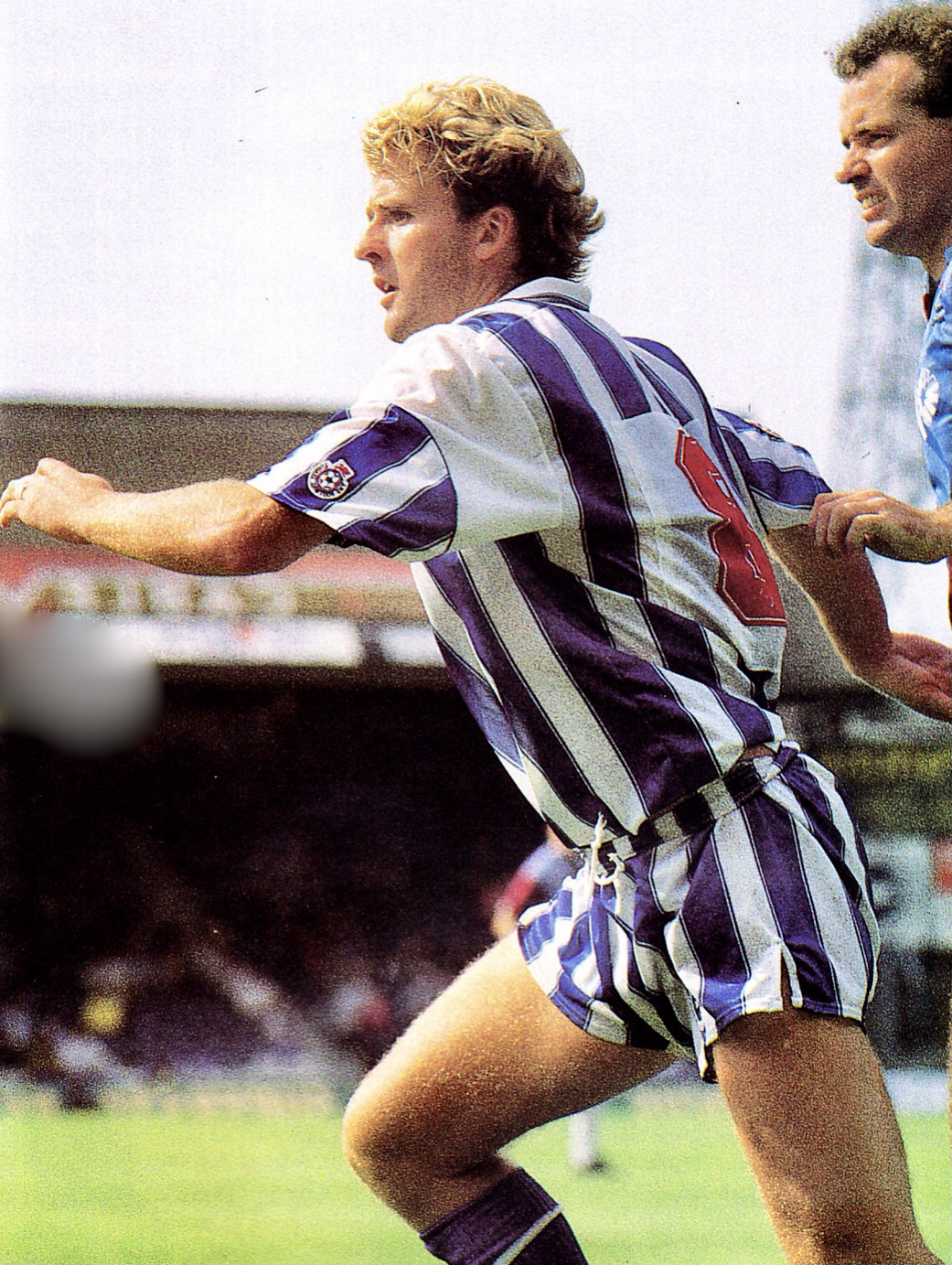
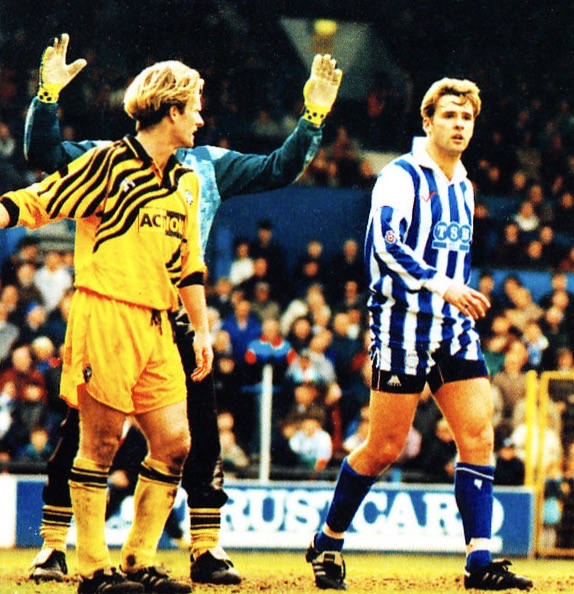
There again, if he hadn’t been fouled on the edge of the box, Albion wouldn’t have won the free kick from which Dean Wilkins scored to earn Albion the play-off spot!

With his right leg heavily strapped, Byrne appeared as a substitute in the final. When the Albion story came to an unhappy ending, and the expected financial boost of playing in the top division didn’t materialise, Lloyd had to cash in his prize assets: Small went to West Ham for £400,000 and Byrne was sold to Sunderland for twice what Brighton had paid for him.

Reflecting on Byrne’s impact, Lloyd told Albion’s matchday programme: “He was outstanding for us, he really was. His workrate was excellent.

“He could pass a ball, cross a ball and he knew where the back of the net was. We didn’t have a lot of money to spend but we got something special with him which very nearly got us into what is now the Premier League.”

Byrne famously scored in every round of the FA Cup as Sunderland marched to the final in 1992, and, almost as famously, missed a great chance from six yards as the Wearsiders lost to Liverpool.

After a season at Sunderland, Byrne moved to Millwall, where things didn’t work out for him, and in 1993 he returned to Brighton on loan for a brief seven-game spell in which he scored twice.

He then had two seasons at Oxford, when he scored 18 times in 55 appearances, before returning once more to the Albion to play 39 games in the 1995-96 season. He scored six times, but, it would be fair to say, he was a shadow of the player who graced that 1990-91 season.

Byrne didn’t let the grass grow under his feet when he packed up playing – he learned how to take care of other people’s by becoming a podiatrist.

Followers of the Albion also got to hear his dulcet Mancunian tones on the radio as a summariser on the local radio station’s coverage of Brighton games.Byrne close action

Byrne pictured in 2010