Ex-Blade Slade edged Albion to safety before the axe fell

RUSSELL SLADE had an eye for picking up footballing gems for nothing and he worked an unlikely miracle to spare relegation-bound Albion from the drop.

The one-time PE teacher who never played professional football himself was only Brighton manager for eight months but keeping them in League One in an end-of-season nailbiter was a much-lauded achievement.

He did it with some astute forays into the loan market and snapping up free agent Lloyd Owusu who made a crucial contribution to Albion’s injury-hit misfiring forward line.

Some years earlier, when youth team manager at Sheffield United, Slade famously picked up three young players – Phil Jagielka, Nick Montgomery and Michael Tonge – discarded by other clubs who went on to become Blades stalwarts.

At Brighton, his summer re-shaping of the squad he inherited put down the foundations on which his successor Gus Poyet was able to build a successful side capable of promotion.

In particular, Slade took great pride in bringing Andrew Crofts to the Albion on a free transfer from Gillingham, the club later selling him on to Norwich City for what was believed to be £300,000.

Slade signing Elliott Bennett, bought from Wolverhampton Wanderers for £200,000, was later sold to the Canaries for a fee believed to be £1.5million.

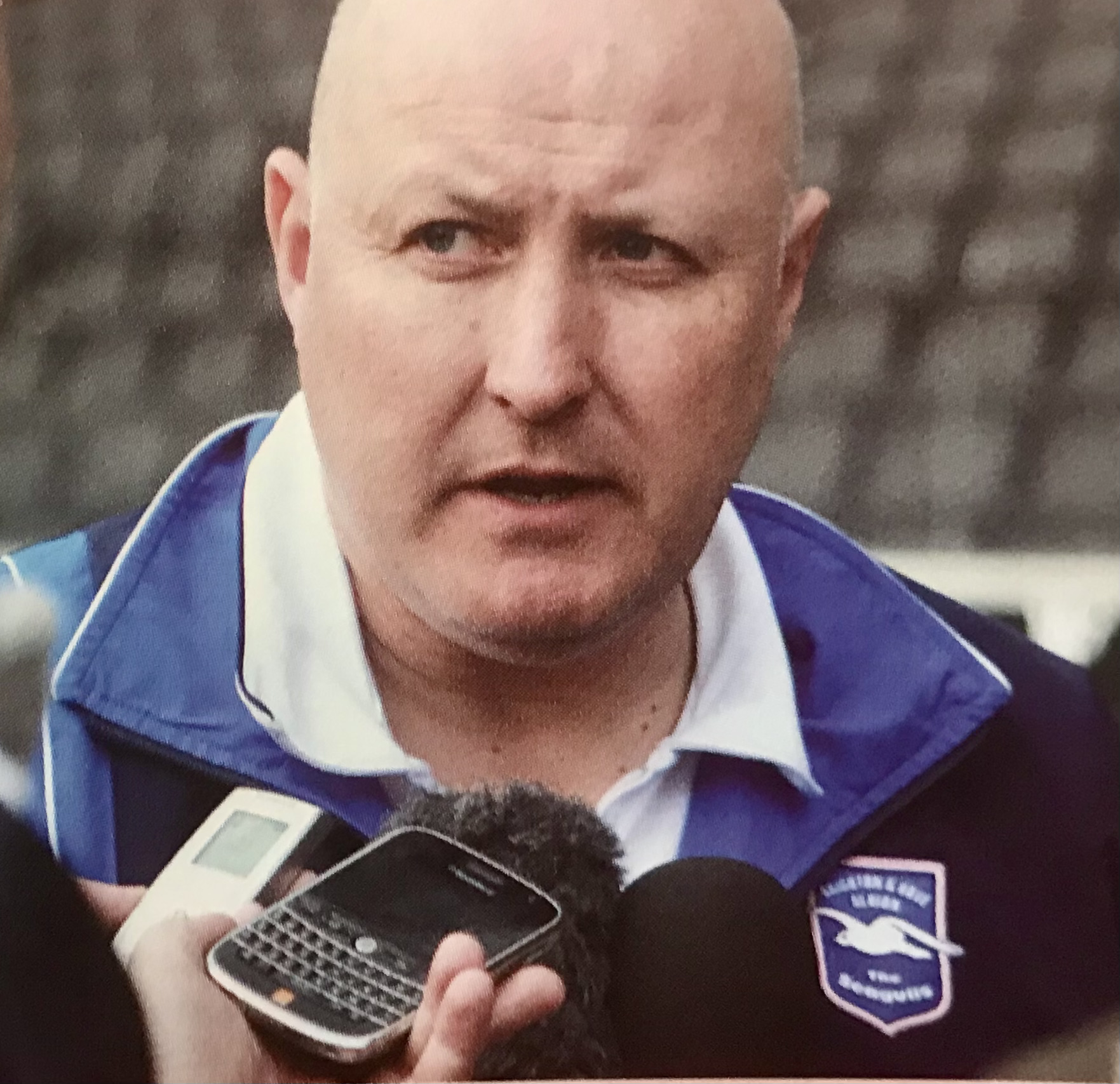
“The majority of my player signings went on to play crucial roles in this promotion season,” Slade asserts on his LinkedIn profile. “During my closed season I began what proved to be an extremely successful transitional period.”

If Slade had failed to keep Albion up at the end of that 2008-09 season, it is doubtful Poyet would have been drawn to the task of lifting the side through the leagues and possibly there would have been a longer wait to see Championship football at the Amex.

Slade’s tenure at the Albion may well have been longer if Tony Bloom hadn’t taken over control of the club from Dick Knight, who was chairman at the time Slade was brought in to replace Micky Adams.

Adams reckoned he was a victim of the power struggle between the two and it seems clear that Bloom wanted to install his own man once he was fully in the driving seat of the club.

Although Slade’s achievement in keeping Albion up was rewarded with a permanent two-year deal in the summer of 2009, the new season got off to a terrible start with no wins in the first six games, one of which saw Albion on the wrong end of a 7-1 thumping at Huddersfield.
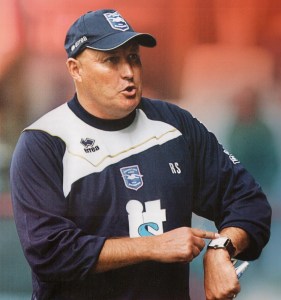
Time was up for Slade after rocky start to the season

With only three wins and three draws in the next 10 games, after a 3-3 home draw against Hartlepool at the end of October, Slade was sacked with the side only out of the relegation zone on goal difference.

Bloom said: “It is not a decision we have taken lightly and one taken with a heavy heart. Russell is a good man – which made it an even harder decision to take – but it is one which has been made in the club’s best interests.

“Like all Albion fans, I am extremely grateful for Russell’s achievements at the end of last season, as he kept us in League One against the odds.”

When he reflected on his tenure in the Albion book Match of My Life, Slade explained: “Despite the club’s perilous position, I felt it was a great opportunity. I signed on a short-term deal, with the incentive to keep the club in the division.

“I inherited a huge squad but it was decimated by injuries and many of the players were loan signings or youngsters, but, in spite of that, I still thought there was enough within the squad to keep Brighton up.”

With 14 games to save the club from the drop, the first two ended in defeats but when Slade’s previous employer Yeovil Town were thumped 5-0 at the Withdean, there was cause for optimism.

A 3-2 Withdean win for Swindon, for whom Gordon Greer and Billy Paynter scored, threatened Brighton’s survival but it turned out to be the only defeat in the last seven games.

Albion memorably lifted themselves out of the relegation zone three games from the end of the season when they won 2-1 at Bristol Rovers, long-serving Gary Hart teeing up goals for Owusu and Palace loanee Calvin Andrew. Both players were also on target to earn a point in a 2-2 draw at Huddersfield.

After safety was secured in the last game of the season courtesy of barely-fit substitute Nicky Forster’s goal against Stockport, fans invaded the pitch and Slade was carried shoulder high by the Albion faithful.

“My hat got nicked and my head scratched, but it didn’t really matter,” he said. “When I finally got back to the office, I sat there with Bob Booker and Dean White and was absolutely exhausted – both emotionally and physically.”

Born in Wokingham on 10 October 1960, Slade’s route into professional football didn’t follow the traditional path.

“At 18 I had a chance to go to Notts County but I got into university so I went away to get a degree in sport instead,” he said. After completing his degree over four years at Edge Hill University in Ormskirk, Lancashire, he became a PE teacher at Frank Wheldon Comprehensive School in Nottingham (it later became Carlton Academy).

“My experiences helped me be more prepared and organised,” he explained. “I took numerous coaching courses and it allows you to be really open minded and dealing with different situations.

“I had qualifications to be a coach in swimming, athletics, badminton, basketball, cricket and tennis. It not only broadens your horizons but allows you to look at things in different ways.”

While he was qualifying as a teacher, he joined Notts County as a non-contract amateur player, appearing in their reserves and manager Neil Warnock appointed him an assistant youth coach under youth team head coach Mick Walker.

When Warnock was sacked in January 1993, County were bottom of football’s second tier (having been relegated from the top flight in the final season before the Premier League started), and Walker and Slade took charge of the first team, keeping them up with three points to spare.

The pair almost took County to the play-offs the following season, only missing out by three points, and also reached the final of the Anglo-Italian Cup, where they lost 1-0 to Brescia at Wembley.

After only one win at the start of the 1994-95 season, Walker was sacked in September and Slade took over as caretaker manager.

After managing only six wins and five draws in 23 matches, Slade reverted to assistant when ex-Everton boss Howard Kendall was appointed manager.

Kendall only lasted three months at Meadow Lane and Slade left the club at the same time but he later acknowledged how much he had learned from Kendall, Warnock and Jimmy Sirrel (an ex-Albion player who was a Notts County legend as manager and general manager).

“I’ve had a good upbringing,” he said. “The one for player management and for talking to players was Howard Kendall, without a doubt.

“He was terrific – had something about him. He had that X factor and you would listen to Howard – and when he coached you took it on board as well.”

Slade told walesonline.co.uk: “Working with Howard was massive because of his man management and his ability to give a football club direction.

“Neil was the big motivator out of all the coaches and managers I have worked with over the years.

“He took County into the top flight and his best work came at 10 minutes to three. He was exceptional, able to get every last drop of effort and energy from his team.”

Slade dropped into non-league football as manager of Southern League Midland Division Armitage but when they finished bottom of the division and then went into liquidation, Slade followed the chairman Sid Osborn to his new club, Leicester United.

That side finished 16th in the Southern League Midland Division, but they too went out of business in August 1996.

Kendall, in charge of Sheffield United, recruited Slade as youth team coach at Bramall Lane and even tried to take him with him when he returned to Everton in June 1997, but Blades demanded a compensation payment the Toffees weren’t prepared to pay.

Kendall said some while later: “I wanted Russell, who I knew from Notts County, to come and coach my kids. He was at Sheffield United at the time, and they didn’t want to lose him. He’s a talented coach who would have been a popular figure at Goodison.”

Slade remained in Sheffield and, in an interview with The Guardian in October 2013, recalled: “My best three spots were when I was at Sheffield United [in 1998].

“At the time I was doing a lot of work on released players because we needed to strengthen our youth squad and in one evening I took Phil Jagielka, Nick Montgomery and Michael Tonge – all for nothing.”

Montgomery made just short of 400 appearances for United and Tonge and Jagielka both played more than 300 games for the club. Jagielka became one of the best defenders in the top flight (at Everton) and won 40 England international caps.

“That was my best night’s work ever,” said Slade. “You don’t half get a buzz when you see those. When we played Everton in the [Capital One] Cup last season Phil gave me a signed shirt with ‘Thanks very much, Russ’ written on it.”

It was in March 1998 that Slade found himself in caretaker charge of the United first team after the departure of Nigel Spackman, overseeing a draw and a defeat, and he also stepped in for two games in November 1999 when Adrian Heath left the club, again overseeing a draw and a defeat before Warnock arrived at Bramall Lane.

It was at Scarborough where Slade landed his first full-time job as a league manager in his own right. During a three-year spell, he helped rescue the club from relegation, resigned when they went into administration but withdrew it when a fans petition urged him to stay.

A highlight was guiding the side on an excellent FA Cup run, when they memorably played Premier League Chelsea in a televised home tie. The Seadogs were only defeated 1-0 by a Chelsea side that included a young Alexis Nicolas in their line-up.

Next up for Slade was the first of two spells as manager of Grimsby Town. Supporters were calling for his head when they only managed a mid-table finish in the 2004-05 season, but an upturn the following season saw them flirt with automatic promotion and have a good run in the League Cup, beating Derby County and Tottenham.

Slade’s Mariners beat a Spurs side that included Jermaine Jenas, Michael Carrick, Robbie Keane and Jermaine Defoe 1-0. In the next round they went down 1-0 at home to a Newcastle United side managed by Graeme Souness, a goal from Alan Shearer sealing it for the visitors.

Grimsby slipped into the play-offs on the last day of the season and beat local rivals Lincoln City in the semi-finals to reach the play-off final at the Millennium Stadium.

But they missed out on promotion when Cheltenham Town edged the tie 1-0, and Slade was on his way.

He might not have reached League One with Grimsby but he was taken on by Yeovil Town on a three-year contract, declaring when appointed: “It is a fantastic opportunity for me as I think Yeovil are a very progressive club. They are going through a period of transition and I am really looking forward to the challenges that are ahead.”

Slade once again found himself a play-off final loser when the Glovers, captained by Nathan Jones, lost 2-0 to Blackpool in the 2007 League One end-of-season decider at Wembley.

It was a heartbreaking finish especially after Yeovil pulled off one of the most remarkable comebacks in the history of play-off football by coming from 2-0 down to beat Nottingham Forest 5-4 on aggregate in the semi-finals.

“Russell Slade’s side gained many plaudits for an impressive campaign in which they almost went up despite being one of the pre-season favourites for relegation,” said somersetlive.co.uk.

Small consolation for Slade was to receive the League One Manager of the Year award, but disappointment followed in 2007-08 when they won only four games in the second half of the season to leave them only four points clear of relegation.

When things didn’t improve in 2008-09, a frustrated Slade reportedly fell out with Yeovil  chairman John Fry over a lack of transfer funds and he left Huish Park by mutual consent in February 2009.

The vacancy at the Albion was almost tailor-made for Slade, and chairman Dick Knight admitted he had spoken with the aforementioned former Seagull, Nathan Jones, about the managerial candidate.

“I had a long chat with Nathan and he told me some good stuff,” Knight told the Argus. “It was a very honest appraisal and I took that into account.

“When I met with Russell initially he impressed me greatly. His CV speaks for itself and his confidence and tactical shrewdness were obvious when I interviewed him.

“He has delivered at this level. He has an extremely competent track record at clubs who have punched above their weight, like Grimsby and Yeovil.

“His players like him. He will convey confidence to our squad and give them a lift.”

Stockport chief Jim Gannon had turned down the job and former England international Paul Ince didn’t even want to hold talks.

“The quality of applications was tremendous, even up to the last minute, from the top of the top league in Romania to one from Portugal which was very interesting but not appropriate at this time,” said Knight.

“By handing the mantle to Russell at this stage, the club is in good hands to address the task right now of staying in League One. We have got a very good and capable man.”

The rest, as they say, is history and, to borrow another familiar phrase, it was a case of not keeping a good man down after his departure from the Seagulls.

It wasn’t long before Barry Hearn, the sports promoter owner of Leyton Orient, was hiring Slade to try to improve the fortunes of the East London minnows.
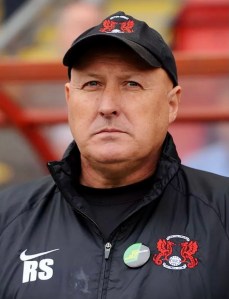
It turned out to be a great move because Orient was where Slade had his longest ever spell as a manager, presiding over 241 matches with a 42 per cent win ratio.

Amongst the players he recruited were two who had played under him at Brighton: Andrew Whing and Dean Cox. Ex-Seagull from another era, Alex Revell, also joined and a certain Harry Kane took his first steps into competitive football on loan from Spurs on Slade’s watch.

The manager’s trademark baseball cap that he could be seen wearing at each of the clubs he served even had its own sponsor at Orient. City of London tax advisory firm Westleton Drake put their logo on the headwear.

Slade repeated the magic touch he’d shown at Brighton to keep Orient in League One and in his first full season in charge took them to seventh place, only missing out on the play-offs by one place.

Along the way was a memorable fifth round FA Cup tie with Arsenal, forcing a 1-1 draw at home before succumbing 5-0 at the Emirates.

There was certainly no questioning Slade’s commitment to the Os’ cause, as Simon Johnson, writing for the Evening Standard on 23 September 2010, observed: “His wife Lisa and four children are living more than 200 miles away in Scarborough, meaning he is all alone most evenings to worry about the side’s plight.”

Slade lived in one of the flats next to the stadium and told Johnson: “Most people get the chance to get away from the office if they have a bad day, but I wouldn’t want it any other way.

“I come back from training and work in the office for a few hours and then go to my flat. I love my job and enjoy the fact my finger is on the pulse and I’m right on top of things.”

When Sheffield United sacked manager David Weir (later to become Albion’s director of football) in October 2013, there was speculation Slade might be in the running for the job, but the out of work Nigel Clough was appointed.

The following Spring, Slade once again found himself in charge of a team in the final of the League One play-offs. Although Orient drew 2-2 with Rotherham United, they missed their last two penalties in the shoot-out to decide the winner and once again he left Wembley disappointed. His only consolation was once again being named League One Manager of the Year.

Even though the club narrowly missed out on the step up to the Championship, Slade himself made it shortly into the new season. After a change of ownership at Orient, Slade resigned and was appointed manager at Cardiff City in October 2014, succeeding Ole Gunnar Solskjaer.

History records Slade’s reign being heavily hampered by a lack of finance and being forced to cut the wage bill significantly and cancelling the contracts of several highly paid players. There was even an embargo on new signings during his second season.

The Bluebirds finished mid-table in his first season and then missed out on the play-offs the following season, losing 3-0 at Sheffield Wednesday in the penultimate game of the season to dash hopes of a top six finish.

Slade was removed from his post to be replaced by his head coach Paul Trollope (later Albion assistant manager to Chris Hughton) but was retained as Head of Football.

Slade decided it wasn’t for him and switched to a more familiar dugout job at Charlton Athletic.

Given a three-year contract by unpopular owner Roland Duchatelet, Slade lasted just 16 matches before he was sacked, although a club statement said: “The club would like to thank Russell for his tireless work during his time at The Valley, particularly the processes and disciplines he has instilled at the training ground.”

He wasn’t out of work for long, though, because Coventry City, sitting 21st in League One and enduring their worst run of results for 43 years, appointed him.

On the wrong end of a 4-1 defeat at Bristol Rovers in his opening match, on Boxing Day, he oversaw just three wins in 16 games and was sacked on 5 March.

In circumstances similar to the atmosphere at The Valley, Sky Blues fans were in dispute with the club’s owners, and the Ricoh Stadium was empty week after week.

Surprisingly, he guided the club to a Checkatrade Trophy final – Coventry later won the competition in front of more than 40,000 of their supporters at Wembley – but by then Slade had been sacked, having equalled the record for the most games (nine) without a win for a City manager before winning at the tenth attempt.

Andy Turner, writing for the Coventry Evening Telegraph, pulled no punches when he said: “Russell Slade will go down in Coventry City history as arguably the worst manager to have taken charge of the club.”

Slade’s take on it was: “It was not a good decision for me to go there, I didn’t do my homework enough before going there.”

Once again, though, Slade was back in work just over a month later when he returned to one of his former clubs, Grimsby Town.

Succeeding Marcus Bignot, Slade took charge with Grimsby 14th in League Two and they won two and drew another of their remaining five matches to stay in that position by the season’s end.

After making an encouraging enough start to the 2017-18 season, the side’s form dipped badly over the festive period, and with no wins on the board the club sank like a stone towards a relegation battle. Slade was sacked after a run of 12 games without a win, including eight defeats.

There was no swift return to management after his Grimsby departure, though, and it was another 18 months before he next took charge of a side, National League North side Hereford United, with former Albion full-back Andrew Whing as his assistant.

Not long afterwards, though, Slade started up his own business, Global Sports Data and Technology, and his tenure with the Bulls lasted only five months, club chairman Andrew Graham saying: “Unfortunately the existing business commitments of Russell Slade do not meet with the current demands of this football club.” Hereford had recorded only one win in 18 games at the time.

The ever-resilient Slade was back in the game the following month when his former player, Alex Revell, appointed manager at Stevenage, invited him to join his staff as a managerial consultant.

Revell, who played under Slade at Orient and Cardiff, said: “I have always respected Russ and it will be a great boost to be able to use his experience around the training ground and on matchdays.”

Plenty of disgruntled fans from clubs where Slade had been less than successful took to social media to mock the appointment.

Nevertheless, Revell was certainly right about experience because Slade could reflect on a managerial career that saw him serve 11 different clubs, taking charge of 865 matches, winning 314, drawing 240 and losing 311.

In his new venture, Slade champions the cause of the way performance data information is handled, as described in a BBC news item in October 2021.

It focuses on companies who take data and process it without consent. “It’s making football – and all sports – aware of the implications and what needs to change,” he said.
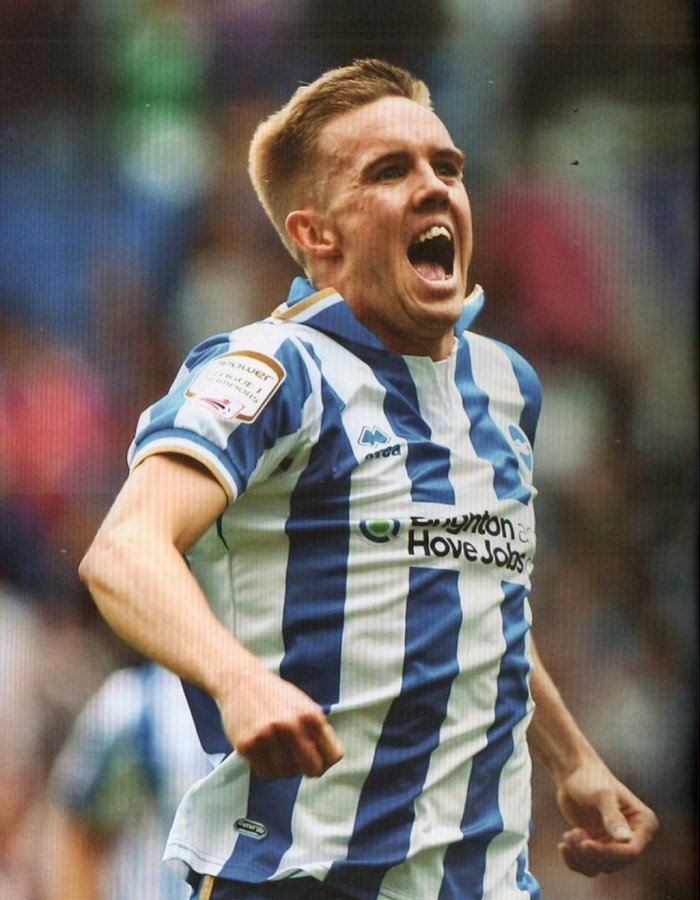
Craig Noone bounced back after Heighway heave-ho

PACY SCOUSE winger Craig Noone was a born entertainer who bounced back from early rejection by Liverpool to make it all the way to the Premier League.

Brighton in the Championship under Gus Poyet provided the former roofer with a platform to showcase his ability before Cardiff City gave him the opportunity to perform at the top level.

After he’d scored (below) and impressed in an away game at Manchester City, then newly-appointed Cardiff boss Ole Gunnar Solskjaer said: “Noone is a terrific little player.

“He causes defenders problems with his pace and his technique; he can go inside and outside. He’s got a good left foot, but he can cross it with his right.”

Born in Kirkby, Liverpool, on 17 November 1987, Noone was on Liverpool’s books between the ages of eight and 11.

“I was spotted playing for my Sunday team St Peter and Paul and I used to train at Melwood a couple of times a week – it was unbelievable,” he recalled. “We wore the cream and black training kit and I loved every minute. I was a big Steve McManaman fan, the way he ran at players, and would try to do the same.

“Unfortunately, when I got to 11, Steve Heighway called one night to say that I wasn’t good enough to stay on – I’ll never forget it.”

Noone would eventually get to play on the hallowed turf of Anfield, but not on behalf of the home side.

It was New Year’s Eve 2010 that he joined Brighton, making his debut four days later in a 2-1 win away to Exeter City, where he’d spent six weeks on loan the previous year.

Poyet had admired the winger’s attributes up against Inigo Calderon in one half and Marcos Painter in the second during the Seagulls’ 2-0 win at Plymouth three months earlier, Noone discovered from another Argyle player, Ashley Barnes, who’d scored against his old club that day.

“Barnesey later told me that the management thought I was a good player and had mentioned me a lot in the half-time team talk,” he said. “When Brighton made their interest official, I didn’t have to think twice. The manager, the team, the stadium…it ticked all the right boxes for me.”

The slightly built Noone swiftly endeared himself to the crowd with jinking runs at pace and it was perhaps inevitable that the fans would adapt for him the chant more widely associated with England and Manchester United star Wayne Rooney.

More a provider of chances for others than a goalscorer, ‘Nooney’ made 10 starts and 13 appearances off the bench as Poyet’s Seagulls romped to the League One championship title, getting his first goal in a home 2-0 win over Colchester United at the end of January, followed by one of Albion’s four in a convincing win over Hartlepool United on 12 February.

The highlight of the following season for Noone was Albion drawing Liverpool in cup games; not once, but twice. In the League Cup at the Amex, Noone put in a man-of-the-match performance as Albion narrowly lost 2-1 to the Reds.

Four years previously, Noone had been working on the roof of an extension at Steven Gerrard’s house, but in the post-match TV interview for Sky Sports he was stood alongside the Liverpool captain.

“It was his comeback match after injury and he gave me his shirt,” Noone told the Liverpool Echo. “To do the Sky interview alongside him afterwards was unbelievable for me. He said I deserved to be man of the match because I’d caused Liverpool a lot of problems.

“For him to say that made me really proud, especially when I think about where I’ve come from. It wasn’t long ago I was playing non-league football part-time and working as a roofer. That puts into perspective how far I’ve come and sometimes I have to pinch myself.”

Indeed, Noone’s resilience and ability to bounce back from adversity did have something of a Roy of the Rovers feel to it. After the disappointment of not progressing at Liverpool, Noone nonetheless did get to play representative games at Anfield: for Merseyside Schoolboys in the final of the National Cup against Bedfordshire.

“I scored to make it 1-0 in front of The Kop and it was an unbelievable feeling,” he said. “That was the only part of the ground open to spectators and I had all my friends and family watching. We went on to win the game 3-1.” He also played for Myerscough College in the National Colleges Cup final, again scoring in front of the Kop.

Non-league Skelmersdale United guided Noone from their youth team through to the first team. In early 2007, he had a trial at Royal Antwerp, a feeder club for Manchester United, but it wasn’t until November that year that he started to climb the football pyramid.

He was 20 when he stepped up two divisions to Blue Square North neighbours Burscough in exchange for experienced non-league striker Kevin Leadbetter. A regular for Burscough under Liam Watson, Noone followed the manager to Southport in June 2008.

He made his debut for Southport on the opening day of the 2008-09 season against Gainsborough, watched by the Plymouth chief scout Andy King, the former Everton striker. After the game, King approached him and told him to expect a call. Sure enough, the following Tuesday, the Devon club made contact and he was soon on his way for a £110,000 fee.

“Craig comes to us with a glowing reputation,” said Argyle boss Paul Sturrock. “It is now up to him to prove that it is merited. If he shows me he can make the step up to the Championship, the door is open for him.”

With Plymouth battling to stay in the division, Noone struggled to get games under his belt initially and was sent on loan to Exeter to gain some league-playing experience. But an intended three-month arrangement was cut to only six weeks by Sturrock, and he returned to Home Park and became a regular until his transfer to Brighton.

The least said the better about the FA Cup fifth round clash when the Seagulls were thumped 6-1 at Anfield. Noone only got on as a substitute, but the pre-match hype gave him the chance to tell his story to the Echo and he said: “I’m loving it at Brighton. I’m learning all the time and Gus is unbelievable to play for. His coaching is spot on and he’s made me a much better player.”

Indeed, Championship football didn’t faze Noone and, with the close season departure of Elliott Bennett to Norwich City, it presented him with the opportunity to start 21 games (coming off the bench in a further 16 matches) despite the addition of another wideman in Will Buckley.

He was also a popular character in the dressing room, having inherited a sense of humour from his dad, Steve, a part-time stand-up comedian. Skipper Gordon Greer said of the winger: “He’s a real top guy. He’s a great laugh and a really good personality to have about the place. He does some hilarious things and that really adds to the good atmosphere we have about the place.”

However, Noone’s performances didn’t go unnoticed by others and promotion-chasing Cardiff tested Albion’s resolve to keep the winger by offering £500,000 for him in January 2012. Albion rebuffed the approach and, in March, extended Noone’s contract until June 2015 with manager Poyet declaring: “He was a key player for us in the second half of last season and has already established himself as a top Championship player.”

A satisfied Noone told the club website: “I set my sights on a long-term contract so I’m very happy to get it sorted, because this club is going from strength to strength.

“We have a few wingers here but we all have our individual qualities and the way this team plays lets me express myself on the pitch. This contract shows that the club has confidence in me and I’m very happy here at Brighton.”

However, just a matter of days after playing for Brighton against Cardiff in a 0-0 draw at the Amex at the start of the new season, Noone was on his way to Wales when the Bluebirds doubled their previous offer to £1m, and Malky Mackay got his man.

“They matched my ambitions to get to the Premier League as quickly as possible,” said Noone, who appreciated their persistence in trying to sign him. “It’s a shame the move didn’t happen in January because I would have liked to be here and settled, but I enjoyed my time at Brighton and wouldn’t change that.

“But Cardiff are better equipped than Brighton to go up after going so close and not quite making it. Hopefully this time we will do it. I’m a Cardiff player and want to do the best I can.”

Noone played 25 times (plus six as a sub) and scored seven goals as Cardiff went up as Champions, while Albion slipped up in the play-offs, so making the switch certainly worked in his favour.

City went straight back down after one season in the Premier League, but Noone managed 15 starts plus eight appearances as a sub. He spoke to the matchday programme about how tough it had been to force his way into the side and said: “When you’re not playing it can be frustrating, but you have to take a step back and take a look at your situation. If I’d have been moaning and groaning, I don’t think I would have lasted long here.”

He was in Cardiff’s midfield when they lost 3-1 at Liverpool on 21 December 2013. The BBC report of the game noted: “Cardiff started the game promisingly and went close early on when a swift counter attack resulted in Mutch playing a ball though to Craig Noone, whose 22-yard shot was palmed over by goalkeeper Simon Mignolet.”

He was not involved in the return match in March when Liverpool thumped City 6-3, by which time Solskjaer had taken over the reins.

Apart from the individual goal against Manchester City that had Solskjaer purring, Noone also enjoyed a FA Cup third round match away to Newcastle United on 4 January 2014 when he scored from distance a minute after coming on as a late substitute, when City were 1-0 down.

Fellow substitute Fraizer Campbell scored a winner, turning the lead in City’s favour only seven minutes later. The victory proved historic, because it was the first time the Bluebirds had won at St James’ Park since 1963.

Noone’s humble journey back into the game meant he was always happy to contribute to community activities too and he was named Community Champion by Cardiff City FC Foundation for his inspiring involvement in its futsal programme.

His voluntary efforts, also recognised by the PFA, included taking part in classroom sessions before leading pupils in practical lessons.

He somewhat modestly said: “I’ve been in the classrooms with the young lads and girls as well. I’ve just been helping them out and giving them ideas of what it feels like to come into football late, the way I did.”

Cardiff’s website said of him: “Having risen from non-league football to the Premier League, Craig Noone has shown what a player can do for a club both on and off the pitch, and is remembered fondly by the Bluebirds faithful for his part in helping the club soar to historic new heights.”

In March 2015, Noone leapt at the chance to play at Anfield again, all in a good cause, when he was part of Jamie Carragher’s team against a Steven Gerrard side in an All Star Charity match.

Noone spent five years at Cardiff, scoring 19 goals in 170 appearances, but in the summer of 2017 manager Neil Warnock went public in suggesting the winger should look for another club. That move came in September 2017 when he joined fellow Championship side Bolton Wanderers on a two-year deal. He went on to score twice in 65 games for Bolton, where he once again found himself lining up alongside Buckley.

In 2019, Noone went Down Under to continue his career, linking up with A-League side Melbourne City FC, one of the sister clubs to Manchester City – the team Aaron Mooy was playing for before he returned to England.

“It’s a big life-change, but it’s something that I’m looking forward to,” he told a-league.com/au. “I like a challenge. The previous clubs I’ve been at it’s always been a challenge, whether it’s going for promotion or staying in the league.”

City football boss Michael Petrillo said of the new signing: “Craig is a creative, pacey wide player who, after playing at the highest level in the UK, will bring a lot in experience and threat to the team.

“Craig is a proven goalscorer and provider who is just as comfortable cutting inside and shooting from range as he is at linking up with his fullback and delivering dangerous crosses.”

After two years with Melbourne, Noone switched to Macarthur FC in South West Sydney for the 2021-22 season.

• Pictures from Albion’s matchday programme and online sources.

United ‘product’ Oliver Norwood eventually fulfilled expectations

IT LOOKED LIKE the so-near-and-yet-so-far story of Oliver Norwood’s flirtation with the Premier League would end in disappointment.

Twice the former Manchester United reserve helped teams to win promotion from the second tier, only then to remain in that division when the sides he played for didn’t see him as a Premiership player.

It happened first of all with Brighton in their 2016-17 promotion under Chris Hughton.

The following campaign Norwood went on a season-long loan to Fulham and was at the heart of their midfield as they won promotion.

Fulham didn’t look to retain him, though, and for 2018-19 he was once again loaned out by Brighton; this time to Sheffield United.

Halfway through the season, they turned the loan into a permanent transfer and, after helping the Blades to win promotion, Norwood finally got his chance to show his skills in what amounted to an impressive return to the top-flight of English football.

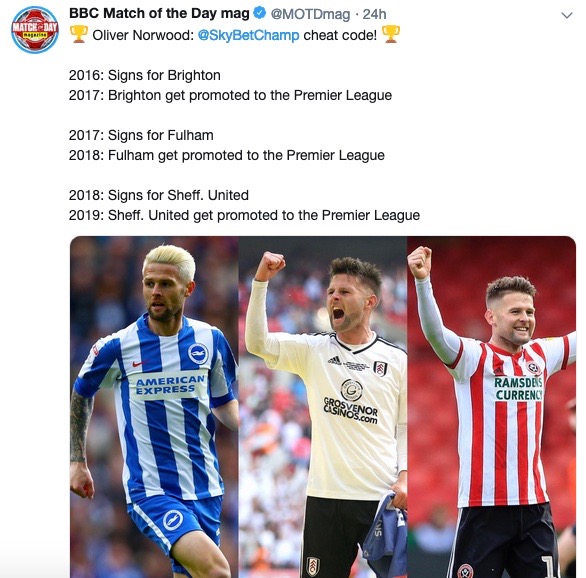
How BBC’s Match of the Day Tweeted Norwood’s record

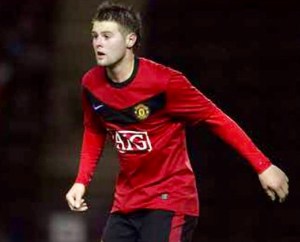
Born in Burnley on 12 April 1991, Norwood was only six when he first came to the attention of Manchester United, spotted playing for Fulledge Colts in his home town.

“My earliest football memory is being on trial at the Manchester United academy aged six and being totally overawed by it,” he told the Albion matchday programme. “I remember standing there at The Cliff, biting my fingernails, and the coach, Paul McGuinness, saying ‘Are you going to join in?’ After that, I was fine and it was really exciting to be part of the club’s academy.” He joined the Red Devils on schoolboy terms at seven and spent 15 years on their books, playing in the same youth teams as Paul Pogba and Jesse Lingard.

During the 2005-06 and 2006-07 seasons, Norwood made appearances for United’s under-18 team and, ultimately, he signed on as a trainee in July 2007.

He became an under-18 regular in 2007-08 and also made his debut for the United reserve side. After netting nine goals in 28 appearances for the under-18s in 2008-09, Norwood was signed as a professional.

He was a reserve team regular in 2009-10 and said he owed a lot to Ole Gunnar Solskjaer, who was in charge of United reserves at that time.

“I owe a lot to Manchester United for the experiences and education I had there,” Norwood told the matchday programme, United Review. “The club taught me not just about football but life. I was taught how to be a good person.

“Ole played a huge role in terms of my development as a footballer and a person. The lessons he taught me in the reserves have stayed with me throughout my career.

“I’ll always be grateful to Manchester United, to Ole, to (former reserves manager) Warren Joyce, for the upbringing they gave me in the game.”

Norwood got a sniff of the first team when Sir Alex Ferguson called him up to the first team squad for a Champions League match away to Wolfsburg. He travelled with the squad to Germany but didn’t get selected in the final matchday 18.

In search of a first team breakthrough, Norwood decided to gain experience on loan with lower league clubs and his first port of call was Carlisle United in September 2010. Ironically, his first match was against Brighton – a 0-0 draw at Brunton Park. Unfortunately, after just five starts and two sub appearances, he tore a thigh muscle and had to cut short his loan and return to Old Trafford for treatment.

The following season, he went out on loan again, this time to League One Scunthorpe United where Alan Knill, Chris Wilder’s no.2 at Sheffield United, was the manager.

In an interview with the aforementioned Joyce, the former reserves manager explained how it was only a change in Norwood’s diet that started to bring about the required improvements to his game.

“I got him to write down everything he ate. And I meant everything. I said, ‘We have to look at your diet and get you absolutely super fit’. I told him we couldn’t allow the ability he had to be wasted.”

Joyce told The Athletic’s Richard Sutcliffe in a 23 June 2020 article: “Once we’d sat him down (after returning from Scunthorpe) and analysed everything, he got himself really ripped. He started eating the right things and worked so hard to get into shape. He is getting the rewards from that now.”

Norwood spent the second half of the 2011-12 season in Coventry City’s unsuccessful effort to beat the drop from the Championship but, having acquired a taste for football at that level, declined the offer of a contract extension on his return to Old Trafford.

He told Talksport at the time: “I want to play every week like I was this season in the Championship. It’s been the hardest decision in my life for me to make but there comes a time when you have to be realistic.”

He opted to join newly promoted Huddersfield Town in the Championship on a three-year contract, and Sutcliffe’s article reveals Norwood was so determined to make the move that he drove down to Heathrow Airport to apprehend holiday-bound Town manager Simon Grayson to persuade him to sign him.

Nevertheless, United boss Sir Alex Ferguson had some encouraging parting words that the midfielder never forgot. “You’re not going to make it at Manchester United, but I believe one day you will play in the Premier League.”

Norwood was a permanent fixture in the Terriers’ midfield for two seasons before switching to fellow Championship outfit Reading at the beginning of the 2014-15 season.

Signed by Nigel Adkins on 21 August, 11 days later he was joined at the Madejski by Glenn Murray, on loan from Crystal Palace.

When the Royals were hammered 6-1 by Birmingham City in mid-December, Adkins was sacked and replaced by Steve Clarke. His second game in charge, on Boxing Day, saw Reading visit the Amex, with Brighton under caretaker manager Nathan Jones. Murray scored twice for the visitors, but Albion rescued a point with a 90th minute equaliser from Inigo Calderon.

Norwood completed the season having made 35 appearances plus seven as a sub and although he made the second highest number of appearances – 50 – the following season, when the Royals visited the Amex on 15 March 2016, under Brian McDermott, their third manager of that campaign, Norwood was a non-playing sub as the Royals lost 1-0 to a James Wilson goal.

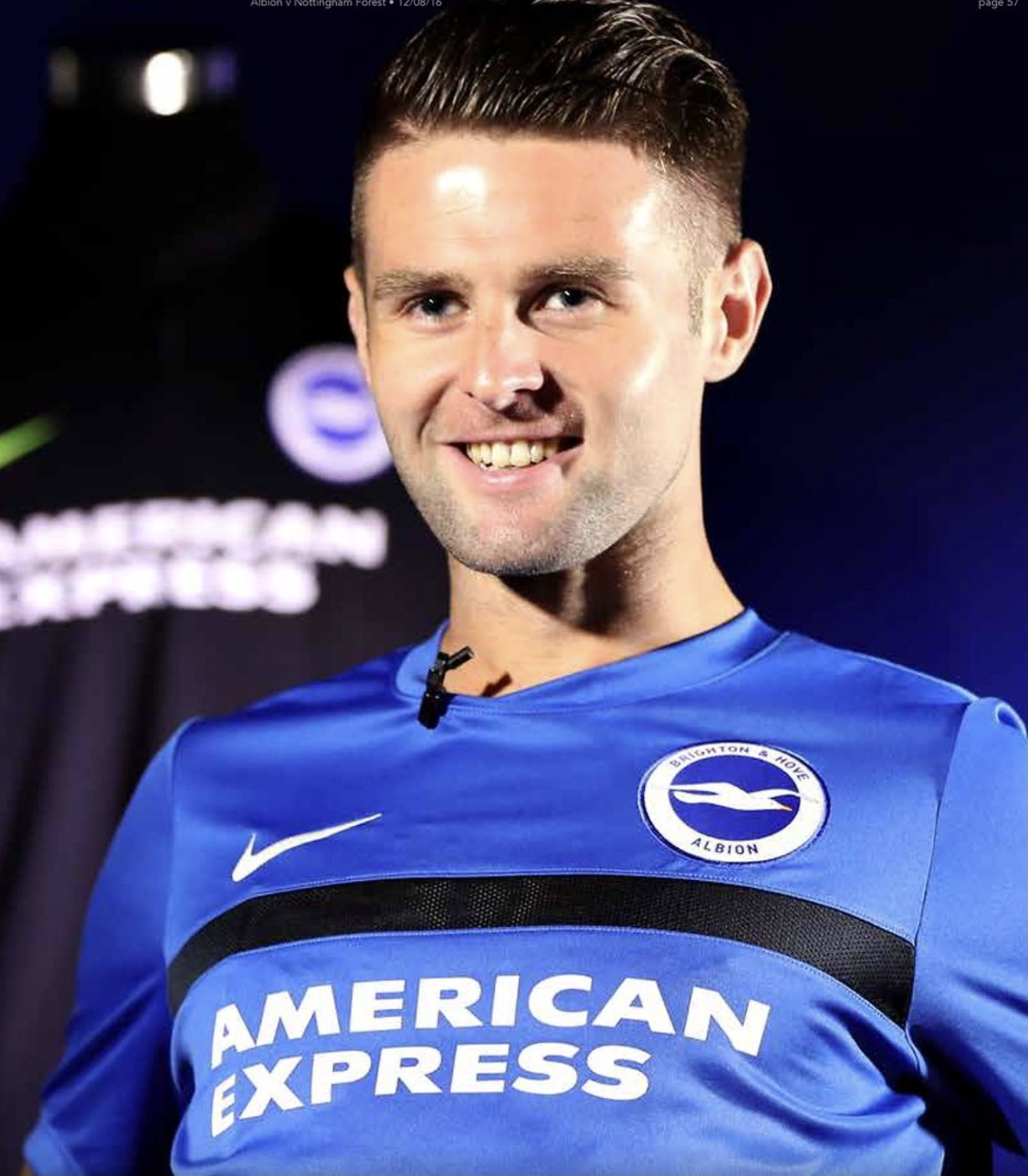
The next time the two sides met (a 2-2 draw at the Madejski on 20 August), Norwood was part of Chris Hughton’s squad, having signed for the Seagulls at the start of the 2016-17 season, along with Murray and Steve Sidwell. Norwood was a 68th-minute sub for Sam Baldock.

Manager Hughton said of Norwood: “Oliver is another excellent addition to our squad.

“He has a good grounding coming from Manchester United, and has a wealth of experience playing in the Championship and at international level.

“He’s a box-to-box midfielder and an excellent passer of the ball, so he gives us extra options in midfield and adds further depth to our squad.”

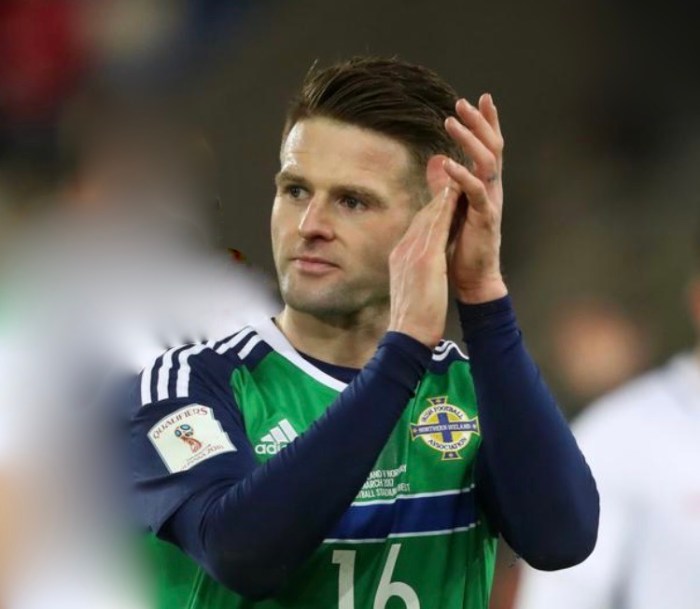
Although he played for England at youth level, he also qualified for Northern Ireland, and chose that country to enable him to experience more opportunities at international level.

Norwood made his full international debut during Nigel Worthington’s time as manager, coming on as a substitute in a 2-0 friendly defeat by Montenegro in Podgorica in August 2010.

He was a regular in Worthington’s successor Michael O’Neill’s midfield when the side qualified for Euro 2016 and played in all four of the team’s matches in the finals in France.

However, having made 57 appearances for his country, he decided in August 2019 to retire from international football when only 28.

Although Norwood made 20 starts for the Albion, he was almost as often used as a substitute, making 17 appearances off the bench, as the Seagulls soared to promotion.

Norwood had a starting berth when Beram Kayal was injured and he told the matchday programme: “This has been a big opportunity for me. The gaffer brought me to the football club and obviously I’ve been desperate to get into the team and play games.

Norwood had plenty to say

“Obviously I understand how football works. When the team’s winning and doing really well you have to bide your time, but an opportunity has come my way and it’s been important for me to grab it with both hands and do all I can to stay in the team.”

It has since transpired that the midfielder was most likely distracted by off-field issues during his season with the Seagulls, as thestar.co.uk reported.

“I went to Brighton after the 2016 Euros, and it was a difficult period in my life,” said Norwood. “My wife, Abigail, was pregnant and really ill, so we were living apart. My head wasn’t fully there.”

He told The Star he only fell in love with football again when he went on loan to Fulham, and subsequently was at loggerheads with Brighton when they didn’t accede to his request for a permanent move. “They said I could leave, but then turned down bids when they came in and started asking for silly things. I don’t think clubs realise sometimes that they’re messing with people’s lives. I had plenty of arguments, saying: ‘You don’t want me here, so let me go’.”

With Dale Stephens and Kayal the preferred central midfield pairing, plus the arrival of Davy Propper for Albion’s first season back amongst the elite, Hughton had been happy to let Norwood join Fulham on a season-long loan.

Norwood made 47 appearances for Fulham in 2017-18, particularly when filling in for the injured Tom Cairney until the Scot’s return from injury towards the end of the season.

His passing accuracy and all-round contribution were favourable, as this footballwhispers.com article assessed, and he proved a vital cog in their promotion via the play-offs when they beat Aston Villa 1-0 in the play-off final.

The website football.london was surprised Fulham didn’t opt to sign him permanently. “Norwood was a key figure under Slavisa Jokanovic, seamlessly plugging the gap left by Tom Cairney as a result of his injury and can be credited with a huge role in getting the club promoted in the first place, with his tackle on Conor Hourihane in the play-off final one that will forever be remembered by Fulham fans,” wrote Phil Spencer. “His vision and incisive passing was key to Fulham’s free-flowing style of play – meaning it was a little surprising that his loan switch to west London was never made permanent.”

Fans have contrasting views about his contribution, as this collection of quotes demonstrates. Some appreciated his ‘Hollywood’ long passes, others are perhaps summed up by this Fulham fan who said: “100% effort every time he played. Honest player. Not stellar but above average.”

Fulham’s loss was Sheffield United’s gain and in wishing Norwood well in his pursuit of more playing time with the Blades, Hughton told Albion’s website: “Ollie was one of our promotion-winning team in 2016-17 and will rightly be remembered as part of that historic team which took the club to the Premier League.”

Critics of Fulham’s strategy of splashing the cash on so-called name players for what proved to be an unsuccessful bid to retain their newly-won status in the Premier League couldn’t help pointing out the irony of Norwood’s situation.

“Fulham could only wave to Norwood on their way back down after ditching him for Jean Michel Seri,” said footyanalyst.com.

The Blades were promoted as runners up behind Norwich City in a season in which Norwood played 43 league games. He told The Observer’s Paul Doyle: “Last season was a big season for me. It was the most I’ve played. I’m definitely a better player now. At everything really. My understanding of the game. Tactically, technically, what needs to be done.”

He told Doyle: “It’s taken a bit longer than I would have liked but it was a dream come true to finally make the level that everybody across the world wants to play at.”

Norwood certainly seized the opportunity to shine at the top level, playing 40 games plus one as sub in all competitions as the Blades confounded the critics by finishing in ninth place, and taking on the captain’s armband in Billy Sharp’s absence.

Pictures from various online sources and the Albion matchday programme.

Jesse Lingard took steps to stardom at Brighton

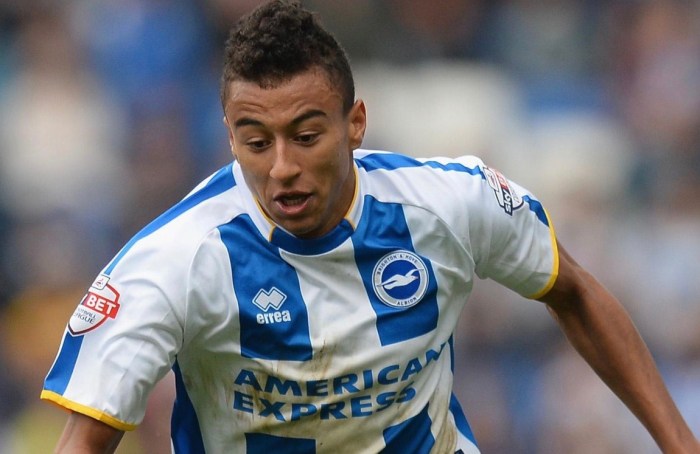
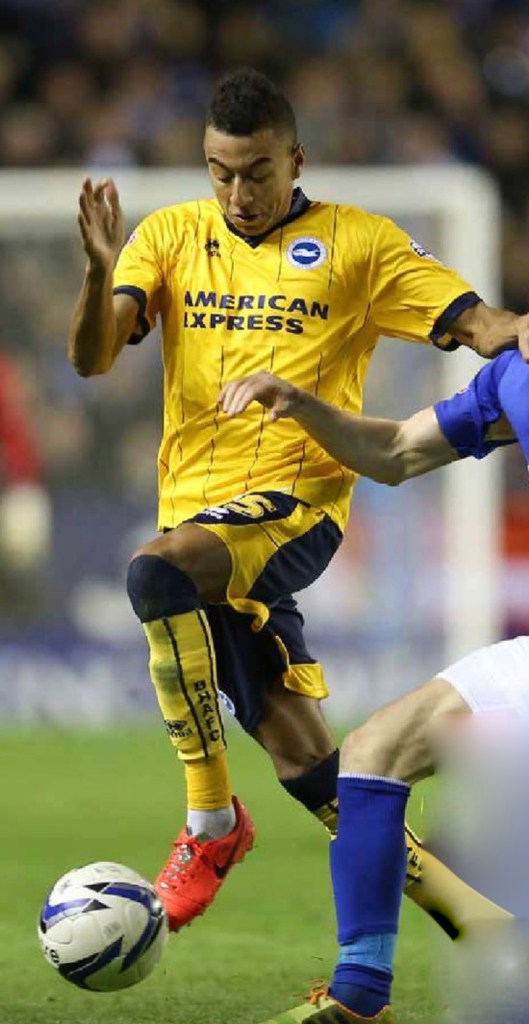
MANCHESTER United youngster Jesse Lingard scored four goals in 17 appearances for Brighton in their 2013-14 Championship season.

As well as helping the Seagulls to reach the play-offs, the move proved a useful development step for Lingard, who later become a regular at United and played for England at the 2018 World Cup.

Former United boss Jose Mourinho spoke about the value of the experience in an interview with manutd.com ahead of a Brighton v Man Utd Premier League game in May 2018.

Although Sir Alex Ferguson involved him in the first team squad a couple of times in the 2011-12 season, his real senior football education began during a three-month loan to Leicester City (he was sent with Michael Keane) in November 2012.

And, although Lingard went on United’s pre-season tour Down Under in the summer of 2013, he joined Birmingham City on loan in September 2013.

He scored a total of six goals in 13 games for the Blues, including a debut four goals at home to Sheffield Wednesday.

Birmingham hoped to keep Lingard

They’d been hoping to re-sign him for the rest of the season but Albion nipped in at the end of February 2014 and he headed south to join Oscar Garcia’s promotion-chasing side until the end of the season.

Garcia told the club website: “We are delighted we have finally secured Jesse until the end of the season. He is one of the most exciting young English players and has already created a lot of interest following his successful loan spell at Birmingham.

“We worked hard to secure a talent who has already shown that he can play at Championship level, and I am very pleased to have added Jesse to our striking options.

“He has an excellent pedigree, having come through the academy at Old Trafford, and there is no doubt that he has a lot of talent and ability. I am really looking forward to working with him.”

Lingard got on the scoresheet in the 4-1 away win at already-crowned champions Leicester City, and four days later also found the net in a 3-0 win over Charlton.

In the third minute of added on time at home to Yeovil Town, Lingard added to Kazenga LuaLua’s opener to secure a 2-0 win in the last home league fixture.

He then scored Albion’s goal in the play-off first leg at home to Derby, but, with Albion losing the game 2-1, they were always on the back foot going into the second leg when County ran riot against the injury-ravaged Seagulls to win 4-1.

Lingard went back to United and got his first competitive first team start under Louis van Gaal in the season-opener against Swansea at Old Trafford, but the occasion was marred by him having to go off with a knee injury after only 24 minutes – and United lost 2-1.

The injury set his career back six months and, on his recovery, Lingard was sent out on loan again in February 2015 when former United assistant manager Steve McLaren took him to Derby County.

Back at Old Trafford the following season, he got his first United goal in November 2015 when United beat West Brom 2-0, and he began to establish himself, making a total of 40 appearances by the season’s end.

In fact, that season ended on a particularly high note for Lingard when he came off the bench to score the winning goal for United in the 2016 FA Cup Final against Crystal Palace.

The 2017-18 season saw him involved even more, when he made 48 appearances, and, even through managerial upheaval, he continued to be a regular member of the United first-team squad.

Born in Warrington on 15 December 1992, Lingard went to the town’s William Beaumont Community High School and was on United’s books from the age of seven.

He progressed through the different age groups but, as a slow developer physically, was still playing at under 16s level when he was 18.

Nevertheless, as a youth player at Manchester United, he helped them to win the FA Youth Cup in 2010-11.

An extended feature on Lingard’s development appeared in the matchday programme for Albion’s game at Old Trafford in November 2017.

One of the coaches involved in his development, academy advisor Tony Whelan, said: “Jesse has had to be patient throughout his career. As a younger player, he was physically under-developed so he had to play a younger age group. That wasn’t easy, but he had the patience, intelligence and trust in the coaching staff to know that those decisions were made in his best interests, that we knew at some point he was going to grow. At some point, all that ability would be able to come out.

“He’s got a wonderful mindset, so his ability to come on and make an impact on the game is down to the fact he’s resilient, he has a wonderful mentality, and he is a great observer of the game. That comes out all the time in the way he deals with things. And on top of that, he has his excellent technical ability.”

Whelan added: “He’s only of slight build, so he’s developed great technical ability, good passing, dribbling, he’s a really good mover – very fluid, a wonderful mover – and he’s athletic without looking that athletic.”

The coach said: “You don’t get in our first-team squad without being a very accomplished player. He’s also playing for the national team fairly regularly. That’s testimony to Jesse’s abilities as an all-round footballer now.”

Lingard was 23 when he made his full England debut, at Wembley against Malta, on 8 October 2016, and he went on to become part of the England squad that reached the World Cup semi-finals in 2018.

He scored his first England goal in a 1-0 win away to the Netherlands in March 2018, and has since scored three more times in 24 matches; against Panama at the World Cup, against the USA at Wembley in November 2018 and three days later also at home against Croatia.

He’d already appeared on the international stage earlier in his career, playing three times for England under 17s in 2008 and scoring twice in 11 games for the under 21s between 2013 and 2015.

Coach Whelan summed up Lingard thus: “From the day he first walked into this football club at seven years of age, he always had a smile on his face. He’s always loved playing, always loved the game, always had wonderful enthusiasm, and in some ways he’s inspired the coaches with his love of the game and love of the ball.

“You never had to ask him to work hard, he was always running around, always energetic, always mischievous, and those are the qualities he brought.”

In an interview with the Albion matchday programme for Brighton’s home game with United in 2017-18, Lingard reflected on his loan spell with the Seagulls and said: “I wanted to go to the club because I knew they were a good club with a great stadium and great fans – it was the perfect club to go on loan to.”

He added: “The stadium, the staff, the fans, you could see the ambition of the club. I always knew that the club would make it into the Premier League. It was heading in that direction for a couple of seasons.”

The 2019-20 season saw a marked decline in Lingard’s fortunes with his starts for United under double figures, and most of his involvement coming off the bench. He also lost his place in the England squad.

It was revealed a business venture had performed badly and, sadly, trying to cope with personal issues involving his family impacted Lingard’s form and demeanour.

After United boss Ole Gunnar Solskjaer challenged him publicly over his declining performances, he decided to talk about the problems publicly.

After the curtain came down on the season, Lingard told his 6.6 million Instagram followers: “This season has been difficult for so many reasons. I lost who I was as a player and person, but I never wanted to give up.

“I knew who I really was on and off the pitch and knew that having been there before I could get there again.”

“This meant working harder than I’d ever done before and trusting in those around me that they knew how to best help me achieve that.

“I know the fans have been frustrated but in all this time my love for this club and everyone connected to it has never left me.”

“This team, this club is my family and I will continue to keep working harder than ever to help this team achieve its goals.”

However, with several new faces arriving at Old Trafford prior to the start of the 2020-21 season, football’s rumour mill was busy suggesting Solskaer was looking to offload Lingard.

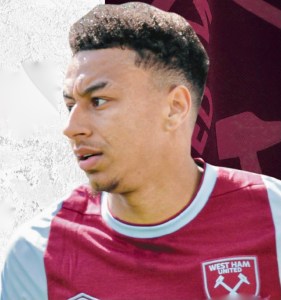
In January 2021, Lingard joined West Ham on a half-season loan and the change of scene seemed to give his career a boost. He scored twice on his debut in a 3-1 win over Aston Villa and finished the season with nine goals in 16 appearances for the Hammers.

He returned to Man Utd for the 2021-22 season, playing in 22 league and cup games but only scoring twice.

When his contract wasn’t renewed at Old Trafford, in the summer of 2022, Lingard signed a one-year deal with newly promoted Nottingham Forest on a reported £200,000 a week.