Graham Winstanley: fledgling Magpie, Carlisle legend, able Albion deputy

GRAHAM Winstanley spent five years at Brighton but only made 70 appearances, plus one as a sub. Most of his time with the Seagulls was spent as a dependable reserve.

Manager Peter Taylor drafted in the central defender to replace Grimsby-bound Steve Govier in the autumn of 1974 and he kept the no.6 shirt for all but two games through to the end of the season.

Govier had only been signed from Norwich City in May that year (together with Andy Rollings and Ian Mellor) but, unlike his co-signings, who had long Albion careers, Govier lasted only 16 games.

Winstanley, a Carlisle United regular for several seasons, had been edged out of the first team picture at Brunton Park following their surprise rise to the top division.
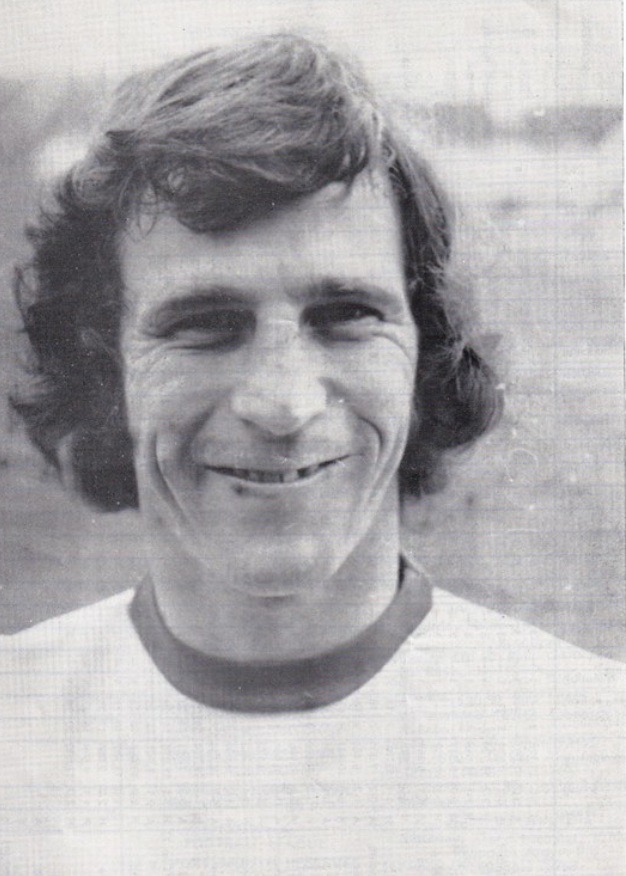
He arrived at the Goldstone in October 1974, on loan initially, and was even made captain during that time. He signed permanently for £20,000 the following month, moved into a house in Shoreham with wife Joan, and stayed in the south for five years despite limited first-team opportunities.

Born in the small north-east village of Croxdale, three miles south of Durham, on 20 January 1948, Winstanley joined Newcastle United straight from Washington Grammar School and, after serving an apprenticeship, turned professional.

He made his first team debut on Christmas Eve 1966, in a 2-1 home defeat to Leeds United.

With the likes of Ollie Burton, John McNamee and Bobby Moncur ahead of him, Winstanley struggled to establish himself at St James’ Park, only featuring seven times for the first team, five times as a starter and twice as a substitute.

Newcastle sold him to Carlisle for £8,000 in 1969, and it was at Brunton Park where he carved out a reputation as a powerful centre back who could also play full back.

In June 1972, against the Italian giants Roma in the Olympic Stadium, he scored a goal for United seven minutes from time that sealed a famous 3-2 win in the Anglo-Italian Cup. Four-Four-Two magazine voted it 45th of 50 top Greatest European Moments!

It may seem implausible to today’s reader to believe that Carlisle could win promotion from the equivalent of the Championship and play a season in the Premier League but that’s exactly what the Cumbrians did in 1974. They finished in third place, in the days before play-offs, a point behind Luton Town and 16 points behind champions Middlesbrough.

Although Winstanley had been part of Alan Ashman’s promotion side, he was not a first choice in the top division, and, after 165 appearances for United, headed south to Brighton.

His influence initially alongside Rollings, and then Steve Piper, brought much needed stability to the defence but the side struggled for goals that season and eventually could only achieve 19th place.

In January 2014, the excellent blog The Goldstone Wrap reflected on Winstanley’s influence at that time, and reproduced an Argus article angled on how the player – nicknamed Tot (he was the youngest of three brothers) – wore contact lenses while playing.
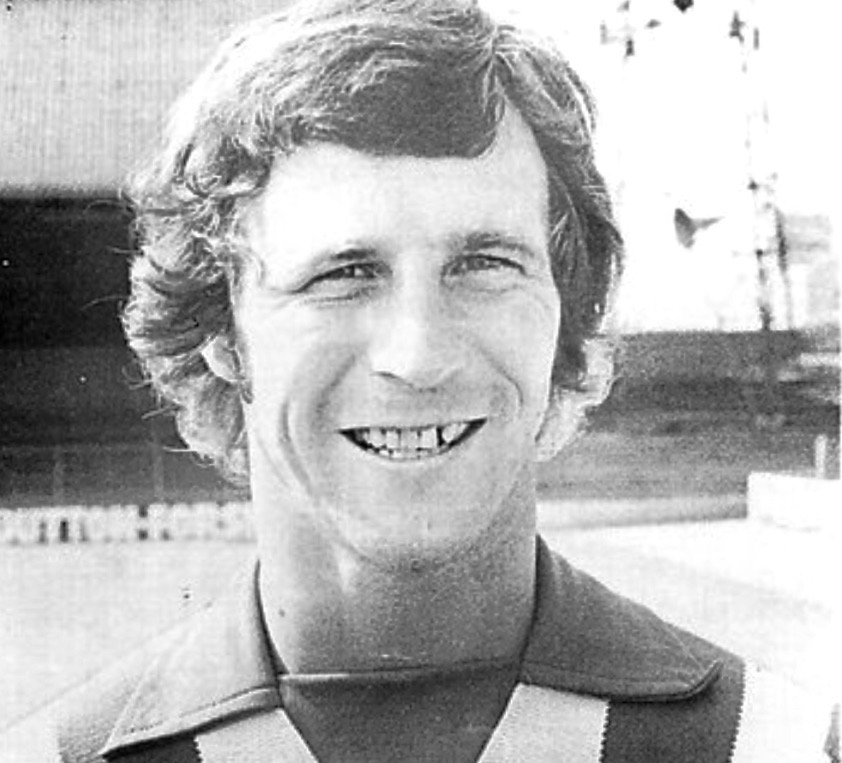
Having taken over the Albion team captaincy from Ernie Machin, Winstanley was appointed club captain in August 1975 but, with the arrival of the cultured former Millwall and West Ham defender, Dennis Burnett, was dislodged from a starting berth and only played three more times that season.

Even when Taylor’s successor, Alan Mullery, dispensed with Burnett’s services, the 1976-77 season saw Graham Cross partner Rollings, restricting Winstanley to just five appearances.

The following season Mark Lawrenson arrived, so it wasn’t as though the competition for a place was getting any easier! However, in that season, Rollings missed several matches through injury and Winstanley proved an able deputy on 19 occasions.

One of his stints in the side included the final seven matches when Albion came so close to earning promotion and Winstanley even got on the scoresheet in the 3-1 home win over Tottenham Hotspur on 15 April 1978.

“It was from a free-kick that got played out wide to the left and when the ball came over I just sneaked in at the back and hit it,” he recalled in an Albion programme feature of 14 March 2009. “It spent a long time coming to me in the air and an even longer time before it hit the back of the net.” It happened in front of a crowd of 32,647 packed into the Goldstone, and the game was interrupted by trouble-making Spurs supporters.

He kept the shirt for the opening two fixtures of the 1978-79 season but only played three more times in that promotion-winning campaign, the last of which came in a 1-1 draw away to Luton Town on 21 April, when neither Lawrenson nor Rollings were available.

When his contract was up in July 1979, he was granted a free transfer and he returned to Carlisle where he made a further 69 appearances. “I could have stayed but I didn’t really fancy it to be honest,” he told Spencer Vignes in a matchday programme article. “I knew I only had a certain amount of ability. I was never a First Division player. That’s why it was the best thing to do.”

During his time in Sussex, he coached Sunday team Boundstone Old Boys and, after his playing career came to an end, he was manager of non-league Penrith for a while. However, he subsequently had a variety of jobs outside the game, in and around Carlisle. He worked for a wholesale electrical company, as a milkman, selling insurance, as a partner in a building supplies company, as well as working for the Post Office and a local newspaper.

Rami’s route from Rome’s Olympic arena to Albion’s ‘Theatre of Trees’ – and then the World Cup!

IN ALBION’S 2004-05 Championship season, both regular goalkeepers, Michel Kuipers and Ben Roberts, were injured.

A rookie American ‘keeper, David Yeldell, was signed on loan from Blackburn Rovers but didn’t inspire confidence and was discarded after just three games.

Instead, Albion manager Mark McGhee turned to Rami Shaaban, a Swedish-born goalkeeper with a Finnish mother and Egyptian father who hadn’t played a competitive match for two years!

However, that game had been for Arsenal in the Champions League in the 70,000-capacity Olympic Stadium in Rome!

Now, here he was on 19 February 2005 lining up for Albion in front of 6,647 at Withdean – The Theatre of Trees – against eventual champions Sunderland.

It proved to be an eventful debut, which I watched with my 10-year-old daughter, Holly (during her brief flirtation with wondering why her Dad was obsessed with this football lark). Albion played more than an hour of the game with only 10 men, Adam Virgo being sent off by referee Dermot Gallagher for two yellow cards.

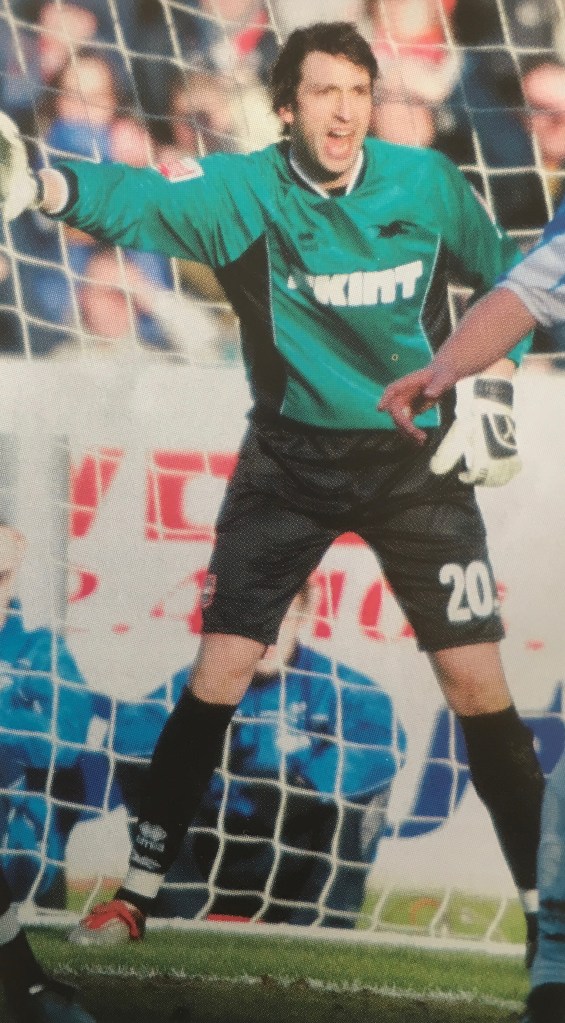
Shaaban, Albion’s fourth different goalkeeper in the space of five games, did not have that much to do but he made an instinctive stop to keep out a cross from Dean Whitehead, fisted away a Sean Thornton effort and did well to hold Julio Arca’s shot from 15 yards.

He told The Argus afterwards: “It’s a great start. I’ve always been lucky with my first games at new clubs.

“At Arsenal, I had a clean sheet. That was in the Champions League, so it was a bit different, but you have to start somewhere and I’m very pleased to get 90 minutes of competitive football.

“I was more nervous playing here than for Arsenal, because before I went to Arsenal I was match fit. Here I had not played competitive football for two years, so this was a big milestone for me.”

albion action

Against all the odds, Albion won the game 2-1 with Albion’s goals coming from a deflected Richard Carpenter shot and a rare Mark McCammon header from a corner.

Born on 30 June 1975 in Solna, Stockholm, Shaaban’s professional football career began with the local Saltsjöbadens IF who he played for 39 times in 1994-95. Then, while studying at university in Cairo, he played for Zamalek and Ittihad Osman.

After university, he spent four years in Chile, between 1997 and 2001, playing initially for Coquimbo Unido and then Deportes Temuco.

Good performances there alerted his hometown club Djurgårdens, of Sweden’s first division, and it was while he was playing there that Arsenal snapped him up.

But his good fortune was to run out quite quickly. Originally drafted in by Arsenal as a possible successor to David Seaman, he suffered a freak training ground accident on Christmas Eve 2002 that left him with a broken leg.

It took him a year to recover and during that time the Gunners signed Jens Lehmann who went on to establish himself as Arsenal’s no.1.

Shaaban did play five games for Arsenal – three Premier League games and two in the Champions League – but he never did make it back to play for Arsenal competitively again after his injury.

However, he did warm the bench in the latter part of the famous Arsenal ‘Invincibles’ season (2003-04), because regular back-up ‘keeper Stuart Taylor had picked up an injury.

In January 2004, Shabaan was loaned to West Ham for a month, but didn’t play for the first team, and then at the season’s end he was released.

Immediately before joining Brighton, he had been training back in Sweden with Djurgårdens, but he was recommended to McGhee by former Wolves goalkeeper coach Hans Segers who had moved to Spurs where Shaaban had recently had a trial.

After spending two weeks training with the Albion, the ‘keeper impressed McGhee, who told the matchday programme: “He’s done well. There’s no doubt about it, he’s a good goalkeeper. We have to now consider what we do with him. We’re going to need two goalkeepers that can play in the team between now and the end of the season.”

Shaaban kept goal for the Albion for six games one of which, on 12 March 2005, saw him harshly penalised in a 5-1 defeat away to Plymouth Argyle, which I attended with my son, Rhys.

Of course, as fans, we would say it, wouldn’t we, but it was never a 5-1 game, and that was largely down to an unbelievable performance by referee Phil Crossley.
Albion, wearing yellow, started brightly enough and soon had the ball in the net. Admittedly the action was at the far end from us, but we couldn’t see anything wrong with the goal (I think the ref ruled out Guy Butters’ header because he claimed the ball from Carpenter’s free kick curled out over the line before the cross came into him).

It was the first of several injustices meted out to the Albion that afternoon by Crossley. Plymouth took a lead as early as the ninth minute when Nick Chadwick finished off a neat one-two with Dexter Blackstock, who, ironically, manager McGhee had tried to sign on loan from Southampton earlier that season.

Our hopes were raised, though, when Charlie Oatway, on his 200th League appearance for the Seagulls, scored with a deflected header from another Carpenter free-kick.

Unfortunately, it wasn’t long before Plymouth were back in front when Crossley failed to spot Adam Hinshelwood being pushed as he went to head the ball. Instead he saw the ball hit the young centre half’s hand and awarded a penalty which Paul Wotton converted.

Then, though, came an almost unbelievable bit of nitpicking by a linesman which led to Plymouth scoring again!

Goalkeepers often go right to the edge of their penalty area before drop-kicking a clearance up field and, just as Shaaban did so, the lino flagged to claim he had taken it out of the area.

Crossley was obliged to award a free kick right on the edge of the penalty area and Wotton duly dispatched a thunderbolt into the net. It was as good as a penalty.

close-up shout

Although 3-1 down, it still looked like Albion were in with a chance, but Plymouth got a fourth on 36 minutes when David Norris evaded several despairing tackles before slotting past Shaaban.

To make matters worse, shortly into the restart Carpenter was consumed by red mist when Chadwick stopped him taking a quick free kick and, having pushed the guy in the chest, was sent off for the first time in his career.

So, 4-1 down and with only ten men, a difficult task just got harder: Plymouth continued to plug away and with just seconds remaining, substitute Scott Taylor rounded the hapless Shaaban to notch a fifth.

In the post-match interviews, McGhee described Chippy’s dismissal as “an absolute joke” and the refereeing as “shambolic”. And of the decision which led to Plymouth’s third, he said: “We see goalkeepers kicking at the edge of the box week in and week out and never in my career have I seen a linesman so sharp to put his flag up.”

Unfortunately for Shaaban, in his short time with the Albion he had conceded 13 goals, so McGhee turned to another loanee ‘keeper, Alan Blayney, from Southampton, who took over between the sticks for the remaining seven games of the season, when four draws and a win saw Albion do just enough to avoid the drop.

Shaaban remained on the bench and, at the end of the season, Albion decided not to take him on long-term. A year later he was called up to the Sweden squad for the 2006 World Cup!!

After his release from Brighton he had a trial with Dundee United but played only once, and also went on trial at Bristol City, but wasn’t taken on. Instead he went to Frederikstad in Norway, where he spent two years, and then joined Stockholm-based Hammarby, where he managed 26 appearances.

Those games led to him being selected for Sweden’s 2006 World Cup squad, although he had never previously been involved with the national side. In fact, in 2006 (and 2007) he was named Swedish goalkeeper of the year.

He made his debut as a half-time substitute in a warm up game with Finland and he played in his country’s 2006 World Cup opener, a 0-0 draw against Trinidad and Tobago, in place of injured first choice Andreas Isaksson.

He also played four Euro 2008 qualifying games for the Swedes, in which he kept a vital clean sheet in a 2-0 win over a Spain side which included the likes of Fernando Torres, Cesc Fabregas and David Villa and was also a member of their final stage squad.

Earlier in his career Shaaban could have chosen to play for Finland but decided to represent Sweden because, at that time Finland had two strong national team goalkeepers in Antii Niemi (later Albion’s goalkeeping coach) and Jussi Jääskeläinen, a Premier League ‘keeper for Bolton for many years.

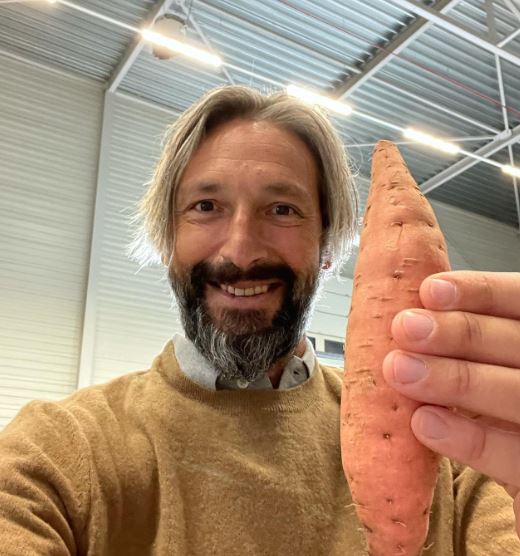
After retiring from the game, Shabaan set up his own Swedish-based company, Rami Fresh, supplying Egypt-grown fruit and vegetables. The Sun did an article about him on 5 July 2023.


Photos from Albion matchday programme.