Albion promotion winner with a place in West Ham history

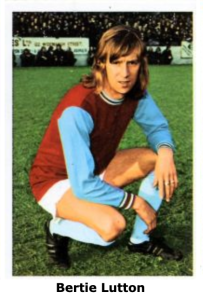
BERTIE LUTTON has a place in the West Ham history books even though he only made 13 appearances.

He was the first Hammer ever to play for Northern Ireland, winning four caps in 1973 (more on these later).

Lutton, frozen out at second tier Brighton less than a year after signing from Wolverhampton Wanderers, stepped back up a level to join Ron Greenwood’s side.

Although he had played at the elite level for Wolves, having been unable to hold down a regular first team spot at Molineux, he joined Pat Saward’s promotion-chasing Brighton in the 1971-72 season.

Lutton played his part in helping Albion go up from the old Third Division as runners up behind Aston Villa in the spring of 1972, as described in my 2016 blog post about his contribution.

But, when Brighton struggled to cope with the higher grade football, Saward questioned the commitment and attitude of certain players and Lutton was put on the transfer list.

It was certainly something of a surprise when, unable to get a start in a second tier side, he went on loan to First Division West Ham.

Lutton did well enough to secure a full-time switch to Upton Park. Almost a year to the day of his arrival at the Goldstone, he was London-bound and the shrewd Saward turned a £10,000 profit on the player.

The enigmatic Irishman made his Hammers First Division debut in a 1-0 away win against Norwich City on 10 February 1973, alongside the likes of Bobby Moore, Billy Bonds and Trevor Brooking, in front of a crowd of 32,597.

Bryan ‘Pop’ Robson scored the only goal of the game and finished the season as the club and League top goalscorer with 28 goals from 46 games. Lutton didn’t reappear until April when he went on as a sub in a 1-1 draw at home to Leeds and a 4-3 Good Friday win over Southampton at the Boleyn Ground (when George Herrington captured the action picture below of him).

Reviving his scoring feat for Brighton at Bournemouth a year previously, given a start on Easter Saturday, Lutton scored his only goal for the Hammers in a 1-1 draw away to Derby County. He then played in the last two games of the season, a 0-0 draw at Birmingham City, and a 2-1 defeat at home to Arsenal. West Ham finished the season in sixth place, though, which was the highest league position they’d achieved under Greenwood.

Lutton’s crucial equaliser for Brighton at Bournemouth on Easter Saturday 1972

Those league appearances earned Lutton a recall to the Northern Ireland squad and manager Terry Neill sent him on as a second half sub for Bryan Hamilton in a World Cup qualifier against Cyprus on 8 May 1973.

The game was played in front of a paltry 6,090 at Fulham’s Craven Cottage because of the troubles in Northern Ireland at the time. The Irish were already 3-0 up at half time and that’s how it finished: Sammy Morgan (later to play for Brighton) scored one and Man Utd’s Trevor Anderson hit two.

Eight days later, Lutton went on for goalscorer Anderson in Glasgow as the Irish succumbed to a 2-1 defeat to Scotland in the Home International tournament.

Three days after that, he saw action again when he once again replaced Ipswich Town’s Hamilton, who’d scored the only goal of the game as the Irish beat Wales 1-0 at Everton’s Goodison Park. Only 4,946 watched that one.

Back with West Ham at the start of the 1973-74 season and Lutton was in the starting line-up for home defeats to Newcastle United (2-1) and QPR (3-2) and was a sub in a 3-1 defeat away to Manchester United.

He started a 1-0 home defeat to Burnley, but was subbed off, as the Hammers’ torrid first half of the season continued. Previously imperious captain Bobby Moore was dropped and the side were bottom of the table at Christmas.
Lutton only re-appeared in the starting line-up in January when, in a FA Cup third round replay away to Third Division Hereford United, West Ham embarrassingly lost 2-1.

He retained his place three days later when, although the Hammers were missing Moore, Brooking, Kevin Lock, John McDowell and Robson, they made amends by beating Man Utd 2-1 at Upton Park. Billy Bonds and Pat Holland scored for the home side, Sammy McIlroy for United.

A week later, Lutton played his last Hammers match when appearing as a sub in a 1-1 draw at Newcastle United.

It came two months after he had made his last appearance for his country. That was in another World Cup qualifier, on 14 November 1973, when the Irish earned a 1-1 draw against Portugal in Lisbon. He played in midfield alongside Tommy Jackson and captain Dave Clements behind George Best, Anderson and Morgan up front.

Lutton had made his Northern Ireland debut three years earlier when his Wolves teammate Derek Dougan led the line in a 1-0 Home International defeat against Scotland in Belfast.

N Ireland training with George Best

Three days later, on 21 April 1970, he played the first half against England at Wembley when Best scored but the hosts won 3-1 (Lutton was replaced by sub John Cowan for the second half).

That was the game in which Bobby Charlton won his 100th England cap (and was made captain for the occasion) and his Man Utd teammate Brian Kidd made his debut. Ralph Coates also won his first England cap. Charlton, Martin Peters and Geoff Hurst scored the English goals.

Born in Banbridge, County Down, on 13 July 1950, Lutton’s brief footballing career began with his hometown club, Banbridge Town, and it’s reported just £50 exchanged hands to take him to Wolves in 1967.

At a time when Wolves were blessed with some outstanding players like Dougan, Hugh Curran, Dave Wagstaffe, Jim McCalliog and Mike Bailey, the young Irishman managed just 25 matches for Wolves between 1967 and 1971.

Although he may have only had a brief spell in the limelight, he seems to have had a penchant for earning a place in footballing history.

His one and only First Division goal for Wolves was also the club’s 2000th goal in that league to be scored at Molineux.
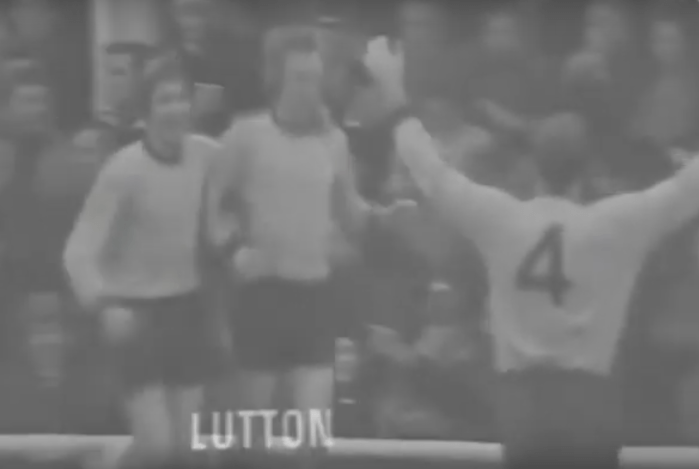
Goal v Arsenal in frront of the Match of the Day cameras

Arsenal were the visitors on 15 November 1969 and Lutton seized on a fortunate deflection off the aforementioned Terry Neill to net in the 47th minute past the Gunners’ back-up ‘keeper Geoff Barnett. The home side won 2-0 with Scottish international Curran scoring the second just two minutes after Lutton’s opener.

Not listed in the matchday programme line-up, Lutton played instead of the injured Mike O’Grady in the no.8 shirt (players didn’t wear a squad number shirt in those days).

The game was featured on Match of the Day with the legendary Kenneth Wolstenholme commentating and the rather grainy black and white coverage of the game can still be found on the internet wolvescompletehistory.co.uk/arsenal-h-1969-70/.

Lutton only made one start and one sub appearance in the 1970-71 season but was a regular in the Wolves reserve side in which the emerging John Richards was banging in the goals.

The pair were room-mates as teenagers with Wolves and were reunited after 37 years by the wolvesheroes.com website.

They hadn’t seen each other since 12 May 1973 at Goodison Park when Lutton was an unused sub for Northern Ireland in a Home International against England and Richards was playing up front for the English alongside two-goal Martin Chivers. (England won the game 2-1).

Lutton has popped up on the Wolves history site on several occasions over the years, often when he has returned from his home in Australia to the Black Country to see his son, Lee, who still lives in the area.

Brighton fans had first seen Lutton back in September 1969 when he played for them in a memorable third round League Cup match in front of a packed Goldstone Ground.

Two years later Saward, quite the specialist at using the loan market, acquired Bertie’s services on a temporary basis between September and November, 1971.

He made his debut in a 2-0 defeat at Aston Villa and scored twice in seven games (in a 2-2 draw at Torquay United and a 3-1 home win over Bristol Rovers) before returning to his parent club.

Celebrating a goal at the Goldstone for Brighton

Then, on 9 March 1972, with the clock ticking down to what in those days was the 5pm transfer deadline, Saward completed a double transfer swoop, securing Lutton’s permanent signing for £5,000 together with Ken Beamish from Tranmere for £25,000 (plus the surplus-to-requirements Alan Duffy).

A delighted Saward declared to Argus reporter John Vinicombe: “Bertie can do a job for us anywhere. This can’t be bad for us. At 21 and with two caps for Ireland he has a future and played very well for us while on loan.

“He can play right or left, up the middle, or midfield and Beamish can fit into a number of positions.”

It’s likely that versatility counted against him and, in the days of only one substitute, he was more often than not a sub, being able to go on in a variety of positions.

He was on the bench when Brighton began the 1972-73 season in the second tier and went on in three games. He then got four successive starts before going back to the bench.

Albion were finding life tough at the higher level and although Saward switched things around and brought in new faces, results went from bad to worse.

Lutton started three games in December which all ended in defeat and the 3-0 Boxing Day reverse at Oxford United turned out to be his last appearance for the Albion.

It fell in the middle of a spell of 12 successive defeats during which only five goals were scored. Saward couldn’t put his finger on the reason for the slump but Lutton found himself one of three put on the transfer list.

The West Ham move must have seemed ideal but sadly it was all over after just 13 games. Injury forced him to quit the professional game and he had a brief spell playing non-league for Horsham before emigrating to Australia.

There he played semi-professional football in the Australian Soccer League for a number of years before settling in Melbourne where he worked for the paint giant Dulux.

Lift engineer Hughton took Seagulls to a different level!

TOTTENHAM HOTSPUR was a key part of Chris Hughton’s life for more years than any of the other clubs he went on to serve.

While Brighton fans will always appreciate his four-year tenure taking the Seagulls from the Championship into the Premier League, he spent the first 19 years of his playing career at Spurs as well as 14 and a half years as a coach (and occasional caretaker manager) at White Hart Lane.

Hughton joined Tottenham’s youth set-up at the tender age of 13 in 1971, as he recounted in an In The Spotlight feature in the Spurs matchday programme for their September 2024 game v Brentford. It was the year the club won the League Cup captained by Alan Mullery with a side that included Phil Beal, Joe Kinnear and Martin Chivers, who scored both goals in the 2-0 victory over Aston Villa.

Hughton attended inner city school St Bonaventure’s in Newham, many years later attended by loanee striker Chuba Akpom who told Andy Naylor in an exclusive for the Argus: “When I was in school there used to be pictures of the gaffer there. The kids used him like an inspiration and motivation. I did as well: seeing someone come from the same area and the same school as me to become such a big and successful person.”

Other footballing St Bon’s alumni included Hughton’s brother Henry, John Chiedozie, Jermaine Defoe and Martin Ling (briefly an Albion player under Micky Adams).

Hughton’s progress as a youngster took a slightly unconventional turn when, at 16, Spurs told him he hadn’t done quite enough to be taken on as an apprentice.

“There was still that chance, though – a small window of opportunity,” he recounted to coachesvoice.com. “So, while I started a four-year apprenticeship as a lift engineer, I stayed on at Tottenham as an amateur.

“That meant working all day, then on two nights a week getting the bus or train to the training ground – apart from those days when I ended up working late and just couldn’t get there in time. Then, on Saturdays, I’d play for the youth team. I lived that life for two years.”

Football-wise, by the age of 18 Hughton had done enough to persuade Spurs to offer him a professional contract – but he didn’t want to cut short his lift engineer apprenticeship, so he turned them down but continued playing for the club as an amateur.

“I was fortunate,” he said. “My window of opportunity stayed open, and at 20 I finally became a professional footballer for Tottenham… as well as a qualified lift engineer.”

It was during Keith Burkinshaw’s eight-year reign as manager that Hughton enjoyed most of his success as a Spurs player, usually filling the left-back spot of a side that won the FA Cup in 1981 and 1982 and the 1984 UEFA Cup.

“It was a period that had a big impact on me, and on who I became,” said Hughton, who played alongside the likes of World Cup winners Ossie Ardiles and Ricky Villa, the gifted Glenn Hoddle and goalkeeper Ray Clemence, and Steve Perryman, “the best captain I played under”.

Born in Forest Gate, east London, on 11 December 1958, it might have been West Ham territory but it was Spurs that took on trial a group of five lads who had been playing in the district of Newham side.

“I ended up staying there,” he told the Argus in a November 2017 interview. “My upbringing was different. I was always playing. Although my dad is very much now a football fan, I didn’t have a family background of football.

“I think I went to West Ham once, a family friend took me. I was a football fanatic but always playing. I never really had an allegiance to any team. But I’m very much a West Ham lad.”

Hughton qualified to play for the Republic of Ireland – home of his mother Christine. His father Willie was Ghanaian (Hughton later became that country’s coach).

He made his debut for Eire in 1979 and won 53 caps over the next 12 years, including playing in three matches at the 1988 Euros. Although he was in the 1990 World Cup squad, he didn’t play any matches. He was the Republic’s assistant manager to Brian Kerr between 2003 and 2005.

Being of mixed race, Hughton suffered plenty of racial abuse both from the terraces and from opposition players, as he revealed in an interview with broadcaster Ian ‘Moose’ Abrahams for whufc.com in November 2023.

“You suffered it by yourself because you were the only one who was receiving that type of abuse, you were the only one that almost understood it, and being the only black player in the team you took all of that on your own shoulders,” he said.

“Sometimes it’s hard to think back now and comprehend how you coped with that, and the coping mechanism is because firstly you are used to it, and secondly your mentality had to be that you’re better than that. You generally suffered by yourself.”

Hughton continued: “There were numerous times over that period, especially in the reserve team, and yes, even in the first team that I suffered racial abuse [from opposing players].

“I reacted to it, but I knew the boundaries, because you knew if you went too far you were going to get sent off.”

A knee injury at the age of 28 was a signal for Hughton to begin to consider what he might do once his playing days were over, and he did some coaching sessions at soccer schools. “I started to think this was what I wanted to do,” he said.

When he was no longer guaranteed a starting berth at Spurs, Hughton moved across London to the club closest to where he grew up: West Ham. Hughton signed for the Hammers initially on loan in November 1990 to cover for the injured Julian Dicks, and then permanently on a free transfer.

“My parents still live in Upton Park, so I was born and brought up very close to the stadium,” Hughton recalled in a November 2017 Argus interview.

Signed by Billy Bonds, he was with the Hammers for just over a year, helped them win promotion from the old Division Two in 1990-91and played a total of 43 matches (plus one as a sub).

“It was a really enjoyable period of time,” he said. “Billy Bonds was the manager. He was not only a great manager but a great individual.”

In February 1992, he moved on a free transfer to then Third Division Brentford, whose squad included Neil Smillie and Bob Booker. Graham Pearce was a coach. They won the divisional title but the following season Hughton’s troublesome knee forced him to retire at the age of 34.

“By the time I signed for Brentford at the age of 33 I was certain that I wanted to coach,” Hughton told coachesvoice.com. “I was taking far more interest in things like tactics and the thinking behind training sessions. Brentford’s manager at the time, Phil Holder, even allowed me to take a few sessions.”
Hughton added: “It actually set me up for my coaching career as I learned a lot in that time.”

After he’d called time on his playing days, he didn’t have to wait long for an opportunity to open up for him as a coach because his former teammate Ardiles, who’d not long since taken over as Spurs manager, invited him to help out back at White Hart Lane.

“We’d been good friends since our days playing for the club, so he knew all about my coaching aspirations and brought me in as the under-21s’ and reserve team coach,” Hughton explained. “I’ve always been very grateful to him for giving me that first opportunity.”

For the first year or so, he worked alongside the former West Ham player Pat Holland, who he described as “an excellent tactical and technical coach”.

Hughton explained it was a period in which he discovered how to transition from being a player to a coach. “As much as you’ve been part of a changing room thousands of times as a player, taken part in countless training sessions and listened to more team talks than you can remember, none of those things have ever been your responsibility before.

“In that respect, football is no different to any other aspect of life. If someone has spent years working on a shop floor, then moves up to management and has to govern a group of people, they have to make that same transition. It’s not easy.”

As managers came and went, Hughton remained on the coaching staff. After Ardiles came Gerry Francis and Christian Gross. Hughton was in caretaker charge for six matches before George Graham took over from Gross. Next in the hot seat was Glenn Hoddle, followed by Jacques Santini and then Martin Jol.

“Such a long apprenticeship might not be for everyone and some can go straight from player to manager at a young age, but I wouldn’t have been ready,” said Hughton.

“There was always something new to learn and experience. It was exciting to see what each new manager would be like, how he would involve me and what I would learn.

“The club could easily have said, ‘Now that the manager has left we won’t be keeping you on’, but they showed faith in my abilities and, in return, I provided some continuity.”

Hughton was assistant manager to Jol and said: “We had three years together, and in terms of league positions they were successful ones.”

By the time he was shown the door at Spurs, along with Jol, after a difficult start to the 2007-08 season, he felt ready to become a manager in his own right.

But before that happened, a different proposition emerged when Kevin Keegan asked him to become first team coach at Newcastle United.

“I’d spent my entire playing and coaching career in London, but any apprehension I felt at relocating to another part of the country was outweighed by the excitement,” he told leadersinperformance.com.

“I was going to a legendary club with an incredible tradition, rich history and great fan base and I was going to assist Kevin Keegan. I learned a lot from him during our time together, especially from his strengths in man-management.”

• What happened next in Hughton’s career is the subject of my next blog post. Thanks for reading!

Cattlin bust-up didn’t stop goalscoring ‘Rooster’ Russell

BEING LET GO by the Albion as an apprentice didn’t stop Kevin Russell from going on to enjoy a multi-club league career as a player and a coach involved in no fewer than eight play-off finals and promotions.

A talented teenager good enough to earn selection for the England Youth team, Russell didn’t progress beyond Brighton’s youth and reserve sides between 1982 and 1984.

Although he was a regular goalscorer in the junior sides, a falling out with manager Chris Cattlin saw him depart the club without earning a competitive first team call-up.

Hailing from Paulsgrove in north Portsmouth, Russell returned home and linked up with his hometown club to complete his scholarship under World Cup winner Alan Ball.

Ball also gave him his first team debut but he only had eight first team outings for Pompey. It wasn’t until he joined Fourth Division Wrexham for £10,000 that his career began to take off and he was in the Wrexham side that reached the 1989 play-off final where they lost 2-1 to Frank Clark’s Leyton Orient. In the first of two spells in north Wales, playing at centre forward, Russell scored an impressive 47 goals in 102 games.

Prolific goalscorer for Wrexham

An ever-present in the 1988-89 season, his 25 goals in a total of 60 league and cup matches was recognised by his peers when he was selected in the PFA divisional team of the year.

That caught the eye of David Pleat at Leicester City, then playing in the ‘old’ Second Division, and a fee of £175,000 took him to Filbert Street.

At Leicester he played wide right rather than in the centre but he still had a knack for scoring goals and he eventually became something of a cult hero with Foxes supporters for the goals he scored in City’s escape from second tier relegation in 1991 and in their run up to the 1992 play-off final.

However, only a month after joining Leicester he had to undergo a hernia operation that put him out of action for eight weeks. When fit, he was sent out on a month’s loan to Peterborough …and suffered a broken leg!

When ready to play again, his effort to resume match fitness saw him go on another month’s loan, to Fourth Division Cardiff City. In the meantime, Pleat was sacked and Gordon Lee took over. Russell returned as the Foxes fought to avoid relegation to the third tier.

Perhaps inevitably one of the vital goals he scored (on 6 April 1991) was against promotion-seeking Albion in a 3-0 win that helped the Foxes in the hunt to stave off the dreaded drop.

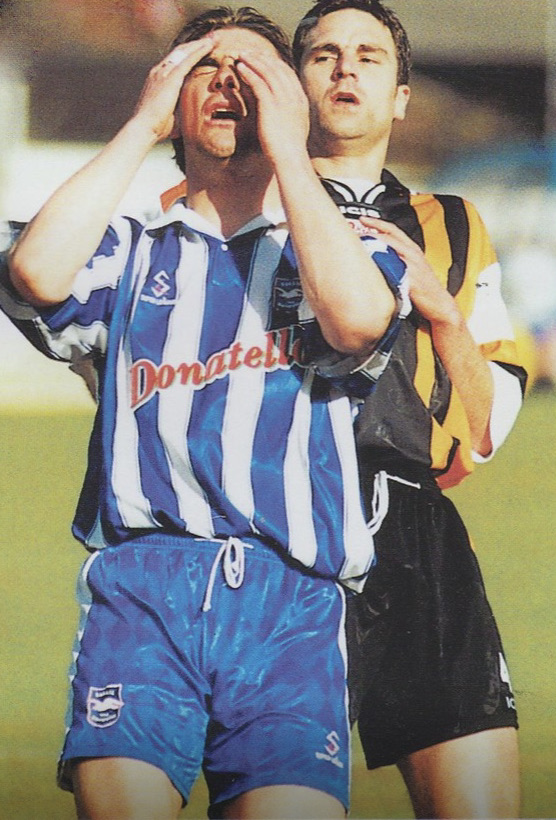
Two years later, after he had moved on to Burnley via Stoke City, Russell’s first goals for the Clarets (above) were also scored in a 3-0 win over the Seagulls.

Born in Portsmouth on 6 December 1966, the nickname Rooster was coined at an early age because his hair formed something of a quiff when he was a boy – ironically, he went prematurely bald but the name stuck.

Russell’s first appearances in Albion’s colours came in the early autumn of 1982 playing in the junior division of the South East Counties League. He was still a 15-year-old schoolboy at the time.

By the spring of 1983, while the Albion first team were edging towards the FA Cup final at Wembley, Russell had stepped up to the reserves, as the matchday programme reported after he’d been involved in a close game against an experienced West Ham second string.

“Kevin Russell is just sixteen and he doesn’t leave school until he has taken his examinations next month,” it said. “But at Upton Park he found himself playing against such experienced men as Trevor Brooking and Jimmy Neighbour.

“Many schoolboys would have given their right arm to play on the same field as Brooking and there was Kevin playing on equal terms.

“Although we lost 2-1, it should be remembered that in Kieran O’Regan, Mark Fleet, Matthew Wiltshire, Gerry McTeague, Gary Howlett, Chris Rodon and Kevin Russell we had seven players under 20, while the Hammers had Paul Allen, Paul Brush and Pat Holland, all of whom have played in European competition, as well as Neighbour and Brooking in their line-up.”

John Shepherd was in charge of the side, aided by John Jackson, who had been signed as goalkeeping cover and was helping out with coaching too.

Russell’s official arrival as an apprentice at Brighton earned a mention in the matchday programme for the home game with Chelsea on 3 September 1983 and he was one of five apprentices on the staff that autumn, together with Dave Ellis, Darron Gearing, Gary Mitchell and Mark Wakefield. Martin Lambert had stepped up to sign as a full professional that summer.

In those days, the youth team played home matches at Lancing College and were looked after by Shepherd and Mick Fogden before experienced George Petchey was brought in to oversee youth development and run the reserves.

It was while a Brighton player that Russell won the first of six England under-18 caps (five starts plus one as sub), and he scored in the first of them – a 2-2 draw with Austria on 6 September 1984 – and in his fourth game, six days later, which England lost 4-1 to Yugoslavia. His strike partner in that side was Manchester City’s Paul Moulden, later an Albion loanee.

With the likes of Terry Connor, Alan Young and Frank Worthington in the first team, and promising youngsters in the reserves, such as Lambert, Rodon and Michael Ring, it is perhaps not surprising that Russell couldn’t break through.

He did have one outing in first team company, though, in a testimonial match for Gary Williams: he scored (along with Young and Connor) in a 3-3 draw against an ex-Albion XI.

The same game saw defender Jim Heggarty appear: like Russell he also went on to play for Burnley without playing a competitive first team game for the Albion.

While on that theme, a frequent partner of Russell’s in the reserves was Ian Muir, another striker who slipped through Albion’s net and ended up scoring goals for Burnley.

After his departure from the Albion in October 1984, Russell made the most of the opportunity Portsmouth presented him to learn from the former Everton, Arsenal and Southampton midfield dynamo Ball.

“I had three years there under him which was fantastic,” Russell told Leicester City club historian John Hutchinson in March 2018. “He was brilliant as a coach and it was very educational. I got the rest of my (under-18) caps at Portsmouth.

“Alan Ball treated us well. I was playing men’s football at 18. I played a few games in the first team and we managed to get promoted into what is now the Premier League.”

Although disappointed to be advised to move on to get more games, Russell’s switch to north Wales was the launchpad for his career, and the beginning of an association with Wrexham that lasted many years.

“It was a gamble worth taking because it meant first team football,” said Russell. “Dixie McNeill was the manager. He used to be a famous striker for them. He was fantastic for me and was an old school kind of manager; a proper man’s manager. It was a good time.”

Mixed fortunes at Leicester City

After Russell’s part in keeping Leicester in the second tier in 1991, he found himself on the outside looking in when Brian Little replaced Gordon Lee as manager and to get some playing time went on a month’s loan to Hereford United and then spent a month at Lou Macari’s Stoke City.

But Little recalled him in February and in his first game back he once again found the net against a former club, scoring in a 2-2 draw with Portsmouth. He kept his place through to the play-off final at Wembley, where they faced Kenny Dalglish’s Blackburn Rovers, and lost to a “dodgy penalty” scored by ex-Leicester player Mike Newell.

“It was a very scrappy game. Both teams were under a lot of pressure and never really got into their rhythm,” said Russell. “We had worked so hard that season to get to where we did get to. The result was a big disappointment, but it was an occasion that I’ll never forget.”

A promotion winner with Stoke City

It also turned out to be his last game for Leicester because that summer he returned to third tier Stoke on a permanent basis. He is fondly remembered for his part in Stoke winning promotion in 1992-93, scoring six goals in 39 league and cup matches (plus 11 as a sub), but he moved on again, this time to Burnley.

Third-tier Burnley signed him from Stoke for £150,000 (or was it £95,000 – I’ve seen both prices quoted) in June 1993 and, although he only stayed for eight months at Turf Moor, he scored eight goals in 35 games (plus two as sub) in Jimmy Mullen’s Clarets side.

Two of those goals – his first for Burnley – were scored against the Albion. I was at Turf Moor for a midweek game on 14 September 1993 when Russell scored with only a minute on the clock and he got a tap-in on 47 minutes in a 3-0 stroll for the home side. Steve Davis got Burnley’s third.

Brighton were a very different club to the one Russell had left in 1984, though. With a win in a League Cup match their only victory in the opening eight matches, it was the beginning of the end of Barry Lloyd’s tumultuous reign in charge, against a backdrop of financial hardship and boardroom mismanagement off the pitch.

Russell’s habit of scoring against his former clubs manifested itself again two days after Christmas, when he netted in a 2-1 home win over Wrexham. He scored again five days later in a New Year’s Day 3-1 home win over Lancashire rivals Blackpool.

But he was not around to be part of the side promoted via the play-offs, having moved back south, to Bournemouth, for £125,000 in March 1994.

• Another move, a return to north Wales and a career in coaching as Russell’s story continues.

Andy Arnott’s United dream dashed by injury

A PLAYER who was on the brink of signing for Man Utd for £100,000 ended up playing for the Albion in exile.

But for an untimely hernia injury, Andy Arnott would have been an Alex Ferguson signing at Old Trafford.

As it turned out, the moment passed and the opportunity didn’t arise again. He later made 28 appearances for the Seagulls during the 1998-99 season when home games were played at Gillingham’s Priestfield Stadium.

It was a ground Arnott was familiar with. Born in nearby Chatham on 18 October 1973, he joined Gillingham as a trainee and had only served one year of his apprenticeship when he was taken on as a professional.

Manager Damien Richardson gave him his debut for the Fourth Division club only four games into the 1991-92 season when he was just 17.

It couldn’t have gone better because he scored the Gills’ opening goal in a 2-0 home win over Scarborough.

This was a Gillingham side that included summer signing Paul Clark, who had been part of Alan Mullery’s successful Brighton side in the late 1970s, and Mike Trusson, who’d won promotion from the Third Division with the Seagulls under Barry Lloyd. A young Richard Carpenter was also breaking through.

Arnott scored three goals in 23 appearances by the season’s end although one goal and two appearances against Aldershot were later expunged from the records because the Shots were expelled from the league.

Nonetheless, the youngster’s emergence hadn’t gone unnoticed higher up the football pyramid and the offer of the chance to join United came along, ostensibly so that he could feature in their youth team’s involvement in the end-of-season Blue Star youth tournament in Zurich.

This was the era of the famous ‘Class of 92’ and Arnott found himself playing alongside David Beckham, Paul Scholes and Nicky Butt.

“After impressing during his spell with United, Ferguson made a £100,000 offer to Gillingham which was turned down by the then manager Damien Richardson,” Albion’s matchday programme noted.

In action for Gillingham against Albion’s Nicky Bissett

The player then suffered a hernia injury that put him out of the game for a year, putting paid to any further interest from United.

“I was gutted at the time, but it was a case of just getting on with returning to fitness and playing football,” Arnott said.

Back at Gillingham, he played 50 matches and scored 12 goals but then, in January 1996, got a £15,000 move to Leyton Orient. He spent a season and a half with the Os under manager Pat Holland and played in every position to help out the team, including goalkeeper in one emergency.

Arnott played under Micky Adams at Fulham

In the summer of 1997, after Fulham’s promotion from Division Three under Micky Adams, Arnott moved to Craven Cottage for an undisclosed fee (thought to be £25,000).

Within a few months, Mohammed Al Fayed took over the club and sacked Adams.

“All of a sudden Fulham went from being an ordinary Second Division outfit to a multi-million pound club,” he said. “I felt sorry for Micky as he had done a fantastic job, but he did foresee what was coming and sorted out long term contracts for most of the players.”

The new management duo of Ray Wilkins and Kevin Keegan brought in their own players and Arnott found himself confined to the reserves with the likes of Mark Walton, winger Paul Brooker, and forward Darren Freeman.

He scored twice for Fulham Reserves in a 3-0 win over Albion’s reserve side on 21 October 1998, and that persuaded Brian Horton to take him on.

“A few clubs had shown an interest around that time, but Brighton were the first that I spoke to and I liked what I was hearing so I signed straight away,” he said.

Horton signed him by the end of the same month for £10,000, plus another appearance-related £10,000, and said in the matchday programme he was “absolutely tremendous” on his debut. It came in a 1-0 win in pouring rain at Barnet when Charlton loanee defender Emeka Ifejagwa scored the only goal of the game on his debut. “He (Arnott) and Jeff Minton forged a good partnership and I am looking for that to flourish,” said Horton.

In his player-by-player commentary of performances, programme columnist Paul Camillin said: “Brilliant debut. He showed a good array of passing skills and he might have the bite we’ve been lacking.”

It was the wrong kind of bite he displayed in only his fourth game, though, when he was shown a red card in the 55th minute of Albion’s 2-0 win at Horton’s old club Hull City.

Defender Ross Johnson also went for an early bath for a second bookable offence but Albion’s nine men hung on for 35 minutes to complete their fourth successive away League win: the best such run for 62 years!

There’s little doubt Arnott’s arrival coincided with an upturn in the side’s form and in the matchday programme he took time to praise Albion’s loyal followers. “It is a fantastic advantage to have the number of away supporters we do,” he said. “It makes you want to play that little bit more to give them something back. They are absolutely magnificent.”

Arnott and Jamie Moralee

In the absence of Gary Hobson and Ian Culverhouse, Arnott was given the captain’s armband although that discipline was a bit questionable at times. He saw red for a second time, after Jeff Wood had taken over from Horton, for a second bookable offence at home to his old club Orient – Os captain Dean Smith (manager of relegation-threatened Leicester) also went for a second yellow – although Wood and Orient boss Tommy Taylor both slammed referee Rob Styles for his officiating.

Man of the Match

Wood declared: “Too many officials want to stamp their authority on the game early and flash cards like they are going out of fashion.”

Although Arnott saw out the season in the starting line-up, when his old boss Adams took over from Wood, by the time the new season got under way back in Brighton, Adams had signed Paul Rogers and Charlie Oatway as his preferred midfield pair.

By the end of September, Arnott had been snapped up by Second Division Colchester United; initially on loan and then permanently when their new boss Steve Whitton completed a direct swap that saw Warren Aspinall join the Seagulls.

However, Arnott made only four starts plus eight appearances off the bench in that first season and his time with United was blighted by a long-standing groin injury.

“The whole thing has been an absolute nightmare. I have been struggling with the injury for 14 months and despite loads of rest, two operations and four cortisone injections, the problem is as bad as ever,” he told Colchester’s Daily Gazette in January 2001.

“I was really struggling just before Christmas and I visited the specialist who told me I’m pretty near to exhausting my options.

“When it’s at its worst the injury is unbearable, especially when I turn or attempt to hit a long ball.

“I’m still only 27 with what should be many years left in the game.”

Unfortunately, though, he was forced to call time on his professional playing career and dropped into non-league initially with then-Conference side Stevenage, then Dover Athletic, where he was captain, Welling United and Ashford Town.

After his playing days were over, he settled in Rochester and became a project manager for Dryspace Structures while retaining his football links as a coach for Ebbsfleet United’s under 16 team.

Midfielder Alan Curbishley helped Seagulls to promotion

Screenshot

ALAN Curbishley completed a hat-trick of promotions with new clubs when he was part of Brighton’s successful third tier side in 1988.

He’d previously been promoted after switching from West Ham to Birmingham City and also when moving from Aston Villa to Charlton Athletic.

Curbishley was what you might call West Ham through and through.

Born at Forest Gate on 8 November 1957, within a mile of West Ham station, he was one of five children (elder brother Bill famously promoted and managed The Who and Led Zeppelin and was producer of the films Tommy and Quadrophenia).

Curbishley first played in Brighton at under 11 level, in a Newham Boys side against Brighton Boys at Longhill School, in May 1967. He was later capped for England Boys aged 15 and after joining the Hammers straight from school played for England Youth.

Curbishley won nine England Youth caps under Ken Burton, scoring on his debut in a 1-1 draw against Poland in Las Palmas on 21 January 1975 when England went on to win the Atlantic Cup. Among his teammates were future England captain Bryan Robson, Peter Barnes and Keith Bertschin.

He vied for a starting berth with Mark Nightingale (Palace, Bournemouth, Norwich, Peterborough), making six starts and three appearances off the bench. His last appearance was in a 1-0 win over Wales in Cardiff on 11 February 1976, playing alongside Glenn Hoddle and Gary Owen.

Almost a year earlier, on 29 March 1975, he had made his first team Hammers debut at the tender age of 17, lining up in midfield alongside Trevor Brooking and Graham Paddon in a 1-0 home defeat against Chelsea. Mervyn Day was in goal for West Ham and guarding the opposition net was John Phillips.

At the time, Curbishley was the youngest to play in the senior team although that record was subsequently eclipsed by Paul Allen.

A contemporary of Geoff Pike, Paul Brush and Alvin Martin, they were all in the West Ham youth team defeated 5-1 on aggregate by Ipswich in the 1975 FA Youth Cup Final.

In a midfield dominated by Brooking, Paddon and Pat Holland, and later Alan Devonshire and Pike, Curbishley found first team chances limited, although in 1977-78 he made 36 appearances.

After 85 matches for the Hammers, in 1979 he moved to Birmingham for £275,000. Manager Jim Smith used the proceeds of the £1m transfer of Trevor Francis to Nottingham Forest to buy Curbishley, Frank Worthington, Colin Todd and Archie Gemmill. Curbishley was still only 21 when he made his debut for the Blues on 18 August 1979 in a 4-3 defeat at home to Fulham and he went on to be ever present for Birmingham in that 1979-80 season.

Curbishley earned his one and only England Under 21 cap in a 5-0 thrashing of Switzerland at Portman Road when Justin Fashanu was among the scorers. He had hopes of going to the 1982 World Cup with England, having broken into the England B squad but fractured a kneecap sliding into a tackle with Albion’s Brian Horton. “I missed the rest of the season and the start of the next, and the World Cup squad which I might have broken into otherwise,” he said. “It was the worst disappointment I’ve ever faced.”

He was on the front cover of the matchday programme for a game I went to watch at St Andrew’s on 27 March 1982 when he played for Ron Saunders’ Blues in a 1-0 win over Brighton. But financial issues meant the side was broken up and, the following year, after a total of 155 games, he committed what today seems to be viewed as a cardinal sin by signing for Villa for £100,000, ironically making his debut against Birmingham in a 1-0 win on 4 April 1983.

“I had high hopes of success there with them just having won the European Cup,” he told Dave Beckett in an Albion matchday programme article. “It was soon obvious though that Tony Barton was under pressure from the moment he took over and all the players thought it was just a matter of time before he was sacked.

“He got a raw deal. That season we finished ninth in the league, got to the semis of the League Cup and were knocked out of the UEFA Cup in the last minute on the away goals rule. Villa have never been near that form since, but Tony Barton’s face didn’t fit and he was soon on his way along with all the men he signed.”

After only 36 appearances, scoring once, Curbishley returned to London, dropping back down to the 2nd division, to begin what would be a long association with Charlton Athletic, punctuated only by his spell at Brighton.

Amazingly, although homeless at the time and playing at Selhurst Park, Charlton won promotion back to the 1st Division. Unfortunately Curbishley sustained an achilles tendon injury and only played 10 games in the 1986-87 season.

“I knew I had an achilles injury but the operation was delayed until a week before the start of the new season and consequently I wasn’t fit again until December,” he said. “The manager bought two new midfield players, which I understood, but when I was fit again I couldn’t get back into the side.

“It became apparent that I wouldn’t get much of a chance unless something drastic happened so I’m pleased to have a fresh start.”

After 13 seasons playing in the top two divisions, he left Charlton having scored six times in 63 games and dropped down to the Third to join the Albion for £32,500.

He made his debut in a goalless draw at Chesterfield on 22 August 1987 in front of a crowd of just 2,286.

After the departure of Jimmy Case in 1985, the centre of Albion’s midfield had been crying out for someone who could put their foot on the ball and pass it, and Curbishley stepped neatly into that role, scoring six goals – mostly penalties – in 34 appearances as Brighton won promotion.

“Alan was a very level-headed guy, an excellent passer and really disciplined,” Albion boss Barry Lloyd told Spencer Vignes in a matchday programme article.

In total, over three years on the south coast, Curbishley played 127 games (plus five as sub)  – making his 400th league appearance during the 1988-89 season – and scored 15 goals.

curbs penThe Albion matchday programme featured Curbishley when the Seagulls hosted the Hammers for a Barclays League Division 2 game on 16 September 1989. Describing his time with the East London club, he said: “It was a brilliant set up although I was definitely a bit headstrong in my early days.

“I didn’t really grow up until I moved to St Andrew’s and that’s where I had my best playing days.”

Lou Macari’s side in 1989 included Curbishley’s old pal Alvin Martin and future Albion manager Liam Brady but the Seagulls ran out 3-0 winners (goals from Kevin Bremner, Robert Codner and Garry Nelson).

In 1990, Curbishley began his coaching career, returning to Charlton initially as player-coach under Lennie Lawrence. When Lawrence left in 1991, Charlton made the somewhat unusual decision to appoint joint managers: Curbishley and Steve Gritt (who would later be at the helm when Albion narrowly escaped dropping out of the league).

Curbishley’s first signings for Charlton were former Albion teammates Nelson and Steve Gatting and he later plundered young winger John Robinson from the Seagulls. After four years, Curbishley took sole charge at The Valley and led Charlton to some of the most successful times in their history.

Considering their resources, Curbishley turned Charlton into a steady top flight club and model of stability, consistently securing a mid-table finish.

Sean Cole in The Bleacher Report described him as “one of the most promising managerial talents of the new millennium” and in 2006, in the wake of Sven-Goran Eriksson’s departure as England manager, Curbs had ‘tea and biscuits’ with then chief executive Brian Barwick – but Steve McLaren got the job instead.

In December 2006, Curbishley landed what surely would have been considered his dream job – manager of West Ham.

It was quite a reunion of old pals when Brighton visited Upton Park for one of his first games in charge, in the third round of the FA Cup in January 2007. Albion boss Dean Wilkins and coach Ian Chapman had both been teammates while physiotherapist Malcolm Stuart was still wielding the magic spray.

In front of 32,874, Hammers ran out fairly comfortable 3-0 winners with Mark Noble scoring his first senior West Ham goal and Carlos Tevez a real handful up front. These were the respective line-ups:

West Ham: Carroll, Dailly, Ferdinand (Spector 45), Gabbidon, McCartney, Benayoun, Mullins, Noble, Boa Morte (Newton 73), Cole (Bobby Zamora 68), Tevez.
Subs not used: Green, Sheringham. Goals: Noble 49, Cole 58, Mullins 90.

Brighton: Wayne Henderson, Joe O’Cearuill, Joel Lynch, Guy Butters, Kerry Mayo, Tommy Fraser (Gary Hart 51), Adam El-Abd, Dean Hammond, Alexandre Frutos (Sam Rents 67), Alex Revell (Joe Gatting 84), Jake Robinson. Subs not used: Michel Kuipers, Richard Carpenter.

Fans’ website westhamtillidie recalled: “Perhaps Curbs’ greatest legacy at the club was the £7m signing of his former Charlton protégé Scott Parker, who went on to win the Hammer of the Year prize three times and pick up a Football Writers’ Player of the Year Award during his time at the club.”

Sadly, though it was to all end in tears and Curbishley quit in protest at the then Icelandic owners’ failure to consult him over the sale of defenders Anton Ferdinand and George McCartney.

In what must have been a tough heart-v-head decision, he resorted to a legal resolution of the situation and eventually won a case for constructive dismissal, eventually receiving £2.2m in compensation. But it was the last manager’s job he had.

“It took me a year to sort out my problem at West Ham,” he told The Independent. “And then, after that, I was perhaps a little too picky. I was told by other senior managers ‘don’t be out too long’ but I was waiting for a job that I thought was the job for me.”

Job vacancies came and went, Curbishley’s name was generally on all the shortlists, but he never again made it through to the manager’s chair. There was a brief moment at Fulham when he was technical director assisting Rene Meulensteen but when Meulensteen was swiftly axed, new manager Felix Magath brought in his own people.

He rejoined the Fulham coaching staff in March 2015 and took charge of training in November 2015 when Kit Symons was relieved of his managerial duties but Stuart Gray took charge of the team before Slavisa Jokanovic was appointed.

In 2016, Curbishley brought out a book, Game Changers: Inside English Football: From the Boardroom to the Bootroom (published by HarperSport) and was a regular pundit on the Football on 5 programme covering Football League games.

Further reading

https://www.westhamtillidie.com/posts/2014/11/07/preview-aston-villa

http://bleacherreport.com/articles/1415997-the-curious-case-of-alan-curbishley-footballs-forgotten-man

https://www.whufc.com/club/history/managers/alan-curbishley#C1vPoA9yPR1kYluJ.99

  • Pictures show westhamtillidie’s image of Curbishley in West Ham colours; the midfielder on the front of a Birmingham matchday programme 1982; in Villa’s colours from a Match Weekly annual, an Argus shot of Curbs scoring a penalty for Brighton against Man City, and other images from the Albion match programme.