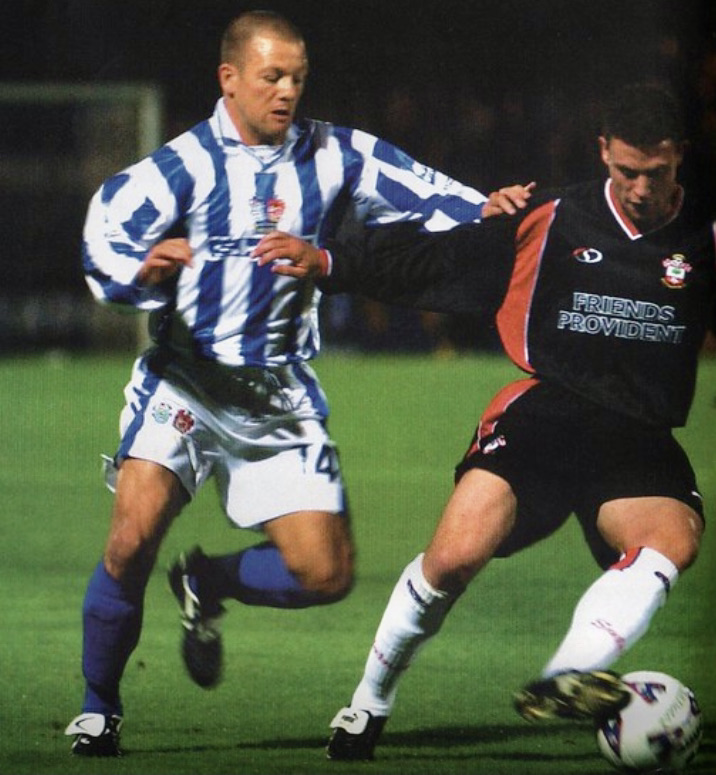
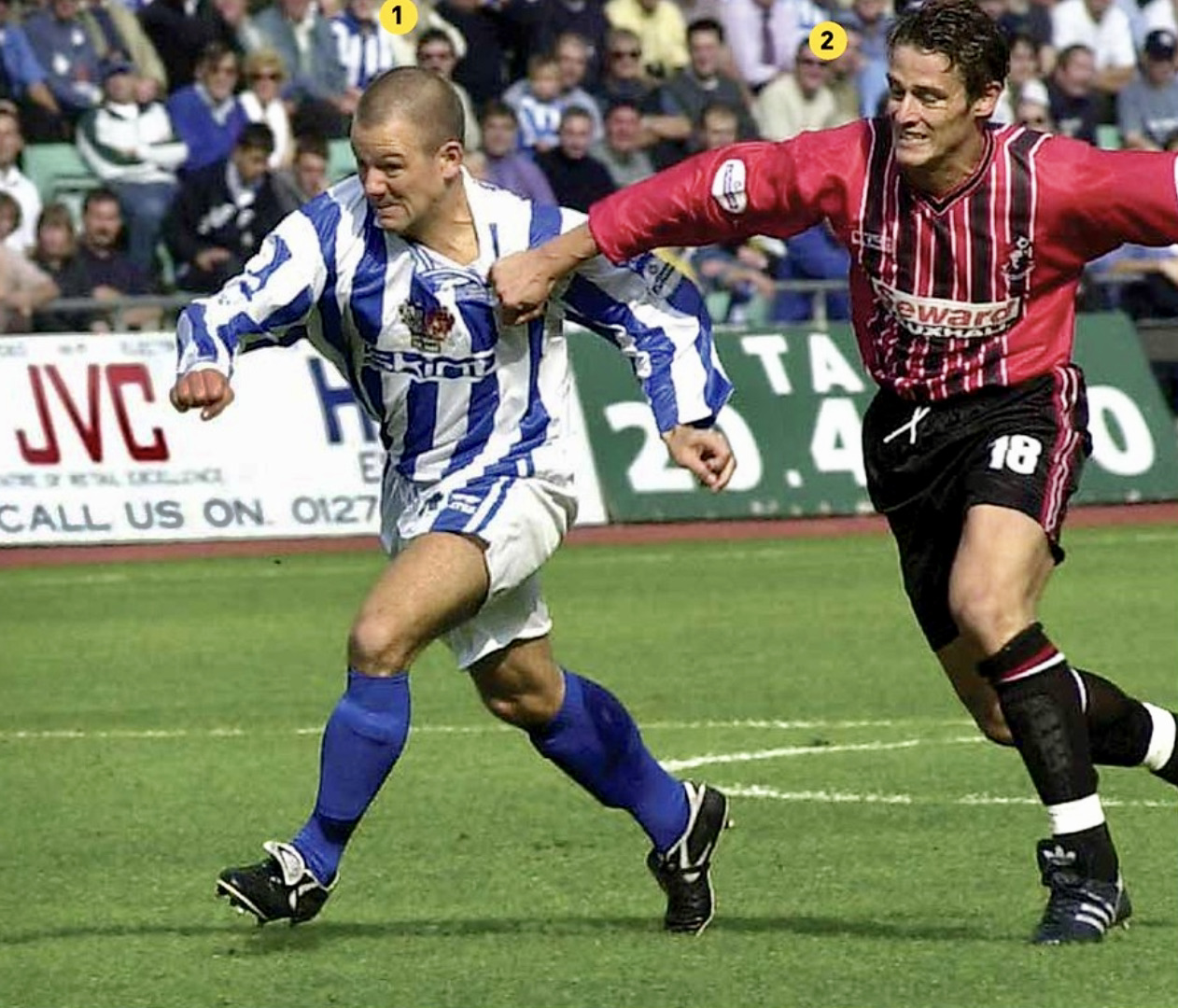
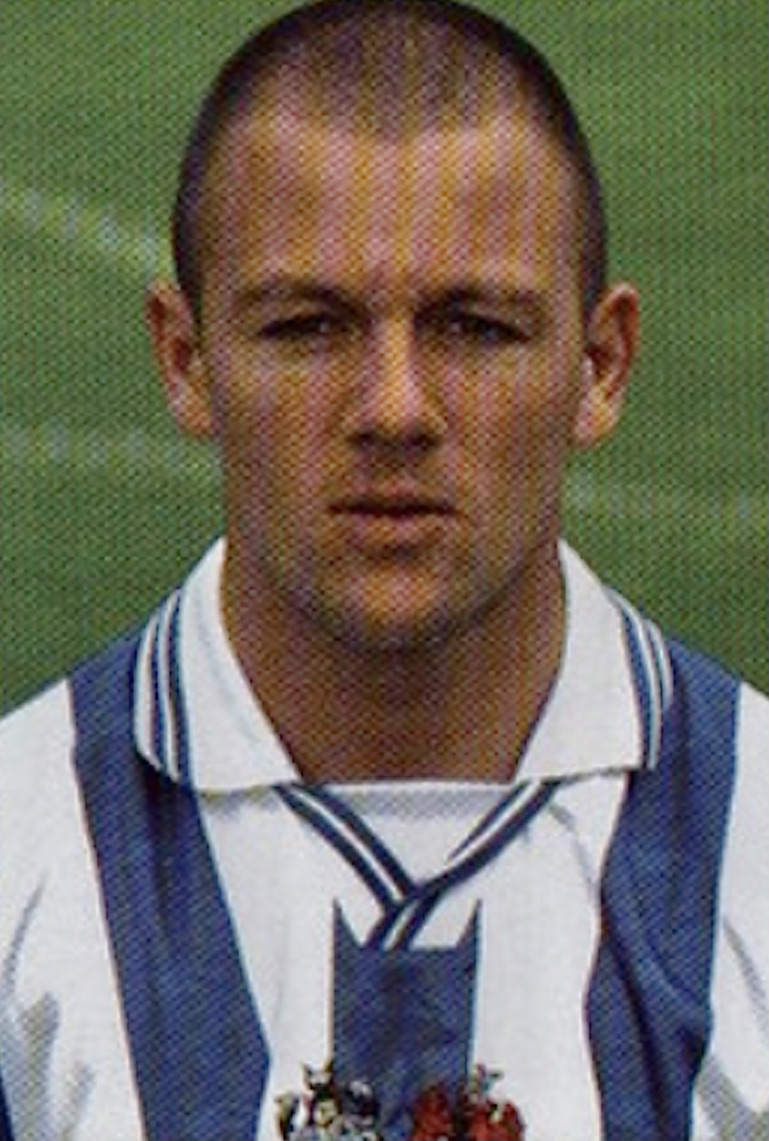
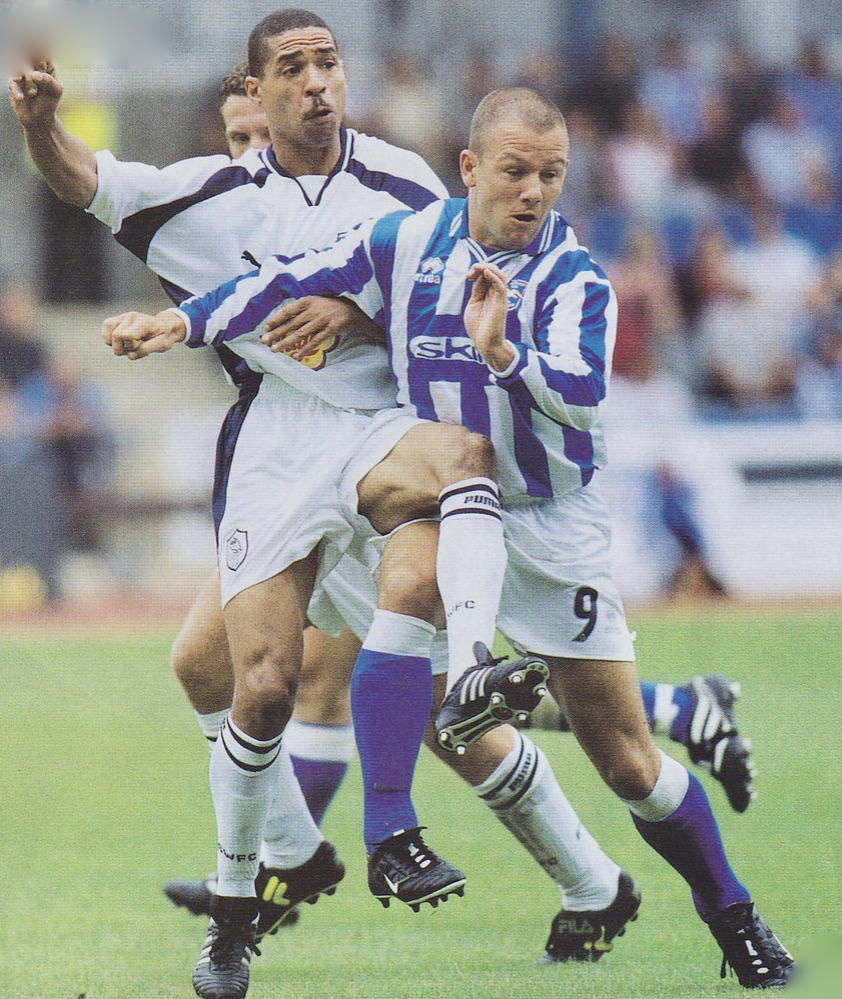
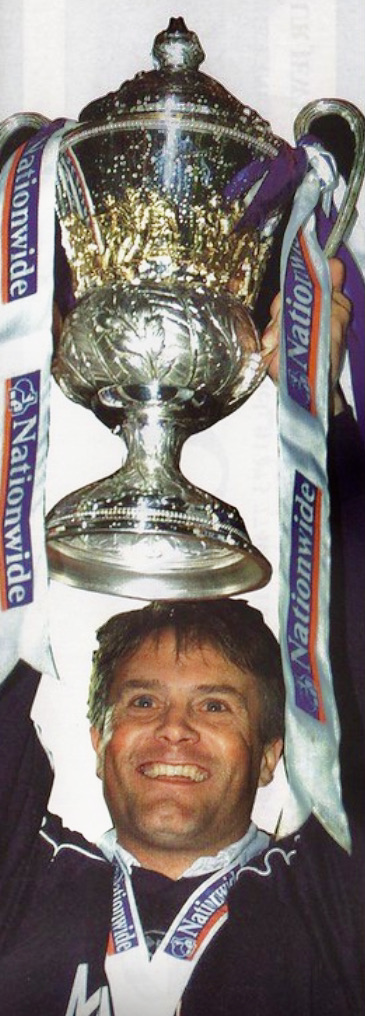
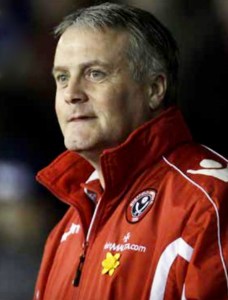
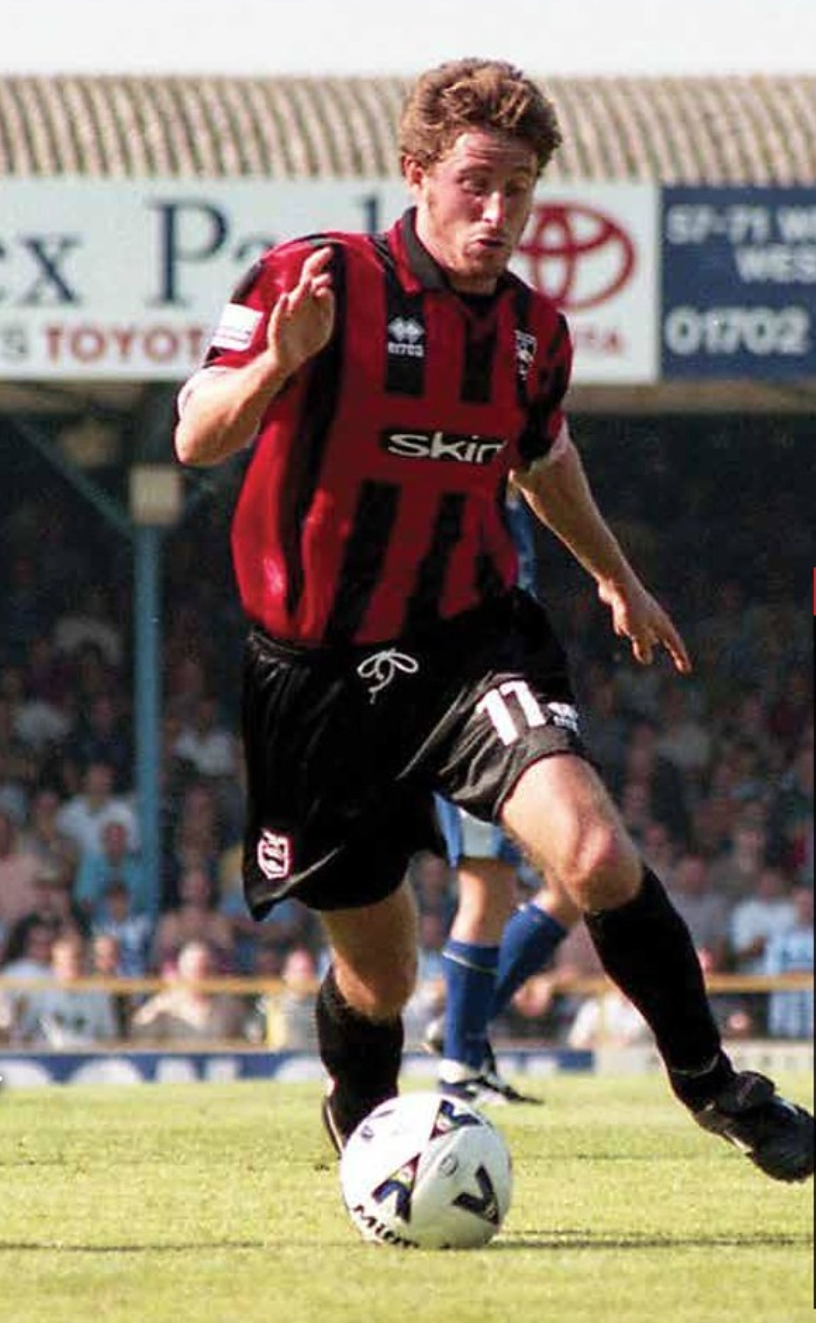
Melton took Micky at his word – and saw red 

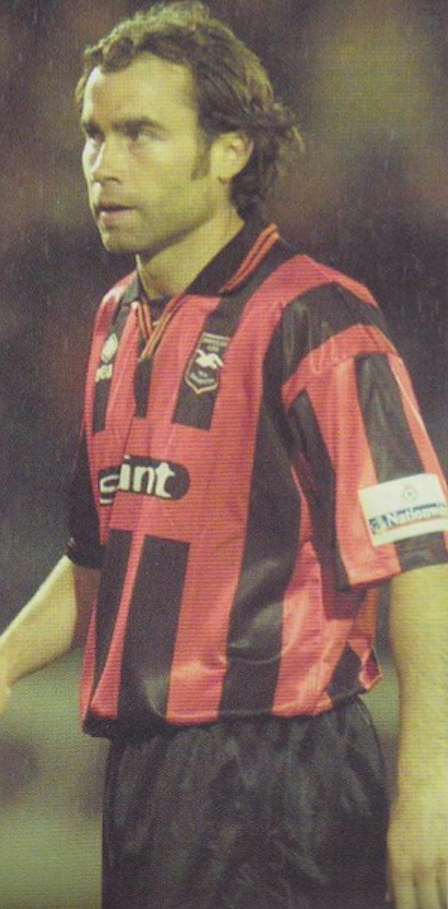
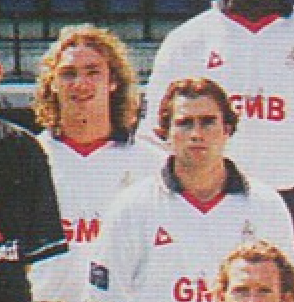
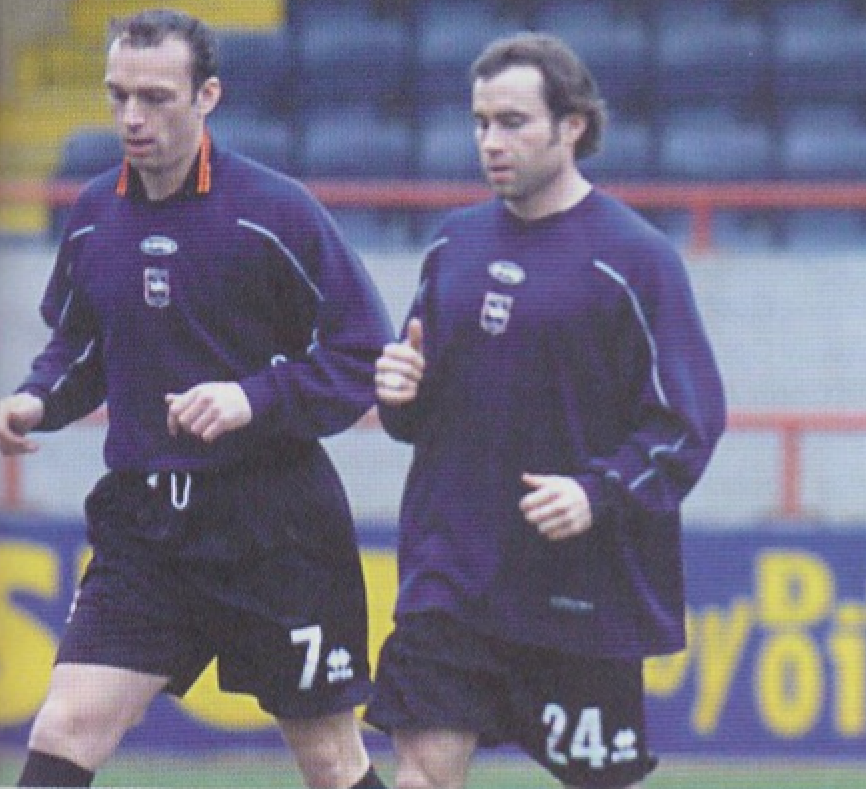
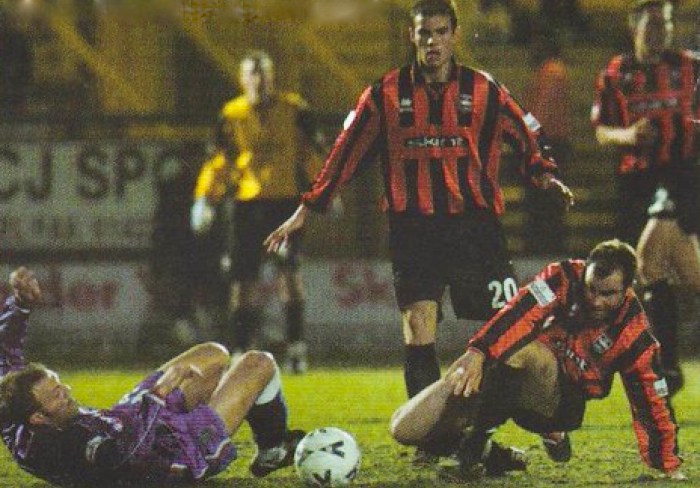
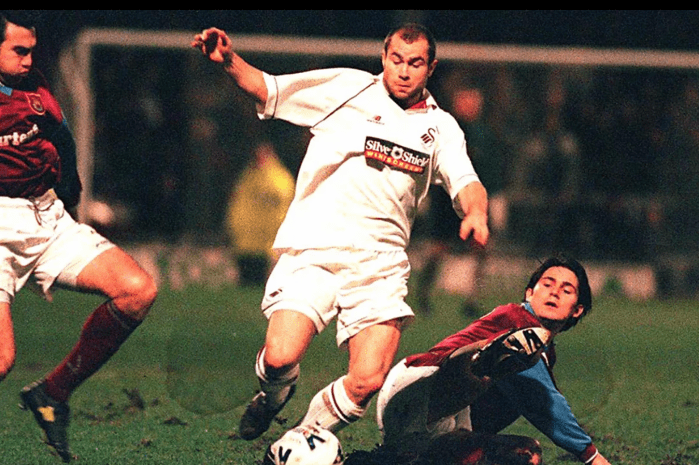
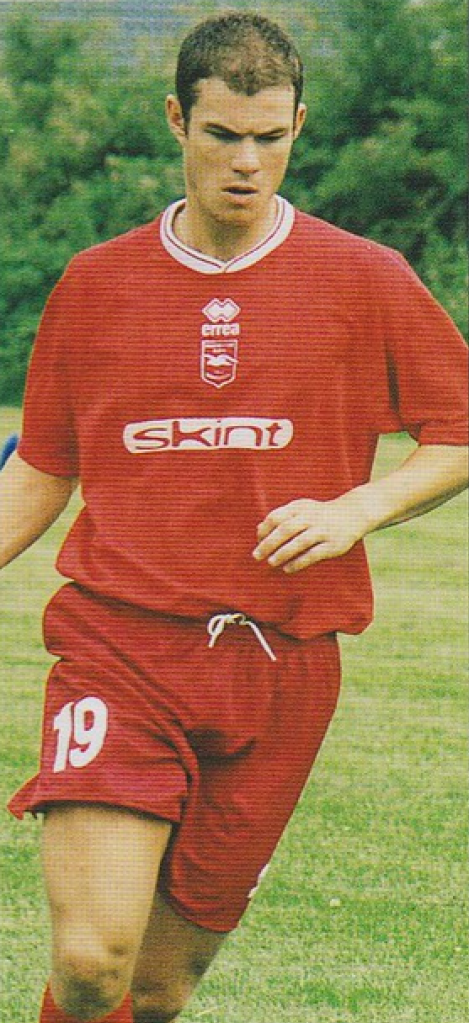
MIDFIELDER Steve Melton took manager Micky Adams at his word in a notorious pre-season friendly – and ended up being sent off after putting in a waist-high tackle on an opponent.

Adams subbed off a riled Richard Carpenter against Longford Town in July 2001 with instructions to former Nottingham Forest trainee Melton “to give the lad who was booting our players up in the air a taste of his own medicine. Make sure he knows you are around.”

Melton duly put in a flying lunge on Longford midfielder Alan Reynolds that saw him receive an automatic red card and the fall-out from the challenge sparked an almighty punch-up which ended up with Albion’s Charlie Oatway and opponent Alan Murphy also being sent off after an altercation.

That particular battle then led to an even bigger scrap involving coaches and even the Longford chairman who took a punch in the face from one of his own players!

The so-called pre-season “friendly” – later dubbed the Battle of Longford – was abandoned with only 44 minutes on the clock by inexperienced ref Dermot Tone, who had only stepped in to officiate because senior Irish referees were at a seminar.

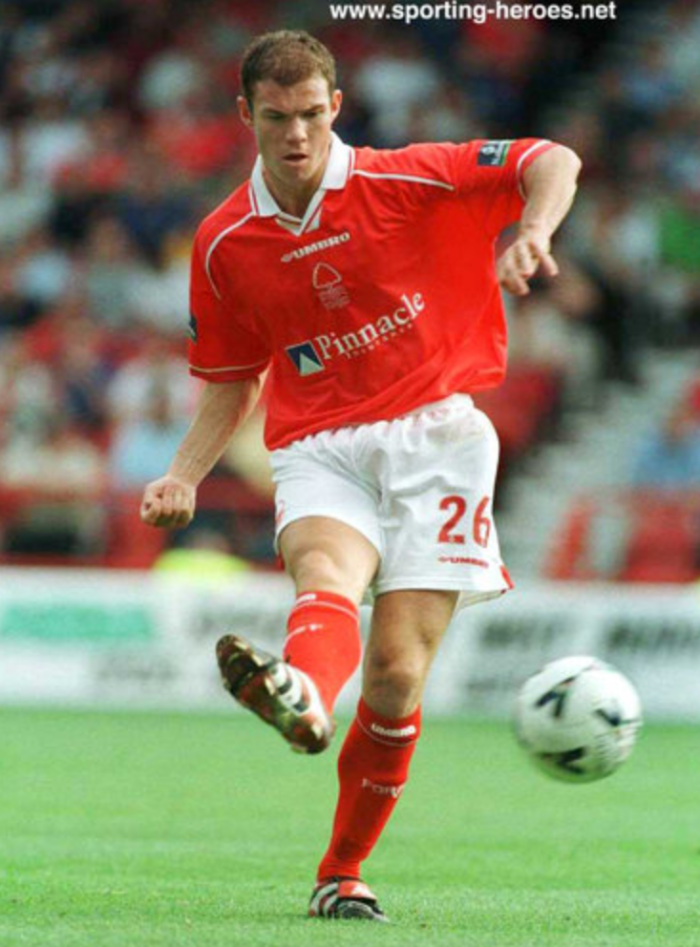
For Melton, it was all a far cry from making your Premier League debut two years earlier in front of 25,353 fans at the City Ground, Nottingham, in Ron Atkinson’s last-ever game as a manager. Melton was pitched in for already-relegated Forest for an East Midlands derby against Leicester and they went down in style (Blackburn and Charlton also went down), scraping a 1-0 win against the Foxes.

Born in Lincoln on 3 October 1978, Melton first linked up with Forest when he was just 11, playing at the centre of excellence. He signed full time at 16, a matter of days after finishing his GCSEs. He progressed through the youth team and reserves and it was during that time that he first worked with Adams, who’d been assistant manager to Dave Bassett before Atkinson’s arrival. 

Before he got close to the Forest first team, 18-year-old Melton and another trainee had experienced competitive football in Finland where Bassett had sent them to play for Sami Hyypiä’s old club MyPa on a three-month loan.

“He sent us out there to toughen us up. It also got us used to playing in a proper men’s league so that we learnt to value the prize of the three points and the standing within the first team,” he explained in a matchday programme interview.

That experience followed by his Forest first team debut didn’t have the outcome he wanted and after only three games under Atkinson’s successor, David Platt, he picked up an injury and couldn’t force his way back into the first team picture.

In February 2000, he switched 50 miles west to third tier Stoke City and admitted: “It seemed a good move as I didn’t have to travel too far. 

“It was a chance for me to play for a decent-sized club that were going strong in the cup and in the league. It was either that or play reserve team games for the rest of the year at Forest and wait for a break that I didn’t think was going to come.”

As it turned out, it was mainly a watching role, making only seven appearances as a substitute. He was a non-playing bench warmer alongside Chris Iwelumo (who did get on) when City won the Football League (Auto Windscreens Shield) Trophy at Wembley, beating Bristol City 2-1.

Stoke’s new Icelandic consortium hinted that they wanted to keep him on but in the absence of a contract offer, rather than risk uncertainty, he took up Adams’ offer to join fourth-tier Albion. 

A complimentary caption in the club match day programme

On a trial in the Emerald Isle the year before the Longford incident, Melton did enough across the week of the tour to earn a one-year contract. He had a long wait before getting a start but after 11 introductions as a substitute he finally made his full debut in February 2001, stepping in for Carpenter at Torquay after the regular midfield starter pulled out with an injured ankle. 

After playing his part in Albion’s first win (1-0 courtesy of Bobby Zamora) at Torquay for 36 years, Melton told The Argus: “I’m enjoying it here. I’ve settled in with the lads and I share a house with some of them.” 

On playing for Adams, he said: “I think Micky is going to be a really good manager. I enjoy working with him. A lot of the lads do. 

“Hopefully he will take Brighton up. He’s had a taste of managing at a higher level at Forest and I think he has the potential to do it again.” 

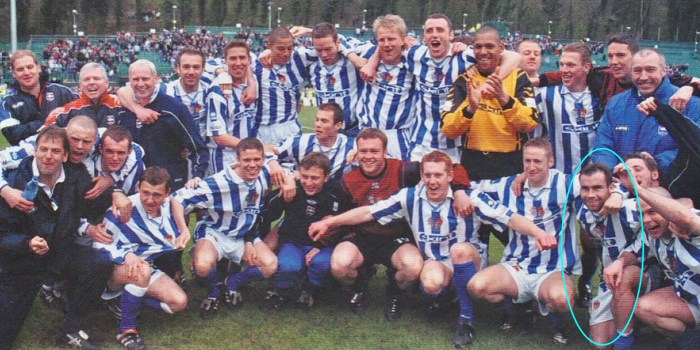
Melton’s outlook brightened the following month and he got starts in nine of the season’s remaining 15 matches as Adams led the Seagulls to promotion as champions. 

At home to his future employer Hull City, Melton made his home debut and scored his first goal for the club in a 3-0 win (Paul Watson and substitute Phil Stant also scored).

Reflecting on his involvement, he said: “It’s difficult to break in when the team keep winning every week, and they go unbeaten for 12 or 13 games, maybe drop a point but then go off on another run.

“It’s frustrating because you’re not playing, but you can’t really have too much of a case when the team is sat at the top of the league.”

Come the end of the season, he had done enough to be offered a two-year extension to his contract. As it turned out, the 2001-02 season followed much the same pattern as his first in terms of more appearances off the bench than starts.

He was on the scoresheet twice in the LDV Vans Trophy, scoring an extra time golden goal in a 2-1 home win over Wycombe Wanderers but was then inadvertently the fall guy in a 2-1 quarter-final defeat at Cambridge United.

Having given Albion a 36th-minute lead, latching on to Dirk Lehmann’s lay-off to fire a low right-footer past Lionel Perez from just outside the penalty area, he lost possession to Dave Kitson, who ran away to equalise, and then, four minutes into extra time, a shot by Armand One that was going wide took a wicked deflection off Melton’s shoulder to send United through to the next round.

A happier outing came when he made a rare start and scored as promotion-chasing Albion beat table-toppers Reading at the Withdean in February 2002. Peter Taylor’s Seagulls triumphed 3-1 on a rain-lashed night under the lights (Zamora and Junior Lewis also scored).

Goalscorers Melton and Zamora after a memorable win over Reading

“It was pleasing to start,” Melton told The Argus. “You have got to be patient and I have waited a good few months. 

“I have been on the outside for the last few weeks. Hopefully I can stay on the inside now. 

“Playing against the League leaders is a different matter completely from the LDV appearances that I made earlier in the season. 

“You can only do as well as you can when you are chosen to play and hopefully I did that. Once you have been given the shirt you have to try and keep it.” 

Melton’s goal was only the second league goal of his career and his first for 11 months. 

Taylor reckoned it was the best home performance since he took over from Adams the previous autumn and Albion won eight (and drew five) of the following 14 games to go on and clinch the third-tier title with the also-promoted Royals six points behind.

Melton scored Albion’s first goal of the 2002-03 season when he started in the 3-1 win at Burnley under his third Brighton manager, Martin Hinshelwood (Zamora and Paul Brooker also scored; Hinshelwood’s 18-year-old nephew Adam made his debut). 

Unfortunately, Melton tweaked a hamstring in the process and had to be subbed off. He only made nine more appearances (six starts plus three off the bench) as Hinshelwood’s short reign in charge ended with 10 league defeats in a row.

Incoming boss Steve Coppell brought in the likes of free agent Simon Rodger and Arsenal loanee Steve Sidwell and Melton found himself surplus to requirements.

It was in October 2002 that he moved to Hull on loan shortly after Peter Taylor had replaced Jan Molby as manager with the club about to move out of Boothferry Park and into the Kingston Communications Stadium.

Tiger Melton

Melton made 19 starts plus six appearances off the bench as the Tigers finished 13th in the old Third Division.

According to the website oncloudseven.com: “Despite his promise and Taylor’s persistence, Melton’s career at City was not a success and he showed only brief flashes of good form. Melton is, however, forever enshrined in the City record books because in December 2002 he scored the first ever goal at the KC Stadium against Sunderland, for the honour of lifting the Raich Carter Trophy.”

He found himself only on the fringes the following season and he had moved on to Boston United under Steve Evans by the time Taylor steered Hull to promotion as divisional runners up.

A recurring back injury restricted his playing time at Boston and during 2005-06 he was sent out on loan to Conference National side Tamworth. On his release from Boston in the summer of 2006, he switched to Southern League Premier King’s Lynn FC for two seasons.

Melton at Boston

In September 2008, he rejoined Boston with manager Tommy Taylor telling the club’s website: “Steve has great quality on the ball and that’s what we have been missing in the midfield area. 

Hopefully he will add another dimension to our team.”

But he was released at the end of the season and joined Lincoln United of the Northern Premier League Division One East, alongside his former Boston and King’s Lynn teammate Matt O’Halloran. After spells with Lincoln Moorlands Railway, Grantham Town and Worksop Town, he wound up his playing days back at Lincoln United.

In the meantime, his first job outside of football was in sales for mobile comms company Vodacom. He spent nearly seven years with the now defunct energy advice and installation company the Mark Group and since 2019 has worked for building services certification business The National Association of Professional Inspectors and Testers, where he is now commercial and compliance director.

Petterson the fall guy during disastrous winless run

ANDY PETTERSON conceded two goals in the first seven minutes of his Albion debut but still picked up the man of the match award when managing to deny visitors Walsall any further goals in a 2-0 defeat.

He pulled off a brilliant point-blank save on the stroke of half-time to deny goalscorer Jorge Leitao a second goal and later blocked the same player’s angled drive. Steve Corica had opened the scoring for the Saddlers.

The game on August Bank Holiday Monday in 2002 was part of a disastrous run under new manager Martin Hinshelwood. In only eight games as a stand-in for injured Michel Kuipers, Petterson conceded eighteen goals, including four against his old club, Portsmouth, in only his second game.

He shipped another four in a game at home to Gillingham, one of which the matchday programme described as “the most embarrassing moment of Petterson’s long career”.

With the score 3-2, and Albion committing everyone forward, including the goalkeeper, in search of an equaliser, when 10-man Gillingham broke on a counter attack, backpedalling Petterson fell over giving Gills striker Kevin James an open goal to notch a fourth for the visitors.

Petterson only appeared once under Hinshelwood’s successor, Steve Coppell, when Kuipers had been sent off in the 89th minute of a home game against Bradford City. Paul Brooker was withdrawn and the sub goalie went between the sticks, although his first involvement was to pick the ball out of the net, Andy Gray having scored from the penalty kick awarded for the infringement that saw Kuipers dismissed.

In pouring rain, Albion – and Petterson – clung on throughout five added minutes for a 3-2 win, bringing to an end a 14-game winless league run. Bobby Zamora scored two penalties for the Seagulls and new arrival Simon Rodger, a loyal Coppell lieutenant, curled in a beauty from outside the area.

Although he was a non-playing sub on two further occasions, Petterson was let go. In a recent interview, he said he had been nursing a recurring calf injury during his time with the Albion.

Albion were the 12th of a remarkable 21 clubs the Aussie ‘keeper joined on loan or permanently.

Wolverhampton Wanderers were another stopping off point for the perennial back-up ‘keeper from Fremantle and it was one of his regrets that he only had a four-month loan spell at Molineux, having previously spurned a two-year deal with the Black Country side to make what turned out to be a career-damaging move to Pompey.

Instead of building on a career that had shown signs of promise at Charlton Athletic, Petterson flitted from club to club without ever putting down roots.

Born in Fremantle, Western Australia, on 26 September 1969, he was still only a teenager when he arrived in the UK and signed for Luton Town, where he spent four seasons.

The Hatters Heritage website recalls: “Andy was so desperate to make a name for himself in the English professional game that he paid his own passage to take up a trial at Luton. Fortunately, his gamble paid off as he was offered a contract at Kenilworth Road in 1988 although he had to wait until the start of the 1992-93 season before making his League debut.

“Impressing in pre-season with his shot stopping ability and quick reflexes, Andy was ever present for the first 14 games but a calamitous performance during a 3-3 draw at Cambridge effectively put paid to his Luton career.”

Petterson joined Alan Curbishley’s Addicks for £85,000 in July 1994, was their player of the season in 1996-97 in the First Division and played for them in the Premier League.

But he was generally no. 2 to Sasa Ilic, and subsequently dropped down to third choice behind Simon Royce, another goalkeeper who spent time with the Seagulls. The situation prompted Petterson to join struggling Portsmouth on loan in November 1998.

“Portsmouth were in financial trouble and down at the bottom of the table,” he recalled in an interview with the Argus. “I went there for three months and everything went very well. Then in the summer I was out of contract at Charlton.

“Portsmouth were one of three clubs in for me and they offered me quite a good deal, so I decided to sign for them. Everything went well under Alan Ball for the first six months, but he got the sack and it was downhill for me from there.

“We had another four managers (Tony Pulis, Steve Claridge, Graham Rix and Harry Redknapp) in the three years I was there and my face never fitted really. It was just unfortunate I went there. I was happy with the way it started, and it was a good club to be at, but it just wasn’t meant to be for me.”

In an extended interview with Neil Allen of The News, Portsmouth, in June 2020, Petterson reflected on his missed opportunity to join Wolves instead of Pompey, when he had been released by Charlton.

“Wolves’ boss Colin Lee was interested,” he said. “I was in Australia and flew back to England ahead of signing at Molineux on a two-year deal on the Monday afternoon.

“Then, late Sunday, my agent called. Milan Mandaric had taken over Pompey and they wanted to talk on Monday morning.

“That was the club I wanted to join, I had familiarity there. I signed a three-year deal. If the club had been taken over 24 hours later, the move would never have happened and I would have ended up at Wolves.”

Petterson told The News: “It was the beginning of the end when I went back to Pompey. My career never really recovered. I was kind of a journeyman before that, but at least was signed to a parent club and sent on loan to places.

“After moving to Pompey permanently it was six months here, three months there. It was the beginning of the end for my career. I guess everything happens for a reason – and for some reason it happened to me.”

Ipswich (three times), Swindon, Bradford, Plymouth, Colchester, Wolves, Torquay and West Brom were all temporary moves for the Australian stopper. After his short stint in Sussex, he also went to Bournemouth, Rushden and Diamonds, Southend, Walsall and Notts County.

“I always had belief in my ability and always wanted to play,” he said. “I think I was a good goalkeeper, although maybe mentally didn’t have the belief in myself enough.

“I’m a bit of a laid-back, casual sort of guy. Sometimes you have to be that pushy arrogant sort of person for the coach to take notice of you a bit more. I tried to do it, as a footballer you have to be a bit of an actor, but it just wasn’t in my nature.”

Referring to the fact he had 16 years as a professional footballer in the UK, he added: “That’s what gives me the belief that I was a decent goalkeeper. But something wasn’t quite there for me to go to the next level, I guess.”

He eventually only got a run of regular games when he returned to Australia and played for Newcastle Jets and then ECU Joondalup.

After his playing days were over, he became a goalkeeper coach for several clubs, including Bali United in Indonesia for a while. In August 2022, he was appointed goalkeeper coach at East Bengal FC.

“I have experienced the highs, the lows, all that kind of stuff, so can relate to goalkeepers,” he told Allen. “I’ve been through plenty.”

Tony Rougier couldn’t have wished for a better Albion start

A GOAL by Tony Rougier three minutes into his debut as a substitute gave Brighton a glimmer of hope in their battle to avoid relegation.

His strike against Mark McGhee’s mid-table Millwall side at Withdean Stadium on 22 February 2003 was the only goal of the game and lifted Albion out of the bottom three of the Championship.

When Bobby Zamora dummied Kerry Mayo’s pass to allow Arsenal loanee Graham Barrett to turn and move the ball goalwards, Rougier nipped in to complete a neat finish past Tony Warner in the Millwall goal.

Manager Steve Coppell had sent on the Reading loanee as a 61st minute substitute for winger Paul Brooker although he admitted to Stuart Barnes of The Guardian: “I honestly didn’t know if Tony would make a difference, but I felt he would pep up everybody else because we were starting to lose our grip.

“Getting out of the bottom three will give the players a lot of self-esteem. For a long time this season they have questioned whether they belonged at this level.”

Trinidad and Tobago international Rougier joined the Seagulls having been sidelined by Alan Pardew at Reading who paid £325,000 when signing him from Brian Horton’s Port Vale.

Horton gave the Argus an insight of what Albion fans might expect when he said in an interview: “Tony has a great build and he is a threat with his pace and strength.

“We had to sell him because we needed the money and he was one of our major earners.”

He had been Vale’s leading goalscorer with eight goals in 38 games when they were relegated from the First Division in 2000 before moving to Reading that August.

Rougier made a total of 84 appearances for Reading, scoring six goals, and in his first season helped them to the Division Two play-off final where they lost 3-2 to Walsall (and Rougier scored an own goal after going on as a substitute). But a year later, he made 20 starts and 13 appearances off the bench as Reading were promoted in second place – behind the Albion!

He had scored twice in 12 outings for Pardew’s high-flying Royals in 2002-03, including in a 1-0 win against Albion at Withdean. But competition for places was fierce, with the likes of Nicky Forster, Darius Henderson, John Salako and Nathan Tyson.

Coppell told the Argus: “I speak with Alan fairly regularly but this came totally out of the blue when I phoned him up.

“Tony is a big, strong lad and he gives us options. He can play as a wide man or down the middle and the move suits Reading, the player and me.”

Getting to grips with Jason Brown of Gillingham

Coppell needed forward cover because Gary Hart was about to start a four-match suspension, Zamora was banned for the next away game at Gillingham, Paul Kitson was still injured and Barrett was struggling for form and goals.

The following matchday programme observed Rougier had not been signed for his goalscoring prowess, but rather for his “power, direct running, and causing havoc that others can exploit”.

But the goal was very welcome in a season that might well not have ended in relegation if Coppell had started the season in charge rather than joining after so many games had already been lost under Martin Hinshelwood.

Rougier made his first start in a 3-0 defeat away to Gillingham playing up front with Barrett when Zamora and Hart were suspended.

He featured in home wins over Rotherham United (2-0) and Nottingham Forest (1-0) as well as an away defeat at Stoke City (0-1), but he missed the 2-1 defeat at Sheffield United after twisting his right ankle against Forest.

He bowed out in style in his final appearance, making one goal and scoring a second in a memorable 2-2 draw away to Ipswich Town.

I took my then 14-year-old son Rhys to the clash at Portman Road and the lively midfielder-cum-striker in the no.34 shirt, who had been taken to the hearts of the Albion faithful, was suitably serenaded with the chant ‘Ra-ra-ra Rougier’ to the tune of the popular vaudeville and music hall song Tarara Boom-de-ay.

His first significant involvement saw him go up for a header from Hart’s cross and Town goalkeeper Andy Marshall diverted the ball into his own net to gift Albion an equaliser.

Future Albion loanee striker Darren Bent missed a penalty that would have put Ipswich back in front, and then, with 10 minutes to go, Albion fans were buoyant with expectation when Rougier slammed the ball into the roof of the net after Ipswich had failed to clear their lines.

Unfortunately for Brighton, a 30-yard thunderbolt from Martin Reuser flew past Dave Beasant to put the home side level and Albion had to be content with a point, which ultimately wasn’t enough to avoid making an immediate return to the division they’d left the previous season.

While the player was keen to extend his stay, Pardew wanted him back to help with Reading’s promotion run-in, although thankfully he wasn’t involved in Brighton’s shock 2-1 win at the Madejski Stadium on 4 April (and Steve Sidwell, who had been on loan at the Albion earlier that season was an unused sub). Goals from Brooker and sub Kitson took the spoils for the Albion, Cureton netting for the home side.

The Royals finished fourth in the league before losing 3-1 on aggregate to Wolves in the play-off semi-finals, and Rougier was released on a free transfer having scored three times in 13 starts and nine appearances off the bench.

Rougier told the Argus he would be interested in returning to the Albion, but nothing came of it and he joined Brentford instead. Manager Wally Downes believed the player had “real quality” although Brentford fans seemed to have divided opinions on what he brought to the side.

‘Snappy’ on The Griffin Park Grapevine reckoned: “The guy is a huge asset, especially in the last 10 minutes of a game when he can hold the ball up and dance his way around players like they were statues and relieve the pressure on the defence.”

‘West Ealing Bee’ agreed: “He is an asset to the club and a very important part of the team.” But ‘Boston Bee’ had a totally different take on the player:Even when he actually tried (15min/match) he looked like he wasn’t trying. His lack of interest in the game going on around him drove me crazy.”

Rougier made 34 appearances for the Bees, scoring five goals but when Martin Allen took over as manager in March 2004, Rougier was one of five players he allowed to leave Griffin Park as part of a squad overhaul that ultimately helped them to a last-day escape from relegation.

Meanwhile, Rougier linked up with another ex-Albion captain, Danny Wilson, at Bristol City on a free transfer. Indeed, Rougier appeared for the Robins when they lost 1-0 to McGhee’s Albion in the divisional play-off final in Cardiff on 30 May.

But when Wilson lost his job that summer, Rougier followed him out of the exit and he returned to Trinidad, where he won the last of 67 international caps for Trinidad and Tobago.

Rougier stepped into coaching

He has since turned to coaching, becoming a UEFA A licensed coach, and attained a degree in sports development. On his LinkedIn profile, he describes himself as the founder, president and technical director of FC South End, and, in 2014, among his past coaching experiences was a spell working with his nation’s under 20 squad.

Four years later, he had moved to the United States to coach the New England Revolution academy team.

Born on 17 July 1971 in Sobo, a village in south west Trinidad, his footballing career was initially confined to his home country.

Tom Lunn, writing for Reading fan website thetilehurstend.sbnation.com in 2019, profiled Rougier describing how the player began his senior footballing career in his home country with La Brea Angels. His Wikipedia page says he also played for Trintoc, United Petrotrin, and Trinity Pros.

An Albion matchday programme article said Rougier then moved to New York where he spent a year working in the baggage department at John F Kennedy airport before heading to the UK.

After overcoming work permit issues, he was taken on by Raith Rovers where, over the course of two years, he became something of a cult hero. In 2018, he returned to Fife to be inducted into the club’s Hall of Fame.

“This is where it all started,” he said in an interview with the club’s TV channel. “It never felt the same whichever club I went to afterwards. The Fife people gave me respect and it’s something I’ll never forget.”

Rougier welcomed back in Fife

During the interview, Rougier remembered fondly an occasion when he man-marked Paul Gascoigne, playing central midfield against Rangers.

His stand-out moment was a UEFA Cup second round tie in Munich’s Olympic Stadium on 30 October 1985 when Raith only narrowly lost 2-1 to Bayern Munich who boasted the likes of Oliver Kahn in goal and Jurgen Klinsmann up front.

His performances for Raith earned him a £250,000 move to Hibernian. He scored four times in 45 matches for Alex McLeish’s Edinburgh outfit but in January 1999 joined Port Vale, signed by Horton’s predecessor John Rudge for £175,000.

By then, he had established himself in the Trinidad and Tobago national side, a teammate of Dwight Yorke, and often being chosen as captain.

In his own words, he describes himself as: “A highly experienced football coach and former professional player with a career in the game spanning more than 25 years, I has successfully made the transition into coaching, management and club operations through a consistent focus on long term player and team development.

“A former national team captain with Trinidad & Tobago and a promotion winner in both England and Scotland, I have been able to effectively apply my on-field experience to guide team success and coaching strategy at professional, grassroots and school level.

“I am a positive, dynamic and passionate professional who is committed to my continued progression as a coach. I am always open to opportunities in which I can develop while positively impacting a football club or organisation, and would relish the opportunity to work with elite players within an ambitious environment.”

Andy Arnott’s United dream dashed by injury

A PLAYER who was on the brink of signing for Man Utd for £100,000 ended up playing for the Albion in exile.

But for an untimely hernia injury, Andy Arnott would have been an Alex Ferguson signing at Old Trafford.

As it turned out, the moment passed and the opportunity didn’t arise again. He later made 28 appearances for the Seagulls during the 1998-99 season when home games were played at Gillingham’s Priestfield Stadium.

It was a ground Arnott was familiar with. Born in nearby Chatham on 18 October 1973, he joined Gillingham as a trainee and had only served one year of his apprenticeship when he was taken on as a professional.

Manager Damien Richardson gave him his debut for the Fourth Division club only four games into the 1991-92 season when he was just 17.

It couldn’t have gone better because he scored the Gills’ opening goal in a 2-0 home win over Scarborough.

This was a Gillingham side that included summer signing Paul Clark, who had been part of Alan Mullery’s successful Brighton side in the late 1970s, and Mike Trusson, who’d won promotion from the Third Division with the Seagulls under Barry Lloyd. A young Richard Carpenter was also breaking through.

Arnott scored three goals in 23 appearances by the season’s end although one goal and two appearances against Aldershot were later expunged from the records because the Shots were expelled from the league.

Nonetheless, the youngster’s emergence hadn’t gone unnoticed higher up the football pyramid and the offer of the chance to join United came along, ostensibly so that he could feature in their youth team’s involvement in the end-of-season Blue Star youth tournament in Zurich.

This was the era of the famous ‘Class of 92’ and Arnott found himself playing alongside David Beckham, Paul Scholes and Nicky Butt.

“After impressing during his spell with United, Ferguson made a £100,000 offer to Gillingham which was turned down by the then manager Damien Richardson,” Albion’s matchday programme noted.

In action for Gillingham against Albion’s Nicky Bissett

The player then suffered a hernia injury that put him out of the game for a year, putting paid to any further interest from United.

“I was gutted at the time, but it was a case of just getting on with returning to fitness and playing football,” Arnott said.

Back at Gillingham, he played 50 matches and scored 12 goals but then, in January 1996, got a £15,000 move to Leyton Orient. He spent a season and a half with the Os under manager Pat Holland and played in every position to help out the team, including goalkeeper in one emergency.

Arnott played under Micky Adams at Fulham

In the summer of 1997, after Fulham’s promotion from Division Three under Micky Adams, Arnott moved to Craven Cottage for an undisclosed fee (thought to be £25,000).

Within a few months, Mohammed Al Fayed took over the club and sacked Adams.

“All of a sudden Fulham went from being an ordinary Second Division outfit to a multi-million pound club,” he said. “I felt sorry for Micky as he had done a fantastic job, but he did foresee what was coming and sorted out long term contracts for most of the players.”

The new management duo of Ray Wilkins and Kevin Keegan brought in their own players and Arnott found himself confined to the reserves with the likes of Mark Walton, winger Paul Brooker, and forward Darren Freeman.

He scored twice for Fulham Reserves in a 3-0 win over Albion’s reserve side on 21 October 1998, and that persuaded Brian Horton to take him on.

“A few clubs had shown an interest around that time, but Brighton were the first that I spoke to and I liked what I was hearing so I signed straight away,” he said.

Horton signed him by the end of the same month for £10,000, plus another appearance-related £10,000, and said in the matchday programme he was “absolutely tremendous” on his debut. It came in a 1-0 win in pouring rain at Barnet when Charlton loanee defender Emeka Ifejagwa scored the only goal of the game on his debut. “He (Arnott) and Jeff Minton forged a good partnership and I am looking for that to flourish,” said Horton.

In his player-by-player commentary of performances, programme columnist Paul Camillin said: “Brilliant debut. He showed a good array of passing skills and he might have the bite we’ve been lacking.”

It was the wrong kind of bite he displayed in only his fourth game, though, when he was shown a red card in the 55th minute of Albion’s 2-0 win at Horton’s old club Hull City.

Defender Ross Johnson also went for an early bath for a second bookable offence but Albion’s nine men hung on for 35 minutes to complete their fourth successive away League win: the best such run for 62 years!

There’s little doubt Arnott’s arrival coincided with an upturn in the side’s form and in the matchday programme he took time to praise Albion’s loyal followers. “It is a fantastic advantage to have the number of away supporters we do,” he said. “It makes you want to play that little bit more to give them something back. They are absolutely magnificent.”

Arnott and Jamie Moralee

In the absence of Gary Hobson and Ian Culverhouse, Arnott was given the captain’s armband although that discipline was a bit questionable at times. He saw red for a second time, after Jeff Wood had taken over from Horton, for a second bookable offence at home to his old club Orient – Os captain Dean Smith (manager of relegation-threatened Leicester) also went for a second yellow – although Wood and Orient boss Tommy Taylor both slammed referee Rob Styles for his officiating.

Man of the Match

Wood declared: “Too many officials want to stamp their authority on the game early and flash cards like they are going out of fashion.”

Although Arnott saw out the season in the starting line-up, when his old boss Adams took over from Wood, by the time the new season got under way back in Brighton, Adams had signed Paul Rogers and Charlie Oatway as his preferred midfield pair.

By the end of September, Arnott had been snapped up by Second Division Colchester United; initially on loan and then permanently when their new boss Steve Whitton completed a direct swap that saw Warren Aspinall join the Seagulls.

However, Arnott made only four starts plus eight appearances off the bench in that first season and his time with United was blighted by a long-standing groin injury.

“The whole thing has been an absolute nightmare. I have been struggling with the injury for 14 months and despite loads of rest, two operations and four cortisone injections, the problem is as bad as ever,” he told Colchester’s Daily Gazette in January 2001.

“I was really struggling just before Christmas and I visited the specialist who told me I’m pretty near to exhausting my options.

“When it’s at its worst the injury is unbearable, especially when I turn or attempt to hit a long ball.

“I’m still only 27 with what should be many years left in the game.”

Unfortunately, though, he was forced to call time on his professional playing career and dropped into non-league initially with then-Conference side Stevenage, then Dover Athletic, where he was captain, Welling United and Ashford Town.

After his playing days were over, he settled in Rochester and became a project manager for Dryspace Structures while retaining his football links as a coach for Ebbsfleet United’s under 16 team.

Mixed fortunes at Brighton for Liverpudlian Lee Steele

ONE-TIME Liverpool triallist Lee Steele was part of the Albion squad which won back-to-back promotions from the fourth and third tiers.

Unfortunately for him, a certain Bobby Zamora was almost always ahead of him in the pecking order, along with Gary Hart, so the diminutive striker often had to be content with involvement off the subs bench.

Nonetheless, he contributed important goals as the Seagulls under Micky Adams went up from League Two in 2001 and from League One in 2002 under Peter Taylor.

His first season at Brighton was marred by a drink-driving incident which, in hindsight, he believed tainted the rest of his time at the club. Indeed, as the season drew to a close, he was put on the transfer list and was at loggerheads with Adams.

“I told him I’d prove him wrong, and he said that only one player had said that to him before and gone ahead and done it,” Steele told Spencer Vignes in a matchday programme article. After shedding a few pounds and improving his fitness, he said: “I scored loads of goals in pre-season and worked my way into the side.

“I got a few more as the season began, and then he left and I was back to square one with Peter Taylor.” Steele said Taylor was easier to get on with than the “totally demanding and driven Adams” although he reckoned: “The intensity went from our game a fair bit.”

Nevertheless, in the 2001-02 season, he made 25 starts plus 19 appearances off the bench and the most important of his 10 goals was the 91st-minute winner in an Easter Monday 2-1 win over Bristol City at the Withdean after he’d gone on as a 30th-minute sub for Paul Brooker, who’d turned an ankle.

Argus reporter Andy Naylor pointed out how Steele had gone from villain to hero after getting himself sent off in a reserve game just as Zamora was ruled out for three games with a shoulder injury. As it turned out, that goal against City was his last in an Albion shirt.

In its end of season play-by-player analysis, the Argus said of Steele: “An enigma. More to offer than he has showed, although he would argue a regular run in the side would help. Still managed to finish with ten goals and has the pace and power to trouble defenders.”

However, there was no more to offer Brighton because Taylor’s departure that summer coincided with Steele’s Albion exit too.

Reflecting on his time at the Albion in another Vignes interview for the matchday programme, Steele said: “I wasn’t used to playing substitute all the time, which I found hard to adjust to. Then when I did come on, I used to put myself under so much pressure that I wouldn’t deliver the goods. It still haunts me actually. OK I was in Bobby’s shadow, but I was at a massive club and should have done better.”

He moved to Oxford United on a two-year deal, but didn’t enjoy a happy time under Ian Atkins, and then joined Leyton Orient where some vital goals – including one that earned the Os promotion while simultaneously relegating his old club out of the league – helped earn him a ‘fans favourite’ tag.

After the Os, he had a season with Chester City, then dropped out of the league to return to Northwich Victoria.

He moved on to semi-pro side Oxford City but was sacked for a homophobic tweet about Gareth Thomas, which he said was tongue-in-cheek. Northern Premier League side Nantwich took him on, although he only played one game for them.

Born in the Garston district of Liverpool on 2 December 1973, Steele was a ‘Red’ from an early age, first being taken to watch them aged six and idolising Ian Rush. He was educated at St Austin’s Catholic Primary School, Liverpool, Holmwood School and then St Mary’s College.

The young Steele harboured ambitions of becoming a professional golfer rather than a footballer but, when that didn’t work out, he started playing football with non-league Bootle while working for his uncle as a bricklayer.

“I managed to get a trial for Liverpool,” he told Andy Heryet in the Albion matchday programme. “I hoped they would ask me back, but I didn’t hear anything from them, which was disappointing as they promised me that I’d hear either way, but they never got back to me.”

It was Northwich Victoria who propelled him towards a career as a professional, signing him as cover ahead of a FA Trophy final against Macclesfield.

Steele scored five goals in three end of season games, earned a place on the bench at Wembley and got on for the last 20 minutes, although Victoria lost.

In his second season at Northwich, his reputation was growing as a prolific striker and Third Division Shrewsbury Town snapped him up for £40,000 – a decent-sized fee for a non-league player.

“I wanted to go. I’d always wanted to be a professional footballer, ever since it became clear I wasn’t going to make it as a golfer,” Steele told Heryet.

He spent the next three seasons with the Shrews although the club’s struggles at the wrong end of the league prompted him to look for a move.

While he was keen to go to Tranmere Rovers, who’d shown an interest, no deal was forthcoming, but Brighton went in for him and, having played against them the season before, he liked what he saw.

Steele has had several strings to his bow since finishing his playing career: he’s a qualified licensed UEFA B coach, a personal trainer and a nutrition advisor. Clients have included pro footballers, elite junior tennis players, 16-times PDC World Darts Champion Phil ‘The Power’ Taylor and Team GB age group triathletes.

He also spent a year as a fitness coach with Oldham Athletic during Lee Johnson’s reign as manager and two years as a scout for his old club, Leyton Orient.

Since 2008 he has been operations manager for Kickback Tax (a tax advisor agency for footballers) and, since December 2021, has been senior scout for Northampton Town.

Confrontation was seldom far away in Micky Adams’ career

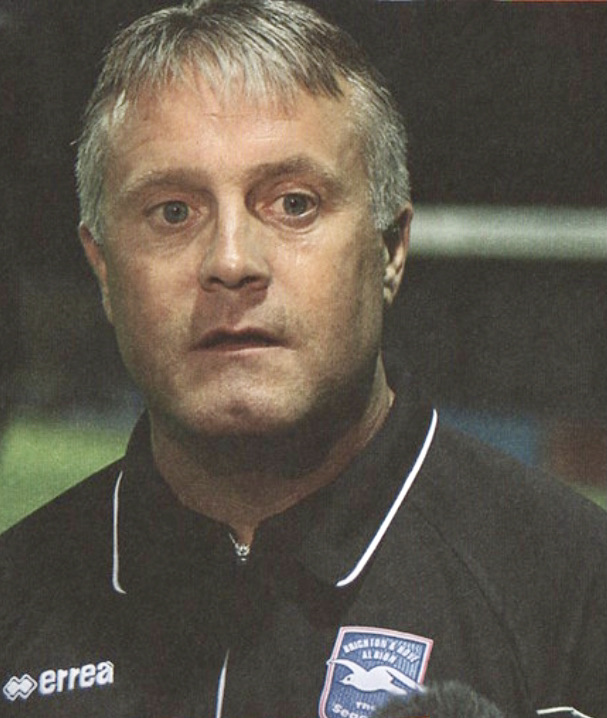
THE FIRST player ever to be sent off in a Premier League game managed Brighton twice.

Fiery Micky Adams saw red playing for Southampton when he decked England international midfielder Ray Wilkins.

“People asked me why I did it. I said I didn’t like him, but I didn’t really know him,” Adams recalls in his autobiography, My Life in Football (Biteback Publishing, 2017).

It was only the second game of the 1992-93 season and Adams was dismissed as Saints lost 3-1 at Queens Park Rangers.

Adams blamed the fact boss Ian Branfoot had played him in midfield that day, where he was never comfortable.

“He (Wilkins) was probably running rings around me. I turned around and thumped him. I was fined two weeks’ wages and hit with a three-match ban.”

It wasn’t the only time he would have cause not to like Wilkins either. The former Chelsea, Manchester United and England midfielder replaced Adams as boss of Fulham when Mohammed Al-Fayed took over.

His previously harmonious relationship with Ray’s younger brother, Dean, turned frosty too. When Adams first took charge at the Albion, he considered youth team boss Dean “one of my best mates”. But the two fell out when Seagulls chairman Dick Knight decided to bring Adams back to the club in 2008 to replace Wilkins, who’d taken over from Mark McGhee as manager.

“He thought I had stitched him up,” said Adams. “I told him that I wanted him to stay. We talked it through and, at the end of the meeting, we seemed to have agreed on the way forward.

“I thought I’d reassured him enough for him to believe he should stay on. But he declined the invitation. He obviously wasn’t happy and attacked me verbally. I did have to remind him about the hypocrisy of a member of the Wilkins family having a dig at me, particularly when his older brother had taken my first job at Fulham.

“We don’t speak now which is a regret because he was a good mate and one of the few people I felt I could talk to and confide in.”

With the benefit of hindsight, Adams also regretted returning to manage the Seagulls a second time considering his stock among Brighton supporters had been high having led them to promotion from the fourth tier in 2001. The side that won promotion to the second tier in 2002 was also regarded as Adams’ team, even though he had left for Leicester City by the time the Albion went up under Peter Taylor.

Adams first took charge of the Seagulls when home games were still being played at Gillingham’s Priestfield Stadium.  Jeff Wood’s short reign was brought to an end after he’d failed to galvanise the side following Brian Horton’s decision to quit to return to the north. Horton took over at Port Vale, where Adams himself would subsequently become manager for two separate stints.

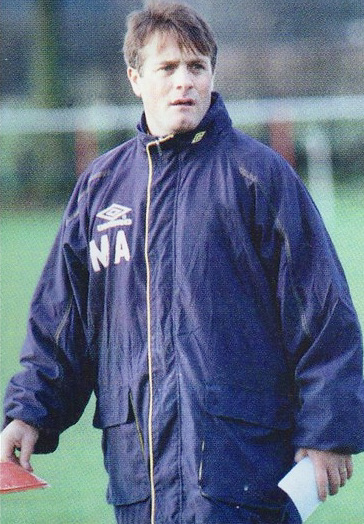
Back in 1999, though, Adams had been at Nottingham Forest before accepting Knight’s offer to take charge of the Albion. He’d originally gone to Nottingham to work as no.2 to Dave Bassett but Ron Atkinson had been brought in to replace Bassett and Adams was switched to reserve team manager.

The Albion job gave him the opportunity to return to front line management, a role he had enjoyed at Fulham and Brentford before regime changes had brought about his departure from both clubs.

On taking the Albion reins, Adams said: “For too long now this club has, for one reason and another, had major problems. The one thing that has remained positive is the faith the supporters have shown in their club.

“The club has to turn around eventually and I want to be the man that helps to turn it around.”

The man who appointed him, Knight, said: “Micky is a formidable character with a proven track record. He knows what it takes to get a club promoted from this division. But, more than that, Micky shares our vision of the future and wants to be part of it. That is why I have offered him a four-year contract and he has agreed to that commitment.”

Not long after taking over the Albion hotseat, he was happy to say goodbye to the stadium he’d previously known as home when a Gillingham player in the ‘80s and it was a revamped squad he assembled for the Albion’s return to Brighton, albeit within the confines of the restricted capacity Withdean Stadium.

Darren Freeman and Aidan Newhouse, two players who’d played for Adams at Fulham, scored five of the six goals that buried Mansfield Town in the new season opener at the ‘Theatre of Trees’.

Considering he was only too happy to be photographed supporting the campaign to build the new stadium at Falmer, it’s disappointing to read in his autobiography what he really thought about it.

“My mates and I nicknamed it ‘Falmer – my arse’ although I never said this to Dick’s face,” he said. “There was always so much talk and we never felt like it was going to get done.”

The turning point in his first full season in charge was the arrival of Bobby Zamora on loan from Bristol Rovers. “The first time I saw him he came onto the training ground; he looked like a kid. But he was tall and gangly with a useful left foot; there was potential there.”

Interestingly, considering Adams makes a point of saying he usually ignored directors who tried to get involved on the playing side, he took up Knight’s suggestion that the side should switch to a 4-4-2 formation – and the Albion promptly won 7-1 at Chester with Zamora scoring a hat-trick!

After a so-so first season back in Brighton, not long into the next season Adams was forced to replace his no.2, Alan Cork, with Bob Booker because Cork was offered the manager’s job at Cardiff City, at the time owned by his former Wimbledon chairman, Sam Hammam. Adams reckoned Booker’s appointment was one of the best decisions he ever made.

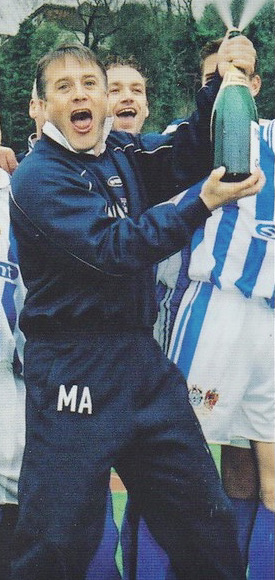
Surrounded by players who had served him well at Fulham and Brentford, together with the additions of Zamora, Michel Kuipers and Paul Rogers, Adams and Booker steered Albion to promotion as champions. Zamora was player of the season and he and Danny Cullip were named in the PFA divisional XI.

Not long into the new season, the lure of taking over as manager at a Premier League club saw Adams quit Brighton, initially to become Bassett’s no.2 at Leicester City, but with the promise of succeeding him.

“While I thought I had a shot at another promotion, it wasn’t a certainty,” Adams explained. “I knew I had put together a team of winners, and I knew I had a goalscorer in Bobby Zamora, but football’s fickle finger of fate could have disrupted that at any time.”

He admitted in the autobiography: “Had I been in charge at the age of 55, rather than 40, then I perhaps would have taken a different decision.”

While Albion enjoyed promotion under Taylor, what followed at Leicester for Adams was a lot more than he’d bargained for and, to his dismay, he is still associated with the ugly shenanigans surrounding the club’s mid-season trip to La Manga, to which he devotes a whole chapter of his book, aiming to set the record straight.

On the pitch, he experienced relegation and promotion with the Foxes and he doesn’t hold back from lashing out about ‘moaner’ Martin Keown, “one of the worst signings of my career”. Eventually, he’d had enough, and walked away from the club with 18 months left on his contract.

After a break in the Dordogne area of France, staying with at his sister-in-law and her husband’s vineyard, he looked for a way back into the game. He was interviewed for the job of managing MK Dons but was put off by a Brighton-style new-ground-in-the-future scenario. Then Peter Reid, a former Southampton teammate, was sacked by Coventry City. He put his name forward and took charge of a Championship side full of experienced players like Steve Staunton and Tim Sherwood.

The side’s fortunes were further boosted by the arrival of Dennis Wise, but, in an all-too-familiar scenario Adams had encountered elsewhere, the chairman who appointed him (Mike McGinnity) was replaced by Geoffrey Robinson. It wasn’t long before it was obvious the relationship was only going to end one way. As Adams tells it, Robinson was influenced by lifelong Sky Blues fan Richard Keys, the TV presenter, and it was pretty much on his say-so that Adams became an ex-City manager after two years in the job.

With an ex-wife and three children to support as well as his partner Claire, Adams couldn’t afford to be out of work for long and fortunately his next opportunity came courtesy of Geraint Williams, boss of newly promoted Colchester United, who took him on as his no.2.

However, it only got to the turn of the year before he was out of work once again, although, from what he describes, he wasn’t enjoying his time with the U’s anyway because Williams kept him at arm’s length when it came to tactics and team selection.

He was amongst the ranks of the unemployed once again when Albion chairman Knight gave him a call, but, with the benefit of hindsight, he said: “Going back turned out to be one of the biggest mistakes of my life.”

Adams blamed the backdrop of “the power struggle” between Knight and Tony Bloom on the lack of success during his second stint in the hotseat, and he reckons it was Bloom who “demanded my head on a platter”. The fateful meeting with Knight, when a parting of the ways was agreed, famously took place in the Little Chef on the A23 near Hickstead.

Looking back, Adams conceded he bowed to pressure from Knight to make certain signings – namely Jim McNulty, Jason Jarrett and Craig Davies in January 2009 – who didn’t work out. He reflected: “I shouldn’t have taken the job in the first place. I’d let my heart rule my head but, in fairness, I didn’t have any other offers coming through and it seemed like a good idea at the time.

“I wouldn’t ever say he (Knight) let me down, but he had his idea about players. I did listen to him, and maybe that’s where I went wrong.”

He added: “Going back to a club where success had been achieved before felt good, yet, the second time around, the same spark wasn’t there no matter how hard I tried.”

Born in Sheffield on 8 November 1961, Micky was the second son of four children. It might be argued his penchant for lashing out could have stemmed from seeing his father hitting his mother, which he chose to spoke about at his father’s funeral. Adams is obviously not sure if he did the right thing but he felt the record should be straight.

The Adams family were always Blades rather than Wednesdayites and, at 15, young Micky was in the youth set-up at Bramall Lane having made progress with Sunday league side Hackenthorpe Throstles.

While he thought he had done well under youth coach John Short during (former Brighton player) Jimmy Sirrel’s reign as first team manager, Sirrel’s successor, Harry Haslam, replaced Short and, not long afterwards, Adams was released.

However, Short moved to Gillingham and invited the young left winger to join the Gills. Adams linked up with a group of promising youngsters that included Steve Bruce.

In September 1979, he had a call-up to John Cartwright’s England Youth side, going on as a sub in a 1-1 draw with West Germany, and starting on the left wing away to Poland (0-1), Hungary (0-2) and Czechoslovakia (1-2) alongside the likes of Colin Pates, Paul Allen, Gary Mabbutt, Paul Walsh and Terry Gibson.

Adams honed his craft under the tutelage of a tough Northern Irishman Bill ‘Buster’ Collins and began to catch the attention of first team manager Gerry Summers and his assistant Alan Hodgkinson, who had played 675 games in goal for Sheffield United.

He made his debut aged just 17 against Rotherham United but didn’t properly break through until Summers and Hodgkinson were replaced by Keith Peacock (remember him, he was the first ever substitute in English football, in 1965, when he went on for Charlton Athletic against John Napier’s Bolton Wanderers) and Paul Taylor.

“Keith saw me as a full-back and that was probably the turning point of my career,” Adams recalled.

Once Adams and Bruce became regulars for the Gills, scouts from bigger clubs began to circle and at one point it looked like Spurs were about to sign Adams. That was until he came up against the aforementioned Peter Taylor, who was playing on the wing for Orient at the time (having previously played for Crystal Palace, Spurs and England).

“He nutmegged me three times in front of the main stand and, to cut a long story short, that was the end of that. Gillingham never heard from Spurs again,” Adams remembered.

Even so, Adams did get a move to play in the top division when Bobby Gould signed him for Coventry City. Managerial upheaval didn’t help his cause at Highfield Road and when John Sillett preferred Greg Downs at left-back, Adams dropped down a division to sign for Billy Bremner’s Leeds United (pictured below right with the legendary Scot).

“He had such a big influence on my career and life that I wouldn’t have swapped it for the world,” said Adams. But life at Elland Road changed with the arrival of Howard Wilkinson, and Adams found himself carpeted by the new boss after admitting punching physio Alan Sutton for making what an injured Adams considered an unreasonable demand to perform an exercise routine even though he was in plaster at the time.

Nevertheless, Adams admits he learned a great deal in terms of coaching from Wilkinson, especially when an improvement in results came about through repetitive fine-tuning on the training pitch.

“It is the one aspect of coaching that is extremely effective, if delivered properly,” said Adams. “I learnt this from Howard and took this lesson with me throughout my coaching and managerial career.”

However, Adams didn’t fit into Wilkinson’s plans for Leeds and he was transferred to Southampton, managed by former Aston Villa, Saints and Northern Ireland international Chris Nicholl. Adams joined Saints in the same week as Neil ‘Razor’ Ruddock and the pair were quickly summoned by Nicholl to explain the large size of the hotel bills they racked up.

Adams moved his family from Wakefield to Warsash and he went on to enjoy what he reflected on as “the best few years of my playing career”. He was at the club when a young Alan Shearer marked his debut by scoring a hat-trick and the “biggest fish in the pond at the Dell” was Jimmy Case.

Adams described the appointment of Branfoot in place of the sacked Nicholl as a watershed moment in his own career. “Overall he was decent to me and I found his methods good,” he said. And he pointed out: “I was getting older, I’d started my coaching badges and I already had one eye on my future.”

Adams recalled an incident during a two-week residential course at Lilleshall, after he had just completed his coaching badge, when he dislocated his shoulder trying to kick Neil Smillie.

“I was left-back and he was right-wing, and he took the piss out of me for 15 minutes. The fuse came out and I decided to boot him up in the air,” Adams recounted. “The only problem was that I missed. I fell over and managed to dislocate my shoulder hitting the ground. It was the worst pain I’ve ever had.”

If life was sweet at Southampton under Branfoot, that all changed when he was replaced by Alan Ball and the returning Lawrie McMenemy. Adams and other older players were left out of the side. Simon Charlton and Francis Benali were preferred at left-back. Eventually Adams went on a month’s loan to Stoke City, at the time managed by former Saints striker Joe Jordan, assisted by Asa Hartford.

On his return to Southampton, and by then 33, Adams was given a free transfer.

Former boss Branfoot came to his rescue, inviting him to move to League Two Fulham as a player-coach in charge of the reserve team. Branfoot also signed Alan Cork and he and Adams began a longstanding friendship that manifested itself in becoming a management pair at various clubs.

On the pitch, Branfoot struggled to galvanise Fulham and, with the team second from bottom of the league, he was sacked – and Adams replaced him. He kept Fulham up by improving fitness levels and introducing more of a passing game.

But he knew big changes were needed if they were going to improve and he gave free transfers to 17 players, despite clashing with Jimmy Hill, who had different ideas.

An admirer of what Tony Pulis was doing at Gillingham, Adams signed three of their players: Paul Watson, Richard Carpenter and Darren Freeman. He also got in goalkeeper Mark Walton and centre back Danny Cullip. Simon Morgan was one of the few who wasn’t let go, and Paul Brooker emerged as a skilful winger. All would later play under him at Brighton.

Promotion was secured and Adams was named divisional Manager of the Year but after all the celebrations had died down Mohamed Al-Fayed bought the club and things changed dramatically.

“The club was in a state of flux as it tried desperately to come to terms with its new status as a billionaire’s plaything,” Adams acerbically observed. “From having nothing, we had everything.”

Before too long, in spite of being given a new five-year contract, Adams was out of the Craven Cottage door, replaced by Wilkins and Kevin Keegan.

But he wasn’t out of work for long because Branfoot’s former deputy, Len Walker, introduced him to the chairman of Swansea City, who were on the brink of relieving Jan Molby of his duties as manager.

Various promises were made regarding funds that would be made available to him but when they were not forthcoming he realised something was not right and he quit, leaving Cork, the deputy he’d taken with him, to take over.

By his own admission, if he hadn’t been sitting on the £140,000 pay-off he’d received from Fulham, he probably would have stayed. As it was, he was out of work once again…..until he had a ‘phone call from David Webb, the former Chelsea and Southampton defender who was the owner of Brentford, but in the process of trying to sell the club.

His brief was to keep the side in the league and to make it attractive to potential purchasers. It was at Griffin Park that he first met up with the aforementioned Bob Booker, who was managing the under 18s at the time. “He is one of the most loyal and trustworthy friends I have ever known,” said Adams. “He would do anything for you.”

However, although he signed the likes of Cullip and Watson from Fulham, he wasn’t able to stop the Bees from being relegated. During the close season, former Palace chairman Ron Noades bought the club and announced he was also taking over as manager.

Once again, Adams was out of a job but his next step saw him appointed as no.2 to Dave Bassett at Nottingham Forest.

Which brings us almost full circle in the Adams career story, but not quite.

After the debacle of his second stint in charge of Brighton, he was twice manager at Port Vale, each spell straddling what turned out to be a disastrous period in charge of his family’s favourite club, Sheffield United.

It was Adams who gave a league debut to Harry Maguire during his time at Bramall Lane, but the side were relegated from the Championship on his watch, and he was sacked.

Adams took charge of 249 games as Vale boss but quit after a run of six defeats saying he’d fallen out of love with the game.

It didn’t prevent him having another go at it, though. He went to bottom of the league Tranmere Rovers and admitted in his book: “It was arrogance to think I could turn round a club that had been relegated twice in two seasons.”

In short, he couldn’t and he ended up leaving two games before the end of what was their third successive relegation.

“It was a really poor end to a career that had started so promisingly at Fulham,” he said.

Pacy Paul Brooker an in-and-out talent on the wing

PAUL BROOKER, a winger at one time mentioned in the same breath as Ryan Giggs, played more games for Brighton – 147 – than any of his other clubs but only managed a Premier League cameo with Leicester City.

Brooker certainly had the capacity to excite fans but there could be frustration in equal measure and, although he won back-to-back promotions with the Albion, his career didn’t come close to the achievements of the great Manchester United winger.

The national football fanzine, When Saturday Comes, ran a superb piece about Brooker in April 2002, in which Adam Powley talked about his “conspicuous talent” and maintained: “Brook­er was in­deed very good, blessed with real pace and an ability to keep con­trol while run­ning at full pelt.”

Born in Hammersmith on 25 November 1976, Brooker was with Chelsea as a schoolboy but it was Fulham who picked him up and gave him his professional opening.

Ian Branfoot handed him his first team debut –  in a 0-0 draw away to Bury on 14 October 1995 – and he was part of Micky Adams’ promotion-winning Fulham side of 1997.

Amazingly, he made just 18 starts for Fulham, but came off the bench 54 times. Across those 72 appearances, he scored six goals. He was eventually frozen out in the Kevin Keegan era, playing his last first team game in September 1998, and then spent time on loan at Stevenage, where he played eight games.

In February 2000, he joined his former Fulham boss, Adams, on loan at Brighton and, after a 15-game spell, he joined Albion permanently for a £25,000 fee.

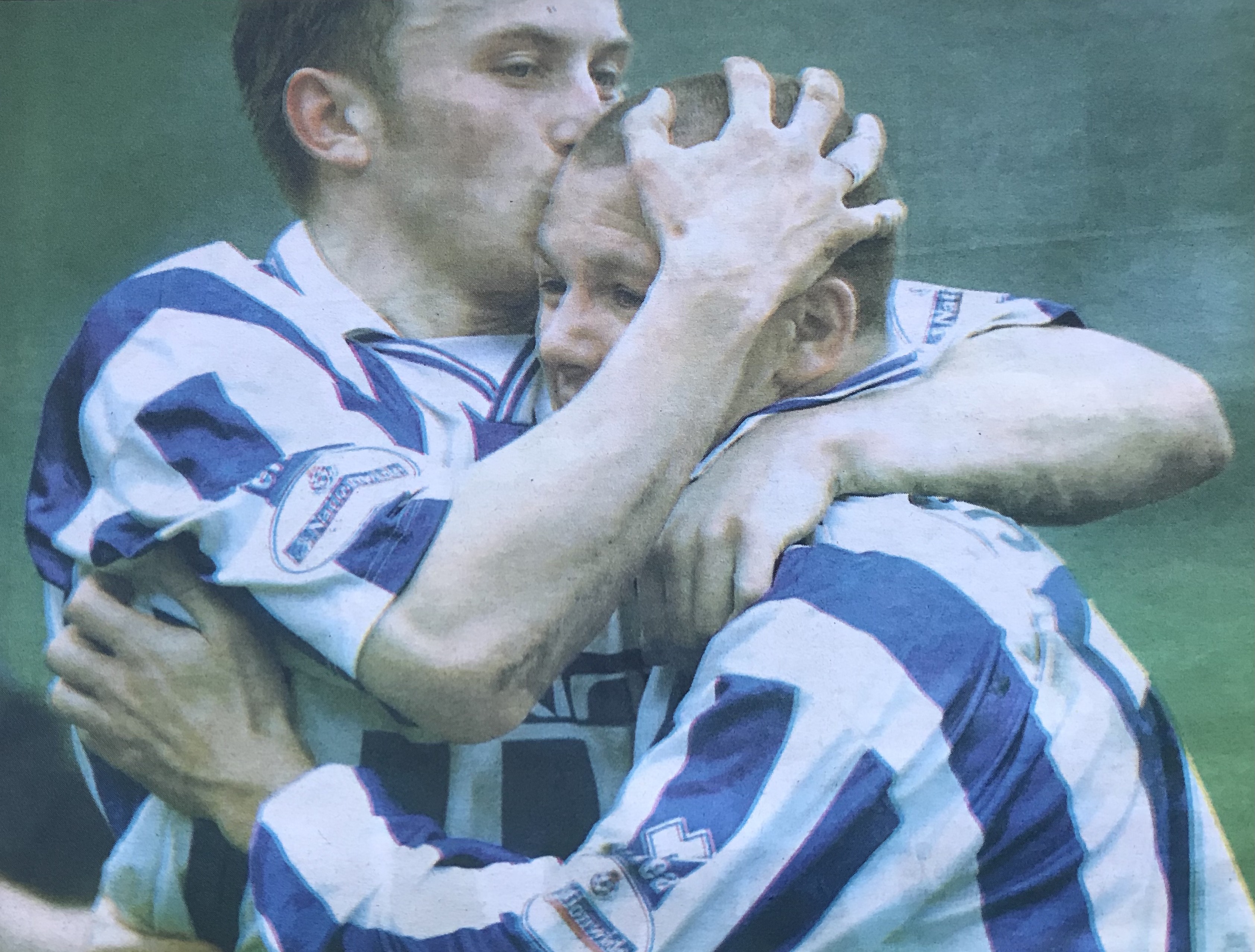
Screen Shot 2021-05-20 at 20.29.32Brooker scored after only three minutes in a 2-0 win away to Plymouth Argyle on 14 April 2001 (celebrating above) which secured promotion for the Seagulls, and he was a regular on the wing that season, making a total of 41 appearances. He remained a key member of Albion’s third tier promotion-winning squad in 2001-02, Argus reporter Andy Naylor summing up his contribution thus: “Most wingers have an inconsistent streak and ‘Bozzy’ is no exception, but he is a matchwinner on his day.

“Quick and an elusive runner with the ball, he hit scoring form as well towards the end of the campaign with three goals in eight games. The First Division should suit his style.”

Brooker also featured in Steve Coppell’s 2002-03 side – I remember seeing him score in a 2-1 away win at the Madjeski Stadium – but as Brighton exited the second tier at the wrong end in 2003, so Brooker ended his association with the club.

Coppell had hoped he would stay, telling The Argus: “We obviously want to keep him at the club. I think he is a terrific asset. He has still got a lot to add to his game and improve but he makes us that little bit different.

“He is hard to tie down. Teams cannot afford to leave him and yet they don’t really want to assign somebody to him.”

For his part, Brooker told Howard Griggs of The Argus in an April 2011 interview: “I absolutely loved my time at Brighton; it was the best three years of my career.

“By nature I am a Chelsea fan but I always look out for Brighton and so do a lot of my family and friends.”

A free transfer move to Leicester City, once again working under Adams, finally gave Brooker a Premier League platform to display his talent but his chances were limited and he ended up starting just two League Cup games as well as getting on as a substitute in three League games and a FA Cup match.

With his top tier opportunities limited, he elected to play under Coppell again and joined Championship side Reading on loan. He made 11 appearances in 2004 before joining the Royals permanently in July 2004.

After just one season at Reading, when he played 34 games, Martin Allen signed him on a free transfer for Brentford.

He had two seasons with the Bees but his time at Griffin Park came to an end shortly after the start of the 2007-08 season.

“When Terry Butcher came in, I think he’d made his mind up about me before he’d even seen me play,” Brooker told fulhamfc.com. “We just didn’t see eye to eye about things, and that was the end of it for me there.”

A Brentford blog, the entertaining BFC Talk, spoke about Brooker in a July 2015 piece. “Paul Brooker was another who flattered to deceive and throughout his career never did justice to his vast ability,” it said.
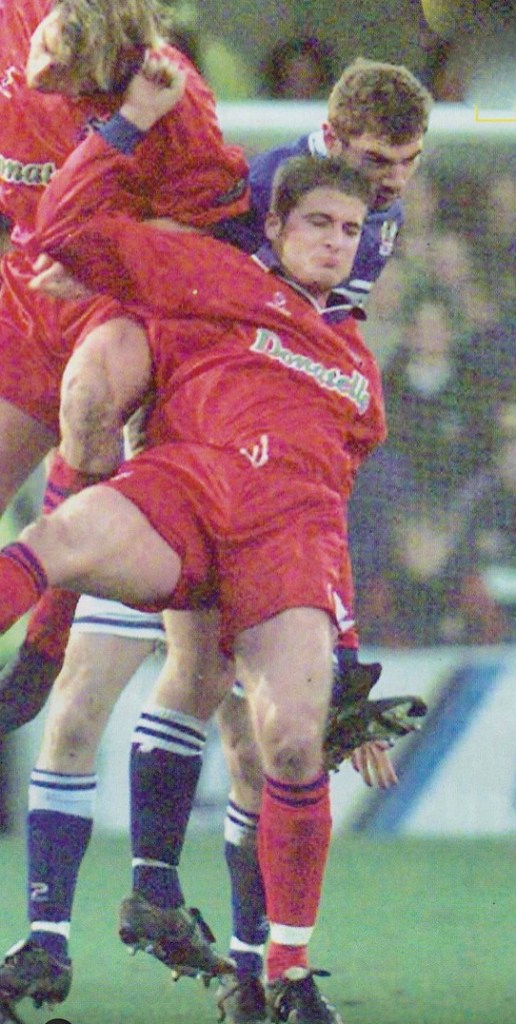
“He scored a goal of sheer brilliance after running the length of the pitch at Swindon, but on other days he appeared to be lethargic, disinterested and peripheral to the action.

“He did not take criticism well, either from fans, or indeed, his manager, Terry Butcher, and reacted badly before having his contract cancelled.” Although Brooker started taking his coaching badges, he admitted to the Fulham website: “I’ve not really kicked a football since I left Brentford; I lost a lot of my passion and love for the game.

“I’ve set up a carpet cleaning business with a friend just for something to do and that’s going quite well. I’m enjoying doing something different from football.”

Brooker played non-league for Chertsey Town in 2008-09 although he did have a short spell back training at the Albion, during Adams’ brief return as manager.

He also turned out for Havant & Waterlooville and Dorking Wanderers. After his playing days ended, he took up after school sports coaching in the Kingston, Twickenham and Hounslow areas.red Brooker

Pictures from the matchday programme; Simon Dack in the Argus, and the Reading website.