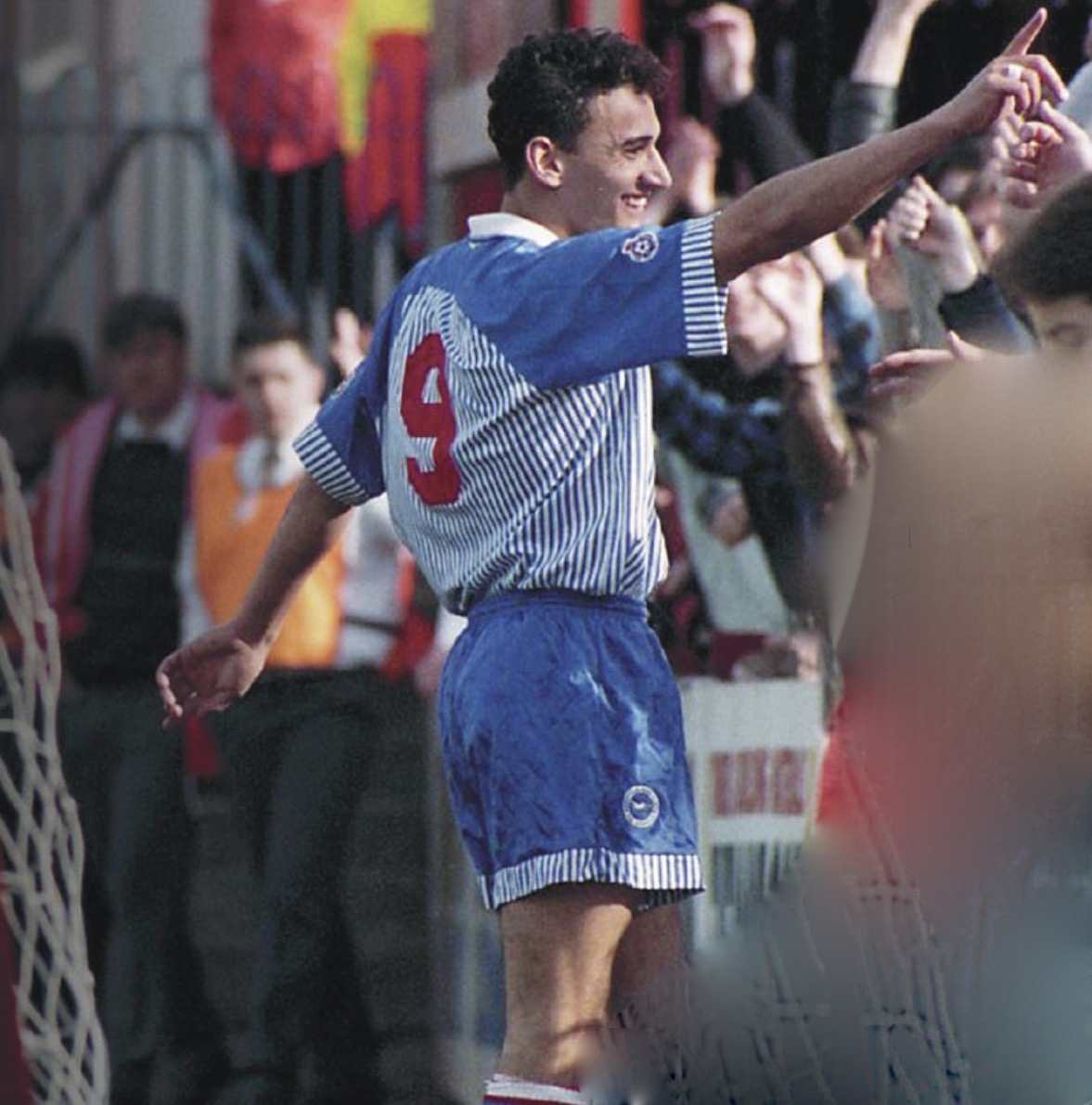
Paynter left a blank canvas at Seagulls and Blades

A JOURNEYMAN striker who fired blanks for Brighton and Sheffield United only found very occasional purple patches of goalscoring in a 12-club, 17-year career.

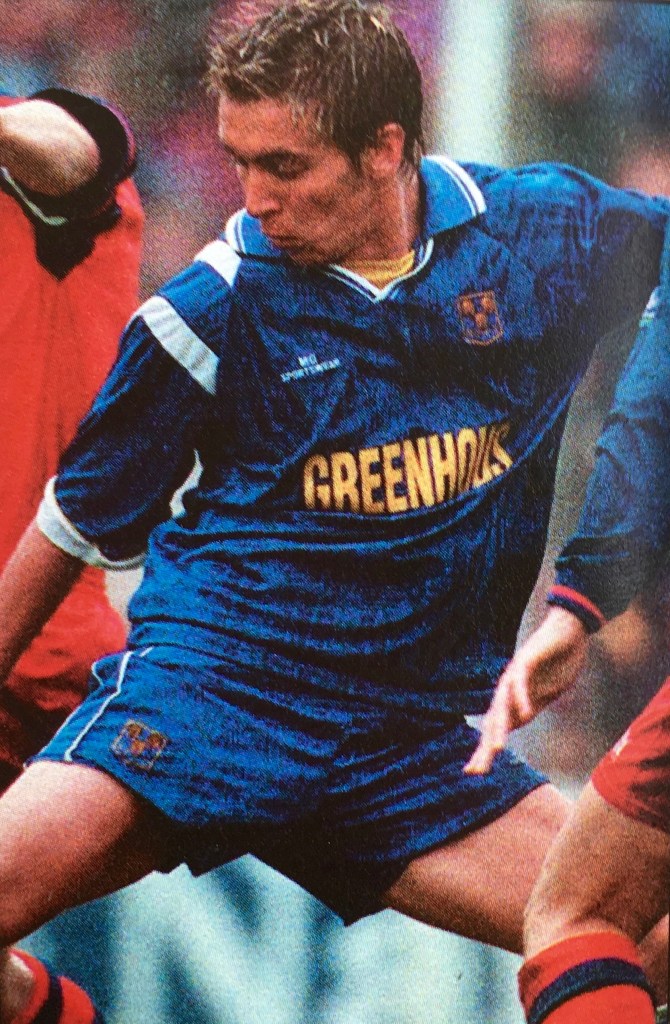
Billy Paynter didn’t manage a single goal in 10 games on loan for Gus Poyet’s Seagulls and carried with him from parent club Leeds United the somewhat unkind epithet ‘Barn door Billy’ for his proverbial inability to hit one with a banjo.

A subsequent half-season loan spell at Sheffield United under Nigel Clough yielded a similar zero in the goals scored column.

A journey around the message boards on supporter websites uncovers some brutal and unflattering comments about Paynter’s contribution for their team and yet it was a career that yielded 131 goals in 529 games – one in four.

And it all began promisingly under the guidance of former Albion captain and manager, Brian Horton.

Born in the Norris Green area of Liverpool on 13 July 1984, Paynter joined Port Vale’s academy at the tender age of 10 and turned professional soon after his 16th birthday.

Horton gave Paynter his first team debut when he was only 16 years and 294 days old on 3 May 2001 as a 61st-minute substitute at home to Walsall.

It was 10 months before he made a start, although he got a few more sub appearances, and Vale supporters had to wait until the start of the 2002-03 season for his first goal, after he’d replaced injured crowd favourite Steve McPhee in a home game against Wrexham.

Eventually, Paynter got into his stride and his popularity with the fans saw him voted Player of the Year in 2004-05.

His 34 goals in 158 games for Vale caught the eye of another former Albion manager, Peter Taylor, at then-Championship side Hull City.

Signed initially on loan, a fee of £150,000 took him on a permanent two-and-a-half-year contract to the KC Stadium in January 2006.

The following month Paynter turned out as a right-sided midfield player for a Football League Under-21 team (selected and managed by Taylor) in a game against an Italian Serie B side at the KC Stadium.

Taylor also experimented with him in the same position for Hull but, having scored only three times in 23 matches, Paynter was on the move again after only eight months.

He switched to Southend United, also in the Championship, for £200,000 in August 2006 and somewhat ironically, his only goal for the Shrimpers was scored against Brighton in a 3-2 League Cup win at Roots Hall in September 2006.

A lack of goals and a hamstring injury meant his stay in Essex was cut short and for the second half of the 2006-07 season he went on loan to League One Bradford City, where he managed four goals in 15 matches, including one on his debut.

On August deadline day in 2007, Paynter’s next move saw Paul Sturrock sign him for Swindon Town. Within a month he had netted a hat-trick against Bournemouth and added two more in a 5-0 win over Gillingham the following month.

It wasn’t all plain sailing for him, though, and after a two-month goal drought which had seen him lose his place, he told BBC Radio Swindon: “You can try and do too much and get caught up with it, but if you relax and get on with your game, I think it will come naturally.”

Paired with Simon Cox initially, Paynter got amongst the goals in support of the main man. But he stepped up a gear after Cox was sold to West Brom in the summer of 2009. His new strike partner was a young Charlie Austin and the pair enjoyed a rich seam of goalscoring form in the 2009-10 season under former Albion captain Danny Wilson.

Paynter had a spell where he scored 15 goals in 17 games and ended the season with 29 goals in 52 matches, his best goals-to-games ratio in a season. Swindon’s captain that season was none other than Gordon Greer, who remains a close friend of Paynter.

Four of Paynter’s goals had been scored against Leeds and, in the summer of 2010, he moved to Elland Road on a Bosman free transfer, with Wilson admitting to BBC Radio Wiltshire: “Anybody who scores nearly 30 goals in a season will be wanted by bigger clubs than us.”

Leeds boss Simon Grayson said: “He has matured as a player over the last couple of years and he had a fantastic season last season. He works ever so hard, holds the ball up well and he has proved he knows where the back of the net is.

“When we knew he was available we were desperate to get him. We feel he will be a good acquisition for the club, and I am delighted to have got him.”

Unfortunately, his time at Leeds didn’t start well when he picked up a shin stress fracture in a pre-season match in Slovakia, leading to him missing the start of the season.

It wasn’t until the second week of October that he was able to make his Leeds debut and starts were rare as Luciano Becchio and Davide Somma were Grayson’s preferred selection up front. Paynter didn’t register his first goal for Leeds until the following March, in a 2-1 win at Preston. It was his only goal in 23 matches that season.

As the 2011-12 season got under way, Grayson had added Mikael Forssell to his striking options and the manager encouraged Paynter to talk to other clubs, with Sheffield United and Brighton discussed as possible destinations.

Paynter preferred to stay and try to stake a claim for a place but, having only played once as a sub in the opening game of the season, he decided to make a three-month loan switch to Brighton at the end of October 2011.

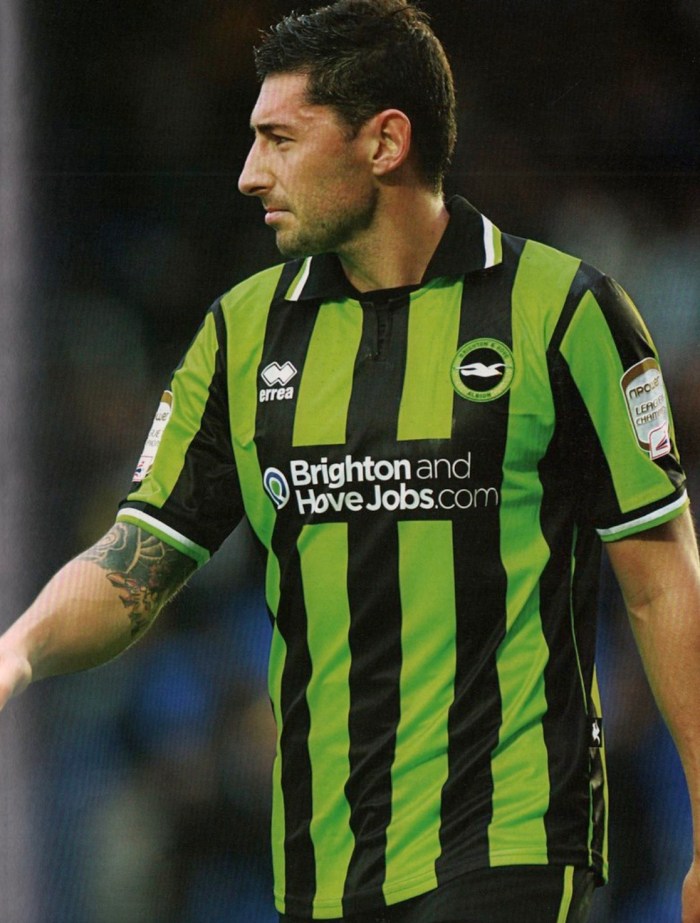
On 29th October 2011, he made his Brighton debut as a 67th-minute substitute for Matt Sparrow in a 0-0 draw away to Birmingham City.

The first of his six starts came on 1 November in a 0-1 defeat at Watford. He came off the bench a further three times and, without troubling the scorers, returned to Elland Road in January.

Back at Leeds he had to wait until April before he was selected by new manager Neil Warnock for a home game against Peterborough United. Paynter scored twice in a 4-1 win and, when replaced by substitute Becchio in the final minute, left the field to a standing ovation. But he picked up an Achilles injury in the following game away to Blackpool and was made available for transfer at the end of the season.

Paynter earned a place in a planetfootball.com poll listing 13 of Leeds’ “worst and weirdest signings under Ken Bates” although he was good-humoured enough to acknowledge it in a 2018 Under the Cosh podcast.

“I’ve always said there’s some players that will be remembered for being good, there’s some players that will be remembered for being sh*te,” he said. “No one remembers the OK players. Take the positives out of a bad situation, in that way I will be remembered!”

It was former Brighton striker Dean Saunders who was responsible for Paynter’s next move, picking him up on a free transfer for League One Doncaster Rovers on 13 August 2012.

While Saunders left the Keep Moat Stadium in January 2013 to join Wolves, Paynter played his part in Rovers winning promotion back to the Championship under Brian Flynn, top-scoring with 15 goals as Rovers returned to the second tier as champions.

An anonymous Donny fan recalled: “He had some good games for us and made the pass from the missed penalty at Brentford that enabled (James) Coppinger to score and win us promotion. He is best played in the box. He causes all sorts of problems. He is a tough guy and takes no prisoners. I liked him but I would say League One is his limit.”

A familiar face in the shape of Brian Horton arrived as assistant manager to new Donny manager Paul Dickov (Flynn had been promoted to director of football) in the summer of 2013.

It must have given Paynter some satisfaction on 27 August 2013 when he scored in a League Cup tie at home to Leeds, although the visitors ran out 3-1 winners. However, that was his only goal and, after managing only one start and 11 appearances off the bench, up to Christmas, he was sent on loan to League One Sheffield United for the second half of the 2013-14 season.

An exiled Blades fan living in Leeds, ‘Blader’ said: “I am uninspired and don’t see this is a great signing. I’ve seen him play many a time and never seen him perform notably and he is a laughing stock in Leeds for how badly he performed.”
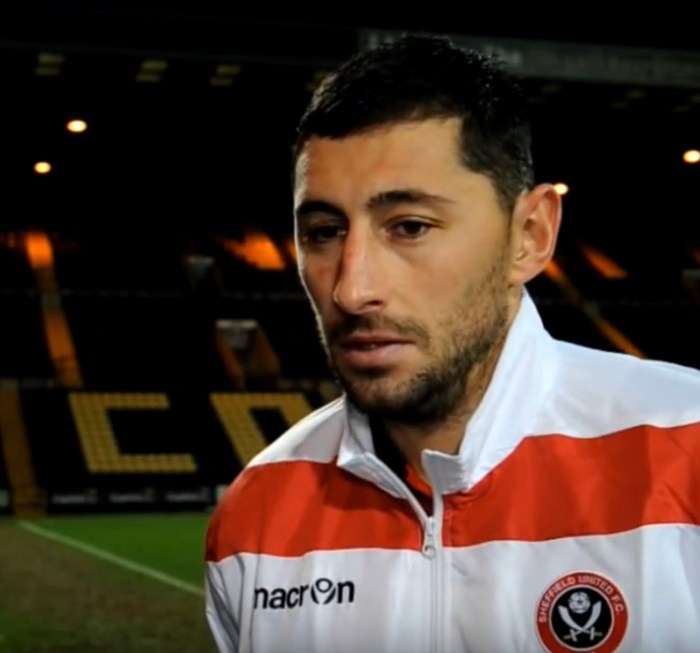
A blunt Blade

He made his debut as a sub against Notts County on 11 January 2014 but spent much of the time on the sub’s bench as manager Nigel Clough preferred to play with ‘a false 9’. Paynter made just six starts and came off the bench seven times but no goals were forthcoming. United finished seventh, one place off the play-off places, seven points adrift of sixth-placed Peterborough United.

Paynter was only a spectator as United remarkably reached the semi-final of the FA Cup, losing 5-3 at Wembley to Hull City, Jamie Murphy, later to play for Brighton, among the Blades scorers. A young Harry Maguire at the back for the Blades was named the League One player of the year.

The last three seasons of his playing career saw Paynter drop into League Two and he joined Carlisle United on the same day as former Albion midfielder Gary Dicker.

However, the season wasn’t even a month old when Graham Kavanagh lost his job as manager. His successor Keith Curle steered them to a fifth from bottom finish.

Paynter’s involvement was limited to 12 starts plus eight appearances off the bench and he and Dicker clashed with Curle when they sought PFA guidance after they were fined for allegedly failing to attend training sessions.

In the close season, Paynter headed 90 miles east to Hartlepool United, who’d just avoided dropping out of the league after finishing four points above Cheltenham Town.

The goal touch returned as Paynter top scored with 15 goals in 35 appearances as Hartlepool finished in 16th place courtesy of a decent run of wins in the spring under new boss Craig Hignett.

The managerial door revolved once more at Victoria Park the following season but Hignett’s successor Dave Jones (the former Southampton and Sheffield Wednesday boss) couldn’t prevent Hartlepool from heading out of the league, controversially parting company with the club with two games to go following an on-screen rant by United’s best known fan, Jeff Stelling.

Club captain Paynter, who had openly questioned Jones’ tactics in the local press, joined forces with fitness coach Stuart Parnaby to assist caretaker Matthew Bates for the final two fixtures.

It was one of those footballing fates moments that they needed a miracle against Paynter’s old club Doncaster in the final match and it was given a big build-up in the Mirror.

“Although we lost at Cheltenham last weekend, the lads had a lot more fight in them. I can understand it when players lose confidence or belief, but you can’t drop out of the Football League after 100 years without a fight,” he said.

“It’s one of those strange coincidences that we need to beat my old club to stand a chance of survival. I really enjoyed my time at Doncaster, and I’ll never forget that day we were promoted to the Championship, but I hope the supporters understand my loyalty is with Hartlepool now.”

Hartlepool hitman

Although Hartlepool won 2-1, they had been relying on other results going their way and Newport’s 2-1 win over Notts County 2-1 meant they stayed up and the North East side lost their league status. Having contributed just four goals in 26 matches, Paynter left the club.

While he attempted a brief extension to his playing career, training at non-league AFC Fylde, Southport and Warrington Town, he retired from playing in November 2017 and turned to coaching. He joined Everton’s academy in February 2018 before returning to his first club, Port Vale as professional development phase lead coach in October 2020.

On rejoining, he said: “It’s a joy to be back where it all started. Coming through PVFC’s Centre of Excellence from the age of 10, I know what the DNA of Port Vale is and what sort of players we should be producing.”

Pictures from various online sources and the Albion matchday programme.
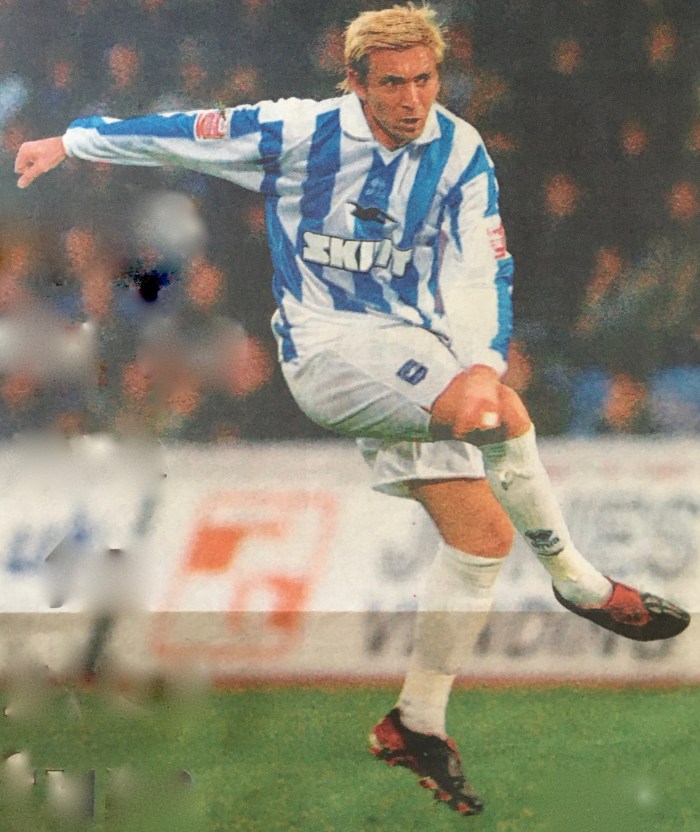
Set-piece expert Darren Currie earned Uncle Tony’s approval

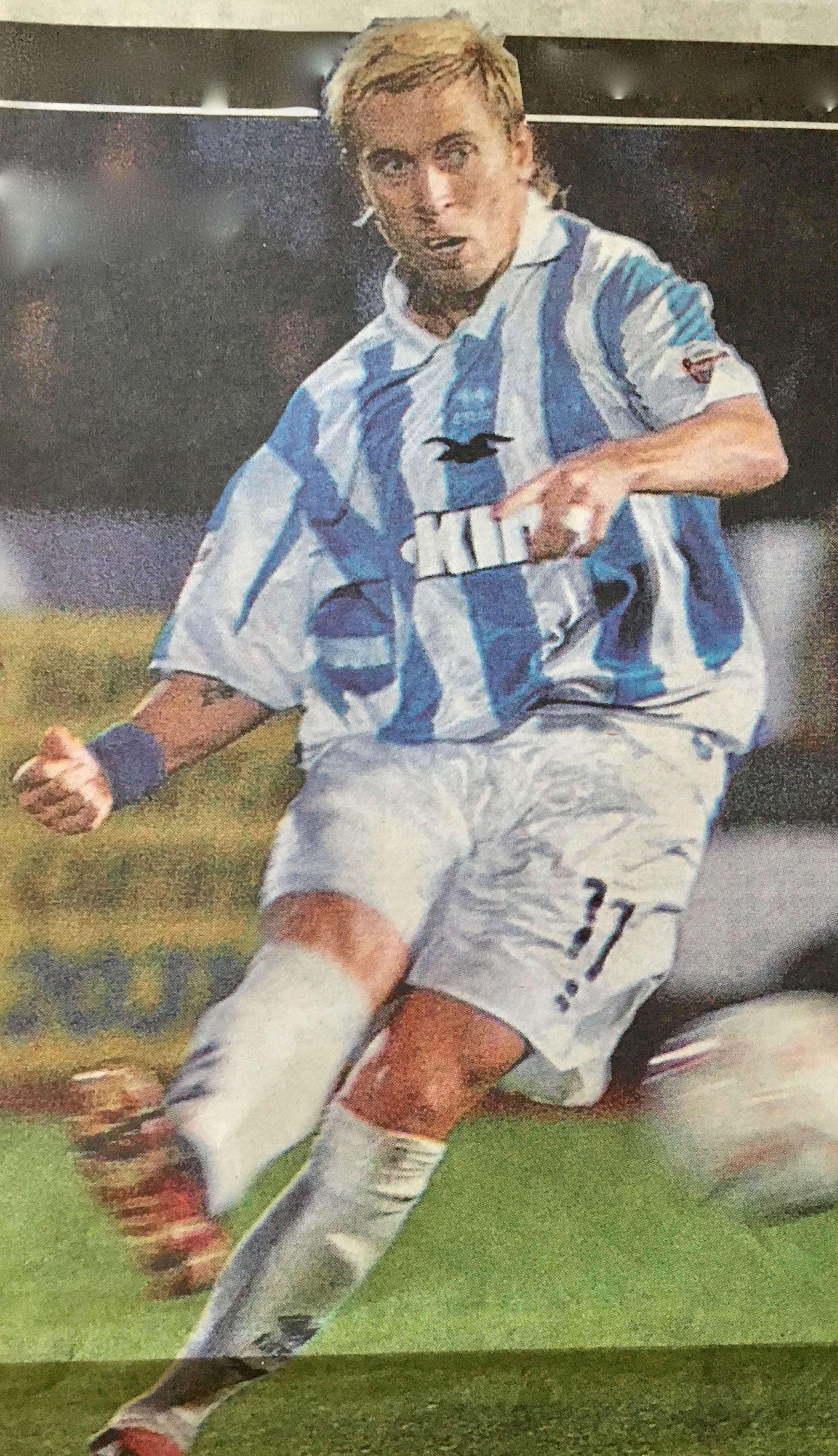
THE PINPOINT accuracy of Darren Currie’s passing and shooting was a joy to watch, even though a lack of pace stopped him being as good a player as his famous uncle.

Currie was a decent player in his own right, making nearly 700 appearances for 15 different clubs, but wherever he went he was always known as the nephew of the former Sheffield United, Leeds, QPR and England creative midfielder Tony Currie.

Perhaps with a hint of family bias, Uncle Tony said in an interview for ITV Digital: “Darren is, without doubt, the best crosser of the ball, after Beckham, in the country. He’ll produce nine times out of ten, right foot or left foot.”

The young Currie attributed his crowd-pleasing skills to the start he was given in the game by West Ham. After 10 years stuck in the lower leagues, Currie was given a platform to perform in the Championship by Brighton, and he very nearly made it to the top when transferred for £250,000 to high-flying Ipswich Town.

As if by a cruel twist of fate, Ipswich lost to the Hammers in the 2004-05 Championship play-off semi-finals having just missed out on automatic promotion.

“Playing for West Ham at youth and reserve levels was a terrific way to start a career,” Currie told the Ipswich Star. “They gave me everything but my debut.”

He certainly came close though, featuring alongside recognised first-teamers like Lee Chapman and Frank Lampard in friendlies and testimonials, but he had to move elsewhere to gain competitive first-team action.

Initially he had loan spells with Shrewsbury Town and Leyton Orient, and when the Shrews bid £70,000 for him in 1996, he chose to drop down a couple of divisions to get regular football.

“The difference in money was only about £50. The then West Ham manager Harry Redknapp called me in and said that I was an adult and had to think about continuing to play regular first team football,” Currie explained. “I was given the opportunity to have a new contract at West Ham or moving permanently to Shrewsbury.

“I was a young pro at West Ham and I had been out on loan a couple of times and I got the buzz for playing at three o’clock on a Saturday afternoon. There was no other feeling like it.

“I thought to myself I’ll go to Shrewsbury and I’ll play really well for a year and I’ll get a move back up to the top.

“My naivety kicked in then because it didn’t quite happen. I thought I’d done OK and I was linked with a couple of moves but the route back to the top wasn’t as simple as I thought it would be in my head.”

Indeed, it was a decade in which, after three seasons with the Shrews, he moved on briefly to Plymouth Argyle, then to Barnet (three seasons) and Wycombe Wanderers (three seasons).

Currie said it got to a point where Wycombe couldn’t afford to keep him, and boss Tony Adams made it clear he was free to look elsewhere.

Mark McGhee invited him to Brighton for a trial and was impressed with the way he knuckled down in training to get himself fit following a programme devised by McGhee’s deputy, Bob Booker.

Currie was offered a 12-month contract but it was more about the opportunity to play at a higher level that prompted him to sign.

“It wasn’t a fantastic offer – put it this way, Peterborough offered me three years – but it wasn’t about the money,” Currie told Spencer Vignes in an Albion matchday programme article.

“It was about the football and playing in the Championship. I was determined to do well and to prove myself, which I did. That’s when people began to sit up and take notice.”

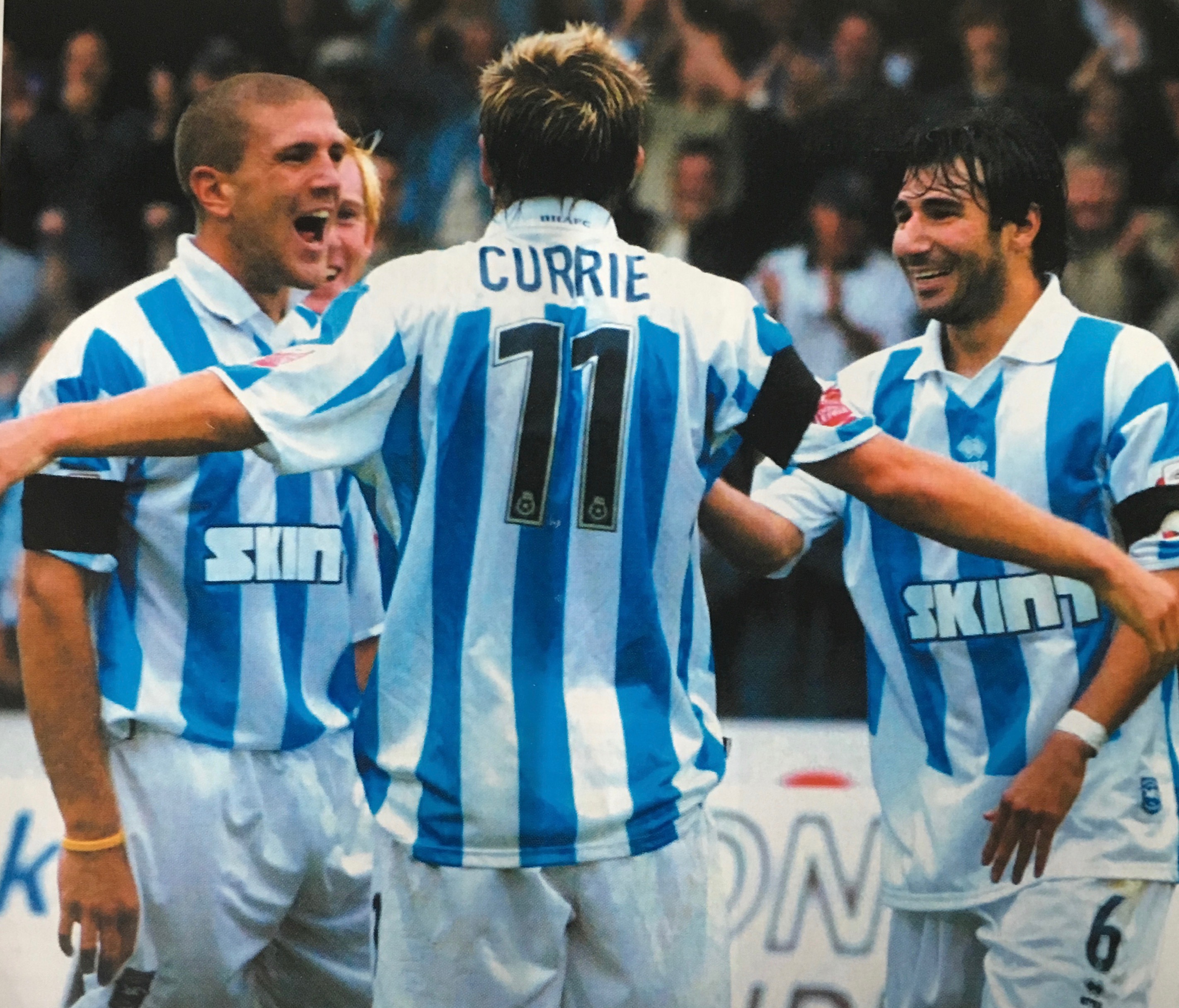
Currie’s ability on the ball carved him out to be a crowd-pleaser and the first of two goals for the Albion typically came from a free kick in a 3-2 home defeat to QPR that left Argus reporter Andy Naylor purring over its execution.

“Currie, having shaved a post and hit the bar with two earlier free-kicks, made it third time lucky from 20 yards just before the break. It was a sumptuous effort from the set-piece expert which rendered Rangers’ keeper Chris Day motionless.”

His other goal came in a 1-1 draw at home to Sheffield United, more noted for Albion wearing the limited-edition Palookaville strip to help publicise backer Fatboy Slim’s latest album.

Injury-hit Albion considered it a point gained rather than two dropped and Naylor complimented Leon Knight for “superbly crafting” Currie’s goal by evading his marker and threading a square pass through the legs of Leigh Bromby.

“Currie, with time as well as room, picked his spot to score, which meant even more to him because of the opposition,” wrote Naylor, informing readers that the Yorkshire side had rejected him as a 16-year-old following a fortnight’s trial.

Unfortunately for Currie, he was only on the bench when the Albion travelled to Upton Park on 13 November 2004. After three successive defeats, McGhee confessed he set the side up not to lose rather than go for a win.

Somewhat ironically, the Seagulls blagged a 1-0 win courtesy of a Guy Butters goal, in a real backs-to-the-wall match, with veteran striker Steve Claridge ploughing a lone furrow up front.

It was only in the 90th minute of the match that McGhee introduced Currie in place of Claridge to play out the final few minutes of the game.

Currie only played 22 games for Brighton over four months but the fee they received for him from Ipswich gave a vital boost to club funds when they were struggling to compete in the division because of the restricted crowd numbers at Withdean. Having signed him on a free transfer, the deal was a no-brainer for the Albion hierarchy, even if it weakened a squad who subsequently only avoided relegation back to the third tier by a single point.

McGhee wasn’t that surprised to see Currie go, telling the Argus: “He was obviously happy here, but I thought he was doing so well that he would keep his options open.

“I cannot see Darren being a regular for Ipswich in the Premiership if they are promoted, but his skills and touch are good enough to justify him making a contribution to a squad in the Premiership.”

It didn’t pan out like that, but Currie was nonetheless grateful to the Albion, and told Vignes: “I am so pleased I had the chance to be a part of it all down there, to see what the support is like and to play with a group of lads who stick together through thick and thin.

“I played at the Goldstone when I was a kid, playing youth team football with West Ham, so I know how important the stadium issue is for everyone. I always will be extremely grateful to the Brighton fans and Mark McGhee because without a doubt without their help this opportunity wouldn’t have come along.”

Currie explained in a matchday programme article how McGhee had helped to develop his game and to add other dimensions which improved him. “I owe a helluva lot to Mark and Bob Booker,” he said.

Currie became an instant hit with the Tractor Boys fans earning the man of the match accolade in two of his first four games.

“I tend to build up a rapport with supporters wherever I go,” he told the Ipswich Star. “I am my own biggest critic and I know when I have done well, and I am very satisfied with my contribution so far.”

After his brief cameo for the Seagulls at West Ham, he got the chance to play against his boyhood club three times that season with Ipswich.

He was in the Town side that lost 2-0 at home to the Hammers on New Year’s Day 2005. Then, in the first leg of the play-off semi-final, Currie and Matt Richards (later a loanee with the Albion) were half-time substitutes who helped Ipswich to recover a deficit to draw 2-2.

Currie started the second leg and had Ipswich’s best opportunities with a shot straight at James Walker, then a long-range drive 10 minutes before the interval which the goalkeeper hopelessly misjudged but fumbled to safety. But they failed to make the final when Bobby Zamora scored two second half goals for West Ham to earn them a 2-0 second leg win. West Ham beat Preston in the play-off final.

Born in Hampstead on 29 November 1974, Currie’s early footballing talent drew interest from Watford and Chelsea, but he decided to join West Ham’s academy.

“The facilities were great, the training for us there as kids was first class and I really enjoyed my time there,” Currie said.

“A lot of the player I became was what I was taught as a kid at West Ham,” he told twtd.co.uk. “It was all about the ball and all about the technical skill and how to manipulate the ball. It was a way I enjoyed playing anyway so it was a really good fit for me.”

After signing professional in 1993, he was a regular in the West Ham reserve side and a trawl through the excellent archive website whu-programmes.co.uk records show he played in a Football Combination game away to Brighton on 1 April 1994, and later the same month was up against Guy Butters in Portsmouth’s reserve side at the Boleyn Ground. Mark Flatts and Paul Dickov were in opposition when the Hammers stiffs entertained their Arsenal counterparts at home on 11 May.

In an Avon Insurance Combination match at the Goldstone Ground on 30 November 1994, Currie scored the only goal of the game from the penalty spot in a West Ham side also featuring Lee Chapman and Frank Lampard.

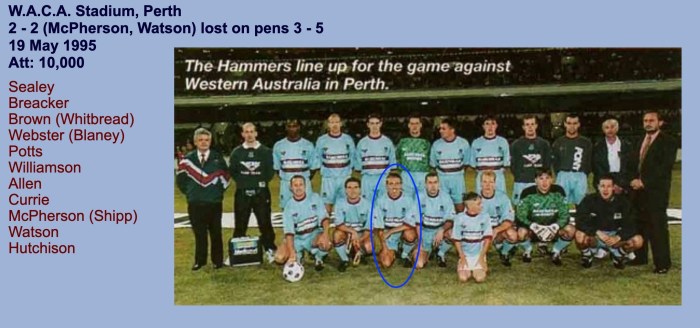
The following summer, Currie played in four matches when he was part of West Ham’s squad on a centenary tour of Australia.

Shrewsbury boss Fred Davies, a former playing colleague of Redknapp’s at Bournemouth, took Currie on full time after his two loan spells at Gay Meadow.

He moved on to Plymouth Argyle in 1998 but only played five matches in three months, then switched to Barnet where he made 136 appearances, plus seven as a sub, in three years.

Wycombe Wanderers paid £200,000 to sign him in the summer of 2001 and manager Lawrie Sanchez told BBC Three Counties Radio: “He’s obviously a quality player. He gets crosses in and that’s an area where we weren’t very good last year. He’s come to add that to our game and his free kicks will trouble the ‘keeper as well.

“It was quite a lot of money for our club to spend but I’ve got to back my judgement. I’d looked at him for a while and quite liked him. He gives us something we haven’t got, he’s a great technician. He hasn’t got particularly great pace but what he does with the ball is tremendous. We’re hoping he does all the things he was doing at Barnet and a little bit more for us.”

Sanchez added: “A lot of people looked at him for a long time. He’s always been considered one of the best players in the Third Division and hopefully we’ll give him the stage where he can prove he’s one of the best players in the Second Division.”

After Currie’s flirtation with promotion to the Premier League ended in disappointment, Joe Royle left Portman Road and his replacement Jim Magilton axed Currie from the side in the 2006-07 season. He was sent on loan to fellow Championship sides Coventry City and Derby County, for whom he made a play-offs appearance as a substitute, although he wasn’t involved in the final when County beat West Brom 1-0.

That summer, on the expiry of his Ipswich contract, Currie moved on a free transfer to League One Luton Town. He made 38 appearances for the Hatters but when they went into administration, were deducted 10 points and relegated, he was among several players given a free transfer.

Micky Adams, back in the hotseat at the Albion, was hopeful of getting Currie back to Brighton for a second spell, telling BBC Southern Counties Radio on 11 July: “He’s a player I’ve admired for a long, long time. We want him, and he wants to come back. He’d offer competition for places and fantastic delivery from set pieces.”

But at the end of the month the player rejected the terms on offer and took up a three-year contract at Chesterfield instead.

While the first year at Saltergate went OK, in the second season, the manager who signed him, Lee Richardson, had been replaced by John Sheridan, and Currie was out of the picture. He went on loan to fellow League Two side Dagenham & Redbridge and the deal was made permanent in January 2010. Currie played in 16 matches as the Daggers won promotion to League One.

They went straight back down the following season, and Currie departed for Conference South outfit Borehamwood as player assistant manager. He was there less than three months before moving to Isthmian League Hendon for a year as a player.

In October 2012, Currie returned to Dagenham & Redbridge, initially as a development coach and later as assistant manager under John Still.

In June 2018, Currie was appointed assistant manager at National League side Barnet, working under Still. He succeeded Still in December 2018, initially as caretaker, before landing the role permanently in January 2019.

Currie, assisted by former Albion loanee midfielder Junior Lewis, came close to getting Barnet promoted to League Two but, having missed out, and the club struggling financially because of the Covid-related lack of fan revenue, both left the club in August 2020.

Glorious home debut as good as it got for Abdul Razak

city action 2A MAN-OF-THE-MATCH home debut was as good as it got when Abdul Razak joined Albion on loan from Manchester City in February 2012.

Already being mentioned as a possible successor to Yaya Toure, there were high hopes for the Ivorian 19-year-old.

He joined originally on a three-month loan with fellow City youngster Gai Assulin (pictured together below), who came on as a substitute for Razak when manager Gus Poyet gave him his debut in a goalless draw away to Hull City.

assulin and razak

With regular midfielder Gary Dicker sidelined through injury, Poyet needed reinforcements in the middle of the park and the promising City youngster looked like he might be a great solution.

He’d already had a month’s loan at Portsmouth earlier the same season, and he was the stand-out performer when the Seagulls beat Ipswich Town 3-0 at the Amex on 25 February 2012.

Two goals from Ashley Barnes and one from Craig Mackail-Smith sealed the win, Brian Owen in the Argus, writing: “Victory extended their unbeaten league run to nine games and was largely inspired by Abdul Razak, who was superb in midfield on his home debut.”

Poyet was concerned about the level of fitness of the City pair, but after that game at Hull told the Argus: “Abdul was better than in training, because of the space, the way he attacks and the ability he has got and strength. He has been missing playing 90 minutes.

“He is stronger than he looks. He can hold the ball, do a trick, have a shot. He is good passing the ball, we just need to make him play the way we play, especially without the ball.”

When signing for the Seagulls, Razak told the official club website: “I like to pass the ball and that’s why I decided to come to Brighton.

“I had a few options, but I chose Brighton because I like the way that they play football. I have seen some of the games and the way Brighton play is different, so I have got to adapt to that. I have spoken to the manager and he is going to give me plenty of information and we will take it from there.”

Unfortunately for him, the more experienced Dicker returned from injury quicker than expected and, after just four starts and two appearances off the bench, the displaced Razak cut short his loan and returned to Manchester.

Wearebrighton.com recently said Razak admitted some while later in a TV interview that he fell out with Poyet, prompting his early departure from the south coast.

There was a similar story when he went on loan to Charlton Athletic later the same year. He joined at the end of September, ostensibly on a three-month deal, but went back to City after a month having made only two first team appearances.

A year later, Razak signed for Russian side Anzhi Makhachkala on a season-long loan deal with the aim of it becoming a permanent arrangement, which it did within a month. He left City having made three starts and seven substitute appearances for the first team.

The following January, Razak moved back to the UK on a short-term contract with West Ham, but he didn’t make an appearance for the first team and left in April.

“It didn’t work at West Ham due to Sam Allardyce, as I like to play football and that’s not his style,” Razak told Will Unwin, in an extended interview in March 2017. “Then my work permit expired, so I had to wait for another one. The Home Office take a long time to reply, so then I was without a club. So I ended up four months without a club.”

Eventually, he moved to Greece and played a handful of games for Crete outfit OFI in 2014-15, and, in the same season, tried his luck back in England when former City legend Paul Dickov gave him a short-term contract with League One Doncaster Rovers, for whom he played nine matches.

After taking advice from Swedish international and former City colleague John Guidetti, Razak started to rebuild his career in Sweden with AFC United in Eskilstuna and, after a dozen games, he was picked up on a three-year deal by leading Swedish club IFK Gothenburg. But in 2018, he moved on again; this time to Uppsala-based IK Sirius.

Born on 11 November 1992 in Bouake, in the south west African country of Ivory Coast, Razak was a youth team player on the books of Crystal Palace initially but joined Manchester City’s elite development squad in July 2010.

Within seven months, he had made his first team debut when manager Roberto Mancini sent him on as a substitute for David Silva in the final minute of a Premier League game against West Brom on 5 February 2011.

city action 1Five days later, he came on as an 80th minute sub for Yaya Toure, and then had a starting spot on 21 September in a League Cup game against Birmingham City. He next appeared in the same competition’s second round, against Wolverhampton Wanderers.

The midfielder played one league game in that 2011-12 season, when City dramatically won the title, beating QPR 3-2 with that Sergio Aguerro goal right at the end of the last game of the season.

In the following season’s curtain-raiser, the FA Community Shield, played at Villa Park, Razak was an unused substitute in City’s 3-2 win over Chelsea.

He has played five times for his country; twice in 2012 and three times in 2013.


City cult hero Paul Dickov never forgot his Seagulls goals

A POCKET dynamo of a striker who became a Manchester City cult hero never forgot the goalscoring platform a short spell with Brighton provided him.

Paul Dickov is fondly remembered by the City faithful, particularly for his equalising goal (above) in the fifth minute of added on time in the League Two play-off final at Wembley in 1999 (City famously went on to win the penalty shoot-out in which Guy Butters missed a vital spot-kick for Gillingham).

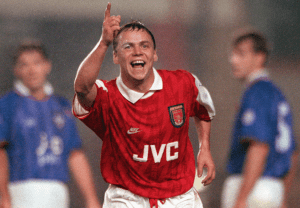
The diminutive Dickov had wowed Brighton fans during the dark days of the 1993-94 season when Barry Lloyd’s replacement as manager, legendary Liam Brady, had secured the striker’s services on loan from his old club Arsenal.

Dickov had managed to break through to the Arsenal first team under George Graham in the latter stages of the 1992-93 season.  But his chances were limited by the manager’s preference for the more experienced Ian Wright and Kevin Campbell.Dickov south stand

Earlier in the 1993-94 season, the young forward left Highbury for a 15-game spell with League One Luton Town, but only managed one goal.

His goalscoring fortunes changed when Brady persuaded his former employers to let Dickov join the struggling Seagulls, who, at the time, were fighting to avoid relegation from League Two.

Dickov Sandtex

The tenacious Dickov relished the opportunity and scored on his debut in a 2-0 home win over Plymouth Argyle on 30 March 1994. It was the first of five goals in eight games to help Brighton avoid the drop. (Pictured below, Dickov scores from close range against Fulham).

“I had a great time there. I loved every minute of it, and it has stuck with me,” Dickov told the Argus some years later. “I’ve always looked out for Brighton since then and I want them to do well.”

Born in Livingston, Scotland, on 1 November 1972, Dickov came to the attention of the Gunners while playing for Scotland at the 1989 FIFA Under-16 World Championship.

Having shown his goalscoring potential in Arsenal’s reserve side, Dickov got his first team opportunity when Graham rested players ahead of the FA Cup Final (in which they beat Sheffield Wednesday after a replay).

Dickov made his Arsenal debut against Southampton on 20 March 1993, and he went on to score against Crystal Palace and Tottenham Hotspur at the end of the season.

Over the following three seasons, although on the fringes of the first team, he was competing against the likes of Dennis Bergkamp, Wright and John Hartson and he was restricted to just 17 appearances in which he scored once.

Despite the disappointment of not quite making it at Arsenal, he is still fondly remembered there, with their history recording: “He never gave anything less than his all in an Arsenal shirt and, despite question marks over his height, Dickov compensated for his 5’5” frame with heart and endeavour.

“He was quick, skilful and scurried around up front causing problems for defenders.”

On 23 August 1996, City paid £1m to take him to Maine Road.

Over six seasons with the club, he was involved in two promotions and two relegations, which saw him play in three different divisions.

For all their success in more recent times, that memorable play-off at Wembley in 1999 was still being talked about 20 years later.

In 2000, Dickov won his first full international cap for Scotland and he earned 10 caps between then and 2004.

By then, he had moved on from City to try to keep Dave Bassett’s Leicester City in the top division. He joined the Foxes in February 2002, and, although he scored four goals as Leicester valiantly tried to maintain their Premiership status, they were not enough to prevent them being relegated to the Championship.

When former Albion boss Micky Adams took over the following season, Dickov thrived up front, netting a career-high 20 goals as Leicester won an instant return to the top-flight, finishing second behind champions Portsmouth.

Dickov scored 13 goals in the Premier League the following season but once again the Foxes were relegated. Even so, Dickov almost had a dream final game of the season against the team who had first give him his chance in the English game.

Arsenal were unbeaten throughout the season going into the Highbury finale but Dickov gave Leicester a shock headed lead before Thierry Henry and Patrick Vieira turned the game back in the Gunners’ favour to earn them the ‘Invincibles’ crown for their achievement.

That season at Leicester was also blighted by a shocking series of events during a training camp in La Manga, Spain, when Dickov and teammates Keith Gillespie and Frank Sinclair were falsely accused of sexual assault.

PD BlackburnAt the season’s end, Dickov took up an option on his contract which allowed him to leave for a top-flight club and Graeme Souness signed him for Blackburn Rovers. It was not long before Mark Hughes took over and Dickov scored 10 goals in 35 games. Craig Bellamy was Rovers’ main man up front the following season and Dickov’s Premier League appearances were confined to 17 games plus four as a sub.
With his contract at an end, he rejoined Manchester City for the 2006-07 season but his time there was dogged by a series of injuries and he ended up having loan spells at Crystal Palace and Blackpool before returning to Leicester in 2008.

During that spell, when City were in League One, he was mainly back-up to Matty Fryatt and Steve Howard, but managed a further 20 appearances and scored two goals to help the club to promotion back to the Championship.

Eventually, he ended up going out on loan, this time to Derby County to help them out in an injury crisis. His Leicester contract was terminated in February 2010 and he took up a short-term deal to the end of the season with League One Leeds United, who ended the season earning promotion to the Championship.

Dickov’s next move, though, was into management. He initially joined Oldham Athletic as player-manager, before packing up playing in May 2011.

In Dickov’s first game as manager, a young Dale Stephens scored both goals as the Latics beat Tranmere Rovers 2-1. The highlight of his tenure at Oldham was leading the Latics to a shock 3-2 win over Liverpool in the FA Cup fourth round in January 2013, but he resigned a few weeks later because of the side’s poor league form.

Three months later, he took over at Doncaster Rovers, with former Albion captain and manager Brian Horton as his assistant.

Since leaving Rovers in September 2015, Dickov has been on the football speakers circuit and is also a frequent eloquent contributor as a pundit.

pundit Dickov2019

Horton’s place in the hearts of Brighton and Man City fans

IMG_5170ARGUABLY the finest captain in Brighton & Hove Albion’s history went on to have a far less successful spell as the club’s manager having also been a boss at the highest level, at Maine Road, Manchester.

The £30,000 signing of tenacious midfielder Brian Horton from Port Vale on the eve of transfer deadline day in March 1976 proved to be one of the most inspirational moments of Peter Taylor’s managerial tenure at the Albion and for such a fee was widely hailed as “an absolute steal”.

Even though Taylor didn’t hang around long enough to reap the benefit of the man he instantly installed as captain, his successor Alan Mullery certainly did.

In the early days after his appointment, there was some suggestion Mullery would be a player-manager but the former Spurs and England captain reassured a concerned Horton that wouldn’t be the case, admitting that he wouldn’t get in ahead of him anyway!

“Fortunately, that next year went really well. It was my best year without a doubt,” Horton told Evening Argus reporter Jamie Baker. “I’d never met Alan Mullery, and he’d probably never heard of me, so I was delighted and surprised when he made me his captain.”

It was the beginning of a strong bond between captain and manager and Horton added: “We had that relationship for all the five years I was with him.

“That first season was great. We went 20 odd games unbeaten and I was scoring left, right and centre, and I was very proud to be voted player of the year.

“Suddenly everything was coming right for me, although we were disappointed not to beat Mansfield for the championship because we felt we were far better than them.

“You’ve got to hand a lot of our success down to Alan Mullery. He was a terrific motivator of players. He was a bubbly character and it used to rub off on players.

“He was new to the game of management but he brought fresh ideas, and he’d been under some top managers as a player.

“The team spirit during those first three years was incredible. When you are winning games every week it makes a hell of a difference and we had that for three years. You just couldn’t describe how good the team spirit was.

“My treasured memory will always be of the day we beat Newcastle to clinch promotion to the First Division. It was even greater because I scored the first goal. It had always been my ambition to play in the First Division and now I had achieved it.”

In an inauspicious start, Horton found himself in the referee’s notebook as Albion were hammered 4-0 by Arsenal as the season opened at the Goldstone. After a narrower defeat away to Aston Villa, the next game was away to Man City – and Horton had the chance to earn the Seagulls their first top level point.

On 25 August 1979, Albion were trailing 3-2 when Horton had the chance to equalise from the penalty spot with only eight minutes of the game left. But the normally reliable spot-kick taker fluffed his lines, meaning Albion succumbed to their third defeat in a row.

While the superior opposition was clearly testing the Seagulls, it was testament to the resilient skipper that he was continuing to lead them having started out in the third tier and, on 20 December 1980, before a 1-0 home win over Aston Villa, he received a cut-glass decanter from chairman Mike Bamber to mark his 200th league appearance for the Seagulls.

As the 1980-81 season drew to a close, Albion were perilously close to the drop but four wins on the trot (3-0 at Palace, 2-1 at home to Leicester, 2-1 at Sunderland and 2-0 at home to Leeds) took them to safety. What Horton didn’t realise was the Leeds game would be his last for the Albion (as it also was for Mark Lawrenson, Peter O’Sullivan and John Gregory).

“I’d bought a house in Hove Park off Mike Bamber and I was sunbathing that summer when there was a knock at the door. It was Alan Mullery come to tell me he’d just resigned,” Horton told interviewer Phil Shaw in issue 26 of the superb retro football magazine, Back Pass.

Mullery told him how he’d quit over the proposed Lawrenson transfer, how O’Sullivan and Gregory were off as well, and that the club wanted to sell him too, for £100,000.

Although Mullery advised him to sit tight because he still had a year left on his contract, new boss Mike Bailey – with a swap deal involving Luton’s Republic of Ireland international, Tony Grealish, lined up – told him he’d have to fight for his place and would have the captaincy taken from him.

“I said I didn’t want to go, that I loved the club and the fans, that I’d bought a house, and, at 31 I thought I had two or three good years left.

“I spoke to Mike Bamber and he said: ‘I don’t want you to go but I have to back the manager’.” Horton felt he had no option but to make the move.

He chose the platform of the Argus to thank the supporters for the backing they’d always given him and said his one disappointment was that he didn’t get the chance to lead Albion at a Cup Final. “That I would have really loved.”

Looking ahead, he added: “The Luton move gives me a new challenge. You can get in a rut if you stay at one club too long. Six years at Port Vale and five and a half at the Albion is enough. It will probably put a little sparkle back into my game.”

And so, Horton went to Kenilworth Road and under David Pleat the Hatters won the 1981-82 Second Division championship by eight points clear of arch rivals Watford. Looking back in his interview with Back Pass, Horton reckoned two of his Luton teammates, David Moss and Ricky Hill, were up there alongside Lawrenson as the best players he’d played alongside.

An all-too-familiar tale of struggle in the top division saw Luton needing to win at Maine Road in the last game of the season to ensure their safety, and Raddy Antic scored a winner six minutes from time that preserved Town’s status and sent City down.

Television cameras memorably captured the sight of Pleat skipping across the turf at the end of the game and planting a kiss on Horton’s cheek.

After one more year at the top level, he began his managerial career as player-manager of Hull City in 1984, working for the mercurial Don Robinson, and steered them to promotion to the old Division Two at the end of his first season in charge. He is fondly remembered by Hull followers, as demonstrated in this fan blog.

When he parted company with the Tigers in April 1988, his old Brighton teammate Lawrenson, by then manager of Oxford United, invited him to become his assistant. United at the time were owned by Kevin Maxwell, son of the highly controversial Robert Maxwell.

When Dean Saunders, who Brighton had sold to Oxford for £70,000, was sold against Lawrenson’s wishes – astonishingly he went to Derby for £1million – Lawrenson quit. Horton took over as manager and stayed in charge for five years, during which time he recruited former Albion teammate Steve Foster to be his captain.

Horton’s managerial break into the big time came in August 1993 when Man City sacked Peter Reid as manager four games into the 1993-94 season. Horton didn’t need to think twice about taking up the role, even though City fans were asking ‘Brian who?’

In Neil McNab, Horton recruited to his backroom team a former playing colleague who’d been a City favourite. “I played with McNab at Brighton and knew his strengths and knew he was well liked here,” he told bluemoon-mcfc.co.uk.

Horton brought in Paul Walsh, Uwe Rossler and Peter Beagrie and City managed to stay up.

The new boss acquired the services of Nicky Summerbee (to follow in the footsteps of his famous father Mike) along with Garry Flitcroft and Steve Lomas and at one point City were as high as sixth in the table.

They eventually finished 17th but fans to this day still stop Horton (who lives in the area) and ask him about a terrific match which saw City beat Spurs 5-2.

It was Horton’s bad luck that when City legend Francis Lee took over the club from previous owner Peter Swales, he was always looking to install his own man in the hot seat, and Lee eventually got his way and replaced Horton with Lee’s old England teammate Alan Ball.

Ball took City down the following season while Horton embarked on a nomadic series of managerial appointments either on his own or in tandem with Phil Brown.

Initially he was boss of Huddersfield Town; then he was a popular appointment when he took over as Albion boss during their exile playing at Gillingham, but, because he wanted to live back in the north, he left in February 1999 to join another of his former clubs, Port Vale.

He led Vale for five years and pitched up next at the helm of Macclesfield Town, where, on 3 November 2004, he marked his 1,000th game as a manager. It was at Macclesfield where one of his players was the self-same Graham Potter whose stewardship of Swansea City came mightily close to upsetting City in the 2019 FA Cup quarter-finals.

A bad start to the 2006-07 season saw him relieved of his duties in September 2006 but, by the following May, he was back in the game as Brown’s no.2 at Hull City. In March 2010, he was briefly caretaker manager following Brown’s departure, until the Tigers appointed Iain Dowie.

Next stop saw him as no.2 to Brown at Preston North End; then a second brief spell as Macclesfield boss at the end of the 2011-12 season.

In June 2013, he was appointed assistant manager to Paul Dickov at Doncaster Rovers, a role he filled for two years before linking up with Brown once again during his tenure at Southend United. Horton was his ‘football co-ordinator’ but left the club in January 2018. He followed Brown to Swindon Town but, in May 2018, decided not to continue in his role as assistant manager.

Born in the Staffordshire coal-mining village of Hednesford on 4 February 1949, Horton went to its Blake Secondary Modern School. Spotted playing football for the Staffordshire Schools side and the Birmingham and District Schools team, the Wolves-supporting youngster was awarded a two-year apprenticeship at Walsall when he was 15.

But, at 17, his hopes of a professional career were dashed when he wasn’t taken on. He ended up finding work in the building trade while continuing his football with Hednesford Town in the West Midlands (Regional) League.

He played at that level for four seasons and it was there he acquired the moniker Nobby because he gained a reputation for World Cup winner Stiles-like aggression. It was a nickname that stuck.

At the time, he was playing up front and scoring a lot of goals so he caught the attention of a few league clubs, but only Gordon Lee at Port Vale made a move. Lee sealed the deal by buying the Town secretary a pint of shandy and promising to take Vale to play Hednesford in a friendly.

Vale had little money so the squad was made up of free transfer signings but Horton said it made them strong collectively with “a fantastic spirit” and it wasn’t long before he was made their captain.

Vale legend Roy Sproson took over from Lee as manager and in March 1976 the cash-strapped Potteries outfit were forced to sell their prize asset.

When Vale headed to Selhurst Park that month, Crystal Palace player-coach Terry Venables got a message to Horton before the game urging him to sit tight until the summer and they’d sign him then. But Albion stole a march on their rivals and Sproson told him: “I’m sorry but we’re selling you to Brighton for thirty grand. We need the money.”

Funnily enough, the previous summer Horton had a chance holiday encounter in Ibiza with Albion’s Peter O’Sullivan. He later told the Argus: “Sully asked me if I fancied a move. Little was I to know that I would be joining him soon after. There was a wealth of ability in the Albion side when I joined them and it was outrageous that we didn’t go up that year.

“I felt they had to go places and I wanted to be part of it. I’d never been in a promotion side but then to be made captain of it was really the icing on the cake.”

Albion’s gain was certainly a loss to two other clubs who’ve since encountered similar troubles in their past. Horton explained: “I knew clubs were interested although Roy Sproson said he wouldn’t let me go to another Third Division team. I think he released me to Brighton because at the time they looked certain for promotion.

“Also, it was the highest bid they’d had. Hereford and Plymouth had offered £25,000 and I would have been happy to have gone to either club.”

In November last year, Horton reflected on his long and varied career in an interview with The Cheshire Magazine.

Pictures mainly from my scrapbook, originally from the Argus, Shoot / Goal magazine, the matchday programme and various online sources.

Fluctuating fortunes for Guy Butters after beginning alongside Spurs stars

GUY BUTTERS saw plenty of highs and lows in a 20-year playing career that started with great promise at Tottenham Hotspur and included six years at Brighton, where he still works.

Butts coaches for Albion in the Community, he’s scouted players, hosted hospitality lounges and still turns out to play in charity matches, not to mention sharing a constant flow of corny jokes with his 3,700+ followers on Twitter!

Promotion via the play-offs at Cardiff in 2004 and being chosen as player of the season would be up there in terms of highs with Brighton.

My personal favourite came on 13 November 2004, when Butters scored the only goal of the game as Albion committed daylight robbery in front of 29,514 packed into West Ham’s Boleyn Ground.

BZ GBBrighton were up against it going into the game and had taken veteran Steve Claridge on for a month to help them out of a striker crisis. Hammers threw everything at the Albion that afternoon but somehow the Seagulls kept the ball out and, on 68 minutes, Butts, up for a Richard Carpenter free kick, got his head on the end of it to send the ball into the back of the net in front of the Seagull faithful.

Even after versatile Adam Virgo and Hammers’ Haydn Mullins were sent off for a scrap on 74 minutes, and West Ham bought on substitute Bobby Zamora, the scoreline remained 1-0 to the Albion.

A couple of months later, it was obviously a special day for Butters when, on 8 January 2005, he was given the captain’s armband to lead the Albion in their third round FA Cup tie against Spurs at White Hart Lane.

  • A programme portrait and skipper for the day in the FA Cup at White Hart Lane.

The matchday programme recalled how Butters “was very much the discovery of the 1988-89 season when manager Terry Venables lifted the tough tackling former Spurs trainee from our reserves to the first team to play alongside Gary Mabbutt and Chris Fairclough in a back three.

“Guy was also in there alongside such names as Paul Gascoigne, Chris Hughton, Chris Waddle, Paul Walsh, Terry Fenwick, Paul Stewart, (former Brighton Cup Final hero) Gary Stevens and Paul Allen. And he kept his regular place the following season when Gary Lineker was added to the squad.”

Born on 30 October 1969 in Hillingdon, he made his debut shortly after his 19th birthday in a League Cup game against Blackburn, and suffered the agony of scoring an own goal. But on his full league debut as a sub against Wimbledon on 12 November 1988, he made amends with a goal in the right end.

“We won that one 3-2 but it’s probably better remembered by Spurs fans as the game in which Gary Stevens was injured following a tackle by Vinnie Jones,” Butters told the Spurs programme.

“I’ve got great memories of my time at Tottenham but, looking back, I recall spending much of my time trying to avoid Gazza who was always up to something! But it was the players around me that I will never forget – I was in there with men who had appeared in World Cups, and that’s my abiding memory.”

The year after his Spurs debut, Butters also earned international honours. In June 1989, he was involved in three England under 21 tournament matches in Espoirs de Toulon matches.

He started in the 3-2 defeat to Bulgaria on 5 June, and was replaced by substitute Neil Ruddock. Two days later, he came on as a sub for Dean Yates in England’s 6-1 thrashing of Senegal in Sainte Mazime. Two days after that, he came on as a sub for Ruddock, as the under 21s drew 0-0 with the Republic of Ireland in Six-Fours-les-Plages.

Of that side, Carlton Palmer, David Batty and David Hirst went on to gain full England caps, but those three games were Butters’ only representative appearances.

After limited game time at Spurs in the 1989-90 season, Butters went out on loan to Fourth Division Southend United, scoring three times in 16 games.

Steve Sedgley, Fenwick and Gudni Bergsson were all ahead of him as potential partners for Mabbutt so, on 28 September 1990, he was transferred to Portsmouth for a fee of £375,000, having made a total of 35 league appearances for Tottenham.

At Pompey, he played at the back alongside Kit Symons and colleagues included Mark Chamberlain on the wing and Warren Aspinall up front, together with his ex-Spurs teammate Paul Walsh, now better known as a Sky Sports pundit.

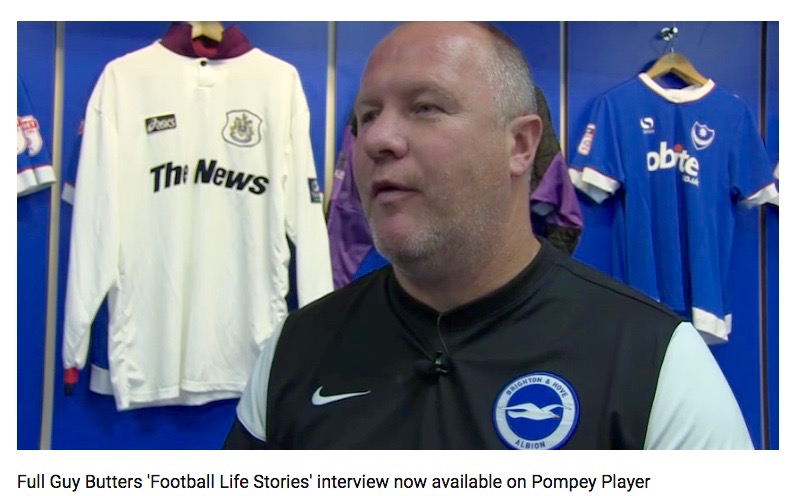
But there were mixed fortunes for Butters at Pompey, which he spoke about in a November 2016 interview for the Portsmouth website. He was there six years and enjoyed some good times when Jim Smith was manager.

guy butters YouTube

He had a brief spell on loan with Oxford United in 1994 and he eventually realised his time at Fratton Park was up when a regime change saw the arrival of Terry Venables, who was the Spurs boss when he was sold to Portsmouth.

Tony Pulis signed him for Gillingham for £225,000 on 18 October 1996 and, in six years at Priestfield, one game in particular stands out for the unfortunate pivotal moment Butters played in it.

It was 30 May 1999, the Football League Second Division play-off final to determine the third and final team to gain promotion and Gillingham were up against Manchester City, remarkably, at that time, struggling to get out of the third tier of English football.

Goals from Carl Asaba and Bob Taylor on 81 and 87 minutes looked to have given Pulis’ side victory. But Kevin Horlock had pulled one back for Joe Royle’s City and, as normal time expired, former Albion loanee Paul Dickov equalised for City in the fifth minute of added on time to level the scores at 2-2.

With no further scoring in extra time, it went to penalties. City scored three of their first four; Gills had scored only one of their three. So, the pressure was on Butters, the fourth penalty taker, to bury it to keep the Gills in it.

When Butters stepped up and hit it low to ‘keeper Nicky Weaver’s left…. it was within the 20-year-old’s reach, and he pushed it away. Cue wild celebrations as City won the shoot-out 3-1.

“Missing that penalty was one of the worst moments of my life but you have to move on and I am not afraid to have another go,” Butters told interviewer Alex Crook in an article for the 2004 Division Two play-off final match programme. “At the time, I just wanted the ground to swallow me up but nobody blamed me because it was just one of those things.”

Consolation for Butters came the following year when Gillingham returned to Wembley and on that occasion won 3-2 in extra-time against Wigan Athletic. As with Pompey, Butters had six years in total with the Kent club and played 159 league games before being released in the summer of 2002.

IMG_6010The 2002-03 season was already under way by the time Butters joined Albion on a free transfer and, in the September, he was doing his own personal pre-season workout programme in a bid to get fit.
“When I first came here I had to do a lot of extra work with Dean White,” Butters told Brian Owen, of the Argus. “It was a case of trying to cram a lot of stuff into a little space of time. I wasn’t really getting too much time to recover after it.”

The managerial change from Martin Hinshelwood to Steve Coppell didn’t do Butters any favours either. Virgo and Butters were the centre back pairing for Coppell’s first match – a 4-2 home defeat to Bristol City – and both were then discarded into the wilderness.  Virgo went on loan to Exeter and, after Coppell brought in Dean Blackwell to play alongside Danny Cullip, Butters was sent out on loan to Barnet.

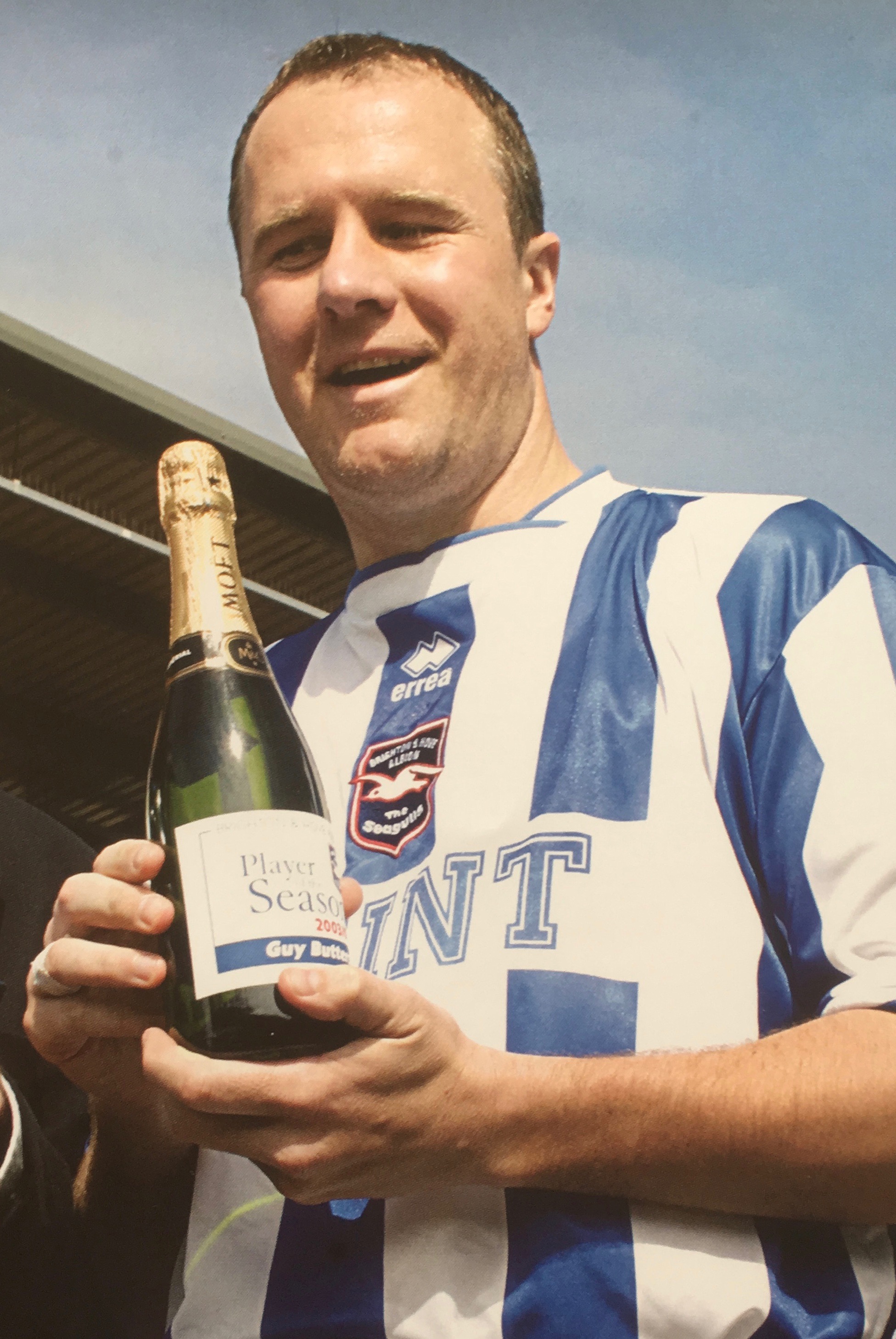
But when injury meant Blackwell’s career was over, the door opened again for Butters and he seized the opportunity to such an extent that as Albion won promotion back to the second tier via the play-offs, he was voted player of the season.

GB potseas by Bennett Dean• 2004 Player of the Season pictured by Bennett Dean.

In fact, it was the arrival of Mark McGhee to succeed Coppell that was very much a turning point in Butters’ career because he had previously been considering hanging up his boots.

In Match of My Life (www.knowthescorebooks.com), he said: “Mark was a real breath of fresh air as manager. Straight away he helped me with a special diet and fitness programme aimed at improving my general match fitness, but, more importantly, helping me work towards prolonging my professional football career.

“He was the first manager to do that and under his guidance I began to thrive and really enjoy my football again.”

As the Argus previewed the 2004-05 season with a special publication, they declared: “Buoyed by a great run of form in last season’s run-in and looking in good shape in training, Butters is ready for another stab at the second tier of English football.”

And Butters said: “This year I did a bit in the summer when I was on holiday and the gaffer put us through our paces so I’m sure that when the season starts I’ll be pretty match fit.

“It’s a big step up but, if we can get a few results away from home, not too many of those big teams are going to fancy coming to Withdean.”

  • The Argus spots a lighter refreshing moment!
  • Butters and Cullip were opponents when the Seagulls won at Sheffield United, another moment captured by the Argus.

Three years later, at the age of 37, Butters was still with the Seagulls and looking forward to what would ultimately turn out to be his last in the stripes.

“I thoroughly enjoyed it last year,” Butters told Andy Naylor. “It is probably one of the most enjoyable seasons I’ve had.

IMG_6014“I missed out on pre-season last year through injury. The gaffer was amazed I played as many games as I did.
“I cannot see why, with a decent pre-season under my belt and, as long as I look after myself, that I cannot do the same again.

“I just want to go on playing as long as I can and along the way enhance my CV with coaching badges.”

Manager Dean Wilkins finally released Butters at the end of the 2007-08 season, during which he had been sent off for the first time in his career.

He’d played a total of 187 games for the Seagulls and carried on playing with Havant & Waterlooville briefly plus a seven-game spell on loan at Lewes before trying his hand at management with Winchester City and Eastleigh.

Guy + Nick

  • I got the chance to meet Guy when he kindly presented an award at an event I was involved in organising: what a great bloke!

Kurt Nogan’s phenomenal goalscoring record for Brighton

Screen Shot 2023-03-06 at 08.26.32KURT NOGAN is right up there as one of my favourite all time Brighton & Hove Albion players. The ‘No, no; No, no, no, no; No, no, no Nogan’ fans’ chant still rings around my head when I think about his goalscoring exploits in the stripes.
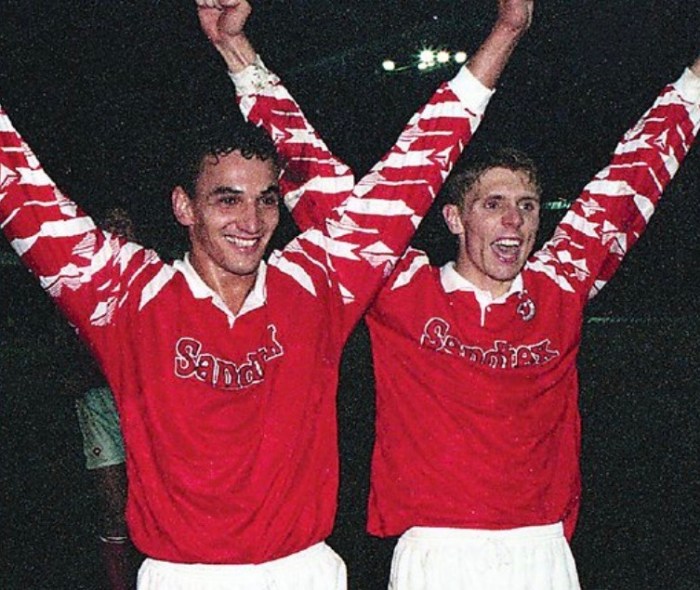
One of my favourite Albion memories involved Kurt scoring at Filbert Street when he rounded off one of Albion’s best ever performances to give Division 2 Albion a 2-0 League Cup victory over Premiership Leicester.

It was the autumn of 1994 and I had travelled halfway across the country to Cheltenham to meet up with my then exiled Albion-supporting friend Colin Snowball to travel up to Leicester together to watch the game.

Before the match, we parked in a side street near the university and found a tiny back-street boozer where they served a magnificent pint of Everard’s Tiger, the local ale.

In those days, League Cup games were played over two legs and Albion, with Liam Brady as manager, went into the away game leading 1-0, courtesy of another Nogan goal, which had given us optimism rather than confidence that Albion could progress.

Leicester got their Nogans in a twist in the match programme, mistakenly identifying the first leg scorer as Kurt’s older brother Lee who played for Watford at the time: they knew which one it was by the end of the game!

With one of the best away displays I have seen, Brighton took the game to their supposedly more illustrious opponents and caused a major shock when a stunning long range strike from young defender Stuart Munday (celebrating above with Nogan) sailed past Kevin Poole in Leicester’s goal.

There was a curious cameo towards the end of the game when Jimmy Case, who was hard of hearing, trotted over to take a corner and seemed to be wasting time. The ref also thought so and promptly sent him off but Case later claimed he had been waiting for the whistle but hadn’t heard it above the din of the crowd!

With Leicester pushing up for a goal to get themselves back in it, Nogan was left unmarked to seal the win and stun the majority of the crowd into silence.

None of the faithful knew at the time, of course, but it was the last goal Nogan would score for the club.

He subsequently went on a 20-game barren run and, at the end of February 1995, with Albion desperately needing funds, they persuaded Burnley to part with £250,000 for his services.

He might have finished on a downer, but Nogan’s Albion record was 60 goals in 120 games, making him one of the club’s great all-time goalscorers.

Born in Cardiff on 9 September 1970, Nogan arrived at the Goldstone having been released at the end of the 1991-92 season by David Pleat during his second spell as manager of Luton Town. At Luton, Nogan celebrated  his top flight debut in 1990 with a goal in a 2-2 draw against Liverpool at Anfield.

The young Welshman was quickly called up for his country’s under-21s for whom he also scored on his debut. However, competing for a place alongside the likes of established forwards Mick Harford and Brian Stein, he struggled to gain a starting berth in the Luton first team, mainly being used as a substitute.

He had just turned 22 when he signed for the Seagulls, and he told the matchday programme in 2020: “I’d been at Luton since I was 16 – cleaned Steve Foster‘s boots as an apprentice, so I did.”

On reflection, he realised it was a crossroads moment in his life. “You can either drop out of the professional game altogether, or something comes along and you get lucky. For me, Brighton came along and I got lucky.”

If Albion had been able to retain the services of the on-loan strike pair Steve Cotterill and Paul Moulden, who started the 1992-93 season up front, Nogan’s chances of making the breakthrough might have been limited.

But finances dictated otherwise and Nogan eventually made his debut in October 1992, taking over up from another free transfer signing, Matthew Edwards, although much of the season he played alongside Edwards, who moved out to the wing, and Andy Kennedy.

nogan saluteAfter a slow start Nogan scored his first goal in one of those lower league meaningless cup matches and then started finding the net regularly in the league, ending the season with 22 goals in all competitions.
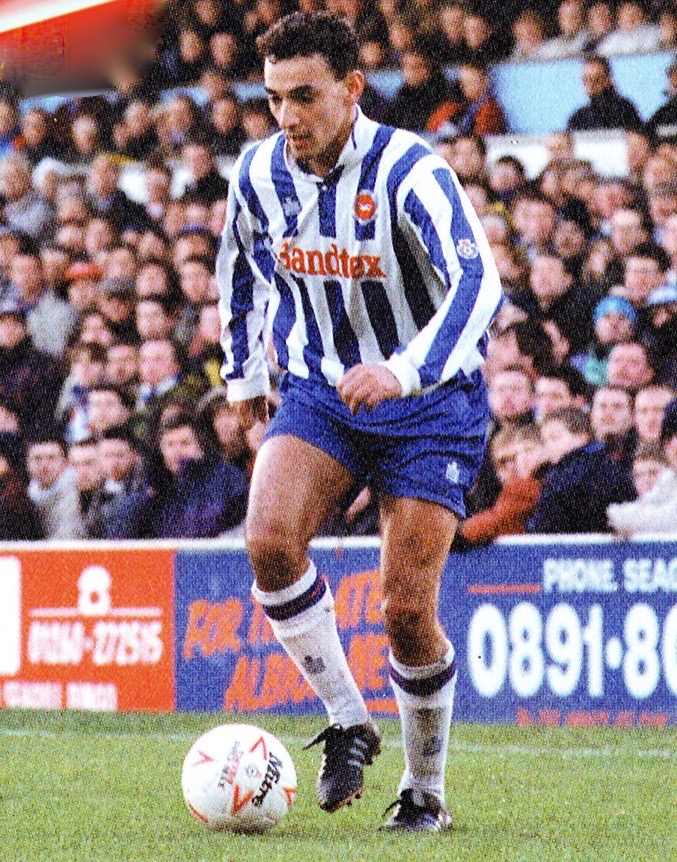
For part of the 1993-94 season he enjoyed a particularly fruitful partnership with a young Paul Dickov, the diminuitive Scottish striker on loan from Arsenal for eight matches.

Nogan ended the campaign with 26 goals to his name, and was voted player of the season, even though the team finished in a disappointing 14th place.

Nogan continued to have a variety of strike partners – often it was Junior McDougald but twice in late 1994 he was alongside the legendary Frank Stapleton who was doing his old Arsenal teammate Brady a favour by turning out for the Seagulls.

nogan ballIn fact, one of Stapleton’s two games in a Brighton shirt was away to Cardiff on 5 November 1994. In the Bluebirds line-up that day were future Seagulls Charlie Oatway and Phil Stant, the latter scoring twice in a 3-0 win.

Nogan’s career was detailed brilliantly in a profile by Tony Scholes on clarets-mad.co.uk and he noted that Burnley boss Jimmy Mullen’s gamble on Nogan wasn’t enough to prevent them being relegated. The Welshman scored just three times and got involved in an altercation with the manager after being substituted at Bristol City.

However his goal touch returned in the 1995-96 season when he racked up 26 goals, 20 of them in the league, and got on well with Mullen’s successor Adrian Heath – until halfway through the following season when he was suddenly out of favour.

A move was inevitable after Nogan aired his differences with the manager on local radio. “All of a sudden the crowd hero had become public enemy number one,” said Scholes.

That he moved to near neighbours Preston in February 1997 was somewhat galling and Burnley fans of a certain age recall the inevitability of him scoring against them for his new club.

Three years later he moved to home town club Cardiff but, after only four full games and a few substitute appearances, a ruptured hamstring ended his league career prematurely at the age of 32. He did subsequently turn out for some Welsh League clubs but he wasn’t able to return to the previous level.

  • Matchday programme pictures include various shots of Nogan in action and, from the Leicester programme for that cup tie, he is wrongly captioned with his brother’s name.