Toon scourge Ian Baird no stranger to red cards

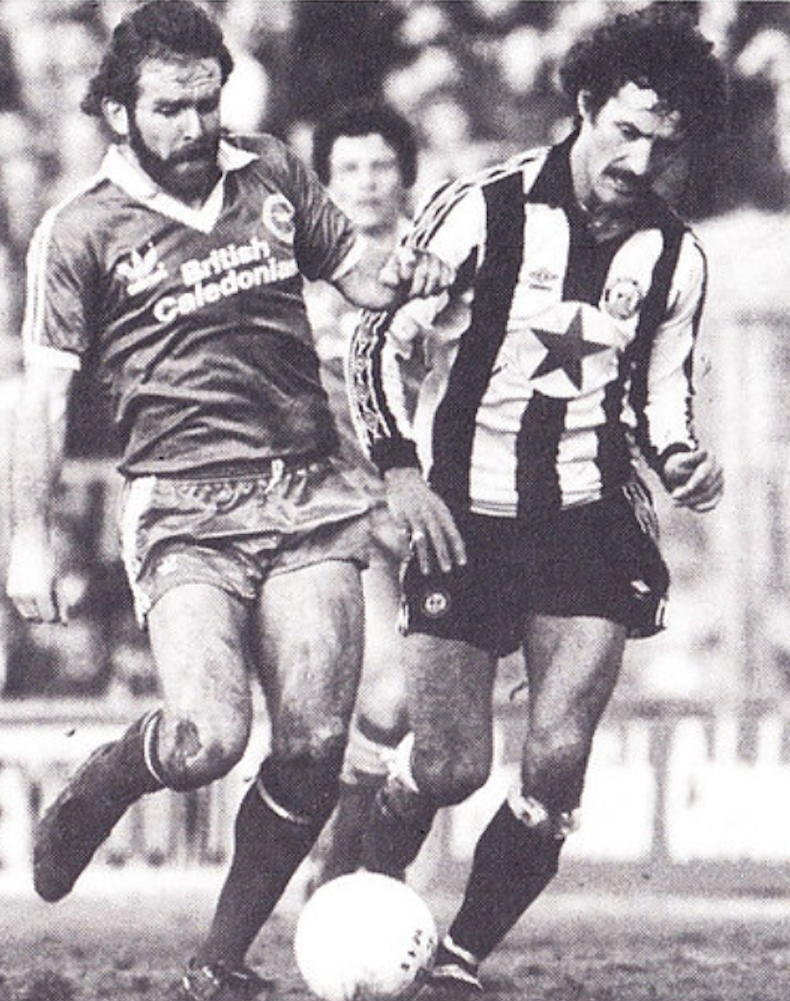
A GOALSCORING scourge of Newcastle United once pulled on the famous black and white stripes – and was booked in three of the five games he played for them!

Baird, who notoriously got himself sent off in the crucial last ever game Brighton played at the Goldstone Ground, led the line in an infamously fiery New Year’s Day derby between Newcastle and Sunderland when the Toon won 3-1 courtesy of a hat-trick by Peter Beardsley.

Jeff Clarke, who’d previously spent seven years at Sunderland and had five games on loan at Brighton at the start of that season, was at the back for Newcastle and future Albion veteran Clive Walker was in attack for the visitors.

A crowd of 36,529 watched the First Division fixture on 1 January 1985 when Sunderland were reduced to nine men through the sendings off of Howard Gayle and Gary Bennett. Baird was one of five bookings made by ref David Scott.

It was Baird’s fourth match for Newcastle after England World Cup winner Jack Charlton signed him on loan from Southampton. He made his debut three days before Christmas 1984 in a 4-0 defeat away to Aston Villa when his former England Schoolboys strike partner Paul Rideout scored a hat-trick. Baird’s only goal for United came in a Boxing Day 2-1 defeat at West Brom.

Three days later, as United lost 3-1 at home to Arsenal, Baird’s involvement was from the bench as a sub for David McCreery. His last game, on 12 January, was another tonking, 4-0 away to champions-in-waiting Everton.

Five years after his Toon cameo, Baird twice stymied Newcastle’s hopes of promotion from the second tier, scoring against them for Leeds in a 1-0 win in December 1989 (it turned out to be his last goal for them) and, after he’d fallen out with manager Howard Wilkinson and been transferred to Middlesbrough in January 1990, netted twice for Boro as they beat Newcastle 4-1 in the last game of the season.
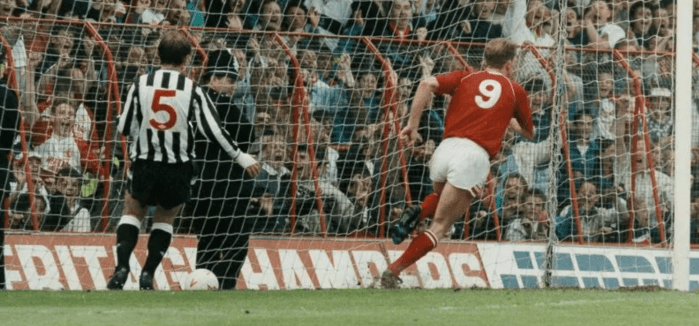
Baird nets for Boro against the Toon

Leeds finished that campaign as second tier champions (Newcastle, who by then had Mark McGhee up front, were five points behind in third place) and Baird’s goals in Boro’s win put paid to the Magpies’ hopes of automatic promotion. To add salt to the wound, Newcastle lost to Sunderland in the semi-final of the play-offs.

Six years later Baird was Brighton’s captain in the penultimate must-win game of the season, when Doncaster Rovers were the visitors.

Albion needed all three points to give themselves a chance of avoiding relegation out of the league when they travelled to Hereford the following week for the final fixture of that tumultuous season.

What they really didn’t need was for the captain to get himself sent off after just 18 minutes of the match!

Talking to The Athletic about it in a 2022 interview, Baird recalled: “I was fired up for it. Darren (Moore) had come right through me, literally in the first minute. The referee didn’t give anything.

“Then he came through me again, and the referee gave a foul. The third time, I lost it. I just turned around and tried to wallop him. There was a big melee. Everyone knew what was at stake.”

Both players were dismissed (it was one of 11 sendings off in Baird’s career) and thankfully Stuart Storer’s memorably-scrambled goal in the 67th minute settled the game in Albion’s favour, although Baird admitted: “It was nerve-racking. I felt guilty that I’d let my team-mates down, let everybody down by getting sent off. It was a massive relief when we won.”

Thankfully, disciplinary rules were different back then (bans were only applied 14 days after the offence) and Baird was able to play his part in the match at Hereford when a 1-1 draw ensured Albion stayed up and The Bulls went down.
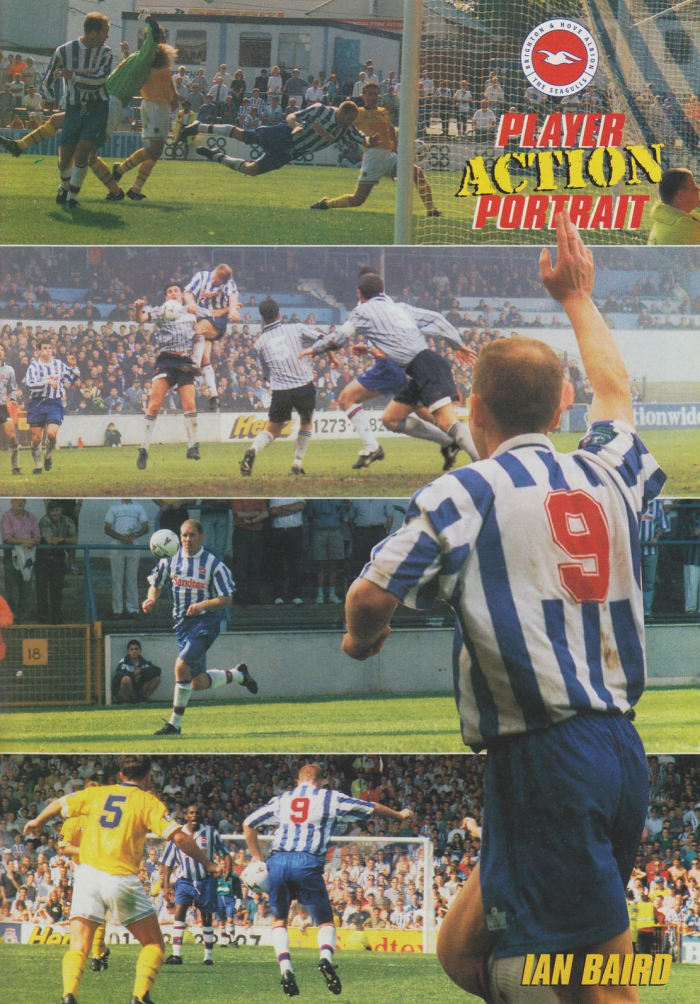
Baird’s exploits for the Albion highlighted in the matchday programme

Brighton were the tenth and last league club Baird had played for and he had only ended up with the Seagulls because of a pre-season falling out with Plymouth Argyle manager Neil Warnock.

Living near Southampton, only a 15-minute drive from Brighton manager Jimmy Case, a move east along the coast made good geographical sense, and a £35,000 fee took him to the Goldstone at the start of the 1996-97 season.

“Whenever I’d played against Brighton, I seemed to score,” Baird told The Athletic. “I loved the Goldstone Ground and there was the lure of playing for Jimmy.”

Although born in Rotherham on 1 April 1964, Baird had moved to Southampton with his family, via Glasgow, when he was a young lad, his father having sailed from the port when he worked on the Queen Mary.

After surviving meningitis as a six-year-old, Baird’s footballing ability saw him turn out for Bitterne Saints, St. Mary’s College, Southampton, Southampton and Hampshire Schools. He joined Southampton on schoolboy terms after he’d been spotted in the same boys’ team, Sarisbury Sparks, as Lawrie McMenemy’s son, Sean.

Baird won two England schoolboy caps: he was in England’s Victory Shield team that beat Wales 2-1 at Wrexham’s Racecourse Ground on 27 April 1979, playing alongside Rideout and winger Mark Walters, who went on to star for Aston Villa, Rangers and Liverpool.

In the same competition, he also played at St James’ Park – two days after Brighton had won 3-1 on the same pitch to win promotion to the top division for the first time in the club’s history.

On 7 May 1979, young England drew 1-1 with Scotland and 14-year-old Rideout’s goal was enough to enable England to retain the Victory Shield. The following month, Baird was an unused sub when England drew 2-2 with West Germany at Wembley.
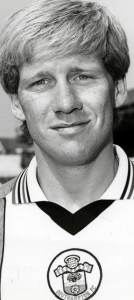
A Saint with hair!

Baird was offered pro terms by Swindon, but he chose instead to sign for his adopted home town club. However, with McMenemy preferring the more experienced Frank Worthington and Joe Jordan, Baird was restricted to 21 starts and three sub appearances for Saints, and, after that loan spell at Newcastle, he moved to Leeds.

His two spells at Leeds (sandwiched either side of an unhappy time at Portsmouth) produced 50 goals in more than 160 appearances and he was in the Leeds side alongside Mervyn Day and Micky Adams that lost the 1986-87 Division Two play-off final to a Charlton Athletic team that included his future Brighton boss Steve Gritt and teammate John Humphrey.

Baird scored 19 goals that season for Billy Bremner’s side, four of them in the FA Cup as United reached the semi-final where they were beaten 3-2 by eventual cup winners Coventry City.

He had taken Saints’ teammate Jordan’s advice to move to Leeds and his next move was to Scotland where Jordan was in charge of Hearts. He later played under the Scottish international striker at Bristol City too.

The Pilgrim who fell out with Neil Warnock

Baird scored six in 29 appearances for Plymouth before that move to Brighton. Discipline might have been a problem but Baird scored eight goals in 10 games from January 1997 as nine wins and a draw at the Goldstone went a huge way to enabling Albion to escape the drop.

As Albion began the 1997-98 season in exile at Gillingham, Baird began the campaign with a three-match ban for that red card against Doncaster — and it wasn’t long before he was seeing red again!

It came in the 13th game of the season and it was certainly unlucky for Baird, well, unlucky in that a linesman spotted his off-the-ball headbutt on a Chester defender. Gritt publicly condemned Baird’s “out of order” behaviour and stripped him of the captaincy.

The following month, with another knee operation required, a surgeon advised him to pack in the game and he left Brighton in December that year having scored 14 goals in 41 appearances in 16 months.

“At least we kept Brighton up,” he told The Athletic. “There were a multitude of problems, it was a weird period, but it was a big thing.”

Post-Brighton, Baird ended up coaching in Hong Kong and was put in charge of the national side for three Asian Cup qualifiers, playing in Jakarta in front of 75,000 people, and then in Cambodia in front of 1,200 people. “It was certainly an experience, that is for sure,” he said.

Baird eventually returned to Hampshire, developed business interests in the vehicle sales and leasing and sports gear industries, while keeping his football links going in non-league circles: at Eastleigh, Sutton United and Havant & Waterlooville.
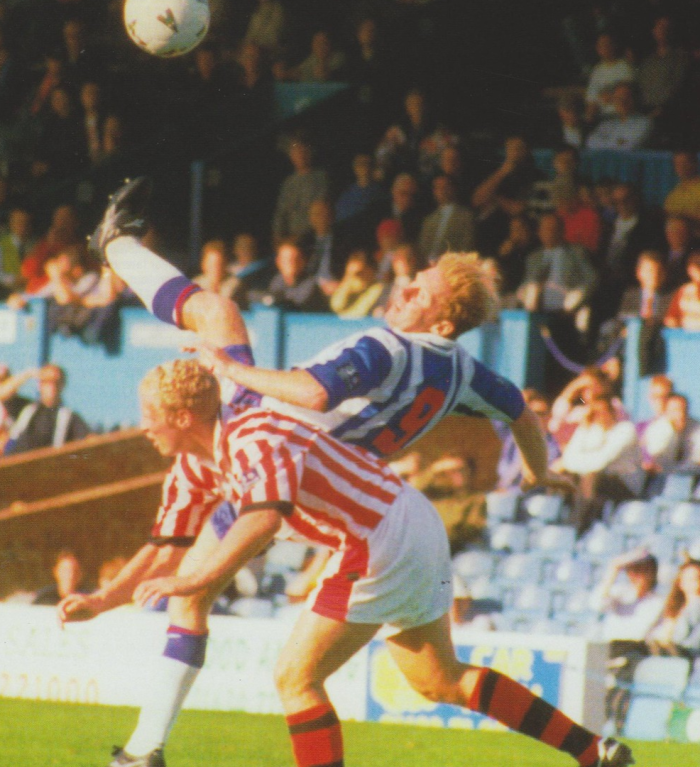
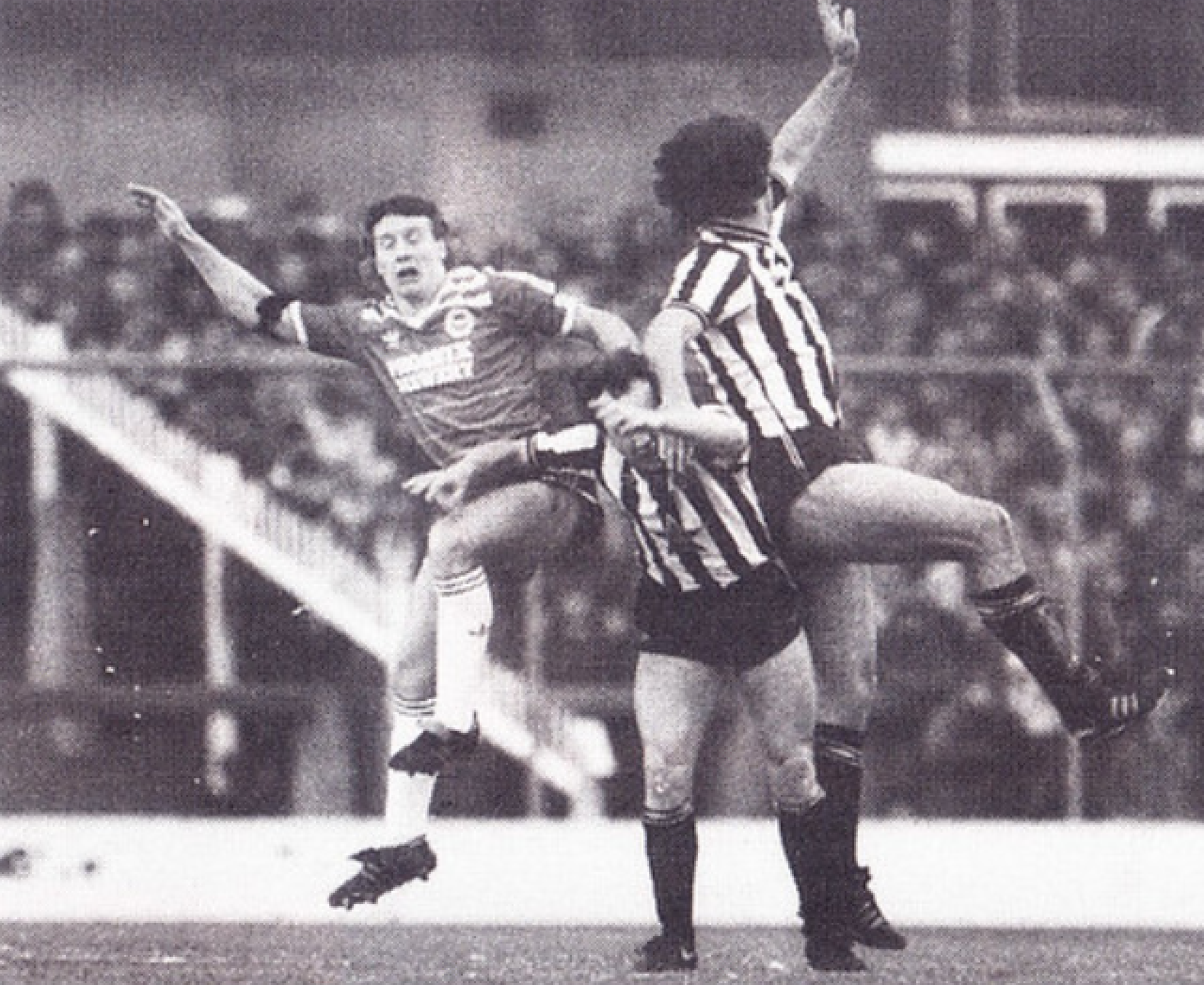
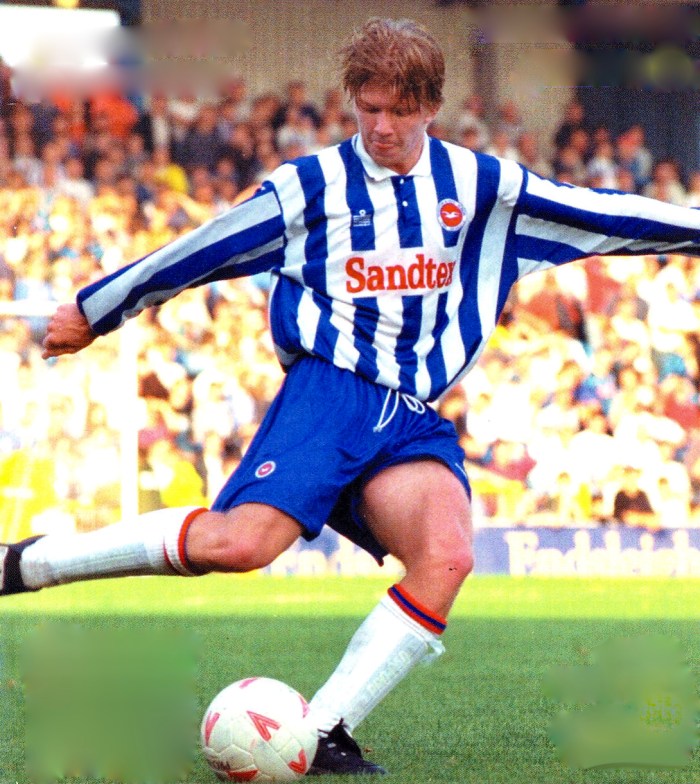
Baird certainly never ducked a challenge

The spectre of Trelford haunted them for ages at St James’

BRIGHTON travel to Newcastle in the fifth round of the FA Cup with the backdrop of having won there twice in the competition in the 1980s – not to mention a 1-0 win in the Premier League this season.

The 1-0 third round win at St. James’ Park in January 1983 set Albion en route to that season’s FA Cup final – but Toon supporters of that era blamed the game’s unusually-named referee, Trelford Mills, from Barnsley, for their exit.

Think I’m exaggerating? Newcastle fans’ website themag.co.uk had this to say ahead of another FA Cup game between the two sides in 2013: “It is doubtful that anything could match the anger and frustration that many of us felt nearly thirty years ago.

“Wednesday 12 January 1983 will always be synonymous with the name Trelford Mills, etched into the consciousness of an entire generation of Newcastle fans, convinced he cheated us out of the FA Cup. Well, a chance of the fourth round anyway!”

Neil Smillie, goalscorer Peter Ward, Steve Gatting, Chris Ramsey and Andy Ritchie celebrate after the 1983 win.

Mills disallowed two Newcastle ‘goals’ while Albion nicked it courtesy of a penalty area pounce by Peter Ward, back at the club on loan from Nottingham Forest, on 62 minutes. They did it without captain Steve Foster who was suspended (as, of course, he would be for the final too).

The game was a third round replay four days after the sides drew 1-1 at the Goldstone Ground when Andy Ritchie’s mis-hit shot in the 56th minute put Albion ahead and Terry McDermott (below right, with Tony Grealish) equalised on 77 minutes.

Even though the Magpies were in the old Division Two at the time, they had Kevin Keegan and Chris Waddle in their line-up, and they fully expected to win because Brighton hadn’t previously won away that season.

Albion, competing in the top division for the fourth season in a row, with joint caretaker managers Jimmy Melia and George Aitken in charge, had goalkeeper Graham Moseley to thank for some heroic stops to keep them in the first game.

The replay at St. James’s Park was in front of a typically noisy crowd of 32,687 and Newcastle did everything but score: they had shots cleared off the line and hit the woodwork and, when they thought they’d scored, Mr Mills disallowed them – twice!

In the meantime, Ward made the most of a counter attack to put the Seagulls ahead. It turned out to be the last goal he scored for the Albion, although he was in the side that pulled off a shock 2-1 win at Anfield to knock out Liverpool in the fifth round.

Enterprising reporter Tim Hodges searched out Mr Mills all those years later to hear his version of the events.

“I remember Brighton went one up, then Imre Varadi went through on goal, but quite clearly controlled the ball with his wrist,” said Mills.

“I think the Brighton keeper realised this, just as most of the players did, and let the ball go into the goal just to waste a bit of time. I just restarted with a free kick. I have spoken to Imre since. I think he accepts my version now.”

Mills continued: “Jeff Clarke managed to win a ball in the penalty area, but only because he had his arm around the defender’s neck. Keegan bundled the ball into the goal, but I had blown up a few seconds before it went in.

“Keegan did his Mick Channon cartwheel arm in front of the Gallowgate end, but I just jogged across to where I wanted the free kick taken from and indicated as to why I had disallowed the goal.”

Mills also recalled how he and his fellow officials needed a police escort away from the ground after the match. “When we sat in the dressing room after the match, I remember chatting to one of my linesmen, John Morley, when this police officer turns up,” he said. The copper said to him: “You’d better hang on here a while, Trelford. There are 2,000 Geordies outside and they all want your autograph!”

Three years later, the status of the teams had been reversed with Newcastle promoted back to the top division in 1984 and Albion back in the second tier, relegated the same year as the cup final appearance.

While Keegan had retired, Willie McFaul’s side had a young Paul Gascoigne in midfield and Peter Beardsley in the forward line. Clarke, who’d played four games on loan at Brighton two years earlier, was still in the centre of United’s defence and it was his foul on Terry Connor in the first minute of the game that saw Albion take a shock early lead.

Danny Wilson floated in a free kick from 30 yards out on the right which found centre back Eric Young on the far edge of the penalty box. He hooked the ball into the Newcastle net with only 50 seconds on the clock!

Albion, wearing their change strip of red, had to endure a relentless series of attacks (Toon had 23 corners to Albion’s one!) and Perry Digweed in Brighton’s goal put in a man of the match performance between the sticks, notable saves keeping out shots from John Bailey, Beardsley and Billy Whitehurst.

With five minutes left of the game, against the run of play, a quick throw-in by Graham Pearce found Dean Saunders and he rifled home an unstoppable shot past Martin Thomas for his 10th goal of the season.

Manager Chris Cattlin summed up afterwards: “It was really tough and we had a little luck on our side, but to go away to a club who have won the cup no fewer than six times and come away winners was quite an achievement.

“With the Geordie fervour up there the noise their supporters created was something special, but our efforts speak volumes for everyone connected with our club.”

There would be no fairytale ending that season, though, with Albion being dumped out of the cup 2-0 by Southampton in a quarter-final tie at the Goldstone Ground.

John Barnes and Steve Harper were on pundit duty for ESPN for the 2012 match

Younger fans will doubtless recall two more recent FA Cup meetings between Brighton and Newcastle, in consecutive seasons during Gus Poyet’s reign, at the Amex in 2012 and 2013.

The Championship Seagulls beat the Premier League Magpies on both occasions – 1-0 in the fourth round in 2012 and 2-0 in the third round the following year.

Getting to grips with Will Buckley

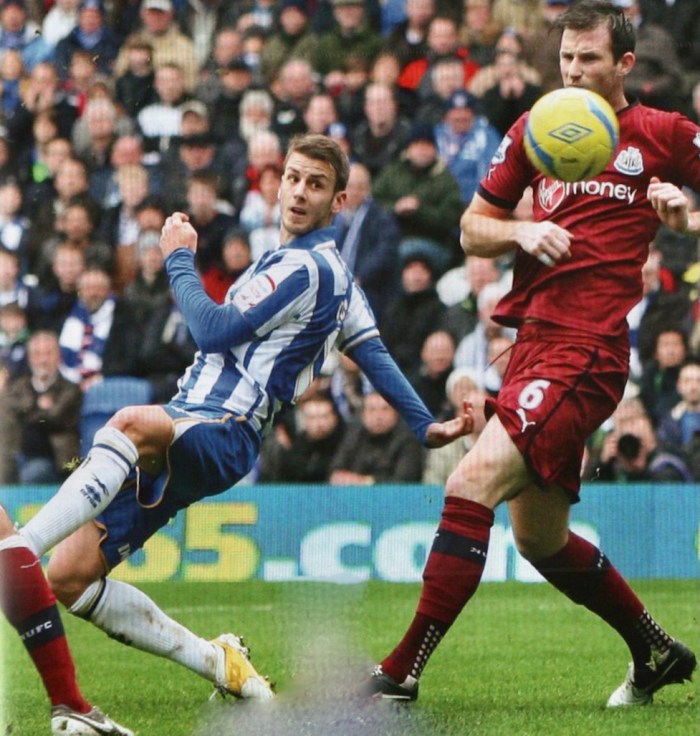
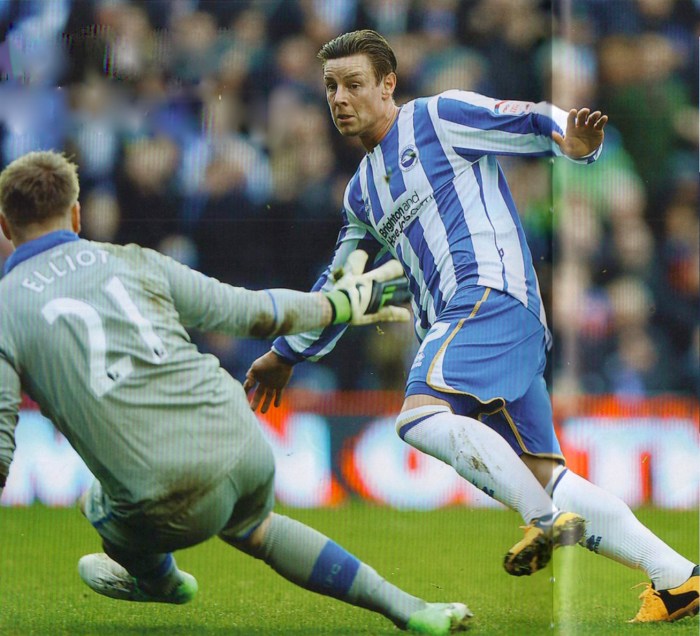
A Mike Williamson own goal was enough to give Albion the edge over Alan Pardew’s side in the first of those games; Will Buckley’s 76th minute shot deflecting off the defender and looping over Tim Krul for the only goal of the game. Leon Best, who would later have a torrid time at Brighton, missed two good chances for the visitors.

The 2013 fixture was a more convincing win for Brighton against a weakened Newcastle side who had Shola Ameobi sent off. Andrea Orlandi gave Albion the lead on the half-hour mark and substitute Will Hoskins added a second late on.

Andrea Orlandi hooks in Albion’s first goal
Praise for Liam Bridcutt

“This was an impressive victory for Brighton, a result that will add to the optimism that surrounds this upwardly mobile club and strengthen their resolve to host Newcastle in next season’s Premier League,” wrote Ben Smith, for BBC Sport. “The cool passing game of Liam Bridcutt at the heart of their midfield was tremendous.”

The reporter added: “Sharper to the ball, and swifter to make use of it, the Seagulls toyed with their more celebrated opponents for much of the opening 45 minutes, producing some stylish attacking moves while tackling, battling and dominating territory in their uncomplicated and effective way.”

Will Hoskins buries Albion’s second goal in 2013

Early promise faded for teenage Geordie debutant McGarrigle

A GRADUATE of the famous Tyneside boys club that spawned the likes of Alan Shearer and Peter Beardsley escaped the clutches of Newcastle United to play for Brighton instead.

After progressing through the ranks at Wallsend Boys Club, Newcastle-born Kevin McGarrigle and two teammates – Ian Thompson and Nicky Henderson – were snapped up by Brighton’s scouting network in the north-east.

Thompson wasn’t taken on and, although Henderson was, he returned home to play for Gateshead in the GM Conference. But McGarrigle stayed on and won a place in Albion’s first team at the tender age of 17, doing enough to earn a three-year contract.

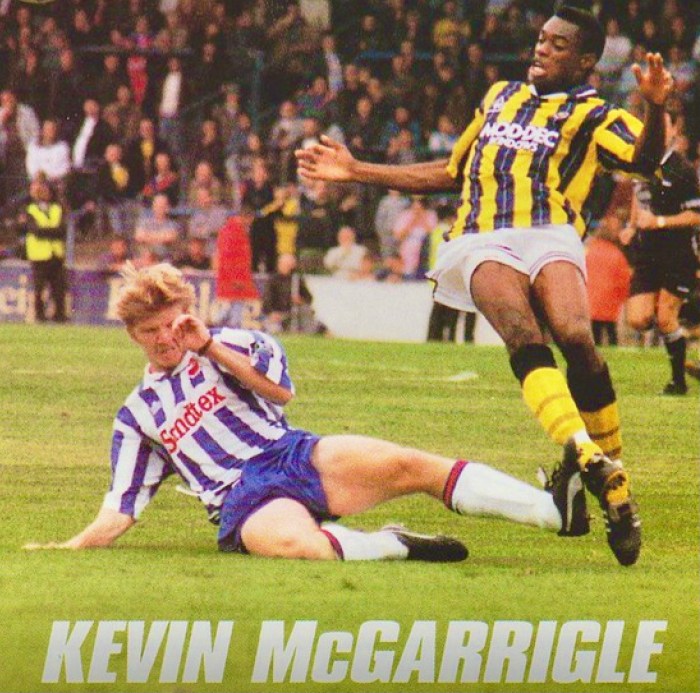
Against a backdrop of turmoil off the pitch, with the club run by a hated regime, McGarrigle played 34 games plus 11 as a substitute under three different managers, mostly as a centre back.

He made his debut in the final game of the 1993-94 season (replacing the injured Steve Foster) when Liam Brady was in charge and cemented a regular place in the starting line-up for the final third of the 1994-95 season.

McGarrigle was drafted in to play alongside Foster, with Paul McCarthy on the other side, as Brady sought to bring a run of three defeats to an end.

“Although it can look like five at the back at times, it does give the chance for the flank players (Peter) Smith and (Ian) Chapman to get much more forward,” the manager explained in his programme notes.

“It has suited Foster at the centre at the back organising McCarthy and McGarrigle in front of him. All in all I think it has worked very well and it is something that I am very pleased about because the players have managed to cope.”

McGarrigle played 16 games on the trot in which Albion posted six wins, seven draws and only three defeats to finish in mid table.

Brady also gave the young defender a special mention in his programme notes at the beginning of the 1995-96 season, pointing out: “I have been telling you that we have some very good talent among the younger element at the club.

“Kevin McGarrigle is doing very well. He has had to come into the middle of the park and do a job. He is there because of the injuries we have had, and he has done well.”

Although he played in the opening two games of the following season, his involvement in the side which was eventually relegated from the third tier under Jimmy Case was more often than not only from the bench.

One of those appearances, when he replaced an injured Smith in a midweek away game at Wycombe Wanderers (on 6 March), saw him score his one and only goal for the Seagulls to bring an eight-game winless run to an end.

Relegation-haunted Albion inflicted a fifth defeat in six games on Alan Smith’s Chairboys. Midfielder Jeff Minton put the Albion ahead on 55 minutes.

McGarrigle scored with what Claire Nash of the Bucks Free Press described as an “excellent” goal. “McGarrigle perfectly timed a run from midfield to meet a left-wing cross from Craig Maskell on 80 minutes,” she wrote.

Peter Smith and Kevin McGarrigle

Case’s preference had been to go with just two centre backs, initially with Foster alongside McCarthy, then, when age caught up with Foster, trying another former England international, Russell Osman, before introducing Ross Johnson alongside the young Irish defender.

Although McGarrigle was assistant Junior Seagull president in the 1996-97 season (Peter Smith was president), his playing time was even more reduced under Case’s successor, Steve Gritt, and he made only a handful of starts.

Gritt went for more experienced heads, like Mark Morris and Gary Hobson.

Nevertheless, the matchday programme showed he wasn’t forgotten, when, for the Wigan Athletic home game on 12 April 1997, it devoted a page photo feature of him in action.

But the following month he wasn’t given a new contract by Gritt, and he made his way back to the north-east. Initially he linked up with Spennymoor United. Before the year was out, though, he switched to Blyth Spartans and was soon involved in a much publicised and televised FA Cup first round match away to Blackpool.

The tie was a magnet for the media because it pitched the 1953 FA Cup winners against a non-league side renowned for past cup exploits and, on this occasion, Blyth’s player-manager was veteran goalkeeper John Burridge, for whom Blackpool was one of his early former clubs.

The occasion, which saw the Tangerines edge it 4-3, was described in detail in this Blyth Spirit blog, which bemoaned a foul on McGarrigle not given which led to a Blackpool goal.

The following season McGarrigle switched to Tow Law Town, turning out for them for three years before moving on again, to Crook Town. His last club was Albany Northern League side Chester-le-Street Town.

Born on 9 April 1977 to Carol, who worked at a local dairy, and Ken, a self-employed gardener, McGarrigle spent his first and middle school years at Wallsend’s Stephenson Memorial School and then moved on to Longbenton High School.

He confessed in a matchday programme article that he wasn’t particularly interested in football up to the age of 12. That all changed when his school pal, John McDonald, took him along to Wallsend Boys Club when he was 13.

The club manager, Kevin Bell, quickly recognised his talent and put him in the XI who competed in the National Association of Boys’ Clubs League on Tyneside.

Steve Bruce, later Toon manager, of course, was said to be McGarrigle’s idol and he too had gone through the Wallsend production line.

The programme reported that McGarrigle was invited for trials at several clubs: he went to Everton, Ipswich Town and Bradford City, while Blackpool, Wimbledon and Charlton Athletic all offered him a YTS place.

But Albion’s north-east scout Steve Burnip won the day and Ted Streeter who ran the youth team at the time persuaded him to sign for Brighton.