Horton’s place in the hearts of Brighton and Man City fans

IMG_5170ARGUABLY the finest captain in Brighton & Hove Albion’s history went on to have a far less successful spell as the club’s manager having also been a boss at the highest level, at Maine Road, Manchester.

The £30,000 signing of tenacious midfielder Brian Horton from Port Vale on the eve of transfer deadline day in March 1976 proved to be one of the most inspirational moments of Peter Taylor’s managerial tenure at the Albion and for such a fee was widely hailed as “an absolute steal”.

Even though Taylor didn’t hang around long enough to reap the benefit of the man he instantly installed as captain, his successor Alan Mullery certainly did.

In the early days after his appointment, there was some suggestion Mullery would be a player-manager but the former Spurs and England captain reassured a concerned Horton that wouldn’t be the case, admitting that he wouldn’t get in ahead of him anyway!

“Fortunately, that next year went really well. It was my best year without a doubt,” Horton told Evening Argus reporter Jamie Baker. “I’d never met Alan Mullery, and he’d probably never heard of me, so I was delighted and surprised when he made me his captain.”

It was the beginning of a strong bond between captain and manager and Horton added: “We had that relationship for all the five years I was with him.

“That first season was great. We went 20 odd games unbeaten and I was scoring left, right and centre, and I was very proud to be voted player of the year.

“Suddenly everything was coming right for me, although we were disappointed not to beat Mansfield for the championship because we felt we were far better than them.

“You’ve got to hand a lot of our success down to Alan Mullery. He was a terrific motivator of players. He was a bubbly character and it used to rub off on players.

“He was new to the game of management but he brought fresh ideas, and he’d been under some top managers as a player.

“The team spirit during those first three years was incredible. When you are winning games every week it makes a hell of a difference and we had that for three years. You just couldn’t describe how good the team spirit was.

“My treasured memory will always be of the day we beat Newcastle to clinch promotion to the First Division. It was even greater because I scored the first goal. It had always been my ambition to play in the First Division and now I had achieved it.”

In an inauspicious start, Horton found himself in the referee’s notebook as Albion were hammered 4-0 by Arsenal as the season opened at the Goldstone. After a narrower defeat away to Aston Villa, the next game was away to Man City – and Horton had the chance to earn the Seagulls their first top level point.

On 25 August 1979, Albion were trailing 3-2 when Horton had the chance to equalise from the penalty spot with only eight minutes of the game left. But the normally reliable spot-kick taker fluffed his lines, meaning Albion succumbed to their third defeat in a row.

While the superior opposition was clearly testing the Seagulls, it was testament to the resilient skipper that he was continuing to lead them having started out in the third tier and, on 20 December 1980, before a 1-0 home win over Aston Villa, he received a cut-glass decanter from chairman Mike Bamber to mark his 200th league appearance for the Seagulls.

As the 1980-81 season drew to a close, Albion were perilously close to the drop but four wins on the trot (3-0 at Palace, 2-1 at home to Leicester, 2-1 at Sunderland and 2-0 at home to Leeds) took them to safety. What Horton didn’t realise was the Leeds game would be his last for the Albion (as it also was for Mark Lawrenson, Peter O’Sullivan and John Gregory).

“I’d bought a house in Hove Park off Mike Bamber and I was sunbathing that summer when there was a knock at the door. It was Alan Mullery come to tell me he’d just resigned,” Horton told interviewer Phil Shaw in issue 26 of the superb retro football magazine, Back Pass.

Mullery told him how he’d quit over the proposed Lawrenson transfer, how O’Sullivan and Gregory were off as well, and that the club wanted to sell him too, for £100,000.

Although Mullery advised him to sit tight because he still had a year left on his contract, new boss Mike Bailey – with a swap deal involving Luton’s Republic of Ireland international, Tony Grealish, lined up – told him he’d have to fight for his place and would have the captaincy taken from him.

“I said I didn’t want to go, that I loved the club and the fans, that I’d bought a house, and, at 31 I thought I had two or three good years left.

“I spoke to Mike Bamber and he said: ‘I don’t want you to go but I have to back the manager’.” Horton felt he had no option but to make the move.

He chose the platform of the Argus to thank the supporters for the backing they’d always given him and said his one disappointment was that he didn’t get the chance to lead Albion at a Cup Final. “That I would have really loved.”

Looking ahead, he added: “The Luton move gives me a new challenge. You can get in a rut if you stay at one club too long. Six years at Port Vale and five and a half at the Albion is enough. It will probably put a little sparkle back into my game.”

And so, Horton went to Kenilworth Road and under David Pleat the Hatters won the 1981-82 Second Division championship by eight points clear of arch rivals Watford. Looking back in his interview with Back Pass, Horton reckoned two of his Luton teammates, David Moss and Ricky Hill, were up there alongside Lawrenson as the best players he’d played alongside.

An all-too-familiar tale of struggle in the top division saw Luton needing to win at Maine Road in the last game of the season to ensure their safety, and Raddy Antic scored a winner six minutes from time that preserved Town’s status and sent City down.

Television cameras memorably captured the sight of Pleat skipping across the turf at the end of the game and planting a kiss on Horton’s cheek.

After one more year at the top level, he began his managerial career as player-manager of Hull City in 1984, working for the mercurial Don Robinson, and steered them to promotion to the old Division Two at the end of his first season in charge. He is fondly remembered by Hull followers, as demonstrated in this fan blog.

When he parted company with the Tigers in April 1988, his old Brighton teammate Lawrenson, by then manager of Oxford United, invited him to become his assistant. United at the time were owned by Kevin Maxwell, son of the highly controversial Robert Maxwell.

When Dean Saunders, who Brighton had sold to Oxford for £70,000, was sold against Lawrenson’s wishes – astonishingly he went to Derby for £1million – Lawrenson quit. Horton took over as manager and stayed in charge for five years, during which time he recruited former Albion teammate Steve Foster to be his captain.

Horton’s managerial break into the big time came in August 1993 when Man City sacked Peter Reid as manager four games into the 1993-94 season. Horton didn’t need to think twice about taking up the role, even though City fans were asking ‘Brian who?’

In Neil McNab, Horton recruited to his backroom team a former playing colleague who’d been a City favourite. “I played with McNab at Brighton and knew his strengths and knew he was well liked here,” he told bluemoon-mcfc.co.uk.

Horton brought in Paul Walsh, Uwe Rossler and Peter Beagrie and City managed to stay up.

The new boss acquired the services of Nicky Summerbee (to follow in the footsteps of his famous father Mike) along with Garry Flitcroft and Steve Lomas and at one point City were as high as sixth in the table.

They eventually finished 17th but fans to this day still stop Horton (who lives in the area) and ask him about a terrific match which saw City beat Spurs 5-2.

It was Horton’s bad luck that when City legend Francis Lee took over the club from previous owner Peter Swales, he was always looking to install his own man in the hot seat, and Lee eventually got his way and replaced Horton with Lee’s old England teammate Alan Ball.

Ball took City down the following season while Horton embarked on a nomadic series of managerial appointments either on his own or in tandem with Phil Brown.

Initially he was boss of Huddersfield Town; then he was a popular appointment when he took over as Albion boss during their exile playing at Gillingham, but, because he wanted to live back in the north, he left in February 1999 to join another of his former clubs, Port Vale.

He led Vale for five years and pitched up next at the helm of Macclesfield Town, where, on 3 November 2004, he marked his 1,000th game as a manager. It was at Macclesfield where one of his players was the self-same Graham Potter whose stewardship of Swansea City came mightily close to upsetting City in the 2019 FA Cup quarter-finals.

A bad start to the 2006-07 season saw him relieved of his duties in September 2006 but, by the following May, he was back in the game as Brown’s no.2 at Hull City. In March 2010, he was briefly caretaker manager following Brown’s departure, until the Tigers appointed Iain Dowie.

Next stop saw him as no.2 to Brown at Preston North End; then a second brief spell as Macclesfield boss at the end of the 2011-12 season.

In June 2013, he was appointed assistant manager to Paul Dickov at Doncaster Rovers, a role he filled for two years before linking up with Brown once again during his tenure at Southend United. Horton was his ‘football co-ordinator’ but left the club in January 2018. He followed Brown to Swindon Town but, in May 2018, decided not to continue in his role as assistant manager.

Born in the Staffordshire coal-mining village of Hednesford on 4 February 1949, Horton went to its Blake Secondary Modern School. Spotted playing football for the Staffordshire Schools side and the Birmingham and District Schools team, the Wolves-supporting youngster was awarded a two-year apprenticeship at Walsall when he was 15.

But, at 17, his hopes of a professional career were dashed when he wasn’t taken on. He ended up finding work in the building trade while continuing his football with Hednesford Town in the West Midlands (Regional) League.

He played at that level for four seasons and it was there he acquired the moniker Nobby because he gained a reputation for World Cup winner Stiles-like aggression. It was a nickname that stuck.

At the time, he was playing up front and scoring a lot of goals so he caught the attention of a few league clubs, but only Gordon Lee at Port Vale made a move. Lee sealed the deal by buying the Town secretary a pint of shandy and promising to take Vale to play Hednesford in a friendly.

Vale had little money so the squad was made up of free transfer signings but Horton said it made them strong collectively with “a fantastic spirit” and it wasn’t long before he was made their captain.

Vale legend Roy Sproson took over from Lee as manager and in March 1976 the cash-strapped Potteries outfit were forced to sell their prize asset.

When Vale headed to Selhurst Park that month, Crystal Palace player-coach Terry Venables got a message to Horton before the game urging him to sit tight until the summer and they’d sign him then. But Albion stole a march on their rivals and Sproson told him: “I’m sorry but we’re selling you to Brighton for thirty grand. We need the money.”

Funnily enough, the previous summer Horton had a chance holiday encounter in Ibiza with Albion’s Peter O’Sullivan. He later told the Argus: “Sully asked me if I fancied a move. Little was I to know that I would be joining him soon after. There was a wealth of ability in the Albion side when I joined them and it was outrageous that we didn’t go up that year.

“I felt they had to go places and I wanted to be part of it. I’d never been in a promotion side but then to be made captain of it was really the icing on the cake.”

Albion’s gain was certainly a loss to two other clubs who’ve since encountered similar troubles in their past. Horton explained: “I knew clubs were interested although Roy Sproson said he wouldn’t let me go to another Third Division team. I think he released me to Brighton because at the time they looked certain for promotion.

“Also, it was the highest bid they’d had. Hereford and Plymouth had offered £25,000 and I would have been happy to have gone to either club.”

In November last year, Horton reflected on his long and varied career in an interview with The Cheshire Magazine.

Pictures mainly from my scrapbook, originally from the Argus, Shoot / Goal magazine, the matchday programme and various online sources.

Neil McNab: Brighton fans ‘worst crowd I’ve played for’

FIERY SCOT Neil McNab left Brighton for a sizeable loss on their initial outlay and went on to be voted Manchester City’s Player of the Year twice.

No stranger to brushes with the football authorities, McNab joined Brighton in the second half of their first-ever season in the top flight.

In his autobiography, manager Alan Mullery said: “Neil McNab was a Scottish whippet, a fierce competitor in midfield who never stopped running or competing.

“I bought him halfway through the season from Bolton Wanderers and he gave us the extra edge we needed.”

The player to give way at the time was Republic of Ireland international Gerry Ryan, and it would be fair to say the football writers were impressed by the tenacious Scot’s early impact.

After watching a 5-1 drubbing against Southampton from the subs bench, McNab made his debut at home to West Brom in a game that finished goalless. “McNab showed some touches of class in his home debut but scarcely as much as the home crowd expected from their £230,000 capture,” said Harold Palmer in the Sunday Express.

The News of the World’s Peter Jarman was slightly more effusive and described it as “impressive” and John Vinicombe in the Evening Argus said: “McNab, on his home debut, impressed with his industry and general involvement.”

Of his second game, a 1-1 draw away to Leeds, the Sunday People’s Keith Ray observed: “McNab looked light years from the off-key young man that Bolton sold. His prompting coupled nicely with Lawrenson’s hard work, and Ward had two chances to hit the target before he made the vital strike.”

A demonstration of his appetite came in the next game, another 1-1 draw, at home to Coventry, when he ran 25 yards to stop Peter O’Sullivan from taking a corner that he fancied for himself. He whipped the ball in and Ray Clarke thumped a header past Jim Blyth in the Coventry goal.

Gordon Smith, another Albion player who moved to Manchester City, remembered McNab’s quick wit in his autobiography, And Smith Did Score.

When it looked like Brighton were heading for relegation, Mullery, in fear of losing his job, famously threatened the players that he’d run them down in his car if that happened.

Smith recounted how the players were huddled round trying not to laugh at the astonishing outburst. “I almost fell off my chair when Neil leant over and whispered, ‘If he loses his job, he’ll no’ have a f****** car!’”

It was no laughing matter for player or club, though, when the tenacious McNab was suspended for four matches for pushing a referee. In the following season, he was up before the FA again after a skirmish with World Cup winner Alan Ball at the end of a 5-a-side tournament at the Brighton Centre.

Charged with bringing the game into disrepute, Ball was fined £100 but McNab was given a £250 fine and a two-game ban.

Manager Mike Bailey was clearly relieved and told the Daily Mail’s Brian Scovell: “Neil was expecting more but the last instance was entirely different. It was on the field of play when he touched the referee.

“We got a fair hearing. We’re not complaining. Both were guilty but the crimes were different as Neil’s part was unfortunately physical while Ball’s was verbal.”

McNab had the third highest number of appearances (44 plus two as sub) in the 1981-82 season, which saw Brighton’s highest ever finish of 13th, and all four of the goals he scored were from the penalty spot.

However, the safety-first style of play adopted by Bailey created a disconnect between players and fans. In the final home game of the season (a 1-0 defeat to Ipswich), McNab was substituted in the 62nd minute and the crowd booed him off.

The often-obtuse Vinicombe reported in the Argus: “When McNab was withdrawn, 30 minutes from time, his gestures to the crowd were capable of only one interpretation.” In the Daily Mail, McNab told Brian Scovell: “They are the worst crowd I’ve played for. When you do something good on the ball they don’t clap and if you make a mistake they give you stick.”

Worse was to follow after the row at the beginning of the 1982-83 season when Steve Foster and Michael Robinson slapped in transfer requests in protest at chairman Bamber refusing to sanction the acquisition of Charlie George, the former Arsenal, Derby and Southampton maverick, who had been on trial pre-season.

In what was supposed to have been a clear-the-air meeting, McNab let his feelings be known in no uncertain terms.

McNab still had five of six years left on his contract. They tried to offload him on loan to Newcastle, but the midfielder refused to budge. Instead, he made a bitter personal attack on the chairman, accusing him of picking the team, and slapped in his own transfer request.

McNab blasted: “The club is petty and small-minded, and players are treated disgracefully.” McNab made it clear he didn’t see his future at the club and after a few months eventually went to Leeds for a six-game spell and also to Portsmouth.

That came after Bailey had been sacked and his replacements, Jimmy Melia and George Aitken, gave the team a big shake-up, dropping McNab and adopting a more adventurous approach (which ultimately led to relegation).

Although completely out of the first team picture from early December 1982 onwards, McNab was to play one last game nearly five months later.

With Melia struggling to field a team because of injuries and suspensions, McNab got the nod for an away game at Notts County on 30 April 1983.

But he was unable to join in the FA Cup run to Wembley because he had been cup tied during his spell at Leeds. The 1-0 defeat to County was the Scot’s last ever Seagulls appearance.

Relegation led to the release of some of the high earners, and while Robinson and Gary Stevens were sold for sizeable fees, McNab was sold to Manchester City – who had been relegated with Albion – for just £35,000.

Born on 4 June 1957 in Greenock, McNab went to the town’s Highlanders Academy and he was in his primary school team at the age of eight. By the time he was 10, he was playing for the Greenock and District Under 12 representative side.

He moved on to Mount Secondary School, playing for the school team at all age groups, and at 14 was selected for the Scotland Schools side.

He played against England at Ibrox Park, against Ireland at Stranraer, and even travelled to Frankfurt to play against West Germany. All the attention alerted various scouts but he had already signed schoolboy forms for his local club, Greenock Morton.

He actually left school before he was 15 to join Morton as a professional and when he made his first team debut aged 15 in September 1972 he was the youngest outfield player ever to play in the Scottish League. McNab ended that season having played 11 matches and appeared a a sub on three occasions.

McNab SpursHe made 14 appearances for them before being snapped up for £40,000 by Tottenham Hotspur in 1974 and made his first team debut for Spurs while still only 16. A former teammate at that time, Andy Keeley said in a recent interview: “I’ll never forget how he played in a friendly match; first team v reserves. He controlled the game from start to finish. He was outstanding. He had a very good career but I never understood how he didn’t become a superstar.”

In four years at White Hart Lane, McNab played 72 matches and was selected by Scotland at under 15, under-18 and under-21 level, but never made it to the full Scotland team.

McNab - BoltonIn November 1978, Bolton Wanderers paid £250,000 for him but after only 35 appearances for the Trotters, in February 1980, Mullery signed him for Brighton.

When the former Scotland and Celtic captain Billy McNeill captured McNab’s signature in the summer of 1983, he began what would be a long association with Manchester City and he turned out to be a bargain buy considering in 1986-87 and 1988-89 he was voted City’s Player of the Year.

“Combative and always willing to stick a boot in, McNab was a key figure in City’s drive to promotion on more than one occasion,” was how manchestercity-mad.co.uk described him, while mancity.com, looking back at past players of the year, said: “Like a fine wine, got better as time went on.”

McNab w HartfordAcknowledging his initial signing failed to excite the City faithful, it added: “McNab developed into a skilful, combative midfielder who became a huge crowd favourite. Not unlike Asa Hartford (pictured above with McNab), McNab was a schemer who could pick a pass and kept the team’s tempo ticking over.”

McNab scored 19 goals in 261 league and cup games (plus five as sub) for City  but when Mel Machin’s successors at Maine Road (caretaker Tony Book and Howard Kendall) discarded him, he continued his playing career at Tranmere Rovers who paid £125,000 to take the 33-year-old to Prenton Park.

The combative midfielder added nous, steel and no little skill to the Rovers midfield, ending his first season in Birkenhead with two appearances at Wembley including the Leyland Daf Cup victory over Bristol Rovers,” said the Liverpool Echo.

He played 105 games for Tranmere, scoring six goals, and was part of the squad that secured promotion to English’s football’s second tier. He also earned the dubious distinction of being the first and thus far only Tranmere player to be sent off in a European game – a 2-1 win over Cosenza in the Anglo-Italian Cup.McNab HS

Determined to carry on playing, McNab had an 11-game loan spell at Huddersfield Town, returned to his native Scotland to turn out for Ayr United, appeared briefly for Darlington, played 13 games in Northern Ireland for Derry City, went non-league with Witton Albion (12 games) before finally calling it a day with Long Island Rough Riders in the States.

In 1994, he returned to Maine Road as youth team coach, when his old Albion teammate, Brian Horton, was City manager, and kept the position even when the aforementioned Alan Ball replaced Horton. But eventually he lost his job during another managerial upheaval in 1997 and took up a similar position at Portsmouth, once again working with Ball.

In October 2002, he finally landed a managerial position when he took the helm of League Two Exeter City. The reign was shortlived, though, and with only six wins in 26 matches (eight draws, 12 defeats) he was relieved of his duties.

McNab’s twin sons, Neil junior and Joe, who were born in Brighton, followed in their dad’s footsteps and were part of the young age group sides at Man City and Portsmouth. But after struggling to make the breakthrough, they moved to Wilmington, North Carolina, and have played for various sides in America.

Neil senior followed them to the States and in 2008 became director of coaching at Chiefs Futbol Club in Atlanta, Georgia, with Neil junior the club’s executive director.

In August 2017, it was reported Neil senior had suffered a severe stroke which left him fighting for his life.

On 2 March 2018, a message was sent via freelance writer Spencer Vignes to say that McNab had finally managed to return home after five months in hospital and in rehabilitation. “He has made tremendous progress, but still has a long way to go,” his son said.

Irish international pals brought wing wonder Steve Penney to Brighton

BRIGHTON & Hove Albion can thank former Middlesbrough goalkeeper Jim Platt for landing one of the most exciting players ever to play for the Seagulls.

Platt was the Teesside club’s man between the sticks for 12 years. During his call-ups on international duty with Northern Ireland, he struck up a friendship with Arsenal defender Sammy Nelson, who joined Brighton towards the end of his career.

When Platt took over as manager of Ballymena United, he quickly recognised that a talented teenage winger at his disposal –  Steve Penney – could make a career for himself in England.

Platt tipped the wink to his old pal Nelson, newly-appointed as Albon’s assistant manager to Chris Cattlin at the time, and the youngster was invited for a trial.

Penney was put up in a house near the Goldstone recently vacated by the sacked Jimmy Melia. His housemate was another young triallist: Ian Wright! Penney was taken on while Wright was released. Whatever happened to him?!

Penney’s Albion story is told in fine detail by journalist Spencer Vignes who devotes 12 pages of his excellent book A Few Good Men (Breedon Books) to a player who, for the record, played 148 games (plus 14 as sub) in eight years with Brighton.

Unfortunately, that rather low figure tells its own story, a succession of injuries robbing him of probably twice as many games as you might have expected him to have played over that length of time.

“He was, in short, a breath of fresh air, a flying winger whose close control and devastating pace left opponents and spectators alike lost for words,” said Vignes.

Among former teammates who voiced their appreciation of Penney, full back Graham Pearce told Vignes: “I always thought of Steve as a bright young winger, very naturally talented, who had all the attributes you need in that position, especially pace.”

Born in Ballymena on 6 January 1964, the son of a teacher and a nurse, although he played football at primary school, he went to what he described himself as “a fairly posh grammar school” where rugby was the preferred sport for boys, and he was a scrum half.

He got the chance to play football in the Boys Brigade, where Nigel Worthington, who later managed Northern Ireland, also played.

“I had to choose between rugby and football and when I decided to join Ballymena United, the school were so furious they suspended me,” he told interviewer Dave Beckett in a matchday programme feature.

“Playing for my home town was excellent, although I had the chance to join Linfield who were one of the best teams in the country.

“I guested for them in Holland a couple of times so I knew they were interested and that’s where I expect I’d have ended up if I hadn’t moved abroad.”

Instead, Platt alerted Nelson and, bearing in mind Albion’s high profile having only recently played against Manchester United in the Cup Final, Penney didn’t take much persuading.

Beckett recounted: “Penney, at 19 years old, made his debut in a 3-1 defeat by Barnsley but was soon a hot favourite on the terraces. Even in his opening match he set up the goal goal for Alan Young, and John Vinicombe wrote in the Evening Argus: ‘The eye for an opening that Penney unquestionably has will serve Albion well. The Goldstone are going to like him’.”

It wasn’t long before he was playing to a much bigger gallery when he was part of the Albion side who toppled Liverpool in the FA Cup (for the second season running), winning 2-0 in front of a live television audience.

Penney tormented the experienced Liverpool left-back Alan Kennedy and his perfectly-flighted pass over the top of the Liverpool defence played in Terry Connor to score the decisive second goal.

His first goal came in a 3-0 win at Derby County in March 1984 and such was his impact in that first season that he was voted runner-up to Jimmy Case as player of the season.

Away from football, Penney was a decent golfer, his regular companions on the golf course being Dean Saunders, Chris Hutchings, Steve Gatting and former Albion favourite Peter O’Sullivan.

During the winter, he loved nothing more than playing snooker at a club in Hove, especially taking on Saunders and competing for a trophy awarded each week to the winner.

So, life was sweet for the young Irishman and it got even better when his form with Brighton led to full international honours.

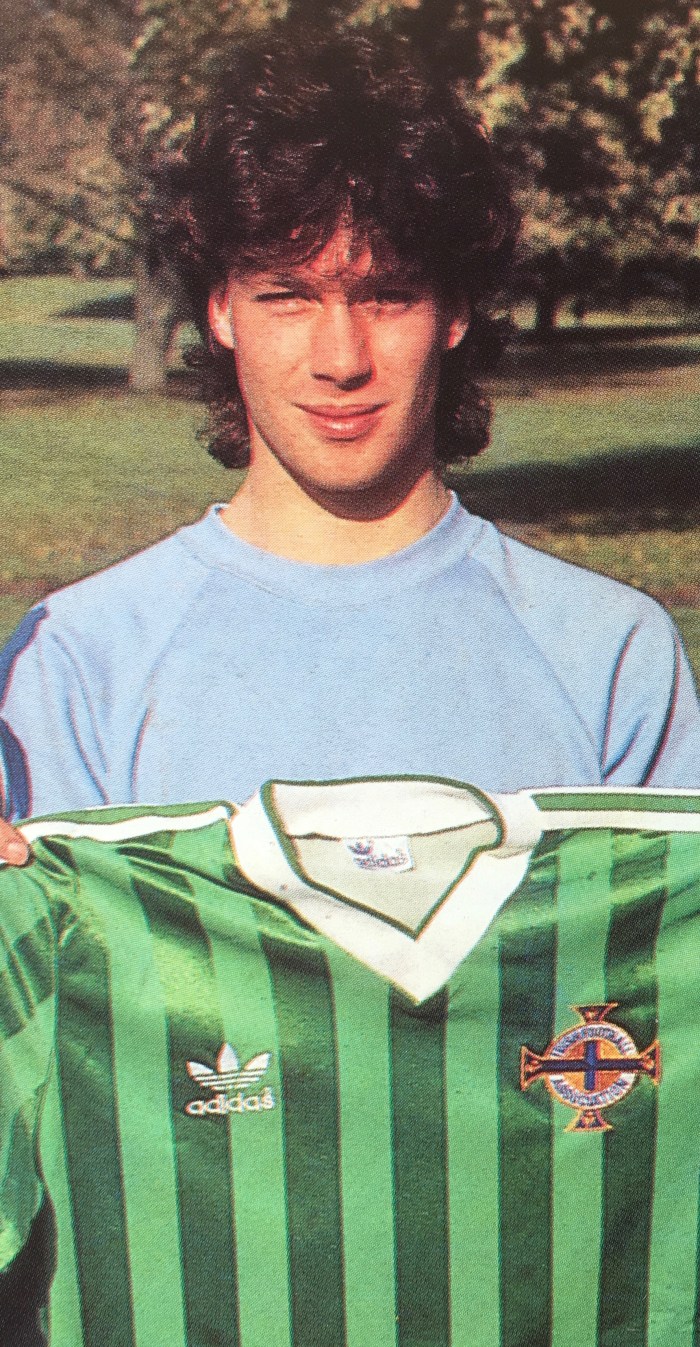
SP w Irish shirt

At the time of writing, he remains the highest-capped Albion player, all of his 17 caps for Northern Ireland being won while with the Seagulls.

After making his debut on 16 October 1984 in a 3-0 friendly win over Israel in Belfast, he was a regular for four years, playing his last game on 21 December 1988 in a 4-0 defeat to Spain in a World Cup qualifying match. He scored twice for his country, in a 1-1 draw with Israel on 18 February 1987 and in a 3-0 win over Malta on 21 May 1988.

The highlight of his international career was playing for Northern Ireland at the 1986 Mexico World Cup.

“The whole experience of going to the World Cup was something I’ll never forget,” he said three months later, in a matchday programme interview.

“Six weeks away from home is a long time, but the spirit in the squad was very good and I wouldn’t have missed it for the world.”

Steve had been in the side that qualified for that World Cup by drawing 0-0 against England at Wembley. “We only needed a draw to get to Mexico and we got it,” he said.

“(Manager) Billy Bingham had been a right winger and obviously appreciated what I could do, which was a source of great strength to me. He’d been part of the team that had played in the World Cup in Sweden in 1958, a lovely man who was very good at getting the best out of his players and encouraged me no end, something I’ll always be grateful to him for.”

Unfortunately, Steve’s World Cup came to a juddering halt after Spain’s hard man Emilio Butragueno went over the top in a tackle and did his ankle in only the second group game.

On his return to Brighton, Penney found himself sufficiently impressed by Cattlin’s successor, Alan Mullery, that he was persuaded to sign a new, three-year contract.

However, it wasn’t long afterwards that Penney started having problems with his left knee and, although he played through the pain barrier, in a game against Derby County in March 1987 a bad tackle damaged his ankle ligaments, sidelining him for the rest of the season.

Barry Lloyd had succeeded Mullery and Penney was in the team at the start of the next season but, after only two games, found himself back on the treatment table after a chip of bone was found floating in a knee.

That kept him out for an agonising seven months before he was able to return to the side in March 1988 to play a crucial part in the final 11 games, scoring three times as the Seagulls earned promotion in second place behind Sunderland.

Penney told Vignes: “At that time, playing for Barry was great. The two of us were getting on even though I always thought there was something not quite right between us. To be honest, he had to play me because I strengthened the team and made a difference.”

Halfway through the 1988-89 season, Crystal Palace tried to sign Penney but weren’t prepared to meet Albion’s £175,000 asking price. And then his left knee went again.

Vignes tells the whole gory story in detail, which I won’t repeat here, but, suffice to say, the wrong treatment by one doctor had to be put right by a Harley Street expert.

Penney rowManager Lloyd and Penney also fell out, principally over Penney putting country before club. “He’d play for them, then come back injured. That didn’t please me,” said Lloyd. “It was a crying shame. He just wanted to play but was so plagued with injuries it was beyond belief.”

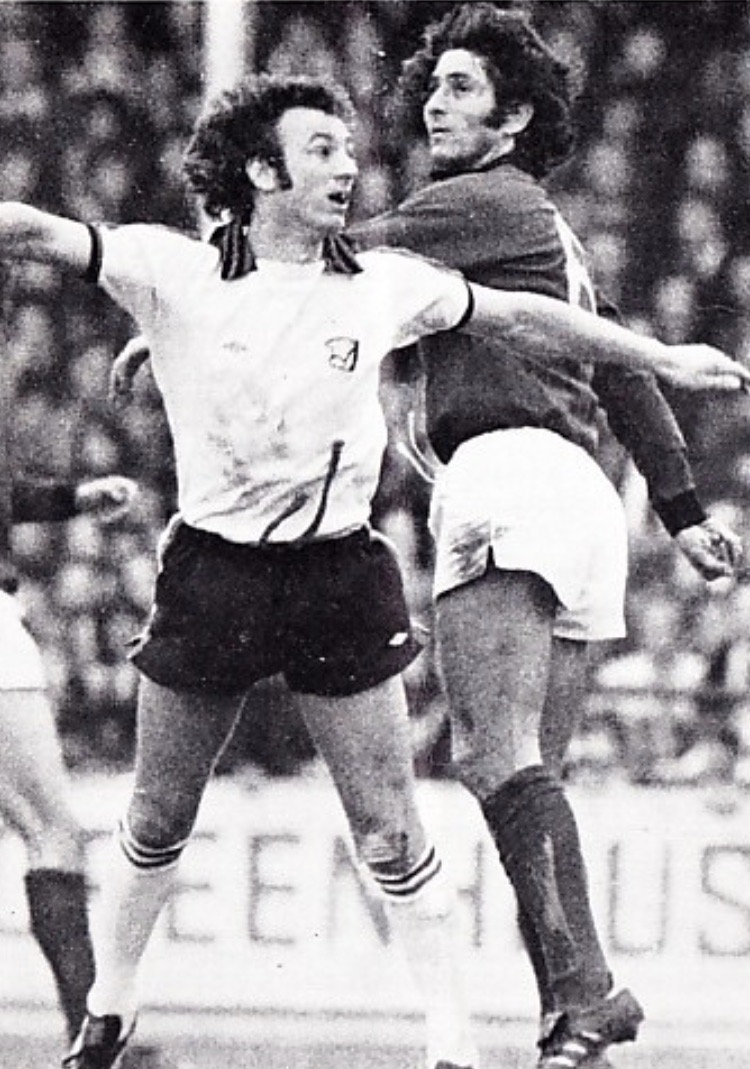
The split came in 1991 when Lloyd clearly thought the player’s level of fitness didn’t merit a new contract. Interest was shown in him by Heart of Midlothian, managed by Joe Jordan, and Charlton Athletic, where the joint manager was his ex-Albion teammate Alan Curbishley.

Having played a couple of trial games for Hearts, he plumped for them but suffered a groin strain early on and only played 14 games all season.

A 15th game would have triggered the award of another one-year deal – and it quickly became apparent that it wasn’t going to happen. Freed at the end of the season, he signed for Burnley, newly-promoted from the old Fourth Division, in August 1992. Continue reading “Irish international pals brought wing wonder Steve Penney to Brighton”

Dennis Burnett – England World Cup trio’s teammate – added finesse to Brighton’s defence

1newhamrecorder.co.uk

WITH all due respect to his predecessors in the number 6 shirt, Dennis Burnett was a classy addition to Brighton’s defence when he signed from Hull City in 1975.

At the end of his first season with Brighton, when they toyed with promotion from Division 3 but just missed out, Burnett was selected in the PFA Third Division Team of the Year, which said everything about his stature amongst his fellow professionals. Albion’s Peter O’Sullivan was also selected while the goalkeeper was Eric Steele, then with Peterborough, and Crystal Palace winger, and, future Brighton manager, Peter Taylor, was also in the XI.

Before 1975, Brighton fans had been used to seeing their centre halves hoof it, but Burnett play more in the style of another famous former West Ham number 6. OK, he might never have reached Bobby Moore’s level but he played alongside the great man for a while and came through the ranks at West Ham when they had a reputation for playing cultured football.

He started off in the West Ham youth team and was in the 1963 FA Youth Cup winning side alongside the likes of Harry Redknapp, Clive Charles, Bobby Howe and John Sissons.

Burnett made his first team debut for the Hammers as a 21-year-old in October 1965, along with Jimmy Bloomfield (the future Orient and Leicester manager), in a 3-0 defeat to Fulham at Craven Cottage. He made 24 league appearances in 1965-66, the most he managed in any one season for the Hammers.

In March 1966, he collected a League Cup runners-up medal playing right back in a side that lost 5-3 over two legs to West Brom. The team was captained by Bobby Moore, and included Martin Peters and Geoff Hurst, just four months before all three played in England’s one and only World Cup win.

Burnett went on to complete 66 league and cup appearances for West Ham.

Born in Southwark on 27 September 1944, perhaps it was no surprise his next stop was Millwall. West Ham sold him to The Lions in 1967 for £15,000, and the vast majority of his football career was spent at The Den, playing in the second tier.

Playing alongside Barry Kitchener at centre half and Harry Cripps at left back, he was part of a team that nearly made it to the First Division, particularly in 1971-72.

In a scene you would never get now in the mobile phone age, Millwall were leading Preston at home and the word went round The Den that rivals for promotion Birmingham were losing at Sheffield Wednesday. It looked like Millwall would be promoted to the elite for the first time in their history and the news spread to the players on the pitch.

Unfortunately, the rumour was completely wrong. Birmingham were leading, not losing. Club skipper Cripps had even gone round the Preston players telling them Millwall were going up but level-headed Burnett didn’t get carried away.

millwall-history.org records: On-the-field skipper Dennis Burnett was less convinced. “I wasn’t going to believe it until I knew for sure,” he said. “Those last few minutes were agonising. We played on in a dream. It was the longest 20 minutes ever for me.”

As the end of the game approached, the crowd jammed the touchline, waiting to cheer off the Millwall players. The pressure behind Millwall’s goal was so great that the woodwork began to buckle.
Centre-forward Barry Bridges
(who would join Brighton five months later) ran back to appeal to the fans to be patient. When the referee blew for the last time – suspiciously early – half the 20,000 crowd stormed on to the pitch. Cripps was carried aloft and some of the other players lost their shirts.

Finally the correct score from Hillsborough was announced and the crowd fell silent and faded away.

The following season, Millwall struggled near the bottom of the table and manager Benny Fenton moved Burnett into midfield.

“As a sweeper I was a bit restricted,” he told Goal’s Ray Bradley, who described him as “one of the most accomplished and stylish players outside the First Division”.

“I had to stay back and wasn’t so involved,” said Burnett. “ Now I find I can express myself more and go up in support of the attack.”

Unlike his illustrious former Hammers teammates, full international recognition eluded him but in April 1973 Burnett was part of an English FA squad managed by Sir Alf Ramsey that thrashed Gibraltar 9-0 in a ‘friendly’. Frank Worthington (of Leicester at the time) scored a hat-trick.

Hankering for another shot at top division football, Burnett went on to the transfer list at The Den. He got his move, but only to a club in the same division.

After clocking up 257 appearances for Millwall, in 1974, Terry Neill paid £80,000 to take Burnett to Hull City, where a young Stuart Pearson, future West Ham, Man Utd and England international was making a name for himself.

However, when Neill left to become manager of Spurs, his replacement John Kaye brought in his own man while Burnett was out of the side suspended. After losing his place, Burnett had a brief loan spell back at Millwall.

During the summer of 1975, he played 21 games in the States with St Louis Stars (for whom former Chelsea and England goalkeeper Peter Bonetti was playing) before Brighton manager Peter Taylor secured his services for the Seagulls.

In an article in Shoot incorporating Goal, Burnett explained how, although he’d been sidelined for two months with an ankle ligament injury, he’d got back in the side only to be sent off in a game away to Bristol City.

“It was a most unjust decision. Even the opposition seemed flabbergasted,” he said. “Anyway, I never played for Hull again. The signing of Dave Roberts from Oxford United put paid to my chances of a first team recall, following my suspension.

“Eventually, manager John Kaye called me into his office and asked if I wanted a move. A price of £30,000 was put on my head, later reduced to £15,000. No one came for me so in April I went to the United States and played for St Louis Stars in Missouri, a North American Soccer League club.

“While there I received another contract from Hull City, which I refused to sign. I lodged an appeal against it to the Football League Management Committee. Surprisingly they upheld it, and, during July, I received a letter to say I’d been given a free transfer.

“I arrived back in England on August 24th, made and received a number of ‘phone calls which resulted in my being offered a three-year contract by Brighton, plus excellent wages, which at the age of 31 was fantastic for me,

“Added to all this is the potential of Brighton in terms of location, players and attendances. It was a move not to be resisted.”

Burnett told the magazine he felt Brighton were much better prepared for promotion than Millwall had been. “Had we gone up, we would have needed a miracle to survive in the First,” he said. “At Brighton, we are winning matches without being fully stretched. The right blend is there and we can only get better.

“If I look after myself, I can get through another four or five seasons, by which time Brighton could be up amongst the big boys.”

Burnett was obviously a good judge because Brighton certainly got themselves up amongst the ‘big boys’ four years later – although by then he was no longer a part of it.

After a successful first season in which he developed a formidable central defensive partnership with Andy Rollings, and earned that placed in the PFA team of the year, perhaps there were signs that age was catching up with him.

In his end of season review in the Evening Argus, Albion reporter John Vinicombe observed: “Over the course of the season, the most improved player was Andy Rollings who profited by the experience of Dennis Burnett at his elbow.

“There were times when Burnett looked unflappable in the centre of the defence. As time wore on, and situations became more frenetic, that casual style, no doubt a legacy of his West Ham upbringing, now and again landed him in trouble.”

Maybe manager Taylor thought the same because one of the last things he did before quitting and rejoining Brian Clough was to sign veteran defender Graham Cross, which spelled trouble for Burnett.

Under new manager Alan Mullery, in the league at least, Cross was preferred alongside Rollings. Burnett deputised for Rollings when he was injured – for example, he played alongside Cross in the memorable 7-2 demolition of York City – and was given some games in midfield, but mainly in the League Cup he got the chance to shine.

He played in memorable games against First Division opponents Ipswich, West Brom and Derby, and was assured alongside Cross in the memorable narrow 2-1 defeat at the Baseball Ground in November 1976.

Vinicombe reported: “Cross and Burnett played coolly and neither looked out of place among the high-priced cream.”

He kept his place for a league game away to Port Vale five days later, but that 2-2 draw was his last in an Albion shirt.

In early February 1977, together with ex-Spur Phil Beal, he agreed a pay-off with the club and played non league with Ilford for the remainder of the season before returning to the States and another 19 games for St Louis Stars, where he was joined by former Albion teammate Fred Binney.

Mullery explained several years later in his autobiography that he had inherited a squad of 36 professionals and needed to prune the numbers. The older players were the obvious ones to go and, although Beal and Burnett went quietly, he had more truck dispensing with Joe Kinnear’s services – but that’s a story for another day.

On his return to these shores, Burnett headed for Ireland to play for Shamrock Rovers, at that time managed by the legendary Johnny Giles.

The defender subsequently played for three years in Norway, for SK Haugar, and popped up back in Sussex in 1994 as assistant manager of Sussex County League side Lancing, and played in a 2-1 defeat against Horsham YMCA in the FA Cup a month before his 50th birthday!

According to Wikipedia, Burnett ran a painting and decorating business in Sussex after he left football and was working in the hospitality suites at Upton Park before West Ham moved to the Olympic Stadium.

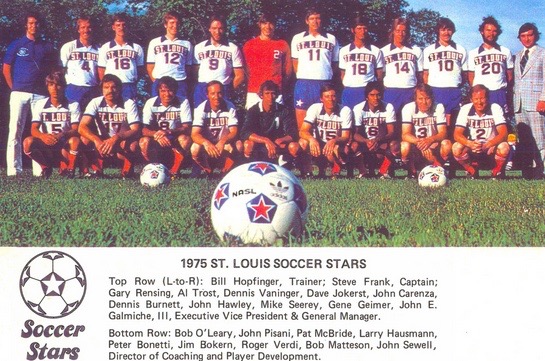
Pictured above are a Newham Recorder shot of Burnett in West Ham colours; in action for Millwall (from Goal), and in Albion’s stripes (from Shoot!). Below, an archive shot of the St Louis Stars side of 1975 with Burnett in the back row wearing the 18 shirt and Peter Bonetti in the centre of the front row.

back row burnett

Flying winger Tony ‘Tiger’ Towner immortalised in children’s TV programme

2-towner-takes-on-argusIF ART is the sincerest form of flattery, Tony Towner can count himself amongst the privileged few to be forever remembered on film.

That it was done by two of Rotherham United’s most ardent celebrity fans is neither here nor there – it’s not everyone who can say their prowess has been portrayed in an episode of Chucklevision.

Towner and fellow Millers hero Ronnie Moore were at the centre of a classic knockabout episode of the children’s TV series in which Rotherham supporters Paul and Barry Chuckle constantly get involved in slapstick scrapes.

In Football Heroes, made in 1996, the Chuckle Brothers meet Towner and Moore (actors playing them rather than the footballers themselves!) on their way to a game and accidentally end up with their invitation cards to play in a veterans match, leading to them ending up on the pitch.

Towner earned plaudits for his Rotherham performances in this Shoot magazine feature – pipping one Danny Wilson!

It was Towner and Moore’s starring performances in the Rotherham side that won promotion from the old Division 3 as champions in 1980-81 that earned them cult status.

Over three seasons, Towner appeared over 100 times for the Millers and even all these years later is still remembered with affection.

Take, for example, comments made on the Millers Mad website a couple of years ago. Ivor Hardy said: “Tony (Tiger) Towner was one of the best and most talented footballers ever to play for us.

“He was instrumental in us winning the league in 80/81, along with doing the double over our near neighbours Sheffield United in the same season.

“We were lucky to get the services of Towner and Seasman from Millwall, and only did so because the Lions were in financial turmoil that season and had to get some money in fast. He will always be a legend with the older fans, along with team mates Seasman, Moore, Fern, Breckin, Mountford etc.

“Tiger gave us some great memories.”

Meanwhile, kevthemaltbymiller said: “Great player for us, very tricky winger with lightning pace. Happy memories.” And sawmiller added: “Tiger was a super player – good winger who created a real buzz in the crowd when he got the ball and ran at players.”

Towner himself considered his time at Rotherham to have been his best playing days. In an Albion matchday programme article, he told Roy Chuter: “They were probably my best years, my most consistent, anyway. I was 26, 27 years old – at my peak. I had three tremendous years.”

Initially playing under Sunderland’s 1973 FA Cup Final hero Ian Porterfield, he also enjoyed working with the former Liverpool legend Emlyn Hughes, when he took over as manager.

Brighton fans also have good memories of the local boy made good. Sussex youngsters making the grade with the Albion have been pretty few and far between over the years, but Towner and defender/midfielder Steve Piper were two who did it in the 1970s.

In Albion’s 1972-73 season in the second tier, Piper had already been blooded in the first team in the November. Towner signed professional on 29 December 1972 and, with Albion having been knocked out of the FA Cup by Chelsea in the third round, manager Pat Saward arranged a friendly against Stoke City on fourth round day, 3 February 1973 (Stoke had been beaten 3-2 by Man City) and gave Towner his first team debut in a 2-0 defeat at the Goldstone.

The following Saturday he made his league debut aged just 17 at home to Luton Town. Albion went into the game having suffered 14 defeats on the trot (12 in the league plus the games against Chelsea and Stoke) and, rooted to the bottom of the table, relegation was inevitable.

Saward gave the side a shake-up, dropping three established players – goalkeeper Brian Powney in favour of loan signing Tommy Hughes from Aston Villa, right back Graham Howell (to the bench), and experienced striker Barry Bridges.

Piper made only his sixth first team appearance and he was joined by winger Towner and forward Pat Hilton. It was Towner’s brilliant display on the wing that really caught the eye as Albion finally mustered a win, beating the Hatters 2-0.

Towner kept the shirt until the end of the season and it was the launchpad for a 15-year professional career in which he made over 400 appearances. After that Luton debut, he scored his first goal in a 2-1 home win against Huddersfield on 10 March.

“I was an Albion fan as a kid, in Bevendean, and I joined them straight from school at 15, as an apprentice,” he said. “I already had the ‘Tiger’ nickname when I got into the team in 1973 – I think it was one of Alan Duffy‘s. I must have tackled him a bit too hard in training, or something. Tiger was a great nickname, and I loved it.”

One of the few survivors of the great Brian Clough cull of the playing staff in 1974, Towner was a speedy, skilful winger who could put in terrific crosses for his teammates. The fact he was a local lad endeared him greatly to the crowd.

In five years, he had plenty of challengers for his place. In the early days, Gerry Fell competed for the wide berth and later Eric Potts, but Towner still managed 171 games (+ 12 as sub) for the Albion and scored 25 goals.

“Gerry was the opposite of me, though still a winger – he had loads of pace, though not too much skill,” Towner recalled. “He’d knock the ball ahead of him and run past the defender to get it, a bit like Stuart Storer. I’d try to trick my way past.”

In John Vinicombe’s end of season assessment of Peter Taylor’s first season in sole charge (1974-75), he said: “It is with no disrespect to Taylor that I suggest that the three most consistent players were those he inherited – O’Sullivan, Towner and Piper.

“Towards the end, Towner tailed off a little but he struck up an intuitive partnership with Fred Binney.”

In fact Towner was third highest in the squad for appearances that season, playing 47 games in total plus four as sub and with 10 goals was second highest goalscorer behind Binney.

It was the arrival of Gerry Ryan from Derby in September 1978, which finally prompted his departure. George Petchey, who later joined Chris Cattlin’s backroom team at the Goldstone, took him to Millwall for £65,000.

Unfortunately, while Brighton won promotion to Division 1 in 1979, Millwall went the opposite way out of Division 2, and Towner found himself back in the third tier.

After 68 appearances for the Lions, in 1980 he was sold to Rotherham along with teammate John Seasman for a combined fee of £165,000.

Towner scored once for Rotherham’s near neighbours Sheffield United in a 10-game loan spell in 1983 and although he had missed out on Brighton’s eventual elevation to the top tier, he managed it with Wolves in 1983-84 having been signed by the Black Country side for £80,000.

He then joined Charlton Athletic but in the 1985-86 season was loaned to Rochdale where he once again linked up with his former Rotherham teammates, Moore and Seasman. He made five appearances for Rochdale and MikeMCSG on clarkechroniclersfootballers.blogspot.co.uk recalls: “He came on as sub in a home game and made an instantly good impression by beating the full back with his first touch.

“He went on to play a blinder in the draw at Halifax on Boxing Day. Unfortunately Tony didn’t want to uproot to the North and couldn’t be persuaded to make his stay permanent. When Cambridge came in with an offer he signed for them instead although he only made eight appearances for them in total.”

Towner’s final Albion appearance had been in a 4-1 defeat away to Leicester in September 1978 but his final appearance at the Goldstone came in a memorable FA Cup 3rd round tie on 4 January 1992.

Albion beat then Southern League Crawley 5-0 and Towner earned a rousing reception from the 18,031 packed into the Goldstone when, at the age of 36, he came on as a substitute for the visitors.

Crawley were one of several non-league clubs he played for: he also turned out for Gravesend, Fisher Athletic, Lewes, Newhaven and Saltdean.

Interestingly, Towner reflected: “I could definitely have played for a few more years at league level, and perhaps I should’ve done. I’d got a bit disillusioned with it though.”

After his playing days ended, Towner ran his own Brighton-based removals business and watched the Albion as a fan. In October 2015, Brian Owen interviewed him for an Argus piece ahead of a game against Cardiff when former Albion winger Craig Noone was in opposition.

Towner reckoned Albion made a mistake letting him go but added: “It’s good to see Brighton making good use of wingers.

“That’s the way I was brought up, using the wide men.

“It’s all right having midfield men or attack-minded full-backs. But what gets the crowd on its feet is a winger going past the full-back and crossing.

“You can have all the formations you like but, if you see a winger getting past his full-back, it excites people.”

Tony Towner certainly came into that category.

1-sawar-towner
3-towner-crosses-argus-prog
4-argus-shot-towner-on-wing

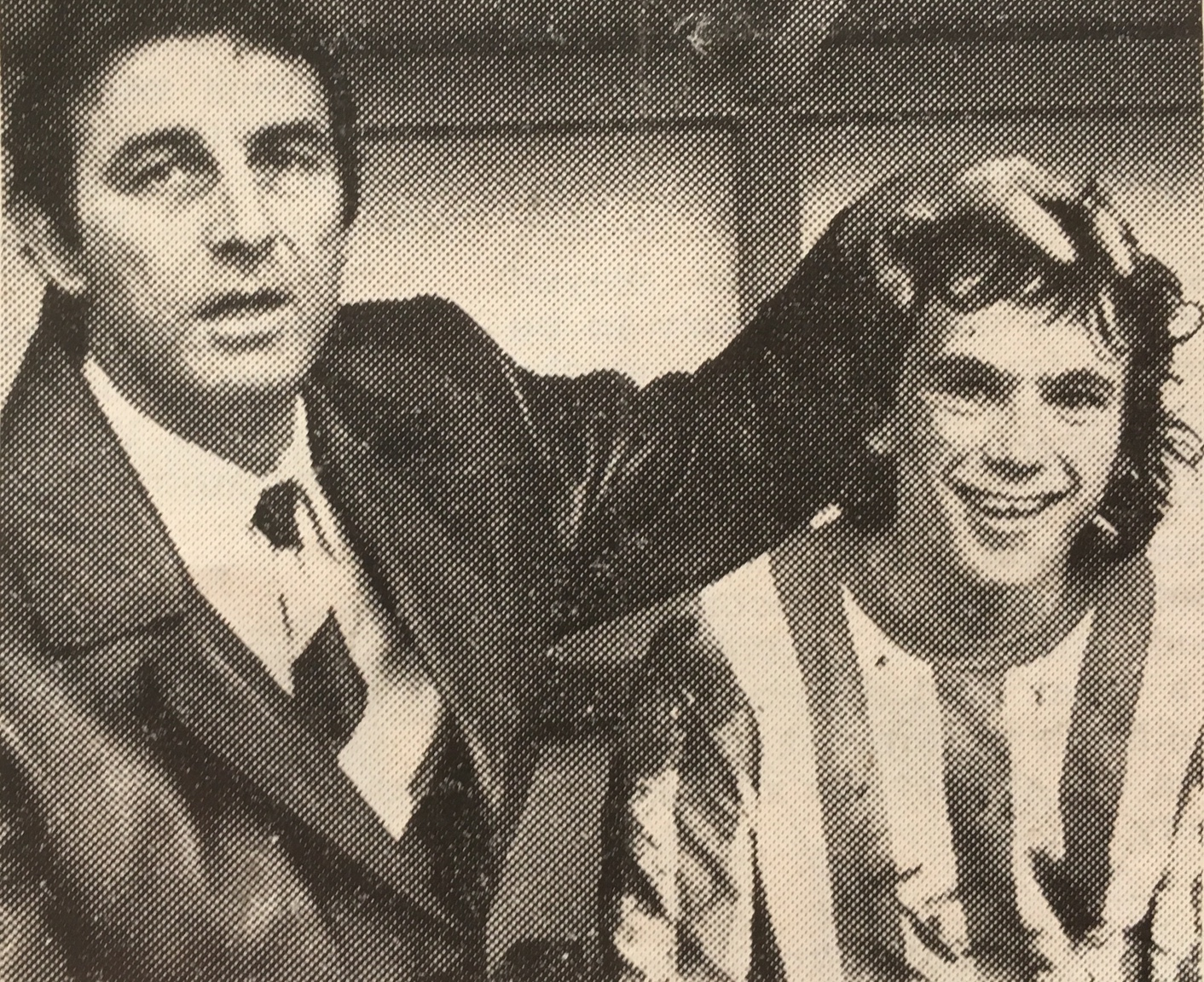
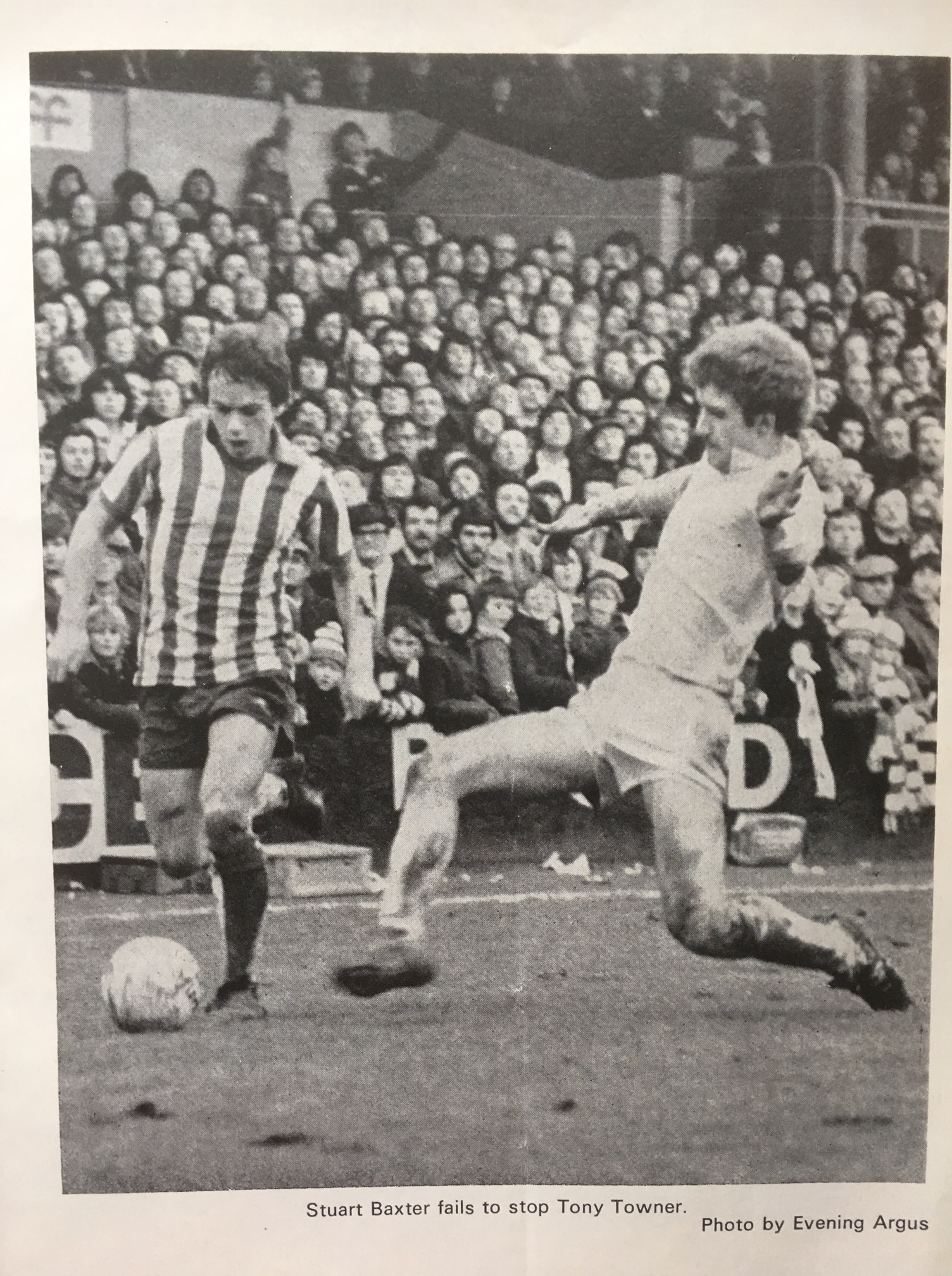
Pictures mainly shot by Evening Argus photographers and then reproduced in the Albion matchday programmes show a happy Towner congratulated by manager Pat Saward after his league debut, in familiar pose taking on a full back, getting in a trademark cross, in full flight on the wing, and finally on a Wolves album sticker.

Bertie Lutton’s memorable Easter goal at Bournemouth

STANDING amongst the writhing crush of Albion fans squeezed in behind the goal at Dean Court on the afternoon of Easter Saturday 1972, I struggled to get a clear view of the frenzied action on the pitch.

Brighton equalised, that much was evident from the eruption and movement of the swaying masses, but who applied the finishing touch was anybody’s guess as far as I was concerned.

I later discovered it was none other than Bertie Lutton, the £5,000 Northern Irish international winger signed only three weeks previously from Wolverhampton Wanderers.

Lutton had got himself into the penalty area and with a centre forward-like instinct headed Peter O’Sullivan’s cross past Fred Davies in the Bournemouth goal to cancel out the lead Ted MacDougall** had given the promotion-chasing Cherries.

It was Lutton’s second Albion goal in two days. On Good Friday at the Goldstone, he was on the scoresheet with Bert Murray and Ken Beamish as a bumper crowd of 27,513 (remember this was the third tier of English football) saw Albion beat Torquay United 3-1.

It’s difficult for modern day fans to contemplate but literally 24 hours later, the Albion had travelled nearly 100 miles west to take on Third Division promotion rivals Bournemouth and 22,540 fans crammed into the stadium.

In what was a classic game of two halves, the Cherries dominated the opening 45 minutes and took the lead through MacDougall, a prolific scorer of that period who went on to play for Manchester United, West Ham, Norwich City and Scotland.

Albion threw everything at them after the break and Lutton’s equaliser was fully deserved on the balance of play in the second half.

The goal was enough to keep him in the side for the following three games. After that he reverted to the bench to the end of the season, but was on the pitch, having replaced Kit Napier, when the whistle blew at the end of the 1-1 Goldstone draw with Rochdale that earned Albion promotion as runners up behind Aston Villa…..with Bournemouth three points behind in third place (there were no play-offs in those days).

Raising a glass of promotion-winning champagne in the dressing room with his Brighton teammates after that game must have felt good, but that Dean Court moment was probably as good as it got for the blond-haired Ulsterman in his time on the south coast.

Born in Banbridge, County Down, on 13 July 1950, Bertie’s brief footballing career began with his hometown club, Banbridge Town, and it’s reported just £50 exchanged hands to take him to then English elite side Wolves in 1967.Lutton WWFC

At a time when Wolves were blessed with some outstanding players like Derek Dougan, Hugh Curran, Dave Wagstaffe, Jim McCalliog and Mike Bailey, Bertie managed just 25 matches for Wolves between 1967 and 1971.

Brighton manager Pat Saward, nicknamed The Loan Ranger because of the number of players who he brought in on loan, first acquired Bertie’s services on a temporary basis between September and November in 1971.

He made his debut in a 2-0 defeat at Aston Villa and scored twice in seven games before returning to his parent club.

Then, on 9 March 1972, with the clock ticking down to what in those days was the 5pm transfer deadline, Saward completed a double transfer swoop, securing Lutton’s permanent signing for £5,000 together with Beamish from Tranmere for £25,000 (plus the surplus-to-requirements Alan Duffy).

A delighted Saward declared to Argus reporter John Vinicombe: “Bertie can do a job for us anywhere. This can’t be bad for us. At 21 and with two caps for Ireland he has a future and played very well for us while on loan.

“He can play right or left, up the middle, or midfield and Beamish can fit into a number of positions.”

Maybe it was the versatility Saward referred to that worked against Lutton. When Brighton began the 1972-73 season in the second tier, Lutton was still on the bench. He came on in three games, then got four successive starts before going back to the bench.

Albion were finding life tough at the higher level and although Saward switched things around and brought in new faces, the results went from bad to worse.

bertieluttonLutton started three games in December which all ended in defeat and the 3-0 Boxing Day reverse at Oxford United turned out to be his last appearance for the Albion.

It fell in the middle of a spell of 12 successive defeats during which only five goals were scored – and two of those were penalties, another an own goal!

Saward couldn’t put his finger on the reason for the slump and declared himself dismayed by the attitude of certain players: Lutton was one of three put on the transfer list.

Astonishingly he stepped up a division and went on loan to West Ham. He did well enough to secure a full-time switch to Upton Park and almost a year to the day of his arrival at the Goldstone, he was gone and the shrewd Saward turned a £10,000 profit on the enigmatic Irishman.

Those two caps Saward referred to had come while on Wolves’ books in April 1970 against Scotland and England in the old end-of-season Home International tournament. After his move to West Ham, he gained four more. Indeed, in the history books, he became the first Hammer ever to represent Northern Ireland. He came on as sub in three games in May 1973 and his final appearance was in November that year as a starter in a 1-1 draw away to Portugal.

His only goal for West Ham came in a 1-1 draw away to Derby County on 21 April 1973, where one of his teammates was the aforementioned MacDougall. Sadly Lutton’s West Ham career lasted just 12 games. He was forced to quit English football in 1974 at the age of just 23.

He emigrated to Australia and played semi-professional football in the Australian Soccer League for a number of years and settled in Melbourne.

The ‘where are they now’ website reveals he most recently worked as a supervisor for a logistics company.

  • The website wolvesheroes.com tracked down Lutton in March 2010 and reported a fascinating tale about what happened to a 1970 Mexico World Cup England shirt Bobby Moore had given his old West Ham teammate.

** MacDouGoal! the striker’s autobiography.

Pictures from my scrapbook show Bertie Lutton

  • celebrating a goal for the Albion
  • appearing for Wolves
  • heading the equaliser in the Easter Saturday draw at Bournemouth

3-lutton-stripes

luttoningoal

Lutton alongside George Best during Northern Ireland training
Lutton pictured in 2010 on wolvesheroes.com

Welsh wizard Peter O’Sullivan an all-time Albion great

IMG_5086

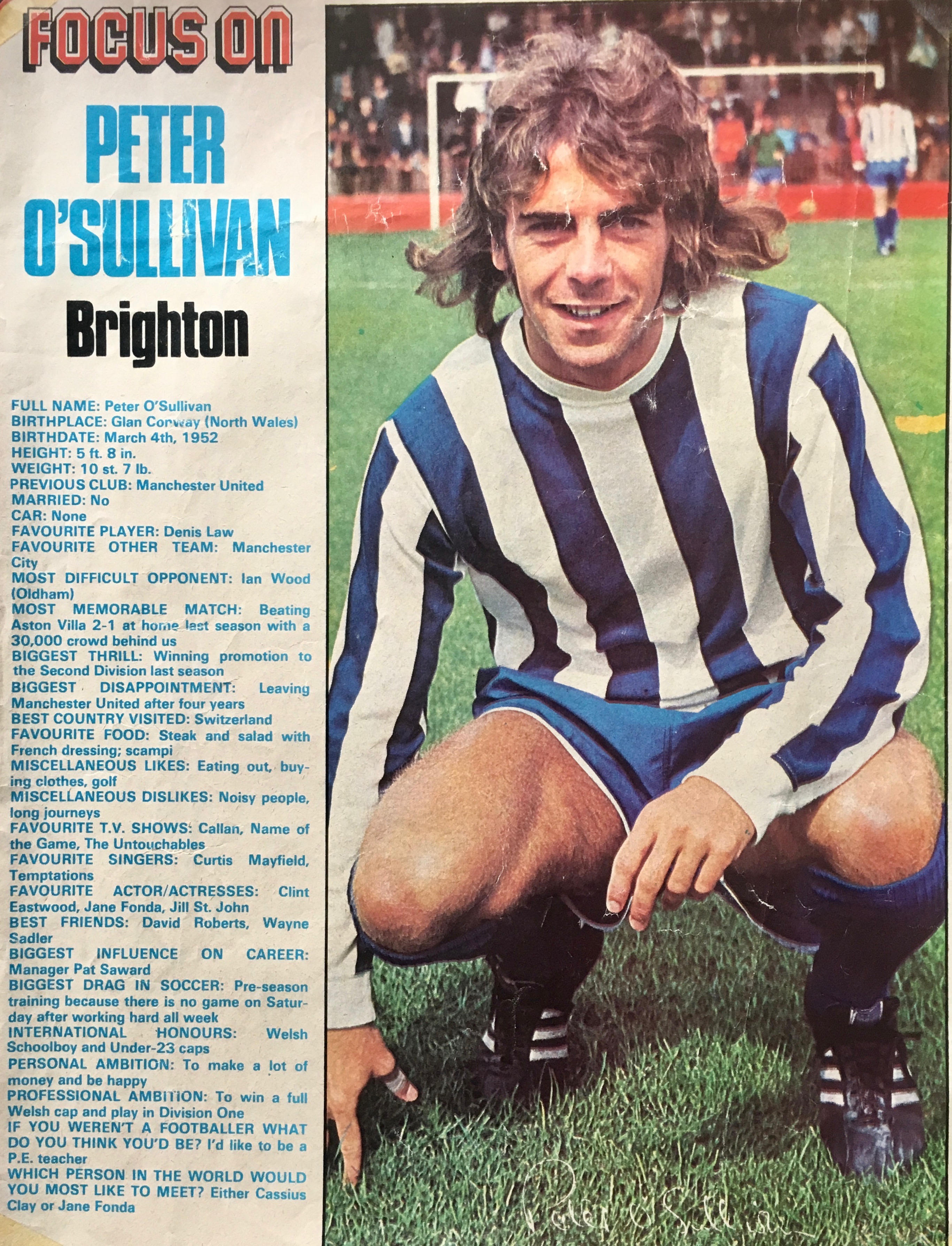
WHILE Peter Ward rightly attracted much of the attention during Albion’s rise to the top in the late ‘70s, few would deny that midfield maestro PETER O’SULLIVAN also deserves a place amongst the club’s all-time greats.

Sully had a long career with the Seagulls before a short stint with Fulham towards the end of his playing days.

The statisticians of the modern football era would have needed their calculators to record the ‘assists’ racked up by Sully, who, from the left wing or left midfield, found goalscoring teammates with unerring accuracy throughout a remarkable 11 years with the Albion.

Managers came and went, a huge swathe of teammates were discarded, but Sully stayed put, showed his worth to whoever sat in the manager’s chair, and entertained the watching faithful.

He played in the same position as the Brazilian genius Rivelino and even sported the same style of moustache in homage to him.

As Brighton rose through the footballing pyramid, Sully was a constant, displaying the talent to make an impact in the third, second and top tiers. One of his former teammates, Andy Rollings, maintained: “He should have played at the top level all the time, he was that good a player.

“He had natural ability and great fitness,” Rollings told freelance journalist Spencer Vignes. “What he did at this club was incredible, and as an individual player he was one of the best I ever played with. He’s a lovely, smashing guy.”

In the excellent Vignes’ book A Few Good Men (Breedon Books Publishing),  Sully admitted there had been occasions when he couldn’t wait to get away from Brighton, and he had some serious arguments with all of the managers he played under.

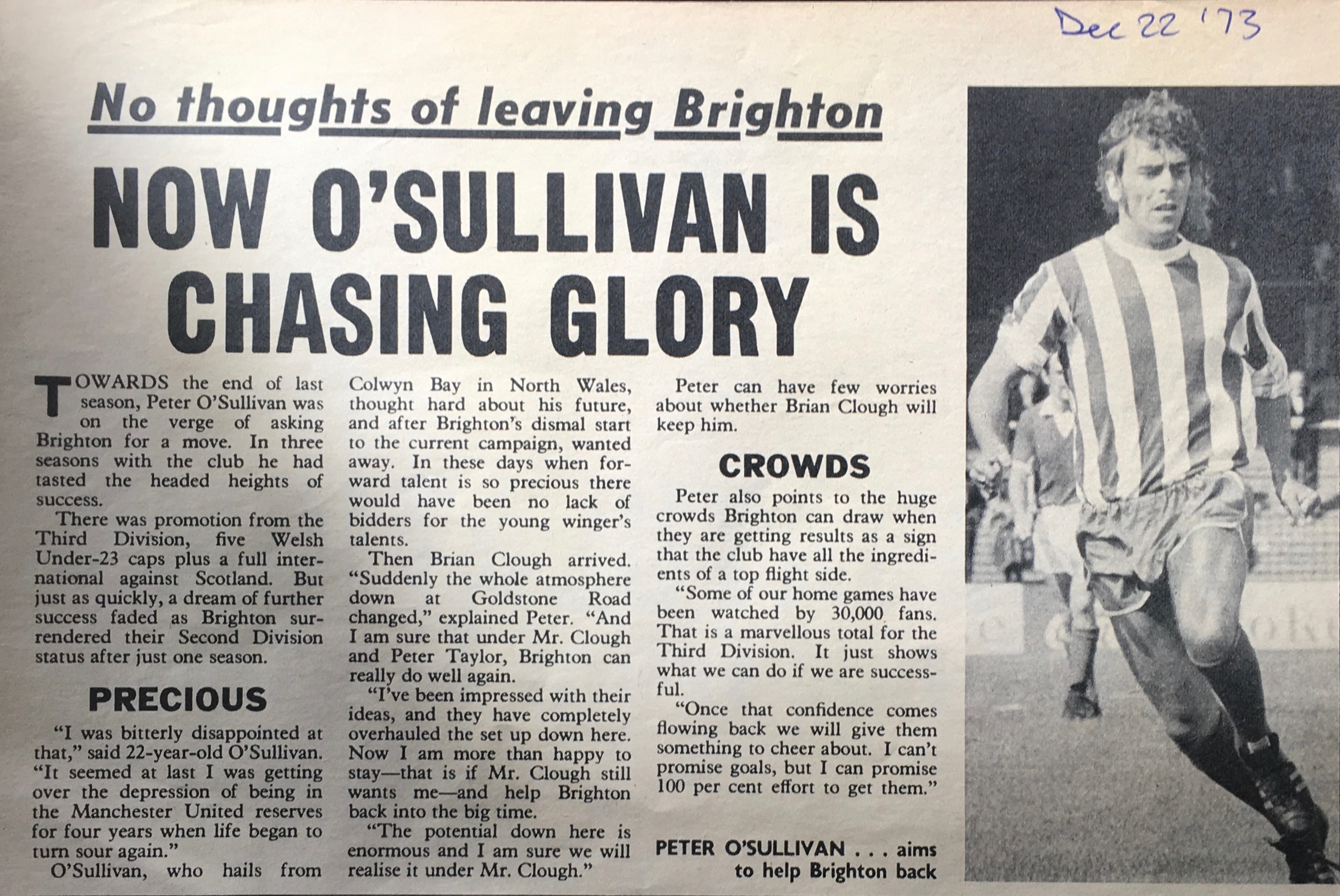
Sully shared his thoughts in a Goal magazine article of 22 December 1973, a couple of months after the arrival of Brian Clough and Peter Taylor. Having won promotion from the Third Division, won five Wales under 23 caps and made his full international debut against Scotland, he was disillusioned after relegation from Division 2.

“I was bitterly disappointed at that,” he said. “It seemed at last I was getting over the depression of being in the Manchester United reserves for four years when life began to turn sour again.”

However, with the arrival of Clough and Taylor, O’Sullivan changed his outlook and told the magazine: “I’ve been impressed with their ideas and they have completely overhauled the set up down here. Now I am more than happy to stay – that is if Mr Clough still wants me – and help Brighton back into the big time.

“The potential down here is enormous and I am sure we will realise it under Mr Clough.”

Vignes’ 2007 interview with Sully explained exactly how he ended up at Brighton having been given a free transfer from Manchester United. None other than the great Bobby Charlton was responsible.

sully man u

Young Peter crouches alongside George Best in a Manchester United team photo

Born in Colwyn Bay, north Wales, on 4 March 1951, Sully had trained alongside the United legend while at Old Trafford as a youngster and, on being released on a free transfer in 1970, was considering offers from several different clubs.

He’d gone to Bristol to have a trial with Bristol City when, on a neighbouring pitch, Charlton was taking part in an England training session prior to the 1970 Mexico World Cup.

The kindly maestro exchanged the time of day with his recently departed colleague and asked which clubs were in for him. On hearing that one of them was Brighton, managed by his former Busby Babe teammate, Freddie Goodwin, Charlton advised him to link up with his old pal……and the rest, as they say, is history.

What Charlton and Sully didn’t know, however, was that no sooner had he arrived on the south coast than Goodwin was heading for the exit, en route to Birmingham City. Sully hadn’t even kicked a ball in anger for him.

“I was a little apprehensive about joining Brighton and it was unsettling when Freddie Goodwin left the club before I had even played for Albion,” he said. “I wondered what was going on and how it would affect me.

“But then Pat Saward arrived and I was overjoyed when he put me in the team. My hopes were quickly dashed again, though, when he dropped me after about six games.”

A homesick Sully struggled to settle at first but he stuck at it and went on to cement his place in the side. He ultimately featured under four different managers, Saward, Clough, Taylor and Alan Mullery.

IMG_5087

He was part of the promotion-winning teams in 1972, 1976 and 1979, and was player of the season in 1978. He won promotion with Fulham too, going up to the old Division 2 in 1982 when the former Newcastle, Arsenal and England centre forward Malcolm MacDonald was in charge.

Sully had one amazing period with the Albion in which he made 194 consecutive appearances, an Albion record for an outfield player.

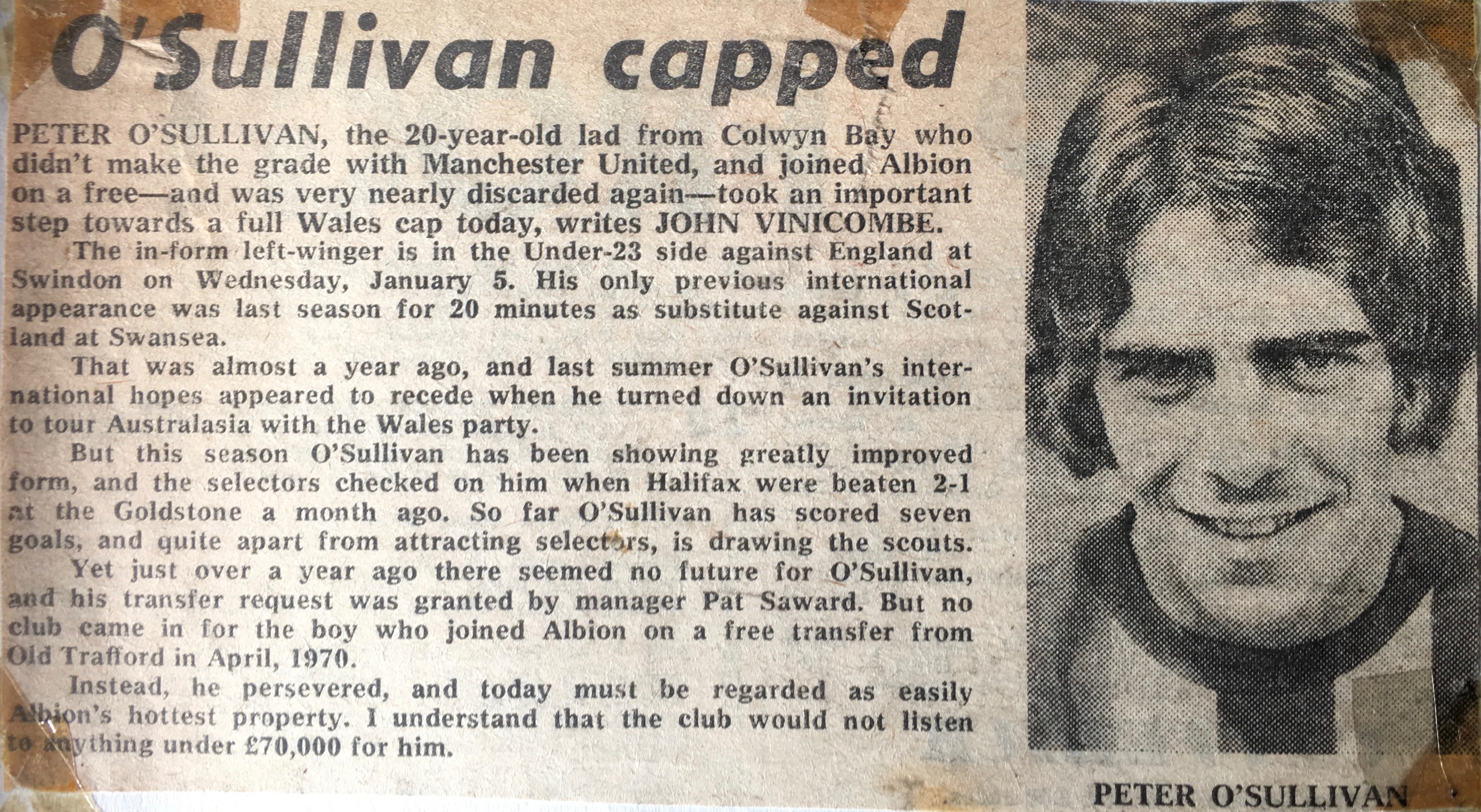
IMG_5091The performances of the lad from Colwyn Bay also saw him earn three international caps for Wales, two against Scotland and one in a rout against Malta when he also got on the scoresheet. Unfortunately for him, during the same period, a superb left-sided player called Leighton James was the first choice for the national side.
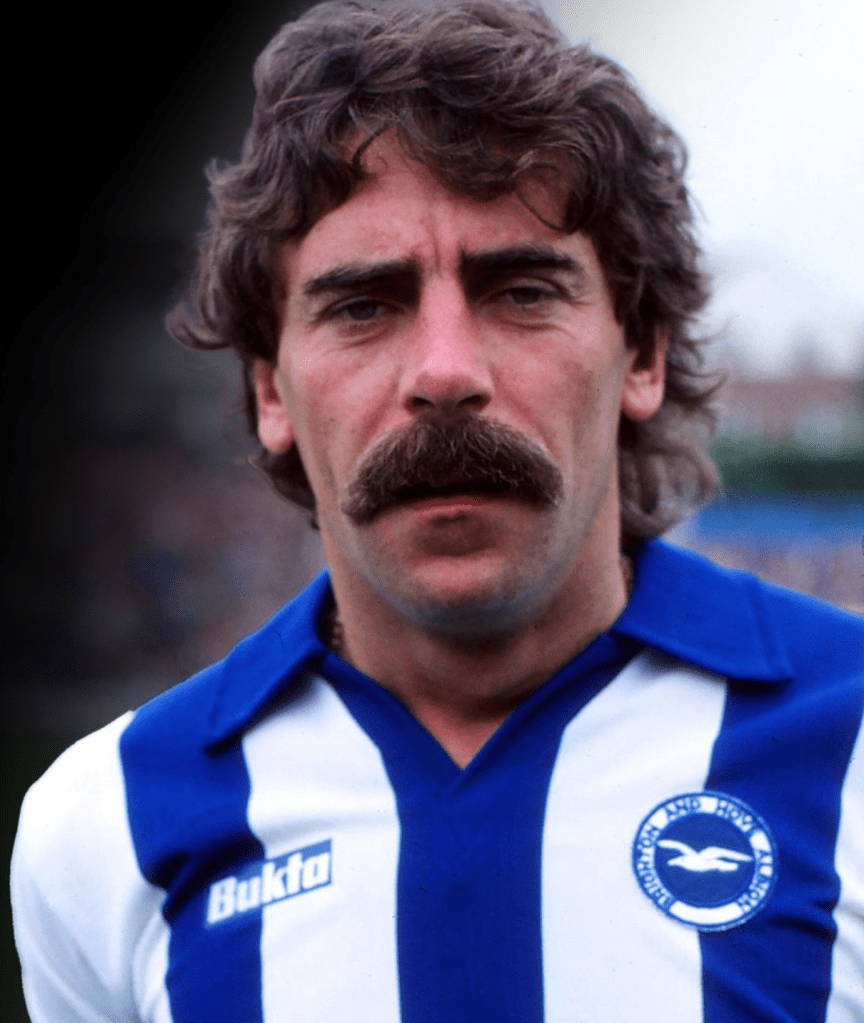
“When I joined Manchester United from school it was always one of my ambitions to play for Wales,” he told the Albion matchday programme. “But I thought those hopes had been dashed when Manchester United released me.”PO Wales

Sully’s 491 appearances for Brighton made him the club’s longest-serving post-war player. He actually left the club in 1980 to play in America for San Diego Sockers but a £50,000 transfer fee saw him return just five months later.

Eventually Sully moved on to Fulham in 1981 and notched up 46 appearances. There were short loan spells with Reading and Charlton in 1982-83 and his Football League career came to an end when he made 14 appearances for Aldershot in the following season.