Sprinter’s boys took different tracks after starting Gunners

A GUNNER from the age of nine gained valuable first team experience with the Seagulls but ultimately fell short of reaching the same heights as his brother.

Commonwealth Games gold-medal winning sprinter Wendy Hoyte saw sons Justin and Gavin climb through the academy and reserve ranks at Arsenal.

Justin played 68 first-team games for the Gunners and went on to make a name for himself in the North East, but younger brother Gavin only played four first-team games for Arsenal and had to set his sights lower to pursue a professional career.

The younger Hoyte spent most of the 2009-10 season as a Brighton player and, although only 19 at the time, got a rough ride from Seagulls supporters who expected more from someone who’d played at the top level of the game.
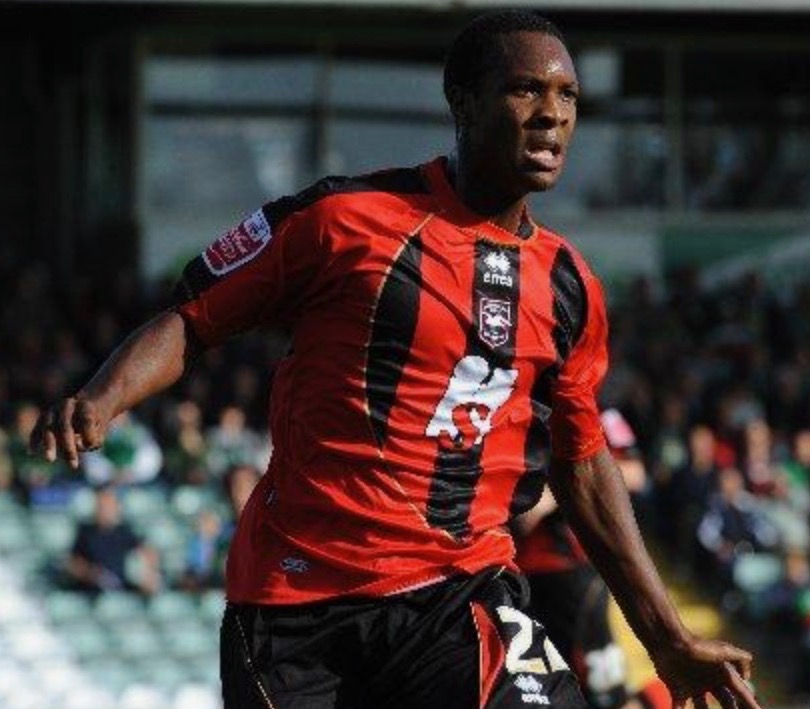
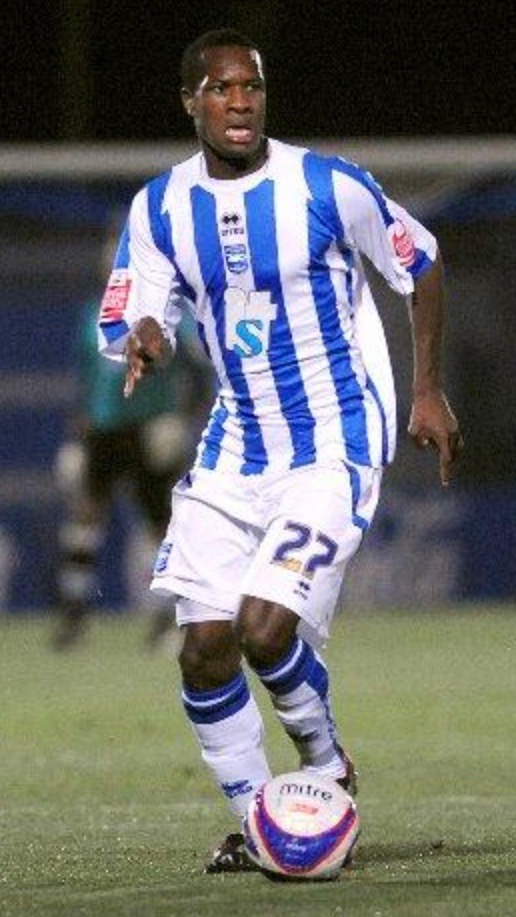
Initially signed on loan in October 2009 by Russell Slade to cover for the injured regular right-back Andrew Whing, Hoyte was handed his debut against Slade’s former club Yeovil Town at Huish Park.

“I am delighted to know the club wants me,” the youngster told The Argus. “They have got a lot of games this month and I just want to get out there and play.”

As it turned out, Hoyte outlasted Slade at the Withdean, and his temporary transfer was extended when Gus Poyet took over as manager.

The young full-back in the no.27 shirt gained a good amount of game time until Poyet unearthed Inigo Calderon in January 2010.

Even then, Poyet was happy to retain the services of the Arsenal youngster, telling the Argus: “We explained to Gavin before asking Arsenal that there was probably a player coming.

“Arsenal knew that as well, so nothing has been hidden. Everyone knows where they stand.

“We are working on different aspects of the game with Gavin, because he has got something which is very difficult to find sometimes in football, the speed to recover.

“When you have that ability, you don’t need to go to ground, because you are quicker than most players.

“He is young and there is plenty to come. We want to help him become a Premier League player or top Championship player.”
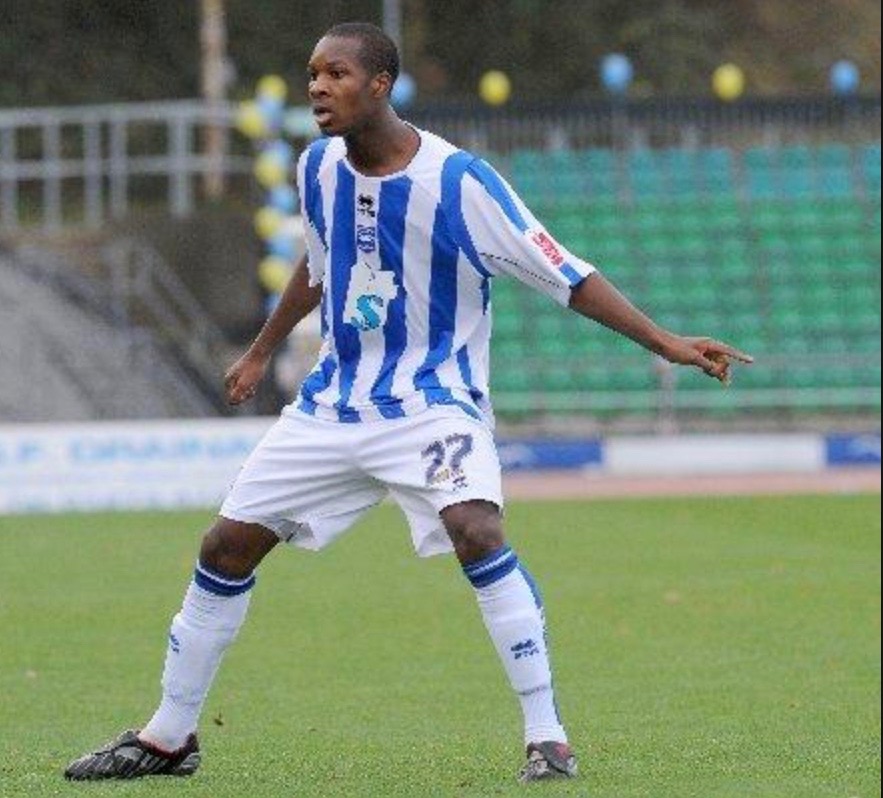
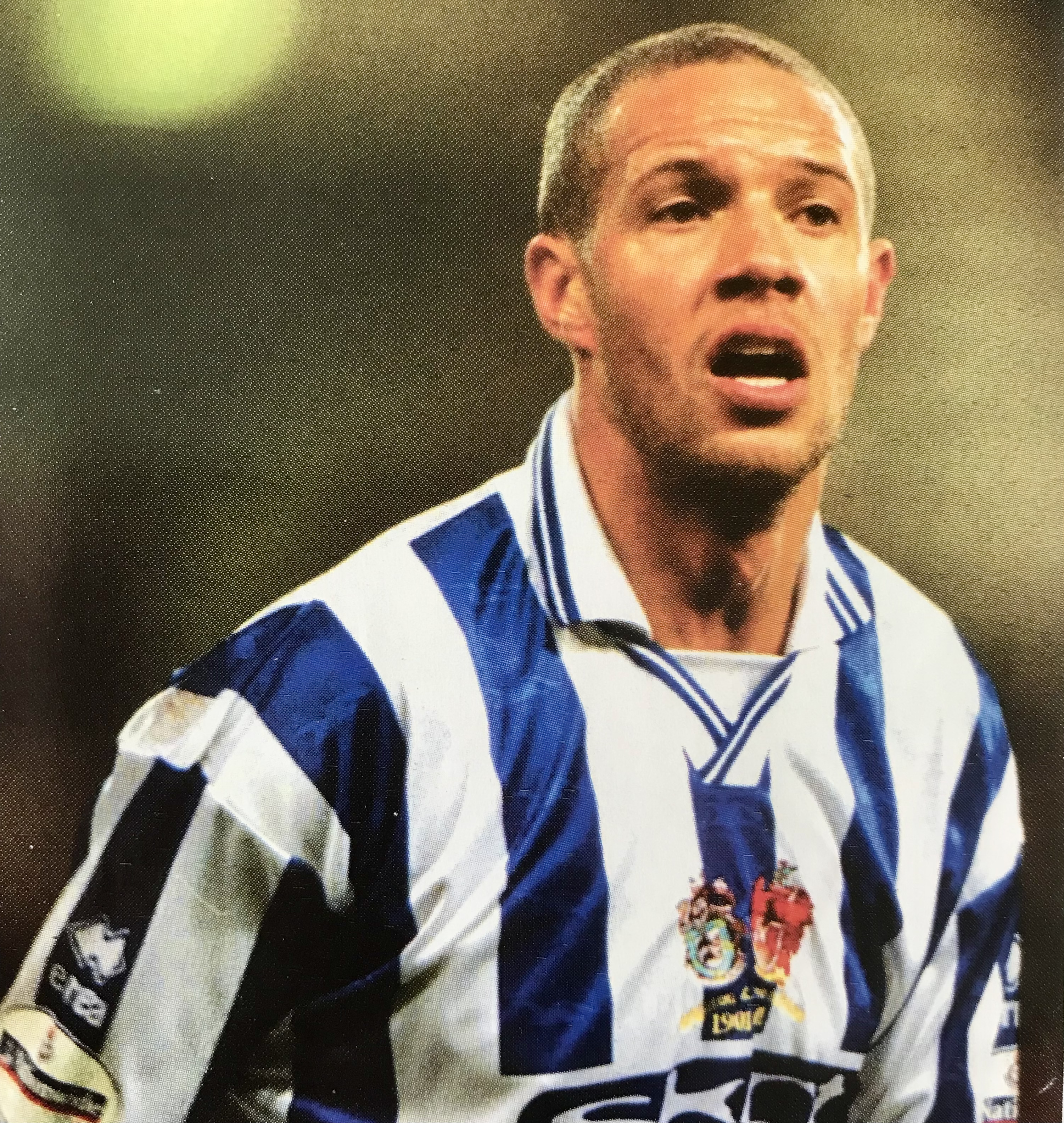
G Hoyte stripes

Hoyte got another chance to prove himself when Calderon picked up a nasty hip injury in April, bringing his total number of Albion games over the season to 21.

When it looked like the popular Spaniard was going to move to Southampton instead of accepting a contract offer from the Seagulls, Argus reporter Andy Naylor ventured: “Gavin Hoyte’s encouraging conclusion to the campaign suggests he might even be capable of rising to the occasion if he returns on loan from Arsenal.”

It didn’t come to that, though, and, over the next two years, he dropped down another division with loan spells at Lincoln City and AFC Wimbledon.

When he realised there was little hope of him ever getting close to the Arsenal first team, he left for Dagenham and Redbridge, having spoken to Arsenal goalkeeping coach Tony Roberts, who’d played for the Daggers himself.

Born in Leytonstone on 6 June 1990, Hoyte followed in his brother’s footsteps to Arsenal and progressed to the point of being appointed the under 18 team captain in the 2006-07 season when he was still only 16.

“I am very vocal during games, although I wouldn’t quite say that I was a Tony Adams, but that’s the sort of captaining style I try to emulate,” Hoyte told the Arsenal matchday programme. “I have captained at schoolboy level and in particular in tournaments and so I do have some experience, but I did not expect to be captain of the under 18s so early.”

Hoyte captained Arsenal’s under 18s when he was only 16

Hoyte was also capped at England under 17, under 18, under 19 and under 20 levels. In the 2009 UEFA under 19 championships, he played in two qualifiers in the space of four days when England beat Slovakia 4-1 and Scotland 2-1; his teammates including current Albion no.3 Jason Steele in goal, and future full international Kieran Trippier.

He was part of the squad who took part in the finals in Ukraine, starting twice and coming on as a substitute three times as England finished runners up to the hosts. The side was managed by Brian Eastick, who’d been an Albion coach during the Mike Bailey era.

Hoyte’s one game for the under 20s came as a substitute in a 1-1 draw away to Uzbekistan on 2 October 2009, when a fellow substitute was Sam Baldock. Two non-playing subs in that game were Jonathan Obika and Gary Gardner, who both had spells on loan with the Seagulls.

Hoyte looked back on his Arsenal time in an interview with Will Unwin for planetfootball.com and said: “When you’re there you always think you’re going to make it – I was pretty confident.

“I had my older brother there as well, so that helped a lot, seeing how he progressed.

“That was a big thing for me, seeing him play every week, watching him, thinking, ‘I want to try and get to where he is’.”

Hoyte was an unused substitute for several first team games before making his debut in a 6-0 League Cup win over Sheffield United, and starting in the next two rounds, against Wigan and Burnley. His Arsenal career only seemed to be heading in one direction.

“Just to play at the Emirates was massive, coming out to a big crowd,” he told Unwin. “There were a lot of young boys in the team so that helped me with confidence and eased it.

“But there were a lot of players in front of me, so I didn’t think about playing in the Premier League. It was always in the back of my mind, but I wasn’t thinking I was going to play immediately.”

But 11 days after the second of those League Cup appearances, Hoyte was handed his Premier League debut, after William Gallas had been stripped of the club captaincy for criticising team-mates amid a poor run of only one win in four games.

G Hoyte v Man City

Up against Robinho of Manchester City, he was taken off after an hour of a 3-0 defeat, and it would prove to be both the start and end of his top-flight career.

Hoyte didn’t recall getting much feedback after the game, although it wasn’t long before he was awarded a new contract. He made his fourth appearance for the club in a League Cup quarter-final defeat to Burnley at the start of December – but he didn’t play for Arsenal again.

He was sent out on loan to Championship side Watford for the second half of the 2008-09 season, featuring in 10 matches, and he eventually left Arsenal in 2012 when his contract expired.

After two seasons in League Two with Dagenham, he spent the 2014-15 season with League One Gillingham, featuring in 35 matches. He dropped down to League Two with Barnet, ended up at National League Eastleigh until the end of the 2017-18 season before returning to Dagenham in 2018-19.

It proved to be a frustrating season for him under the managership of former Albion boss Peter Taylor, but, reunited with former manager John Still at Maidstone United, he has been a regular at right-back in 2019-20 and scored just the third goal of his career against Dulwich Hamlet in December.

Along with his brother, the younger Hoyte has enjoyed the opportunity to play international football with Trinidad and Tobago, as he told socawarriors.net, and spent 20 minutes on the same pitch as Lionel Messi in a friendly as Argentina warmed up for the 2014 World Cup.

Injury-hit Albion among six to borrow Borrowdale

DEFENDER Gary Borrowdale couldn’t have been more aptly named for a loanee which is just as well because he found himself in that situation half a dozen times over five years.

He made a temporary switch to Brighton from QPR in March 2009 to fill the spot vacated when Albion’s regular left-back Jim McNulty suffered a shocking injury in a 4-0 home defeat to Crewe Alexandra.

While McNulty needed an operation to remove a kidney, former England under 20 international Borrowdale had the chance to resurrect his flagging career with the Seagulls.

For a player who’d clocked up 100 appearances for Crystal Palace by the time he was 21, there was the inevitable ‘noise’ about helping out the arch rivals, but Borrowdale just wanted some game time, and he was one of five debutants who pulled on Albion’s sky blue second kit for the game at Brisbane Road on 7 March 2009.

Brighton lost that match 2-1 but, under Russell Slade’s astute stewardship, Borrowdale acquitted himself well during 12 matches through to the end of the season and the Albion just managed to retain their third-tier status.

Borrowdale montage“I made my debut for Palace at 17 and played my first game in the Premiership at 18, so it was a great start and Palace will always be dear to me as a result,” Borrowdale told Spencer Vignes for a matchday programme article.

“The highlight of my career would be the promotion I had with Palace when we went from the Championship to the Premiership,” he said, referring to the play-off win over West Ham, the day before Albion beat Bristol City in their own divisional play-off.

Borrowdale returned to west London after his spell on the south coast but in March 2010 he went on loan to Charlton Athletic and the following year had temporary spells at Carlisle United and Barnet.

His league career seemed to be over when QPR released him in June 2012 and he went over to Northern Ireland to join second tier outfit Carrick Rangers.

In January 2014, he looked to have got a foothold back in the English professional game when loaned by Margate to Gillingham, but he didn’t play any first-team games and was released at the end of the season.

Former Albion boss Peter Taylor told the club’s official website: “He’s done very well, lost weight every week and looked fitter every week.

“I just don’t think he’s ready for League One football, especially considering if we have to play Saturday and Tuesday. As a result, I have decided to let him go.”

Borrowdale then linked up with Greenwich Borough, initially as a player, before becoming a coach.

Born in Worcester Park, south London, on 16 July 1985, Borrowdale came through the youth ranks at Selhurst Park and Trevor Francis handed him his debut for Crystal Palace in December 2002.

When Iain Dowie took over as manager, Borrowdale quickly became a regular in the first team. He also represented England at each of the age groups from 16 to 20, playing alongside the likes of Gary Cahill in defence.

In a 2-2 draw with the Netherlands, played at Turf Moor, Borrowdale’s teammates included fellow Palace youngster Scott Flinders in goal and future Albion player Will Hoskins.

Borrowdale won Palace’s Young Player of the Year award in 2006-07, but, when Dowie moved on to manage Coventry City, Borrowdale joined him there, a tribunal fixing the transfer fee at £650,000.

The move didn’t work out, though, and, with Dowie gone, Borrowdale was sidelined, eventually being sent out on loan to Colchester United and then QPR.

Paulo Sousa took him on loan in November 2008 and, although he didn’t feature, made the move permanent in January 2009 on a three-and-a-half-year deal. He made just 22 appearances for QPR during that time.

Borrowdale stripes

Pictures as featured in the Albion matchday programme.

Two goals that etched Sammy Morgan’s place in Albion history

HAVING A cheekbone broken in four places during a pre-season friendly summed up the bad luck of never-say-die Northern Irish international striker Sammy Morgan.

His cause wasn’t helped when the manager who signed him six months earlier quit. And, to top it off, while he was recovering from that horrific injury, an Albion footballing legend in the shape of Peter Ward burst onto the scene.

When a £30,000 fee brought him to Brighton from Aston Villa just before Christmas 1975, it looked like the side had found the perfect strike partner for Fred Binney as they pushed for promotion from the third tier.

Unfortunately, the man with the swashbuckling, fearless approach went eight games without registering a goal. However, in his ninth game he made amends in memorable fashion.

Morgan scored both goals in a 2-0 win over Crystal Palace in front of an all-ticket Goldstone Ground crowd of 33,300 – with another 4,000 locked out.

It was 24 February 1976 and the Daily Mail’s Brian Scovell reported the goals thus: “In the 12th minute, Ernie Machin struck an early ball into the middle from the right and Ian Mellor headed on intelligently behind the defence for Morgan to steer the ball into the corner of the net.

“The second goal, in the 55th minute, came when Tony Towner took the ball off Jeffries and set off on a 40-yard run which ended with his shot rebounding off goalkeeper Paul Hammond. Morgan tapped in the rebound.”

Gritty, angular and awkward, Morgan scored five more before the end of the season, including another brace at home to Swindon.

However, Albion narrowly missed out on promotion and Peter Taylor, the manager who bought Morgan, quit the club in the close season. The new season under Alan Mullery hadn’t even begun when, in a pre-season friendly against Luton Town, Morgan fractured his cheekbone in four places.

“I know I’m probably more prone to injuries than other players because of my style of play, but there’s no way I can change it, even if I wanted to,” Morgan told Shoot! magazine. “I made up my mind as soon as I got back in the team that I’d have a real go and that’s what I’ve done. People say I’m a brave player but I don’t really know if that’s true. I just like to give 100 per cent and that way no-one can ever come back at you.”

In the season before he joined Brighton, a groin injury had restricted him to just three top-flight appearances for Villa and, when he was fit to return, Villa had signed Andy Gray, whose form kept him out of the side.

Initially reluctant to move on, he admitted in that Shoot! interview: “I was sad at the time because I had a lot of happy times at Villa but now I think they may have done me a favour. Brighton are a very good ambitious club and I’ve just bought a house in Peacehaven. Really, I couldn’t be happier.”

Born in Belfast on 3 December 1946, Morgan’s family moved to England to settle in Great Yarmouth and, with an eye to a teaching career, he combined studies with playing part-time football for non-league Gorleston Town.

“Deep down I knew I could make the grade, but the opportunity just wasn’t there,” he told Goal magazine in a 1974 interview. “The local league club was Norwich City and in those days they didn’t seem that keen on local talent.”

Morgan enrolled at teacher training college in Nottingham and just when he thought a professional football career might elude him, Port Vale made an approach.

“I jumped at the chance,” he said. “They let me stay at Nottingham to complete my studies and I would travel up to train and play with them. Deep down I thought that the Third Division was as high as I could get, unless, of course, Vale were promoted.”

In his three years with Vale, where his teammates included Albion legend Brian Horton, he scored 24 goals in 113 appearances, and he caught the eye of the Northern Ireland international selectors. He scored on his debut in a European Championship qualifier with Spain on 16 February 1972 when he took over at centre-forward from the legendary Derek Dougan.

Amongst his illustrious teammates that day were Pat Jennings in goal and the mercurial George Best. Future Brighton left-back, Sammy Nelson (then with Arsenal) was also in the side. The game was played at Boothferry Park, Hull, because of the ‘troubles’ in Northern Ireland at that time and it finished 1-1.

Morgan won 18 caps in total over the next six years, scoring twice more, in 3-0 home wins over Cyprus on 8 May 1973 and Norway on 29 October 1975.

The Goal article noted Morgan “earned a reputation of being a hard, no-nonsense striker who could unsettle defences and goalkeepers with his aggression”.

Aston Villa boss Vic Crowe liked what he saw and reckoned he’d be an ideal replacement for that tough Scottish centre-forward Andy Lochhead, who was coming to the end of his career.

Morgan was by now 27 but, in the summer of 1973, Villa paid a £20,000 fee for his services.

“The offer came right out of the blue and I had no second thoughts about the move at all,” he said. “Being part of such a famous club naturally brings pressures, but I wouldn’t have it any other way.

There was a famous incident in a televised game between Arsenal and Aston Villa when the normally calm, cool and collected Arsenal goalkeeper Bob Wilson went ballistic because of the way Morgan tried to stop him clearing his lines.

Swindon goal celeb“The bigger the atmosphere, the more I like it. For instance, my best two games this season were against Arsenal, and in the replay there was a crowd of 47,000.”

At Brighton, new manager Mullery quickly decided he preferred Ward to Binney and, with Morgan sidelined by that pre-season injury, opted to put former midfielder Ian Mellor up front to partner him.

Wardy MorgBetween them, they literally couldn’t stop scoring goals, and the success of their striking partnership restricted Morgan to only two starts in 1976-77. He was on the sub’s bench throughout that first promotion season under Alan Mullery, and he scored just once in 16 appearances as the no.12.

He subsequently moved on to Cambridge United before a spell in Holland, where he played for Sparta Rotterdam and FC Groningen.

When his playing days were over, he became a teacher back in Gorleston. He also became involved in the Norwich youth team in 1990, signing full time as the youth development officer in 1998 and becoming the club’s first football academy director (he holds a UEFA Class A coaching licence). He resigned in 2004 and moved to Ipswich as education officer.

In 2014, Morgan was diagnosed with stomach cancer and underwent chemo to tackle it. Through that association, in September 2017 he gave his backing to Norfolk and Suffolk Youth Football League’s choice of the oesophago-gastric cancer department at the Norfolk and Norwich University Hospital (NNUH) as its charity of the year.

Even when he could have had his feet up, he was helping to coach youngsters at independent Langley School in Norwich.

  • Pictures from various sources: Goal, Shoot! and the Evening Argus.

Graham Winstanley: fledgling Magpie, Carlisle legend, able Albion deputy

GRAHAM Winstanley spent five years at Brighton but only made 70 appearances, plus one as a sub. Most of his time with the Seagulls was spent as a dependable reserve.

Manager Peter Taylor drafted in the central defender to replace Grimsby-bound Steve Govier in the autumn of 1974 and he kept the no.6 shirt for all but two games through to the end of the season.

Govier had only been signed from Norwich City in May that year (together with Andy Rollings and Ian Mellor) but, unlike his co-signings, who had long Albion careers, Govier lasted only 16 games.

Winstanley, a Carlisle United regular for several seasons, had been edged out of the first team picture at Brunton Park following their surprise rise to the top division.

He arrived at the Goldstone in October 1974, on loan initially, and was even made captain during that time. He signed permanently for £20,000 the following month, moved into a house in Shoreham with wife Joan, and stayed in the south for five years despite limited first-team opportunities.

Born in the small north-east village of Croxdale, three miles south of Durham, on 20 January 1948, Winstanley joined Newcastle United straight from Washington Grammar School and, after serving an apprenticeship, turned professional.

He made his first team debut on Christmas Eve 1966, in a 2-1 home defeat to Leeds United.

With the likes of Ollie Burton, John McNamee and Bobby Moncur ahead of him, Winstanley struggled to establish himself at St James’ Park, only featuring seven times for the first team, five times as a starter and twice as a substitute.

Newcastle sold him to Carlisle for £8,000 in 1969, and it was at Brunton Park where he carved out a reputation as a powerful centre back who could also play full back.

In June 1972, against the Italian giants Roma in the Olympic Stadium, he scored a goal for United seven minutes from time that sealed a famous 3-2 win in the Anglo-Italian Cup. Four-Four-Two magazine voted it 45th of 50 top Greatest European Moments!

It may seem implausible to today’s reader to believe that Carlisle could win promotion from the equivalent of the Championship and play a season in the Premier League but that’s exactly what the Cumbrians did in 1974. They finished in third place, in the days before play-offs, a point behind Luton Town and 16 points behind champions Middlesbrough.

Although Winstanley had been part of Alan Ashman’s promotion side, he was not a first choice in the top division, and, after 165 appearances for United, headed south to Brighton.

His influence initially alongside Rollings, and then Steve Piper, brought much needed stability to the defence but the side struggled for goals that season and eventually could only achieve 19th place.

In January 2014, the excellent blog The Goldstone Wrap reflected on Winstanley’s influence at that time, and reproduced an Argus article angled on how the player – nicknamed Tot (he was the youngest of three brothers) – wore contact lenses while playing.

Having taken over the Albion team captaincy from Ernie Machin, Winstanley was appointed club captain in August 1975 but, with the arrival of the cultured former Millwall and West Ham defender, Dennis Burnett, was dislodged from a starting berth and only played three more times that season.

Even when Taylor’s successor, Alan Mullery, dispensed with Burnett’s services, the 1976-77 season saw Graham Cross partner Rollings, restricting Winstanley to just five appearances.

The following season Mark Lawrenson arrived, so it wasn’t as though the competition for a place was getting any easier! However, in that season, Rollings missed several matches through injury and Winstanley proved an able deputy on 19 occasions.

One of his stints in the side included the final seven matches when Albion came so close to earning promotion and Winstanley even got on the scoresheet in the 3-1 home win over Tottenham Hotspur on 15 April 1978.

“It was from a free-kick that got played out wide to the left and when the ball came over I just sneaked in at the back and hit it,” he recalled in an Albion programme feature of 14 March 2009. “It spent a long time coming to me in the air and an even longer time before it hit the back of the net.” It happened in front of a crowd of 32,647 packed into the Goldstone, and the game was interrupted by trouble-making Spurs supporters.

He kept the shirt for the opening two fixtures of the 1978-79 season but only played three more times in that promotion-winning campaign, the last of which came in a 1-1 draw away to Luton Town on 21 April, when neither Lawrenson nor Rollings were available.

When his contract was up in July 1979, he was granted a free transfer and he returned to Carlisle where he made a further 69 appearances. “I could have stayed but I didn’t really fancy it to be honest,” he told Spencer Vignes in a matchday programme article. “I knew I only had a certain amount of ability. I was never a First Division player. That’s why it was the best thing to do.”

During his time in Sussex, he coached Sunday team Boundstone Old Boys and, after his playing career came to an end, he was manager of non-league Penrith for a while. However, he subsequently had a variety of jobs outside the game, in and around Carlisle. He worked for a wholesale electrical company, as a milkman, selling insurance, as a partner in a building supplies company, as well as working for the Post Office and a local newspaper.

Horton’s place in the hearts of Brighton and Man City fans

IMG_5170ARGUABLY the finest captain in Brighton & Hove Albion’s history went on to have a far less successful spell as the club’s manager having also been a boss at the highest level, at Maine Road, Manchester.

The £30,000 signing of tenacious midfielder Brian Horton from Port Vale on the eve of transfer deadline day in March 1976 proved to be one of the most inspirational moments of Peter Taylor’s managerial tenure at the Albion and for such a fee was widely hailed as “an absolute steal”.

Even though Taylor didn’t hang around long enough to reap the benefit of the man he instantly installed as captain, his successor Alan Mullery certainly did.

In the early days after his appointment, there was some suggestion Mullery would be a player-manager but the former Spurs and England captain reassured a concerned Horton that wouldn’t be the case, admitting that he wouldn’t get in ahead of him anyway!

“Fortunately, that next year went really well. It was my best year without a doubt,” Horton told Evening Argus reporter Jamie Baker. “I’d never met Alan Mullery, and he’d probably never heard of me, so I was delighted and surprised when he made me his captain.”

It was the beginning of a strong bond between captain and manager and Horton added: “We had that relationship for all the five years I was with him.

“That first season was great. We went 20 odd games unbeaten and I was scoring left, right and centre, and I was very proud to be voted player of the year.

“Suddenly everything was coming right for me, although we were disappointed not to beat Mansfield for the championship because we felt we were far better than them.

“You’ve got to hand a lot of our success down to Alan Mullery. He was a terrific motivator of players. He was a bubbly character and it used to rub off on players.

“He was new to the game of management but he brought fresh ideas, and he’d been under some top managers as a player.

“The team spirit during those first three years was incredible. When you are winning games every week it makes a hell of a difference and we had that for three years. You just couldn’t describe how good the team spirit was.

“My treasured memory will always be of the day we beat Newcastle to clinch promotion to the First Division. It was even greater because I scored the first goal. It had always been my ambition to play in the First Division and now I had achieved it.”

In an inauspicious start, Horton found himself in the referee’s notebook as Albion were hammered 4-0 by Arsenal as the season opened at the Goldstone. After a narrower defeat away to Aston Villa, the next game was away to Man City – and Horton had the chance to earn the Seagulls their first top level point.

On 25 August 1979, Albion were trailing 3-2 when Horton had the chance to equalise from the penalty spot with only eight minutes of the game left. But the normally reliable spot-kick taker fluffed his lines, meaning Albion succumbed to their third defeat in a row.

While the superior opposition was clearly testing the Seagulls, it was testament to the resilient skipper that he was continuing to lead them having started out in the third tier and, on 20 December 1980, before a 1-0 home win over Aston Villa, he received a cut-glass decanter from chairman Mike Bamber to mark his 200th league appearance for the Seagulls.

As the 1980-81 season drew to a close, Albion were perilously close to the drop but four wins on the trot (3-0 at Palace, 2-1 at home to Leicester, 2-1 at Sunderland and 2-0 at home to Leeds) took them to safety. What Horton didn’t realise was the Leeds game would be his last for the Albion (as it also was for Mark Lawrenson, Peter O’Sullivan and John Gregory).

“I’d bought a house in Hove Park off Mike Bamber and I was sunbathing that summer when there was a knock at the door. It was Alan Mullery come to tell me he’d just resigned,” Horton told interviewer Phil Shaw in issue 26 of the superb retro football magazine, Back Pass.

Mullery told him how he’d quit over the proposed Lawrenson transfer, how O’Sullivan and Gregory were off as well, and that the club wanted to sell him too, for £100,000.

Although Mullery advised him to sit tight because he still had a year left on his contract, new boss Mike Bailey – with a swap deal involving Luton’s Republic of Ireland international, Tony Grealish, lined up – told him he’d have to fight for his place and would have the captaincy taken from him.

“I said I didn’t want to go, that I loved the club and the fans, that I’d bought a house, and, at 31 I thought I had two or three good years left.

“I spoke to Mike Bamber and he said: ‘I don’t want you to go but I have to back the manager’.” Horton felt he had no option but to make the move.

He chose the platform of the Argus to thank the supporters for the backing they’d always given him and said his one disappointment was that he didn’t get the chance to lead Albion at a Cup Final. “That I would have really loved.”

Looking ahead, he added: “The Luton move gives me a new challenge. You can get in a rut if you stay at one club too long. Six years at Port Vale and five and a half at the Albion is enough. It will probably put a little sparkle back into my game.”

And so, Horton went to Kenilworth Road and under David Pleat the Hatters won the 1981-82 Second Division championship by eight points clear of arch rivals Watford. Looking back in his interview with Back Pass, Horton reckoned two of his Luton teammates, David Moss and Ricky Hill, were up there alongside Lawrenson as the best players he’d played alongside.

An all-too-familiar tale of struggle in the top division saw Luton needing to win at Maine Road in the last game of the season to ensure their safety, and Raddy Antic scored a winner six minutes from time that preserved Town’s status and sent City down.

Television cameras memorably captured the sight of Pleat skipping across the turf at the end of the game and planting a kiss on Horton’s cheek.

After one more year at the top level, he began his managerial career as player-manager of Hull City in 1984, working for the mercurial Don Robinson, and steered them to promotion to the old Division Two at the end of his first season in charge. He is fondly remembered by Hull followers, as demonstrated in this fan blog.

When he parted company with the Tigers in April 1988, his old Brighton teammate Lawrenson, by then manager of Oxford United, invited him to become his assistant. United at the time were owned by Kevin Maxwell, son of the highly controversial Robert Maxwell.

When Dean Saunders, who Brighton had sold to Oxford for £70,000, was sold against Lawrenson’s wishes – astonishingly he went to Derby for £1million – Lawrenson quit. Horton took over as manager and stayed in charge for five years, during which time he recruited former Albion teammate Steve Foster to be his captain.

Horton’s managerial break into the big time came in August 1993 when Man City sacked Peter Reid as manager four games into the 1993-94 season. Horton didn’t need to think twice about taking up the role, even though City fans were asking ‘Brian who?’

In Neil McNab, Horton recruited to his backroom team a former playing colleague who’d been a City favourite. “I played with McNab at Brighton and knew his strengths and knew he was well liked here,” he told bluemoon-mcfc.co.uk.

Horton brought in Paul Walsh, Uwe Rossler and Peter Beagrie and City managed to stay up.

The new boss acquired the services of Nicky Summerbee (to follow in the footsteps of his famous father Mike) along with Garry Flitcroft and Steve Lomas and at one point City were as high as sixth in the table.

They eventually finished 17th but fans to this day still stop Horton (who lives in the area) and ask him about a terrific match which saw City beat Spurs 5-2.

It was Horton’s bad luck that when City legend Francis Lee took over the club from previous owner Peter Swales, he was always looking to install his own man in the hot seat, and Lee eventually got his way and replaced Horton with Lee’s old England teammate Alan Ball.

Ball took City down the following season while Horton embarked on a nomadic series of managerial appointments either on his own or in tandem with Phil Brown.

Initially he was boss of Huddersfield Town; then he was a popular appointment when he took over as Albion boss during their exile playing at Gillingham, but, because he wanted to live back in the north, he left in February 1999 to join another of his former clubs, Port Vale.

He led Vale for five years and pitched up next at the helm of Macclesfield Town, where, on 3 November 2004, he marked his 1,000th game as a manager. It was at Macclesfield where one of his players was the self-same Graham Potter whose stewardship of Swansea City came mightily close to upsetting City in the 2019 FA Cup quarter-finals.

A bad start to the 2006-07 season saw him relieved of his duties in September 2006 but, by the following May, he was back in the game as Brown’s no.2 at Hull City. In March 2010, he was briefly caretaker manager following Brown’s departure, until the Tigers appointed Iain Dowie.

Next stop saw him as no.2 to Brown at Preston North End; then a second brief spell as Macclesfield boss at the end of the 2011-12 season.

In June 2013, he was appointed assistant manager to Paul Dickov at Doncaster Rovers, a role he filled for two years before linking up with Brown once again during his tenure at Southend United. Horton was his ‘football co-ordinator’ but left the club in January 2018. He followed Brown to Swindon Town but, in May 2018, decided not to continue in his role as assistant manager.

Born in the Staffordshire coal-mining village of Hednesford on 4 February 1949, Horton went to its Blake Secondary Modern School. Spotted playing football for the Staffordshire Schools side and the Birmingham and District Schools team, the Wolves-supporting youngster was awarded a two-year apprenticeship at Walsall when he was 15.

But, at 17, his hopes of a professional career were dashed when he wasn’t taken on. He ended up finding work in the building trade while continuing his football with Hednesford Town in the West Midlands (Regional) League.

He played at that level for four seasons and it was there he acquired the moniker Nobby because he gained a reputation for World Cup winner Stiles-like aggression. It was a nickname that stuck.

At the time, he was playing up front and scoring a lot of goals so he caught the attention of a few league clubs, but only Gordon Lee at Port Vale made a move. Lee sealed the deal by buying the Town secretary a pint of shandy and promising to take Vale to play Hednesford in a friendly.

Vale had little money so the squad was made up of free transfer signings but Horton said it made them strong collectively with “a fantastic spirit” and it wasn’t long before he was made their captain.

Vale legend Roy Sproson took over from Lee as manager and in March 1976 the cash-strapped Potteries outfit were forced to sell their prize asset.

When Vale headed to Selhurst Park that month, Crystal Palace player-coach Terry Venables got a message to Horton before the game urging him to sit tight until the summer and they’d sign him then. But Albion stole a march on their rivals and Sproson told him: “I’m sorry but we’re selling you to Brighton for thirty grand. We need the money.”

Funnily enough, the previous summer Horton had a chance holiday encounter in Ibiza with Albion’s Peter O’Sullivan. He later told the Argus: “Sully asked me if I fancied a move. Little was I to know that I would be joining him soon after. There was a wealth of ability in the Albion side when I joined them and it was outrageous that we didn’t go up that year.

“I felt they had to go places and I wanted to be part of it. I’d never been in a promotion side but then to be made captain of it was really the icing on the cake.”

Albion’s gain was certainly a loss to two other clubs who’ve since encountered similar troubles in their past. Horton explained: “I knew clubs were interested although Roy Sproson said he wouldn’t let me go to another Third Division team. I think he released me to Brighton because at the time they looked certain for promotion.

“Also, it was the highest bid they’d had. Hereford and Plymouth had offered £25,000 and I would have been happy to have gone to either club.”

In November last year, Horton reflected on his long and varied career in an interview with The Cheshire Magazine.

Pictures mainly from my scrapbook, originally from the Argus, Shoot / Goal magazine, the matchday programme and various online sources.

Peter Taylor disciple Junior Lewis helped Seagulls to promotion

JunLewJUNIOR LEWIS was a loyal disciple of Peter Taylor, linking up with him as a player or a coach at EIGHT different clubs.

Although he didn’t win the support of too many Leicester City fans during his time with the Foxes, his arrival for the final third of Brighton’s 2001-02 season helped them to claim the third tier crown.

One particular game stands out in the memory, and it came on a rain-soaked night against league leaders Reading at the Withdean Stadium.

I recollect watching the action from the front row of the covered east side of the ground – the roof affording no protection whatsoever as the rain swept in.

Reading hadn’t lost in 12 games but with Bobby Zamora in sparkling form, Albion beat the Royals 3-1.

Lewis marked his debut with a simple tap-in after Zamora had set him up. The striker with the golden touch had scored his 26th goal of the season to give Albion the lead on 59 minutes and then provided the assist for an unstoppable strike by Steve Melton.

Five days later, Lewis scored the only goal of the game at home to Huddersfield  and, as promotion came properly into view, boss Taylor talked to the Argus about the difference he had made to the side.

Brighton went on to overtake Reading to claim the title, rounding off the season with a 1-0 win away to Port Vale. Lewis finished with three goals in 15 appearances as the side Taylor inherited from Adams lifted the championship trophy.

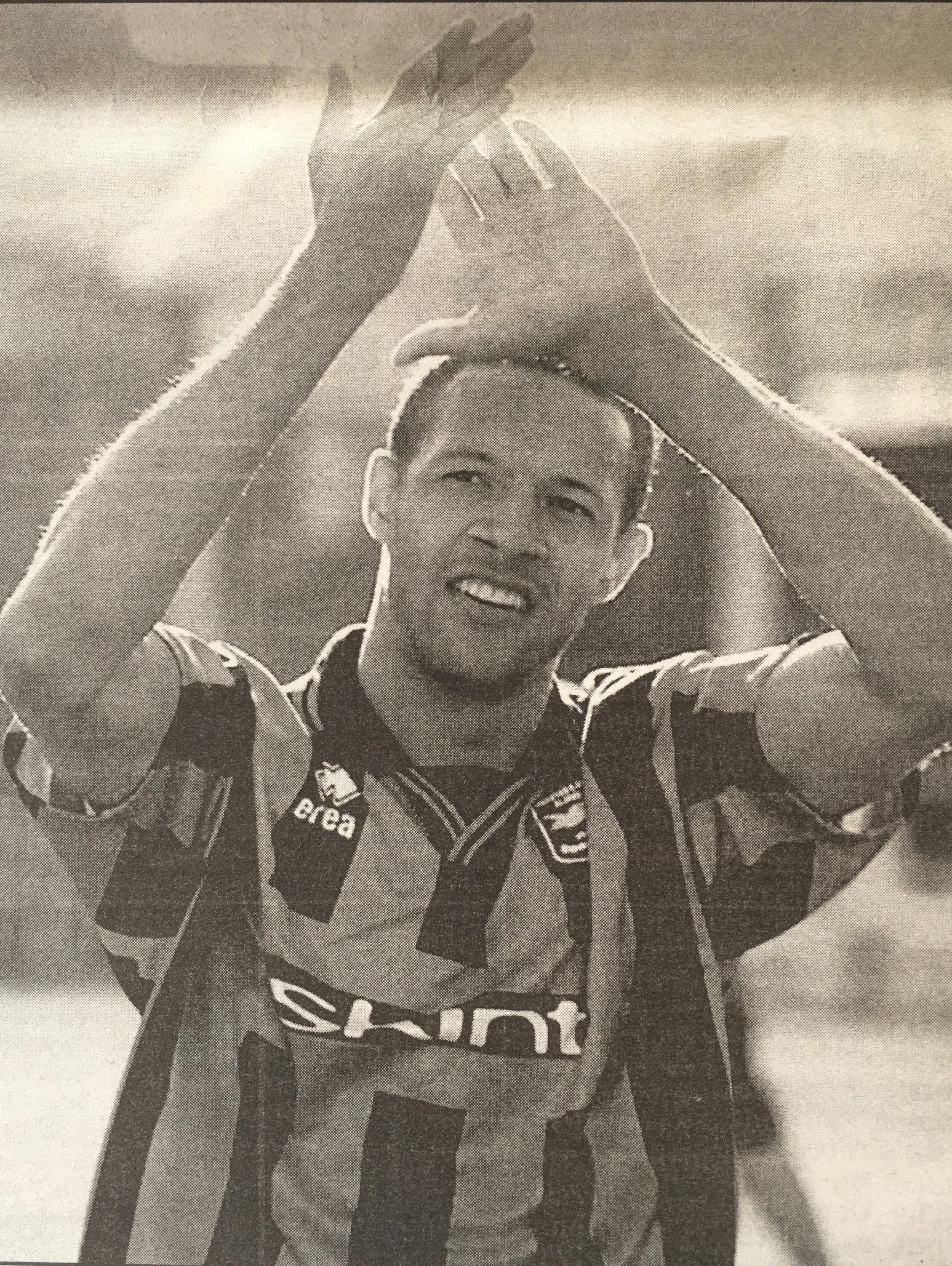
lewis applaudsBorn in Wembley on 9 October 1973, Lewis was on Fulham’s books as a youngster and made it through to the first team, his debut coming as a substitute in a league game against Burnley in October 1992.

But he played only six games at first team level before dropping into non-league and playing for three years with Dover Athletic – where he was first managed by Taylor.

He went on to play for Hayes and Hendon before getting back into league football under Taylor at Gillingham.

In a season and a half with the Gills, he played 59 games before Taylor, by now manager of Premiership Leicester City, took him there initially on loan and then as a permanent signing in 2001.

Although he was a Leicester player for three years, he managed only 30 appearances for the Foxes because Taylor’s successors as manager sent him out on loan.

After the temporary move to Brighton, Lewis had two spells on loan at Swindon Town the following year, then, in 2004, he was reunited with Taylor at Hull City, initially on loan and then on a permanent basis.

After 52 appearances for Hull, he had fleeting spells with Brentford, Milton Keynes Dons, Edgware Town and Stevenage Borough.

He joined Taylor’s backroom staff as a coach at Wycombe Wanderers and then moved in a similar capacity when Taylor was appointed as boss at Bradford City, the eighth club where they’d worked together.

“I’ve worked with him at every level from the Conference right up to the Premier League and been lucky enough to get promotion at a lot of those clubs,” Lewis told the Bradford Telegraph and Argus. “I know how the manager works and how he likes things done from playing for him and working under him as a coach.”

In a FourFourTwo magazine article by Nick Moore on 19 February 2016, Lewis reckoned Taylor always sought him out because he reminded him of his younger self.

“We were both two-footed, but mainly left-footed, and we relied on a similar trick – feinting to cross but chopping back onto your right foot,” Lewis explained. “I watched a video of him play once and I thought: ‘I do that’.

“He trusted me to keep things ticking over. I fitted his philosophy, and he brought the best out in me. But I didn’t assume that when he moved, I’d automatically follow. When he took over Leicester in the Premier League I did really hope I’d join, but I didn’t hear from him for ages.”

Lewis also reckoned operating in a difficult position was a way to become a favourite. “I was always a two-footed holding midfielder. There aren’t a lot of us around, compared to more attacking players, probably because you don’t get as much glory.

“So, having me in that role meant Peter always knew he had one position sorted.”

Before joining Taylor at Bradford, Lewis had continued playing at Welwyn Garden City and after leaving Bradford pulled on the boots once more as player-coach back at Hendon in 2014.

To the astonishment of many, Lewis was named first team coach of Leeds United in June 2014, when the relatively unknown Dave Hockaday was appointed their manager, but the role lasted only a couple of months as the pair were sacked by controversial owner Massimo Cellino after a poor start which included a 2-0 defeat at home to Brighton on 19 August.

In 2015-16 Lewis was coaching Canvey Island before moving on to become first team coach at Barnet, when former Seagull Darren Currie took over as boss from the veteran John Still.  Lewis and Currie were relieved of their duties at Barnet in August 2020 when the club had to restructure after missing out on promotion back to the League.

Much-travelled Ade Akinbiyi a big hit in brief Seagulls spell

A STRIKER with wildly differing fortunes in a varied and much-travelled career made a good early impression when joining Albion on loan from Norwich City back in the autumn of 1994.

Ade Akinbiyi had not long since broken through to the City team as a teenager and he scored four times in seven games on loan to the Seagulls.

Just turned 20, Akinbiyi arrived at a time when Liam Brady’s Albion hadn’t registered a win for 11 games and, although Albion lost the first game he played in, the remaining six produced three wins and three draws.

AA scores

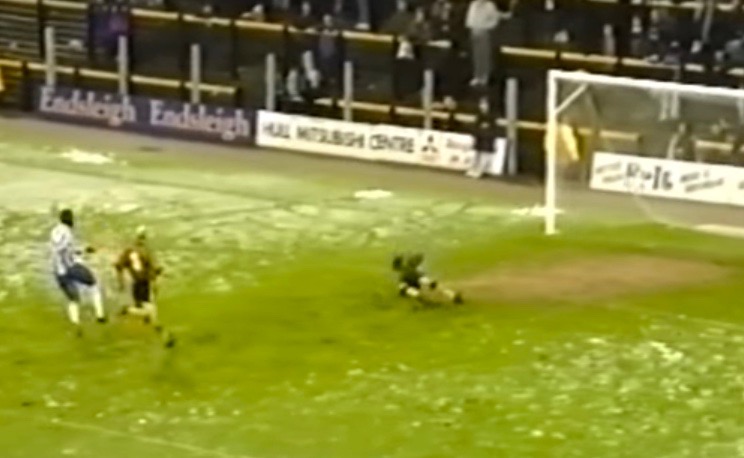
There is some YouTube footage of him scoring Albion’s second goal on a snowy pitch at Hull City’s old Boothferry Park ground in a game that finished 2-2.

“He is powerful and big and he can take knocks and we have missed having somebody in that mould,” Brady wrote in his matchday programme notes.

Later in his career Akinbiyi would prove to be a real handful for the Seagulls – I recall him shrugging off a powder-puff challenge from a young Dan Harding at Withdean and muscling his way to a winning goal for Stoke City. Manager Mark McGhee subbed Harding off and publicly lambasted him afterwards.

Born in Hackney on 10 October 1974, Akinbiyi was more interested in athletics at an early age, as he told the Lancashire Telegraph.

“I was interested in football but not massive on playing it,” he said. His school PE teacher persuaded him otherwise. “I went to play for my district team, Hackney, and it all started from there.”

From Hackney, Akinbiyi joined nearby Senrab, the team that blooded the likes of Bobby Zamora, Leon Knight, John Terry and Jermain Defoe.

His age group earned a place in a children’s tournament in Great Yarmouth called the ‘Canary Cup’ where he was spotted by a scout for nearby Norwich, who signed him as a schoolboy.

“The schoolboy and youth team system was second to none, as it still is now,” said Akinbiyi. But he found it hard living away from home, missing his mum’s native Nigerian cooking.

But after finding new digs with a few of his team-mates, he stuck at it and earned a dream debut as a substitute against Bayern Munich in the return leg of their UEFA Cup second round game, less than a month after his 19th birthday.

“I thought my debut would come in a cup game, perhaps against lower league opposition, not against Bayern Munich,” he said. “Not many people make their debut in a European cup competition.”

Although Akinbiyi made 51 league appearances for Norwich, his Canaries career never really took off, hence the Brighton loan spell and a similar move to Hereford United.

Eventually, though, a manager who believed in him, Tony Pulis, made him a record £250,000 buy for Gillingham in January 1997. Akinbiyi repaid Pulis’ faith in him with 29 goals in 67 starts, leading to Bristol City paying £1.2million for the striker following their promotion to the old Division One (now the Championship).

akinbiyi + colin lee

After scoring 21 goals in 47 league appearances for the Robins, in 1999 he completed a £3.5m move to Wolverhampton Wanderers. In the same year, he played his one and only game for Nigeria, in a friendly against Greece in Athens.

He made a great start at Wolves, scoring eight times in his first 12 games for Colin Lee’s side, but a year later, switched to Premier League Leicester City, after the Foxes’ boss Peter Taylor (later to replace Micky Adams at Brighton) paid out a £5m fee for the striker.

Ade A LeicesterAkinbiyi was brought in to replace Emile Heskey, a real Filbert Street hero who had been sold to Liverpool for £11m. However, his goal touch eluded him and he managed to score only 11 goals in 58 league appearances for the club – some Leicester fans dubbing him Ade Akin-Bad-Buy!

Akinbiyi looked back on it in an interview with Four Four Two magazine and said: “I came in as Emile Heskey’s replacement, but he is a different breed of footballer.

“He’s big, strong and scores goals, but, back then, if Heskey wasn’t scoring a lot he could get away with it. He was the local hero. I was a different player – I’d be running in behind and trying to cause people problems. But Leicester looked at my record in the Championship and thought I’d come and do the same thing.”

Eventually they cut their losses and sold him to Division One Crystal Palace for £2.2m. At Selhurst, he was rather ignominiously given the number 55 shirt! Having scored just one goal in 14 league and cup appearances, in 2003 he was loaned to Stoke City, under his old boss Pulis.

He scored twice – the second goal coming in the last game of the 2002-03 season, when the Potters won 1-0 against Reading to seal their Division One (now the Championship) status (the season Albion were relegated).

Akinibiyi discussed the events in an interview with another ex-Stoke, Burnley and Brighton striker, Chris Iwelumo, for Stoke City FC TV.

AA chat with CIIt led to Akinbiyi joining on a permanent basis, on a free transfer, and he became a cult hero with the Stoke City crowd.

In March 2005, Burnley signed him for £600,000 – and he was promptly sent off on his debut! The game was only two minutes old when he head-butted George McCartney of Sunderland, and was shown a straight red.

Less than a year later, he was on the move again, switching to Sheffield United in January 2006 for what was then a club record £1.75m fee.

He scored on his Blades debut against Derby County but by October that year he was in the news for his alleged involvement in a training ground bust-up with team-mate Claude Davis.

In all, Akinbiyi made only five appearances for the Blades in the Premiership in 2006 and, on New Year’s Day 2007 he returned to Burnley for a £650,000 fee, with add-ons.

He scored in his first game back, against Reading, but only notched three by the season’s end. Burnley fans have some good memories of him, particularly in a brief spell when he played alongside loan signing Andrew Cole, but on 2 April 2009, Burnley offloaded him to Houston Dynamo.

Dave Thomas, a prolific writer on all things Burnley, talked about Akinbiyi’s cult hero status among Burnley fans, telling thelongside.co.uk: “Ade certainly had a talent and that talent was scoring goals. The story that he was utterly bad at this is totally inaccurate, but that is the legend that developed, at one club in particular, Leicester City.

“In truth, at Burnley too, he missed sitters that Harry Redknapp might say his wife could have scored. But then so do all other players and, in many games, he displayed all the things that he was good at, and the attributes that he had in abundance.”

After he was released by Houston, back in the UK he played 10 games for Notts County, as they won the League Two title In 2009-10, and the following season pitched up in south Wales to play for then non-league Newport County.

In July 2013, Akinbiyi became a player-coach for Colwyn Bay, managed by his former Burnley teammate Frank Sinclair, but both resigned in January 2015 after a 5-0 defeat at Boston.

Akinbiyi now lives in Manchester and in 2015 was interviewed about work he has done as an ambassador for Prostate Cancer UK after his father died from the disease.

Shankly ‘disciple’ George Aitken coached Mariners and Seagulls

MEDIA-friendly Jimmy Melia stole all the limelight as Brighton stormed to the final of the 1983 FA Cup but a quiet, wavy-haired Scot alongside him played a big part in the achievement.

George Aitken was joint caretaker manager with Melia for three months after Mike Bailey’s dismissal in December 1982, and he’d previously been in the dugout alongside Alan Mullery and Ken Craggs during Albion’s rise through the divisions having originally been brought to the club by Peter Taylor.

.When he died aged 78 in August 2006, Jimmy Case told the Cumbrian Times & Star: “George was a great character, a great friend and coach right the way through my time at the club. “Jimmy Melia was in the front line with his white shoes but George was right there in terms of the workings of the club and picking the team. He was well respected for his knowledge of the game.”

Mark Lawrenson also paid tribute in an interview with Argus reporter Paul Holden, telling him: “George never got carried away. He had seen it all before. He was a very wily old fox. He was from the old school, a good, honest, true, loyal man.

“He knew his football, knew his players and liked a laugh. He had one of those infectious laughs.”

Micky Adams said: “He was a great football man, George. When I first joined Brighton as manager, he was one of my biggest allies. He always popped into the office to chew the cud and talk football. He loved Brighton and was a well-respected man who loved the game.”

Holden also reported that at Aitken’s testimonial dinner in 1988, former Albion secretary, Stephen Rooke, said: “He may never have reached the dizzy heights attained by many of his friends and acquaintances over the years but he represents a rare breed, in fact the very lifeblood of our national game.

Aitken tiler sully 78

Aitken puts Ken Tiler and Peter O’Sullivan through their paces in pre-season training in 1978

“Deep down George is a very private person but his reliability and honest, down-to-earth approach has, quite rightly, earned him enormous respect throughout the football world.”

Aitken had been a manager in his own right at Workington, and he and Melia had both been players under one of the game’s legends – Bill Shankly.

Shankly managed Workington between 6 January 1954 and 15 November 1955, when Aitken was a strong and commanding centre back for the Cumbrian side, and five of Melia’s 10 years playing for Liverpool were under Shankly’s managership.

Born in Dalkeith, Scotland, on 13 August 1928, Aitken was educated at Dalkeith High School and played football for Midlothian Schools.

His step up to senior football came at Edinburgh Thistle, which was essentially a feeder side for Hibernian.

David Jack, remembered as the first player ever to score at Wembley, had become manager of Middlesbrough in 1944, and took Aitken to Ayresome Park after the war.

“I was 20 at the time and it took me two seasons to reach the first team,” Aitken recalled in an Albion matchday programme article.

“Middlesbrough had a great team at the time and I played alongside the likes of (England internationals) Wilf Mannion and George Hardwick.”

Aitken made his debut against Fulham in 1951-52, but only made 18 top division appearances and, in July 1953, was sold to nearby Workington for £5,000.

It was the beginning of a long-standing relationship with a club who in those days played in the basement division of the Football League and is now in the Northern Premier League – the seventh tier of English football.

Aitken amassed 262 league appearances for Workington and, in the 1957-58 season, played against the famous Busby Babes at home in the 3rd round of the FA Cup in front of a record 21,000 crowd – just a month before the Munich air crash. Dennis Viollet scored a hat-trick for United in a 3-1 win.

“The game was an experience that I’ll never forget,” said Aitken, who kept on the wall of his house a picture of him with United’s skipper that day, Roger Byrne, who not long after that match perished in the Munich air crash.

Aitken retired as a player in 1960 but he stayed on at Borough Park as a coach, initially under Joe Harvey, who later enjoyed success at Newcastle United, and then Ken Furphy, who went on to manage Watford, Blackburn and Sheffield United before moving to the USA and taking charge of four different clubs.

Aitken had a brief spell as Workington manager between March and June 1965 (stepping in after Keith Burkinshaw – later famously boss of Spurs – had left) but then followed Furphy to Watford in 1965 as his coach. During that time, Watford, then in Division Two, famously beat Shankly’s Liverpool 1-0 in the quarter-finals of the FA Cup before losing to eventual winners Chelsea in the semi-finals.

The lure of Workington was to draw him back to the north west, though. When the manager’s job became vacant in 1971, Aitken took over and stayed for three seasons, eventually leaving in October 1974.

grimsby 75

In the 1975-76 season, he was trainer-coach during Tommy Casey’s spell managing Grimsby Town (where, as in picture, one of the players was former Albion defender Steve Govier), but left the Lincolnshire outfit to join Peter Taylor’s coaching set-up at Brighton in 1976. The Scot ended up staying for 10 years.

Aitken and wife Celia had three children and I well remember one of them, Bruce, appearing for Worthing FC.Aitken 2

George was clearly football daft, and in a matchday programme feature of September 1985, Celia told Tony Norman: “Football has always been his hobby, as well as his way of earning a living. He really loves the game. It’s not unusual for us to be driving somewhere and to stop because George has seen a game going on in a park by the road. He can’t resist watching for a while.”

During Chris Cattlin’s reign as manager, Aitken was the reserve team manager and chief scout, and in the programme article he said: “I can look back on some very happy memories. I was assistant manager when we took the club to Wembley and that experience is something I’ll never forget. But that is all in the past and what really matters to me is the future for Brighton Football Club. So, I enjoy going out to look for youngsters who could do a good job for us in years to come.”

After being sacked by Brighton, Aitken did scouting work for Graham Taylor during his spells at Watford and Aston Villa and then had three years working for the FA during Taylor’s reign as England manager. His last football role  was at Bolton Wanderers when Colin Todd was the manager.

end shot aitken armchair

Pictures from a variety of sources including the matchday programme, online sites and the Argus.

Promotion-winning full-back Paul Watson delivered for Zamora

DEPENDABLE full-back Paul Watson will best be remembered by Brighton fans for a sweet left foot that invariably created goalscoring chances for Bobby Zamora

.Previously, Watson made 57 appearances in a season-and-a-half with Fulham, and was a mainstay in their famous 1996-97 side that earned promotion from Division Three under Micky Adams.

.Born in Hastings on 4 January 1975, Watson began his playing career with Gillingham, where he spent five years before following Adams to Fulham in July 1996.

He teamed up with Adams once more, at Brentford, where he played for 20 months before signing for the Albion in a joint deal with Bees teammate Charlie Oatway.

Watson was a key member of the side that won back-to-back championships, helping the Seagulls from the fourth to the second tier.

The left-footed right back was particularly accurate from dead ball situations and his pinpoint passing proved ideal for Zamora to thrive on.

In Paul Camillin’s Match of My Life book (knowthescorebooks.com, 2009), Zamora said: “Whenever Watto got the ball I knew precisely where I needed to run to and he knew where to deliver it to.

“It was just such a great connection: Watto has an absolutely wonderful left foot and it made my job as a striker so much easier when you get deliveries like that.”

At the time of the interview, Zamora had moved on to Premiership Fulham and had played several seasons at the highest level. He said: “I don’t think I have come across anybody with a better left foot than Watto’s.

“I was very lucky to have played in the same team as him: he created numerous goals for me; not only with his deliveries but with his intelligent play as well.”

When the Seagulls finished top of the third tier under Adams’ successor Peter Taylor, Watson was one of four former Fulham players in the side: Danny Cullip, Simon Morgan and Paul Brooker the others.

img_4424

The disastrous run of 12 defeats under Martin Hinshelwood, after such a promising start in the second tier, took the players by surprise, as Watson revealed in an extended interview with Jon Culley for the Wolverhampton Wanderers matchday programme on 11 November 2002.

“Obviously we were aware it was a step up but we thought we would at least do okay,” he said. “Nobody was suggesting we would win promotion for a third season in a row, but, with a couple of new signings and the quality that was already in the side, we didn’t think we would struggle as we have.

“Everything started off all right. We had a good win at Burnley and then a 0-0 draw against Coventry and the way we were playing seemed to be working but after that nothing would go right.

“Every bit of luck, even the referees’ decisions, seemed to go against us and we could not get a point for love nor money.”

Watson conceded that the squad Peter Taylor had led to the Second Division title before his resignation faced a steeper learning curve than anticipated.

“You have to appreciate that 80 per cent of the squad had never played in the First Division before and it is a big jump in terms of the technical quality of some of the people you are up against,” he said.

Watson admitted the loss of Taylor had come as a big blow, and said: “Peter Taylor had been the England coach, even if it was only for one game, and to attract a manager of that quality to a club such as ourselves was very exciting.  Lots of players were gutted when he left.”

The arrival of Steve Coppell as manager gave the team renewed hope, although at the time Watson also spoke about the return to fitness and form of Zamora.

“Bobby was out for a while at the beginning of the season and you are always going to miss a player of his quality,” he said. “Now that he is beginning to get his fitness back, hopefully he will be able to make a difference to our fortunes.

“Nobody here is talking about relegation despite the start we have made. The arrival of players like Dean Blackwell and Simon Rodger have given a bit more know-how to the squad. We think we have what it takes to stay up.”

Obviously, it didn’t quite turn out that way, although they came mighty close to avoiding the drop. Watson stayed with the club the following season when Mark McGhee came in and steered the Seagulls to play-off victory in Cardiff against Bristol City, but his regular right-back slot was taken over by Adam Virgo.

After six years with the Seagulls, Watson left in July 2005, once again following ex-boss Adams, this time to Coventry City.

“I’ve got a lot of respect for him,” Watson told fulhamfc.com. “He’s made my career, basically! I’ll always have good things to say about him. Wherever he’s been he’s always been able to get the best out of his players, and he got the best out of me as well.”

However, Watson only played three games in a six-month spell with the Sky Blues, before going non-league with Woking, playing 15 games and, in the 2006-07 season, appearing in 44 games for Rushden & Diamonds.

He then had a season with Crawley and finally finished playing with Bognor. After hanging up his boots, Watson undertook a physiotherapy degree and was subsequently taken on by the Albion.

“It kind of started when I was at Brighton,” Watson told fulhamfc.com. “I had a couple of injuries towards the end of my time there and the physio at the time, Malcolm Stuart, helped me along and pointed me in the right direction.

Watto phys

“I did a couple of courses while I was still playing which helped me get onto my degree when I retired.”

Watson spent just short of nine years with the Albion’s physio team, initially with the development squad and then with the first team, during which time he earned a first class honours degree in physiotherapy at Brunel University, graduating in 2012.

Since June 2017 he has been head physio at Sheffield United and is currently studying for a Master’s degree in Sports Physiotherapy with Bath University.

Left back Harry Wilson “something of a fire-eater”

BRIGHTON boss Brian Clough turned up at Burnley to capture the signings of two of their fringe first team players – and ended up having pie and chips with the groundsman!

When Clough arrived at Turf Moor, he found manager Jimmy Adamson, chairman Bob Lord and secretary Albert Maddox were nowhere in sight, it being lunchtime.

In their absence, as recounted to respected writer Dave Thomas, groundsman Roy Oldfield made the famous visitor a cup of tea, popped to a nearby chippy to get them both pie and chips and chatted all things football until the office re-opened after lunch.

Although Clough hadn’t got quite what he expected on arrival, his journey did bear fruit. In exchange for £70,000, he secured the services of left-back Harry Wilson, a 20-year-old who had made 12 appearances for the Clarets, and midfielder Ronnie Welch, 21, who had played one game.

At the time, Clough was desperately trying to bring in new recruits to a beleaguered Brighton side that he and sidekick Peter Taylor had taken on in October 1973, a period covered in detail in a recent book, Bloody Southerners, by author and journalist Spencer Vignes.

The man who only the season before had led unfashionable Derby County to the First Division Championship, couldn’t quite believe what he had inherited at Third Division Albion.

The players seemed bewildered by what the new celebrity boss expected of them.

Heavy defeats – 4-0 to non-league Walton and Hersham in the FA Cup; 8-2 at home to Bristol Rovers and 4-1 away to Tranmere Rovers in the league – reflected the disarray.

Clough and Taylor weren’t slow in pointing the finger. Their only solution was to find replacements – and quickly.

Former Manchester United reserve Ken Goodeve was first to arrive, from Luton Town, although he failed to impress and made only a handful of appearances before joining Watford at the end of the season.

Goalkeeper Brian Powney was axed in favour of former England under 23 international, Peter Grummitt, initially on loan from Sheffield Wednesday.

Experienced left-back George Ley never played for the Albion again after the defeat at Tranmere, while utility man and former captain, Eddie Spearritt, also lost his place (although he eventually forced his way back into the side briefly).

Lammie Robertson, who knew the pair from his early days at Burnley, was asked to introduce them to their new teammates in the dressing room before an away game at Watford (they’d not been signed in time to play).

Robertson told Spencer Vignes in a matchday programme interview how Wilson was sporting a rather loud checked suit at the time and, in his own inimitable style, Clough boomed out: “Flipping hell, I never want to see that suit again.”

Needless to say the players laughed out loud, only for Clough to say: “What the hell are you all laughing at? They’ll be in the team next week.” And sure enough, they were.

Wilson and Welch made their debuts against Aldershot in a home game on Boxing Day when a crowd of 14,769 saw Albion slump to their fifth successive defeat, although at least the deficit this time was only 1-0.

A win finally came in the next game, a 1-0 success at home to Plymouth Argyle – Ken Beamish scoring the solitary goal.

In a 2010 matchday programme article, Wilson said: “I really didn’t want to go to Brighton. No disrespect but I loved it up at Burnley.

“The people there had been so friendly and helpful when I arrived from the North East so it broke my heart to leave. That said, I thoroughly enjoyed my time at Brighton and met some fantastic people, so, looking back now, I’m glad that Jimmy Adamson let me go.”

In the Evening Argus, reporter John Vinicombe purred about the impact of the new recruits from Burnley, saying Wilson “is looking something of a fire-eater. He has a rare zest for the game and relishes the close, physical contact that is synonymous with his position.

“He knows how to destroy and create, and does both in a manner befitting a five-year background at the academy of fine footballing arts (editor’s note: at the time, Burnley had a reputation for producing highly-talented young players).

“His colleague from Turf Moor, Ronnie Welch, is not so completely extrovert, but is no less involved in midfield, and has a fine turn of speed. He made one mistake through trying to play the ball instead of hoofing it away, but this can only be described as a ‘good’ fault.”

Further signings followed and the ship was steadied. Wilson kept the no.3 shirt through to the end of the season. But Welch made only 36 appearances for Albion before Taylor, by then under his own steam, traded in him and fellow midfielder Billy McEwan as a makeweight in the transfer that brought full-back Ken Tiler to the Goldstone from Chesterfield.

Wilson, meanwhile, became a mainstay in Albion’s left-back spot for three years, including being ever-present in the 1975-76 season.

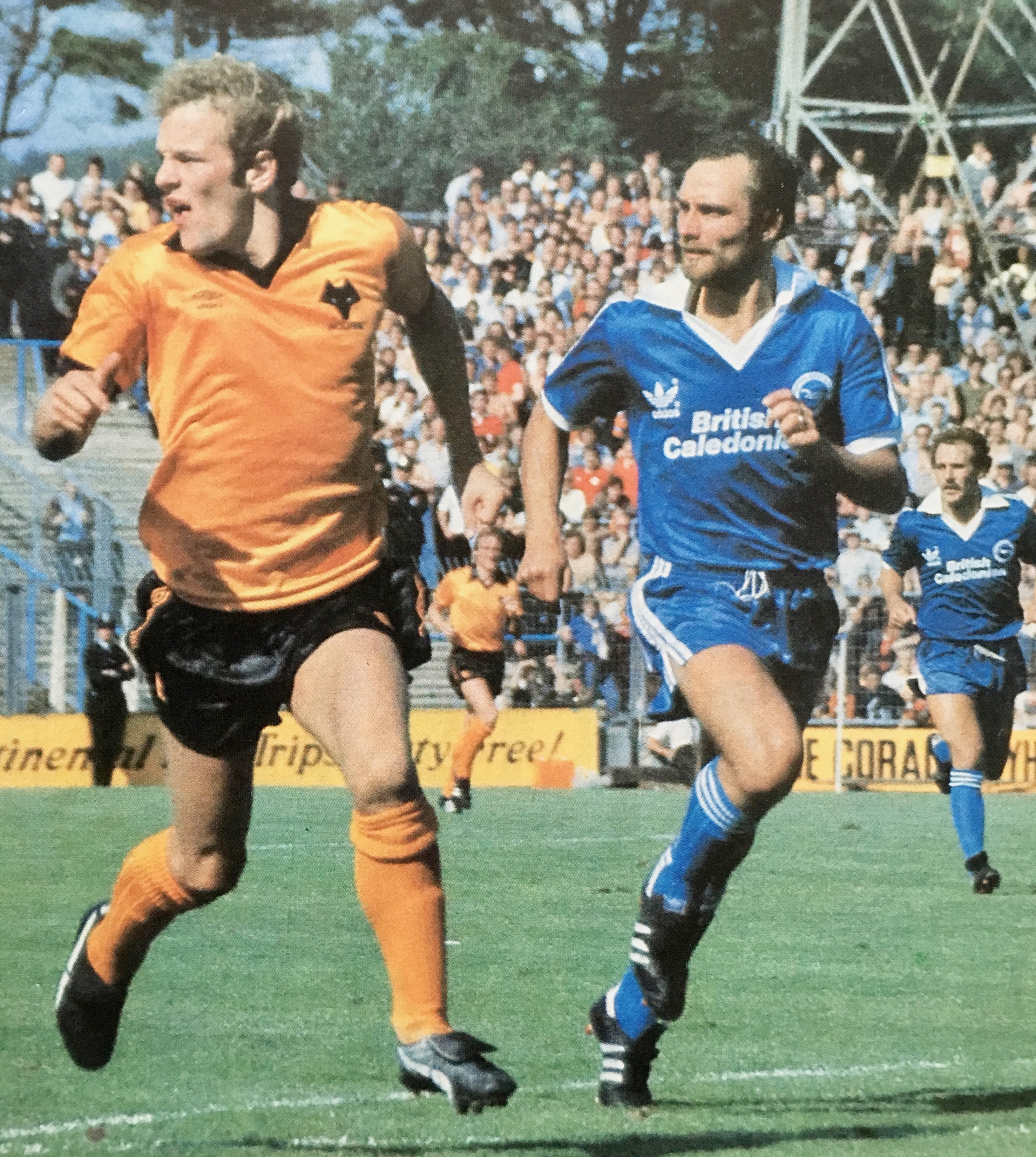
5 HW action v MillwallEver-present Wilson in action against Millwall at The Den

Suited for England!

Born in Hetton-le-Hole, near Durham, on 29 November 1953, Wilson played for Durham County Schools and made four appearances for England schoolboys (under 15s) in the 1968-69 season. He was taken on as an apprentice at Burnley before signing professional forms in December 1970.

In 1971, he earned an England Youth cap going on as a sub for Coventry’s Alan Dugdale in a 3-2 defeat against Spain in Pamplona. Don Shanks also played in that game.

He made his first-team debut at home to Chelsea on 26 April 1971 and the last of his 12 appearances for the Clarets was on 3 April 1972: away to Sunderland.

Young apprentice Wilson with experienced pros John Angus and Colin Waldron

He was part of Alan Mullery’s Third Division promotion-winning squad in 1976-77, although he was restricted to 22 appearances. The arrival of the experienced Chris Cattlin meant he was no longer first choice left-back, although in several games they both played – the versatile Cattlin being equally at home as right-back.

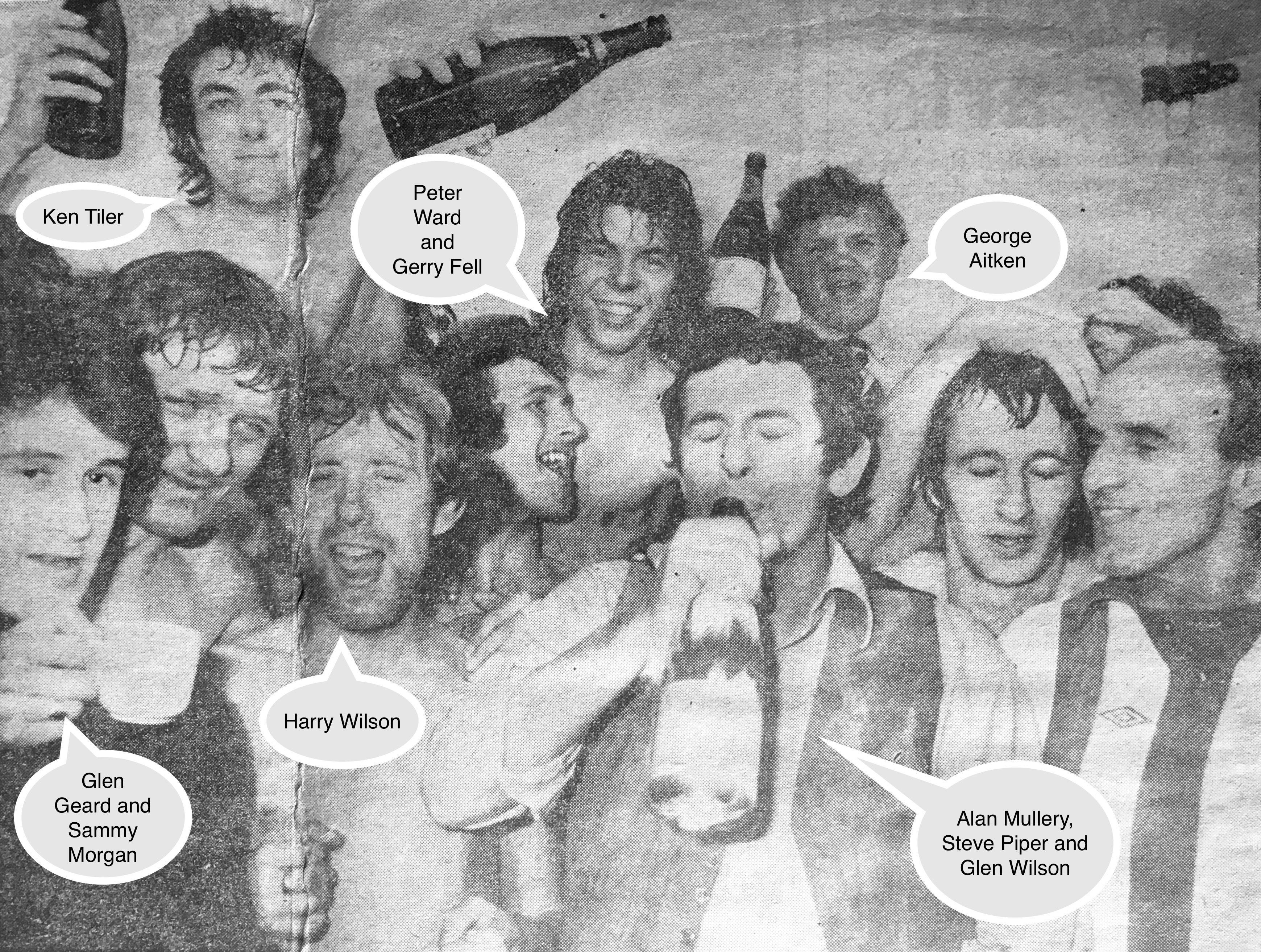
6 HW promotionA bare-chested Wilson was pictured (above) in the Albion dressing room alongside Mullery enjoying the celebratory champagne after promotion was clinched courtesy of a 3-2 win over Sheffield Wednesday on 3 May 1977. But that game was his Goldstone swansong.

He’d made a total of 146 appearances for the Albion – as well as chipping in with four goals – but when Mullery signed Mark Lawrenson and Gary Williams from Preston that summer, Wilson went in the opposite direction along with Graham Cross.

Only six months after arriving at Preston, Wilson was badly injured in a road accident after his car skidded on black ice and collided with a transit van. He suffered a punctured lung and damage to his knees. Doctors told him he wouldn’t play again, but he proved them wrong and ended up spending three years at Preston, playing 42 games.

“I suppose I was lucky to be alive,” he said in an Albion matchday programme article. “I lost a couple of yards of pace, but then again I ws never exactly the quickest of players.”

With his best days behind him, he moved back to his native north-east in 1980 to play for Darlington, making 85 appearances in three years.

He stayed in the north east in 1983, switching to Hartlepool for a season, but only played 16 times for them before dropping out of the league to play for Crook Town.

According to The Football League Paper, Wilson stayed in the game as manager of Seaham Red Star and, in 1988-89, Whitby Town.

He then worked as a community officer for Sunderland before joining the coaching staff at Burnley in the 1990s.

When Chris Waddle took over as manager, Wilson was sacked but he took the club to an industrial tribunal, which found in his favour.

He later worked for his long-term friend, Stan Ternent, at Bury, and as a monitor for the Football League, a job that saw him checking that the right procedures were being followed by the youth development set-ups of clubs in the north-west.

Wilson was in the news in 2007 when Ternent appeared at Lancaster Crown Court accused of assaulting Wilson’s son, Greg, on the steps of Burnley Cricket Club (a venue familiar to visiting supporters as a popular watering hole before games at the neighbouring football ground).

Greg Wilson required hospital treatment for a deep cut above his left eyebrow and needed nine stitches in his forehead.

Ternent said he had accidentally clashed heads, denied causing actually bodily harm, and was cleared by a jury.

4 HW colour laugh w WardWilson in an Albion line-up alongside Peter Ward
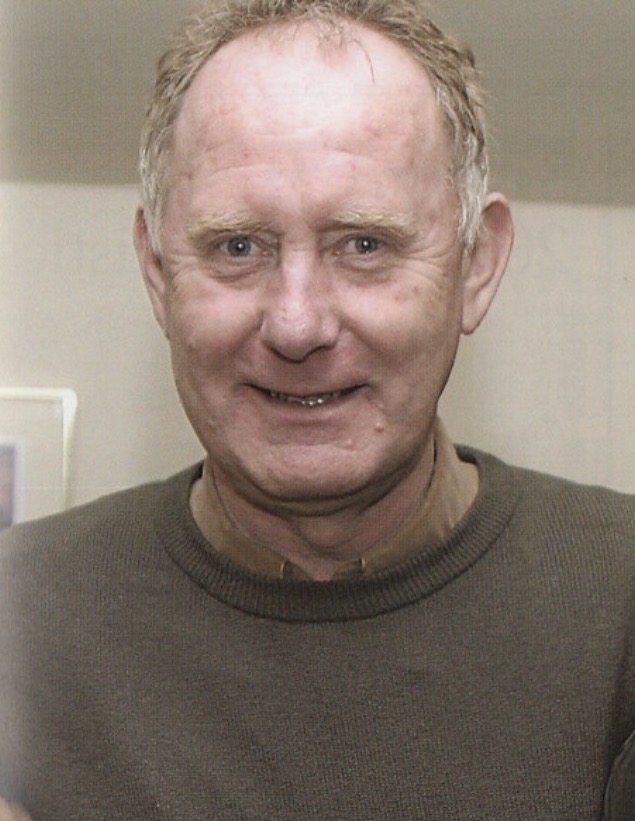
Wilson pictured in 2010