‘Rooster’ became pivotal to developing young players

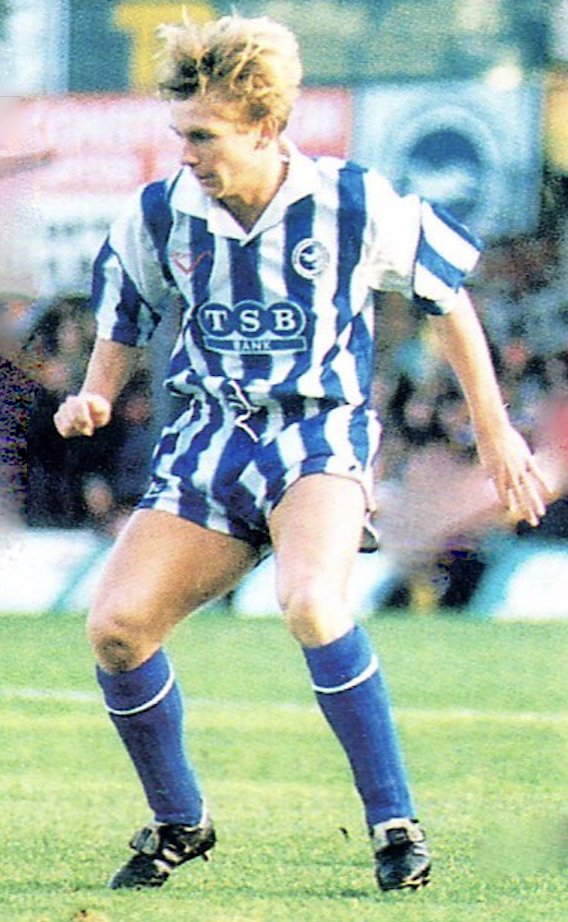
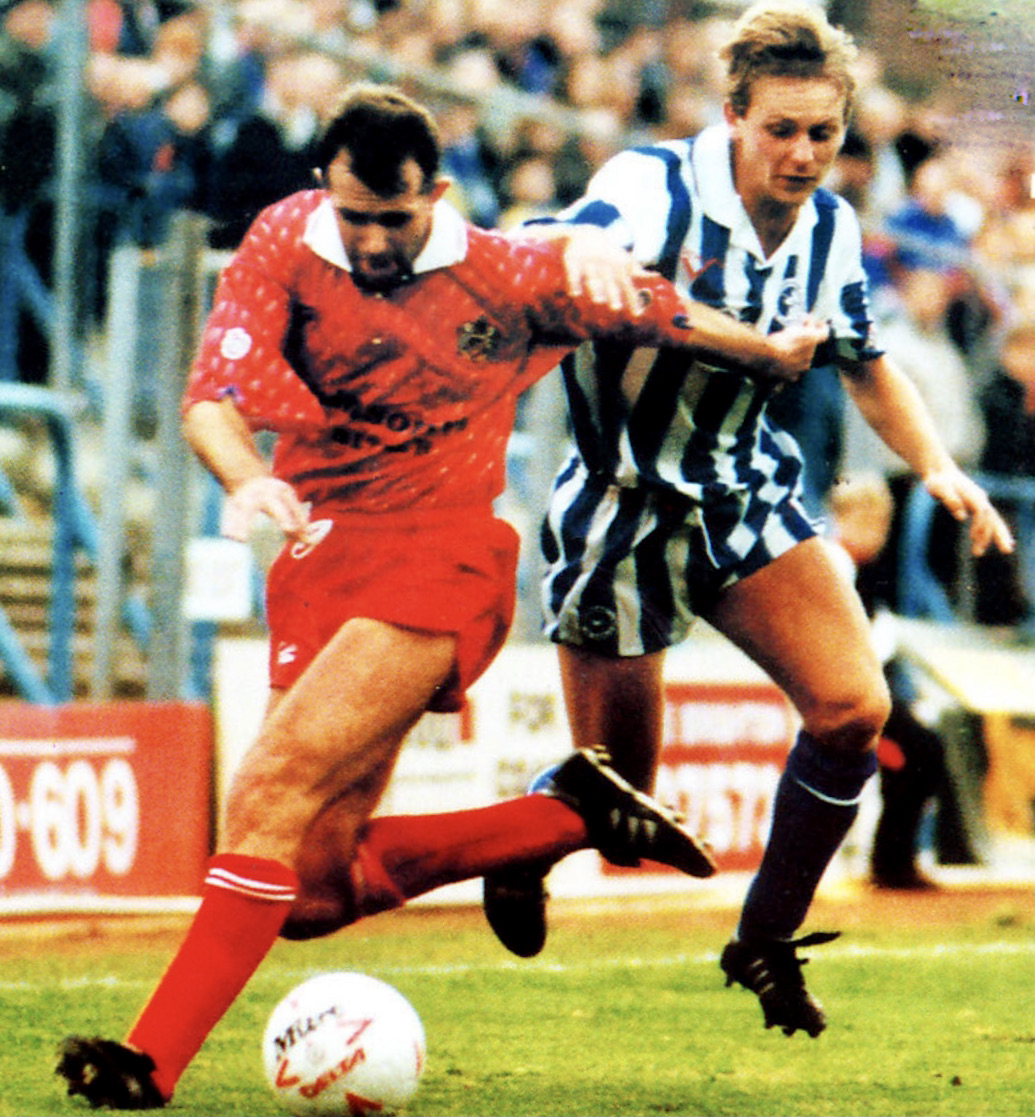
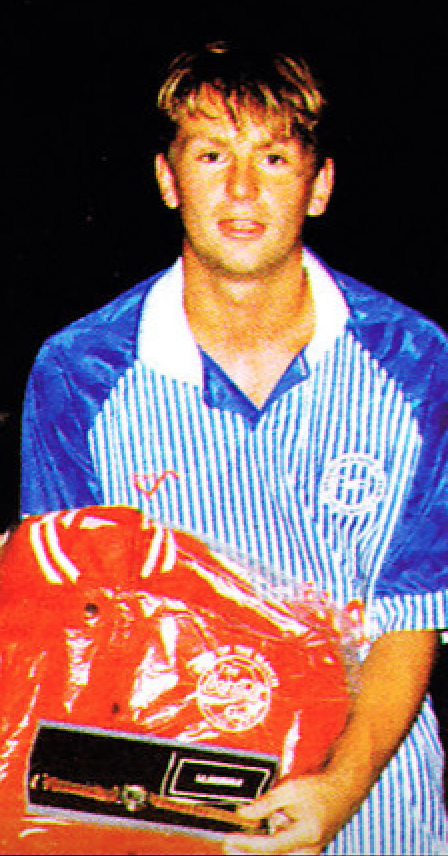
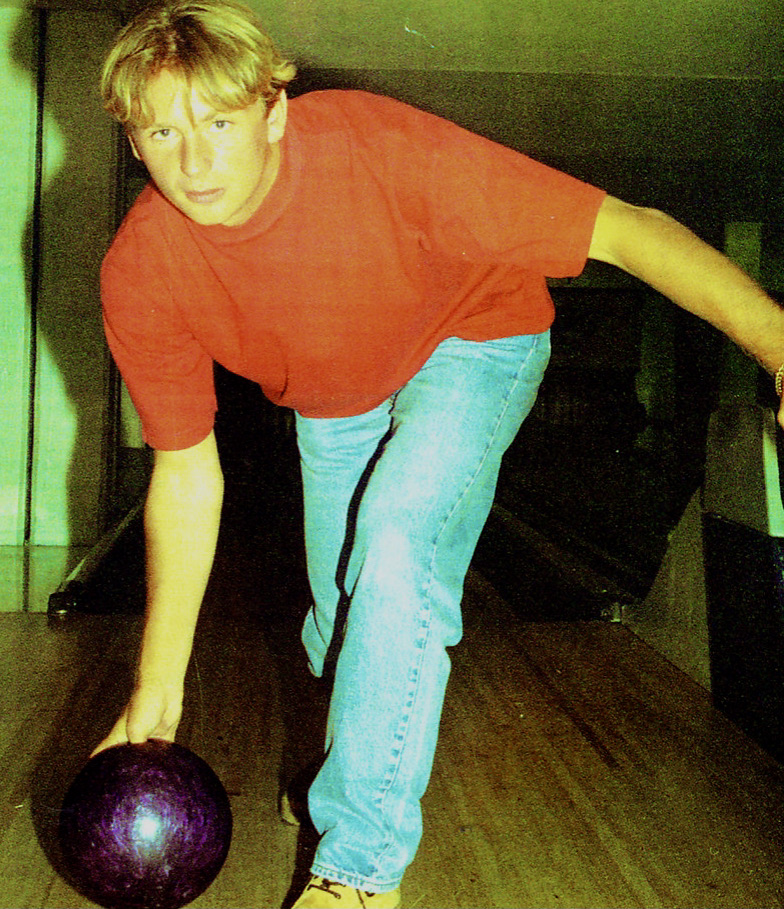
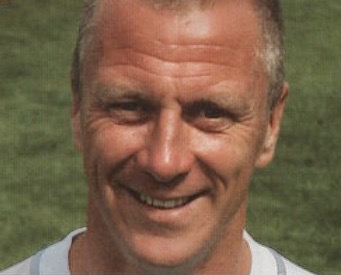
FORMER BRIGHTON apprentice Kevin Russell enjoyed a 20-year playing career in which he scored 105 goals in 552 games but he had forgettable spells at three South Coast clubs.

As we learned in my previous blog post, England Youth international Russell scored goals for Albion’s youth team and reserves but moved on before making the first team after a falling out with manager Chris Cattlin.

He got on better with Alan Ball at Portsmouth but only played eight games in three years at Pompey.

In March 1994, he was back in the south after a £125,000 move from Burnley to AFC Bournemouth. Unfortunately, his time at Dean Court coincided with dismal form on the pitch and financial pressures off it.

Russell was signed by Tony Pulis, who, it turned out, was in the final throes of his first spell as a manager, having succeeded Harry Redknapp at Dean Court.

The side had a dreadful run of form the month after Russell joined, suffering five defeats and three draws in eight matches. It was in the last of these that Russell finally got on the scoresheet for the Cherries as they picked up a point in a 1-1 draw at Hull City (his only goal in 17 matches).

While Mark McGhee won the Division Two title with Reading and Russell’s former club Burnley won promotion via a play-off final win over Stockport County, the Cherries finished a disappointing 17th in the table.

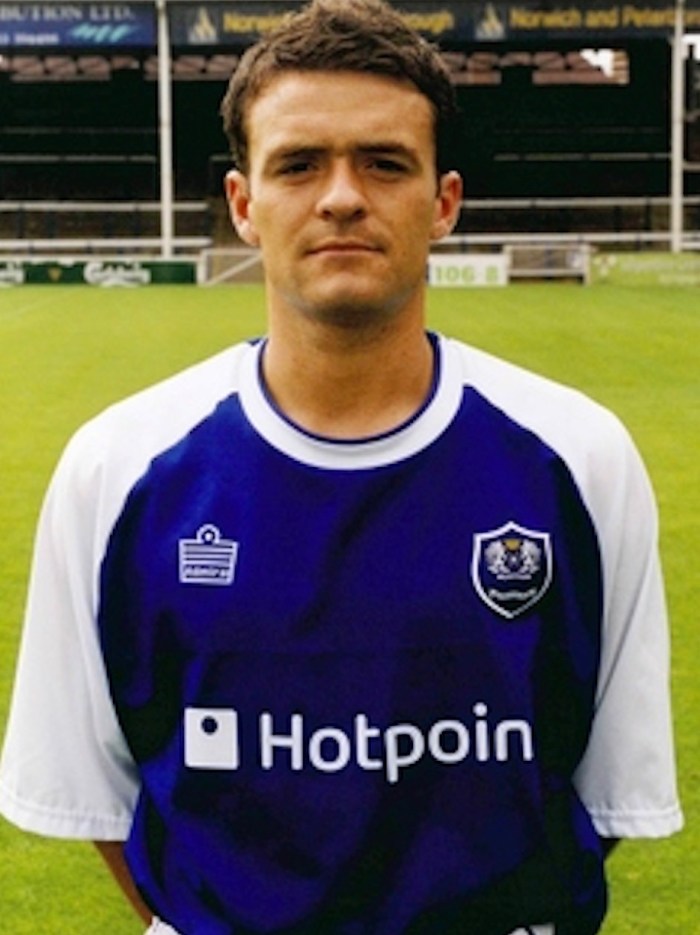
Portsmouth-born Russell had joined a squad (above) that included a number of players with past or future Brighton connections: Gary Chivers, Mark Morris, Paul Wood, Steve Cotterill and Warren Aspinall.

Cotterill recalled in a 2023 interview with gloucestershirelive.co.uk: “I know Rooster very well. I played with him at Bournemouth and he’s a great guy and a good coach.

“I liked him when I played with him because he used to stick crosses on a sixpence for me. I remember scoring a few goals from his crosses.”

Back in 1994, Pulis was sacked early on in the new season and former player Mel Machin took over, but the Cherries had managed only one win and a draw in their first 14 matches by the time they met the Albion at the Goldstone on 2 November 1994.

The game ended in a 0-0 draw and, although they won their next game, by Christmas they’d only got nine points from 21 games. Staring down the barrel of relegation, a last ditch revival in fortunes saw the season go down in memory as ‘The Great Escape’ because Bournemouth managed to avoided the drop by two points.

Russell, who had scored twice in 18 matches, had moved on by then and according to Aspinall, in a September 2011 interview with the Bournemouth Daily Echo: “Mel wanted rid of myself and Kevin Russell.”

Russell, who later had a habit of scoring against the Cherries – he hit four in 10 games against them – said after a 2001 encounter between Wrexham and Bournemouth: “The club was in a bad state when I was there, but Mel Machin and Sean O’Driscoll have turned things round and you know you’re always going to have a hard game against them.

“I don’t try any harder than normal when I play against them, but because I am playing up front and not in midfield or out wide, I get more chances to score.”

Aspinall had a couple of trial matches for the Albion before being packed off to Carlisle, while in February 1995 Russell joined First Division strugglers Notts County where he was reunited with former Leicester teammates Gary Mills and Phil Turner.

Howard Kendall was in charge at the time but County, who got through four managers that season (including Russell Slade for four months), finished bottom of the table having won only nine matches all season.

Russell then returned to his spiritual home in north Wales and, over the next seven years, played a further 240 matches for Wrexham, scoring 23 goals along the way.

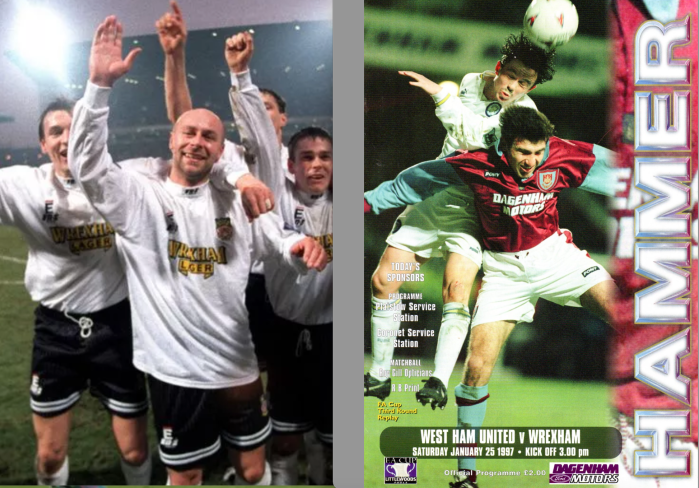
One of the most memorable was a last-minute winner at the Boleyn Ground in January 1997 as Wrexham pulled off a FA Cup giant-killing against West Ham. Having held the Hammers to a 1-1 draw at the Racecourse Ground, Russell went on as a 75th minute sub in the replay and scored a screamer in the dying seconds against a side that included Rio Ferdinand and Frank Lampard.

While the Dragons fans were elated, protesting home supporters spilled onto the pitch in anger at Harry Redknapp’s side’s performance and lowly Premier League position.

Slaven Bilic, later West Ham’s manager, was playing alongside Ferdinand and remembered the game thus: “We were struggling. We weren’t conceding a lot of goals but we couldn’t score and then Wrexham came and they scored at the end of the game, a great goal from 25 yards. After that we signed Johnny Hartson and Paul Kitson and we stayed up.”

When Russell’s playing days were over, he stayed on as a coach and worked as assistant manager under Denis Smith, taking Wrexham to promotion from the Third Division in 2002-03 and winning the LDV (English Football League) trophy in 2005.

That same year his loyalty and service to the club were rewarded with a pre-season testimonial against Manchester United – managed by his former teammate and captain Darren Ferguson’s dad!

Russell played the first 14 minutes of the match against a largely youthful United before being replaced by Ferguson. United won the game 3-1 with goals from Giuseppe Rossi, Liam Miller and Frazier Campbell and one of their subs that day was Paul McShane.

“I can’t speak highly enough of Alex for bringing his side here for me,” said Russell. “I’ve been treated to a special team with a lot of quality. I know there were a lot of young players out there, but you could see the potential they’ve got is immense.”

A crowd of nearly 6,000 watched the match and Wrexham secretary Geraint Parry said: “It just shows how well respected Kevin Russell is after his many years in the game.”

Smith and Russell were sacked in January 2007 but he went straight to Peterborough with Ferguson, who had been appointed Posh player-manager.

“We had an unbelievable time at Peterborough,” Russell told John Hutchinson. “We took them from the bottom league to the Championship in successive seasons in 2008 and 2009.”

There was a brief and unsuccessful spell for the managerial duo at Preston North End in 2010 – they were sacked four days after Christmas with Preston bottom of the Championship – but they weren’t out of work for long because they were re-appointed at Peterborough the following month.

They lost their first game back in charge though – to Brighton. Albion, on course to be league one champions under Gus Poyet that season, beat Posh 3-1: Chris Wood two and Elliott Bennett the scorers while Craig Noone made his home debut for the Seagulls.

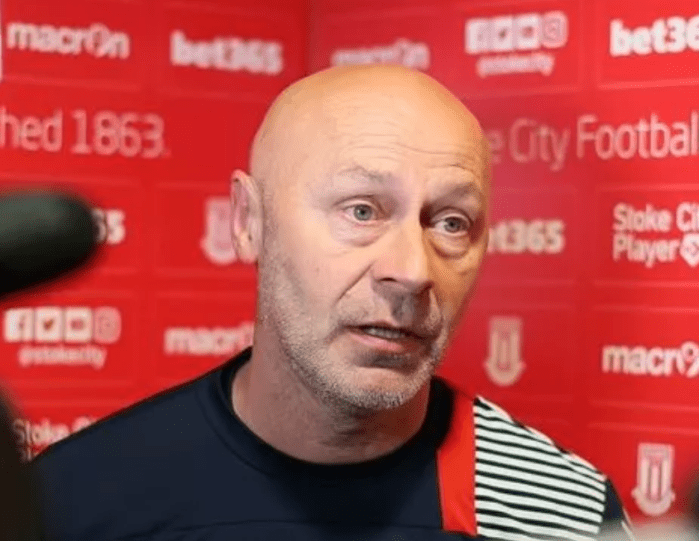
After three years at Peterborough, Russell moved back to the Potteries to join the coaching staff at Stoke (below) and stayed for nine years! He mainly worked with the under 18s and under 21s but also helped with the first team in between managerial changes in 2018 and 2019.

In May 2023, Russell joined Cheltenham Town as assistant manager to Wade Elliott. He was in caretaker charge for two matches when Elliott was sacked four months later but didn’t want the job on a permanent basis and left the club in October 2023 when Darrell Clarke was appointed.

Robins chairman David Bloxham said: “I am extremely grateful to Kevin for all his hard work and dedication and for his willingness to step in to manage the side in an extremely difficult period between Wade leaving and Darrell’s appointment.”

Once again, Russell wasn’t out of work for long. In January 2024, he was reunited with former Stoke technical director Mark Cartwright, a former goalkeeper who played 15 matches in Brighton’s 2000-01 promotion winning side, at Huddersfield Town.

Back in the game at Huddersfield Town

He was appointed as B team manager with a glowing endorsement from Cartwright, now Town’s sporting director, who said: “Not only is Kevin a great coach, but he also has a brilliant ability to develop relationships with young players.

“He’s a lively character and he knows how to relate to individuals to get the best out of them. Whilst at Stoke City, he played the pivotal role in developing players such as Nathan Collins, Harry Souttar, Tyrese Campbell, and Josh Tymon, alongside many others.

“He’s been so successful in doing that because he has a great understanding of the qualities that senior coaching staff want to see in young players.”

Edwards stole the limelight when Beckham made his debut

THE STORY of Matthew Edwards scoring for Brighton against Manchester United in the same cup match in which David Beckham made his debut has been told many times, and who wouldn’t be proud of that memory.

The history books can’t take it away from him, nor should they. “Scoring that goal against Manchester United was certainly the highspot of my career. Everyone wanted to talk about it and I was mentioned in all the papers and (I was) interviewed on television,” he said.

While that second round League Cup game on 23 September 1992 stands out, Edwards actually played 78 matches for the Albion after being released by Tottenham Hotspur, where his only first team outings were in testimonials or friendlies.

Albion were a very different proposition in September 1992, just beginning to reacquaint themselves to life back in the third tier of English football barely 16 months after having come close to returning to the top flight.

Big name players had been sold to try to balance the books and manager Barry Lloyd had to turn to free transfers, loanees and young hopefuls to put out a side.

Edwards was in that category and he probably only played in that United match because the respective parent clubs didn’t want loan forwards Steve Cotterill and Paul Moulden to be cup tied. He played alongside Scot Andy Kennedy, a recent arrival from Watford.

The youngster seized his chance and made a name for himself by heading home an Ian Chapman cross to cancel out Danny Wallace’s 35th-minute opener for the illustrious visitors.

Beckham had been sent on for his United bow in place of Andrei Kanchelskis (serenaded by a familiar North Stand chant of ‘Who the f****** h*** are you?’) but the game finished 1-1 at the Goldstone Ground, setting things up nicely for the second leg at Old Trafford (which United won 1-0).

Edwards once again earned a place in the headlines four months later when he scored the only goal of the game in a FA Cup third round win over south coast rivals Portsmouth, a side playing in the division above the Seagulls, and who had reached the previous season’s semi-finals.

Born in Hammersmith on 15 June 1971, the family lived in Brighton for a time and the young Edwards, who first started kicking a football around the age of six, played for local side Saltdean Tigers. At 13, he was on the Albion’s books under the guidance of Colin Woffinden, a former player who became youth coach.

But the family relocated to Surrey and it was while playing schoolboy football for Elmbridge Borough that he was spotted by Tottenham. In an extended interview with Lennon Branagan, Edwards explained how he got his big break courtesy of Fred Callaghan, Fulham’s left-back for 10 years who managed Brentford in the 1980s.

His son was playing in the same side as Edwards and Callaghan recommended Edwards to his friend Ted Buxton, a renowned coach and scout, who was working for Spurs at the time.

“I didn’t know that Ted had come along to watch me and then after one of the games they said: ‘Do you want to come to Spurs?’” Edwards recounted.

Young Spur Matthew Edwards

He signed associate schoolboy forms and while at Hinchley Wood Secondary School, Esher, travelled up to White Hart Lane on a Tuesday and Thursday night for training on an indoor pitch next to the main reception area.

On leaving school, he was taken on as an apprentice at Spurs and worked through his YTS under the auspices of youth team manager Keith Blunt and coach (and Blunt’s successor) Keith Waldon.

At 17, he signed on as a professional and he was on the books for three and a half years.

“We were quite successful in the reserves and I think that we used to win the league pretty much every season,” Edwards recalled.

It was tours abroad that he remembered most fondly from his time at Spurs, playing in Hawaii and Japan, and he also joined up with the first team squad for tours to Norway, Ireland and Italy.

A rare first team opportunity came in Billy Bonds’ testimonial at West Ham on 12 November 1990.

“I was young and had long blond hair and I can remember getting absolutely slaughtered by the West Ham fans that day,” he said.

In his final year, he went on loan to Reading, where he played eight games before returning to Spurs, and later the same season went to Peterborough on a similar arrangement, although he only played in one cup match for Posh.

He sensed his days at Spurs were drawing to a close, telling an Albion matchday programme: “I knew it was time for me to go when (manager) Peter Shreeves forgot my name!”

He said: “I had three months on loan at Peterborough but didn’t get a league game. Martin Hinshelwood rang me up in May and asked if I would be interested in coming to Brighton.”

Edwards marked by ex-teammate Justin Edinburgh

One of the first matches he played for the Seagulls was in a pre-season friendly against his former club, a 1-1 draw at the Goldstone on 29 July 1992. In a shocking excuse for a programme for the visit of Croatian side FC Inker Zapresic, a barely recognisable picture of the new signing was included. Thankfully a more professional programme appeared for the opening home league game, against Bolton Wanderers, and Edwards was pictured (left) in action up against his former teammate Justin Edinburgh

After Cotterill and Moulden had returned to their parent clubs because Albion couldn’t afford to make their moves permanent, Edwards started to forge a fledgling forward partnership with Kennedy. But Kurt Nogan took over and his prolific goalscoring saw Edwards have more of a peripheral role, although he ended the season taking over from soon-to-depart Clive Walker on the left wing.

Edwards was in the starting line-up for the first half of the 1993-94 season, won a man-of-the-match award for his performance against Gillingham in the League Cup and scored in a 2-2 draw at home to Huddersfield.

He was the programme cover boy for the Exeter City home game on 2 October (0-0) but, with Albion dangerously close to the drop zone, Liam Brady took over from Lloyd and it soon became quite a different picture for the former Spurs youngster.

He played in the first seven games under the new boss, and scored in a 3-3 FA Cup tie v Bournemouth, but Brady had his own ideas and started looking elsewhere for solutions.

“Me and him didn’t really see eye to eye, or he didn’t particularly fancy me as a player,” Edwards told Branagan.
Although Edwards was a sub three times in March, his appearance off the bench in a home 1-1 draw with Burnley was his last involvement with the first team.

A regular in the reserves in the latter part of the season, at the end of it he was released and joined Conference side Kettering where he had barely got his shorts dirty before suffering a cruciate ligament injury.

“That that was the start of the end of my career as such,” he confessed. “I had a year out of the game.”

On his return to fitness, he had two good seasons for Walton & Hersham, and then Enfield. “My knees just kept on going for me,” he recounted. Over the course of another couple of years, he appeared for Carshalton Athletic, Sutton United, Molesey, Yeading, Bognor and Egham.

But he said: “My knees just weren’t up to playing football, so I had to call it a day and that was the end of the career.”

Interviewed for an Albion matchday programme article in 2019, he told journalist Spencer Vignes he had developed a career in computer software sales and had been a visitor to the Amex on behalf of a ticketing company that worked with the club.

He had subsequently moved on to providing similar expertise for visitor attractions such as zoos, museums, aquaria and cathedrals.

Reflecting on his all too brief career, he said: “I suppose I’m lucky in that I was in the right place at the right time to play for the Albion at the Goldstone, rather than Withdean. Saltdean Tigers to Spurs to Brighton; there can’t have been many people who have done that!”

Zeke Rowe’s three goals and a red card as Albion went down

CHELSEA loanee Zeke Rowe scored three goals in nine matches for doomed Brighton and ended his spell with the ignominy of being sent off.

Rowe, a 22-year-old striker who had scored plenty at youth level for Chelsea,  was one of five new faces to join Jimmy Case’s relegation-bound Seagulls in the spring of 1996.

Winger Paul McDonald and striker Craig Maskell joined permanently from Case’s old club, Southampton, together with Saints defender Derek Allan, on loan initially and then permanently. Future captain Gary Hobson signed from Hull City.

All found themselves plunged into what turned out to be a fruitless battle to avoid relegation against a toxic backdrop created by the people running the club at that time – the hated Archer / Stanley / Bellotti regime – who tried to sell the club’s home without having a new ground to move to.

In the same matchday programme that announced the arrival of the five new players, the publication also detailed the impending departures of the likes of former first team regulars Steve Foster, Ian Chapman, Dean Wilkins, John Byrne, Stuart Myall and Stuart Munday; not to mention directors Bernard Clarke, Peter Kent, Dudley Sizen and Denis Sullivan. To misquote Shakespeare: Something was definitely rotten in the state of Hove!

Rowe made his debut in a 1-1 draw at home to Rotherham United, on 30 March, and then got off the mark with a goal away to Swindon Town four days later, although the Albion went down 3-2 (Jeff Minton scored the other).

Rowe’s picture adorned the front cover of the matchday programme for the 9 April home match v Burnley when his goal earned the Seagulls a win.

And his solitary goal also proved to be the decider in another 1-0 home win, over fellow strugglers Carlisle United, managed at the time by Mervyn Day.

Rowe’s dismissal for fighting with York City’s John Sharples came in a Thursday morning game, played five days after the official end of the season, in front of a post-War record low gate of 2,106 fans at the Goldstone.

The fixture had been rearranged because the original game 12 days previously had been abandoned after disgruntled Albion supporters had stormed the pitch in protest at the proposed sale of the ground and broken both crossbars.

It drew hysterical reaction in some quarters (probably because it was only a few weeks before England played host to Euro 96) but had the desired effect of bringing the rogue direction of the club to the attention of the football authorities who somewhat late in the day intervened to stop the Albion going out of business.

The original York game had looked like being the last ever at the Goldstone but a stay of execution saw the club stay for one more season before the site was redeveloped and the Seagulls were forced to groundshare at Gillingham.

The only happy supporters at the Goldstone on 9 May 1996 were around 400 followers of the Minstermen because their side overcame going a goal down to a Maskell opener to win 3-1, a result which prevented them joining Albion in the drop. Gary Bull, who had enjoyed a successful time on loan with Brighton at the start of that season, had equalised for York.

One City fan, Simon Worden, wrote an amusing blog about the whole occasion, and explained: “Whilst I should have been in a lecture at university at Preston, as I was only 19 at the time, I decided that the match was too important to miss and travelled down the day before to watch the match and stayed in a very cheap B&B.”

After witnessing the win, he said: “All the York fans were jumping around on a Thursday morning singing ‘We are staying up’ and enjoying the sunshine.

“One of the best days even and, whilst I was very tired, it was an enjoyable (but expensive) trip back to Preston where I had to catch up with my studies!”

Also watching on was Michael Knighton, chairman of Carlisle United, who, as a consequence of the result, were relegated with the Albion. Greg Wood, covering the game for The Independent, spiced up his report with a couple of choice quotes from him.

“Once York had gone 2-1 ahead, Brighton just weren’t interested,” said Knighton. “We’ve been relegated and we’ll never know if we should have been. This competition should be based on fairness, and towards us it hasn’t been.”

Wood also observed: “After York’s third goal, a member of their board turned to Knighton and made some distinctly unsporting gestures. Ordinary supporters have probably been expelled for less.”

Born in Hackney on 30 October 1973, Rowe was a frequent goalscorer in Chelsea junior teams playing alongside the likes of Neil Shipperley, Muzzy Izzet, Michael Duberry and Craig Burley.

But a first team breakthrough eluded him and before his time at Brighton he had scored twice in 10 games on loan at Barnet and had a trial with Swindon Town that didn’t work out.

When Chelsea let him go in the summer of 1996, he moved to Second Division Peterborough United under Barry Fry and was quickly off the mark netting the Posh opener in a 3-3 home draw with Millwall on 10 September 1996.

He was on target again, four days later, ironically against York City, in a 2-2 draw. But the season didn’t end well for Posh, because they were relegated. Rowe only scored once more in his 15 starts and 14 appearances off the bench that season.

Over the next two seasons, he only made four more starts for United and 13 appearances as a sub, while also going out on loan to Kettering Town and Doncaster Rovers.

Rowe later moved to Welling United where, according to the fanzine Winning Isn’t Everything, he was a disappointment after a bright start. It said: “Ezekiel Bartholomew Rowe, to give him his full name. Another in the long line of loanees from Uncle Barry Fry, he was brought in late in the 1998-99 season as the club attempted another Houdini act. Joined permanently in the summer, was on fire pre-season and then… he was shit. Had an impressive tattoo, erm, apparently.”

At King’s Lynn, Rowe played under his former Peterborough teammate Tony Spearing, who won the FA Youth Cup with Norwich City. (That 1983 success saw the Canaries draw 5-5 with Everton over two legs – Mark Farrington scoring four of Everton’s goals – before edging a replay 1-0).

Rowe ended his playing days with Conference North side Hinckley United where he was a teammate of Stuart Storer, who famously scored the last ever goal at the Goldstone – against Doncaster Rovers – a year after Rowe’s dismissal at that much-loved old stadium.

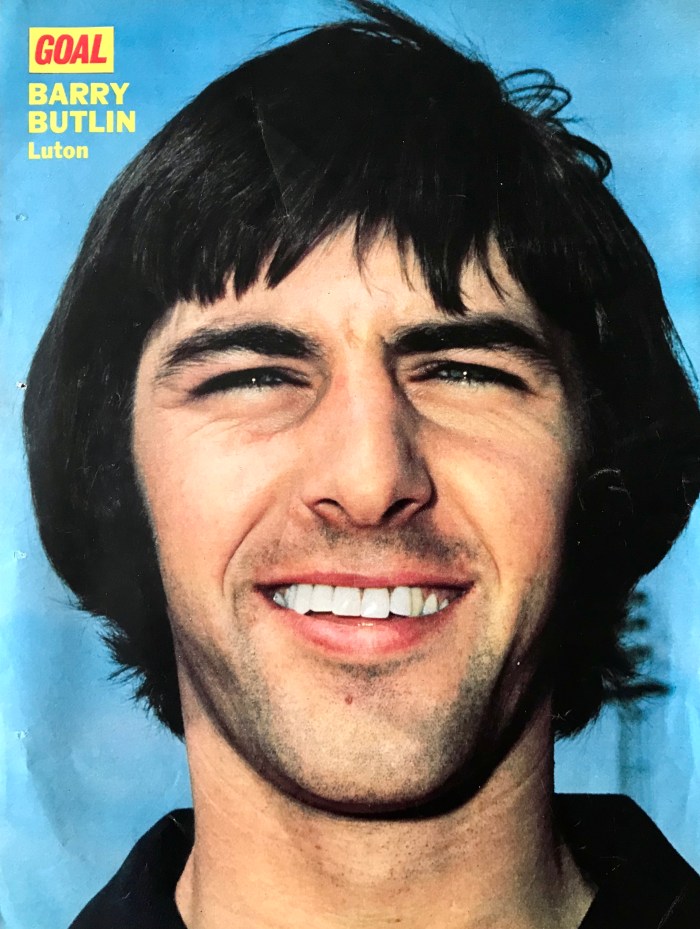
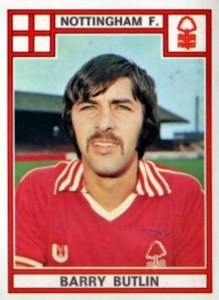
Barry Butlin’s belter at Selhurst helped revive Forest career

BARRY BUTLIN is one of that pantheon of players who’ve scored winning goals for the Albion against Crystal Palace.

He may sound like the alliterative title of a south Wales holiday camp, but this was a moustachioed striker who’d joined Third Division Brighton on loan from Second Division Nottingham Forest.

When former Albion boss Brian Clough couldn’t find a place for him in his Forest line-up in September 1975, previous managerial partner, Peter Taylor, going it alone at the Albion, was more than happy to add Butlin to his forward line options.

Butlin had started his career at Derby County on the periphery of Clough and Taylor’s squad at the Baseball Ground.

During his five years as a Rams player, he’d twice been out on loan to Notts County, scoring eight in 20 games in 1968-69 and another five in 10 appearances in the 1969-70 season.

While Derby won the First Division title in 1972, Butlin was sold for £50,000 to Luton Town, where he made his mark with an impressive 24 goals in 57 matches.

One of them came in a 1-1 draw at Elland Road during Clough’s ill-fated 44-day spell as Leeds manager, and, in a typically odd Clough way, in the post-match press conference he put his arm around Butlin and told the journalists: “This is who you want to write about after that wonderful goal. He deserves it.”

The following month, Butlin’s goalscoring exploits for the Hatters saw Forest boss Allan Brown take him to the City Ground for a fee of £120,000.

Imagine how he must have felt when his old Derby boss Clough arrived to take over at Forest in January 1975!

Nevertheless, the striker said all the right things publicly ahead of the manager’s first game, a third round FA Cup replay against Spurs, as recorded in Jonathan Wilson’s excellent book Brian Clough: Nobody Ever Says Thank You The Biography (Orion Books 2011).

“The lads all know that everybody is starting from scratch with everything to prove,” said Butlin. “Brian Clough has the ability to make an average player good and a good player great.”

Such a show of loyalty might have been understandable in the circumstances but Wilson also recalls Clough’s eccentric attitude towards players when they were injured. Butlin fractured his cheek in a training ground incident when at Derby.

“As he lay on the ground, Clough screamed at him to get up, insisting there was nothing wrong with him,” wrote Wilson. “Even after he’d been taken to hospital, Clough refused to believe anything was the matter.

“When Butlin’s wife turned up looking for her husband and mentioned an ‘accident’ to Clough, he snapped: ‘I’ll tell you when there’s been an accident’.”

Although Butlin feared the worst when Clough arrived at Forest, he wasn’t instantly discarded, finishing that season with seven goals in 33 games (plus one as a sub), while fellow forward Neil Martin netted 12 in 30 matches (plus two as a sub).

Butlin had a front row seat in this Forest line-up

But Clough clearly had other ideas about who he wanted in attack and brought in John O’Hare, who had done well for him at Derby, but less well during the ill-fated spell at Leeds, and introduced a young Tony Woodcock.

Intriguingly, that summer Martin was reunited with Taylor at Brighton and, within a matter of weeks, Butlin was also heading to the Albion, although his move was only temporary.

As it happened, Martin got off to a decent start alongside Fred Binney up front, scoring three times in the opening matches. But Taylor obviously considered Butlin offered a more potent threat; and it wasn’t long before fans saw why.

Butlin lets fly and scores the winner at Selhurst Park in 1975

In only his second game, in the third minute of Albion’s clash with Palace at Selhurst Park on 23 September 1975, Butlin got on the end of a Gerry Fell cross and hit an unstoppable shot that turned out to be the only goal of a pulsating game played in front of a crowd of 25,606 – a quite remarkable number for a third tier fixture.

“It still sticks with me, that one,” Butlin told Spencer Vignes, in his book Bloody Southerners (Biteback Publishing), which details the Clough-Taylor period at the Goldstone.

“It was the start of a cracking time down at Brighton,” said Butlin. “I only wish I could have gone on a little longer.”

Butlin soars to connect with this header

Butlin followed up that midweek winner at Palace with another goal on his home debut four days later when Chesterfield were beaten 3-0 (Peter O’Sullivan and Binney the other scorers).

Although not on the scoresheet, he also featured in two more wins (2-1 at Shrewsbury Town and 1-0 at home to Preston). However, in his absence Forest had gone through a mini slump, losing four out of five matches.

Butlin had taken his wife and children to Sussex with him, staying in the Courtlands Hotel in Hove. They all really liked the area, and the player had hopes of making the move a permanent one. Clough had other ideas.

“Brighton made me so welcome, but Forest weren’t doing very well at all,” Butlin told Vignes. “When I came to the end of my loan period, Brian got me straight back up to Forest and I had a real purple patch during which I played really well.”

In fact, he finished the season with eight goals from 38 games played as Forest finished eighth in the old Second Division.

Collector’s item

“We had this team meeting before one game and Brian said: ‘If sending you down to Brighton gives you that impetus, then I’d better start sending some more players down there!’

“I’d seen the seafront and the wonderful countryside and thought it was the prelude to us staying there as a family, but it wasn’t to be. I was disappointed to say the least.”

Born in the south Derbyshire village of Rosliston, on 9 November 1949, Butlin attended Granville County Secondary School in Woodville from 1961 to 1966, and proudly records on his LinkedIn profile that he obtained six GCEs. He was also the school football captain.

He signed on for Derby in July 1967 but the likes of Richie Barker and Frank Wignall initially, then O’Hare and Kevin Hector, were ahead of him as the Rams progressed from the old Second Division into the First, before winning the title in 1972.

Chances for Butlin were few and far between. He made just four first team appearances in five years but those loan spells at Notts County at least demonstrated there was a player in the making, able to find the back of the net.

A knee injury prevented him making an immediate impact at Luton, after Harry Haslam had signed him, but he was the top scorer as Town gained promotion to the elite in second place in 1973-74.

The Hatters assured promotion by securing a 1-1 draw at West Brom in the penultimate game of the season, and midfield player Alan West relived the moment in an interview with theleaguepaper.com.

“I remember Barry Butlin, who was magnificent in the old centre forward’s role that season, got the vital goal,” he said. “I played in midfield with Peter Anderson and Jimmy Ryan. Peter was a great player and finished that season as our second highest scorer behind Barry.”

Just before Christmas in 2014, Butlin and West were among several former players who got together for a 40th anniversary celebration dinner. Also there were John Faulkner, Gordon Hindson, Alan Garner, Jimmy Husband, John Ryan, Jimmy Ryan, Don Shanks and Ken Goodeve.

Luton history website hattersheritage.co.uk remembers Butlin as “brilliant in the air and no slouch on the ground” and mentions the shock fans felt when he was sold to Forest, particularly as Town were desperate for goals at the time.

In the 1976-77 season, Butlin once more went out on loan, this time to Reading, and the heave-ho from Forest he had long expected finally came when Peter Withe was brought in.

Butlin was sold to Peterborough United and in two seasons with the Posh he scored 14 goals in 77 matches. His teammates at London Road included former Forest colleagues Jim Barron and Peter Hindley as well as former Albion midfielder Billy McEwan.

United just missed out on promotion from the Third Division, finishing fourth in 1977-78. It was a disastrously different second season, by which time another former Albion player, Lammie Robertson had joined them – when Posh were relegated to Division Four.

Butlin’s final club was Sheffield United, as they faced their first season outside the top two divisions. Signed by his former Luton boss Harry Haslam, Butlin scored 12 times in 53 matches for the Blades, but by the end of 1980-81 season, after Martin Peters had taken over, United were relegated to the fourth tier for the first time in their history.

Butlin retired and spent three decades working as a financial adviser and mortgage manager in Sherwood, Nottingham.

He lived in Derby and between July 2000 and October 2010 was secretary and treasurer of the Derby County Former Players’ Association.

Things didn’t click for wanderer Stephen Dobbie

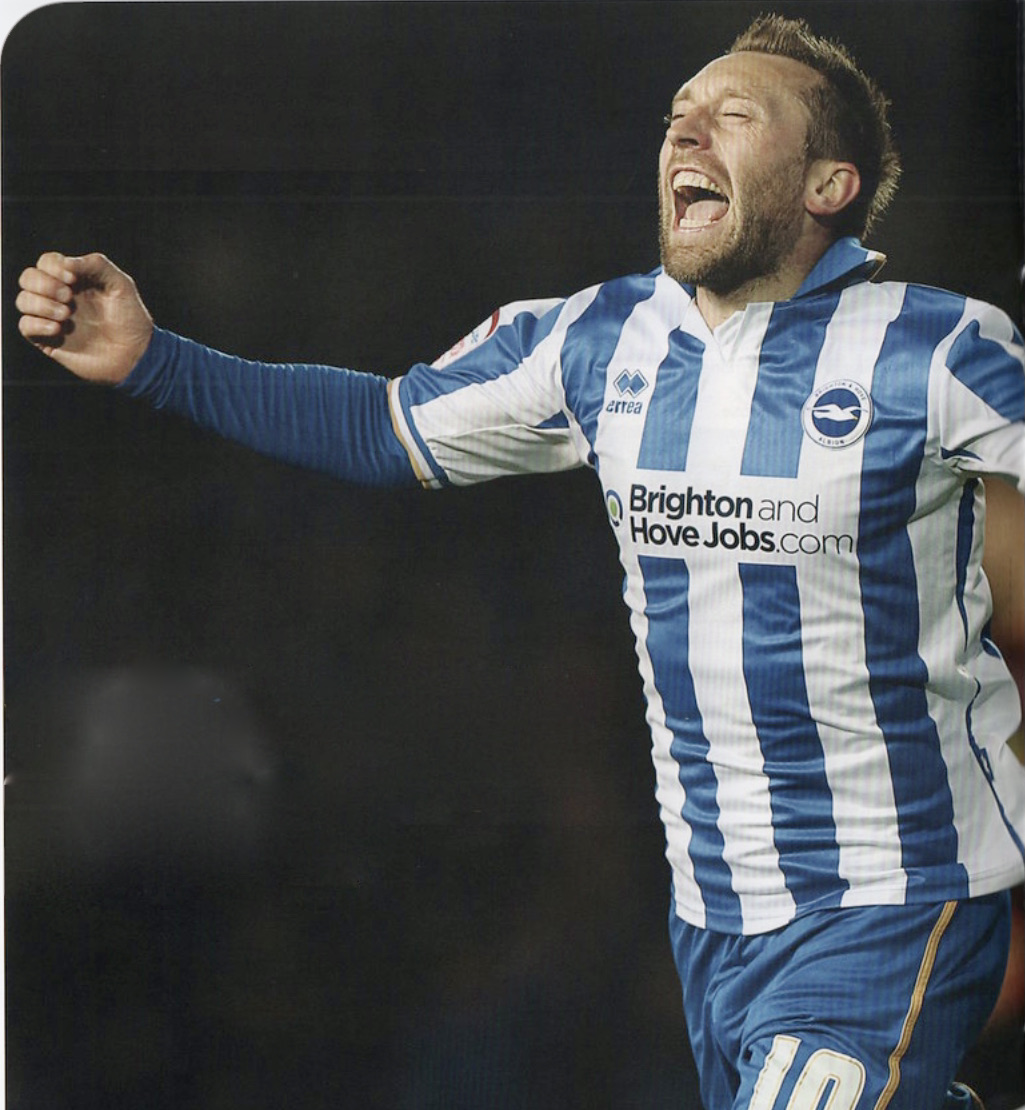
A 93RD-MINUTE winning goal in a Championship match against Peterborough United was as good as it got in Stephen Dobbie’s brief stay with Brighton.

Dobbie left the Albion for Crystal Palace just five months into a three-year contract after failing to live up to the hope that he would be the answer to Albion’s shortage of a genuine goalscorer.

“He has great quality which will unlock defences and I have no doubt he will also score plenty of goals,” Poyet said on capturing a player who had a goalscoring pedigree at Championship level with Swansea City and Blackpool, as well as in Scotland.

“He has played and proven himself at this level and in the Premier League. His goals helped Blackpool win promotion in 2010 and he returned on loan to help them reach the play-off final last season,” he said.

Dobbie was one of four players who joined Brighton on 31 August 2012; fellow Swansea player Andrea Orlandi also arrived, along with Dean Hammond, on loan from Southampton, and Athletic Bilbao’s David Lopez.

Seldom a starter, Dobbie’s first Albion goal came after he’d gone on as a 64th minute substitute for Andrew Crofts at home to Peterborough. Despite relentless Albion pressure, the game looked to be heading for a goalless draw when Dobbie produced a composed finish from an Ashley Barnes pass in the third minute of added on time.

A delighted Poyet said: “We needed quality and Dobbie showed us what he is capable of and that won us the game. It was real quality and that’s what we needed to score tonight.

“On another day, another player would have smashed that and it would not have gone in. The touch was magnificent and we are all delighted.”

Dobbie added: “Before I came on the gaffer told me to keep doing what I have been doing in training. I was confident that my time would come. Hopefully I can kick on and show the sort of form I have showed before in the Championship.”

As it happened, Dobbie did score in the next match too although an astonishing game at Molineux possibly summed up his time with the Albion. He had a great chance when through on goal that Carl Ikeme saved; he then put Albion 3-2 up with an 89th minute penalty – but 10-man Wolves hit back with a 90th-minute equaliser.

“We are all a bit gutted because the three points were there to be taken and on another day we probably would have scored four or five,” said Dobbie afterwards.

Dobbie didn’t score again and after just five starts plus 10 appearances off the bench Poyet decided to cut his losses and ship the player out on loan to Palace.

He couldn’t put his finger on exactly why it hadn’t worked out and was open in his assessment when talking to the Argus about it.

“I don’t think there is one reason, one person responsible,” said Poyet. “I think it didn’t click, that’s all. I am more than happy to take the blame but it’s a mix of things, the way we play, the player, the results, the team.

“The moment it was a possibility to get him I was convinced he was the perfect player for us, to play between the lines, arrive late, get goals, play in different positions in a front three or even behind the striker.”

Earlier in the season, Dobbie said matters off the pitch had made it difficult for him to settle. He had been living in a hotel with his wife and young son for a month during which time his wife gave birth to their second child.

“It was quite hard living in the hotel with my wife and little boy but thankfully we’re now settled in a house and another little boy has since come along, so I can concentrate fully on my football,” he told the matchday programme. “It’s not easy when you’ve got so much going on, it takes a period of adjustment, but now I’m able to just focus on what I’m doing on the training ground.”

At least the move to Palace reunited Dobbie with a familiar face: he had played under Palace boss Ian Holloway during two loan spells at Blackpool. Dobbie scored three times in 15 matches for Palace as they won promotion via the play-offs (thankfully he didn’t play in the semi-finals v Brighton).

Albion and Palace had to make the transfer a loan initially to comply with FIFA regulations regarding the number of clubs a player can play for on a permanent basis in one season, but the loan became permanent in the summer.

Although he signed a two-year deal at Selhurst Park, he only played in one Premier League game and one League Cup tie before returning to Bloomfield Road on loan to Blackpool for a third time.

It was perhaps inevitable that Dobbie should score an equaliser for relegation-threatened Blackpool when they salvaged a point in a disappointing 1-1 draw at the Amex on 21 April 2014.

Blackpool player-manager Barry Ferguson said: “It was a great strike. [Dobbie] has quality and it’s up to him to produce it more often.

“I let him play where he wants to. I’ve known him a long time and, apart from what he does on the ball, his work-rate off the ball is excellent.”

Although still under contract with Palace, Dobbie spent the 2014-15 season on loan at newly promoted League One side Fleetwood Town.

Released by Palace at the end of that season, he spent pre-season on a trial basis at Championship side Bolton Wanderers and when boss Neil Lennon liked what he saw he was given a one-year contract with the Trotters.

In 2016, Dobbie returned to the club where he’d previously been most prolific as a goalscorer:  Queen of the South. In his first spell (2006-09), he scored 55 goals in 105 games for the Scottish First Division outfit.

That level of goalscoring prowess returned second time around, as he netted 111 goals in 178 games over five seasons in the Scottish Championship. He topped the Championship scoring charts in 2017 and 2018 and his 43 goals in 2018-19 was the best ever total for a Queens player in a single season.

Born in Glasgow on 5 December 1982, Dobbie grew up in the tough Barlanark district of the city, and in an interview with the Daily Record he described his experience playing street football in the area.

He was a Rangers fan and, although it was Hearts who first showed interest in him, he spent two years as a youth player at Ibrox Park.

“I signed for the club when I was about 10 or 11,” he recalled. “I was quite lively as a kid but I was soon brought back down to earth whenever I got to meet my heroes. It was intimidating walking into a room and there’s Gazza, Brian Laudrup and Ally McCoist sitting there.”

He added: “They were world class and although I never got to follow them into the first team, it was a brilliant club and I loved my time there.”

While he scored goals for Rangers reserves, he didn’t break through to the first team with his boyhood heroes. The first of many loan moves in his career saw him go to Sydney in Australia and score three times in three games for Northern Spirit.

In the summer of 2003, he was transferred to Hibernian and made a total of 33 Scottish Premier League and cup games during his first season at Easter Road. But a regular starting berth eluded him and he went on loan to Scottish First Division St Johnstone.

That move was turned into a permanent switch but in 2006-07, when once again he couldn’t nail down a regular starting spot, he was loaned to Third Division Dumbarton, where he hit a purple patch, scoring 11 goals in 18 matches.

Such form attracted Queen of the South; he joined them on 5 January 2007 and enjoyed a successful two-and-a-half-year spell.

After he’d finished the 2008-09 season as the Scottish First Division’s top goalscorer with 24 goals, Swansea City, then in the Championship, made him an offer he couldn’t refuse.

“Dobbie has reinvented himself in the last two seasons and is at the best stage of his career,” said Swansea manager Roberto Martinez.

Aged 26 at the time, Dobbie was reunited with Swans top scorer Jason Scotland who he’d played with at St Johnstone in 2005-06.

“He has been through many different moments since his Rangers days, but I firmly believe he is now ready for a new challenge,” said Martinez. “He is a typical Swansea player – very gifted and strong technically.

“He’s also a natural goalscorer, has high standards and is hungry to show off his talent in the Championship.”

Dobbie’s first goals for Swansea somewhat ironically came against Brighton when the Welsh side dumped Russell Slade’s side out of the Carling Cup with a 3-0 victory at the Liberty Stadium.

He scored again in the next round but injury then kept him out of the side and by the following February he was on his way to Blackpool on loan for the first time.

Ironically, Dobbie went on to play for Blackpool in their 3-2 Championship play-off win over the Swans bitter rivals Cardiff City, which saw him branded “Secret Agent Dobbie” by a certain section of the Swansea faithful.

Back at Swansea, Dobbie finally got his place back after Brendan Rodgers had taken over from Paulo Sousa in the manager’s chair.

Dobbie score four times for the Swans but he eventually found himself back on the bench playing second fiddle to loan signing Marvin Emnes and Craig Beattie.

Nevertheless, he chipped in with some important goals from the bench and once again found himself playing in the Championship play-off final, this time getting on the scoresheet as Reading were beaten 4-2.

Remarkably, he featured in a third successive Championship play-off final, again with Blackpool, having failed to hold down a place in Swansea’s Premier League side. He made eight appearances at the elite level but didn’t get on the scoresheet.

Dobbie joined Holloway’s Blackpool in March 2012 but they missed out on another promotion when West Ham beat them 2-1 at Wembley.

In April 2021, Dobbie announced his departure from Queen of the South, with the Daily Record declaring: “The 36-year-old has scored 166 times in 282 games over two spells with the club and is regarded as one of their best players of all time.”

Having put down roots in the North West (even when he was playing for Queen of the South he would commute from his home on the Fylde coast), it was little surprise to see him start the 2021-22 season with AFC Fylde of the Vanarama National League North.

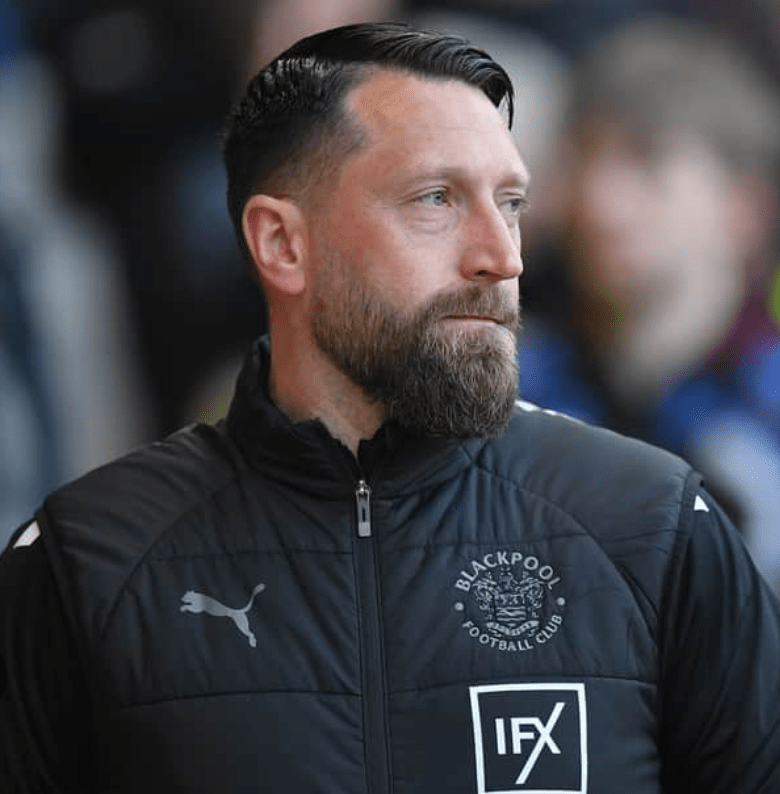
Dobbie became part of Steve Bruce’s coaching team at Blackpool

Admirable Crichton on standby for the Seagulls at 39

JOURNEYMAN goalkeeper Paul Crichton played 540 games in a 22-year career and, even at the age of 39, found himself on the Brighton subs bench ready to be called on in an emergency.

As things turned out, the former Burnley custodian’s time with the Seagulls remained in a coaching capacity, helping to develop youngster John Sullivan and improve no.1 Michel Kuipers.

However, he was registered as a player and when either Kuipers or Sullivan were unavailable, Crichton answered the call as stand-by ‘keeper, as well as making an appearance as a sub in a pre-season friendly.

Much of Crichton’s career was as a back-up no.1 but he stepped up as a coach, working with the likes of Rob Green and Fraser Forster, and obtained a UEFA A licence in outfield and goalkeeper coaching.

Crichton arrived at Withdean in July 2007 after previous goalkeeping coach John Keeley moved along the coast to take up a similar role with Portsmouth.

Manager Dean Wilkins told the club website: “Paul has impressive coaching qualifications and we have already seen him in action on the training ground.

“He also has a huge amount of experience from over 20 years playing professional football.”

No. 1 Kuipers certainly appreciated the influence the coach had on his game. He told an Albion matchday programme: “Paul approaches things from a different angle. He has given me extra information and a different opinion on how I can get the best out of myself.

“His input has improved me as a goalkeeper and my performances on the pitch have improved. We’ve worked on me playing more as a kind of sweeper, letting the defence sit a little higher up the pitch. It helps the defenders out as they don’t have to worry as much about the space behind them and allows them to go tighter on the strikers and gives them a better opportunity to win the ball or defend against strikers.”

Kuipers said he also felt more confident leaving his goal to claim crosses, and with his kicking. “It’s an aspect I feel has improved,” he said. “Paul and I have practised it on an almost daily basis in training, and the more I am doing it, the better I am getting at it.”

Sullivan was also grateful for Crichton’s input, telling the matchday programme: “Paul’s brought some great new ideas into the club – he’sa very, very good coach. Paul is not long retired so he’s well aware of how the modern game has changed so much for ‘keepers.”

Crichton remained in post until February 2009 when the lure of returning to Norwich City, one of his former clubs, four and a half years after leaving the club as a player, was too great and he went back to East Anglia, even though he had started to put down roots in Sussex.

“We’d just started to get settled in Eastbourne,” he told pinkun.com. “The manager, Micky Adams, and the backroom staff have been fantastic and I’m sad to leave. But I had three great years here, ending in the Championship winning season.

“I didn’t play many games, but I just wanted to return – it’s a great place.”

Adams told the Argus: “I am very disappointed to lose Paul. He was a hard-working and highly-valued member of the backroom staff and he has done a fantastic job with all the goalkeepers at the club.

“I have no doubt he is going to be one of the top goalkeeping coaches in years to come but, after he expressed a desire to go back to Norwich for both footballing and family reasons, it was not right for us to stand in his way.”

Crichton had been understudy to the aforementioned Green during his time as a player at Carrow Road, and boss Bryan Gunn (a former City goalkeeper himself) told the pinkun.com: “We want someone to continue to develop not only the first team goalkeepers but those in the academy and I know he’s looking forward to putting a development programme in place, which is important as we’ve had a good record in this position in recent years.”

Crichton had first moved to City on a two-year contract in June 2001, signed for £150,000 by former Burnley coach Nigel Worthington, who’d taken charge of the Canaries.

At Turf Moor, Crichton had been one of Stan Ternent’s first signings after he took over as manager from Chris Waddle in 1998. He made his debut on 8 August 1998 in a 2-1 win at home to Bristol Rovers and was a regular in their third-tier side, helping them to promotion in 2000.

Clarets fans have mixed opinions of his attributes, if a 2019 discussion on uptheclarets.com is anything to go by. For example, ‘jdrobbo’ said: “Used to be a big fan of his. Thought his kicking was excellent for a keeper at that level. Occasionally left stranded off his line. A key player in our 2000 promotion side, but not good enough for the next level up.”

‘ClaretTony’ reckoned: “A master of a goalkeeper at not being where he should be. Never known a goalkeeper out of position so much.”

Although ‘Lord Beamish’ said: “A key part of the last Burnley team to play in the third tier. He’ll always be fondly remembered by this Claret fan.”

Born in Pontefract, Yorkshire, on 3 October 1968, Crichton began his career with Nottingham Forest, turning professional in 1986. But with Hans Segers and Steve Sutton ahead of him, he didn’t break into the first team at the City Ground and went out on loan to six different league clubs to get games, making his debut across the Trent at Notts County.

Eventually he moved on permanently, in 1988, initially spending two years with Peterborough United, then three years with Doncaster Rovers.

Alan Buckley signed him on a free transfer for Grimsby Town, where he played the most games (133) for any of the clubs he represented. Mariners Memories on Facebook, noted: “Crichton was a good shot stopper…..he was made the Supporters Player of the Season in 1994”.

In September 1996, he followed Buckley to West Bromwich Albion for £250,000.

It was during his time at West Brom that he had two loan spells with Burnley in 1998 before joining them permanently for £100,000 in November that year.

His playing career following his departure from Carrow Road took him to eight different clubs, Gillingham and Cambridge United among them, together with some non-league outfits. During a brief and controversial spell at York City, when he was alleged to have clashed with supporters, he coached a young David Stockdale. He moved to the Albion from King’s Lynn.

His subsequent return to Carrow Road was briefer than expected when Paul Lambert took over from Gunn and brought in his own goalkeeping coach.

In March 2010, Crichton became goalkeeping coach at Northampton Town but, in the summer of 2010, he linked up with Danny Wilson at Sheffield United, where he was also registered as a player to provide emergency cover. He spent two seasons at Bramall Lane before becoming part of Simon Grayson’s management team at Huddersfield Town.

After two years with the Terriers, he switched to Blackpool and spent just over a year working as goalkeeper coach and interim assistant manager alongside Jose Riga.

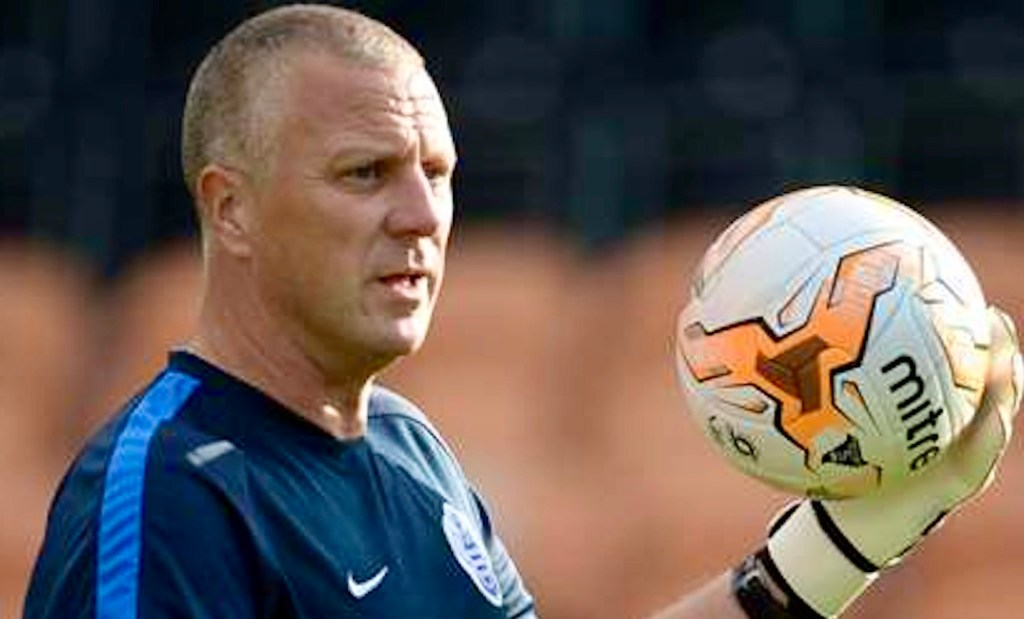
Next up was a brief spell in London, at QPR, where he was appointed by former Albion full-back Chris Ramsey to succeed Kevin Hitchcock.

After leaving the Hoops in early 2016, his next port of call was Swindon Town, to work under Luke Williams, Brighton’s former under-21s manager, but he left after only a couple of months to move to America.

He had several short spells coaching with different clubs in Florida before becoming assistant head coach at The Miami FC in January 2020, when head coach was Kenny Dalglish’s son, Paul.

He became goalkeeper and interim assistant coach for North American professional women’s team the Washington Spirit during the 2021 and 2022 seasons, helping lead goalkeeper Aubrey Kingsbury to the 2021 NWSL Goalkeeper of the Year award and guiding the club to the 2021 NWSL Championship.

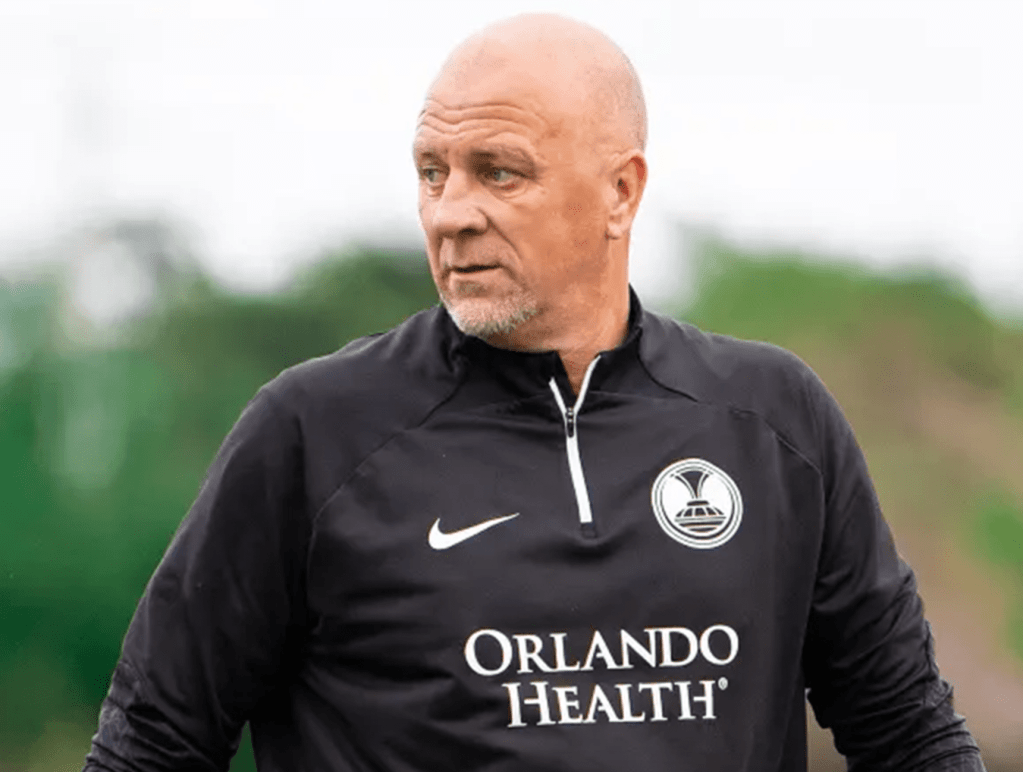
Then in April 2023 he switched in a similar role to Florida based women’s team Orlando Pride.

Andrew Crofts just couldn’t stay away from the Seagulls

ANDREW Crofts is one of that rare breed of player who had three separate spells at Brighton, although the latter time was only as player-coach with the under-23s.

The Welsh international midfielder returned to the Seagulls after only a month as player-coach at Yeovil Town when Liam Rosenior left the Albion to move to Derby County.

His signing as an over-age player as well as a coach was explained by technical director Dan Ashworth, who hailed the “innovative step” and told the club website: “The thinking behind the playing role is to have someone of his experience out there on the pitch alongside our younger players, and to impart that crucial knowledge he has gained from his time in the game.

“To have that experience out on the field, in the pressure situation of a game, will be of enormous benefit to our young players and have a positive impact on their collective and individual development.”

Crofts first joined the club in the summer of 2009 during Russell Slade’s managerial reign and, when Gus Poyet took over the managerial chair, he appointed Crofts as captain for his first game in charge.

The midfielder repaid the faith in that televised away game at St Mary’s on 15 November by scoring in Albion’s memorable 3-1 win. Crofts retained the armband through to the end of the season and his form had caught the attention of Championship side Norwich City.

Crofts made the switch to Carrow Road and played 44 games as Paul Lambert’s outfit won promotion to the Premier League in runners up spot.

In the top-flight, though, Crofts was no longer a mainstay of the midfield, starting just 15 matches in 2011-12, and coming off the bench on 10 occasions.

“Towards the end of the season I was in and out,” he told the Albion matchday programme in 2019. “Paul then went to Aston Villa and when the chance came up to return to the Albion I jumped at it.”

“It felt like coming home and I wanted to replicate what we had done with Norwich. It was a completely different club compared to the one I’d left, with the Amex Stadium and plans for the new training ground.”

Poyet wasted no time in seizing the chance to re-sign him, telling the club website: “When we knew about the possibility to bring him back we worked very hard to do that.

“I am delighted to have him back. He is going to be a very important player.

“He is coming back to a club that he knows and he was happy to come back – that shows his commitment,” said Poyet. “He leads by example and we want players like that on the pitch.”

Unfortunately, that season his playing time was limited by two long-term spells out injured, and the following season it got worse. After sustaining a serious cruciate knee ligament injury in January 2014, he was sidelined by an almost identical injury again in October 2014.

When the player suffered the first injury in an away game at Birmingham, Poyet’s successor, Oscar Garcia, said: “He will be a big loss and I feel sorry for Crofty. He has been excellent and has been a key player.”

Crofts battled over many months to regain fitness only to suffer a partial tear of his anterior cruciate ligament and a tear to the meniscus in a match against Watford in October 2014, putting paid to any involvement in the rest of the 2014-15 season.

Head coach Sami Hyypia told the club website: “We are all devastated for Crofty. He is an important member of our squad and worked incredibly hard to get back to full fitness after last season’s knee injury.

“Crofty is a very strong character and he will continue to receive the best possible care and treatment from our medical staff throughout his rehabilitation.”

Unfortunately for him, by the time he was fit again, another new manager was in place and Dale Stephens and Beram Kayal were firmly established as Chris Hughton’s preferred midfield pairing. So, in March 2016, Albion loaned him back to his first club, Gillingham, until the end of the season.

On leaving the Seagulls that summer, he moved to Charlton Athletic under his former Albion boss Slade, on a one-year contract, and made a total of 54 appearances for the Addicks.

Although born in Chatham, Kent, Crofts qualified to play for Wales because his grandfather hailed from the principality. He earned a total of 29 caps, spread over 13 seasons, initially under John Toshack, most coming under Gary Speed, before making his final appearance against Panama in November 2017, in Chris Coleman’s last game as Wales manager.

Crofts v Rooney in a Wales v England match
Welsh international

Crofts was on Chelsea’s books from the age of 10 to 15, going through the ranks with John Terry, with whom he shared digs. One of his coaches was ex-Albion and Chelsea defender Gary Chivers. After being released by Chelsea, he linked up with Gillingham as a trainee and worked his way through the youth and reserve sides, making a surprise first team debut against Watford in May 2001 when only 16.

It wasn’t until 2004 and 2005 that he became a first team regular. His first Gills goal was scored in the Championship clash at the Withdean Stadium on Boxing Day 2004 when the Seagulls won 2-1.

Crofts eventually took over the captaincy at Gillingham but, after the side were relegated to League One, manager Mark Stimson believed the role was too much of a burden on the player. After more than 200 appearances for the Gills, he was made available for transfer and, in 2008-09, went out on loan to Peterborough United and then Conference side Wrexham under former Albion striker Dean Saunders.

When he joined Albion on a free transfer in June 2009, boss Slade said: “He’s an international player so that’s not bad for a start. He’s got good pedigree and was an important player for a good Gillingham team at the time.

“He can sit in for you defensively or he can get forward. He has got a good work ethic and I’m pleased to get him.”

Towards the end of his league playing days, Crofts had spells at Scunthorpe United in 2017-18 then Newport County for the 2018-19 season, playing under his former Gillingham teammate Michael Flynn, who he played alongside at Priestfield between 2005 and 2007,

Flynn made his old pal captain and said: “He’s a gentleman and he’s somebody I trust a lot. So signing him was really a no-brainer.

“Andrew coming in is a massive signing for the club. He’s the ultimate professional and he’s in fantastic condition.”

Crofts himself said: “I played with Michael Flynn at Gillingham and he was a winner. I loved playing with him and I can’t wait to play for him now with him being my gaffer.”

Unfortunately, injury issues restricted Crofts to just 12 appearances for Newport and he was released at the end of the season.

On leaving County, Crofts moved to Yeovil Town as player-coach with manager Darren Sarll saying: “To bring a player of Andrew’s experience into the club at this time is a great coup.

“He still has a thirst and hunger for playing and winning promotions and it’s refreshing to be part of the very early stages of his coaching career.

“He’ll be a valuable asset to the squad both as a player and in terms of passing on his experience and knowledge to the younger members of the squad.”

But then the opening arose with the Albion and he didn’t hesitate to return. When Graham Potter left the Albion, Crofts temporarily took on the head coach position and was retained as a first team coach under Roberto De Zerbi and his successor, Fabian Hurzeler.

• In an interview with Andy Naylor of The Athletic in December 2020, Crofts talked at length about his career, his coaching ambitions and some of the big names he played alongside.

Pass ‘master’ Steven Thomson’s unhappy year with Brighton

STEVEN THOMSON didn’t enjoy his year playing for Brighton in League One and the former Crystal Palace midfielder seized an escape route to return to Scotland to see out the remainder of his long professional career.

It had been considered quite a coup when Dean Wilkins secured the signing of the Falkirk captain in January 2008. In effect a replacement for the departing Dean Hammond, Thomson was soon a victim of Wilkins’ tinkering with the formation, and over his 41 matches for the Seagulls had a conveyor belt of midfield partners, not to mention a change in manager, as Wilkins’ replacement, Micky Adams, introduced a different style – in vain – to try to galvanise the side during his second spell as boss.

Although Thomson had signed a two-and-a-half-year contract with the Seagulls, in January 2009 the disillusioned Scot headed back north of the border.

“I didn’t enjoy it there at all and was keen to try and get myself back up the road,” he admitted in an interview with the Daily Record in 2018.

Having wound down his full-time career at St Mirren, after 18 seasons as a professional, and having moved to London to begin a business career, Thomson linked up with his former Albion teammate Nicky Forster to spend a season as a part-time player with Dover Athletic, where the former Seagulls striker was manager at the time.

In an in-depth interview for the Dover Athletic website, Thomson gave a great insight into his career, revealing the lengths he went to to get a break into the professional game.

Born in Glasgow on 23 January 1978, he explained: “After playing for a local boys club I was invited to go and train with a few clubs, so, at the age of 10, I found myself training with Rangers on a Monday, Celtic on a Tuesday, Hearts on a Wednesday and Hibs on a Thursday.”

When he reached 14, he was advised to choose one club over the others and opted for Rangers. Daunted by the high numbers of youngsters all trying for the same opportunity, aged just 16 he took the bold move to head to Croydon and signed on as an apprentice with Palace.

He progressed from the youth team to be offered a pro contract at 17, worked his way through the reserves and then got some calls up to the first team subs bench when they were still in the Premier League. He also played for Scotland’s under-18 side between 1995 and 1997.

During his brief return as manager, Terry Venables gave Thomson his debut aged 19 in the 1998-99 season. Thomson wasn’t renowned for goalscoring, but Palace fans do remember a particularly sweet strike he succeeded with in a 3-0 Worthington Cup win at Leicester City in November 2000.

Leicester’s back-up goalkeeper Simon Royce, who would later join Albion on loan, was beaten from 35 yards by Thomson’s spectacular shot.

The midfielder’s 121 games spanned the spells of five managers – Venables, Steve Bruce, Trevor Francis, Steve Coppell and Dave Bassett – before he left the club at the end of the 2002-03 season. It would be fair to say he divided opinion among Eagles supporters.

On fans forum cpfc.org, ‘Hairybear’ said: “Thomson was a warrior. Very little ability but did a good job when called upon under Bruce and co. He would never let you down.”

But ‘Baron Greenback’ said: “As well as THAT goal against Leicester, he also scored great goals at home to Sunderland in the FA Cup and Wolves.”

It was the ebullient Barry Fry who took Thomson to Peterborough United, (above) where he played 75 games in two seasons before moving back to Scotland to play for Falkirk in the Scottish Premier League.

When Brighton signed him, his former Falkirk teammate and one-time Albion loanee, Graham Barrett, told the Argus what Seagulls supporters could expect.

“They are getting a fantastic professional and a really good player,” said Barrett. “We have been going really well and he has been a massive part of that.

“He is a box-to-box player, he is comfortable on the ball and he has got a bit of everything.

“He is not particularly big (5ft 8in) but he is also very good in the air for his height.”

Barrett reckoned he would be “a massive influence” if he could continue the form he’d shown in Scotland. “He is great in the dressing room as well, a real leader,” said Barrett.

Thomson made his Albion debut in a 1-1 draw at home to Huddersfield on 19 January, starting at the base of a midfield diamond with Paul Reid and David Martot out wide and Dean Cox at the top of it.

Brian Owen, of the Argus, described him as “a neat and tidy passer who only gave the ball away when trying something ambitious”.

Within a couple of months, the Argus was reporting: “It has not been easy for Thomson since his January move back to England from Falkirk.

“He has had to adjust to playing with a number of different partners and now Adam El-Abd is a long-term casualty with the medial knee ligament injury he suffered at Huddersfield.”

Although mostly recognised as a centre back, El-Abd had been one of the options tried in midfield. Thomson admitted to the newspaper: “I know I can perform better. There is more to come. I am adjusting to playing so many games. In Scotland you just play Saturday to Saturday.

“It has been a big move for my family as well. My wife (originally from London) is a lot closer to her parents now and she has got a lot of family around, which helps with our young son.”

In rather a similar vein to the Palace faithful, Brighton fans were also divided as to Thomson’s merits. ‘The Complete Badger’ declared on North Stand Chat: “The only midfielder of any class we’ve got. A real touch of quality about everything he does in my opinion. Much better than Hammond, and much better than anyone else we’ve got.”

But ‘Napper’ reckoned: “Thomson just seems to have nothing about him, not quick, no killer passes. Just seems to either waste possession or go backwards. I’ve really given him more than enough time, but facts are he just isn’t very good. I’ve been watching him closely for many games now.”

In his end-of-season summary, Andy Naylor, Albion reporter for the Argus in 2008, reckoned Hammond had been a hard act to follow, and commented: “Thomson looks a tidy player who will benefit from playing as a central midfielder in a 4-4-2, not the dreaded diamond.”

After Wilkins was shown the door, new boss Adams recognised Thomson’s leadership qualities, making him vice-captain to skipper Nicky Forster, as well as saying he was going to play him in a role further forward than he had been previously.

“I enjoyed the responsibility at Falkirk and I will be willing to help Nicky as much as I can,” Thomson told the Argus. “The manager has stressed that he wants me to try and push forward a lot more, rather than just sitting in front of the back four, and I am quite happy with that.

“I look after myself off the park, so I’m quite fit. Maybe he thinks I have got the engine to get up and down!”

However, problems mounted for Adams when Forster was ruled out by injury and, as in the previous season, Thomson found himself alongside different midfield partners, including, at one time, the flamboyant Robbie Savage, trying to recover some fitness on loan from Derby.

As the year drew to a close, it became public knowledge that Thomson was unsettled and itching to go back to Scotland, so a deal was lined up for him to join St Mirren as soon as the January transfer window opened.

He joined them on the day they played their final game at Love Street ahead of their move to Greenhill Road, and he went on to make more than 100 appearances for the Buddies.

Their fans’ abiding memory of his time there centre on a surprise 4-0 win over Celtic on 24 March 2010, when Thomson scored twice. The result so shocked the Parkhead bosses that they sacked Hoops boss Tony Mowbray.

On joining Dover in May 2012, Thomson told the club’s website: “I made the decision last year that this would be my final season as a full-time player. I have been studying for four or five years and I’m now fully qualified and have secured a job in London.

“My wife Bryony is from London anyway and she wanted to move closer to her family. I’ve been a footballer for 18 years and now it’s time to enter the real world.”

Thomson now works as a financial advisor, with a stylish looking profile on LinkedIn.

Great strike rate at Brighton but journeyman Benjamin had 29 clubs!

T Benj BTNSELDOM in his remarkable 29-club career did Trevor Benjamin enjoy such a successful spell as the 10 games he spent on loan at Brighton.

The bustling striker who had thrived under Micky Adams at Leicester City the season before scored five times for Mark McGhee’s promotion-chasing side in 2004.

McGhee was keen to keep him through to the end of the season but because of the timing of the three-month deal he wouldn’t have been eligible to play in the play-offs.

As a result, he went back to Leicester and McGhee brought in Chris Iwelumo instead, and, with a goalscoring debut in an away win at Chesterfield, there was no looking back.

Born on 8 February 1979 in Kettering, Benjamin was brought up in Wellingborough, Northants, and, having done well for Wellingborough Colts, was picked up by Kettering Town, playing for their youth team and reserves.

Cambridge United took him on as a trainee and he made his first team debut aged only 16 against Gillingham and went on to score 46 goals in 146 appearances.

Such a scoring record caught the eye of Leicester boss Peter Taylor and, on 12 July 2000, Benjamin joined the Foxes for a fee of £1.3 million.

However, he managed only a single goal in the 2000-01 season and the following season was sent out on loan to Crystal Palace, Norwich City and West Bromwich Albion.

He returned to Leicester for the whole of the 2002-03 season, including playing against the Albion at Withdean.

He said in a matchday programme article for that season’s return match against Brighton on 19 April 2003: “Brighton are a very similar team to ourselves. They have got a good work ethic and never give up.

“I came on as a substitute for the last 10 minutes when we played against them at the Withdean Stadium just before Christmas and that was a tough night.

TBenj Lei action“The conditions were terrible and both sides had to work hard to beat the elements. But I think our quality shone through on the night.” (Leicester won 1-0).

The following season, Benjamin was back on his travels, initially to Gillingham, then Rushden & Diamonds and, in January 2004, to Brighton.

Benjamin’s first Brighton goal came after just 12 minutes of Albion’s home game against Plymouth Argyle, who were then top of the league table. Leon Knight added a second goal before a jubilant celebration in front of the Sky cameras and Albion prevailed 2-1.

He followed that up by netting Albion’s goal in a 1-1 draw away to Wycombe Wanderers, and was again on the scoresheet in the 2-1 away defeat to Grimsby Town.

A 3-0 home win over AFC Bournemouth saw Benjamin score the second of Albion’s three goals at Withdean. When Tranmere Rovers were dispatched by the same score, he once again scored the second goal.

Back at Leicester, when Craig Levein was installed as boss, he cancelled Benjamin’s contract in January 2005. Benjamin initially dropped down a couple of divisions to play for Northampton but, three months later, his old Leicester boss, Adams, took him to Championship side Coventry City. He helped to set up both goals on his debut for the Sky Blues as they beat Reading 2-1.

In Coventry’s matchday programme for their home game against Brighton on 2 April 2005, he talked about how he had been settling in and the efforts he’d been making to try to improve his game.

“I’ve been training quite hard with Alan Cork on my finishing since I got here and he’s great to work with. He’s trying to get me to focus on what I am best at and hopefully when the games start again the practice will pay off.”

Benjamin’s arrival at Coventry may have seen him make a leap of two divisions but he was by no means unfamiliar with football at that level having played with Leicester for five years in both the Premiership and the Championship.

David Antill wrote: ‘During his time with the Foxes he was loaned out to no fewer than seven clubs before eventually signing permanently with Northampton Town but he is delighted to be back in a league he enjoys playing, for a manager he believes can get the best out of him.

“I’ve always believed in my own ability and thought I could play at this level and it was great to be given the chance to return to this league with Coventry,” said Benjamin. “My confidence never really slipped – I never had a doubt about coming here and being able to deliver the goods.

“I know what Micky Adams is all about and he knows what I’m all about so I enjoy working with him. What he’s brought here is exactly what he brought to Leicester and that’s what brought him success there. He’s a hard-working manager and he wants exactly the same thing from all of his players and I think he’s getting that.”

After scoring only once for the Sky Blues, in the summer of 2005 the burly forward linked up with Peterborough United, where he signed a three-year deal. However, he was loaned out several times, appearing for Watford, Swindon Town, Boston United and Walsall.

There was some stability and a return to goalscoring when he moved to Hereford United. He scored 10 in 34 games for the Bulls but was released in May 2008 and ended up drifting across the non-league scene for the next four years, popping up at no fewer than 13 different clubs.

It was all a far cry from the heady days of 2001 and 2002 when he briefly reached the international arena.

He went on as a substitute for Howard Wilkinson’s England under 21s as they beat Mexico 3-0 in a friendly at Filbert Street on 24 May 2001. Because he hadn’t played in a competitive fixture, he was then able to swap allegiances and played two matches for the full Jamaica international side in 2002.

One-goal striker Craig Davies a Seagulls flop

THE PHRASE ‘journeyman striker’ sits perfectly with Welsh international Craig Davies who, despite success later in his career, fired blanks for Wolverhampton Wanderers and Brighton.

To use that rather amusing, though well-worn phrase, he couldn’t hit a cow’s arse with a banjo during his time with the Seagulls.

He arrived on the south coast in January 2009 during Micky Adams’ second, unsuccessful, spell in Albion’s managerial chair.

Oldham Athletic received a reported £150,000 for his signature and, in 23 games for Brighton, he managed just the one goal – on his debut!

That strike came at Withdean – the opening goal in what ended up a 4-2 defeat to Peterborough United (for whom a certain Craig Mackail-Smith equalised).

When a 4-0 home thrashing by Crewe Alexandra meant it had been six games on the trot without a win, Adams was fired by Dick Knight at a Little Chef on the A23. He’d managed just seven wins in 34 matches, and ‘fireman’ Russell Slade arrived just in time to rescue the Seagulls from the League One relegation trapdoor.

Many different striker permutations were tried that season, with main men Nicky Forster and Glenn Murray sidelined by injury, and Albion’s survival was largely due to the goals of loan arrival Lloyd Owusu. Davies huffed and puffed but simply couldn’t make a meaningful connection when the goal beckoned.

Typical of the fans’ eye view was this observation by wearebrighton.com: “That Adams actually paid money for Craig Davies remains one of the more startling moments of his reign of terror.

“Rarely has a Brighton player enraged the Seagulls support like Davies, a man who mixed incompetence – such as the ability to put the ball over the bar when faced with an open goal three yards away – with a complete lack of effort.”

There had been such promise on his arrival, with chairman Dick Knight telling the matchday programme: “Craig is an exciting player with loads of potential, he is lightning-quick and his direct approach can be a nightmare for defenders. This is a major career move for him and he has every chance to be a crucial part of our future.”

Davies himself clearly thought he’d finally found a place to further his career, saying: “I’ve had a few ups and downs through my career but hopefully now I can get settled at Brighton and start knocking in the goals here.

“The gaffer seems to have a bit of faith in me so hopefully I can repay that by putting in some performances and getting a few goals.”

Albion cut their losses on Davies and loaned him to Yeovil Town (he didn’t score in four games for them, either) and then Adams re-signed him, this time for League Two Port Vale, where he finally managed to find the back of the net again.

In the summer of 2010, Davies came to a mutual agreement to end his Brighton nightmare and he joined League Two Chesterfield, from where his career began an amazing upward trajectory.

Born in Burton-upon-Trent on 9 January 1986, Davies began his career as a schoolboy at Shrewsbury Town, but did his apprenticeship at Manchester City. In August 2004, he moved on to League Two Oxford United, where he made his league debut the same month in a 1-0 win at Notts County.

In two seasons with Oxford, managed by former Ipswich and Arsenal midfielder Brian Talbot, he scored eight times in 55 appearances. In the summer of 2005, he made his debut for Wales (qualifying because he had a Welsh grandfather) as a substitute in a 0-0 draw v Slovenia. Reports linked him with a move to Premier League Charlton Athletic, but nothing came of it and instead, in January 2006, he moved to Italy to join Hellas Verona for a £85,000 fee.

It proved to be too big a step for someone who was then only 20, and he referred to feelings of homesickness in an interview with the BBC.

Remarkably, Davies hit the headlines in May 2006, when in the sixth of seven games he played for the Wales under-21 side (which featured Gareth Bale, Andrew Crofts and Arron Davies) he scored a hat-trick in a 5-1 win over Estonia, and it earned him a recall to the full international side.

Wales under-21 manager Brian Flynn told the BBC: “Craig has sometimes been frustrating to watch, but he has skill and we will help him, and them all, to flourish.”

Davies hoped the international goals would attract a club to rescue him from Italy. “I have found it very hard to settle in Italy,” he told the BBC. “Verona want me to come back and have a year on loan somewhere and then they will look at the situation again when I have a bit more experience.”

It was Wolves, then in the Championship, who offered him a lifeline back in the UK and he moved to Molineux on loan, playing 23 games, mainly in the first half of the 2006-07 season.

The only goals he scored for Wolves both came in a FA Cup tie against Oldham Athletic who, ironically, turned out to be his next club. He joined them for an undisclosed fee from Hellas in June 2007.

Davies netted 13 times for a League One Latics side in 2007-08 but, after a 10-game barren spell the following season, he was sent on loan to Stockport County where he scored six times in 13 games, including bagging a hat-trick against Bristol Rovers, and scoring a penalty against Albion as County won 2-0.

When Adams rescued Davies from his Seagulls horror spell, he was rewarded with seven goals in 24 matches for League Two Port Vale between January 2010 and the end of the season.

Chesterfield stepped in to sign him on a one-year deal for the 2010-11 season – and he was promptly sent off in his first competitive game for the Spireites!

Things did get much better, though, and he ended the season with 25 goals to his name, Chesterfield were promoted, and Davies was chosen in the divisional PFA select team for the season.

Such success drew attention from other clubs and he opted to join Championship side Barnsley under Keith Hill. He struggled to find the net in the opening nine matches but eventually finished the season with 11 goals in 42 appearances.

In September 2012, Davies scored FOUR goals in the space of 19 minutes in a 5-0 demolition of Birmingham City at St Andrews and, with nine goals in 22 appearances to his name in the first half of the 2012-13 season, Bolton Wanderers came forward with a £300,000 bid to take him to the Reebok Stadium.

He scored four goals in 18 Championship games for Wanderers but another of his barren spells struck in the opening half of the following season. Wanderers loaned him to League One Preston and he got a goal on his debut as well as a hat-trick in a 6-1 thrashing of Carlisle United. North End reached the play-offs, and Davies made his way back to Bolton having scored five in 15 games.

Hamstring injury issues plagued him in 2014-15 and manager Neil Lennon released him at the end of the season.

He didn’t have far to travel for his next port of call when newly-relegated Wigan Athletic offered him a two-year contract. He only scored twice in 30 appearances, but Wigan won promotion as League One champions.

With just one goal in 14 Championship games in the first part of the 2016-17 season, Davies was on the move again, this time linking up with League One Scunthorpe United until the end of the season. Cue another barren spell: no goals in 21 games.

The 2017-18 season saw Davies return to his old club, Oldham Athletic, and despite scoring 14 goals in 44 appearances, could not prevent the club being relegated to League Two. Davies had strong views about the ownership of the club as he departed for Mansfield Town.

He signed a two-year deal with the Stags, but injury curtailed his involvement in 2018-19.

C Davies Wales