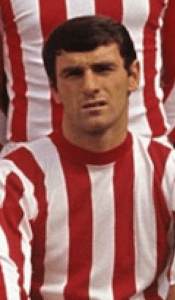
Lift engineer Hughton took Seagulls to a different level!

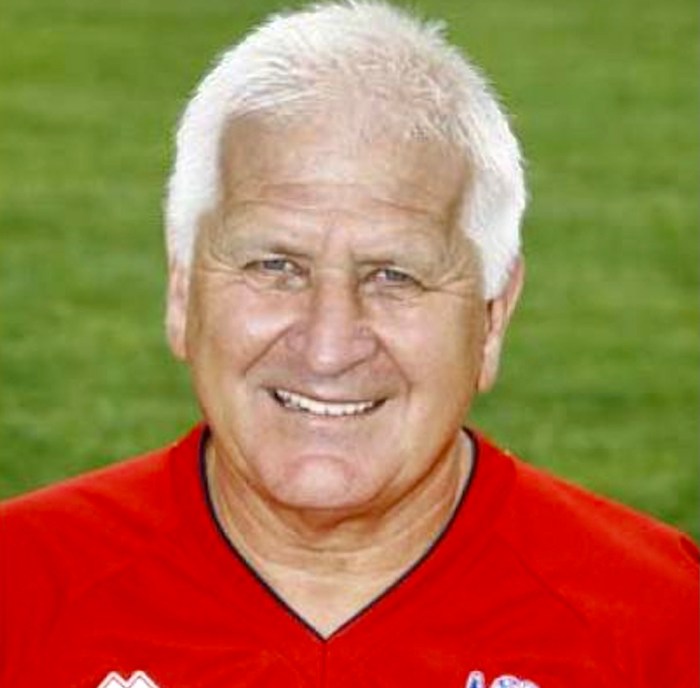
TOTTENHAM HOTSPUR was a key part of Chris Hughton’s life for more years than any of the other clubs he went on to serve.

While Brighton fans will always appreciate his four-year tenure taking the Seagulls from the Championship into the Premier League, he spent the first 19 years of his playing career at Spurs as well as 14 and a half years as a coach (and occasional caretaker manager) at White Hart Lane.

Hughton joined Tottenham’s youth set-up at the tender age of 13 in 1971, as he recounted in an In The Spotlight feature in the Spurs matchday programme for their September 2024 game v Brentford. It was the year the club won the League Cup captained by Alan Mullery with a side that included Phil Beal, Joe Kinnear and Martin Chivers, who scored both goals in the 2-0 victory over Aston Villa.

Hughton attended inner city school St Bonaventure’s in Newham, many years later attended by loanee striker Chuba Akpom who told Andy Naylor in an exclusive for the Argus: “When I was in school there used to be pictures of the gaffer there. The kids used him like an inspiration and motivation. I did as well: seeing someone come from the same area and the same school as me to become such a big and successful person.”

Other footballing St Bon’s alumni included Hughton’s brother Henry, John Chiedozie, Jermaine Defoe and Martin Ling (briefly an Albion player under Micky Adams).

Hughton’s progress as a youngster took a slightly unconventional turn when, at 16, Spurs told him he hadn’t done quite enough to be taken on as an apprentice.

“There was still that chance, though – a small window of opportunity,” he recounted to coachesvoice.com. “So, while I started a four-year apprenticeship as a lift engineer, I stayed on at Tottenham as an amateur.

“That meant working all day, then on two nights a week getting the bus or train to the training ground – apart from those days when I ended up working late and just couldn’t get there in time. Then, on Saturdays, I’d play for the youth team. I lived that life for two years.”

Football-wise, by the age of 18 Hughton had done enough to persuade Spurs to offer him a professional contract – but he didn’t want to cut short his lift engineer apprenticeship, so he turned them down but continued playing for the club as an amateur.

“I was fortunate,” he said. “My window of opportunity stayed open, and at 20 I finally became a professional footballer for Tottenham… as well as a qualified lift engineer.”

It was during Keith Burkinshaw’s eight-year reign as manager that Hughton enjoyed most of his success as a Spurs player, usually filling the left-back spot of a side that won the FA Cup in 1981 and 1982 and the 1984 UEFA Cup.

“It was a period that had a big impact on me, and on who I became,” said Hughton, who played alongside the likes of World Cup winners Ossie Ardiles and Ricky Villa, the gifted Glenn Hoddle and goalkeeper Ray Clemence, and Steve Perryman, “the best captain I played under”.

Born in Forest Gate, east London, on 11 December 1958, it might have been West Ham territory but it was Spurs that took on trial a group of five lads who had been playing in the district of Newham side.

“I ended up staying there,” he told the Argus in a November 2017 interview. “My upbringing was different. I was always playing. Although my dad is very much now a football fan, I didn’t have a family background of football.

“I think I went to West Ham once, a family friend took me. I was a football fanatic but always playing. I never really had an allegiance to any team. But I’m very much a West Ham lad.”

Hughton qualified to play for the Republic of Ireland – home of his mother Christine. His father Willie was Ghanaian (Hughton later became that country’s coach).

He made his debut for Eire in 1979 and won 53 caps over the next 12 years, including playing in three matches at the 1988 Euros. Although he was in the 1990 World Cup squad, he didn’t play any matches. He was the Republic’s assistant manager to Brian Kerr between 2003 and 2005.

Being of mixed race, Hughton suffered plenty of racial abuse both from the terraces and from opposition players, as he revealed in an interview with broadcaster Ian ‘Moose’ Abrahams for whufc.com in November 2023.

“You suffered it by yourself because you were the only one who was receiving that type of abuse, you were the only one that almost understood it, and being the only black player in the team you took all of that on your own shoulders,” he said.

“Sometimes it’s hard to think back now and comprehend how you coped with that, and the coping mechanism is because firstly you are used to it, and secondly your mentality had to be that you’re better than that. You generally suffered by yourself.”

Hughton continued: “There were numerous times over that period, especially in the reserve team, and yes, even in the first team that I suffered racial abuse [from opposing players].

“I reacted to it, but I knew the boundaries, because you knew if you went too far you were going to get sent off.”

A knee injury at the age of 28 was a signal for Hughton to begin to consider what he might do once his playing days were over, and he did some coaching sessions at soccer schools. “I started to think this was what I wanted to do,” he said.

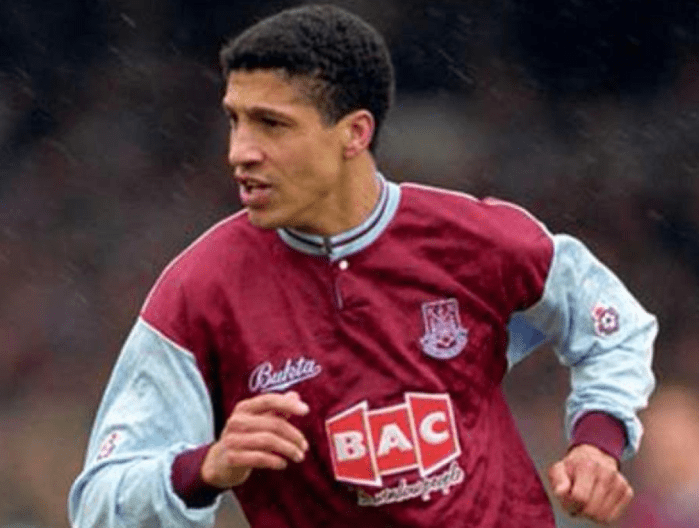
When he was no longer guaranteed a starting berth at Spurs, Hughton moved across London to the club closest to where he grew up: West Ham. Hughton signed for the Hammers initially on loan in November 1990 to cover for the injured Julian Dicks, and then permanently on a free transfer.

“My parents still live in Upton Park, so I was born and brought up very close to the stadium,” Hughton recalled in a November 2017 Argus interview.

Signed by Billy Bonds, he was with the Hammers for just over a year, helped them win promotion from the old Division Two in 1990-91and played a total of 43 matches (plus one as a sub).

“It was a really enjoyable period of time,” he said. “Billy Bonds was the manager. He was not only a great manager but a great individual.”

In February 1992, he moved on a free transfer to then Third Division Brentford, whose squad included Neil Smillie and Bob Booker. Graham Pearce was a coach. They won the divisional title but the following season Hughton’s troublesome knee forced him to retire at the age of 34.

“By the time I signed for Brentford at the age of 33 I was certain that I wanted to coach,” Hughton told coachesvoice.com. “I was taking far more interest in things like tactics and the thinking behind training sessions. Brentford’s manager at the time, Phil Holder, even allowed me to take a few sessions.”
Hughton added: “It actually set me up for my coaching career as I learned a lot in that time.”

After he’d called time on his playing days, he didn’t have to wait long for an opportunity to open up for him as a coach because his former teammate Ardiles, who’d not long since taken over as Spurs manager, invited him to help out back at White Hart Lane.

“We’d been good friends since our days playing for the club, so he knew all about my coaching aspirations and brought me in as the under-21s’ and reserve team coach,” Hughton explained. “I’ve always been very grateful to him for giving me that first opportunity.”

For the first year or so, he worked alongside the former West Ham player Pat Holland, who he described as “an excellent tactical and technical coach”.

Hughton explained it was a period in which he discovered how to transition from being a player to a coach. “As much as you’ve been part of a changing room thousands of times as a player, taken part in countless training sessions and listened to more team talks than you can remember, none of those things have ever been your responsibility before.

“In that respect, football is no different to any other aspect of life. If someone has spent years working on a shop floor, then moves up to management and has to govern a group of people, they have to make that same transition. It’s not easy.”

As managers came and went, Hughton remained on the coaching staff. After Ardiles came Gerry Francis and Christian Gross. Hughton was in caretaker charge for six matches before George Graham took over from Gross. Next in the hot seat was Glenn Hoddle, followed by Jacques Santini and then Martin Jol.

“Such a long apprenticeship might not be for everyone and some can go straight from player to manager at a young age, but I wouldn’t have been ready,” said Hughton.

“There was always something new to learn and experience. It was exciting to see what each new manager would be like, how he would involve me and what I would learn.

“The club could easily have said, ‘Now that the manager has left we won’t be keeping you on’, but they showed faith in my abilities and, in return, I provided some continuity.”

Hughton was assistant manager to Jol and said: “We had three years together, and in terms of league positions they were successful ones.”

By the time he was shown the door at Spurs, along with Jol, after a difficult start to the 2007-08 season, he felt ready to become a manager in his own right.

But before that happened, a different proposition emerged when Kevin Keegan asked him to become first team coach at Newcastle United.

“I’d spent my entire playing and coaching career in London, but any apprehension I felt at relocating to another part of the country was outweighed by the excitement,” he told leadersinperformance.com.

“I was going to a legendary club with an incredible tradition, rich history and great fan base and I was going to assist Kevin Keegan. I learned a lot from him during our time together, especially from his strengths in man-management.”

• What happened next in Hughton’s career is the subject of my next blog post. Thanks for reading!

Bobby Moore’s Dear mate netted five in seven for Albion

A STRIKER who once scored five goals in 20 minutes for West Ham took slightly longer when playing for Brighton but still netted five in seven games.

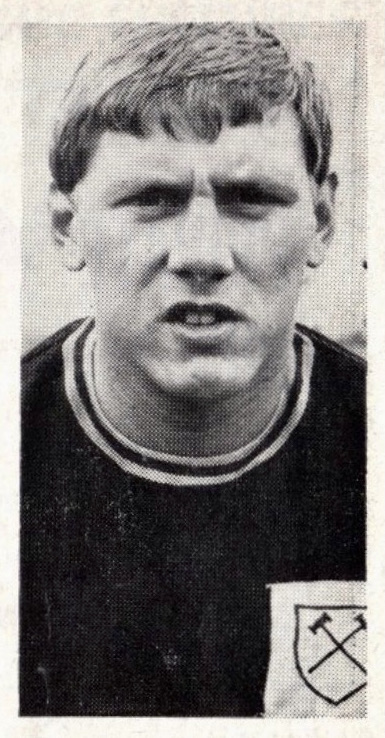
Brian Dear (nicknamed Stag, geddit?) won the European Cup Winners’ Cup with West Ham in front of 97,974 fans at Wembley in May 1965. Only the month before, he’d netted in the 44th, 53rd, 56th, 59th and 64th minutes of West Ham’s 6-1 demolition of West Brom in front of 27,706 fans at the Boleyn Ground.

Dear scores one of his five v WBA

Two years later, 23-year-old Dear found himself travelling to Workington to make his debut for Third Division Albion. The train journey there had been made worse by a derailment that meant Albion only arrived at the Borough Park ground 45 minutes before kick-off. Although Kit Napier scored against his former club, a sparse crowd of just 2,863 saw the visitors beaten 2-1.

Quite some change in fortunes for Dear, who had joined Brighton the previous day – transfer deadline day – in March 1967 when manager Archie Macaulay, a one-time Hammers player, went back to his old club to secure the forward’s services.

“No fee was paid at the time of the transfer. This will be discussed at the end of the season, and from now until then, it is up to Brian to prove his worth as to whether there will be a place at the Goldstone Ground for him in the future,” Macaulay wrote in the matchday programme.

Albion were bumping along in the lower half of the old Third Division at the time so it was quite a step down for Dear, but Brighton were keen to make his move permanent.

It wasn’t long before he showed what he was made of; Dear scored twice in his third game, on Easter Saturday, as Scunthorpe United held the Albion to a 2-2 draw at the Goldstone. Two days later he scored the only goal of the game as Albion beat visitors Watford 1-0. He was on the scoresheet again when Albion visited Boundary Park, Oldham, but the home side rallied in the second half to end up 4-1 winners.

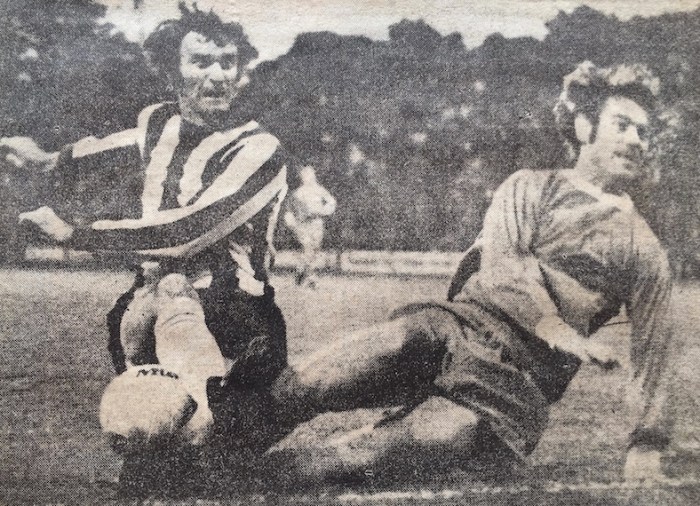
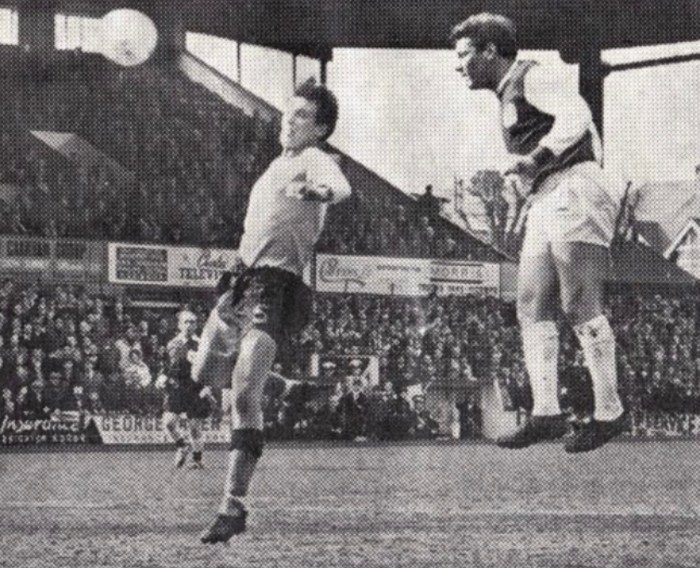
Back at the Goldstone the following Saturday, he scored Brighton’s opener in a 2-0 win over Oxford United (top picture), but that was the end of his scoring in Albion’s colours. He missed three matches in April and his last game for Brighton was in a goalless draw away to Shrewsbury.

His hoped-for permanent signing didn’t happen and he returned to West Ham where the following season he went on to enjoy the most consistent spell of his Hammers career, scoring 16 goals in 29 matches (plus one as sub). The East Londoners finished in mid-table: a season in which Manchester City were champions, two points ahead of second-placed Man Utd.

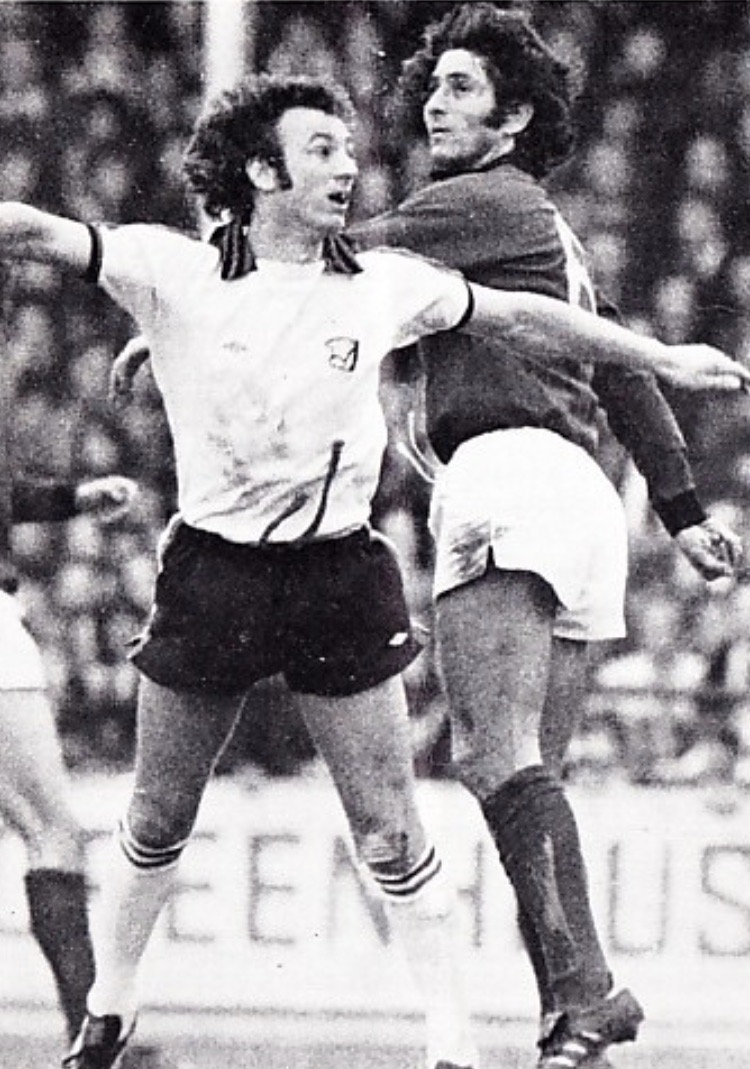
Dear rises to get in a header at the Goldstone Ground, with the West Stand in the background

“As a fan watching him, he was frustrating at times but he had the natural talent required for the top level and he certainly knew how to score goals,” said Tony Hanna, of the excellent fans website West Ham Till I Die.

Born in Plaistow, London, on 18 September 1943, Dear joined West Ham straight from school at the age of 15 and was an England schoolboy international who played against Scotland, Wales and Ireland in 1959.

On 29 December 1960, he scored twice for an England Youth XI when they beat an AFA Public Schools XI 8-0. Phil Beal and Bert Murray were among his teammates.

Dear made his league debut for the Hammers away to Wolves on 29 August 1962 but there were only two more first team appearances that season.

The following season, which culminated in West Ham beating a Preston North End side captained by Nobby Lawton 3-2 (Alex Dawson scored one of Preston’s goals), saw Dear struggle to get into the side and he made just three league appearances.

That five-goal haul v West Brom – when the crowd taunted the Baggies with a rendition of  ‘Oh Dear what can the matter be’ – helped take his 1964-65 season stats to 14 goals in just 15 appearances but he was part of the XI who won the European Cup Winners Cup 2-0 at Wembley. He scored four goals in previous rounds but it was outside right Alan Sealey who scored both Hammers goals against TSV Munich 1860 in the final.

Dear once again spent most of the 1965-66 season in a back-up role, featuring in just 10 first team matches while Hammer of the Year Geoff Hurst scored an impressive 40 goals in all competitions before going on to cement his name in English football history with a hat-trick as England won the World Cup in July 1966.

Hurst went one better the following season, netting 41 times, while Dear ended the season exploiting an opportunity to play competitive football with the Albion.

Throughout it all, Dear became a close friend of the legendary Bobby Moore, and in April 2021 West Ham invited the former striker to talk to the club’s academy players about the man he first met when he joined the club in 1958, the year Moore made his first-team debut against Manchester United at the tender age of 17.

“After that first period, that’s when we began to become friends,” Dear told the schoolboys. “We were all mates. You are all different ages at the academy, but you all know one another, how you play, what you do – it’s the same as us.

“Bobby was a bit shy. Once he felt comfortable with you, that was it. You had everything he could give, and he’d give everything to you. He was an amazing fella.”

The West Ham website said: “Dear and Moore were also inseparable off the pitch, enjoying a close friendship for over three decades before the icon’s tragic passing on 24 February 1993, at the age of just 51.”

Dear told the schoolboys: “You would have loved him if you’d have met him. He was a wonderful, wonderful man, and you lads should be very proud that you’re involved in the club that he was a part of.”

West Ham through and through, Dear did eventually leave Upton Park in February 1969, scoring seven times in 13 appearances for Fulham but they were relegated to the Third Division. He swiftly moved on to Millwall but only managed a handful of games before returning to West Ham in 1970.

However, his short-lived second spell is best remembered for his involvement in a curfew-busting drink before a FA Cup tie at Blackpool on 2 January 1971. Having been told icy weather would most likely mean the match would be called off, Dear, Moore, Jimmy Greaves, Clyde Best and physio Rob Jenkins went out late to ex-boxer Brian London’s club in the seaside resort.

Unfortunately, the game went ahead, West Ham were surprisingly beaten 4-0 by bottom-of-the-league Blackpool, and someone dobbed in the errant Hammers group.

Dear’s appearance as a sub that day was his last involvement in professional football. Manager Ron Greenwood turfed him out, along with Greaves, while Moore and Best were fined. Best later told his version of the story to the Knees Up Mother Brown website.

Before hanging up his boots, Dear played briefly for non-league Woodford Town. Football was in his blood and he became catering manager at Southend United and later worked in its commercial department.

West Ham Till I Die writer Tony Hanna concluded: “By Brian’s own admission he ‘enjoyed life’ more than most professional footballers. His stocky build was more often likened to being overweight and he enjoyed a beer after training, and also after matches.

“Being left out of the team, especially if he had scored the previous week, only further demotivated him in a career where he never really cemented a first team place.”

Tony Burns handled the art of goalkeeping for decades

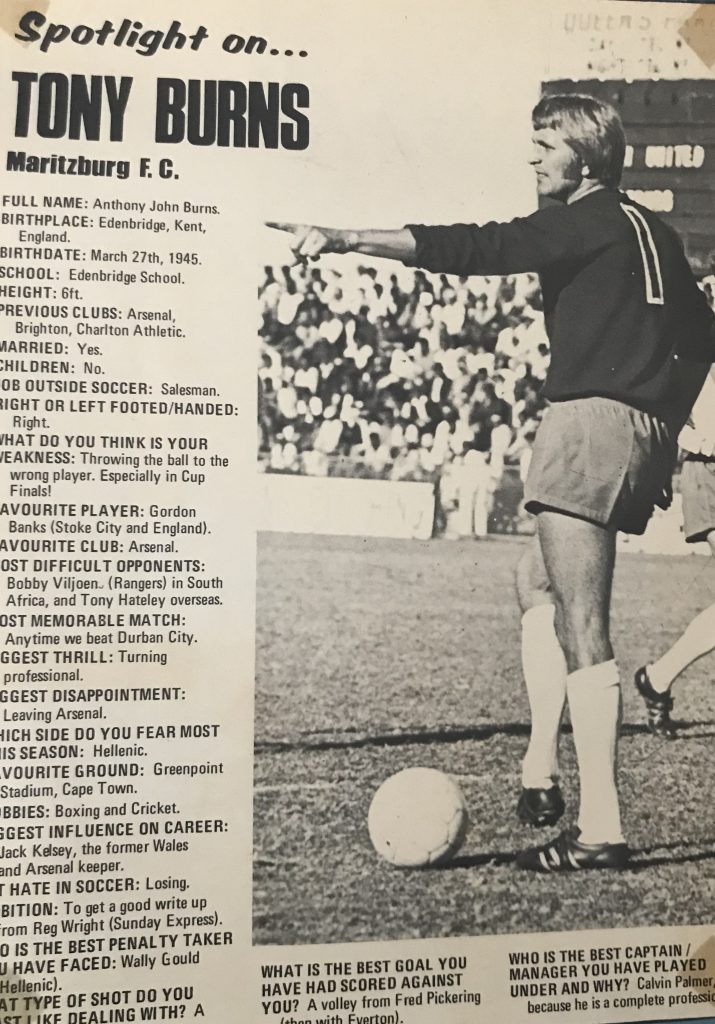
A GOALKEEPER with film star looks signed for Brighton from Arsenal just after England lifted the World Cup.

Tony Burns had kept goal for the Gunners in 31 top-flight matches and Albion boss Archie Macaulay, who had played for Arsenal himself, went back to his old club to sign a no.1 to challenge the emerging local lad, Brian Powney.

It wasn’t difficult for Burns to settle at the Goldstone because the dressing room included Northern Irish full-back Jimmy Magill and winger Brian Tawse, familiar faces from his time in north London who’d also made the switch to Brighton.

It also wasn’t long before female fans who admired his smouldering good looks were sending in letters to the office inquiring about his eligibility!

Burns relived his career in detail in 2020 when interviewed by 17-year-old would-be journalist Jed Vine, who watches games at the Amex with his mother, and games at the Emirates with his dad.

Born in Edenbridge, Kent, on 27 March 1944, Burns first showed his goalkeeping prowess during his schooldays in the town before he joined Southern League club Tonbridge (now Tonbridge Angels) who he returned to twice more and later managed three times.

He made his Southern League debut against Yiewsley (later to become Hillingdon Borough) in February 1963 and only his third game for Tonbridge was as an 18-year-old against Arsenal at Highbury.

With long term custodian Jack Kelsey retiring, Arsenal were looking around for likely successors and, liking what they saw of Burns, offered him a contract.

“In his early days at Highbury, he showed immense potential and, after benefitting from Kelsey`s coaching, made encouraging strides,” a 2020 Pitching In piece for the Southern League recalled.

Manager Billy Wright gave him his senior Arsenal debut in a friendly against Enschede in Holland in August 1963, with Magill in defence, and he got his first taste of South Africa on a five-game tour the following May when he was in goal for Arsenal’s 5-1 win over a Western Province XI and their 6-0 win over an Eastern Province XI.

But his big breakthrough came when he made his league debut in a 3-2 home win over Burnley in October 1964 (three days earlier he’d played in goal in a 7-0 friendly win over non-league Corinthian Casuals).

“I felt on top of the world. I had always wanted to play for the Gunners and here I was keeping goal for them, and on the winning side at that,” he told the Albion matchday programme. “There’s only one first match and I’ll never forget this one.”

Once he got the shirt, he had a run of 26 games (32 including friendlies) from October 1964 through to the end of March 1965.

He generally played in front of a defence featuring the likes of Don Howe, Frank McLintock and Ian Ure with John Radford and Joe Baker up front.

During the first half of the 1965-66 season, Burns appeared in seven league games and three friendlies, but his final Gunners first team appearance came on 27 December 1965 in a 4-0 defeat away to Sheffield Wednesday.

Jim Furnell was Wright’s preferred first choice, and, as the season wore on, the emerging Bob Wilson was getting the nod ahead of him as stand-in (although it wasn’t until 1968 that Wilson finally ousted Furnell).

Disappointed to leave, Burns nonetheless went in search of regular football by joining Third Division Brighton for £2,000 in July 1966.

He made his first appearance for the Albion on 17 September 1966, when he took over from the injured Powney, but Brighton went down 2-0 to Grimsby Town.

Powney returned the following week and Burns had to wait until January for his next games – two FA Cup ties against Aldershot.

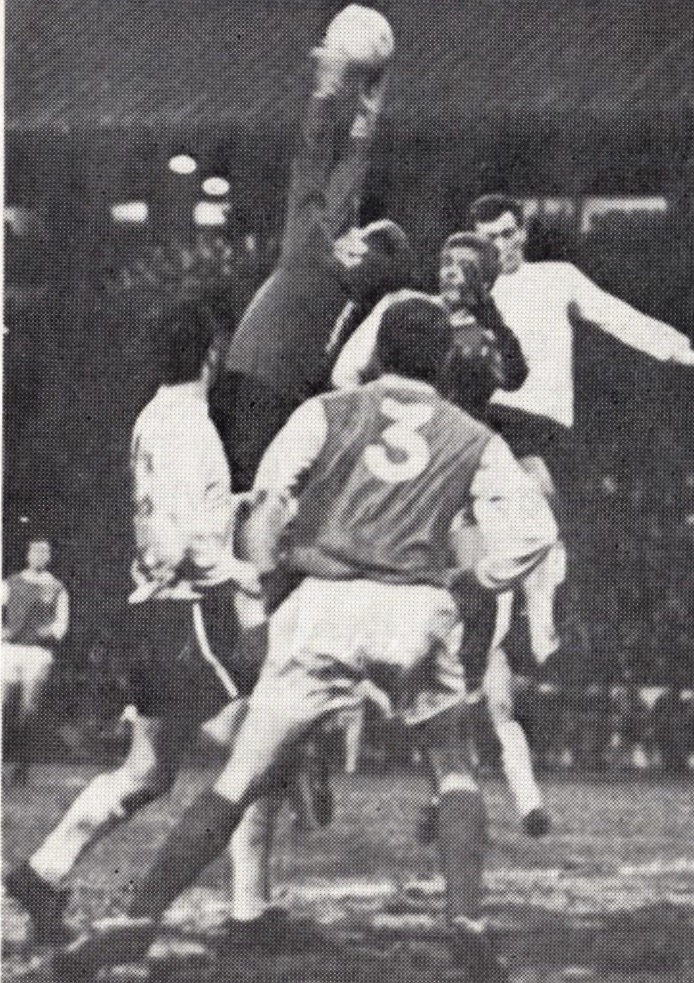
Burns in action versus Chelsea

He kept his place for the big fourth round FA Cup game against First Division Chelsea at the Goldstone which finished 1-1 when his former Arsenal teammate Tawse controversially had what he thought was a cracking late winner ruled out for a foul by Kit Napier.

Unfortunately, Burns conceded four in the replay at Stamford Bridge as the superior Chelsea side made the most of home advantage to ease their way through comfortably, 4-0. That was the season they went all the way to the final only to lose 2-1 to Tottenham Hotspur, whose ranks included Alan Mullery and Joe Kinnear.

By the end of the season, Burns had played 18 matches against Powney’s 37. But Burns had the upper hand in 1967-68 featuring in 29 games compared to Powney’s 21.

He also started the 1968-69 season as first choice but his 54th and final game for the Albion was in the 2-1 home defeat to Northampton in the second round of the FA Cup on 20 December 1968.

New manager Freddie Goodwin brought in former Wolves and Aston Villa ‘keeper Geoff Sidebottom to challenge Powney and let Burns leave on a free transfer in March 1969.

He joined Charlton Athletic, where he made 10 appearances in their unsuccessful tilt at promotion, but declined what he saw as a derisory contract offer. He returned to Tonbridge briefly and in January 1971 headed off to play in South Africa, initially for Durban United, and later, Maritzburg.

In his interview with Jed, he recalls playing in an English All Stars team managed by Malcolm Allison who invited him to return to England with Crystal Palace when his contract was up.

Burns made the move in October 1973 after previous Palace no.1 (and later Albion youth coach) John Jackson had moved to Orient.

He shared goalkeeping duties with Paul Hammond, playing a total of 90 matches between the sticks for Palace over the next four years under Allison and his successor Terry Venables.

In 1977, Burns played half a dozen games on loan for Brentford before heading off to the States like a lot of ageing players did at that time.

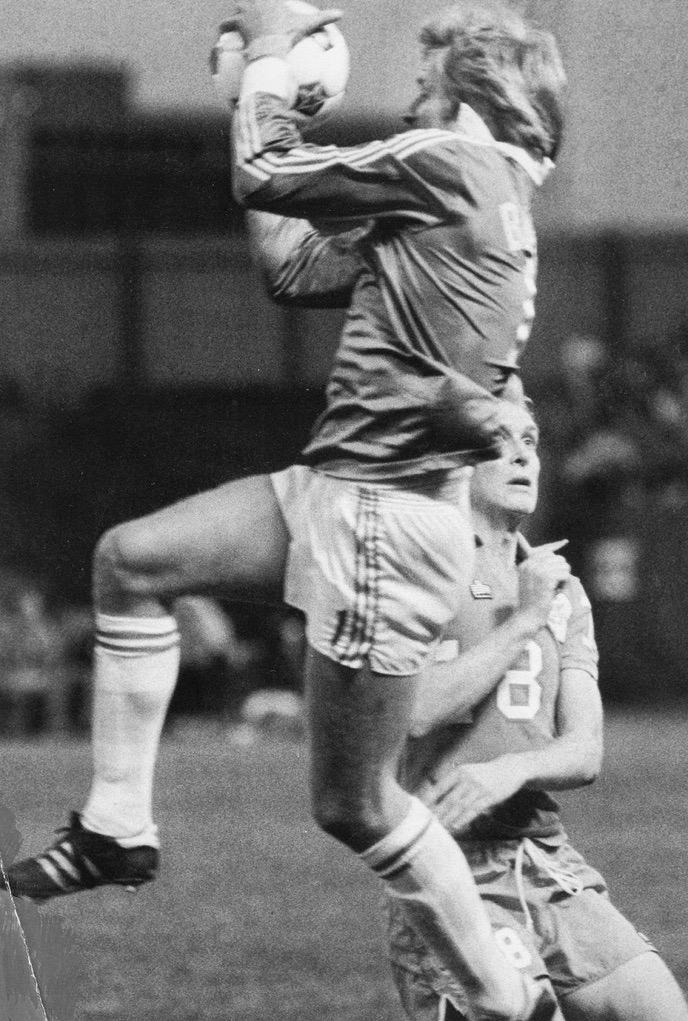
The ‘keeper played a dozen games for Memphis Rogues in the North American Football League. They were coached by former Chelsea defender and manager Eddie McCreadie although Burns had gone there to team up with former boss Allison who was sacked without a ball being kicked because he hadn’t signed enough players!

Burns played for Memphis Rogues in the USA

Among Burns’ teammates were a young Neil Smillie, who’d been struggling for games at Palace, Phil Beal, who had left Brighton the year before, John Faulkner, the one-time Leeds and Luton defender, and the flamboyant Alan Birchenall, beloved by Leicester City supporters of many generations.

Back in the UK in 1978, Burns joined Plymouth Argyle as cover for Martin Hodge, and ended his league playing days in this country appearing in 11 games in the first half of the 1978-79 season.

However, he left Home Park to rejoin Tonbridge Angels for a third time and he also played for Hastings United and Dartford.

After his playing days were over, Burns had three spells in charge of Tonbridge, from August 1980 to December 1982, August 1989 to May 1990, and in a caretaker role from November 2001 to May 2002 (by which time he was goalkeeping coach at Millwall, who he joined in 1992 under Mick McCarthy.

Burns served as goalkeeper coach under several Millwall managers.
Picture: Brian Tonks.

He also spent seven years as manager of Gravesend and Northfleet (who became Ebbsfleet United) between 1982 and 1989.

But it was at Millwall where he finally found a permanent home, working under no fewer than 18 different managers, including Steve Gritt and Mark McGhee.

He was even at the helm himself for a while, working as co-caretaker manager with former Lions boss Alan McLeary after Dave Tuttle’s departure in April 2006, when Millwall’s relegation had already been confirmed.

The appointment of Nigel Spackman the following month led to Burns’ departure in July 2006, when he took up a similar role at his old club Palace, working under former Albion boss Peter Taylor coaching Julian Speroni and Scott Flinders.

Goalkeeping coach at Palace under Peter Taylor

He left Selhurst in November 2007 when Taylor lost his job, and Speroni told yourlocalguardian.co.uk: “It was sad to lose Tony Burns because we worked well with him. During last season when I wasn’t playing regular football, Tony was the one who kept me going which was very important.”

Burns moved with Taylor to Conference side Stevenage Borough but later returned to Millwall under Kenny Jackett before stepping down in 2012, when he was succeeded by Kevin Pressman.

Still, he wasn’t finished with the game, though, and at the age of 70, in the summer of 2014, he teamed up with Taylor yet again to become goalkeeping coach at Gillingham. He joined them on a part-time non-contract basis as a replacement for Carl Muggleton.

Boss weighed into ex Spurs teammate Joe Kinnear

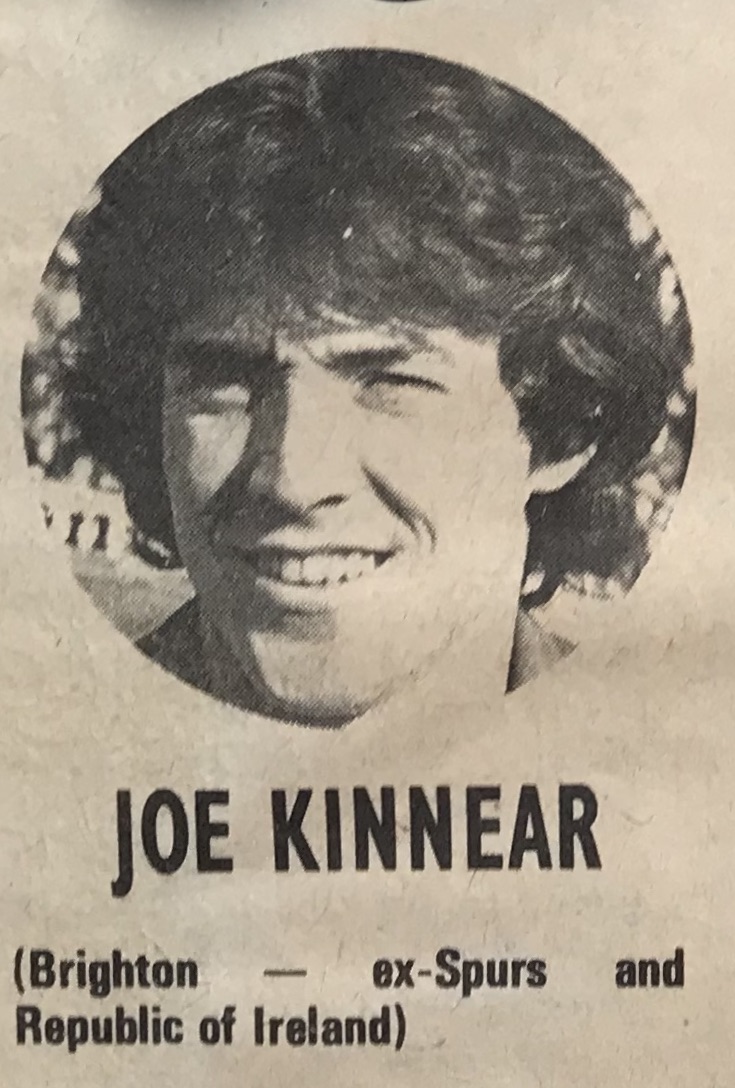
JOE KINNEAR was no stranger to expletive-filled rants so we can only imagine how he reacted when his former Tottenham Hotspur teammate Alan Mullery told him he was a stone overweight and shouldn’t expect any special treatment at Brighton.

The right-back who’d won silverware alongside the former Spurs skipper ended up leaving the Goldstone acrimoniously after his former colleague took over as Albion boss.

Having made 258 appearances in 10 years at White Hart Lane, Kinnear only played 18 games for Brighton after being signed by Mullery’s predecessor, Peter Taylor in August 1975.

He’d followed fellow former Spurs defender Phil Beal to third-tier Brighton, both having been eased out of the door as Tottenham’s new boss Terry Neill re-shaped the award-winning squad built up by the legendary Bill Nicholson and his faithful assistant, Eddie Baily.

Back when Taylor and Brian Clough were turning round the fortunes of Derby County, they had acquired the services of former Spurs hardman Dave Mackay, a friend of Kinnear’s, so he was no stranger to turning to experienced old pros.

“I left Tottenham because although I was good enough to hold down a regular first team place, manager Terry Neill didn’t think so,” Kinnear told Shoot! magazine. “I’m 28-years-of-age and have plenty of soccer at senior level left in me. Brighton have the potential to become as big-time as Spurs once were.”

Three days after signing, the Irishman made his Albion debut at right-back in a 1-0 home defeat to Cardiff City and, while he played in the following game too, previous regular right-back Ken Tiler was restored to the line-up for the next three months.

Nevertheless, his lack of involvement at Brighton didn’t stop the Republic of Ireland selecting him and he made what was his last and 26th appearance for his country as an 83rd minute substitute for Tony Dunne in a 4-0 win over Turkey at Dalymount Park, Dublin, on 29 October (Don Givens scored all four).

Kinnear was on Brighton’s bench a few times in the days of only one substitute, and he managed four consecutive starts in December, but he had to bide his time for his next starting spot, which only came when a bad injury in mid-March brought an end to Tiler’s involvement in Albion’s promotion push.

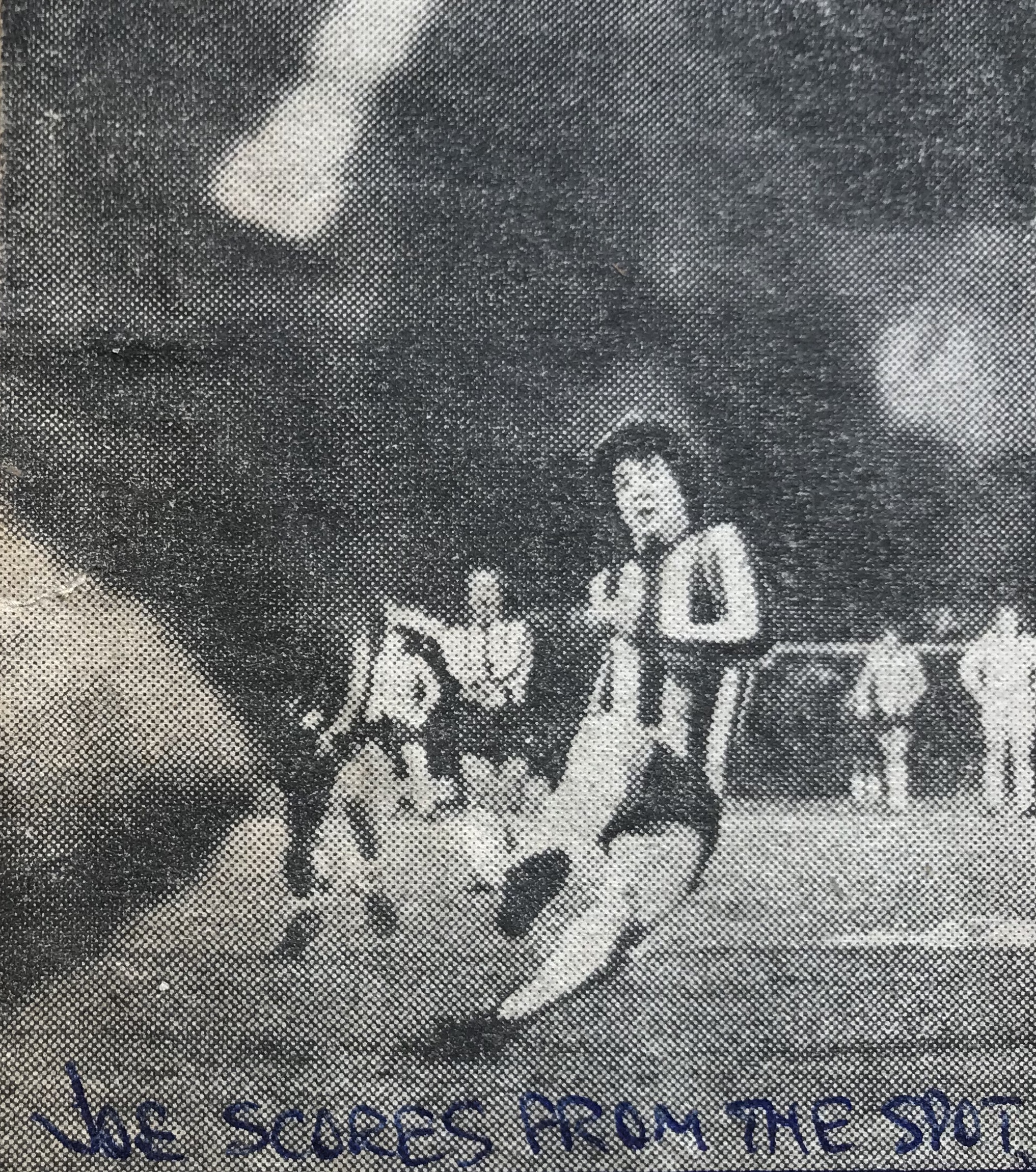
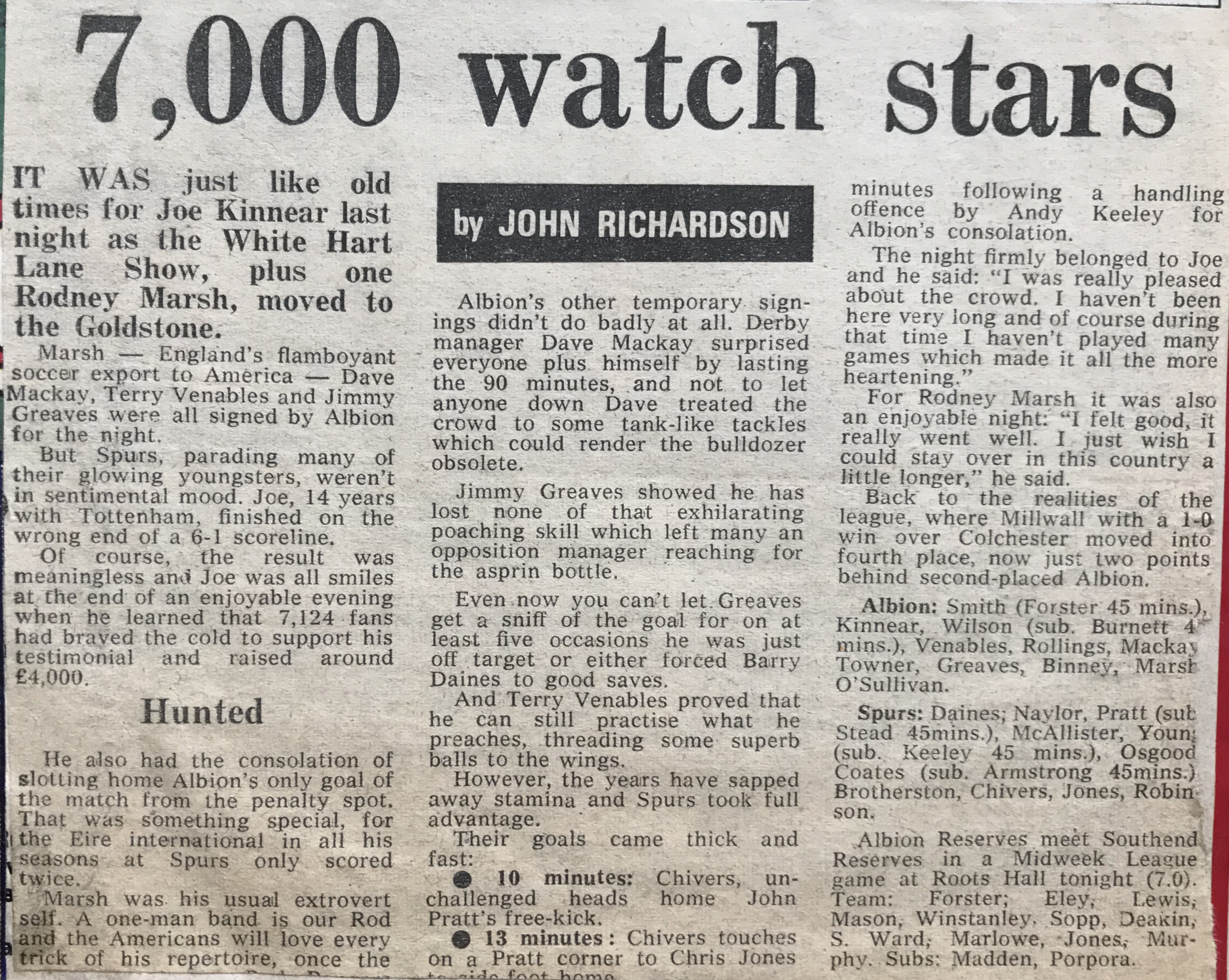
It was timely because on 23 March a testimonial match for him against Spurs took place at the Goldstone. It had been part of the arrangement made when he signed, and the Albion XI who took to the field in front of 7,124 fans included Kinnear’s old teammates Terry Venables, Mackay and Jimmy Greaves, along with guest star Rodney Marsh.

Spurs were in no mood for sentiment, though, and ran out 6-1 winners, with Kinnear scoring a consolation for Albion from the penalty spot.

As Albion’s promotion bid unravelled, Kinnear played in 10 league matches, only three of which were won. Although he was successful with another penalty, this time against Chesterfield, the Spireites won 2-1 with two penalties of their own.

Fingers were pointed at Kinnear for a gaffe in a decisive Easter game at promotion rivals Millwall which Albion ended up losing 3-1.

In his end-of-season summary, the Evening Argus Albion watcher John Vinicombe pointedly considered it was the injury ruling out Tiler that had been a key turning point in the failure to gain a promotion spot.

Kinnear himself suffered a serious knee injury in the penultimate game of the season, a 1-1 home draw against Gillingham, capping a dismal afternoon in which he also had a penalty saved. His departure on a stretcher on 19 April 1976 was his last appearance in an Albion shirt, other than being pictured kneeling on the end of the front row in the August pre-season team photo.

What happened next was covered in some detail in a 2013 blog post on thegoldstonewrap.com. In short, Mullery had arrived as manager following Taylor’s decision to quit and link up again with Clough, who’d taken over at Nottingham Forest.

Mullery was unimpressed by his former teammate’s level of fitness and attitude and called him out in front of the squad. Peter Ward, the new kid on the block at that point, thought it was the wrong approach and, in Matthew Horner’s book He Shot, He Scored, said: “It seemed that Mullery and Kinnear didn’t get on very well.”

Contractually, Albion still owed Kinnear money but it was evident he wasn’t going to feature while Mullery was in charge and a settlement had to be reached. Eventually Kinnear moved on to become player-manager of non-league Woodford Town, beginning a career in coaching and management that ultimately took him back to the top level of the game, albeit frequently attracting headlines for some extraordinary and controversial behaviour.

But let’s stick with Kinnear the player for the moment. Born in Kimmage, Dublin, on 27 December 1946, he moved to Watford at the age of seven. After leaving school, he became an apprentice machine minder in a print works and played amateur football for St Albans City. It was there he was spotted by the aforementioned Baily, who invited him to join Spurs’ pre-season training. He initially signed as an amateur in 1963, turning professional two years later.

His breakthrough season was 1966-67. He made his debut for the Republic of Ireland on 22 February 1967 in a 2-1 defeat to Turkey and won a regular place in the Spurs side when Phil Beal was sidelined with a broken arm. Kinnear performed well in Beal’s absence and he ended it as a member of the side which beat Chelsea 2-1 in the 1967 FA Cup Final.

“I was 20 when we played in the 1967 FA Cup Final and I got Man of the Match, so it was a great start for me,” Kinnear told tottenhamhotspur.com.

All was going well until January 1969 when in a home game against Leeds United he broke his right leg in two places, and he was out of the side for a long while.

Kinnear’s misfortune provided an opportunity for emerging youngster Ray Evans, as this Spurs archive website recalls: “When he got his chance through an injury to regular right back Joe Kinnear, Evans took over in that position and provided a threat with fast, over-lapping runs along with a notable fierce shot that chipped in with a few goals for the club.  Strong in the tackle and quick to recover his position, his height also helped him when teams tried to play diagonal passes in behind him.”

Evans had long spells in the side, especially in the 1973-74 season when Kinnear barely got a look-in, but the Irishman battled for his place and was first-choice right-back in Spurs’ League Cup winning sides of 1971 and 1973, and the UEFA Cup winning line-up in 1972.

The revered Nicholson had encouraged Kinnear to become a coach once his playing days were over, but he struggled to get a foot on the ladder in the UK. Ex-Derby boss Mackay, with whom he used to go to Walthamstow dogs after training, took him on as his assistant in the United Arab Emirates and Malaysia, then later at Doncaster Rovers after Kinnear had spent time in India and Nepal.

Eventually, in 1992, he got his chance at Wimbledon, defying the purists with a brand of football that saw them finish in sixth place in 1993-94 – and Kinnear won the League Managers’ Association Manager of the Year award.

Over seven years, The Dons played 364 games under him, winning 130, drawing 109 and losing 125. Despite not even playing at their own ground – they played home matches at Selhurst Park – Wimbledon continued to defy the critics with their resilience in the Premier League and progress in the cups but in 1999 Kinnear stood down as manager after suffering a minor heart attack.

He later enjoyed success in two years (2001-03) at Luton Town and had colourful spells as manager of Nottingham Forest (2004) and manager (2008-09) then director of football (2013-14) at Newcastle United.

Acres of newsprint and plenty of clips on YouTube record some extraordinary behaviour following his appointment by Mike Ashley at Newcastle. Perhaps one of the best summaries is on planetfootball.com, with reporter Benedict O’Neill saying: “Mike Ashley’s mismanagement of Newcastle has been a long-term affair with many bizarre decisions, but his appointment of the long-forgotten Joe Kinnear — twice! — may just be the strangest of all.”

Kinnear, who was diagnosed with dementia in 2015, died aged 77 on 7 April 2024.

Pictures from my personal scrapbook, matchday programmes and various online sources.

Winger Neil Smillie was a Wembley winner eventually

NS v MU Wemb

AN UNSUNG hero of Brighton’s 1983 FA Cup Final side, winger Neil Smillie, had the distinction of being the first ever apprentice the legendary Malcolm Allison signed for Crystal Palace.

Big Mal had enjoyed league and FA Cup success at Manchester City as Joe Mercer’s sidekick but he swept into Palace in the early 70s as a boss in his own right, courting publicity with his flamboyant fedora hat and giant cigar.

Smillie admitted: “I was going to West Ham but Allison persuaded me to take a look at Palace.

“The place was so alive and vibrant under him that I went there instead.”

Born in Barnsley on 19 July 1958, Neil followed in the footsteps of his dad, Ron, a former professional who played for Barnsley and Lincoln.

After joining Palace in 1974, Smillie turned professional a year later and was on Palace’s books for seven years, although he had three loan spells away from Selhurst.

In 1977, he went briefly to Brentford, who he ultimately would have a long association with later in his career.

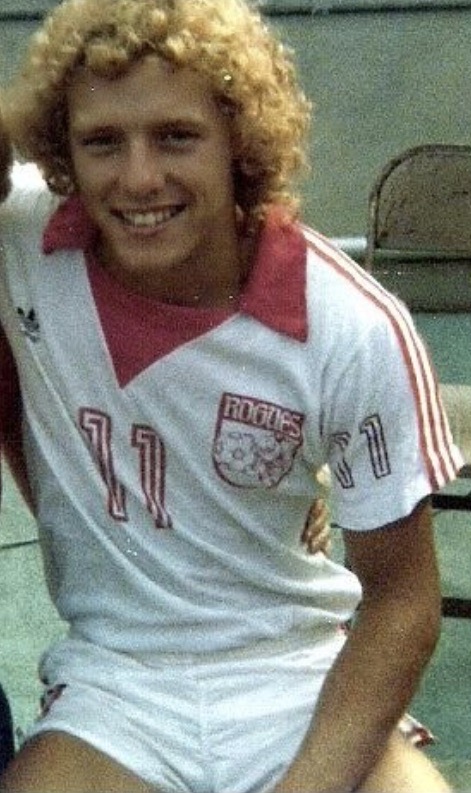
Smillie MemphisThe following two years, he went to play in America for Memphis Rogues (pictured left) where his teammates were players from the English game winding down their careers: the likes of former Albion players Tony Burns and Phil Beal, ex-Chelsea, Leicester and Palace striker Alan Birchenall and former Chelsea winger Charlie Cooke; the side being managed by former Chelsea defender Eddie McCreadie.

At the end of the 1981-82 season, Smillie was denied a pay rise by Palace so he decided to quit and wrote letters to clubs in the top two divisions in England asking for a job!

Brighton had managed to offload the troublesome Mickey Thomas to Stoke City so had a need for a left winger. They were the first to come up with an offer, and with full back Gary Williams surplus to requirements since the arrival of experienced defender Sammy Nelson, Brighton offered him in exchange for Smillie.

The bubble-haired winger gratefully accepted the switch to the Seagulls. While he made the starting line-up for the opening game of the new season, a heavy (5-0) defeat away at West Brom in the next game then saw him dropped and sidelined for months.

It was only once ultra-cautious manager Mike Bailey had left that Smillie got back in contention, and only then – in January 1983 – through someone else’s misfortune.

He said: “I was out in the cold and only got my break when Giles Stille was injured during the Cup game against Newcastle United.”

Smillie seized his opportunity and remained in the side for the rest of the season, culminating in the two Wembley FA Cup Final matches against Manchester United.

Back in the second tier following Brighton’s relegation, Smillie played 28 games plus once as a sub but following new manager Chris Cattlin’s signing of Northern Irish winger Steve Penney, there was competition in the wide areas.

Throughout the 1984-85 campaign, Smillie was more often than not a substitute rather than a starter. He did manage a seven-game run of appearances in the late autumn and began the final three games of the season, but the last game, a 1-0 home win over Sheffield United, proved to be his farewell.

Smillie revealed in a 2003 interview with Spencer Vignes that he’d discovered Manchester City had been keen to take him on loan but Cattlin hadn’t sanctioned it, even though he wasn’t selecting him.

“Chris had turned them down, saying I was a good player and he needed me. Yet he wasn’t even playing me! I just couldn’t believe he’d done it,” he said. Although he and his family were settled in Sussex, he realised he had to move.

Several eyebrows were raised when Cattlin managed to secure a £100,000 fee from Watford for Smillie’s services in the summer of 1985. The winger joined Graham Taylor’s beaten FA Cup finalists but he failed to establish himself in the side and made just 16 first team appearances in a season with the Hornets.

In the summer of 1986, he moved on to Reading for two years and, in 1988, after his disappointment with Brighton, Smillie was finally a winner at Wembley, scoring and setting up two goals as Reading beat Luton 4-1 in the Simod Cup Final.

The Hatters were led by former Albion captain Steve Foster and another of Smillie’s former teammates, Danny Wilson, was in their midfield. Mick Harford scored the opening goal for Luton, but Smillie’s pass allowed Michael Gilkes to bundle home an equaliser.

Smillie then won a spot kick converted by Stuart Beavon, and, in the second half, Mick Tait swept home another Smillie assist. Smillie then rounded off a great afternoon by scoring himself. It was hailed as one of the best days in Reading’s history, witnessed by over 45,000 loyal Royals fans.

Nevertheless, Smillie didn’t hang around and instead joined Brentford, where his former Palace teammate Phil Holder was assisting the manager at the time, Steve Perryman.NS Bees

Nick Bruzon interviewed Smillie in depth for a Where are they now? feature on the Brentford FC website in July 2010.

“Representing Brentford over three different decades, initially on loan in 1977 and then for five years from 1988 to 1993, Neil Smillie combined raw pace with ceaseless energy to make him one of the most popular players to patrol the New Road touchline,” said Bruzon. “Whilst with Brentford he experienced promotion, relegation and play off heartbreak, scoring 18 goals in 185 games.”

Smillie said: “I’ve got to say, the five years I spent at Brentford (and I was 30 when I signed) I thoroughly enjoyed.

“I’d reached a point in my career where I felt comfortable in terms of what I could give on the pitch. I’d always been a hard worker and I got the feeling that the supporters appreciated someone who worked hard.”

In the 1992-93 season, he played alongside Chris Hughton, who, like Smillie, was winding down his playing career.

“I loved taking people on and I loved getting crosses in for people to score so that just seemed to fit in nicely at the time with the team that we had,” he said. “I played my part as well as others who played theirs in getting the ball to me. We all did our bit and for me it was a great part of my career.”

On leaving Brentford, Smillie became a player-coach at Gillingham when his old Palace teammate Mike Flanagan was the manager. When Flanagan was sacked, Smillie took over the managerial reigns on a caretaker basis while the club tried to stabilise during financial troubles.

Smillie told Bruzon: “We were in a fairly precarious position and ended up in a decent position. So there was some enjoyment to it but the situation at a club without any money and struggling was difficult.”

Some names familiar to Brighton fans were at Gillingham at the time. Smillie played up front with Nicky Forster. Paul Watson was in defence and Richard Carpenter in midfield.

His three-month reign came to an end when Gillingham appointed Tony Pulis as the new manager and former Palace manager Alan Smith took Smillie to Wycombe Wanderers to look after their youth team.

When Smith left, Smillie was caretaker manager until former Albion full back John Gregory got the managerial post. Smillie then became Gregory’s successor in the hot seat for a year.

When the inevitable sack came, Smillie stepped outside of day to day running of football to become sports marketing manager for Nike in the UK. His role was to identify emerging talent for Nike to associate themselves with, and, as a result he stayed in touch with the game.

Among the players he signed to Nike were Theo Walcott, Darren Bent, Gabby Agbonlahor, James Milner, Tom Huddlestone, Danny Welbeck and Johnny Evans.

Pictures show (top) Smillie in action on the cover of the Albion programme; walking his dog; in Match magazine, on the cover of Shoot! being tackled by Liverpool’s Sammy Lee; a Simod Cup winner with Reading.

Dennis Burnett – England World Cup trio’s teammate – added finesse to Brighton’s defence

1newhamrecorder.co.uk

WITH all due respect to his predecessors in the number 6 shirt, Dennis Burnett was a classy addition to Brighton’s defence when he signed from Hull City in 1975.

At the end of his first season with Brighton, when they toyed with promotion from Division 3 but just missed out, Burnett was selected in the PFA Third Division Team of the Year, which said everything about his stature amongst his fellow professionals. Albion’s Peter O’Sullivan was also selected while the goalkeeper was Eric Steele, then with Peterborough, and Crystal Palace winger, and, future Brighton manager, Peter Taylor, was also in the XI.

Before 1975, Brighton fans had been used to seeing their centre halves hoof it, but Burnett play more in the style of another famous former West Ham number 6. OK, he might never have reached Bobby Moore’s level but he played alongside the great man for a while and came through the ranks at West Ham when they had a reputation for playing cultured football.

He started off in the West Ham youth team and was in the 1963 FA Youth Cup winning side alongside the likes of Harry Redknapp, Clive Charles, Bobby Howe and John Sissons.

Burnett made his first team debut for the Hammers as a 21-year-old in October 1965, along with Jimmy Bloomfield (the future Orient and Leicester manager), in a 3-0 defeat to Fulham at Craven Cottage. He made 24 league appearances in 1965-66, the most he managed in any one season for the Hammers.

In March 1966, he collected a League Cup runners-up medal playing right back in a side that lost 5-3 over two legs to West Brom. The team was captained by Bobby Moore, and included Martin Peters and Geoff Hurst, just four months before all three played in England’s one and only World Cup win.

Burnett went on to complete 66 league and cup appearances for West Ham.

Born in Southwark on 27 September 1944, perhaps it was no surprise his next stop was Millwall. West Ham sold him to The Lions in 1967 for £15,000, and the vast majority of his football career was spent at The Den, playing in the second tier.

Playing alongside Barry Kitchener at centre half and Harry Cripps at left back, he was part of a team that nearly made it to the First Division, particularly in 1971-72.

In a scene you would never get now in the mobile phone age, Millwall were leading Preston at home and the word went round The Den that rivals for promotion Birmingham were losing at Sheffield Wednesday. It looked like Millwall would be promoted to the elite for the first time in their history and the news spread to the players on the pitch.

Unfortunately, the rumour was completely wrong. Birmingham were leading, not losing. Club skipper Cripps had even gone round the Preston players telling them Millwall were going up but level-headed Burnett didn’t get carried away.

millwall-history.org records: On-the-field skipper Dennis Burnett was less convinced. “I wasn’t going to believe it until I knew for sure,” he said. “Those last few minutes were agonising. We played on in a dream. It was the longest 20 minutes ever for me.”

As the end of the game approached, the crowd jammed the touchline, waiting to cheer off the Millwall players. The pressure behind Millwall’s goal was so great that the woodwork began to buckle.
Centre-forward Barry Bridges
(who would join Brighton five months later) ran back to appeal to the fans to be patient. When the referee blew for the last time – suspiciously early – half the 20,000 crowd stormed on to the pitch. Cripps was carried aloft and some of the other players lost their shirts.

Finally the correct score from Hillsborough was announced and the crowd fell silent and faded away.

The following season, Millwall struggled near the bottom of the table and manager Benny Fenton moved Burnett into midfield.

“As a sweeper I was a bit restricted,” he told Goal’s Ray Bradley, who described him as “one of the most accomplished and stylish players outside the First Division”.

“I had to stay back and wasn’t so involved,” said Burnett. “ Now I find I can express myself more and go up in support of the attack.”

Unlike his illustrious former Hammers teammates, full international recognition eluded him but in April 1973 Burnett was part of an English FA squad managed by Sir Alf Ramsey that thrashed Gibraltar 9-0 in a ‘friendly’. Frank Worthington (of Leicester at the time) scored a hat-trick.

Hankering for another shot at top division football, Burnett went on to the transfer list at The Den. He got his move, but only to a club in the same division.

After clocking up 257 appearances for Millwall, in 1974, Terry Neill paid £80,000 to take Burnett to Hull City, where a young Stuart Pearson, future West Ham, Man Utd and England international was making a name for himself.

However, when Neill left to become manager of Spurs, his replacement John Kaye brought in his own man while Burnett was out of the side suspended. After losing his place, Burnett had a brief loan spell back at Millwall.

During the summer of 1975, he played 21 games in the States with St Louis Stars (for whom former Chelsea and England goalkeeper Peter Bonetti was playing) before Brighton manager Peter Taylor secured his services for the Seagulls.

In an article in Shoot incorporating Goal, Burnett explained how, although he’d been sidelined for two months with an ankle ligament injury, he’d got back in the side only to be sent off in a game away to Bristol City.

“It was a most unjust decision. Even the opposition seemed flabbergasted,” he said. “Anyway, I never played for Hull again. The signing of Dave Roberts from Oxford United put paid to my chances of a first team recall, following my suspension.

“Eventually, manager John Kaye called me into his office and asked if I wanted a move. A price of £30,000 was put on my head, later reduced to £15,000. No one came for me so in April I went to the United States and played for St Louis Stars in Missouri, a North American Soccer League club.

“While there I received another contract from Hull City, which I refused to sign. I lodged an appeal against it to the Football League Management Committee. Surprisingly they upheld it, and, during July, I received a letter to say I’d been given a free transfer.

“I arrived back in England on August 24th, made and received a number of ‘phone calls which resulted in my being offered a three-year contract by Brighton, plus excellent wages, which at the age of 31 was fantastic for me,

“Added to all this is the potential of Brighton in terms of location, players and attendances. It was a move not to be resisted.”

Burnett told the magazine he felt Brighton were much better prepared for promotion than Millwall had been. “Had we gone up, we would have needed a miracle to survive in the First,” he said. “At Brighton, we are winning matches without being fully stretched. The right blend is there and we can only get better.

“If I look after myself, I can get through another four or five seasons, by which time Brighton could be up amongst the big boys.”

Burnett was obviously a good judge because Brighton certainly got themselves up amongst the ‘big boys’ four years later – although by then he was no longer a part of it.

After a successful first season in which he developed a formidable central defensive partnership with Andy Rollings, and earned that placed in the PFA team of the year, perhaps there were signs that age was catching up with him.

In his end of season review in the Evening Argus, Albion reporter John Vinicombe observed: “Over the course of the season, the most improved player was Andy Rollings who profited by the experience of Dennis Burnett at his elbow.

“There were times when Burnett looked unflappable in the centre of the defence. As time wore on, and situations became more frenetic, that casual style, no doubt a legacy of his West Ham upbringing, now and again landed him in trouble.”

Maybe manager Taylor thought the same because one of the last things he did before quitting and rejoining Brian Clough was to sign veteran defender Graham Cross, which spelled trouble for Burnett.

Under new manager Alan Mullery, in the league at least, Cross was preferred alongside Rollings. Burnett deputised for Rollings when he was injured – for example, he played alongside Cross in the memorable 7-2 demolition of York City – and was given some games in midfield, but mainly in the League Cup he got the chance to shine.

He played in memorable games against First Division opponents Ipswich, West Brom and Derby, and was assured alongside Cross in the memorable narrow 2-1 defeat at the Baseball Ground in November 1976.

Vinicombe reported: “Cross and Burnett played coolly and neither looked out of place among the high-priced cream.”

He kept his place for a league game away to Port Vale five days later, but that 2-2 draw was his last in an Albion shirt.

In early February 1977, together with ex-Spur Phil Beal, he agreed a pay-off with the club and played non league with Ilford for the remainder of the season before returning to the States and another 19 games for St Louis Stars, where he was joined by former Albion teammate Fred Binney.

Mullery explained several years later in his autobiography that he had inherited a squad of 36 professionals and needed to prune the numbers. The older players were the obvious ones to go and, although Beal and Burnett went quietly, he had more truck dispensing with Joe Kinnear’s services – but that’s a story for another day.

On his return to these shores, Burnett headed for Ireland to play for Shamrock Rovers, at that time managed by the legendary Johnny Giles.

The defender subsequently played for three years in Norway, for SK Haugar, and popped up back in Sussex in 1994 as assistant manager of Sussex County League side Lancing, and played in a 2-1 defeat against Horsham YMCA in the FA Cup a month before his 50th birthday!

According to Wikipedia, Burnett ran a painting and decorating business in Sussex after he left football and was working in the hospitality suites at Upton Park before West Ham moved to the Olympic Stadium.

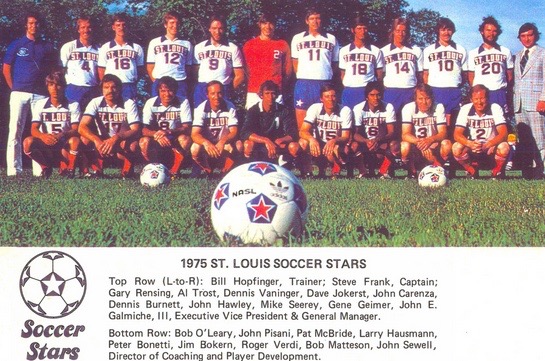
Pictured above are a Newham Recorder shot of Burnett in West Ham colours; in action for Millwall (from Goal), and in Albion’s stripes (from Shoot!). Below, an archive shot of the St Louis Stars side of 1975 with Burnett in the back row wearing the 18 shirt and Peter Bonetti in the centre of the front row.

back row burnett

Cross the colossus majestic in promotion-winning season

1-cross-clincherGRAHAM Cross won promotion from the third tier in successive seasons – one with Brighton & Hove Albion, the next with Preston North End.

They came after a record-breaking 15-year spell with his hometown club Leicester City.

Cross was a tower of strength and ever-present in Alan Mullery’s 1976-77 promotion-winning team. He was so consistent that his fellow professionals named him and fellow Seagulls Brian Horton and Peter Ward in the division’s PFA team of the year.

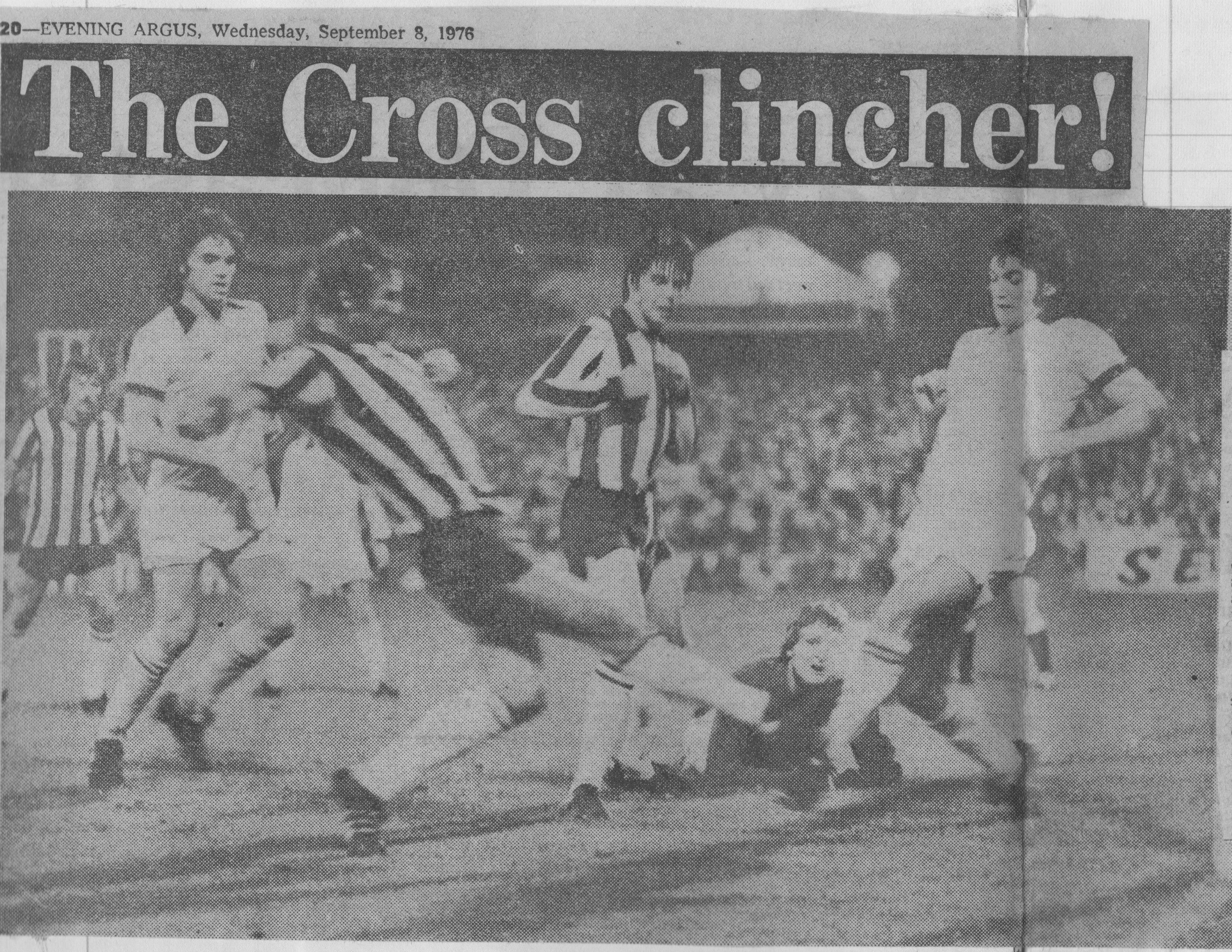
One standout performance I recall was in a cracking League Cup replay at the Goldstone against Division 1 side Ipswich Town on 7 September 1976 (see picture above).

Despite the Albion being down to 10 men, having had Phil Beal carried off injured after sub Ian Mellor had already come on, Cross scored the winning goal two minutes from time to give Albion their first competitive victory against a first division team for 43 years!

“Graham had an absolutely tremendous 1976-77 season for us and I can’t speak too highly of him,” Mullery told Shoot! “When I first started planning for the new term I reckoned on having him in the side for our step up into the Second Division.”

G Cross BW HSHowever, when he realised he could land the highly promising 20-year-old Mark Lawrenson from Preston for £112,000, those plans changed.

Lawrenson had played brilliantly against the Albion during the promotion season and was eager to take the step up so he headed south together with full back Gary Williams and Cross and left back Harry Wilson went in the opposite direction.

“I wish him well at Preston and can assure their supporters they are getting one of the most honest lads in the game in Graham,” said Mullery.

Cross certainly played his part as Preston earned promotion from the third tier – one of his teammates was centre forward Michael Robinson, who joined Albion in 1980 – but in the following season the magic touch eluded him when he played 19 times for Lincoln City but didn’t manage to stop them being relegated to the Fourth Division.

3-gc-leicesterCross had been part of the furniture at Leicester and the meashamfox blog recalls how he scored on his debut on 29 April 1961 against Birmingham City in a 3-2 win at Filbert Street.

He was a real ‘Mr Versatility’ who played in eight different positions, although mostly  in midfield – the history books describe him as an inside forward or wing half – and at centre back.

During all the hullabaloo surrounding Leicester’s remarkable Premiership title win in 2016, there were flashbacks to the last time a Leicester side went that close to clinching the league title – in 1962-63 – with Cross a member of that side.

In an interview with the Leicester Mercury, his former Scottish international teammate Frank McLintock spoke about a so-called signature move called ‘the switch’ Leicester employed whereby Cross dropped back and McLintock bombed past him.

“It was a load of rubbish, really,” McLintock told the paper. “It was just that I was really fit and Graham, who was a great player, would be a bit puffed out when he got back. We just swapped positions for a bit.

“The opposition would get confused with who was picking up who. Even Bill Shankly copied it later on at Liverpool.”

Unlike the 2016 vintage, the 1963 side blew their title chances by losing their last four league games. However, they did reach the FA Cup Final that year. Cross was in the side that lost 3-1 to Manchester United. He was also in the Leicester side that lost the 1969 final 1-0 to Manchester City.

His performances in 1963 were good enough to earn him a call up to the England under 23 team, making his debut in a 0-0 draw with Yugoslavia at Old Trafford. In the return fixture two months later, he scored a penalty to supplement an Alan Hinton hat-trick as England won 4-2.

He was a permanent fixture in the side for 10 matches (including a 4-1 win over West Germany, when future Albion colleague Peter Grummitt was in goal). But in November 1964, Leeds’ Norman Hunter took over the no.6 shirt.

Cross was recalled for one more game, in April 1966, when the under 23s beat Turkey 2-0 at Ewood Park. Two of the side that day – Martin Peters and Roger Hunt – would go on to be part of the England World Cup winning team three months later, but Cross never progressed to the senior England team.

Nevertheless he did pick up a  League Cup winner’s medal when Leicester beat Stoke City in 1964 but was a loser the following year when they were beaten narrowly by a Chelsea side containing Barry Bridges and Bert Murray.

Three years before joining Brighton, Cross received a long service clock to mark 500 first class appearances.

Throughout this period, he was also one of that rare breed who played county cricket too.

A right-arm medium-fast bowler, he played 83 first class matches for Leicestershire between 1962 and 1976 and took 92 wickets at an average of 29.95. His top batting performance was a knock of 78.

I am indebted once more to the meashamfox blog to learn that it was Cross’ dual sporting prowess that eventually brought his Leicester career to an end.

In the summer of 1975, he was part of the Leicestershire side captained by Ray Illingworth that won the county championship and the Benson and Hedges Cup, making him the only man to have played in cup finals at Wembley and Lord’s.

But the Leicester board took a dim view of him carrying on playing cricket instead of reporting back for pre-season training and he was suspended.

He was sent out on loan to Chesterfield and played 12 times for them in the 1975-76 season, before being released.

He arrived at the Goldstone on May 25 1976 at the same time as full back (and future manager) Chris Cattlin.

Manager Peter Taylor had impeccable contacts in the Midlands and in Cattlin, from Coventry, and Cross, from Leicester, he acquired two experienced campaigners who had played at the top level in the game for many years.

Taylor’s intention was that Cross would have the sort of impact at Brighton that the ageing Dave Mackay had on Derby when Taylor and Brian Clough signed him from Spurs.G Cross LEic

Taylor had tried to sign Cross before, in the pair’s early days at Derby. Leicester even accepted an £80,000 bid but Cross prevaricated over the move and they turned their attentions elsewhere. He admitted his regret at missing out on the £4,000 cut of the deal but told Goal magazine: “I’m happy in Leicester and I’m pleased that I decided to stay.”

That decision would ultimately lead him to become the all-time appearance record holder for Leicester, having played 599 games; a feat still not surpassed.

Clough and Taylor were renowned for building their sides on solid defences and, having already captured Grummitt, Graham Winstanley, Andy Rollings and Wilson, Taylor added Ken Tiler, Dennis Burnett, Cattlin and Cross.

Taylor, of course, didn’t hang around to see how Cattlin and Cross would contribute. With only four weeks to go to the start of the season, he decided to quit and renew his partnership with Clough, this time at Nottingham Forest.

One of the first images fans saw of his replacement, Alan Mullery, showed him embracing Cross and Cattlin at the pre-season press photocall.

Cross mostly played alongside Rollings, with Burnett and Winstanley filling in when Rollings was sidelined.

Interestingly, Cross never actually moved to Brighton during his spell with the Seagulls: the deal he agreed allowed him to continue to train with Leicester because he and his wife had business interests in the Leicester area.

The meashamfox blog declared “Graham Cross was Leicester City’s finest ever player” although the author was also sad to report how in February 1993 “he had been jailed for using post office funds to pay off his gambling debts”.

The blog concluded: “Despite this blip in his life, for me ‘The Tank’ Graham Cross is a true Leicester legend.”

Pictures from my scrapbook show:

  • A cracking Argus picture and headline record the winner Graham Cross scored against Ipswich in the League Cup.
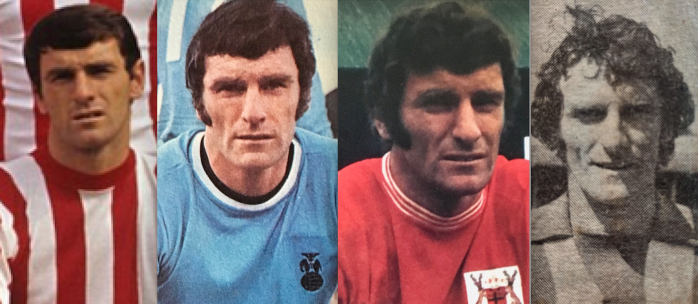
  • A full page colour photo in Goal magazine when at Leicester.
  • Celebrating his inclusion in the PFA division 3 team of the year with Brian Horton and Peter Ward at the annual awards dinner.
  • Another Goal article, from 1973, marking a clock presentation to Cross in recognition of 500 senior appearances for Leicester.
  • Cross in the Preston team line-up alongside Michael Robinson, who would eventually join the Seagulls via Manchester City.
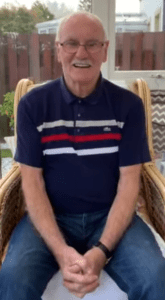
Cross aged 77 was interviewed and photographed by The Times ahead of Leicester’s 2021 FA Cup Final win over Chelsea