Even fearsome John McGrath couldn’t stop the rot

IN ALBION’S bleak midwinter of 1972-73, manager Pat Saward was desperate to try to reverse a worrying run of defeats.

The handful of additions he’d made to the squad promoted from the old Third Division in May 1972 had not made the sort of improvements in quality he had hoped for.

An injury to Norman Gall’s central defensive partner Ian Goodwin didn’t help matters and Saward chopped and changed the line-up from week to week to try to find the right formula.

Previously frozen out former captain John Napier was restored for a handful of games (before being sold to Bradford City for £10,000). The loan ranger’ (as Saward was dubbed for the number of temporary signings he brought in) then tried Luton Town’s John Moore in Goodwin’s absence.

Youngster Steve Piper was given his debut at home to high-flying Burnley, but Albion lost that 1-0. Then Saward tried left-back George Ley in the middle away to Preston, but that didn’t work either. North End ran out comfortable 4-0 winners with Albion’s rookie ‘keeper Alan Dovey between the sticks after regular no.1 Brian Powney went down with ‘flu.
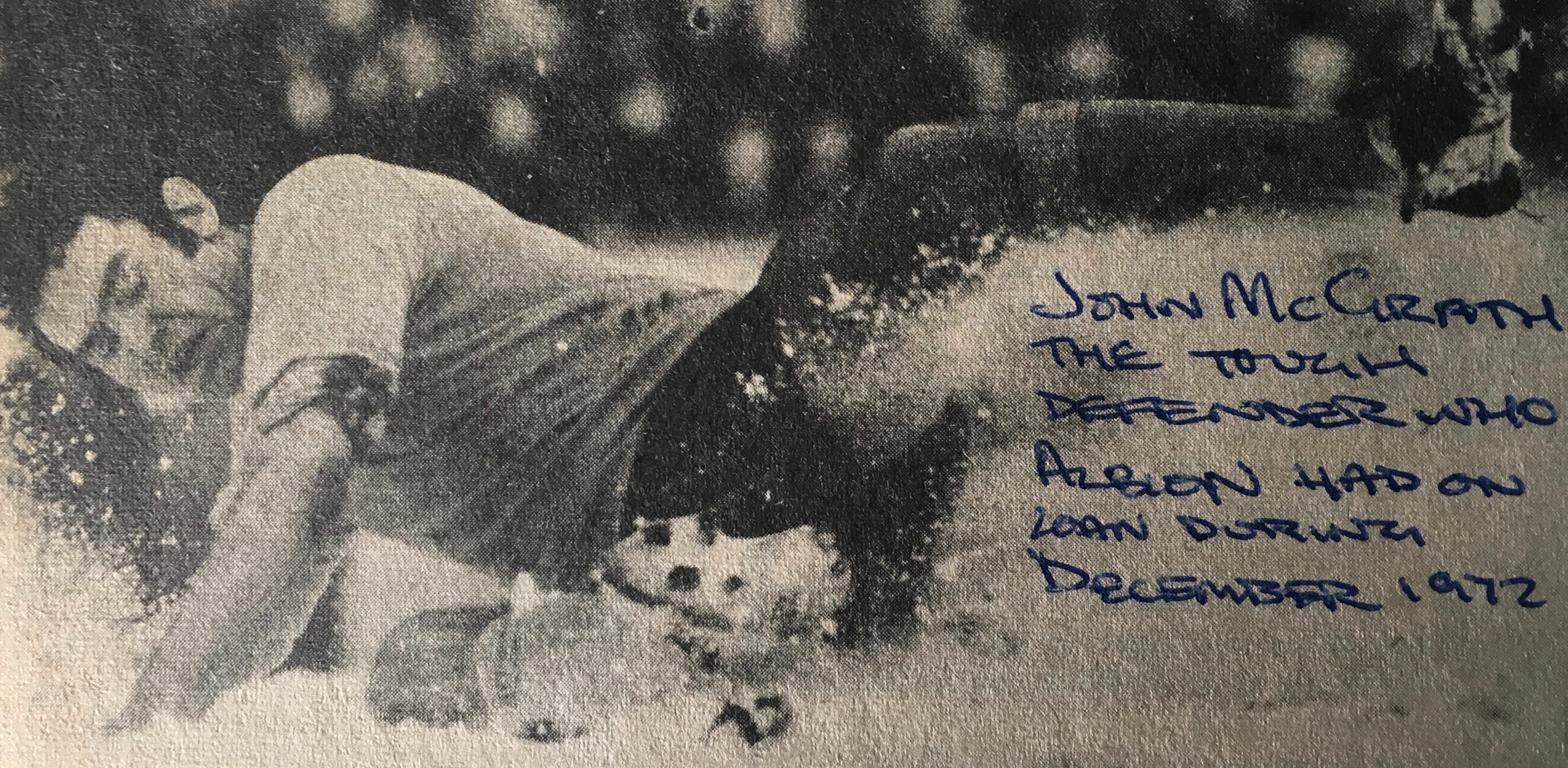
As December loomed, and with Goodwin still a couple of weeks away from full fitness after a cartilage operation, Saward turned to John McGrath, a no-nonsense, rugged centre-half who had played close on 200 games for Southampton over five years.

“With his rolled-up sleeves, shorts hitched high to emphasise implausibly bulging thigh-muscles, an old-fashioned haircut and a body dripping with baby oil, ‘Big Jake’ cut an imposing figure,” to quote the immensely readable saintsplayers.co.uk.

In Ivan Ponting’s obituary in the Independent following McGrath’s death at 60 on Christmas Day 1998, he reckoned his “lurid public persona was something between Desperate Dan and Attila the Hun”.

Although McGrath had begun the 1972-73 season in the Saints side, the emerging Paul Bennett had taken his place, so a temporary switch to the Albion offered a return to first team football.

Albion had conceded eight goals in three straight defeats and hadn’t registered a goal of their own, so, even though the imposing centre-half was approaching the end of a playing career that had begun with Bury in 1955, it was hoped his know-how defending against some of the best strikers in the country might add steel in the heart of the defence, and stem the flow of goals.

In short, it didn’t work. McGrath played in three matches and all three ended in defeats, with another eight goals conceded.

In his first match (above left), Middlesbrough won 2-0 at the Goldstone. At least the deficit was slimmer in his second game: a 1-0 loss away to George Petchey’s Orient in which Lewes-born midfielder Stan Brown played the last of nine games on loan from Fulham.

McGrath’s third match saw Albion succumb to a thrashing at Carlisle United. By then, Brighton had lost five in a row and still hadn’t managed to score a single goal. Stalwart Norman Gall was dropped to substitute to allow the returning Goodwin to line up alongside McGrath, and Bert Murray led the side out resplendent in the second strip of red and black striped shirts and black shorts.

Carlisle hadn’t read the script, though, and promptly went 5-0 up. To compound Albion’s agony, with 20 minutes still to play, goalkeeper Powney was carried off concussed and with a broken nose.

In those days before substitute goalkeepers, Murray (who’d swapped to right-back that day with Graham Howell moving into his midfield berth) took over the gloves. Miraculously, Albion won a penalty and because usual spot kick taker Murray was between the sticks, utility man Eddie Spearritt took responsibility having relinquished the job after a crucial miss in a game in 1970.

Thankfully, he buried it, finally to make a much-awaited addition to that season’s ‘goals for’ column.

No more was seen of McGrath, however. Gall was restored to the no.5 shirt and was variously partnered by Goodwin, Piper and, towards the end of the season, Spearritt.

After another heavy defeat, 4-0 at Sunderland, which had seen another rare appearance by Dovey in goal, he was transfer-listed along with Gall and Bertie Lutton, as Saward pointed the finger. Lutton got a surprise move to West Ham but Gall stayed put and Dovey was released at the end of the season without playing another game.

The run of defeats eventually extended to a total of 13 and was only alleviated after a big shake-up for the home game versus Luton Town on 10 February.

Powney, who’d conceded five at Fulham in the previous game, was replaced by Aston Villa goalkeeper Tommy Hughes on loan; out went experienced striker Barry Bridges in favour of rookie Pat Hilton and exciting teenage winger Tony Towner made his debut. Albion won 2-0 with both goals from Ken Beamish, and the monkey was finally off their backs.

Although the following two games (away to Bristol City and Hull) were lost, results did pick up, but it was all too little too late and Albion exited the division only 12 months after their promotion.

Born in Manchester on 23 August 1938, McGrath sought unsuccessfully to get into the game as an amateur with Bolton Wanderers but at 17 he joined Bury who were in the old Division Two at the time.

Although they were subsequently relegated, McGrath was part of the 1961 side that went on to win the Third Division Championship. By the time they lifted the trophy, though, he had moved on to Newcastle United for a fee of £24,000, with Bob Stokoe (later renowned for steering Second Division Sunderland to a famous FA Cup win over Leeds United in 1973) a makeweight in the transfer.

It was a busy time for the young defender. On 15 March 1961, he made his one and only England Under-23 appearance against West Germany at White Hart Lane, Tottenham, playing alongside future World Cup winners George Cohen at right-back and the imperious Bobby Moore.

Also in the young England side for that 4-1 win was Terry Paine, who would later become a teammate at Southampton.

Newcastle had hoped the defender would prevent their relegation from the top flight, but it didn’t happen as they went down having conceded 109 goals; their worst ever goals against tally.

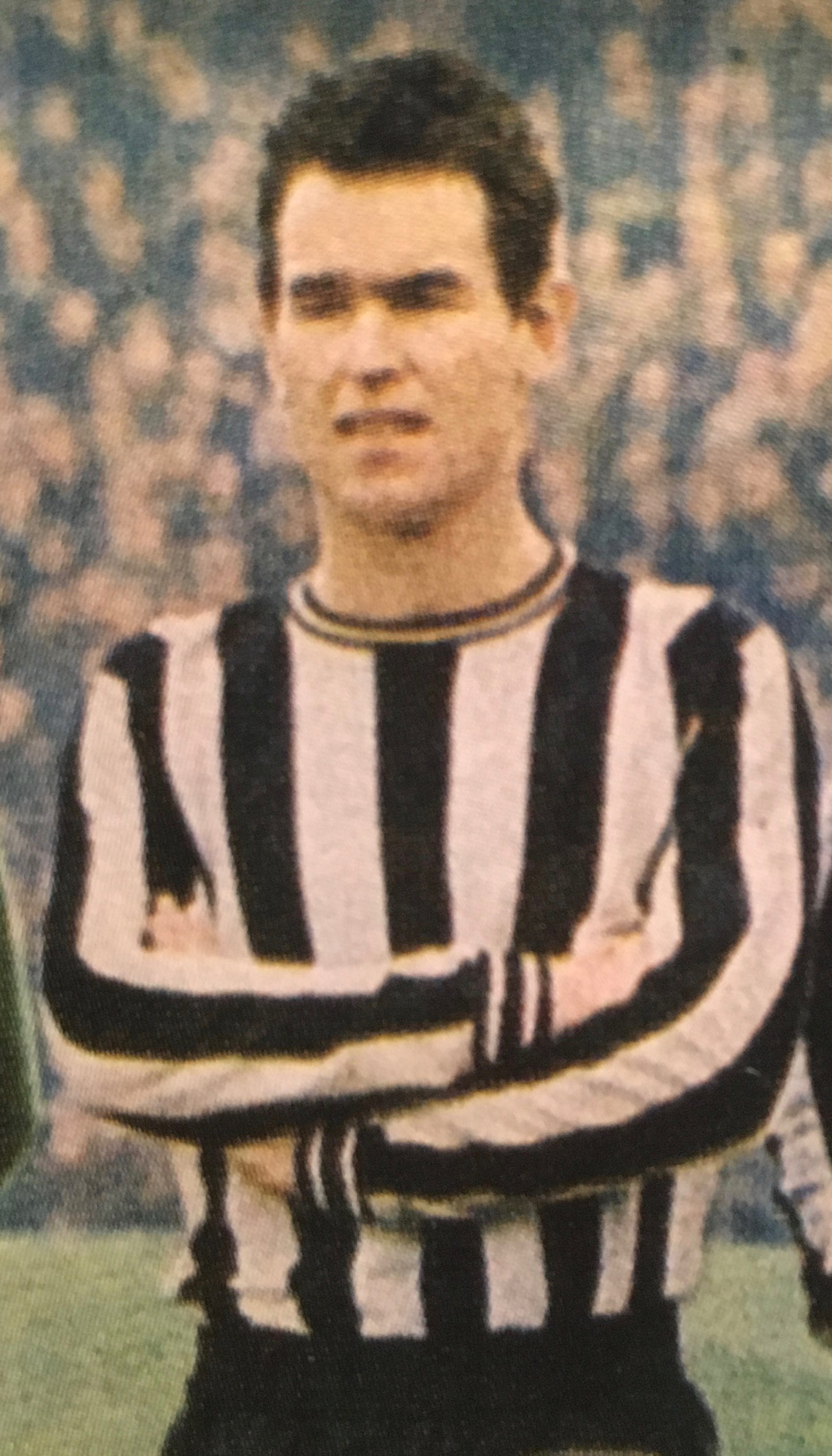
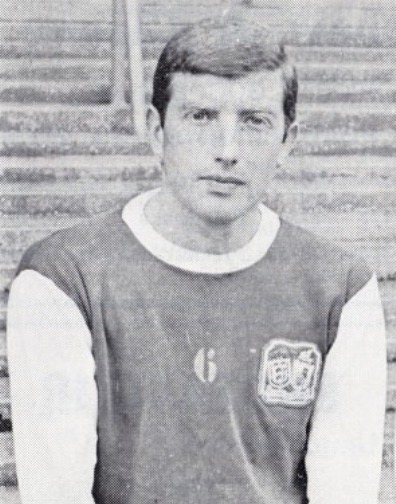
Joe Harvey eventually succeeded Charlie Mitten as manager as Newcastle adapted to life back in the Second Division, and McGrath (below left and, in team picture, back row, far left) played 16 matches in a side in which full-back George Dalton (below, back row, far right) had started to emerge.
Future Brighton captain Dave Turner was one of the successful FA Youth Cup-winning side Harvey inherited, but his first team outings were rare and he was sold to the Albion in December 1963.

Meanwhile, McGrath really established himself, featuring in 41 games in 1963-64 (Dalton played in 40) as Newcastle finished in a respectable eighth place.

The 1964-65 season saw McGrath ever-present as Toon were promoted back to the First Division, pipping Northampton Town to the Second Division championship title by one point. McGrath – “a monster of a centre-half, who was as tough as he was effective” was “the cornerstone” of the promotion side, according to newcastleunited-mad.co.uk.

McGrath retained his place in Toon’s first season back amongst the elite but the arrival of John McNamee and the emergence of Bobby Moncur started to restrict his involvement.

That pairing became Harvey’s first choice, and young Graham Winstanley was in reserve too, so, after playing only 11 games in the first half of the 1967-68 season, McGrath, by then 29, was sold to Southampton for £30,000. He’d played 181 games for United.

In Ted Bates’ Saints side, McGrath was a rock at the back alongside Jimmy Gabriel, although, as saintsplayers.co.uk records, he wasn’t too popular with opposing managers: Liverpool’s Bill Shankly accusing Southampton of playing “alehouse football”.

He went on to make 194 appearances (plus one as a sub) for Saints, before becoming youth coach at the club, part of the first team coaching staff when Southampton won the FA Cup in 1976, and then reserve team manager.

Not content with a backroom role, McGrath took the plunge into management and made his mark with two clubs in particular: managing Port Vale on 203 occasions and Preston North End in 205 matches.

According to Rob Fielding he became a cult hero at Vale Park with his unorthodox ways, once putting FIFTEEN players on the transfer list…which resulted in a six-match unbeaten run!

Winger Mark Chamberlain, who went on to play for Stoke and England, and later Brighton, was one of the young players McGrath introduced.

Long-serving Vale defender Phil Sproson, who was originally signed by former Albion midfielder Bobby Smith, rose to prominence under McGrath and said: “I’ll always be grateful because he taught me how to play centre-half.”

Fielding reckoned McGrath’s finest hour was steering Vale to promotion from the old Fourth Division in 1982-1983, even though by then he had sold Chamberlain to Stoke.

Against a backdrop of player unrest and what were perceived to be ill-judged moves in the transfer market, McGrath was sacked in December 1983 and replaced by his assistant, John Rudge.

He wasn’t out of work for long, though, and took the reins at basement side Chester City where he was in charge for just under a year. Most notably in that time, he gave future Arsenal and England defender Lee Dixon his first taste of regular football.

While success eluded him at Chester, his arrival at Preston in 1986 proved fruitful, North End striker Gary Brazil recalling: “It needed a catalyst and it needed a change and very fortunately for the club and for the players, John McGrath came walking through the door who was like a Tasmanian devil. He came in and the world changed really, really quickly for the better.”

McGrath led Preston to promotion from the bottom tier in 1987 with a squad built around Sam Allardyce and veteran Frank Worthington.
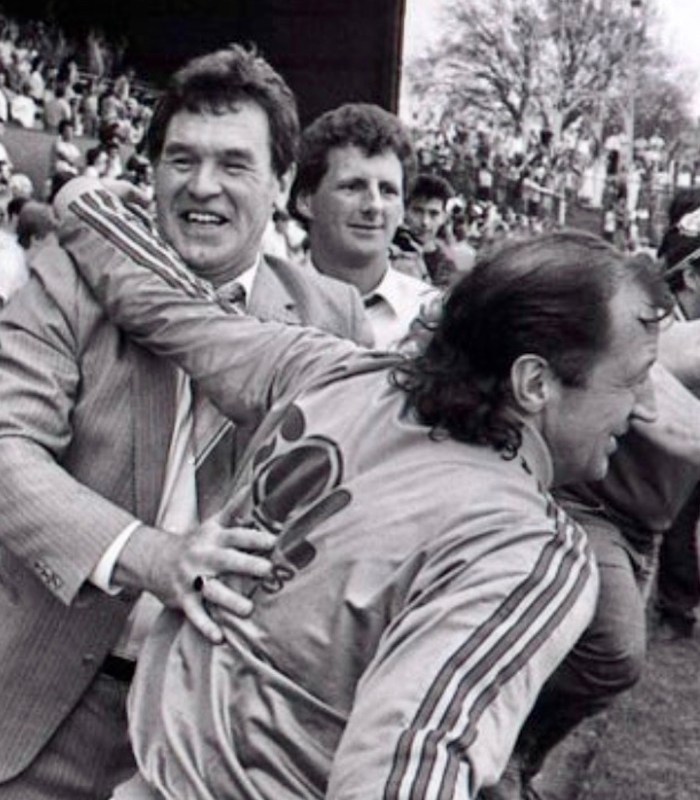
Manager McGrath and Frank Worthington celebrate promotion

“Frank Worthington was a delight to have around and set a real high standard for a lot of us in terms of how we train,” said Brazil. “He just stunned me how he was always first out training.”

The turnround McGrath oversaw, with Deepdale crowds rising from below 3,000 to more than 16,000, rejuvenated the club and the city.

Brazil reminisced: “It was the best year of my football life that year that we got promoted. It wasn’t just an experience playing but an experience of a group of players and how well they could bond and John was integral to that. He was a very, very clever man.”

Indeed McGrath was viewed as having saved North End from the ignominy of losing their league status, the club having had to apply for re-election the season before he arrived at Deepdale.

Edward Skingsley’s book, Back From The Brink, features a black and white photograph of McGrath on its cover and tells the story of North End’s transformation under his direction.

Describing his appointment as “a masterstroke” he reckoned the club owed him a massive debt for masterminding their resurgence and subsequent stability.

“Without him, it is debatable whether Preston North End would even exist today, never mind play in the latest fantastic incarnation of Deepdale,” said Skingsley. “Thank goodness he caught Preston North End before it died.”

McGrath left Preston in February 1990 and had one last stab at management, this time with Halifax Town. He succeeded Saints’ FA Cup winner Jim McCalliog and was in charge at The Shay for 14 months but left in December 1992. Five months later they lost their league status, finishing bottom of pile.

The silver-tongued McGrath was subsequently a popular choice on the after-dinner speaking circuit and a pundit on local radio in Lancashire but died suddenly on Christmas Day 1998.
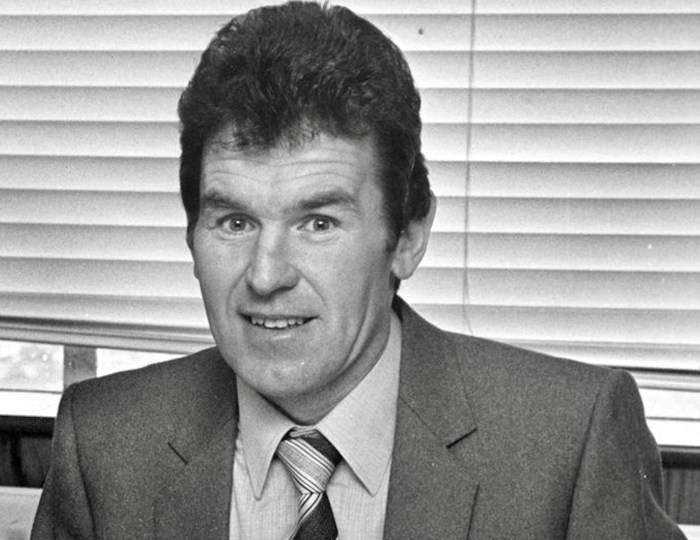
Knock-out stories of Mark ‘The Fizz’ Leather

MARK LEATHER spent six years as the first team physiotherapist at Anfield having previously been Brighton’s physio in the early days of Barry Lloyd’s reign as manager.

Leather tended the injured when Albion were promoted from the old Third Division in 1987-88 and half of the 1988-89 tier two campaign before moving back to his native north west.

Roy Evans added Leather’s specialist knowledge to the backroom team at Anfield in 1994 but the physio was controversially sacked by his successor Gerard Houllier following a row over the then teenage striker Michael Owen’s fitness.

A sign of the way Leather expected to work with managers came in an interview for Albion’s matchday programme. “Barry Lloyd will respect the decision if I say a player needs more time to get back to fitness,” he told interviewer Dave Beckett. “From that point of view, he is sadly in the minority.

“If it was different, I wouldn’t hang around, but it still amazes me that some clubs don’t realise that if we all stick to what we know things will run more smoothly.”

Leather, who’d spent three years studying for a diploma, and gained experience in the National Health Service, added: “We’re getting away from the old ‘bucket-and-sponge’ image.”

Ahead of his arrival at the Goldstone, Leather had combined his studies with helping out Exeter City, Leek Town, Port Vale and Sheffield Wednesday. And during the Commonwealth Games in Edinburgh in 1986, Leather provided specialist medical support for the weightlifters and wrestlers.

He revealed a funny story against himself in a matchday programme article. Asked to reveal his ‘most embarrassing moment’ he said: “During the Port Vale and Scunthorpe match in 1985, when Port Vale scored, I jumped up out of the bench hitting my head on the dugout roof and needed smelling salts and a cold sponge.”

Perhaps predictably nicknamed ‘The Fizz’, Leather sought to give an insight to his role in his matchday programme interview. “I try to be friends with all of the lads and the management too, but sometimes you really do have to sit on the fence,” he said.

“There’s pressure sometimes from both sides to say a player’s ready to return, but you have to stand back from the situation and give a professional opinion.”

The Albion gave him a regular slot in the matchday programme which he used to give readers updates on the progress of injured players, and in recent times he has become a regular source for the media seeking expert comments on football injuries.

Leather now has his own physiotherapy business and back in the day at Brighton he and his physiotherapist wife Lucy ran a sports injury clinic for the general public two evenings a week.

Born in Bolton on 24 June 1961, Leather left the Seagulls halfway through the 1988-89 season to return to more a familiar part of the country and took a job in the NHS in Chorley, Lancashire.

Leather had been an ardent Bolton Wanderers fan from an early age and his all-time favourite player was Frank Worthington, who had played for the Seagulls during the 1984-85 season.

When Evans stepped up to take charge of Liverpool, Leather was one of his first appointments (along with goalkeeping coach Joe Corrigan, whose playing career had ended with the Seagulls).

Leather and Corrigan together in Liverpool backroom team

An insight into Evans’ decision-making was given in the book Men In White Suits, by Simon Hughes. “With Mark Leather’s arrival, there was an end to the running repair jobs carried out by a succession of unqualified coaches mid game,” he wrote.

“Regularly injured players had long been treated with suspicion at Liverpool. (Bill) Shankly maintained his side were the fittest in the league, with pre-season geared towards building stamina and therefore preventing muscle tears.

“It was a difficult theory to argue against. Liverpool won the 1965-66 title using just 14 players all season. Anyone who suffered an injury was almost bullied into feeling better. ‘Otherwise you really were persona non grata,’ Alan Hansen said.

“Leather’s recruitment meant that (Ronnie) Moran could focus on drilling the first team in the Liverpool way rather than writing what Evans describes as ‘little scribbles’ on an old ledger, charting training patterns.”

Endorsements to Leather’s attributes appear on his website from the likes of Robbie Fowler and Jamie Redknapp, who is quoted as saying: “Mark Leather has been brilliant with me. He has kept me going and it’s because of him really that I’m back to full fitness as soon as I am.”

In 1999 media reports said Houllier was facing “a furious players’ backlash after his escalating row with Liverpool physio Mark Leather took a dramatic twist”.

Leather was left in the UK when Liverpool went to Oslo for pre-season games, a move which was said to be causing disquiet in the dressing room.

Leather clashed with Houllier over the condition of injured Michael Owen

“Leather is one of the game’s top physios and he was publicly praised by Robbie Fowler after helping the striker make a miraculous recovery from a cruciate knee ligament injury last season,” said one report in the Scottish Daily Record. “Other stars, including Michael Owen and skipper Jamie Redknapp, are known to have a close bond with the medic.”

Houllier was angry at the length of time it was taking for Owen to return to full training after a hamstring injury and sent him to a specialist in Germany for a course of treatment.

In 2013, when Owen’s many injuries finally forced him to his retire from the game, he recalled bad decisions in the past that ultimately affected his career.

“I was compromised because I played too much too soon as a youngster at Liverpool. In my opinion, had I been managed differently I would have been at my best for longer as opposed to being a better player,” he said in The Mirror.

“I basically run on two hamstrings on my right leg and three on the other. I lost a third of the power.

“If I hadn’t, 90 per cent of the other injuries wouldn’t have happened and I would have been the all-time leading scorer for England.”

The Mirror article continued: “If there was a defining moment in his career, then it was a snapped hamstring when his then-manager Houllier ignored the advice of his physio and insisted Owen be brought back from injury quickly because he needed his goal threat so desperately.

“The French coach fell out so badly with the physio, Mark Leather, he forced him out, but Houllier later admitted to the mistake, which Owen believes led to the moment that changed his career – on a cold March evening at Elland Road, Leeds, in 1999. ‘My hamstring snapped in two and it was at that point that my ability to perform unimpeded was finished,’ said Owen.

Leather wasn’t finished with football, however, and he moved to his beloved Bolton Wanderers as Sam Allardyce’s physio for a year, before joining former Trotter Peter Reid at the Stadium of Light.

“From a personal point of view, I’ve had the privilege of working with two guys I used to support from the terraces at Burnden,” Leather told the Bolton News ahead of a match between Bolton and the Black Cats in September 2001. “There’s only one team I’ve ever supported and leaving them last year was purely a professional decision,” he said. “Financially and from a facility point of view, it was the right move for me, but I’ll never stop supporting the Wanderers.”

Leather spent four years (2000-2004) as the head physio at Sunderland straddling the managerial reigns of Reid, Howard Wilkinson and Mick McCarthy.

It certainly wasn’t all plain sailing for Leather on Wearside, as the Republic of Ireland winger Kevin Kilbane, now a TV pundit on the BBC, mentioned in his autobiography (Killa: The Autobiography of Kevin Kilbane; Aurum Press Ltd, 2014).

The player was determined to play for his country but the physio obviously didn’t feel he should because he was still trying to recover from an ankle injury.

Leather had already put him through some tough routines to test the strength of his ankle and when they were then on opposing sides in a two-a-side hockey match, Leather caught Kilbane on the tender joint with his hockey stick.

“After a few times and much pain, I finally snapped, and I gave him a left hook and decked him, leaving him with a fat lip and a very surprised look on his face,” Kilbane admitted.

Although he told the assistant manager Bobby Saxton what had happened, nothing more was done about it. Kilbane said: “I later apologised to Mark Leather but was disappointed he didn’t reciprocate. Things were never right between us after that, although we didn’t let it interfere with our professional relationship.”

After Sunderland, Leather switched sports and took on a similar position with Wigan Warriors rugby league side before moving into the world of academia. He spent seven years at Edge Hill University as a senior lecturer in sports therapy and programme leader for the Football Rehabilitation MSc course.

In October 2006,Leather joined Chester City as club physio, with City chairman Stephen Vaughan declaring: “He is a fully qualified physio and has a wealth of experience at Premier League level, so it’s something of a coup to bring him to the Deva Stadium.”

In 2013, he returned to Bolton, spending three years as Head of Sports Performance.

He had also set up his own physiotherapy business in 2008 and, since 2016, has been a senior lecturer and course leader for the Football Science and Rehabilitation MSc course at the University of Central Lancashire.

• Pictures from the Albion matchday programme and various online sources.

The Harry Hotspur youngster who went west

MULTIPLE loans away from parent club Tottenham Hotspur didn’t succeed in laying a path to a top level football career for striker Jonathan Obika.

One of the last such arrangements saw the young forward spend three months with the Seagulls in the 2013-14 season.

Nathan Jones, no.2 to Brighton head coach Oscar Garcia, had seen what Obika could do when the young striker had been under him as a coach on loan at Yeovil and Charlton Athletic.

Unfortunately, his impact with the Seagulls was underwhelming even though he scored on his first (and, ultimately, only) full start in a 3-1 win away to Port Vale in the fourth round of the FA Cup.

Obika salutes his one and only goal for Brighton

Albion’s other goals that day, from Rohan Ince and Solly March, were also their first for the club – generating the statistic that it was the first Albion game in 110 years in which three players had scored their first goal in the same league or cup match.

It had been an amazing goalscoring performance for Spurs reserves that prompted Albion to make a move for Obika as cover for first choice Leonardo Ulloa, especially with Craig Mackail-Smith and Will Hoskins sidelined by injury and Ashley Barnes on the brink of a move to Burnley.

The Argus reported that Obika had previously been a target but a move had been put on ice because he’d been injured. His return to fitness saw him net a double hat-trick in a friendly for Tottenham against Charlton’s under-21s, watched by Jones.

“The report coming back on him after the game was one word – lethal!” former Seagulls goalkeeper Ben Roberts, then on the coaching staff at Charlton, told the Argus.

“Like Nathan, I worked with Jon at Yeovil and then at Charlton and he’s a really good pro,” said Roberts. “He is guaranteed to score goals. He is a real predator around the box.

Obika in action for Yeovil

“I’ve been waiting for his career to really kick off. When he came to us at Charlton it took him a couple of weeks to get up to speed. But he was brilliant for us. The end of the season came too soon for us.

“He is a great signing for Brighton and he will suit the way they play.”

However, Garcia also brought in Spaniard David Rodriguez at the same time and Obika found himself down the pecking order, especially when Manchester United loanee Jesse Lingard was added to the forward options.

The Vale cup game aside, Obika made just seven appearances as a substitute but didn’t add to the lone goal and was eventually recalled by Spurs and sent out on loan to Charlton again until the end of the season.

Nevertheless, Garcia said: “He came in to give us forward cover and, while he may not have played as much as he would have liked, he has been a great professional and a pleasure to work with.”

Obika’s long association with Tottenham finally came to an end in September that year when he headed west to League One Swindon Town, where he played for three years, scoring 28 times in 108 games for the Robins.

In 2017, he switched to Town’s rivals Oxford United on a two-year deal before then trying his luck in Scotland, playing in the Scottish Premier League for St Mirren.

On the expiry of that contract, Obika moved to League One Morecambe and, in January 2022, found himself back in the news ahead of this year’s FA Cup third round when Morecambe travelled to North London to take on the club who nurtured his early career for 13 years.

Although Morecambe took a shock first half lead against Spurs through defender Antony O’Connor, it wasn’t a fairytale ending as the Premier League side eventually won the tie 3-1 with three goals in the last 16 minutes of the game.

Obika had to watch from the bench until the 58th minute when he replaced Jonah Ayunga – a Brighton reserve player between 2016 and 2018 – with Morecambe still clinging on to their slim lead.

Born in Enfield on 12 September 1990, of Nigerian parents, Obika grew up in Edmonton and it was while playing football for his primary school, St Paul’s & All Hallows, that he was scouted by Tottenham.

“I lived five minutes from the stadium, so I used to walk to training as a 10, 11-year-old,” he said. “That was my only focus back then.” He later attended Bishop Stopford School in Enfield and left with seven GCSEs.

Originally a left winger, Spurs’ under 18s coach Alex Inglethorpe was responsible for moving him to play as a central striker and in the 2007-08 season he was top scorer for the Spurs academy side.

Those goals caught the attention of first team boss Harry Redknapp and he signed his first professional contract at 18, while a second-year trainee in the academy, and earned a call-up to the first team squad.

Wearing the number 80, he made his debut off the bench in a UEFA Cup game in Holland against NEC Nijmegen on 28 November 2008. A few weeks later, he made his first senior start in front of the White Hart Lane faithful, playing against Shakhtar Donetsk in the same competition.

“I didn’t know I was starting at the beginning of the game, there were a few injuries so a lot of the youth team players trained that week and we were in the squad,” Obika remembered.

When announcing the team, Redknapp actually read out his name as John Utaka, his former player at Portsmouth, amid much hilarity. “That broke the ice,” said Obika. “I was less nervous after that. I was more relaxed and actually ended up having a good game. To play at the Lane, having grown up down the road, was a great feeling and I had all my family and friends there that night.”

Along with Inglethorpe, the coaches who most influenced his development at Spurs were John McDermott and, when he progressed to the reserves, Tim Sherwood, Les Ferdinand and former Albion full-back Chris Ramsey.

Obika and fellow Spurs youngster Andros Townsend were sent out on loan to Yeovil – it was the first of four loan spells there for Obika – as recalled by Jones in an interview with coachesvoice.com: “A host of other clubs wanted them, but I think Harry saw two young kids who wanted to play, and he saw something in us as a coaching team.

“Townsend clearly had huge drive and ambition, and Obika scored the goals that kept us in League One that season – so we will always be thankful to Harry for that.”

Obika recalled: “While I was at Yeovil, Nathan Jones was my coach and I built up a good relationship with him. He would stay behind with me while I did extra shooting: he didn’t need to, I could have done it with other teammates, but he wanted to be there and help me progress and I really appreciated that. He is a good man. He also took me to Charlton for a loan spell and, of course, to Brighton.”

Obika also had loan stints at Millwall, Crystal Palace, Peterborough and Swindon although in the 2012-13 season he did manage to get two more games for the Spurs first team, featuring in the League Cup and the FA Cup.

He went on as a 75th minute substitute for Clint Dempsey when André Villas-Boas’ Spurs side beat Carlisle United 3-0 in the League Cup in September 2012, and was a 59th-minute substitute for Gylfi Sigurdsson when Leeds dumped Spurs out of the FA Cup 2-1 in a fourth round tie at Elland Road in January 2013.

Chirpy as a Canary but Mark Walton squawked as a Seagull

A CAREER highlight saw Welshman Mark Walton keep goal for Norwich City in a FA Cup semi-final in front of 40,000 at Hillsborough but his time with the Seagulls was marred by Brighton’s boo boys.

Walton’s first action in an Albion shirt was in front of only a few Albion followers because Brian Horton signed him in the summer of 1998 when the side was playing in exile at Gillingham’s Priestfield Stadium.

Walton, who’d been part of Micky Adams’ fourth tier Fulham promotion side in 1996-97, found himself out of favour at Craven Cottage once Kevin Keegan had been installed as manager following the club’s takeover by Mohamed Al-Fayed.

Not wishing to play second fiddle to Northern Ireland international Maik Taylor, Walton moved for £20,000 to Brighton, who were a ‘keeper light after Nicky Rust’s departure to Barnet. Walton was Horton’s first choice between the sticks in the opening 16 games of the season.

“When Maik arrived, it was a matter of when I went rather than anything else,” he told fulhamfocus.com.  “I was at a stage in my career that I just wanted to play, so moving was a necessity. In retrospect, I probably should have thought harder about my decision to join Brighton.”

After he’d shipped six goals in two successive 3-1 defeats in October, young Mark Ormerod took over and kept the ‘keeper’s jersey until Horton quit to take over at Port Vale shortly into the new year.

Caretaker boss, Jeff Wood, who’d been a goalkeeper himself, reinstated Walton to the starting line-up for five matches, but he damaged a hamstring in a 3-0 defeat at Southend on 20 February and didn’t play again that season.

Walton must have been encouraged when his old boss Adams took over from Wood, and he shed a stone and a half during the summer to get back into shape. Although Ormerod started the first five games of the new season back in Brighton, Walton was then reinstated as first choice ‘keeper.

But a gaffe — wearebrighton.com recounted how Walton’s attempted clearance from a back pass cannoned into the back of Paul Watson and into the net for an own goal — as Albion succumbed 3-2 to previously winless Chester City on 18 September (despite a goalscoring debut for Danny Cullip) saw feelings running high.

Adams had the players in for an extra training session the following day and Walton was dropped for the next match. Before the month was over, he submitted a transfer request citing the stick he was receiving as his reason for wanting to go.

“It’s one of those things you cannot really do too much about,” he told The Argus. “I am not the first and I won’t be the last. Everybody hears it. It’s just general abuse from boo boys and it’s the same home and away.

“It is obviously not the best feeling in the world, but you are paid to do a job and you go out and give your best.”

The manager was clearly upset that Walton felt he had to leave because of criticism from supporters.

“I’m immensely disappointed that a boy has come in to see me and wants to leave the club because he feels he is not being given a fair crack of the whip by the fans,” Adams told The Argus. “I am disappointed it has come to this and that he feels he has got to bow to fan pressure.

“Mark is a great lad. Whichever eleven lads I put out on the pitch in the blue and white stripes, they are representing Albion and the fans have got to get behind them. They are going out to give their best for the supporters and the club.”

Support came too from part-time goalkeeping coach John Keeley, who said: “Mark looks ever so fit now and the way he has trained and looked after himself in the summer shows he wants to prove to people he is a good goalie.

“As a goalkeeper you want the crowd on your side because it gives you a certain amount of confidence, especially when you are playing at home.”

Adams showed his faith in Walton by restoring him to the starting line-up and he was rewarded for his loyalty by two shut-outs on the road as Albion drew 0-0 at Peterborough and beat Carlisle United 1-0.

The matchday programme noted of the big ‘keeper’s performance at London Road: “Walton didn’t put a foot, or should that be hand, wrong during the 90 minutes, prompting praise from supporters, who chanted his name at the final whistle.”

Adams added: “Mark was terrific. I cannot speak highly enough of him. He is a good, honest pro and he answered his critics.”

Walton collected a player of the month award for conceding only one goal in five matches during October. He kept the shirt for the rest of the season, only missing two games towards the end, and playing a total of 45 games.

But the last-day 1-0 home win over Carlisle United turned out to be his last for the Seagulls. It was reported he’d verbally agreed a new contract but just before the start of the new season he chose to move on to Cardiff, along the road from where he was born in Merthyr Tydfil on 1 June 1969.

As it turned out, the move worked out well all round because Walton helped the Bluebirds win promotion from Division Three as runners up behind the Seagulls in top spot, Adams having unearthed a more than capable replacement in Michel Kuipers.

In an interview with Dan Smith in 2018 for fulhamfocus.com, Walton explained how his footballing life began at South Wales valleys village side Georgetown Boys Club and, because he suffered from severe asthma when he was 12, he decided it would be better to play in goal than in an outfield position. He was inspired by Phil Parkes of West Ham, Jimmy Rimmer of Aston Villa and Everton’s Neville Southall.

Walton played youth team football for Swansea City but his first senior professional club was Luton Town, where he spent six months. With the experienced Les Sealey and Andy Dibble ahead of him, he wasn’t able to break through to the first team. He moved initially on loan to Colchester United, managed by Mike Walker, who’d previously kept goal for the Us after a distinguished career at Watford.

Walker gave him his debut at Layer Road as an 18-year-old in August 1987 and he went on to make a total of 56 appearances for United, having moved permanently for £17,500 in December 1987, by which time Roger Brown was in charge.

Walker, meanwhile, had moved on to take charge of Norwich’s reserve side and, on his recommendation, City signed the Welsh goalkeeper for £75,000 in 1989.

“I owe Mike Walker a debt of gratitude to this day, as he basically taught me from scratch and helped develop me into a solid keeper with a sound technique,” Walton told Ed Couzens-Lake in a 2013 article for myfootballwriter.com.

Walton spent most of his three years at Carrow Road as understudy to first choice Bryan Gunn. It was because of a serious back injury to Gunn that Walton found himself facing Sunderland in the 1992 FA Cup semi-final, when a single goal from John Byrne settled the tie.

Looking back on his time with the Canaries, Walton told Couzens-Lake: “I loved my football and I loved Norwich, and, for me, it is still ‘my club’. The camaraderie of the dressing room was fantastic – indeed, whilst I don’t miss playing one bit, I do miss the changing room banter, all the characters, bad and good, and those shared triumphs, disasters and the shared sense of humour.”

The admirable Flown From The Nest website notes Walton made 28 appearances for the first team and 114 for their reserves. He had loan spells with Wrexham and Dundee United, trials with St Johnstone and West Ham, but it was Bolton Wanderers during Bruce Rioch’s reign that he next saw first team action, playing three games for the Trotters.

After his release from Norwich, a bizarre series of circumstances which he explained to fulhamfocus.com saw him spend two years out of the game before a Fulham fan, who was a member of the Norfolk cricket club he’d been playing for, wrote to Adams and suggested he give Walton another crack at league football.

“Micky telephoned and invited me for a trial. After three weeks, I was offered a year’s contract,” he said.

When ousted by the upheaval at the Cottage, Walton went on loan to Gillingham in March 1998 but couldn’t agree terms for a permanent move and on transfer deadline day ended up back at Norwich on loan as cover for Andy Marshall.

After his stint with the Albion and initial success at Cardiff, Walton slipped down the pecking order and briefly tried his luck with a semi-professional side in Melbourne, Australia.

He returned to South Wales after retiring from playing and went on to gain a first-class sports psychology degree at Cardiff Metropolitan University, a Masters degreeand a Postgraduate Certificate in Education (PGCE) which led him to become a teacher for 10 years.

He also worked for Cricket Wales as a researcher and community coach and in January 2021 joined the cricket staff of Glamorgan.

“Cricket has always been a passion of mine,” he told his new employers’ website. “I’ve always played but that became more sporadic when I focused on football, but I always tried to sneak in the odd game here and there which was often in midweek.

“I played some league cricket in Norfolk, Essex and Wales and was able to represent Wales Minor Counties. Then about 20 years ago I fell into coaching and it’s prospered from there and I’ve coached every age group within Cricket Wales.”

• Pictures from the Albion matchday programme and online sources.

Eventful Albion stopover for on-loan Calvin Andrew

JOURNEYMAN striker Calvin Andrew is unlikely to forget his eventful months playing for the Seagulls on loan from Crystal Palace.

The Luton-born forward got off to a great start in January 2009 when he scored a 90th-minute winner on his debut for the Seagulls.

In only his fourth game, he damaged a hamstring against his hometown club – a match that turned out to be the last for the manager who’d brought him in on loan.

While Andrew was back at Selhurst Park recovering from the injury, a new boss – but familiar face – took charge at the Withdean.

Andrew rejoined the Seagulls but couldn’t force his way into the starting line-up because Lloyd Uwusu had arrived to take centre stage. However, the loanee scored two vital goals in Albion’s ‘Great Escape’ when going on as a substitute.

To cap it all, in the nail-biting last game of the season, when Brighton just preserved their League One status with a 1-0 win over Stockport County, Andrew suffered a horrific injury which sidelined him for six months.

Andrew, who had lost his place at Palace after picking up an injury at the start of the season, had joined the Seagulls as part of a major January transfer window overhaul Micky Adams oversaw in an attempt to revive the club’s flagging League One fortunes.

When he signed, Adams said: “Calvin is a young centre-forward and will complement our existing forwards by giving us an added physical presence up front.

“He is over six-foot tall and the type of striker who makes things happen and can be a real handful for opposing defenders.”

The player himself, who had only joined Palace the previous summer for a £30,000 fee, said: “I went there and at the start of the season I was playing games and I was doing well. But then the situation changed. I got injured and since then I haven’t been able to get back in the team.

“The team has been doing really well and it’s totally understandable from my point of view. Neil Warnock still rates me highly, but he wants me to go out and get some games and get myself ready for when my chance does come.

“It was quite an easy decision. There were a few clubs in for me, but Brighton is relatively close to where I’m living so it was an easy choice. It’s a good club.

“I didn’t know any of the players, but I knew the manager. He’s a great manager and I’m looking forward to playing for him. Everybody knows about Nicky Forster. He’s an experienced player and there’s always something to learn as well as forming a good partnership.”

With Forster scoring Albion’s first against Hartlepool United at the Withdean on 31 January 2009, the script looked like it had been perfectly written when Andrew netted a winner in the last minute to seal a 2-1 victory.

Unfortunately, successive home defeats – 4-2 to Peterborough United and 2-0 to Carlisle United – in five days followed by elimination from the Johnstone’s Paint Trophy at Luton the following week was too much for Adams to stomach and he decided to quit after meeting chairman Dick Knight the day before the next match, which ironically saw Albion win 1-0 at Millwall.

Andrew wasn’t involved because he’d picked up a hamstring injury at Kenilworth Road, a ground where he’d made a first team debut as a 17-year-old in the 2004-05 season. Born in Luton on 19 December 1986, Andrew was a prolific goalscorer as a youth player at his hometown club.

When he was sent out on loan to gain experience at League Two Grimsby Town in 2005, he played nine matches under manager Russell Slade.

And it was Slade who was parachuted in at the Withdean to try to steer Albion away from the League One relegation trapdoor in the Spring of 2009.

Even though Albion picked up only four points from Slade’s first seven games in charge, the former Yeovil boss slowly turned things around with four wins in the next five games to lift the Seagulls out of the bottom four.

Andrew spoke about the change in fortunes in an Argus interview. He told reporter Steve Hollis: “We have shown different qualities which I don’t think we had when I was at the club before my injury. There is some real resilience now.

“I know Russell Slade quite well and he asks all of his teams to show some grit when the going gets tough. He demands you stick in there when you are struggling and to keep going.”

Andrew was buoyant having headed the winner from Gary Hart’s cross in the 52nd minute at Bristol Rovers after leaving the bench before half-time to replace the injured Dean Cox.

“That was a big goal,” he said. “It was important for me because I am coming back from injury but it was more important for the club and the town.

“I usually hang around the back post when I am playing on the left but Dean White told me to get into attacking positions and it was a cross you dream about from Hart.”

He told Hollis: “When I initially had the injury, my fear was that I wouldn’t play again this season. I had a very bad tear in two places in the hamstring and was told it would take a very long time to repair.

“Fortunately, I seem to recover pretty quickly, and I am glad because I want to play a part in helping Albion stay up. It means a lot for me that Brighton stay up, even though I am only on loan.

“I have been made to not only feel part of the team but part of the town and it would be awful to go down.

“The supporters have been great and welcomed me even though I am from a rival team, so it is my duty to give 110 per cent. Just because I am on loan doesn’t make any difference.”

Andrew had to contend himself with another appearance from the bench in the following match but, again, he made a positive impact after replacing Hart, who limped off injured after only nine minutes of the game at Huddersfield.

The young striker levelled up the game after Town had taken the lead and Owusu continued his purple patch of form by netting a second equaliser to give Albion a share of the spoils.

Palace boss Warnock had been contemplating recalling Andrew but was told he would start in Albion’s crunch final home game against Stockport County. In fact, Slade once again opted to use Gary Hart in the starting line-up instead but Andrew was sent on in injured Hart’s place after only 17 minutes and went close to breaking the deadlock with a header that hit the top of the bar.

Forster, who had also been troubled by injury throughout the season, had to replace Andrew for the second half because he picked up an anterior cruciate knee ligament injury which ultimately prevented him playing for six months.

It wasn’t until October 2009 that Andrew got back playing for Palace reserves, and their assistant manager, Mick Jones told the club’s website: “Calvin played for half-an-hour on Monday. He is miles ahead of schedule following one of the worst injuries I have ever seen.”

The 2009-10 season saw Palace in all sorts of trouble: going into administration, Warnock departing as a result, Paul Hart taking over as manager, and the side only narrowly avoiding relegation. Andrew got 13 starts as Palace battled at the wrong end of the Championship, but he was more often a substitute, coming off the bench on 19 occasions.

With game time limited under new boss George Burley the following season, Andrew once again went out on loan: briefly to feature in three games for fellow Championship side Millwall in November, and in the New Year to League One Swindon Town, where his old Palace boss Hart was in charge.

Although he was involved in the Palace set-up at the start of the 2011-12 season, by the following March he went out on loan again, this time reuniting with Slade at Leyton Orient. He only started two matches, though, and didn’t score in any of the 10 games played while he was at Brisbane Road.

At the end of the season, Palace boss Dougie Freedman didn’t offer Andrew a new contract. His next stop saw him link up with League Two Port Vale on a two-month deal under former Albion boss Adams.

While he managed to earn a contract until the end of the season, he only started eight matches and was used as a substitute on 15 occasions.

With no new deal in the offing, he then switched to another League Two side, Mansfield Town, for the first part of 2013-14 before joining York City in the closing months.

It was in the summer of 2014 that he finally found a more permanent berth, at Rochdale, who’d been newly promoted to League One.

In six seasons at Spotland, Andrew scored 28 goals in 231 appearances and over four years was recognised as a ‘community champion’ for the amount of work he did in the local community, including school visits and involvement with the club’s women’s teams. In 2020, he was declared the League One PFA Community Champion.

One blot on his copybook came in 2016 when he was handed a 12-match FA ban (later reduced to nine games) after video evidence found him guilty of elbowing Oldham’s Peter Clarke in the face in an incident the referee missed.

After leaving Rochdale, he didn’t get fixed up with a new club until March 2021, when he joined Barrow AFC until the end of the season.

Pictures from matchday programmes.

Boss feistily defended crowd-heckled Bobby Smith

B Smith white actionTOUGH-TACKLING midfielder Bobby Smith made more than 200 appearances for Manchester United’s reserve side.
He played alongside emerging talents such as George Best and Nobby Stiles but wasn’t able to follow them in making the step up to the first team.

Like many before and since, he had to look elsewhere to establish a career in the game, and 85 of his 307 senior career appearances came in the colours of Brighton & Hove Albion, the fourth of seven clubs he served as a player.

Smith stayed in the game as a manager and coach for 26 years after hanging up his boots, his most notable achievement coming in December 1979 as boss of Third Division Swindon Town when they overcame the mighty Arsenal in a thrilling League Cup quarter final.

Born in Prestbury, Cheshire, on 14 March 1944, Smith won six England Schoolboys (under 15s) caps, playing right-half with future World Cup winner Martin Peters playing on the left.

He went on to win two England Youth caps: on 9 March 1961, he was in an England side (which also included John Jackson in goal and future Luton and Spurs boss David Pleat) that lost 1-0 to the Netherlands in Utrecht and three days later was again on the losing side, this time 2-0, to West Germany in Flensburg, when teammates included John Milkins, Portsmouth’s ‘keeper for many years, and striker John O’Rourke, who played for various clubs. Smith turned professional with United the following month.

MUFC REs v WBA

I’ve discovered an old programme (above) for a Man Utd reserve fixture against West Brom during that era. It shows Smith alongside Wilf Tranter (who also later played for Brighton, and was Smith’s assistant manager at Swindon), Nobby Stiles in midfield, and George Best on the left wing.

In 1964, when a first team call-up continued to elude Smith, he lowered his sights and went to play for a former United colleague at Scunthorpe United. That colleague was Freddie Goodwin who would later be his manager at Brighton as well.

At Scunthorpe, Smith finally saw league action and played 87 games in two seasons before being transferred for £8,000 to Grimsby Town. In two years with the Mariners, he played 56 games before joining the Albion in June 1968.

My distant memory of Smith was of a tough-tackling midfielder who was in the shadow of the likes of Nobby Lawton and Dave Turner when it came to his popularity with supporters. And manager Goodwin hit back strongly when a section of fans voiced their disapproval of the player.

Smith scored the only goal of the game after only 50 seconds away to Stockport County on 23 January 1970, but in the previous home game (a 2-1 win over Bradford City) there had been a few shouts from the terraces in Smith’s direction.

In his weekly article for the Brighton and Hove Herald, Goodwin said: “I was most disappointed to hear certain sections of the crowd getting at Bobby Smith.

“He has done nothing to warrant this behaviour. He is a 90-minute aggressive player and his value to the team lies in his ability to win the ball from the opposition.

“He is well aware of his limitations as a player, but there is no-one who can accuse him of ever giving less than 100 per cent.

“This sort of behaviour by a small minority of spectators does nothing to help the team or the individual players.

“Any player who takes the field as a representative of Brighton and Hove Albion does so because he has been selected for the team by me.

“It is my responsibility that a player represents the Albion. So, to barrack any player is most unfair to him.”

Smith in action against the backdrop of the packed East Terrace at the Goldstone. Albion won 4-0

His 85 games for the Albion came across three seasons: 33 in 1968-69 and 26 in each of the following two seasons. Goodwin’s successor, Pat Saward, released him at the end of the 1970-71 season, and, in June 1971, he went on a free transfer to Chester City.

After only four months in the North West, he switched to the North East, joining Hartlepool United, initially on loan. Over two years, in which Len Ashurst’s side only just avoided the old re-election places, Smith played in 76 matches before moving on to Bury in August 1973. He signed as a player-coach but didn’t feature in the league side, instead taking over as manager – aged only 29 – from Allan Brown in December 1973.

It was the start of a coaching and managerial career that would span more than a quarter of a century.

He took Bury to promotion from the fourth tier by the end of that 1973-74 season, and remained in charge for just under four years, He was at the helm for a total of 215 games; the record books showing he achieved a 41.9 per cent win rate.

A six-month stint followed at Port Vale, between November 1977 and May 1978, but, of his 33 games in charge, he only presided over six wins (there were 14 draws and 13 defeats).

Swindon paid £10,000 compensation to lure him to the County Ground, where, as mentioned, his assistant manager was the aforementioned Tranter.

The official Swindon website remembered: “Despite being a relatively young manager, he guided Swindon to a promotion challenge in his first season in charge – missing out by three points, after losing the last two games of the season.”

Part of the secret had been Smith’s signing of strikers Andy Rowland and Alan Mayes.

Swindon w BS WTSmith (far right) as manager of Swindon, with Tranter (far left), Chris Kamara (circled back row) and skipper Ray McHale (centre front row).

His major achievement came the following year, when Town beat Arsenal 4-3 in a replay to reach the League Cup semi-final.

When one considers the size of League Cup game crowds now, it seems extraordinary to discover around 7,000 Swindon fans (in a gate of 38,024) had made the trip to Highbury for the initial tie, which finished 1-1.

The Gunners had famously lost to lowly Swindon in the 1969 League Cup Final at Wembley, so the humble Wiltshire club smelled history repeating itself.

In the replay, with 21,795 packed into the County Ground, Steve Walford and John Hollins scored own goals and future Brighton manager Liam Brady scored twice for Arsenal. One of the key players for Swindon was future Sky Sports reporter Chris Kamara.

Striker Rowland, who scored an extra time winner, relived the momentous occasion in an interview with SwindonWebTV.

Smith on Focus

Unsurprisingly, the giant killing attracted plenty of media attention and Smith was interviewed live on Football Focus by presenter Bob Wilson.

Smith pointed out that his side had been well grounded and, after the initial draw against Arsenal, had thumped his old club Bury 8-0, equalling Swindon’s biggest winning margin in a league game. Amongst the scorers were Rowland and Billy Tucker – two of four ex-Bury players in Swindon’s starting line-up. Another was Brian Williams – Bury’s youngest ever player – and one of the other goalscorers, Ray McHale, (later to play for Brighton in the top division) went on to have a loan spell at Gigg Lane later in his career.

The Robins beat top-flight opponents Wolverhampton Wanderers 2-1 at home in the first leg of the semi-final but went down 3-1 at Molineux in controversial circumstances, Wolves scoring the decisive goal five minutes from the end.

“We were so unfortunate because Wolves should have been down to 10 men,” Kamara told the Swindon Advertiser. “Alan Mayes got hit by the goalkeeper (Paul Bradshaw). He came out of his goal, didn’t get anywhere near the ball and he clattered Alan and broke his two front teeth and his nose but didn’t get sent off.

“I know everyone looks at situations and says ‘You were unlucky’ but that was a turning point in the game, and we ended up losing.”

It later emerged that the tie could have had a dramatic impact on Kamara’s playing career. In a 2010 interview with FourFourTwo magazine, he explained how he was once on Manchester United’s radar during Ron Atkinson’s reign.

“I was at Swindon and my manager Bobby Smith said, ‘Big Ron’s coming to watch you.’ We were playing in the 1980 semi-final of the League Cup against Wolves, but I had the ’flu and didn’t play so well. I’m not saying that’s the reason he didn’t sign me, but Ron went back to his old club, West Brom, and signed Remi Moses instead.”

With the benefit of hindsight, the cup run took its toll on the Swindon side. Before the semi, they were just five points from a promotion place, with four games in hand. But only five of their last 18 games were won, and they lost nine away games on the trot, resulting in a disappointing 10th place finish.

Smith had spent large –  by Swindon’s standards –  including £250,000 on two players, David Peach and Glenn Cockerill, both of whom never fitted in at the club.

When Swindon lost their first five matches of the 1980-81 season, Smith was relieved of his duties.

He later took charge at Newport County and Swansea City, as well as coaching at the Swans, Blackpool, Cardiff City, and Sheffield Wednesday, together with a spell as assistant manager of Hereford United.

He was assistant manager to Frank Burrows at the Vetch Field but when the chairman at the time announced his intention to sell up, and no funds were being made available for new players, Burrows left of his own accord and Smith became caretaker manager.

Contributor Colin_swansea, on the fans website scfc2.co.uk, observed: “After Tosh left we had caretakers Doug Livermore for 30 days, Les Chappell for 23 days prior to Tosh returning, and after Tosh had left for a second time on the 5th March 1984 Les returned as caretaker until the end of the season.

“Our manager’s position was even more farcical after Frankie Burrows left with his assistant Bobby Smith taking over until a bust up during the Xmas period when Doug Sharp wouldn’t sanction the buying of rubber studded boots to combat the winter conditions.

Smith interviewed after his Swindon side held Spurs to a 0-0 draw in the FA Cup

“Smith left on 22 December 1995, Jimmy Rimmer was caretaker to 7 February 1996, Kevin Cullis became manager for a week, a two-game spell of two defeats, Rimmer returned for eight days as caretaker, before Jan Molby’s appointment on 22 February 1996. Molby’s replacement as manager on 9 October 1997 was Micky Adams who lasted 13 days and three league defeats with his assistant Alan Cork taking over until the end of the season.

“Cork didn’t fit the profile for the club’s new owners, Silver Shield, and he was offloaded at the end of the season. Ironically his successor, John Hollins, didn’t sign one player the following season when the club reached the play offs.

“Never a dull moment being manager of the Swans during the 80s and 90s!”

One-goal striker Craig Davies a Seagulls flop

THE PHRASE ‘journeyman striker’ sits perfectly with Welsh international Craig Davies who, despite success later in his career, fired blanks for Wolverhampton Wanderers and Brighton.

To use that rather amusing, though well-worn phrase, he couldn’t hit a cow’s arse with a banjo during his time with the Seagulls.

He arrived on the south coast in January 2009 during Micky Adams’ second, unsuccessful, spell in Albion’s managerial chair.

Oldham Athletic received a reported £150,000 for his signature and, in 23 games for Brighton, he managed just the one goal – on his debut!

That strike came at Withdean – the opening goal in what ended up a 4-2 defeat to Peterborough United (for whom a certain Craig Mackail-Smith equalised).

When a 4-0 home thrashing by Crewe Alexandra meant it had been six games on the trot without a win, Adams was fired by Dick Knight at a Little Chef on the A23. He’d managed just seven wins in 34 matches, and ‘fireman’ Russell Slade arrived just in time to rescue the Seagulls from the League One relegation trapdoor.

Many different striker permutations were tried that season, with main men Nicky Forster and Glenn Murray sidelined by injury, and Albion’s survival was largely due to the goals of loan arrival Lloyd Owusu. Davies huffed and puffed but simply couldn’t make a meaningful connection when the goal beckoned.

Typical of the fans’ eye view was this observation by wearebrighton.com: “That Adams actually paid money for Craig Davies remains one of the more startling moments of his reign of terror.

“Rarely has a Brighton player enraged the Seagulls support like Davies, a man who mixed incompetence – such as the ability to put the ball over the bar when faced with an open goal three yards away – with a complete lack of effort.”

There had been such promise on his arrival, with chairman Dick Knight telling the matchday programme: “Craig is an exciting player with loads of potential, he is lightning-quick and his direct approach can be a nightmare for defenders. This is a major career move for him and he has every chance to be a crucial part of our future.”

Davies himself clearly thought he’d finally found a place to further his career, saying: “I’ve had a few ups and downs through my career but hopefully now I can get settled at Brighton and start knocking in the goals here.

“The gaffer seems to have a bit of faith in me so hopefully I can repay that by putting in some performances and getting a few goals.”

Albion cut their losses on Davies and loaned him to Yeovil Town (he didn’t score in four games for them, either) and then Adams re-signed him, this time for League Two Port Vale, where he finally managed to find the back of the net again.

In the summer of 2010, Davies came to a mutual agreement to end his Brighton nightmare and he joined League Two Chesterfield, from where his career began an amazing upward trajectory.

Born in Burton-upon-Trent on 9 January 1986, Davies began his career as a schoolboy at Shrewsbury Town, but did his apprenticeship at Manchester City. In August 2004, he moved on to League Two Oxford United, where he made his league debut the same month in a 1-0 win at Notts County.

In two seasons with Oxford, managed by former Ipswich and Arsenal midfielder Brian Talbot, he scored eight times in 55 appearances. In the summer of 2005, he made his debut for Wales (qualifying because he had a Welsh grandfather) as a substitute in a 0-0 draw v Slovenia. Reports linked him with a move to Premier League Charlton Athletic, but nothing came of it and instead, in January 2006, he moved to Italy to join Hellas Verona for a £85,000 fee.

It proved to be too big a step for someone who was then only 20, and he referred to feelings of homesickness in an interview with the BBC.

Remarkably, Davies hit the headlines in May 2006, when in the sixth of seven games he played for the Wales under-21 side (which featured Gareth Bale, Andrew Crofts and Arron Davies) he scored a hat-trick in a 5-1 win over Estonia, and it earned him a recall to the full international side.

Wales under-21 manager Brian Flynn told the BBC: “Craig has sometimes been frustrating to watch, but he has skill and we will help him, and them all, to flourish.”

Davies hoped the international goals would attract a club to rescue him from Italy. “I have found it very hard to settle in Italy,” he told the BBC. “Verona want me to come back and have a year on loan somewhere and then they will look at the situation again when I have a bit more experience.”

It was Wolves, then in the Championship, who offered him a lifeline back in the UK and he moved to Molineux on loan, playing 23 games, mainly in the first half of the 2006-07 season.

The only goals he scored for Wolves both came in a FA Cup tie against Oldham Athletic who, ironically, turned out to be his next club. He joined them for an undisclosed fee from Hellas in June 2007.

Davies netted 13 times for a League One Latics side in 2007-08 but, after a 10-game barren spell the following season, he was sent on loan to Stockport County where he scored six times in 13 games, including bagging a hat-trick against Bristol Rovers, and scoring a penalty against Albion as County won 2-0.

When Adams rescued Davies from his Seagulls horror spell, he was rewarded with seven goals in 24 matches for League Two Port Vale between January 2010 and the end of the season.

Chesterfield stepped in to sign him on a one-year deal for the 2010-11 season – and he was promptly sent off in his first competitive game for the Spireites!

Things did get much better, though, and he ended the season with 25 goals to his name, Chesterfield were promoted, and Davies was chosen in the divisional PFA select team for the season.

Such success drew attention from other clubs and he opted to join Championship side Barnsley under Keith Hill. He struggled to find the net in the opening nine matches but eventually finished the season with 11 goals in 42 appearances.

In September 2012, Davies scored FOUR goals in the space of 19 minutes in a 5-0 demolition of Birmingham City at St Andrews and, with nine goals in 22 appearances to his name in the first half of the 2012-13 season, Bolton Wanderers came forward with a £300,000 bid to take him to the Reebok Stadium.

He scored four goals in 18 Championship games for Wanderers but another of his barren spells struck in the opening half of the following season. Wanderers loaned him to League One Preston and he got a goal on his debut as well as a hat-trick in a 6-1 thrashing of Carlisle United. North End reached the play-offs, and Davies made his way back to Bolton having scored five in 15 games.

Hamstring injury issues plagued him in 2014-15 and manager Neil Lennon released him at the end of the season.

He didn’t have far to travel for his next port of call when newly-relegated Wigan Athletic offered him a two-year contract. He only scored twice in 30 appearances, but Wigan won promotion as League One champions.

With just one goal in 14 Championship games in the first part of the 2016-17 season, Davies was on the move again, this time linking up with League One Scunthorpe United until the end of the season. Cue another barren spell: no goals in 21 games.

The 2017-18 season saw Davies return to his old club, Oldham Athletic, and despite scoring 14 goals in 44 appearances, could not prevent the club being relegated to League Two. Davies had strong views about the ownership of the club as he departed for Mansfield Town.

He signed a two-year deal with the Stags, but injury curtailed his involvement in 2018-19.

C Davies Wales

Two goals that etched Sammy Morgan’s place in Albion history

HAVING A cheekbone broken in four places during a pre-season friendly summed up the bad luck of never-say-die Northern Irish international striker Sammy Morgan.

His cause wasn’t helped when the manager who signed him six months earlier quit. And, to top it off, while he was recovering from that horrific injury, an Albion footballing legend in the shape of Peter Ward burst onto the scene.

When a £30,000 fee brought him to Brighton from Aston Villa just before Christmas 1975, it looked like the side had found the perfect strike partner for Fred Binney as they pushed for promotion from the third tier.

Unfortunately, the man with the swashbuckling, fearless approach went eight games without registering a goal. However, in his ninth game he made amends in memorable fashion.

Morgan scored both goals in a 2-0 win over Crystal Palace in front of an all-ticket Goldstone Ground crowd of 33,300 – with another 4,000 locked out.

It was 24 February 1976 and the Daily Mail’s Brian Scovell reported the goals thus: “In the 12th minute, Ernie Machin struck an early ball into the middle from the right and Ian Mellor headed on intelligently behind the defence for Morgan to steer the ball into the corner of the net.

“The second goal, in the 55th minute, came when Tony Towner took the ball off Jeffries and set off on a 40-yard run which ended with his shot rebounding off goalkeeper Paul Hammond. Morgan tapped in the rebound.”

Gritty, angular and awkward, Morgan scored five more before the end of the season, including another brace at home to Swindon.

However, Albion narrowly missed out on promotion and Peter Taylor, the manager who bought Morgan, quit the club in the close season. The new season under Alan Mullery hadn’t even begun when, in a pre-season friendly against Luton Town, Morgan fractured his cheekbone in four places.

“I know I’m probably more prone to injuries than other players because of my style of play, but there’s no way I can change it, even if I wanted to,” Morgan told Shoot! magazine. “I made up my mind as soon as I got back in the team that I’d have a real go and that’s what I’ve done. People say I’m a brave player but I don’t really know if that’s true. I just like to give 100 per cent and that way no-one can ever come back at you.”

In the season before he joined Brighton, a groin injury had restricted him to just three top-flight appearances for Villa and, when he was fit to return, Villa had signed Andy Gray, whose form kept him out of the side.

Initially reluctant to move on, he admitted in that Shoot! interview: “I was sad at the time because I had a lot of happy times at Villa but now I think they may have done me a favour. Brighton are a very good ambitious club and I’ve just bought a house in Peacehaven. Really, I couldn’t be happier.”

Born in Belfast on 3 December 1946, Morgan’s family moved to England to settle in Great Yarmouth and, with an eye to a teaching career, he combined studies with playing part-time football for non-league Gorleston Town.

“Deep down I knew I could make the grade, but the opportunity just wasn’t there,” he told Goal magazine in a 1974 interview. “The local league club was Norwich City and in those days they didn’t seem that keen on local talent.”

Morgan enrolled at teacher training college in Nottingham and just when he thought a professional football career might elude him, Port Vale made an approach.

“I jumped at the chance,” he said. “They let me stay at Nottingham to complete my studies and I would travel up to train and play with them. Deep down I thought that the Third Division was as high as I could get, unless, of course, Vale were promoted.”

In his three years with Vale, where his teammates included Albion legend Brian Horton, he scored 24 goals in 113 appearances, and he caught the eye of the Northern Ireland international selectors. He scored on his debut in a European Championship qualifier with Spain on 16 February 1972 when he took over at centre-forward from the legendary Derek Dougan.

Amongst his illustrious teammates that day were Pat Jennings in goal and the mercurial George Best. Future Brighton left-back, Sammy Nelson (then with Arsenal) was also in the side. The game was played at Boothferry Park, Hull, because of the ‘troubles’ in Northern Ireland at that time and it finished 1-1.

Morgan won 18 caps in total over the next six years, scoring twice more, in 3-0 home wins over Cyprus on 8 May 1973 and Norway on 29 October 1975.

The Goal article noted Morgan “earned a reputation of being a hard, no-nonsense striker who could unsettle defences and goalkeepers with his aggression”.

Aston Villa boss Vic Crowe liked what he saw and reckoned he’d be an ideal replacement for that tough Scottish centre-forward Andy Lochhead, who was coming to the end of his career.

Morgan was by now 27 but, in the summer of 1973, Villa paid a £20,000 fee for his services.

“The offer came right out of the blue and I had no second thoughts about the move at all,” he said. “Being part of such a famous club naturally brings pressures, but I wouldn’t have it any other way.

There was a famous incident in a televised game between Arsenal and Aston Villa when the normally calm, cool and collected Arsenal goalkeeper Bob Wilson went ballistic because of the way Morgan tried to stop him clearing his lines.

Swindon goal celeb“The bigger the atmosphere, the more I like it. For instance, my best two games this season were against Arsenal, and in the replay there was a crowd of 47,000.”

At Brighton, new manager Mullery quickly decided he preferred Ward to Binney and, with Morgan sidelined by that pre-season injury, opted to put former midfielder Ian Mellor up front to partner him.

Wardy MorgBetween them, they literally couldn’t stop scoring goals, and the success of their striking partnership restricted Morgan to only two starts in 1976-77. He was on the sub’s bench throughout that first promotion season under Alan Mullery, and he scored just once in 16 appearances as the no.12.

He subsequently moved on to Cambridge United before a spell in Holland, where he played for Sparta Rotterdam and FC Groningen.

When his playing days were over, he became a teacher back in Gorleston. He also became involved in the Norwich youth team in 1990, signing full time as the youth development officer in 1998 and becoming the club’s first football academy director (he holds a UEFA Class A coaching licence). He resigned in 2004 and moved to Ipswich as education officer.

In 2014, Morgan was diagnosed with stomach cancer and underwent chemo to tackle it. Through that association, in September 2017 he gave his backing to Norfolk and Suffolk Youth Football League’s choice of the oesophago-gastric cancer department at the Norfolk and Norwich University Hospital (NNUH) as its charity of the year.

Even when he could have had his feet up, he was helping to coach youngsters at independent Langley School in Norwich.

  • Pictures from various sources: Goal, Shoot! and the Evening Argus.

Jeff Minton a rare bright light in Albion’s gloom after dream Spurs debut

Screenshot

AFTER 10 years at Tottenham Hotspur, Jeff Minton spent five years with Brighton & Hove Albion making just one short of 200 appearances and scoring 32 goals.

He was arguably the stand-out player in an otherwise gloom-laden period for the club when off-field issues overshadowed the playing side.

Minton’s spell in Seagulls’ colours remarkably straddled the reigns of five managers and he eventually left the south to rejoin one of them, Brian Horton, at Port Vale.

It was Liam Brady who brought him to the Albion on a free transfer and it is good to read how he viewed the genial Irishman as “like a father figure to me” and “somebody who had great confidence in my ability during his spell as manager”.

He made his Brighton debut away to Swansea in August 1994 and remained a mainstay of the midfield until the summer of 1999.

It doesn’t say a huge amount about the rest of the Albion side in the 1997-98 season that Minton was the top scorer with seven goals.

It’s to his credit though that, the following season, despite Albion finishing a lowly 17th in the fourth tier, Minton was chosen by his fellow professionals in the division in the PFA team of the year.

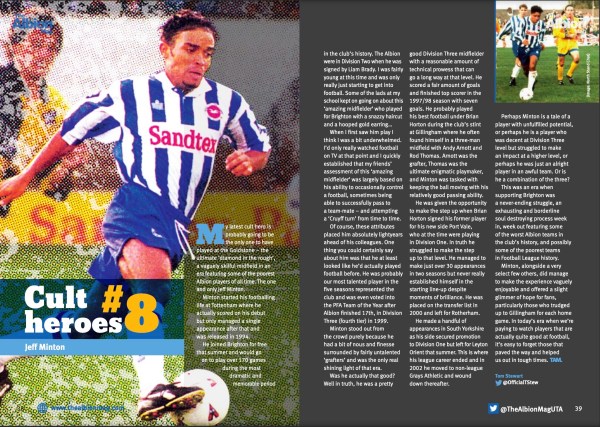
In the October 2017 issue (no.9) of The Albion Mag (below), Tom Stewart featured Minton as one of his cult heroes of yesteryear.

minton albion magNot exactly a glowing endorsement – “a vaguely skillful midfielder in an era featuring some of the poorest Albion players of all time” – Stewart nonetheless reckoned for the five seasons he was at the club he was “probably our most talented player”.

He went on to say: “Minton stood out from the crowd purely because he had a bit of nous and finesse surrounded by fairly untalented ‘grafters’ and was the only real shining light of that era.”

Stewart posed the conundrum: “Perhaps Minton is a tale of a player with unfulfilled potential, or perhaps he is a player who was decent at Divison Three level but struggled to make an impact at a higher level, or perhaps he was just an alright player in an awful team. Or is he a combination of the three?”

In April 2017, Brighton & Hove Independent gathered together player and fan memories of Albion’s iconic former home, the Goldstone Ground, and Minton was among the contributors.

“I loved the Goldstone, it was a great stadium and it’s a shame it got sold off,” he said. “The fans were all brilliant. I’m not too sure if they took to me in the first couple of years I was there, but the last two or three seasons I got on really well with them. “They were always fantastic and got right behind their side at the Goldstone. You don’t see that at a lot of teams.”

Born on 28 December 1973 in Hackney, Minton initially started training with Arsenal but, as a Spurs fan, he jumped at the chance to join Tottenham as a schoolboy.

“I joined the club as a 10-year-old after the scout Dick Moss watched me playing a district game for Hackney against Enfield in which I scored a hat-trick,” Minton recounted in a January 2018 interview with superhotspur.com (pictured below).

“Joining as a 10-year-old and leaving as a 20-year-old gave me 10 very valuable learning years at a club I supported, and also one of the country’s top clubs which is steeped in so much tradition and history. Those treasured memories will forever live with me.”

Like fellow Spurs schoolboy Junior McDougald, at 14 Minton was invited to become a member of the FA School of Excellence at Lilleshall.

J Minton SpursHaving successfully worked his way through the ranks, Minton was given his first team debut by boss Peter Shreeves on 25 April 1992 in a game that turned out to be Gary Lineker’s last home match for Spurs.

If reaching that promised land wasn’t good enough, the dream debut was complete when he scored in a 3-3 draw against Everton, with Paul Stewart and Paul Allen also on the scoresheet.

However, Minton only played two more games for the Spurs first team: one in the league seven days later in a 3-1 defeat away to Manchester United, the other in the league cup, going on as a substitute for Darren Anderton in a 3-1 win over Brentford.

Managerial upheaval probably didn’t help his cause: Terry Venables had been in charge when he joined, after Shreeves’ spell in charge, Doug Livermore and Ray Clemence took over, and it was Ossie Ardiles who ended up releasing him on a free transfer in July 1994.

It’s interesting to read that Minton’s former youth team manager, Keith Waldon, was disappointed that Minton didn’t make more of a name for himself. Waldon told superhotspur.com: “One of those who disappointed me with how far he went in the game was Jeffrey Minton.

“Jeffrey had phenomenal ability with his feet, was quick off the mark and had wonderful skill. But he didn’t go as far as I hoped he would, and I think that he’d tell you that he wasn’t the most disciplined person, but he was a wonderful player.”

While welcoming the chance to play first division football for Port Vale after his Brighton career came to a close, he struggled to settle in the Potteries and in his second year there moved on loan to second division Rotherham United, who he helped to promotion.

He then returned to London for the 2001-02 season and played 39 league and cup games for Third Division Leyton Orient.

Although offered a contract extension by the O’s, Minton says excessive demands from his agent scuppered a deal and he ended up playing non-league football with Canvey Island for three seasons.

He moved on to Chelmsford City in August 2006 where he played for a further three years, had a brief spell at Welling United and ended his playing days with Isthmian League Ware.

When football didn’t deliver the right break for Colin Dobson

THE architect of Brighton’s humiliating 8-2 home defeat to Bristol Rovers in 1973 was none other than a player who might have been wearing Albion’s stripes if injury hadn’t struck.

Goalscoring winger Colin Dobson turned goal provider the day Rovers were rampant at the Goldstone Ground. Twenty-one months earlier he’d left the same pitch on a stretcher, not certain that he’d ever be able to play again.

Dobson had joined Brighton on loan in January 1972, making his debut in a mid-season friendly against his parent club, Huddersfield Town, on 18 January.

Ironically, his first meaningful Albion action came against Rovers when he was a substitute in a 2-2 draw at Eastville on 22 January.

Dobson was also on the bench for the home 1-0 win over Swansea City the following Saturday. He was elevated to the starting line-up away to Wrexham on 5 February, when goals from Willie Irvine and Peter O’Sullivan sealed a vital 2-1 win.

It was during his full home debut against Walsall on 12 February that his short-lived Albion career came to a sudden halt. Albion lost 2-1 and Dobson suffered an ankle fracture.

It had been expected that Albion would sign him permanently, and he told the Evening Argus that he had been offered a good deal to do so, but the injury put paid to the transfer being completed.

With Pat Saward’s side heading towards promotion with Aston Villa, the Irish manager instead went back to Wolverhampton Wanderers to sign Bertie Lutton, who had been on loan earlier in the season.

Lutton duly played his part as the Seagulls acquired the necessary points to earn promotion, while Dobson nursed an injury which at the time threatened to end his playing days.

His six-year Huddersfield career at an end, in the summer of 1972 he accepted a role as player-coach at Bristol Rovers, working under his former Sheffield Wednesday teammate, Don Megson.

Dobson Rovers

Thus it was that he was part of a Rovers side who had gone 18 matches unbeaten when they showed up at the Goldstone on a cold winter’s day on the first day of December 1973 to tackle Brian Clough’s Albion in front of The Big Match television cameras.

The game was only five minutes old when Dobson played in Alan Warboys who beat Norman Gall before passing to his strike partner Bruce Bannister to open the scoring.

Seven minutes later, Dobson took Warboys’ pass and laid on a pinpoint centre for Gordon Fearnley to score with a header. The game was still six minutes short of half-time when another Dobson centre was met by Warboys to make the score 5-1 to the visitors.

John Vinicombe, Albion reporter for the Argus, declared in his summary: “To Colin Dobson, freed by Albion when a broken ankle looked like ending his career, the accolade for a thinking player.

“He masterminded the operation in unbelievably generous space. Bruce Bannister knifed through for the early, killing goals, and Alan Warboys, superbly balanced and fast on the slightly frozen pitch, looked the perfect striker, taking his four goals so cleanly.”

An incandescent Clough told the media: “I was ashamed for the town and the club that 11 players could play like that. I feel sick. We were pathetic. This side hasn’t got enough heart to fill a thimble.”

Rovers went on to win promotion to the second tier that season and Dobson eventually completed 63 league and cup games for them before retiring at the end of the 1975-76 season.

Born on 9 May 1940 in Eston, North Yorkshire, Dobson joined Sheffield Wednesday at 15, and made a name for himself with the Owls in the days when they played in the top tier of English football.

He earned a reputation as a goalscoring winger after making his debut in 1961 and scored 52 goals in 193 games over the next five years.

He was twice capped by England Under 23s: on 29 May 1963, he came on as a substitute for Alan Suddick as England beat Yugoslavia 4-2 in Belgrade. Alan Hinton scored a hat-trick for England and the other goal was a penalty by Graham Cross, then with Leicester but later a Brighton player. Future England World Cup winner George Cohen was the side’s right-back.

Four days later, with Ernie Hunt leading the line, Dobson started for England when they lost 1-0 to Romania in Bucharest.

In 1966, Dobson made the switch to second division Huddersfield for a £21,000 fee and he was Town’s top scorer in the 1967-68 season (with 14 goals) and 1968-69 (with 11).

Although full international honours eluded him, in the summer of 1968, he was selected for the Football Association Commonwealth tour of the USA, New Zealand, Malaysia and Hong Kong.

He was also part of the side Ian Greaves led to the 1969-70 Second Division title, but he only made a handful of top-flight appearances, and his last Huddersfield appearance was against Stoke City in an FA Cup fourth-round replay in January 1971.

Once his playing days were over, Dobson worked for a whole host of clubs in a coaching or scouting capacity, including Port Vale, Coventry City, Aston Villa, clubs in the Middle-East (Bahraini side West Riffa; Al Rayyan in Qatar; Kuwaiti side Al Arabi, and Oman’s Under-17s), Portugal’s Sporting Lisbon, Gillingham, Watford and Stoke, where he renewed his acquaintance with John Rudge, who he had known at Huddersfield and Bristol Rovers, who was director of football for the Potters.

It was during his time with Stoke that he discovered the future Manchester United and England goalkeeper Ben Foster, a chef playing part-time non-league football at the time.

Foster later told the Birmingham Mail: “There was a scout called Colin Dobson who worked for Stoke but was living in Warwick.

“One night he saw some floodlights, stopped off and had a watch of the game and I caught the eye. That was it. He made a note of it and came to watch me a few more times.

“I owe it all to him. Top man. Whether I’d still be working as a chef if he hadn’t spotted me, I don’t know.”

Dobson died in Middlesbrough aged 82 on 16 February 2023.

  • Pictures from my scrapbook. Originally sourced from the Evening Argus, Shoot! and Goal magazines.