Northern Irish legend Aaron Hughes was talk of the Toon

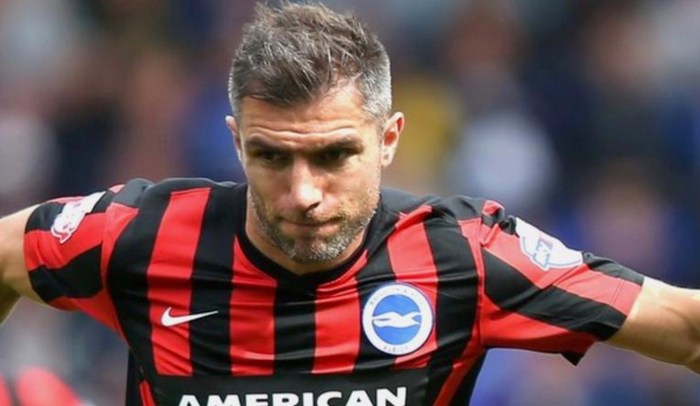
AH red blackVETERAN Northern Irishman Aaron Hughes only brought down the curtain on his lengthy playing career in June 2019 at the age of 39.

On 12 June he finally confirmed his playing days were over in an emotional speech to his Northern Ireland team-mates in the Borisov Arena after the country’s 1-0 victory over Belarus.

Remarkably, Hughes had first been called up to the Northern Ireland squad at the age of 17, before he’d even broken through at Newcastle United.

“Having known Aaron Hughes for nearly 25 years, it was an honour to be present to witness his typically classy speech to all of the Northern Ireland players and staff to announce his retirement from the game after an amazing career,” former Newcastle keeper and current Northern Ireland coach Steve Harper told the Belfast Telegraph.

Amongst many others paying tribute, former international Paddy McCourt added: “Without doubt the best professional I encountered during my football career. I was fortunate enough to play alongside Aaron Hughes at Brighton and we also spent many years together with Northern Ireland. A true gentleman and brilliant player.”

He had just the one season with Brighton & Hove Albion – in 2014-15. Mainly a central defender, Hughes could also play comfortably in either full-back position or midfield.

He was the first Brighton signing of Sami Hyypia’s ill-fated spell as manager, and Hyypia told the club website: “We wanted to bring another experienced defender, and Aaron fits the bill – having played at Premier League, Champions League and international level.

“I have played against Aaron a few times during my time at Liverpool and also for Finland, and I know his qualities and what he will give us.

“He has a very good footballing pedigree, is an intelligent player, and he has a great mentality and good approach to the game.

“He has that experience I wanted to bring into the squad, which alongside our other senior players, will help our younger players continue to develop and progress in the first-team squad.”

As it turned out, Hughes was only used as cover and during his season with the Seagulls made only 13 appearances.

Nevertheless, Hughes’ stay on the south coast clearly left an impression and fellow Northern Ireland international Oliver Norwood described how Hughes played a part in persuading him to join the Seagulls in 2016.

“I spoke to Hughesy about his time here and he spoke so highly of the club, mentioning the facilities, the stadium and that it’s set up to go to the Premier League,” Norwood told the club website. “He’s a wonderful person that’s achieved so much.

“I know he didn’t get the game time he would have liked here, but if I have half the career he has, then I’ll be very happy.”

Born in Cookstown, County Tyrone, on 8 November 1979, Hughes joined Newcastle United’s youth ranks at 17 and, over eight years, he made 279 appearances for the Magpies.

A Hughes superb footy picsEyebrows were raised when former Northern Ireland manager Bryan Hamilton took Hughes to Portugal for a World Cup qualifier in October 1997, when he was still only 17, but Hamilton told the Belfast Telegraph: “There was something special in him, even at a young age, and I wanted him in the squad. I felt he could be an outstanding player for Northern Ireland and I knew that coming in early wouldn’t affect or faze him.”

Hughes had to wait until Lawrie McMenemy succeeded Hamilton to make his international debut the following March, and by then he’d made a memorable debut for Newcastle in November 1997 against Barcelona at the Nou Camp. Selected by manager Kenny Dalglish, despite the 1-0 defeat, the 18-year-old showed tremendous promise against the likes of Figo, Ronaldo and Stoichkov. He eventually held down a regular first team place under Dalglish’s successor Ruud Gullitt before Bobby Robson took the helm.

Hughes made his name at St James’s Park in the centre of Newcastle’s defence, playing alongside Sylvain Distin in a side also featuring Craig Bellamy, Gary Speed and Alan Shearer. He spoke about his time playing under Dalglish and Robson in an interview with the Guardian.

Discerning followers of Toon were quick to join in the tributes paid to Hughes when he announced his retirement. Elsewhere they have vented their spleen at the decision Graeme Souness took to sell him to Aston Villa.

Hughes had three seasons at Villa, having been signed by David O’Leary in the 2005-06 season. But Villa fans are a tough lot to please and, despite his previous success at Newcastle, it seems they expected more. “Hughes, despite filling his role admirably as a centre back, never felt integral to our defence as he found himself chopped and changed with (Olof) Melberg, and fellow signing Wilfried Bouma,” declared readastonvilla.com.

Eventually with injury-hit defender Martin Laursen returning to the side under new manager Martin O’Neill, Hughes became more of a squad player at Villa Park. He was allowed to leave to join Fulham and was signed by a former Northern Irish international teammate, Lawrie Sanchez.

hughes fulhamAt Fulham, he formed a formidable defensive partnership with Brede Hangeland and fulhamfc.com said: “The pair worked brilliantly together, with the fans soon referring to them as our very own Thames Barrier. Their styles complemented each other perfectly, and while Hughes wasn’t the tallest of centre-backs, his leap and reading of the game more than made up for it.”

Hughes was one of three ever-presents – with Mark Schwarzer and Danny Murphy – when Fulham finished seventh in the Premier League in 2008-09, which led to European qualification.

He was part of the side captained by Murphy, with Bobby Zamora up front, who went on a gloriously unexpected UEFA Cup journey in 2010, only to be pipped to the trophy in extra time by Atletico Madrid.

“The way we lost, right at the end of extra-time, still grates with me, so the final is a bitter-sweet memory,” Hughes reflected in a 2014 interview for Albion’s matchday programme. “The Juventus game stands out more, where we came back from 3-1 down from the first leg in Italy to win 4-1 at Craven Cottage.”

On transfer deadline day in January 2014, Hughes signed a short-term deal for Harry Redknapp’s Queens Park Rangers for whom he made 11 Championship appearances.

After his season with Brighton, even at the age of 36 Hughes had no intention of packing up playing. Instead, he headed to Australia and played for Melbourne City and then linked up with India’s Kerala Blasters before he joined Hearts for his final two seasons.

His last club game saw Hearts bring him on in the 68th minute of their final league game of the season, a 2-1 defeat to Celtic at Celtic Park. Upon replacing John Souttar, the 39-year-old Hughes took the captain’s armband for the final few minutes of a career stretching across an impressive 22 years.

Hughes won an amazing 112 caps for his country across 20 years – a record for an outfield player. He was second only to the legendary Pat Jennings as most-capped player and was captain of his country for eight years. Small wonder, then, that he should be so grateful to so many at the Irish FA for the longevity of his international career.

hughes NI

  • Pictures from various online sources.

History-maker Joel Lynch went to Town after Brighton breakthrough

SUSSEX lad Joel Lynch made Brighton & Hove Albion history when he was made first team captain aged just 19 and 186 days.

The ‘youngest-ever Albion captain’ honour was a measure of the maturity the defender had displayed in Dean Wilkins’ young line-up in April 2007, even if it was a temporary appointment in the absence of the rested Guy Butters and the injured Dean Hammond.

“I wasn’t even captain of my school team,” Lynch told Argus reporter Andy Naylor. “I am 19 years old and it is a great honour. I am grateful to the gaffer for having so much faith in me and it will be good for my confidence.”

Unfortunately, the experience against Doncaster Rovers at Withdean was marred when Lynch missed a clearance, the player he was supposed to be marking, Graeme Lee, scored and Rovers went on to win 2-0.

It was a minor blip at the beginning of a career which saw Lynch become a consistent Championship defender for more than a decade after emerging from Brighton’s youth ranks in the ‘noughties’.

Born on 3 October 1987 in Eastbourne, Lynch made his way through the age group sides with the Albion, often alongside another local youngster who went on to have a good career, Tommy Elphick.

“We played all the way through the youth teams together since the age of about ten,” Lynch told Naylor of the Argus. “Both of our games really changed and we really grew up when we went to Bognor on loan. We did really well there for Bognor and ourselves.”

 Lynch pictured in the Argus alongside Tommy Elphick when they were together as under 14s in 2001, and still together a couple of years later.

As well as being part of the Brighton team which reached the quarter finals of the FA Youth Cup in 2006, the year couldn’t have begun better for Lynch when Wilkins’ predecessor, Mark McGhee, handed him his first team debut in a narrow 2-1 defeat away to Southampton on 2 January 2006.

He went on to play 16 times that season, and also registered his first goal for the club, which is a fond memory for me and my son, Rhys. It came on Easter Saturday 2006, and we made a last-minute decision on the day to travel up to Ipswich to watch the game.

Although Albion were destined to relinquish their Championship status, they had a new-found confidence in their play thanks to the belated arrival of much-needed hold-up centre forward, Gifton Noel-Williams (on loan from Burnley).

He’d scored on his debut in a home draw against Luton and got an assist by laying on a goal for Paul Reid in a 2-0 win at Millwall two weeks before.

At Portman Road, always a favourite away ground, Albion, wearing the stylish all-burgundy away strip, opened the scoring when Noel-Williams buried a cross from Colin Kazim-Richards.

To add to the unexpected delight, teenage defender Lynch made sure our trip was a memorable one. Ipswich failed to clear a corner properly and when Reid returned the ball to the penalty area, Kazim-Richards jumped simultaneously with ‘keeper Shane Supple and the ball broke for Lynch (above left) to prod it in.

Albion, never wanting to make life too easy for themselves or their fans, allowed Ipswich to pull a goal back when Alan Lee flicked on from former Seagull Darren Currie’s cross for substitute Nicky Forster – a future £75,000 signing for Albion – to score. But thankfully it was too late for Ipswich to salvage anything from the game.

It was all to turn pear-shaped on the Easter Monday at home to Sheffield Wednesday, but for a couple of days at least the Great Escape still seemed a possibility.

In December 2006, the matchday programme devoted a two-page article to Lynch’s progress in the first team, pointing out how he had begun at left-back, stepped in as a left-sided centre-back – his more natural position – and even played right-back in the 8-0 thrashing of Northwich Victoria in the FA Cup.

Lynch spoke of the experience he had gained playing alongside the veteran defender Guy Butters, telling the programme: “I learned a lot from him, Guy’s had a great career and he is still playing great football. Hopefully I will just slot in there when the time comes and, in the meantime, I will play wherever the manager wants me to play and hopefully stay in the team. I’ve still got a lot of years ahead of me to make the centre-half slot my own.”

Lynch confessed being handed the no.5 shirt at the start of the season had given him a massive boost. “So far, I have really enjoyed this season. I have had my ups and downs and missed a few games due to my performances,” he said. “There have been things that I have had to sort out within my game, but I think I have resolved them now and I am slowly regaining my confidence and my performances have been improving week by week since I regained my place in the team.

“I feel more confident and my self-belief has improved a lot. I want to keep improving and I think that I can help the team in a big way.”

Lynch said a lot of the younger players had been inspired by Bobby Zamora’s elevation to Premiership football and added: “Hopefully a few years down the line we all will be playing at a higher level with Brighton in a new stadium.”

Interviewed by the Argus on the eve of the 2006-07 season, Lynch said: “Last season was a season to just keep on progressing and doing well.

“This season is one where I really want to push on. I want to play a major part in getting the club promoted and express myself more so maybe more clubs are interested in me or I get called up for England.”

Pretty bold stuff from a 19-year-old player still aiming to establish himself, but, having been awarded a three-year contract, he certainly wasn’t short of confidence. “I’ve got to do something really big or something big should happen,” he continued.

“We’ll take it one game at a time but you’ve got to aim for promotion. You can’t aim for anything else.”

Lynch certainly made his mark across the League One season, playing in a total of 44 league and cup games.

The following season was only a matter of a few weeks old when Lynch was sidelined by a hairline fracture in his left leg and ligament damage when twisting to clear in a game against Millwall. Then when he returned sooner than expected, he suffered a hamstring problem.

Perhaps if Albion’s move to the Amex had come sooner, Lynch might have stuck around, but he clearly felt he needed to be playing at a higher level than the Seagulls could attain at the time and, in September 2008, having made 88 first-team appearances, forced through a loan move to Nottingham Forest, with various extensions taking the loan through to the end of the season.

In July 2009, the deal eventually became permanent, with Forest paying a £200,000 fee and offering Lynch a three-year contract. Albion obtained midfielder Matt Thornhill on a six-month loan from Forest as part of the arrangement.

The young defender initially found it difficult to break through as a regular at Forest, with most of his appearances coming as a stand-in left-back.

It was in the 2011-12 season that he began to get games in his preferred position, at first playing alongside Wes Morgan and then, after Morgan’s transfer to Leicester, pairing with Luke Chambers.

In November 2011, writer Peter Blackburn waxed lyrical about Lynch’s form at Forest via the seatpitch.co.uk platform, describing him as “a tough-tackling, committed, classy and agile defender”.

Blackburn added: “Capable of reading the game, nipping in front of the attacker to steal the ball and hold his own in the air, Lynch also seems to possess the sort of driven cross-field ball out of defence not seen on the fair shores of the Trent since prodigal son, Michael Dawson so entertained the crowd.”

No doubt it would have delighted Lynch that he scored a last-gasp equaliser for Forest at the Amex in March 2012.

Four months later, he rejected a new deal at Forest to become a fifth new signing made by Simon Grayson at Huddersfield Town, and in August the same year he got onto the international stage – not for England, though, but Wales. He qualified for Wales because his father came from Barry in South Wales, and he made his debut as a substitute in a friendly against Bosnia and Herzogovina.

HuddExam LynchLynch made 22 appearances in his first season with the Terriers; nine more the following season, and 35 in 2014-15. In January 2015, Lynch was winner of the Examiner Huddersfield Town Player of the Month award, with writer Doug Thomson saying: “He scored a stunning goal to help clinch a welcome 3-1 win over Watford. But Lynch, who stung the Hornets with an overhead kick, also excelled in the centre of defence.

“And the former Brighton and Hove Albion and Nottingham Forest man played a key role when Town finally ended their long wait for an away win, and kept a clean sheet to boot, at Wigan Athletic.

“Calm and composed both on the ground and in the air, the 27-year-old brings plenty of experience to the backline. Lynch also works well alongside skipper Mark Hudson.”

lynch qprAfter making 40 appearances for Town in 2015-16, he departed Yorkshire for London and signed a three-year deal with Championship side Queens Park Rangers.

The fee was undisclosed but was believed to be something of the order of £1.2 million and the QPR manager at the time, Jimmy Floyd Hasselbaink told bbc.co.uk: “He offers us something a little bit different. He’s left-sided, which will give us better balance, and has that ability to bring the ball out from the back.”

Hamstring and foot injuries hampered opportunities to show his worth to the Loftus Road faithful, a frustrating situation he talked about in January 2018, but he has since become a regular at the heart of the Rs’ defence.

Perhaps with an eye to the future, Lynch has a profile on the professional networking site LinkedIn.

Pictures sourced from The Argus (Simon Dack / Liz Finlayson), matchday programmes, Huddersfield Examiner and QPR websites.


Oatway took off with Bluebirds and soared with Seagulls

CHARLIE Oatway had not long earned his break in professional football with Cardiff City before he found himself behind bars in Pentonville Prison.

Up on a charge of GBH for his part in a fight, when an Afro-Caribbean friend was racially abused, Oatway didn’t expect to get incarcerated but ended up serving two months of a four-month sentence.

Before he headed off to court in London on a Monday morning, he had told Cardiff’s general manager, the former Leeds and Wales international Terry Yorath (broadcaster Gabby Logan’s dad), to expect him for training on the Tuesday morning!

The story is explained in detail in Tackling Life, the book Oatway published about how he turned his life round to become captain of Brighton and part of three promotion-winning sides.

The tale reveals how imprisonment was just one of the hurdles Oatway had to overcome in a life that’s taken many colourful twists and turns.

It was sadly ironic that his career as a player with Brighton was cut short in a Boxing Day clash against Queens Park Rangers, the team he followed home and away from an early age.

The family lived a stone’s throw from Loftus Road and Charlie – a nickname given to him by an aunt – was named by his Rs-daft dad after the whole of the promotion-winning 1973 QPR team: Anthony, Phillip, David, Terry, Frank, Donald, Stanley, Gerry, Gordon, Steven, James.

He was even starstruck at an Albion Legends event when he saw John Byrne who had been a hero of his during his days playing up front for the Rs alongside Gary Bannister.

Albion reaching the Division 2 play-off final in Cardiff in 2004 was the highlight of Oatway’s career – but a feature in the match programme was angled on the disappointment he had suffered the year before, when he had gone as a spectator with all his family to see QPR lose to Cardiff.

“Everything about the day was perfect apart from the result,” Oatway told reporter Alex Crook. “Being a QPR fan at heart, I felt the pain of the defeat just as much as the other 35,000 fans. But this time I am going up there as a player and not as a fan and I am determined our supporters will not go through what I did last season.”

The youngest of five kids, Oatway grew up in Shepherd’s Bush and even though he started to struggle in school from an early age, he displayed quite a talent for football.

“I knew by the time I was eight that I was as good as any of the eleven-year-olds I was playing with,” he recalls in Tackling Life. He had trials for the West London District schools team and played for Harrow Boys Club and Bedfont Eagles.

Oatway reveals how it was Wally Downes, the former Wimbledon player and later loyal assistant manager to Steve Coppell, who helped to get him noticed, along with his cousin, Terry Oatway.

The young Oatway joined up with Wimbledon in the year they won the FA Cup – 1988 – and played for the youth team, but he was let go at the end of the 1989-90 season because they thought he was too small. He went to Sheffield United on trial but was homesick so he returned to London and joined non-league Yeading on semi-professional terms. Off the field, life was by no means straightforward. “By the age of 19, I had two children with two different mothers,” he said.

After helping to get Yeading promoted in 1993-94, Oatway found a pathway back into the professional game when a community worker (Ritchie Jacobs) on the estate where he lived organised a trial at Cardiff City for him and two pals.

He was the only one of the three invited back and he said: “When Cardiff asked me back for another month, I knew it was the chance I’d been waiting for, and I was going to grab it with both hands.”

Not surprisingly, the two months he spent in Pentonville didn’t greatly help his cause but remarkably he was welcomed back to the club and accepted by the fans. However, in his absence there was a change in team management and ownership and, before long, new team manager Kenny Hibbitt was instructed to send Oatway out on loan to Coleraine in Northern Ireland.

On his return to Cardiff the following season, they had by then been relegated to the Fourth Division. Still he was unable to get back in the first team and he happened to play a reserve team game against Torquay United, who were managed by his old Cardiff boss, Eddie May. May asked if he fancied a move for first team football and, although he only joined just before Christmas in 1995, by the end of the season he had been voted Player of the Year.

When May moved on to become manager of Brentford, he put in a bid for the combative midfielder and took him back to west London to play in the Bees’ third tier side.

In 1998, Oatway had a brief loan spell with Lincoln City but on his return to Griffin Park he came under the managership of Micky Adams for the first time.

Adams had taken over the manager’s chair at Griffin Park but he was sacked when owner Ron Noades thought he could make a better job of running the team. Oatway was sent on a month’s loan to Lincoln, somewhat against his wishes, but on his return to the Bees he forced his way into the side and worked well with coach Ray Lewington.

Adams then took the reins at Brighton and, as the Albion began life back in Brighton & Hove after the two-year exile in Gillingham, Oatway and Bees teammate Paul Watson joined the Seagulls for a combined fee of £30,000.

Adams wanted the pair to join a nucleus of players who’d all played under him previously at Brentford and Fulham.

In an Albion matchday programme profile of Oatway to coincide with the visit of his former club, Torquay, on 2 September 2000, it noted: “Despite getting sent off rather stupidly in one of his earliest games for the Seagulls – he bit a Darlington player’s face – he soon became a great favourite with the Brighton crowd, who hadn’t seen a midfield scrapper like him since Jimmy Case retired.”

oatway prog cover

He went on to be a vital midfield cog in the back-to-back league title winning sides of 2001 and 2002. Although he was in the team that was relegated from the second tier in 2003, he was full of praise for the effort made to avoid the drop. “Steve Coppell was one of the best managers I’ve ever played under because of his attention to detail,” he said. “Steve’s team talks on the day before a game were brilliant.”

When the departed Coppell was replaced by Mark McGhee, Oatway remained a cornerstone of the Albion line-up and described that 2004 play-off final at the Millennium Stadium as “the best day of my career”.

But at one point it was touch and go whether he was going to be able to carry on. In October 2003, he underwent major back surgery to repair a slipped disc and trapped nerve.

He was out for nearly three months and he admitted in an Argus interview: “There was a good chance I wouldn’t play again.”

When the Albion cashed in on captain Danny Cullip in December 2004, selling him to Sheffield United, Oatway took over the skipper’s armband full-time, a role he had previously embraced as a stand-in.

The following season’s Boxing Day clash with QPR at Withdean was only two minutes old when Marcus Bean tackled Oatway from behind and escaped without even a booking.

Oatway was stretchered off and McGhee later told the mirror.co.uk: “Charlie has been a tremendous leader and captain and this is a huge blow. I’m very upset about it.”

Oatway had four different operations to try to fix the ankle injury, but he never recovered sufficiently to return to the required level to play league football.

“I tried to get back to playing again but by the pre-season of 2007 I had to call it a day,” he said.

However, even when he was out injured, Oatway was always a strong influence on the dressing room.

Stand-in skipper Dean Hammond said in an Argus interview in November 2006: “Charlie has been out injured but he has been fantastic for everyone. He comes in, he gets everyone up for it, he’s always laughing and joking. He’s got the enthusiasm and he is still determined, even though he is not playing.

“His personality is fantastic for everyone and I think he deserves a massive pat on the back.”

He also used the time productively, studying how the coaches worked with the youth team players and starting to take his coaching badges. When it was clear he wouldn’t be able to return to play full-time professional football again, he got involved with the Albion in the Community scheme as a community liaison manager.

Rather than give up the game completely, Oatway took the opportunity to become player-coach at Havant and Waterlooville and, in January 2008, he found himself in the national media spotlight when the Blue Square South minnows played away to Liverpool in the fifth round of the FA Cup.

Oatway wasn’t fit to start the game but he got on as a substitute in the 74th minute and later recounted how his former teammate Bobby Zamora fixed it for him to swap shirts with Liverpool’s Yossi Benayoun, who scored a hat-trick in the Reds’ 5-2 win that day.

Then, in 2009-10, Oatway began helping Brighton manager Russell Slade to coach the first team and, after Slade’s departure, continued in the role under Gus Poyet.

When Poyet left the Seagulls to join Sunderland, Oatway went with him and he was also in the dug-out alongside Poyet and his assistant Mauricio Taricco at Chinese Super League team Shanghai Greenland Shenhua, AEK Athens and Seville-based Real Betis.

Pictures: matchday programme; The Argus; Tackling Life (Quick Reads, 2011).

Chelsea starlet Barry Bridges a Brighton record signing

5-bridges-in-stripesENGLAND international Barry Bridges was once Brighton & Hove Albion’s record signing for the princely sum of £28,000.

Much of his career ran in parallel with Bert Murray. Both young stars at Chelsea in the early to mid-60s, they were transferred to Birmingham City in 1966 and joined the Albion in the early 1970s.

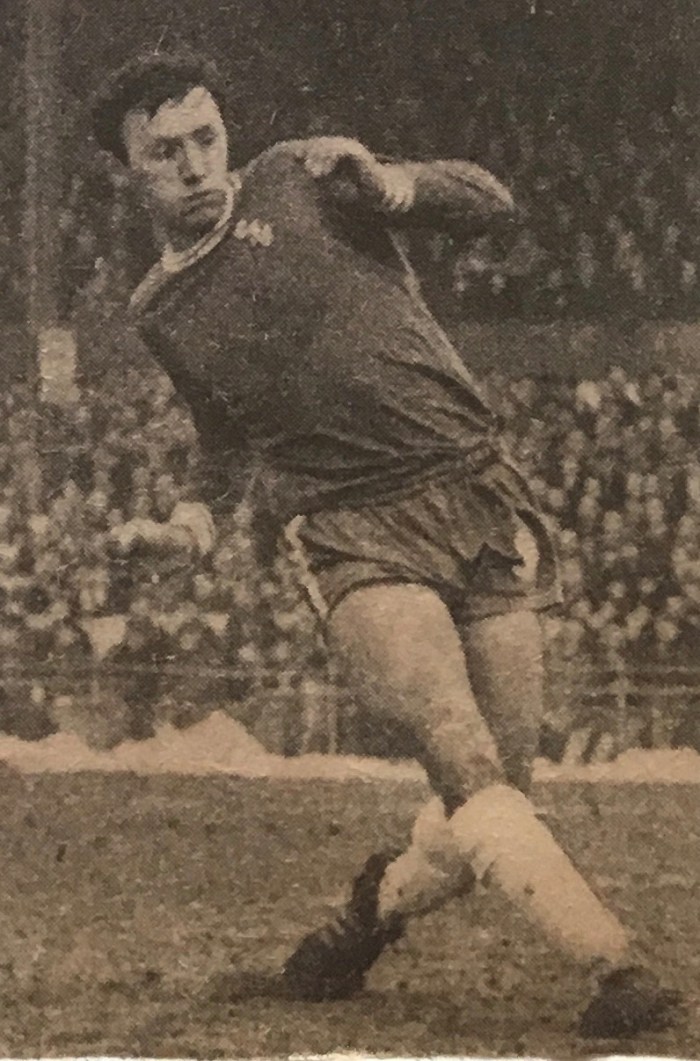
Norfolk-born Bridges had come to the attention of Chelsea while playing for local side Norwich & Norfolk Boys and had a dream debut in 1959 at just 17, scoring in a local derby against West Ham. It was in the 1961-62 season that he established himself in the Chelsea first team, Jimmy Greaves having been transferred to AC Milan.

In what turned out to be  superb 1964-65 season for him and the club, he scored 27 goals in 42 appearances for Chelsea and collected a League Cup winners’ medal when they beat Leicester City 3-2 over two legs.

It was in May 1966 when Tommy Docherty started breaking up his squad and Bridges left Chelsea for Birmingham having scored 93 goals in 205 league appearances for the London club.

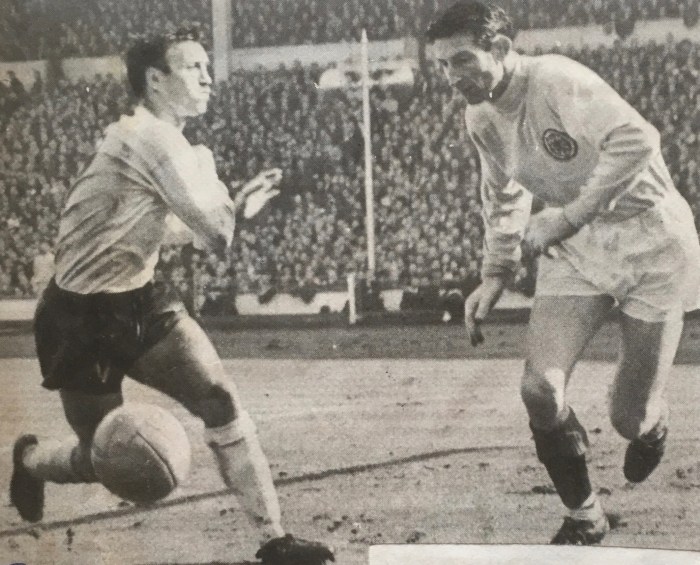
Bridges went one better than Murray and earned full England international honours. Four caps in fact. He was just a few days short of his 24th birthday when he made his debut in a 2-2 draw with Scotland at Wembley in April 1965.

bb-england-w-sir-a

Bridges pictured with Sir Alf Ramsey, Jack Charlton and Nobby Stiles while on England international duty.

He kept the no.9 shirt in the next two games, played in May, a 1-0 win over Hungary at Wembley and was the scorer of England’s goal in a 1-1 draw away to Yugoslavia. His fourth and final game was in a 3-2 friendly defeat against Austria in October 1965. Injury prevented him staking a claim for a place in the 1966 World Cup squad.

In 1971, Bridges went on an end-of-season tour to Australia with an English FA squad that also included Peter Grummitt (then of Sheffield Wednesday) and Dennis Mortimer (of Coventry at the time). The squad went to Dublin first to celebrate the 50th anniversary of the FA of Ireland, drawing 1-1 with the Republic, before heading Down Under where they won all nine of the matches they played in various locations across a month.

BridgesChels

Birmingham paid a then club record fee of £55,000 to acquire Bridges and in two seasons in the West Midlands he scored 46 goals in 104 outings.

Interviewed by bcfc.com in 2014, Bridges said: “What persuaded me to join Birmingham more than anything was the chairman, Clifford Coombs. He was a great guy and wanted to put the club back on its feet. He told me that I was going to be his first signing and he really wanted me to join.”

In his first season he helped Blues to a League Cup semi-final – ironically against Queens Park Rangers – the club he would move to next.

In August 1968, a £50,000 deal saw him move to Loftus Road, where he was part of a strong forward line playing alongside Frank Clarke and the flamboyant Rodney Marsh with his old Chelsea teammate Terry Venables pulling the strings in midfield.

Unfortunately the campaign ended in relegation from the old First Division but in 1969-70 he linked up well alongside Marsh and Clarke and scored 24 goals in all competitions.

Bridges QPR

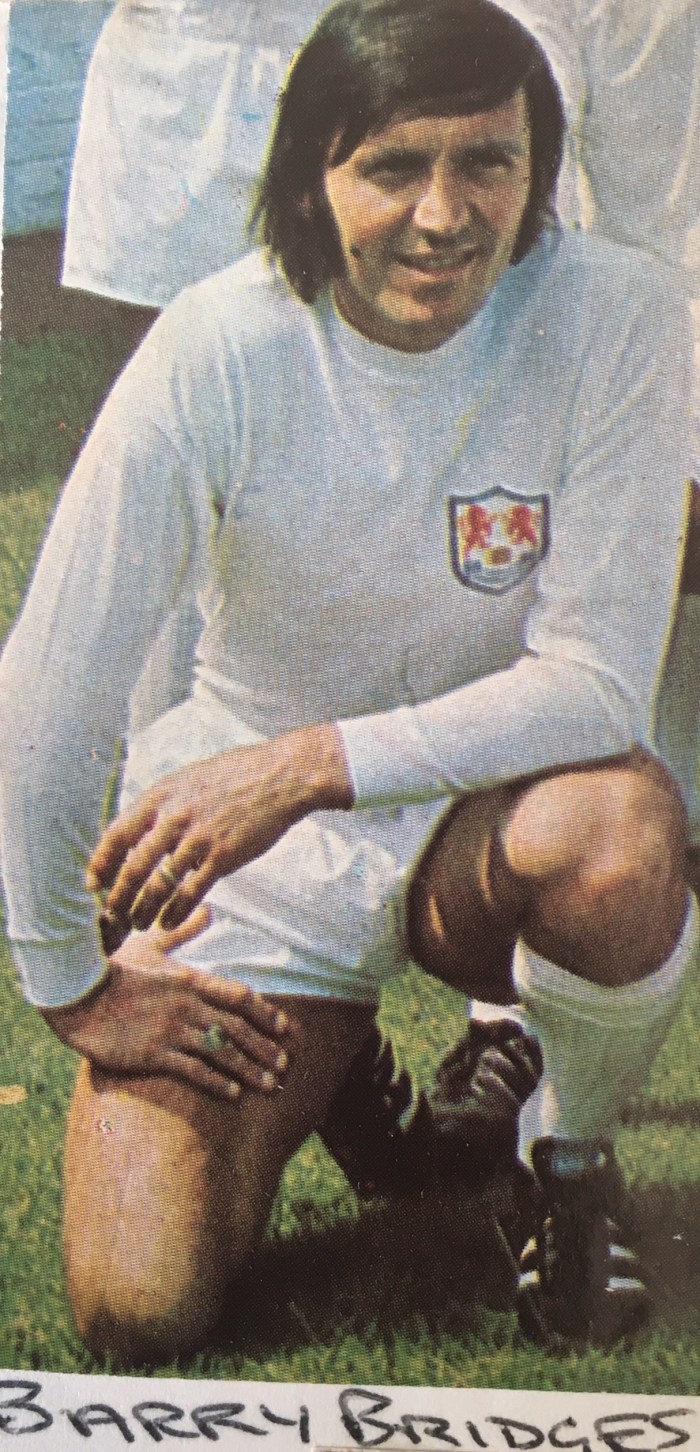
QPR decided to cash in on him and sold him to Millwall in 1970 and in 1972 he was part of a Millwall side who only narrowly missed promotion to the top division. The Lions were already celebrating promotion on the pitch at The Den when news came through that in fact promotion rivals Birmingham had beaten Sheffield Wednesday to go up, contrary to a rumour that had been circulating in the ground that they’d been losing.

“The four supporters who had been chairing me on their shoulders dropped me. Everyone was stunned, and we had to troop off the pitch all bitterly disappointed and choked,” said Bridges. “I desperately wanted to play First Division football again and so did the rest of the lads. We were all sick.”

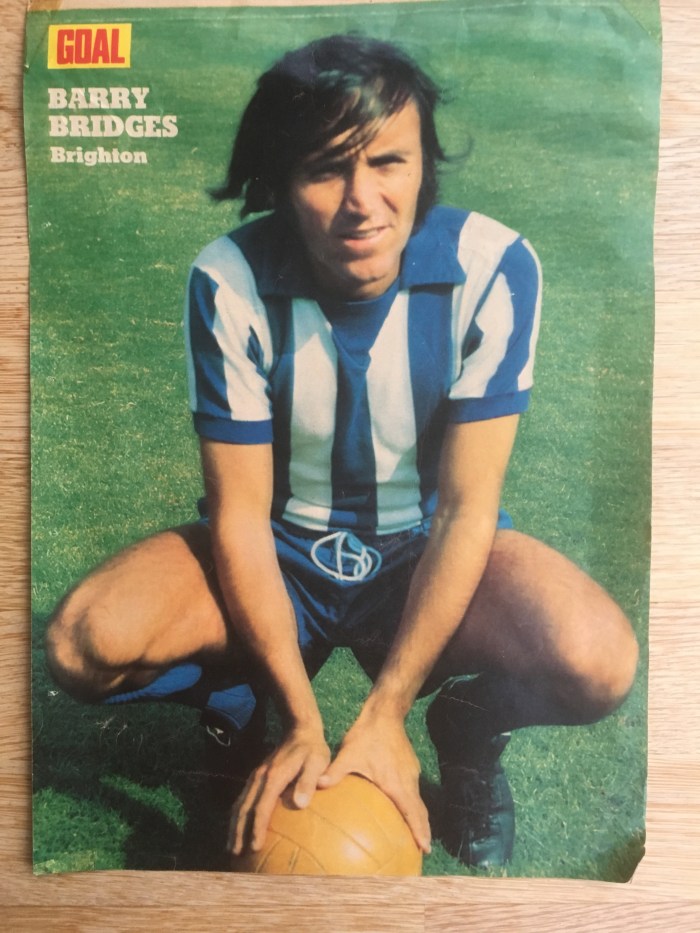
When Pat Saward signed him for Brighton in September 1972, it was evident from the start that this was a player who had played at the highest level.

Unfortunately, although Bridges could easily cope at that level, others either didn’t step up or the new players didn’t gel – arguably Saward made too many changes – but, whatever the reason, Brighton couldn’t stop losing and were left floundering at the foot of the table.

Bridges made his debut in a 1-1 draw away to Aston Villa but it was another four matches before he got his first goal, ironically against his old club Millwall, in a 3-1 defeat at home.

Bridges seldom had the same partner up front, early on playing with Willie Irvine, on other occasions with Ken Beamish and later with Lammie Robertson after Saward brought him in from Halifax in exchange for Irvine.

My abiding impression of him was that he appeared to be too good for the rest of the team. His speed of thought was often way ahead of the rest so he would put passes into areas where he would expect a teammate to be, only to be disappointed that they hadn’t read it, so he was made to look wasteful.

One of the few moments of pleasure for Bridges in what was otherwise a season of doom and gloom was the prospect of a FA Cup third round tie against Chelsea at the Goldstone in January 1973. Bridges was in great demand for pre-match interviews in view of his past association with the London club.

“It’s a tremendous draw for the club and a dream draw for Bert Murray and myself who both started our careers at Chelsea,” Bridges told Goal magazine. “Personally it will be nice to see most of the Chelsea lads again. I grew up with Peter Bonetti, Ron Harris and Ossie (Peter Osgood).”

Bridges hoped a good performance in the Cup would help to reinvigorate the lacklustre league form and said: “It’s a crying shame that we’re struggling because the facilities here are second to none. Obviously we need to start getting results now before it’s too late. A win against Chelsea could be just the boost we need to get out of trouble in the league.”

As it turned out, not only did the game end in defeat (2-0) for the Albion but it drew national headlines for all the wrong reasons – ‘day of shame’ for example – as Harris and Brighton left back George Ley were sent off, five were booked and the mood on the pitch led to fighting on the terraces with 25 people arrested.

However, Albion’s fortunes did eventually improve – although it was without Bridges, who in the final few games of the season was restricted to appearances off the bench.

Back in the third division, Bridges was restored to the starting line-up and scored in the opening game in a 1-1 draw at Rochdale.

He was part of the team Brian Clough and Peter Taylor inherited in October and, after they secured their first win courtesy of Pat Hilton’s goal in a 1-0 win away to Walsall, Bridges told the press: “I did more running about in this game than I had in the previous 10 matches.

“I’m 32 now, but with this chap geeing me up I reckon I can go on playing for several more years. We were a bit on edge before the game and the first thing he told us was to relax. Afterwards he told us he was pleased with the effort we showed and we can work from here and go places.

“Though I was sorry to see Pat Saward go – he was a great coach – I think Brian’s got what it takes to make us a good side. He’s just what the club have been waiting for.”

But three games later, as one of the team humiliated in a 4-0 home FA Cup defeat to Walton & Hersham at the end of November, Bridges was unceremoniously dropped and didn’t play again for the first team until February.

Although he then had a run in the team, scoring six times in a 17-game spell, he was among twelve players Clough and Taylor offloaded at the end of the season.

That brought down the curtain on his league career but he continued playing – initially in South Africa with Johannesburg side Highlands Park and then in Ireland – where when player-manager of St Patrick’s Athletic he also gave game time to another former Brighton striker, Neil Martin. He also managed Sligo Rovers before returning to his native Norfolk to manage non league sides Kings Lynn and Dereham Town.

In 2013, the QPR programme caught up with him to discover he was living in Norwich close to where he was brought up, and still getting along to watch matches.

1-england-bridges2-chelsea-bridges4-bridges-in-hoopsB Bridges Btn GOALBarry Bridges (Lions)Barry Bridges (Millwall yellow)

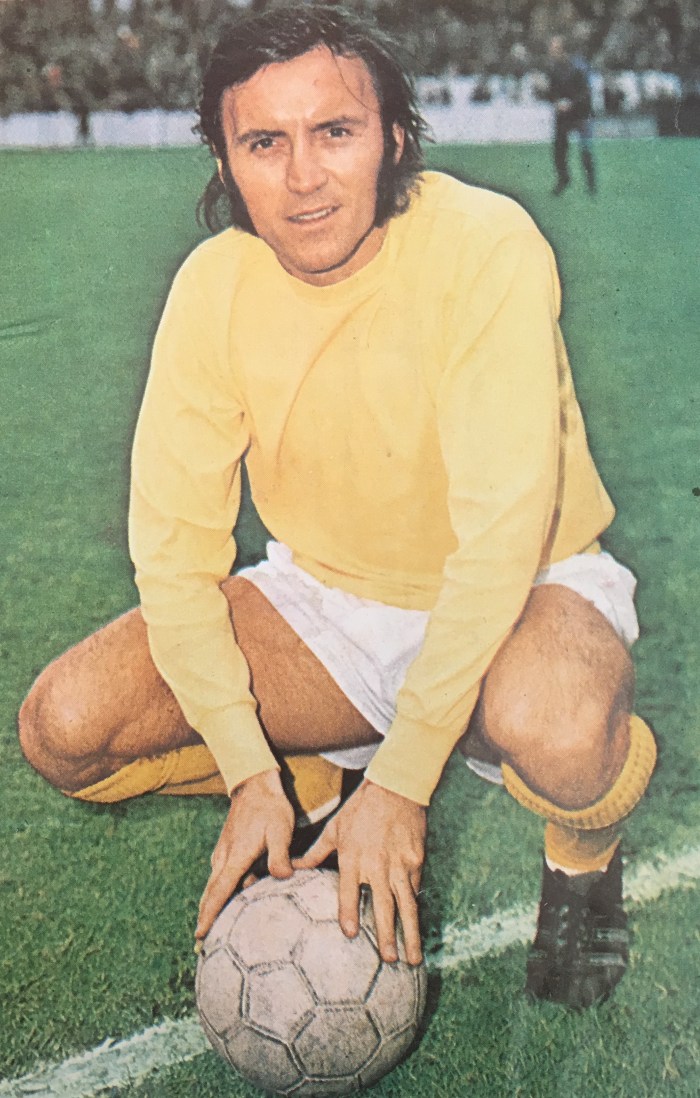
  • Pictures from my scrapbook show Barry in his England and Chelsea days, in Millwall’s white and change yellow shirts, in QPR’s familiar hoops, and in the Albion stripes.

Did Chris Ramsey’s injury alter outcome of 1983 FA Cup Final?

2-near-post-guardBRIGHTON & HOVE Albion’s May 1983 FA Cup Final clash with Manchester United was historic for the club and for their 21-year-old right back it was even more eventful.

Who would have known that former Bristol City apprentice Chris Ramsey’s ignominious departure from the field in a firemen’s lift on Glen Wilson’s shoulder would more or less be the end of an all-too-brief playing spell in the top echelons of the English game?

Might the match – and Ramsey’s career – have panned out differently if it hadn’t been for that diabolical tackle by Norman Whiteside?

Trouble had been brewing in the weeks leading up to the final and the national media, looking for every possible angle to pick at, had singled out Ramsey for criticism. Did that stoke the fire?

Let’s rewind a little and explore what happened.

Born in Birmingham on 28 April 1962 , Ramsey, whose father came to the UK from St Lucia, was one of two boys and five girls. Rejected by Charlton Athletic as a schoolboy, he became an apprentice at Ashton Gate but was then released and, after a successful trial, Brighton took him on.

The 1980-81 season was Albion’s second in the top division and, as it drew towards its close, it was looking increasingly likely they were heading for relegation.

Manager Alan Mullery was openly criticising his players for their efforts and his big ally off the field, vice-chairman Harry Bloom (current chairman Tony Bloom’s granddad) had died of a heart attack on the team coach on an away trip to Stoke.

Something had to change and, at the tender age of 19, Ramsey was called up from the reserves and plunged in at the deep end.

In three of the last four games, he took over the no.2 shirt after Mullery switched John Gregory from right back into midfield. Ramsey’s debut came in a crucial Easter Saturday clash away to rivals Crystal Palace when, released from the shackles of defending, Gregory scored twice in a 3-0 win. Ramsey also played in the wins over Sunderland away and Leeds at home.

The Seagulls stayed up by the skin of their teeth and Evening Argus reporter John Vinicombe said in his end of season analysis that Ramsey had been “a revelation” in those three games.

Within a matter of weeks, Mullery quit as manager in the furore over chairman Mike Bamber selling Mark Lawrenson to Liverpool (after Mullery had already agreed a deal to sell him to Manchester United).

Gregory was sold to QPR for £300,000 but, far from that move opening up an opportunity for Ramsey, Mullery’s replacement Mike Bailey brought in on a free transfer from Loftus Road the experienced Don Shanks, who was immediately installed as the first choice right back.

Indeed Bailey froze out Ramsey for the following 19 months! At one point he was transfer listed but it was Bailey who departed the Goldstone first – his sacking working to the advantage of the young defender.

When George Aitken and Jimmy Melia took over in December 1982, Ramsey was instantly promoted from the reserves and seized his opportunity.

In a profile in an Albion matchday programme in February 1983, Ramsey told Tony Norman: “Like any other young apprentice, my dream was to play in the First Division. I must admit that even after coming to Brighton, I had times when I wondered if I’d make it. But now I’ve got my chance and I’m keen to make the most of it.”

In one of the most comprehensive profiles on Ramsey, former Brighton teammate, Andy Ritchie, told Adam Ellis of The Football League Paper: “He was quite a shy lad back then but he had everything you want in a full back. Aggression, pace, agility – and he could tackle like a demon.”

These were the attributes that Melia appreciated too. In a Daily Mail preview of the Norwich quarter final, Melia told reporter Brian Scovell: “The other players love playing with him. He’s a great competitor, tackles well and uses the ball with a bit of style.

“I’m pleased he’s taken his chance. He deserves to play at Wembley if we manage to get there.”ramsey + mel

As it turned out, Ramsey’s place was in jeopardy because of two sendings off in the league in April which led to him being banned for the semi-final against Sheffield Wednesday at Highbury.

After being sent off in a 2-1 home win over Spurs, Terry McNeill reported in the News of the World: “Ramsey was lucky to stay on earlier after bringing down Mark Falco in a probable scoring position. When he took the striker again from behind, there was no escape.”

The 20-year-old Ramsey was fairly phlegmatic about the situation and told Alex Montgomery of The Sun: “Whatever I did, I did for the club. You can’t think about Cup games when you are struggling for points at the bottom of the First Division.”

His second dismissal, along with Coventry’s Steve Jacobs (who later played for the Albion under Chris Cattlin) after a scuffle in a 1-0 win at the Goldstone, was lambasted by one of the pre-eminent football writers of the day, Frank McGhee of the Daily Mirror.

“Can Brighton afford to field at Wembley a man who by then won’t have been able to play for 19 days?” he intoned. “And can they trust Ramsey not to sully soccer’s great state occasion by a moment of blind madness?”

Nevertheless, after Wednesday were beaten, Melia was happy to restore his first-choice right back to the starting line-up but one wonders now whether Ramsey had a sense of foreboding about how the big occasion would unfold.

Reflecting on those dismissals in the build-up to the final, he told The Sun’s Montgomery: “I just hope people aren’t looking for me. I’ll certainly be careful. I honestly don’t think I deserve the reputation which I’ve been saddled with in the last few weeks.

“The dismissals were just coincidences – nothing more than that. I know I am an aggressive type of player but that is my game. I always want to give 100 per cent for the club. The last thing I want is trouble at Wembley.”

After Albion had taken a shock lead through Gordon Smith’s header, United piled on the pressure and Ramsey headed a goalbound Gordon McQueen effort off the line.

But then came a pivotal moment early in the second half. Tim Carder and Roger Harris record it thus in their excellent Seagulls! The Story of Brighton & Hove Albion FC: “Whiteside went in high on Ramsey’s shin as the Albion full back cleared, and then trod on his ankle. The referee had a strong word with the United forward but did not signal a foul.”

The tackle had rendered Ramsey lame and while he tried in vain to carry on, two minutes later he wasn’t able to challenge for a ball to the far post which Frank Stapleton duly dispatched to equalise.

Those of us watching in the stadium, together with millions glued to TV screens around the world, saw Ramsey carried from the Wembley turf and, in those days of only one substitute, wondered how Albion would cope with a makeshift defender in the shape of Gerry Ryan.

After United took the lead through Ray Wilkins, Ramsey’s friend – and fellow England under-20 teammate – Gary Stevens’ equalised to send the game into extra time and ultimately a replay. Stevens was adamant about the impact Whiteside’s challenge had on the game.

In Match of My Life, edited by Paul Camillin, he said: “It was a bad tackle and perhaps cost us the game. In those days we only had one substitute and Gerry Ryan came on and did a great job at right back, even though he was a midfield player, but we did miss Chris because he had been having a great game.”

Whiteside was unapologetic about the challenge but Ramsey fumed to The Sun’s Montgomery: “It could have broken my leg. If I’d done it, I’d have been off. I just can’t understand how Whiteside got away with it.”

The injury deprived Ramsey of the chance to play in the replay five days later and, after that sad exit, his playing career never reached similar heights again.

Indeed he actually only played 37 games for the Albion, most of those coming in that 1982-83 season. He played only a handful of games in the following season and in August 1984 went on loan to Swindon Town before joining them permanently four months later.

There, he played alongside the likes of Sky Sports reporter Chris Kamara and one-time Albion assistant manager Colin Calderwood and clocked up over 120 appearances, including being part of Lou Macari’s Fourth Division champions in 1986 and Third Division play-off winners in 1987.

In August 1987, he joined Southend United but played just 13 games for them before persistent back injuries forced his early retirement at the age of just 26.

Some business ventures he embarked on didn’t work out and former Albion right back rival Shanks set him up with a trial for a team in Malta, Naxxar Lions, where he made a playing comeback.

Eventually the ongoing injury problems made him look to other ways of making a living. He coached in the United States but also started studying like crazy.

Amongst lots of qualifications, he got a Master’s degree at the University of North London in Health, Physical Education and Recreation (a qualification which enabled him to become a primary school teacher) and simultaneously obtained his UEFA coaching badges.

That Football League Paper piece records: “With an MSc, ten diplomas and myriad other qualifications, Ramsey is so highly educated that he actually sets the test for pro licence candidates.”

ramsey EngA stint in charge of youth development at Leyton Orient and coaching Newham Ladies was followed by an FA appointment as coach to the England under-20 side in the 1999 FIFA World Youth Championship when among the players under his direction were Ashley Cole, Peter Crouch, Matthew Etherington and John Piercy, who later played for the Albion. At the FA he learned from the likes of Les Reed and one-time Albion winger Howard Wilkinson.

He had a short and unsuccessful three-month spell as assistant to Ricky Hill at Luton Town, and he said: “Ricky Hill was a massive inspiration to me.”

Just when it appeared new offers had dried up, Ramsey got the chance to manage Charleston Battery in the USA, where he stayed for three years.

Winning the USL A-League (second division) with Battery in 2003 brought him to the attention of Spurs, and, as head of player development, many of the young players he coached in tandem with Les Ferdinand and Tim Sherwood were Harry Kane, Ryan Mason, Danny Rose, Nabil Bentaleb, Andros Townsend, Steven Caulker and Jake Livermore.

“He was massive for all of us,” French midfielder Bentaleb told The Football League Paper. “He believed in us, he encouraged us. He told the manager we were ready when everyone else believed we were not. He was not shy or scared of anybody and he knew exactly what he wanted.”

chris ramsey (spurs)In the Evening Standard in 2012, Spurs and England centre back, Ledley King, said: “He is one of the best coaches in the country. The youngsters love the way he works and they have really bought into his methods.”

Ramsey left Spurs in 2014 to take up a coaching role at QPR, and when Harry Redknapp left the floundering Hoops in February 2015, Ramsey stepped up to become a fully-fledged Premier League manager.

He was not able to halt Rangers’ relegation from the elite, though, and lasted only until November in charge of the side as they struggled to come to terms with life back in the Championship.

However, in January 2016, he was appointed technical director at QPR to oversee the club’s academy coaching and player development.

The club’s director of football, Ferdinand, told The Guardian: “While we were disappointed things didn’t work out with Chris at first team level, we were determined to retain his services. As such, we actually put a clause in his contract which allowed us to retain Chris’s services in a player-development role should things not work out for him as head coach.”

Ramsey finally left QPR in January 2024. By then 61, the head of coaching and technical director told the club website: “I have had a fantastic nine years at QPR and the club will always have a special place in my heart.”

The club’s chairman Lee Hoos said: “Chris has been a great servant to the club. I cannot thank him enough for his incredible hard work, dedication and guidance.

“However, as we thoroughly rationalise everything we do, and following very amicable discussions with Chris, it is felt this move is in the best interests of all parties. He will always remain a friend of the club.”

  • Shootthedefence.com did a face-to-face interview with Ramsey on 23 September 2016 which is well worth a listen as he talks in detail about his whole career.
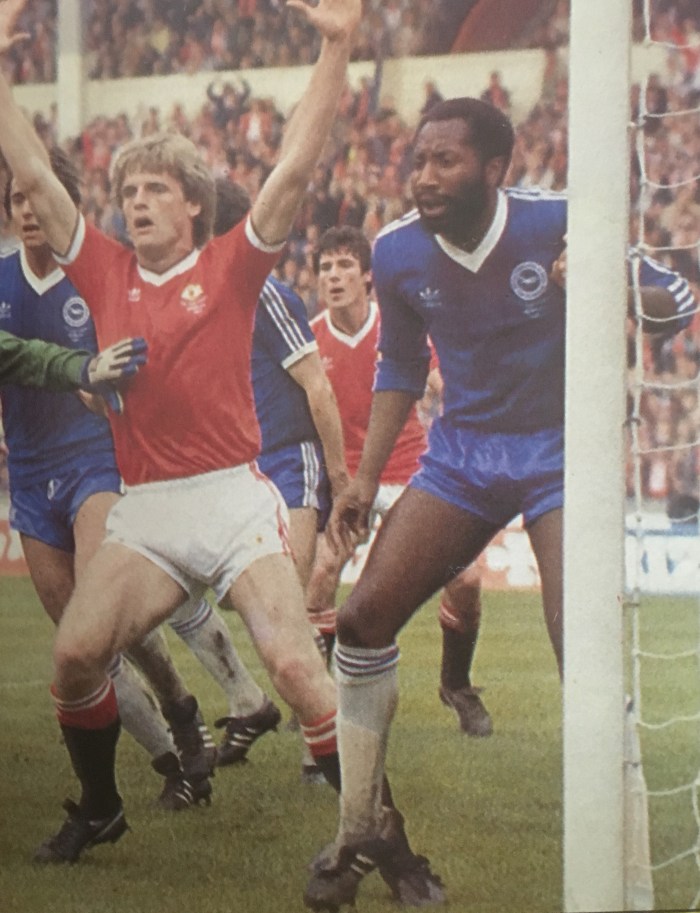
  • In pictures from my scrapbook, Ramsey graces the cover of an Albion matchday programme; (top) he defends the near post during the 1983 FA Cup Final with Gordon McQueen in attendance; he is photographed by Tony Norman outside the Goldstone and criticised in the Daily Mirror by Frank McGhee.