

DEFENSIVE midfielder Toby Collyer can genuinely be placed in the ‘one that got away’ category as far as Brighton are concerned.
Worthing-born Collyer excelled as a teenager in Albion’s youth set-up but chose to move on to Manchester United when he was 18.
He has since made it through to United’s first team, getting on as a sub in the last two matches under Ruben Amorim having been blooded by former boss Erik Ten Hag.
After involvement with the first team squad from February 2024 as a non-playing sub, he impressed in pre-season games and played in the Community Shield match at Wembley against Manchester City.
He made his Premier League debut as a half-time substitute for Casemiro when United lost 3-0 to Liverpool at Old Trafford and his first competitive start was in the 7-0 beating of Barnsley in the Carabao Cup, when he played at left-back.
Born in Worthing on 3 January 2004, Collyer’s talent began to be honed when he was only 11 playing for Albion’s under-12s squad.
He attended Angmering School and Ian Gooding, his former teacher, told the BBC: “Toby was the epitome of dedication. Even as a young student, he had an undeniable mentality and drive to succeed in top-level sport.
“His commitment to his studies and football was evident in everything he did.” Gooding said, “It was clear from the beginning that Toby wasn’t just a talented athlete; he was someone who truly wanted to excel and make a mark in the world of sports.”

Collyer made his debut for Brighton’s under-18s just a few weeks after turning 15 and never looked back.
“Even though he didn’t play a great deal at under-16 he still trained,” former Albion under-18s coach Mark Beard told Sussex Live. “You could see he was going to be a top-class player.
“He is a pleasure to coach. He is so low maintenance, what I mean by that is you don’t know he is there. He gets on with his job. He regularly put in displays of 8/10 at the least.
“You want 11 of these type of players in the team. You know what you’re going to get in training, he works hard, he wants to improve, he’s intelligent. He’s a good all-round kid.”
A defensive midfielder happy to tackle and control play from deep, he also showed his versatility by filling in at centre-back with Albion’s under-18s. He also captained England at under-16 and under-17 level, highlighting his leadership qualities and tendency to lead by example.
In an extended interview with the Manchester Evening News, Beard said: “I was made aware of Toby probably from around the age of under-14s. I was the u18 manager and he used to come up and train with us, despite being much younger and I gave him his debut toward the end of his under-15 year. He was always a little bit smaller back then and he seemed to shoot up in height suddenly when he became a scholar.
“Everyone would say he was the best player in the age group every year, but he was just one of them that you hardly noticed. He just got on with his job, there was no trouble and he worked hard.
“He took everything on board like a sponge. There were obviously a few things as he got older that we needed to work on and as he shot up a bit and he needed to redevelop.
“Toby sort of changed the way he played, so different types of passing, defending and he became a real good all-round midfielder once he’d learnt those two of three key areas.”
The coach admired the youngster’s ability to cover left and right from a central position, closing players down and winning the ball. “His ball retention was different class,” said Beard.
“I had such a good team at Brighton, with Evan Ferguson and players like that, and everyone would say Evan was unbelievable, but he’d touch the ball 10 times, score a goal and run about 8km.
“Toby would run around 13km every single game, he’d have 200 touches of the ball and have the best defensive duel win-rate. His stats would be astronomical, honestly, absolutely ridiculous.
“You really don’t get that with many players. He’d be under the radar, but those are the players you want in your team more than anyone else.”
Collyer captained England at under-16 and under-17 level and played 25 games for Albion’s under-18s and under-21s in the 2020-21 season. But he couldn’t agree terms on a new deal at Brighton, after which he was frozen out and given only one game in the 2021-22 season.

The teenager had a successful trial period with United, appearing in a friendly game for the club’s under-23s against Huddersfield Town, and impressed the coaching staff sufficiently to be offered a three-year contract.
There had been no shortage of suitors eager to take him on and Beard encouraged him to join United over the likes of Chelsea and Spurs. As things transpired, he was the first (and only) signing of the Ralf Rangnick era and became a regular in United’s under-18s and under-21s.
Originally given a three-year contract, in July 2024 he had it extended to 2027 with an option to extend to 2028.
Injuries hampered his early days at United but under-21s manager Travis Binnion told the Manchester Evening News: “We’re talking about a really good young player with high potential. “When you have a spell out of the game and have a couple of injuries that stop you playing, it takes a while to get going, but when we signed him, we had no doubts about what he was capable of – he’s a fantastic athlete and effective without the ball.
“Toby is also making great strides with the ball, so we’re talking there about someone who can be really effective in all moments of the game.”
It was in pre-season ahead of the 2024-25 season that Collyer saw action for the first team for the first time, being handed the captain’s armband when part of a complete half-time team change in a 1-0 defeat to Rosenborg in Norway.
He then started the 2-0 win over Rangers before getting another 45 minutes against Arsenal in Los Angeles.
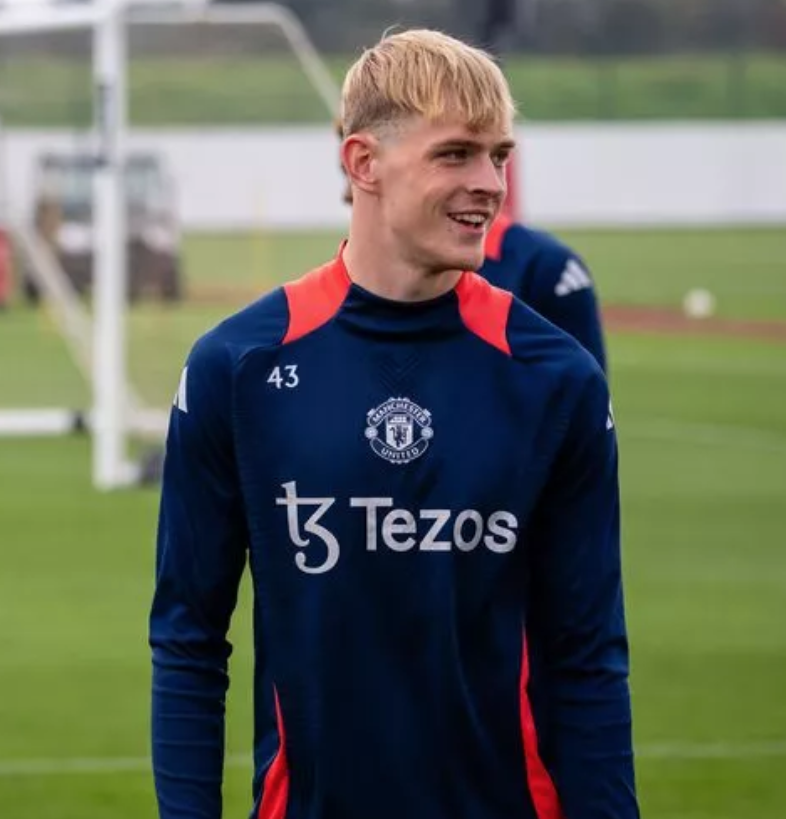

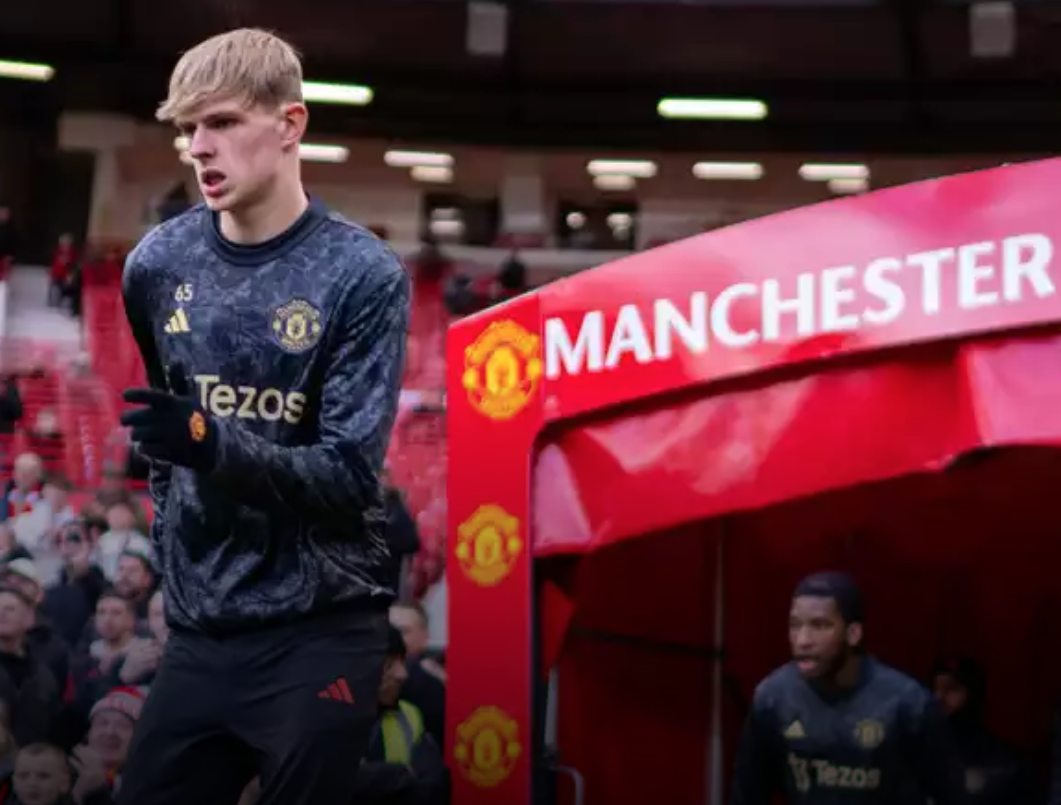
Interviewed by United media’s Sam Carney about his first experience of an overseas tour with the first team, he said: “It’s really, really, really valuable. Everyone wants to be able to play in the first team. So I think getting experiences like this in a stadium like this as well, it’s the top level, and obviously the opposition [was top level] as well today.
“I’m taking everything step by step and hopefully I’ll get many more opportunities to show what I can do.”
Although United lost 2-1 to the Gunners, Collyer said: “I thought I had an okay game. I thought there was a lot of things I could have done better, but it’s great to experience a game like today and I can take it into the next game, and even into training tomorrow.”
United writer for The Athletic, Carl Anka, liked what he saw, observing: “Collyer is a calm operator on the ball, favouring safe, short passes either sideways or backwards, while showing himself capable of occasional long switch passes.
“He is also skilled at receiving the ball on the half turn, letting passes come across his body before swinging his hips around to protect the ball from opponents looking to pressure him.
“Tall, strong and with a good sense of how to delay opposition counter-attacks, there are moments where his play can resemble Declan Rice when he broke into West Ham United’s first-team squad.”



The reporter added: “Athletically gifted, Collyer can cover 20-30 yards quickly — but rather than sprint around with wild abandon in search of the ball, Collyer works to disrupt easy passes inside the opposition half. Collyer’s defensive work centres on blocking off the more obvious passes opponents can make before looking to intercept the ball for his team.”
Interviewed for United’s matchday programme, United Review, Collyer talked about sharing the field with the likes of Casemiro, Christian Eriksen and Bruno Fernandes.
“Without them, I wouldn’t be able to reach the level I’ve got to at the minute. I think as much as I’ve done hard work, they’ve worked hard with me as well to help me and give me tips. It’s massive for me.”
Collyer earned a call up to the England under-20 squad in October 2024, and United’s Binnion said: “He’s a fantastic lad. He’s got a superb attitude and he’s getting what he deserves.”
He was on the bench for United’s 3-3 Europa League draw with FC Porto at the beginning of October but, later that month, was ruled out by injury; reports reckoning he would be sidelined for a month.
Shortly after Ruud Van Nistelrooy took over as manager at Leicester, The Sun reported the former United assistant manager was keen to take Collyer on loan. The newspaper also reported that former Albion midfielder Steve Sidwell had tipped Collyer to be a “shining star just like Kobbie Mainoo.”
Collyer was plunged into the heat of battle as a substitute in United’s dramatic FA Cup third round win at Arsenal on 12 January 2025, and Steven Railston, Manchester United writer for the Manchester Evening News, liked what he saw.
“Toby Collyer made his first appearance under Ruben Amorim against Arsenal and took his chance with both hands,” wrote Railston.
“The youngster was introduced to the game with nine minutes of normal time remaining and deserves praise for the maturity he demonstrated under immense pressure.”
The reporter noted that Amorim chose to introduce Collyer over the more experienced Casemiro, who was available on the bench and wrote: “The 21-year-old embraced the occasion when it was possible to be overawed, seemed to cover every blade of grass and proved to United’s new head coach that he can provide value to the squad.”


 In parallel lines