Steady Eddie had plenty of strings to his bow

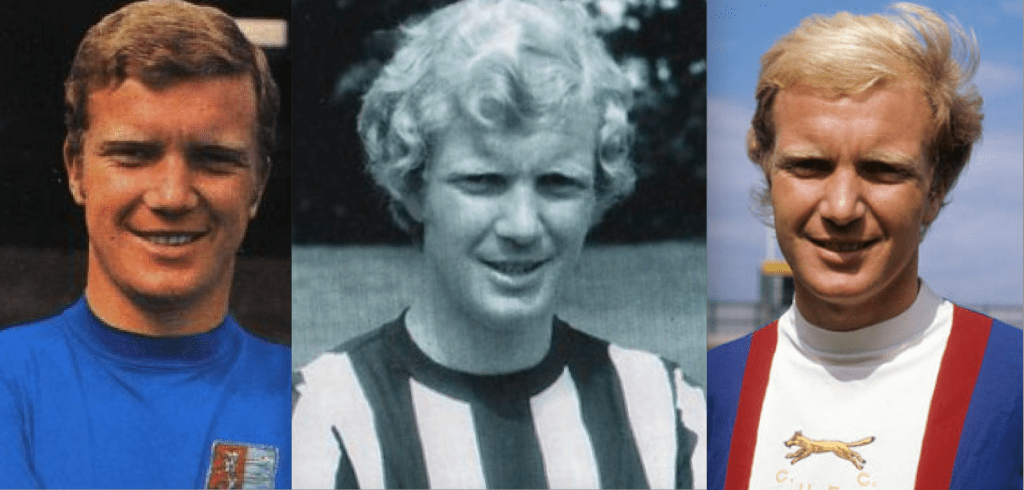
ONE TIME Albion captain and utility player Eddie Spearritt played in the top flight for Ipswich Town and Carlisle United.

He made five starts and five appearances off the bench for second tier champions Ipswich at the beginning of the 1968-69 season before joining third tier Brighton for £20,000 in January 1969.

Play anywhere Spearritt was then a permanent fixture in the Albion line-up for almost five years, making 225 appearances, before Brian Clough turfed him out at the end of the 1973-74 season.

But he found himself back amongst the elite when newly promoted Carlisle United snapped him up for their one and only season (1974-75) amongst the big boys.

Spearritt made 17 starts and six appearances as a sub for the Cumbrians but, in spite of a superb winning start when they briefly topped the division, United finished the season in bottom spot.

Spearritt shapes to challenge Aston Villa’s Ray Graydon

Equally comfortable playing in midfield, at full back or sweeper, Spearritt had on-off spells as Albion’s chosen penalty-taker as well as chipping in with goals from open play. He even turned his hand to goalkeeping when necessary.

Another key attribute to his game was an ability to send in long throw-ins which could sometimes be as effective as a free kick or corner. It was a skill which earned him a place in a Longest Throw competition staged by BBC’s sport show Grandstand in 1970-71, although he didn’t win it.

Born in Lowestoft on 31 January 1947, Spearritt went to Lowestoft Grammar School and on leaving school was picked up by Arsenal. But when the Gunners didn’t keep him on, he returned to East Anglia and joined Ipswich as an apprentice in August 1963.

He signed a professional contract with Town in February 1965 and, as Tim Hodge details on prideofanglia.com, he made his league debut in the 1965-66 season in a 1-0 win away to Preston in the old Division Two.

That was the season when substitutes were first introduced into the English game and the record books show that Spearritt was the first Ipswich sub to score a goal.

He went on for Irish international Danny Hegan in a match away to Derby County on 15 January 1966 and scored Ipswich’s second goal. The game finished 2-2; Gerry Baker having scored Town’s first.

Over the next three years, Spearritt made a total of 69 appearances (plus 10 as sub) for Bill McGarry’s side, scoring 14 goals along the way. Twenty of those games came in the 1967-68 season when Ipswich won the old Second Division.

A 1-0 home defeat to Spurs in October 1968 was his last for the Suffolk club and he parted company with Town shortly after McGarry left Portman Road to take over at Wolverhampton Wanderers.

A debut v Crewe (left) and slaloming through the Plymouth Argyle defence (right)

Spearritt was one of Freddie Goodwin’s first signings for Brighton – just a few weeks before my first ever Albion game. He made his debut in a 3-1 home win over Crewe Alexandra and kept the number 10 shirt to the end of the season, by which time he had scored five times, including both Albion’s goals in a 2-2 draw at home to Tranmere Rovers.

In the 1969-70 season, not only was he part of the Third Division Albion side who pushed his old manager McGarry’s First Division Wolves side all the way in a memorable third round League Cup tie, it was his header from Kit Napier’s free kick that put the Albion 2-1 ahead just before half-time.

Scottish international Hugh Curran scored twice in eight second half minutes to clinch the win for Wolves but a bumper Goldstone Ground crowd of 32,539 witnessed a terrific effort by their side.

A few weeks’ later, in a marathon FA Cup second round tie with Walsall that required three replays before the Saddlers finally prevailed 2-1, Spearritt took over in goal during the second replay when a concussed Geoff Sidebottom was stretchered off on 65 minutes. Albion hung on for a 1-1 draw.

Spearritt was a midfield regular in his first two seasons but Goodwin’s successor, Pat Saward, switched him to left back halfway through the 1970-71 season and that’s where he stayed throughout 1971-72 when Albion won promotion from the old Third Division as runners up behind Saward’s old club, Aston Villa.

It was in the first half of that season that Spearritt took a call from ex-Ipswich teammate Ray Crawford, the former England international centre forward, who had returned homesick from a short stint playing in South Africa.

He persuaded Saward to offer Crawford a trial and although he didn’t make the league side he scouted upcoming opponents, played for the reserves and subsequently ran the youth team.

Meanwhile, Spearritt was a key part of the promotion side and player-of-the-season Bert Murray generously declared the award could have gone to Eddie for his consistency that season. As it happened, Spearritt did get the award the following season, although somewhat more ignominiously considering Albion were relegated.

All smiles as Pat Saward’s side toast promotion in 1972

In the close season after promotion, Spearritt tied the knot with Penelope Biddulph, “an accomplished professional dancer,” the matchday programme told us, and they moved into a new home in Kingston-by-Sea.

Spearritt started out at left back in Division Two but after ten games was ousted by the arrival of George Ley from Portsmouth. He then switched back into midfield, but by the end of that relegation season was playing sweeper alongside Norman Gall (for nine games) and Steve Piper (for two).
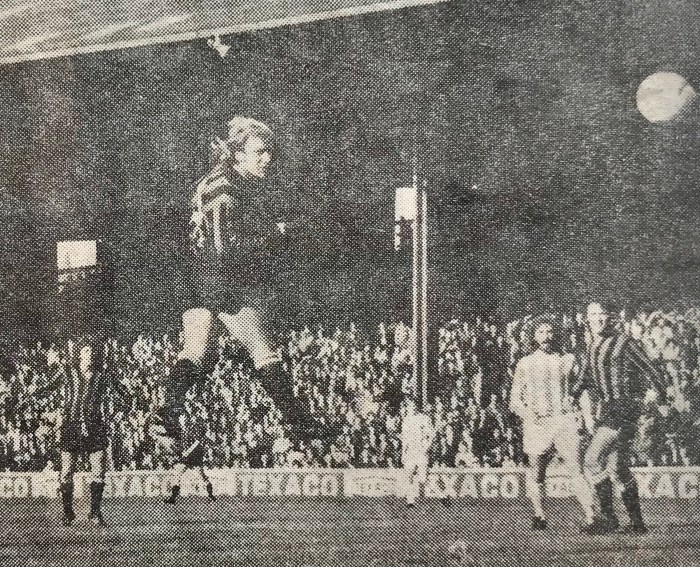
He scored (pictured above), along with Barry Bridges, in a 2-0 win at Huddersfield on 14 October but the team went on a disastrous run of 16 games without a win, although Spearritt did get on the scoresheet three times, including notching two penalties.

When Albion went to that footballing outpost Carlisle on 16 December, they had lost five in a row without managing a single goal. Carlisle were 5-0 up, goalkeeper Brian Powney was carried off with a broken nose, replaced between the sticks by Murray, then Albion won a penalty.

Spearritt took up the story in a subsequent matchday programme. “I used to be the club’s penalty taker but, after I had missed an important one at Mansfield in 1970, I lost the job. Penalty-taking is really all about confidence,” he said. “After I had missed that one at Mansfield, which cost us a point, the players lost confidence in me and the job went first to John Napier and was then taken over by Murray.

“Bert would have taken the penalty at Carlisle. He has already scored two this season. But he had gone in goal and it was decided it was too risky to fetch Bert out of goal to take the penalty.

“Nobody else seemed to want to take it so I just picked the ball up and put it on the spot. We were 5-0 down by then but I thought from a morale point of view that it was extremely important that I scored. You can understand my relief when I saw the ball hit the back of the net.

“Everybody was beginning to wonder when we would score again. I suppose with the run of bad luck we have been having it was almost inevitable that we should break our goal famine from the penalty spot.”

Towards the end of the dismal run, Albion drew First Division Chelsea at home in the third round of the FA Cup. The game was won 2-0 by Chelsea but it was an ugly, violent affair – The Argus labelled it ‘Goldstone day of shame’ – in which five players were booked and each side had a player sent off.

Spearritt, the first to be booked, found himself caught up in a huge controversy which resulted in Chelsea hard man Ron Harris being sent off by Leicester referee Peter Reeves; remarkably the only time in his career he was dismissed.

The Brighton man insisted he’d been hit by the defender and Saward said in diplomatic terms after the game: “Spearritt said he was struck on the mouth and that it was not an involuntary action but a blow. From what I saw, I couldn’t understand it.”

Esteemed football writer Norman Giller subsequently recorded it like this: “Harris got involved in a tussle with Spearritt, and, as he pushed him, Spearritt went down holding his face as if he had been punched. The referee directed Ron to an early bath. All the bones he had kicked, and here was Harris being sent off for a playground push.

“A Brighton-supporting vicar, with a pitchside view, wrote to the Football Association telling them what he had witnessed, and ‘Chopper’ was vindicated.”

Whatever the truth of the matter, Spearritt told Argus Albion reporter John Vinicombe that he’d been threatened by a Chelsea player after the incident. “He spoke to me several times and made it quite clear what he had in mind.”

Albion’s Ley was sent off for bringing down Tommy Baldwin and then getting involved in an altercation with Peter Osgood, who scored both Chelsea goals. Two minutes later David Webb went into the book for a ‘blatant foul’ on Spearritt.
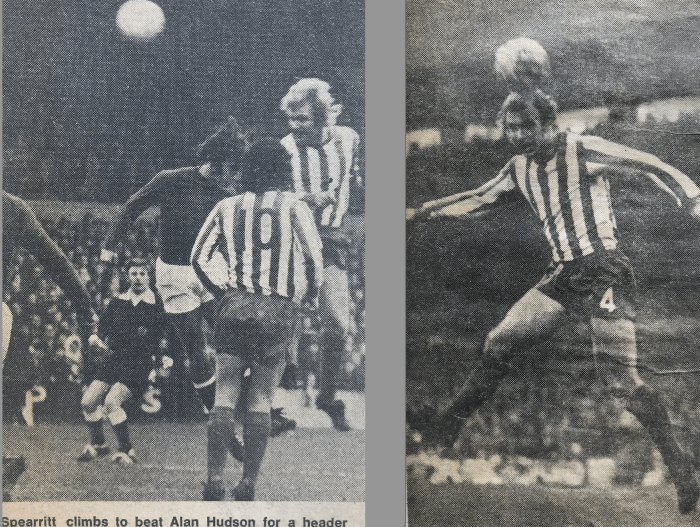
Albion finally returned to winning ways the following month with a 2-0 win over Luton (on 10 February), and then beat Huddersfield, Carlisle and Swindon, prompting Saward to refer to “some outstanding individual performances” and adding: “I have been particularly pleased with the way Eddie Spearritt has been playing in recent weeks.

“He has maintained a high level of consistency this season and his work in defence and in midfield has been invaluable as the side has plugged away trying to turn the tide of results.”

Saward made Spearritt Albion’s captain at the start of the 1973-74 season back in Division Three and with the return of central defender Ian Goodwin and then the emergence of Piper in the sweeping role, he was soon back in midfield.

But when Saward was sacked in October and sensationally replaced by former Derby County League title winning management duo Brian Clough and Peter Taylor, Spearritt was one of the first to have his nose put out of joint by the new arrivals.

Journalist Spencer Vignes described what happened in Bloody Southerners (Biteback Publishing, 2018), his excellent book about that era.

Clough sought out long-serving centre back Norman Gall and, because he hailed from the same part of the country (ie the north east), told him he was making him the captain. Gall told Vignes: “Suddenly I’m captain, which I was really happy about. Eddie Spearritt didn’t like it though. He’d been captain up until then. In fact, he didn’t talk to me after that. That was the beginning of the end for Eddie.”

Spearritt was part of the side who capitulated 4-0, 8-2 and 4-1 in successive games against Walton & Hersham, Bristol Rovers and Tranmere Rovers, and he was dropped for six games, along with Ley (who never played for Albion again). Clough went into the transfer market and brought in midfielder Ronnie Welch and left back Harry Wilson from Burnley.

Although Spearritt was restored to the team in mid January, and had a run of seven games — including his 200th league game for Albion — when he was subbed off in a home win over Hereford United on 10 March 1974, it was to be his last appearance in an Albion shirt.

In five years he’d played 225 games (plus seven as sub) and scored 25 goals.

Come the end of the season, Spearritt was one of 12 players released by the club in what became known as the great Clough clear-out.

Perhaps surprisingly, though, his next step was UP two divisions to play in the First Division with then newly promoted Carlisle United.

One of his teammates there was defender Graham Winstanley, who later joined the Albion. The side was captained by Chris Balderstone, who was also a top cricketer. Journeyman striker Hugh McIlmoyle played up front while John Gorman, who later played for Spurs and became Glenn Hoddle’s managerial sidekick, was also in the team.

They memorably topped the division after three games…but predictably finished bottom of the pile by the end. In his two-year stay with the Cumbrians, Spearritt played 29 times, was sub twice and scored a single goal.

He moved back south in August 1976, signed by Gerry Summers at Gillingham, and made his debut in a League Cup first round second leg tie against Aldershot, then made his league debut against Reading.
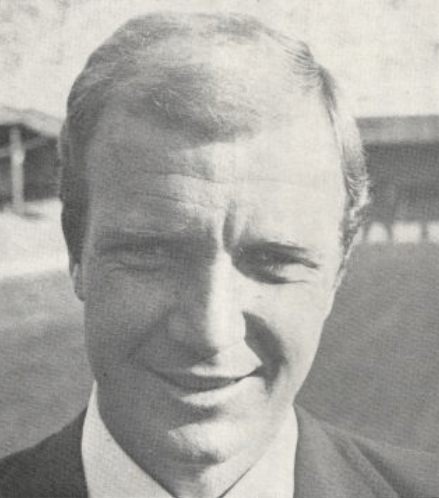
In total, he made 22 appearances in his one season at the club — one of them at the Goldstone Ground on December 29 1976, when the Albion won 2-0 on a slippery, snow-covered pitch. Spearritt scored just the once for the Gills, from the penalty spot against Rotherham United at Priestfield.

He emigrated to Australia the following summer and settled in Brisbane where he played 56 games for the Brisbane Lions between 1977 and 1980 and was their head coach in 1979. He subsequently coached Rochedale Rovers in the Brisbane Intermediate League, steering them to promotion to the Premier League in 1983.

Outside of football, he became estates manager for L’Oréal and in later years was better known as the uncle of Hannah Spearritt, once of the pop group S Club 7, who became an actress in the ITV drama Primevil.
Brighton trial was curtain call for Fred Pickering’s career

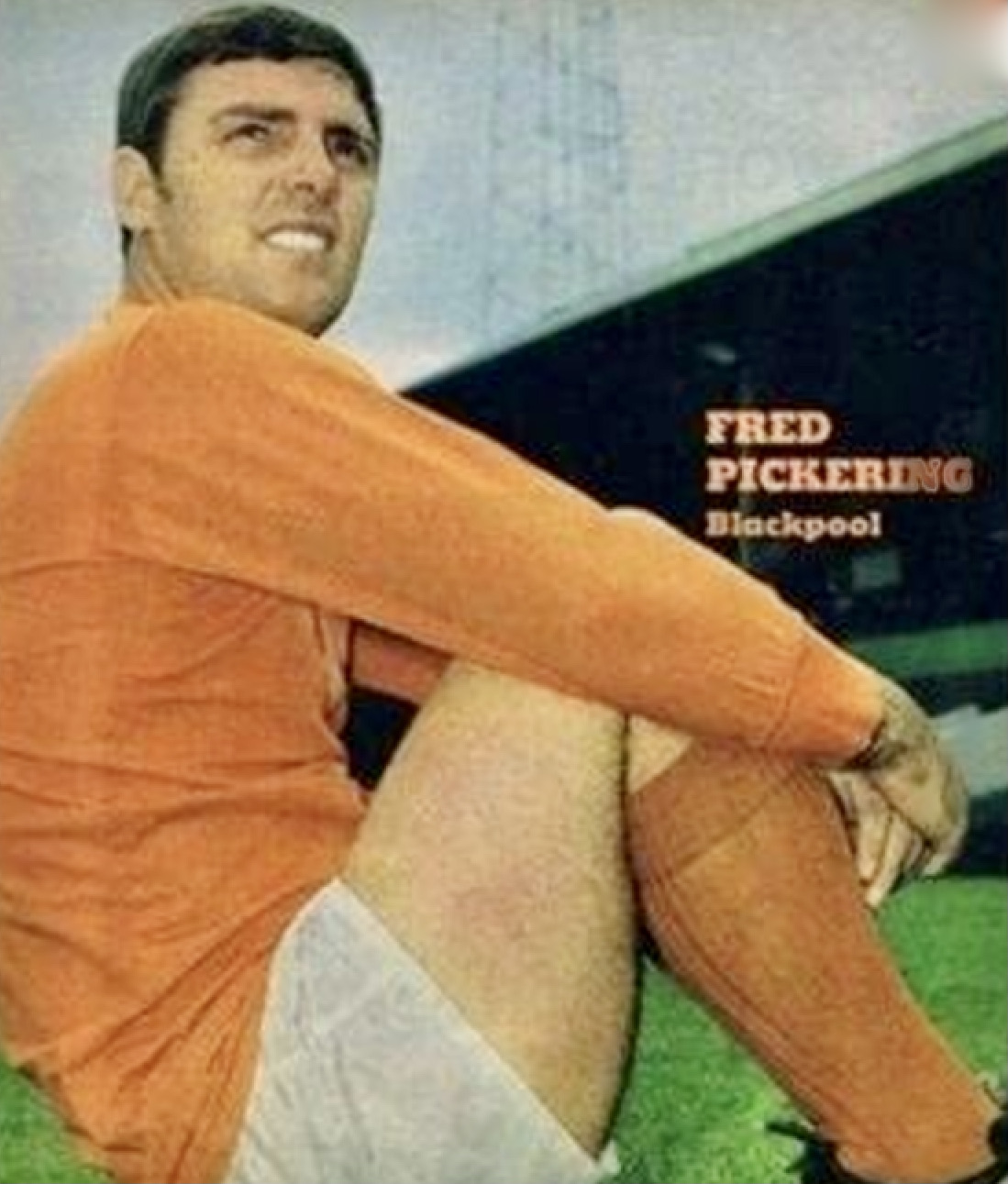
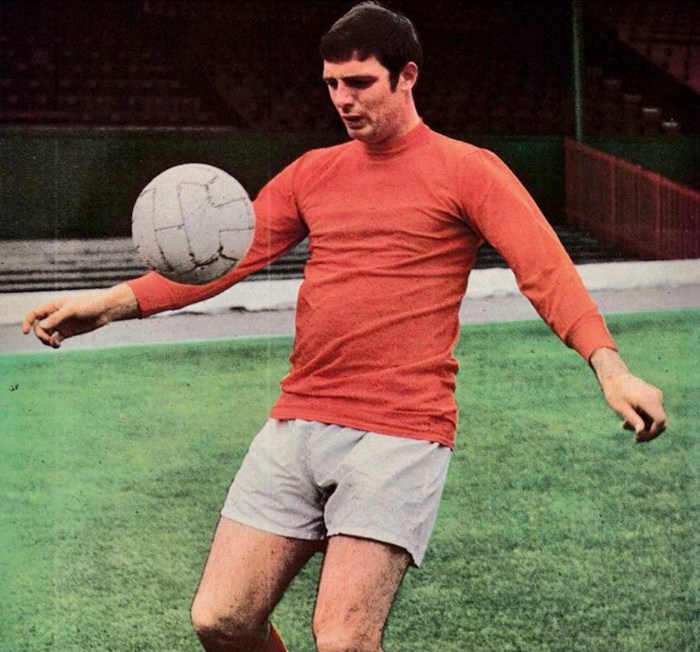
PROLIFIC goalscoring centre-forward Fred Pickering, who at his peak scored hat-tricks on his Everton and England debuts, ended his career after an unsuccessful two-month trial with Brighton.

Pickering was a transfer record signing for Everton (the previous season’s league champions) when he joined them from Blackburn Rovers for £85,000 in March 1964.

On his debut for Harry Catterick’s side, he scored three past Nottingham Forest’s Peter Grummitt in a 6-1 thrashing.

Eight years later, a player who’d played for his country and, but for injury, might have been involved in the 1966 World Cup, scored once for Brighton’s reserve side: in a 3-0 home win over Colchester United on 8 March 1972.

Brighton won promotion from the old Third Division two months later thanks in no small part to 19 goals scored by Kit Napier and 17 from Willie Irvine (Pickering’s former Birmingham City teammate Bert Murray netted 13 and Peter O’Sullivan hit 12).

Throughout the season, manager Pat Saward had been hankering for something a bit extra in the forward line. While he appreciated the skill of Napier and Irvine, he said “none had the devil in him. We wanted more thrust.”

Pickering was the second seasoned striker Saward had run the rule over, wondering whether their experience of goal plundering at the highest level several years before might be revived in third tier Albion’s quest for promotion.

Earlier in the season, he tried recruiting an ageing Ray Crawford but contract issues with the player’s last club, Durban City, meant the former Portsmouth, Ipswich, Wolves and Colchester centre-forward ended up joining the staff as a scout and coach instead.

In February 1972, 31-year-old Pickering, by then not even getting a game in Blackburn’s Third Division side, was given a chance by Saward to show he still had the goalscoring ability he had demonstrated so effectively earlier in his career.

Photographs of a rather heavy-looking Pickering training appeared in the Evening Argus and the former England striker was interviewed on Radio Brighton (as it was then) about his illustrious career. Although he played for the reserves, he wasn’t deemed fit enough to make it into the first team.

Saward eventually got the thrusting forward he sought on March transfer deadline day when he signed Tranmere Rovers’ Ken Beamish, who, at 24, was younger and fitter, and quickly endeared himself to Albion fans by scoring a handful of late goals which helped clinch promotion.

But what of Pickering? Born in Blackburn on 19 January 1941, he played junior football in his hometown before joining Rovers as an amateur aged 15.

As a schoolboy, he’d been an inside forward (a no.8 or no.10 in today’s parlance) but he was a full-back when he signed as a professional for Rovers on his 17th birthday.

Indeed, he was at left-back in the Rovers side that won the FA Youth Cup in 1959, beating West Ham United 2-1 on aggregate over two legs.

Alongside him for Rovers were future Spurs and Wales centre-half Mike England and Keith Newton, who also later moved to Everton and played for England at the 1970 World Cup. West Ham included Bobby Moore and Geoff Hurst in their line-up.

With the likes of Dave Whelan and Bill Eckersley ahead of Pickering in the Blackburn pecking order, his chances of a first team breakthrough were limited.

But after a successful outing for the reserves up front, and with wantaway Irish striker Derek Dougan dropped, Pickering was given a chance as a centre forward – and he never looked back.

He scored twice in a 4-1 win over Manchester City and went on to strike up successful partnerships with Ian Lawther, initially, and then Andy McEvoy.

“It was a big turning point for me to be playing centre forward,” Pickering told the Lancashire Telegraph. “Especially when you consider in 1961, Dally Duncan (Blackburn manager, and later Brighton guesthouse owner) told me that Plymouth wanted me and that I was free to leave. I didn’t want to go because Blackburn was my club.

“I only left in the end because the club wouldn’t give me a rise of a couple of quid. It was absurd.”

By then Pickering had scored 74 goalsin158 appearances – some strike rate – which meant he always held a special place in the hearts of the Ewood Park faithful, as reporter Andy Cryer described in a 2011 article for the Lancashire Telegraph.

“Had fate been kinder to him he could easily have been a national darling too,” wrote Cryer.

“When hat-trick hero Geoff Hurst was firing England to World Cup final glory in 1966, an injured Pickering was left reflecting on what might have been after an incredible journey took him from Rovers reserves to international stardom.”

Pickering, nicknamed Boomer for his powerful right foot, had scored five goals in three England appearances and looked set for inclusion in England’s 1966 World Cup squad having been named in Sir Alf Ramsey’s provisional selection.

But he suffered a knee injury in an FA Cup quarter final replay against Manchester City which not only caused him to miss Everton’s FA Cup final win that Spring, but also meant he had to withdraw from the England squad. Cryer reckons it also led to the subsequent demise of his career.

Pickering told the reporter: “I played three games for England and I scored in every game I played, I scored five goals and I was playing well. I was named in the World Cup squads. I was going and from that day it was the following weekend when the knee started to go.

“I watched all the Brazil games at Goodison. England struggled in their first game against Uruguay and that is when Jimmy Greaves got injured.

“Obviously that is how Hurst got in, he wasn’t even really in the set up before. There was every chance if I had been fit it that might have been me who had got in. I wouldn’t say I would have done what Geoff Hurst did but you never know what might have happened.”

Pickering had made his England debut two months after moving to Everton, in a 10-0 demolition of the USA on 27 May 1964. It was the same match that saw future Albion manager Mike Bailey play his first full international for his country. Roger Hunt went one better than Pickering by scoring four, Terry Paine got two and Bobby Charlton the other. Eight of that England side made it to the 1966 World Cup squad two years later – alas Pickering didn’t.

The same scoring rate he had enjoyed at Blackburn continued at Everton and in his first full season he scored 37 goals in all competitions – the most by an Everton player since Tommy Lawton scored 38 in 1938-39.

In three years with the club, he scored 70 times in 115 matches but his exclusion from the 1966 FA Cup final squad soured his relationship with manager Catterick, as covered in detail by the efcstatto.com website. Injuries disrupted his involvement at the start of the following season, and a cartilage operation put him out of action for nearly six months.

Although he made his comeback in March 1967, his Everton days were numbered and, in August 1967, moneybags Birmingham City bought him for £50,000 to form a hugely effective forward line with Barry Bridges and Geoff Vowden.

Pickering and Bridges played in all 50 of Birmingham’s matches in the 1967-68 season; the aforementioned Bert Murray 47. Bridges was top scorer with 28 goals and Pickering netted 15.

The Second Division Blues made an eye-catching run to the semi-finals of the FA Cup, but they lost 2-0 to West Brom (who went on to beat Everton 1-0 in the final).

The following season, Pickering scored 17 times in 40 appearances (Phil Summerill also scored 17, and Jimmy Greenhoff 15) but City finished a disappointing seventh.

That signalled the end of the striker’s time in the Midlands and he returned to his native north west with Blackpool, who paid £45,000 for his services.

It was money well spent as Pickering top-scored with 18 goals as the Tangerines won promotion back to the elite, finishing runners up to Huddersfield Town. His most memorable performance was on 13 April 1970 when he scored a hat-trick away to local rivals Preston North End in front of a Deepdale crowd of 34,000. It earned Blackpool promotion while simultaneously relegating North End to the third tier.

But the 1970-71 season didn’t go well for Blackpool or Pickering. The club got through three managers and only won four matches all season, which eventually saw them finish bottom of the pile and relegated along with fellow Lancastrians Burnley. Pickering found himself fined and excluded for breaches of club discipline (mainly involving missing training) and before the season was over he was sold back to his first club, Blackburn.

That was a blow to Preston, who had just loaned Willie Irvine to Brighton and were keen to install Pickering as his replacement. But it was to Rovers, for £9,000, that he went, but he couldn’t prevent the Ewood Park outfit being relegated to the third tier.

He scored just twice in 11 League games in his second spell at Blackburn before that two-month trial at Brighton.

After he retired from football, he became a forklift truck driver. Warm tributes were paid when Pickering died aged 78 on 9 February 2019. Well-known football obituarist Ivan Ponting said of him: “At his rampaging best, Fred was an irresistible performer.

“Though neither outstanding in the air, nor overly-physical for a man of his power, not even particularly fast, he could disrupt the tightest of defences with his determined running and a savage right-foot shot that earned him the nickname of ‘Boomer’.

“Boasting nimble footwork for one so burly – he could nutmeg an opponent as comprehensively as many a winger – he was especially dangerous when cutting in from the flank, a manoeuvre that yielded some of his most spectacular goals.”

In March 2022, a road in the Mill Hill district of Blackburn, where he lived all his life, was named after him and his family spoke of their pride as they unveiled the street sign in his honour.

Ken Beamish dumped by Clough without a word

1-k-beamish-btn-goalSWASHBUCKLING Ken Beamish was a good old fashioned centre forward who crowds appreciated for his never-say-die attitude in pursuit of goals.

He mostly played in the third tier but had three seasons at the next level up (one was Brighton’s disastrous 1972-73 season and he had two with Blackburn).

He twice won promotion from the old Third Division – with Brighton in 1972 and Blackburn in 1975 – and scored 198 goals in 642 league and cup games between 1965 and 1982.

Born in Bebington on 25 August 1947, Beamish started his career with nearby Fourth Division Tranmere Rovers in the 1965-66 season and was top scorer in two of his six seasons with the club, helping them to promotion to the Third Division in 1966-67.KB Tran

He joined Brighton on transfer deadline day on 9 March 1972; manager Pat Saward having set off for the north west from Sussex at 5am to ensure he captured his man before the 5pm deadline that existed at the time.

When Beamish signed for £23,000 (plus the surplus-to-requirements Alan Duffy), Albion had just scored 13 goals in three games so supporters were baffled as to why he was needed.

After two substitute appearances, Beamish made his full debut in the oft-talked about televised game v Aston Villa and then got off the mark in the 3-1 Good Friday win over Torquay United (see picture).

He contributed six goals in 14 games, including last minute winners in two games in the same week, against Rotherham and Rochdale.

In an interview in Goal magazine after promotion was clinched,  Saward explained why he had signed him when the team was already riding high and looking a good bet for promotion.

Aiming a bit of a sideswipe at the incumbents Willie Irvine and Kit Napier, Saward said: “We had plenty of skilful players up front but none had the devil in him. We wanted more thrust. Beamish gave us it.”

Reporter David Wright wrote: “He added the final spark to an ever-improving Brighton side that, after promising a great deal for two-thirds of the season, finally showed their true force in the last two months of the season when they enjoyed a marvellous run of 12 games without defeat.”

Saward was delighted with his signing and said: “Ken shows great courage and has an insatiable appetite for scoring goals. He would die in the box for you. He goes in where angels fear to tread. The whole side never know when they’re beaten – something they proved over and over again – and Beamish epitomises this. He battles away from the first whistle to the last.”

There was clearly mutual admiration because Beamish reflected in an Albion matchday programme how Saward had helped him to become a better player. “He really put in the work with me on the training pitch,” he said. “My ball control was never the best but he worked hard with me to make sure it improved. He was a good man.”

In Brighton & Hove Albion Supporters’ Club’s official souvenir handbook, produced to celebrate the promotion, coach Ray Crawford, the former England international striker who was part of Saward’s backroom team, said: “I don’t like to single out players because football is a team game, but I must on this occasion. Ken Beamish added the final bite up front, and those vital goals that he scored helped us into Division II. What a player this boy is – he never gives up!”

Unfortunately for Beamish, the goals were harder to come by in the division above, particularly in a struggling side and with a new strike partner in the shape of experienced Barry Bridges. Beamish’s scoring ratio dropped to one in four during 1972-73 and, back in the third tier the following season, it didn’t get much better.

He kept his place in the side after Brian Clough’s arrival in October 1973 but 12 goals in 45 games didn’t impress a manager used to better things and he found himself part of the former Derby manager’s huge clear-out of players – and he was none too happy at the manner of it.

A contributor to Jonathan Wilson’s biography about Clough, Nobody Ever Says Thank You, Beamish spoke about how most of the players failed to get any rapport going with the manager because he was seldom around. “I played most of the games but we never saw much of Clough,” he said. “We saw him on matchday and Friday.”

Clough didn’t help matters when he missed a game altogether so he could go to America to watch a Muhammad Ali-Joe Frazier fight. That left him open to criticism but Clough was not remotely bothered. Instead he went on the front foot and openly criticised the players for lacking moral courage and declared: “There is a gale blowing through this club and the players concerned are about to feel the draught.”

That one of them was Beamish appeared harsh at the time and the manner of his departure clearly left a nasty taste in the mouth.

Beamish told Simon Levenson in his interview for Match of My Life (Know The Score Books Ltd): “I knew my time was up when I wasn’t included in the end of season tour to Torremolinos. We’re all grown men and there are ways of telling people that you’re not part of their future plans. He could have told me face to face, but instead I discovered I’d been transfer listed when my neighbour told me he’d heard it on the radio.”

A subsequent Albion matchday programme interview revealed his dismay at the circumstances, which understandably made it easy for him to leave.

“I never spoke to anyone at Brighton between the end of the season and signing for Blackburn,” he said. “That was the disappointing thing because I’d enjoyed my time at Brighton and made some good friends there.

“It was a sad ending to a happy period in my life.”

Clough’s loss was Gordon Lee’s gain. Lee, who would go on to manage Everton, paid £26,000 to take Beamish to Blackburn Rovers – the start of an association which continues to this day.

After scoring 19 goals for Blackburn in 86 appearances between 1974 and 1976, including promotion in 1975, he then had two years at Port Vale – where he was the player of the year in 1977-78 – a year at Bury and a second spell at Tranmere. He ended his playing days at Swindon Town, where he originally went to become assistant manager to long-serving John Trollope – father of former Albion assistant manager, Paul.

When Trollope senior left Swindon, Beamish ended up taking over as boss for 15 months (as pictured below), from March 1983 to June 1984, but 1983-84 proved to be a nightmare season in Swindon’s history with them finishing 17th in the old Fourth Division, the lowest finishing position in their history.Beam Swin mgr

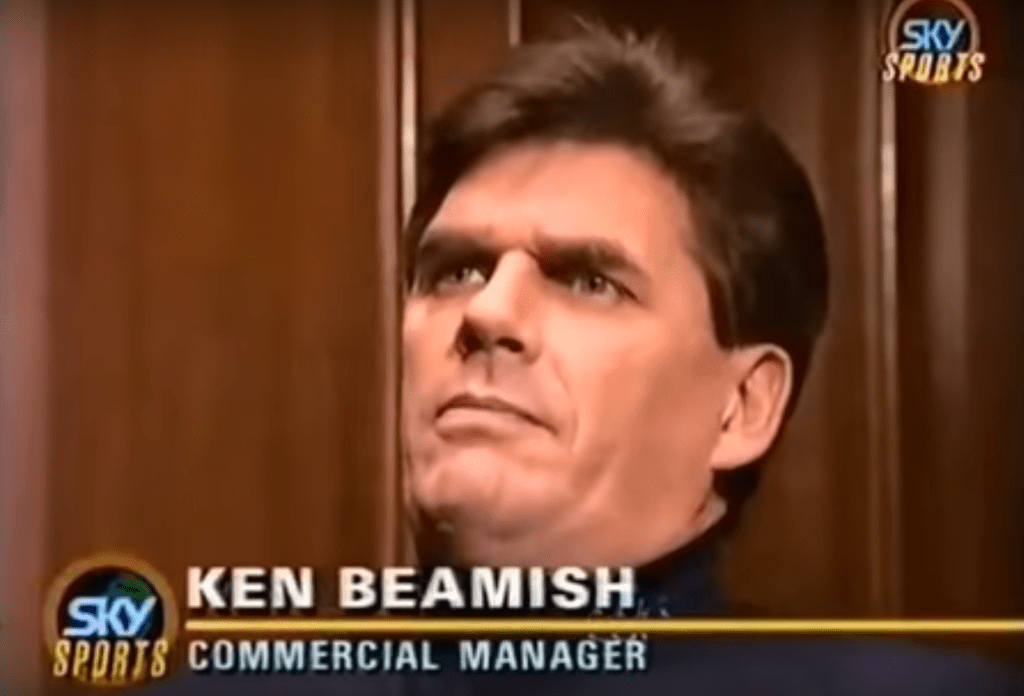
Beamish subsequently became commercial manager at Blackburn from 1986 until his retirement in 2012. He then became vice chairman of the Blackburn Rovers Former Players Association.

  • Pictures from my scrapbook show a great action shot of Beamish scoring against Torquay, as featured in a Brighton & Hove Gazette end of season publication, a portrait of him in Goal magazine. Dig the hairstyle, pear drop collar shirt and tank top in this Goal picture of him with his son. The Argus captured Ken’s elation as he celebrated Willie Irvine’s goal against Aston Villa. And the man himself signed the photo of him being interviewed. Below, interviewed in 1992 by Sky Sports.