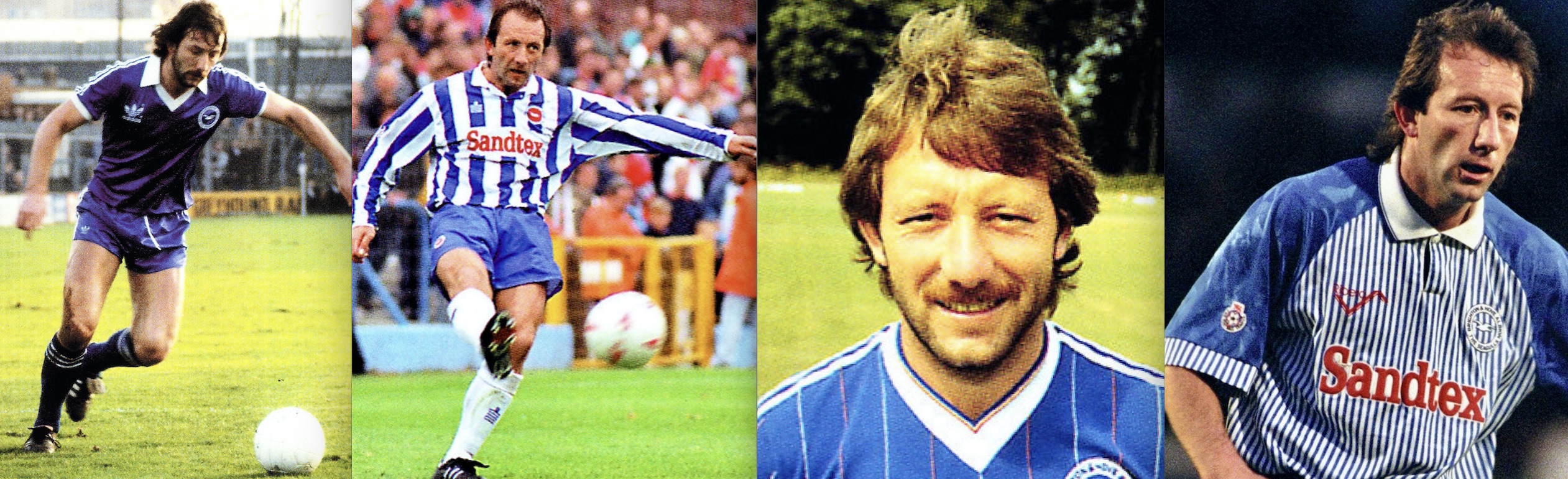
John Ruggiero scored on his Brighton league debut

JOHN RUGGIERO was one of four signings Alan Mullery made for newly promoted Albion in the summer of 1977.

That one of the quartet was Mark Lawrenson from Preston North End for £115,000 rather eclipsed Ruggiero’s arrival from recently relegated Stoke City for £30,000.

Nonetheless, Ruggiero made an immediate impact, scoring on his league debut as a substitute for Peter O’Sullivan to earn the Seagulls a 1-1 draw at Southampton.

Ruggiero had begun the season in the starting line-up in Albion’s home and away goalless draws against Ron Atkinson’s Cambridge United in the League Cup before relinquishing a starting berth for the opening Division Two fixture at The Dell.

His 77th minute equaliser, after Alan Ball had put the home side ahead just before half time, was added to a fortnight later and, for a brief moment, he was joint top scorer with Steve Piper – on two goals.

The pair were both on the scoresheet to help the Seagulls to a 2-1 win at Mansfield Town on 3 September; the home side’s first defeat at Field Mill in 38 matches.

Shoot! magazine previewed Ruggiero’s eager anticipation at returning to the Victoria Ground for a league game on 15 October but he was only a sub that day and, although he went on for fellow summer signing Eric Potts, Albion lost 1-0.

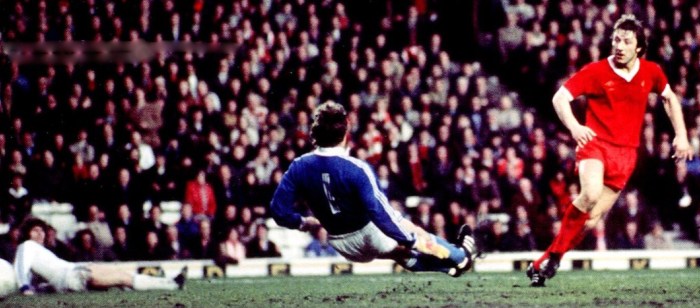
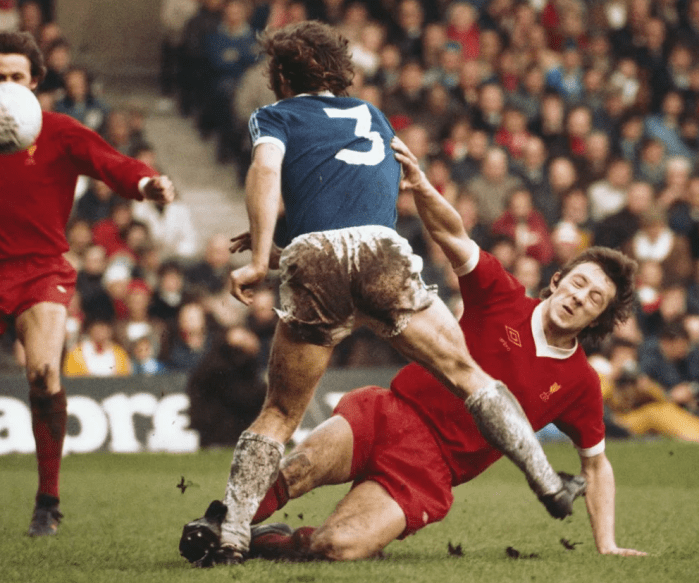
A young Garth Crooks taking on Chris Cattlin the day Ruggiero returned to Stoke

After only seven league and cup starts (and three appearances off the bench), Ruggiero then had to wait six months for another sub appearance.

He went on as a second half substitute for injured Paul Clark in a 1-0 win at Blackburn, combining with Potts who went on to score the only goal of a game described by Argus writer John Vinicombe as “the most exhilarating match I have seen for years”.

Ruggiero didn’t make another start until the very last game of the season; but what a match to play in. A crowd of 33,431 packed in to the Goldstone to see the Seagulls take on Blackpool, with another possible promotion finely poised.

Albion dutifully won the game 2-1 (sending Blackpool down) with goals from Brian Horton and Peter Ward but their hopes of going up were cruelly dashed when Southampton and Spurs, who each only needed a draw to go up, lo and behold ground out a 0-0 draw playing each other.

As the Argus reported: “When news came of the goalless draw at The Dell there were cries of ‘fix’ and Albion had to suffer the bitter disappointment of missing promotion by the difference of nine goals.”

Before his recall for that clash, Ruggiero had continued to find the back of the net for the reserves – indeed he was the side’s top scorer for two seasons.

The Albion matchday programme reported his scoring exploits in some detail. For instance, in a 4-1 win away to Portsmouth. “John Ruggiero was the star of our win at Fratton Park with two fine goals and might have scored a hat-trick,” it said.

And in a 5-2 Goldstone win over Charlton Athletic, Ruggiero opened the scoring with a header from a Gary Williams cross, Steve Gritt pulled one back for the Addicks and Ruggiero volleyed in a fourth goal from the edge of the box.

Ruggiero, who lived in Shoreham with his wife Mary, discovered competition for a first team spot intensified after his summer signing: Clark from Southend adding steel to the midfield and Fulham’s Teddy Maybank taking over from Ian Mellor as Ward’s striking partner. O’Sullivan, meanwhile, comfortably stepped up to the higher level and kept his place.

When Albion were on course for promotion to the elite the following season, Ruggiero’s first team involvement was almost non-existent (a non-playing sub on one occasion).

He was sent out on loan to Portsmouth, then in the old Division 3, where he was a teammate of Steve Foster. Ruggiero scored once in six appearances, netting in a home 2-2 draw with Cambridge United on 27 December 1977.

He was released before Albion took their place amongst the elite and moved on to Chester City, signed by player-manager Alan Oakes, the former Manchester City stalwart.

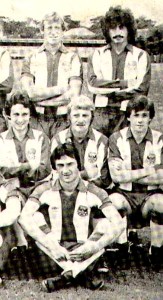
Ruggiero joined just as ex-Albion teammate Mellor was moving on from Sealand Road, but, in a Chester team photo (above right), Ruggiero is standing alongside Jim Walker, who’d played at the Albion under Peter Taylor, and in the front row is a young Ian Rush.

Ruggiero scored within three minutes of his first league game for Chester, setting them on their way to a 3-2 win over Chesterfield. But he only made 15 appearances for them before dropping into the non-league scene.

The legendary England World Cup winner Gordon Banks, formerly of Stoke, signed Ruggiero for Telford United in the 1979-80 season when he was briefly manager of the Alliance Premier League side.

Born in Blurton on 26 November 1954 to Italian parents, the young Ruggiero went to Bentilee Junior School then Willfield High School. His prowess on the football field saw him represent Stoke Boys and the county Staffordshire Boys side and he was one of 24 young players who had a trial at Middlesbrough for the England Schoolboys side but missed the final cut.

He had the chance to join Stoke City at 15 but stayed on at school and passed five O levels: English Language, English Literature, Technical Drawing, History and Art.

“I had a lot of interest from many clubs: Blackpool, Leicester City, Derby County, Blackburn Rovers, Bolton Wanderers, Coventry City, West Brom and I even had a letter from Arsenal inviting me to go training with them,” Ruggiero told Nicholas Lloyd-Pugh for the svenskafans.com website in an April 2011 interview.

“I nearly signed for Coventry but the very last club to ask me was Stoke City and, once this happened, I knew where I would go. I joined as an apprentice when I was 16 in 1970.”  

Ruggiero explained how he started in the A youth team, progressed to the reserve side and finally made his first team debut under Tony Waddington on 5 February 1977, in a home 2-0 defeat against league leaders Manchester City.

He had made his league debut the previous season during a short loan period with Workington Town, playing three games in Division Four, which gives him the relatively rare distinction of having played in all four divisions of English football.

Even as a reserve team regular at Stoke he got to play at big stadiums like Old Trafford, Anfield, Elland Road, Hillsborough and Goodison Park. “It was great for the young players but you always hoped to make the first team at some point,” he said.

“It was a real dream for me to have players like Gordon Banks, Geoff Hurst, Alan Hudson, Peter Shilton and many more being part of your life.

“Tony Waddington loved his team and he always went for experience, so the younger players found it really hard to make the first team. However, a few younger players did well such as Alan Dodd, Sean Haslegrave, Stewart Jump, Ian Moores and Garth Crooks.”

He continued: “Players like Terry Conroy and John Mahoney were really friendly and always had a word of advice for you. I really liked Alan Dodd; he was a much underrated player and would have played for England at a bigger club.”

Ruggiero also spoke warmly of Alan A’Court, Stoke’s first team coach who had played for Liverpool, who took him on a football holiday to Zambia in 1973 where he played for Ndola United. A’Court was Zambia’s national coach at the time.

Two years later, Ruggiero earned a ‘Player of the Tournament’ accolade while playing for Stoke in a youth tournament in Holland.

Waddington’s successor as manager, former player George Eastham, also played a part in Ruggiero’s development by arranging for him to play in South Africa for eight months in 1975 where he was a league and cup winner with Cape Town City.

“I knew that George liked me as a player so I felt that this could be good for me when he took over the team,” Ruggiero told Lloyd-Pugh. “He had already played me in a friendly match against Stockport which was a showcase for the return of George Best from America.

“Whilst Best, Hudson and Greenhoff were doing their party tricks, I was quietly having a good game and it was clear that I was ready for another chance.”

That came in a home game against Liverpool, Ruggiero playing in midfield. “The next 90 minutes was my best of all time,” he said. “We drew the game 0–0. I would like to think I was the man of the match and George spoke very highly of me to the press after the game. The Liverpool team included Kevin Keegan, Ray Kennedy, Ray Clemence and many other big names.”

Stoke had turned to youngsters like Ruggiero because big name players had been sold off to pay for a replacement Butler Street stand roof at the Victoria Ground.

And while the youngster kept his place after that impressive display v Liverpool, they only won one of their remaining nine games and were relegated. It was little consolation that he scored twice away to Coventry because they lost 5-2.

“After the Liverpool game I was on a high, I really thought I’d made the big time and would be a first team player at Stoke for years to come,” he said. “I played nearly all the games left that season and was pretty consistent in all of the games.

“I was just enjoying my time and never really thought about relegation.”

But the 1-0 last day defeat at Aston Villa would prove to be his last game for Stoke because Brighton, who had gained promotion from the third tier, were bolstering their squad to compete at the higher level.

Ruggiero signed for the Seagulls along with Lawrenson and Williams, who moved from Preston (swapping places with Graham Cross and Harry Wilson), and Sheffield Wednesday winger Potts.

While Lawrenson was on the path to greatness, and Williams established himself in Albion’s left-back spot, Potts found his involvement was mainly from the bench and Ruggiero’s early promise faded.

After his short football career was over, Ruggiero joined the police, serving in the Cheshire force, rising to the rank of detective sergeant and mainly working in the Crewe area.

When the Goldstone Wrap blog checked on him in 2014, they unearthed a Facebook message in which he said: “Loved my short time in Brighton. Would have liked to have played a few more games but still love the place and the team were buzzing at that time.”

And in 2020, a former police colleague, Steve Beddows, informed the Where Are They Now website that Ruggiero had retired and was continuing to live in the Stoke area.

“He remains a very fit man with a keen eye for precise action posed wildlife photography and undertakes huge amounts of charitable work,” said Beddows. “A great sense of humour but very dogged, smart and highly professional. He does masses for charity with Stoke City Old Boys Association still and had the nickname ‘Italian Stallion’ because of his good looks.

“I never heard a bad word about him from anyone and he can still run marathons and plays lots of golf.”

Duffy had Burleigh pal for company on his Albion arrival

HISTORY has seen a whole string of goalkeepers play for both Newcastle United and Brighton. Dutchman Tim Krul was the most recent and others stretching back over the years – Eric Steele, Dave Beasant, and Steve Harper – have featured in this blog at various times.

My post this time, though, centres on Martin Burleigh, for many years an understudy to Northern Irish international Iam McFaul.

When stocky striker Alan Duffy travelled 350 miles from home to join Brighton in early 1970, it was with some relief that he found the familiar face of Burleigh amongst his new teammates.

How Albion’s matchday programme reported Duffy’s delight in meeting up with a familiar face

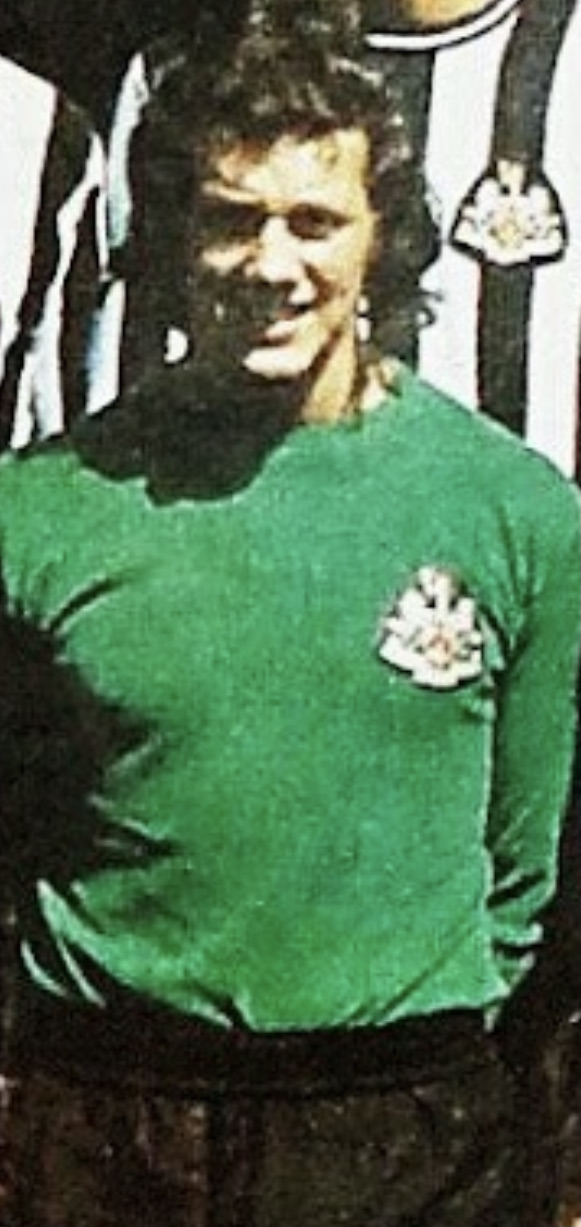
The goalkeeper, who was only 18, was on loan at the Albion at the time. The previous year he and Duffy had been in the same Newcastle United youth team.

Not only did that side do the Northern Intermediate League and cup double, 10 days before the first team won the Inter-Cities Fairs Cup, the youth team brought even more silverware to Tyneside – winning a prestigious international youth tournament at Feyenoord’s ground in Rotterdam.

Toon’s trophy-winning youth team of 1969

Unlike Albion’s new £10,000 permanent signing, though, Burleigh was to have only a short-lived stay in Sussex. Manager Freddie Goodwin had brought in the Toon no.3 ‘keeper (Iam McFaul was first choice and John Hope his deputy) as cover while Albion were reduced to only one fit goalkeeper (Brian Powney) following a serious head injury to Geoff Sidebottom in the first match of a marathon second round FA Cup tie against Walsall (it took four games to decide it; those were the days before penalty shoot-outs).

Thankfully Powney avoided injury so young Burleigh was not called into match action, and he returned to the north east still waiting to make his league debut. Indeed, he had to wait until Boxing Day 1970 for that chance. Although Toon went down 3-0 at Leeds United, opposition manager Don Revie praised the youngster, saying: “I thought he had a fine game. He had no chance with the goals. Some of the saves he made showed he has a fine future ahead of him.”

It would seem Toon boss Joe Harvey wasn’t so sure and it was more than a year before Burleigh got his next chance to shine, making his home debut in a 4-2 win over Coventry City on 8 January 1972.

Once again it was to be his only first team appearance of the season, but in the 1972-73 season he finally got a run of games when McFaul was injured. He played in 11 matches but then had the misfortune to fracture a finger in a collision with Mick Channon during a 1-1 draw at Southampton, and McFaul returned.

The Toon 1892.com website recalls Burleigh then having a struggle with weight issues and he had a public dispute with manager Harvey which saw him walk out of the club saying he was going to join the RAF. But Newcastle retained his registration and when the dust settled on the dispute he was sent on loan to Darlington before making the move permanent in October 1974 for a fee of £8,000.

He was only at Darlington for a season before switching across country to Carlisle United, where he spent two seasons.

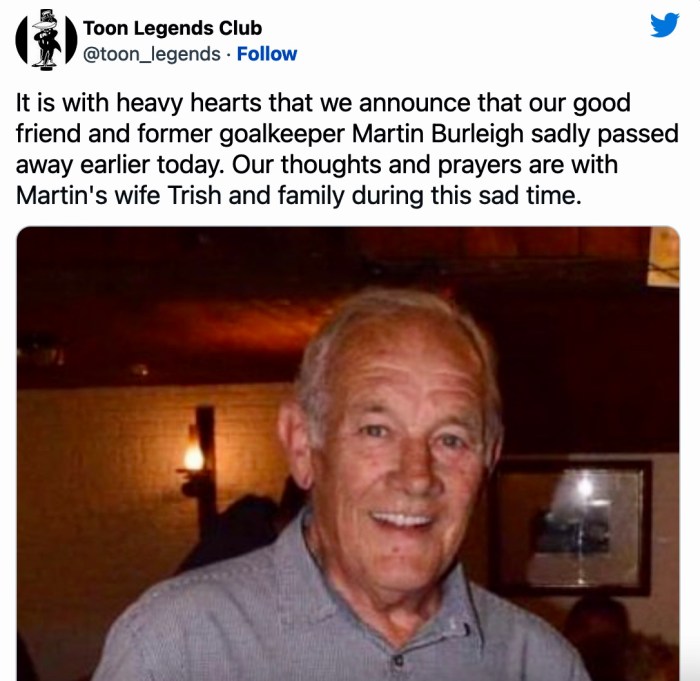
When Burleigh died at the age of 70 on 27 September 2021, Carlisle chairman Andrew Jenkins said: “Martin was a big character who was a pleasure to have around. He was tall and strong in stature and very stylish in the way he kept goal.

“We used to talk about how he very much had the manner of how the goalkeepers in Europe used to do things, with flair and a bit of theatre.

“I remember that Alan Ashman was really keen to get him signed and over here to join us. When he was speaking to the board about him, he said that the fans would be queuing along Warwick Road to watch him – he felt he was that good.”

His death was mourned by former Newcastle teammates too and several ‘Toon Legends’ remembered him at a gathering at the Tyneside Irish Centre.

Tribute on Twitter following Burleigh’s death

“Martin was a great friend and a lot of players who played alongside him at Newcastle from junior to first team level want to pay their respects to a real character,” Toon Legends official Chris Emmerson told Chronicle Live.

After his spell at Carlisle, where he also had to bide his time behind first choice Allan Ross, Burleigh returned to Fourth Division Darlington for two more seasons, during which time (in October 1978) he kept goal when the north east minnows only narrowly lost (1-0) to First Division Everton in a third round League Cup tie.

Burleigh went on to spend three seasons in goal for Hartlepool, ending his league career with a total of 222 appearances.

He then became a painter and decorator but continued playing for non-league sides in the area, appearing for Bishop Auckland, Spennymoor and Langley Park until packing up playing in 1984.

Born in Willington, County Durham, on 2 February 1951, Burleigh was playing for his hometown team at 17 when Newcastle signed him in 1968, initially as an amateur.

Kenneth Scott, in The Toon1892 Chronicles, wrote: “He displayed within the junior and reserve teams that he was more than capable between the posts and it was not long before he turned professional.”

That happened in December 1968 and before the end of the season he was in goal for the Newcastle youth team under coach Keith Burkinshaw (who later managed Spurs) when they won the international tournament in Holland, beating an Arsenal side containing the likes of Ray Kennedy, Sammy Nelson, Charlie George, Eddie Kelly, and Pat Rice.

The achievement was somewhat overshadowed by the first team’s triumph in the old Inter-Cities Fairs Cup when Toon beat Hungarian side Ujpest in the two-legged final, skipper Bobby Moncur lifting the trophy in Budapest.

Although Burleigh managed to edge out McFaul’s deputy Hope to become the no.2 at St James’s Park (Hope joined Sheffield United along with David Ford in exchange for John Tudor in 1971), the form and fitness of the Northern Irish international (who later spent three years as manager of Newcastle) always kept him on the sidelines.

• Incidentally, in line with the tradition of Albion ‘sharing’ goalkeepers over several decades, when McFaul was in the manager’s chair in January 1988 he took Albion’s long-serving Perry Digweed on a month’s loan with the Magpies. He played in their reserves but didn’t appear in the first team. The following month he went on loan to relegation-threatened Chelsea where he featured in three matches: a 3-3 draw away to Coventry City, a 0-0 home draw v Everton and a 4-4 draw at Oxford United.

Liverpool legend Jimmy Case became a Seagulls favourite too

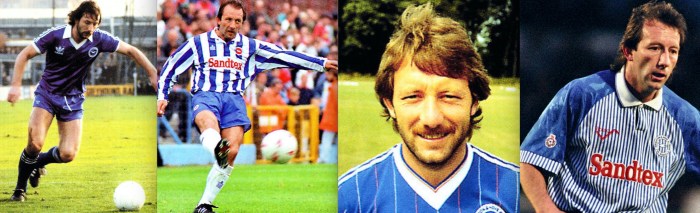
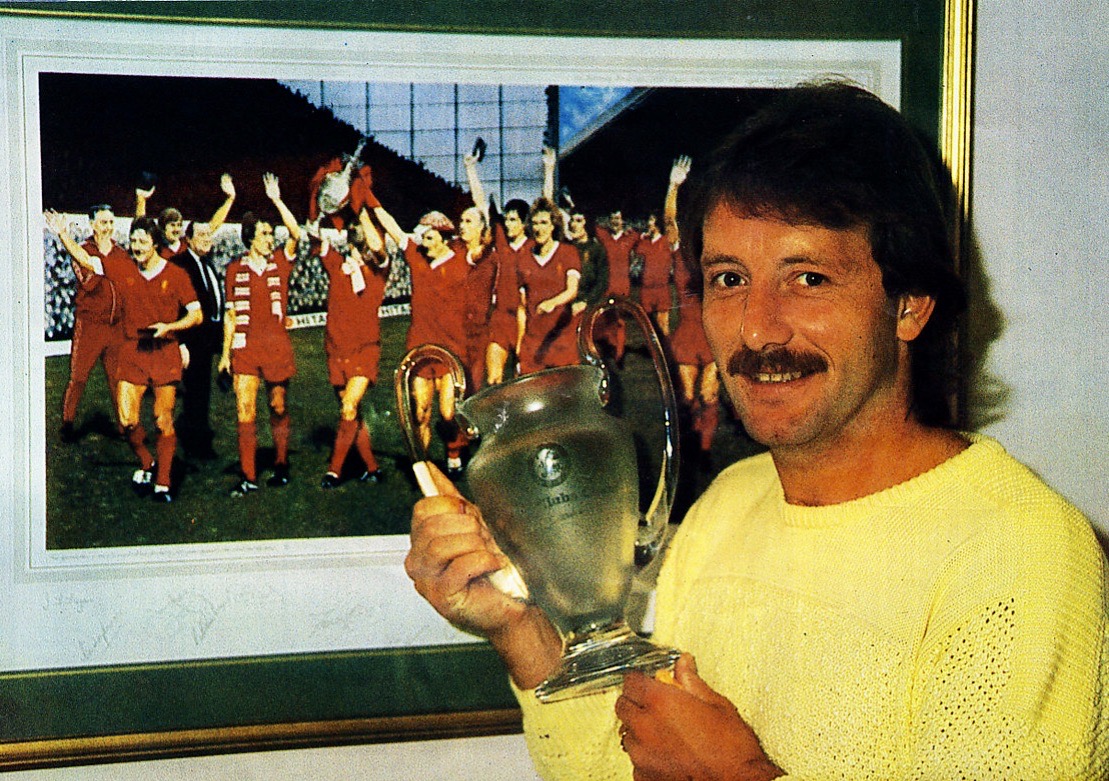
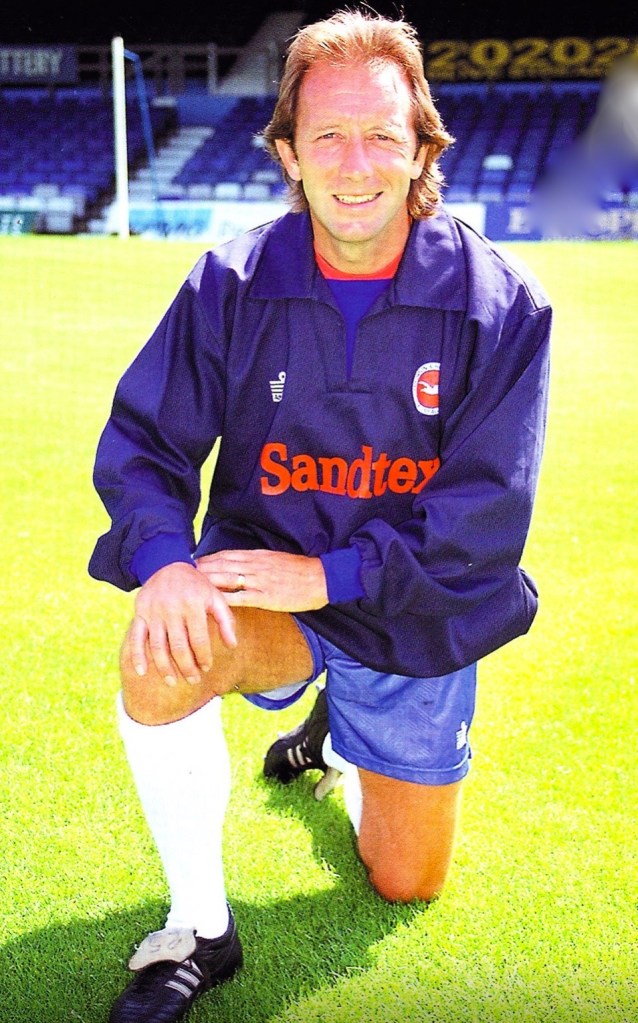
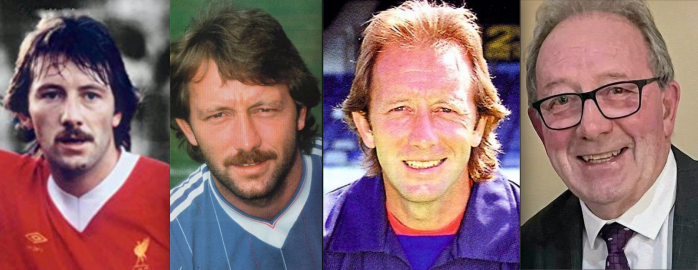
Case 4 imagesJIMMY Case remains one of my all-time favourite Albion players.

Several of the best moments I can recall as an Albion supporter involve Case: the 1983 FA Cup semi-final belter against Sheffield Wednesday at sunny Highbury perhaps the most memorable.

The biggest disappointment was that Albion let him go so easily.

Younger readers may only remember his unhappy stint as manager when the misdirected club was in turmoil, and he ended up holding the reins when Liam Brady just couldn’t take any more.

But rather than remember him as the man who took Brighton down to Division 3 in 1996, I remember the class act who arrived at the Goldstone in 1981 with a trophy cabinet the envy of many a footballer.

Although Brighton lost the sublime Mark Lawrenson to Liverpool as part of the deal that saw Case move to Brighton, they gained a player who had already got three European Cup winners’ medals, four Division 1 (Premiership equivalent) winners’ medals plus one each for winning the UEFA Cup, European Super Cup and the League Cup.
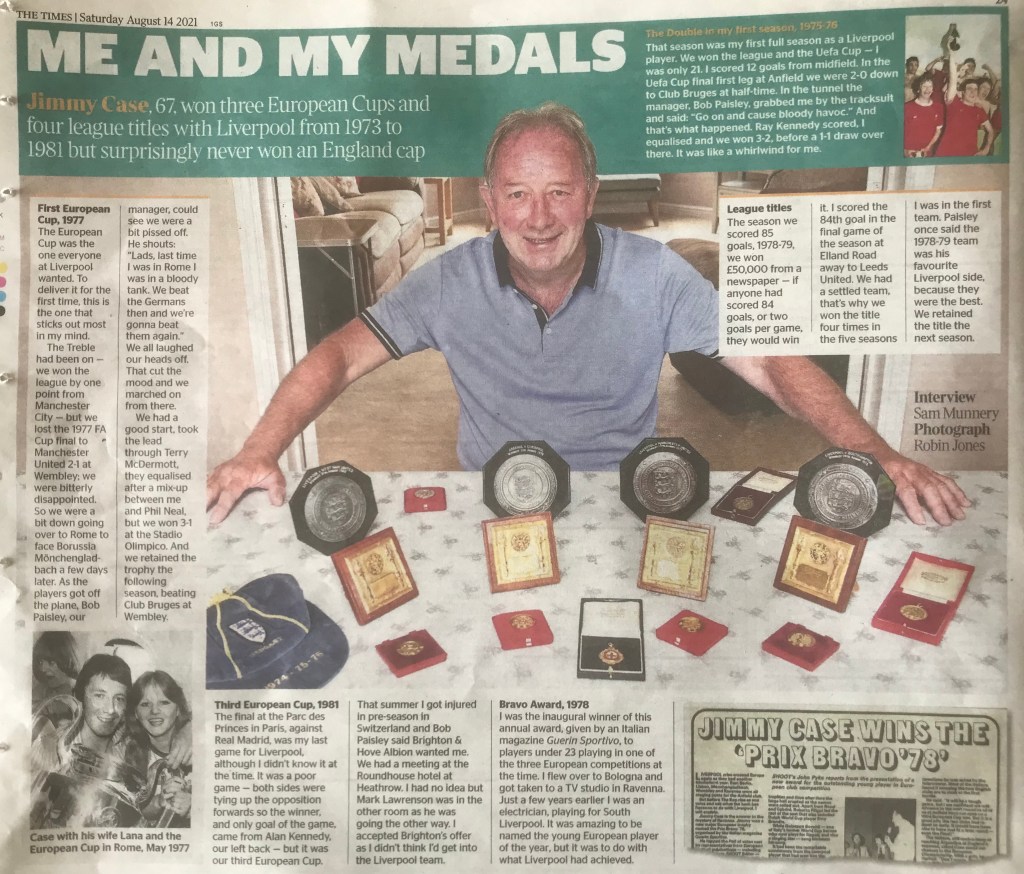
Case, born in Liverpool on 18 May 1954, was one of four children David and Dorothy Case raised in a council house in the city’s Allerton district.

He learned how to handle himself on a football field playing in a tough dockers’ team but Liverpool picked him up from the local non-league club, South Liverpool. By then, Case had left school and was training to be an electrician.

He carried on those studies but after two years on Liverpool’s staff he made his first team debut in April 1975 in a 3-1 win over QPR.

He scored his first goal in a 3-2 home win over Spurs at the beginning of the following season and, in what must have seemed a dream start, completed his first full season as part of a championship winning team, as well as scoring in the two-legged UEFA Cup Final win over FC Bruges.

Case EuropeThe triumphs and trophies kept coming with Case enjoying the ride but by 1980-81 he was beginning to be edged out by Sammy Lee, and manager Bob Paisley didn’t look kindly on some of the off-field escapades Case was involved in with fellow midfielder Ray Kennedy.

Paisley said: “He had lost his appetite for the game in his last year at Anfield. It’s a hard stint working the right flank in our team and Jimmy had stopped getting forward and was looking to play early passes from deep positions. I think his legs had become tired.”

The move to Brighton might never have happened if Alan Mullery had got his way because he had already done a deal with Ron Atkinson to sell Lawrenson to Manchester United in exchange for two of their players.

But when chairman Mike Bamber pulled rank and forced through the Liverpool deal he had negotiated, Mullery quit and Case arrived on a five-year contract to find a new manager in charge in Mike Bailey.

It felt to me that Brighton were stepping up to a whole new level bringing in someone of Case’s stature, and so it proved.

In his first season at the Goldstone, Albion recorded their highest-ever finish among the elite – 13th.

I recollect heading to Upton Park for the opening game of the season to see Case make his debut against West Ham and Albion earned a 1-1 draw despite having Gerry Ryan sent off.

Case found himself in trouble with referees on way too many occasions that season. Although he came to the club with a hard man image, amazingly he had never previously been suspended for accumulating bookings.

But by December he had to sit out a two game ban, and when his bookings total reached eight by March, he missed another three games.

Case told John Vinicombe of the Evening Argus: “I am a face, and there is nothing I can do about that. I am known, and that might explain some of the things that have happened to me on the pitch.

“The last thing I wanted on coming to Brighton was to get suspended. Brighton didn’t give me a contract to miss games.”

For anyone who has not yet read it, Case’s autobiography, Hard Case (John Blake Publishing) is well worth a read, detailing through writer Andrew Smart a fascinating career.

Disappointingly, it has a few factual errors that doubtless the distance of time brought about. Nevertheless, Case says: “I enjoyed every minute of my time with Brighton.”

Particularly pleasing for him was to score with a thumping header past Bruce Grobelaar in a 3-3 draw with Liverpool at the Goldstone, and to be on the right end of Albion’s 1-0 win at Anfield that season.

Case enjoyed life off the field as well and admits in his book: “The inhabitants of Brighton and Hove were just a little more sophisticated than the Allerton of the 1970s and I was introduced to the many and varied attractions of decent food and fine wine. It was an education I really appreciated.”

His second season was to end in relegation, but, more famously, with Brighton’s one and only appearance in an FA Cup final. Case scored goals in the fourth, fifth and sixth rounds, as well as the semi-final.

The newspapers had a field day when Case’s winner for Brighton in the fifth round of the Cup at Anfield denied his old boss Bob Paisley the chance to wipe the board with trophies that season.

It seemed every national and local newspaper headline revolved around the likeable Scouser: ‘It’s Case for Champagne’, ‘Jimmy sets out his case’, ‘Old boy Case kills off Liverpool hopes’, ‘Amazing Case’, ‘Killer Case’, ‘Case packs a super Cup punch’, ‘Case for Cup win’.

The Daily Mirror made him their footballer of the month for February on the back of that goal with reporter Harry Miller declaring: “No single act did more to capture the imagination of the public than midfielder Case’s dramatic 71st minute winner on Sunday, February 20.”

Case himself had mixed emotions about it all, saying: “I had ten fantastic years at a remarkable club. That’s something that goes deep down.”

He also revealed how a good friend of his had been out of the country at the time of the game and sent him a postcard with only two words as its message: ‘You bastard’.

When he scored the only goal of the game in the quarter final win over Norwich, the headlines continued: ‘Case of bubbly’, ‘The odd Case of hero and villain’, ‘Seagulls have landed with champagne Jim’.

That belting free kick in the Highbury sunshine set Albion on their way to the 2-1 win over Sheffield Wednesday, earning a first ever  – and only – place in the FA Cup final.

He was no stranger to Wembley, of course, having previously scored Liverpool’s goal in the 1978 2-1 defeat to Manchester United, but unfortunately he didn’t repeat his earlier goalscoring feats in the 1983 final.

He played a key part in Albion’s brave effort to earn a draw against Man U and then had the agony of returning home that Saturday evening to discover his mother, who had been a visitor, had died in her sleep at the age of just 63.

It was to Case’s immense credit that he took his place in the side for the replay just five days later.

While relegation brought the inevitable break-up of the team, with Gary Stevens and Michael Robinson departing before the new season began, Case publicly declared his intention to stay and try to get the team back up to the elite.

However, once fellow Scouser Jimmy Melia had been replaced by Chris Cattlin, there was probably only going to be one outcome and eventually Case was sold to Southampton for £30,000 in March 1985.

For him, it was a great move because he was returning to the top division again. It turned out that he was Lawrie McMenemy’s last signing for Saints, but, on this occasion, the change of manager was to cement his place in the side. Chris Nicholl made him the club captain the following season.

In 1985-86, Saints reached the semi-final of the FA Cup (beating Brighton 2-0 in the quarter-final!) losing 2-0 to Liverpool after extra time. If Saints had won, Case would have been the first player to appear in three FA Cup finals with different clubs.

Over his six years at The Dell, Case played alongside Glenn Cockerill and Barry Horne and helped to bring on the careers of youngsters such as Matt Le Tissier, Alan Shearer and Jason Dodd.

But when Ian Branfoot took over as manager in June 1991, he dispensed with Case’s services within a matter of days and transferred him to Bournemouth, who were managed by Harry Redknapp.

After 40 league games for Bournemouth in 1991-92, he moved to Halifax Town managed by former Saint and, one-time Albion loanee, John McGrath, who was being assisted by another ex-Albion man, Frank Worthington.

But Case only played there for six months, moving on to Wrexham, where he helped them gain promotion from the 3rd Division at the end of the 1992-93 season.

He then turned out for non-league side Sittingbourne until, at the ripe old age of 39, Liam Brady brought him back to Brighton in December 1993, as a player/coach. It was during that spell that he played in his 600th league game, the club chief executive David Bellotti presenting him with a silver salver on reaching that milestone

As a mark of the esteem in which Case was held, a testimonial game for him at the Goldstone Ground on 17 October 1994 had to be delayed 10 minutes because so many people wanted to get in to pay tribute. The capacity of the grand old ground was much reduced by then but still 15,645 packed in to see Case’s old club Liverpool do him the honour of providing the opposition.

Albion featured Matt Le Tissier in their line-up and even Ryan and Brady made substitute appearances as Liverpool emerged 2-1. The result, of course, was immaterial, and an emotional Case said afterwards: “I can’t thank the supporters enough. This was the only game I’ve ever been nervous about. I’ve never really asked for anything from the game, I just wanted everyone to enjoy it.

“It’s all been quite embarrassing really. I like to go to parties, I just don’t like them being my own.”

After his unhappy time as Albion manager, Case later managed non-league Bashley but is more often seen and heard these days on the after dinner speaking circuit or on regional football programmes. He also contributes to Southampton’s in-house radio station “The Saint”.

In July 2007, he once again donned a Brighton shirt, playing a cameo role alongside other past heroes in a brief curtain-raiser to Kerry Mayo’s testimonial game against Reading.