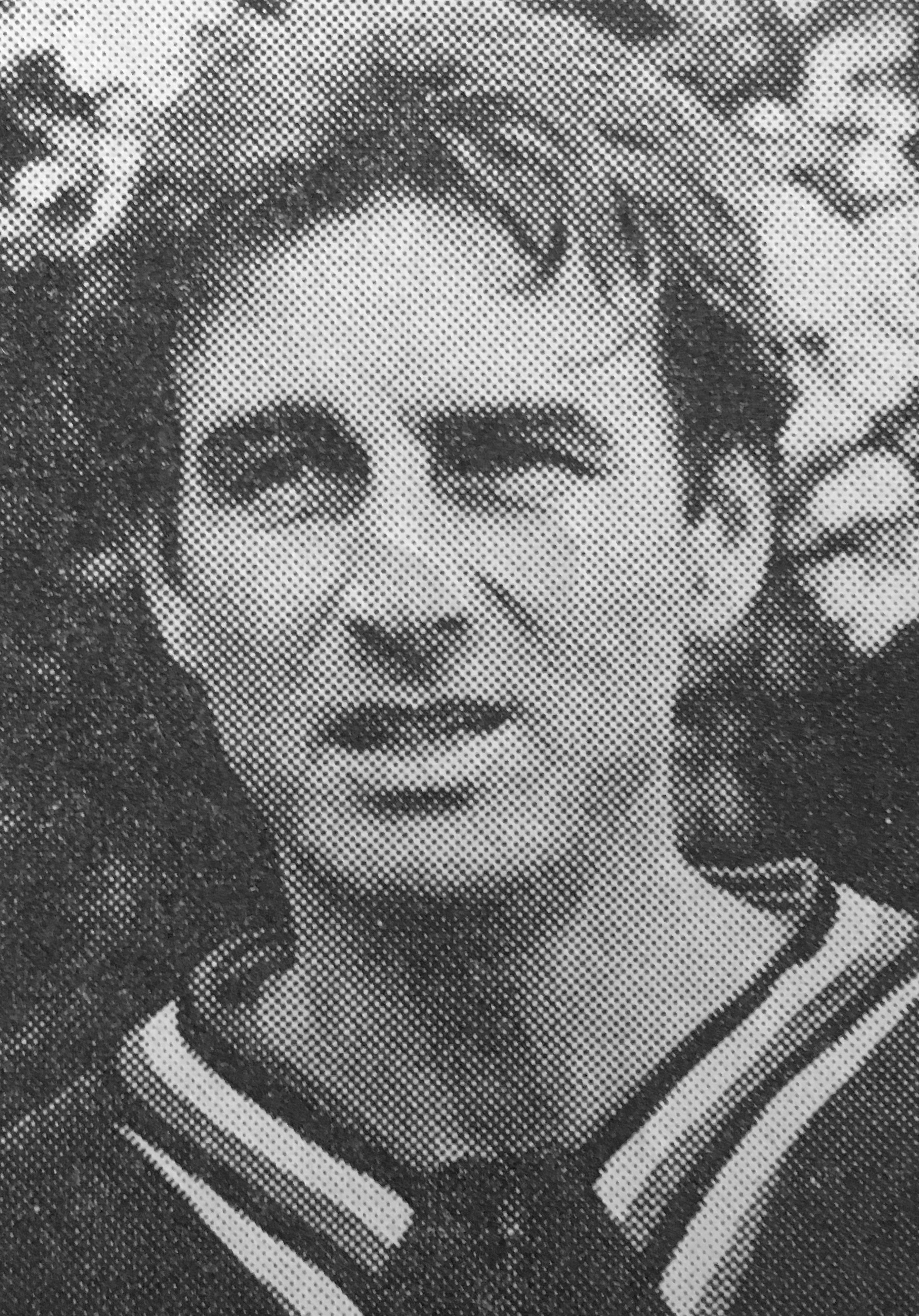
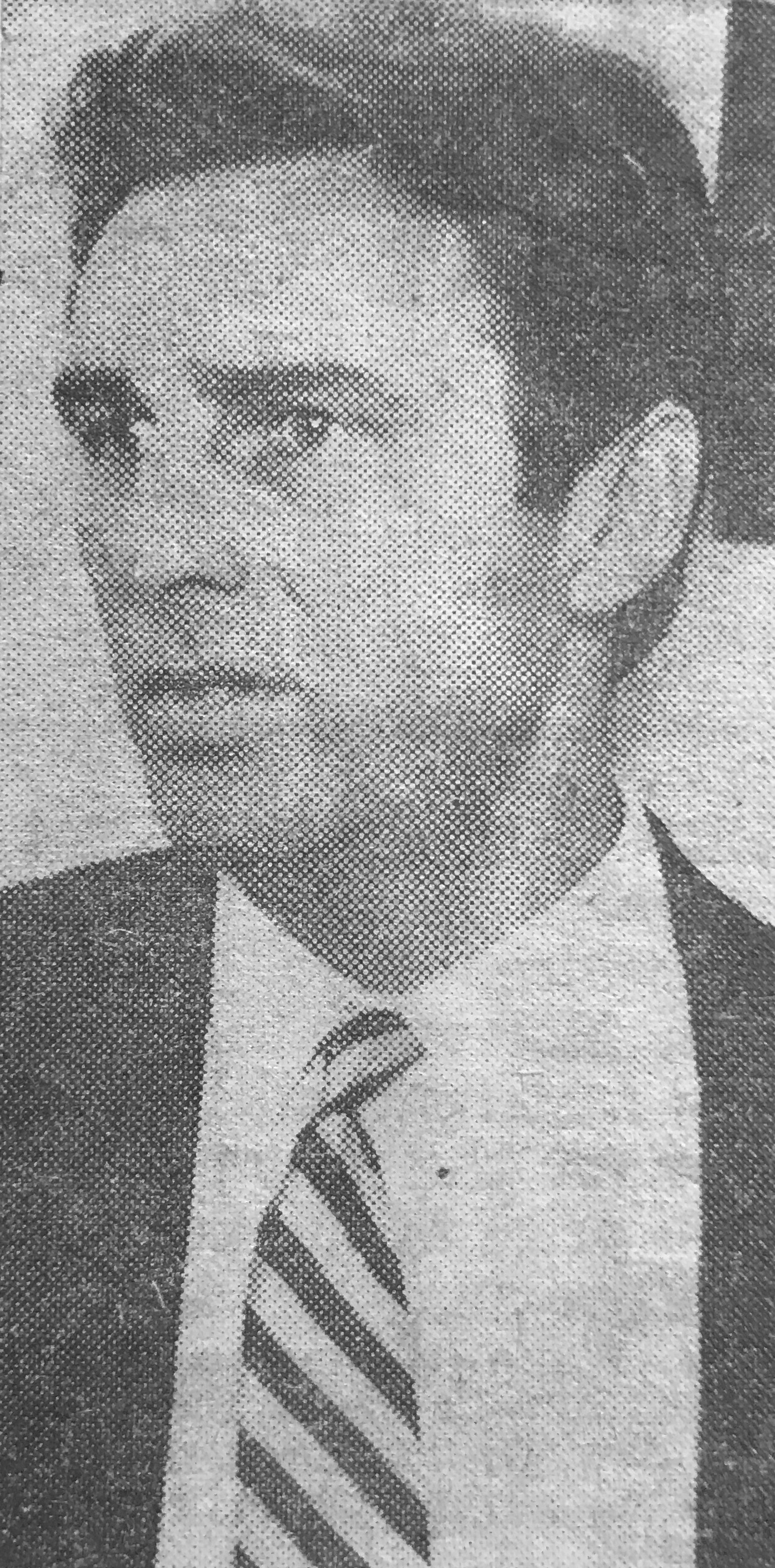
Villa cup winner and captain Pat Saward led Albion to promotion

A FORMER Aston Villa captain and 1957 FA Cup winner steered Brighton to the first promotion I witnessed on my Albion journey.

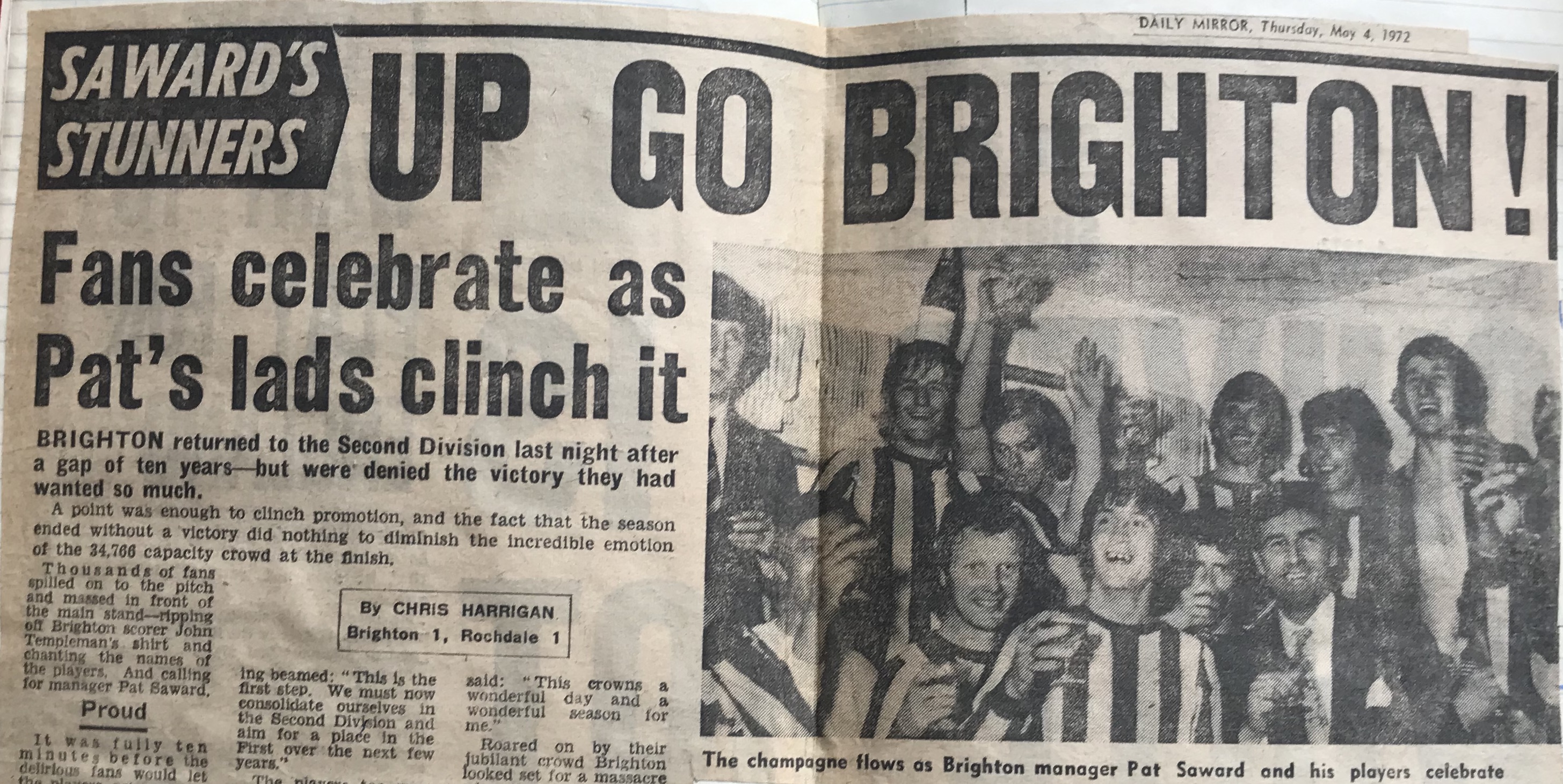
Genial Irishman Pat Saward, who lived in my hometown of Shoreham during his time as Albion boss, galvanised a squad not expected to be promoted from the third tier and took them up as runners up behind his former club in 1972.

As the champagne flowed in the Goldstone Ground home dressing room, Saward took centre stage surrounded by his blue and white stripe-shirted heroes.
When the promotion tilt had looked like faltering, he’d been bold enough to make drastic changes to the side before a top of the table clash with Villa in front of the Match of the Day cameras. After a memorable 2-1 win in which Willie Irvine scored a goal later judged as the third best in the programme’s Goal of the Season competition, Saward added to his squad on transfer deadline day, bringing in Northern Ireland international Bertie Lutton from Wolves and Ken Beamish from Tranmere Rovers, described in the Official Football League Book as “stocky and packed full of explosive sprinting power, a terrific shot and great appetite for the game”.

Saward told the publication: “They were both last ditch signings and Ken made an astonishing difference. I spent only £41,000 in getting my promotion side together so we were very much Villa’s poor relations in that sense.”

The manager put the success down to: “Dogged determination to succeed from all the players. We stamped out inconsistency. I got rid of ten of the players I inherited and got together a team built on character. That’s the key quality, apart from skill of course.”

However, hindsight reveals the club wasn’t really ready for the higher division and some have suggested Saward broke up the promotion-winning squad rather too hastily. Players he brought in who were used to the level now known as the Championship struggled to gel, and the manager turned to rather too many loan signings.

A mid-season run of 13 consecutive defeats was Albion’s undoing and a glamour FA Cup tie at home to First Division Chelsea in early January 1973 gave a welcome respite from the gloom.

Ahead of the match, Saward opened his heart to Daily Mirror reporter Nigel Clarke, revealing that he couldn’t understand why the side had struggled so much.

“I wish I knew. But I’ve learned more about football these last few weeks than at any other time in my career.

“We are five points behind the next club but I must be the luckiest man in the league. There are no pressures on me,” he said, explaining that supporters were still writing to him, backing him and the team.

“When we came up from the Third Division, I was so big-headed, so confident. I thought with the right results we could go straight through to the First Division. I really did.

“There was spirit and ambition here – and there still is….that’s how this club gets you. My heart is in the place.”

Saward revealed that he had turned down two better paid jobs in the First Division to stay at Brighton after the promotion win, telling Clarke: “What I want is importance, appreciation, understanding and love…not being kicked up the backside and put under the lash.

“Adulation is false. I’ve found my oasis at Brighton and I’m wealthy the way I want to be – in feeling.”

Although the Chelsea game ended in another defeat, fortunes eventually changed the following month – but the damage had been done and Brighton went straight back down.

A defiant Saward promised to blood more youngsters like Steve Piper and Tony Towner, who’d done well when drafted in and Piper, in a matchday programme article, said of him: “Saward was more of a coach than a man-manager, very suave and sophisticated. He knew his football from his days at Coventry.”

However, when results didn’t improve on the return to third tier level, and with a new, ambitious chairman – Mike Bamber – at the helm, Saward was sacked and replaced with the legendary Brian Clough.

Albion’s hierarchy had turned to the untried Saward in the World Cup summer of 1970 after Birmingham City poached Freddie Goodwin from Brighton to replace Stan Cullis as their manager. It was second time lucky for Saward, who’d applied to succeed Archie Macaulay two years previously when Goodwin pipped him to the post.

“Give me ten years and I’ll have Brighton in the First Division,” Saward declared when appointed. Prescient words considering they made it within nine – although it came six years after he’d parted ways with the club.

There’s little doubt Saward was an innovative football man and a popular figure during the first two years of his reign.
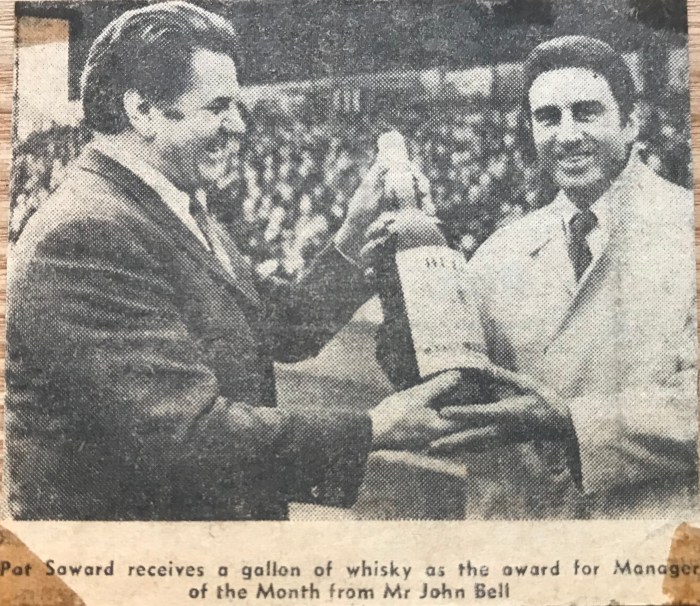
Apart from success on the pitch in the 1971-72 season, the way he involved fans in helping him to improve the side also proved a winner.

His buy-a-player appeal was a direct attempt to involve the supporters in the affairs of their club and Saward led a sponsored walk on Brighton seafront as one of the initial events geared towards generating funds to help him compete in the transfer market.

“Too many people spend too much time shouting about how hard up their club is, and too little time fighting to improve the situation,” Saward said in an article for the April 1971 edition of Football League Review. “You never get success if you sit around. You must have courage, even audacity, and work hard for survival.”

The first funds generated provided Saward with the money to bring in experienced Bert Murray from Birmingham City, initially on loan, and then permanently. Murray would go on to be voted Player of the Year in 1971-72.

Another player who signed on loan at the same time as Murray was Preston’s Irvine, who recalled in his autobiography, Together Again, how Saward wooed him.

“Pat sold me the place with his charm and persuasive ways,” he said, describing the former male model as “extrovert, infectious and bubbly”.

He added: “Pat Saward was a gem of a manager and a pleasure to play for. He said what he thought, but never offensively; in a matter-of-fact, plain-speaking kind of way, rather than aggressively.”

Irvine continued: “Saward had the knack of making people feel important. He instilled pride and a sense of identity…..Pat loved attacking, entertaining football and worked tirelessly for the club. I would have run through that proverbial brick wall for him.”

As Brighton neared promotion, Irvine said: “Saward, with a joke or a smile, an arm around the shoulder or a bit of geeing up, knew just how to keep a dressing room happy or dispel any tension or nerves.”

Sadly, Irvine’s opinion of Saward shifted dramatically when, during the summer, the manager told him he intended to bring in a replacement – although it was three months before he eventually signed Barry Bridges from Millwall.

Saward and new signings Barry Bridges (left) and Graham Howell

Irvine was in the starting line-up at the beginning of the season and scored six times in 13 league and cup games, but, once Bridges arrived in October, his days were numbered, and, before the year was out, he was sold to Halifax Town in part exchange for Lammie Robertson.

Saward had already dispensed with the services of Albion’s other main promotion season scorer, Kit Napier, along with his former captain, John Napier.

Irvine said that once Albion were promoted, Saward changed. “He seemed to become unapproachable, or at least he did to me, and where once I could see him whenever I wanted, now I seemed to have to book an appointment two or three days in advance. We all had to.”

Teammate Peter O’Sullivan, who had repaired his relationship with Saward after some difficult early exchanges which saw the Welshman transfer-listed, also witnessed a change in the manager.

“We had one or two players who were over the hill and Pat just lost the plot. It was grim,” he told Spencer Vignes in A Few Good Men.

Albion’s tier two fortunes were picked over in some detail in a feature reporter Nick Harling compiled for Goal magazine.

“I didn’t foresee the snags and the type of league the Second Division was,” Saward told him. “It’s the hardest division of the four. Everyone is fighting either to stay in or get out.

“It’s a hell of a hard division. It’s a mixture of the First and Third. It’s good and very hard football. They don’t give you an awful lot of time to play.

“It’s a division governed by fear because to drop out of it is not good, while to get out at the top is fantastic. I didn’t believe the gap would be so different.

“Teams are so well organised and supplement their lack of ability with tremendous defensive play. It’s very hard to get results.”

While open and honest, they didn’t sound like the words of a manager very confident of finding a solution, and Saward sought to explain part of the problem when he said: “To me the most important thing is the attitude of mind. Players should have an arrogant attitude, an attitude that they’re going to do well even when the chips are down. But some types are destroyed. These are the ones who succumb and want to rely on other people.

“Here we’ve got some great boys, but I wish to God some of them had more determination.”

Bamber was resigned to relegation but nonetheless confident of where the club was heading. “There’s no doubting it – First Division here we come,” he told the magazine.

Saward added: “I haven’t lost any enthusiasm. I’ve had my hopes dampened slightly, but one overcomes that.

“This club has got to be built for the future. I want to put Brighton on the map.”

Sadly, when Albion’s poor form at the start of the 1973-74 season continued, Saward publicly admitted: “I haven’t any more answers. I am in a fog.”

Unsurprisingly, the Albion’s directors interpreted it as a loss of confidence and sacked him.

It’s front page news on the Evening Argus as Saward is sacked

Saward never managed in the English game again, although he coached in Saudi Arabia for a while.

Born in Cobh, County Cork, on 17 August 1928, Saward lived in Singapore and Malta during his childhood, before the family moved to south London.

His first club was Beckenham FC before he turned professional with Millwall in 1951. He made 118 appearances for the Lions in the next four years.

Saward was 26 when Eric Houghton signed him for Villa for £7,000 in August 1955. The legendary Joe Mercer took over as Villa manager in 1958.

Pat enjoyed a goalscoring debut with his new club, hitting the final equalising goal in a 4-4 draw with Manchester United at Villa Park on 15 October 1955. But he struggled to oust left half Vic Crowe and made only six appearances that season.

In Crowe’s absence through injury the following season, Saward became a regular, making 50 appearances.
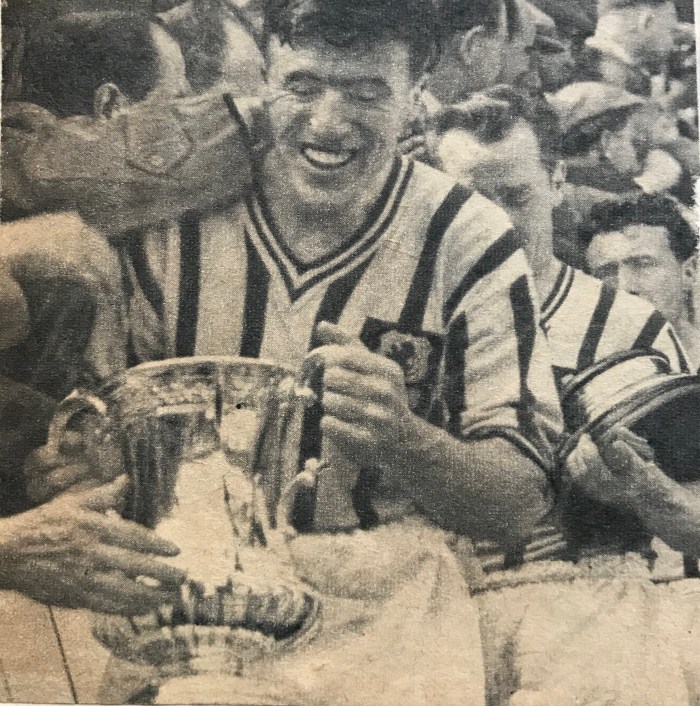
Saward (right) descends the steps at Wembley as a FA Cup winner with Aston Villa

In total, Saward played 170 games for Villa between 1955 and 1960, most notably featuring in their FA Cup winning team in 1957. Villa beat Manchester United 2-1 in the final at Wembley Stadium in front of a crowd of 99,225, Peter McParland scoring twice to win Villa the Cup for a seventh time.

Saward made only 14 appearances as Villa were relegated from the top-flight in 1959 but he was back in harness as captain when they made a swift return as Second Division champions in the 1959-60 season.

In his final season, he made just 12 appearances, his last coming on 22 October 1960 in a second city derby, Villa beating Birmingham 6-2. The following March, he was given a free transfer and moved on to Huddersfield Town.

Saward in the stripes of Huddersfield Town

He had first been selected for the Republic of Ireland on 7 March 1954 in a World Cup qualifier in which Luxembourg were beaten 1-0, and he went on to make 18 appearances for his country, the last, on 2 September 1962, coming when he was 34: a 1-1 draw away to Iceland in Reykjavík.

He played twice against England in World Cup qualifiers in 1957, a 1-1 draw and a 5-1 defeat, when he was up against the likes of Duncan Edwards, Johnny Haynes and Stanley Matthews, and in the same competition against Scotland, in 1961, when the Irish lost 4-1, and his teammates included Johnny Giles.

After 59 appearances for the Terriers, he dropped out of the league but acquainted himself with Sussex when moving to Crawley Town.

Jimmy Hill signed him for Coventry as a player-coach in October 1963 and although he made numerous reserve team appearances, he really made his mark as a coach and was responsible for the rapid development of City’s youth team in the 1960s.
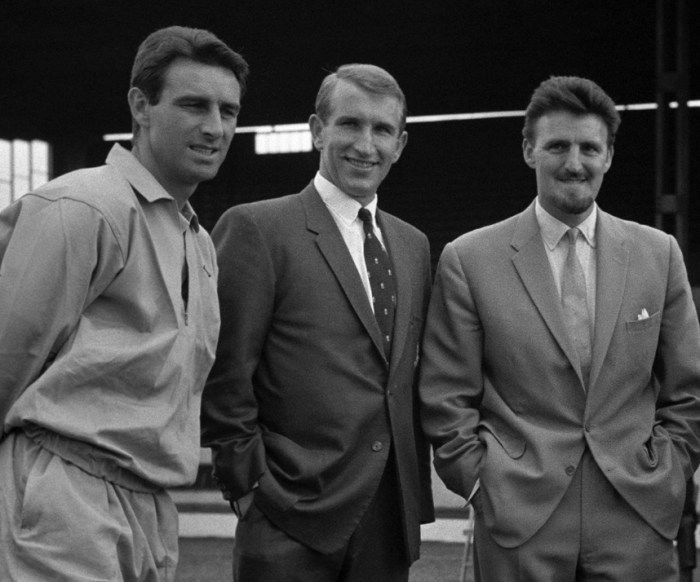
Saward (left) with assistant manager Alan Dicks and Jimmy Hill at Coventry City

Willie Carr and Dennis Mortimer were just two of several first teamers who made it under his guidance. He stepped up to first team assistant manager when his former Eire teammate, Noel Cantwell, was appointed boss in 1967.

Not long after his switch to the Goldstone, Saward picked up one of his former Sky Blues proteges, Ian Goodwin, initially on loan, and then permanently, and eventually made him Albion captain. The rugged defender’s arrival was remembered in an Argus article.

When Saward died on 20 September 2002 following a period when he’d suffered with Alzheimer’s, an excellent Villa website pieced together a detailed obituary. His career is also recorded on the avfchistory.co.uk site.

Saward was laid to rest in the same Cambridge cemetery as his brother Len, a forward who played a total of 170 games for Cambridge United between 1952 and 1958, scoring 43 times. He went on to serve the club behind the scenes in their commercial department.
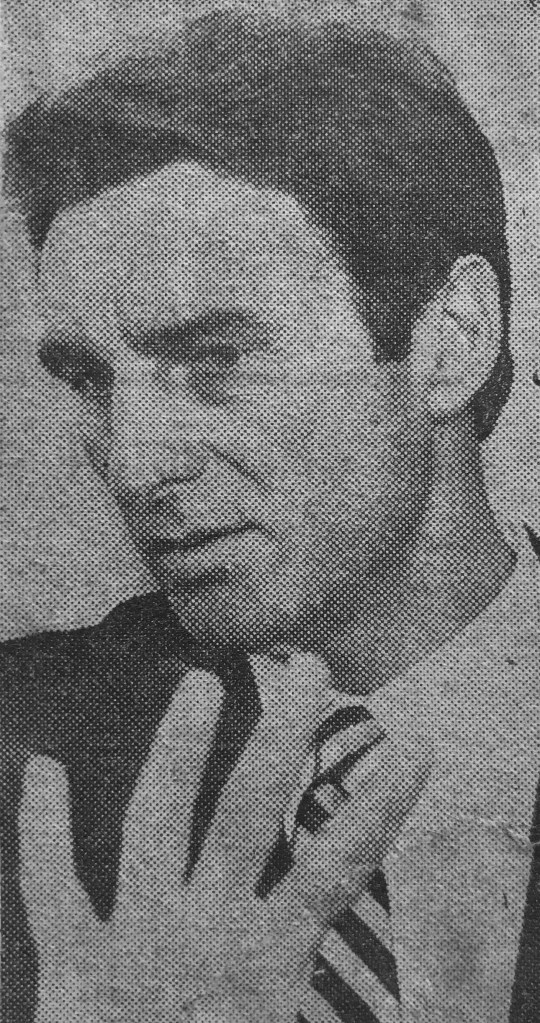
Pictures from my schoolboy Albion scrapbook and various online sources.

Irish defender Stephen Ward surprised Albion supporters

SWARDWHEN Wolverhampton Wanderers slipped into the third tier, they urgently needed to loan out some of their higher-paid players – hence, in August 2013, the arrival at Brighton of left-back Stephen Ward.

Most Seagulls supporters were not sure of his attributes having had the pleasure the previous season of watching the imperious Wayne Bridge shine in that position while on loan from Manchester City.

However, Albion fans were delighted to be proved wrong after Ward helped to shore up a defence that had leaked seven goals in the first eight days of the season. The Irish international defender went on to make a total of 47 appearances and was runner-up to Matt Upson as Albion’s 2013-14 player of the year.

Ward also chipped in with four goals, including the tide-turning equaliser at Nottingham Forest on the final day of the season.

Forest equaliser

Although injury-hit Albion failed to get past Derby County in the play-off semi-finals, it was thought Ward would sign permanently for the Seagulls that summer. But Burnley stepped in, offering Wolves and the defender more money, not to mention the more immediate chance of Premier League football.

Ward’s agent, Scott Fisher, later told the Argus that dithering or perhaps a bit of brinkmanship by then head of recruitment David Burke had scuppered the deal.

“We really tried our best to make Stephen Ward a permanent Brighton player. Had they done their business earlier this wouldn’t have happened,” he said.

Ward spoke more about the circumstances in an interview with the Argus in April 2016.

Previously, as the season drew to a close, Ward told the Argus: “If I’m going to move on, I don’t see why this wouldn’t be one of the better options for me. I’ve been here for a year; I’ve really enjoyed it.

SW Argus

“I couldn’t say one bad thing about the club. The crowd we get, the stadium we have is phenomenal, probably the best in the Championship, and with the new training ground the club is on a real up and a real high.

“If I was to move on from Wolves, Brighton would definitely be high on the list. It’s not in my hands, it’s going to be in other people’s hands to discuss the future, but it has been a great move for me. I’ve really enjoyed it. It’s a really good club and one people should be privileged to play for.”

Ward went on to spend five years at Turf Moor, making 110 appearances, but only featured 11 times in the 2018-19 season, and manager Sean Dyche told punditarena.com: “He (Ward) has been brilliant for us, absolutely brilliant, he’s done a fantastic job.”

SW BurnPerhaps it was no surprise that former Albion coach Nathan Jones stepped in to sign the experienced defender for Stoke City, where he’d taken on an often-perilous managerial hotseat.

Jones said: “He’s had a fantastic career, the only downside for him is his age, because he isn’t what we normally go for.

“But I feel we need to add certain things to the changing room and the environment and Stephen brings those.

“He’s a wonderful player, a great character, very experienced. He’s been promoted – won the Championship twice. He’s an Irish international, I worked with him, he’s technically very, very good so he ticks every box. It’s just the aging process is the only drawback.

“With Stephen, he’s a specialist in what we need and he will provide vital competition and good strength in that area.”

Unfortunately Ward couldn’t claim a regular starting place and in December 2019 picked up a calf injury which sidelined him for four months. Having made only 17 appearances for City, in August 2020 he switched to League One Ipswich Town on a free transfer.

After playing 29 games for them in the 2020-21 season, the club announced on 5 May 2021 he would be released at the end of the season (one more appearance would have triggered a 12-month extension to his contract).

Born in Dublin on 20 August 1985, Ward grew up in Portmarnock and, as a schoolboy, played football for Home Farm and Portmarnock before joining League of Ireland side Bohemians.

He attributed his eventual success in making it as a player to staying in Ireland when he was younger and continuing to live at home rather than going to play at a UK club’s academy.

In an excellent lengthy interview with the Irish Independent, he said: “I had a few trials – Leicester a couple of times, I went to Aston Villa a lot and Hibs for some reason – nothing worked out and I signed for Bohs. And the most important thing for me then was living at home and having my family around me.

“It does depend on the academy, but you are in a bubble from a young age. You train in a certain way, everything is done for you; I know you get your jobs, but not that many now, and sometimes there is a mentality that once you are in an academy, you’ve made it. I was 17 and played in a league where players were playing for their mortgages and to put food on the table.”

Originally a forward, he scored 26 goals in 93 appearances, and, having been looked at by Sunderland boss Mick McCarthy and deemed not quite ready, McCarthy kept tabs on him when he took over at Wolves.

“I signed for Wolves as a striker,” Ward told the Irish Independent. “I was not a typical number nine, scoring 20 or 30 a season, but an old-fashioned centre-forward running round, closing down.

“We signed a couple of strikers – Sylvan Ebanks-Blake and Chris Iwelumo – and I knew if I was going to play consistently it was probably not as a centre-forward. So, I went to left-wing for a bit.

“I played at left-back at Norwich for 30 minutes or so when we went down to nine men. We scraped a draw and afterwards Mick said, ‘You could make a career playing there.’ I thought, ‘Yeah, whatever’. Next season, three games in, and new left-back George Elokobi suffers an awful injury, the window was shut and Mick had no one else . . .”

On the international stage, Ward played through the age levels for the Republic of Ireland and had a dream full international debut in May 2011 as he scored in a 5-0 win over Northern Ireland.

He went on to play 50 times for his country before announcing his retirement from international football in March 2019.

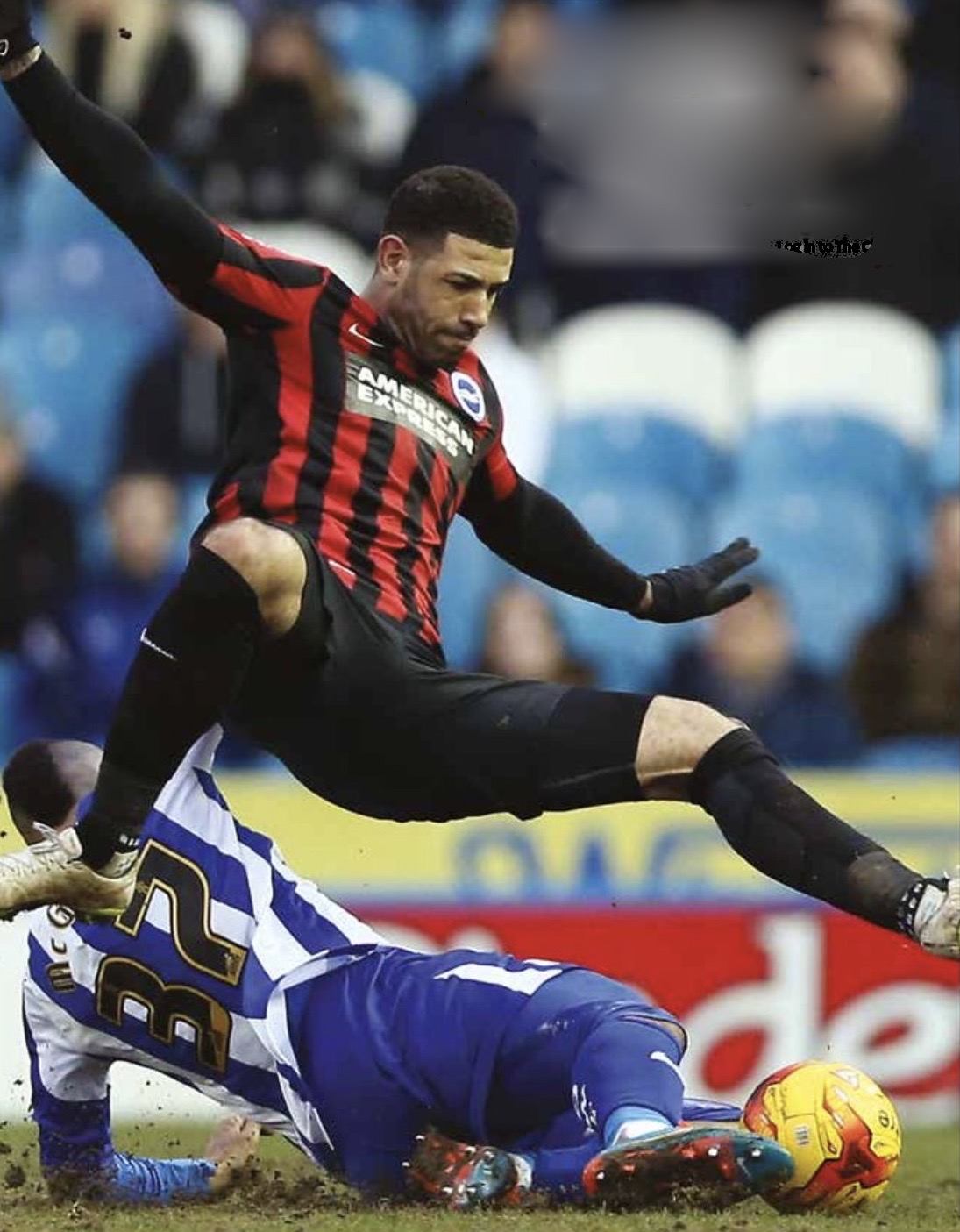
Goal-shy journeyman striker Leon Best drew derision

FOR SOMEONE purporting to be a striker, Leon Best fired blanks at a good many of the clubs he played for.

Such was his time at Brighton where he failed to get on the scoresheet in 13 games (six as a starter, seven as a substitute).

When he featured for AFC Bournemouth in the third tier, he fared slightly better. He managed three goals in 14 starts plus three as a substitute when on loan from Premier League Southampton during the 2006-07 season.

The somewhat derogatory phrase ‘journeyman’ was tailor-made for the likes of Best, who appeared for 13 different league clubs, failing to score for five of them and only registering double figure tallies at three.

Brighton supporters, on the whole, are normally supportive of anyone who appears for their team, but feelings boiled over at Best’s apparent lack of desire when pulling on the Seagulls stripes.

He was part of the struggling 2014-15 side which narrowly avoided the drop from the Championship, and I recall him being booed when he came on as a substitute at the Amex. On reflection, of course, such derision was unlikely to improve his demeanour.

The keyboard warriors of North Stand Chat weren’t slow to vent their anger, with one correspondent suggesting: “We’ve not seen much in the way of desire, endeavour, hunger or appetite from someone you would hope feels he has something to prove.”

Chris Hughton had not long been in the manager’s chair when he was casting around for players to help Albion climb away from the foot of the table.

Perhaps not unreasonably, he turned to a player who’d scored goals for him in the Premier League during his time at Newcastle United.

Hughton told the Argus: “I know Leon very well, having signed him during my time at Newcastle and I am delighted to have him here.

Screen Shot 2021-06-10 at 14.55.50“He is a strong, physical presence, he knows the Championship and knows the position we are in. We wanted new faces, to freshen up the squad, and Leon will add competition alongside our existing strikers.

“I signed him previously at Newcastle. I know he can be a very good player and he did very well for me both in the Championship and Premier League. He also had a very good spell with Newcastle after I left the club.”

Best scored 10 in 46 games for the Magpies but, at his next club, Blackburn Rovers, he managed only two in 16, hence them sending him out on loan.

While Best had scored five in 16 playing on loan at Sheffield Wednesday in 2013-14, he scored a big fat zero in 20 games for Derby County earlier in the 2014-15 season so perhaps expectations should not have been high when he arrived at Brighton on 20 January 2015.

Nevertheless, Hughton told Brian Owen: “I am very pleased he is here. He gives us another attacking option and I hope he can produce the same form he did for me when we worked together at Newcastle.” In short, he didn’t.

Born in Nottingham on 19 September 1986, his first steps into the professional game came with his local side Notts County. When international recognition came calling, he chose to represent his mother’s birth country, the Republic of Ireland, and was capped at under 17, under 19 and under 21 levels before gaining seven full caps in 2009-10.

Southampton snapped up Best in 2004 and gave him his league debut aged 18, ironically against his future employer, Newcastle.

But opportunities were limited with the Saints and over the course of three years on their books they loaned him out to QPR, Sheffield Wednesday, Bournemouth and Yeovil Town.

In 2007, Best transferred to then Championship side Coventry City for £650,000 and arguably his most successful goalscoring spell came during his time there, as he netted 23 goals in 104 appearances over three seasons.

It prompted Hughton to spend £1.5m of Mike Ashley’s money to take Best to Tyneside on 1 February 2010.

Maybe the warning bells should have been sounding in those first few months on Tyneside when he didn’t register a goal in 13 Championship appearances and fell behind Andy Carroll and Peter Lovenkrands in the pecking order.

Although he managed a couple of goals in pre-season matches, the early part of the 2010-11 season was marred by a cruciate knee ligament injury. Nevertheless, when he returned to action in the January, he did it in some style, bagging a hat-trick in a 5-0 win over West Ham. He got a further three goals before injury ruled him out once again.

3490663In the following season, he went 12 games without scoring but in the summer of 2012, Blackburn Rovers paid £3m to take him to Ewood Park – only for him to pick up an anterior cruciate knee injury one month into the season, ruling him out of action for six months.

The temporary move to Brighton was one of three loans away from Blackburn before they finally released him by mutual consent in July 2015.

It wasn’t until November 2015 he managed to find another club, pitching up for six months at Championship side Rotherham United. When he couldn’t agree terms on a new deal with the Millers, he instead moved to Ipswich Town, ostensibly as a replacement for Daryl Murphy.

He made six starts and six appearances as a substitute without scoring and, by January 2017, manager Mick McCarthy had lost patience with him and declared he wouldn’t play another game for the club.

Released by Town in the summer of 2017, Best managed to secure a two-month deal with Charlton Athletic in November 2017 but he sustained a knee injury on New Year’s Day 2018 and hasn’t played since.

Eagles’ Cup Final scorer Gary O’Reilly had two Seagulls spells

GARY O’REILLY was one of those rare players who had two different spells with Brighton – and played for rivals Crystal Palace in between.

Indeed, his career highlight came when he played – and scored – in the 1990 FA Cup Final for Crystal Palace against Manchester United.

It was from Phil Barber’s free-kick on the right that O’Reilly put Palace ahead after 18 minutes, his header looping over goalkeeper Jim Leighton.

United recovered to lead 2-1 before Ian Wright, only six weeks after breaking his leg, came on to score twice, in the 72nd minute and again at the start of extra-time. But Mark Hughes got an equaliser for United seven minutes from the end of extra-time, and, just as they had against Brighton in 1983, United went on to win the replay.

Born in Isleworth on 21 March 1961, O’Reilly started to make a name for himself with the Essex Boys team and, as a schoolboy, played for both England and the Republic of Ireland because his father was from Dublin and his mother English.

Arsenal wanted him on associate schoolboy forms, but it was Spurs who snapped him up at the age of 13. His youth team-mates at White Hart Lane included Kerry Dixon and Mick Hazard.

O’Reilly also had the offer of a sports scholarship at Columbia University before signing for Spurs as a professional. Among a total of 45 first-team appearances in five seasons at Tottenham were games in the Charity Shield at Wembley against Liverpool and a quarter-final victory in the UEFA Cup over German giants Bayern Munich.

Ironically it was the arrival of Gary Stevens from Albion shortly after the 1983 FA Cup Final that began to signal the end of his time at White Hart Lane, together with the emergence of Danny Thomas.

Even though he still had two years of his contract remaining, O’Reilly requested a transfer and, in August 1984, he became part of Chris Cattlin’s Albion squad after signing for a fee of £45,000.

Cattlin recalled: “I watched him eight times before signing him, and six times with Tottenham Reserves he had stinkers. But I thought then he had great potential.”

O’Reilly made his debut at right-back in a notorious home game against Notts County which saw centre-backs Jeff Clarke and Eric Young both hospitalised after clashes with County’s Justin Fashanu, meaning the new arrival hastily shifting into his more familiar position in the centre.

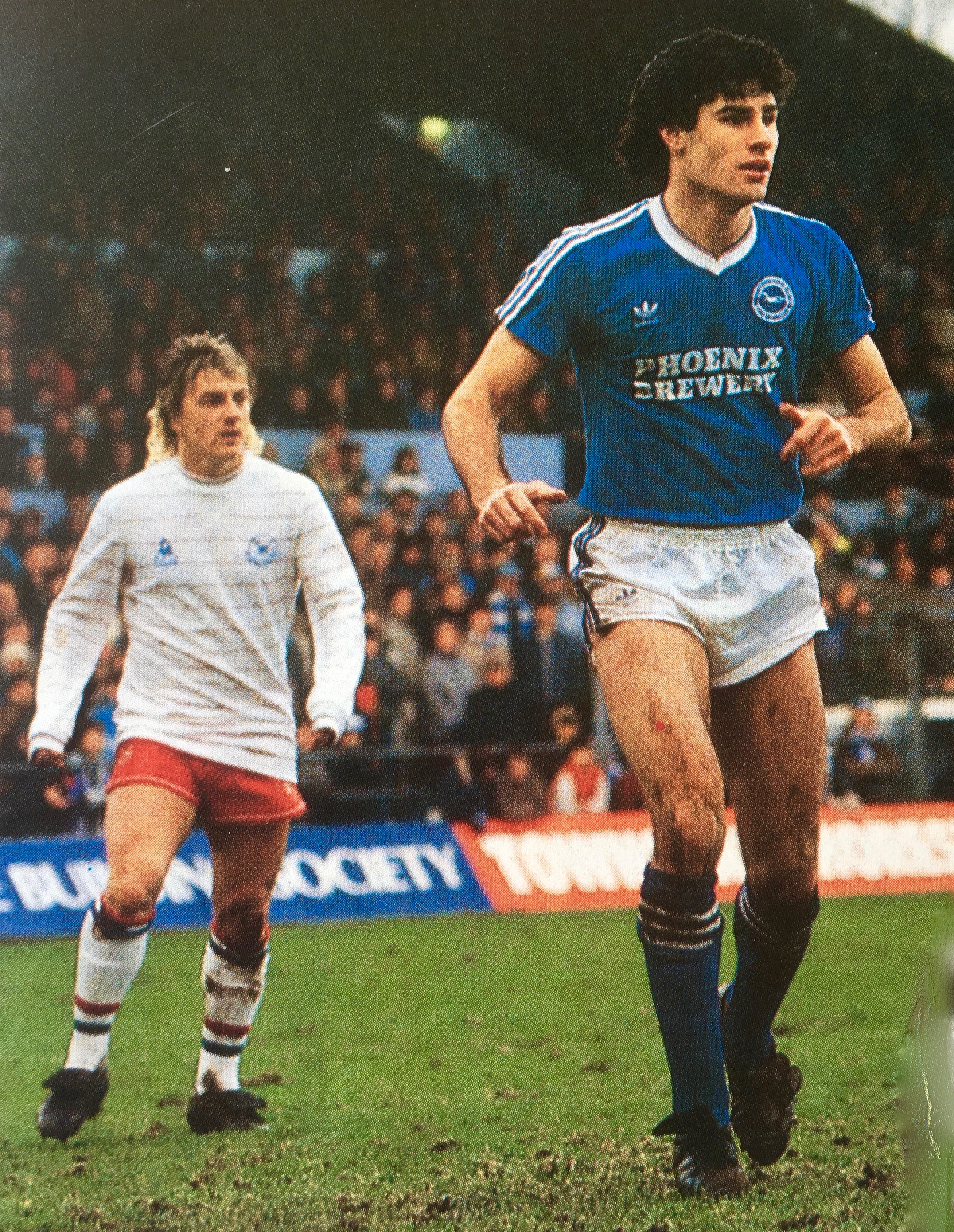
In what was an eventful first few weeks, he also joined that illustrious list of players to score a winning goal AGAINST Palace. That came on 15 September 1984 when 15,044 at the Goldstone Ground saw O’Reilly score the only goal of the game.

His centre-back partner that day – and for most of his time at the Goldstone – was Young, who also later joined the Eagles, having left Brighton for Wimbledon.

O’Reilly made 79 appearances in three seasons with Albion, scoring three goals, and was virtually an ever-present for the first two seasons.

GO'R by the pierOff the field, he became a popular figure with a social conscience, leading a campaign to help youngsters fight drug addiction and becoming president of the Junior Seagulls.

Unfortunately, injuries, including a worrying hamstring condition, restricted him to just eight games in the ill-fated 1986-87 season.

Then, on 3 January 1987, manager Alan Mullery reluctantly sold him to Palace for £40,000. Mullery later recounted: “I remember Gary O”Reilly coming in the day before we were going up to Grimsby. I asked him: ‘Do you want your wages next month?’ He thought it was some kind of quiz question, but I said ‘If you do, you are going to have to leave the club’. That’s how bad it was. We couldn’t afford the wages.” Albion won 2-1 at Grimsby but two days later, Mullery was gone himself – his second spell as manager ending in a sacking.

O’Reilly played 70 times in his first four seasons at Selhurst Park but he did not figure in Steve Coppell’s plans in the 1990-91 season and had just one game on loan with Birmingham City.

At the age of 30, the versatile defender returned to the Seagulls and was given a two-year contract by Barry Lloyd.

“There’s no substitute for first-team football,” he said. “There is nothing like playing regularly to give a player the right degree of confidence.”

Although he made 31 appearances in the 1991-92 season, he was unable to prevent Albion’s relegation back to the third tier and, after a series of unsuccessful knee operations, he was forced to retire from the game in April 1993.

After hanging up his boots, he embarked on a successful broadcasting career for Sky Sports, BBC, ART Prime in Dubai and Trans World International’s Premier League international feed.

On Twitter, with the handle @mythreeleftfeet, he describes himself as “global TV presenter, co commentator, ex professional football player all round sports broadcaster, writer, amateur photographer & someone you might just like…”

worldsoccertalk.com caught up with him in May 2017 to discuss a new venture in which O’Reilly is joint host (alongside stand-up comedian Chuck Nice) of a weekly podcast in America Playing With Science, which explores fascinating topics linking sport and science.

Phoenix O'R w Pompey's Biley

Pictures mainly from the matchday programme.

Above, defending against Portsmouth’s Alan Biley, who later played alongside him.

Gerry Ryan – ‘a special player and one of football’s nice people’

THERE WAS no shortage of tributes paid to Gerry Ryan when the former Albion winger died at the age of 68 on 15 October 2023.

Fellow Irish international Liam Brady, who appointed Ryan as his assistant when he took charge of the Seagulls in 1996, said: “Gerry was a wonderful team-mate. He was a very quick winger, very brave, and he took people on.

“We had some great games together and then we ended up on opposite sides, for Brighton and Arsenal, in the old First Division.”

Although Ryan and Brady’s time in charge happened during a turbulent time off the pitch, Brady pointed out: “We did a pretty good job in what were, of course, difficult circumstances, and I could see then just what Brighton meant to him – he was in love with the club so much.

“Off the pitch, Gerry was just a really nice guy. He was affable, unassuming and got on with everyone he came in contact with.”

That sentiment was echoed by teammate Gordon Smith who told the Albion website: “Gerry was always fired up to play.

“He was not always first choice, but he was still a very good player. He had this ability to be able to turn games around because he was quick and he could score goals.

“He was so reliable – he could fit into any position with his levels of fitness, ability and positional play.

“We were a very close group; we socialised a lot, we played golf, went to the races and Gerry was a key part of that – he was a really good laugh.”

Turlough O’Connor, another former team-mate, from his early days playing for Bohemians in Dublin, told the Irish Independent: “He was the most easygoing guy you’d ever meet, very laidback and always in a happy mood, and a very good footballer as well.

“He was comfortable both left and right, very good on the ball, and very quick, which helped. A very good crosser, he went by people, and was always a threat. He helped so many times laying on goals for me.”

Ryan was one of the most likeable Albion players for a huge number of fans, and I was one of them.

A versatile trier who was good enough to represent the Republic of Ireland on 18 occasions, the wholehearted Ryan might not make it into the all-time best Brighton XI but, if it was judged on affability, his name would be first on the team sheet.

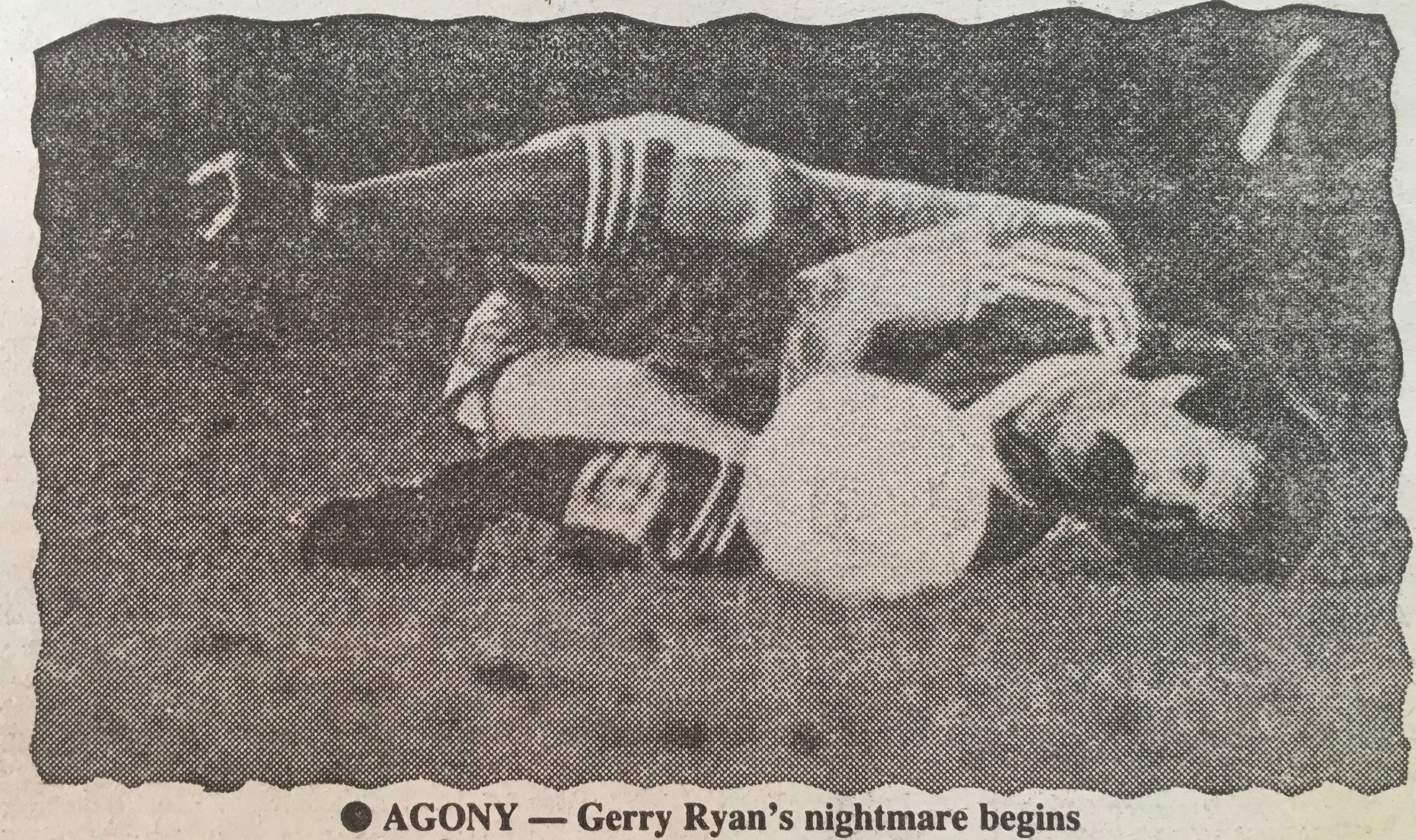
A cruel twist of fate saw his career ended in a tackle made by his Irish teammate (and former Albion boss) Chris Hughton’s brother, Henry. Typically, Ryan bore no grudges, as stressed by former Argus Albion reporter John Vinicombe in an article published in May 1986 when the genial Irishman finally accepted that his career was over.

Describing “the immense dignity and true manliness that Ryan displayed in refusing to condemn or indeed utter any harsh word against the player responsible,” he added: “Where others have sued and raged, slandered, cursed and threatened, Ryan said nothing.”

GR leg break

It was 2 April 1985 when his career was ended by that Hughton tackle in a 1-1 draw with Crystal Palace at Selhurst Park.

“Never in his life has he shirked a tackle and the one that ended his career so unfortunately at Crystal Palace was typical of many he faced in his career,” said Alan Mullery, the manager who signed him for the Seagulls.

“As a person, he is a lovely and typical Irish personality,” Mullery said in the programme for the player’s testimonial game against Spurs at the Goldstone on 8 August 1986. “I can honestly say that I have never met a player who dislikes him or has a bad word to say about him. I will remember Gerry Ryan as being a special player and one of football’s nice people.”

Mullery also referred to a Sunday lunch he and his family had with Ryan and his wife at the time he signed. “When Gerry ordered roast beef and chips I must have known then that I had a very special sort of player. At the time, I was a little dubious but afterwards I had no regrets.”

Mullery had been over in Dublin watching Albion’s Mark Lawrenson playing for the Republic of Ireland and Derby’s Ryan was playing in the same side. He had been having talks about moving to Stoke City but Mullers persuaded him to join Brighton instead, and, in a strange quirk of fate, he made his debut in a 2-2 draw away to Stoke.

After they’d become teammates, Lawrenson was among those players appreciative of Ryan’s “mercurial” qualities. He said in a matchday programme: “He wasn’t the most confident of players but he had loads of ability. For a wide player, he would come in and get goals for you.”

GR capsA week after joining the Seagulls, Ryan became an instant hit with Albion fans when he scored on his home debut in a 5-1 win over Preston. He notched a total of nine goals in 34 appearances in that first season and went on to score 39 in a total of 199 games.

Born in Dublin on 4 October 1955, Ryan was one of eight children. His early education was at the local convent in Walkinstown, a suburb to the south of Dublin where the family lived. At the age of eight he moved on to Drimnagh Castle School (it covered primary and secondary age groups).

At that stage, he was playing Gaelic football and hurling, at which he was capped at under-15 level by Dublin Schools. He didn’t play competitive football until he was 16 when he was introduced to a Dublin football club called Rangers AFC. He played alongside Kevin Moran, who later played for Manchester United, and Pat Byrne, who later played for Leicester City. Byrne and Ryan also played together for Bohemians, the oldest football club in Dublin.

Ryan joined the Dublin Corporation as a clerical officer on leaving school and played for Bohs as an amateur initially before becoming a part-timer on professional terms. By 18, Ryan was a first-team regular and, after collecting a League of Ireland Championship medal, was watched by Manchester United boss Tommy Docherty.

Docherty didn’t pounce then but, after Ryan had stayed four years with Bohemians, the ebullient Scot eventually returned to take him to England as his first signing for Derby County for a fee of £55,000.

The newly-appointed Docherty was determined to shake-up the club and while long-serving goalkeeper Colin Boulton was discarded along with striker Kevin Hector, Ryan, Scottish internationals Bruce Rioch and Don Masson, and Terry Curran and Steve Buckley were all introduced.

Ram Ryan

Ryan spoke about the way Docherty’s attitude towards him changed in an interview with Brian Owen of The Argus in 2016.

“One minute you were the blue-eyed boy, the next he wouldn’t even talk to you,” he said. Ryan made a hamstring injury worse by playing when Docherty insisted he was fit enough, and ended up sidelined for three months. “He didn’t like me then! That’s the way he was, he would turn on you, and he turned on me.”

Within a year, Docherty accepted Brighton’s £80,000 offer for Ryan and, as he was weighing up whether to choose the Seagulls or Stoke City, Ryan consulted the legendary Republic of Ireland and ex-Leeds midfielder Johnny Giles to ask his opinion.

“Gilesy said ‘Stoke have been in and out of the First Division forever but there is something going on down at Brighton. They get great crowds and it’s a beautiful place.’ I went to Brighton that weekend and absolutely loved it,” Ryan told Owen.

It was on 25 September 1978 winger Ryan arrived, prompting the departure of popular local lad Tony Towner after eight years at the Albion.

Five months before Ryan arrived at the Goldstone, he made his international debut, featuring for the first time in April 1978 in a 4-2 win over Turkey at Lansdowne Road. He only scored once for the Republic, but it was a cracking overhead kick in a 3-1 defeat against West Germany.

Ryan Eire

He was one of four regular Eire internationals playing for Albion at the time: Lawrenson, Tony Grealish and Michael Robinson the others.

His final appearance for his country came in a 0-0 draw against Mexico at Dalymount Park in 1984.

Ryan was part of some all-time history-making moments during his time with the Albion – scoring at St James’s Park in the 3-1 win over Newcastle on 5 May 1979 to clinch promotion to the top division for the first time, and burying the only goal of the game as unfancied Albion beat Brian Clough’s European champions Nottingham Forest, who’d previously not lost at home for two and a half years.

Ryan scoresMy personal favourite came on 29 December 1979 at the Goldstone when he ran virtually the entire length of a boggy, bobbly pitch to score past Joe Corrigan in the goal at the South Stand end to top off a 4-1 win over Manchester City. Ryan himself reckoned it was “the best goal I ever scored” as he recounted in a May 2020 BBC Sussex Sport interview with Johnny Cantor.

It was one of the most superb individual goals I saw scored and, when he was trying to recuperate from the horrific leg break which ultimately ended his career, I wrote to him in hospital to say what a special memory it held for me.

I was delighted to receive a grateful reply from him, and he has held a special place in my Albion memory bank ever since.

There were other stand-out occasions, two of which came against Liverpool:

in February 1983 at Anfield when he opened the scoring in Albion’s memorable 2-1 FA Cup triumph en route to the final, and, in the following season, at the Goldstone when he and Terry Connor were on target in Second Division Albion’s 2-0 win over the Reds in the same competition, the first-ever live FA Cup match (other than finals) to be shown (previously any television coverage of FA Cup ties was only ever recorded highlights).

If the modern-day reader can’t quite put the feat in perspective, it is worth pointing out that Liverpool, managed by Joe Fagan, went on to win the League Cup, the League title and the European Cup that season.

Danny Wilson hadn’t long since joined the Albion and, in an interview with the Seagull matchday programme in 2003, he recalled: “That has to be my favourite memory from all my time at the Goldstone. Back then, Liverpool were just awesome, and to beat them like we did was virtually unheard of.”

Ryan’s involvement in the 1983 Cup run was hampered by a hamstring injury which meant he missed out on the semi-final. But, in the days of only one substitute, he was on the bench for the final and, when the injured Chris Ramsey couldn’t continue, Ryan went on at Wembley and did a typically thorough job at right-back.

GR prog snow

Following Albion’s relegation, as the big-name players departed the Goldstone, Ryan’s versatility and play-anywhere attitude came to the fore and, in his last two seasons with the club he was often selected as a centre-forward, although he was not a prolific goalscorer from that position.

After he was forced to quit playing, Ryan took what was then quite a familiar route for ex-players and became a pub licensee, running the Witch Inn at Lindfield, near Haywards Heath. Ryan and goalkeeper Graham Moseley, who he’d known from his days at Derby, were neighbours in Haywards Heath.

GR pots

However, when another of his former Republic of Ireland teammates, Liam Brady, was appointed Albion manager in 1994, it was an inspired choice for him to appoint Ryan as his assistant.

When that all-too-brief managerial spell came to a messy close, Ryan returned to his pub, and then moved back to the family home in Walkinstown. Ryan’s son Darragh played 11 games for the Albion in the late 1990s.

Sadly, in August 2007, Ryan suffered a stroke, and three years later he was diagnosed with kidney cancer. On his death, his family paid tribute to the care he was given by the staff of Our Lady’s Hospice, Harold’s Cross and to the staff of Lisheen Nursing Home, Dr Brenda Griffin, the Beacon Renal Unit, Tallaght, and Tallaght Hospital Renal Unit “for the excellent care given to Gerry over the past number of years”.

Pictures from a variety of sources but mainly from my scrapbook, the matchday programme and The Argus.

‘Dynamic and energetic’ international Keith Andrews wanted longer Brighton stay

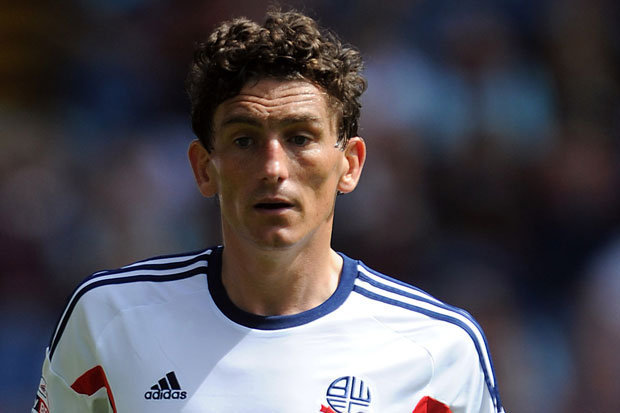
15486REPUBLIC of Ireland international midfielder Keith Andrews was something of a revelation during a season-long loan at Brighton & Hove Albion.

Now plying his trade as a pundit for Sky Sports, Andrews had previously played for the other Albion as well – West Bromwich – although his stay there was even briefer than his time with the Seagulls.

With the looming expectation that back-to-back Player of the Season Liam Bridcutt would shortly follow old boss Gus Poyet to Sunderland (which eventually happened in January 2014), Brighton turned to Andrews to cover the defensive midfield slot in 2013-14.

Arriving at the Amex in August 2013 just short of his 33rd birthday on a season-long loan from Bolton Wanderers, Andrews was not at all happy with the way the Trotters ‘disposed’ of him, telling bbc.co.uk: “Nobody really had the decency to even phone me as I was leaving.

“I think I deserve a little bit more respect than that, I suppose. I always felt I’d done things well at that club, been very professional and treated people like I like to be treated.

“To end on that note was a bit sour but you can’t be surprised by anything in football.”

Even if Seagulls supporters viewed his signing as somewhat underwhelming, Andrews himself was delighted and excited, saying: “If it wasn’t the right move, I certainly wouldn’t have gone and I didn’t feel any pressure to leave.

“It was a move that genuinely excited me. To come to a club that plays in the fashion and style that Brighton do was something that really appealed to me.

“I have still got a huge appetite for the game and I feel I can have a big impact here. I have come into a squad that has a wealth of experience and ability that will make me be the player I know I can be.”

And boss Oscar Garcia sought to dispel any doubts, telling bbc.co.uk: “He is a player with experience at the top level of the English game and international football – including World Cups and European Championships.

“Keith is a player who I know will enjoy the way we like to play. He is a dynamic and energetic player.”

It wasn’t long before supporters began to be pleasantly surprised by Andrews’ contribution on the pitch, and off it the new signing also began to show his aptitude for handling the media.

As early as September 2013, Andrews was speaking eloquently about his teammates, for example telling BBC Radio Sussex his views about striker Leonardo Ulloa.

“He is a handful and has got a bit of everything,” he said. “He is a big player for us at the moment as he is really leading the line on his own. He allows us to bring other players, such as Bucko [Will Buckley] and Ashley Barnes, into play.

“He is very effective and I’ve seen first hand in training how strong he is and what a handful he is to deal with. I have only been here a few weeks but I have been very impressed by the mix we have got in the dressing room. We’ve got experience, youth, foreign, English and Irish.

“It is a good atmosphere and if we hold onto what we have got I am more than confident we can have a very successful season.”

As the months progressed, Andrews became an established part of the side which Garcia ultimately led to the play-offs. In December 2013, Andrews made use of the platform offered by the Daily Mail’s Footballers’ Football Column to expand on his enjoyment of his time at the Amex.

“The club made a big impression on me when I played against them for Bolton last season, in terms of their style of football and their new stadium, and when they came in for me it was a very easy decision in footballing terms,” he said. “It’s not an easy decision, moving 250 miles away from your home in the north-west, but Brighton made it very clear they wanted me and Bolton made it clear they didn’t.

“It came out of the blue, but I felt it was a chance to be a part of something really exciting.”

Garcia’s decision to quit after the failure to get past Derby County in the play-off semi-finals was the catalyst for a number of changes in the playing personnel, although Andrews hankered to make his move to Sussex permanent having been involved in 37 appearances since his temporary move.

keith ands v sheff wedHe registered one goal during that time, an 89th minute equaliser at home to Sheffield Wednesday in October.
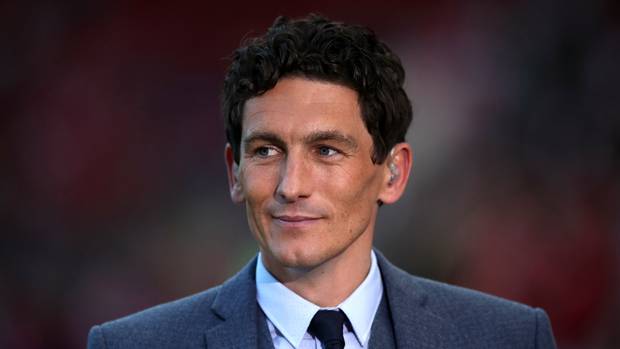
In a May 2014 interview with the Bolton News, he said: “It would be something I’d be interested in. When the people are so good to you and make you feel so welcome, the fans have been fantastic, it’s a one-club town.

“No-one supports anyone else and the attendances are something that I haven’t experienced in football for a long, long time. We’ve got the best attendances in the whole league although other clubs in the league are supposedly bigger.

“It’s a club I would like to stay involved in but contract-wise I’m contracted to a different club next season, I’m only here on loan. These things are not always in your hands and you can’t always dictate where you go and how your career pans out.

“But I would certainly like to stay on at Brighton into the future because I have thoroughly enjoyed it this year.”

The midfielder also reflected positively on his time at the Amex in a blog post for Sky Sports, pointing out: “Although I was only at the Amex for one season I have a lot of affection for the club as I think they try to do things in the right manner for the club to evolve with real sustainability for years to come.

“There are good people involved behind the scenes there, none more so than in the academy. Last season I worked closely with the academy manager John Morling and the development coach Ian Buckman as I was in the middle of my UEFA ‘A’ licence and they couldn’t have done any more to help me.

“It was a great experience to work with them as they prepared weekly and monthly schedules with the rest of the coaches and sports scientists to ensure the young lads had the best chance of developing their games, both technically and physically.

“I was amazed at the schedule a 14-year-old at the club had and a little envious to be honest as it certainly wasn’t like that in my day!”

Born in Dublin on 13 September 1980, Andrews came through the ranks of Drumcondra side Stella Maris before being picked up as a junior by Wolverhampton Wanderers, where he stayed for six years.

He made his first team debut on 18 March 2000 in a 2-1 win at Swindon and at 21 was Wolves’ youngest ever captain in a game against QPR, but he was sent out on loan on three separate occasions, playing briefly for Oxford United, Stoke City and Walsall.

After 72 appearances for the Molineux side, in 2005 he moved on to Hull City, where injury blighted his only season with them He then had a two-year spell with Milton Keynes Dons, where he had a productive midfield partnership with Alan Navarro, and he assumed the captaincy of Paul Ince’s side.

His second season was a huge success as the Dons won promotion to League One; Andrews scoring the goal which secured the success. He also scored in the club’s 2-0 win over Grimsby Town in the Football League Trophy at Wembley.

Andrews was chosen in the PFA Team of the Year, won the League Two player of the Year Award and was listed 38th of FourFourTwo magazine’s top 50 Football League players.

The Irishman followed his old Dons boss Ince to Premier League Blackburn Rovers in September 2008 and, two months later, at the comparatively late age of 28, made it onto the international scene with Ireland, making his debut as a substitute in a 3-2 friendly defeat against Poland.

It was the first of 35 international caps. He was involved in Ireland’s 2010 World Cup qualifying campaign and although the country was winless at the 2012 European Championship in Poland and Ukraine, Andrews was named FAI Player of the Year for 2012.

Meanwhile, Andrews’ third season at Blackburn (2010-11) had been curtailed by injury, restricting him to just five Premier League appearances, and in August 2011 he went on a half-season loan to Ipswich Town.

A permanent switch looked on the cards but on deadline day of the January 2012 transfer window he ended up joining West Brom on a six-month deal. After 14 Premier League appearances for the Baggies, his contract came to an end and his next port of call was newly-relegated Bolton Wanderers, who he joined on a three-year contract in the summer of 2012.

Owen Coyle was the manager at that time but his tenure came to an abrupt end in October that year. Although Andrews played 25 times under his successor, Dougie Freedman, the following season he was edged out by the signing from Liverpool of Jay Spearing.

After his loan season with Brighton, Andrews had a similar arrangement at Watford but he didn’t enjoy the same success there and ended up curtailing the deal and going back to MK Dons on loan for the latter part of the season.

When the curtain came down on his playing career at the end of the 2014-15 season, he’d completed 413 career appearances and scored 49 goals.

He became first team coach at MK Dons and harboured ambitions of becoming manager when Karl Robinson departed, but he was overlooked and began working as a coach with the junior Irish international teams, and turned to punditry with Sky Sports.

ipanews_045350c2-6dc7-4ca9-82e8-cb2036cb6b94_1

Goal machine Frank Stapleton ended his playing days in a Brighton shirt

stapleton stretch

FRANK STAPLETON hit the heights as a goalscorer for Arsenal and Manchester United but his prize-winning playing days came to an end in a Brighton & Hove Albion shirt.

Stapleton was the scorer of the first top flight goal at the Goldstone Ground – unfortunately, it was the opener in Arsenal’s 4-0 win in 1979! He was also one of the Manchester United scorers in the 1983 FA Cup Final against Brighton, having moved to Old Trafford two years earlier (above, however, he just fails to connect for Arsenal against Brighton with Steve Foster and Gary Williams looking on).

His two appearances for Brighton came in 1995 when his old pal Liam Brady brought him in to try to improve the front line of an ailing side.

Born in Dublin on 10 July 1956, the promising young Stapleton was rejected by United as a teenager but the Gunners reaped the benefit of that decision by snapping him up at the tender age of 15 on chief scout Gordon Clark’s recommendation.

Arsenal’s confidence in the prospects for the promising young Irish duo were reflected in a Goal magazine article of 7 October 1972 in which boss Bertie Mee talked about them as future first team players. At the time, they were still part of the club’s junior ranks, aged just 15 and 16.

goal cutting

Mee said: “Brady is almost established as a regular in the reserve side. He needs building up but has the potential to become a first-team player. Stapleton has made quite an impact in his first season and, providing he maintains a steady improvement, he could also follow the path of Brady.”

It was only Brady’s second season and Clark, the Arsenal chief scout who unearthed him, said, at first, he thought he would be better suited to becoming a jockey because he was so small and frail!

He quickly changed his mind when he saw his ability with a football. “He was like a little midget but he had so much confidence. He’s really shot up now and although he’s still not very tall, he’s strong enough to hold his own,” said Clark.

Stapleton, at 15, joined Arsenal in the summer of 1972 and quickly developed a reputation as a goalscorer, netting 11 goals in seven games.

“Frank is tall and very good in the air,” said Clark. “He seems to get up and hang for the ball. He is also very good on the floor and reads the game intelligently for a youngster.”

As expected, Stapleton progressed to the first team and made his debut in 1975 against Stoke City. He initially formed an impressive partnership with England striker Malcolm Macdonald and in three successive seasons was Arsenal’s leading goalscorer.

Such prowess brought him to the attention of the Republic of Ireland international selectors and player-manager Johnny Giles gave him his full debut aged just 20 in 1976 against Turkey in Ankara.

It was the first of a total of 71 caps for his country, during which time he became their captain and scorer of 20 goals. He led Eire when they famously beat England 1-0 at the Euro 1988 finals in Germany. Although he was part of the 1990 World Cup squad – alongside former Albion boss, Chris Hughton –  he was by then behind Niall Quinn, John Aldridge and Tony Cascarino in the pecking order.

Stapleton was part of Arsenal’s three successive FA Cup final teams (1978, 1979, 1980), scoring against United in Arsenal’s 3-2 win in 1979.

When the Gunners sold Brady to Juventus in 1980, Stapleton started to question the club’s ambition and, the following year, on expiry of his contract, decided he would move on himself.

He had scored 108 goals in 300 appearances for Arsenal – some strike rate! – and it wasn’t a popular move to join a major rival in the same division, but he wasn’t the first or last player to have done so.

In the Sixties, United had taken David Herd from the marble halls of Highbury to lead their line and, of course, in more recent times, United signed Alexis Sanchez.

stapleton utd

When Robin van Persie made the same transfer switch from Arsenal to Manchester United in 2012, the Daily Mail took Stapleton back 30 years to talk about the circumstances of his own move.

Stapleton was Ron Atkinson’s first major signing for United and in his first season was partnered up front with Garry Birtles. Stapleton was the leading scorer for United in that first season, with 13 goals in 41 league games.

Subsequently, his main strike partner was the Northern Ireland international, Norman Whiteside.

img_4637

Stapleton scored United’s first goal, a 55th minute equaliser, in the 2-2 Cup Final draw against Brighton: one of 19 he notched during the 1982-83 season in which he played in 59 of United’s 60 games.

By the end of the following season, Stapleton’s regular strike partner was Mark Hughes and he scored in the 1985 FA Cup semi-final against Liverpool to set up yet another Wembley appearance, this time collecting his third winners’ medal when Whiteside’s winner beat Everton.

Despite a good start to the following season, with Stapleton once again amongst the goals, poor league form eventually cost Atkinson his job and his successor, Alex Ferguson, began rebuilding the side.

After six years at United, Stapleton, by then 30, was amongst those to be let go, and he was sold to Ajax of Amsterdam, lured by the fact they were managed by Johan Cruyff. But the move failed to live up to expectations, as detailed by the42.ie, and he ended up having a spell on loan at Anderlecht.

It was the first of a series of moves which didn’t really work out for him, although in the 1988-89 season he found himself playing in France alongside fellow Irish international – and future Brighton striker – John Byrne for Le Havre.

stapleton 4 derby

Derby County offered him a platform back in the UK game and he featured 10 times for them in 1987-88 and, after his stint in France came to an end, he spent two seasons with Blackburn Rovers.

He played once for lowly Aldershot and five times for Huddersfield Town before landing a player-manager’s post with Bradford City. In three years at Valley Parade, he made 68 appearances before the axe fell, and he answered Brady’s call for help at the Goldstone Ground.

The brilliant The Goldstone Wrap detailed his brief involvement in a March 2015 post, explaining how he featured as a substitute in a 0-0 draw at home to Bournemouth and started in a 3-0 defeat away to Cardiff City.

It was a final swansong for his playing career, as he looked to get back into coaching or management. He had two stints working under his former United teammate Ray Wilkins: at QPR and, in 2014, with the Jordan national side.

Stapleton spent eight months in 1996 as the first head coach of American Major Soccer League side New England Revolution, of Massachusetts.

His last appointment in the English game was briefly as a specialist striker coach at Bolton Wanderers, appointed during Sam Allardyce’s reign, in 2003-04.

Nowadays, Stapleton is more likely to be found talking about his illustrious career, his availability for bookings listed by football-speakers.com.

Imperious Mark Lawrenson starred at Brighton before hitting Liverpool heights

MARK LAWRENSON was without doubt in my mind the best player ever to play for Brighton and Hove Albion. Peter Ward was exceptional but Lawrenson did it for Brighton and went on to have a glittering career with Liverpool, the top club in the country at the time.

And, whatever your thoughts about his contribution as a pundit – and many are very disparaging – you can’t take away his longevity on our TV screens and across our media.

Although now slightly less prominent as a TV pundit, for a good many years, Lawrenson reprised his successful Liverpool central defensive partnership with Alan Hansen in the BBC Match of the Day studios.

But where did it all begin? Born on 2 June 1957 in Penwortham, Lancashire, Lawrenson joined nearby Preston at 17 in 1974, who at the time were managed by the legendary Bobby Charlton.

Lawrenson made his full debut for the Lilywhites the following year, two months before his 18th birthday. However, it was Charlton’s fellow World Cup winner, Nobby Stiles, to whom Lawrenson was most grateful.

“I was a winger when I joined Preston, while he was coach, and he was the one who converted me to my present position – in the middle of the back four,” Lawrenson told Keir Radnedge in Football Weekly News.

“Nobby was very good with the youngsters. He was almost like a father-figure. He commanded respect not only because of what he’d achieved himself but because of the way he’d help iron out your faults.”

At the age of 19, and thinking he’d never be good enough to play for England, Lawrenson opted to play for the Republic of Ireland when player-manager Johnny Giles (perhaps not coincidentally, Nobby’s brother-in-law) found out that he qualified to play for them through his grandfather.

That debut for Ireland in April 1977, in a 0-0 draw with Poland, came at the end of a season in which he was voted Preston’s Player of the Year.

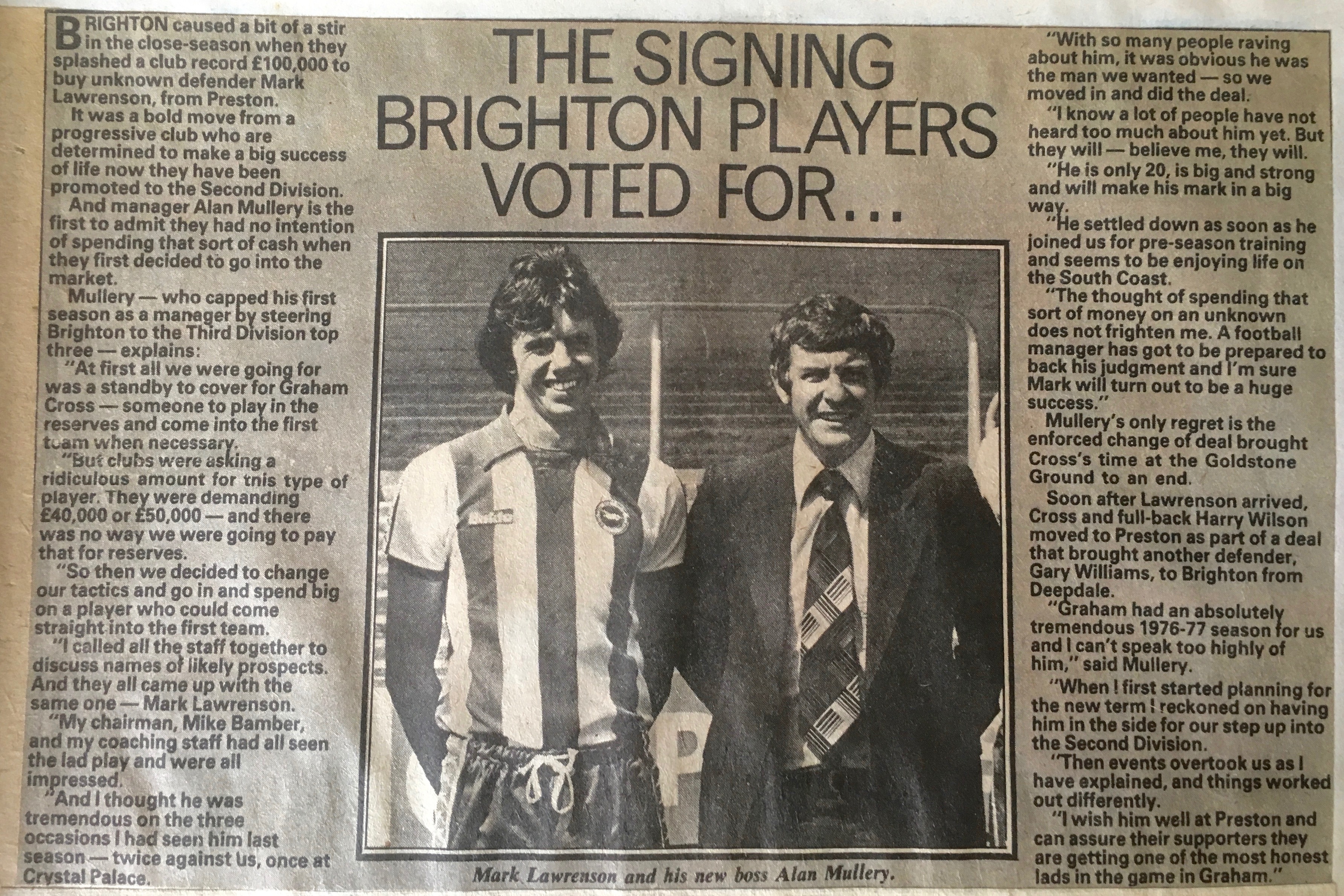
Within weeks, he joined the Albion for £112,000 (£100,000 + VAT @ 12 per cent) after Brighton manager Alan Mullery persuaded Albion to outbid Liverpool to get their man.

Shoot article

Mullery recalled in his 2006 autobiography how he had taken the board of directors to see Lawrenson perform superbly in an end-of-season game at Crystal Palace, where he marked their new star striker Mike Flanagan out of the game.

Lawrenson recollects how he was on an end-of-season ‘jolly’ in Spain with his Preston team-mates when Brighton chairman Mike Bamber and director Dudley Sizen turned up and ‘sold’ the club to him in a Benidorm beachside bar.

There was nearly a hitch in the deal when his medical showed high sugar levels in his blood – but it turned out he had been drinking blackcurrant-flavoured Guinness while on the Spanish holiday.

Mullery was building on the success of guiding the Seagulls to promotion from Division Three in his first season in charge, and the young defender replaced the experienced Graham Cross, who went to Preston in part-exchange.

Shortly after signing Lawrenson, Mullery told Shoot magazine: “I know a lot of people have not heard too much about him yet. But they will – believe me, they will. He is only 20, is big and strong and will make his mark in a big way.”

And, in his autobiography, Mullery said: “Any manager would love to have a player of Mark’s ability in their side. He had a calm, strong temperament, he never caused any problems and he always performed brilliantly on the field. His presence helped to lift the team to a whole new level of performance in the 1977-78 season.”

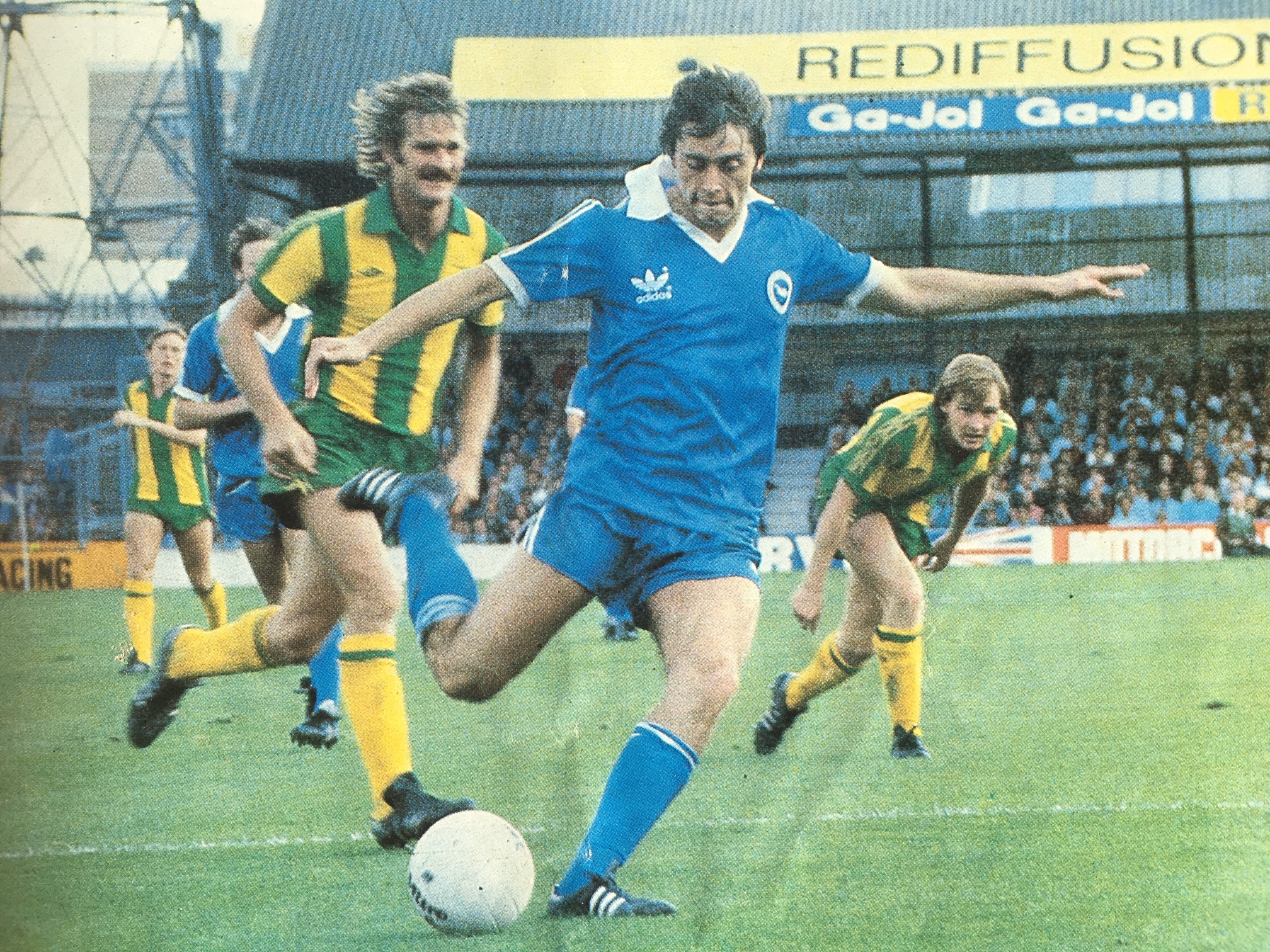
Lawrenson made his Brighton debut on the 20 August 1977 in a 1-1 draw against Southampton at The Dell and went on to make 40 league appearances by the end of his first season at the club.

The following season, when Albion went one better and earned promotion to the top division for the first time, Lawrenson was a stand-out performer. In his book, A Few Good Men, author Spencer Vignes said: “His timing in the tackle and ability to read the game belied his relative youth, but what really caught the eye was his skill on the ball, which, for a centre-back still earning his wages in English football’s second tier, was little short of remarkable.”

Skipper Brian Horton told Vignes: “The way he used to bring the ball out from the back had to be seen to be believed.”

In a special Argus supplement of April 1997, to mark Albion’s departure from the Goldstone, Lawrenson was interviewed by Mike Donovan, and told him: “The Goldstone was a great place to play and I was extremely happy there.

“It was an excellent team that played good football the way it should be played – by passing it around. Also, we had a great team spirit, mainly because a lot of the team were outsiders coming in and stuck together. We all played and socialised together.”

Unfortunately, Albion’s first season amongst the elite was only five games in when Lawrenson received a serious injury in a clash with Glenn Hoddle at White Hart Lane.

Badly torn ankle ligaments and a chipped bone was the diagnosis and it sidelined Lawrenson for 12 matches, although his absence created an opportunity for young Gary Stevens.

lawro yellowWhen Lawrenson was fit to return, Mullery sprung a surprise by utilising him in midfield, but it was an inspired decision and he stayed there for the rest of the season, helping Albion to finish a respectable 16th of 22.
He went on to make 152 league appearances by the end of 1980-81.

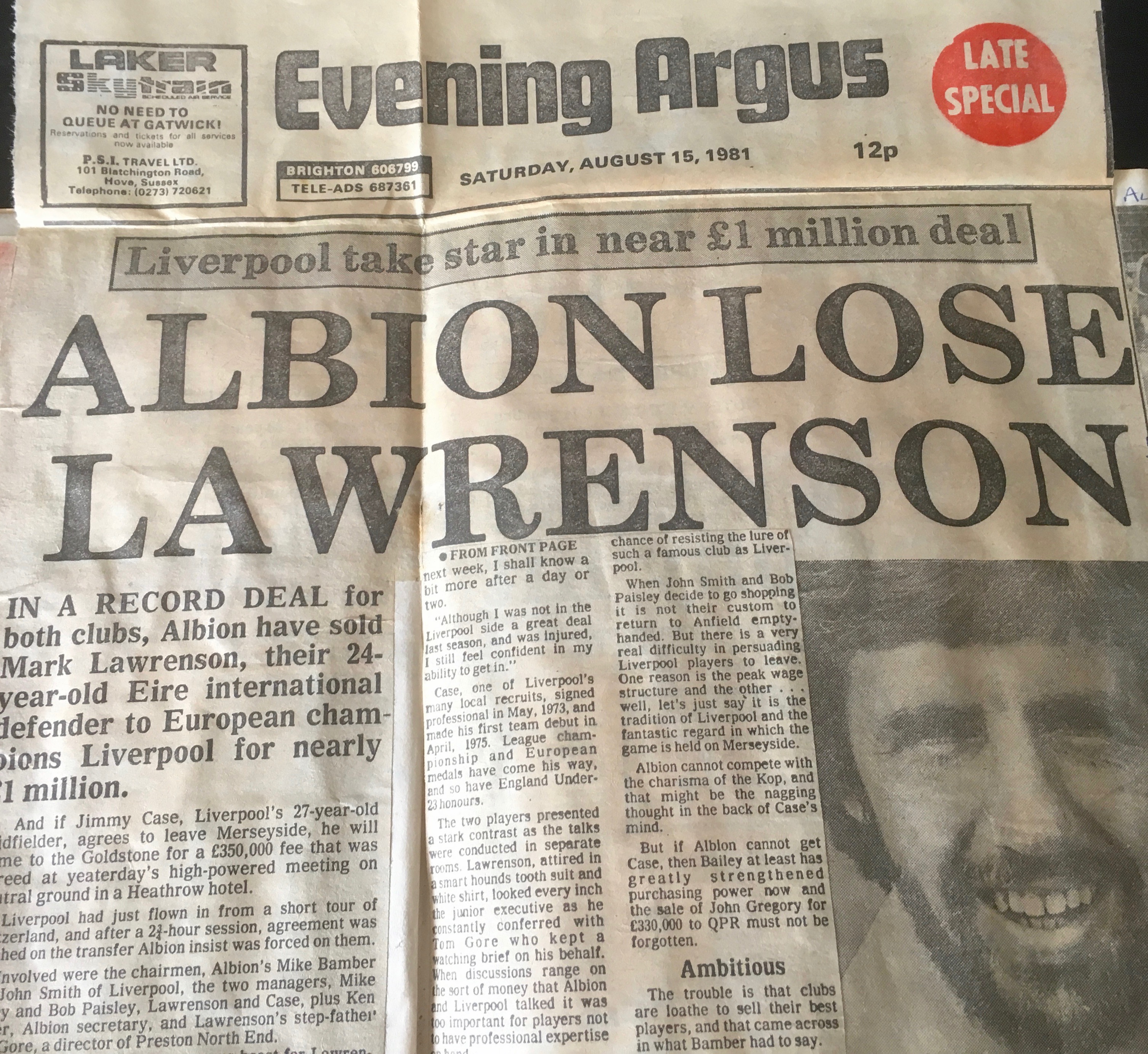
It was his sale to Liverpool in the summer of 1981 that was part of the reason Mullery’s reign at the club came to an end. Mullery had negotiated with Ron Atkinson to sell him to Manchester United with two United players coming to Brighton as part of the deal.

But, behind his back, chairman Bamber had been talking to Liverpool and, in exchange for what was then a Liverpool club transfer record of £900,000, he was destined to be heading back to the North West with midfielder Jimmy Case coming South as part of the deal.

Interestingly, though, Lawrenson revealed in his autobiography how new manager Mike Bailey had actually made him Albion captain, but then asked him how he saw his future, which sowed a seed of doubt about the club’s intentions.

“I don’t know if there was a financial crisis and they were looking for a big transfer fee from my sale to sort themselves out, but the uncertainty did unsettle me,” he wrote. Lawrenson was sent off in an ill-tempered pre-season friendly (against FC Utrecht in the Dordrecht Tournament) and put it down to his personal frustration.

“On our return flight, there was a message that Terry Neill of Arsenal was waiting to meet the chairman at Gatwick,” Lawrenson recalled. “Somehow they missed each other and the next day there was talk of me going to Manchester United.

“But then Mike Bailey asked me if I would meet Liverpool, and I travelled to the Aerial Hotel at Heathrow to meet Bob Paisley, Peter Robinson and Liverpool chairman John Smith.

“Terry Neill was, at the time, waiting in the next hotel in case discussions broke down. He missed out because it only took me 15 minutes to agree to move to Liverpool.

“I travelled North and had a medical at 11.30 at night. I even took the registration forms to the League offices myself, because they are only a few doors away from my mother’s home at St Annes.”

Argus front page

Lawrenson went on to form a formidable central defensive partnership with Hansen after England centre back Phil Thompson suffered an injury, but, as he had showed at Brighton, he was versatile enough also to play at full back or in midfield.

Indeed, Lawrenson made his first start for Liverpool at left-back in a 1-0 league defeat to Wolves. In his first season, Liverpool won the League championship and the League Cup. They won it again in 1982 and retained both for another two seasons, becoming only the third club in history to win three titles in a row. They also added the club’s fourth European Cup in 1984.

Many believed Lawrenson and Hansen were the best central defensive partnership in English football by the time Liverpool clinched the League and FA Cup “double” in 1986.

But Lawrenson was being put under pressure by young centre back Gary Gillespie and an Achilles tendon injury in 1988 prematurely ended his career after 332 appearances and 18 goals, although he earned a fifth and final title medal when that season ended.

Lawrenson tried his hand at management at Oxford United in 1988 but, in almost a mirror image of the situation over his own transfer from Brighton, he resigned after their star striker Dean Saunders, the former Albion player, was sold by the board of directors without Lawrenson’s blessing.

Lawrenson later managed Peterborough United for 14 months between September 1989 and November 1990, but it was a largely unsuccessful tenure.

Apart from one brief foray back into football as a defensive coach at Newcastle during Kevin Keegan’s first reign in the North East, Lawrenson’s involvement since has been one step removed as a pundit and newspaper columnist.

At the 2018 World Cup, Lawrenson particularly hit the headlines when many observed his cantankerous and sarcastic observations were just too much.

Never shy of voicing his opinions, they once led to him losing what at the time was a trademark moustache!

He was so convinced that Bolton would be relegated that he said live on Football Focus that he would shave it off if they proved him wrong, which they did!

In 2003, my friend Andrew Setten somehow blagged tickets which gave us the opportunity to go into the exclusive Football Association area at the FA Cup Final between Arsenal and Southampton at the Millennium Stadium and, all those years later, I finally got the chance to meet Lawro and to get his autograph.

• Pictures from Shoot magazine, cuttings from the Evening Argus and the matchday programme.

Lawrenson pictured in 2024

Spanish TV star Michael Robinson followed in dad’s footsteps to play for Brighton

Robinson v WBA

WHEN Michael Robinson died of cancer aged 61 on 28 April 2020, warm tributes were paid in many quarters to the former Brighton, Liverpool and Republic of Ireland international who became a big TV celebrity in Spain.

“We have lost a very special guy, a lovely person and someone I’m proud to have known both on and off the pitch,” his former teammate Gordon Smith told Spencer Vignes. “He was one of the boys, one of the good guys.”

It seemed like half a world away since Robinson had charged towards Gary Bailey’s goal in the dying moments of the 1983 FA Cup Final only inexplicably to pass up the opportunity of scoring a Wembley winner to lay the ball off to Smith.

“With Michael bursting forward and having turned the United defence inside out, I was genuinely expecting him to shoot and had put myself in a position to pick up any possible rebound,” Smith recounted. “Instead he squared it to me and we all know what happened next.”

Robinson’s next two competitive matches also took place at Wembley:

  • He once again led the line for Brighton when the Seagulls were crushed 4-0 by Manchester United in the cup final replay on 26 May. It turned out to be his last game for the Albion.
  • Three months later he was in the Liverpool side who lost 2-0 to United in the FA Charity Shield season-opening fixture between league champions and FA Cup winners, following his £200,000 move from relegated Brighton.

It was hardly surprising Robinson didn’t hang around at the Goldstone: the Seagulls had given him a platform to resurrect a career that had stalled at Manchester City, but the striker had several disputes with the club and the newspapers were always full of stories linking him with moves to other clubs.

robbo livPerhaps it was surprising, though, that champions Liverpool were the ones to snap him up, particularly as Ian Rush and Kenny Dalglish were in tandem as first choice strikers.

But at the start of the 1983-84 season, Joe Fagan’s Liverpool had several trophies in their sights and Robinson scored 12 times in 42 appearances as the Merseyside club claimed a treble of the First Division title, the League Cup, and the European Cup.

It took him a while to settle at the Reds because by his own admission he was in awe of the players around him but advice from Fagan to play without the metal supports he’d worn in his boots for six years previously (to protect swollen arches) paid off.

“It made a hell of a difference,” he said. “I felt a lot sharper and so much lighter on my feet.” In the first game without them, Robinson scored twice in a European game at Anfield, then he got one in a Milk Cup tie versus Brentford and scored a hat-trick in a 3-0 league win at West Ham.

robbo semi hatNevertheless, asked many years later to describe his proudest moment in football, he maintained: “Scoring the winning goal in the FA Cup semi-final that meant that a bunch of mates at Brighton were going to Wembley in 1983.”

One of two sons born to Leicester publican Arthur Robinson on 12 July 1958, Michael followed in his father’s footsteps in playing for Brighton. Arthur played for the club during the Second World War when in the army, and also played for Leyton Orient.

When he was four, Robinson moved to Blackpool where his parents took over the running of a hotel in the popular seaside resort. The young Robinson first played football on Blackpool beach with his brother.

After leaving Thames Primary School, it was at Palatine High School that he first got involved in organised football, and, before long, he caught the eye of the local selectors and represented Blackpool Schools at under 15 level, even though he was only 13.

Amongst his teammates at that level was George Berry, who ironically was Robinson’s opponent at centre half in his first Albion match, against Wolverhampton Wanderers.

The young Robinson also played for Sunday side Waterloo Wanderers in Blackpool and when still only 13 he was invited for trials at Chelsea, by assistant manager Ron Suart, who had played for and managed Blackpool.

Although he was asked to sign schoolboy forms, Robinson’s dad thought it was too far from home. Coventry, Blackpool, Preston and Blackburn were also keen and the North West clubs had the edge because he wouldn’t have to leave home.

Eventually he chose Preston and on his 16th birthday signed as an apprentice. At the time, Mark Lawrenson was also there, training with the youngsters, and Gary Williams was already on the books.

After two years as an apprentice, he signed professional and began to push for a first team place with the Lillywhites. With former World Cup winner Nobby Stiles in charge, in 1978-79, Robinson scored 13 goals in 36 matches, was chosen Preston fans’ Player of the Year and his form attracted several bigger clubs.

In a deal which shocked the football world at the time, the flamboyant Malcolm Allison paid an astonishing £756,000 to take him to Manchester City. It was a remarkable sum for a relatively unproven striker.

The move didn’t work out and after scoring only eight times in 30 appearances for City, Robinson later admitted: “I’d never kicked a ball in the First Division and the fee was terrifying. If I had cost around £200,000 – a price that at that time was realistic for me – I would have been hailed as a young striker with bags of promise.”

It was Brighton manager Alan Mullery, desperate to bolster his squad as Albion approached their second season amongst the elite, who capitalised on the situation.

“I received the go ahead to make some major signings in the summer of 1980,” Mullery said in his autobiography. Mullery, had the support of vice-chairman Harry Bloom – current chairman Tony Bloom’s grandfather – even though chairman Mike Bamber was keener to invest in the ground.

“I could see he’d lost confidence at City and I made a point of praising him every chance I got,” said Mullery. “I asked him to lead the line like an old-fashioned centre forward and he did the job very well.”

Robinson told the matchday programme: “When Brighton came in for me, I needed to think about the move…12 months earlier I had made the biggest decision of my life and I didn’t want to be wrong again.”

In Matthew Horner’s authorised biography of Peter Ward, He shot, he scored, Mullery told him: “When I signed Michael Robinson it was because I thought Ward was struggling in the First Division and that Robinson could help take the pressure off him. Robinson was big, strong, and powerful and he ended up scoring 22 goals for us in his first season.”

The first of those goals came in his fourth game, a 3-1 league cup win over Tranmere Rovers, and after that, as a permanent fixture in the no.9 shirt, the goals flowed.

With five goals already to his name, Robinson earned a call up to the Republic of Ireland squad. Although born in Leicester, his mother was third generation Irish and took out Irish citizenship so that her son could qualify for an Irish passport. It was also established that his grandparents hailed from Cork.

He made his international debut on 28 October 1980 against France. It was a 1982 World Cup qualifier and the Irish lost 2-0 in front of 44,800 in the famous Parc des Princes stadium.

Nevertheless, the following month he scored for his country in a 6-0 thrashing of Cyprus at Lansdowne Road, Dublin, when the other scorers were Gerry Daly (2), Albion teammate Tony Grealish, Frank Stapleton – and Chris Hughton!

In April 1982, Robinson, Grealish and Gerry Ryan were all involved in Eire’s 2-0 defeat to Algeria, played in front of 100,000 partisan fans, and for a few moments on the return flight weren’t sure they were going to make it home. The Air Algeria jet developed undercarriage problems and had to abort take-off. Robinson told the Argus: “I thought we were all going to end up as pieces of toast. But the pilot did his stuff and we later changed to another aircraft.”

Although not a prolific goalscorer for Ireland, he went on to collect 24 caps, mostly won when Eoin Hand was manager. He only appeared twice after Jack Charlton took charge.

But back to the closing months of the 1980-81 season…while only a late surge of decent results kept Albion in the division, Robinson’s eye for goal and his never-say-die, wholehearted approach earned him the Player of the Season award.

As goal no.20 went in to secure a 1-1 draw at home to Stoke City on 21 March, Sydney Spicer in the Sunday Express began his report: “Big Mike Robinson must be worth his weight in gold to Brighton.”

However, the close season brought the shock departure of Mullery after his falling out with the board over the sale of Mark Lawrenson and the arrival of the defensively-minded Mike Bailey.

Bailey had barely got his feet under the table before Robinson was submitting a written transfer request, only to withdraw it almost immediately.

He said he wanted a move because he was homesick, but after talks with chairman Bamber, he was offered an incredible 10-year contract to stay, and said the club had “fallen over themselves to help me”.

Bamber told the Argus: “I have had a very satisfactory talk with Robinson and now everybody’s contracts have been sorted out. It has not been easy to persuade him to stay.”

Even though Bailey led the Seagulls to their highest-ever finish of 13th, it was at the expense of entertainment and perhaps it was no surprise that Robinson’s goal return for the season was just 11 from 39 games (plus one as sub).

The 1982-83 season had barely got underway when unrest in the club came to the surface. Steve Foster thought he deserved more money having been to the World Cup with England and Robinson questioned the club’s ambition after chairman Bamber refused to sanction the acquisition of Charlie George, the former Arsenal, Derby and Southampton maverick, who had been on trial pre-season.

Indeed, Robinson went so far as to accuse the club of “settling for mediocrity” and couldn’t believe manager Bailey was working without a contract. Bamber voiced his disgust at Robinson, claiming it was really all about money.

The club tried to do a deal whereby Robinson would be sold to Sunderland, with Stan Cummins coming in the opposite direction, but it fell through.

Foster and Robinson were temporarily left out of the side until they settled their differences, returning after a three-game exile. But within four months it was the manager who paid the price when he was replaced in December 1982 by Jimmy Melia and George Aitken.

Exactly how much influence the managerial pair had on the team is a matter of conjecture because it became a fairly open secret that the real power was being wielded by Foster and Robinson.

On the pitch, the return of the prodigal son in the shape of Peter Ward on loan from Nottingham Forest had boosted crowd morale but didn’t really make a difference to the inexorable slide towards the bottom of the league table.

Ward scored a famous winner as Manchester United were beaten 1-0 at the Goldstone a month before Bailey’s departure, but he only managed two more in a total of 20 games and Brian Clough wouldn’t let him stay on loan until the end of the season.

Albion variously tried Gerry Ryan, Andy Ritchie and, after his replacement from Leeds, Terry Connor, to partner Robinson in attack. But Connor was cup-tied and Ryan bedevilled by injuries, so invariably Smith was moved up from midfield.

Robinson would finish the season with just 10 goals to his name from 45 games (plus one as sub) – not a great ratio considering his past prowess.

The fearless striker also found himself lucky to be available for the famous FA Cup fifth round tie at Liverpool after an FA Commission found him guilty of headbutting Watford goalkeeper Steve Sherwood in a New Year’s Day game at the Goldstone.

The referee hadn’t seen it at the time but video evidence of the incident was used and the blazer brigade punished him with a one-match ban and a £250 fine. Robinson claimed it had been an accident…but it was one that left Sherwood needing five stitches. The ban only came into effect the day after the Liverpool tie, and he missed a home league game against Stoke City instead.

In the run-up to the FA Cup semi-final with Sheffield Wednesday, Robinson was reported to be suffering with a migraine although he told Brian Scovell it was more to do with tension, worrying about the possibility of losing the upcoming tie.

Nevertheless, he told the Daily Mail reporter: “When I was with Preston, I suffered a depressed fracture of the skull and have had headaches ever since. This week it’s been worse with the extra worry about the semi-final.”

Manager Melia, meanwhile was relieved to know Robinson would be OK and almost as a precursor to what happened told John Vinicombe of the Evening Argus: “Robbo is a very important member of our team and he’s the man who can win it for us.

“It is Robbo who helps finish off our style of attacking football and I know he’ll do the business for us on the day.”

Reports of the semi-final were splashed across all of the Sunday papers, but I’ll quote the Sunday Express. Under the headline MELIA’S MARVELS, reporter Alan Hoby described the key moment of the game.

“In a stunning 77th minute breakaway, Case slipped a beauty forward to the long-striding Gordon Smith whose shot was blocked by Bob Bolder.

“Out flashed the ball to Smith again and this time the cultured Scot crossed for Mike Robinson to rap it in off a Wednesday defender.”

Other accounts noted that defender Mel Sterland had made a vain attempt to stop the ball with his hand, but the shot had too much power.

When mayhem exploded at the final whistle, a beaming Robinson appeared on the pitch wearing a crumpled brown hat thrown from the crowd to acknowledge the ecstatic Albion supporters.

In one of many previews of the Final, Robinson was interviewed by Shoot! magazine and sought to psyche out United by saying all the pressure was on them.

“That leaves us to stride out from that tunnel with a smile and a determination to make everyone proud of us,” he said.

“Nobody seems to give us a prayer. They all seem glad that ‘little’ Brighton has reached the Final, but only, I suspect, because they expect to see us taken apart by United.”

Everyone knows what happened next and quite why the normally-confident Robinson didn’t take on his golden opportunity to win the game for Brighton in extra time remains a mystery.

However, as mentioned earlier, within months ‘little’ Brighton was a former club and Robinson had taken to a much bigger stage. This is Anfield reflected on his short time at Anfield as “a golden opportunity for him” and recalls that it turned out to be “the best and most successful season of his career”.

RobFozBWHe had yet more Wembley heartache during a two-year spell with Queen’s Park Rangers, being part of their losing line-up in the 3-0 league cup defeat to Oxford United in 1986.

The move which would lay the foundations for what has become a glorious career on TV arose in January 1987 when Robinson moved to Spain to play for Osasuna, scoring 12 times in 59 appearances before retiring through injury aged 31.

Robinson completely embraced the Spanish way of life, learned the language sufficiently to be an analyst for a Spanish TV station’s coverage of the 1990 World Cup, and took Spanish citizenship.

His on-screen work grew and the stardom Robinson achieved on Spanish TV attracted some of the heavyweight English newspapers to head out to Spain to find out how he had managed it.

For instance, Elizabeth Nash interviewed him for The Independent in 1997 and discovered how he had sold his house in Windsor and settled in Madrid.

Meanwhile, in a truly remarkable interview Spanish-based journalist Sid Lowe did with Robinson for The Guardian in 2004, we learned how that FA Cup semi-final goal was his proudest moment in football and that Steve Foster was his best friend in football.

In June 2017, his TV programme marked the 25th anniversary of Barcelona’s first European Cup win at Wembley, with some very studious analysis. On Informe Robinson (‘Robinson Report), he said: “Wembley was a turning point in the history of football. Cruyff gave the ball back to football.”

Paul McShane wrote his name in Albion’s history in one season

McShane

FLAME-HAIRED Irish centre back Paul McShane was a complete revelation during a season on loan to Brighton from Manchester United.

The 2005-06 season ended ingloriously for the Seagulls but McShane was imperious, given a platform to launch a career which saw him play most of it in the second tier of English football, and almost 100 times at the top level, together with earning him 33 full caps for his country.

Although he was given a squad number by United, and had been selected by Sir Alex Ferguson for pre-season matches, McShane didn’t get the chance to play any proper competitive football for United’s first team.

United reserve team manager, Brian McClair, a former Celtic teammate of Albion manager, Mark McGhee, could see the benefit of giving McShane first team football at a decent level and an initial half-season loan was agreed, then, in January, it was extended to the season’s end.

Brighton were missing the long-term injured Adam Hinshelwood and although veteran Jason Dodd had been signed to add experience to the defence, his season was to be plagued by injury, so McShane was a near permanent fixture alongside Guy Butters in the centre of the back four.

The young defender shared a flat in Hove with fellow Republic of Ireland international Wayne Henderson and in an early season profile article, Butters was quick to acknowledge the quality of the youngster. “He is an excellent player. He’s only 19 but you see he’s got that Premiership quality about him,” said Butters. “He’s very confident; he likes to bring the ball down and play.”

The former Spurs and Portsmouth defender said he reminded him of Richard Gough, a former teammate at Tottenham. “He’s strong; not the tallest, but makes up for that with his great leap. Very good on the ball, quick and great in deep positions.”

McShane coverHis passion and aggression sometimes got the better of him and the only reason he wasn’t ever present was a penchant for bookings – 12 over the course of the season – which earned suspensions, and a couple of injury-induced absences. And he was missed when he wasn’t available.

After he’d picked up an ankle injury that required him to return to Old Trafford for treatment, the matchday programme put together an article extolling the merits of the young defender in which it said: “Paul’s cool reading of the game and his ability to overcome some of the most effective attacking players in the division marked him out as a fine prospect, and he proved competitive in the air and on the ground, his pace and positional sense being a real asset.”

In their end-of-season player ratings, the Argus summed up his contribution thus: “Talent and determination in abundance. Rash in the tackle at times but that is a product of his insatiable hunger. Will be sorely missed next season.”

Such was the impact of McShane’s outstanding performances over the course of the season that he was selected as the Player of the Season, the first time a loan player had ever been given the honour.

Butters was convinced it was the right choice and told the Argus: “He’s done really well for us. He’s scored some vital goals. Obviously the one away to Palace springs to mind.

“He has been solid all-round. He is very aggressive, ultra-competitive and hates losing, even in training.”

It’s perhaps inevitable that any player who scores a winning goal against arch rivals Crystal Palace earns a place in Albion folklore. McShane’s scruffy effort, which appeared to go in off his shoulder, at Selhurst Park on 18 October 2005 proved to be the only goal of an intense scrap but how it went in became irrelevant as time passed.

“Crystal Palace was a special night, because of the rivalry,” said McShane. “It was a great atmosphere and scoring that goal was brilliant.”

He scored three other goals over the season, including a crucial opener in a 2-0 win away to Millwall as the Seagulls put up a valiant, but hopeless, fight to avoid the drop, but it will always be the goal at Selhurst that fans remember most.

McShane confessed in an interview with Andy Naylor in the Argus that relegation had hurt, but the season for him had been “brilliant” and “a great experience”.

He said: “It has given me a chance to get out there and make my name in the Championship and I think I have done that well enough.

“It has given me a great opportunity to get the experience I need to take back to Manchester and hopefully give it a good crack there, because I’ve learnt so much this season.

“Brighton have been brilliant to me. They’ve treated me really well. They’ve made me feel very welcome, the fans and the people around. That has helped a lot. It has been great.”

In conclusion, he told Naylor: “The club is part of me now. You never know what will happen in the future but Brighton will always have a place in my heart.”

Perhaps rather presciently, Naylor commented: “McShane’s fierce commitment is unlikely to be seen in an Albion shirt again. If he does not make it at Manchester United, there are sure to be Championship clubs interested in signing him.”

With Rio Ferdinand and Nemanja Vidić United’s regular centre back pairing, and Wes Brown as back-up, it was always going to be a difficult ask to dislodge them, and in August 2006 McShane left Old Trafford together with goalkeeper Luke Steele as makeweights in the deal that took goalkeeper Tomasz Kuszczak to United.

mufcmcshaneMcShane and Steele had both been members of United’s winning FA Youth Cup team of 2003, a side which also included Kieran Richardson and Chris Eagles, who went on to make names for themselves in the game.

McShane, born in Wicklow on 6 January 1986, played hurling, Gaelic football, rugby and badminton (his dad, Sean, and uncle played Gaelic football for Dublin) in his early years in Ireland but eventually began to demonstrate his soccer prowess with junior clubs and was playing for St Joseph’s Boys AFC in Dublin when United snapped him up in 2002.

“I was 16 when I signed; I wasn’t going to until I went to Old Trafford with my mum and dad,” McShane said. “It was so down to earth for such a big club. I would be getting the best coaching and training, also playing with some of the best players in the world.”

He added: “Alex Ferguson has been brilliant to me and my family; a very nice man. He just cracks jokes all the time.”

After his success with United’s Youth Cup team, McShane’s first senior football came in 2004 during a brief loan spell with Walsall, where he played four games and scored once.

At Championship West Brom, McShane played 42 games in the 2006-07 season as the Baggies finished fourth and agonisingly lost to Derby County in the play-off final.

Before the new season got underway, McShane was one of 12 new signings manager Roy Keane made for Sunderland, newly-promoted to the Premier League.

He scored an own goal in only his second league game but Sunderland salvaged a 2-2 draw at Birmingham and he went on to make 21 appearances (plus one as sub) as the Black Cats finished just three points clear of the drop zone.

In the following season, McShane went on loan to Premier League new boys, Hull City, and having played 19 games for the Tigers made the move permanent the following season. The KFC Stadium would be his home for the next six years, although he was sent out on loan twice, to Barnsley in 2011 and Crystal Palace in 2012.

In the final game of the 2012-13 season, McShane scored a vital goal for Hull which guaranteed them promotion back to the Premier League, and he earned a new two-year contract from manager Steve Bruce.

However, with Curtis Davies, Alex Bruce and James Chester ahead of him, his appearances were limited, although he did get on as a substitute in Hull’s 3-2 FA Cup Final defeat to Arsenal.

McShane featured 23 times as Hull relinquished their Premier League status in 2015, and he was among six players released by the club, including Liam Rosenior, who moved to Brighton, of course, and goalkeeper Steve Harper, who’d had a short loan spell at Brighton from Newcastle.

McShane wasn’t without a club for long, and joined Reading in July 2015, with manager Steve Clarke telling the club website: “I knew that Paul’s contract with Hull City was due to expire and was always monitoring the situation. When we met up earlier in the summer for a chat I knew that Paul would be a good signing for Reading FC and I’m pleased that we managed to get the deal completed.

“As well as his obvious talents as an experienced defender who is aggressive both in the air and on the ground, I felt that he was a good character to bring into our squad.
“Paul has gained good experience at many clubs and, like Stephen Quinn, was an important part of a promotion-winning team. He has a winning mentality and it will be good for our two young central defenders, Michael Hector and Jake Cooper, to train and play alongside Paul.”

After four years at Reading, over which he played 103 games, in 2019 McShane switched to League One Rochdale.

In July 2021, McShane returned to Man Utd as player-coach for the under 23 side and made two appearances for the under 21s in the EFL Trophy as an over-age player. When he retired from playing at the end of the 2021-22 season he took up the role of professional development phase coach (covering under 18s through to under 23s).

“I’m calling it a day playing now,” he told manutd.com .”I’ve had 20 years playing and I’ve come back into the club as a player-coach in the under 23s. It’s been a great year and great experience but now it’s time to fully focus on the next stage of my career, which will be in coaching.

“It’s amazing how things work out. It’s a great way to end my career, to come back here and help the future generation with their careers. It was perfect, to be honest with you, when this role came about, and I’m grateful to the people who made it happen. I think it’s a great way to end my playing days.”