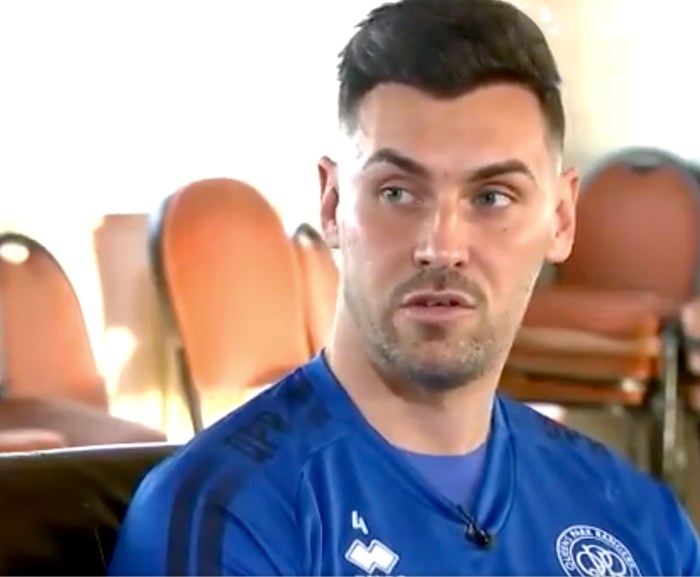
Andy Crosby enjoyed the taste of success with Brighton

ROCK-solid centre-half Andy Crosby won a Division 3 Championship medal with the Albion in 2001 before experiencing two frustrating near-miss seasons as captain of Oxford United.

Brighton’s achievement provided him with his first-ever promotion, but it didn’t turn out to be his last: he climbed out of the same division with Scunthorpe United and then, against all the odds, reached the Championship with the Iron – twice.

Micky Adams, who was a player at Leeds when Crosby was in their youth ranks, had been unsuccessful in trying to sign the defender when he was in charge of Brentford.
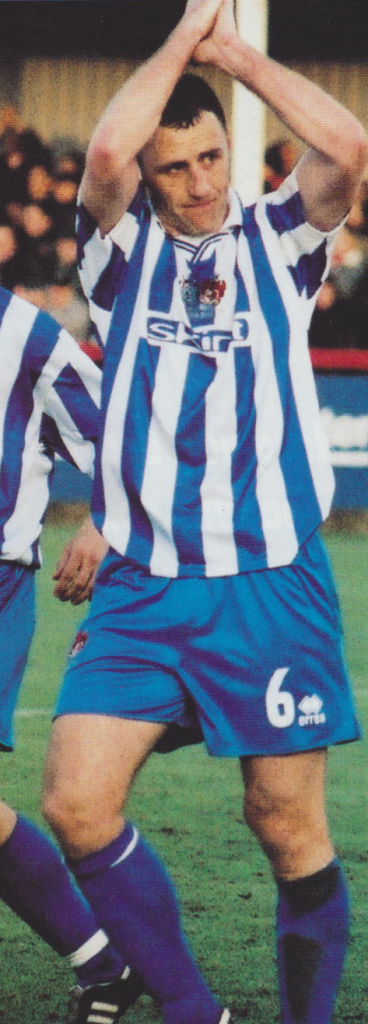
But as Adams set about building his first squad at the Albion, he managed to secure Crosby’s services for a £10,000 fee in the summer of 1999.

“I didn’t need any convincing at all to sign,” said Crosby. “It was good timing for me and it worked out fantastically well,” he told Richard Walker. “Sometimes it’s hard to see where you’re going when you’re just keeping your head down and working hard at a struggling club so the Albion did wonders for my career.”

In a matchday programme interview with Spencer Vignes, he added: “I couldn’t wait to sign. Even at that level, I still thought of them as a big club.

“My only reservations were that I’d never lived down south and that we’d just bought a house. We also had a one-year-old daughter. But in the end the pros outweighed the cons.”

The family moved into a house at Stone Cross, near Eastbourne, and Crosby made his debut (albeit with a broken toe!) in the 6-0 Withdean win over Mansfield (as featured in my recent blog post about Darren Freeman).

He developed an effective central defensive partnership with Danny Cullip, and he said: “Although we were very different characters away from the 90 minutes, something really clicked between us and everyone knows how vital it is to have a good centre-half pairing, just as much as a good front two working for each other.

“Our paths have crossed since, and the talk’s always of great memories from Brighton days.”

Hired as a stopper rather than a scorer, Crosby helpfully weighed in with five goals as Albion found their feet back in Sussex.

Then in the following season, Crosby was at the heart of the defence when Albion won the league. “That win down at Plymouth and the home game against Chesterfield where we sealed the Championship will stay with me forever,” he said. “It was just an amazing ride.”

Crosby continued: “We had this great spirit, a team desperate to do really well.
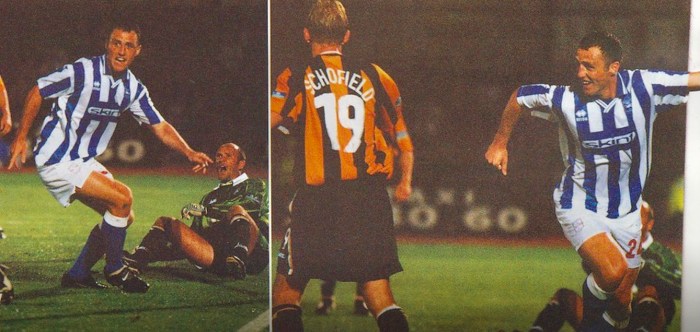
Pouncing to score and celebrate against future employer Hull City

“I’ve got nothing but good memories of the place. It was the first time I’d ever been involved in a promotion campaign as a player. For the first time in my life, I was seeing on a day-to-day basis what it takes to be successful.

“We played some great football and the fans were fantastic. I’ve said it before but if you can’t play for them you can’t play for anyone.”

He added: “Withdean was a funny place but somehow we were able to use it to our advantage. Other clubs didn’t like playing there.”
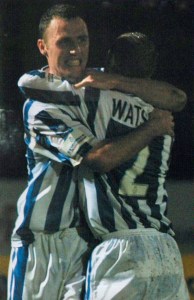
Getting to grips with Paul Watson

Once elevated to the higher level, Crosby lost his starting place to Simon Morgan and Adams’ successor Peter Taylor continued with Cullip and Morgan as his preferred centre-back pairing.

By then 28, Crosby didn’t fancy a watching brief and in December 2001 he moved on a free transfer to Oxford, the first United signing made by Ian Atkins. He said: “I didn’t want to go, and Peter said he wanted me to stay, but I wanted to play. Going to Oxford meant first team football.”

Although Crosby’s first half season with Oxford saw them struggle near the foot of the division, the 2002-03 campaign ended with them only a point off the play-off places and the central defender scored winning goals in four of the 53 matches he played.

It got better for him on a personal level the next season when his fellow pros named him in the 2003-04 PFA team of the year, but United missed out on the play-offs by three points.

Another string to Crosby’s bow at Oxford was being an accomplished penalty taker. He never missed a spot kick in normal play and, in 2003-04, one of the five he buried was at Scunthorpe’s Glanford Park.

In the summer of 2004, he declined a new contract believed to have been on worse terms than the previous one and chose to move back to the north to join Scunny.

Nonetheless, the Oxford Mail said of him: “The 31-year-old centre back has been a model of consistency in his time at the Kassam Stadium.

“Ideally suited to the Third Division with his uncompromising, no-nonsense style, the hard-tackling defender, who is also good in the air, was also greatly respected by his teammates for his cool professionalism.”

He may have started out in the basement division with Scunthorpe, but what followed was the stuff of dreams. Crosby himself later admitted: “When I joined, if someone had told me I’d be playing for Scunthorpe in the Championship, I would have called them a doctor.

“But it reaffirms your belief in football a little bit, especially when you’re involved first-hand, to see a club of Scunthorpe’s size still being able to pull off what was nothing short of a minor miracle.”

In an interview with the Scunny website, Crosby pointed out: “I was 31 when I arrived at Scunthorpe and I had to use my knowledge and experience in whatever capacity I could, and set standards on and off the pitch. It was something I enjoyed doing and I think it’s something that’s either in you or it’s not.

“My whole time at Scunthorpe was great and I never thought when I signed that we’d get to the Championship twice. It was fantastic and the highlight of my career without a shadow of a doubt.

“I was captain of a promotion-winning team from League One to the Championship, playing at some massive stadiums.”

Although knee injury issues limited him to nine appearances in the 2008-09 season, he was restored to the side for the play-offs and led Scunny to a 3-2 League One play-off final win over Millwall at Wembley in May 2009 (Matt Sparrow scored twice for Scunny).

“It was a great way to end playing,” he admitted. “I have some fantastic memories and look back at my time at the club with nothing but fondness.”

By then he had already been working as assistant manager to Nigel Adkins, the former Iron physio and after playing a total of 715 games for six league clubs he was also Adkins’ assistant manager at Southampton, Reading, Sheffield United, Hull City and Tranmere Rovers.

Crosby, who took over from Adkins as manager of League Two Tranmere in February 2025, said “I’ve got a fantastic relationship with Nigel. He’s been fantastic for me, changed me as a person and polished off a few of the rough edges. I’ve got nothing but great words to say about him.”
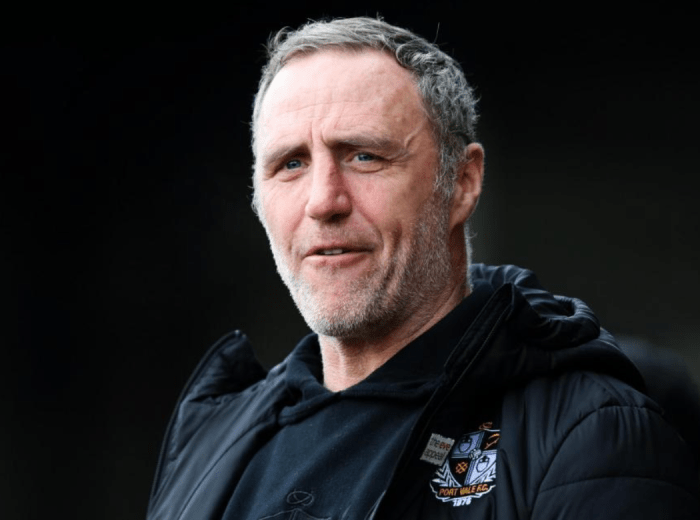
Into the manager’s chair

In an interview with tribalfootball.com, he said: “My coaching journey has been full of learning experiences, and I’m a much better coach now than when I started. I was fortunate to work with some fantastic players.

“My best experience was at Southampton, where we achieved back-to-back promotions from League One to the Premier League, working with incredible players like Lallana, Lambert, and Schneiderlin. Even the difficult moments teach you a lot, though. Results didn’t always go our way, but even then, those experiences helped me grow as a coach.”

Crosby also saw the development of the likes of Alex Oxlade-Chamberlain, James Ward-Prowse and Luke Shaw during nearly two and a half years at Southampton. While at Bramall Lane, he also worked with future England internationals Aaron Ramsdale and Dominic Calvert-Lewin.

Even at Hull, he had the fortune to work with Fikayo Tomori, on loan from Chelsea, and Jarrod Bowen.

Born in Rotherham on 3 March 1973, miner’s son Crosby was raised in the village of Maltby. He supported the Millers as a youngster but was rejected by them as a player when he was 11. At 14, though, he was taken on at Leeds.

When he didn’t progress beyond the youth team at Elland Road, former Leeds captain and manager Billy Bremner took him on at Doncaster Rovers and gave him his league debut aged 18.

He played 60 times for Donny over a couple of seasons (and spent a month on loan at Conference side Halifax) before moving to the north east and spending five years at Darlington, notching up a total of 211 appearances.

He was captain of the losing side in the 1996 Third Division play-off final at Wembley when Jim Platt’s Darlo lost by a single goal to Neil Warnock’s Plymouth Argyle.

Off-field financial issues marred his time at Chester City in the 1998-99 season, so his move to Brighton was a welcome change.

Reflecting on that time with the Seagulls, he said: “In any walk of life, if you get a really good group together, recruit well and get good characters in who complement each other well, then you should succeed. A lot of that was down to Micky.

“It was the fittest I’ve ever been – that was down to him – but that work and organisation brought its reward which is something I’ve taken with me into my own coaching career.”

Before his current (August 2025) position at Prenton Park, he also coached the Northern Ireland under 21 international side and spent three years coaching and managing at Port Vale.

Grant Hall owed second chance to mentor Danny Cullip

TALENTED defender Grant Hall has suffered plenty of slings and arrows in a career that might not have got off the ground but for the influence and encouragement of former Albion captain Danny Cullip.

When he got a second chance at Brighton, he seized it, made it to the first team, was signed by Tottenham Hotspur and is still playing tier two football more than 10 years later.

In one of those strange quirks of football, Neil Warnock, the manager who signed Cullip for Sheffield United, made Hall his first signing when he took charge at Middlesbrough.

Warnock infamously dumped Cullip within three months of signing him for the Blades but he was a lot more complimentary about Hall, who had faced his demons at one of Cullip’s old clubs, QPR.

“Grant is a smashing lad and I’m sure the fans will really take to him,” Warnock told Boro fans after signing him in July 2020.

Born in Brighton on 29 October 1991, Hall was with the Albion as a schoolboy but was released when he was 16. That’s when he went to play for non-league Lewes where Albion’s former captain was seeing out the remaining days of his career.

“He (Cullip) was a massive influence on me,” the young defender told Albion’s matchday programme. “Danny talked to me every time I played. He gave me advice on what to do and he never had a go at me, which might not have helped me as a youngster. He was always positive and encouraging me.

“He was a great pro when he was playing so was a great person to be mentored by.”

Together with input from another former pro, Anthony Barness, and manager Kevin Keehan, Hall said: “I felt their belief and that gave me confidence and I became a better player. They helped me so much; I owe a massive thanks to them.”

The changed Hall brought Albion’s director of football Martin Hinshelwood back to his door with an invitation to return to the club two years after he’d left.

Hall was part of a hugely successful development squad under youth team coach Luke Williams, and eventually made it to the first team, joining Gus Poyet’s squad for training over Christmas 2011.

Although a centre back by preference, his debut was at left-back as a second-half substitute for assistant manager Mauricio Taricco in a memorable New Year’s 3-0 win over 10-man Southampton at the Amex. Saints’ Rickie Lambert was shown a red card and Matt Sparrow scored two belting goals for the Albion.

“I’ve waited a long time but it’s a great feeling to have finally made my debut,” said Hall. “Obviously there were a few nerves as I was getting my shirt on but once you step onto the pitch you just block everything out.

“You are just so focused on your game that you can’t even hear the crowd but I really enjoyed the experience.”

Hall did well enough to be given his full debut the following Saturday in the FA Cup against Wrexham, although Poyet couched his words of praise carefully after the youngster put in a composed display, suggesting certain representations on Hall’s behalf were not welcome.

“I would stay calm if I was anyone connected to Grant,” he said. “He played for half-an-hour against Southampton when we were eleven v ten, and then 90 minutes against Wrexham, with all respect to Wrexham, so we’ll see.”

Albion fans liked what they saw though, with correspondent ‘4everaseagull’ saying on the Argus discussion forum: “Hall’s performance was very assured against Wrexham and he looked very comfortable. For me he was MoM. He didn’t miss a header all game, and his positional play and passing were excellent. It really showed how important it is for all the respective teams at the club to play the same way. Feet on the ground for Hall but what a great prospect.”

Hall played alongside versatile Frenchman Romain Vincelot against the Welsh Conference side but there was plenty of competition at centre back with captain Gordon Greer usually featuring alongside Adam El-Abd, and a rookie Lewis Dunk beginning to emerge. Steve Cook, also 20, had returned from a loan spell at Bournemouth to help out during an injury crisis but he soon departed to Dean Court on a permanent basis, joining Tommy Elphick whose own Albion progress had been blighted by a serious injury.

Whatever had narked Poyet in January resurfaced when Hall rejected a three-year deal offered by Albion before his contract expired at the end of June. Hall chose to join Spurs instead, although Poyet was baffled and, in a convoluted but contorted way, went public with his criticism of the youngster’s move.

“The only disappointing side with Grant Hall is that what he told us was the reason for not signing a contract was not true,” Poyet told the Argus. “He didn’t accept our contract for a reason but that reason is not happening.

“There was a clear reason he gave us as to why he did not want to stay here. I know what he said and it’s not happening, so it’s disappointing, no doubt.”

Albion clearly felt Hall had a future, and with the seven substitutes rule coming in it was felt his chances of being involved in the first team squad were pretty good.

Nevertheless, Poyet added: “Sometimes we try to advise players knowing the game, but my point of view is probably not the same as the player’s point of view. I just wish him well. I hope he can make it and can be playing at the highest level.

“I am not against him. He made a decision, nothing else, but I think it’s important to know the reason.”

While Hall went straight into Tottenham’s academy team and made his debut in a 2-1 friendly victory over Kingstonian, Albion began a drawn out wrangle over compensation, which was due because Hall was still under 24.

It wasn’t until the following January that Albion finally reached an undisclosed settlement with Spurs to prevent it going to a tribunal.

Hall featured in Spurs’ under 21 side from the start of the 2012-13 season but in three years on their books, he didn’t make a first team appearance. He had three loan spells away from White Hart Lane – at League One Swindon Town under the aforementioned Luke Williams – and at Birmingham City and Blackpool, both in the Championship.

In 2015 he made a permanent move to Queens Park Rangers, signed by former Albion full-back Chris Ramsey who had coached him at Tottenham.

“He’s an old-fashioned defender who can head the ball, tackle and he doesn’t mind putting his foot in when he needs to,” said Ramsey. “But he can play as well from the back, and that’s what we’ll be looking to do when the opportunities present themselves this season.

“He’s still a young boy and centre-half is a very responsible position, but he’s got experience in the Championship and that’s vitally important for us.”

Hall won the supporters’ Player of the Year award in his first season but suffered a serious knee injury towards the end of the 2016-17 season.

He started drinking heavily because he couldn’t cope with the pain of tendonitis in his knee, and two years later spoke out about the mental health issues he went through.

Hall encouraged others to talk about such problems in the way he did after he broke down in a meeting with QPR director of football Les Ferdinand and then manager Steve McLaren.

Ferdinand put him in touch with the Professional Footballers’ Association and he was able to understand that it was OK to speak about his issues.

“I had a really good conversation with them and they helped me understand that it’s okay to speak about your mental health. No-one is going to judge you for it and opening up about your mental well-being is a strength and not a weakness,” he told qpr.co.uk. “It was exactly what I needed. It felt like a huge release, a weight off of my shoulders and it allowed me to re-focus and start to look after myself again.”

Explaining how things unravelled, Hall said: “I went from a place where life was perfect, I had a great relationship with the QPR supporters and everything was going right on and off the pitch. Then all of a sudden everything seemed to come crashing down. It was a huge reality check for me and I now realise that you can never anticipate what is around the corner in life.”

Hall managed to turn that corner and worked hard to restore his fitness to the extent that he featured in 30 matches during the 2019-20 season. “Deep down it’s just a relief for me to be playing football again,” he said.

But after 128 appearances across five years at Loftus Road, where he had become club captain, he was unable to agree a new contract with QPR in the summer of 2020 and upped sticks at the age of 28 to become Warnock’s first signing at Middlesbrough.

“I’ve known Grant for a few years now,” said Warnock. “Everyone knows I’m looking at the spine of the team, and he’s the right fit for what we need.”

Unfortunately, not for the first time in his career, injury sidelined him for several of those early months on Teesside but on his return he proved a bright spot in a disappointing second half of the season.

“It’s been a massive plus because I didn’t personally think he’d be able to come back like he has, if I’m totally honest,” Warnock told Craig Johns, of gazettelive.co.uk. “I was worried he’d put a bit of weight on and I couldn’t see enough mobility.

“And yet he’s proven me entirely wrong. He’s come back fitness-wise better than I’ve ever seen him and he’s using his experience at the back for us to the point where he’s been a breath of fresh air for us.”

Warnock also told the reporter: “The thing I’ve been most impressed with, more than his heading or his contribution in that respect, has been his reading of the game against quick players. You would probably question how he would get on against a quick player, but he’s just revelled in it really.

“His quickness of thought has put him a long way ahead of some of these quick strikers that he’s been playing against. That’s what I’ve been pleased with more than anything.

“I always know he’ll chip in with an odd goal here and there, but his reading of the game has been outstanding.”

After Warnock’s departure, Hall was on the outside looking in under Chris Wilder although the new manager sought to give him public encouragement by saying he could still have a role to play. “He’s had a couple of little issues but he is back involved now and back part of the group,” he told gazettelive.co.uk. “Grant has an important role to play between now and the end of the season,” he said. “I think they all know they have to be ready when called upon.”

In July 2022, it was announced Hall was joining newly-promoted Championship side Rotherham United on a season-long loan.